


Beth Granter – Digital Leap Date 28 October 2009 Online Community Mediation Training
Ecology http://www.flickr.com/photos/brianscott/1382977476/
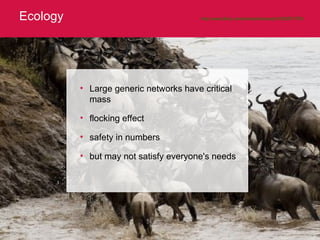
Ecology http://www.flickr.com/photos/brianscott/1382977476/   Large generic networks have critical mass flocking effect safety in numbers but may not satisfy everyone's needs
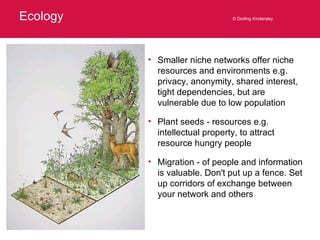
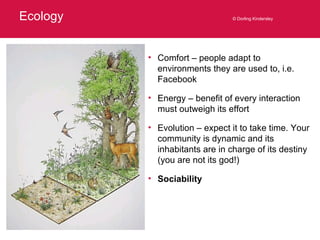
Ecology © Dorling Kindersley Smaller niche networks offer niche resources and environments e.g. privacy, anonymity, shared interest, tight dependencies, but are vulnerable due to low population Plant seeds - resources e.g. intellectual property, to attract resource hungry people Migration - of people and information is valuable. Don't put up a fence. Set up corridors of exchange between your network and others
Ecology © Dorling Kindersley Comfort – people adapt to environments they are used to, i.e. Facebook Energy – benefit of every interaction must outweigh its effort Evolution – expect it to take time. Your community is dynamic and its inhabitants are in charge of its destiny (you are not its god!) Sociability
To build or not to build? Stolen from t’interweb. Sorry.
To build or not to build? Consider the global audience  how many are  already  interested in discussing the main topic?  How many people  potentially  might want to? How much energy are people likely to put into your project? How much passion do people have about the topic? Do you need to run a separate awareness raising campaign to boost initial interest? Read 7 Harsh Truths About Running Online Communities  http://boagworld.com/site-content/7-harsh-truths-about-running-online-communities
Communication: conversation http://www.flickr.com/photos/assbach/262165233/
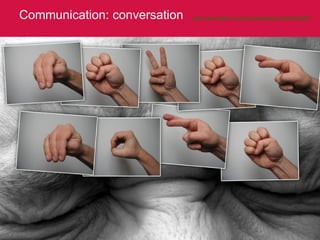
Communication: conversation http://www.flickr.com/photos/assbach/262165233/   Offline traditional media is unidirectional – from organisations to citizens Face-to-face cues which aide communication offline: Body language Gestures Facial expression Tone of voice Any others? What are the online equivalents?
Communication: conversation http://www.flickr.com/photos/assbach/262165233/   Modern online communication is multidirectional – From citizen to citizen to organisation to citizen Online methods of communicating intent CAPITALISATION Punctuation! ‘ Tone of voice’ (should be very different to traditional marketing copy or emails – don't just put your press release on your forum) Smilies :)
Identity http://www.flickr.com/photos/belljar/108664273/
Identity http://www.flickr.com/photos/belljar/108664273/   Offline Physical appearance, clothes, hairstyle How you introduce yourself  Where you spend your time Who you spend your time with Accent How your identity is perceived by others based on the above is not always your choice, e.g. gender, age, social class, dis/ability, religion, race, nationality, sexual orientation
Identity http://www.flickr.com/photos/belljar/108664273/   Online Avatar Username Profile information Profile design Group membership/associations
Identity http://www.flickr.com/photos/belljar/108664273/   What fields do you ask people to complete on your social network?  What do you make mandatory?  Are they restrictive or do they provide opportunities to help people express their online identity?  How much personalisation is allowed for self expression? Active, (public?) self definition -> solidification of identity -> acceptance?  Teenage reinvention.
Identity http://www.flickr.com/photos/belljar/108664273/   Individualism and Social Capital in an Online Social Networking Community: ‘MySpace’ as an organising site for Identity Construction The valorising of individuality in Western society, which is exaggerated in youth culture, has been described as ‘a cult of individualism’ (Atkinson, 2006).  Indicators of such traits may function as commodities in social settings, which in turn could earn social status, increasing social capital (Allik, 2004).  Perceived autonomy of an individual by others is related to the opportunities for social and community involvement they experience (Allik, 2004).  http://bethgranter.com/blog/2006/04/individualism-and-social-capital-in-an-online-social-networking-community-%E2%80%98myspace%E2%80%99-as-an-organising-site-for-identity-construction/
Value http://www.flickr.com/photos/dislocations/1348895033/
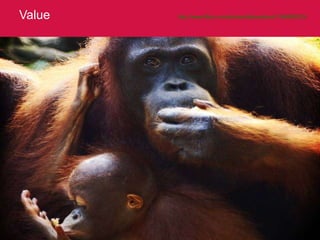
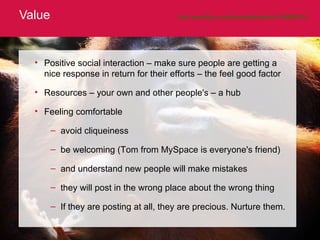
Value http://www.flickr.com/photos/dislocations/1348895033/   Positive social interaction – make sure people are getting a nice response in return for their efforts – the feel good factor Resources – your own and other people's – a hub Feeling comfortable  avoid cliqueiness be welcoming (Tom from MySpace is everyone's friend)  and understand new people will make mistakes they will post in the wrong place about the wrong thing If they are posting at all, they are precious. Nurture them.
Value http://www.flickr.com/photos/dislocations/1348895033/   Provide opportunities for people to gain social capital.  Friend lists Badges Awards Roles “ Everybody builds  social   capital individually  by improving each others’  knowledge   capital collaboratively ”  The Art of Hosting Good Conversations Online - Howard Rheingold
Community moderators http://www.flickr.com/photos/brianlewandowski/49474359/
Community moderators http://www.flickr.com/photos/brianlewandowski/49474359/   “ A host is like a host at a party. You don't automatically throw a great party by hiring a room and buying some beer. Someone needs to invite an interesting mix of people, greet people at the door, make introductions, start conversations, avert fisticuffs, encourage people to let their hair down and entertain each other.”  Rheingold
Community moderators http://www.flickr.com/photos/brianlewandowski/49474359/   Must understand the  purpose  of the community Moderate Facilitate Host Referee A ‘conversation convener’ Pick a welcoming collective name!
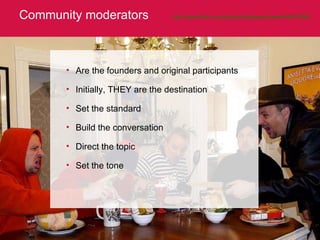
Community moderators http://www.flickr.com/photos/brianlewandowski/49474359/   Are the founders and original participants Initially, THEY are the destination Set the standard Build the conversation Direct the topic Set the tone
What you want people to do http://www.flickr.com/photos/ginable/325235488/
What you want people to do http://www.flickr.com/photos/ginable/325235488/   Log in regularly Talk amongst themselves Talk to you Discuss Debate (contentious issues are helpful) Banter Inform
What you want people to do http://www.flickr.com/photos/ginable/325235488/   Connect With people with shared values This is the purpose The essential shared value of the community should be the same ideal that the campaign is working towards
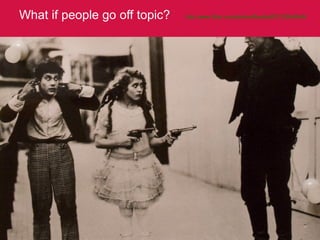
What if people go off topic? http://www.flickr.com/photos/floodkoff/2122644649/
What if people go off topic? http://www.flickr.com/photos/floodkoff/2122644649/   Don’t be too strict  Encourage experimentation It's healthy for the conversation to develop in ways you couldn't predict Don't forget – you don't own the conversation just because you own the site
How to host http://www.flickr.com/photos/eek/16295395/
How to host http://www.flickr.com/photos/eek/16295395/   Active participation Ask questions Answer questions Give opinions Thank people for contributing Thank people for joining Make suggestions Provide crosslinks
Volume http://www.flickr.com/photos/hebe/251592918/
Volume http://www.flickr.com/photos/hebe/251592918/   Consider volume Remember it’s not all about you! Listen to the mood Encourage lurkers to speak up and join in Don’t be too cliquey
Recycle, tend and prune http://www.flickr.com/photos/jenny-pics/3403451061
Recycle, tend and prune http://www.flickr.com/photos/jenny-pics/3403451061 Recycle - old useful conversations can add value Tend welcome consider an introductions area look out for first time contributors and say hello and thanks build a community of hosts and communicate Prune - retire obsolete sections… with notice
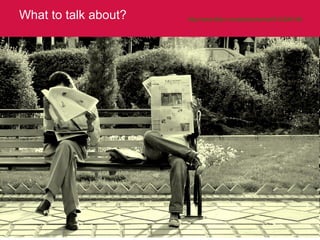
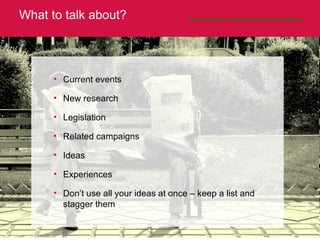
What to talk about? http://www.flickr.com/photos/hamed/512309138/
What to talk about? http://www.flickr.com/photos/hamed/512309138/   Current events New research Legislation Related campaigns Ideas Experiences Don’t use all your ideas at once – keep a list and stagger them
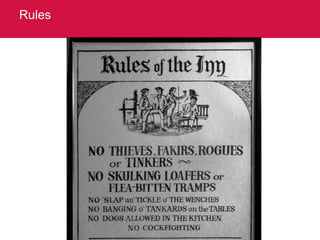
Rules
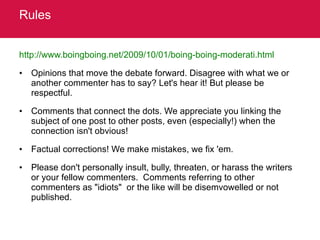
Rules http://www.boingboing.net/2009/10/01/boing-boing-moderati.html   Opinions that move the debate forward. Disagree with what we or another commenter has to say? Let's hear it! But please be respectful.  Comments that connect the dots. We appreciate you linking the subject of one post to other posts, even (especially!) when the connection isn't obvious!  Factual corrections! We make mistakes, we fix 'em.  Please don't personally insult, bully, threaten, or harass the writers or your fellow commenters.  Comments referring to other commenters as "idiots"  or the like will be disemvowelled or not published.
Rules
Rules Will be questioned Segment rule questioning so it doesn’t take over May be circumvented via Inference Innuendo Ambiguity Innocent postings may be misinterpreted
Rules Be direct and respectful Ask for clarification Remind people of the rules Be consistent Provide a process for democratic decision making
Sharing responsibility http://www.flickr.com/photos/ryanr/142455033/
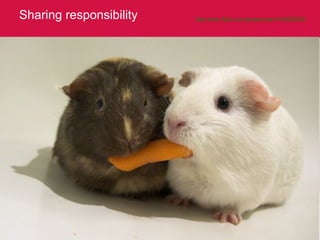
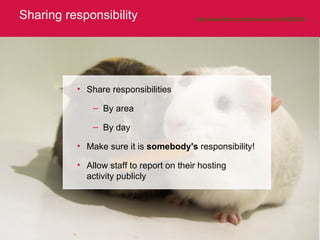
Sharing responsibility http://www.flickr.com/photos/ryanr/142455033/   Share responsibilities By area By day Make sure it is  somebody's  responsibility! Allow staff to report on their hosting activity publicly
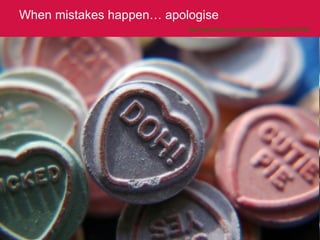
When mistakes happen… apologise http://www.flickr.com/photos/alltheaces/673008768/
Sustainability http://www.flickr.com/photos/heartindustry/1007082351/
Sustainability http://www.flickr.com/photos/heartindustry/1007082351/   Good hosting is contagious You are modelling civil discourse The early crowd influences late arrivals
The End The end Date 28 October 2009 p.s. some of my favourite moderation links: http://delicious.com/bethgranter/moderation

Community Moderation; best practice

  • 1.
    Beth Granter –Digital Leap Date 28 October 2009 Online Community Mediation Training
  • 2.
  • 3.
    Ecology http://www.flickr.com/photos/brianscott/1382977476/ Large generic networks have critical mass flocking effect safety in numbers but may not satisfy everyone's needs
  • 4.
    Ecology © DorlingKindersley Smaller niche networks offer niche resources and environments e.g. privacy, anonymity, shared interest, tight dependencies, but are vulnerable due to low population Plant seeds - resources e.g. intellectual property, to attract resource hungry people Migration - of people and information is valuable. Don't put up a fence. Set up corridors of exchange between your network and others
  • 5.
    Ecology © DorlingKindersley Comfort – people adapt to environments they are used to, i.e. Facebook Energy – benefit of every interaction must outweigh its effort Evolution – expect it to take time. Your community is dynamic and its inhabitants are in charge of its destiny (you are not its god!) Sociability
  • 6.
    To build ornot to build? Stolen from t’interweb. Sorry.
  • 7.
    To build ornot to build? Consider the global audience how many are already interested in discussing the main topic? How many people potentially might want to? How much energy are people likely to put into your project? How much passion do people have about the topic? Do you need to run a separate awareness raising campaign to boost initial interest? Read 7 Harsh Truths About Running Online Communities http://boagworld.com/site-content/7-harsh-truths-about-running-online-communities
  • 8.
  • 9.
    Communication: conversation http://www.flickr.com/photos/assbach/262165233/ Offline traditional media is unidirectional – from organisations to citizens Face-to-face cues which aide communication offline: Body language Gestures Facial expression Tone of voice Any others? What are the online equivalents?
  • 10.
    Communication: conversation http://www.flickr.com/photos/assbach/262165233/ Modern online communication is multidirectional – From citizen to citizen to organisation to citizen Online methods of communicating intent CAPITALISATION Punctuation! ‘ Tone of voice’ (should be very different to traditional marketing copy or emails – don't just put your press release on your forum) Smilies :)
  • 11.
  • 12.
    Identity http://www.flickr.com/photos/belljar/108664273/ Offline Physical appearance, clothes, hairstyle How you introduce yourself Where you spend your time Who you spend your time with Accent How your identity is perceived by others based on the above is not always your choice, e.g. gender, age, social class, dis/ability, religion, race, nationality, sexual orientation
  • 13.
    Identity http://www.flickr.com/photos/belljar/108664273/ Online Avatar Username Profile information Profile design Group membership/associations
  • 14.
    Identity http://www.flickr.com/photos/belljar/108664273/ What fields do you ask people to complete on your social network? What do you make mandatory? Are they restrictive or do they provide opportunities to help people express their online identity? How much personalisation is allowed for self expression? Active, (public?) self definition -> solidification of identity -> acceptance? Teenage reinvention.
  • 15.
    Identity http://www.flickr.com/photos/belljar/108664273/ Individualism and Social Capital in an Online Social Networking Community: ‘MySpace’ as an organising site for Identity Construction The valorising of individuality in Western society, which is exaggerated in youth culture, has been described as ‘a cult of individualism’ (Atkinson, 2006). Indicators of such traits may function as commodities in social settings, which in turn could earn social status, increasing social capital (Allik, 2004). Perceived autonomy of an individual by others is related to the opportunities for social and community involvement they experience (Allik, 2004). http://bethgranter.com/blog/2006/04/individualism-and-social-capital-in-an-online-social-networking-community-%E2%80%98myspace%E2%80%99-as-an-organising-site-for-identity-construction/
  • 16.
  • 17.
    Value http://www.flickr.com/photos/dislocations/1348895033/ Positive social interaction – make sure people are getting a nice response in return for their efforts – the feel good factor Resources – your own and other people's – a hub Feeling comfortable avoid cliqueiness be welcoming (Tom from MySpace is everyone's friend) and understand new people will make mistakes they will post in the wrong place about the wrong thing If they are posting at all, they are precious. Nurture them.
  • 18.
    Value http://www.flickr.com/photos/dislocations/1348895033/ Provide opportunities for people to gain social capital. Friend lists Badges Awards Roles “ Everybody builds social capital individually by improving each others’ knowledge capital collaboratively ” The Art of Hosting Good Conversations Online - Howard Rheingold
  • 19.
  • 20.
    Community moderators http://www.flickr.com/photos/brianlewandowski/49474359/ “ A host is like a host at a party. You don't automatically throw a great party by hiring a room and buying some beer. Someone needs to invite an interesting mix of people, greet people at the door, make introductions, start conversations, avert fisticuffs, encourage people to let their hair down and entertain each other.” Rheingold
  • 21.
    Community moderators http://www.flickr.com/photos/brianlewandowski/49474359/ Must understand the purpose of the community Moderate Facilitate Host Referee A ‘conversation convener’ Pick a welcoming collective name!
  • 22.
    Community moderators http://www.flickr.com/photos/brianlewandowski/49474359/ Are the founders and original participants Initially, THEY are the destination Set the standard Build the conversation Direct the topic Set the tone
  • 23.
    What you wantpeople to do http://www.flickr.com/photos/ginable/325235488/
  • 24.
    What you wantpeople to do http://www.flickr.com/photos/ginable/325235488/ Log in regularly Talk amongst themselves Talk to you Discuss Debate (contentious issues are helpful) Banter Inform
  • 25.
    What you wantpeople to do http://www.flickr.com/photos/ginable/325235488/ Connect With people with shared values This is the purpose The essential shared value of the community should be the same ideal that the campaign is working towards
  • 26.
    What if peoplego off topic? http://www.flickr.com/photos/floodkoff/2122644649/
  • 27.
    What if peoplego off topic? http://www.flickr.com/photos/floodkoff/2122644649/ Don’t be too strict Encourage experimentation It's healthy for the conversation to develop in ways you couldn't predict Don't forget – you don't own the conversation just because you own the site
  • 28.
    How to hosthttp://www.flickr.com/photos/eek/16295395/
  • 29.
    How to hosthttp://www.flickr.com/photos/eek/16295395/ Active participation Ask questions Answer questions Give opinions Thank people for contributing Thank people for joining Make suggestions Provide crosslinks
  • 30.
  • 31.
    Volume http://www.flickr.com/photos/hebe/251592918/ Consider volume Remember it’s not all about you! Listen to the mood Encourage lurkers to speak up and join in Don’t be too cliquey
  • 32.
    Recycle, tend andprune http://www.flickr.com/photos/jenny-pics/3403451061
  • 33.
    Recycle, tend andprune http://www.flickr.com/photos/jenny-pics/3403451061 Recycle - old useful conversations can add value Tend welcome consider an introductions area look out for first time contributors and say hello and thanks build a community of hosts and communicate Prune - retire obsolete sections… with notice
  • 34.
    What to talkabout? http://www.flickr.com/photos/hamed/512309138/
  • 35.
    What to talkabout? http://www.flickr.com/photos/hamed/512309138/ Current events New research Legislation Related campaigns Ideas Experiences Don’t use all your ideas at once – keep a list and stagger them
  • 36.
  • 37.
    Rules http://www.boingboing.net/2009/10/01/boing-boing-moderati.html Opinions that move the debate forward. Disagree with what we or another commenter has to say? Let's hear it! But please be respectful. Comments that connect the dots. We appreciate you linking the subject of one post to other posts, even (especially!) when the connection isn't obvious! Factual corrections! We make mistakes, we fix 'em. Please don't personally insult, bully, threaten, or harass the writers or your fellow commenters.  Comments referring to other commenters as "idiots"  or the like will be disemvowelled or not published.
  • 38.
  • 39.
    Rules Will bequestioned Segment rule questioning so it doesn’t take over May be circumvented via Inference Innuendo Ambiguity Innocent postings may be misinterpreted
  • 40.
    Rules Be directand respectful Ask for clarification Remind people of the rules Be consistent Provide a process for democratic decision making
  • 41.
  • 42.
    Sharing responsibility http://www.flickr.com/photos/ryanr/142455033/ Share responsibilities By area By day Make sure it is somebody's responsibility! Allow staff to report on their hosting activity publicly
  • 43.
    When mistakes happen…apologise http://www.flickr.com/photos/alltheaces/673008768/
  • 44.
  • 45.
    Sustainability http://www.flickr.com/photos/heartindustry/1007082351/ Good hosting is contagious You are modelling civil discourse The early crowd influences late arrivals
  • 46.
    The End Theend Date 28 October 2009 p.s. some of my favourite moderation links: http://delicious.com/bethgranter/moderation