













Community Management Fundamentals
Who are We? www.community-roundtable.com Megan Smith Community Manager Ovation TV @mightymegasaur  Rachel Happe Principal & Co-Founder The Community Roundtable @rhappe @TheCR
What is Community?
Community is  NOT
 
Community  IS
 
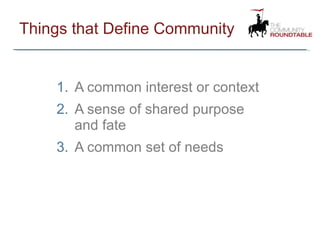
Things that Define Community A common interest or context A sense of shared purpose and fate A common set of needs
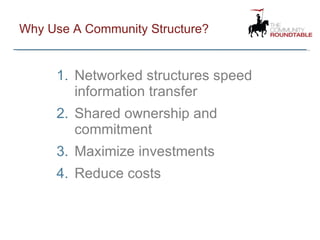
Why Use A Community Structure? Networked structures speed information transfer Shared ownership and commitment  Maximize investments Reduce costs
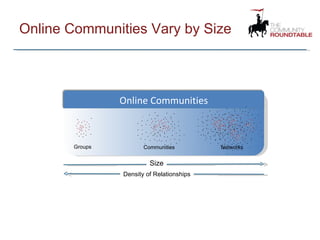
Online Communities Vary by Size Online Communities Size Density of Relationships Groups Communities Networks
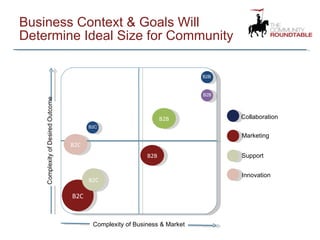
Business Context & Goals Will Determine Ideal Size for Community Complexity of Business & Market B2C B2B B2C Marketing Support Innovation Collaboration B2C B2C B2B B2B B2B
What is Community Management?
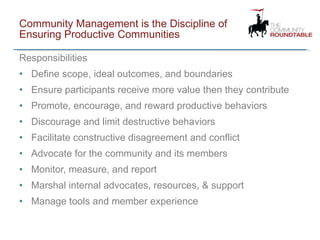
Community Management is the Discipline of Ensuring Productive Communities Responsibilities Define scope, ideal outcomes, and boundaries Ensure participants receive more value then they contribute Promote, encourage, and reward productive behaviors Discourage and limit destructive behaviors Facilitate constructive disagreement and conflict  Advocate for the community and its members Monitor, measure, and report Marshal internal advocates, resources, & support Manage tools and member experience
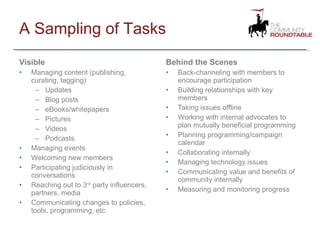
A Sampling of Tasks Visible Managing content (publishing, curating, tagging) Updates Blog posts eBooks/whitepapers Pictures Videos Podcasts Managing events Welcoming new members Participating judiciously in conversations Reaching out to 3 rd  party influencers, partners, media Communicating changes to policies, tools, programming, etc Behind the Scenes Back-channeling with members to encourage participation Building relationships with key members Taking issues offline Working with internal advocates to plan mutually beneficial programming Planning programming/campaign calendar Collaborating internally  Managing technology issues Communicating value and benefits of community internally Measuring and monitoring progress
What Are the Risks of Not Having  Community Management?
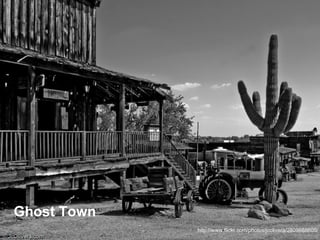
http://www.flickr.com/photos/jcolivera/2809988605/ Ghost Town
http://www.flickr.com/photos/pedjap/74410434/ Land of 1,000 Flowers
http://www.flickr.com/photos/thomasfordmemoriallibrary/3467799183/ Drama Central
http://www.flickr.com/photos/gordontarpley/1481380410/ A Circling Storm
http://www.flickr.com/photos/swirlingthoughts/162016762/ A Clique
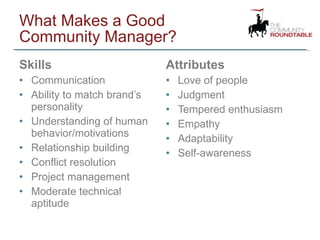
What Makes a Good Community Manager? Skills Communication Ability to match brand’s personality Understanding of human behavior/motivations Relationship building Conflict resolution Project management Moderate technical aptitude Attributes Love of people Judgment Tempered enthusiasm Empathy Adaptability Self-awareness
How Do You Build a Thriving Community?
http://www.flickr.com/photos/machineproject/5162106562/ Observe Your Audience
Schedule http://www.flickr.com/photos/vidiot/61484953/ Keep A Regular Schedule
Image http://www.flickr.com/photos/mfakheri/2815755503/ Be Valuable
http://www.flickr.com/photos/pandemia/1286794844/ Be Notable
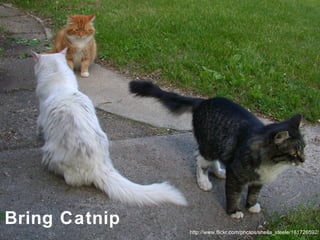
http://www.flickr.com/photos/sheila_steele/161726592/ Bring Catnip
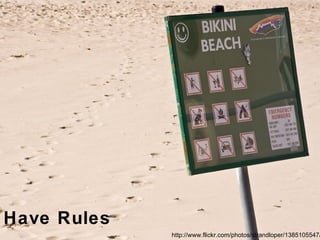
Have Rules http://www.flickr.com/photos/strandloper/1385105547/
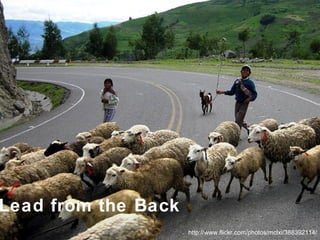
Distributed http://www.flickr.com/photos/mclxi/388392114/ Lead from the Back
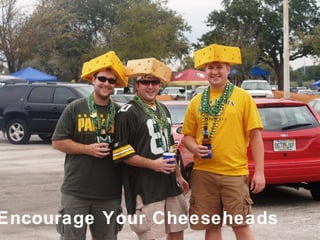
Encourage Your Cheeseheads
Ride The Waves http://www.flickr.com/photos/tk_five_0/2279894817/
http://www.flickr.com/photos/jfchenier/2409726404/ Don’t Ignore
Text http://www.flickr.com/photos/cecilanne_r-s/3541646602/ Be Multi-Modal
http://www.flickr.com/photos/islespunkfan/2746157133/ Protect the Fish
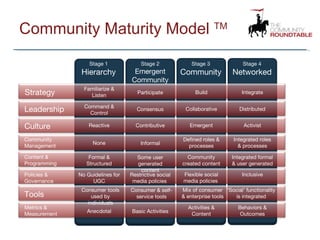
Community Maturity Model  TM Strategy Leadership Culture Community Management Content & Programming Policies & Governance Tools Metrics & Measurement Stage 1 Hierarchy Stage 2 Emergent Community Stage 3 Community Stage 4 Networked Familiarize & Listen Command & Control Reactive None Formal & Structured No Guidelines for UGC Consumer tools used by individuals Anecdotal Participate Consensus Contributive Informal Some user generated content Restrictive social media policies  Consumer & self-service tools Basic Activities Build Collaborative Emergent Defined roles & processes Community created content Flexible social media policies  Mix of consumer & enterprise tools Activities & Content Integrate Distributed Activist Integrated roles & processes Integrated formal & user generated Inclusive ‘ Social’ functionality is integrated Behaviors & Outcomes
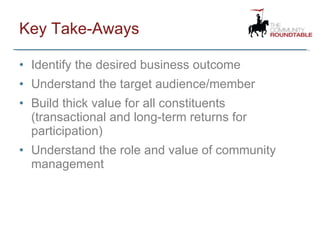
Key Take-Aways Identify the desired business outcome Understand the target audience/member Build thick value for all constituents (transactional and long-term returns for participation) Understand the role and value of community management
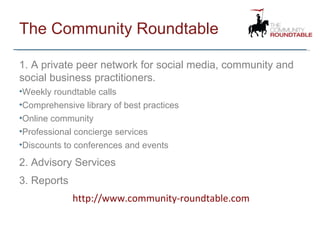
The Community Roundtable 1. A private peer network for social media, community and social business practitioners. Weekly roundtable calls Comprehensive library of best practices Online community Professional concierge services Discounts to conferences and events 2. Advisory Services 3. Reports http://www.community-roundtable.com
Thank You Download our latest report: The State of Community Management  http://www.community-roundtable.com/socm-2010

Community Management Fundamentals

Editor's Notes

  • #2 We are here to talk about community management – what it is, why you need it, and what are some of the fundamental tenets of the discipline.
  • #3 I’m Rachel Happe, background in management consulting, software, and as an analyst. In 2009, my partner Jim Storer and I saw a need in the market to better articulate the management concepts required for success in using social software effectively. We started The Community Roundtable to connect practitioners who are somewhat isolated, share and document best practices, and educate people about the discipline of community management. Megan Smith, the Community Manager from OvationTV is here to join me and share a front lines perspective and give you a more intimate view of the day-to-day realities of being a community manager.
  • #8 There is an overwhelming amount of conversation about the tools and the content – and both are important and critical. However, the reason social software is so compelling is that it draws people back because of the relationships. It is really important to not loose site of that. If you create a social initiative constructed with relationships at its core, it will be far more sustainable than one that puts the tools or content at its core. People can easily ignore tools and content but have a much harder time ignoring people.
  • #9 People need a connection in order to form a relationship and the more relevant and urgent their need, the faster that connection will form. As marketers looking to create engagement, it is really important to think about your target audience and their interests/needs and make your initiative focus on that. For most companies and brands, building a community about a product won’t work so well. Examples: Rubbermaid – professional organizers, home organization Fiskaters – crafts GHY – Internal trade issues Aetna/Humana – fitness/health H&R Block – tax advice Exceptions: Palladium Group – Balanced Scorecard SAP - SDN Newell Rubbermaid – Sharpies
  • #10 Comes down to cost/benefit. Transactional processes are one-to-one, hierarchical processes are one-to-many, and networked processes are many-to-many. Along with hard costs, they also drive long term loyalty and retention because participants are more invested if done well, however that can only have if the organization is willing to share control.
  • #11 I think of any collection of people created by social software as a community. However, there are really big differences in scale between different online communities and it’s important to understand the scale that will serve your needs the best because they act very differently.
  • #12 For purposes of illustration, I made some gross assumptions to point out that different size communities work best for different business contexts and desired outcomes. Linking the desired biz outcome to size and density of the online community is critical and will also allow you to better focus on the tools, resources, content, and metrics required to support the goal.
  • #14 Community management is, at a fundamental level, a job for generalists who can orchestrate the right resources, skills, tone, and talent that establishes the environment in which community will take hold. Relevant and fun.
  • #17 No one shows up and/or there is no engagement
  • #18 People are initially very enthusiastic and everyone creates groups or content – some of which is relevant but a lot of which is duplicate or random making it hard for people over time to find useful connections and content and usage drops off.
  • #19 You’ve created a place for people to vent… and they do, in volume. Turns off people who might otherwise use the environment more productively
  • #20 Communities can attract the disenfranchised, the disgruntled, the socially awkward because they have worn out their welcome with individuals and yet, they need social interaction. These people can cause trouble of various types over time and be very persistent. If there are legitimate issues and/or others like them, they can create really big problems over time that are hard to recover from.
  • #21 One set of members becomes much stronger than the others and eventually takes over which creates a huge social barrier to entry for other groups.
  • #22 Skills, Attributes, Experience (Program management, Marketing programs, product manager). Person needs to understand people and business to do this job effectively – lots of internal relationships also helps.
  • #24 An interest and talent in observing behavior is quite helpful. Someone that intuitively understands the social dynamic is incredibly useful.
  • #25 Have regularly scheduled events – cadence is important. Cadence sets the expectation and models behavior for members – if you want people coming back daily, you need to have something valuable going on every day.
  • #26 Make it valuable (contextual/relevant) – why will they return if it is not? The more complex the target behavior, the more valuable you need the community to be.
  • #27 Give them a reason to come and socialize – and then share the experience with colleagues/friends.
  • #28 What are the handful of things that will keep your audience/members coming back? Celebrities? Games? Experts? Tools?
  • #29 Rules codify the culture you would like to promote and set the expectations for behavior. Useful to document things you want to encourage as well as things that are not acceptable.
  • #30 Animals and people cannot be lead from the front without force. Creating boundary conditions and encouraging certain behaviors is typically a less invasive and more enjoyable experience for people.
  • #31 Identify the individuals in your community who are most enthusiastic and supportive. Give them tools, special access, and air time because they pull in others, rally the troops, and give your community a sense of soul.
  • #32 Really hard to create enough energy to build a wave, much more effective and efficient to ride existing waves. Link initiatives to community hot topics. Harder to plan for with specifics but more efficient.
  • #33 Most problems/issues don’t go away however, also really important have the judgment to understand which issues and how to respond to them.
  • #34 Be Multi-modal: Text, images, video; Asynchronous, Synchronous
  • #35 Once a certain type of person is aggregated, there are lots of others who will want to use the community as a channel for their own interests. Important to protect members in a way that allows other 3 rd parties to participate.
  • #39 Q1 -