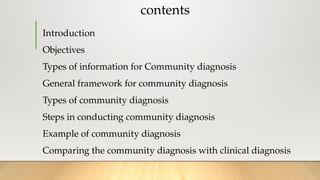
contents
Introduction
Objectives
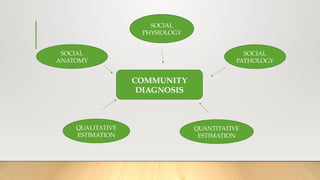
Types of informationfor Community diagnosis
General framework for community diagnosis
Types of community diagnosis
Steps in conducting community diagnosis
Example of community diagnosis
Comparing the community diagnosis with clinical diagnosis
3.
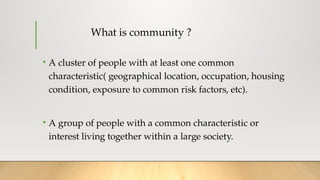
What is community?
• A cluster of people with at least one common
characteristic( geographical location, occupation, housing
condition, exposure to common risk factors, etc).
• A group of people with a common characteristic or
interest living together within a large society.
4.
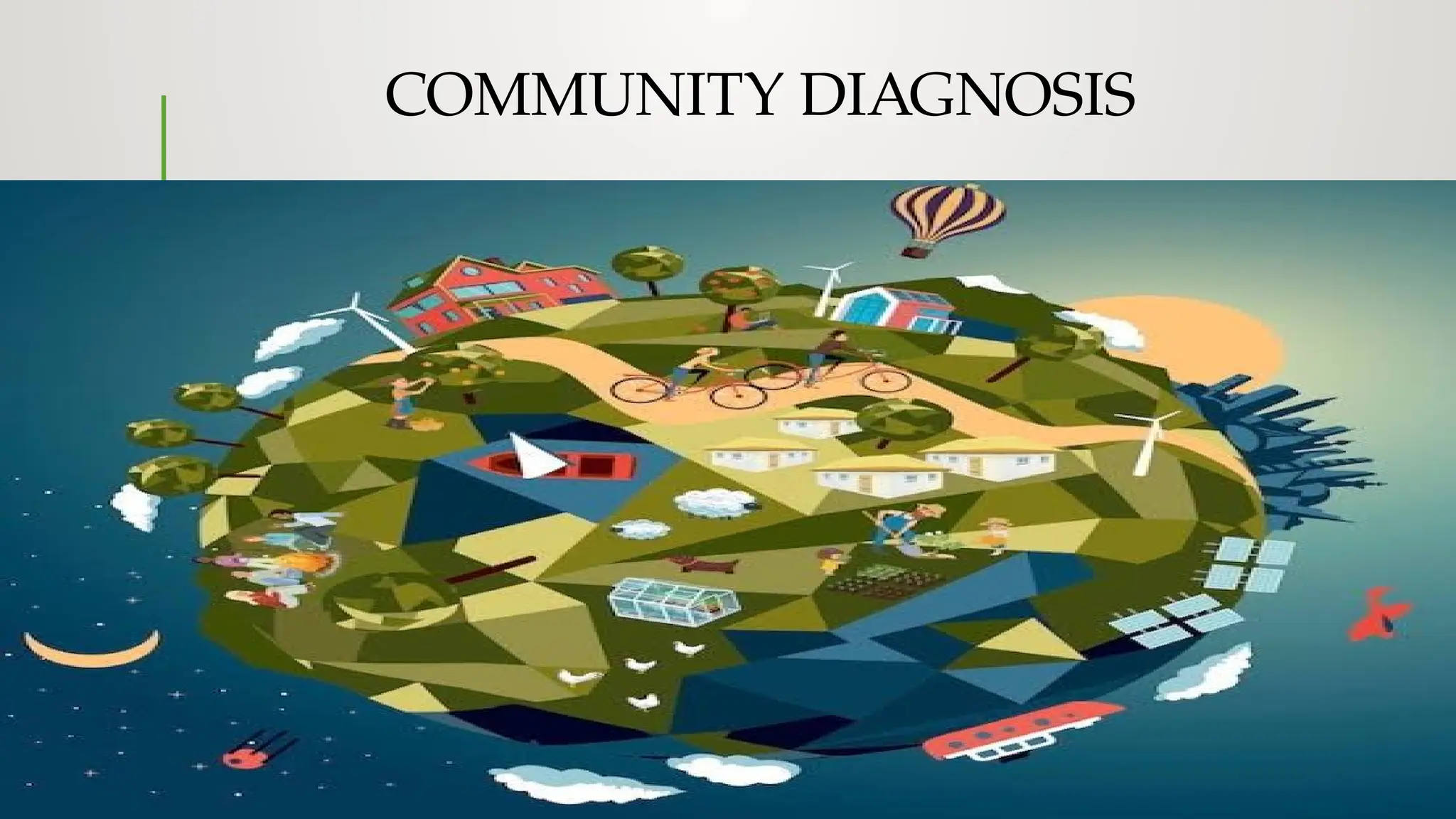
Community diagnosis
• Communitydiagnosis is a comprehensive assessment of
health status of the community in relation to its social,
physical and biological environment.
5.
WHO definition
• Itis a quantitative and qualitative description of the
health of citizens and the factors which influence their
health and it identifies problems, proposes areas for
improvement and stimulates action.
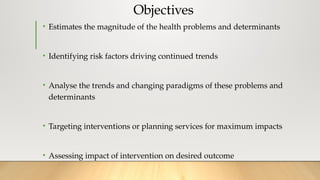
Objectives
• Estimates themagnitude of the health problems and determinants
• Identifying risk factors driving continued trends
• Analyse the trends and changing paradigms of these problems and
determinants
• Targeting interventions or planning services for maximum impacts
• Assessing impact of intervention on desired outcome
8.
Types of informationfor community diagnosis
• Health situations and needs
• Availability of resources
• Accessibility and utilization of existing health resources
• Impact on health outcomes
• Health care financing
9.
General framework forcommunity diagnosis
• Defining the community
• Sources of information and methods
• Health indicators
• Trend analysis
• Characteristics of community diagnosis
10.
Types of communitydiagnosis
• Comprehensive: To gather general information about
community like demographic, sociocultural ,economic,
health-related information, resources available.
• Problem based: To gather information responding to a
particular problem and to address its solution.
11.
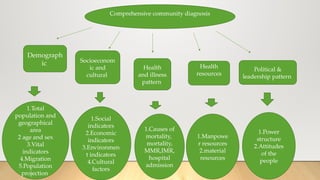
Comprehensive community diagnosis
Demograph
icSocioeconom
ic and
cultural
Health
and illness
pattern
Health
resources
Political &
leadership pattern
1.Total
population and
geographical
area
2 age and sex
3.Vital
indicators
4.Migration
5.Population
projection
1.Social
indicators
2.Economic
indicators
3.Environmen
t indicators
4.Cultural
factors
1.Causes of
mortality,
mortality,
MMR,IMR,
hospital
admission
1.Manpowe
r resources
2.material
resources
1.Power
structure
2.Attitudes
of the
people
12.
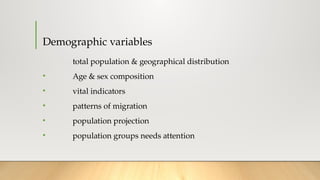
Demographic variables
total population& geographical distribution
• Age & sex composition
• vital indicators
• patterns of migration
• population projection
• population groups needs attention
13.
Social economic andcultural variables
Social indicators
Economic
indicators
Environmental
indicators
Cultural
factors
1]
communication
network
2]transportation
system
3] educational
level
4]housing
condition
1] poverty level
income
2]unemployme
nt
3]income
4] types of
industry
5]occupation
1] physical
/geographical
2] water supply
3]waste disposal
4] air, water, soil
pollution
1]ethnicity
2]social class
3]religion
4]race
5]cultural
beliefs
14.
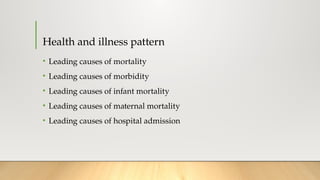
Health and illnesspattern
• Leading causes of mortality
• Leading causes of morbidity
• Leading causes of infant mortality
• Leading causes of maternal mortality
• Leading causes of hospital admission
15.
Health resources
Manpower resourcesMaterial recourses
1]categories of health
manpower
2]Geographical distribution
3]health facilities
4] type of health organisation
5]quality of health manpower
6]existing manpower policies
1] health budget and manpower
2]sources of health funding
3]categories of health institutions
4]Hospital bed-population ratio
5]categories of services available
16.
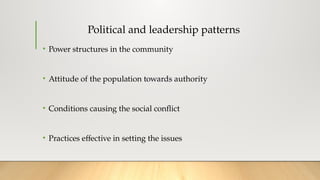
Political and leadershippatterns
• Power structures in the community
• Attitude of the population towards authority
• Conditions causing the social conflict
• Practices effective in setting the issues
17.
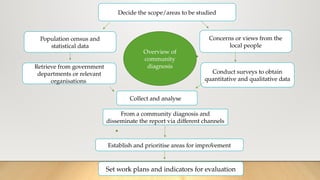
Decide the scope/areasto be studied
Population census and
statistical data
Concerns or views from the
local people
Conduct surveys to obtain
quantitative and qualitative data
Retrieve from government
departments or relevant
organisations
Collect and analyse
From a community diagnosis and
disseminate the report via different channels
Establish and prioritise areas for improvement
Set work plans and indicators for evaluation
Overview of
community
diagnosis
18.
Steps in conductof community diagnosis
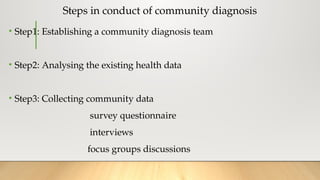
• Step1: Establishing a community diagnosis team
• Step2: Analysing the existing health data
• Step3: Collecting community data
survey questionnaire
interviews
focus groups discussions
19.
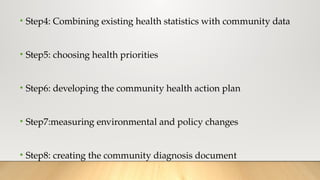
• Step4: Combiningexisting health statistics with community data
• Step5: choosing health priorities
• Step6: developing the community health action plan
• Step7:measuring environmental and policy changes
• Step8: creating the community diagnosis document
20.
Limitations of communitydiagnosis
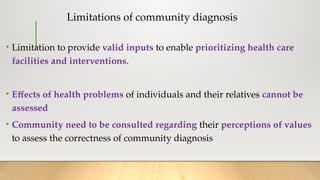
• Limitation to provide valid inputs to enable prioritizing health care
facilities and interventions.
• Effects of health problems of individuals and their relatives cannot be
assessed
• Community need to be consulted regarding their perceptions of values
to assess the correctness of community diagnosis
21.
Example of communityproblem
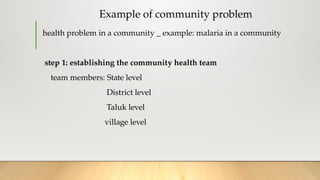
health problem in a community _ example: malaria in a community
step 1: establishing the community health team
team members: State level
District level
Taluk level
village level
22.
Step 2:Analysing theexisting health data
• Malaria prevalence
• In INDIA
• In Karnataka
• In Davangere district
• In RHC Kakkargolla
• In village- Avargolla
23.
Step3: collecting communitydata
• 1] using community or health system malaria records
• IHIP data, PHC records, ANM records
• 2] conducting the fever survey through questionnaire
a] basic demographic data
b] human behaviour
c] perception of illness
d] treatment seeking behaviour
24.
Step 4:combining theexistent health statistics with
community data
• Review of data from step 2 and step 3
• Confirmation of health issues
• Comparison with other communities
25.
Step 5:choosing thehealth priorities
• Improvement of patients condition by treatment
• Mosquitos control measures
• Sanitation improvement
• Health education
26.
Step 6: developingcommunity health action plan
1] Health intervention
a] case management
b] anti adult and anti larval measures
c]other vector control measures
d] mass treatment for fever
•
Step 7: measuringenvironmental and policy
changes
1] Evaluate the success of the interventions
2] Community level indicator data to know the extent of community
making changes
29.
Step 8: creatingthe community diagnosis document
This document having assessment results and plans with community
A] malarial cases
B] malarial transmission
C] malarial deaths
D] impact of effective treatment
E] mosquito control by IRS
30.
• F] preventionof malaria in pregnancy
• G] diagnosis
• H] appropriate treatment at health facility
• I] routine distribution of mosquito nets
• J] anti malarial drug supplies
• K] reporting of malaria cases in health facilities
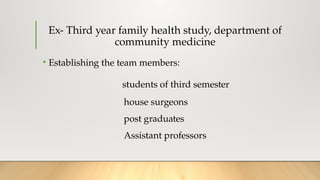
Ex- Third yearfamily health study, department of
community medicine
• Establishing the team members:
students of third semester
house surgeons
post graduates
Assistant professors
33.
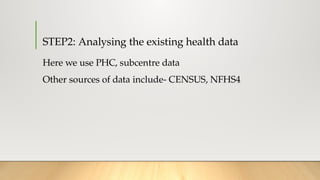
STEP2: Analysing theexisting health data
Here we use PHC, subcentre data
Other sources of data include- CENSUS, NFHS4
34.
STEP3: collecting communitydata
• 1]identification data & family composition
• 2]environmental data-a] macro
• b] micro-housing, kitchen, water, sanitation
3] dietary practices of family: a]dietary habits
4] social & economic data
5] morbidity in the family
35.
• 6] knowledge,attitude, practice about:
• health
• disease
• immunisation
• family planning
• 7]sources of health information
• 8] health seeking behaviour
36.
Step4: combining existinghealth statistics with
community data
• By combing the data from step2 and step 3 we will get information
about
• Health status of community
• Nutritional deficiencies
• Immunisation status etc..
37.
STEP5: choosing healthpriorities
• Obtained based on information gathered
• Example- whether there are any NCD related problems or
CD related etc
38.
STEP6: developing communityhealth action plan
• Health intervention: case management
• IEC campaigns
• planning further health camps
• Prevention: vaccination
• pregnant women-iron and folic acid
• adolescent-sanitary pads distribution
health education
39.
Step7: measuring theenvironmental and policy
changes
To evaluate the success of the interventions
Community level indicator data to know the extent to
which the community is making changes to improve
health
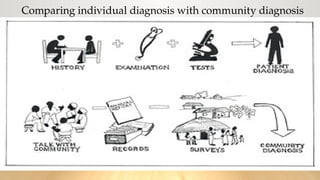
Comparing individual diagnosiswith community
diagnosis
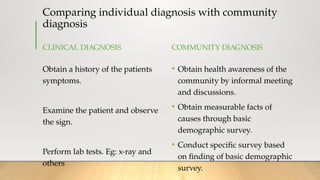
CLINICAL DIAGNOSIS
Obtain a history of the patients
symptoms.
Examine the patient and observe
the sign.
Perform lab tests. Eg: x-ray and
others
COMMUNITY DIAGNOSIS
• Obtain health awareness of the
community by informal meeting
and discussions.
• Obtain measurable facts of
causes through basic
demographic survey.
• Conduct specific survey based
on finding of basic demographic
survey.
43.
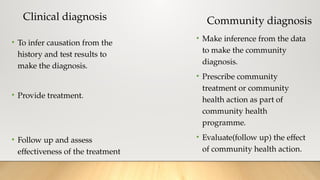
Clinical diagnosis
• Toinfer causation from the
history and test results to
make the diagnosis.
• Provide treatment.
• Follow up and assess
effectiveness of the treatment
Community diagnosis
• Make inference from the data
to make the community
diagnosis.
• Prescribe community
treatment or community
health action as part of
community health
programme.
• Evaluate(follow up) the effect
of community health action.
44.
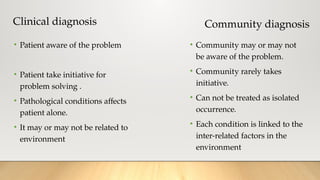
Clinical diagnosis
• Patientaware of the problem
• Patient take initiative for
problem solving .
• Pathological conditions affects
patient alone.
• It may or may not be related to
environment
Community diagnosis
• Community may or may not
be aware of the problem.
• Community rarely takes
initiative.
• Can not be treated as isolated
occurrence.
• Each condition is linked to the
inter-related factors in the
environment

![Social economic and cultural variables
Social indicators
Economic
indicators
Environmental
indicators
Cultural
factors
1]
communication
network
2]transportation
system
3] educational
level
4]housing
condition
1] poverty level
income
2]unemployme
nt
3]income
4] types of
industry
5]occupation
1] physical
/geographical
2] water supply
3]waste disposal
4] air, water, soil
pollution
1]ethnicity
2]social class
3]religion
4]race
5]cultural
beliefs](https://image.slidesharecdn.com/communitydiagnosis-250705150614-1f45f858/85/Community-Diagnosis-framework-types-steps-13-320.jpg)
![Health resources
Manpower resources Material recourses
1]categories of health
manpower
2]Geographical distribution
3]health facilities
4] type of health organisation
5]quality of health manpower
6]existing manpower policies
1] health budget and manpower
2]sources of health funding
3]categories of health institutions
4]Hospital bed-population ratio
5]categories of services available](https://image.slidesharecdn.com/communitydiagnosis-250705150614-1f45f858/85/Community-Diagnosis-framework-types-steps-15-320.jpg)
![Step3: collecting community data
• 1] using community or health system malaria records
• IHIP data, PHC records, ANM records
• 2] conducting the fever survey through questionnaire
a] basic demographic data
b] human behaviour
c] perception of illness
d] treatment seeking behaviour](https://image.slidesharecdn.com/communitydiagnosis-250705150614-1f45f858/85/Community-Diagnosis-framework-types-steps-23-320.jpg)
![Step 6: developing community health action plan
1] Health intervention
a] case management
b] anti adult and anti larval measures
c]other vector control measures
d] mass treatment for fever
•](https://image.slidesharecdn.com/communitydiagnosis-250705150614-1f45f858/85/Community-Diagnosis-framework-types-steps-26-320.jpg)
![• 2] prevention
a] insecticide treated nets
b] Intermittent Preventive treatment – PW
c] Intermittent Preventive treatment – Infants
d] IRS
e] effective anti-malarial drugs
f] source reduction[ Friday-dry day]
h] community participation](https://image.slidesharecdn.com/communitydiagnosis-250705150614-1f45f858/85/Community-Diagnosis-framework-types-steps-27-320.jpg)
![Step 7: measuring environmental and policy
changes
1] Evaluate the success of the interventions
2] Community level indicator data to know the extent of community
making changes](https://image.slidesharecdn.com/communitydiagnosis-250705150614-1f45f858/85/Community-Diagnosis-framework-types-steps-28-320.jpg)
![Step 8: creating the community diagnosis document
This document having assessment results and plans with community
A] malarial cases
B] malarial transmission
C] malarial deaths
D] impact of effective treatment
E] mosquito control by IRS](https://image.slidesharecdn.com/communitydiagnosis-250705150614-1f45f858/85/Community-Diagnosis-framework-types-steps-29-320.jpg)
![• F] prevention of malaria in pregnancy
• G] diagnosis
• H] appropriate treatment at health facility
• I] routine distribution of mosquito nets
• J] anti malarial drug supplies
• K] reporting of malaria cases in health facilities](https://image.slidesharecdn.com/communitydiagnosis-250705150614-1f45f858/85/Community-Diagnosis-framework-types-steps-30-320.jpg)
![STEP3: collecting community data
• 1]identification data & family composition
• 2]environmental data-a] macro
• b] micro-housing, kitchen, water, sanitation
3] dietary practices of family: a]dietary habits
4] social & economic data
5] morbidity in the family](https://image.slidesharecdn.com/communitydiagnosis-250705150614-1f45f858/85/Community-Diagnosis-framework-types-steps-34-320.jpg)
![• 6] knowledge, attitude, practice about:
• health
• disease
• immunisation
• family planning
• 7]sources of health information
• 8] health seeking behaviour](https://image.slidesharecdn.com/communitydiagnosis-250705150614-1f45f858/85/Community-Diagnosis-framework-types-steps-35-320.jpg)