Semester Conversion Communications M.B. Reilly Assistant Director, Public Relations University of Cincinnati
Key communications strategy To provide a central Web site for information and to drive audiences to that site via electronic, print and in-person communication streams.
Major and Minor Audiences Major Audiences prospective and future students  current students  parents  faculty and staff  employers and corporate partners  alumni  donors  Minor Audiences landlords police and fire public transportation  residents businesses  fans of UC athletics
Changing audiences and needs Each audience will seek information at different times throughout the semester conversion  Faculty members are the current “strategic audience.” We will need to prioritize and focus on strategic audiences, as they arise, throughout the semester conversion period.
Responding to strategic audiences Phase 1: Faculty and Staff need information and resources for course revision. 2009-2010. Phase 2: Current students need information about advising. 2010-2011.  Phase 3: TBD.   For each phase, communications focus on the needs of the stragetic audience.
Communication streams Electronic : Web site, video monitors, e-mail, surveys, online “ask a question” forms.    Print : posters, signage, student newspaper ads, door hangers for residence halls, business cards. All print material will contain the Web site address.  In-person : presentations, information booths, meetings, campus tour guides, college ambassadors.
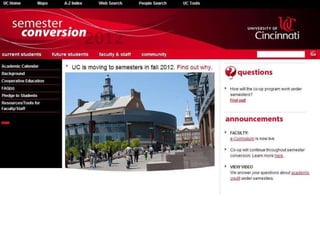
The Web Site  www.uc.edu/conversion
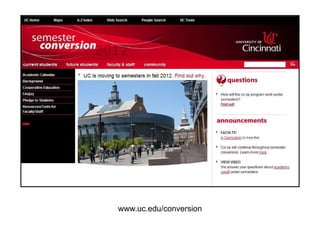
www.uc.edu/conversion
Web site concerns Inspire calmness and quiet fears, rather than create excitement Provide complete and well organized information Make content available from multiple second-level pages Ensure users find the information they need Coordinate among multiple posters
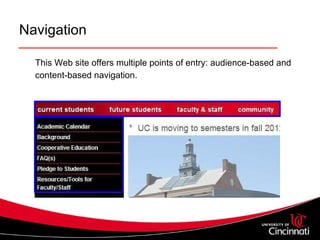
Navigation This Web site offers multiple points of entry: audience-based and content-based navigation.
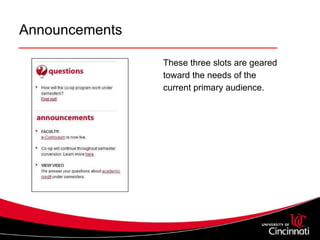
Announcements These three slots are geared toward the needs of the current primary audience.
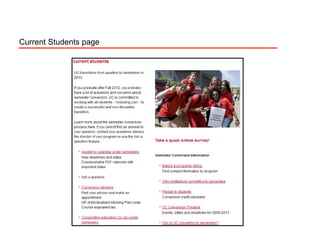
Audience pages These pages provide users with a gateway to find and access information content relevant to their needs. Current Students  Future Students Faculty & Staff Community (Community Members and Parents)
Current Students page
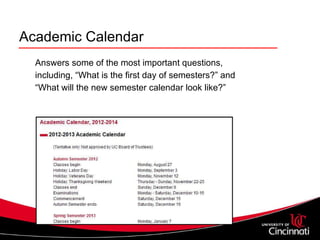
Academic Calendar Answers some of the most important questions, including, “What is the first day of semesters?” and “What will the new semester calendar look like?”
Academic Calendar, continued A print-ready version (pdf) is also included. A user should be able to easily print important information from the Web site so he may access that information when he is away from a computer.
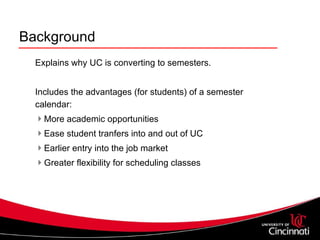
Background Explains why UC is converting to semesters. Includes the advantages (for students) of a semester calendar: More academic opportunities Ease student tranfers into and out of UC Earlier entry into the job market Greater flexibility for scheduling classes
Cooperative Education For many programs at UC, co-op is a key element. The main purpose of this secondary-level page is to assure readers that co-op  will continue , and the co-op programs will not suffer due to semester conversion.  We want to assure students, parents and alumni: Co-op employers love semesters!
FAQs Text FAQs: General  Academic Credit Co-op FAQ for Students Co-op FAQ for Employers Video FAQs for the “YouTube” generation Helpful links, organized by audience List of Ohio institutions converting to semesters
Pledge to Students This pledge applies only to students who complete semester conversion advising. Three guarantees:  No loss of academic progress No delay to degree completion No increased cost for degree completion
Resources/Tools for Faculty/Staff Offers links to course revision materials and curricular information.  Currently, faculty make up the primary users of this Web site.  The Web site is designed so faculty can easily access the resources and materials they need to complete their course and curriculum revisions. They can quickly bypass all pages intended for other audiences (current students, future students, parents, community members, etc.).
 

Communication Power Point

  • 1.
    Semester Conversion CommunicationsM.B. Reilly Assistant Director, Public Relations University of Cincinnati
  • 2.
    Key communications strategyTo provide a central Web site for information and to drive audiences to that site via electronic, print and in-person communication streams.
  • 3.
    Major and MinorAudiences Major Audiences prospective and future students current students parents faculty and staff employers and corporate partners alumni donors Minor Audiences landlords police and fire public transportation residents businesses fans of UC athletics
  • 4.
    Changing audiences andneeds Each audience will seek information at different times throughout the semester conversion Faculty members are the current “strategic audience.” We will need to prioritize and focus on strategic audiences, as they arise, throughout the semester conversion period.
  • 5.
    Responding to strategicaudiences Phase 1: Faculty and Staff need information and resources for course revision. 2009-2010. Phase 2: Current students need information about advising. 2010-2011. Phase 3: TBD. For each phase, communications focus on the needs of the stragetic audience.
  • 6.
    Communication streams Electronic: Web site, video monitors, e-mail, surveys, online “ask a question” forms. Print : posters, signage, student newspaper ads, door hangers for residence halls, business cards. All print material will contain the Web site address. In-person : presentations, information booths, meetings, campus tour guides, college ambassadors.
  • 7.
    The Web Site www.uc.edu/conversion
  • 8.
  • 9.
    Web site concernsInspire calmness and quiet fears, rather than create excitement Provide complete and well organized information Make content available from multiple second-level pages Ensure users find the information they need Coordinate among multiple posters
  • 10.
    Navigation This Website offers multiple points of entry: audience-based and content-based navigation.
  • 11.
    Announcements These threeslots are geared toward the needs of the current primary audience.
  • 12.
    Audience pages Thesepages provide users with a gateway to find and access information content relevant to their needs. Current Students Future Students Faculty & Staff Community (Community Members and Parents)
  • 13.
  • 14.
    Academic Calendar Answerssome of the most important questions, including, “What is the first day of semesters?” and “What will the new semester calendar look like?”
  • 15.
    Academic Calendar, continuedA print-ready version (pdf) is also included. A user should be able to easily print important information from the Web site so he may access that information when he is away from a computer.
  • 16.
    Background Explains whyUC is converting to semesters. Includes the advantages (for students) of a semester calendar: More academic opportunities Ease student tranfers into and out of UC Earlier entry into the job market Greater flexibility for scheduling classes
  • 17.
    Cooperative Education Formany programs at UC, co-op is a key element. The main purpose of this secondary-level page is to assure readers that co-op will continue , and the co-op programs will not suffer due to semester conversion. We want to assure students, parents and alumni: Co-op employers love semesters!
  • 18.
    FAQs Text FAQs:General Academic Credit Co-op FAQ for Students Co-op FAQ for Employers Video FAQs for the “YouTube” generation Helpful links, organized by audience List of Ohio institutions converting to semesters
  • 19.
    Pledge to StudentsThis pledge applies only to students who complete semester conversion advising. Three guarantees: No loss of academic progress No delay to degree completion No increased cost for degree completion
  • 20.
    Resources/Tools for Faculty/StaffOffers links to course revision materials and curricular information. Currently, faculty make up the primary users of this Web site. The Web site is designed so faculty can easily access the resources and materials they need to complete their course and curriculum revisions. They can quickly bypass all pages intended for other audiences (current students, future students, parents, community members, etc.).
  • 21.

Editor's Notes

  • #7 Click twice to reveal all text
  • #11 Click four times to highlight the navigation bars
  • #12 Click four times to highlight the navigation bars