ELEMENTS OF
COMMUNICATION
Made By: Daksh Mudgal
Class: 9th B
Subject: Artificial Intelligence
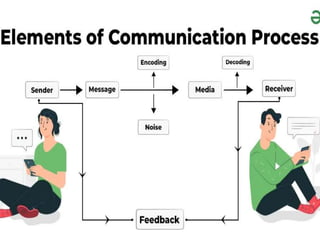
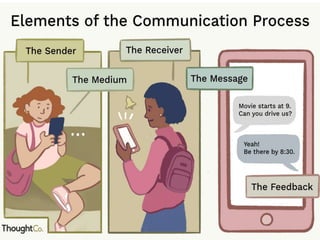
ELEMENT #1
• SENDER: The “sender” is the
source or person who starts the
communication process by
sending a message to another
person or entity.
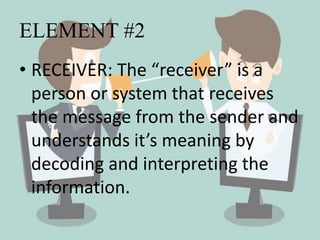
ELEMENT #2
• RECEIVER: The “receiver” is a
person or system that receives
the message from the sender and
understands it’s meaning by
decoding and interpreting the
information.
ELEMENT #3
• MESSAGE: The “message” is the
information, data, instructions,
or normal conversation being
communicated from the sender
to the receiver .
ELEMENT #4
• MEDIUM: The “medium” is the
channel or means through which
the message is transmitted, such
as text, speech or digital signals.
Eg: “Text” for “Typing”
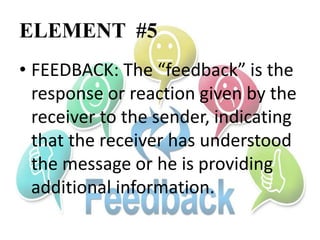
ELEMENT #5
• FEEDBACK: The “feedback” is the
response or reaction given by the
receiver to the sender, indicating
that the receiver has understood
the message or he is providing
additional information.
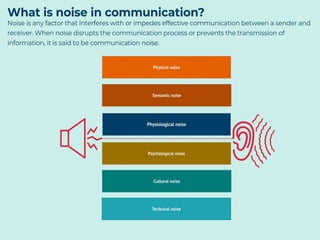
ELEMENT #6
• NOISE: It is any interference or
disturbance which can disturb the
clean transmission or
understanding of a message. It
can include factors like distraction
,background noise, etc.
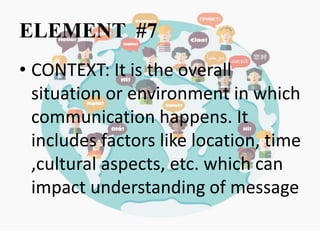
ELEMENT #7
• CONTEXT: It is the overall
situation or environment in which
communication happens. It
includes factors like location, time
,cultural aspects, etc. which can
impact understanding of message
TYPES OF
COMMUNICATION
SUBTOPIC: Introduction to the
importance of communication and its
relevance in the field of AI
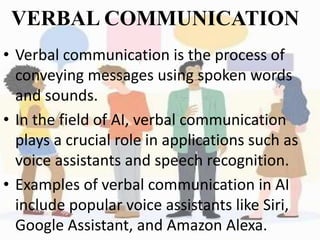
VERBAL COMMUNICATION
• Verbal communication is the process of
conveying messages using spoken words
and sounds.
• In the field of AI, verbal communication
plays a crucial role in applications such as
voice assistants and speech recognition.
• Examples of verbal communication in AI
include popular voice assistants like Siri,
Google Assistant, and Amazon Alexa.
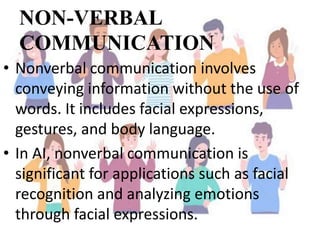
NON-VERBAL
COMMUNICATION
• Nonverbal communication involves
conveying information without the use of
words. It includes facial expressions,
gestures, and body language.
• In AI, nonverbal communication is
significant for applications such as facial
recognition and analyzing emotions
through facial expressions.
WRITTEN
COMMUNICATION
• Written communication refers to the
exchange of information through
written symbols such as letters,
emails, and text messages.
• In AI, written communication is
essential for applications like chatbots
and natural language processing.
VISUAL COMMUNICATION
• Visual communication involves
conveying information using visual
elements such as graphs, charts,
images, and videos.
• In AI, visual communication plays a
vital role in applications like data
visualization and image recognition.
DIGITAL
COMMUNICATION
• Digital communication refers to the
exchange of information through
digital platforms and technologies
like email, instant messaging, and
video conferencing.
• In field of AI, it facilitates seamless
interaction among the user and AI .It
also includes email communication.
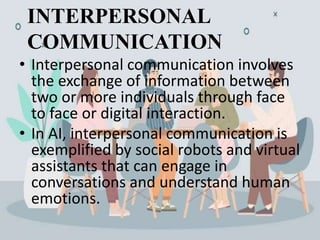
INTERPERSONAL
COMMUNICATION
• Interpersonal communication involves
the exchange of information between
two or more individuals through face
to face or digital interaction.
• In AI, interpersonal communication is
exemplified by social robots and virtual
assistants that can engage in
conversations and understand human
emotions.
SELF
MANAGEMENT
HOLIDAYS HOMEWORK 3
Introduction to the concept of self-
management and its significance in
personal and professional contexts
DEFINITION
• Self-management is the ability to
regulate and control one's
thoughts, emotions, behaviors,
and actions.
• It is crucial for achieving goals,
maintaining well-being, and
personal growth.
BENEFITS
• Increased productivity: Effective self-
management leads to better time utilization
and task prioritization.
• Improved decision-making: Self-management
helps in making informed choices and taking
responsibility for outcomes.
• Work-life balance: By managing time and
priorities, self-management enables
individuals to maintain a healthy balance
between work and personal life.
KEY SKILLS
• Time management: Prioritizing tasks,
setting deadlines, and avoiding
procrastination.
• Goal setting: Setting specific,
measurable, achievable, relevant, and
time-bound (SMART) goals.
• Stress management: Adopting
techniques like relaxation exercises,
mindfulness, and self-care.
KEY SKILLS
• Adaptability: Being flexible,
open to change, and
embracing new perspectives.
• Self-discipline: Developing
habits, maintaining focus, and
overcoming distractions.
TIME MANAGEMENT
• Tips for effective time management:
Setting clear priorities, creating
schedules, and avoiding time-wasting
activities.
• Overcoming procrastination:
Breaking tasks into smaller steps,
setting deadlines, and using
productivity techniques.
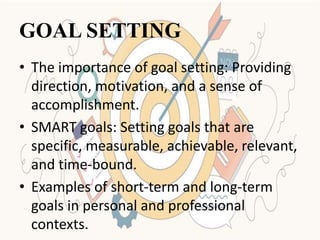
GOAL SETTING
• The importance of goal setting: Providing
direction, motivation, and a sense of
accomplishment.
• SMART goals: Setting goals that are
specific, measurable, achievable, relevant,
and time-bound.
• Examples of short-term and long-term
goals in personal and professional
contexts.
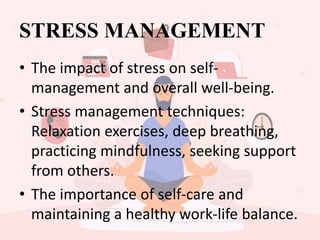
STRESS MANAGEMENT
• The impact of stress on self-
management and overall well-being.
• Stress management techniques:
Relaxation exercises, deep breathing,
practicing mindfulness, seeking support
from others.
• The importance of self-care and
maintaining a healthy work-life balance.
DECISION MAKING
• The connection between decision-
making and self-management.
• Decision-making models or
frameworks: Pros and cons analysis,
rational decision-making model.
• Tips for making informed decisions
and considering potential outcomes.
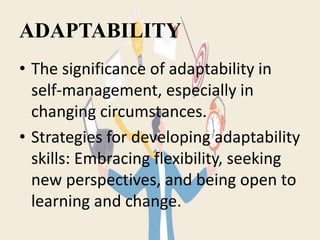
ADAPTABILITY
• The significance of adaptability in
self-management, especially in
changing circumstances.
• Strategies for developing adaptability
skills: Embracing flexibility, seeking
new perspectives, and being open to
learning and change.
Communication in AI.

Communication in AI.

  • 2.
    ELEMENTS OF COMMUNICATION Made By:Daksh Mudgal Class: 9th B Subject: Artificial Intelligence
  • 3.
    ELEMENT #1 • SENDER:The “sender” is the source or person who starts the communication process by sending a message to another person or entity.
  • 4.
    ELEMENT #2 • RECEIVER:The “receiver” is a person or system that receives the message from the sender and understands it’s meaning by decoding and interpreting the information.
  • 5.
    ELEMENT #3 • MESSAGE:The “message” is the information, data, instructions, or normal conversation being communicated from the sender to the receiver .
  • 6.
    ELEMENT #4 • MEDIUM:The “medium” is the channel or means through which the message is transmitted, such as text, speech or digital signals. Eg: “Text” for “Typing”
  • 7.
    ELEMENT #5 • FEEDBACK:The “feedback” is the response or reaction given by the receiver to the sender, indicating that the receiver has understood the message or he is providing additional information.
  • 8.
    ELEMENT #6 • NOISE:It is any interference or disturbance which can disturb the clean transmission or understanding of a message. It can include factors like distraction ,background noise, etc.
  • 10.
    ELEMENT #7 • CONTEXT:It is the overall situation or environment in which communication happens. It includes factors like location, time ,cultural aspects, etc. which can impact understanding of message
  • 13.
    TYPES OF COMMUNICATION SUBTOPIC: Introductionto the importance of communication and its relevance in the field of AI
  • 14.
    VERBAL COMMUNICATION • Verbalcommunication is the process of conveying messages using spoken words and sounds. • In the field of AI, verbal communication plays a crucial role in applications such as voice assistants and speech recognition. • Examples of verbal communication in AI include popular voice assistants like Siri, Google Assistant, and Amazon Alexa.
  • 15.
    NON-VERBAL COMMUNICATION • Nonverbal communicationinvolves conveying information without the use of words. It includes facial expressions, gestures, and body language. • In AI, nonverbal communication is significant for applications such as facial recognition and analyzing emotions through facial expressions.
  • 16.
    WRITTEN COMMUNICATION • Written communicationrefers to the exchange of information through written symbols such as letters, emails, and text messages. • In AI, written communication is essential for applications like chatbots and natural language processing.
  • 17.
    VISUAL COMMUNICATION • Visualcommunication involves conveying information using visual elements such as graphs, charts, images, and videos. • In AI, visual communication plays a vital role in applications like data visualization and image recognition.
  • 18.
    DIGITAL COMMUNICATION • Digital communicationrefers to the exchange of information through digital platforms and technologies like email, instant messaging, and video conferencing. • In field of AI, it facilitates seamless interaction among the user and AI .It also includes email communication.
  • 19.
    INTERPERSONAL COMMUNICATION • Interpersonal communicationinvolves the exchange of information between two or more individuals through face to face or digital interaction. • In AI, interpersonal communication is exemplified by social robots and virtual assistants that can engage in conversations and understand human emotions.
  • 20.
    SELF MANAGEMENT HOLIDAYS HOMEWORK 3 Introductionto the concept of self- management and its significance in personal and professional contexts
  • 21.
    DEFINITION • Self-management isthe ability to regulate and control one's thoughts, emotions, behaviors, and actions. • It is crucial for achieving goals, maintaining well-being, and personal growth.
  • 22.
    BENEFITS • Increased productivity:Effective self- management leads to better time utilization and task prioritization. • Improved decision-making: Self-management helps in making informed choices and taking responsibility for outcomes. • Work-life balance: By managing time and priorities, self-management enables individuals to maintain a healthy balance between work and personal life.
  • 23.
    KEY SKILLS • Timemanagement: Prioritizing tasks, setting deadlines, and avoiding procrastination. • Goal setting: Setting specific, measurable, achievable, relevant, and time-bound (SMART) goals. • Stress management: Adopting techniques like relaxation exercises, mindfulness, and self-care.
  • 24.
    KEY SKILLS • Adaptability:Being flexible, open to change, and embracing new perspectives. • Self-discipline: Developing habits, maintaining focus, and overcoming distractions.
  • 25.
    TIME MANAGEMENT • Tipsfor effective time management: Setting clear priorities, creating schedules, and avoiding time-wasting activities. • Overcoming procrastination: Breaking tasks into smaller steps, setting deadlines, and using productivity techniques.
  • 26.
    GOAL SETTING • Theimportance of goal setting: Providing direction, motivation, and a sense of accomplishment. • SMART goals: Setting goals that are specific, measurable, achievable, relevant, and time-bound. • Examples of short-term and long-term goals in personal and professional contexts.
  • 27.
    STRESS MANAGEMENT • Theimpact of stress on self- management and overall well-being. • Stress management techniques: Relaxation exercises, deep breathing, practicing mindfulness, seeking support from others. • The importance of self-care and maintaining a healthy work-life balance.
  • 28.
    DECISION MAKING • Theconnection between decision- making and self-management. • Decision-making models or frameworks: Pros and cons analysis, rational decision-making model. • Tips for making informed decisions and considering potential outcomes.
  • 29.
    ADAPTABILITY • The significanceof adaptability in self-management, especially in changing circumstances. • Strategies for developing adaptability skills: Embracing flexibility, seeking new perspectives, and being open to learning and change.