Copyright © 2010 Films for the Humanities & Sciences®
• www.films.com • 1-800-257-5126
®
Films for the
Humanities & Sciences
Instructor’s Guide
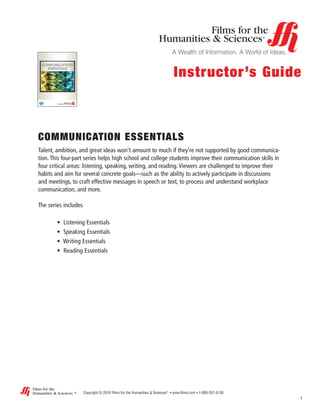
COMMUNICATION ESSENTIALS
Talent, ambition, and great ideas won’t amount to much if they’re not supported by good communica-
tion. This four-part series helps high school and college students improve their communication skills in
four critical areas: listening, speaking, writing, and reading. Viewers are challenged to improve their
habits and aim for several concrete goals—such as the ability to actively participate in discussions
and meetings, to craft effective messages in speech or text, to process and understand workplace
communication, and more.
The series includes
• Listening Essentials
• Speaking Essentials
• Writing Essentials
• Reading Essentials
A Wealth of Information. A World of Ideas.
®
Films for the
Humanities & Sciences i
1
LISTENING ESSENTIALS
Highlighting the idea that a major part of good communication is good listening, this program
enables students to improve their listening skills and absorb valuable information. The video identifies
the best methods for giving coworkers the attention they deserve and provides eight simple tips that
viewers can use to sharpen concentration. These include learning to focus, taking proper notes, put-
ting emotions on hold, avoiding biases and stereotypes, finding a point of interest in a dull but
important conversation, and more.
Chapter 1: Introduction
Chapter 2: Negative Effects of Poor Listening (Did You Say Something?)
Chapter 3: Types of Listening (Listening Begins)
Chapter 4: Interpreting Nonverbal Communication (Nonverbal Communication)
Chapter 5: What Prevents Good Listening (Not Listening)
Chapter 6: Tips for Effective Listening (Listen Up)
Chapter 7: Good Listener’s Checklist (Keep Listening)
Review
(1) List some factors that cause us to be poor listeners.
(2) What are the four types of listening?
(3) List the three important roles that nonverbal signals play in communication.
(4) Give some examples of nonverbal communication.
(5) True or False? Nonverbal cues speak louder than words.
(6) List three facets of effective listening.
(7) List some barriers that interrupt the listening process.
(8) List at least five tips for being a more effective listener.
(9) Name at least five points from the Good Listener’s Checklist.
(10) What are some of the benefits of improving your listening skills?
2
Copyright © 2010 Films for the Humanities & Sciences®
• www.films.com • 1-800-257-5126
Communication Essentials: Listening INSTRUCTOR’S GUIDE
®
Films for the
Humanities & Sciencesi
Answer Key
(1) List some factors that cause us to be poor listeners.
• Schools teach reading, speaking, and writing skills, but not listening skills
• There are physical and mental barriers that interrupt our listening process
• Listeners can process what they are hearing quicker than speakers can finish talking,
so they tend to daydream
(2) What are the four types of listening?
• Content (listening to gather information)
• Critical (evaluating the message, separating fact from opinion)
• Empathetic (understanding the speaker’s feelings)
• Active (ignoring distractions, tuning in to what the speaker is saying, listening without bias)
(3) List the three important roles that nonverbal signals play in communication.
• They reinforce the spoken word
• They reveal the truth, often without speakers (and listeners) being aware of the message
they are sending
• They convey information efficiently
(4) Give some examples of nonverbal communication.
• Facial expressions (making eye contact, rolling your eyes)
• Body movement (slouching, leaning towards the other person)
• Vocal characteristics (tone of voice, volume, pitch, speed)
(5) True or False? Nonverbal cues speak louder than words.
True.
(6) List three facets of effective listening.
• Consider all the information being given
• Be aware of your own biases
• Don’t jump to conclusions
3
Copyright © 2010 Films for the Humanities & Sciences®
• www.films.com • 1-800-257-5126
Communication Essentials: Listening INSTRUCTOR’S GUIDE
®
Films for the
Humanities & Sciencesi
(7) List some barriers that interrupt the listening process.
• Being consumed by your own emotions (anger, anxiety, disappointment) while listening
• A noisy environment (traffic sounds, other conversations, TV)
• You can’t stop thinking about things you have to do
• Judging the speaker unfairly due to your own biases (e.g., making assumptions about the
speaker based on their accent, hairstyle, age, race, etc.)
• Becoming bored when you’re not interested in what’s being said
• Tuning out because you disagree with the speaker’s opinion or beliefs
(8) List at least five tips for being a more effective listener.
• Put your emotions on hold
• Assume the best of the speaker –– don’t be biased due to their age, race, personal style, etc.
• Keep listening even if you strongly disagree with an opinion being stated –– acknowledge
the speaker’s point, then offer your side
• Show empathy (make eye contact, nod, ask questions)
• Focus on what the speaker is saying, not on your to-do list.
• If the speaker is boring, try to find something interesting in what they’re saying
• When appropriate, take notes
• Practice! Like any skill, the more you practice it, the better you’ll become
(9) Name at least five points from the Good Listener’s Checklist.
• Stop talking, and concentrate on the speaker
• Listen attentively
• Block out competing thoughts
• Control the listening environment (turn off TV, phone, move to a quieter location)
• Maintain an open mind
• Provide verbal and nonverbal feedback
• Take notes
• Pay attention to nonverbal communication along with spoken words
• Capitalize on lag time by organizing and reviewing information
(10) What are some of the benefits of improving your listening skills?
• For students: listening attentively helps you gather the information you need to complete
your studies successfully
• For professionals: listening is critical to understanding your role in the job, to building trust,
and meeting your company’s needs
• In your personal life: listening carefully makes you stand out as a trusted friend, and helps
build harmonious relationships
4
Copyright © 2010 Films for the Humanities & Sciences®
• www.films.com • 1-800-257-5126
Communication Essentials: Listening INSTRUCTOR’S GUIDE
®
Films for the
Humanities & Sciencesi
SPEAKING ESSENTIALS
Does giving a typical business presentation put a person in mortal danger? Of course not, but statis-
tics suggest that many people dread public speaking more than they fear death. This program shows
students ways to overcome that kind of paralysis and transform it into positive energy. These include
thorough preparation (from learning the wants and needs of the audience to scoping out the location
at which the speech will take place) as well as starting with a strong opener, finding the right pace,
using nonverbal communication, and more.
Chapter 1: Introduction
Chapter 2: Know Your Audience
Chapter 3: Know the Speaking Location (Know Your Space)
Chapter 4: Speech Preparation (Be Prepared)
Chapter 5: Prepare a Strong Opener
Chapter 6: Using Notes and PowerPoint
Chapter 7: Using Nonverbal Communication
Chapter 8: Helpful Speaking Tips
Chapter 9: Ending Your Speech
Chapter 10: Summary & Checklist
Review
(1) What is the first rule of public speaking?
(2) What are the four types of audience, and how can you tailor your presentation to each?
(3) Give at least four tips that will help you connect with your audience.
(4) One way to reduce nervousness before a presentation is by visiting ahead of time the room
where you’ll be presenting. What should you be checking for here?
(5) List some ways to write an effective speech.
(6) What are some good ways to begin your presentation?
(7) List some ways to effectively deliver a speech.
(8) What are some Dos and Don’ts for using PowerPoint or slides?
(9) List some ways to use nonverbal communication to enhance your presentation.
(10) Give at least five tips for an effective presentation.
5
Copyright © 2010 Films for the Humanities & Sciences®
• www.films.com • 1-800-257-5126
Communication Essentials: Speaking INSTRUCTOR’S GUIDE
®
Films for the
Humanities & Sciencesi
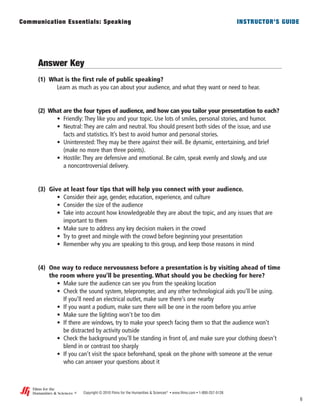
Answer Key
(1) What is the first rule of public speaking?
Learn as much as you can about your audience, and what they want or need to hear.
(2) What are the four types of audience, and how can you tailor your presentation to each?
• Friendly: They like you and your topic. Use lots of smiles, personal stories, and humor.
• Neutral: They are calm and neutral. You should present both sides of the issue, and use
facts and statistics. It’s best to avoid humor and personal stories.
• Uninterested: They may be there against their will. Be dynamic, entertaining, and brief
(make no more than three points).
• Hostile: They are defensive and emotional. Be calm, speak evenly and slowly, and use
a noncontroversial delivery.
(3) Give at least four tips that will help you connect with your audience.
• Consider their age, gender, education, experience, and culture
• Consider the size of the audience
• Take into account how knowledgeable they are about the topic, and any issues that are
important to them
• Make sure to address any key decision makers in the crowd
• Try to greet and mingle with the crowd before beginning your presentation
• Remember why you are speaking to this group, and keep those reasons in mind
(4) One way to reduce nervousness before a presentation is by visiting ahead of time
the room where you’ll be presenting. What should you be checking for here?
• Make sure the audience can see you from the speaking location
• Check the sound system, teleprompter, and any other technological aids you’ll be using.
If you’ll need an electrical outlet, make sure there’s one nearby
• If you want a podium, make sure there will be one in the room before you arrive
• Make sure the lighting won’t be too dim
• If there are windows, try to make your speech facing them so that the audience won’t
be distracted by activity outside
• Check the background you’ll be standing in front of, and make sure your clothing doesn’t
blend in or contrast too sharply
• If you can’t visit the space beforehand, speak on the phone with someone at the venue
who can answer your questions about it
6
Copyright © 2010 Films for the Humanities & Sciences®
• www.films.com • 1-800-257-5126
Communication Essentials: Speaking INSTRUCTOR’S GUIDE
®
Films for the
Humanities & Sciencesi
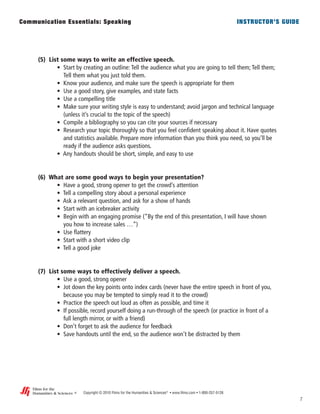
(5) List some ways to write an effective speech.
• Start by creating an outline: Tell the audience what you are going to tell them; Tell them;
Tell them what you just told them.
• Know your audience, and make sure the speech is appropriate for them
• Use a good story, give examples, and state facts
• Use a compelling title
• Make sure your writing style is easy to understand; avoid jargon and technical language
(unless it’s crucial to the topic of the speech)
• Compile a bibliography so you can cite your sources if necessary
• Research your topic thoroughly so that you feel confident speaking about it. Have quotes
and statistics available. Prepare more information than you think you need, so you’ll be
ready if the audience asks questions.
• Any handouts should be short, simple, and easy to use
(6) What are some good ways to begin your presentation?
• Have a good, strong opener to get the crowd’s attention
• Tell a compelling story about a personal experience
• Ask a relevant question, and ask for a show of hands
• Start with an icebreaker activity
• Begin with an engaging promise (“By the end of this presentation, I will have shown
you how to increase sales …”)
• Use flattery
• Start with a short video clip
• Tell a good joke
(7) List some ways to effectively deliver a speech.
• Use a good, strong opener
• Jot down the key points onto index cards (never have the entire speech in front of you,
because you may be tempted to simply read it to the crowd)
• Practice the speech out loud as often as possible, and time it
• If possible, record yourself doing a run-through of the speech (or practice in front of a
full length mirror, or with a friend)
• Don’t forget to ask the audience for feedback
• Save handouts until the end, so the audience won’t be distracted by them
7
Copyright © 2010 Films for the Humanities & Sciences®
• www.films.com • 1-800-257-5126
Communication Essentials: Speaking INSTRUCTOR’S GUIDE
®
Films for the
Humanities & Sciencesi
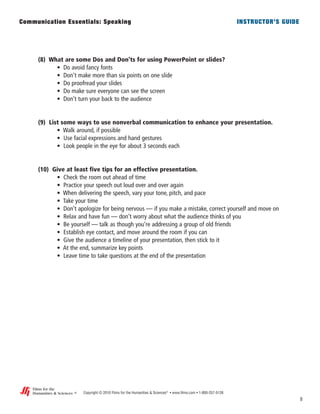
(8) What are some Dos and Don’ts for using PowerPoint or slides?
• Do avoid fancy fonts
• Don’t make more than six points on one slide
• Do proofread your slides
• Do make sure everyone can see the screen
• Don’t turn your back to the audience
(9) List some ways to use nonverbal communication to enhance your presentation.
• Walk around, if possible
• Use facial expressions and hand gestures
• Look people in the eye for about 3 seconds each
(10) Give at least five tips for an effective presentation.
• Check the room out ahead of time
• Practice your speech out loud over and over again
• When delivering the speech, vary your tone, pitch, and pace
• Take your time
• Don’t apologize for being nervous –– if you make a mistake, correct yourself and move on
• Relax and have fun –– don’t worry about what the audience thinks of you
• Be yourself –– talk as though you’re addressing a group of old friends
• Establish eye contact, and move around the room if you can
• Give the audience a timeline of your presentation, then stick to it
• At the end, summarize key points
• Leave time to take questions at the end of the presentation
8
Copyright © 2010 Films for the Humanities & Sciences®
• www.films.com • 1-800-257-5126
Communication Essentials: Speaking INSTRUCTOR’S GUIDE
®
Films for the
Humanities & Sciencesi
WRITING ESSENTIALS
Students who’ve had a hard time with term papers and essay questions may be shocked to learn how
much their postgraduation world revolves around writing. This program shows how effective written
communication is possible for anyone, even those who struggle to complete a simple fax or e-mail.
Methods for improvement include gauging the needs of the reader, keeping prose short and simple,
emphasizing benefits, avoiding jargon and overblown language, employing a confident yet respectful
tone, and more.
Chapter 1: Introduction
Chapter 2: Pre-Writing Preparation (Getting Started)
Chapter 3: Writing Tips (Writing It Down)
Chapter 4: Active vs. Passive Voice
Chapter 5: Tone
Chapter 6: Proofreading
Review
(1) What three points should guide you before actually beginning to write?
(2) Name three different reasons for writing (for professional or academic reasons).
(3) What are some factors you should consider when identifying your audience?
(4) List some tips for good business writing.
(5) What is the difference between the active voice and the passive voice?
(6) When should the passive voice be used?
(7) What are some ways to organize your work?
(8) Give at least four ways to use the correct tone in your writing.
(9) True or False? It’s okay to use a casual tone for writing email.
(10) List at least five proofreading tips.
9
Copyright © 2010 Films for the Humanities & Sciences®
• www.films.com • 1-800-257-5126
Communication Essentials: Writing INSTRUCTOR’S GUIDE
®
Films for the
Humanities & Sciencesi
Answer Key
(1) What three points should guide you before actually beginning to write?
• Defining your purpose
• Identifying your reader
• Pinpointing the key points of your message
(2) Name three different reasons for writing (for professional or academic reasons).
• Writing to persuade someone, such as a cover letter, college application essay,
or business proposal
• Writing to describe something, such as the minutes of a meeting
• Writing to explain something, such as a memo about how to access a folder on a shared
computer network
(3) What are some factors you should consider when identifying your audience?
• Who are my primary readers?
• What is my relationship to them?
• What position do they hold in the organization?
• How much do they know about the subject?
• What do I know about their education, beliefs, culture, attitudes?
• What sort of response should I expect from them?
• Who else might see this?
(4) List some tips for good business writing.
• Your purpose should be stated in the opening of your piece
• Use simple words and phrases
• Avoid jargon
• Stick with the topic
• Keep it short; get to the point
• Use the active voice whenever possible
(5) What is the difference between the active voice and the passive voice?
In the active voice, the subject performs the action: “Jane shut the door,” versus
“The door was shut by Jane.”
10
Copyright © 2010 Films for the Humanities & Sciences®
• www.films.com • 1-800-257-5126
Communication Essentials: Writing INSTRUCTOR’S GUIDE
®
Films for the
Humanities & Sciences
(6) When should the passive voice be used?
Use the passive voice when you want to be diplomatic, to soften bad news, to depersonalize
an action, to avoid sounding accusatory: “Applications should be submitted on time,” versus
“Submit your applications on time.”
(7) What are some ways to organize your work?
• Before starting to write, map out the information that’s most important to your reader
• Use paragraphs, bullet points, headings, and sub-headings
(8) Give at least four ways to use the correct tone in your writing.
• Be confident, but not arrogant
• Be polite, especially when sending a negative message
• Use neutral, unbiased language (such as salesperson, not salesman)
• Never use slang
• Use an appropriate reading level for your reader –– consider their age and experience
when choosing your words and phrases
• Write conversationally –– read the piece aloud to make sure it sounds natural
(9) True or False? It’s okay to use a casual tone for writing email.
Any emails sent for business or professional reasons (such as inquiring about a job opening)
should follow the guidelines for business writing.
(10) List at least five proofreading tips.
• Don’t rely on spell-check
• Take a break between writing and proofreading, so you can assess the piece with a fresh outlook
• Proofread a print-out, not on the computer screen (your eyes will wander less)
• Proofread twice, checking first for clarity and conciseness, and then for grammar, spelling,
and punctuation errors
• Check for missing elements, such as drawings, tables, or charts
• Look over the layout and design, paying attention to fonts, spacing, and margins
• Be on the lookout for commonly misused words (they’re, their; your, you’re)
• Have someone else proofread the piece, too
11
Copyright © 2010 Films for the Humanities & Sciences®
• www.films.com • 1-800-257-5126
Communication Essentials: Writing INSTRUCTOR’S GUIDE
®
Films for the
Humanities & Sciences
READING ESSENTIALS
A torrent of e-mails, faxes, memos, reports, contracts, and newsletters threatens to drown the typical
new hire in a sea of paper and text. With simple methods for tackling an immense volume of content,
this program helps students manage workplace reading tasks quickly and efficiently without overlook-
ing important information. Featured tips show viewers how to stay focused, prioritize reading matter,
and create a comfortable reading environment—while making the best use of tables of contents,
indexes, sub-headings, and more.
Chapter 1: Introduction
Chapter 2: Becoming a Better Reader
Chapter 3: Tip 1: Reading Environment
Chapter 4: Tip 2: Know Your Purpose
Chapter 5: Tip 3: Read Selectively
Chapter 6: Tip 4: Prioritize
Chapter 7: Tip 5: Scan First
Chapter 8: Tip 6: Keep Reading
Chapter 9: Tip 7: Stay Focused
Chapter 10: Tip 8: Take Notes
Chapter 11: Practice
Review
(1) Why is reading important no matter what type of job you want to pursue?
(2) What is the best environment in which to read?
(3) Why is it important to know the purpose for your reading?
(4) How important is it to read everything thoroughly?
(5) How can you get a quick overview of your reading material?
(6) How important is it to be a fast reader?
(7) How can you stay focused if the reading material is boring or difficult?
(8) How can you improve your reading comprehension?
(9) How can you tell whether you really understood what you read?
(10) List some tips for good note-taking.
12
Copyright © 2010 Films for the Humanities & Sciences®
• www.films.com • 1-800-257-5126
Communication Essentials: Reading INSTRUCTOR’S GUIDE
®
Films for the
Humanities & Sciences
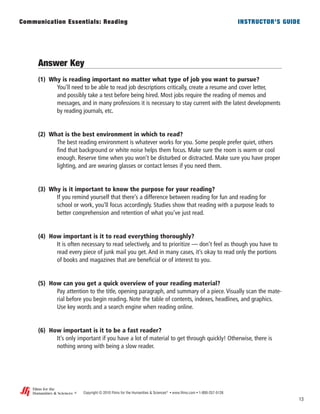
Answer Key
(1) Why is reading important no matter what type of job you want to pursue?
You’ll need to be able to read job descriptions critically, create a resume and cover letter,
and possibly take a test before being hired. Most jobs require the reading of memos and
messages, and in many professions it is necessary to stay current with the latest developments
by reading journals, etc.
(2) What is the best environment in which to read?
The best reading environment is whatever works for you. Some people prefer quiet, others
find that background or white noise helps them focus. Make sure the room is warm or cool
enough. Reserve time when you won’t be disturbed or distracted. Make sure you have proper
lighting, and are wearing glasses or contact lenses if you need them.
(3) Why is it important to know the purpose for your reading?
If you remind yourself that there’s a difference between reading for fun and reading for
school or work, you’ll focus accordingly. Studies show that reading with a purpose leads to
better comprehension and retention of what you’ve just read.
(4) How important is it to read everything thoroughly?
It is often necessary to read selectively, and to prioritize –– don’t feel as though you have to
read every piece of junk mail you get. And in many cases, it’s okay to read only the portions
of books and magazines that are beneficial or of interest to you.
(5) How can you get a quick overview of your reading material?
Pay attention to the title, opening paragraph, and summary of a piece. Visually scan the mate-
rial before you begin reading. Note the table of contents, indexes, headlines, and graphics.
Use key words and a search engine when reading online.
(6) How important is it to be a fast reader?
It’s only important if you have a lot of material to get through quickly! Otherwise, there is
nothing wrong with being a slow reader.
13
Copyright © 2010 Films for the Humanities & Sciences®
• www.films.com • 1-800-257-5126
Communication Essentials: Reading INSTRUCTOR’S GUIDE
®
Films for the
Humanities & Sciences
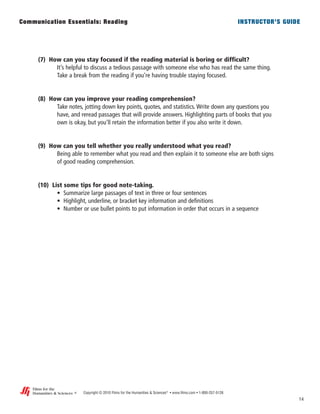
(7) How can you stay focused if the reading material is boring or difficult?
It’s helpful to discuss a tedious passage with someone else who has read the same thing.
Take a break from the reading if you’re having trouble staying focused.
(8) How can you improve your reading comprehension?
Take notes, jotting down key points, quotes, and statistics. Write down any questions you
have, and reread passages that will provide answers. Highlighting parts of books that you
own is okay, but you’ll retain the information better if you also write it down.
(9) How can you tell whether you really understood what you read?
Being able to remember what you read and then explain it to someone else are both signs
of good reading comprehension.
(10) List some tips for good note-taking.
• Summarize large passages of text in three or four sentences
• Highlight, underline, or bracket key information and definitions
• Number or use bullet points to put information in order that occurs in a sequence
14
Copyright © 2010 Films for the Humanities & Sciences®
• www.films.com • 1-800-257-5126
Communication Essentials: Reading INSTRUCTOR’S GUIDE
®
Films for the
Humanities & Sciences
40421
Copyright © 2010 Films for the Humanities & Sciences®
• www.films.com • 1-800-257-5126
A Wealth of Information. A World of Ideas.
®
Films for the
Humanities & Sciences i

COMMUNICATION ESSENTIALS (Instructor's Guide).pdf

  • 1.
    Copyright © 2010Films for the Humanities & Sciences® • www.films.com • 1-800-257-5126 ® Films for the Humanities & Sciences Instructor’s Guide COMMUNICATION ESSENTIALS Talent, ambition, and great ideas won’t amount to much if they’re not supported by good communica- tion. This four-part series helps high school and college students improve their communication skills in four critical areas: listening, speaking, writing, and reading. Viewers are challenged to improve their habits and aim for several concrete goals—such as the ability to actively participate in discussions and meetings, to craft effective messages in speech or text, to process and understand workplace communication, and more. The series includes • Listening Essentials • Speaking Essentials • Writing Essentials • Reading Essentials A Wealth of Information. A World of Ideas. ® Films for the Humanities & Sciences i 1
  • 2.
    LISTENING ESSENTIALS Highlighting theidea that a major part of good communication is good listening, this program enables students to improve their listening skills and absorb valuable information. The video identifies the best methods for giving coworkers the attention they deserve and provides eight simple tips that viewers can use to sharpen concentration. These include learning to focus, taking proper notes, put- ting emotions on hold, avoiding biases and stereotypes, finding a point of interest in a dull but important conversation, and more. Chapter 1: Introduction Chapter 2: Negative Effects of Poor Listening (Did You Say Something?) Chapter 3: Types of Listening (Listening Begins) Chapter 4: Interpreting Nonverbal Communication (Nonverbal Communication) Chapter 5: What Prevents Good Listening (Not Listening) Chapter 6: Tips for Effective Listening (Listen Up) Chapter 7: Good Listener’s Checklist (Keep Listening) Review (1) List some factors that cause us to be poor listeners. (2) What are the four types of listening? (3) List the three important roles that nonverbal signals play in communication. (4) Give some examples of nonverbal communication. (5) True or False? Nonverbal cues speak louder than words. (6) List three facets of effective listening. (7) List some barriers that interrupt the listening process. (8) List at least five tips for being a more effective listener. (9) Name at least five points from the Good Listener’s Checklist. (10) What are some of the benefits of improving your listening skills? 2 Copyright © 2010 Films for the Humanities & Sciences® • www.films.com • 1-800-257-5126 Communication Essentials: Listening INSTRUCTOR’S GUIDE ® Films for the Humanities & Sciencesi
  • 3.
    Answer Key (1) Listsome factors that cause us to be poor listeners. • Schools teach reading, speaking, and writing skills, but not listening skills • There are physical and mental barriers that interrupt our listening process • Listeners can process what they are hearing quicker than speakers can finish talking, so they tend to daydream (2) What are the four types of listening? • Content (listening to gather information) • Critical (evaluating the message, separating fact from opinion) • Empathetic (understanding the speaker’s feelings) • Active (ignoring distractions, tuning in to what the speaker is saying, listening without bias) (3) List the three important roles that nonverbal signals play in communication. • They reinforce the spoken word • They reveal the truth, often without speakers (and listeners) being aware of the message they are sending • They convey information efficiently (4) Give some examples of nonverbal communication. • Facial expressions (making eye contact, rolling your eyes) • Body movement (slouching, leaning towards the other person) • Vocal characteristics (tone of voice, volume, pitch, speed) (5) True or False? Nonverbal cues speak louder than words. True. (6) List three facets of effective listening. • Consider all the information being given • Be aware of your own biases • Don’t jump to conclusions 3 Copyright © 2010 Films for the Humanities & Sciences® • www.films.com • 1-800-257-5126 Communication Essentials: Listening INSTRUCTOR’S GUIDE ® Films for the Humanities & Sciencesi
  • 4.
    (7) List somebarriers that interrupt the listening process. • Being consumed by your own emotions (anger, anxiety, disappointment) while listening • A noisy environment (traffic sounds, other conversations, TV) • You can’t stop thinking about things you have to do • Judging the speaker unfairly due to your own biases (e.g., making assumptions about the speaker based on their accent, hairstyle, age, race, etc.) • Becoming bored when you’re not interested in what’s being said • Tuning out because you disagree with the speaker’s opinion or beliefs (8) List at least five tips for being a more effective listener. • Put your emotions on hold • Assume the best of the speaker –– don’t be biased due to their age, race, personal style, etc. • Keep listening even if you strongly disagree with an opinion being stated –– acknowledge the speaker’s point, then offer your side • Show empathy (make eye contact, nod, ask questions) • Focus on what the speaker is saying, not on your to-do list. • If the speaker is boring, try to find something interesting in what they’re saying • When appropriate, take notes • Practice! Like any skill, the more you practice it, the better you’ll become (9) Name at least five points from the Good Listener’s Checklist. • Stop talking, and concentrate on the speaker • Listen attentively • Block out competing thoughts • Control the listening environment (turn off TV, phone, move to a quieter location) • Maintain an open mind • Provide verbal and nonverbal feedback • Take notes • Pay attention to nonverbal communication along with spoken words • Capitalize on lag time by organizing and reviewing information (10) What are some of the benefits of improving your listening skills? • For students: listening attentively helps you gather the information you need to complete your studies successfully • For professionals: listening is critical to understanding your role in the job, to building trust, and meeting your company’s needs • In your personal life: listening carefully makes you stand out as a trusted friend, and helps build harmonious relationships 4 Copyright © 2010 Films for the Humanities & Sciences® • www.films.com • 1-800-257-5126 Communication Essentials: Listening INSTRUCTOR’S GUIDE ® Films for the Humanities & Sciencesi
  • 5.
    SPEAKING ESSENTIALS Does givinga typical business presentation put a person in mortal danger? Of course not, but statis- tics suggest that many people dread public speaking more than they fear death. This program shows students ways to overcome that kind of paralysis and transform it into positive energy. These include thorough preparation (from learning the wants and needs of the audience to scoping out the location at which the speech will take place) as well as starting with a strong opener, finding the right pace, using nonverbal communication, and more. Chapter 1: Introduction Chapter 2: Know Your Audience Chapter 3: Know the Speaking Location (Know Your Space) Chapter 4: Speech Preparation (Be Prepared) Chapter 5: Prepare a Strong Opener Chapter 6: Using Notes and PowerPoint Chapter 7: Using Nonverbal Communication Chapter 8: Helpful Speaking Tips Chapter 9: Ending Your Speech Chapter 10: Summary & Checklist Review (1) What is the first rule of public speaking? (2) What are the four types of audience, and how can you tailor your presentation to each? (3) Give at least four tips that will help you connect with your audience. (4) One way to reduce nervousness before a presentation is by visiting ahead of time the room where you’ll be presenting. What should you be checking for here? (5) List some ways to write an effective speech. (6) What are some good ways to begin your presentation? (7) List some ways to effectively deliver a speech. (8) What are some Dos and Don’ts for using PowerPoint or slides? (9) List some ways to use nonverbal communication to enhance your presentation. (10) Give at least five tips for an effective presentation. 5 Copyright © 2010 Films for the Humanities & Sciences® • www.films.com • 1-800-257-5126 Communication Essentials: Speaking INSTRUCTOR’S GUIDE ® Films for the Humanities & Sciencesi
  • 6.
    Answer Key (1) Whatis the first rule of public speaking? Learn as much as you can about your audience, and what they want or need to hear. (2) What are the four types of audience, and how can you tailor your presentation to each? • Friendly: They like you and your topic. Use lots of smiles, personal stories, and humor. • Neutral: They are calm and neutral. You should present both sides of the issue, and use facts and statistics. It’s best to avoid humor and personal stories. • Uninterested: They may be there against their will. Be dynamic, entertaining, and brief (make no more than three points). • Hostile: They are defensive and emotional. Be calm, speak evenly and slowly, and use a noncontroversial delivery. (3) Give at least four tips that will help you connect with your audience. • Consider their age, gender, education, experience, and culture • Consider the size of the audience • Take into account how knowledgeable they are about the topic, and any issues that are important to them • Make sure to address any key decision makers in the crowd • Try to greet and mingle with the crowd before beginning your presentation • Remember why you are speaking to this group, and keep those reasons in mind (4) One way to reduce nervousness before a presentation is by visiting ahead of time the room where you’ll be presenting. What should you be checking for here? • Make sure the audience can see you from the speaking location • Check the sound system, teleprompter, and any other technological aids you’ll be using. If you’ll need an electrical outlet, make sure there’s one nearby • If you want a podium, make sure there will be one in the room before you arrive • Make sure the lighting won’t be too dim • If there are windows, try to make your speech facing them so that the audience won’t be distracted by activity outside • Check the background you’ll be standing in front of, and make sure your clothing doesn’t blend in or contrast too sharply • If you can’t visit the space beforehand, speak on the phone with someone at the venue who can answer your questions about it 6 Copyright © 2010 Films for the Humanities & Sciences® • www.films.com • 1-800-257-5126 Communication Essentials: Speaking INSTRUCTOR’S GUIDE ® Films for the Humanities & Sciencesi
  • 7.
    (5) List someways to write an effective speech. • Start by creating an outline: Tell the audience what you are going to tell them; Tell them; Tell them what you just told them. • Know your audience, and make sure the speech is appropriate for them • Use a good story, give examples, and state facts • Use a compelling title • Make sure your writing style is easy to understand; avoid jargon and technical language (unless it’s crucial to the topic of the speech) • Compile a bibliography so you can cite your sources if necessary • Research your topic thoroughly so that you feel confident speaking about it. Have quotes and statistics available. Prepare more information than you think you need, so you’ll be ready if the audience asks questions. • Any handouts should be short, simple, and easy to use (6) What are some good ways to begin your presentation? • Have a good, strong opener to get the crowd’s attention • Tell a compelling story about a personal experience • Ask a relevant question, and ask for a show of hands • Start with an icebreaker activity • Begin with an engaging promise (“By the end of this presentation, I will have shown you how to increase sales …”) • Use flattery • Start with a short video clip • Tell a good joke (7) List some ways to effectively deliver a speech. • Use a good, strong opener • Jot down the key points onto index cards (never have the entire speech in front of you, because you may be tempted to simply read it to the crowd) • Practice the speech out loud as often as possible, and time it • If possible, record yourself doing a run-through of the speech (or practice in front of a full length mirror, or with a friend) • Don’t forget to ask the audience for feedback • Save handouts until the end, so the audience won’t be distracted by them 7 Copyright © 2010 Films for the Humanities & Sciences® • www.films.com • 1-800-257-5126 Communication Essentials: Speaking INSTRUCTOR’S GUIDE ® Films for the Humanities & Sciencesi
  • 8.
    (8) What aresome Dos and Don’ts for using PowerPoint or slides? • Do avoid fancy fonts • Don’t make more than six points on one slide • Do proofread your slides • Do make sure everyone can see the screen • Don’t turn your back to the audience (9) List some ways to use nonverbal communication to enhance your presentation. • Walk around, if possible • Use facial expressions and hand gestures • Look people in the eye for about 3 seconds each (10) Give at least five tips for an effective presentation. • Check the room out ahead of time • Practice your speech out loud over and over again • When delivering the speech, vary your tone, pitch, and pace • Take your time • Don’t apologize for being nervous –– if you make a mistake, correct yourself and move on • Relax and have fun –– don’t worry about what the audience thinks of you • Be yourself –– talk as though you’re addressing a group of old friends • Establish eye contact, and move around the room if you can • Give the audience a timeline of your presentation, then stick to it • At the end, summarize key points • Leave time to take questions at the end of the presentation 8 Copyright © 2010 Films for the Humanities & Sciences® • www.films.com • 1-800-257-5126 Communication Essentials: Speaking INSTRUCTOR’S GUIDE ® Films for the Humanities & Sciencesi
  • 9.
    WRITING ESSENTIALS Students who’vehad a hard time with term papers and essay questions may be shocked to learn how much their postgraduation world revolves around writing. This program shows how effective written communication is possible for anyone, even those who struggle to complete a simple fax or e-mail. Methods for improvement include gauging the needs of the reader, keeping prose short and simple, emphasizing benefits, avoiding jargon and overblown language, employing a confident yet respectful tone, and more. Chapter 1: Introduction Chapter 2: Pre-Writing Preparation (Getting Started) Chapter 3: Writing Tips (Writing It Down) Chapter 4: Active vs. Passive Voice Chapter 5: Tone Chapter 6: Proofreading Review (1) What three points should guide you before actually beginning to write? (2) Name three different reasons for writing (for professional or academic reasons). (3) What are some factors you should consider when identifying your audience? (4) List some tips for good business writing. (5) What is the difference between the active voice and the passive voice? (6) When should the passive voice be used? (7) What are some ways to organize your work? (8) Give at least four ways to use the correct tone in your writing. (9) True or False? It’s okay to use a casual tone for writing email. (10) List at least five proofreading tips. 9 Copyright © 2010 Films for the Humanities & Sciences® • www.films.com • 1-800-257-5126 Communication Essentials: Writing INSTRUCTOR’S GUIDE ® Films for the Humanities & Sciencesi
  • 10.
    Answer Key (1) Whatthree points should guide you before actually beginning to write? • Defining your purpose • Identifying your reader • Pinpointing the key points of your message (2) Name three different reasons for writing (for professional or academic reasons). • Writing to persuade someone, such as a cover letter, college application essay, or business proposal • Writing to describe something, such as the minutes of a meeting • Writing to explain something, such as a memo about how to access a folder on a shared computer network (3) What are some factors you should consider when identifying your audience? • Who are my primary readers? • What is my relationship to them? • What position do they hold in the organization? • How much do they know about the subject? • What do I know about their education, beliefs, culture, attitudes? • What sort of response should I expect from them? • Who else might see this? (4) List some tips for good business writing. • Your purpose should be stated in the opening of your piece • Use simple words and phrases • Avoid jargon • Stick with the topic • Keep it short; get to the point • Use the active voice whenever possible (5) What is the difference between the active voice and the passive voice? In the active voice, the subject performs the action: “Jane shut the door,” versus “The door was shut by Jane.” 10 Copyright © 2010 Films for the Humanities & Sciences® • www.films.com • 1-800-257-5126 Communication Essentials: Writing INSTRUCTOR’S GUIDE ® Films for the Humanities & Sciences
  • 11.
    (6) When shouldthe passive voice be used? Use the passive voice when you want to be diplomatic, to soften bad news, to depersonalize an action, to avoid sounding accusatory: “Applications should be submitted on time,” versus “Submit your applications on time.” (7) What are some ways to organize your work? • Before starting to write, map out the information that’s most important to your reader • Use paragraphs, bullet points, headings, and sub-headings (8) Give at least four ways to use the correct tone in your writing. • Be confident, but not arrogant • Be polite, especially when sending a negative message • Use neutral, unbiased language (such as salesperson, not salesman) • Never use slang • Use an appropriate reading level for your reader –– consider their age and experience when choosing your words and phrases • Write conversationally –– read the piece aloud to make sure it sounds natural (9) True or False? It’s okay to use a casual tone for writing email. Any emails sent for business or professional reasons (such as inquiring about a job opening) should follow the guidelines for business writing. (10) List at least five proofreading tips. • Don’t rely on spell-check • Take a break between writing and proofreading, so you can assess the piece with a fresh outlook • Proofread a print-out, not on the computer screen (your eyes will wander less) • Proofread twice, checking first for clarity and conciseness, and then for grammar, spelling, and punctuation errors • Check for missing elements, such as drawings, tables, or charts • Look over the layout and design, paying attention to fonts, spacing, and margins • Be on the lookout for commonly misused words (they’re, their; your, you’re) • Have someone else proofread the piece, too 11 Copyright © 2010 Films for the Humanities & Sciences® • www.films.com • 1-800-257-5126 Communication Essentials: Writing INSTRUCTOR’S GUIDE ® Films for the Humanities & Sciences
  • 12.
    READING ESSENTIALS A torrentof e-mails, faxes, memos, reports, contracts, and newsletters threatens to drown the typical new hire in a sea of paper and text. With simple methods for tackling an immense volume of content, this program helps students manage workplace reading tasks quickly and efficiently without overlook- ing important information. Featured tips show viewers how to stay focused, prioritize reading matter, and create a comfortable reading environment—while making the best use of tables of contents, indexes, sub-headings, and more. Chapter 1: Introduction Chapter 2: Becoming a Better Reader Chapter 3: Tip 1: Reading Environment Chapter 4: Tip 2: Know Your Purpose Chapter 5: Tip 3: Read Selectively Chapter 6: Tip 4: Prioritize Chapter 7: Tip 5: Scan First Chapter 8: Tip 6: Keep Reading Chapter 9: Tip 7: Stay Focused Chapter 10: Tip 8: Take Notes Chapter 11: Practice Review (1) Why is reading important no matter what type of job you want to pursue? (2) What is the best environment in which to read? (3) Why is it important to know the purpose for your reading? (4) How important is it to read everything thoroughly? (5) How can you get a quick overview of your reading material? (6) How important is it to be a fast reader? (7) How can you stay focused if the reading material is boring or difficult? (8) How can you improve your reading comprehension? (9) How can you tell whether you really understood what you read? (10) List some tips for good note-taking. 12 Copyright © 2010 Films for the Humanities & Sciences® • www.films.com • 1-800-257-5126 Communication Essentials: Reading INSTRUCTOR’S GUIDE ® Films for the Humanities & Sciences
  • 13.
    Answer Key (1) Whyis reading important no matter what type of job you want to pursue? You’ll need to be able to read job descriptions critically, create a resume and cover letter, and possibly take a test before being hired. Most jobs require the reading of memos and messages, and in many professions it is necessary to stay current with the latest developments by reading journals, etc. (2) What is the best environment in which to read? The best reading environment is whatever works for you. Some people prefer quiet, others find that background or white noise helps them focus. Make sure the room is warm or cool enough. Reserve time when you won’t be disturbed or distracted. Make sure you have proper lighting, and are wearing glasses or contact lenses if you need them. (3) Why is it important to know the purpose for your reading? If you remind yourself that there’s a difference between reading for fun and reading for school or work, you’ll focus accordingly. Studies show that reading with a purpose leads to better comprehension and retention of what you’ve just read. (4) How important is it to read everything thoroughly? It is often necessary to read selectively, and to prioritize –– don’t feel as though you have to read every piece of junk mail you get. And in many cases, it’s okay to read only the portions of books and magazines that are beneficial or of interest to you. (5) How can you get a quick overview of your reading material? Pay attention to the title, opening paragraph, and summary of a piece. Visually scan the mate- rial before you begin reading. Note the table of contents, indexes, headlines, and graphics. Use key words and a search engine when reading online. (6) How important is it to be a fast reader? It’s only important if you have a lot of material to get through quickly! Otherwise, there is nothing wrong with being a slow reader. 13 Copyright © 2010 Films for the Humanities & Sciences® • www.films.com • 1-800-257-5126 Communication Essentials: Reading INSTRUCTOR’S GUIDE ® Films for the Humanities & Sciences
  • 14.
    (7) How canyou stay focused if the reading material is boring or difficult? It’s helpful to discuss a tedious passage with someone else who has read the same thing. Take a break from the reading if you’re having trouble staying focused. (8) How can you improve your reading comprehension? Take notes, jotting down key points, quotes, and statistics. Write down any questions you have, and reread passages that will provide answers. Highlighting parts of books that you own is okay, but you’ll retain the information better if you also write it down. (9) How can you tell whether you really understood what you read? Being able to remember what you read and then explain it to someone else are both signs of good reading comprehension. (10) List some tips for good note-taking. • Summarize large passages of text in three or four sentences • Highlight, underline, or bracket key information and definitions • Number or use bullet points to put information in order that occurs in a sequence 14 Copyright © 2010 Films for the Humanities & Sciences® • www.films.com • 1-800-257-5126 Communication Essentials: Reading INSTRUCTOR’S GUIDE ® Films for the Humanities & Sciences
  • 15.
    40421 Copyright © 2010Films for the Humanities & Sciences® • www.films.com • 1-800-257-5126 A Wealth of Information. A World of Ideas. ® Films for the Humanities & Sciences i