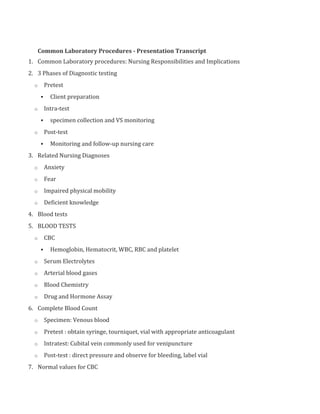
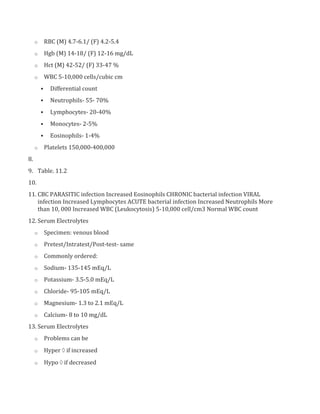
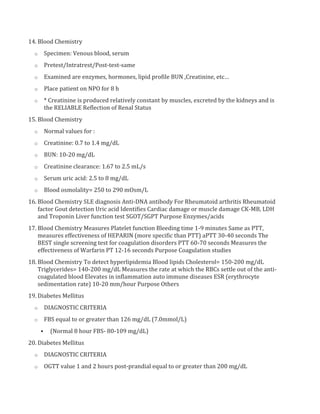
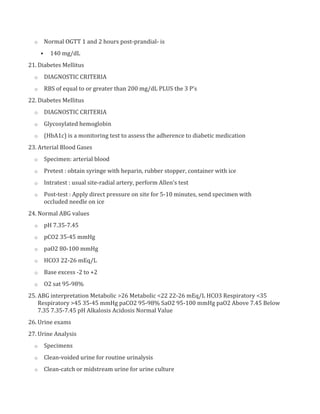
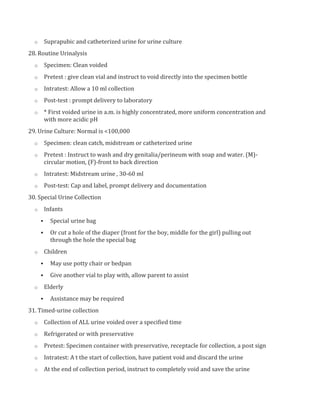
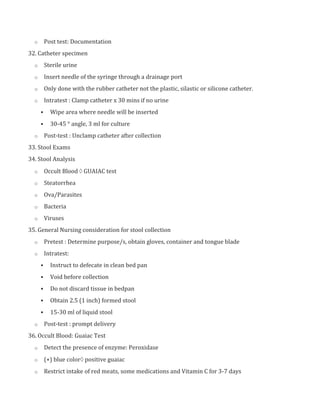
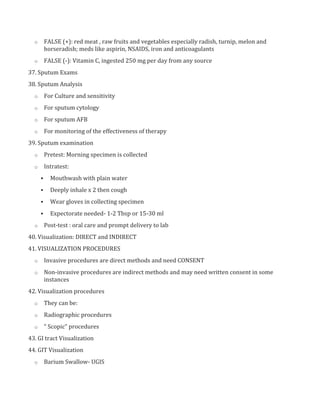
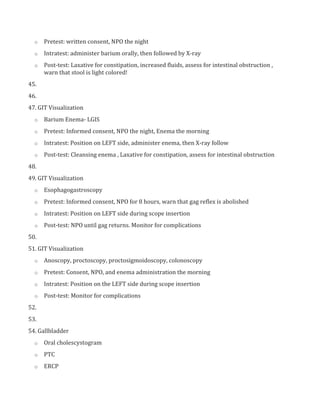
Common Laboratory Procedures - Presentation Transcript<br />Common Laboratory procedures: Nursing Responsibilities and Implications<br />3 Phases of Diagnostic testing<br />Pretest<br />Client preparation<br />Intra-test<br />specimen collection and VS monitoring<br />Post-test<br />Monitoring and follow-up nursing care<br />Related Nursing Diagnoses<br />Anxiety<br />Fear<br />Impaired physical mobility<br />Deficient knowledge<br />Blood tests<br />BLOOD TESTS<br />CBC<br />Hemoglobin, Hematocrit, WBC, RBC and platelet<br />Serum Electrolytes<br />Arterial blood gases<br />Blood Chemistry<br />Drug and Hormone Assay<br />Complete Blood Count<br />Specimen: Venous blood<br />Pretest : obtain syringe, tourniquet, vial with appropriate anticoagulant<br />Intratest: Cubital vein commonly used for venipuncture<br />Post-test : direct pressure and observe for bleeding, label vial<br />Normal values for CBC<br />RBC (M) 4.7-6.1/ (F) 4.2-5.4<br />Hgb (M) 14-18/ (F) 12-16 mg/dL<br />Hct (M) 42-52/ (F) 33-47 %<br />WBC 5-10,000 cells/cubic cm<br />Differential count<br />Neutrophils- 55- 70%<br />Lymphocytes- 20-40%<br />Monocytes- 2-5%<br />Eosinophils- 1-4%<br />Platelets 150,000-400,000<br /> <br />Table. 11.2<br /> <br />CBC PARASITIC infection Increased Eosinophils CHRONIC bacterial infection VIRAL infection Increased Lymphocytes ACUTE bacterial infection Increased Neutrophils More than 10, 000 Increased WBC (Leukocytosis) 5-10,000 cell/cm3 Normal WBC count<br />Serum Electrolytes<br />Specimen: venous blood<br />Pretest/Intratest/Post-test- same<br />Commonly ordered:<br />Sodium- 135-145 mEq/L<br />Potassium- 3.5-5.0 mEq/L<br />Chloride- 95-105 mEq/L<br />Magnesium- 1.3 to 2.1 mEq/L<br />Calcium- 8 to 10 mg/dL<br />Serum Electrolytes<br />Problems can be<br />Hyper  if increased<br />Hypo  if decreased<br />Blood Chemistry<br />Specimen: Venous blood, serum<br />Pretest/Intratrest/Post-test-same<br />Examined are enzymes, hormones, lipid profile BUN , Creatinine, etc…<br />Place patient on NPO for 8 h<br />* Creatinine is produced relatively constant by muscles, excreted by the kidneys and is the RELIABLE Reflection of Renal Status<br />Blood Chemistry<br />Normal values for :<br />Creatinine: 0.7 to 1.4 mg/dL<br />BUN: 10-20 mg/dL<br />Creatinine clearance: 1.67 to 2.5 mL/s<br />Serum uric acid: 2.5 to 8 mg/dL<br />Blood osmolality= 250 to 290 mOsm/L<br />Blood Chemistry SLE diagnosis Anti-DNA antibody For Rheumatoid arthritis Rheumatoid factor Gout detection Uric acid Identifies Cardiac damage or muscle damage CK-MB, LDH and Troponin Liver function test SGOT/SGPT Purpose Enzymes/acids<br />Blood Chemistry Measures Platelet function Bleeding time 1-9 minutes Same as PTT, measures effectiveness of HEPARIN (more specific than PTT) aPTT 30-40 seconds The BEST single screening test for coagulation disorders PTT 60-70 seconds Measures the effectiveness of Warfarin PT 12-16 seconds Purpose Coagulation studies<br />Blood Chemistry To detect hyperlipidemia Blood lipids Cholesterol= 150-200 mg/dL Triglycerides= 140-200 mg/dL Measures the rate at which the RBCs settle out of the anti-coagulated blood Elevates in inflammation auto immune diseases ESR (erythrocyte sedimentation rate) 10-20 mm/hour Purpose Others<br />Diabetes Mellitus<br />DIAGNOSTIC CRITERIA<br />FBS equal to or greater than 126 mg/dL (7.0mmol/L)<br />(Normal 8 hour FBS- 80-109 mg/dL)<br />Diabetes Mellitus<br />DIAGNOSTIC CRITERIA<br />OGTT value 1 and 2 hours post-prandial equal to or greater than 200 mg/dL<br />Normal OGTT 1 and 2 hours post-prandial- is<br />140 mg/dL<br />Diabetes Mellitus<br />DIAGNOSTIC CRITERIA<br />RBS of equal to or greater than 200 mg/dL PLUS the 3 P’s<br />Diabetes Mellitus<br />DIAGNOSTIC CRITERIA<br />Glycosylated hemoglobin<br />(HbA1c) is a monitoring test to assess the adherence to diabetic medication<br />Arterial Blood Gases<br />Specimen: arterial blood<br />Pretest : obtain syringe with heparin, rubber stopper, container with ice<br />Intratest : usual site-radial artery, perform Allen’s test<br />Post-test : Apply direct pressure on site for 5-10 minutes, send specimen with occluded needle on ice<br />Normal ABG values<br />pH 7.35-7.45<br />pCO2 35-45 mmHg<br />paO2 80-100 mmHg<br />HCO3 22-26 mEq/L<br />Base excess -2 to +2<br />O2 sat 95-98%<br />ABG interpretation Metabolic >26 Metabolic <22 22-26 mEq/L HCO3 Respiratory <35 Respiratory >45 35-45 mmHg paCO2 95-98% SaO2 95-100 mmHg paO2 Above 7.45 Below 7.35 7.35-7.45 pH Alkalosis Acidosis Normal Value<br />Urine exams<br />Urine Analysis<br />Specimens<br />Clean-voided urine for routine urinalysis<br />Clean-catch or midstream urine for urine culture<br />Suprapubic and catheterized urine for urine culture<br />Routine Urinalysis<br />Specimen: Clean voided<br />Pretest : give clean vial and instruct to void directly into the specimen bottle<br />Intratest: Allow a 10 ml collection<br />Post-test : prompt delivery to laboratory<br />* First voided urine in a.m. is highly concentrated, more uniform concentration and with more acidic pH<br />Urine Culture: Normal is <100,000<br />Specimen: clean catch, midstream or catheterized urine<br />Pretest : Instruct to wash and dry genitalia/perineum with soap and water. (M)- circular motion, (F)-front to back direction<br />Intratest: Midstream urine , 30-60 ml<br />Post-test: Cap and label, prompt delivery and documentation<br />Special Urine Collection<br />Infants<br />Special urine bag<br />Or cut a hole of the diaper (front for the boy, middle for the girl) pulling out through the hole the special bag<br />Children<br />May use potty chair or bedpan<br />Give another vial to play with, allow parent to assist<br />Elderly<br />Assistance may be required<br />Timed-urine collection<br />Collection of ALL urine voided over a specified time<br />Refrigerated or with preservative<br />Pretest: Specimen container with preservative, receptacle for collection, a post sign<br />Intratest: A t the start of collection, have patient void and discard the urine<br />At the end of collection period, instruct to completely void and save the urine<br />Post test: Documentation<br />Catheter specimen<br />Sterile urine<br />Insert needle of the syringe through a drainage port<br />Only done with the rubber catheter not the plastic, silastic or silicone catheter.<br />Intratest : Clamp catheter x 30 mins if no urine<br />Wipe area where needle will be inserted<br />30-45 ° angle, 3 ml for culture<br />Post-test : Unclamp catheter after collection<br />Stool Exams<br />Stool Analysis<br />Occult Blood  GUAIAC test<br />Steatorrhea<br />Ova/Parasites<br />Bacteria<br />Viruses<br />General Nursing consideration for stool collection<br />Pretest : Determine purpose/s, obtain gloves, container and tongue blade<br />Intratest:<br />Instruct to defecate in clean bed pan<br />Void before collection<br />Do not discard tissue in bedpan<br />Obtain 2.5 (1 inch) formed stool<br />15-30 ml of liquid stool<br />Post-test : prompt delivery<br />Occult Blood: Guaiac Test<br />Detect the presence of enzyme: Peroxidase<br />(+) blue color  positive guaiac<br />Restrict intake of red meats, some medications and Vitamin C for 3-7 days<br />FALSE (+): red meat , raw fruits and vegetables especially radish, turnip, melon and horseradish; meds like aspirin, NSAIDS, iron and anticoagulants<br />FALSE (-): Vitamin C, ingested 250 mg per day from any source<br />Sputum Exams<br />Sputum Analysis<br />For Culture and sensitivity<br />For sputum cytology<br />For sputum AFB<br />For monitoring of the effectiveness of therapy<br />Sputum examination<br />Pretest: Morning specimen is collected<br />Intratest:<br />Mouthwash with plain water<br />Deeply inhale x 2 then cough<br />Wear gloves in collecting specimen<br />Expectorate needed- 1-2 Tbsp or 15-30 ml<br />Post-test : oral care and prompt delivery to lab<br />Visualization: DIRECT and INDIRECT<br />VISUALIZATION PROCEDURES<br />Invasive procedures are direct methods and need CONSENT<br />Non-invasive procedures are indirect methods and may need written consent in some instances<br />Visualization procedures<br />They can be:<br />Radiographic procedures<br />“ Scopic” procedures<br />GI tract Visualization<br />GIT Visualization<br />Barium Swallow- UGIS<br />Pretest: written consent, NPO the night<br />Intratest: administer barium orally, then followed by X-ray<br />Post-test: Laxative for constipation, increased fluids, assess for intestinal obstruction , warn that stool is light colored!<br /> <br /> <br />GIT Visualization<br />Barium Enema- LGIS<br />Pretest: Informed consent, NPO the night, Enema the morning<br />Intratest: Position on LEFT side, administer enema, then X-ray follow<br />Post-test: Cleansing enema , Laxative for constipation, assess for intestinal obstruction<br /> <br />GIT Visualization<br />Esophagogastroscopy<br />Pretest: Informed consent, NPO for 8 hours, warn that gag reflex is abolished<br />Intratest: Position on LEFT side during scope insertion<br />Post-test: NPO until gag returns. Monitor for complications<br /> <br />GIT Visualization<br />Anoscopy, proctoscopy, proctosigmoidoscopy, colonoscopy<br />Pretest: Consent, NPO, and enema administration the morning<br />Intratest: Position on the LEFT side during scope insertion<br />Post-test: Monitor for complications<br /> <br /> <br />Gallbladder<br />Oral cholescystogram<br />PTC<br />ERCP<br />Ultrasound<br />IV Cholecystogram<br />X-ray visualization of the gallbladder after administration of contrast media intravenously<br />Pre-test: Allergy to iodine and sea-foods<br />Intra-test: ensure patent IV line<br />Post-test: increase fluid intake to flush out the dye, Assess for delayed hypersensitivity reaction to the dye like chills and N/V<br /> <br />Oral Cholecystogram<br />X-ray visualization of the gallbladder after administration of contrast media<br />Done 10 hours after ingestion of contrast tablets<br />Done to determine the patency of biliary duct<br /> <br /> <br />Endoscopic retrograde cholangiopancreatography<br />Examination where a flexible endoscope is inserted into the mouth and via the common bile duct and pancreatic duct to visualize the structures<br />Iodinated dye can also be injected after for the x-ray procedure<br />Endoscopic retrograde cholangiopancreatography<br />Pre-test: consent, NPO for 12 hours, Allergy to sea-foods, Atropine sulfate<br />Intra-test: Gag reflex is abolished, Position on LEFT side<br />Post-test: NPO until gag reflex returns, Position side lying and monitor for perforation and hemorrhage<br /> <br /> <br /> <br />Percutaneous Transhepatic Cholangiogram<br />Under fluoroscopy, the bile duct is entered percutaneously and injected with a dye to observe filling of hepatic and biliary ducts<br /> <br />Ultrasound of the liver, gallbladder and pancreas<br />Consent MAY be needed<br />Place patient on NPO!!!<br />Laxative may be given to decrease the bowel gas<br />urinary visualization<br />Urinary Visualization<br />Non-invasive: KUB, IVP, Ultrasound<br />Pretest: Elicit allergy to iodine and seafood, NPO after midnight<br />Intra-test: IV iodinated Dye is administered then X-ray is taken<br />Post-test: Increase fluids to flush the dye. Documentation, VS monitoring<br /> <br /> <br />Urinary Visualization<br />Invasive: retrograde cystourethrogram<br />Pretest: Elicit allergy to iodine and seafood<br />Intra-test: catheter is inserted with dye is administered then X-ray is taken as patient voids<br />Post-test: Increase fluids to flush the dye. Documentation, VS monitoring<br /> <br />Pulmonary test<br />Pulmonary visualization<br />Invasive: Bronchoscopy, laryngoscopy<br />Non-invasive: CXR and Scan<br />Bronchoscopy<br />Purpose: Diagnostic and therapeutic<br />Pretest: Consent, NPO, client teaching, anti-anxiety drugs<br />Intratest : gag reflex is abolished, instruct to remain still during procedure, FOWLER or SUPINE<br />Post-test : NPO until gag reflex returns, monitor patient for complication like perforation/bleed<br /> <br /> <br />Pulmonary function test<br />Test to determine lung volumes and capacities<br /> <br /> <br />LUNG VOLUMES<br />1. Tidal volume – TV<br />2. Inspiratory Reserve Volume- IRV<br />3. Expiratory Reserve Volume- ERV<br />4. Residual volume- RV<br />LUNG CAPACITIES<br />Lung volume + another lung volume<br />1. Inspiratory Capacity- IC<br />2. Functional Residual Capacity- FRC<br />3. Vital capacity- VC<br />4. Total Lung capacity- TLC<br />Pulmonary &quot;Volumes”<br />1. Tidal Volume:<br />-volume of air inspired or expired with each normal breath, about 500ml<br />2. Inspiratory Reserve Volume<br />-extra volume of air than can be inspired over & beyond the normal tidal volume, about 3000ml<br />Pulmonary &quot;Volumes”<br />3. Expiratory Reserve Volume<br />-amount of air that can still be expired by forceful expiration after the end of a normal tidal expiration<br />-about 1100ml<br />4. Residual Volume<br />-volume of air still remaining in the lungs after the most forceful expiration, averages about 1200ml<br />Pulmonary &quot;Capacities:&quot;<br />1. Inspiratory Capacity<br />-equals TV + IRV, about 3500ml<br />-amount of air that a person can breathe beginning at the normal expiratory level & distending his lungs to maximum amount<br />2. Functional Residual Capacity<br />-equals ERV + RV<br />-about amount of air remaining in the lungs at the end of normal expiration, about 2300ml<br />Pulmonary &quot;Capacities:&quot;<br />3. Vital Capacity<br />-equals IRV + TV + ERV or 1C + ERV, about 4600ml<br />-maximum amount of air that a person can expel from the lungs after filling the lungs to their maximum extent & expiring to the maximum extent<br />4. Total Lung Capacity<br />-maximum volume to which the lungs can be expanded with the greatest possible effort<br />-volume of air in the lungs at this level is equal to FRC (2300ml) in young adult<br />Heart exams<br />Cardiac Visualization<br />Invasive: angiography. Cardiac catheterization<br />Non-invasive: ECG, Echocardiography, Stress ECG<br />The Cardiovascular System LABORATORY PROCEDURES<br />ECHOCARDIOGRAM<br />Non-invasive test that studies the structural and functional changes of the heart with the use of ultrasound<br />No special preparation is needed<br />2 D-echocardiogram<br />Angiography<br />Pretest: informed consent, allergy to dyes, seafood and iodine<br />Intratest: Monitor VS<br />Post-test: maintain pressure dressing over puncture site<br />Immobilize for 6 hours<br /> <br />arteriography<br />Cardiac Catheterization<br />Introduction of catheter into heart chambers<br />Pretest: informed consent, allergy to dyes, seafood and iodine, NPO 8-12 hours<br />Intra-test: Empty bladder, Monitor VS, explain palpitations<br />Post-test: maintain pressure dressing over puncture site<br />Immobilize for 6-8 hours with extremity straight<br />Spinal column<br />Myelography<br />Radiographic examination of the spinal column and sub-arachnoid space to help diagnose back pain causes<br />Pre-test: Consent, NPO, allergy to seafoods<br />Intra-test: like LT<br />Post-test: supine for 12 hours<br />Myelography<br />Arthroscopy<br />Insertion of fiber optic scope into the joint to visualize it, perform biopsy<br />Performed under OR condition<br />After care: Dressing over the puncture site for 24 hours to prevent bleeding<br />Limit activity for several days (7 usually)<br /> <br />Arthrogram<br />X-ray visualization of the joint after introduction of contrast medium<br />Pre-test: consent, allergy to seafoods<br />Post-test: Dressing over puncture site and limit joint activity<br /> <br />Electromyelography<br />Records the electrical activity in muscles at rest and during involuntary and electrical stimulation<br />Detects disorders such as MG, MS and Parkinson’s<br />Explain the use of electrode inserted into the muscles<br />Mild discomfort may be experienced<br />About 45 minutes for one muscle<br /> <br />Scans<br />CT scan<br />Painless, non-invasive, x-ray procedure<br />Mechanism: distinguish density of tissues<br /> <br />MRI<br />Painless, non-invasive, no radiation<br />Creates a magnetic field<br />Contraindications:<br />(+) pacemaker<br />(+) metal prosthesis<br />Client teaching:<br />Lie still during the procedure for 60-90 minutes<br />Earplugs to reduce noise discomfort<br />Claustrophobia<br />No radiation<br />MRI<br />PET scan<br />Bone Scan<br />Aspiration and Biopsy<br />ASPIRATION AND BIOSPY<br />Aspiration : withdrawal of fluid<br />Biopsy : removal and exam of tissue<br />Invasive procedure needs INFORMED CONSENT<br />Lumbar Puncture<br />Withdrawal of CSF from the arachnoid space<br />Purpose: diagnostic and therapeutic<br />To obtain specimen, relieve pressure and inject medication<br />Pretest: consent, empty bladder<br />Lumbar Puncture<br />Intra-test: Site used-between L4/L5<br />Position- flexion of the trunk<br />Post-test: Flat on bed (8-12 hours)<br />Offer fluids to 3 Liters<br />Oral analgesic for headache<br />Monitor bleeding, swelling and changes in neurologic status<br /> <br /> <br />Abdominal Paracentesis<br />Withdrawal of fluid from the peritoneal space<br />Purpose: diagnostic and therapeutic<br />Pretest: consent, empty bladder<br />Position: sitting<br />Site: midway between the umbilicus and symphysis<br />Abdominal Paracentesis<br />Intratest: 1,500 ml maximum amount collected at one time, Monitor VS<br />Post-test : monitor VS, bleeding complication<br />Measure abdominal girth and weight<br /> <br />Thoracentesis<br />Removal of fluid from the pleural space<br />Purpose: Diagnostic and therapeutic<br />Pretest: Consent, teach to avoid coughing<br />Position: sitting with arms above head<br />Thoracentesis<br />Intra-test: Support and observation<br />Post-test: Assess VS<br />Position Post-procedure: lie on the UNAFFECTED SIDE with head elevated 30 ° x 30 minutes to facilitate expansion of the affected lungs<br />Thoracentesis<br /> <br />Bone marrow Biopsy<br />Removal of specimen of bone marrow<br />Purpose: diagnostic<br />Pretest : consent, teach that procedure is painful<br />Site: POSTERIOR SUPERIOR ILIAC CREST (adult); PROXIMAL TIBIA (pedia)<br />Position: prone or lateral<br />Bone marrow Biopsy<br />Intratest: Monitor, maintain pressure dressing over punctured site X 10 mins<br />Post-test: Asses for discomfort, administer prescribed pain meds<br />Liver Biopsy<br />Liver tissue obtained for diagnostic purpose<br />Pretest: consent, administer Vitamin K, monitor bleeding parameters, NPO 2 hours before procedure<br />Position: Supine or semi-fowlers with upper right quadrant of abdomen exposed<br />Liver Biopsy<br />Intra-test : Monitor VS<br />Take few deep inhalation and exhalation and hold final breath in exhalation x 10 seconds as needle is injected<br />Post-test: monitor VS, bleeding<br />Position post-procedure: RIGHT side-lying with folded towel/pillow under biopsy site for 4-6 hours<br />Papanicolau Smear<br />Done as screening test for cervical cancer, for culture<br />Pre-test: no coitus for 2-3 days, no menstrual bleeding<br />Intra-test: Lithotomy, speculum with water for lubrication, specimen obtained for cervix and vagina<br />Post-test: monitor for bleeding<br />Others<br />The Cardiovascular System LABORATORY PROCEDURES<br />ELECTROCARDIOGRAM (ECG)<br />A non-invasive procedure that evaluates the electrical activity of the heart<br />Electrodes and wires are attached to the patient<br /> <br /> <br /> <br />What the waves represent?<br />P wave= Atrial Depolarization<br />QRS= Ventricular Depolarization<br />T wave= Ventricular REPOLARIZATION<br /> <br />LABORATORY PROCEDURES<br />CVP<br />The CVP is the pressure within the SVC<br />Reflects the pressure under which blood is returned to the SVC and right atrium<br />LABORATORY PROCEDURES<br />CVP<br />Normal CVP is 0 to 8 mmHg/ 4-10 cm H2O<br />LABORATORY PROCEDURES<br />Measuring CVP<br />1. Position the client supine with bed elevated at 45 degrees (CBQ)<br />2. Position the zero point of the CVP line at the level of the right atrium. Usually this is at the MAL, 4 th ICS<br />3. Instruct the client to be relaxed and avoid coughing and straining.<br /> <br />Tubes and drainage<br />Tubes<br />Levine<br />Salem Sump tube<br />Gastrostomy tube<br />Jejunostomy tube<br />Salem Sump tube<br /> <br />T-tube<br />Drainage<br />Penrose Drain<br />Hemovac<br />Pleuravac<br />Jackson-Pratt<br />Hemovac<br />Jackson-Pratt<br />Penrose<br />Asked in the local boards<br />DRE<br />Snellen’s chart<br />Weber’s test<br />Rinnes’ test<br />DRE<br />Position: Left Lateral or Sim’s position with upper leg acutely flexed. Females can also be examined in lithotomy<br />Ask client to BEAR DOWN<br />To accentuate rectal fissure, prolapse ,polyps<br />To relax the anal sphincter<br />Snellen’s Chart: test for visual acuity<br />20 ft or 6 m distance<br />3 readings: L, R and Both eyes<br />Report: 20/ xxx<br />Numerator: denotes the distance from the chart<br /> <br />Snellen’s Chart: test for visual acuity<br />Denominator denotes the distance from which the normal eye can read the chart<br />20/60: the person can see at 20 feet, what a normal person can see at 60 feet.<br />Weber’s test<br />Test for lateralization and bone conduction<br />Tuning fork is placed on top of head<br />NORMAL: sound is heard in BOTH ears, localized at the center of the head: WEBER NEGATIVE<br />Weber’s test<br />Sound is heard BETTER in the affected ear: Bone conductive hearing loss<br />Sound is heard only or better on the NORMAL ear: Sensorineural heating loss<br />ABNORMAL: WEBER POSITIVE<br />Rinne’s Test<br />Test for AIR and BONE conduction<br />Tuning fork is initially placed on the mastoid process until no vibration is heard<br />Tuning fork is now placed in front of the ear until sound disappears<br />Rinne’s Test<br />Air conduction is LONGER than bone conduction<br />Normal is POSITIVE Rinne’s<br />Rinne’s Test<br />CONDUCTIVE HEARING LOSS:<br />Bone conduction is GREATER than or equal to the AIR conduction<br />Abnormal is NEGATIVE RINNEs<br />Rinne’s Test<br />SENSORINEURAL HEARING LOSS:<br />No bone conduction and air conduction vibration can be assessed<br />NEGATIVE RINNEs<br />Weber<br />Rinne’s<br />Rinne’s<br />FAILING TO PREPARE<br />IS<br />PREPARING TO FAIL…<br />END<br />
Common laboratory & diagnostic procedures

Common laboratory & diagnostic procedures

  • 1.
    Common Laboratory Procedures- Presentation Transcript<br />Common Laboratory procedures: Nursing Responsibilities and Implications<br />3 Phases of Diagnostic testing<br />Pretest<br />Client preparation<br />Intra-test<br />specimen collection and VS monitoring<br />Post-test<br />Monitoring and follow-up nursing care<br />Related Nursing Diagnoses<br />Anxiety<br />Fear<br />Impaired physical mobility<br />Deficient knowledge<br />Blood tests<br />BLOOD TESTS<br />CBC<br />Hemoglobin, Hematocrit, WBC, RBC and platelet<br />Serum Electrolytes<br />Arterial blood gases<br />Blood Chemistry<br />Drug and Hormone Assay<br />Complete Blood Count<br />Specimen: Venous blood<br />Pretest : obtain syringe, tourniquet, vial with appropriate anticoagulant<br />Intratest: Cubital vein commonly used for venipuncture<br />Post-test : direct pressure and observe for bleeding, label vial<br />Normal values for CBC<br />RBC (M) 4.7-6.1/ (F) 4.2-5.4<br />Hgb (M) 14-18/ (F) 12-16 mg/dL<br />Hct (M) 42-52/ (F) 33-47 %<br />WBC 5-10,000 cells/cubic cm<br />Differential count<br />Neutrophils- 55- 70%<br />Lymphocytes- 20-40%<br />Monocytes- 2-5%<br />Eosinophils- 1-4%<br />Platelets 150,000-400,000<br /> <br />Table. 11.2<br /> <br />CBC PARASITIC infection Increased Eosinophils CHRONIC bacterial infection VIRAL infection Increased Lymphocytes ACUTE bacterial infection Increased Neutrophils More than 10, 000 Increased WBC (Leukocytosis) 5-10,000 cell/cm3 Normal WBC count<br />Serum Electrolytes<br />Specimen: venous blood<br />Pretest/Intratest/Post-test- same<br />Commonly ordered:<br />Sodium- 135-145 mEq/L<br />Potassium- 3.5-5.0 mEq/L<br />Chloride- 95-105 mEq/L<br />Magnesium- 1.3 to 2.1 mEq/L<br />Calcium- 8 to 10 mg/dL<br />Serum Electrolytes<br />Problems can be<br />Hyper if increased<br />Hypo if decreased<br />Blood Chemistry<br />Specimen: Venous blood, serum<br />Pretest/Intratrest/Post-test-same<br />Examined are enzymes, hormones, lipid profile BUN , Creatinine, etc…<br />Place patient on NPO for 8 h<br />* Creatinine is produced relatively constant by muscles, excreted by the kidneys and is the RELIABLE Reflection of Renal Status<br />Blood Chemistry<br />Normal values for :<br />Creatinine: 0.7 to 1.4 mg/dL<br />BUN: 10-20 mg/dL<br />Creatinine clearance: 1.67 to 2.5 mL/s<br />Serum uric acid: 2.5 to 8 mg/dL<br />Blood osmolality= 250 to 290 mOsm/L<br />Blood Chemistry SLE diagnosis Anti-DNA antibody For Rheumatoid arthritis Rheumatoid factor Gout detection Uric acid Identifies Cardiac damage or muscle damage CK-MB, LDH and Troponin Liver function test SGOT/SGPT Purpose Enzymes/acids<br />Blood Chemistry Measures Platelet function Bleeding time 1-9 minutes Same as PTT, measures effectiveness of HEPARIN (more specific than PTT) aPTT 30-40 seconds The BEST single screening test for coagulation disorders PTT 60-70 seconds Measures the effectiveness of Warfarin PT 12-16 seconds Purpose Coagulation studies<br />Blood Chemistry To detect hyperlipidemia Blood lipids Cholesterol= 150-200 mg/dL Triglycerides= 140-200 mg/dL Measures the rate at which the RBCs settle out of the anti-coagulated blood Elevates in inflammation auto immune diseases ESR (erythrocyte sedimentation rate) 10-20 mm/hour Purpose Others<br />Diabetes Mellitus<br />DIAGNOSTIC CRITERIA<br />FBS equal to or greater than 126 mg/dL (7.0mmol/L)<br />(Normal 8 hour FBS- 80-109 mg/dL)<br />Diabetes Mellitus<br />DIAGNOSTIC CRITERIA<br />OGTT value 1 and 2 hours post-prandial equal to or greater than 200 mg/dL<br />Normal OGTT 1 and 2 hours post-prandial- is<br />140 mg/dL<br />Diabetes Mellitus<br />DIAGNOSTIC CRITERIA<br />RBS of equal to or greater than 200 mg/dL PLUS the 3 P’s<br />Diabetes Mellitus<br />DIAGNOSTIC CRITERIA<br />Glycosylated hemoglobin<br />(HbA1c) is a monitoring test to assess the adherence to diabetic medication<br />Arterial Blood Gases<br />Specimen: arterial blood<br />Pretest : obtain syringe with heparin, rubber stopper, container with ice<br />Intratest : usual site-radial artery, perform Allen’s test<br />Post-test : Apply direct pressure on site for 5-10 minutes, send specimen with occluded needle on ice<br />Normal ABG values<br />pH 7.35-7.45<br />pCO2 35-45 mmHg<br />paO2 80-100 mmHg<br />HCO3 22-26 mEq/L<br />Base excess -2 to +2<br />O2 sat 95-98%<br />ABG interpretation Metabolic >26 Metabolic <22 22-26 mEq/L HCO3 Respiratory <35 Respiratory >45 35-45 mmHg paCO2 95-98% SaO2 95-100 mmHg paO2 Above 7.45 Below 7.35 7.35-7.45 pH Alkalosis Acidosis Normal Value<br />Urine exams<br />Urine Analysis<br />Specimens<br />Clean-voided urine for routine urinalysis<br />Clean-catch or midstream urine for urine culture<br />Suprapubic and catheterized urine for urine culture<br />Routine Urinalysis<br />Specimen: Clean voided<br />Pretest : give clean vial and instruct to void directly into the specimen bottle<br />Intratest: Allow a 10 ml collection<br />Post-test : prompt delivery to laboratory<br />* First voided urine in a.m. is highly concentrated, more uniform concentration and with more acidic pH<br />Urine Culture: Normal is <100,000<br />Specimen: clean catch, midstream or catheterized urine<br />Pretest : Instruct to wash and dry genitalia/perineum with soap and water. (M)- circular motion, (F)-front to back direction<br />Intratest: Midstream urine , 30-60 ml<br />Post-test: Cap and label, prompt delivery and documentation<br />Special Urine Collection<br />Infants<br />Special urine bag<br />Or cut a hole of the diaper (front for the boy, middle for the girl) pulling out through the hole the special bag<br />Children<br />May use potty chair or bedpan<br />Give another vial to play with, allow parent to assist<br />Elderly<br />Assistance may be required<br />Timed-urine collection<br />Collection of ALL urine voided over a specified time<br />Refrigerated or with preservative<br />Pretest: Specimen container with preservative, receptacle for collection, a post sign<br />Intratest: A t the start of collection, have patient void and discard the urine<br />At the end of collection period, instruct to completely void and save the urine<br />Post test: Documentation<br />Catheter specimen<br />Sterile urine<br />Insert needle of the syringe through a drainage port<br />Only done with the rubber catheter not the plastic, silastic or silicone catheter.<br />Intratest : Clamp catheter x 30 mins if no urine<br />Wipe area where needle will be inserted<br />30-45 ° angle, 3 ml for culture<br />Post-test : Unclamp catheter after collection<br />Stool Exams<br />Stool Analysis<br />Occult Blood GUAIAC test<br />Steatorrhea<br />Ova/Parasites<br />Bacteria<br />Viruses<br />General Nursing consideration for stool collection<br />Pretest : Determine purpose/s, obtain gloves, container and tongue blade<br />Intratest:<br />Instruct to defecate in clean bed pan<br />Void before collection<br />Do not discard tissue in bedpan<br />Obtain 2.5 (1 inch) formed stool<br />15-30 ml of liquid stool<br />Post-test : prompt delivery<br />Occult Blood: Guaiac Test<br />Detect the presence of enzyme: Peroxidase<br />(+) blue color positive guaiac<br />Restrict intake of red meats, some medications and Vitamin C for 3-7 days<br />FALSE (+): red meat , raw fruits and vegetables especially radish, turnip, melon and horseradish; meds like aspirin, NSAIDS, iron and anticoagulants<br />FALSE (-): Vitamin C, ingested 250 mg per day from any source<br />Sputum Exams<br />Sputum Analysis<br />For Culture and sensitivity<br />For sputum cytology<br />For sputum AFB<br />For monitoring of the effectiveness of therapy<br />Sputum examination<br />Pretest: Morning specimen is collected<br />Intratest:<br />Mouthwash with plain water<br />Deeply inhale x 2 then cough<br />Wear gloves in collecting specimen<br />Expectorate needed- 1-2 Tbsp or 15-30 ml<br />Post-test : oral care and prompt delivery to lab<br />Visualization: DIRECT and INDIRECT<br />VISUALIZATION PROCEDURES<br />Invasive procedures are direct methods and need CONSENT<br />Non-invasive procedures are indirect methods and may need written consent in some instances<br />Visualization procedures<br />They can be:<br />Radiographic procedures<br />“ Scopic” procedures<br />GI tract Visualization<br />GIT Visualization<br />Barium Swallow- UGIS<br />Pretest: written consent, NPO the night<br />Intratest: administer barium orally, then followed by X-ray<br />Post-test: Laxative for constipation, increased fluids, assess for intestinal obstruction , warn that stool is light colored!<br /> <br /> <br />GIT Visualization<br />Barium Enema- LGIS<br />Pretest: Informed consent, NPO the night, Enema the morning<br />Intratest: Position on LEFT side, administer enema, then X-ray follow<br />Post-test: Cleansing enema , Laxative for constipation, assess for intestinal obstruction<br /> <br />GIT Visualization<br />Esophagogastroscopy<br />Pretest: Informed consent, NPO for 8 hours, warn that gag reflex is abolished<br />Intratest: Position on LEFT side during scope insertion<br />Post-test: NPO until gag returns. Monitor for complications<br /> <br />GIT Visualization<br />Anoscopy, proctoscopy, proctosigmoidoscopy, colonoscopy<br />Pretest: Consent, NPO, and enema administration the morning<br />Intratest: Position on the LEFT side during scope insertion<br />Post-test: Monitor for complications<br /> <br /> <br />Gallbladder<br />Oral cholescystogram<br />PTC<br />ERCP<br />Ultrasound<br />IV Cholecystogram<br />X-ray visualization of the gallbladder after administration of contrast media intravenously<br />Pre-test: Allergy to iodine and sea-foods<br />Intra-test: ensure patent IV line<br />Post-test: increase fluid intake to flush out the dye, Assess for delayed hypersensitivity reaction to the dye like chills and N/V<br /> <br />Oral Cholecystogram<br />X-ray visualization of the gallbladder after administration of contrast media<br />Done 10 hours after ingestion of contrast tablets<br />Done to determine the patency of biliary duct<br /> <br /> <br />Endoscopic retrograde cholangiopancreatography<br />Examination where a flexible endoscope is inserted into the mouth and via the common bile duct and pancreatic duct to visualize the structures<br />Iodinated dye can also be injected after for the x-ray procedure<br />Endoscopic retrograde cholangiopancreatography<br />Pre-test: consent, NPO for 12 hours, Allergy to sea-foods, Atropine sulfate<br />Intra-test: Gag reflex is abolished, Position on LEFT side<br />Post-test: NPO until gag reflex returns, Position side lying and monitor for perforation and hemorrhage<br /> <br /> <br /> <br />Percutaneous Transhepatic Cholangiogram<br />Under fluoroscopy, the bile duct is entered percutaneously and injected with a dye to observe filling of hepatic and biliary ducts<br /> <br />Ultrasound of the liver, gallbladder and pancreas<br />Consent MAY be needed<br />Place patient on NPO!!!<br />Laxative may be given to decrease the bowel gas<br />urinary visualization<br />Urinary Visualization<br />Non-invasive: KUB, IVP, Ultrasound<br />Pretest: Elicit allergy to iodine and seafood, NPO after midnight<br />Intra-test: IV iodinated Dye is administered then X-ray is taken<br />Post-test: Increase fluids to flush the dye. Documentation, VS monitoring<br /> <br /> <br />Urinary Visualization<br />Invasive: retrograde cystourethrogram<br />Pretest: Elicit allergy to iodine and seafood<br />Intra-test: catheter is inserted with dye is administered then X-ray is taken as patient voids<br />Post-test: Increase fluids to flush the dye. Documentation, VS monitoring<br /> <br />Pulmonary test<br />Pulmonary visualization<br />Invasive: Bronchoscopy, laryngoscopy<br />Non-invasive: CXR and Scan<br />Bronchoscopy<br />Purpose: Diagnostic and therapeutic<br />Pretest: Consent, NPO, client teaching, anti-anxiety drugs<br />Intratest : gag reflex is abolished, instruct to remain still during procedure, FOWLER or SUPINE<br />Post-test : NPO until gag reflex returns, monitor patient for complication like perforation/bleed<br /> <br /> <br />Pulmonary function test<br />Test to determine lung volumes and capacities<br /> <br /> <br />LUNG VOLUMES<br />1. Tidal volume – TV<br />2. Inspiratory Reserve Volume- IRV<br />3. Expiratory Reserve Volume- ERV<br />4. Residual volume- RV<br />LUNG CAPACITIES<br />Lung volume + another lung volume<br />1. Inspiratory Capacity- IC<br />2. Functional Residual Capacity- FRC<br />3. Vital capacity- VC<br />4. Total Lung capacity- TLC<br />Pulmonary &quot;Volumes”<br />1. Tidal Volume:<br />-volume of air inspired or expired with each normal breath, about 500ml<br />2. Inspiratory Reserve Volume<br />-extra volume of air than can be inspired over & beyond the normal tidal volume, about 3000ml<br />Pulmonary &quot;Volumes”<br />3. Expiratory Reserve Volume<br />-amount of air that can still be expired by forceful expiration after the end of a normal tidal expiration<br />-about 1100ml<br />4. Residual Volume<br />-volume of air still remaining in the lungs after the most forceful expiration, averages about 1200ml<br />Pulmonary &quot;Capacities:&quot;<br />1. Inspiratory Capacity<br />-equals TV + IRV, about 3500ml<br />-amount of air that a person can breathe beginning at the normal expiratory level & distending his lungs to maximum amount<br />2. Functional Residual Capacity<br />-equals ERV + RV<br />-about amount of air remaining in the lungs at the end of normal expiration, about 2300ml<br />Pulmonary &quot;Capacities:&quot;<br />3. Vital Capacity<br />-equals IRV + TV + ERV or 1C + ERV, about 4600ml<br />-maximum amount of air that a person can expel from the lungs after filling the lungs to their maximum extent & expiring to the maximum extent<br />4. Total Lung Capacity<br />-maximum volume to which the lungs can be expanded with the greatest possible effort<br />-volume of air in the lungs at this level is equal to FRC (2300ml) in young adult<br />Heart exams<br />Cardiac Visualization<br />Invasive: angiography. Cardiac catheterization<br />Non-invasive: ECG, Echocardiography, Stress ECG<br />The Cardiovascular System LABORATORY PROCEDURES<br />ECHOCARDIOGRAM<br />Non-invasive test that studies the structural and functional changes of the heart with the use of ultrasound<br />No special preparation is needed<br />2 D-echocardiogram<br />Angiography<br />Pretest: informed consent, allergy to dyes, seafood and iodine<br />Intratest: Monitor VS<br />Post-test: maintain pressure dressing over puncture site<br />Immobilize for 6 hours<br /> <br />arteriography<br />Cardiac Catheterization<br />Introduction of catheter into heart chambers<br />Pretest: informed consent, allergy to dyes, seafood and iodine, NPO 8-12 hours<br />Intra-test: Empty bladder, Monitor VS, explain palpitations<br />Post-test: maintain pressure dressing over puncture site<br />Immobilize for 6-8 hours with extremity straight<br />Spinal column<br />Myelography<br />Radiographic examination of the spinal column and sub-arachnoid space to help diagnose back pain causes<br />Pre-test: Consent, NPO, allergy to seafoods<br />Intra-test: like LT<br />Post-test: supine for 12 hours<br />Myelography<br />Arthroscopy<br />Insertion of fiber optic scope into the joint to visualize it, perform biopsy<br />Performed under OR condition<br />After care: Dressing over the puncture site for 24 hours to prevent bleeding<br />Limit activity for several days (7 usually)<br /> <br />Arthrogram<br />X-ray visualization of the joint after introduction of contrast medium<br />Pre-test: consent, allergy to seafoods<br />Post-test: Dressing over puncture site and limit joint activity<br /> <br />Electromyelography<br />Records the electrical activity in muscles at rest and during involuntary and electrical stimulation<br />Detects disorders such as MG, MS and Parkinson’s<br />Explain the use of electrode inserted into the muscles<br />Mild discomfort may be experienced<br />About 45 minutes for one muscle<br /> <br />Scans<br />CT scan<br />Painless, non-invasive, x-ray procedure<br />Mechanism: distinguish density of tissues<br /> <br />MRI<br />Painless, non-invasive, no radiation<br />Creates a magnetic field<br />Contraindications:<br />(+) pacemaker<br />(+) metal prosthesis<br />Client teaching:<br />Lie still during the procedure for 60-90 minutes<br />Earplugs to reduce noise discomfort<br />Claustrophobia<br />No radiation<br />MRI<br />PET scan<br />Bone Scan<br />Aspiration and Biopsy<br />ASPIRATION AND BIOSPY<br />Aspiration : withdrawal of fluid<br />Biopsy : removal and exam of tissue<br />Invasive procedure needs INFORMED CONSENT<br />Lumbar Puncture<br />Withdrawal of CSF from the arachnoid space<br />Purpose: diagnostic and therapeutic<br />To obtain specimen, relieve pressure and inject medication<br />Pretest: consent, empty bladder<br />Lumbar Puncture<br />Intra-test: Site used-between L4/L5<br />Position- flexion of the trunk<br />Post-test: Flat on bed (8-12 hours)<br />Offer fluids to 3 Liters<br />Oral analgesic for headache<br />Monitor bleeding, swelling and changes in neurologic status<br /> <br /> <br />Abdominal Paracentesis<br />Withdrawal of fluid from the peritoneal space<br />Purpose: diagnostic and therapeutic<br />Pretest: consent, empty bladder<br />Position: sitting<br />Site: midway between the umbilicus and symphysis<br />Abdominal Paracentesis<br />Intratest: 1,500 ml maximum amount collected at one time, Monitor VS<br />Post-test : monitor VS, bleeding complication<br />Measure abdominal girth and weight<br /> <br />Thoracentesis<br />Removal of fluid from the pleural space<br />Purpose: Diagnostic and therapeutic<br />Pretest: Consent, teach to avoid coughing<br />Position: sitting with arms above head<br />Thoracentesis<br />Intra-test: Support and observation<br />Post-test: Assess VS<br />Position Post-procedure: lie on the UNAFFECTED SIDE with head elevated 30 ° x 30 minutes to facilitate expansion of the affected lungs<br />Thoracentesis<br /> <br />Bone marrow Biopsy<br />Removal of specimen of bone marrow<br />Purpose: diagnostic<br />Pretest : consent, teach that procedure is painful<br />Site: POSTERIOR SUPERIOR ILIAC CREST (adult); PROXIMAL TIBIA (pedia)<br />Position: prone or lateral<br />Bone marrow Biopsy<br />Intratest: Monitor, maintain pressure dressing over punctured site X 10 mins<br />Post-test: Asses for discomfort, administer prescribed pain meds<br />Liver Biopsy<br />Liver tissue obtained for diagnostic purpose<br />Pretest: consent, administer Vitamin K, monitor bleeding parameters, NPO 2 hours before procedure<br />Position: Supine or semi-fowlers with upper right quadrant of abdomen exposed<br />Liver Biopsy<br />Intra-test : Monitor VS<br />Take few deep inhalation and exhalation and hold final breath in exhalation x 10 seconds as needle is injected<br />Post-test: monitor VS, bleeding<br />Position post-procedure: RIGHT side-lying with folded towel/pillow under biopsy site for 4-6 hours<br />Papanicolau Smear<br />Done as screening test for cervical cancer, for culture<br />Pre-test: no coitus for 2-3 days, no menstrual bleeding<br />Intra-test: Lithotomy, speculum with water for lubrication, specimen obtained for cervix and vagina<br />Post-test: monitor for bleeding<br />Others<br />The Cardiovascular System LABORATORY PROCEDURES<br />ELECTROCARDIOGRAM (ECG)<br />A non-invasive procedure that evaluates the electrical activity of the heart<br />Electrodes and wires are attached to the patient<br /> <br /> <br /> <br />What the waves represent?<br />P wave= Atrial Depolarization<br />QRS= Ventricular Depolarization<br />T wave= Ventricular REPOLARIZATION<br /> <br />LABORATORY PROCEDURES<br />CVP<br />The CVP is the pressure within the SVC<br />Reflects the pressure under which blood is returned to the SVC and right atrium<br />LABORATORY PROCEDURES<br />CVP<br />Normal CVP is 0 to 8 mmHg/ 4-10 cm H2O<br />LABORATORY PROCEDURES<br />Measuring CVP<br />1. Position the client supine with bed elevated at 45 degrees (CBQ)<br />2. Position the zero point of the CVP line at the level of the right atrium. Usually this is at the MAL, 4 th ICS<br />3. Instruct the client to be relaxed and avoid coughing and straining.<br /> <br />Tubes and drainage<br />Tubes<br />Levine<br />Salem Sump tube<br />Gastrostomy tube<br />Jejunostomy tube<br />Salem Sump tube<br /> <br />T-tube<br />Drainage<br />Penrose Drain<br />Hemovac<br />Pleuravac<br />Jackson-Pratt<br />Hemovac<br />Jackson-Pratt<br />Penrose<br />Asked in the local boards<br />DRE<br />Snellen’s chart<br />Weber’s test<br />Rinnes’ test<br />DRE<br />Position: Left Lateral or Sim’s position with upper leg acutely flexed. Females can also be examined in lithotomy<br />Ask client to BEAR DOWN<br />To accentuate rectal fissure, prolapse ,polyps<br />To relax the anal sphincter<br />Snellen’s Chart: test for visual acuity<br />20 ft or 6 m distance<br />3 readings: L, R and Both eyes<br />Report: 20/ xxx<br />Numerator: denotes the distance from the chart<br /> <br />Snellen’s Chart: test for visual acuity<br />Denominator denotes the distance from which the normal eye can read the chart<br />20/60: the person can see at 20 feet, what a normal person can see at 60 feet.<br />Weber’s test<br />Test for lateralization and bone conduction<br />Tuning fork is placed on top of head<br />NORMAL: sound is heard in BOTH ears, localized at the center of the head: WEBER NEGATIVE<br />Weber’s test<br />Sound is heard BETTER in the affected ear: Bone conductive hearing loss<br />Sound is heard only or better on the NORMAL ear: Sensorineural heating loss<br />ABNORMAL: WEBER POSITIVE<br />Rinne’s Test<br />Test for AIR and BONE conduction<br />Tuning fork is initially placed on the mastoid process until no vibration is heard<br />Tuning fork is now placed in front of the ear until sound disappears<br />Rinne’s Test<br />Air conduction is LONGER than bone conduction<br />Normal is POSITIVE Rinne’s<br />Rinne’s Test<br />CONDUCTIVE HEARING LOSS:<br />Bone conduction is GREATER than or equal to the AIR conduction<br />Abnormal is NEGATIVE RINNEs<br />Rinne’s Test<br />SENSORINEURAL HEARING LOSS:<br />No bone conduction and air conduction vibration can be assessed<br />NEGATIVE RINNEs<br />Weber<br />Rinne’s<br />Rinne’s<br />FAILING TO PREPARE<br />IS<br />PREPARING TO FAIL…<br />END<br />