EPIDEMEOLOGY
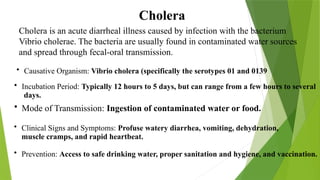
Cholera
Cholera is an acute diarrheal illness caused by infection with the bacterium
Vibrio cholerae. The bacteria are usually found in contaminated water sources
and spread through fecal-oral transmission.
• Causative Organism: Vibrio cholera (specifically the serotypes 01 and 0139
• Incubation Period: Typically 12 hours to 5 days, but can range from a few hours to several
days.
• Mode of Transmission: Ingestion of contaminated water or food.
• Clinical Signs and Symptoms: Profuse watery diarrhea, vomiting, dehydration,
muscle cramps, and rapid heartbeat.
• Prevention: Access to safe drinking water, proper sanitation and hygiene, and vaccination.
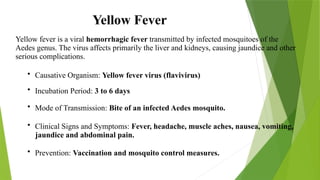
Yellow Fever
Yellow fever is a viral hemorrhagic fever transmitted by infected mosquitoes of the
Aedes genus. The virus affects primarily the liver and kidneys, causing jaundice and other
serious complications.
• Causative Organism: Yellow fever virus (flavivirus)
• Incubation Period: 3 to 6 days
• Mode of Transmission: Bite of an infected Aedes mosquito.
• Clinical Signs and Symptoms: Fever, headache, muscle aches, nausea, vomiting,
jaundice and abdominal pain.
• Prevention: Vaccination and mosquito control measures.
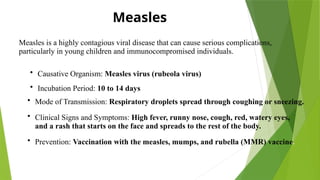
Measles
Measles is a highly contagious viral disease that can cause serious complications,
particularly in young children and immunocompromised individuals.
• Causative Organism: Measles virus (rubeola virus)
• Incubation Period: 10 to 14 days
• Mode of Transmission: Respiratory droplets spread through coughing or sneezing.
• Clinical Signs and Symptoms: High fever, runny nose, cough, red, watery eyes,
and a rash that starts on the face and spreads to the rest of the body.
• Prevention: Vaccination with the measles, mumps, and rubella (MMR) vaccine.
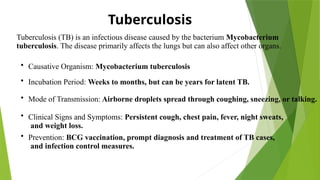
Tuberculosis
Tuberculosis (TB) is an infectious disease caused by the bacterium Mycobacterium
tuberculosis. The disease primarily affects the lungs but can also affect other organs.
• Causative Organism: Mycobacterium tuberculosis
• Incubation Period: Weeks to months, but can be years for latent TB.
• Mode of Transmission: Airborne droplets spread through coughing, sneezing, or talking.
• Clinical Signs and Symptoms: Persistent cough, chest pain, fever, night sweats,
and weight loss.
• Prevention: BCG vaccination, prompt diagnosis and treatment of TB cases,
and infection control measures.
Typhoid Fever
Typhoid fever is a bacterial infection caused by Salmonella Typhi. It spreads through
contaminated food and water and can lead to serious complications if untreated.
• Causative Organism: Salmonella Typhi
• Incubation Period: 1 to 3 weeks
• Mode of Transmission: Ingestion of contaminated food or water.
• Clinical Signs and Symptoms: High fever, headache, abdominal pain,
constipation or diarrhea, and rose-colored spots on the skin.
• Prevention: Safe water and food handling practices, improved sanitation,
and vaccination.
Poliomyelitis
Poliomyelitis, also known as polio, is a viral disease that can cause paralysis, particularly
in children. The virus affects the nervous system, leading to muscle weakness and
difficulty breathing.
• Causative Organism: Poliovirus
• Incubation Period: 3 to 35 days
• Mode of Transmission: Fecal-oral route, through contact with infected
individuals or contaminated water or food.
• Clinical Signs and Symptoms: Fever, headache, fatigue, muscle weakness, and paralysis.
• Prevention: Vaccination with the polio vaccine.
Guinea Worm Disease
Guinea worm disease, also known as dracunculiasis, is a parasitic infection caused by the
Guinea worm (Dracunculus medinensis). The infection is spread through drinking water
contaminated with infected copepods.
• Causative Organism: Guinea worm (Dracunculus medinensis)
• Incubation Period: Approximately one year
• Mode of Transmission: Drinking water contaminated with infected copepods.
• Clinical Signs and Symptoms: Painful blisters that appear on the skin, typically
on the legs and feet, followed by the emergence of the Guinea worm.
• Prevention: Improved access to safe drinking water, filtration of water sources,
and avoiding drinking water directly from wells or ponds.
Meningitis
Meningitis is an inflammation of the meninges, the membranes that surround the brain
and spinal cord. It can be caused by various pathogens, including bacteria, viruses, and
fungi.
• Causative Organisms: Bacteria, viruses, and fungi
• Incubation Period: Varies depending on the pathogen. Bacterial meningitis can
have an incubation period of 2 to 10 days, while viral meningitis can have an
incubation period of 7 to 10 days.
• Mode of Transmission: Respiratory droplets, close contact with an infected
person, and contaminated objects.
• Clinical Signs and Symptoms: Fever, headache, stiff neck, sensitivity to light,
nausea, vomiting, confusion, and seizures.
• Prevention: Vaccination against certain types of bacterial meningitis, good
hygiene practices, and early diagnosis and treatment.
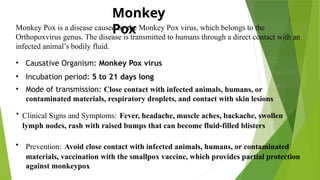
Monkey
Pox
Monkey Pox is a disease caused by the Monkey Pox virus, which belongs to the
Orthopoxvirus genus. The disease is transmitted to humans through a direct contact with an
infected animal’s bodily fluid.
• Causative Organism: Monkey Pox virus
• Incubation period: 5 to 21 days long
• Mode of transmission: Close contact with infected animals, humans, or
contaminated materials, respiratory droplets, and contact with skin lesions
• Clinical Signs and Symptoms: Fever, headache, muscle aches, backache, swollen
lymph nodes, rash with raised bumps that can become fluid-filled blisters
• Prevention: Avoid close contact with infected animals, humans, or contaminated
materials, vaccination with the smallpox vaccine, which provides partial protection
against monkeypox
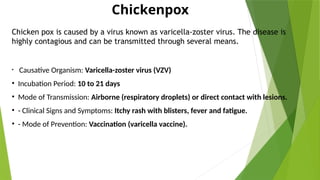
Chickenpox
Chicken pox is caused by a virus known as varicella-zoster virus. The disease is
highly contagious and can be transmitted through several means.
• Causative Organism: Varicella-zoster virus (VZV)
• Incubation Period: 10 to 21 days
• Mode of Transmission: Airborne (respiratory droplets) or direct contact with lesions.
• - Clinical Signs and Symptoms: Itchy rash with blisters, fever and fatigue.
• - Mode of Prevention: Vaccination (varicella vaccine).

Common-Infectious-Diseases-A-Comprehensive-Overview (1).pptx

  • 1.
  • 2.
    Cholera Cholera is anacute diarrheal illness caused by infection with the bacterium Vibrio cholerae. The bacteria are usually found in contaminated water sources and spread through fecal-oral transmission. • Causative Organism: Vibrio cholera (specifically the serotypes 01 and 0139 • Incubation Period: Typically 12 hours to 5 days, but can range from a few hours to several days. • Mode of Transmission: Ingestion of contaminated water or food. • Clinical Signs and Symptoms: Profuse watery diarrhea, vomiting, dehydration, muscle cramps, and rapid heartbeat. • Prevention: Access to safe drinking water, proper sanitation and hygiene, and vaccination.
  • 3.
    Yellow Fever Yellow feveris a viral hemorrhagic fever transmitted by infected mosquitoes of the Aedes genus. The virus affects primarily the liver and kidneys, causing jaundice and other serious complications. • Causative Organism: Yellow fever virus (flavivirus) • Incubation Period: 3 to 6 days • Mode of Transmission: Bite of an infected Aedes mosquito. • Clinical Signs and Symptoms: Fever, headache, muscle aches, nausea, vomiting, jaundice and abdominal pain. • Prevention: Vaccination and mosquito control measures.
  • 4.
    Measles Measles is ahighly contagious viral disease that can cause serious complications, particularly in young children and immunocompromised individuals. • Causative Organism: Measles virus (rubeola virus) • Incubation Period: 10 to 14 days • Mode of Transmission: Respiratory droplets spread through coughing or sneezing. • Clinical Signs and Symptoms: High fever, runny nose, cough, red, watery eyes, and a rash that starts on the face and spreads to the rest of the body. • Prevention: Vaccination with the measles, mumps, and rubella (MMR) vaccine.
  • 5.
    Tuberculosis Tuberculosis (TB) isan infectious disease caused by the bacterium Mycobacterium tuberculosis. The disease primarily affects the lungs but can also affect other organs. • Causative Organism: Mycobacterium tuberculosis • Incubation Period: Weeks to months, but can be years for latent TB. • Mode of Transmission: Airborne droplets spread through coughing, sneezing, or talking. • Clinical Signs and Symptoms: Persistent cough, chest pain, fever, night sweats, and weight loss. • Prevention: BCG vaccination, prompt diagnosis and treatment of TB cases, and infection control measures.
  • 6.
    Typhoid Fever Typhoid feveris a bacterial infection caused by Salmonella Typhi. It spreads through contaminated food and water and can lead to serious complications if untreated. • Causative Organism: Salmonella Typhi • Incubation Period: 1 to 3 weeks • Mode of Transmission: Ingestion of contaminated food or water. • Clinical Signs and Symptoms: High fever, headache, abdominal pain, constipation or diarrhea, and rose-colored spots on the skin. • Prevention: Safe water and food handling practices, improved sanitation, and vaccination.
  • 7.
    Poliomyelitis Poliomyelitis, also knownas polio, is a viral disease that can cause paralysis, particularly in children. The virus affects the nervous system, leading to muscle weakness and difficulty breathing. • Causative Organism: Poliovirus • Incubation Period: 3 to 35 days • Mode of Transmission: Fecal-oral route, through contact with infected individuals or contaminated water or food. • Clinical Signs and Symptoms: Fever, headache, fatigue, muscle weakness, and paralysis. • Prevention: Vaccination with the polio vaccine.
  • 8.
    Guinea Worm Disease Guineaworm disease, also known as dracunculiasis, is a parasitic infection caused by the Guinea worm (Dracunculus medinensis). The infection is spread through drinking water contaminated with infected copepods. • Causative Organism: Guinea worm (Dracunculus medinensis) • Incubation Period: Approximately one year • Mode of Transmission: Drinking water contaminated with infected copepods. • Clinical Signs and Symptoms: Painful blisters that appear on the skin, typically on the legs and feet, followed by the emergence of the Guinea worm. • Prevention: Improved access to safe drinking water, filtration of water sources, and avoiding drinking water directly from wells or ponds.
  • 9.
    Meningitis Meningitis is aninflammation of the meninges, the membranes that surround the brain and spinal cord. It can be caused by various pathogens, including bacteria, viruses, and fungi. • Causative Organisms: Bacteria, viruses, and fungi • Incubation Period: Varies depending on the pathogen. Bacterial meningitis can have an incubation period of 2 to 10 days, while viral meningitis can have an incubation period of 7 to 10 days. • Mode of Transmission: Respiratory droplets, close contact with an infected person, and contaminated objects. • Clinical Signs and Symptoms: Fever, headache, stiff neck, sensitivity to light, nausea, vomiting, confusion, and seizures. • Prevention: Vaccination against certain types of bacterial meningitis, good hygiene practices, and early diagnosis and treatment.
  • 10.
    Monkey Pox Monkey Pox isa disease caused by the Monkey Pox virus, which belongs to the Orthopoxvirus genus. The disease is transmitted to humans through a direct contact with an infected animal’s bodily fluid. • Causative Organism: Monkey Pox virus • Incubation period: 5 to 21 days long • Mode of transmission: Close contact with infected animals, humans, or contaminated materials, respiratory droplets, and contact with skin lesions • Clinical Signs and Symptoms: Fever, headache, muscle aches, backache, swollen lymph nodes, rash with raised bumps that can become fluid-filled blisters • Prevention: Avoid close contact with infected animals, humans, or contaminated materials, vaccination with the smallpox vaccine, which provides partial protection against monkeypox
  • 11.
    Chickenpox Chicken pox iscaused by a virus known as varicella-zoster virus. The disease is highly contagious and can be transmitted through several means. • Causative Organism: Varicella-zoster virus (VZV) • Incubation Period: 10 to 21 days • Mode of Transmission: Airborne (respiratory droplets) or direct contact with lesions. • - Clinical Signs and Symptoms: Itchy rash with blisters, fever and fatigue. • - Mode of Prevention: Vaccination (varicella vaccine).