Privacy
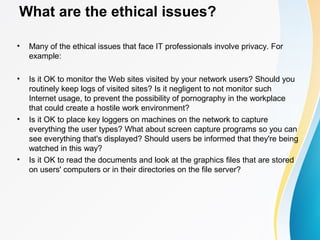
What are the ethical issues?
• Many of the ethical issues that face IT professionals involve privacy. For
example:
• Is it OK to monitor the Web sites visited by your network users? Should you
routinely keep logs of visited sites? Is it negligent to not monitor such
Internet usage, to prevent the possibility of pornography in the workplace
that could create a hostile work environment?
• Is it OK to place key loggers on machines on the network to capture
everything the user types? What about screen capture programs so you can
see everything that's displayed? Should users be informed that they're being
watched in this way?
• Is it OK to read the documents and look at the graphics files that are stored
on users' computers or in their directories on the file server?
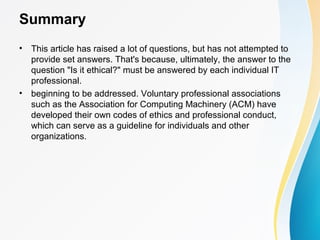
Summary
• This article has raised a lot of questions, but has not attempted to
provide set answers. That's because, ultimately, the answer to the
question "Is it ethical?" must be answered by each individual IT
professional.
• beginning to be addressed. Voluntary professional associations
such as the Association for Computing Machinery (ACM) have
developed their own codes of ethics and professional conduct,
which can serve as a guideline for individuals and other
organizations.
Sharing of
Information
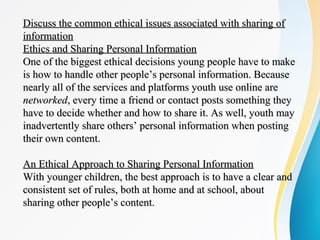
Discuss the common ethical issues associated with sharing ofDiscuss the common ethical issues associated with sharing of
informationinformation
Ethics and Sharing Personal InformationEthics and Sharing Personal Information
One of the biggest ethical decisions young people have to makeOne of the biggest ethical decisions young people have to make
is how to handle other people’s personal information. Becauseis how to handle other people’s personal information. Because
nearly all of the services and platforms youth use online arenearly all of the services and platforms youth use online are
networkednetworked, every time a friend or contact posts something they, every time a friend or contact posts something they
have to decide whether and how to share it. As well, youth mayhave to decide whether and how to share it. As well, youth may
inadvertently share others’ personal information when postinginadvertently share others’ personal information when posting
their own content.their own content.
An Ethical Approach to Sharing Personal InformationAn Ethical Approach to Sharing Personal Information
With younger children, the best approach is to have a clear andWith younger children, the best approach is to have a clear and
consistent set of rules, both at home and at school, aboutconsistent set of rules, both at home and at school, about
sharing other people’s content.sharing other people’s content.
Commandment 4Commandment 4
IssueIssue
Discuss the common ethical issues associated withDiscuss the common ethical issues associated with
b) sharing of informationb) sharing of information
issuesissues
You shall not use a computer to steal.You shall not use a computer to steal.
•• Do not use computer technology to steal information.Do not use computer technology to steal information.
Explanation: Stealing sensitive information or leaking confidentialExplanation: Stealing sensitive information or leaking confidential
information is as good as robbery. It is wrong to acquire personalinformation is as good as robbery. It is wrong to acquire personal
information of employees from an employee database or patient historyinformation of employees from an employee database or patient history
from a hospital database or other such information that is meant to befrom a hospital database or other such information that is meant to be
confidential. Similarly, breaking into a bank account to collect informationconfidential. Similarly, breaking into a bank account to collect information
about the account or account holder is wrong. Illegal electronic transferabout the account or account holder is wrong. Illegal electronic transfer
of funds is a type of fraud. With the use of technology, stealing ofof funds is a type of fraud. With the use of technology, stealing of
information is much easier.information is much easier.
Ethical Issues Associated with
Usage of Computing Resources
CHALLENGE :
Computer Resource Abuse
computer fraudcomputer fraud
computer crimecomputer crime
- Sending virus in order to hack personal
information and exposing to the others.
- Deleting friend's assignment document.
- Look/change students' grades from the
lecturers' computers.
- Taking someone's personal
information or idea to use without any
approval.
- Posting something like "He or she
did ...." without any proves.
- Cracking demo program and using it
forever.
- Using site's information and publishing a
book without the source to earn benefit.
- Posting New movie that just came out on
Youtube.
- Making program that can spy on other
people's computer.
- Chatting with someone using curse
words.
Common ethical issues

Common ethical issues

  • 2.
  • 3.
    What are theethical issues? • Many of the ethical issues that face IT professionals involve privacy. For example: • Is it OK to monitor the Web sites visited by your network users? Should you routinely keep logs of visited sites? Is it negligent to not monitor such Internet usage, to prevent the possibility of pornography in the workplace that could create a hostile work environment? • Is it OK to place key loggers on machines on the network to capture everything the user types? What about screen capture programs so you can see everything that's displayed? Should users be informed that they're being watched in this way? • Is it OK to read the documents and look at the graphics files that are stored on users' computers or in their directories on the file server?
  • 4.
    Summary • This articlehas raised a lot of questions, but has not attempted to provide set answers. That's because, ultimately, the answer to the question "Is it ethical?" must be answered by each individual IT professional. • beginning to be addressed. Voluntary professional associations such as the Association for Computing Machinery (ACM) have developed their own codes of ethics and professional conduct, which can serve as a guideline for individuals and other organizations.
  • 5.
  • 6.
    Discuss the commonethical issues associated with sharing ofDiscuss the common ethical issues associated with sharing of informationinformation Ethics and Sharing Personal InformationEthics and Sharing Personal Information One of the biggest ethical decisions young people have to makeOne of the biggest ethical decisions young people have to make is how to handle other people’s personal information. Becauseis how to handle other people’s personal information. Because nearly all of the services and platforms youth use online arenearly all of the services and platforms youth use online are networkednetworked, every time a friend or contact posts something they, every time a friend or contact posts something they have to decide whether and how to share it. As well, youth mayhave to decide whether and how to share it. As well, youth may inadvertently share others’ personal information when postinginadvertently share others’ personal information when posting their own content.their own content. An Ethical Approach to Sharing Personal InformationAn Ethical Approach to Sharing Personal Information With younger children, the best approach is to have a clear andWith younger children, the best approach is to have a clear and consistent set of rules, both at home and at school, aboutconsistent set of rules, both at home and at school, about sharing other people’s content.sharing other people’s content.
  • 7.
    Commandment 4Commandment 4 IssueIssue Discussthe common ethical issues associated withDiscuss the common ethical issues associated with b) sharing of informationb) sharing of information issuesissues You shall not use a computer to steal.You shall not use a computer to steal. •• Do not use computer technology to steal information.Do not use computer technology to steal information. Explanation: Stealing sensitive information or leaking confidentialExplanation: Stealing sensitive information or leaking confidential information is as good as robbery. It is wrong to acquire personalinformation is as good as robbery. It is wrong to acquire personal information of employees from an employee database or patient historyinformation of employees from an employee database or patient history from a hospital database or other such information that is meant to befrom a hospital database or other such information that is meant to be confidential. Similarly, breaking into a bank account to collect informationconfidential. Similarly, breaking into a bank account to collect information about the account or account holder is wrong. Illegal electronic transferabout the account or account holder is wrong. Illegal electronic transfer of funds is a type of fraud. With the use of technology, stealing ofof funds is a type of fraud. With the use of technology, stealing of information is much easier.information is much easier.
  • 8.
    Ethical Issues Associatedwith Usage of Computing Resources CHALLENGE : Computer Resource Abuse computer fraudcomputer fraud computer crimecomputer crime
  • 9.
    - Sending virusin order to hack personal information and exposing to the others. - Deleting friend's assignment document. - Look/change students' grades from the lecturers' computers.
  • 10.
    - Taking someone'spersonal information or idea to use without any approval. - Posting something like "He or she did ...." without any proves. - Cracking demo program and using it forever.
  • 11.
    - Using site'sinformation and publishing a book without the source to earn benefit. - Posting New movie that just came out on Youtube. - Making program that can spy on other people's computer. - Chatting with someone using curse words.