Coming Out: Differences in Gay, Lesbian, Trans-sexual and Bisexual PeopleBy: Jeanette M. Larson 8-17-10
SOC 235 Gender Roles: Diversity - 0965 - SU10 August 2010Homosexuality has interested me for almost 20 years when my sister came out as a lesbian.My eldest child is also a lesbian and encourages and challenges me to think of gender beyond male/female roles. I dedicate this power-point project toMy sister, Michelle and eldest Jesse.
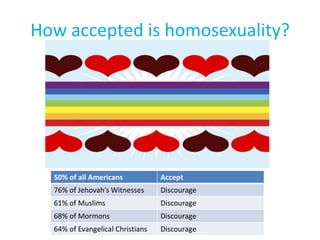
How accepted is homosexuality?
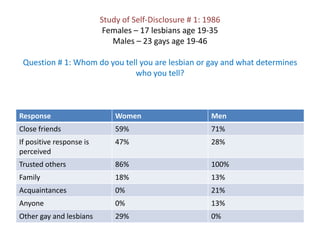
Study of Self-Disclosure # 1: 1986Females – 17 lesbians age 19-35Males – 23 gays age 19-46Question # 1: Whom do you tell you are lesbian or gay and what determines who you tell?
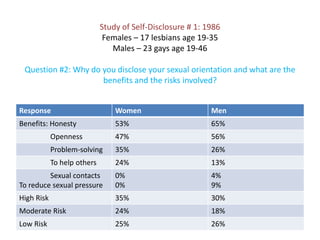
Study of Self-Disclosure # 1: 1986Females – 17 lesbians age 19-35Males – 23 gays age 19-46Question #2: Why do you disclose your sexual orientation and what are the benefits and the risks involved?
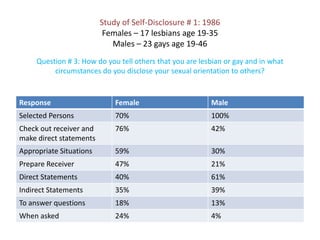
Study of Self-Disclosure # 1: 1986Females – 17 lesbians age 19-35Males – 23 gays age 19-46Question # 3: How do you tell others that you are lesbian or gay and in what circumstances do you disclose your sexual orientation to others?
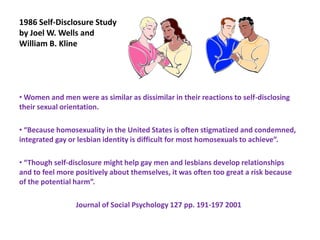
1986 Self-Disclosure Study by Joel W. Wells and William B. Kline Women and men were as similar as dissimilar in their reactions to self-disclosing their sexual orientation.
 “Because homosexuality in the United States is often stigmatized and condemned,  integrated gay or lesbian identity is difficult for most homosexuals to achieve”.
 “Though self-disclosure might help gay men and lesbians develop relationships and to feel more positively about themselves, it was often too great a risk because of the potential harm”.Journal of Social Psychology 127 pp. 191-197 2001
Coming Out to Families in a Multi-cultural ContextA study to determine how young gay men disclose their sexual identity to family members and how their family responded to this disclosure.In 2000, Joseph Merighi and Marty Grimes interviewed men ages 18-24 18 African American25 European American8 Mexican American6 Vietnamese American4 general types of responses emerged from the data:Support through action: i.e. a mother demonstrated her support through involvement in the gay rights demonstrations and public appearances.Support that preserves a kinship bond: i.e. overlooking a child’s sexual orientation to support the preservation of harmonious family relations.Avoidance: i.e. denial of homosexuality by saying, “it is just a phase”.Distancing and disengagement: i.e. non-disclosure or being forced or asked to leave home after disclosure.
Study # 3: ‘ Shiny happy same-sex attracted woman seeking same’: How communities contribute to bisexual and lesbian women’s well-beingMary Heath and Ea Mulligan, 2008"Lack of social support is a risk factor in the lower mental health status of bisexual and lesbian women. In contrast, community participation has been found to be protective of health in the wider population“.	The women saw supportive communities as places of connection and affirmation. They said communities were especially important when they were "coming out" - disclosing their homosexuality. They were able to build confidence and self-esteem.  However, it was found in this study that many of the bisexual women were not welcome in lesbian communities. The study concluded that bisexual and lesbian women participate in different communities.
Hypothesis Lesbian's familial response will be more positive followed by bisexual, gay and then transgender. I also hypothesized that having a support group such as Stonewall was beneficial.  I tried to measure this through a survey of gay youth that was anonymous following the format of familial outcomes in the second study I cited in this paper.
SurveyAgeGender (circle one): Lesbian, Bisexual, Gay, TransgenderReligious background? (optional)Familial Response to self-disclosure (circle a; b; c; or d)a.	 Support through action: (family member(s) demonstrate support through involvement in PFLAG or other demonstrations.)b.	Kinship bond support: (Support that overlooks your sexual orientation in order to preserve family relations)c. 	 Avoidance: (denial that you are gay; It's just a phase you're going through)d. 	Distancing and Disengagement: (Negative reaction to coming out; possibly forced to leave home)Other information regarding disclosure you would like to share?Support group: How has your support group helped you? (Be specific please!) Behavior and feelings before joining:Behavior and Feelings after joining:
Results5 participants listed choice A: 2 of whom were gender-queer, 1 gay,1 lesbian and 1 transgender person. 2 participants listed choice B: of whom were gender-queer and gay. 1 bisexual person chose C and 1 bisexual person chose D. So, gender/orientation order of acceptance was gender-queer, lesbian, transgender, gay and bisexual. So, my hypothesis was disproved but it I feel it is inconclusive due to the small sample of people I was able to survey.
EvaluationMy hypothesis was disproved but it I feel it is inconclusive due to the small sample of people I was able to survey. If I had the opportunity to do so, I would include gender-queer as a category.  Gender-queer is " used by some people who identify their gender to be somewhere on the continuum in between or outside the binary gender system altogether" (The Gay, Lesbian and Straight Education Network:	www.GLSEN.org 2010).

Coming out

  • 1.
    Coming Out: Differencesin Gay, Lesbian, Trans-sexual and Bisexual PeopleBy: Jeanette M. Larson 8-17-10
  • 2.
    SOC 235 GenderRoles: Diversity - 0965 - SU10 August 2010Homosexuality has interested me for almost 20 years when my sister came out as a lesbian.My eldest child is also a lesbian and encourages and challenges me to think of gender beyond male/female roles. I dedicate this power-point project toMy sister, Michelle and eldest Jesse.
  • 3.
    How accepted ishomosexuality?
  • 4.
    Study of Self-Disclosure# 1: 1986Females – 17 lesbians age 19-35Males – 23 gays age 19-46Question # 1: Whom do you tell you are lesbian or gay and what determines who you tell?
  • 5.
    Study of Self-Disclosure# 1: 1986Females – 17 lesbians age 19-35Males – 23 gays age 19-46Question #2: Why do you disclose your sexual orientation and what are the benefits and the risks involved?
  • 6.
    Study of Self-Disclosure# 1: 1986Females – 17 lesbians age 19-35Males – 23 gays age 19-46Question # 3: How do you tell others that you are lesbian or gay and in what circumstances do you disclose your sexual orientation to others?
  • 7.
    1986 Self-Disclosure Studyby Joel W. Wells and William B. Kline Women and men were as similar as dissimilar in their reactions to self-disclosing their sexual orientation.
  • 8.
    “Because homosexualityin the United States is often stigmatized and condemned, integrated gay or lesbian identity is difficult for most homosexuals to achieve”.
  • 9.
    “Though self-disclosuremight help gay men and lesbians develop relationships and to feel more positively about themselves, it was often too great a risk because of the potential harm”.Journal of Social Psychology 127 pp. 191-197 2001
  • 10.
    Coming Out toFamilies in a Multi-cultural ContextA study to determine how young gay men disclose their sexual identity to family members and how their family responded to this disclosure.In 2000, Joseph Merighi and Marty Grimes interviewed men ages 18-24 18 African American25 European American8 Mexican American6 Vietnamese American4 general types of responses emerged from the data:Support through action: i.e. a mother demonstrated her support through involvement in the gay rights demonstrations and public appearances.Support that preserves a kinship bond: i.e. overlooking a child’s sexual orientation to support the preservation of harmonious family relations.Avoidance: i.e. denial of homosexuality by saying, “it is just a phase”.Distancing and disengagement: i.e. non-disclosure or being forced or asked to leave home after disclosure.
  • 11.
    Study # 3:‘ Shiny happy same-sex attracted woman seeking same’: How communities contribute to bisexual and lesbian women’s well-beingMary Heath and Ea Mulligan, 2008"Lack of social support is a risk factor in the lower mental health status of bisexual and lesbian women. In contrast, community participation has been found to be protective of health in the wider population“. The women saw supportive communities as places of connection and affirmation. They said communities were especially important when they were "coming out" - disclosing their homosexuality. They were able to build confidence and self-esteem. However, it was found in this study that many of the bisexual women were not welcome in lesbian communities. The study concluded that bisexual and lesbian women participate in different communities.
  • 12.
    Hypothesis Lesbian's familialresponse will be more positive followed by bisexual, gay and then transgender. I also hypothesized that having a support group such as Stonewall was beneficial. I tried to measure this through a survey of gay youth that was anonymous following the format of familial outcomes in the second study I cited in this paper.
  • 13.
    SurveyAgeGender (circle one):Lesbian, Bisexual, Gay, TransgenderReligious background? (optional)Familial Response to self-disclosure (circle a; b; c; or d)a. Support through action: (family member(s) demonstrate support through involvement in PFLAG or other demonstrations.)b. Kinship bond support: (Support that overlooks your sexual orientation in order to preserve family relations)c. Avoidance: (denial that you are gay; It's just a phase you're going through)d. Distancing and Disengagement: (Negative reaction to coming out; possibly forced to leave home)Other information regarding disclosure you would like to share?Support group: How has your support group helped you? (Be specific please!) Behavior and feelings before joining:Behavior and Feelings after joining:
  • 14.
    Results5 participants listedchoice A: 2 of whom were gender-queer, 1 gay,1 lesbian and 1 transgender person. 2 participants listed choice B: of whom were gender-queer and gay. 1 bisexual person chose C and 1 bisexual person chose D. So, gender/orientation order of acceptance was gender-queer, lesbian, transgender, gay and bisexual. So, my hypothesis was disproved but it I feel it is inconclusive due to the small sample of people I was able to survey.
  • 15.
    EvaluationMy hypothesis wasdisproved but it I feel it is inconclusive due to the small sample of people I was able to survey. If I had the opportunity to do so, I would include gender-queer as a category. Gender-queer is " used by some people who identify their gender to be somewhere on the continuum in between or outside the binary gender system altogether" (The Gay, Lesbian and Straight Education Network: www.GLSEN.org 2010).