■
□
■□
□■
■□■□
□■□■□■
■□■□■□
□■□■□■□■
■□■□■□■□■□
□■□■□■□■□■□■□
■□■□■□■□■□■□■□■□
□■□■□■□■□■□■□■□■□■
■□■□■□■□■□■□■□■□■□■□■□
Satoshi Inomata
IDE-JETRO
Mapping Global Value Chains:
International Input-Output Table
“3E” HOT TOPICS
- Employment and poverty
- Environmental issues
- Economic integration
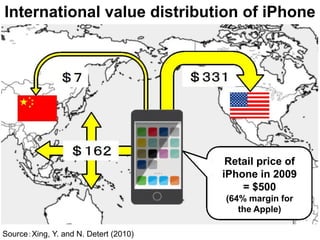
International value distribution of iPhone
Retail price of
iPhone in 2009
= $500
(64% margin for
the Apple)
Source:Xing, Y. and N. Detert (2010)
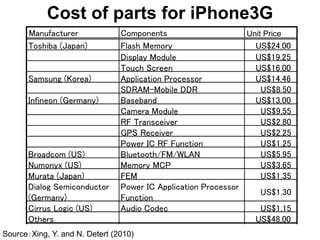
Cost of parts for iPhone3G
Manufacturer Components Unit Price
Toshiba (Japan) Flash Memory US$24.00
Display Module US$19.25
Touch Screen US$16.00
Samsung (Korea) Application Processor US$14.46
SDRAM-Mobile DDR US$8.50
Infineon (Germany) Baseband US$13.00
Camera Module US$9.55
RF Transceiver US$2.80
GPS Receiver US$2.25
Power IC RF Function US$1.25
Broadcom (US) Bluetooth/FM/WLAN US$5.95
Numonyx (US) Memory MCP US$3.65
Murata (Japan) FEM US$1.35
Dialog Semiconductor
(Germany)
Power IC Application Processor
Function
US$1.30
Cirrus Logic (US) Audio Codec US$1.15
Others US$48.00
Source:Xing, Y. and N. Detert (2010)
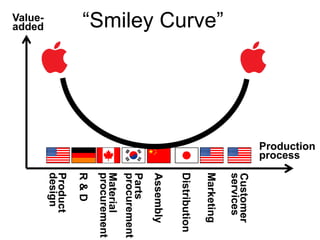
Value-
added
Production
process
Product
design
Assembly
Distribution
Marketing
Customer
services
Material
procurement
R&D
Parts
procurement
“Smiley Curve”
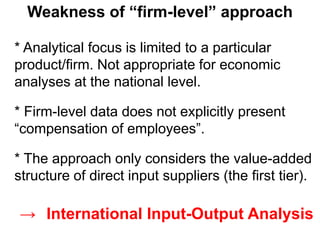
* Analytical focus is limited to a particular
product/firm. Not appropriate for economic
analyses at the national level.
* Firm-level data does not explicitly present
“compensation of employees”.
* The approach only considers the value-added
structure of direct input suppliers (the first tier).
Weakness of “firm-level” approach
→ International Input-Output Analysis
Automobiles
(Y10 billion)
Rough steel
(Y8 million)
Electricity
(Y400,000)
Coal products
(Y100,000)
Petroleum products
(Y40,000)
Steel
(Y12 million)
Wholesale
(Y2 million)
Roadfreight transport
(Y400,000)
Sea shipping
(Y200,000)
Dye
(Y3.5 million)
Intermediate organic
chemical products
(Y500,000)
Composite plastics
(Y200,000)
Electricity
(Y100,000)
Wood pulp
(Y100,000)
Wholesale
(Y100,000)
Chemical fiber
(Y2.1 million)
Financing
(Y300,000)
Wholesale
(Y300,000)
Car parts
(Y260 million)
Cold-finished steel
(Y60 million)
Steel shar slit
(Y20 million)
Paint
(Y17 million)
Composite rubber
(Y30 million)
Carbon black
(Y10 million)
Silk and rayon textiles
(Y10 million)
Raw rubber (imported)
(Y10 million)
Car chassis
(Y650 million)
Tires and inner
tubes
Glass products
(Y130 million)
Internal-combustion
engines
(Y1.52 billion)
...
...
...
...
...
...
...
Initial
Impact
1st-round
Impacts
2nd-round
Impacts
3rd-round
Impacts
4th-round
Impacts
Value-
added
Value-
added
Value-
added
Value-
added
Value-
added
Value-
added
Value-
added
Value-
added
Value-
added
Value-
added
Value-
added
Value-
added
Value-
added
Value-
added
Value-
added
Value-
added
Value-
added
Value-
added
Value-
added
Value-
added
Value-
added
Value-
added
Value-
added
Value-
added
Value-
added
Value-
added
Value-
added
Value-
added
Value-
added
Value-
added
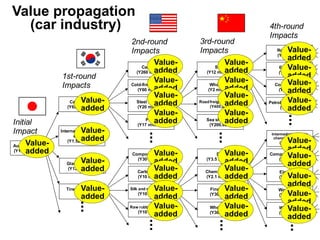
Value propagation
(car industry)
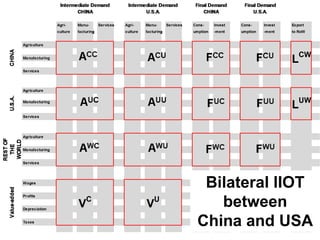
Bilateral IIOT
between
China and USA
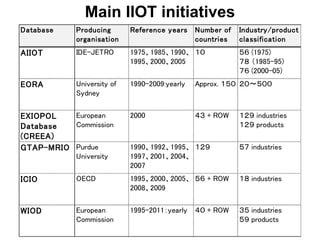
Main IIOT initiatives
Database Producing
organisation
Reference years Number of
countries
Industry/product
classification
AIIOT IDE-JETRO 1975、1985、1990、
1995、2000、2005
10 56 (1975)
78 (1985-95)
76 (2000-05)
EORA University of
Sydney
1990-2009:yearly Approx. 150 20~500
EXIOPOL
Database
(CREEA)
European
Commission
2000 43 + ROW 129 industries
129 products
GTAP-MRIO Purdue
University
1990、1992、1995、
1997、2001、2004、
2007
129 57 industries
ICIO OECD 1995、2000、2005、
2008、2009
56 + ROW 18 industries
WIOD European
Commission
1995-2011:yearly 40 + ROW 35 industries
59 products
Value-
added
Production
process
Product
design
Assembly
Distribution
Marketing
Customer
services
Material
procurement
R&D
Parts
procurement
DownstreamUpstream
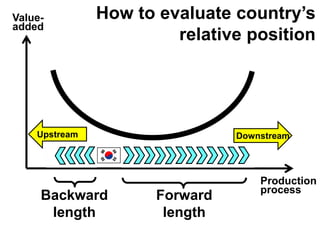
How to evaluate country’s
relative position
Backward
length
Forward
length
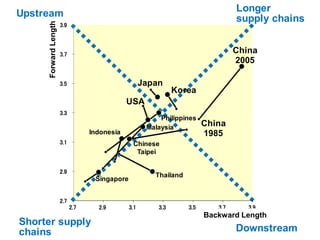
China
1985
China
2005
Indonesia
Japan
Korea
Malaysia
Chinese
Taipei
Philippines
Singapore
Thailand
USA
2.7
2.9
3.1
3.3
3.5
3.7
3.9
2.7 2.9 3.1 3.3 3.5 3.7 3.9
Upstream
Downstream
Longer
supply chains
Shorter supply
chains
Backward APL
ForwardAPL
Backward Length
ForwardLength
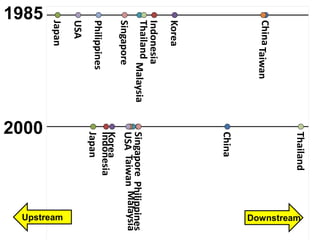
1985
2000
China
China
Indonesia
Indonesia
Japan
Japan
Korea
Korea
Malaysia
Malaysia
Taiwan
Taiwan
Philippines
Philippines
Singapore
SingaporeThailand
Thailand
USA
USA
1985
2005
DownstreamUpstream
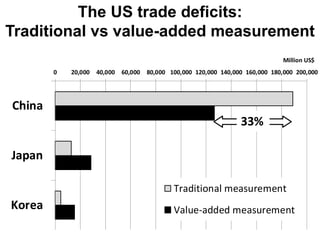
0 20,000 40,000 60,000 80,000 100,000 120,000 140,000 160,000 180,000 200,000
China
Japan
Korea
Traditional measurement
Value-added measurement
Million US$
33%
The US trade deficits:
Traditional vs value-added measurement
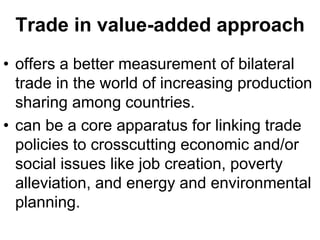
Trade in value-added approach
• offers a better measurement of bilateral
trade in the world of increasing production
sharing among countries.
• can be a core apparatus for linking trade
policies to crosscutting economic and/or
social issues like job creation, poverty
alleviation, and energy and environmental
planning.

Comex2014 inomata ide