Annual Report
FROM THE GROUND UP
                              08


                 COM DEV International
FROM THE GROUND UP


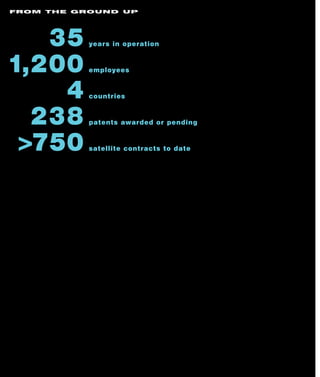
   35      years in operation


1,200      employees


    4      countries


  238      patents awarded or pending


 >750      satellite contracts to date
2008 Annual Report
In fiscal 2003, the new COM DEV
leadership team embarked on a
strategic course that would rebuild
the Company from the ground up.
We refocused on our core space
business. We harnessed our unique
engineering capability to extend our
traditional boundaries. We invested
in new technologies, new markets
and new businesses. We grew by
being aggressive yet disciplined.
The result is a solid foundation
upon which we plan to continue to
build. We will adhere to the same
strategic principles that enabled us
to outperform the market over the
past five years.


                                           1
ON SOLID GROUND


                                                              We expanded
                                                              A core strategic principle for COM DEV is
                                                              expansion into adjacent markets: providing
                                                              existing products to new customers,
                                                              selling new products to existing customers,
        We diversified                                        or introducing an existing capability into a
        COM DEV has always excelled in the                    new market. Our 2005 purchase of certain
        commercial communications market,                     Canadian operations of a U.S.‑based space
        routinely winning contracts on the vast               contractor expedited our full participation
        majority of satellites ordered each year.             in Canada’s civil space market. The U.S.
        In recent years, we made the strategic                Passive Microwave Devices (PMD)
        decision to actively pursue growth                    business we acquired in 2008 mirrored
        opportunities in the civil and military space         COM DEV’s own core strength in PMD,
        segments, each of which is significantly              and has accelerated our entry into the
        larger than the commercial market. Those              U.S. Government space market.
        two segments generated $83 million of
        combined revenue in 2008, compared
        to $43 million in 2003.


                                                        118                             124

    88M
    REVENUE
$


2     2003                                               04                                      05
2008 Annual Report
                                                        We outperformed
                                                        From 2003 to 2008, COM DEV grew
                                                        revenues at a compound annual growth
                                                        rate of 19 percent – significantly above the
 We improved                                            6 to 8 percent average growth rate of the
 Our organization has fully embraced the                overall space industry.
 principles of lean manufacturing, with staff
 at all levels contributing to a succession of
 process innovations. The resulting productivity


                                                        210M
 improvements have allowed us to maintain our
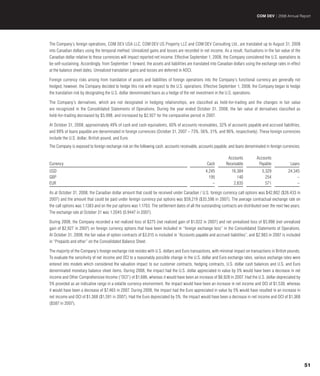
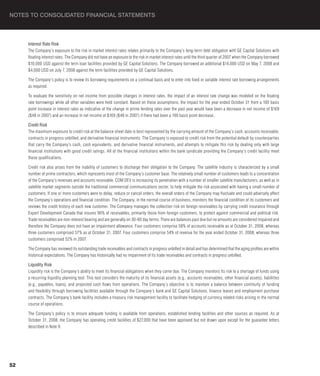
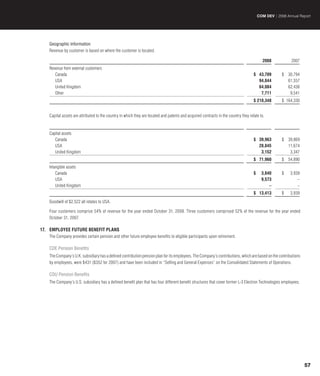
 gross margins throughout a period of several       $
 years while a major shift in currency exchange
 rates applied negative pressure to reported
 revenues and margins.


                                                                                                19%
                                                                                                 COM DEV
                                                                                                 compound


                                         164
                                                                                                 annual
                                                                                                 growth


154
                                                                                                 2003-08


                                                                                                 6-8%
                                                                                                 INDUSTRY
                                                                                                 average
                                                                                                 annual
                                                                                                 growth
                                                                                                 2003-08


 06                                                07                         08                                3
James Webb Space Telescope
Cospas-Sarsat
RADARSAT Constellation
SAPPHIRE
M3MSat


4
HOME GROUND


                                                                                                             2008 Annual Report
COM DEV decided several years ago to actively grow our Canadian civil space business,
as part of a broader strategy of leveraging our space engineering capabilities to expand
into the civil and military segments. Unusual for a space contractor, we previously
chose to forego many domestic opportunities due to our success in the commercial
marketplace. We recognized, however, that civil space programs offer the chance to be
involved in pioneering programs and fly novel technologies.

Civil space programs run for many years; to participate, one must be involved from
the very beginning, or buy a company that has. COM DEV pursued both paths.
We purchased the Canadian‑based space science, optical payload and search and
rescue operations of a U.S. company in 2005. That transaction led directly to the
establishment of our Ottawa facility and our participation in the James Webb Space
Telescope and Cospas‑Sarsat programs. Our other business development efforts
led to contracts on the RADARSAT Constellation, SAPPHIRE and M3MSat programs.
Our Canadian space revenues have increased faster than any other area of our business
in the past five years, growing from $8 million in 2004 to nearly $50 million in 2008.

We believe the Government of Canada is increasingly recognizing the potential of the


                                                                                           50 M
domestic space sector to serve the country’s interests. Canada’s geography dictates
that many vital tasks – including sovereignty, security, safety, communications and        $
environmental protection applications – can be more effectively undertaken through
satellite technology than they can be from the ground. COM DEV has worked to
position itself as a key supplier with capabilities along the entire value chain, from
subsystems to payloads to complete spacecraft.
                                                                                               COM DEV Canada
                                                                                               revenues in 2008


                                                                                                                 5
COM DEV USA
has unparalleled
heritage and expertise
as a supplier of
passive microwave
equipment to the
U.S. Government
space market.


                         IMAGE TO
                           COME


6
2008 Annual Report
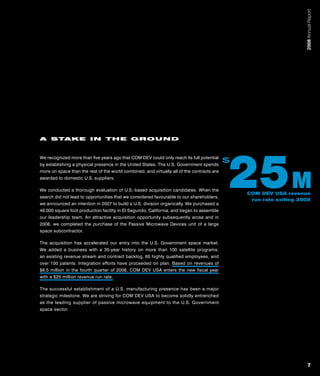
A STAKE IN THE GROUND


                                                                                            25 M
We recognized more than five years ago that COM DEV could only reach its full potential
by establishing a physical presence in the United States. The U.S. Government spends
                                                                                            $
more on space than the rest of the world combined, and virtually all of the contracts are
awarded to domestic U.S. suppliers.

We conducted a thorough evaluation of U.S.‑based acquisition candidates. When the
                                                                                                COM DEV USA revenue
search did not lead to opportunities that we considered favourable to our shareholders,
                                                                                                 run rate exiting 2008
we announced an intention in 2007 to build a U.S. division organically. We purchased a
46,000 square foot production facility in El Segundo, California, and began to assemble
our leadership team. An attractive acquisition opportunity subsequently arose and in
2008, we completed the purchase of the Passive Microwave Devices unit of a large
space subcontractor.

The acquisition has accelerated our entry into the U.S. Government space market.
We added a business with a 35‑year history on more than 100 satellite programs,
an existing revenue stream and contract backlog, 65 highly qualified employees, and
over 100 patents. Integration efforts have proceeded on plan. Based on revenues of
$6.5 million in the fourth quarter of 2008, COM DEV USA enters the new fiscal year
with a $25 million revenue run rate.

The successful establishment of a U.S. manufacturing presence has been a major
strategic milestone. We are striving for COM DEV USA to become solidly entrenched
as the leading supplier of passive microwave equipment to the U.S. Government
space sector.


                                                                                                                        7
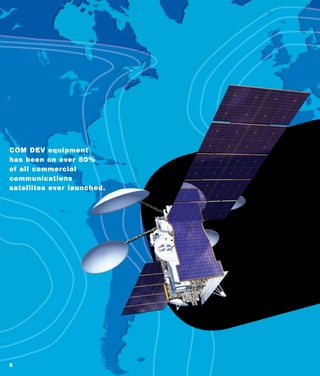
COM DEV equipment
has been on over 80%
of all commercial
communications
satellites ever launched.


8
2008 Annual Report
                                                                                        127M
                                                                                      $


GAINING MORE GROUND
                                                                                               Commercial space
                                                                                                revenues in 2008
COM DEV has been a leading provider of commercial communications satellite payload
equipment for more than three decades. Our share of the world’s addressable market
for switches and multiplexers exceeds 60 percent, and we have enjoyed long‑standing
relationships with every major satellite manufacturer. Our objective has been to maintain
and build upon this leadership position.

In the past five years, we have executed successfully on all of the key strategic priorities
for our commercial space business. We have continually enhanced our technology to
meet customer needs for product innovation. We have “moved up the value chain” by
broadening our role beyond components and subsystems and taking on more integration
and payload work. We have made new inroads with targeted prime contractors by
winning an increasing share of work on their satellite programs. And we have added the
production capacity necessary to accommodate an increased volume of business.

The result of successful execution has been rapid growth. COM DEV’s commercial space
revenues were $127 million in fiscal 2008, compared to less than $50 million five years
earlier – a compound annual growth rate of 22 percent.

The outlook for our commercial business is very positive. The satellite replacement cycle
will necessitate higher order levels in the coming years. Demand for added capacity will
be further increased by the ongoing changeover to High Definition Television (HDTV), the
growth of broadband services over satellite, and other new communications services.
COM DEV intends to continue to pursue the strategies that have made us leaders in
commercial space.
                                                                                                                  9
THE GROUND AHEAD


lower mass
improved efficiency
shorter timelines
lower cost
better flexibility
reduced risk
more accessibility
more options


10
2008 Annual Report
Space is evolving. Technological
advances have enabled low power,
low mass satellites to achieve
performance levels previously
limited to larger, heavier and more
costly spacecraft. We can now
address a whole new set of needs
from space using micro‑satellites
– a smaller, lighter and less
expensive alternative. COM DEV
anticipated this opportunity. We are
ideally suited to lead in an emerging
niche which requires us to be agile,
responsive and innovative. Our R&D
pipeline is filled with ideas designed
to take advantage of the new
possibilities of space.


                                         11
BREAKING NEW GROUND


COM DEV invests significant resources in research and development
activities to ensure we maintain a robust pipeline of promising new
technologies to fuel future growth.


                        1
                         Satellite Bus                                Mission Solutions
                       Development                                    Our missions team is working with
                                                                      potential customers to develop
                       COM DEV is developing a capability
                                                                      opportunities to use our micro-satellite
                       to build and operate micro-satellites.
                                                                      capability as the platform to provide an
                       These small satellites can cost-
                                                                      end-to-end solution for some of their
                       effectively provide services that were not
                                                                      most pressing issues.
                       previously viable due to the high initial
                       costs of deploying traditional spacecraft.
                                                                       2
                                                                           AIS

                       Micro-sat bus                                  We are developing an Automatic
                       The bus consists of the satellite structure,   Identification System monitoring
                       solar panels and power system, attitude        solution that will enable the detection
                       control, and command and telemetry             and tracking of ships from space, with
                       systems. Our micro‑sat bus will provide a      data to be provided to government and
                       platform for a diverse range of payloads.      civil authorities interested in monitoring
                                                                      vessel traffic.

                       Integration & test
                       We will integrate the payload – which          M2M

                       could be built by COM DEV or by others         We are developing system approaches
                       – with our micro‑sat bus and complete          and technologies that will improve and
                       all required testing prior to launch.          enable communication and management
                                                                      solutions to collect data from unmanned
                                                                      sensors or monitors anywhere in the
                                                                      world, thereby providing access to
                                                                      low‑cost data communications for
                                                                      remote locations.


                                                                      Earth observation
                                                                      Working with partners, COM DEV is
                                                                      developing sensors and applications that
                                                                      can provide advanced Earth observation
                                                                      solutions for agriculture, forestry, oil
                                                                      exploration, resource mapping and
                                                                      urban planning applications. A number
                                                                      of these solutions could be enabled
                                                                      using our micro‑satellite technology.


12
2008 Annual Report
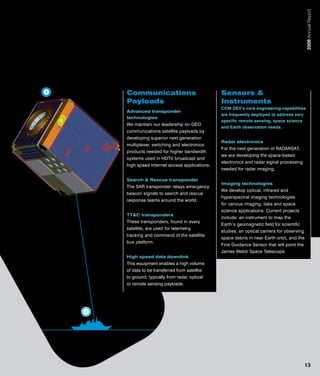
1       Communications                             Sensors &
        Payloads                                   Instruments
                                                   COM DEV’s core engineering capabilities
        Advanced transponder
                                                   are frequently deployed to address very
        technologies
                                                   specific remote sensing, space science
        We maintain our leadership on GEO
                                                   and Earth observation needs.
        communications satellite payloads by
        developing superior next generation
                                                   Radar electronics
        multiplexer, switching and electronics
                                                   For the next generation of RADARSAT,
        products needed for higher bandwidth
                                                   we are developing the space‑based
        systems used in HDTV broadcast and
                                                   electronics and radar signal processing
        high speed Internet access applications.
                                                   needed for radar imaging.

        Search & Rescue transponder
                                                   Imaging technologies
        The SAR transponder relays emergency
                                                   We develop optical, infrared and
        beacon signals to search and rescue
                                                   hyperspectral imaging technologies
        response teams around the world.
                                                   for various imaging, data and space
                                                   science applications. Current projects
        TT&C transponders
                                                   include: an instrument to map the
        These transponders, found in every
                                                   Earth’s geomagnetic field for scientific
        satellite, are used for telemetry,
                                                   studies, an optical camera for observing
        tracking and command of the satellite
                                                   space debris in near Earth orbit, and the
        bus platform.
                                                   Fine Guidance Sensor that will point the
                                                   James Webb Space Telescope.
        High speed data downlink
        This equipment enables a high volume
        of data to be transferred from satellite
        to ground, typically from radar, optical
        or remote sensing payloads.


    2


                                                                                              13
WELL- GROUNDED


As we enter 2009, even in these times of uncertainty, I am confident
we have built a solid business with growth prospects that are as
exciting as ever.


        Fellow Shareholders,

        I am pleased to report that 2008 was a year of very strong growth for COM DEV. Once
        again we effectively executed what I believe to be a sound strategy, allowing us to
        continue our pattern of outperforming the broader market. As we enter 2009, even in
        these times of uncertainty, I am confident we have built a solid business with growth
        prospects that are as exciting as ever.

        Our revenues increased by 28 percent to $210 million, significantly ahead of our long‑
        term expectation of 10 to 15 percent annual growth. Revenue growth was driven by the
        outstanding performance of our commercial space business, which grew by 54 percent
        to $127 million despite a relatively flat market for new transponder orders. Gross margins
        improved modestly to 24 percent and we improved net income to $12 million even as
        we made substantial investments in growth initiatives like our Automated Identification
        System (AIS) technology and U.S. expansion.

        In 2008, we made progress on every major component of our strategy – a strategy that
        has been consistent for several years. We look to maintain and build upon our leadership
        in the markets where we are already strong, such as commercial communications
        satellites. We seek to expand into adjacent markets, where the need for high reliability
        technology is paramount, in niches where we have an opportunity to be a world leader.
        We endeavour to strengthen our business through a pipeline of new products and
        through diversification into new market segments such as civil and military, and new
        geographic markets such as the U.S.

        Indeed, the successful launch of COM DEV USA was our most tangible strategic
        accomplishment of the year. In May, we completed the acquisition of an existing passive
        microwave devices business, and we spent the second half of the year integrating the
        operations into our recently purchased facility in El Segundo, California. COM DEV USA
        won its first major contract in September, and exited the year with a $25 million revenue
        run rate. We are very well positioned to become the leading supplier of passive
        microwave equipment to the lucrative U.S. Government space procurement market.


14
2008 Annual Report
                                                                                       John Keating
                                                                                       Chief Executive Officer


In last year’s annual report we highlighted three promising new products: AIS,
micro‑satellites, and Search and Rescue Repeaters (SARR). Since that time we have
successfully demonstrated our AIS technology through the launch of a nano‑satellite,
won a contract to develop a new micro‑satellite bus for the Canadian Government, and
won our first ever SARR contract. In this year’s report we preview some of our next
generation technology.

We continue to set highly ambitious objectives for 2009 and beyond, and we invite our
shareholders to monitor our progress against these key priorities.

First, we are striving to realize significant improvements in the operating margins of
our core business. In a business as complex as ours, simply maintaining our margins
during the recent five‑year span of unfavourable shifts in currency exchange rates has
required a relentless pursuit of operational improvements. I believe this mindset is now
ingrained into our organization. With currency stabilizing and our business volume
growing, I expect the benefits to become more apparent to investors.

Second, we are looking to build on the momentum achieved by our geographic divisions.
COM DEV USA has been very active in bidding for new contracts, and we are aiming
to broaden its customer base in 2009. COM DEV Canada has moved up the value
chain to reposition itself as a provider of spacecraft, namely the new M3MSat micro‑
satellite bus, rather than just as a supplier of subsystems. We expect to see increased
opportunities in Canada as the federal government recognizes the importance of the
domestic space industry and the potential for space‑based technology to serve the
national interest. We are looking to COM DEV Europe to achieve improved operational
performance as we continue to leverage our local presence to participate in European‑
based space programs.

A third objective for the near term is to complete our evaluation of the best possible
business model through which to bring our AIS solution to market, and take action to
benefit from our early position of technology leadership.


                                                                                                                 15
An obvious question, as I write about ambitious growth objectives, is how the current
     economic downturn is likely to affect COM DEV’s prospects. The short answer is that I
     believe we are very well positioned. While the space industry is not immune to broader
     trends, history has shown that it is less volatile than other sectors. Major programs take
     years to complete; it makes little sense to shut them down after hundreds of millions
     of dollars have already been committed. Existing satellites in orbit have finite lifespans
     and must be replaced if we want to avoid losing services like television broadcasts,
     weather monitoring and military communications. Demand for new commercial satellites
     in particular will continue to rise in the coming years as we complete the transition to
     bandwidth‑hungry HDTV at a time when satellite fill rates are already at record levels.
     To date we have seen little evidence of a decline in our sector, but we will keep very close
     watch on industry trends and be prudent in our decisions. It is important to note that
     COM DEV is targeting specific niches that are growing faster than the overall market.

     I take comfort in the indicators we track in our own business. We booked $230 million
     of new orders in 2008, and our pipeline of bidding activity remains as robust as ever.
     We ended the year with an order backlog of $158 million, with nearly $50 million of
     additional orders virtually assured on the basis of programs on which we have already
     begun work. On this basis we have excellent visibility into future revenues.

     Investors can also be reassured by the strength of our balance sheet. We begin fiscal
     2009 with $16 million of cash, a five‑year commitment from the lender of our term debt
     facility, and a significant line of credit that was not drawn upon.

     An important consideration is the strength and the track record of the leadership team
     we have in place. This is the group of people that established a new strategic direction
     six years ago when COM DEV was emerging from very difficult times. We overcame
     significant challenges to execute on that strategy and grow the Company on multiple
     dimensions. The strategic principles are the same, the team is largely the same, and
     as a result of successes to date, our potential is greater than ever. I will take this
     opportunity to thank that team for their efforts. I could not select a better group of men
     and women to stand alongside me. I also thank our customers and our shareholders for
     their ongoing support, and hope to enjoy continued mutual success.


     John Keating
     Chief Executive Officer


16
COM DEV | 2008 Annual Report


MANAGEMENT’S DISCUSSION AND ANALYSIS
OF FINANCIAL CONDITION AND RESULTS OF OPERATIONS
INTRODUCTION
    The following Management’s Discussion and Analysis (“MD&A”) provides information that management believes is relevant to an assessment and
    understanding of COM DEV International Ltd.’s (“the Company”, or “COM DEV”) consolidated results of operations and financial condition. This discussion
    should be read in conjunction with the Company’s audited consolidated financial statements including the notes thereto for the year ended October 31, 2008
    (“the Consolidated Financial Statements”). The Consolidated Financial Statements have been prepared in accordance with Canadian generally accepted
    accounting principles (GAAP) and are reported in Canadian dollars. The information contained herein is dated as of January 19, 2009.

CAUTION REGARDING FUTURE ORIENTED FINANCIAL INFORMATION
    Certain statements contained in this report contain forward-looking statements, including, (without limitation) statements concerning possible or
    assumed future results of operations of the Company preceded by, followed by or that include the words “believes”, “expects”, “anticipates”, “estimates”,
    “intends”, “plans”, “forecasts”, “guidance”, or similar expressions. Forward-looking statements are not guarantees of future performance. They involve
    risks, uncertainties and assumptions and the Company’s actual results may differ materially from those anticipated in these forward-looking statements.
    Additional information relating to the Company and the risks inherent in its business is provided in the Company’s Annual Information Form for the year
    ended October 31, 2008 and other documents available on SEDAR at www.sedar.com.

    This MD&A contains Future Oriented Financial Information (FOFI) in several areas, notably: in discussing R&D spending levels, SG&A spending, revenue
    growth guidance, and gross margin trending. Readers are again cautioned that this FOFI is provided solely to provide a view of the operations through the
    eyes of management, based on management’s current expectations in these areas, and should not be used for any other purpose. Readers are reminded
    that, as noted above, FOFI are not guarantees of future performance, and should not be considered such, since actual results may differ materially from
    those expressed in the FOFI.

COMMENT ON CURRENT GLOBAL ECONOMIC CONDITIONS
    The current global financial market downturn has resulted in some of the world’s best known financial institutions disappearing, as well as significant erosion
    of stock market values, and severe restrictions on credit availability. The volatile and uncertain economic environment presents many companies with new
    business challenges, not the least of which is communicating the impact of the current economic environment to its shareholders.

    COM DEV has not seen a significant impact on its operations thus far as a result of the global financial crisis. The Company’s customer base includes all of
    the world’s largest satellite prime manufacturers, who are building satellites for satellite operators whose businesses are generally described as generators
    of significant cash. In addition to these satellite prime manufacturers as customers, the Company’s strategic efforts to diversify into the government space
    sector have thus far been very successful, as evidenced by our revenue split, which is now roughly equal between the government and non-government
    sectors of the space market. With government departments now included in our customer base, management believes that it is well positioned with a
    diversified portfolio of financially healthy customers. Even with this kind of customer base, the Company continues to insure its foreign accounts receivable
    to the extent possible to minimize the risk of non-collection from these customers. Since this economic downturn began, the Company has not experienced
    any collection problems on accounts receivable.

    Management continues to see significant bidding activity in the marketplace. While it is possible that a prolonged economic downturn could make it more
    likely that some satellite programs become delayed, we have not seen significant evidence of this to date. Unlike many other industries, where there is
    significant discretion on timing of business decisions, the commercial space industry faces the reality that satellites have a limited life expectancy. Satellite
    operators must replace their satellite fleets over time if they are to continue to provide not just new services, but current services that are provided to their
    customers. While this does not make the space industry immune to the effects of the current economic crisis, the current replacement cycle that the industry
    is in has perhaps at least partly lessened any impact in our industry to date. Management will continue to monitor market activity and trends in our industry,
    in order to be able to react in a timely fashion should we see a decline in the level of new business activity.


                                                                                                                                                                        17
MANAGEMENT’S DISCUSSION AND ANALYSIS


              The current global economic conditions have not caused the Company to alter its strategic plans. Since 2002, management has described its intent to
              maintain its leadership position in the commercial satellite equipment market, and to expand its presence in the civil and defense space markets. This broad
              strategic plan has led to two acquisitions: one in 2005 which established the Company’s position as the leading Canadian provider of space science and
              optical instruments, and one in 2008 when we accelerated its expansion into the U.S. market through a product line acquisition in California. Our current
              focus is to expand its market share in each of these businesses, while at the same time continuing to develop technologies in support of market needs.

              The Company utilized its term debt facility to finance its U.S. expansion, and is repaying this debt according to the repayment schedule, over five years.
              There is no adverse economic change language in the loan agreement, which means that as long as the Company continues to repay the loan according
              to the established repayment schedule, an adverse material economic change will not result in the lender calling the loan. This provides management with
              confidence that this term loan should not cause concern about the Company’s liquidity.†

              The Company renegotiated its operating credit facility with the Canadian Imperial Bank of Commerce during the fourth quarter, increasing the
              Company’s available operating credit line from $17 million to $27 million. The covenants associated with that agreement were renegotiated at the same
              time. The covenants on the operating line include a current ratio minimum, a leverage ratio maximum, and a fixed charge coverage ratio minimum.
              The Company is well within all covenant ratio requirements at the end of the year. The operating line of credit remains undrawn and available to the
              Company to support its operations as required.

              For a more complete analysis of risks faced by the Company, and additional comments on the global economic environment, please refer to the section
              “Business Risks and Prospects”, included later in this MD&A.

     USE OF NON-GAAP MEASURES
              In this MD&A, we provide information about orders and contract backlog. Orders and backlog measures are not defined by Canadian generally accepted
              accounting principles (GAAP) and our measurement of them may vary from that used by others. The Company measures orders as the sum of fully executed
              contracts from our customers. The Company measures backlog as the sum of all customers’ orders at contract value (including the contract value of change
              notices subsequently received) to date, less revenue recognized against those orders, plus or minus the impact of foreign exchange fluctuations on orders
              denominated in foreign currency. The Company includes in its backlog determination, only those amounts that are covered by contracts. While we believe
              that long-term backlog trends serve as a useful metric for assessing the growth prospects for our business, backlog is not a guarantee of future revenues
              and provides no information about the timing on which future revenue may be recorded.

     OVERVIEW – CONTINUING OPERATIONS
              COM DEV is a leading global designer, manufacturer and distributor of space communications and space science products and systems. The Company
              began operations in 1974 and completed its initial public offering in December 1996. The Company is headquartered in Cambridge, Ontario, Canada,
              with additional operations in Aylesbury, England; Ottawa, Ontario, Canada; El Segundo, California; and Xian, China. The Company’s common shares
              trade on The Toronto Stock Exchange under the symbol “CDV”. COM DEV employed 1,206 people around the world as of October 31, 2008, compared to
              1,082 people as of October 31, 2007.

              COM DEV designs and manufactures advanced instruments and microwave products for space satellites such as multiplexers, filters, switches, surface
              acoustic wave (SAW) devices, signal processors, satellite payloads, and micro-satellite spacecraft. The products are sold to substantially all of the major
              satellite prime contractors for use in commercial communications, military/defense communications and space science satellites.

     OVERVIEW – DISCONTINUED OPERATIONS
              Two additional divisions are treated as discontinued operations in the Consolidated Financial Statements: COM DEV Wireless (CDW) which, as previously
              reported, was divested in the first quarter of the Company’s 2002 fiscal year; and COM DEV Broadband (CDB) which was divested immediately subsequent
              to the third quarter of the 2002 fiscal year.

              The Company has no continuing operations from these businesses, and the remaining obligations represent the final payments relating to these operations.

              The following analysis is related to the continuing operations of the Company unless otherwise noted.


     †
         Future oriented financial information (FOFI). Please refer to Caution Regarding FOFI on page 17 of this document.


18
COM DEV | 2008 Annual Report


OVERALL PERFORMANCE
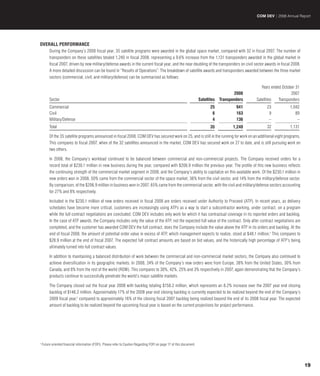
         During the Company’s 2008 fiscal year, 35 satellite programs were awarded in the global space market, compared with 32 in fiscal 2007. The number of
         transponders on these satellites totaled 1,240 in fiscal 2008, representing a 9.6% increase from the 1,131 transponders awarded in the global market in
         fiscal 2007, driven by new military/defense awards in the current fiscal year, and the near doubling of the transponders on civil sector awards in fiscal 2008.
         A more detailed discussion can be found in “Results of Operations”. The breakdown of satellite awards and transponders awarded between the three market
         sectors (commercial, civil, and military/defense) can be summarized as follows:

                                                                                                                                                       Years ended October 31
                                                                                                                                            2008                        2007
         Sector                                                                                                         Satellites   Transponders   Satellites   Transponders
         Commercial                                                                                                            25            941          23           1,042
         Civil                                                                                                                  6            163           9              89
         Military/Defense                                                                                                       4            136           –               –
         Total                                                                                                                 35          1,240          32           1,131

         Of the 35 satellite programs announced in fiscal 2008, COM DEV has secured work on 25, and is still in the running for work on an additional eight programs.
         This compares to fiscal 2007, when of the 32 satellites announced in the market, COM DEV has secured work on 27 to date, and is still pursuing work on
         two others.

         In 2008, the Company’s workload continued to be balanced between commercial and non-commercial projects. The Company received orders for a
         record total of $230.1 million in new business during the year, compared with $206.9 million the previous year. The profile of this new business reflects
         the continuing strength of the commercial market segment in 2008, and the Company’s ability to capitalize on this available work. Of the $230.1 million in
         new orders won in 2008, 50% came from the commercial sector of the space market, 36% from the civil sector, and 14% from the military/defense sector.
         By comparison, of the $206.9 million in business won in 2007, 65% came from the commercial sector, with the civil and military/defense sectors accounting
         for 27% and 8% respectively.

         Included in the $230.1 million of new orders received in fiscal 2008 are orders received under Authority to Proceed (ATP). In recent years, as delivery
         schedules have become more critical, customers are increasingly using ATPs as a way to start a subcontractor working, under contract, on a program
         while the full contract negotiations are concluded. COM DEV includes only work for which it has contractual coverage in its reported orders and backlog.
         In the case of ATP awards, the Company includes only the value of the ATP, not the expected full value of the contract. Only after contract negotiations are
         completed, and the customer has awarded COM DEV the full contract, does the Company include the value above the ATP in its orders and backlog. At the
         end of fiscal 2008, the amount of potential order value in excess of ATP, which management expects to realize, stood at $48.1 million.† This compares to
         $28.9 million at the end of fiscal 2007. The expected full contract amounts are based on bid values, and the historically high percentage of ATP’s being
         ultimately turned into full contract values.

         In addition to maintaining a balanced distribution of work between the commercial and non-commercial market sectors, the Company also continued to
         achieve diversification in its geographic markets. In 2008, 24% of the Company’s new orders were from Europe, 38% from the United States, 30% from
         Canada, and 8% from the rest of the world (ROW). This compares to 30%, 42%, 25% and 3% respectively in 2007, again demonstrating that the Company’s
         products continue to successfully penetrate the world’s major satellite markets.

         The Company closed out the fiscal year 2008 with backlog totaling $158.2 million, which represents an 8.2% increase over the 2007 year end closing
         backlog of $146.2 million. Approximately 17% of the 2008 year end closing backlog is currently expected to be realized beyond the end of the Company’s
         2009 fiscal year,† compared to approximately 16% of the closing fiscal 2007 backlog being realized beyond the end of its 2008 fiscal year. The expected
         amount of backlog to be realized beyond the upcoming fiscal year is based on the current projections for project performance.


†
    Future oriented financial information (FOFI). Please refer to Caution Regarding FOFI on page 17 of this document.


                                                                                                                                                                                19
MANAGEMENT’S DISCUSSION AND ANALYSIS


         The U.S. dollar continued to have an impact on the business during 2008. During the first three quarters of fiscal 2008, the U.S. dollar hovered around par
         with the Canadian dollar, based on the fiscal quarter-ending spot rates as reported by the Bank of Canada. This compares to fiscal 2007 where, according
         to Bank of Canada statistics, the U.S. dollar averaged $1.12 on the same basis for the first three quarters of that year. The fourth quarter saw a significant
         strengthening of the U.S. dollar compared to its Canadian counterpart, reaching $1.2045 at October 31, 2008 compared to $0.9447 at October 31, 2007.
         In 2008, the strengthening U.S. dollar had the effect of increasing revenues by $8.3 million, compared to 2007, when a weakened U.S. dollar had the effect
         of reducing revenues by $7.1 million. Most of the revenue impact in each year flowed through to gross margin as a result of the low level of U.S. sourced
         material in most programs. The hedging program in place at the Company moderated these exchange impacts in both years. In 2008, the hedging strategy
         had a negative impact on net income of $6.0 million, while in 2007 it had a positive impact on net income of $2.9 million.

         Gross margins for the year improved over the prior year, averaging 23.7% in 2008 compared with 21.0% in 2007. This improvement in gross margins reflects
         several factors, including the positive impacts of a stronger U.S. dollar, higher volumes of work flowing through the organization during the year, as increased
         capacity established throughout 2007 became utilized in 2008, and the absence of significant technical problems in 2008.

         In 2008, the Company expanded its Research & Development (“R&D”) efforts to include the development of a micro-satellite capability, which initially, will be
         targeted at the Canadian government market. In addition, work continued on our Automatic Identification System (AIS) technology as we launched our first-ever
         satellite during the year and successfully validated that technology’s potential. R&D spending for 2008 reached $17.4 million, compared to $15.0 million in
         2007. The current year spending represents 8.3% of revenues, compared with 9.1% of revenues in fiscal 2007.

         The Company made significant investments during 2008, in support of its growth objectives. In total, $27.3 million in capital was invested in two broad
         areas: $13.5 million to purchase the California-based Passive Microwave Devices (PMD) product line from L-3 Communications, and $13.8 million invested
         in capital equipment for the Company’s four sites: Cambridge, El Segundo, Ottawa, and Aylesbury. In 2007, the Company invested $25.2 million in new
         equipment, and capacity expansion in the U.S. and Cambridge.

         The Company renegotiated its operating line of credit with the Canadian Imperial Bank of Commerce during the latter part of 2008, resulting in an increase
         in the Company’s operating line to $27 million from its former level of $17 million. This operating line of credit remains undrawn at the end of fiscal 2008,
         except for $0.9 million in the form of guarantee letters issued to customers in the normal course of operations by the bank on behalf of the Company.
         The Company also has a term debt facility of $30 million through GE Capital Solutions, which has been almost fully drawn to complete the Company’s
         expansion efforts into the U.S. The Company drew on $11.0 million of this term debt facility in 2007 for the purchase of the land and building in California,
         and drew a further $18.2 million in 2008 to complete its PMD acquisition and related activities.

         For a more complete analysis of risks faced by the Company, please refer to the section “Business Risks and Prospects”, included later in this MD&A.

     SELECTED ANNUAL INFORMATION** (prepared in accordance with Canadian GAAP)
         (in thousands of dollars, except per share amounts)                                                                                                     Years ended October 31
                                                                                                                                              2008                2007            2006
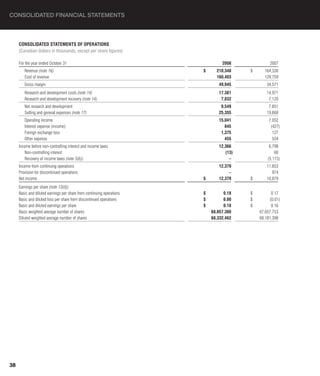
         Revenue                                                                                                                        $ 210,348          $   164,330      $   153,773
         Net income – continuing operations                                                                                             $ 12,379           $    11,853      $    21,202
         Earnings per share, basic & diluted – continuing operations*                                                                   $    0.18          $      0.17      $      0.34
         Net Income                                                                                                                     $ 12,379           $    10,879      $    21,202
         Earnings per share, basic & diluted*                                                                                           $    0.18          $      0.16      $      0.34
         Total assets                                                                                                                   $ 203,529          $   165,411      $   132,899
         Long-term financial liabilities                                                                                                $ 25,447           $     7,692      $       480
         Cash dividends declared                                                                                                        $       –          $         –      $         –
         * For a complete reconciliation of 2007 and 2008 earnings per share, please refer to Note 13 in the Notes to Consolidated Financial Statements.
         ** For 2007 to 2008 year to year variation commentaries, see the additional comments included in Results Of Operations sections below.


20
COM DEV | 2008 Annual Report


RESULTS OF OPERATIONS
Revenues
         (in millions of dollars)                                                                                                                 Years ended October 31
                                                                                                                               2008                2007        % change
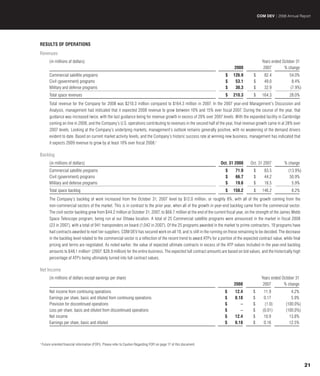
         Commercial satellite programs                                                                                    $   126.9         $      82.4            54.0%
         Civil (government) programs                                                                                      $    53.1         $      49.0             8.4%
         Military and defense programs                                                                                    $    30.3         $      32.9            (7.9%)
         Total space revenues                                                                                             $   210.3         $     164.3            28.0%
         Total revenue for the Company for 2008 was $210.3 million compared to $164.3 million in 2007. In the 2007 year-end Management’s Discussion and
         Analysis, management had indicated that it expected 2008 revenue to grow between 10% and 15% over fiscal 2007. During the course of the year, that
         guidance was increased twice, with the last guidance being for revenue growth in excess of 20% over 2007 levels. With the expanded facility in Cambridge
         coming on line in 2008, and the Company’s U.S. operations contributing to revenues in the second half of the year, final revenue growth came in at 28% over
         2007 levels. Looking at the Company’s underlying markets, management’s outlook remains generally positive, with no weakening of the demand drivers
         evident to date. Based on current market activity levels, and the Company’s historic success rate at winning new business, management has indicated that
         it expects 2009 revenue to grow by at least 10% over fiscal 2008.†

Backlog
         (in millions of dollars)                                                                                       Oct. 31 2008      Oct. 31 2007         % change
         Commercial satellite programs                                                                                    $     71.9        $      83.5           (13.9%)
         Civil (government) programs                                                                                      $     66.7        $      44.2            50.9%
         Military and defense programs                                                                                    $     19.6        $      18.5             5.9%
         Total space backlog                                                                                              $   158.2         $     146.2             8.2%
         The Company’s backlog of work increased from the October 31, 2007 level by $12.0 million, or roughly 8%, with all of the growth coming from the
         non-commercial sectors of the market. This is in contrast to the prior year, when all of the growth in year-end backlog came from the commercial sector.
         The civil sector backlog grew from $44.2 million at October 31, 2007, to $66.7 million at the end of the current fiscal year, on the strength of the James Webb
         Space Telescope program, being run at our Ottawa location. A total of 25 Commercial satellite programs were announced in the market in fiscal 2008
         (23 in 2007), with a total of 941 transponders on board (1,042 in 2007). Of the 25 programs awarded in the market to prime contractors, 19 programs have
         had contracts awarded to next tier suppliers. COM DEV has secured work on all 19, and is still in the running on those remaining to be decided. The decrease
         in the backlog level related to the commercial sector is a reflection of the recent trend to award ATPs for a portion of the expected contract value, while final
         pricing and terms are negotiated. As noted earlier, the value of expected ultimate contracts in excess of the ATP values included in the year-end backlog
         amounts to $48.1 million† (2007: $28.9 million) for the entire business. The expected full contract amounts are based on bid values, and the historically high
         percentage of ATPs being ultimately turned into full contract values.

Net Income
         (in millions of dollars except earnings per share)                                                                                       Years ended October 31
                                                                                                                               2008                2007        % change
         Net income from continuing operations                                                                            $     12.4       $       11.9            4.2%
         Earnings per share, basic and diluted from continuing operations                                                 $     0.18       $       0.17            5.9%
         Provision for discontinued operations                                                                            $        –       $       (1.0)        (100.0%)
         Loss per share, basic and diluted from discontinued operations                                                   $        –       $      (0.01)        (100.0%)
         Net income                                                                                                       $     12.4       $       10.9           13.8%
         Earnings per share, basic and diluted                                                                            $     0.18       $       0.16           12.5%


†
    Future oriented financial information (FOFI). Please refer to Caution Regarding FOFI on page 17 of this document.


                                                                                                                                                                             21
MANAGEMENT’S DISCUSSION AND ANALYSIS


         Net income in 2008 was $12.4 million compared with $10.9 million in 2007. There were a number of factors that impacted net income in 2008. Of primary
         significance was 28.0% growth in revenue, at 2.7% higher average gross margins than in 2007. The resulting $15.4 million in additional gross margin was
         partly offset by higher spending on Selling, General & Administrative (SG&A), Research & Development (R&D), Interest, and foreign exchange loss costs.
         Each of these is discussed later in this document. In 2007, the Company’s net income benefited from the initial recognition of $7.9 million of future tax assets.
         There were no additional future tax assets recognized in fiscal 2008.

     Gross Margin
         (in millions of dollars)                                                                                                                 Years ended October 31
                                                                                                                               2008                2007        % change
         Total gross margin                                                                                              $      49.9          $    34.6           44.2%
         Total gross margin %                                                                                                 23.7%               21.0%            2.7%
         Gross margins for 2008 averaged 23.7% compared to 21.0% in 2007. The Canadian/U.S. dollar volatility which we saw in the latter half of 2007, moderated
         during the first three quarters of fiscal 2008, with the exchange rate remaining near par for that period. In the fourth quarter of fiscal 2008, the U.S. dollar
         strengthened significantly, benefiting gross margins in that quarter by $3.9 million. The capacity expansion efforts that hampered gross margins in fiscal
         2007 were completed, and the additional capacity became utilized in 2008. This capacity increase, both in the Company’s Cambridge, and El Segundo
         operations, provided the organization with the ability to realize higher production throughput, resulting in revenue growth of 28.0% over the prior year, and
         improved facility utilization, thus generating better gross margins. While some programs encountered cost growth during fiscal 2008, there were no major
         technical issues impacting gross margins during the year.

     Research and Development
         (in millions of dollars)                                                                                                                 Years ended October 31
                                                                                                                               2008                2007        % change
         Total R&D spending before funding                                                                               $      17.4      $        15.0           16.0%
         Total R&D funding received                                                                                      $      (7.8)         $    (7.1)           9.9%
         R&D, net of funding                                                                                             $       9.6          $     7.9           21.5%
         The Company has an established R&D technology roadmap that drives its internal research and development activities. This technology roadmap is
         reviewed semi-annually against longer term customer requirements, and potential new technologies that show promise in meeting those requirements.
         While the Company works to secure outside funding for its R&D efforts, in the absence of funding, it maintains its focus on the activities that form the
         Company’s technology roadmap. During 2008, the level of outside funding for R&D activities increased by 9.9% from levels received in 2007. Despite
         that increase in outside funding, the Company’s development efforts on AIS, and micro-satellite capabilities resulted in an increase in gross spending
         of 16.1%. The Company will continue to work closely with all available sources of outside funding to defray the costs of its R&D efforts, and maintains
         its commitment to technological leadership in its industry. It is important to note that R&D costs noted in the table above reflect only Company-funded
         research and development activities (net of any external offset funding received). Customer-funded development costs are included in the Company’s
         cost of revenue figures.

     Other Expenses
         (in millions of dollars)                                                                                                                 Years ended October 31
                                                                                                                               2008                2007        % change
         Selling, general and administrative expenses (SG&A)                                                             $     25.4           $    19.7           28.9%
         SG&A % of total revenue                                                                                              12.1%               12.0%            0.1%
         Interest expense / (income)                                                                                     $       0.8          $     (0.4)        300.0%
         Foreign exchange loss                                                                                           $       1.4          $      0.1        1300.0%
         Other expense                                                                                                   $       0.5          $      0.6         (16.7%)


22
COM DEV | 2008 Annual Report


Selling, General and Administrative
SG&A expenses for 2008 were $25.4 million compared with $19.7 million in 2007. The year over year increase in SG&A expenses reflects costs of
approximately $1.6 million associated with the Special Committee review of the Company’s historic stock option granting practices, incremental costs
of approximately $1.0 million from the establishment of the Company’s new divisional structure, and management incentive accruals of $1.2 million
where only $0.4 million were accrued in the prior year. Selling costs were $1.9 million higher during the year versus 2007 as a result of the high level of
bidding activity. The success of the organization in winning $230.1 million in new orders during the year supports these higher selling costs.

Interest Expense / (Income)
The Company incurred interest charges of $0.8 million in fiscal 2008, compared with interest income of $0.4 million in fiscal 2007. In May 2008, the
Company drew on its term debt facility by $18.2 million to finance the purchase of the PMD product line from L-3 Communications in California. The resulting
higher level of term debt outstanding, coupled with lower cash balances throughout the year resulted in the shift from interest income earned in 2007 to
interest expense in 2008. The term debt attracts interest at rates varying from LIBOR plus 225 bps to LIBOR plus 360 bps.

Foreign Exchange
The foreign exchange loss in 2008 was $1.4 million, compared with a loss of $0.1 million in 2007. Foreign exchange amounts on the Consolidated Statement
of Operations include realized and unrealized gains and losses that result from balance sheet translation of foreign denominated balances, and mark to
market valuation adjustments on the Company’s outstanding U.S. dollar hedge contracts. They do not include the impact of foreign exchange fluctuations on
customer program values, and their resulting profitability, which is reflected in the revenue, cost of revenue, and gross margin sections of the Consolidated
Statement of Operations. The significant strengthening of the U.S. dollar in the fourth quarter of 2008 resulted in erosion of the mark to market valuation of
the Company’s U.S. dollar hedges. For the year, the impact from the mark to market valuations on the U.S. dollar hedge contracts was an unrealized exchange
loss of $6.0 million, compared to an unrealized exchange gain of $2.9 million in fiscal 2007. The impact of translation of foreign denominated balance sheet
items during the year was a gain of $4.6 million, compared to a loss of $3.0 million in 2007.

Other Expense
Other expense includes bank fees and Export Development Canada (EDC) accounts receivable insurance premiums, as well as other miscellaneous items.
The Company insures its customer receivables with EDC to the extent possible in order to mitigate the risk of non-collection.


                                                                                                                                                                 23
MANAGEMENT’S DISCUSSION AND ANALYSIS


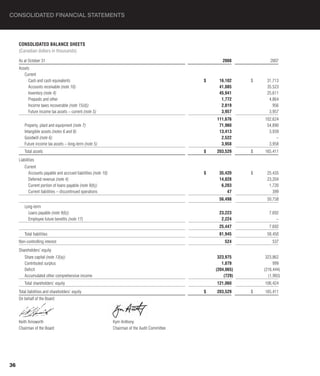
     Financial Position
          The following chart outlines the significant changes in the balance sheet between October 31, 2007 and October 31, 2008:

                                                             Increase/
          (in millions of dollars)                         (Decrease)     Explanation
          Cash and cash equivalents                        $     (15.6)   Refer to Statement of Cash Flows.
          Accounts receivable                                      5.6    Normal billing and collection activity, but on a higher volume of work.
          Inventory                                               20.3    Project inventory increase of $17.6 million, which supports specific work for customer
                                                                          contracts, and which will ultimately turn into accounts receivable and cash. This increase
                                                                          is in line with the increase in orders and backlog within the organization. General inventory
                                                                          increase of $2.7 million in support of overall level of work within the organization. This
                                                                          inventory is not specifically identified to a customer contract, but is generally expected to
                                                                          be required as a normal part of project execution.
          Prepaid and other                                       (3.1)   Decrease in mark to market valuation of U.S. dollar hedge contracts.
          Income taxes recoverable                                 1.9    Payments on account of disputed tax assessments, less amounts related to issues where
                                                                          the Company has dropped its dispute.
          Future income tax assets – current                        –
          Property, plant and equipment                          17.1     Normal capital additions during the year plus capital assets acquired through the PMD
                                                                          product line acquisition, less normal depreciation.
          Intangible assets                                        9.5    Intangibles purchased through the PMD product line acquisition, including patents,
                                                                          customer relationships, acquired processes, and non-compete agreement.
          Goodwill                                                2.5     Price paid in excess of fair value of tangible and intangible assets of the PMD product line.
          Future income tax assets – long-term                      –
          Accounts payable and accrued liabilities               10.0     Normal accounts payable payment cycle, on a higher level of purchasing activity due to
                                                                          higher volume of work at the Company.
          Deferred revenue                                        (8.4)   Lower customer billings in advance of work being performed. This balance fluctuates with
                                                                          order levels, and billing profiles on each order.
          Current portion of loans payable                        4.5     Current portion of draws on term debt facility for land, building, and the PMD acquisition.
          Current liabilities – discontinued operations          (0.4)    Scheduled payout of final obligations from discontinued operations.
          Loans payable                                          15.5     Long-term portion of all draws on the Company’s term debt facility.
          Employee future benefits                                2.2     Benefits obligations related to employees of the acquired PMD product line from
                                                                          L-3 Communications.
          Share capital                                            0.1    Issuance of shares to satisfy Employee Share Purchase Plan commitments.
          Contributed surplus                                      0.9    Value of Employee Share Purchase Plan awards, and expense recognized on stock options.
          Deficit                                                (12.4)   Net income for the year.
          Accumulated other comprehensive income                  (1.3)   Foreign currency translation of self-sustaining subsidiaries. Effective August 31, 2008, the
                                                                          Company’s operations in the U.S. met the conditions for classification as a self-sustaining
                                                                          foreign operation.

     LIqUIDITY AND CAPITAL RESOURCES
          (in millions of dollars)                                                                                                            Years ended October 31
                                                                                                                            2008               2007        % change
          Cash (used in) / from operating activities                                                                  $      (1.4)       $      21.9          (106.4%)
          Net (decrease) / increase in cash                                                                           $     (15.6)       $       6.0          (360.0%)
          Property and equipment additions                                                                            $      13.7        $      25.2           (45.6%)
          Business acquisition                                                                                        $      13.5        $         –                –
          The Company used $1.4 million of cash for operating activities in 2008, compared with 2007 when $21.9 million was generated. Unlike fiscal 2007, when
          working capital generated $10.6 million in cash, the Company invested $26.1 million in working capital in 2008.


24
COM DEV | 2008 Annual Report


   As noted earlier, the Company renegotiated its operating line of credit facility with the Canadian Imperial Bank of Commerce in 2008, with the result
   being an increase in the available credit line from $17 million to its new level of $27 million, which was not drawn upon throughout fiscal 2008, except
   for $0.9 million in the form of guarantee letters issued to customers in the normal course of operations by the bank on behalf of the Company. In addition
   to this operating line of credit, the Company also has a treasury risk management facility to facilitate hedging of currency related risks arising in the
   normal course of operations. Under these facilities, the Company is required to maintain certain financial ratios, which the Company has met as of
   October 31, 2008.

   In addition, the Company has term credit facilities totaling $30 million (2007: $30 million) to support its strategic and capital initiatives. The Company
   drew $10 million USD in support of the Company’s acquisition of a production facility in El Segundo, California, during the third quarter of 2007. In the third
   quarter of fiscal 2008, the Company further drew on the term debt facility by $18 million USD to complete the acquisition of the PMD product line from
   L-3 Communications Ltd., and to complete additional build-out work on the building in El Segundo.

OFF-BALANCE ShEET ARRANGEMENTS
   The Company has no off-balance sheet arrangements other than operating leases disclosed in the Notes to the Consolidated Financial Statements as at the
   end of the 2008 fiscal year.

TRANSACTIONS WITh RELATED PARTIES
   The Company had no transactions with related parties in fiscal 2008.

FOURTh qUARTER
   The Company booked $60.0 million in new orders in the fourth quarter of fiscal 2008, compared with approximately $55.1 million in the fourth quarter
   of 2007. The book-to-bill ratio for the quarter was 1.00, compared to 1.27 in the fourth quarter of fiscal 2007. It is important to note that contract awards in
   the space market are typically characterized as lumpy, which historically has resulted in uneven new order levels on a quarter-by-quarter basis. Revenues for
   the fourth quarter were $59.8 million, compared with $51.5 million in the prior quarter, and $43.4 million in the fourth quarter of fiscal 2007. Gross margins
   were 27.0% in the fourth quarter, up from 23.0% in the prior quarter, and up from 11.1% in the fourth quarter of fiscal 2007. The increase in fourth quarter
   margins reflected the significant year over year strengthening of the U.S. dollar, higher levels of production than in the prior year, with the resulting realization
   of improved operating efficiencies, and the absence of any significant technical issues during the quarter. The weakening of the Canadian dollar against the
   U.S. dollar had a positive impact on gross margins of $3.9 million in the fourth quarter.

   During the fourth quarter, the Company generated $11.3 million in cash from operating activities, compared with the prior quarter where the Company generated
   $2.2 million in cash from operating activities. In the fourth quarter of 2007, the Company generated $19.0 million in cash from operating activities.

   The Company invested $4.0 million in capital asset additions during the fourth quarter of 2008, up from $3.5 million spent in the third quarter excluding
   the $13.1 million PMD product line acquisition in that quarter. The Company invested $6.5 million in capital assets during the fourth quarter of fiscal 2007.
   The Company ended the quarter with $16.1 million in cash, compared with $11.1 million at the end of the prior quarter, and $31.7 million at the end of the
   fourth quarter of fiscal 2007.

   On August 31, 2008, the Company determined that its operations in El Segundo satisfied the conditions of being classified as a self-sustaining foreign
   operation. As a result of, and effective from the date of this determination, the Company’s exposure to exchange risk became limited to its net investment in
   the U.S. operations. The debt associated with the Company’s investment in its U.S. subsidiary is designated as a hedge against that investment. Translation
   gains or losses arising from the U.S. operations are reflected in Other Comprehensive Income.


                                                                                                                                                                           25
MANAGEMENT’S DISCUSSION AND ANALYSIS


     PROPOSED TRANSACTIONS
        While the Company continues to evaluate potential business expansion initiatives, it has no firm proposed transactions as at October 31, 2008.

     CONTRACTUAL OBLIGATIONS
        (in thousands of dollars)                           Total               2009                2010                 2011                2012                 2013 2014 & beyond
        Long-term debt*                              $ 29,426            $     6,203          $     6,610         $     7,055         $     6,800          $     2,758         $         –
        Operating leases                             $ 4,569             $     1,841          $     1,863         $       864         $         1          $         –         $         –
        Capital leases                               $      –            $         –          $         –         $         –         $         –          $         –         $         –
        Purchase obligations**                       $      –            $         –          $         –         $         –         $         –          $         –         $         –
        Other long-term obligations***               $ 3,581             $       101          $        83         $       123         $       172          $       243         $     2,859
        Total contractual obligations                $ 37,576            $     8,145          $     8,556         $     8,042         $     6,973          $     3,001         $     2,859
        * Long-term debt appears on the balance sheet using the effective interest rate method of valuation in accordance with recent GAAP pronouncements.
        ** Defined as an agreement to purchase goods and services that is enforceable and legally binding on the Company and that specifies all significant terms including: fixed or minimum
           quantities to be purchased; fixed, minimum or variable price provisions; and the approximate timing of the transactions.
        *** Includes expected future benefit payments to certain employees under a defined benefit pension plan, as well as $47 in remaining obligations from the Company’s
            discontinued operations.

     FINANCIAL INSTRUMENTS AND OThER INSTRUMENTS
        The Company realizes a significant portion of its revenues in U.S. dollars and incurs most of its expenses in Canadian dollars. The Company utilizes foreign
        exchange options to hedge the net cash flow risk associated with forecasted transactions in foreign currencies but does not enter into derivatives for
        speculative purposes. The Company utilizes derivative instruments to manage the risk associated with anticipated cash flows that will be denominated in
        foreign currencies. The Company does not designate or measure the effectiveness of the derivative instruments as hedges of specific firm commitments or
        forecasted transactions and accordingly does not meet the requirements of CICA Handbook Section 3865, Hedges to apply hedge accounting. The Company
        generally uses foreign exchange put options and related call options to manage foreign currency risk related to sales to customers in the United States and
        United Kingdom.

        Derivative financial instruments are carried at their fair values. Realized and unrealized gains and losses associated with the derivative instruments are
        included in “foreign exchange loss” in the Consolidated Statements of Operations. In 2008, the loss from erosion in fair value of the Company’s hedge
        options was $6.0 million, compared to a gain of $2.9 million in 2007.

        On October 31, 2008, the Company had outstanding foreign exchange call options with a notional value of $42.8 million maturing within a year at an average
        exchange rate of $1.1383 (October 31, 2007: $26.4 million at $1.0680). The Company had outstanding foreign exchange put options with a notional value of
        $59.2 million maturing within a year at an average exchange rate of $1.1703 (October 31, 2007: $35.6 million at $1.0787). The Company is exposed to credit
        risk on derivative financial instruments arising from the potential for counterparties to default on their contractual obligations to the Company. The Company
        minimizes this risk by limiting counterparties to these contracts to Canadian Schedule A Chartered Banks.


26
COM DEV | 2008 Annual Report


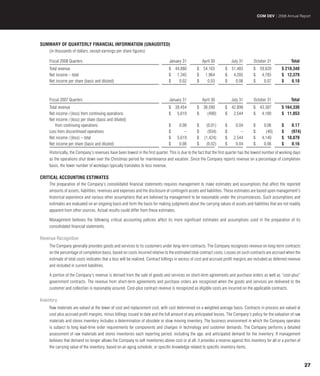
SUMMARY OF qUARTERLY FINANCIAL INFORMATION (UNAUDITED)
    (in thousands of dollars, except earnings per share figures)

    Fiscal 2008 Quarters                                                        January 31            April 30          July 31       October 31              Total
    Total revenue                                                               $ 44,880          $ 54,165          $ 51,483          $ 59,820          $ 210,348
    Net income – total                                                          $ 1,345           $ 1,964           $ 4,285           $ 4,785           $ 12,379
    Net income per share (basic and diluted)                                    $   0.02          $   0.03          $   0.06          $   0.07          $    0.18


    Fiscal 2007 Quarters                                                        January 31            April 30          July 31       October 31              Total
    Total revenue                                                               $ 39,454          $ 38,590          $ 42,899          $ 43,387          $ 164,330
    Net income / (loss) from continuing operations                              $ 5,619           $   (490)         $ 2,544           $ 4,180           $ 11,853
    Net income / (loss) per share (basic and diluted)
        from continuing operations                                              $     0.08        $     (0.01)      $     0.04        $      0.06       $   0.17
    Loss from discontinued operations                                           $        –        $      (934)      $        –        $       (40)      $   (974)
    Net income / (loss) – total                                                 $    5,619        $    (1,424)      $    2,544        $     4,140       $ 10,879
    Net income per share (basic and diluted)                                    $     0.08        $     (0.02)      $     0.04        $      0.06       $   0.16
    Historically, the Company’s revenues have been lowest in the first quarter. This is due to the fact that the first quarter has the lowest number of working days
    as the operations shut down over the Christmas period for maintenance and vacation. Since the Company reports revenue on a percentage of completion
    basis, the lower number of workdays typically translates to less revenue.

CRITICAL ACCOUNTING ESTIMATES
    The preparation of the Company’s consolidated financial statements requires management to make estimates and assumptions that affect the reported
    amounts of assets, liabilities, revenues and expenses and the disclosure of contingent assets and liabilities. These estimates are based upon management’s
    historical experience and various other assumptions that are believed by management to be reasonable under the circumstances. Such assumptions and
    estimates are evaluated on an ongoing basis and form the basis for making judgments about the carrying values of assets and liabilities that are not readily
    apparent from other sources. Actual results could differ from these estimates.

    Management believes the following critical accounting policies affect its more significant estimates and assumptions used in the preparation of its
    consolidated financial statements.

Revenue Recognition
    The Company generally provides goods and services to its customers under long-term contracts. The Company recognizes revenue on long-term contracts
    on the percentage of completion basis, based on costs incurred relative to the estimated total contract costs. Losses on such contracts are accrued when the
    estimate of total costs indicates that a loss will be realized. Contract billings in excess of cost and accrued profit margins are included as deferred revenue
    and included in current liabilities.

    A portion of the Company’s revenue is derived from the sale of goods and services on short-term agreements and purchase orders as well as “cost-plus”
    government contracts. The revenue from short-term agreements and purchase orders are recognized when the goods and services are delivered to the
    customer and collection is reasonably assured. Cost-plus contract revenue is recognized as eligible costs are incurred on the applicable contracts.

Inventory
    Raw materials are valued at the lower of cost and replacement cost, with cost determined on a weighted average basis. Contracts in process are valued at
    cost plus accrued profit margins, minus billings issued to date and the full amount of any anticipated losses. The Company’s policy for the valuation of raw
    materials and stores inventory includes a determination of obsolete or slow moving inventory. The business environment in which the Company operates
    is subject to long lead-time order requirements for components and changes in technology and customer demands. The Company performs a detailed
    assessment of raw materials and stores inventories each reporting period, including the age, and anticipated demand for the inventory. If management
    believes that demand no longer allows the Company to sell inventories above cost or at all, it provides a reserve against this inventory for all or a portion of
    the carrying value of the inventory, based on an aging schedule, or specific knowledge related to specific inventory items.


                                                                                                                                                                       27
MANAGEMENT’S DISCUSSION AND ANALYSIS


     Project Costs to Complete
          At the outset of each customer project, an estimate of the total expected cost to complete the scope of work under contract is made. During the course of
          the projects, these estimates are reviewed and revised to reflect current expectations of cost to complete, and total cost. These estimates are based on
          specific knowledge of the status of the project, as well as historic understanding of costs on similar projects. Cost elements include material, direct labour,
          and overhead costs, with labour and overhead costs being determined using pre-determined costing rates applied to estimated labour hours required to
          complete the scope of work under contract. These estimates are reviewed on a monthly and quarterly basis to ensure the estimates reflect the current
          expectations for total costs, however this is not a guarantee that unforeseen or additional costs could be incurred, which would have an impact on project
          total cost, reported revenue, and gross margins. Management believes it has a review procedure in place to ensure the validity of these estimates at the time
          they are made.

     Useful Life of Intangible and Long-Term Assets
          The Company has established policies for determining the useful life of its intangible and long-term assets, and amortizes the costs of these assets over
          those useful lives. The useful life for each category of asset is determined based on the expectation of its ability to continue to generate revenues, and thus,
          cash flows for the Company. This ability is tested periodically to ensure the conditions still exist to allow the asset to be reflected at its net-recorded value in
          the accounts of the Company, and any impairment to the valuation is reflected in the accounts at the time the impairment is determined.

     Income Tax Liabilities
          The Company establishes a tax provision based on its calculation of taxable income in any year. Occasionally, the Company is subjected to audits by various
          federal and provincial agencies. When adjustments are proposed, the Company assesses its position with respect to the issue, and when it considers the
          Company’s position to be correct, may object to proposed adjustments. Management estimates the likelihood of succeeding in its position, and where
          appropriate, provides for amounts estimated to be payable, or reports in notes to the Company’s financial statements. For a complete description of
          carry-forward tax balances, the future tax asset, and associated valuation reserve against that future tax asset, see Note 5 to the 2008 audited Consolidated
          Financial Statements.

     Contract Penalties
          In some cases, the Company enters into contracts with its customers for the delivery of equipment, where penalties are incurred for late delivery. When the
          Company wins these orders, it assumes that the cost of the penalties will not be incurred unless the project schedule indicates that contracted delivery dates
          will not be met. At that time, the individual projects are charged with the cost associated with expected penalties.

     ChANGES IN ACCOUNTING POLICIES INCLUDING INITIAL ADOPTION
     International Financial Reporting Standards (IFRS)
          The Canadian Institute of Chartered Accountants’ (CICA) Accounting Standards Board has announced that Canadian publicly accountable enterprises will
          adopt IFRS as issued by the International Accounting Standards Board effective for fiscal years beginning on or after January 1, 2011 and therefore will
          commence in the first quarter of the Company’s 2012 fiscal year with comparative figures. The Company is in the process of developing a plan for the
          implementation of IFRS, and it is expected that this plan will take into consideration, amongst other things:

          •  Identification of differences in Canadian GAAP and IFRS accounting policies and choices and their impacts on the Company’s
             consolidated financial statements.
          •  Selection of the Company’s continuing IFRS policies.
          •  Changes in note disclosures.
          •  Information technology and data system requirements.
          •  Disclosure controls and procedures, including investor relations and external communications plans related to the IFRS conversion.
          •  Identification of impacts of IFRS conversion on Internal Controls over Financial Reporting.
          •  Financial reporting expertise requirements, including training of personnel.
          •  Impacts on other business activities that may be influenced by GAAP measures, such as debt covenants.


28
COM DEV | 2008 Annual Report


     It is not practically possible at this time to quantify the impact of these differences. The Company expects to make changes to processes and systems before
     the 2011 fiscal year, in time to enable the Company to record transactions under IFRS for comparative purposes in the 2012 financial year reporting.

Goodwill and Intangible Assets
     In February 2008, the CICA released Handbook Section 3064, Goodwill and Intangible Assets, replacing the previous CICA Handbook Sections 3062
     (Goodwill and Intangible Assets), and 3450 (Research and Development Costs). The objectives of the changes are to reinforce a principle-based approach
     to the recognition of costs as assets and to clarify the application of the concept of matching revenues and expenses. See Note 3 to the 2008 audited
     Consolidated Financial Statements for additional description of the requirements of this Handbook Section 3064. The effective date of adopting this new
     section for the Company is November 1, 2008. The impact of adopting this standard is not expected to have any effect on the Company’s Consolidated
     Statement of Operations.

Inventories
     In June 2007, the CICA released Handbook Section 3031, Inventories. This new standard, with an effective date for adoption for the Company of
     November 1, 2008 provides more guidance on the measurement and disclosure requirements for inventories than the previous CICA Handbook
     Section 3030. The impact of adoption of this new section will not be material to the Company as it already records the inventories at the lower of cost
     and net realizable value.

Financial Instruments – Disclosures & Presentation
     In December 2006, the CICA released Handbook Section 3862 and 3863, Financial Instruments – Disclosures & Presentation, effective for all annual and
     interim periods beginning on or after November 1, 2007, and accordingly, the Company adopted these new Handbook Sections in its 2008 fiscal year. These
     new Handbook Sections include required disclosures for the assessment of the significance of financial instruments for an entity’s financial position and
     performance and of the extent of risks arising from financial instruments to which the Company is exposed and how the Company manages those risks.
     CICA Handbook Section 3863 carries forward the presentation requirements of CICA Handbook Section 3861. There was no impact on the Company’s results
     as a result of the adoption of these new standards was not material.

Changes in Accounting Policies and Estimates, and Errors
     In July 2006, the Accounting Standards Board issued a new Section, Changes in Accounting Policies and Estimates, and Errors. This standard affects
     when an accounting policy may be changed, how any resulting changes are to be applied, and what disclosures must be made. Adoption is for fiscal years
     beginning on or after January 1, 2007, which resulted in the Company adopting this Section in its fiscal year 2008. The impact of the adoption of this standard
     on the consolidated results of operations or financial position was not material.

Capital Disclosures
     In December 2006, the CICA released Handbook Section 1535, Capital Disclosures, effective for all annual and interim periods beginning on or after
     November 1, 2007, and accordingly, the Company adopted this new Section in its 2008 fiscal year. This new Section establishes standards for disclosing
     information about an entity’s capital and how it is managed. The entity’s disclosure should include information about its objectives, policies and processes
     for managing capital, and disclose whether or not it has complied with any capital requirements to which it is subject and the consequences of non-
     compliance. There was no impact on the Company’s results from adopting this new standard.

Financial Instruments – Recognition and Measurement
     In January 2005, the CICA released Handbook Section 3855, Financial Instruments – Recognition and Measurement, effective for all annual and interim
     periods beginning on or after October 1, 2006, and accordingly, the Company adopted Section 3855 in its fiscal year 2007. All financial instruments
     must be classified into prescribed categories and reclassification is rarely possible. Classification determines how each instrument is measured and how
     gains and losses are recognized. See Note 1 to the 2008 audited Consolidated Financial Statements for additional description of the requirements of
     Section 3855, including standards pertaining to stand-alone, and embedded derivatives. The impact of the adoption of this standard on the consolidated
     results of operations and financial position of the Company was not material.


                                                                                                                                                                       29
MANAGEMENT’S DISCUSSION AND ANALYSIS


     Comprehensive Income
         In the fiscal year 2007, the Company adopted CICA 1530, Comprehensive Income, which set the standards for the reporting and display of comprehensive
         income. See Note 2 to the 2008 audited Consolidated Financial Statements for a description of the impact of adoption. Comprehensive income is defined as
         the change in equity (net assets) of an enterprise during a period from transactions and other events and circumstances from non-owner sources. It includes
         all changes in equity during a period, except those resulting from investment by owners and distributions to owners. A statement of comprehensive income
         is included in a full set of financial statements for both interim and annual periods. The new statement presents net income and each component to be
         recognized in other comprehensive income. These components would include, for example, exchange gains and losses arising on translation of the financial
         statements of self-sustaining foreign operations. This standard became effective for years beginning on or after October 1, 2006.

     Hedges
         In April 2005, the CICA issued Handbook Section 3865, Hedges, which is effective for years beginning on or after October 1, 2006, and which the
         Company adopted in its fiscal year 2007. This section established standards for when and how hedge accounting may be applied. Hedging is an activity
         designed to modify an entity’s exposure to one or more risks. Hedge accounting modifies the normal basis for recognizing the gains, losses, revenues and
         expenses associated with a hedged item in an entity’s statement of operations. It ensures that the counterbalancing gains, losses, revenues and expenses
         are recognized in the same period. Since the Company does not designate its foreign exchange options as hedges, the impact of this standard on the
         consolidated results of operations or financial position of the Company was not material.

     BUSINESS RISkS AND PROSPECTS
     Global Economic Environment
         Recent events have demonstrated that businesses and industries throughout the world are very tightly connected to each other. Thus, events seemingly
         unrelated to the Company or to its industry, such as the recent extraordinary developments in global financial markets, may adversely affect the Company
         over the course of time. For example, rapid changes to foreign currency exchange rates may adversely affect the Company’s financial results. Credit
         contraction in financial markets may hurt the Company’s ability to access credit in the event that it identifies an acquisition opportunity or some other
         opportunity that would require a significant investment in resources. Government payments to support financial institutions and other distressed industries
         may reduce the amount of money governmental agencies have to spend on space and defence related projects. A reduction in credit, combined with reduced
         economic activity, may adversely affect prime contractors and other businesses that collectively constitute a significant portion of the Company’s customer
         base. As a result, these customers may need to reduce their purchases of COM DEV’s products or services, or the Company may experience greater difficulty
         in receiving payment for the products or services that these customers purchase from the Company. Any of these events, or any other events caused by
         turmoil in world financial markets, may have a material adverse effect on the Company’s business, operating results, and financial condition.

         For additional comments on the impact of the current global economic environment, please see the comments included on page 17 of this document.

     New Products and Technological Change
         The market for the Company’s products is characterized by rapidly changing technology involving industry standards and frequent new product introductions.
         The Company’s success will depend upon market acceptance of its existing products and its ability to enhance its existing products and to introduce new
         products and features to meet changing customer requirements. There can be no assurance that the Company will be successful in identifying, developing,
         manufacturing and marketing new products or enhancing its existing products. The Company’s business will be adversely affected if the Company incurs
         delays in developing new products or enhancements or if such products or enhancements do not gain market acceptance. In addition, there can be no
         assurance that products or technologies developed by others will not render the Company’s products or technologies non-competitive or obsolete.

     Reliance on Significant Customers and Credit Concentration
         The satellite industry is characterized by a small number of prime contractors, which represents most of the Company’s customer base. The relatively
         small number of customers leads to a concentration of the Company’s revenues and accounts receivable. If one or more customers were to delay, reduce
         or cancel orders, the overall orders of the Company may fluctuate and could adversely affect the Company’s operations and financial condition. While
         the Company’s accounts receivable tend to be concentrated, many of our customer receivables, by virtue of their non-Canadian status are insured
         with Export Development Canada (EDC). While the Company expects to be able to continue to access receivables insurance through EDC, there is no


30
COM DEV | 2008 Annual Report


     assurance that this will be the case, and any subsequent credit loss could have a material adverse affect on the business and its financial condition.
     COM DEV is increasing its penetration with a number of smaller satellite manufacturers, as well as in satellite market segments outside the traditional
     commercial communications sector, to help mitigate the risk associated with having a small number of customers.

Fluctuations in Operating Results
     The Company’s revenues and earnings fluctuate from quarter to quarter, or year to year, based on customer requirements and the timing of orders. While the
     Company recognizes revenue on a percentage of completion basis for long-term contracts, it has experienced fluctuations in its quarterly operating results
     and anticipates that such fluctuations may continue. The Company’s revenue is derived in large part from long-term fixed price contracts, some of which
     are subject to significant technology risk. As a result, the Company’s financial reporting relies upon management’s estimates of earned revenues and the
     costs required to complete the project. Revision to the estimates used in the preparation of the Company’s financial results could have a material impact
     on financial results of future periods. There can be no assurance that levels of profitability will not vary significantly among quarterly or annual periods.
     The Company’s operating results may fluctuate as a result of many factors, including increased competition, the size and timing of significant customer
     orders, cancellations of significant projects by customers, changes in operating expenses, changes in the Company’s strategy, personnel changes, foreign
     currency exchange rates and general economic and political factors.

     The Company’s expense levels are based in significant part on its expectations regarding future revenues. Accordingly, the Company may be unable to adjust
     spending in a timely manner to compensate for any unexpected revenue shortfall. Any significant revenue shortfall could therefore have a material adverse
     effect on the Company’s results of operations.

Project Performance
     Any inability of the Company to execute customer projects in accordance with requirements, including adherence to delivery timetables, could have a
     material adverse effect on the Company’s business, operations and prospects.

Sources of Supply
     The Company uses some subcomponents for which there is only a single source of supply. As a result, the Company may occasionally suffer shortages
     of such subcomponents, which shortages may have short-term adverse effects on the Company’s sales. Although the Company seeks to reduce exposure
     to single source suppliers through a continual evaluation of competent alternate sources of supply, the loss of certain of these suppliers, or the inability
     of certain of these suppliers to deliver to the Company on a timely basis, could have a material adverse effect on the Company’s operations and prospects.

Dependence on Key Personnel
     The Company is highly dependent on the continued service of and its ability to attract and retain qualified technical and engineering personnel. The competition
     for such personnel is intense and the loss of particular persons, as well as the failure to recruit additional key technical personnel in a timely manner, could
     have a material adverse effect on the Company’s business.

Product Failure
     COM DEV Space operates in a market where product reliability is essential. While the Company enjoys a strong reputation for product reliability,
     any significant product failure could materially affect the Company’s reputation, revenue and future business prospects.

Failure to Perform Contracts
     Contracts for the Company’s products may include penalties and/or incentives related to performance, which could materially affect operating results.
     Management provides for any anticipated penalty costs in its estimates of the costs to complete a contract and the contract generally limits any penalties
     to 5% or less of the contract value. The Space division’s products are complex, use sophisticated technologies and often involve a lengthy development
     and manufacturing cycle. In addition, these products are integral to the customer’s satellite payload and alternate sources of supply may not be available in
     the time required, or at all. Consequently, any failure by the Company to satisfy its contractual obligations could trigger losses in excess of the value of the
     contract. Since the Space division often works on large individual contracts, the claims against the Company could be material.


                                                                                                                                                                        31
MANAGEMENT’S DISCUSSION AND ANALYSIS


     Competition
          COM DEV’s competitors, who are generally its customers, are larger, better capitalized and have greater resources than the Company. The Company
          believes that its ability to compete depends in part on a number of competitive factors, some of which are outside its control, such as innovative products
          or cost-saving production techniques developed by the Company’s competitors. There can be no assurance that the Company will be able to compete
          successfully with its existing competitors or with new competitors.

     Changing Business Conditions
          The Company’s future operating results will substantially depend on the ability of its officers and key employees to manage changing business conditions
          and to implement and improve its operational, financial control and reporting systems. If the Company is unable to respond to and manage changing
          business conditions, the quality of the Company’s services, its ability to retain key personnel and its results of operations could be materially adversely
          affected. The Company has recently expanded into the U.S. with the purchase of a facility to be used to design, engineer, and produce equipment for its
          customers involved in U.S. government satellite programs. The inability to effectively address this new market could result in a material adverse effect on
          the results of the Company’s operations.

     Future Capital Requirements
          The Company’s future capital requirements will depend on many factors, including the development of new products, the progress of the Company’s
          research and development efforts, the rate of expansion and the status of competitive products. Depending on these factors, the Company may require
          additional financing which may or may not be available on acceptable terms. If additional funds are raised by issuing equity securities, dilution to the existing
          shareholders may result. If adequate funds are not available, the Company may not be able to achieve its growth objectives and operational targets, which
          could have a material adverse effect on the Company’s business.

     Risks Associated with Intellectual Property
          The Company’s success is dependent upon proprietary technology. The Company relies upon patent protection to protect its proprietary technology.
          In addition, the Company attempts to protect its trade secrets and other proprietary information through agreements with customers, suppliers, employees
          and consultants and other security measures. There can be no assurance that the steps taken by the Company in this regard will be adequate to prevent
          misappropriation or independent third-party development of its technology. Furthermore, the laws of certain countries in which the Company sells its
          products do not protect the Company’s intellectual property rights to the same extent as do the laws of Canada or the United States.

          Although the Company believes that its products and technology do not infringe patents or other proprietary rights of others, there can be no assurance
          that third parties will not claim that the Company’s current or future products infringe the patents or other proprietary rights of others. Any such claim,
          with or without merit, could result in costly litigation or could require the Company to enter into royalty or licensing agreements. Such royalty or licensing
          agreements, if required, may not be available on terms acceptable to the Company or at all.

     Foreign Exchange Risk
          The Company carries on a significant portion of its business in the United States and elsewhere outside Canada, and the majority of its sales outside of
          Canada are made in U.S. dollars. Any weakening in the value of the U.S. dollar, British pounds or Euro against the Canadian dollar would result in lower
          revenues and margins for the Company when stated in Canadian dollars. The Company does engage in hedging its U.S. dollar-denominated net cash flows,
          and is actively targeting efficiency improvements in its operations, both in terms of productivity and cost control. These measures will continue to be taken
          regardless of the currency environment. The Company also seeks to contract in Canadian dollars in its Canadian operations wherever possible.


32
COM DEV | 2008 Annual Report


Seasonal Volatility
     The Company recognizes revenue based on percentage of completion in accordance with its stated accounting policy. Since the recognition of revenue is
     determined by costs incurred on projects compared to total expected costs, and since a large portion of the Company’s project costs are labour, any quarter
     with fewer working days will cause suppression in labour effort exerted on projects, and consequently, revenue recognized. Typically, the Company slows
     production during the Christmas holiday season to provide time for maintenance and facilities improvements to take place. As a result, the Company’s first
     quarter revenues are typically the lowest of the year.

Tax Assessments
     The Company has recently undergone audits by Canada Revenue Agency and the Ontario Ministry of Finance. As a result of the audits, several adjustments
     to prior year returns have been proposed for capital taxes and corporate minimum taxes. The Company has considered the proposed assessments and
     opposes several matters on the basis of its interpretation of the tax rules and has made submission to the tax authorities on this basis. The Company is
     currently unable to determine the likelihood of success of its objection to the proposed assessments. The disputed tax amounts total $3.254 million,
     including accrued interest. Any amount of tax liability arising from these assessments will be recorded when the probable amounts can be determined. While
     the Company expects that if it is required to pay additional taxes, a significant amount will be recoverable against future tax amounts, there is no guarantee
     that this will be the case.

Timing Risks
     There can be no assurance that the market demand for the Company’s products will translate into orders within the timeframes anticipated. The timing and
     extent of satellite procurement, and the Company’s ability to secure project orders stemming from anticipated satellite procurement activity could have a
     material adverse effect on the Company’s business, operations and prospects.

New Market Risks
     The Company has identified, as part of its strategic direction, civil/government, and military/defense markets for its product and service offerings. While the
     Company has seen some success in initial penetration into these markets, there can be no assurance, given the Company’s limited experience and operating
     history in these markets, that the Company’s investment and efforts in these markets will be successful. Failure to succeed in the civil/government and
     military/defense markets may adversely affect the Company’s future business, financial condition and operating results.

Regulatory Environment for Technology and Materials
     Certain of the Company’s programs are subjected to export controls either domestically or through International Traffic in Arms Regulations (ITAR).
     This regulatory environment places strict controls over receipt, use, transfer, and export of technology, material, and equipment. While the Company
     understands the requirements of these controls and regulations, there is no assurance that these regulations, or their interpretations by regulatory authorities,
     will not change in a way that would cause a material adverse effect to the Company’s business, operations and prospects.

Risks Arising from the Independent Committee’s Review of the Company’s Historical Stock Option Granting Practice
     On November 29, 2007, the Company announced the formation of the Special Committee to commence a review of COM DEV’s historical stock option
     granting practices. On June 13, 2008, the Company announced that the Special Committee delivered a report presenting the findings of its review
     (such report, the “Options Report”). The Options Report stated that some of the option grants made by the Company resulted in certain directors, officers
     and employees receiving benefits from option grants that were effectively made at an exercise price that was less than fair market value as of the date
     determined to be the grant date for the award. However, the Options Report also stated that none of the currently serving directors or executive officers
     of the Company exercised any options which were determined to have been granted at less than fair market value. The Options Report concluded that
     the Company did not maintain adequate internal controls with respect to the issuance of options. As a result of the Special Committee’s review, it was
     determined that no adjustment to, or restatement of the Company’s historical financial statements would be required.


                                                                                                                                                                         33
MANAGEMENT’S DISCUSSION AND ANALYSIS


         In a press release dated November 20, 2008 (the “November 20 Press Release”), the Company announced that the following actions were taken in response
         to the findings presented in the Options Report: (i) the exercise price with respect to 635,779 stock options granted on July 4, 2006 had been increased from
         $4.44 per share to $5.14 per share; (ii) the Compensation Committee drafted a stock option granting manual which established specific procedures for the
         recommendation, approval and granting of stock options; (iii) the Chairman of the Board of the Corporation (the “Chairman”) agreed to take the Director’s
         Education Program offered by the Institute of Corporate Directors; and (iv) the Chairman and the members of the Compensation Committee agreed to attend
         a half-day course on stock-based compensation that is offered by the Toronto Stock Exchange (the “TSX”). The November 20 Press Release also announced
         that the Corporation has met with staff of the OSC and staff of the TSX to discuss the findings of the Special Committee’s review and the Corporation’s
         proposed remediation measures. The OSC has issued warning letters to the Corporation and to the Chairman admonishing the Corporation for its past stock
         option granting practices. The OSC advised the Corporation that it does not intend to initiate any proceedings against the Corporation or any of its executive
         officers or directors. While the Company is not currently aware of any litigation initiated by private parties regarding the Company’s historical stock option
         granting practices, such activity could be initiated in the future and could lead to a civil or equitable judgment levied against the Company. The results of
         any civil judgment levied against the Company as a result of private litigation could have a material adverse effect on the Company’s business, operations,
         finances or prospects.

     Enterprise Risk Management
         During the year, management established the position of Director, Enterprise Risk Management to oversee the Company’s assessment of the various
         significant risks it faces, and to coordinate and facilitate the establishment of risk mitigation actions and plans.

     MULTILATERAL INSTRUMENT 52-109 DISCLOSURE
         The Chief Executive Officer and Chief Financial Officer of COM DEV International Ltd. are responsible for designing and maintaining disclosure controls and
         procedures and internal control over financial reporting for the issuer, and have:

         (a)   designed such disclosure controls and procedures, or caused them to be designed under our supervision, to provide reasonable assurance that
               material information relating to the issuer, is made known to management by others within the Company, particularly during the period in which the
               annual filings are being prepared;

         (b)   designed such internal control over financial reporting, or caused it to be designed under our supervision, to provide reasonable assurance regarding
               the reliability of financial reporting and the preparation of financial statements for external purposes in accordance with Canadian GAAP; and

         (c)   evaluated the effectiveness of the issuer’s disclosure controls and procedures as of the end of fiscal 2008, and concluded that such disclosure controls
               and procedures are effective.

         There have been no changes in COM DEV’s internal control over financial reporting during the year ended October 31, 2008, that have materially affected,
         or are reasonably likely to materially affect its internal control over financial reporting.

     OUTSTANDING ShARE DATA
         Details of the Company’s outstanding share data as of January 19, 2009 are as follows:

         Common shares                                                                                                                                    68,238,433
         Options on common shares                                                                                                                           1,323,599

         Each option is exercisable for one common share of the Company.


34
COM DEV | 2008 Annual Report


MANAGEMENT’S RESPONSIBILITY FOR FINANCIAL REPORTING
   The management of COM DEV International Ltd. is responsible for the preparation and integrity of the Consolidated Financial Statements and related
   financial information of the Company. The Consolidated Financial Statements, notes and other financial information included in this Annual Report were
   prepared in accordance with Canadian generally accepted accounting principles. The Consolidated Financial Statements include amounts that are based on
   management’s best estimates. The primary objective of financial reporting is to provide users of financial statements with sufficient relevant information.
   The consolidated financial information presented elsewhere in this Annual Report is consistent with the Consolidated Financial Statements. In fulfilling its
   responsibility for the reliability and integrity of financial information, management has established and maintains a system of internal controls and budgeting
   procedures. Management believes that these systems and controls provide reasonable assurance that assets are safeguarded; that transactions are executed
   in accordance with management’s authorization and recorded properly to permit the preparation of reliable financial statements. The Consolidated Financial
   Statements have been certified by the Chief Executive Officer and the Chief Financial Officer in accordance with National Instrument 52-109 – Certification
   of Disclosure in Issuers’ Annual and Interim Filings.

   The Consolidated Financial Statements are reviewed and approved by the Board of Directors and Audit Committee, which oversee management’s reporting
   responsibilities. Ernst & Young LLP, the independent auditors appointed by the shareholders of the Company, have examined the Consolidated Financial
   Statements in accordance with Canadian generally accepted auditing standards and their report accompanies this one. The shareholders’ auditors have full
   and free access to the Audit Committee to discuss audit findings, financial reporting and other related matters.

   January 19, 2009


   John keating                             Gary Calhoun
   Chief Executive Officer                  Chief Financial Officer


AUDITORS’ REPORT
   To the Shareholders of COM DEV International Ltd.

   We have audited the consolidated balance sheets of COM DEV International Ltd. as at October 31, 2008 and 2007 and the consolidated statements of operations,
   changes in equity and cash flows for the years then ended. These financial statements are the responsibility of the Company’s management. Our responsibility
   is to express an opinion on these financial statements based on our audits.

   We conducted our audits in accordance with Canadian generally accepted auditing standards. Those standards require that we plan and perform an audit
   to obtain reasonable assurance whether the financial statements are free of material misstatement. An audit includes examining, on a test basis, evidence
   supporting the amounts and disclosures in the financial statements. An audit also includes assessing the accounting principles used and significant estimates
   made by management, as well as evaluating the overall financial statement presentation.

   In our opinion, these consolidated financial statements present fairly, in all material respects, the financial position of the Company as at
   October 31, 2008 and 2007 and the results of its operations and its cash flows for the years then ended in accordance with Canadian generally
   accepted accounting principles.


   Chartered Accountants
   Licensed Public Accountants
   Kitchener, Canada,
   December 10, 2008.


                                                                                                                                                                     35
CONSOLIDATED FINANCIAL STATEMENTS


     CONSOLIDATED BALANCE ShEETS
     (Canadian dollars in thousands)

     As at October 31                                                                                    2008            2007
     Assets
        Current
          Cash and cash equivalents                                                               $    16,102     $    31,713
          Accounts receivable (note 10)                                                                41,085          35,523
          Inventory (note 4)                                                                           45,941          25,611
          Prepaids and other                                                                            1,772           4,864
          Income taxes recoverable (note 15(d))                                                         2,819             956
          Future income tax assets – current (note 5)                                                   3,957           3,957
                                                                                                      111,676         102,624
         Property, plant and equipment (note 7)                                                        71,960          54,890
         Intangible assets (notes 6 and 8)                                                             13,413           3,939
         Goodwill (note 6)                                                                              2,522               –
         Future income tax assets – long-term (note 5)                                                  3,958           3,958
         Total assets                                                                             $   203,529     $   165,411
     Liabilities
         Current
           Accounts payable and accrued liabilities (note 10)                                     $    35,420     $    25,435
           Deferred revenue (note 4)                                                                   14,828          23,204
           Current portion of loans payable (note 9(b))                                                 6,203           1,720
           Current liabilities – discontinued operations                                                   47             399
                                                                                                       56,498          50,758
         Long-term
           Loans payable (note 9(b))                                                                   23,223           7,692
           Employee future benefits (note 17)                                                           2,224               –
                                                                                                       25,447           7,692
         Total liabilities                                                                             81,945          58,450
     Non-controlling interest                                                                             524             537
     Shareholders’ equity
         Share capital (note 13(a))                                                                    323,975         323,862
         Contributed surplus                                                                             1,879             999
         Deficit                                                                                      (204,065)       (216,444)
         Accumulated other comprehensive income                                                           (729)         (1,993)
         Total shareholders’ equity                                                                   121,060         106,424
     Total liabilities and shareholders’ equity                                                   $   203,529     $   165,411
     On behalf of the Board:


     Keith Ainsworth                                            Kym Anthony
     Chairman of the Board                                      Chairman of the Audit Committee


36
COM DEV | 2008 Annual Report


CONSOLIDATED STATEMENTS OF ChANGES IN EqUITY
(Canadian dollars in thousands)

                                                                          Accumulated Other
                                                                             Comprehensive
For the year ended October 31, 2008                 Total       Deficit             Income     Share Capital   Contributed Surplus
Balance, October 31, 2007                     $ 106,424     $ (216,444)         $    (1,993)    $ 323,862             $       999
Comprehensive income
  Net income                                      12,379       12,379                    –                –                     –
  Foreign currency translation adjustments
    (net of taxes of $nil)                         1,264             –               1,264                –                     –
                                                  13,643       12,379                1,264                –                     –
Common stock issued                                   2                                                 113                  (111)
Value of ESOP awards                                179              –                   –                –                   179
Expense recognized for share options                812              –                   –                –                   812
Balance, October 31, 2008                     $ 121,060     $ (204,065)         $     (729)     $ 323,975             $     1,879

For the year ended October 31, 2007
Balance as reported, October 31, 2006         $   92,807    $ (227,436)         $    (1,285)    $ 320,948             $       580
   Opening deficit adjustment (note 1(s))            113           113                    –             –                       –
Adjusted balance, October 31, 2006                92,920      (227,323)              (1,285)       320,948                    580

Comprehensive income
   Net income                                     10,879       10,879                    –                –                     –
   Foreign currency translation adjustments
     (net of taxes of $nil)                         (708)            –                (708)               –                     –
                                                  10,171       10,879                 (708)               –                     –
Common stock issued                                2,321             –                   –            2,914                  (593)
Value of ESOP awards                                 180             –                   –                –                   180
Expense recognized for share options                 832             –                   –                –                   832
Balance, October 31, 2007                     $ 106,424     $ (216,444)         $    (1,993)    $ 323,862             $       999


                                                                                                                                     37
CONSOLIDATED FINANCIAL STATEMENTS


     CONSOLIDATED STATEMENTS OF OPERATIONS
     (Canadian dollars in thousands, except per share figures)

     For the year ended October 31                                              2008             2007
        Revenue (note 16)                                              $     210,348    $     164,330
        Cost of revenue                                                      160,403          129,759
        Gross margin                                                          49,945           34,571
        Research and development costs (note 14)                              17,381           14,971
        Research and development recovery (note 14)                            7,832            7,120
        Net research and development                                           9,549            7,851
        Selling and general expenses (note 17)                                25,355           19,668
        Operating income                                                      15,041             7,052
        Interest expense (income)                                                845              (427)
        Foreign exchange loss                                                  1,375               127
        Other expense                                                            455               554
     Income before non-controlling interest and income taxes                  12,366             6,798
        Non-controlling interest                                                 (13)               60
        Recovery of income taxes (note 5(b))                                       –            (5,115)
     Income from continuing operations                                        12,379           11,853
     Provision for discontinued operations                                         –              974
     Net income                                                        $      12,379    $      10,879
     Earnings per share (note 13(d))
     Basic and diluted earnings per share from continuing operations   $         0.18   $         0.17
     Basic and diluted loss per share from discontinued operations     $         0.00   $        (0.01)
     Basic and diluted earnings per share                              $         0.18   $         0.16
     Basic weighted average number of shares                               68,057,380       67,657,753
     Diluted weighted average number of shares                             68,332,462       68,181,398


38
COM DEV | 2008 Annual Report


CONSOLIDATED STATEMENTS OF CASh FLOWS
(Canadian dollars in thousands)

For the year ended October 31                                        2008                 2007
Cash flows (used in) from operating activities
   Net income from continuing operations                       $   12,379       $        11,853
   Amortization (notes 7 and 8)                                     9,891                 7,621
   (Gain) loss on disposal of assets                                  (92)                  177
   Stock compensation expense                                         990                 1,012
   Future income taxes (note 5)                                         –                (7,915)
   Unrealized foreign exchange loss (gain) on long-term debt        1,528                (1,492)
   Employee stock option plan awards                                  111                     –
   Non-controlling interest                                           (13)                   60
                                                                    24,794               11,316
   Net change in non-cash working capital items                    (26,147)              10,611
Cash flows (used in) from operating activities                      (1,353)              21,927
Cash flows from financing activities
   Shares issued                                                        2                 2,321
   Advance of long-term debt (notes 6 and 9)                       18,174                10,988
   Repayment of long-term debt                                     (3,320)                 (680)
Cash flows from financing activities                               14,856                12,629
Cash flows (used in) from investing activities
   Acquisition of property, plant, and equipment                   (13,726)             (25,224)
   Proceeds on disposal of property, plant, and equipment              213                   22
   Acquisition of intangible assets                                   (378)                (310)
   Business acquisition (note 6)                                   (13,525)                   –
Cash flows used in investing activities                            (27,416)             (25,512)
Effect of exchange rate changes on cash                             (1,347)                (710)
Net (decrease) increase in cash from continuing operations         (15,260)               8,334
Net cash used in discontinued operations                             (351)               (2,332)
Net (decrease) increase in cash                                    (15,611)               6,002
Cash and cash equivalents, beginning of year                       31,713                25,711
Cash and cash equivalents, end of year                         $   16,102       $        31,713
Interest paid                                                  $    1,456       $           292


                                                                                                      39
NOTES TO CONSOLIDATED FINANCIAL STATEMENTS


     NOTES TO CONSOLIDATED FINANCIAL STATEMENTS
     OCTOBER 31, 2008
     (Canadian dollars in thousands, except per share figures)
     1.   SUMMARY OF SIGNIFICANT ACCOUNTING POLICIES
          These consolidated financial statements of COM DEV International Ltd. (the “Company”) have been prepared by management in accordance with Canadian
          generally accepted accounting principles on a basis consistent with prior periods. All financial amounts are expressed in thousands of Canadian dollars,
          except per share information or as otherwise indicated. These consolidated financial statements have, in management’s opinion, been properly prepared
          within reasonable limits of materiality and within the framework of the significant accounting policies summarized below.

     a)   Basis of Consolidation
          The consolidated financial statements include the accounts of all of the Company’s subsidiaries with inter-company transactions and balances eliminated.
          The Company’s principal wholly owned subsidiaries are COM DEV Limited (“CDL”), COM DEV Europe Limited (“CDE”), COM DEV USA LLC (“CDU”),
          COM DEV US Property LLC, COM DEV Consulting Ltd., 6645348 Canada Inc., and its 70% owned subsidiary, COM DEV Microwave Electronics Company
          Limited (“Xian”).

     b)   Use of Estimates
          The preparation of financial statements requires management to make estimates and assumptions that affect the reported amounts of assets and liabilities
          and disclosure of contingent assets and liabilities at the date of the consolidated financial statements and the reported amounts of revenue and expenses
          during the reporting period. Estimates include, but are not limited to, the value of contract work in progress and recognition of revenue related to the
          percentage of completion of contract work, the accounting for doubtful accounts, impairment of long-lived assets, intangibles, and goodwill, useful lives
          of intangible assets and property, plant, and equipment, determination of net recoverable value of assets, contracts in progress, future income tax assets,
          valuation of employee future benefits liabilities, and contingencies. Actual results could differ from these estimates.

     c)   Cash and Cash Equivalents
          Cash and cash equivalents consist of balances with banks and short-term investments that mature within 90 days from the date of acquisition. Short-term
          deposits are carried at their fair values. Fair values of short-term investments with maturity less than 90 days approximate the carrying amount.

     d)   Inventory
          Raw materials are valued at the lower of cost and replacement cost, with cost determined on a weighted average basis. Contracts in process are valued at
          cost plus accrued profit margins, less billings issued to date and less the full amount of any anticipated losses.

     e)   Property, Plant and Equipment
          Property, plant and equipment are stated at cost and amortization is recorded using the straight-line method as follows:

          Buildings                                            - forty years
          Machinery                                            - five to fifteen years
          Electrical equipment, furniture and fixtures         - five to ten years
          Computer hardware and software                       - three to five years


     f)   Goodwill
          Goodwill represents the excess of consideration paid over the fair value of the total identifiable tangible and intangible assets acquired. Goodwill is tested
          for impairment in accordance with the Canadian Institute of Chartered Accountants (CICA) Handbook Section 3062, on at least an annual basis or upon
          the occurrence of certain events or circumstances which may indicate that the asset might be impaired. CICA 3062 requires goodwill impairment to be
          assessed at a reporting unit level. The Company has defined the reporting unit to be CDU. Impairment testing will be assessed at CDU to which all goodwill
          is allocated.


40
COM DEV | 2008 Annual Report


     The impairment test is carried out in two steps. In the first step, the carrying amount of the reporting unit including goodwill is compared with its fair value.
     Fair value of the reporting unit is measured using a multiple of annual revenue. When the fair value exceeds its carrying amount, goodwill is considered not to
     be impaired and the second step is considered unnecessary. In the event that the fair value of the reporting unit, including goodwill, is less than the carrying
     value, a second step is performed whereby the implied fair value of goodwill is compared with its carrying amount to measure the impairment loss, if any.
     The implied fair value of goodwill is determined in the same manner as the value of goodwill is determined in a business combination using the reporting unit
     fair value as if it was a purchase price. When the carrying amount of goodwill exceeds the implied fair value of the goodwill, an impairment loss is recognized
     in an amount equal to the excess and is presented as a separate line in the Consolidated Statements of Operations. Any impairment of goodwill is written off
     against income in the period that such impairment becomes evident.

g)   Intangible Assets
     Finite life intangible assets are valued at cost less accumulated amortization, which is provided at rates sufficient to write off the costs over the estimated
     useful lives of the assets using the straight-line method as follows:

     Patents                                               - up to 17 years
     Customer relationships                                - the term of the programs up to 8 years
     Non-compete agreement                                 - over term of agreement (3 years)
     Acquired processes                                    - over the expected life of the technology up to 5 years

     Patent costs represent amounts paid to third parties for the development or acquisition of patents.

h)   Long-Lived Assets
     When events and circumstances warrant a review, the Company evaluates the carrying value of its long-lived assets for potential impairment. An impairment
     loss is recognized when the estimated net recoverable amount of a long-lived asset is less than its carrying value. The impairment loss is measured as
     the excess, if any, of the carrying value over the fair value of the asset. Any impairment in these assets is written off against income in the year that such
     impairment becomes evident.

i)   Leases
     Leases that transfer substantially all of the benefits and risks of ownership of the leased assets to the Company are capitalized by recording the present value
     of future minimum payments under the lease as a capital asset and a liability on the Consolidated Balance Sheets. Assets recorded under capital leases
     are amortized using the rates consistent with those used by the Company for similar assets. All other leases are accounted for as operating leases and the
     related lease payments are expensed as incurred.

j)   Income Taxes
     The Company uses the liability method to account for income taxes. Under this method, future tax assets and liabilities are determined based upon
     differences between the financial reporting and tax bases of assets and liabilities, and measured using the substantively enacted tax rates and laws that will
     be in effect when the differences are expected to reverse. In assessing the realizable amount of future tax assets, management considers whether it is more
     likely than not that some portion or all the benefit of the future income tax assets will be realized. The ultimate realization of future tax assets is dependent
     upon the generation of future taxable income and/or tax planning strategies.

k)   Revenue Recognition
     The Company generally provides goods and services to its customers under long-term contracts. The Company recognizes revenue on long-term contracts
     on the percentage of completion basis, based on costs incurred relative to the estimated total contract costs. Losses on such contracts are accrued when the
     estimate of total costs indicates that a loss will be realized. Contract billings in excess of cost and accrued profit margins are included as deferred revenue
     and included in current liabilities.


                                                                                                                                                                         41
NOTES TO CONSOLIDATED FINANCIAL STATEMENTS


          A portion of the Company’s revenue is derived from the sale of goods and services on short-term agreements and purchase orders as well as “cost-plus”
          government contracts where the Company recovers its’ costs plus a profit margin as set out in the contract. The revenue from short-term agreements and
          purchase orders are recognized when the goods and services are delivered to the customer and collection is reasonably assured. Cost-plus contract revenue
          is recognized as eligible costs are incurred on the applicable contracts.

     l)   Research and Development
          The Company is engaged at all times in research and development work. The Company expenses research and development costs as incurred, unless
          they meet Canadian generally accepted accounting principles for deferral. The Company has deferred development costs to date of $1,385 that will be
          amortized over seven years. Investment tax credits reduce research and development expense and/or capital assets in the same period in which the related
          expenditures are charged to earnings or capitalized, provided there is reasonable assurance the benefit will be realized. No amortization has been recorded
          against the deferred development costs.

     m) Foreign Currency Translation
          Foreign denominated monetary items of Canadian operations are translated into Canadian dollars at the exchange rate in effect at year-end. Transactions in
          foreign currencies are translated at the rate prevailing at the time of the transaction. The resulting gain or loss from translation is recorded in income.

          The accounts of the Company’s self-sustaining foreign operations, CDE and Xian, are translated using the current rate method, whereby assets and liabilities
          are translated at the exchange rate in effect at the Consolidated Balance Sheet date and revenue and expenses are translated at the average rate for the year.
          Unrealized translation gains and losses are deferred and included in Accumulated Other Comprehensive Income (“AOCI”).

          The accounts of the Company’s integrated foreign operations, COM DEV USA LLC, COM DEV US Property LLC, and COM DEV Consulting Ltd., are translated
          up to August 31, 2008 using the temporal method, whereby assets, liabilities, revenues and expenses are translated in a manner that retains their basis
          of measurement in terms of the Canadian dollar. Monetary items are translated at the exchange rate in effect at the period end. Non-monetary items are
          translated at historical exchange rates, unless such items are carried at market, in which case they are translated at the exchange rate in effect at the period
          end. Revenue and expense items are translated at the average rate for the period. Depreciation or amortization of assets is translated at historical exchange
          rates using the same exchange rates as the assets to which it relates.

          Effective September 1, 2008, the Company determined that all of the U.S. operations met the conditions to be considered self-sustaining and accordingly,
          are translated using the current rate method from that date forward.

     n)   Derivative Financial Instruments
          The Company, in the management of its foreign currency exposures, utilizes derivative financial instruments. The Company generally uses foreign exchange
          put options and related call options to manage foreign currency risk related to sales to customers in the United States and United Kingdom. The Company
          has elected not to apply hedge accounting and accordingly, carries derivatives at their fair value in the Consolidated Balance Sheet. Changes in the fair value
          of derivatives are recognized in gains or losses on foreign exchange in the Consolidated Statements of Operations.

     o)   Government Assistance
          Government assistance is periodically received in the form of grants or loans that may be repayable in the form of royalties based on future sales levels
          related to the technology funded. Amounts that are repayable will be accounted for in the period in which conditions arise that will cause repayment.
          Government assistance with predetermined repayment requirements is recorded as a liability when received. If no predetermined repayment requirements
          exist, the assistance is treated as a reduction in the cost of the related item.

     p)   Earnings per Share
          Basic earnings per share is calculated on the basis of income attributable to holders of common shares, divided by the weighted average number of
          common shares outstanding during the year. Diluted earnings per share amounts are calculated giving effect to the potential dilution that would occur if
          securities or other contracts to issue common shares were exercised or converted to common shares using the treasury stock method. The treasury stock
          method assumes that proceeds received from the exercise of the in-the-money stock options together with unamortized compensation expense are used to
          repurchase common shares at the prevailing market rate, thereby reducing the number of shares otherwise used to calculate the diluted earnings per share.


42
COM DEV | 2008 Annual Report


q)   Stock-Based Compensation and Employee Share Ownership Plan (“ESOP”)
     The Company provides compensation to employees in the form of a stock option plan. The Company only grants stock options with an exercise price equal to
     the market value of the underlying stock on the date of grant. The Company employs a fair value method of accounting for all options granted to employees or
     directors. The fair value of the direct grants of stock is determined by the quoted market price of the Company’s stock at the time of award and the fair value
     of stock options is determined using the Black-Scholes option pricing model. Under the fair value method, the fair value of awards issued is recorded over
     the period of vesting as compensation expense and contributed surplus. When the options are exercised, the proceeds received, together with any related
     amount in contributed surplus, will be credited to share capital.

     Direct grants of stock to employees and stock options granted to non-employees are being accounted for in accordance with a fair value method of
     accounting for stock-based compensation.

     The Company offers employees the option of contributing a portion, between 2.5% and 10%, of their gross salary towards the purchase of common shares
     of the Company through the ESOP. The Company issues one share for every four shares that employees purchase during the plan year, which runs from
     March 1 to February 28. The Company’s matching contribution will be issued to the employee contingent upon the employee remaining employed by the
     Company on the date one year following the end of the plan year. The fair values on the date that the employees commit to purchase shares are used to
     determine the applicable compensation expense to the Company. The compensation expense is recognized over the period from the date the employee
     acquires the shares to the date the Company-matching shares are issued to the employee. The accumulated amount of ESOP shares charged to income but
     not yet issued is included in contributed surplus.

r)   Employee Future Benefit Plans
     Defined Contribution Pension Plan
     The Company sponsors a defined contribution pension plan for certain of its employees. The cost of providing benefits through the defined contribution
     pension plan is charged to income in the period in which the contributions become payable.

     Defined Pension Plan
     The defined benefit plan has four different benefit structures that cover former L-3 Electron Technologies Employees. Retirement benefits are based on the
     employee’s service and compensation history. Some of the employees are required to contribute towards the cost of their plan benefits. The employer’s
     portion of plan costs is actuarially determined using the projected benefit method pro-rated on service and management’s best estimate of high quality
     long-term bond rates, salary escalation and retirement ages of employees. Differences arising from plan amendments, changes in assumptions and
     experience gains and losses are recognized in income over the expected average remaining service life of employees. Gains related to plan curtailments
     are recognized when the event precipitating the curtailment has occurred. Actuarial gains and losses are amortized using the 10% corridor method where
     the Company recognizes amortization of actuarial gains or losses in a period in which at the beginning of the period the unamortized net actuarial gain or
     loss exceeds 10% of the greater of the accrued benefit obligation or the fair value of the plan assets at the beginning of the year. Plan assets are valued at
     fair value. The assets supporting the pension benefits are held in a separate trusteed pension fund.

     Non-Pension Benefits
     The Company accounts for the cost of employer provided non-pension retirement benefits including medical and vision benefits for eligible retirees, their
     spouses and qualified dependents on an accrual basis. These costs are recognized in income in the period in which the services are rendered and actuarially
     determined using the projected benefit method pro-rated on service and management’s best estimate of high quality, long-term bond rates, retirement ages
     of employees and expected health care costs.


                                                                                                                                                                       43
NOTES TO CONSOLIDATED FINANCIAL STATEMENTS


     s)   Financial Instruments
          Subsequent to November 1, 2006, all of the Company’s financial instruments are classified into one of the three categories as defined below.

          The Company has classified its financial instruments as follows:

          •  Cash and cash equivalents are classified as held-for-trading.
          •  Accounts receivable are classified as loans and receivables.
          •  Bank indebtedness is classified as held-for-trading.
          •  Accounts payable and accrued liabilities and long-term debt are classified as other liabilities.
          •  Derivative financial instruments are classified as held-for-trading.

          All financial instruments are initially recognized at fair value and are subsequently accounted for based on their classification. The fair value of a financial
          instrument is the amount of consideration that would be agreed upon in an arm’s length transaction between knowledgeable, willing parties who are under
          no compulsion to act. The fair value of a financial instrument on initial recognition is the transaction price, which is the fair value of the consideration given
          or received.

          The impact of adopting the new standards as at November 1, 2006 was as follows:

          •  $1,285 of net foreign currency losses that were previously presented as a separate item in shareholders’ equity have been reclassified to AOCI.
          •  The carrying value of the Government of Canada loan of $518, included in loans payable as at November 1, 2006, was adjusted through the opening
             deficit to amortized cost of $405 using the effective interest rate method as if the loan had been recorded at fair value at inception.

          Subsequent to initial recognition, financial assets and liabilities classified as held-for-trading are measured at fair value with changes in fair value recorded
          in the Consolidated Statements of Operations. Financial assets classified as “loans and receivables” and “other financial liabilities” are carried at amortized
          cost using the effective interest rate method. The fair values are based on quoted market bid prices if available, otherwise fair value is obtained using
          discounted cash flow analysis.

          Embedded Derivatives
          The Company enters into certain non-financial instrument contracts, which contain embedded foreign currency derivatives. Where the contract is not
          leveraged, does not contain an option feature and is denominated in a currency that is commonly used in the economic environment where the transaction
          takes place, the embedded derivative is not accounted for separately from the host contract. Changes in the fair value of embedded derivatives will be
          recognized on a basis consistent with the host contract in the Consolidated Statements of Operations.

     2.   ChANGES IN ACCOUNTING STANDARDS
     a)   Financial Instruments
          On November 1, 2007, the Company adopted the requirements of the CICA Handbook Section 3862, Financial Instruments – Disclosures and
          CICA Handbook Section 3863, Financial Instruments – Presentation, which modify the disclosure and presentation requirements for CICA Handbook
          Section 3861. These sections have been applied in accordance with the transitional provisions, which do not require restatement of prior periods.
          CICA Handbook Section 3862 requires disclosure that enables the users of the financial statements to evaluate the significance of the Company’s
          financial instruments. CICA Handbook Section 3863 carries forward the presentation requirements of the CICA Handbook Section 3861. The new
          disclosures are included throughout the financial statements.

     b)   Capital Disclosures
          On November 1, 2007, the Company adopted the requirements of the CICA Handbook Section 1535, Capital Disclosures. This new standard requires the
          Company to make new disclosures to enable users of the financial statements to evaluate the Company’s objectives, policies and processes for managing
          capital. These new disclosures are shown in Note 11.


44
COM DEV | 2008 Annual Report


c)   Comprehensive Income
     Effective November 1, 2006, the Company adopted the requirements of the Canadian Institute of Chartered Accountants (“CICA”) Handbook Section 1530,
     Comprehensive Income. This section establishes standards for reporting and display of comprehensive income. This section has been applied in accordance
     with the transitional provisions, which requires restatement of prior periods for certain items. Other comprehensive income includes the foreign currency
     translation of all of the Company’s self-sustaining foreign operations.

3.   FUTURE ACCOUNTING ChANGES
     The CICA has issued the following new Standards that will become effective for the Company:

     •  CICA Handbook Section 3031, Inventories
     •  CICA Handbook Section 3064, Goodwill and Intangible Assets
     •  Adoption of International Financial Reporting Standards

     CICA 3031, Inventories (“CICA 3031”), replaces CICA 3030, Inventories. The main features of CICA 3031 are: (1) measurement of inventories at the lower
     of cost and net realizable value, with guidance on the determination of cost, including allocation of overheads and other costs to inventory; (2) cost of
     inventories of items that are not ordinarily interchangeable, and goods or services produced and segregated for specific projects, assigned by using a
     specific identification of the individual costs; (3) consistent use (by type of inventory with similar nature and use) of either the first-in, first-out (“FIFO”)
     or weighted-average cost formula; (4) reversal of previous write-downs to net realizable value when there is a subsequent increase in value of inventories;
     and (5) possible classification of major spare parts and servicing stand-by equipment as property, plant and equipment. The effective date of adopting this
     new section for the Company is November 1, 2008. The impact of adoption of this new section will not have a material impact on the financial statements as
     the Company already records the inventories at the lower of cost and net realizable value.

     In February 2008, the CICA issued new CICA 3064, Goodwill and Intangible Assets, replacing CICA 3062, Goodwill and Other Intangible Assets, and
     CICA 3450, Research and Development Costs. New Section 3064 addresses when an internally developed intangible asset meets the criteria for recognition
     as an asset. The CICA also issued amendments to Section 1000, Financial Statement Concepts, and Accounting Guideline AcG-11, Enterprises in the
     Development Stage. EIC-27, Revenues and Expenditures during the Pre-operating Period, will not apply to entities that have adopted Section 3064.
     The objectives of the changes are to reinforce a principle-based approach to the recognition of costs as assets and to clarify the application of the concept
     of matching revenues and expenses in CICA 1000. Collectively, these changes bring Canadian practice closer to International Financial Reporting Standards
     (“IFRS”) and U.S. GAAP by eliminating the practice of recognizing as assets a variety of startup, pre-production and similar costs that do not meet the
     definition and recognition criteria of an asset. Consequently, such costs will be expensed as incurred. The effective date of adopting this new standard for
     the Company is November 1, 2008. This standard will have no effect on the Company’s consolidated net income.

     The CICA’s Accounting Standards Board has announced that Canadian publicly accountable enterprises will adopt IFRS as issued by the International
     Accounting Standards Board effective January 1, 2011 and therefore will commence in the first quarter of the Company’s 2012 fiscal year with comparative
     figures. The Company is in the process of developing a plan for the implementation of IFRS and will assess the impact of the differences in accounting
     standards on the Company’s consolidated financial statements. It is not practically possible to quantify the impact of these differences at this time.
     The Company expects to make changes to processes and system before the 2011 fiscal year, in time to enable the Company to record transactions under
     IFRS for comparative purposes in the 2012 financial year reporting.

4.   INVENTORY AND DEFERRED REVENUE
                                                                                                                                             2008               2007
     Inventory is comprised of:
     Raw materials                                                                                                                      $ 13,626          $ 10,902
     Contracts in process – costs and profits earned in excess of progress billings                                                       32,315            14,709
                                                                                                                                        $ 45,941          $ 25,611
     Deferred revenue is comprised of:
     Contract billings in excess of cost and accrued profit margins earned on contract work in progress                                 $ 14,828          $ 23,204


                                                                                                                                                                         45
NOTES TO CONSOLIDATED FINANCIAL STATEMENTS


     5.   INCOME TAxES
     a)   Carry Forward Amounts
          The Company has non-refundable investment tax credits, which total $24,065. These investment tax credits are available to offset future federal income
          taxes payable. The Company has federal and provincial operating loss carry forwards in Canada of $5,657 and $6,213 respectively. The carry forwards
          subject to expiration are as follows:

                                                                                                                                          Investment    Operating Loss
                                                                                                                                          Tax Credits    Carry Forward
          2009                                                                                                                           $         –       $      877
          2015                                                                                                                                     –            1,186
          2019                                                                                                                                 1,718                –
          2020                                                                                                                                 2,167                –
          2021                                                                                                                                 2,555                –
          2022                                                                                                                                 1,468                –
          2023                                                                                                                                 1,165                –
          2024                                                                                                                                   936                –
          2025                                                                                                                                 2,846                –
          2026                                                                                                                                 4,299                –
          2027                                                                                                                                 4,038              686
          2028                                                                                                                                 2,873            2,908
                                                                                                                                         $ 24,065          $    5,657
          The Company has unclaimed scientific research and experimental development (“SRED”) tax pools for Canada of $57,756 (federal) and $33,330 (provincial),
          which are available to offset future taxable income. These SRED amounts have an unlimited carry forward period. The Company’s subsidiary in the
          United Kingdom has unlimited loss carry forwards of $13,606. The Company’s U.S. subsidiaries have loss carry forwards of $23,707 that commence expiring
          in 2018 to 2028. In addition, the Company has capital loss carry forwards in the amount of $75,575 which have an unlimited life and can be used to offset any
          future capital gains.

     b)   Reconciliation of Income Tax Rates
          The difference between the amount of the consolidated provision for income taxes and the amount computed by multiplying income before taxes by the
          statutory rate is reconciled as follows:

                                                                                                                             2008                                2007
          Income before non-controlling interest and income taxes multiplied
             by the Company’s tax rate                                                                $    4,224          34.16%         $     2,455           36.12%
          Differences in income taxes resulting from:
              Non-deductible expenses                                                                        (61)                              1,295
              Utilization of losses not recognized for accounting                                         (8,316)                             (6,267)
              Tax rate changes in utilization of losses not recognized for accounting                     (1,156)                               (473)
              Losses not recognized for accounting                                                         4,419                               4,377
              Foreign exchange translation                                                                   890                                (848)
              Recognition of future tax asset                                                                  –                              (5,654)
                                                                                                      $         –                        $    (5,115)


46
COM DEV | 2008 Annual Report


     The tax provision / (recovery) consists of:

                                                                                                                                           2008              2007
     Current                                                                                                                         $         –       $      539
     Future                                                                                                                                    –           (5,654)
     Total                                                                                                                           $         –       $   (5,115)
     Tax effects of significant temporary differences are as follows:

                                                                                                                                           2008              2007
     Assets
        Tax paid reserves                                                                                                            $    3,171        $    2,573
        Research and development incentives                                                                                              30,297            30,265
        Loss carry forwards                                                                                                              21,194            24,919
        Capital assets                                                                                                                      631             3,599
                                                                                                                                     $ 55,293          $ 61,356
     Liabilities
         Deferred revenue                                                                                                            $ 11,424          $ 13,504
                                                                                                                                     $ 11,424          $ 13,504
     Net future tax assets                                                                                                           $ 43,869          $ 47,852
     Valuation allowance                                                                                                               35,954            39,937
     Future tax asset                                                                                                                $     7,915       $    7,915
     Less: current portion                                                                                                                 3,957            3,957
     Future tax asset                                                                                                                $     3,958       $    3,958

6.   ACqUISITION
     Effective May 9, 2008, the Company purchased certain assets of the Passive Microwave Devices product line of L-3 Communications Electron
     Technologies Inc. (“ETI-PMD”).

     The acquisition has been accounted for using the purchase method and the Company has included the results of operations in its consolidated financial
     statements from the date of acquisition effective May 9, 2008.

     The aggregate purchase price paid in cash was $13,525. The purchase price plus an additional amount to pay certain of the liabilities assumed noted below
     was advanced on the GE Capital term loan facility in the amount of $18,174 ($18,000 USD).

     The following table summarizes the fair value of the assets acquired and liabilities assumed as agreed upon by the parties effective May 9, the date of
     acquisition. There are certain purchase adjustments to be finalized. Final negotiation of the purchase price and related allocations for this acquisition have
     not been completed, however, any subsequent adjustments, will be made through the purchase equation.


                                                                                                                                                                      47
NOTES TO CONSOLIDATED FINANCIAL STATEMENTS


          Acquisition price                                                                                                                             $ 12,405
          Acquisition costs                                                                                                                                1,120
          Total purchase price                                                                                                                          $ 13,525

          Allocated to:
          Capital assets                                                                                                                                $      7,686
          Non-compete agreement                                                                                                                                1,274
          Customer relationships                                                                                                                               3,388
          Patents                                                                                                                                              3,680
          Acquired processes                                                                                                                                     474
          Payable to vendor                                                                                                                                     (324)
          Employee future benefits                                                                                                                            (1,936)
          Other liabilities                                                                                                                                   (2,845)
          Goodwill                                                                                                                                             2,128
          Total net assets acquired                                                                                                                     $ 13,525

          It is expected that all of the goodwill acquired will be deductible for tax purposes.

     7.   CAPITAL ASSETS
          Capital assets are comprised as follows:

                                                                                                          2008                                                 2007
                                                                                   Accumulated       Net Book                        Accumulated            Net Book
                                                                           Cost    Amortization         Value               Cost     Amortization              Value
          Land                                                      $    8,041         $        –   $    8,041       $    7,635        $        –       $     7,635
          Buildings                                                     38,005             11,799       26,206           29,820            10,520            19,300
          Machinery                                                     20,039              4,606       15,433            9,401             2,884             6,517
          Electrical equipment                                          70,798             55,802       14,996           69,598            52,054            17,544
          Computers                                                     30,564             26,367        4,197           27,112            24,706             2,406
          Furniture and fixtures                                         7,662              5,960        1,702            7,017             5,529             1,488
          Deferred development                                           1,385                  –        1,385                –                 –                 –
                                                                    $ 176,494          $ 104,534    $ 71,960         $ 150,583         $ 95,693         $ 54,890
          Included in capital assets are computers and test equipment under capital leases with a cost of $2,653 ($2,653 as at October 31, 2007) and accumulated
          amortization of $2,642 ($2,627 as at October 31, 2007). Also included in capital assets is $746 of machinery and equipment ($2,706 in 2007), $3,211 of
          buildings ($4,509 in 2007), $86 of software ($126 in 2007) that has not yet commenced being depreciated, as the assets are capital in progress and not yet
          ready for use. Capital leases entered into during fiscal 2008 amounted to nil ($nil in 2007).

          Amortization of capital assets for the year was $8,656 ($7,151 for 2007).


48
COM DEV | 2008 Annual Report


8. INTANGIBLE ASSETS
     Intangible assets are comprised as follows:

                                                                                                       2008                                                    2007
                                                                            Accumulated            Net Book                        Accumulated             Net Book
                                                                    Cost    Amortization              Value               Cost     Amortization               Value
     Patents                                                  $    8,814        $    2,300       $    6,514        $     4,096       $     1,811       $     2,285
     Customer relationships                                        6,186             1,047            5,139              2,178               524             1,654
     Non-compete agreement                                         1,507               251            1,256                  –                 –                 –
     Acquired processes                                              560                56              504                  –                 –                 –
                                                              $ 17,067          $    3,654       $ 13,413          $     6,274       $     2,335       $     3,939
     Amortization of intangible assets for the year was $1,235 ($470 for 2007).

9.   BANk INDEBTEDNESS AND LOANS PAYABLE
a)   Bank Indebtedness
     During the 2008 fiscal year, the Company’s bank has made available working capital facilities to the Company. This agreement provides for an operating
     facility of up to $27,000, an increase of $10,000 from the previous agreement. The only outstanding drawings against this operating facility at year-end
     are $887 in the form of guarantee letters issued to customers in the normal course of operations by the bank on behalf of the Company. The interest rate
     applicable to the operating credit facility available from the Company’s bank is the chartered bank’s prime rate plus 0.75%. This facility is provided subject
     to certain covenants, including certain minimum financial ratios.

     The collateral for this arrangement includes a general security agreement on certain assets of the Company, security under Section 427 of the
     Bank Act (Canada), as well as assignment of insurance policies.

     As at October 31, 2008, the Company was in compliance with its bank covenants.

     Interest paid on bank indebtedness during the year was $67 ($nil in 2007).

b)   Loans Payable
     Loans payable are comprised as follows:

                                                                                                                                           2008               2007
     Government of Canada                                                                                                            $       310       $       358
     GE Capital Solutions loans                                                                                                           29,116             9,054
                                                                                                                                          29,426              9,412
     Less: current portion of loans payable                                                                                               (6,203)            (1,720)
     Long-term loans payable                                                                                                         $ 23,223          $     7,692


     Principal repayments are due as follows:

     For the year ending
     2009                                                                                                                                              $     6,203
     2010                                                                                                                                                    6,610
     2011                                                                                                                                                    7,055
     2012                                                                                                                                                    6,800
     2013                                                                                                                                                    2,758
                                                                                                                                                       $ 29,426


                                                                                                                                                                       49
NOTES TO CONSOLIDATED FINANCIAL STATEMENTS


        In 2006, GE Capital Solutions made available term loan facilities of up to $28,000 USD, consisting of a Capex/Acquisition loan facility of up to $10,000, and
        a Debenture Retirement loan facility of up to $18,000. On May 15, 2007, the Company borrowed $10,000 USD against these facilities for the acquisition of
        land, building, and production equipment in El Segundo, California. On May 7, 2008, and July 7, 2008, the Company borrowed an additional $14,000 USD
        and $4,000 USD respectively, against these facilities for the acquisition of certain assets of ETI-PMD. The interest rate applicable to both facilities is the
        LIBOR rate plus a rate that varies between 2.25% and 3.60%.

        The collateral for these arrangements includes a general security agreement on the capital assets of the Company as well as assignment of insurance policies.

        The GE Capital Solutions loans are being amortized over 5 years with quarterly payments of principal and interest of $4,302 ($4,270 USD) in 2008
        ($643 [$606 USD] in 2007). Interest paid on the GE Capital Solutions loan in the year was $1,036 ($1,030 USD) and $202 ($190 USD) in 2007.

        The Company has a product development agreement with Technology Partnerships Canada (TPC) that provides partial funding for certain research and
        development projects. Royalties of 4.9% are to be paid on annual gross product revenues resulting from the project to March 1, 2013. If total royalties paid by
        March 1, 2013 are equal to or exceed $3,263, the payment obligation will be terminated. If total royalties paid at that date are less than $3,263, the payment
        obligation shall continue until March 1, 2016 or until $3,263 is paid, whichever comes first. A royalty payment of $17 was made in 2008 ($12 in 2007). It is
        not possible to determine the timing of the ultimate amount that will be repaid in connection with this arrangement and accordingly, no amount is accrued.

        The Government of Canada loan in conjunction with TPC is without interest or specific security with payments due annually until March 2013. The carrying
        value of the Government of Canada loan of $518, included in loans payable as at November 1, 2006, was adjusted through the opening deficit to a carrying
        value of $405 using a discount rate of 6% (Note 1). During 2008 and 2007, installment payments totaling $74, net of the effective interest, were made,
        reducing the carrying value to $310 as at October 31, 2008 ($358 in 2007).

     10. FINANCIAL INSTRUMENTS – RISk MANAGEMENT OBJECTIVES AND POLICIES
        For the Company’s cash and cash equivalents, accounts receivables, accounts payable and accrued liabilities and discontinued operations liabilities, the fair
        values approximate their respective carrying amounts due to their short maturities. The fair values of foreign currency call and put option contracts have been
        estimated using market quoted rates of foreign currencies. The Government of Canada loan, included in loans payable, has a fair value at October 31, 2008
        of $312 ($358 in 2007) that approximates the carrying value of $310. The fair value of the Government of Canada loan is calculated using discounted cash
        flows with a discount rate comprised of the Bank of Canada prime rate plus 2% which is indicative of the Company’s borrowing rate. The fair value of the
        GE Capital loans, included in loans payable, approximates the carrying value due to their variable interest rate terms policy.

        Foreign Currency Risk
        Transaction Exposure
        The Company is exposed to foreign exchange risk as a result of transactions in currencies other than its functional currency, the Canadian dollar. The majority
        of the Company’s revenues are transacted in U.S. dollars. Portions of the revenues are denominated in Canadian dollars, British pounds, and Euros.
        Purchases of raw materials, and other expenses, consisting primarily of the majority of salaries, certain operating costs and manufacturing overhead, are
        incurred primarily in Canadian dollars. The Company utilizes foreign exchange put options and related call options contracts to hedge the net cash flow risk
        associated with forecasted transactions in foreign currencies but does not enter into derivatives for speculative purposes. The Company does not designate
        or measure the effectiveness of the derivative instruments as hedges or specific firm commitments or forecasted transactions and accordingly, does not
        meet the requirements of CICA Handbook Section 3865, Hedges. The Company generally uses foreign exchange put options and related call options to
        manage foreign currency risk related to sales to customers in the United States and United Kingdom. Management policy is to hedge between 75% and
        100% of expected U.S. dollar net cash flows.

        Translation Exposure
        The Company’s foreign operations, CDE and Xian, are considered self-sustaining. Accordingly, assets and liabilities are translated into Canadian dollars
        using the exchange rates in effect at the balance sheet dates. Unrealized translation gains and losses are deferred in AOCI. The accumulated currency
        translation adjustments are recognized in income when there has been a reduction in the net investment of the self-sustaining foreign operations.


50
COM DEV | 2008 Annual Report


The Company’s foreign operations, COM DEV USA LLC, COM DEV US Property LLC and COM DEV Consulting Ltd., are translated up to August 31, 2008
into Canadian dollars using the temporal method. Unrealized gains and losses are recorded in net income. As a result, fluctuations in the fair value of the
Canadian dollar relative to these currencies will impact reported net income. Effective September 1, 2008, the Company considered the U.S. operations to
be self-sustaining. Accordingly, from September 1 forward, the assets and liabilities are translated into Canadian dollars using the exchange rates in effect
at the balance sheet dates. Unrealized translation gains and losses are deferred in AOCI.

Foreign currency risks arising from translation of assets and liabilities of foreign operations into the Company’s functional currency are generally not
hedged, however, the Company decided to hedge this risk with respect to the U.S. operations. Effective September 1, 2008, the Company began to hedge
the translation risk by designating the U.S. dollar denominated loans as a hedge of the net investment in the U.S. operations.

The Company’s derivatives, which are not designated in hedging relationships, are classified as held-for-trading and the changes in fair value
are recognized in the Consolidated Statements of Operations. During the year ended October 31, 2008, the fair value of derivatives classified as
held-for-trading decreased by $5,998, and increased by $2,927 for the comparative period in 2007.

At October 31, 2008, approximately 49% of cash and cash equivalents, 60% of accounts receivables, 32% of accounts payable and accrued liabilities,
and 99% of loans payable are denominated in foreign currencies (October 31, 2007 – 73%, 56%, 31%, and 96%, respectively). These foreign currencies
include the U.S. dollar, British pound, and Euro.
The Company is exposed to foreign exchange risk on the following cash, accounts receivable, accounts payable, and loans denominated in foreign currencies:

                                                                                                               Accounts          Accounts
Currency                                                                                          Cash        Receivable          Payable             Loans
USD                                                                                              4,245            16,384             5,329           24,345
GBP                                                                                                195               140               254                –
EUR                                                                                                  –             2,835               571                –

As at October 31, 2008, the Canadian dollar amount that could be received under Canadian / U.S. foreign currency call options was $42,802 ($26,433 in
2007) and the amount that could be paid under foreign currency put options was $59,219 ($35,598 in 2007). The average contractual exchange rate on
the call options was 1.1383 and on the put options was 1.1703. The settlement dates of all the outstanding contracts are distributed over the next two years.
The exchange rate at October 31 was 1.2045 (0.9447 in 2007).

During 2008, the Company recorded a net realized loss of $275 (net realized gain of $1,022 in 2007) and net unrealized loss of $5,998 (net unrealized
gain of $2,927 in 2007) on foreign currency options that have been included in “foreign exchange loss” in the Consolidated Statements of Operations.
At October 31, 2008, the fair value of option contracts of $3,015 is included in “Accounts payable and accrued liabilities”, and $2,983 in 2007 is included
in “Prepaids and other” on the Consolidated Balance Sheet.

The majority of the Company’s foreign exchange risk resides with U.S. dollars and Euro transactions, with minimal impact on transactions in British pounds.
To evaluate the sensitivity of net income and OCI to a reasonably possible change in the U.S. dollar and Euro exchange rates, various exchange rates were
entered into models which considered the valuation impact to our customer contracts, hedging contracts, U.S. dollar cash balances and U.S. and Euro
denominated monetary balance sheet items. During 2008, the impact had the U.S. dollar appreciated in value by 5% would have been a decrease in net
income and Other Comprehensive Income (“OCI”) of $1,686, whereas it would have been an increase of $6,928 in 2007. Had the U.S. dollar depreciated by
5% provided as an indicative range in a volatile currency environment, the impact would have been an increase in net income and OCI of $1,530, whereas
it would have been a decrease of $7,465 in 2007. During 2008, the impact had the Euro appreciated in value by 5% would have resulted in an increase in
net income and OCI of $1,368 ($1,591 in 2007). Had the Euro depreciated by 5%, the impact would have been a decrease in net income and OCI of $1,368
($587 in 2007).


                                                                                                                                                                51
NOTES TO CONSOLIDATED FINANCIAL STATEMENTS


     Interest Rate Risk
     The Company’s exposure to the risk in market interest rates relates primarily to the Company’s long-term debt obligation with GE Capital Solutions with
     floating interest rates. The Company did not have an exposure to the risk in market interest rates until the third quarter of 2007 when the Company borrowed
     $10,000 USD against the term loan facilities provided by GE Capital Solutions. The Company borrowed an additional $14,000 USD on May 7, 2008 and
     $4,000 USD on July 7, 2008 against the term facilities provided by GE Capital Solutions.

     The Company’s policy is to review its borrowing requirements on a continual basis and to enter into fixed or variable interest rate borrowing arrangements
     as required.

     To evaluate the sensitivity on net income from possible changes in interest rates, the impact of an interest rate change was modeled on the floating
     rate borrowings while all other variables were held constant. Based on these assumptions, the impact for the year ended October 31 from a 100 basis
     point increase in interest rates as indicative of the change in prime lending rates over the past year would have been a decrease in net income of $169
     ($48 in 2007) and an increase in net income of $169 ($48 in 2007) if there had been a 100 basis point decrease.

     Credit Risk
     The maximum exposure to credit risk at the balance sheet date is best represented by the carrying amount of the Company’s cash, accounts receivable,
     contracts in progress unbilled, and derivative financial instruments. The Company is exposed to credit risk from the potential default by counterparties
     that carry the Company’s cash, cash equivalents, and derivative financial instruments, and attempts to mitigate this risk by dealing only with large
     financial institutions with good credit ratings. All of the financial institutions within the bank syndicate providing the Company’s credit facility meet
     these qualifications.

     Credit risk also arises from the inability of customers to discharge their obligation to the Company. The satellite industry is characterized by a small
     number of prime contractors, which represents most of the Company’s customer base. The relatively small number of customers leads to a concentration
     of the Company’s revenues and accounts receivable. COM DEV is increasing its penetration with a number of smaller satellite manufacturers, as well as in
     satellite market segments outside the traditional commercial communications sector, to help mitigate the risk associated with having a small number of
     customers. If one or more customers were to delay, reduce or cancel orders, the overall orders of the Company may fluctuate and could adversely affect
     the Company’s operations and financial condition. The Company, in the normal course of business, monitors the financial condition of its customers and
     reviews the credit history of each new customer. The Company manages the collection risk on foreign receivables by carrying credit insurance through
     Export Development Canada that insures 90% of receivables, primarily those from foreign customers, to protect against commercial and political risk.
     Trade receivables are non-interest bearing and are generally on 30-60 day terms. There are balances past due but no amounts are considered impaired and
     therefore the Company does not have an impairment allowance. Four customers comprise 58% of accounts receivable as at October 31, 2008, whereas
     three customers comprised 57% as at October 31, 2007. Four customers comprise 54% of revenue for the year ended October 31, 2008, whereas three
     customers comprised 52% in 2007.

     The Company has reviewed its outstanding trade receivables and contracts in progress unbilled in detail and has determined that the aging profiles are within
     historical expectations. The Company has historically had no impairment of its trade receivables and contracts in progress unbilled.

     Liquidity Risk
     Liquidity risk is the Company’s ability to meet its financial obligations when they come due. The Company monitors its risk to a shortage of funds using
     a recurring liquidity planning tool. This tool considers the maturity of its financial assets (e.g., accounts receivables, other financial assets), liabilities
     (e.g., payables, loans), and projected cash flows from operations. The Company’s objective is to maintain a balance between continuity of funding
     and flexibility through borrowing facilities available through the Company’s bank and GE Capital Solutions, finance leases and employment purchase
     contracts. The Company’s bank facility includes a treasury risk management facility to facilitate hedging of currency related risks arising in the normal
     course of operations.

     The Company’s policy is to ensure adequate funding is available from operations, established lending facilities and other sources as required. As at
     October 31, 2008, the Company has operating credit facilities of $27,000 that have been approved but not drawn upon except for the guarantee letters
     described in Note 9.


52
COM DEV | 2008 Annual Report


   The table below summarizes the maturity profile of the Company’s financial liabilities based on contractual undiscounted payments.

                                                                                 On Demand < 3 Months 3 to 12 months                    1 to 5 years            Total
   October 31, 2008
   Loans and interest payable                                                              –          1,971            5,985                 25,993           33,949
   Accounts payable and accrued liabilities                                            2,784         23,056            9,580                      –           35,420
   Employee future benefits                                                                –              –                –                  2,224            2,224
   Discontinued operations                                                                 –              1               46                      –               47
   Total                                                                               2,784         25,028           15,611                 28,217           71,640
   October 31, 2007
   Loans and interest payable                                                              –            646            1,717                  8,956           11,319
   Accounts payable and accrued liabilities                                            4,375         15,120            5,940                      –           25,435
   Discontinued operations                                                                 –            272               49                     78              399
   Total                                                                               4,375         16,038            7,706                  9,034           37,153

11. CAPITAL MANAGEMENT
   The primary objectives of the Company’s capital management are:

   •  to ensure that it maintains strong credit ratings and exceeds its borrowing covenants in order to support its business and maximize shareholder value; and
   •  to provide an adequate return to shareholders by pricing products and services commensurately with the level of risk undertaken.

   The Company monitors capital on a basis consistent with others in the industry based on total debt to shareholders’ equity. Capital is defined
   as shareholders’ equity as presented on the balance sheet excluding AOCI and total debt is defined as the sum of short-term and long-term
   interest-bearing debt. The Company uses the percentage of total debt to total capital to monitor the capitalization of the Company. The Company is
   not subject to any capital requirements imposed by a regulator.

12. DISCONTINUED OPERATIONS
   The Company established a provision for discontinuance of the Wireless Division in 2001. The provision has been drawn down through time as expenses
   have been paid. The Company increased the provision by $974 in 2007 to account primarily for the higher than expected costs of discharge of the lease
   obligations related to the Dunstable facility, which was paid during that year. The remaining obligation for discontinued operations is included in the liabilities
   section of the Consolidated Balance Sheets. The balance of the provision as at October 31, 2008 is $47 ($399 in 2007).


                                                                                                                                                                         53
NOTES TO CONSOLIDATED FINANCIAL STATEMENTS


     13. ShARE CAPITAL AND EARNINGS PER ShARE
     a)   Issued Capital
          The Company has authorized an unlimited number of preferred shares of which there are none outstanding. The Company has authorized an unlimited
          number of common shares with no par value. The following details the changes in issued and outstanding common shares for the two years ended
          October 31, 2008:

                                                                                                                                                      Common Shares
                                                                                                                                            Number       Dollar Value
          Balance, October 31, 2006                                                                                                     67,329,340        $ 320,948
          Issuance of common shares (i)                                                                                                    625,330            2,439
          Shares issued through employee plan (ii)                                                                                          80,748              475
          Balance, October 31, 2007                                                                                                     68,035,418        $ 323,862
          Issuance of common shares (i)                                                                                                      2,000                2
          Shares issued through employee plan (ii)                                                                                          15,515              111
          Balance, October 31, 2008                                                                                                     68,052,933        $ 323,975
          (i)    In fiscal 2008, the Company issued 2,000 (625,330 in 2007) common shares to satisfy the equivalent number of stock options exercised of which
                 none (120,280 in 2007) of the options represent options issued after November 1, 2003.

          (ii)   On February 28, the Company issued 32,270 (80,748 in 2007) common shares under the ESOP. On September 24, the Company directed Computershare
                 to cancel 16,755 common shares issued in error in the administration of ESOP.

          The maximum number of shares outstanding if all options were exercised and ESOP shares were issued is 69,628,533.

     b)   Stock Based Compensation
          The Company employs a fair value based method of accounting for all options issued to employees or directors on or after November 1, 2003. The Company
          recognizes compensation cost for all stock options granted to employees and directors under its stock option plan after that date. The exercise price of any
          options granted is no less than the closing price of the Company’s common shares on the date of the grant. During fiscal years 2008 and 2007, the Company
          did not grant any options.

          Options granted vest over three years, and vested options can be exercised over a five-year period from the date of issue. The maximum number of shares
          authorized for grant under the option plan is 9.4% of the outstanding shares issued or 6,396,976.

          The estimated fair value of the options is amortized to expense over the vesting period of the options. In the year, compensation expense of $811
          ($832 in 2007) was recognized. This amount was added to contributed surplus.

          A summary of option activity for the two years ended October 31, 2008 is as follows:

                                                                                                                                                            Weighted
                                                                                                                                                              Average
                                                                                                                                            Number      Exercise Price
          Balance, October 31, 2006                                                                                                      2,613,969        $      3.65
             Stock options exercised                                                                                                      (625,330)              3.90
             Stock options expired                                                                                                         (66,600)              7.83
          Balance, October 31, 2007                                                                                                      1,922,039               3.50
             Stock options exercised                                                                                                        (2,000)              1.12
             Stock options expired                                                                                                        (410,940)              5.29
          Balance, October 31, 2008                                                                                                      1,509,099               3.33


54
COM DEV | 2008 Annual Report


     The exercise price with respect to 635,779 stock options granted to certain executive officers and senior management of the Company on July 4, 2006 has been
     increased from $4.44 per share to $5.14 per share. There was minimal impact on the compensation expense. None of these options have been exercised.

     The outstanding options are summarized as follows:

                                                                                                        Options Outstanding                        Options Vested
                                                                                   Number        Weighted                               Number
                                                                               Outstanding         Average        Weighted          Outstanding        Weighted
                                                                            at October 31,   Remaining Life        Average       at October 31,          Average
                                                                                     2008          in Years Exercise Price                2008     Exercise Price
     Range of Exercise Prices
     $1.27 – 1.91                                                                 253,100              0.89       $      1.52            223,100      $      1.47
     $1.92 – 2.88                                                                 620,220              2.13              2.22            402,390             2.22
     $2.89 – 4.34                                                                       –                 –                 –                  –                –
     $4.35 – 5.14                                                                 635,779              2.66              5.14            445,045             5.14
     $1.27 – 5.14                                                               1,509,099                                            1,070,535

c)   Employee Share Ownership Plan
     The value of Employee Stock Ownership Plan (“ESOP”) shares amortized to compensation expense but not yet issued at year-end was $179 ($180 in 2007).
     This amount is included in contributed surplus. The estimated number of shares, if all outstanding ESOP shares were issued, is 66,501.

d)   Earnings per Share
     The following table sets forth the computation of basic and diluted earnings per share for the comparable reporting periods:

                                                                                                                                           2008             2007
     Numerator for basic and diluted earnings per share available to common shareholders
     Basic and diluted net income attributed to common shareholders                                                                  $ 12,379         $ 11,853
     Loss from discontinued operations                                                                                                      –             (974)
     Net income attributable to common stockholders                                                                                  $ 12,379         $ 10,879
     Denominator for basic earnings per share – weighted average number of shares outstanding                                       68,057,380       67,657,753
     Effect of dilutive securities
     Employee stock options                                                                                                              244,102          481,049
     ESOP                                                                                                                                 30,980           42,596
     Potential dilutive common shares                                                                                                    275,082          523,645
     Denominator for diluted earnings per share – adjusted weighted average shares and assumed conversions                          68,332,462       68,181,398
     Earnings per share
     Basic and diluted earnings per share from continuing operations                                                                 $      0.18      $      0.17
     Basic and diluted earnings per share from discontinued operations                                                               $         –      $     (0.01)
     Basic and diluted earning per share                                                                                             $      0.18      $      0.16


14. RESEARCh AND DEVELOPMENT
     Research and development costs that are funded by the Company are presented separately on the Consolidated Statements of Operations. Research and
     development costs that are funded by customers or other programs are included in cost of revenue. Government grants and other funding for research
     activity are presented as a reduction of the related expense. The Company recognized investment tax credits of $nil in 2008 ($2,774 in 2007), which are
     included in “Research and Development Recovery” in the Consolidated Statements of Operations.


                                                                                                                                                                     55
NOTES TO CONSOLIDATED FINANCIAL STATEMENTS


     15. COMMITMENTS AND CONTINGENCIES
     a)   General
          The preparation of these consolidated financial statements requires management’s best estimate related to events whose outcome will not be fully resolved
          until future periods. The Company’s revenue is derived primarily from long-term fixed price contracts, some of which are subject to significant technology
          risk. The preparation of these consolidated financial statements is based on management estimates of revenue and the costs required to complete the
          projects. Revisions to the estimates used in preparation of the consolidated financial statements could have a material impact on financial results of future
          periods. Revenue under such contracts may include incentive payments for specified performance and costs may include performance related penalties.

     b)   Lease Commitments
          The Company is committed to various operating leases, primarily related to buildings and computers. Future minimum lease payments under the operating
          leases for the following fiscal years are approximately as follows:

          Year ending October 31
          2009                                                                                                                                                  $    1,841
          2010                                                                                                                                                       1,863
          2011                                                                                                                                                         864
          2012                                                                                                                                                           1

     c)   Claims or Legal Actions
          In the normal course of business, the Company is involved on an ongoing basis in various legal actions, the outcome of which is indeterminable.
          In management’s opinion, the resolution of such actions will not have a material adverse effect on the financial condition of the Company.

     d)   Tax Audits
          In the prior year, Canada Revenue Agency and the Ontario Ministry of Finance completed audits. As a result of the audits, prior year tax returns have been
          reassessed for capital taxes and corporate minimum taxes. The Company opposes several matters on the basis of interpretation of the tax rules and has
          appealed to the tax authorities on this basis. The Company is currently unable to determine the likelihood of success of its objections to the reassessments.
          The disputed tax and accumulated interest amounts, including estimates for un-assessed years subsequent to the audit period, total $3,254. The Company
          will continue to provide information to the tax authorities and attempt to resolve these issues favourably. Any amount of tax liability arising from these matters
          will be recorded when the probable amounts can be determined. The Company expects that if it is required to pay additional taxes, a significant amount will
          be recoverable by offset against future tax amounts.

          As part of the objection process, the Company is required to pay the amount of taxes in dispute. To-date the Company has made payments in the amount of
          $2,725 to the Ontario Ministry of Finance.

     16. SEGMENT AND GEOGRAPhIC INFORMATION
          The Company operates principally in the satellite communication industry using complimentary and compatible products. The Company has one reportable
          business segment, the Space Division. The Space Division is a leading global designer and manufacturer of space hardware subsystems. With facilities in
          Canada, the United Kingdom and the United States, the Space Division designs and manufactures advanced products and subsystems that are sold to major
          satellite prime contractors for use in communications, space science, remote sensing and military satellites.


56
COM DEV | 2008 Annual Report


   Geographic Information
   Revenue by customer is based on where the customer is located.

                                                                                                                                          2008           2007
   Revenue from external customers
      Canada                                                                                                                        $ 43,709        $ 30,794
      USA                                                                                                                             94,844          61,557
      United Kingdom                                                                                                                  64,084          62,438
      Other                                                                                                                            7,711           9,541
                                                                                                                                    $ 210,348       $ 164,330


   Capital assets are attributed to the country in which they are located and patents and acquired contracts in the country they relate to.


   Capital assets
      Canada                                                                                                                        $ 39,963        $ 39,869
      USA                                                                                                                             28,845          11,674
      United Kingdom                                                                                                                   3,152           3,347
                                                                                                                                    $ 71,960        $ 54,890
   Intangible assets
       Canada                                                                                                                       $     3,840     $    3,939
       USA                                                                                                                                9,573              –
       United Kingdom                                                                                                                         –              –
                                                                                                                                    $ 13,413        $    3,939
   Goodwill of $2,522 all relates to USA.

   Four customers comprise 54% of revenue for the year ended October 31, 2008. Three customers comprised 52% of the revenue for the year ended
   October 31, 2007.

17. EMPLOYEE FUTURE BENEFIT PLANS
   The Company provides certain pension and other future employee benefits to eligible participants upon retirement.

   CDE Pension Benefits
   The Company’s U.K. subsidiary has a defined contribution pension plan for its employees. The Company’s contributions, which are based on the contributions
   by employees, were $431 ($352 for 2007) and have been included in “Selling and General Expenses” on the Consolidated Statements of Operations.

   CDU Pension Benefits
   The Company’s U.S. subsidiary has a defined benefit plan that has four different benefit structures that cover former L-3 Electron Technologies employees.


                                                                                                                                                                 57
NOTES TO CONSOLIDATED FINANCIAL STATEMENTS


     Management’s best estimate of the assumptions used include:

                                                                                                                                            2008
     Projected benefit obligation
        Discount rate                                                                                                                        7.1%
        Rate of compensation increase                                                                                                        5.0%
     Net periodic benefit cost
        Discount rate                                                                                                                        6.0%
        Rate of compensation increase                                                                                                        5.0%
        Expected return on plan assets                                                                                                       7.0%
     Average remaining service life of employees                                                                                              8.1

     The most recent actuarial valuation was prepared as of May 9, 2008. The year-end balances were measured as of October 31, 2008.

     Information about the Company’s defined benefit pension plans is as follows:

                                                                                                                                            2008
     Projected benefit obligation
        As of May 9, 2008 (note 6)                                                                                                     $    7,142
        Current service                                                                                                                       145
        Interest costs                                                                                                                        216
        Actuarial gains                                                                                                                    (1,288)
        Benefits paid                                                                                                                           –
        Currency translation                                                                                                                1,193
        End of year                                                                                                                    $   7,408


     Plan assets at fair value
        As of May 9, 2008 (note 6)                                                                                                     $   6,485
        Return on plan assets                                                                                                               (732)
        Employer contributions                                                                                                               264
        Benefits paid                                                                                                                          –
        Currency translation                                                                                                               1,136
        End of year                                                                                                                    $   7,153


     Unfunded amount                                                                                                                   $     255
     Unrecognized actuarial losses                                                                                                           367
     Net amount recognized in the consolidated balance sheets                                                                          $     622


     Net periodic benefit cost
        Current service                                                                                                                $     145
        Interest costs                                                                                                                       216
        Return on plan assets                                                                                                                732
        Actuarial loss                                                                                                                      (966)
     Net periodic benefit cost                                                                                                         $     127


58
COM DEV | 2008 Annual Report


CDU Non-Pension Benefits
The Company provides non-pension retirement benefits including medical and vision benefits for eligible retirees, their spouses and qualified dependents
for its U.S. subsidiary on an accrual basis.

                                                                                                                                                      2008
The assumptions used in measuring the Company’s projected retirement medical benefit obligations and net periodic cost are as follows:
   Retirement medical benefit obligations                                                                                                             6.0%
   Net periodic benefit cost                                                                                                                          7.1%
   Health care cost inflation                                                                                                                         9.0%
Information about the Company’s retirement medical benefits plan is as follows:
   Unfunded amount as of May 9, 2008                                                                                                             $    1,279
   Current service cost                                                                                                                                  30
   Interest costs                                                                                                                                        45
   Currency translation                                                                                                                                 248
   Unfunded amount at end of year                                                                                                                $    1,602
Unfunded amount                                                                                                                                  $    1,602
Unrecognized actuarial losses                                                                                                                              –
Net amount recognized in the consolidated balance sheets                                                                                         $    1,602
Net periodic benefit cost
   Current service costs                                                                                                                         $       30
   Interest costs                                                                                                                                        45
Net periodic benefit cost                                                                                                                        $       75


Sensitivity to Change in Health Care Trend Rates
                                                                                                        Trend Minus 1%                        Trend Plus 1%
                                                                                                            in every year   Current Trend       in every year
Retirement medical benefit obligation                                                                             1,370             1,516             1,677
Difference due to trend change                                                                                     (145)                                161
Percentage difference                                                                                             (9.6%)                              10.6%

Service cost plus interest cost                                                                                      68                  75              84
Difference due to trend change                                                                                        (7)                                 8
Percentage difference                                                                                             (9.7%)                              10.8%


CDU Future Benefit Payments
                                                                                                         Defined Benefit       Retirement
                                                                                                           Pension Plan          Medical                Total
Expected employer contributions for fiscal year ending October 31, 2009                                      $       602      $           –      $       602
Expected benefit payments
2009                                                                                                         $        54      $         –        $        54
2010                                                                                                                  83                –                 83
2011                                                                                                                 123                7                130
2012                                                                                                                 172               34                206
2013                                                                                                                 243               70                313
Thereafter                                                                                                         2,859            1,112              3,971
                                                                                                             $     3,534      $     1,223        $     4,757


                                                                                                                                                                59
NOTES TO CONSOLIDATED FINANCIAL STATEMENTS


        CDU Plan Assets
        The weighted-average asset allocation of the Company’s defined benefit pension plans at October 31,2008 are as follows:

                                                                                                                                             October 31,
        Asset Category                                                                                                                             2008
        Equity securities                                                                                                                          35.8%
        Fixed income securities                                                                                                                    26.7%
        Cash and cash equivalents                                                                                                                  23.9%
        Other                                                                                                                                      13.6%
        Total                                                                                                                                    100.0%
        The expected rate of return on plan assets was determined by considering the Company’s current investment mix, the historic performance of these
        investment categories and expected future performance of these investment categories.

     18. COMPARATIVE CONSOLIDATED FINANCIAL STATEMENTS
        The comparative consolidated financial statements have been reclassified from financial statements previously presented in order to conform to the
        presentation of the current year consolidated financial statements.


60
CORPORATE DATA


Directors                                         Officers                                                Investor Relations Contact
Keith Ainsworth                                   John Keating                                            Gary Calhoun
    Chairman                                            Chief Executive Officer                                 Tel: (519) 622-2300 Ext. 2826
    COM DEV International Ltd.                                                                                  Fax: (519) 622-2158
    Cambridge, ON                                 Gary Calhoun                                                  gary.calhoun@comdev.ca
                                                        Chief Financial Officer
James Adamson                                                                                             Jeff Codispodi
    President & CEO                               Michael Pley                                                  The Equicom Group
    Monarch Precision, LLC                              Chief Operating Officer                                 Tel: 416-815-0700 Ext. 261
    Fishersville, Virginia, USA                                                                                 Fax: 416-815-0080
                                                  Corporate Locations                                           jcodispodi@equicomgroup.com
Kym Anthony                                             Cambridge, Canada
    Chairman                                            Ottawa, Canada                                    Website
    DFGIA Inc., New York                                Aylesbury, U.K.                                         www.comdevintl.com
    Toronto, ON                                         El Segundo, California, USA
                                                        Xi’an, China                                      Year End
John Keating                                                                                                    October 31
    CEO                                           Head Office
    COM DEV International Ltd.                                                                            Auditors
                                                  COM DEV International
    Cambridge, ON                                                                                         Ernst & Young LLP
                                                        155 Sheldon Drive
                                                        Cambridge, ON                                           Kitchener, Ontario, Canada
Christopher O’Donovan
                                                        Canada N1R 7H6
    Lecturer in Physics                                                                                   Legal Counsel
    University of Waterloo                              Tel: (519) 622-2300
                                                        Fax: (519) 622-1691                               Gardiner Roberts LLP
    Waterloo, ON
                                                                                                                Toronto, Ontario, Canada
Terry Reidel                                      Exchange Listing
                                                        Toronto Stock Exchange                            Transfer Agent
    Vice Chairman
    COM DEV International Ltd.                                                                            Computershare Investor Services Inc.
                                                  Stock Symbol
    Kitchener, ON                                                                                               Toronto, Ontario, Canada
                                                        CDV
Peter Scovell                                                                                             Annual Meeting Notice
    President                                                                                                   The Annual Meeting of shareholders
    Newlyn Technologies Ltd.                                                                                    will be held at the Holiday Inn
    Ottawa, ON                                                                                                  Cambridge, 200 Holiday Inn Drive,
                                                                                                                Cambridge, Ontario on Wednesday,
Douglas Wright                                                                                                  April 22, 2009 at 6:00 p.m.
    President Emeritus
    University of Waterloo
    Waterloo, ON


    Photo Credits:
    Cover: COM DEV International head office in Cambridge, Ontario, as photographed from the QuickBird satellite.
    Page 4: (background) Hubble data: NASA [http://www.nasa.gov], ESA [http://www.spacetelescope.org], and A. Zezas (Harvard-Smithsonian
            Center for Astrophysics); GALEX data: NASA [http://www.nasa.gov], JPL-Caltech, GALEX Team, J. Huchra et al. (Harvard-Smithsonian
            Center for Astrophysics); Spitzer data: NASA [http://www.nasa.gov]/JPL/Caltech/Harvard-Smithsonian Center for Astrophysics
    The triangular logo and the word COM DEV are each registered trademarks and the property of COM DEV Ltd. All rights reserved.
    Design & Production by Equicom, a TMX Group Company.
®


    155 Sheldon Drive
    Cambridge, Ontario
    Canada N1R 7H6

    Tel: (519) 622-2300
    Fax: (519) 622-1691

    w w w.c o m d e v i n t l.c o m

Com Dev 2008 Annual Report

  • 1.
    Annual Report FROM THEGROUND UP 08 COM DEV International
  • 2.
    FROM THE GROUNDUP 35 years in operation 1,200 employees 4 countries 238 patents awarded or pending >750 satellite contracts to date
  • 3.
    2008 Annual Report Infiscal 2003, the new COM DEV leadership team embarked on a strategic course that would rebuild the Company from the ground up. We refocused on our core space business. We harnessed our unique engineering capability to extend our traditional boundaries. We invested in new technologies, new markets and new businesses. We grew by being aggressive yet disciplined. The result is a solid foundation upon which we plan to continue to build. We will adhere to the same strategic principles that enabled us to outperform the market over the past five years. 1
  • 4.
    ON SOLID GROUND We expanded A core strategic principle for COM DEV is expansion into adjacent markets: providing existing products to new customers, selling new products to existing customers, We diversified or introducing an existing capability into a COM DEV has always excelled in the new market. Our 2005 purchase of certain commercial communications market, Canadian operations of a U.S.‑based space routinely winning contracts on the vast contractor expedited our full participation majority of satellites ordered each year. in Canada’s civil space market. The U.S. In recent years, we made the strategic Passive Microwave Devices (PMD) decision to actively pursue growth business we acquired in 2008 mirrored opportunities in the civil and military space COM DEV’s own core strength in PMD, segments, each of which is significantly and has accelerated our entry into the larger than the commercial market. Those U.S. Government space market. two segments generated $83 million of combined revenue in 2008, compared to $43 million in 2003. 118 124 88M REVENUE $ 2 2003 04 05
  • 5.
    2008 Annual Report We outperformed From 2003 to 2008, COM DEV grew revenues at a compound annual growth rate of 19 percent – significantly above the We improved 6 to 8 percent average growth rate of the Our organization has fully embraced the overall space industry. principles of lean manufacturing, with staff at all levels contributing to a succession of process innovations. The resulting productivity 210M improvements have allowed us to maintain our gross margins throughout a period of several $ years while a major shift in currency exchange rates applied negative pressure to reported revenues and margins. 19% COM DEV compound 164 annual growth 154 2003-08 6-8% INDUSTRY average annual growth 2003-08 06 07 08 3
  • 6.
    James Webb SpaceTelescope Cospas-Sarsat RADARSAT Constellation SAPPHIRE M3MSat 4
  • 7.
    HOME GROUND 2008 Annual Report COM DEV decided several years ago to actively grow our Canadian civil space business, as part of a broader strategy of leveraging our space engineering capabilities to expand into the civil and military segments. Unusual for a space contractor, we previously chose to forego many domestic opportunities due to our success in the commercial marketplace. We recognized, however, that civil space programs offer the chance to be involved in pioneering programs and fly novel technologies. Civil space programs run for many years; to participate, one must be involved from the very beginning, or buy a company that has. COM DEV pursued both paths. We purchased the Canadian‑based space science, optical payload and search and rescue operations of a U.S. company in 2005. That transaction led directly to the establishment of our Ottawa facility and our participation in the James Webb Space Telescope and Cospas‑Sarsat programs. Our other business development efforts led to contracts on the RADARSAT Constellation, SAPPHIRE and M3MSat programs. Our Canadian space revenues have increased faster than any other area of our business in the past five years, growing from $8 million in 2004 to nearly $50 million in 2008. We believe the Government of Canada is increasingly recognizing the potential of the 50 M domestic space sector to serve the country’s interests. Canada’s geography dictates that many vital tasks – including sovereignty, security, safety, communications and $ environmental protection applications – can be more effectively undertaken through satellite technology than they can be from the ground. COM DEV has worked to position itself as a key supplier with capabilities along the entire value chain, from subsystems to payloads to complete spacecraft. COM DEV Canada revenues in 2008 5
  • 8.
    COM DEV USA hasunparalleled heritage and expertise as a supplier of passive microwave equipment to the U.S. Government space market. IMAGE TO COME 6
  • 9.
    2008 Annual Report ASTAKE IN THE GROUND 25 M We recognized more than five years ago that COM DEV could only reach its full potential by establishing a physical presence in the United States. The U.S. Government spends $ more on space than the rest of the world combined, and virtually all of the contracts are awarded to domestic U.S. suppliers. We conducted a thorough evaluation of U.S.‑based acquisition candidates. When the COM DEV USA revenue search did not lead to opportunities that we considered favourable to our shareholders, run rate exiting 2008 we announced an intention in 2007 to build a U.S. division organically. We purchased a 46,000 square foot production facility in El Segundo, California, and began to assemble our leadership team. An attractive acquisition opportunity subsequently arose and in 2008, we completed the purchase of the Passive Microwave Devices unit of a large space subcontractor. The acquisition has accelerated our entry into the U.S. Government space market. We added a business with a 35‑year history on more than 100 satellite programs, an existing revenue stream and contract backlog, 65 highly qualified employees, and over 100 patents. Integration efforts have proceeded on plan. Based on revenues of $6.5 million in the fourth quarter of 2008, COM DEV USA enters the new fiscal year with a $25 million revenue run rate. The successful establishment of a U.S. manufacturing presence has been a major strategic milestone. We are striving for COM DEV USA to become solidly entrenched as the leading supplier of passive microwave equipment to the U.S. Government space sector. 7
  • 10.
    COM DEV equipment hasbeen on over 80% of all commercial communications satellites ever launched. 8
  • 11.
    2008 Annual Report 127M $ GAINING MORE GROUND Commercial space revenues in 2008 COM DEV has been a leading provider of commercial communications satellite payload equipment for more than three decades. Our share of the world’s addressable market for switches and multiplexers exceeds 60 percent, and we have enjoyed long‑standing relationships with every major satellite manufacturer. Our objective has been to maintain and build upon this leadership position. In the past five years, we have executed successfully on all of the key strategic priorities for our commercial space business. We have continually enhanced our technology to meet customer needs for product innovation. We have “moved up the value chain” by broadening our role beyond components and subsystems and taking on more integration and payload work. We have made new inroads with targeted prime contractors by winning an increasing share of work on their satellite programs. And we have added the production capacity necessary to accommodate an increased volume of business. The result of successful execution has been rapid growth. COM DEV’s commercial space revenues were $127 million in fiscal 2008, compared to less than $50 million five years earlier – a compound annual growth rate of 22 percent. The outlook for our commercial business is very positive. The satellite replacement cycle will necessitate higher order levels in the coming years. Demand for added capacity will be further increased by the ongoing changeover to High Definition Television (HDTV), the growth of broadband services over satellite, and other new communications services. COM DEV intends to continue to pursue the strategies that have made us leaders in commercial space. 9
  • 12.
    THE GROUND AHEAD lowermass improved efficiency shorter timelines lower cost better flexibility reduced risk more accessibility more options 10
  • 13.
    2008 Annual Report Spaceis evolving. Technological advances have enabled low power, low mass satellites to achieve performance levels previously limited to larger, heavier and more costly spacecraft. We can now address a whole new set of needs from space using micro‑satellites – a smaller, lighter and less expensive alternative. COM DEV anticipated this opportunity. We are ideally suited to lead in an emerging niche which requires us to be agile, responsive and innovative. Our R&D pipeline is filled with ideas designed to take advantage of the new possibilities of space. 11
  • 14.
    BREAKING NEW GROUND COMDEV invests significant resources in research and development activities to ensure we maintain a robust pipeline of promising new technologies to fuel future growth. 1 Satellite Bus Mission Solutions Development Our missions team is working with potential customers to develop COM DEV is developing a capability opportunities to use our micro-satellite to build and operate micro-satellites. capability as the platform to provide an These small satellites can cost- end-to-end solution for some of their effectively provide services that were not most pressing issues. previously viable due to the high initial costs of deploying traditional spacecraft. 2 AIS Micro-sat bus We are developing an Automatic The bus consists of the satellite structure, Identification System monitoring solar panels and power system, attitude solution that will enable the detection control, and command and telemetry and tracking of ships from space, with systems. Our micro‑sat bus will provide a data to be provided to government and platform for a diverse range of payloads. civil authorities interested in monitoring vessel traffic. Integration & test We will integrate the payload – which M2M could be built by COM DEV or by others We are developing system approaches – with our micro‑sat bus and complete and technologies that will improve and all required testing prior to launch. enable communication and management solutions to collect data from unmanned sensors or monitors anywhere in the world, thereby providing access to low‑cost data communications for remote locations. Earth observation Working with partners, COM DEV is developing sensors and applications that can provide advanced Earth observation solutions for agriculture, forestry, oil exploration, resource mapping and urban planning applications. A number of these solutions could be enabled using our micro‑satellite technology. 12
  • 15.
    2008 Annual Report 1 Communications Sensors & Payloads Instruments COM DEV’s core engineering capabilities Advanced transponder are frequently deployed to address very technologies specific remote sensing, space science We maintain our leadership on GEO and Earth observation needs. communications satellite payloads by developing superior next generation Radar electronics multiplexer, switching and electronics For the next generation of RADARSAT, products needed for higher bandwidth we are developing the space‑based systems used in HDTV broadcast and electronics and radar signal processing high speed Internet access applications. needed for radar imaging. Search & Rescue transponder Imaging technologies The SAR transponder relays emergency We develop optical, infrared and beacon signals to search and rescue hyperspectral imaging technologies response teams around the world. for various imaging, data and space science applications. Current projects TT&C transponders include: an instrument to map the These transponders, found in every Earth’s geomagnetic field for scientific satellite, are used for telemetry, studies, an optical camera for observing tracking and command of the satellite space debris in near Earth orbit, and the bus platform. Fine Guidance Sensor that will point the James Webb Space Telescope. High speed data downlink This equipment enables a high volume of data to be transferred from satellite to ground, typically from radar, optical or remote sensing payloads. 2 13
  • 16.
    WELL- GROUNDED As weenter 2009, even in these times of uncertainty, I am confident we have built a solid business with growth prospects that are as exciting as ever. Fellow Shareholders, I am pleased to report that 2008 was a year of very strong growth for COM DEV. Once again we effectively executed what I believe to be a sound strategy, allowing us to continue our pattern of outperforming the broader market. As we enter 2009, even in these times of uncertainty, I am confident we have built a solid business with growth prospects that are as exciting as ever. Our revenues increased by 28 percent to $210 million, significantly ahead of our long‑ term expectation of 10 to 15 percent annual growth. Revenue growth was driven by the outstanding performance of our commercial space business, which grew by 54 percent to $127 million despite a relatively flat market for new transponder orders. Gross margins improved modestly to 24 percent and we improved net income to $12 million even as we made substantial investments in growth initiatives like our Automated Identification System (AIS) technology and U.S. expansion. In 2008, we made progress on every major component of our strategy – a strategy that has been consistent for several years. We look to maintain and build upon our leadership in the markets where we are already strong, such as commercial communications satellites. We seek to expand into adjacent markets, where the need for high reliability technology is paramount, in niches where we have an opportunity to be a world leader. We endeavour to strengthen our business through a pipeline of new products and through diversification into new market segments such as civil and military, and new geographic markets such as the U.S. Indeed, the successful launch of COM DEV USA was our most tangible strategic accomplishment of the year. In May, we completed the acquisition of an existing passive microwave devices business, and we spent the second half of the year integrating the operations into our recently purchased facility in El Segundo, California. COM DEV USA won its first major contract in September, and exited the year with a $25 million revenue run rate. We are very well positioned to become the leading supplier of passive microwave equipment to the lucrative U.S. Government space procurement market. 14
  • 17.
    2008 Annual Report John Keating Chief Executive Officer In last year’s annual report we highlighted three promising new products: AIS, micro‑satellites, and Search and Rescue Repeaters (SARR). Since that time we have successfully demonstrated our AIS technology through the launch of a nano‑satellite, won a contract to develop a new micro‑satellite bus for the Canadian Government, and won our first ever SARR contract. In this year’s report we preview some of our next generation technology. We continue to set highly ambitious objectives for 2009 and beyond, and we invite our shareholders to monitor our progress against these key priorities. First, we are striving to realize significant improvements in the operating margins of our core business. In a business as complex as ours, simply maintaining our margins during the recent five‑year span of unfavourable shifts in currency exchange rates has required a relentless pursuit of operational improvements. I believe this mindset is now ingrained into our organization. With currency stabilizing and our business volume growing, I expect the benefits to become more apparent to investors. Second, we are looking to build on the momentum achieved by our geographic divisions. COM DEV USA has been very active in bidding for new contracts, and we are aiming to broaden its customer base in 2009. COM DEV Canada has moved up the value chain to reposition itself as a provider of spacecraft, namely the new M3MSat micro‑ satellite bus, rather than just as a supplier of subsystems. We expect to see increased opportunities in Canada as the federal government recognizes the importance of the domestic space industry and the potential for space‑based technology to serve the national interest. We are looking to COM DEV Europe to achieve improved operational performance as we continue to leverage our local presence to participate in European‑ based space programs. A third objective for the near term is to complete our evaluation of the best possible business model through which to bring our AIS solution to market, and take action to benefit from our early position of technology leadership. 15
  • 18.
    An obvious question,as I write about ambitious growth objectives, is how the current economic downturn is likely to affect COM DEV’s prospects. The short answer is that I believe we are very well positioned. While the space industry is not immune to broader trends, history has shown that it is less volatile than other sectors. Major programs take years to complete; it makes little sense to shut them down after hundreds of millions of dollars have already been committed. Existing satellites in orbit have finite lifespans and must be replaced if we want to avoid losing services like television broadcasts, weather monitoring and military communications. Demand for new commercial satellites in particular will continue to rise in the coming years as we complete the transition to bandwidth‑hungry HDTV at a time when satellite fill rates are already at record levels. To date we have seen little evidence of a decline in our sector, but we will keep very close watch on industry trends and be prudent in our decisions. It is important to note that COM DEV is targeting specific niches that are growing faster than the overall market. I take comfort in the indicators we track in our own business. We booked $230 million of new orders in 2008, and our pipeline of bidding activity remains as robust as ever. We ended the year with an order backlog of $158 million, with nearly $50 million of additional orders virtually assured on the basis of programs on which we have already begun work. On this basis we have excellent visibility into future revenues. Investors can also be reassured by the strength of our balance sheet. We begin fiscal 2009 with $16 million of cash, a five‑year commitment from the lender of our term debt facility, and a significant line of credit that was not drawn upon. An important consideration is the strength and the track record of the leadership team we have in place. This is the group of people that established a new strategic direction six years ago when COM DEV was emerging from very difficult times. We overcame significant challenges to execute on that strategy and grow the Company on multiple dimensions. The strategic principles are the same, the team is largely the same, and as a result of successes to date, our potential is greater than ever. I will take this opportunity to thank that team for their efforts. I could not select a better group of men and women to stand alongside me. I also thank our customers and our shareholders for their ongoing support, and hope to enjoy continued mutual success. John Keating Chief Executive Officer 16
  • 19.
    COM DEV |2008 Annual Report MANAGEMENT’S DISCUSSION AND ANALYSIS OF FINANCIAL CONDITION AND RESULTS OF OPERATIONS INTRODUCTION The following Management’s Discussion and Analysis (“MD&A”) provides information that management believes is relevant to an assessment and understanding of COM DEV International Ltd.’s (“the Company”, or “COM DEV”) consolidated results of operations and financial condition. This discussion should be read in conjunction with the Company’s audited consolidated financial statements including the notes thereto for the year ended October 31, 2008 (“the Consolidated Financial Statements”). The Consolidated Financial Statements have been prepared in accordance with Canadian generally accepted accounting principles (GAAP) and are reported in Canadian dollars. The information contained herein is dated as of January 19, 2009. CAUTION REGARDING FUTURE ORIENTED FINANCIAL INFORMATION Certain statements contained in this report contain forward-looking statements, including, (without limitation) statements concerning possible or assumed future results of operations of the Company preceded by, followed by or that include the words “believes”, “expects”, “anticipates”, “estimates”, “intends”, “plans”, “forecasts”, “guidance”, or similar expressions. Forward-looking statements are not guarantees of future performance. They involve risks, uncertainties and assumptions and the Company’s actual results may differ materially from those anticipated in these forward-looking statements. Additional information relating to the Company and the risks inherent in its business is provided in the Company’s Annual Information Form for the year ended October 31, 2008 and other documents available on SEDAR at www.sedar.com. This MD&A contains Future Oriented Financial Information (FOFI) in several areas, notably: in discussing R&D spending levels, SG&A spending, revenue growth guidance, and gross margin trending. Readers are again cautioned that this FOFI is provided solely to provide a view of the operations through the eyes of management, based on management’s current expectations in these areas, and should not be used for any other purpose. Readers are reminded that, as noted above, FOFI are not guarantees of future performance, and should not be considered such, since actual results may differ materially from those expressed in the FOFI. COMMENT ON CURRENT GLOBAL ECONOMIC CONDITIONS The current global financial market downturn has resulted in some of the world’s best known financial institutions disappearing, as well as significant erosion of stock market values, and severe restrictions on credit availability. The volatile and uncertain economic environment presents many companies with new business challenges, not the least of which is communicating the impact of the current economic environment to its shareholders. COM DEV has not seen a significant impact on its operations thus far as a result of the global financial crisis. The Company’s customer base includes all of the world’s largest satellite prime manufacturers, who are building satellites for satellite operators whose businesses are generally described as generators of significant cash. In addition to these satellite prime manufacturers as customers, the Company’s strategic efforts to diversify into the government space sector have thus far been very successful, as evidenced by our revenue split, which is now roughly equal between the government and non-government sectors of the space market. With government departments now included in our customer base, management believes that it is well positioned with a diversified portfolio of financially healthy customers. Even with this kind of customer base, the Company continues to insure its foreign accounts receivable to the extent possible to minimize the risk of non-collection from these customers. Since this economic downturn began, the Company has not experienced any collection problems on accounts receivable. Management continues to see significant bidding activity in the marketplace. While it is possible that a prolonged economic downturn could make it more likely that some satellite programs become delayed, we have not seen significant evidence of this to date. Unlike many other industries, where there is significant discretion on timing of business decisions, the commercial space industry faces the reality that satellites have a limited life expectancy. Satellite operators must replace their satellite fleets over time if they are to continue to provide not just new services, but current services that are provided to their customers. While this does not make the space industry immune to the effects of the current economic crisis, the current replacement cycle that the industry is in has perhaps at least partly lessened any impact in our industry to date. Management will continue to monitor market activity and trends in our industry, in order to be able to react in a timely fashion should we see a decline in the level of new business activity. 17
  • 20.
    MANAGEMENT’S DISCUSSION ANDANALYSIS The current global economic conditions have not caused the Company to alter its strategic plans. Since 2002, management has described its intent to maintain its leadership position in the commercial satellite equipment market, and to expand its presence in the civil and defense space markets. This broad strategic plan has led to two acquisitions: one in 2005 which established the Company’s position as the leading Canadian provider of space science and optical instruments, and one in 2008 when we accelerated its expansion into the U.S. market through a product line acquisition in California. Our current focus is to expand its market share in each of these businesses, while at the same time continuing to develop technologies in support of market needs. The Company utilized its term debt facility to finance its U.S. expansion, and is repaying this debt according to the repayment schedule, over five years. There is no adverse economic change language in the loan agreement, which means that as long as the Company continues to repay the loan according to the established repayment schedule, an adverse material economic change will not result in the lender calling the loan. This provides management with confidence that this term loan should not cause concern about the Company’s liquidity.† The Company renegotiated its operating credit facility with the Canadian Imperial Bank of Commerce during the fourth quarter, increasing the Company’s available operating credit line from $17 million to $27 million. The covenants associated with that agreement were renegotiated at the same time. The covenants on the operating line include a current ratio minimum, a leverage ratio maximum, and a fixed charge coverage ratio minimum. The Company is well within all covenant ratio requirements at the end of the year. The operating line of credit remains undrawn and available to the Company to support its operations as required. For a more complete analysis of risks faced by the Company, and additional comments on the global economic environment, please refer to the section “Business Risks and Prospects”, included later in this MD&A. USE OF NON-GAAP MEASURES In this MD&A, we provide information about orders and contract backlog. Orders and backlog measures are not defined by Canadian generally accepted accounting principles (GAAP) and our measurement of them may vary from that used by others. The Company measures orders as the sum of fully executed contracts from our customers. The Company measures backlog as the sum of all customers’ orders at contract value (including the contract value of change notices subsequently received) to date, less revenue recognized against those orders, plus or minus the impact of foreign exchange fluctuations on orders denominated in foreign currency. The Company includes in its backlog determination, only those amounts that are covered by contracts. While we believe that long-term backlog trends serve as a useful metric for assessing the growth prospects for our business, backlog is not a guarantee of future revenues and provides no information about the timing on which future revenue may be recorded. OVERVIEW – CONTINUING OPERATIONS COM DEV is a leading global designer, manufacturer and distributor of space communications and space science products and systems. The Company began operations in 1974 and completed its initial public offering in December 1996. The Company is headquartered in Cambridge, Ontario, Canada, with additional operations in Aylesbury, England; Ottawa, Ontario, Canada; El Segundo, California; and Xian, China. The Company’s common shares trade on The Toronto Stock Exchange under the symbol “CDV”. COM DEV employed 1,206 people around the world as of October 31, 2008, compared to 1,082 people as of October 31, 2007. COM DEV designs and manufactures advanced instruments and microwave products for space satellites such as multiplexers, filters, switches, surface acoustic wave (SAW) devices, signal processors, satellite payloads, and micro-satellite spacecraft. The products are sold to substantially all of the major satellite prime contractors for use in commercial communications, military/defense communications and space science satellites. OVERVIEW – DISCONTINUED OPERATIONS Two additional divisions are treated as discontinued operations in the Consolidated Financial Statements: COM DEV Wireless (CDW) which, as previously reported, was divested in the first quarter of the Company’s 2002 fiscal year; and COM DEV Broadband (CDB) which was divested immediately subsequent to the third quarter of the 2002 fiscal year. The Company has no continuing operations from these businesses, and the remaining obligations represent the final payments relating to these operations. The following analysis is related to the continuing operations of the Company unless otherwise noted. † Future oriented financial information (FOFI). Please refer to Caution Regarding FOFI on page 17 of this document. 18
  • 21.
    COM DEV |2008 Annual Report OVERALL PERFORMANCE During the Company’s 2008 fiscal year, 35 satellite programs were awarded in the global space market, compared with 32 in fiscal 2007. The number of transponders on these satellites totaled 1,240 in fiscal 2008, representing a 9.6% increase from the 1,131 transponders awarded in the global market in fiscal 2007, driven by new military/defense awards in the current fiscal year, and the near doubling of the transponders on civil sector awards in fiscal 2008. A more detailed discussion can be found in “Results of Operations”. The breakdown of satellite awards and transponders awarded between the three market sectors (commercial, civil, and military/defense) can be summarized as follows: Years ended October 31 2008 2007 Sector Satellites Transponders Satellites Transponders Commercial 25 941 23 1,042 Civil 6 163 9 89 Military/Defense 4 136 – – Total 35 1,240 32 1,131 Of the 35 satellite programs announced in fiscal 2008, COM DEV has secured work on 25, and is still in the running for work on an additional eight programs. This compares to fiscal 2007, when of the 32 satellites announced in the market, COM DEV has secured work on 27 to date, and is still pursuing work on two others. In 2008, the Company’s workload continued to be balanced between commercial and non-commercial projects. The Company received orders for a record total of $230.1 million in new business during the year, compared with $206.9 million the previous year. The profile of this new business reflects the continuing strength of the commercial market segment in 2008, and the Company’s ability to capitalize on this available work. Of the $230.1 million in new orders won in 2008, 50% came from the commercial sector of the space market, 36% from the civil sector, and 14% from the military/defense sector. By comparison, of the $206.9 million in business won in 2007, 65% came from the commercial sector, with the civil and military/defense sectors accounting for 27% and 8% respectively. Included in the $230.1 million of new orders received in fiscal 2008 are orders received under Authority to Proceed (ATP). In recent years, as delivery schedules have become more critical, customers are increasingly using ATPs as a way to start a subcontractor working, under contract, on a program while the full contract negotiations are concluded. COM DEV includes only work for which it has contractual coverage in its reported orders and backlog. In the case of ATP awards, the Company includes only the value of the ATP, not the expected full value of the contract. Only after contract negotiations are completed, and the customer has awarded COM DEV the full contract, does the Company include the value above the ATP in its orders and backlog. At the end of fiscal 2008, the amount of potential order value in excess of ATP, which management expects to realize, stood at $48.1 million.† This compares to $28.9 million at the end of fiscal 2007. The expected full contract amounts are based on bid values, and the historically high percentage of ATP’s being ultimately turned into full contract values. In addition to maintaining a balanced distribution of work between the commercial and non-commercial market sectors, the Company also continued to achieve diversification in its geographic markets. In 2008, 24% of the Company’s new orders were from Europe, 38% from the United States, 30% from Canada, and 8% from the rest of the world (ROW). This compares to 30%, 42%, 25% and 3% respectively in 2007, again demonstrating that the Company’s products continue to successfully penetrate the world’s major satellite markets. The Company closed out the fiscal year 2008 with backlog totaling $158.2 million, which represents an 8.2% increase over the 2007 year end closing backlog of $146.2 million. Approximately 17% of the 2008 year end closing backlog is currently expected to be realized beyond the end of the Company’s 2009 fiscal year,† compared to approximately 16% of the closing fiscal 2007 backlog being realized beyond the end of its 2008 fiscal year. The expected amount of backlog to be realized beyond the upcoming fiscal year is based on the current projections for project performance. † Future oriented financial information (FOFI). Please refer to Caution Regarding FOFI on page 17 of this document. 19
  • 22.
    MANAGEMENT’S DISCUSSION ANDANALYSIS The U.S. dollar continued to have an impact on the business during 2008. During the first three quarters of fiscal 2008, the U.S. dollar hovered around par with the Canadian dollar, based on the fiscal quarter-ending spot rates as reported by the Bank of Canada. This compares to fiscal 2007 where, according to Bank of Canada statistics, the U.S. dollar averaged $1.12 on the same basis for the first three quarters of that year. The fourth quarter saw a significant strengthening of the U.S. dollar compared to its Canadian counterpart, reaching $1.2045 at October 31, 2008 compared to $0.9447 at October 31, 2007. In 2008, the strengthening U.S. dollar had the effect of increasing revenues by $8.3 million, compared to 2007, when a weakened U.S. dollar had the effect of reducing revenues by $7.1 million. Most of the revenue impact in each year flowed through to gross margin as a result of the low level of U.S. sourced material in most programs. The hedging program in place at the Company moderated these exchange impacts in both years. In 2008, the hedging strategy had a negative impact on net income of $6.0 million, while in 2007 it had a positive impact on net income of $2.9 million. Gross margins for the year improved over the prior year, averaging 23.7% in 2008 compared with 21.0% in 2007. This improvement in gross margins reflects several factors, including the positive impacts of a stronger U.S. dollar, higher volumes of work flowing through the organization during the year, as increased capacity established throughout 2007 became utilized in 2008, and the absence of significant technical problems in 2008. In 2008, the Company expanded its Research & Development (“R&D”) efforts to include the development of a micro-satellite capability, which initially, will be targeted at the Canadian government market. In addition, work continued on our Automatic Identification System (AIS) technology as we launched our first-ever satellite during the year and successfully validated that technology’s potential. R&D spending for 2008 reached $17.4 million, compared to $15.0 million in 2007. The current year spending represents 8.3% of revenues, compared with 9.1% of revenues in fiscal 2007. The Company made significant investments during 2008, in support of its growth objectives. In total, $27.3 million in capital was invested in two broad areas: $13.5 million to purchase the California-based Passive Microwave Devices (PMD) product line from L-3 Communications, and $13.8 million invested in capital equipment for the Company’s four sites: Cambridge, El Segundo, Ottawa, and Aylesbury. In 2007, the Company invested $25.2 million in new equipment, and capacity expansion in the U.S. and Cambridge. The Company renegotiated its operating line of credit with the Canadian Imperial Bank of Commerce during the latter part of 2008, resulting in an increase in the Company’s operating line to $27 million from its former level of $17 million. This operating line of credit remains undrawn at the end of fiscal 2008, except for $0.9 million in the form of guarantee letters issued to customers in the normal course of operations by the bank on behalf of the Company. The Company also has a term debt facility of $30 million through GE Capital Solutions, which has been almost fully drawn to complete the Company’s expansion efforts into the U.S. The Company drew on $11.0 million of this term debt facility in 2007 for the purchase of the land and building in California, and drew a further $18.2 million in 2008 to complete its PMD acquisition and related activities. For a more complete analysis of risks faced by the Company, please refer to the section “Business Risks and Prospects”, included later in this MD&A. SELECTED ANNUAL INFORMATION** (prepared in accordance with Canadian GAAP) (in thousands of dollars, except per share amounts) Years ended October 31 2008 2007 2006 Revenue $ 210,348 $ 164,330 $ 153,773 Net income – continuing operations $ 12,379 $ 11,853 $ 21,202 Earnings per share, basic & diluted – continuing operations* $ 0.18 $ 0.17 $ 0.34 Net Income $ 12,379 $ 10,879 $ 21,202 Earnings per share, basic & diluted* $ 0.18 $ 0.16 $ 0.34 Total assets $ 203,529 $ 165,411 $ 132,899 Long-term financial liabilities $ 25,447 $ 7,692 $ 480 Cash dividends declared $ – $ – $ – * For a complete reconciliation of 2007 and 2008 earnings per share, please refer to Note 13 in the Notes to Consolidated Financial Statements. ** For 2007 to 2008 year to year variation commentaries, see the additional comments included in Results Of Operations sections below. 20
  • 23.
    COM DEV |2008 Annual Report RESULTS OF OPERATIONS Revenues (in millions of dollars) Years ended October 31 2008 2007 % change Commercial satellite programs $ 126.9 $ 82.4 54.0% Civil (government) programs $ 53.1 $ 49.0 8.4% Military and defense programs $ 30.3 $ 32.9 (7.9%) Total space revenues $ 210.3 $ 164.3 28.0% Total revenue for the Company for 2008 was $210.3 million compared to $164.3 million in 2007. In the 2007 year-end Management’s Discussion and Analysis, management had indicated that it expected 2008 revenue to grow between 10% and 15% over fiscal 2007. During the course of the year, that guidance was increased twice, with the last guidance being for revenue growth in excess of 20% over 2007 levels. With the expanded facility in Cambridge coming on line in 2008, and the Company’s U.S. operations contributing to revenues in the second half of the year, final revenue growth came in at 28% over 2007 levels. Looking at the Company’s underlying markets, management’s outlook remains generally positive, with no weakening of the demand drivers evident to date. Based on current market activity levels, and the Company’s historic success rate at winning new business, management has indicated that it expects 2009 revenue to grow by at least 10% over fiscal 2008.† Backlog (in millions of dollars) Oct. 31 2008 Oct. 31 2007 % change Commercial satellite programs $ 71.9 $ 83.5 (13.9%) Civil (government) programs $ 66.7 $ 44.2 50.9% Military and defense programs $ 19.6 $ 18.5 5.9% Total space backlog $ 158.2 $ 146.2 8.2% The Company’s backlog of work increased from the October 31, 2007 level by $12.0 million, or roughly 8%, with all of the growth coming from the non-commercial sectors of the market. This is in contrast to the prior year, when all of the growth in year-end backlog came from the commercial sector. The civil sector backlog grew from $44.2 million at October 31, 2007, to $66.7 million at the end of the current fiscal year, on the strength of the James Webb Space Telescope program, being run at our Ottawa location. A total of 25 Commercial satellite programs were announced in the market in fiscal 2008 (23 in 2007), with a total of 941 transponders on board (1,042 in 2007). Of the 25 programs awarded in the market to prime contractors, 19 programs have had contracts awarded to next tier suppliers. COM DEV has secured work on all 19, and is still in the running on those remaining to be decided. The decrease in the backlog level related to the commercial sector is a reflection of the recent trend to award ATPs for a portion of the expected contract value, while final pricing and terms are negotiated. As noted earlier, the value of expected ultimate contracts in excess of the ATP values included in the year-end backlog amounts to $48.1 million† (2007: $28.9 million) for the entire business. The expected full contract amounts are based on bid values, and the historically high percentage of ATPs being ultimately turned into full contract values. Net Income (in millions of dollars except earnings per share) Years ended October 31 2008 2007 % change Net income from continuing operations $ 12.4 $ 11.9 4.2% Earnings per share, basic and diluted from continuing operations $ 0.18 $ 0.17 5.9% Provision for discontinued operations $ – $ (1.0) (100.0%) Loss per share, basic and diluted from discontinued operations $ – $ (0.01) (100.0%) Net income $ 12.4 $ 10.9 13.8% Earnings per share, basic and diluted $ 0.18 $ 0.16 12.5% † Future oriented financial information (FOFI). Please refer to Caution Regarding FOFI on page 17 of this document. 21
  • 24.
    MANAGEMENT’S DISCUSSION ANDANALYSIS Net income in 2008 was $12.4 million compared with $10.9 million in 2007. There were a number of factors that impacted net income in 2008. Of primary significance was 28.0% growth in revenue, at 2.7% higher average gross margins than in 2007. The resulting $15.4 million in additional gross margin was partly offset by higher spending on Selling, General & Administrative (SG&A), Research & Development (R&D), Interest, and foreign exchange loss costs. Each of these is discussed later in this document. In 2007, the Company’s net income benefited from the initial recognition of $7.9 million of future tax assets. There were no additional future tax assets recognized in fiscal 2008. Gross Margin (in millions of dollars) Years ended October 31 2008 2007 % change Total gross margin $ 49.9 $ 34.6 44.2% Total gross margin % 23.7% 21.0% 2.7% Gross margins for 2008 averaged 23.7% compared to 21.0% in 2007. The Canadian/U.S. dollar volatility which we saw in the latter half of 2007, moderated during the first three quarters of fiscal 2008, with the exchange rate remaining near par for that period. In the fourth quarter of fiscal 2008, the U.S. dollar strengthened significantly, benefiting gross margins in that quarter by $3.9 million. The capacity expansion efforts that hampered gross margins in fiscal 2007 were completed, and the additional capacity became utilized in 2008. This capacity increase, both in the Company’s Cambridge, and El Segundo operations, provided the organization with the ability to realize higher production throughput, resulting in revenue growth of 28.0% over the prior year, and improved facility utilization, thus generating better gross margins. While some programs encountered cost growth during fiscal 2008, there were no major technical issues impacting gross margins during the year. Research and Development (in millions of dollars) Years ended October 31 2008 2007 % change Total R&D spending before funding $ 17.4 $ 15.0 16.0% Total R&D funding received $ (7.8) $ (7.1) 9.9% R&D, net of funding $ 9.6 $ 7.9 21.5% The Company has an established R&D technology roadmap that drives its internal research and development activities. This technology roadmap is reviewed semi-annually against longer term customer requirements, and potential new technologies that show promise in meeting those requirements. While the Company works to secure outside funding for its R&D efforts, in the absence of funding, it maintains its focus on the activities that form the Company’s technology roadmap. During 2008, the level of outside funding for R&D activities increased by 9.9% from levels received in 2007. Despite that increase in outside funding, the Company’s development efforts on AIS, and micro-satellite capabilities resulted in an increase in gross spending of 16.1%. The Company will continue to work closely with all available sources of outside funding to defray the costs of its R&D efforts, and maintains its commitment to technological leadership in its industry. It is important to note that R&D costs noted in the table above reflect only Company-funded research and development activities (net of any external offset funding received). Customer-funded development costs are included in the Company’s cost of revenue figures. Other Expenses (in millions of dollars) Years ended October 31 2008 2007 % change Selling, general and administrative expenses (SG&A) $ 25.4 $ 19.7 28.9% SG&A % of total revenue 12.1% 12.0% 0.1% Interest expense / (income) $ 0.8 $ (0.4) 300.0% Foreign exchange loss $ 1.4 $ 0.1 1300.0% Other expense $ 0.5 $ 0.6 (16.7%) 22
  • 25.
    COM DEV |2008 Annual Report Selling, General and Administrative SG&A expenses for 2008 were $25.4 million compared with $19.7 million in 2007. The year over year increase in SG&A expenses reflects costs of approximately $1.6 million associated with the Special Committee review of the Company’s historic stock option granting practices, incremental costs of approximately $1.0 million from the establishment of the Company’s new divisional structure, and management incentive accruals of $1.2 million where only $0.4 million were accrued in the prior year. Selling costs were $1.9 million higher during the year versus 2007 as a result of the high level of bidding activity. The success of the organization in winning $230.1 million in new orders during the year supports these higher selling costs. Interest Expense / (Income) The Company incurred interest charges of $0.8 million in fiscal 2008, compared with interest income of $0.4 million in fiscal 2007. In May 2008, the Company drew on its term debt facility by $18.2 million to finance the purchase of the PMD product line from L-3 Communications in California. The resulting higher level of term debt outstanding, coupled with lower cash balances throughout the year resulted in the shift from interest income earned in 2007 to interest expense in 2008. The term debt attracts interest at rates varying from LIBOR plus 225 bps to LIBOR plus 360 bps. Foreign Exchange The foreign exchange loss in 2008 was $1.4 million, compared with a loss of $0.1 million in 2007. Foreign exchange amounts on the Consolidated Statement of Operations include realized and unrealized gains and losses that result from balance sheet translation of foreign denominated balances, and mark to market valuation adjustments on the Company’s outstanding U.S. dollar hedge contracts. They do not include the impact of foreign exchange fluctuations on customer program values, and their resulting profitability, which is reflected in the revenue, cost of revenue, and gross margin sections of the Consolidated Statement of Operations. The significant strengthening of the U.S. dollar in the fourth quarter of 2008 resulted in erosion of the mark to market valuation of the Company’s U.S. dollar hedges. For the year, the impact from the mark to market valuations on the U.S. dollar hedge contracts was an unrealized exchange loss of $6.0 million, compared to an unrealized exchange gain of $2.9 million in fiscal 2007. The impact of translation of foreign denominated balance sheet items during the year was a gain of $4.6 million, compared to a loss of $3.0 million in 2007. Other Expense Other expense includes bank fees and Export Development Canada (EDC) accounts receivable insurance premiums, as well as other miscellaneous items. The Company insures its customer receivables with EDC to the extent possible in order to mitigate the risk of non-collection. 23
  • 26.
    MANAGEMENT’S DISCUSSION ANDANALYSIS Financial Position The following chart outlines the significant changes in the balance sheet between October 31, 2007 and October 31, 2008: Increase/ (in millions of dollars) (Decrease) Explanation Cash and cash equivalents $ (15.6) Refer to Statement of Cash Flows. Accounts receivable 5.6 Normal billing and collection activity, but on a higher volume of work. Inventory 20.3 Project inventory increase of $17.6 million, which supports specific work for customer contracts, and which will ultimately turn into accounts receivable and cash. This increase is in line with the increase in orders and backlog within the organization. General inventory increase of $2.7 million in support of overall level of work within the organization. This inventory is not specifically identified to a customer contract, but is generally expected to be required as a normal part of project execution. Prepaid and other (3.1) Decrease in mark to market valuation of U.S. dollar hedge contracts. Income taxes recoverable 1.9 Payments on account of disputed tax assessments, less amounts related to issues where the Company has dropped its dispute. Future income tax assets – current – Property, plant and equipment 17.1 Normal capital additions during the year plus capital assets acquired through the PMD product line acquisition, less normal depreciation. Intangible assets 9.5 Intangibles purchased through the PMD product line acquisition, including patents, customer relationships, acquired processes, and non-compete agreement. Goodwill 2.5 Price paid in excess of fair value of tangible and intangible assets of the PMD product line. Future income tax assets – long-term – Accounts payable and accrued liabilities 10.0 Normal accounts payable payment cycle, on a higher level of purchasing activity due to higher volume of work at the Company. Deferred revenue (8.4) Lower customer billings in advance of work being performed. This balance fluctuates with order levels, and billing profiles on each order. Current portion of loans payable 4.5 Current portion of draws on term debt facility for land, building, and the PMD acquisition. Current liabilities – discontinued operations (0.4) Scheduled payout of final obligations from discontinued operations. Loans payable 15.5 Long-term portion of all draws on the Company’s term debt facility. Employee future benefits 2.2 Benefits obligations related to employees of the acquired PMD product line from L-3 Communications. Share capital 0.1 Issuance of shares to satisfy Employee Share Purchase Plan commitments. Contributed surplus 0.9 Value of Employee Share Purchase Plan awards, and expense recognized on stock options. Deficit (12.4) Net income for the year. Accumulated other comprehensive income (1.3) Foreign currency translation of self-sustaining subsidiaries. Effective August 31, 2008, the Company’s operations in the U.S. met the conditions for classification as a self-sustaining foreign operation. LIqUIDITY AND CAPITAL RESOURCES (in millions of dollars) Years ended October 31 2008 2007 % change Cash (used in) / from operating activities $ (1.4) $ 21.9 (106.4%) Net (decrease) / increase in cash $ (15.6) $ 6.0 (360.0%) Property and equipment additions $ 13.7 $ 25.2 (45.6%) Business acquisition $ 13.5 $ – – The Company used $1.4 million of cash for operating activities in 2008, compared with 2007 when $21.9 million was generated. Unlike fiscal 2007, when working capital generated $10.6 million in cash, the Company invested $26.1 million in working capital in 2008. 24
  • 27.
    COM DEV |2008 Annual Report As noted earlier, the Company renegotiated its operating line of credit facility with the Canadian Imperial Bank of Commerce in 2008, with the result being an increase in the available credit line from $17 million to its new level of $27 million, which was not drawn upon throughout fiscal 2008, except for $0.9 million in the form of guarantee letters issued to customers in the normal course of operations by the bank on behalf of the Company. In addition to this operating line of credit, the Company also has a treasury risk management facility to facilitate hedging of currency related risks arising in the normal course of operations. Under these facilities, the Company is required to maintain certain financial ratios, which the Company has met as of October 31, 2008. In addition, the Company has term credit facilities totaling $30 million (2007: $30 million) to support its strategic and capital initiatives. The Company drew $10 million USD in support of the Company’s acquisition of a production facility in El Segundo, California, during the third quarter of 2007. In the third quarter of fiscal 2008, the Company further drew on the term debt facility by $18 million USD to complete the acquisition of the PMD product line from L-3 Communications Ltd., and to complete additional build-out work on the building in El Segundo. OFF-BALANCE ShEET ARRANGEMENTS The Company has no off-balance sheet arrangements other than operating leases disclosed in the Notes to the Consolidated Financial Statements as at the end of the 2008 fiscal year. TRANSACTIONS WITh RELATED PARTIES The Company had no transactions with related parties in fiscal 2008. FOURTh qUARTER The Company booked $60.0 million in new orders in the fourth quarter of fiscal 2008, compared with approximately $55.1 million in the fourth quarter of 2007. The book-to-bill ratio for the quarter was 1.00, compared to 1.27 in the fourth quarter of fiscal 2007. It is important to note that contract awards in the space market are typically characterized as lumpy, which historically has resulted in uneven new order levels on a quarter-by-quarter basis. Revenues for the fourth quarter were $59.8 million, compared with $51.5 million in the prior quarter, and $43.4 million in the fourth quarter of fiscal 2007. Gross margins were 27.0% in the fourth quarter, up from 23.0% in the prior quarter, and up from 11.1% in the fourth quarter of fiscal 2007. The increase in fourth quarter margins reflected the significant year over year strengthening of the U.S. dollar, higher levels of production than in the prior year, with the resulting realization of improved operating efficiencies, and the absence of any significant technical issues during the quarter. The weakening of the Canadian dollar against the U.S. dollar had a positive impact on gross margins of $3.9 million in the fourth quarter. During the fourth quarter, the Company generated $11.3 million in cash from operating activities, compared with the prior quarter where the Company generated $2.2 million in cash from operating activities. In the fourth quarter of 2007, the Company generated $19.0 million in cash from operating activities. The Company invested $4.0 million in capital asset additions during the fourth quarter of 2008, up from $3.5 million spent in the third quarter excluding the $13.1 million PMD product line acquisition in that quarter. The Company invested $6.5 million in capital assets during the fourth quarter of fiscal 2007. The Company ended the quarter with $16.1 million in cash, compared with $11.1 million at the end of the prior quarter, and $31.7 million at the end of the fourth quarter of fiscal 2007. On August 31, 2008, the Company determined that its operations in El Segundo satisfied the conditions of being classified as a self-sustaining foreign operation. As a result of, and effective from the date of this determination, the Company’s exposure to exchange risk became limited to its net investment in the U.S. operations. The debt associated with the Company’s investment in its U.S. subsidiary is designated as a hedge against that investment. Translation gains or losses arising from the U.S. operations are reflected in Other Comprehensive Income. 25
  • 28.
    MANAGEMENT’S DISCUSSION ANDANALYSIS PROPOSED TRANSACTIONS While the Company continues to evaluate potential business expansion initiatives, it has no firm proposed transactions as at October 31, 2008. CONTRACTUAL OBLIGATIONS (in thousands of dollars) Total 2009 2010 2011 2012 2013 2014 & beyond Long-term debt* $ 29,426 $ 6,203 $ 6,610 $ 7,055 $ 6,800 $ 2,758 $ – Operating leases $ 4,569 $ 1,841 $ 1,863 $ 864 $ 1 $ – $ – Capital leases $ – $ – $ – $ – $ – $ – $ – Purchase obligations** $ – $ – $ – $ – $ – $ – $ – Other long-term obligations*** $ 3,581 $ 101 $ 83 $ 123 $ 172 $ 243 $ 2,859 Total contractual obligations $ 37,576 $ 8,145 $ 8,556 $ 8,042 $ 6,973 $ 3,001 $ 2,859 * Long-term debt appears on the balance sheet using the effective interest rate method of valuation in accordance with recent GAAP pronouncements. ** Defined as an agreement to purchase goods and services that is enforceable and legally binding on the Company and that specifies all significant terms including: fixed or minimum quantities to be purchased; fixed, minimum or variable price provisions; and the approximate timing of the transactions. *** Includes expected future benefit payments to certain employees under a defined benefit pension plan, as well as $47 in remaining obligations from the Company’s discontinued operations. FINANCIAL INSTRUMENTS AND OThER INSTRUMENTS The Company realizes a significant portion of its revenues in U.S. dollars and incurs most of its expenses in Canadian dollars. The Company utilizes foreign exchange options to hedge the net cash flow risk associated with forecasted transactions in foreign currencies but does not enter into derivatives for speculative purposes. The Company utilizes derivative instruments to manage the risk associated with anticipated cash flows that will be denominated in foreign currencies. The Company does not designate or measure the effectiveness of the derivative instruments as hedges of specific firm commitments or forecasted transactions and accordingly does not meet the requirements of CICA Handbook Section 3865, Hedges to apply hedge accounting. The Company generally uses foreign exchange put options and related call options to manage foreign currency risk related to sales to customers in the United States and United Kingdom. Derivative financial instruments are carried at their fair values. Realized and unrealized gains and losses associated with the derivative instruments are included in “foreign exchange loss” in the Consolidated Statements of Operations. In 2008, the loss from erosion in fair value of the Company’s hedge options was $6.0 million, compared to a gain of $2.9 million in 2007. On October 31, 2008, the Company had outstanding foreign exchange call options with a notional value of $42.8 million maturing within a year at an average exchange rate of $1.1383 (October 31, 2007: $26.4 million at $1.0680). The Company had outstanding foreign exchange put options with a notional value of $59.2 million maturing within a year at an average exchange rate of $1.1703 (October 31, 2007: $35.6 million at $1.0787). The Company is exposed to credit risk on derivative financial instruments arising from the potential for counterparties to default on their contractual obligations to the Company. The Company minimizes this risk by limiting counterparties to these contracts to Canadian Schedule A Chartered Banks. 26
  • 29.
    COM DEV |2008 Annual Report SUMMARY OF qUARTERLY FINANCIAL INFORMATION (UNAUDITED) (in thousands of dollars, except earnings per share figures) Fiscal 2008 Quarters January 31 April 30 July 31 October 31 Total Total revenue $ 44,880 $ 54,165 $ 51,483 $ 59,820 $ 210,348 Net income – total $ 1,345 $ 1,964 $ 4,285 $ 4,785 $ 12,379 Net income per share (basic and diluted) $ 0.02 $ 0.03 $ 0.06 $ 0.07 $ 0.18 Fiscal 2007 Quarters January 31 April 30 July 31 October 31 Total Total revenue $ 39,454 $ 38,590 $ 42,899 $ 43,387 $ 164,330 Net income / (loss) from continuing operations $ 5,619 $ (490) $ 2,544 $ 4,180 $ 11,853 Net income / (loss) per share (basic and diluted) from continuing operations $ 0.08 $ (0.01) $ 0.04 $ 0.06 $ 0.17 Loss from discontinued operations $ – $ (934) $ – $ (40) $ (974) Net income / (loss) – total $ 5,619 $ (1,424) $ 2,544 $ 4,140 $ 10,879 Net income per share (basic and diluted) $ 0.08 $ (0.02) $ 0.04 $ 0.06 $ 0.16 Historically, the Company’s revenues have been lowest in the first quarter. This is due to the fact that the first quarter has the lowest number of working days as the operations shut down over the Christmas period for maintenance and vacation. Since the Company reports revenue on a percentage of completion basis, the lower number of workdays typically translates to less revenue. CRITICAL ACCOUNTING ESTIMATES The preparation of the Company’s consolidated financial statements requires management to make estimates and assumptions that affect the reported amounts of assets, liabilities, revenues and expenses and the disclosure of contingent assets and liabilities. These estimates are based upon management’s historical experience and various other assumptions that are believed by management to be reasonable under the circumstances. Such assumptions and estimates are evaluated on an ongoing basis and form the basis for making judgments about the carrying values of assets and liabilities that are not readily apparent from other sources. Actual results could differ from these estimates. Management believes the following critical accounting policies affect its more significant estimates and assumptions used in the preparation of its consolidated financial statements. Revenue Recognition The Company generally provides goods and services to its customers under long-term contracts. The Company recognizes revenue on long-term contracts on the percentage of completion basis, based on costs incurred relative to the estimated total contract costs. Losses on such contracts are accrued when the estimate of total costs indicates that a loss will be realized. Contract billings in excess of cost and accrued profit margins are included as deferred revenue and included in current liabilities. A portion of the Company’s revenue is derived from the sale of goods and services on short-term agreements and purchase orders as well as “cost-plus” government contracts. The revenue from short-term agreements and purchase orders are recognized when the goods and services are delivered to the customer and collection is reasonably assured. Cost-plus contract revenue is recognized as eligible costs are incurred on the applicable contracts. Inventory Raw materials are valued at the lower of cost and replacement cost, with cost determined on a weighted average basis. Contracts in process are valued at cost plus accrued profit margins, minus billings issued to date and the full amount of any anticipated losses. The Company’s policy for the valuation of raw materials and stores inventory includes a determination of obsolete or slow moving inventory. The business environment in which the Company operates is subject to long lead-time order requirements for components and changes in technology and customer demands. The Company performs a detailed assessment of raw materials and stores inventories each reporting period, including the age, and anticipated demand for the inventory. If management believes that demand no longer allows the Company to sell inventories above cost or at all, it provides a reserve against this inventory for all or a portion of the carrying value of the inventory, based on an aging schedule, or specific knowledge related to specific inventory items. 27
  • 30.
    MANAGEMENT’S DISCUSSION ANDANALYSIS Project Costs to Complete At the outset of each customer project, an estimate of the total expected cost to complete the scope of work under contract is made. During the course of the projects, these estimates are reviewed and revised to reflect current expectations of cost to complete, and total cost. These estimates are based on specific knowledge of the status of the project, as well as historic understanding of costs on similar projects. Cost elements include material, direct labour, and overhead costs, with labour and overhead costs being determined using pre-determined costing rates applied to estimated labour hours required to complete the scope of work under contract. These estimates are reviewed on a monthly and quarterly basis to ensure the estimates reflect the current expectations for total costs, however this is not a guarantee that unforeseen or additional costs could be incurred, which would have an impact on project total cost, reported revenue, and gross margins. Management believes it has a review procedure in place to ensure the validity of these estimates at the time they are made. Useful Life of Intangible and Long-Term Assets The Company has established policies for determining the useful life of its intangible and long-term assets, and amortizes the costs of these assets over those useful lives. The useful life for each category of asset is determined based on the expectation of its ability to continue to generate revenues, and thus, cash flows for the Company. This ability is tested periodically to ensure the conditions still exist to allow the asset to be reflected at its net-recorded value in the accounts of the Company, and any impairment to the valuation is reflected in the accounts at the time the impairment is determined. Income Tax Liabilities The Company establishes a tax provision based on its calculation of taxable income in any year. Occasionally, the Company is subjected to audits by various federal and provincial agencies. When adjustments are proposed, the Company assesses its position with respect to the issue, and when it considers the Company’s position to be correct, may object to proposed adjustments. Management estimates the likelihood of succeeding in its position, and where appropriate, provides for amounts estimated to be payable, or reports in notes to the Company’s financial statements. For a complete description of carry-forward tax balances, the future tax asset, and associated valuation reserve against that future tax asset, see Note 5 to the 2008 audited Consolidated Financial Statements. Contract Penalties In some cases, the Company enters into contracts with its customers for the delivery of equipment, where penalties are incurred for late delivery. When the Company wins these orders, it assumes that the cost of the penalties will not be incurred unless the project schedule indicates that contracted delivery dates will not be met. At that time, the individual projects are charged with the cost associated with expected penalties. ChANGES IN ACCOUNTING POLICIES INCLUDING INITIAL ADOPTION International Financial Reporting Standards (IFRS) The Canadian Institute of Chartered Accountants’ (CICA) Accounting Standards Board has announced that Canadian publicly accountable enterprises will adopt IFRS as issued by the International Accounting Standards Board effective for fiscal years beginning on or after January 1, 2011 and therefore will commence in the first quarter of the Company’s 2012 fiscal year with comparative figures. The Company is in the process of developing a plan for the implementation of IFRS, and it is expected that this plan will take into consideration, amongst other things: •  Identification of differences in Canadian GAAP and IFRS accounting policies and choices and their impacts on the Company’s consolidated financial statements. •  Selection of the Company’s continuing IFRS policies. •  Changes in note disclosures. •  Information technology and data system requirements. •  Disclosure controls and procedures, including investor relations and external communications plans related to the IFRS conversion. •  Identification of impacts of IFRS conversion on Internal Controls over Financial Reporting. •  Financial reporting expertise requirements, including training of personnel. •  Impacts on other business activities that may be influenced by GAAP measures, such as debt covenants. 28
  • 31.
    COM DEV |2008 Annual Report It is not practically possible at this time to quantify the impact of these differences. The Company expects to make changes to processes and systems before the 2011 fiscal year, in time to enable the Company to record transactions under IFRS for comparative purposes in the 2012 financial year reporting. Goodwill and Intangible Assets In February 2008, the CICA released Handbook Section 3064, Goodwill and Intangible Assets, replacing the previous CICA Handbook Sections 3062 (Goodwill and Intangible Assets), and 3450 (Research and Development Costs). The objectives of the changes are to reinforce a principle-based approach to the recognition of costs as assets and to clarify the application of the concept of matching revenues and expenses. See Note 3 to the 2008 audited Consolidated Financial Statements for additional description of the requirements of this Handbook Section 3064. The effective date of adopting this new section for the Company is November 1, 2008. The impact of adopting this standard is not expected to have any effect on the Company’s Consolidated Statement of Operations. Inventories In June 2007, the CICA released Handbook Section 3031, Inventories. This new standard, with an effective date for adoption for the Company of November 1, 2008 provides more guidance on the measurement and disclosure requirements for inventories than the previous CICA Handbook Section 3030. The impact of adoption of this new section will not be material to the Company as it already records the inventories at the lower of cost and net realizable value. Financial Instruments – Disclosures & Presentation In December 2006, the CICA released Handbook Section 3862 and 3863, Financial Instruments – Disclosures & Presentation, effective for all annual and interim periods beginning on or after November 1, 2007, and accordingly, the Company adopted these new Handbook Sections in its 2008 fiscal year. These new Handbook Sections include required disclosures for the assessment of the significance of financial instruments for an entity’s financial position and performance and of the extent of risks arising from financial instruments to which the Company is exposed and how the Company manages those risks. CICA Handbook Section 3863 carries forward the presentation requirements of CICA Handbook Section 3861. There was no impact on the Company’s results as a result of the adoption of these new standards was not material. Changes in Accounting Policies and Estimates, and Errors In July 2006, the Accounting Standards Board issued a new Section, Changes in Accounting Policies and Estimates, and Errors. This standard affects when an accounting policy may be changed, how any resulting changes are to be applied, and what disclosures must be made. Adoption is for fiscal years beginning on or after January 1, 2007, which resulted in the Company adopting this Section in its fiscal year 2008. The impact of the adoption of this standard on the consolidated results of operations or financial position was not material. Capital Disclosures In December 2006, the CICA released Handbook Section 1535, Capital Disclosures, effective for all annual and interim periods beginning on or after November 1, 2007, and accordingly, the Company adopted this new Section in its 2008 fiscal year. This new Section establishes standards for disclosing information about an entity’s capital and how it is managed. The entity’s disclosure should include information about its objectives, policies and processes for managing capital, and disclose whether or not it has complied with any capital requirements to which it is subject and the consequences of non- compliance. There was no impact on the Company’s results from adopting this new standard. Financial Instruments – Recognition and Measurement In January 2005, the CICA released Handbook Section 3855, Financial Instruments – Recognition and Measurement, effective for all annual and interim periods beginning on or after October 1, 2006, and accordingly, the Company adopted Section 3855 in its fiscal year 2007. All financial instruments must be classified into prescribed categories and reclassification is rarely possible. Classification determines how each instrument is measured and how gains and losses are recognized. See Note 1 to the 2008 audited Consolidated Financial Statements for additional description of the requirements of Section 3855, including standards pertaining to stand-alone, and embedded derivatives. The impact of the adoption of this standard on the consolidated results of operations and financial position of the Company was not material. 29
  • 32.
    MANAGEMENT’S DISCUSSION ANDANALYSIS Comprehensive Income In the fiscal year 2007, the Company adopted CICA 1530, Comprehensive Income, which set the standards for the reporting and display of comprehensive income. See Note 2 to the 2008 audited Consolidated Financial Statements for a description of the impact of adoption. Comprehensive income is defined as the change in equity (net assets) of an enterprise during a period from transactions and other events and circumstances from non-owner sources. It includes all changes in equity during a period, except those resulting from investment by owners and distributions to owners. A statement of comprehensive income is included in a full set of financial statements for both interim and annual periods. The new statement presents net income and each component to be recognized in other comprehensive income. These components would include, for example, exchange gains and losses arising on translation of the financial statements of self-sustaining foreign operations. This standard became effective for years beginning on or after October 1, 2006. Hedges In April 2005, the CICA issued Handbook Section 3865, Hedges, which is effective for years beginning on or after October 1, 2006, and which the Company adopted in its fiscal year 2007. This section established standards for when and how hedge accounting may be applied. Hedging is an activity designed to modify an entity’s exposure to one or more risks. Hedge accounting modifies the normal basis for recognizing the gains, losses, revenues and expenses associated with a hedged item in an entity’s statement of operations. It ensures that the counterbalancing gains, losses, revenues and expenses are recognized in the same period. Since the Company does not designate its foreign exchange options as hedges, the impact of this standard on the consolidated results of operations or financial position of the Company was not material. BUSINESS RISkS AND PROSPECTS Global Economic Environment Recent events have demonstrated that businesses and industries throughout the world are very tightly connected to each other. Thus, events seemingly unrelated to the Company or to its industry, such as the recent extraordinary developments in global financial markets, may adversely affect the Company over the course of time. For example, rapid changes to foreign currency exchange rates may adversely affect the Company’s financial results. Credit contraction in financial markets may hurt the Company’s ability to access credit in the event that it identifies an acquisition opportunity or some other opportunity that would require a significant investment in resources. Government payments to support financial institutions and other distressed industries may reduce the amount of money governmental agencies have to spend on space and defence related projects. A reduction in credit, combined with reduced economic activity, may adversely affect prime contractors and other businesses that collectively constitute a significant portion of the Company’s customer base. As a result, these customers may need to reduce their purchases of COM DEV’s products or services, or the Company may experience greater difficulty in receiving payment for the products or services that these customers purchase from the Company. Any of these events, or any other events caused by turmoil in world financial markets, may have a material adverse effect on the Company’s business, operating results, and financial condition. For additional comments on the impact of the current global economic environment, please see the comments included on page 17 of this document. New Products and Technological Change The market for the Company’s products is characterized by rapidly changing technology involving industry standards and frequent new product introductions. The Company’s success will depend upon market acceptance of its existing products and its ability to enhance its existing products and to introduce new products and features to meet changing customer requirements. There can be no assurance that the Company will be successful in identifying, developing, manufacturing and marketing new products or enhancing its existing products. The Company’s business will be adversely affected if the Company incurs delays in developing new products or enhancements or if such products or enhancements do not gain market acceptance. In addition, there can be no assurance that products or technologies developed by others will not render the Company’s products or technologies non-competitive or obsolete. Reliance on Significant Customers and Credit Concentration The satellite industry is characterized by a small number of prime contractors, which represents most of the Company’s customer base. The relatively small number of customers leads to a concentration of the Company’s revenues and accounts receivable. If one or more customers were to delay, reduce or cancel orders, the overall orders of the Company may fluctuate and could adversely affect the Company’s operations and financial condition. While the Company’s accounts receivable tend to be concentrated, many of our customer receivables, by virtue of their non-Canadian status are insured with Export Development Canada (EDC). While the Company expects to be able to continue to access receivables insurance through EDC, there is no 30
  • 33.
    COM DEV |2008 Annual Report assurance that this will be the case, and any subsequent credit loss could have a material adverse affect on the business and its financial condition. COM DEV is increasing its penetration with a number of smaller satellite manufacturers, as well as in satellite market segments outside the traditional commercial communications sector, to help mitigate the risk associated with having a small number of customers. Fluctuations in Operating Results The Company’s revenues and earnings fluctuate from quarter to quarter, or year to year, based on customer requirements and the timing of orders. While the Company recognizes revenue on a percentage of completion basis for long-term contracts, it has experienced fluctuations in its quarterly operating results and anticipates that such fluctuations may continue. The Company’s revenue is derived in large part from long-term fixed price contracts, some of which are subject to significant technology risk. As a result, the Company’s financial reporting relies upon management’s estimates of earned revenues and the costs required to complete the project. Revision to the estimates used in the preparation of the Company’s financial results could have a material impact on financial results of future periods. There can be no assurance that levels of profitability will not vary significantly among quarterly or annual periods. The Company’s operating results may fluctuate as a result of many factors, including increased competition, the size and timing of significant customer orders, cancellations of significant projects by customers, changes in operating expenses, changes in the Company’s strategy, personnel changes, foreign currency exchange rates and general economic and political factors. The Company’s expense levels are based in significant part on its expectations regarding future revenues. Accordingly, the Company may be unable to adjust spending in a timely manner to compensate for any unexpected revenue shortfall. Any significant revenue shortfall could therefore have a material adverse effect on the Company’s results of operations. Project Performance Any inability of the Company to execute customer projects in accordance with requirements, including adherence to delivery timetables, could have a material adverse effect on the Company’s business, operations and prospects. Sources of Supply The Company uses some subcomponents for which there is only a single source of supply. As a result, the Company may occasionally suffer shortages of such subcomponents, which shortages may have short-term adverse effects on the Company’s sales. Although the Company seeks to reduce exposure to single source suppliers through a continual evaluation of competent alternate sources of supply, the loss of certain of these suppliers, or the inability of certain of these suppliers to deliver to the Company on a timely basis, could have a material adverse effect on the Company’s operations and prospects. Dependence on Key Personnel The Company is highly dependent on the continued service of and its ability to attract and retain qualified technical and engineering personnel. The competition for such personnel is intense and the loss of particular persons, as well as the failure to recruit additional key technical personnel in a timely manner, could have a material adverse effect on the Company’s business. Product Failure COM DEV Space operates in a market where product reliability is essential. While the Company enjoys a strong reputation for product reliability, any significant product failure could materially affect the Company’s reputation, revenue and future business prospects. Failure to Perform Contracts Contracts for the Company’s products may include penalties and/or incentives related to performance, which could materially affect operating results. Management provides for any anticipated penalty costs in its estimates of the costs to complete a contract and the contract generally limits any penalties to 5% or less of the contract value. The Space division’s products are complex, use sophisticated technologies and often involve a lengthy development and manufacturing cycle. In addition, these products are integral to the customer’s satellite payload and alternate sources of supply may not be available in the time required, or at all. Consequently, any failure by the Company to satisfy its contractual obligations could trigger losses in excess of the value of the contract. Since the Space division often works on large individual contracts, the claims against the Company could be material. 31
  • 34.
    MANAGEMENT’S DISCUSSION ANDANALYSIS Competition COM DEV’s competitors, who are generally its customers, are larger, better capitalized and have greater resources than the Company. The Company believes that its ability to compete depends in part on a number of competitive factors, some of which are outside its control, such as innovative products or cost-saving production techniques developed by the Company’s competitors. There can be no assurance that the Company will be able to compete successfully with its existing competitors or with new competitors. Changing Business Conditions The Company’s future operating results will substantially depend on the ability of its officers and key employees to manage changing business conditions and to implement and improve its operational, financial control and reporting systems. If the Company is unable to respond to and manage changing business conditions, the quality of the Company’s services, its ability to retain key personnel and its results of operations could be materially adversely affected. The Company has recently expanded into the U.S. with the purchase of a facility to be used to design, engineer, and produce equipment for its customers involved in U.S. government satellite programs. The inability to effectively address this new market could result in a material adverse effect on the results of the Company’s operations. Future Capital Requirements The Company’s future capital requirements will depend on many factors, including the development of new products, the progress of the Company’s research and development efforts, the rate of expansion and the status of competitive products. Depending on these factors, the Company may require additional financing which may or may not be available on acceptable terms. If additional funds are raised by issuing equity securities, dilution to the existing shareholders may result. If adequate funds are not available, the Company may not be able to achieve its growth objectives and operational targets, which could have a material adverse effect on the Company’s business. Risks Associated with Intellectual Property The Company’s success is dependent upon proprietary technology. The Company relies upon patent protection to protect its proprietary technology. In addition, the Company attempts to protect its trade secrets and other proprietary information through agreements with customers, suppliers, employees and consultants and other security measures. There can be no assurance that the steps taken by the Company in this regard will be adequate to prevent misappropriation or independent third-party development of its technology. Furthermore, the laws of certain countries in which the Company sells its products do not protect the Company’s intellectual property rights to the same extent as do the laws of Canada or the United States. Although the Company believes that its products and technology do not infringe patents or other proprietary rights of others, there can be no assurance that third parties will not claim that the Company’s current or future products infringe the patents or other proprietary rights of others. Any such claim, with or without merit, could result in costly litigation or could require the Company to enter into royalty or licensing agreements. Such royalty or licensing agreements, if required, may not be available on terms acceptable to the Company or at all. Foreign Exchange Risk The Company carries on a significant portion of its business in the United States and elsewhere outside Canada, and the majority of its sales outside of Canada are made in U.S. dollars. Any weakening in the value of the U.S. dollar, British pounds or Euro against the Canadian dollar would result in lower revenues and margins for the Company when stated in Canadian dollars. The Company does engage in hedging its U.S. dollar-denominated net cash flows, and is actively targeting efficiency improvements in its operations, both in terms of productivity and cost control. These measures will continue to be taken regardless of the currency environment. The Company also seeks to contract in Canadian dollars in its Canadian operations wherever possible. 32
  • 35.
    COM DEV |2008 Annual Report Seasonal Volatility The Company recognizes revenue based on percentage of completion in accordance with its stated accounting policy. Since the recognition of revenue is determined by costs incurred on projects compared to total expected costs, and since a large portion of the Company’s project costs are labour, any quarter with fewer working days will cause suppression in labour effort exerted on projects, and consequently, revenue recognized. Typically, the Company slows production during the Christmas holiday season to provide time for maintenance and facilities improvements to take place. As a result, the Company’s first quarter revenues are typically the lowest of the year. Tax Assessments The Company has recently undergone audits by Canada Revenue Agency and the Ontario Ministry of Finance. As a result of the audits, several adjustments to prior year returns have been proposed for capital taxes and corporate minimum taxes. The Company has considered the proposed assessments and opposes several matters on the basis of its interpretation of the tax rules and has made submission to the tax authorities on this basis. The Company is currently unable to determine the likelihood of success of its objection to the proposed assessments. The disputed tax amounts total $3.254 million, including accrued interest. Any amount of tax liability arising from these assessments will be recorded when the probable amounts can be determined. While the Company expects that if it is required to pay additional taxes, a significant amount will be recoverable against future tax amounts, there is no guarantee that this will be the case. Timing Risks There can be no assurance that the market demand for the Company’s products will translate into orders within the timeframes anticipated. The timing and extent of satellite procurement, and the Company’s ability to secure project orders stemming from anticipated satellite procurement activity could have a material adverse effect on the Company’s business, operations and prospects. New Market Risks The Company has identified, as part of its strategic direction, civil/government, and military/defense markets for its product and service offerings. While the Company has seen some success in initial penetration into these markets, there can be no assurance, given the Company’s limited experience and operating history in these markets, that the Company’s investment and efforts in these markets will be successful. Failure to succeed in the civil/government and military/defense markets may adversely affect the Company’s future business, financial condition and operating results. Regulatory Environment for Technology and Materials Certain of the Company’s programs are subjected to export controls either domestically or through International Traffic in Arms Regulations (ITAR). This regulatory environment places strict controls over receipt, use, transfer, and export of technology, material, and equipment. While the Company understands the requirements of these controls and regulations, there is no assurance that these regulations, or their interpretations by regulatory authorities, will not change in a way that would cause a material adverse effect to the Company’s business, operations and prospects. Risks Arising from the Independent Committee’s Review of the Company’s Historical Stock Option Granting Practice On November 29, 2007, the Company announced the formation of the Special Committee to commence a review of COM DEV’s historical stock option granting practices. On June 13, 2008, the Company announced that the Special Committee delivered a report presenting the findings of its review (such report, the “Options Report”). The Options Report stated that some of the option grants made by the Company resulted in certain directors, officers and employees receiving benefits from option grants that were effectively made at an exercise price that was less than fair market value as of the date determined to be the grant date for the award. However, the Options Report also stated that none of the currently serving directors or executive officers of the Company exercised any options which were determined to have been granted at less than fair market value. The Options Report concluded that the Company did not maintain adequate internal controls with respect to the issuance of options. As a result of the Special Committee’s review, it was determined that no adjustment to, or restatement of the Company’s historical financial statements would be required. 33
  • 36.
    MANAGEMENT’S DISCUSSION ANDANALYSIS In a press release dated November 20, 2008 (the “November 20 Press Release”), the Company announced that the following actions were taken in response to the findings presented in the Options Report: (i) the exercise price with respect to 635,779 stock options granted on July 4, 2006 had been increased from $4.44 per share to $5.14 per share; (ii) the Compensation Committee drafted a stock option granting manual which established specific procedures for the recommendation, approval and granting of stock options; (iii) the Chairman of the Board of the Corporation (the “Chairman”) agreed to take the Director’s Education Program offered by the Institute of Corporate Directors; and (iv) the Chairman and the members of the Compensation Committee agreed to attend a half-day course on stock-based compensation that is offered by the Toronto Stock Exchange (the “TSX”). The November 20 Press Release also announced that the Corporation has met with staff of the OSC and staff of the TSX to discuss the findings of the Special Committee’s review and the Corporation’s proposed remediation measures. The OSC has issued warning letters to the Corporation and to the Chairman admonishing the Corporation for its past stock option granting practices. The OSC advised the Corporation that it does not intend to initiate any proceedings against the Corporation or any of its executive officers or directors. While the Company is not currently aware of any litigation initiated by private parties regarding the Company’s historical stock option granting practices, such activity could be initiated in the future and could lead to a civil or equitable judgment levied against the Company. The results of any civil judgment levied against the Company as a result of private litigation could have a material adverse effect on the Company’s business, operations, finances or prospects. Enterprise Risk Management During the year, management established the position of Director, Enterprise Risk Management to oversee the Company’s assessment of the various significant risks it faces, and to coordinate and facilitate the establishment of risk mitigation actions and plans. MULTILATERAL INSTRUMENT 52-109 DISCLOSURE The Chief Executive Officer and Chief Financial Officer of COM DEV International Ltd. are responsible for designing and maintaining disclosure controls and procedures and internal control over financial reporting for the issuer, and have: (a) designed such disclosure controls and procedures, or caused them to be designed under our supervision, to provide reasonable assurance that material information relating to the issuer, is made known to management by others within the Company, particularly during the period in which the annual filings are being prepared; (b) designed such internal control over financial reporting, or caused it to be designed under our supervision, to provide reasonable assurance regarding the reliability of financial reporting and the preparation of financial statements for external purposes in accordance with Canadian GAAP; and (c) evaluated the effectiveness of the issuer’s disclosure controls and procedures as of the end of fiscal 2008, and concluded that such disclosure controls and procedures are effective. There have been no changes in COM DEV’s internal control over financial reporting during the year ended October 31, 2008, that have materially affected, or are reasonably likely to materially affect its internal control over financial reporting. OUTSTANDING ShARE DATA Details of the Company’s outstanding share data as of January 19, 2009 are as follows: Common shares 68,238,433 Options on common shares 1,323,599 Each option is exercisable for one common share of the Company. 34
  • 37.
    COM DEV |2008 Annual Report MANAGEMENT’S RESPONSIBILITY FOR FINANCIAL REPORTING The management of COM DEV International Ltd. is responsible for the preparation and integrity of the Consolidated Financial Statements and related financial information of the Company. The Consolidated Financial Statements, notes and other financial information included in this Annual Report were prepared in accordance with Canadian generally accepted accounting principles. The Consolidated Financial Statements include amounts that are based on management’s best estimates. The primary objective of financial reporting is to provide users of financial statements with sufficient relevant information. The consolidated financial information presented elsewhere in this Annual Report is consistent with the Consolidated Financial Statements. In fulfilling its responsibility for the reliability and integrity of financial information, management has established and maintains a system of internal controls and budgeting procedures. Management believes that these systems and controls provide reasonable assurance that assets are safeguarded; that transactions are executed in accordance with management’s authorization and recorded properly to permit the preparation of reliable financial statements. The Consolidated Financial Statements have been certified by the Chief Executive Officer and the Chief Financial Officer in accordance with National Instrument 52-109 – Certification of Disclosure in Issuers’ Annual and Interim Filings. The Consolidated Financial Statements are reviewed and approved by the Board of Directors and Audit Committee, which oversee management’s reporting responsibilities. Ernst & Young LLP, the independent auditors appointed by the shareholders of the Company, have examined the Consolidated Financial Statements in accordance with Canadian generally accepted auditing standards and their report accompanies this one. The shareholders’ auditors have full and free access to the Audit Committee to discuss audit findings, financial reporting and other related matters. January 19, 2009 John keating Gary Calhoun Chief Executive Officer Chief Financial Officer AUDITORS’ REPORT To the Shareholders of COM DEV International Ltd. We have audited the consolidated balance sheets of COM DEV International Ltd. as at October 31, 2008 and 2007 and the consolidated statements of operations, changes in equity and cash flows for the years then ended. These financial statements are the responsibility of the Company’s management. Our responsibility is to express an opinion on these financial statements based on our audits. We conducted our audits in accordance with Canadian generally accepted auditing standards. Those standards require that we plan and perform an audit to obtain reasonable assurance whether the financial statements are free of material misstatement. An audit includes examining, on a test basis, evidence supporting the amounts and disclosures in the financial statements. An audit also includes assessing the accounting principles used and significant estimates made by management, as well as evaluating the overall financial statement presentation. In our opinion, these consolidated financial statements present fairly, in all material respects, the financial position of the Company as at October 31, 2008 and 2007 and the results of its operations and its cash flows for the years then ended in accordance with Canadian generally accepted accounting principles. Chartered Accountants Licensed Public Accountants Kitchener, Canada, December 10, 2008. 35
  • 38.
    CONSOLIDATED FINANCIAL STATEMENTS CONSOLIDATED BALANCE ShEETS (Canadian dollars in thousands) As at October 31 2008 2007 Assets Current Cash and cash equivalents $ 16,102 $ 31,713 Accounts receivable (note 10) 41,085 35,523 Inventory (note 4) 45,941 25,611 Prepaids and other 1,772 4,864 Income taxes recoverable (note 15(d)) 2,819 956 Future income tax assets – current (note 5) 3,957 3,957 111,676 102,624 Property, plant and equipment (note 7) 71,960 54,890 Intangible assets (notes 6 and 8) 13,413 3,939 Goodwill (note 6) 2,522 – Future income tax assets – long-term (note 5) 3,958 3,958 Total assets $ 203,529 $ 165,411 Liabilities Current Accounts payable and accrued liabilities (note 10) $ 35,420 $ 25,435 Deferred revenue (note 4) 14,828 23,204 Current portion of loans payable (note 9(b)) 6,203 1,720 Current liabilities – discontinued operations 47 399 56,498 50,758 Long-term Loans payable (note 9(b)) 23,223 7,692 Employee future benefits (note 17) 2,224 – 25,447 7,692 Total liabilities 81,945 58,450 Non-controlling interest 524 537 Shareholders’ equity Share capital (note 13(a)) 323,975 323,862 Contributed surplus 1,879 999 Deficit (204,065) (216,444) Accumulated other comprehensive income (729) (1,993) Total shareholders’ equity 121,060 106,424 Total liabilities and shareholders’ equity $ 203,529 $ 165,411 On behalf of the Board: Keith Ainsworth Kym Anthony Chairman of the Board Chairman of the Audit Committee 36
  • 39.
    COM DEV |2008 Annual Report CONSOLIDATED STATEMENTS OF ChANGES IN EqUITY (Canadian dollars in thousands) Accumulated Other Comprehensive For the year ended October 31, 2008 Total Deficit Income Share Capital Contributed Surplus Balance, October 31, 2007 $ 106,424 $ (216,444) $ (1,993) $ 323,862 $ 999 Comprehensive income Net income 12,379 12,379 – – – Foreign currency translation adjustments (net of taxes of $nil) 1,264 – 1,264 – – 13,643 12,379 1,264 – – Common stock issued 2 113 (111) Value of ESOP awards 179 – – – 179 Expense recognized for share options 812 – – – 812 Balance, October 31, 2008 $ 121,060 $ (204,065) $ (729) $ 323,975 $ 1,879 For the year ended October 31, 2007 Balance as reported, October 31, 2006 $ 92,807 $ (227,436) $ (1,285) $ 320,948 $ 580 Opening deficit adjustment (note 1(s)) 113 113 – – – Adjusted balance, October 31, 2006 92,920 (227,323) (1,285) 320,948 580 Comprehensive income Net income 10,879 10,879 – – – Foreign currency translation adjustments (net of taxes of $nil) (708) – (708) – – 10,171 10,879 (708) – – Common stock issued 2,321 – – 2,914 (593) Value of ESOP awards 180 – – – 180 Expense recognized for share options 832 – – – 832 Balance, October 31, 2007 $ 106,424 $ (216,444) $ (1,993) $ 323,862 $ 999 37
  • 40.
    CONSOLIDATED FINANCIAL STATEMENTS CONSOLIDATED STATEMENTS OF OPERATIONS (Canadian dollars in thousands, except per share figures) For the year ended October 31 2008 2007 Revenue (note 16) $ 210,348 $ 164,330 Cost of revenue 160,403 129,759 Gross margin 49,945 34,571 Research and development costs (note 14) 17,381 14,971 Research and development recovery (note 14) 7,832 7,120 Net research and development 9,549 7,851 Selling and general expenses (note 17) 25,355 19,668 Operating income 15,041 7,052 Interest expense (income) 845 (427) Foreign exchange loss 1,375 127 Other expense 455 554 Income before non-controlling interest and income taxes 12,366 6,798 Non-controlling interest (13) 60 Recovery of income taxes (note 5(b)) – (5,115) Income from continuing operations 12,379 11,853 Provision for discontinued operations – 974 Net income $ 12,379 $ 10,879 Earnings per share (note 13(d)) Basic and diluted earnings per share from continuing operations $ 0.18 $ 0.17 Basic and diluted loss per share from discontinued operations $ 0.00 $ (0.01) Basic and diluted earnings per share $ 0.18 $ 0.16 Basic weighted average number of shares 68,057,380 67,657,753 Diluted weighted average number of shares 68,332,462 68,181,398 38
  • 41.
    COM DEV |2008 Annual Report CONSOLIDATED STATEMENTS OF CASh FLOWS (Canadian dollars in thousands) For the year ended October 31 2008 2007 Cash flows (used in) from operating activities Net income from continuing operations $ 12,379 $ 11,853 Amortization (notes 7 and 8) 9,891 7,621 (Gain) loss on disposal of assets (92) 177 Stock compensation expense 990 1,012 Future income taxes (note 5) – (7,915) Unrealized foreign exchange loss (gain) on long-term debt 1,528 (1,492) Employee stock option plan awards 111 – Non-controlling interest (13) 60 24,794 11,316 Net change in non-cash working capital items (26,147) 10,611 Cash flows (used in) from operating activities (1,353) 21,927 Cash flows from financing activities Shares issued 2 2,321 Advance of long-term debt (notes 6 and 9) 18,174 10,988 Repayment of long-term debt (3,320) (680) Cash flows from financing activities 14,856 12,629 Cash flows (used in) from investing activities Acquisition of property, plant, and equipment (13,726) (25,224) Proceeds on disposal of property, plant, and equipment 213 22 Acquisition of intangible assets (378) (310) Business acquisition (note 6) (13,525) – Cash flows used in investing activities (27,416) (25,512) Effect of exchange rate changes on cash (1,347) (710) Net (decrease) increase in cash from continuing operations (15,260) 8,334 Net cash used in discontinued operations (351) (2,332) Net (decrease) increase in cash (15,611) 6,002 Cash and cash equivalents, beginning of year 31,713 25,711 Cash and cash equivalents, end of year $ 16,102 $ 31,713 Interest paid $ 1,456 $ 292 39
  • 42.
    NOTES TO CONSOLIDATEDFINANCIAL STATEMENTS NOTES TO CONSOLIDATED FINANCIAL STATEMENTS OCTOBER 31, 2008 (Canadian dollars in thousands, except per share figures) 1. SUMMARY OF SIGNIFICANT ACCOUNTING POLICIES These consolidated financial statements of COM DEV International Ltd. (the “Company”) have been prepared by management in accordance with Canadian generally accepted accounting principles on a basis consistent with prior periods. All financial amounts are expressed in thousands of Canadian dollars, except per share information or as otherwise indicated. These consolidated financial statements have, in management’s opinion, been properly prepared within reasonable limits of materiality and within the framework of the significant accounting policies summarized below. a) Basis of Consolidation The consolidated financial statements include the accounts of all of the Company’s subsidiaries with inter-company transactions and balances eliminated. The Company’s principal wholly owned subsidiaries are COM DEV Limited (“CDL”), COM DEV Europe Limited (“CDE”), COM DEV USA LLC (“CDU”), COM DEV US Property LLC, COM DEV Consulting Ltd., 6645348 Canada Inc., and its 70% owned subsidiary, COM DEV Microwave Electronics Company Limited (“Xian”). b) Use of Estimates The preparation of financial statements requires management to make estimates and assumptions that affect the reported amounts of assets and liabilities and disclosure of contingent assets and liabilities at the date of the consolidated financial statements and the reported amounts of revenue and expenses during the reporting period. Estimates include, but are not limited to, the value of contract work in progress and recognition of revenue related to the percentage of completion of contract work, the accounting for doubtful accounts, impairment of long-lived assets, intangibles, and goodwill, useful lives of intangible assets and property, plant, and equipment, determination of net recoverable value of assets, contracts in progress, future income tax assets, valuation of employee future benefits liabilities, and contingencies. Actual results could differ from these estimates. c) Cash and Cash Equivalents Cash and cash equivalents consist of balances with banks and short-term investments that mature within 90 days from the date of acquisition. Short-term deposits are carried at their fair values. Fair values of short-term investments with maturity less than 90 days approximate the carrying amount. d) Inventory Raw materials are valued at the lower of cost and replacement cost, with cost determined on a weighted average basis. Contracts in process are valued at cost plus accrued profit margins, less billings issued to date and less the full amount of any anticipated losses. e) Property, Plant and Equipment Property, plant and equipment are stated at cost and amortization is recorded using the straight-line method as follows: Buildings - forty years Machinery - five to fifteen years Electrical equipment, furniture and fixtures - five to ten years Computer hardware and software - three to five years f) Goodwill Goodwill represents the excess of consideration paid over the fair value of the total identifiable tangible and intangible assets acquired. Goodwill is tested for impairment in accordance with the Canadian Institute of Chartered Accountants (CICA) Handbook Section 3062, on at least an annual basis or upon the occurrence of certain events or circumstances which may indicate that the asset might be impaired. CICA 3062 requires goodwill impairment to be assessed at a reporting unit level. The Company has defined the reporting unit to be CDU. Impairment testing will be assessed at CDU to which all goodwill is allocated. 40
  • 43.
    COM DEV |2008 Annual Report The impairment test is carried out in two steps. In the first step, the carrying amount of the reporting unit including goodwill is compared with its fair value. Fair value of the reporting unit is measured using a multiple of annual revenue. When the fair value exceeds its carrying amount, goodwill is considered not to be impaired and the second step is considered unnecessary. In the event that the fair value of the reporting unit, including goodwill, is less than the carrying value, a second step is performed whereby the implied fair value of goodwill is compared with its carrying amount to measure the impairment loss, if any. The implied fair value of goodwill is determined in the same manner as the value of goodwill is determined in a business combination using the reporting unit fair value as if it was a purchase price. When the carrying amount of goodwill exceeds the implied fair value of the goodwill, an impairment loss is recognized in an amount equal to the excess and is presented as a separate line in the Consolidated Statements of Operations. Any impairment of goodwill is written off against income in the period that such impairment becomes evident. g) Intangible Assets Finite life intangible assets are valued at cost less accumulated amortization, which is provided at rates sufficient to write off the costs over the estimated useful lives of the assets using the straight-line method as follows: Patents - up to 17 years Customer relationships - the term of the programs up to 8 years Non-compete agreement - over term of agreement (3 years) Acquired processes - over the expected life of the technology up to 5 years Patent costs represent amounts paid to third parties for the development or acquisition of patents. h) Long-Lived Assets When events and circumstances warrant a review, the Company evaluates the carrying value of its long-lived assets for potential impairment. An impairment loss is recognized when the estimated net recoverable amount of a long-lived asset is less than its carrying value. The impairment loss is measured as the excess, if any, of the carrying value over the fair value of the asset. Any impairment in these assets is written off against income in the year that such impairment becomes evident. i) Leases Leases that transfer substantially all of the benefits and risks of ownership of the leased assets to the Company are capitalized by recording the present value of future minimum payments under the lease as a capital asset and a liability on the Consolidated Balance Sheets. Assets recorded under capital leases are amortized using the rates consistent with those used by the Company for similar assets. All other leases are accounted for as operating leases and the related lease payments are expensed as incurred. j) Income Taxes The Company uses the liability method to account for income taxes. Under this method, future tax assets and liabilities are determined based upon differences between the financial reporting and tax bases of assets and liabilities, and measured using the substantively enacted tax rates and laws that will be in effect when the differences are expected to reverse. In assessing the realizable amount of future tax assets, management considers whether it is more likely than not that some portion or all the benefit of the future income tax assets will be realized. The ultimate realization of future tax assets is dependent upon the generation of future taxable income and/or tax planning strategies. k) Revenue Recognition The Company generally provides goods and services to its customers under long-term contracts. The Company recognizes revenue on long-term contracts on the percentage of completion basis, based on costs incurred relative to the estimated total contract costs. Losses on such contracts are accrued when the estimate of total costs indicates that a loss will be realized. Contract billings in excess of cost and accrued profit margins are included as deferred revenue and included in current liabilities. 41
  • 44.
    NOTES TO CONSOLIDATEDFINANCIAL STATEMENTS A portion of the Company’s revenue is derived from the sale of goods and services on short-term agreements and purchase orders as well as “cost-plus” government contracts where the Company recovers its’ costs plus a profit margin as set out in the contract. The revenue from short-term agreements and purchase orders are recognized when the goods and services are delivered to the customer and collection is reasonably assured. Cost-plus contract revenue is recognized as eligible costs are incurred on the applicable contracts. l) Research and Development The Company is engaged at all times in research and development work. The Company expenses research and development costs as incurred, unless they meet Canadian generally accepted accounting principles for deferral. The Company has deferred development costs to date of $1,385 that will be amortized over seven years. Investment tax credits reduce research and development expense and/or capital assets in the same period in which the related expenditures are charged to earnings or capitalized, provided there is reasonable assurance the benefit will be realized. No amortization has been recorded against the deferred development costs. m) Foreign Currency Translation Foreign denominated monetary items of Canadian operations are translated into Canadian dollars at the exchange rate in effect at year-end. Transactions in foreign currencies are translated at the rate prevailing at the time of the transaction. The resulting gain or loss from translation is recorded in income. The accounts of the Company’s self-sustaining foreign operations, CDE and Xian, are translated using the current rate method, whereby assets and liabilities are translated at the exchange rate in effect at the Consolidated Balance Sheet date and revenue and expenses are translated at the average rate for the year. Unrealized translation gains and losses are deferred and included in Accumulated Other Comprehensive Income (“AOCI”). The accounts of the Company’s integrated foreign operations, COM DEV USA LLC, COM DEV US Property LLC, and COM DEV Consulting Ltd., are translated up to August 31, 2008 using the temporal method, whereby assets, liabilities, revenues and expenses are translated in a manner that retains their basis of measurement in terms of the Canadian dollar. Monetary items are translated at the exchange rate in effect at the period end. Non-monetary items are translated at historical exchange rates, unless such items are carried at market, in which case they are translated at the exchange rate in effect at the period end. Revenue and expense items are translated at the average rate for the period. Depreciation or amortization of assets is translated at historical exchange rates using the same exchange rates as the assets to which it relates. Effective September 1, 2008, the Company determined that all of the U.S. operations met the conditions to be considered self-sustaining and accordingly, are translated using the current rate method from that date forward. n) Derivative Financial Instruments The Company, in the management of its foreign currency exposures, utilizes derivative financial instruments. The Company generally uses foreign exchange put options and related call options to manage foreign currency risk related to sales to customers in the United States and United Kingdom. The Company has elected not to apply hedge accounting and accordingly, carries derivatives at their fair value in the Consolidated Balance Sheet. Changes in the fair value of derivatives are recognized in gains or losses on foreign exchange in the Consolidated Statements of Operations. o) Government Assistance Government assistance is periodically received in the form of grants or loans that may be repayable in the form of royalties based on future sales levels related to the technology funded. Amounts that are repayable will be accounted for in the period in which conditions arise that will cause repayment. Government assistance with predetermined repayment requirements is recorded as a liability when received. If no predetermined repayment requirements exist, the assistance is treated as a reduction in the cost of the related item. p) Earnings per Share Basic earnings per share is calculated on the basis of income attributable to holders of common shares, divided by the weighted average number of common shares outstanding during the year. Diluted earnings per share amounts are calculated giving effect to the potential dilution that would occur if securities or other contracts to issue common shares were exercised or converted to common shares using the treasury stock method. The treasury stock method assumes that proceeds received from the exercise of the in-the-money stock options together with unamortized compensation expense are used to repurchase common shares at the prevailing market rate, thereby reducing the number of shares otherwise used to calculate the diluted earnings per share. 42
  • 45.
    COM DEV |2008 Annual Report q) Stock-Based Compensation and Employee Share Ownership Plan (“ESOP”) The Company provides compensation to employees in the form of a stock option plan. The Company only grants stock options with an exercise price equal to the market value of the underlying stock on the date of grant. The Company employs a fair value method of accounting for all options granted to employees or directors. The fair value of the direct grants of stock is determined by the quoted market price of the Company’s stock at the time of award and the fair value of stock options is determined using the Black-Scholes option pricing model. Under the fair value method, the fair value of awards issued is recorded over the period of vesting as compensation expense and contributed surplus. When the options are exercised, the proceeds received, together with any related amount in contributed surplus, will be credited to share capital. Direct grants of stock to employees and stock options granted to non-employees are being accounted for in accordance with a fair value method of accounting for stock-based compensation. The Company offers employees the option of contributing a portion, between 2.5% and 10%, of their gross salary towards the purchase of common shares of the Company through the ESOP. The Company issues one share for every four shares that employees purchase during the plan year, which runs from March 1 to February 28. The Company’s matching contribution will be issued to the employee contingent upon the employee remaining employed by the Company on the date one year following the end of the plan year. The fair values on the date that the employees commit to purchase shares are used to determine the applicable compensation expense to the Company. The compensation expense is recognized over the period from the date the employee acquires the shares to the date the Company-matching shares are issued to the employee. The accumulated amount of ESOP shares charged to income but not yet issued is included in contributed surplus. r) Employee Future Benefit Plans Defined Contribution Pension Plan The Company sponsors a defined contribution pension plan for certain of its employees. The cost of providing benefits through the defined contribution pension plan is charged to income in the period in which the contributions become payable. Defined Pension Plan The defined benefit plan has four different benefit structures that cover former L-3 Electron Technologies Employees. Retirement benefits are based on the employee’s service and compensation history. Some of the employees are required to contribute towards the cost of their plan benefits. The employer’s portion of plan costs is actuarially determined using the projected benefit method pro-rated on service and management’s best estimate of high quality long-term bond rates, salary escalation and retirement ages of employees. Differences arising from plan amendments, changes in assumptions and experience gains and losses are recognized in income over the expected average remaining service life of employees. Gains related to plan curtailments are recognized when the event precipitating the curtailment has occurred. Actuarial gains and losses are amortized using the 10% corridor method where the Company recognizes amortization of actuarial gains or losses in a period in which at the beginning of the period the unamortized net actuarial gain or loss exceeds 10% of the greater of the accrued benefit obligation or the fair value of the plan assets at the beginning of the year. Plan assets are valued at fair value. The assets supporting the pension benefits are held in a separate trusteed pension fund. Non-Pension Benefits The Company accounts for the cost of employer provided non-pension retirement benefits including medical and vision benefits for eligible retirees, their spouses and qualified dependents on an accrual basis. These costs are recognized in income in the period in which the services are rendered and actuarially determined using the projected benefit method pro-rated on service and management’s best estimate of high quality, long-term bond rates, retirement ages of employees and expected health care costs. 43
  • 46.
    NOTES TO CONSOLIDATEDFINANCIAL STATEMENTS s) Financial Instruments Subsequent to November 1, 2006, all of the Company’s financial instruments are classified into one of the three categories as defined below. The Company has classified its financial instruments as follows: •  Cash and cash equivalents are classified as held-for-trading. •  Accounts receivable are classified as loans and receivables. •  Bank indebtedness is classified as held-for-trading. •  Accounts payable and accrued liabilities and long-term debt are classified as other liabilities. •  Derivative financial instruments are classified as held-for-trading. All financial instruments are initially recognized at fair value and are subsequently accounted for based on their classification. The fair value of a financial instrument is the amount of consideration that would be agreed upon in an arm’s length transaction between knowledgeable, willing parties who are under no compulsion to act. The fair value of a financial instrument on initial recognition is the transaction price, which is the fair value of the consideration given or received. The impact of adopting the new standards as at November 1, 2006 was as follows: •  $1,285 of net foreign currency losses that were previously presented as a separate item in shareholders’ equity have been reclassified to AOCI. •  The carrying value of the Government of Canada loan of $518, included in loans payable as at November 1, 2006, was adjusted through the opening deficit to amortized cost of $405 using the effective interest rate method as if the loan had been recorded at fair value at inception. Subsequent to initial recognition, financial assets and liabilities classified as held-for-trading are measured at fair value with changes in fair value recorded in the Consolidated Statements of Operations. Financial assets classified as “loans and receivables” and “other financial liabilities” are carried at amortized cost using the effective interest rate method. The fair values are based on quoted market bid prices if available, otherwise fair value is obtained using discounted cash flow analysis. Embedded Derivatives The Company enters into certain non-financial instrument contracts, which contain embedded foreign currency derivatives. Where the contract is not leveraged, does not contain an option feature and is denominated in a currency that is commonly used in the economic environment where the transaction takes place, the embedded derivative is not accounted for separately from the host contract. Changes in the fair value of embedded derivatives will be recognized on a basis consistent with the host contract in the Consolidated Statements of Operations. 2. ChANGES IN ACCOUNTING STANDARDS a) Financial Instruments On November 1, 2007, the Company adopted the requirements of the CICA Handbook Section 3862, Financial Instruments – Disclosures and CICA Handbook Section 3863, Financial Instruments – Presentation, which modify the disclosure and presentation requirements for CICA Handbook Section 3861. These sections have been applied in accordance with the transitional provisions, which do not require restatement of prior periods. CICA Handbook Section 3862 requires disclosure that enables the users of the financial statements to evaluate the significance of the Company’s financial instruments. CICA Handbook Section 3863 carries forward the presentation requirements of the CICA Handbook Section 3861. The new disclosures are included throughout the financial statements. b) Capital Disclosures On November 1, 2007, the Company adopted the requirements of the CICA Handbook Section 1535, Capital Disclosures. This new standard requires the Company to make new disclosures to enable users of the financial statements to evaluate the Company’s objectives, policies and processes for managing capital. These new disclosures are shown in Note 11. 44
  • 47.
    COM DEV |2008 Annual Report c) Comprehensive Income Effective November 1, 2006, the Company adopted the requirements of the Canadian Institute of Chartered Accountants (“CICA”) Handbook Section 1530, Comprehensive Income. This section establishes standards for reporting and display of comprehensive income. This section has been applied in accordance with the transitional provisions, which requires restatement of prior periods for certain items. Other comprehensive income includes the foreign currency translation of all of the Company’s self-sustaining foreign operations. 3. FUTURE ACCOUNTING ChANGES The CICA has issued the following new Standards that will become effective for the Company: •  CICA Handbook Section 3031, Inventories •  CICA Handbook Section 3064, Goodwill and Intangible Assets •  Adoption of International Financial Reporting Standards CICA 3031, Inventories (“CICA 3031”), replaces CICA 3030, Inventories. The main features of CICA 3031 are: (1) measurement of inventories at the lower of cost and net realizable value, with guidance on the determination of cost, including allocation of overheads and other costs to inventory; (2) cost of inventories of items that are not ordinarily interchangeable, and goods or services produced and segregated for specific projects, assigned by using a specific identification of the individual costs; (3) consistent use (by type of inventory with similar nature and use) of either the first-in, first-out (“FIFO”) or weighted-average cost formula; (4) reversal of previous write-downs to net realizable value when there is a subsequent increase in value of inventories; and (5) possible classification of major spare parts and servicing stand-by equipment as property, plant and equipment. The effective date of adopting this new section for the Company is November 1, 2008. The impact of adoption of this new section will not have a material impact on the financial statements as the Company already records the inventories at the lower of cost and net realizable value. In February 2008, the CICA issued new CICA 3064, Goodwill and Intangible Assets, replacing CICA 3062, Goodwill and Other Intangible Assets, and CICA 3450, Research and Development Costs. New Section 3064 addresses when an internally developed intangible asset meets the criteria for recognition as an asset. The CICA also issued amendments to Section 1000, Financial Statement Concepts, and Accounting Guideline AcG-11, Enterprises in the Development Stage. EIC-27, Revenues and Expenditures during the Pre-operating Period, will not apply to entities that have adopted Section 3064. The objectives of the changes are to reinforce a principle-based approach to the recognition of costs as assets and to clarify the application of the concept of matching revenues and expenses in CICA 1000. Collectively, these changes bring Canadian practice closer to International Financial Reporting Standards (“IFRS”) and U.S. GAAP by eliminating the practice of recognizing as assets a variety of startup, pre-production and similar costs that do not meet the definition and recognition criteria of an asset. Consequently, such costs will be expensed as incurred. The effective date of adopting this new standard for the Company is November 1, 2008. This standard will have no effect on the Company’s consolidated net income. The CICA’s Accounting Standards Board has announced that Canadian publicly accountable enterprises will adopt IFRS as issued by the International Accounting Standards Board effective January 1, 2011 and therefore will commence in the first quarter of the Company’s 2012 fiscal year with comparative figures. The Company is in the process of developing a plan for the implementation of IFRS and will assess the impact of the differences in accounting standards on the Company’s consolidated financial statements. It is not practically possible to quantify the impact of these differences at this time. The Company expects to make changes to processes and system before the 2011 fiscal year, in time to enable the Company to record transactions under IFRS for comparative purposes in the 2012 financial year reporting. 4. INVENTORY AND DEFERRED REVENUE 2008 2007 Inventory is comprised of: Raw materials $ 13,626 $ 10,902 Contracts in process – costs and profits earned in excess of progress billings 32,315 14,709 $ 45,941 $ 25,611 Deferred revenue is comprised of: Contract billings in excess of cost and accrued profit margins earned on contract work in progress $ 14,828 $ 23,204 45
  • 48.
    NOTES TO CONSOLIDATEDFINANCIAL STATEMENTS 5. INCOME TAxES a) Carry Forward Amounts The Company has non-refundable investment tax credits, which total $24,065. These investment tax credits are available to offset future federal income taxes payable. The Company has federal and provincial operating loss carry forwards in Canada of $5,657 and $6,213 respectively. The carry forwards subject to expiration are as follows: Investment Operating Loss Tax Credits Carry Forward 2009 $ – $ 877 2015 – 1,186 2019 1,718 – 2020 2,167 – 2021 2,555 – 2022 1,468 – 2023 1,165 – 2024 936 – 2025 2,846 – 2026 4,299 – 2027 4,038 686 2028 2,873 2,908 $ 24,065 $ 5,657 The Company has unclaimed scientific research and experimental development (“SRED”) tax pools for Canada of $57,756 (federal) and $33,330 (provincial), which are available to offset future taxable income. These SRED amounts have an unlimited carry forward period. The Company’s subsidiary in the United Kingdom has unlimited loss carry forwards of $13,606. The Company’s U.S. subsidiaries have loss carry forwards of $23,707 that commence expiring in 2018 to 2028. In addition, the Company has capital loss carry forwards in the amount of $75,575 which have an unlimited life and can be used to offset any future capital gains. b) Reconciliation of Income Tax Rates The difference between the amount of the consolidated provision for income taxes and the amount computed by multiplying income before taxes by the statutory rate is reconciled as follows: 2008 2007 Income before non-controlling interest and income taxes multiplied by the Company’s tax rate $ 4,224 34.16% $ 2,455 36.12% Differences in income taxes resulting from: Non-deductible expenses (61) 1,295 Utilization of losses not recognized for accounting (8,316) (6,267) Tax rate changes in utilization of losses not recognized for accounting (1,156) (473) Losses not recognized for accounting 4,419 4,377 Foreign exchange translation 890 (848) Recognition of future tax asset – (5,654) $ – $ (5,115) 46
  • 49.
    COM DEV |2008 Annual Report The tax provision / (recovery) consists of: 2008 2007 Current $ – $ 539 Future – (5,654) Total $ – $ (5,115) Tax effects of significant temporary differences are as follows: 2008 2007 Assets Tax paid reserves $ 3,171 $ 2,573 Research and development incentives 30,297 30,265 Loss carry forwards 21,194 24,919 Capital assets 631 3,599 $ 55,293 $ 61,356 Liabilities Deferred revenue $ 11,424 $ 13,504 $ 11,424 $ 13,504 Net future tax assets $ 43,869 $ 47,852 Valuation allowance 35,954 39,937 Future tax asset $ 7,915 $ 7,915 Less: current portion 3,957 3,957 Future tax asset $ 3,958 $ 3,958 6. ACqUISITION Effective May 9, 2008, the Company purchased certain assets of the Passive Microwave Devices product line of L-3 Communications Electron Technologies Inc. (“ETI-PMD”). The acquisition has been accounted for using the purchase method and the Company has included the results of operations in its consolidated financial statements from the date of acquisition effective May 9, 2008. The aggregate purchase price paid in cash was $13,525. The purchase price plus an additional amount to pay certain of the liabilities assumed noted below was advanced on the GE Capital term loan facility in the amount of $18,174 ($18,000 USD). The following table summarizes the fair value of the assets acquired and liabilities assumed as agreed upon by the parties effective May 9, the date of acquisition. There are certain purchase adjustments to be finalized. Final negotiation of the purchase price and related allocations for this acquisition have not been completed, however, any subsequent adjustments, will be made through the purchase equation. 47
  • 50.
    NOTES TO CONSOLIDATEDFINANCIAL STATEMENTS Acquisition price $ 12,405 Acquisition costs 1,120 Total purchase price $ 13,525 Allocated to: Capital assets $ 7,686 Non-compete agreement 1,274 Customer relationships 3,388 Patents 3,680 Acquired processes 474 Payable to vendor (324) Employee future benefits (1,936) Other liabilities (2,845) Goodwill 2,128 Total net assets acquired $ 13,525 It is expected that all of the goodwill acquired will be deductible for tax purposes. 7. CAPITAL ASSETS Capital assets are comprised as follows: 2008 2007 Accumulated Net Book Accumulated Net Book Cost Amortization Value Cost Amortization Value Land $ 8,041 $ – $ 8,041 $ 7,635 $ – $ 7,635 Buildings 38,005 11,799 26,206 29,820 10,520 19,300 Machinery 20,039 4,606 15,433 9,401 2,884 6,517 Electrical equipment 70,798 55,802 14,996 69,598 52,054 17,544 Computers 30,564 26,367 4,197 27,112 24,706 2,406 Furniture and fixtures 7,662 5,960 1,702 7,017 5,529 1,488 Deferred development 1,385 – 1,385 – – – $ 176,494 $ 104,534 $ 71,960 $ 150,583 $ 95,693 $ 54,890 Included in capital assets are computers and test equipment under capital leases with a cost of $2,653 ($2,653 as at October 31, 2007) and accumulated amortization of $2,642 ($2,627 as at October 31, 2007). Also included in capital assets is $746 of machinery and equipment ($2,706 in 2007), $3,211 of buildings ($4,509 in 2007), $86 of software ($126 in 2007) that has not yet commenced being depreciated, as the assets are capital in progress and not yet ready for use. Capital leases entered into during fiscal 2008 amounted to nil ($nil in 2007). Amortization of capital assets for the year was $8,656 ($7,151 for 2007). 48
  • 51.
    COM DEV |2008 Annual Report 8. INTANGIBLE ASSETS Intangible assets are comprised as follows: 2008 2007 Accumulated Net Book Accumulated Net Book Cost Amortization Value Cost Amortization Value Patents $ 8,814 $ 2,300 $ 6,514 $ 4,096 $ 1,811 $ 2,285 Customer relationships 6,186 1,047 5,139 2,178 524 1,654 Non-compete agreement 1,507 251 1,256 – – – Acquired processes 560 56 504 – – – $ 17,067 $ 3,654 $ 13,413 $ 6,274 $ 2,335 $ 3,939 Amortization of intangible assets for the year was $1,235 ($470 for 2007). 9. BANk INDEBTEDNESS AND LOANS PAYABLE a) Bank Indebtedness During the 2008 fiscal year, the Company’s bank has made available working capital facilities to the Company. This agreement provides for an operating facility of up to $27,000, an increase of $10,000 from the previous agreement. The only outstanding drawings against this operating facility at year-end are $887 in the form of guarantee letters issued to customers in the normal course of operations by the bank on behalf of the Company. The interest rate applicable to the operating credit facility available from the Company’s bank is the chartered bank’s prime rate plus 0.75%. This facility is provided subject to certain covenants, including certain minimum financial ratios. The collateral for this arrangement includes a general security agreement on certain assets of the Company, security under Section 427 of the Bank Act (Canada), as well as assignment of insurance policies. As at October 31, 2008, the Company was in compliance with its bank covenants. Interest paid on bank indebtedness during the year was $67 ($nil in 2007). b) Loans Payable Loans payable are comprised as follows: 2008 2007 Government of Canada $ 310 $ 358 GE Capital Solutions loans 29,116 9,054 29,426 9,412 Less: current portion of loans payable (6,203) (1,720) Long-term loans payable $ 23,223 $ 7,692 Principal repayments are due as follows: For the year ending 2009 $ 6,203 2010 6,610 2011 7,055 2012 6,800 2013 2,758 $ 29,426 49
  • 52.
    NOTES TO CONSOLIDATEDFINANCIAL STATEMENTS In 2006, GE Capital Solutions made available term loan facilities of up to $28,000 USD, consisting of a Capex/Acquisition loan facility of up to $10,000, and a Debenture Retirement loan facility of up to $18,000. On May 15, 2007, the Company borrowed $10,000 USD against these facilities for the acquisition of land, building, and production equipment in El Segundo, California. On May 7, 2008, and July 7, 2008, the Company borrowed an additional $14,000 USD and $4,000 USD respectively, against these facilities for the acquisition of certain assets of ETI-PMD. The interest rate applicable to both facilities is the LIBOR rate plus a rate that varies between 2.25% and 3.60%. The collateral for these arrangements includes a general security agreement on the capital assets of the Company as well as assignment of insurance policies. The GE Capital Solutions loans are being amortized over 5 years with quarterly payments of principal and interest of $4,302 ($4,270 USD) in 2008 ($643 [$606 USD] in 2007). Interest paid on the GE Capital Solutions loan in the year was $1,036 ($1,030 USD) and $202 ($190 USD) in 2007. The Company has a product development agreement with Technology Partnerships Canada (TPC) that provides partial funding for certain research and development projects. Royalties of 4.9% are to be paid on annual gross product revenues resulting from the project to March 1, 2013. If total royalties paid by March 1, 2013 are equal to or exceed $3,263, the payment obligation will be terminated. If total royalties paid at that date are less than $3,263, the payment obligation shall continue until March 1, 2016 or until $3,263 is paid, whichever comes first. A royalty payment of $17 was made in 2008 ($12 in 2007). It is not possible to determine the timing of the ultimate amount that will be repaid in connection with this arrangement and accordingly, no amount is accrued. The Government of Canada loan in conjunction with TPC is without interest or specific security with payments due annually until March 2013. The carrying value of the Government of Canada loan of $518, included in loans payable as at November 1, 2006, was adjusted through the opening deficit to a carrying value of $405 using a discount rate of 6% (Note 1). During 2008 and 2007, installment payments totaling $74, net of the effective interest, were made, reducing the carrying value to $310 as at October 31, 2008 ($358 in 2007). 10. FINANCIAL INSTRUMENTS – RISk MANAGEMENT OBJECTIVES AND POLICIES For the Company’s cash and cash equivalents, accounts receivables, accounts payable and accrued liabilities and discontinued operations liabilities, the fair values approximate their respective carrying amounts due to their short maturities. The fair values of foreign currency call and put option contracts have been estimated using market quoted rates of foreign currencies. The Government of Canada loan, included in loans payable, has a fair value at October 31, 2008 of $312 ($358 in 2007) that approximates the carrying value of $310. The fair value of the Government of Canada loan is calculated using discounted cash flows with a discount rate comprised of the Bank of Canada prime rate plus 2% which is indicative of the Company’s borrowing rate. The fair value of the GE Capital loans, included in loans payable, approximates the carrying value due to their variable interest rate terms policy. Foreign Currency Risk Transaction Exposure The Company is exposed to foreign exchange risk as a result of transactions in currencies other than its functional currency, the Canadian dollar. The majority of the Company’s revenues are transacted in U.S. dollars. Portions of the revenues are denominated in Canadian dollars, British pounds, and Euros. Purchases of raw materials, and other expenses, consisting primarily of the majority of salaries, certain operating costs and manufacturing overhead, are incurred primarily in Canadian dollars. The Company utilizes foreign exchange put options and related call options contracts to hedge the net cash flow risk associated with forecasted transactions in foreign currencies but does not enter into derivatives for speculative purposes. The Company does not designate or measure the effectiveness of the derivative instruments as hedges or specific firm commitments or forecasted transactions and accordingly, does not meet the requirements of CICA Handbook Section 3865, Hedges. The Company generally uses foreign exchange put options and related call options to manage foreign currency risk related to sales to customers in the United States and United Kingdom. Management policy is to hedge between 75% and 100% of expected U.S. dollar net cash flows. Translation Exposure The Company’s foreign operations, CDE and Xian, are considered self-sustaining. Accordingly, assets and liabilities are translated into Canadian dollars using the exchange rates in effect at the balance sheet dates. Unrealized translation gains and losses are deferred in AOCI. The accumulated currency translation adjustments are recognized in income when there has been a reduction in the net investment of the self-sustaining foreign operations. 50
  • 53.
    COM DEV |2008 Annual Report The Company’s foreign operations, COM DEV USA LLC, COM DEV US Property LLC and COM DEV Consulting Ltd., are translated up to August 31, 2008 into Canadian dollars using the temporal method. Unrealized gains and losses are recorded in net income. As a result, fluctuations in the fair value of the Canadian dollar relative to these currencies will impact reported net income. Effective September 1, 2008, the Company considered the U.S. operations to be self-sustaining. Accordingly, from September 1 forward, the assets and liabilities are translated into Canadian dollars using the exchange rates in effect at the balance sheet dates. Unrealized translation gains and losses are deferred in AOCI. Foreign currency risks arising from translation of assets and liabilities of foreign operations into the Company’s functional currency are generally not hedged, however, the Company decided to hedge this risk with respect to the U.S. operations. Effective September 1, 2008, the Company began to hedge the translation risk by designating the U.S. dollar denominated loans as a hedge of the net investment in the U.S. operations. The Company’s derivatives, which are not designated in hedging relationships, are classified as held-for-trading and the changes in fair value are recognized in the Consolidated Statements of Operations. During the year ended October 31, 2008, the fair value of derivatives classified as held-for-trading decreased by $5,998, and increased by $2,927 for the comparative period in 2007. At October 31, 2008, approximately 49% of cash and cash equivalents, 60% of accounts receivables, 32% of accounts payable and accrued liabilities, and 99% of loans payable are denominated in foreign currencies (October 31, 2007 – 73%, 56%, 31%, and 96%, respectively). These foreign currencies include the U.S. dollar, British pound, and Euro. The Company is exposed to foreign exchange risk on the following cash, accounts receivable, accounts payable, and loans denominated in foreign currencies: Accounts Accounts Currency Cash Receivable Payable Loans USD 4,245 16,384 5,329 24,345 GBP 195 140 254 – EUR – 2,835 571 – As at October 31, 2008, the Canadian dollar amount that could be received under Canadian / U.S. foreign currency call options was $42,802 ($26,433 in 2007) and the amount that could be paid under foreign currency put options was $59,219 ($35,598 in 2007). The average contractual exchange rate on the call options was 1.1383 and on the put options was 1.1703. The settlement dates of all the outstanding contracts are distributed over the next two years. The exchange rate at October 31 was 1.2045 (0.9447 in 2007). During 2008, the Company recorded a net realized loss of $275 (net realized gain of $1,022 in 2007) and net unrealized loss of $5,998 (net unrealized gain of $2,927 in 2007) on foreign currency options that have been included in “foreign exchange loss” in the Consolidated Statements of Operations. At October 31, 2008, the fair value of option contracts of $3,015 is included in “Accounts payable and accrued liabilities”, and $2,983 in 2007 is included in “Prepaids and other” on the Consolidated Balance Sheet. The majority of the Company’s foreign exchange risk resides with U.S. dollars and Euro transactions, with minimal impact on transactions in British pounds. To evaluate the sensitivity of net income and OCI to a reasonably possible change in the U.S. dollar and Euro exchange rates, various exchange rates were entered into models which considered the valuation impact to our customer contracts, hedging contracts, U.S. dollar cash balances and U.S. and Euro denominated monetary balance sheet items. During 2008, the impact had the U.S. dollar appreciated in value by 5% would have been a decrease in net income and Other Comprehensive Income (“OCI”) of $1,686, whereas it would have been an increase of $6,928 in 2007. Had the U.S. dollar depreciated by 5% provided as an indicative range in a volatile currency environment, the impact would have been an increase in net income and OCI of $1,530, whereas it would have been a decrease of $7,465 in 2007. During 2008, the impact had the Euro appreciated in value by 5% would have resulted in an increase in net income and OCI of $1,368 ($1,591 in 2007). Had the Euro depreciated by 5%, the impact would have been a decrease in net income and OCI of $1,368 ($587 in 2007). 51
  • 54.
    NOTES TO CONSOLIDATEDFINANCIAL STATEMENTS Interest Rate Risk The Company’s exposure to the risk in market interest rates relates primarily to the Company’s long-term debt obligation with GE Capital Solutions with floating interest rates. The Company did not have an exposure to the risk in market interest rates until the third quarter of 2007 when the Company borrowed $10,000 USD against the term loan facilities provided by GE Capital Solutions. The Company borrowed an additional $14,000 USD on May 7, 2008 and $4,000 USD on July 7, 2008 against the term facilities provided by GE Capital Solutions. The Company’s policy is to review its borrowing requirements on a continual basis and to enter into fixed or variable interest rate borrowing arrangements as required. To evaluate the sensitivity on net income from possible changes in interest rates, the impact of an interest rate change was modeled on the floating rate borrowings while all other variables were held constant. Based on these assumptions, the impact for the year ended October 31 from a 100 basis point increase in interest rates as indicative of the change in prime lending rates over the past year would have been a decrease in net income of $169 ($48 in 2007) and an increase in net income of $169 ($48 in 2007) if there had been a 100 basis point decrease. Credit Risk The maximum exposure to credit risk at the balance sheet date is best represented by the carrying amount of the Company’s cash, accounts receivable, contracts in progress unbilled, and derivative financial instruments. The Company is exposed to credit risk from the potential default by counterparties that carry the Company’s cash, cash equivalents, and derivative financial instruments, and attempts to mitigate this risk by dealing only with large financial institutions with good credit ratings. All of the financial institutions within the bank syndicate providing the Company’s credit facility meet these qualifications. Credit risk also arises from the inability of customers to discharge their obligation to the Company. The satellite industry is characterized by a small number of prime contractors, which represents most of the Company’s customer base. The relatively small number of customers leads to a concentration of the Company’s revenues and accounts receivable. COM DEV is increasing its penetration with a number of smaller satellite manufacturers, as well as in satellite market segments outside the traditional commercial communications sector, to help mitigate the risk associated with having a small number of customers. If one or more customers were to delay, reduce or cancel orders, the overall orders of the Company may fluctuate and could adversely affect the Company’s operations and financial condition. The Company, in the normal course of business, monitors the financial condition of its customers and reviews the credit history of each new customer. The Company manages the collection risk on foreign receivables by carrying credit insurance through Export Development Canada that insures 90% of receivables, primarily those from foreign customers, to protect against commercial and political risk. Trade receivables are non-interest bearing and are generally on 30-60 day terms. There are balances past due but no amounts are considered impaired and therefore the Company does not have an impairment allowance. Four customers comprise 58% of accounts receivable as at October 31, 2008, whereas three customers comprised 57% as at October 31, 2007. Four customers comprise 54% of revenue for the year ended October 31, 2008, whereas three customers comprised 52% in 2007. The Company has reviewed its outstanding trade receivables and contracts in progress unbilled in detail and has determined that the aging profiles are within historical expectations. The Company has historically had no impairment of its trade receivables and contracts in progress unbilled. Liquidity Risk Liquidity risk is the Company’s ability to meet its financial obligations when they come due. The Company monitors its risk to a shortage of funds using a recurring liquidity planning tool. This tool considers the maturity of its financial assets (e.g., accounts receivables, other financial assets), liabilities (e.g., payables, loans), and projected cash flows from operations. The Company’s objective is to maintain a balance between continuity of funding and flexibility through borrowing facilities available through the Company’s bank and GE Capital Solutions, finance leases and employment purchase contracts. The Company’s bank facility includes a treasury risk management facility to facilitate hedging of currency related risks arising in the normal course of operations. The Company’s policy is to ensure adequate funding is available from operations, established lending facilities and other sources as required. As at October 31, 2008, the Company has operating credit facilities of $27,000 that have been approved but not drawn upon except for the guarantee letters described in Note 9. 52
  • 55.
    COM DEV |2008 Annual Report The table below summarizes the maturity profile of the Company’s financial liabilities based on contractual undiscounted payments. On Demand < 3 Months 3 to 12 months 1 to 5 years Total October 31, 2008 Loans and interest payable – 1,971 5,985 25,993 33,949 Accounts payable and accrued liabilities 2,784 23,056 9,580 – 35,420 Employee future benefits – – – 2,224 2,224 Discontinued operations – 1 46 – 47 Total 2,784 25,028 15,611 28,217 71,640 October 31, 2007 Loans and interest payable – 646 1,717 8,956 11,319 Accounts payable and accrued liabilities 4,375 15,120 5,940 – 25,435 Discontinued operations – 272 49 78 399 Total 4,375 16,038 7,706 9,034 37,153 11. CAPITAL MANAGEMENT The primary objectives of the Company’s capital management are: •  to ensure that it maintains strong credit ratings and exceeds its borrowing covenants in order to support its business and maximize shareholder value; and •  to provide an adequate return to shareholders by pricing products and services commensurately with the level of risk undertaken. The Company monitors capital on a basis consistent with others in the industry based on total debt to shareholders’ equity. Capital is defined as shareholders’ equity as presented on the balance sheet excluding AOCI and total debt is defined as the sum of short-term and long-term interest-bearing debt. The Company uses the percentage of total debt to total capital to monitor the capitalization of the Company. The Company is not subject to any capital requirements imposed by a regulator. 12. DISCONTINUED OPERATIONS The Company established a provision for discontinuance of the Wireless Division in 2001. The provision has been drawn down through time as expenses have been paid. The Company increased the provision by $974 in 2007 to account primarily for the higher than expected costs of discharge of the lease obligations related to the Dunstable facility, which was paid during that year. The remaining obligation for discontinued operations is included in the liabilities section of the Consolidated Balance Sheets. The balance of the provision as at October 31, 2008 is $47 ($399 in 2007). 53
  • 56.
    NOTES TO CONSOLIDATEDFINANCIAL STATEMENTS 13. ShARE CAPITAL AND EARNINGS PER ShARE a) Issued Capital The Company has authorized an unlimited number of preferred shares of which there are none outstanding. The Company has authorized an unlimited number of common shares with no par value. The following details the changes in issued and outstanding common shares for the two years ended October 31, 2008: Common Shares Number Dollar Value Balance, October 31, 2006 67,329,340 $ 320,948 Issuance of common shares (i) 625,330 2,439 Shares issued through employee plan (ii) 80,748 475 Balance, October 31, 2007 68,035,418 $ 323,862 Issuance of common shares (i) 2,000 2 Shares issued through employee plan (ii) 15,515 111 Balance, October 31, 2008 68,052,933 $ 323,975 (i) In fiscal 2008, the Company issued 2,000 (625,330 in 2007) common shares to satisfy the equivalent number of stock options exercised of which none (120,280 in 2007) of the options represent options issued after November 1, 2003. (ii) On February 28, the Company issued 32,270 (80,748 in 2007) common shares under the ESOP. On September 24, the Company directed Computershare to cancel 16,755 common shares issued in error in the administration of ESOP. The maximum number of shares outstanding if all options were exercised and ESOP shares were issued is 69,628,533. b) Stock Based Compensation The Company employs a fair value based method of accounting for all options issued to employees or directors on or after November 1, 2003. The Company recognizes compensation cost for all stock options granted to employees and directors under its stock option plan after that date. The exercise price of any options granted is no less than the closing price of the Company’s common shares on the date of the grant. During fiscal years 2008 and 2007, the Company did not grant any options. Options granted vest over three years, and vested options can be exercised over a five-year period from the date of issue. The maximum number of shares authorized for grant under the option plan is 9.4% of the outstanding shares issued or 6,396,976. The estimated fair value of the options is amortized to expense over the vesting period of the options. In the year, compensation expense of $811 ($832 in 2007) was recognized. This amount was added to contributed surplus. A summary of option activity for the two years ended October 31, 2008 is as follows: Weighted Average Number Exercise Price Balance, October 31, 2006 2,613,969 $ 3.65 Stock options exercised (625,330) 3.90 Stock options expired (66,600) 7.83 Balance, October 31, 2007 1,922,039 3.50 Stock options exercised (2,000) 1.12 Stock options expired (410,940) 5.29 Balance, October 31, 2008 1,509,099 3.33 54
  • 57.
    COM DEV |2008 Annual Report The exercise price with respect to 635,779 stock options granted to certain executive officers and senior management of the Company on July 4, 2006 has been increased from $4.44 per share to $5.14 per share. There was minimal impact on the compensation expense. None of these options have been exercised. The outstanding options are summarized as follows: Options Outstanding Options Vested Number Weighted Number Outstanding Average Weighted Outstanding Weighted at October 31, Remaining Life Average at October 31, Average 2008 in Years Exercise Price 2008 Exercise Price Range of Exercise Prices $1.27 – 1.91 253,100 0.89 $ 1.52 223,100 $ 1.47 $1.92 – 2.88 620,220 2.13 2.22 402,390 2.22 $2.89 – 4.34 – – – – – $4.35 – 5.14 635,779 2.66 5.14 445,045 5.14 $1.27 – 5.14 1,509,099 1,070,535 c) Employee Share Ownership Plan The value of Employee Stock Ownership Plan (“ESOP”) shares amortized to compensation expense but not yet issued at year-end was $179 ($180 in 2007). This amount is included in contributed surplus. The estimated number of shares, if all outstanding ESOP shares were issued, is 66,501. d) Earnings per Share The following table sets forth the computation of basic and diluted earnings per share for the comparable reporting periods: 2008 2007 Numerator for basic and diluted earnings per share available to common shareholders Basic and diluted net income attributed to common shareholders $ 12,379 $ 11,853 Loss from discontinued operations – (974) Net income attributable to common stockholders $ 12,379 $ 10,879 Denominator for basic earnings per share – weighted average number of shares outstanding 68,057,380 67,657,753 Effect of dilutive securities Employee stock options 244,102 481,049 ESOP 30,980 42,596 Potential dilutive common shares 275,082 523,645 Denominator for diluted earnings per share – adjusted weighted average shares and assumed conversions 68,332,462 68,181,398 Earnings per share Basic and diluted earnings per share from continuing operations $ 0.18 $ 0.17 Basic and diluted earnings per share from discontinued operations $ – $ (0.01) Basic and diluted earning per share $ 0.18 $ 0.16 14. RESEARCh AND DEVELOPMENT Research and development costs that are funded by the Company are presented separately on the Consolidated Statements of Operations. Research and development costs that are funded by customers or other programs are included in cost of revenue. Government grants and other funding for research activity are presented as a reduction of the related expense. The Company recognized investment tax credits of $nil in 2008 ($2,774 in 2007), which are included in “Research and Development Recovery” in the Consolidated Statements of Operations. 55
  • 58.
    NOTES TO CONSOLIDATEDFINANCIAL STATEMENTS 15. COMMITMENTS AND CONTINGENCIES a) General The preparation of these consolidated financial statements requires management’s best estimate related to events whose outcome will not be fully resolved until future periods. The Company’s revenue is derived primarily from long-term fixed price contracts, some of which are subject to significant technology risk. The preparation of these consolidated financial statements is based on management estimates of revenue and the costs required to complete the projects. Revisions to the estimates used in preparation of the consolidated financial statements could have a material impact on financial results of future periods. Revenue under such contracts may include incentive payments for specified performance and costs may include performance related penalties. b) Lease Commitments The Company is committed to various operating leases, primarily related to buildings and computers. Future minimum lease payments under the operating leases for the following fiscal years are approximately as follows: Year ending October 31 2009 $ 1,841 2010 1,863 2011 864 2012 1 c) Claims or Legal Actions In the normal course of business, the Company is involved on an ongoing basis in various legal actions, the outcome of which is indeterminable. In management’s opinion, the resolution of such actions will not have a material adverse effect on the financial condition of the Company. d) Tax Audits In the prior year, Canada Revenue Agency and the Ontario Ministry of Finance completed audits. As a result of the audits, prior year tax returns have been reassessed for capital taxes and corporate minimum taxes. The Company opposes several matters on the basis of interpretation of the tax rules and has appealed to the tax authorities on this basis. The Company is currently unable to determine the likelihood of success of its objections to the reassessments. The disputed tax and accumulated interest amounts, including estimates for un-assessed years subsequent to the audit period, total $3,254. The Company will continue to provide information to the tax authorities and attempt to resolve these issues favourably. Any amount of tax liability arising from these matters will be recorded when the probable amounts can be determined. The Company expects that if it is required to pay additional taxes, a significant amount will be recoverable by offset against future tax amounts. As part of the objection process, the Company is required to pay the amount of taxes in dispute. To-date the Company has made payments in the amount of $2,725 to the Ontario Ministry of Finance. 16. SEGMENT AND GEOGRAPhIC INFORMATION The Company operates principally in the satellite communication industry using complimentary and compatible products. The Company has one reportable business segment, the Space Division. The Space Division is a leading global designer and manufacturer of space hardware subsystems. With facilities in Canada, the United Kingdom and the United States, the Space Division designs and manufactures advanced products and subsystems that are sold to major satellite prime contractors for use in communications, space science, remote sensing and military satellites. 56
  • 59.
    COM DEV |2008 Annual Report Geographic Information Revenue by customer is based on where the customer is located. 2008 2007 Revenue from external customers Canada $ 43,709 $ 30,794 USA 94,844 61,557 United Kingdom 64,084 62,438 Other 7,711 9,541 $ 210,348 $ 164,330 Capital assets are attributed to the country in which they are located and patents and acquired contracts in the country they relate to. Capital assets Canada $ 39,963 $ 39,869 USA 28,845 11,674 United Kingdom 3,152 3,347 $ 71,960 $ 54,890 Intangible assets Canada $ 3,840 $ 3,939 USA 9,573 – United Kingdom – – $ 13,413 $ 3,939 Goodwill of $2,522 all relates to USA. Four customers comprise 54% of revenue for the year ended October 31, 2008. Three customers comprised 52% of the revenue for the year ended October 31, 2007. 17. EMPLOYEE FUTURE BENEFIT PLANS The Company provides certain pension and other future employee benefits to eligible participants upon retirement. CDE Pension Benefits The Company’s U.K. subsidiary has a defined contribution pension plan for its employees. The Company’s contributions, which are based on the contributions by employees, were $431 ($352 for 2007) and have been included in “Selling and General Expenses” on the Consolidated Statements of Operations. CDU Pension Benefits The Company’s U.S. subsidiary has a defined benefit plan that has four different benefit structures that cover former L-3 Electron Technologies employees. 57
  • 60.
    NOTES TO CONSOLIDATEDFINANCIAL STATEMENTS Management’s best estimate of the assumptions used include: 2008 Projected benefit obligation Discount rate 7.1% Rate of compensation increase 5.0% Net periodic benefit cost Discount rate 6.0% Rate of compensation increase 5.0% Expected return on plan assets 7.0% Average remaining service life of employees 8.1 The most recent actuarial valuation was prepared as of May 9, 2008. The year-end balances were measured as of October 31, 2008. Information about the Company’s defined benefit pension plans is as follows: 2008 Projected benefit obligation As of May 9, 2008 (note 6) $ 7,142 Current service 145 Interest costs 216 Actuarial gains (1,288) Benefits paid – Currency translation 1,193 End of year $ 7,408 Plan assets at fair value As of May 9, 2008 (note 6) $ 6,485 Return on plan assets (732) Employer contributions 264 Benefits paid – Currency translation 1,136 End of year $ 7,153 Unfunded amount $ 255 Unrecognized actuarial losses 367 Net amount recognized in the consolidated balance sheets $ 622 Net periodic benefit cost Current service $ 145 Interest costs 216 Return on plan assets 732 Actuarial loss (966) Net periodic benefit cost $ 127 58
  • 61.
    COM DEV |2008 Annual Report CDU Non-Pension Benefits The Company provides non-pension retirement benefits including medical and vision benefits for eligible retirees, their spouses and qualified dependents for its U.S. subsidiary on an accrual basis. 2008 The assumptions used in measuring the Company’s projected retirement medical benefit obligations and net periodic cost are as follows: Retirement medical benefit obligations 6.0% Net periodic benefit cost 7.1% Health care cost inflation 9.0% Information about the Company’s retirement medical benefits plan is as follows: Unfunded amount as of May 9, 2008 $ 1,279 Current service cost 30 Interest costs 45 Currency translation 248 Unfunded amount at end of year $ 1,602 Unfunded amount $ 1,602 Unrecognized actuarial losses – Net amount recognized in the consolidated balance sheets $ 1,602 Net periodic benefit cost Current service costs $ 30 Interest costs 45 Net periodic benefit cost $ 75 Sensitivity to Change in Health Care Trend Rates Trend Minus 1% Trend Plus 1% in every year Current Trend in every year Retirement medical benefit obligation 1,370 1,516 1,677 Difference due to trend change (145) 161 Percentage difference (9.6%) 10.6% Service cost plus interest cost 68 75 84 Difference due to trend change (7) 8 Percentage difference (9.7%) 10.8% CDU Future Benefit Payments Defined Benefit Retirement Pension Plan Medical Total Expected employer contributions for fiscal year ending October 31, 2009 $ 602 $ – $ 602 Expected benefit payments 2009 $ 54 $ – $ 54 2010 83 – 83 2011 123 7 130 2012 172 34 206 2013 243 70 313 Thereafter 2,859 1,112 3,971 $ 3,534 $ 1,223 $ 4,757 59
  • 62.
    NOTES TO CONSOLIDATEDFINANCIAL STATEMENTS CDU Plan Assets The weighted-average asset allocation of the Company’s defined benefit pension plans at October 31,2008 are as follows: October 31, Asset Category 2008 Equity securities 35.8% Fixed income securities 26.7% Cash and cash equivalents 23.9% Other 13.6% Total 100.0% The expected rate of return on plan assets was determined by considering the Company’s current investment mix, the historic performance of these investment categories and expected future performance of these investment categories. 18. COMPARATIVE CONSOLIDATED FINANCIAL STATEMENTS The comparative consolidated financial statements have been reclassified from financial statements previously presented in order to conform to the presentation of the current year consolidated financial statements. 60
  • 63.
    CORPORATE DATA Directors Officers Investor Relations Contact Keith Ainsworth John Keating Gary Calhoun Chairman Chief Executive Officer Tel: (519) 622-2300 Ext. 2826 COM DEV International Ltd. Fax: (519) 622-2158 Cambridge, ON Gary Calhoun gary.calhoun@comdev.ca Chief Financial Officer James Adamson Jeff Codispodi President & CEO Michael Pley The Equicom Group Monarch Precision, LLC Chief Operating Officer Tel: 416-815-0700 Ext. 261 Fishersville, Virginia, USA Fax: 416-815-0080 Corporate Locations jcodispodi@equicomgroup.com Kym Anthony Cambridge, Canada Chairman Ottawa, Canada Website DFGIA Inc., New York Aylesbury, U.K. www.comdevintl.com Toronto, ON El Segundo, California, USA Xi’an, China Year End John Keating October 31 CEO Head Office COM DEV International Ltd. Auditors COM DEV International Cambridge, ON Ernst & Young LLP 155 Sheldon Drive Cambridge, ON Kitchener, Ontario, Canada Christopher O’Donovan Canada N1R 7H6 Lecturer in Physics Legal Counsel University of Waterloo Tel: (519) 622-2300 Fax: (519) 622-1691 Gardiner Roberts LLP Waterloo, ON Toronto, Ontario, Canada Terry Reidel Exchange Listing Toronto Stock Exchange Transfer Agent Vice Chairman COM DEV International Ltd. Computershare Investor Services Inc. Stock Symbol Kitchener, ON Toronto, Ontario, Canada CDV Peter Scovell Annual Meeting Notice President The Annual Meeting of shareholders Newlyn Technologies Ltd. will be held at the Holiday Inn Ottawa, ON Cambridge, 200 Holiday Inn Drive, Cambridge, Ontario on Wednesday, Douglas Wright April 22, 2009 at 6:00 p.m. President Emeritus University of Waterloo Waterloo, ON Photo Credits: Cover: COM DEV International head office in Cambridge, Ontario, as photographed from the QuickBird satellite. Page 4: (background) Hubble data: NASA [http://www.nasa.gov], ESA [http://www.spacetelescope.org], and A. Zezas (Harvard-Smithsonian Center for Astrophysics); GALEX data: NASA [http://www.nasa.gov], JPL-Caltech, GALEX Team, J. Huchra et al. (Harvard-Smithsonian Center for Astrophysics); Spitzer data: NASA [http://www.nasa.gov]/JPL/Caltech/Harvard-Smithsonian Center for Astrophysics The triangular logo and the word COM DEV are each registered trademarks and the property of COM DEV Ltd. All rights reserved. Design & Production by Equicom, a TMX Group Company.
  • 64.
    ® 155 Sheldon Drive Cambridge, Ontario Canada N1R 7H6 Tel: (519) 622-2300 Fax: (519) 622-1691 w w w.c o m d e v i n t l.c o m