Prof | Michelle Hinebrook                         Color Theorist | Color Workshop


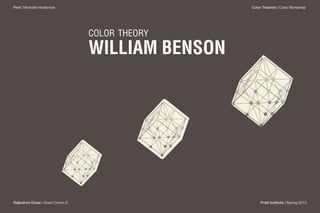
                                 color theory
                                 WILLIAM BENSON


Rajkishori Desai | Grad Comm.D                        Pratt Institute | Spring 2013
Prof | Michelle Hinebrook                                         Color Theorist | Color Workshop


       About
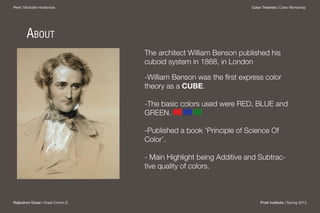
                                 The architect William Benson published his
                                 cuboid system in 1868, in London

                                 -William Benson was the first express color
                                 theory as a CUBE.

                                 -The basic colors used were RED, BLUE and
                                 GREEN.

                                 -Published a book ‘Principle of Science Of
                                 Color’.

                                 - Main Highlight being Additive and Subtrac-
                                 tive quality of colors.


Rajkishori Desai | Grad Comm.D                                        Pratt Institute | Spring 2013
Prof | Michelle Hinebrook                                               Color Theorist | Color Workshop


                                                                    W
       theory
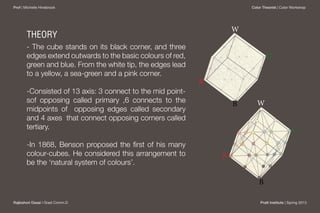
       - The cube stands on its black corner, and three
       edges extend outwards to the basic colours of red,                       G
       green and blue. From the white tip, the edges lead
       to a yellow, a sea-green and a pink corner.
                                                            R
       -Consisted of 13 axis: 3 connect to the mid point-
       sof opposing called primary ,6 connects to the               B      W
       midpoints of opposing edges called secondary
       and 4 axes that connect opposing corners called
       tertiary.                                                                               G
       -In 1868, Benson proposed the first of his many
       colour-cubes. He considered this arrangement to          R
       be the ‘natural system of colours’.

                                                                            B

Rajkishori Desai | Grad Comm.D                                              Pratt Institute | Spring 2013
Prof | Michelle Hinebrook                                                          Color Theorist | Color Workshop


                                                    COMPLETE BRIGHTNESS
       explation of theory
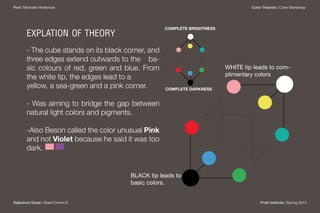
       - The cube stands on its black corner, and
       three edges extend outwards to the ba-
       sic colours of red, green and blue. From                           WHITE tip leads to com-
       the white tip, the edges lead to a                                 plimentary colors
       yellow, a sea-green and a pink corner.       COMPLETE DARKNESS


       - Was aiming to bridge the gap between
       natural light colors and pigments.

       -Also Beson called the color unusual Pink
       and not Violet because he said it was too
       dark.


                                       BLACK tip leads to
                                       basic colors.


Rajkishori Desai | Grad Comm.D                                                         Pratt Institute | Spring 2013
Prof | Michelle Hinebrook                                                     Color Theorist | Color Workshop


                                 additive   and            subtractive


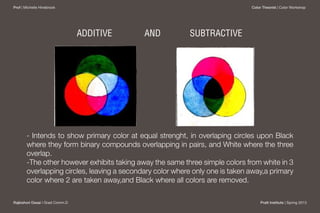
       - Intends to show primary color at equal strenght, in overlaping circles upon Black
       where they form binary compounds overlapping in pairs, and White where the three
       overlap.
       -The other however exhibits taking away the same three simple colors from white in 3
       overlapping circles, leaving a secondary color where only one is taken away,a primary
       color where 2 are taken away,and Black where all colors are removed.

Rajkishori Desai | Grad Comm.D                                                    Pratt Institute | Spring 2013
Prof | Michelle Hinebrook                               Color Theorist | Color Workshop


       Intermediate colors
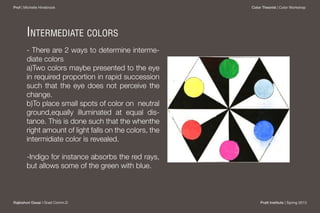
       - There are 2 ways to determine interme-
       diate colors
       a)Two colors maybe presented to the eye
       in required proportion in rapid succession
       such that the eye does not perceive the
       change.
       b)To place small spots of color on neutral
       ground,equally illuminated at equal dis-
       tance. This is done such that the whenthe
       right amount of light falls on the colors, the
       intermidiate color is revealed.

       -Indigo for instance absorbs the red rays,
       but allows some of the green with blue.


Rajkishori Desai | Grad Comm.D                              Pratt Institute | Spring 2013
Prof | Michelle Hinebrook                                                       Color Theorist | Color Workshop


       Primary and Secondary colors
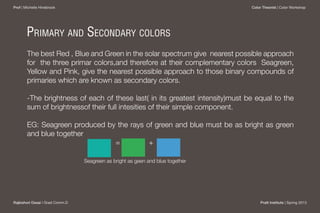
        The best Red , Blue and Green in the solar spectrum give nearest possible approach
        for the three primar colors,and therefore at their complementary colors Seagreen,
        Yellow and Pink, give the nearest possible approach to those binary compounds of
        primaries which are known as secondary colors.

        -The brightness of each of these last( in its greatest intensity)must be equal to the
        sum of brightnessof their full intesities of their simple component.

        EG: Seagreen produced by the rays of green and blue must be as bright as green
        and blue together
                                =          +

                                 Seagreen as bright as geen and blue together


Rajkishori Desai | Grad Comm.D                                                      Pratt Institute | Spring 2013
Prof | Michelle Hinebrook                    Color Theorist | Color Workshop


       william benson’s model
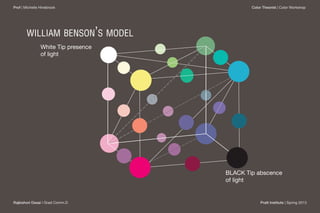
                White Tip presence
                of light


                                     BLACK Tip abscence
                                     of light


Rajkishori Desai | Grad Comm.D                   Pratt Institute | Spring 2013
Prof | Michelle Hinebrook                            Color Theorist | Color Workshop


       My Representation


                                 The cube has been opened to re-
                                 veal the colors on all sides.
                                 This gives a better understanding
                                 of how the primary, secondary and
                                 tertiary colors interact

Rajkishori Desai | Grad Comm.D                           Pratt Institute | Spring 2013
Prof | Michelle Hinebrook                                                        Color Theorist | Color Workshop


       drawbacks


         As the form to represent the theory was a cube there was one basic problem:

       -It does not fully allow for the significance of brightness, and therefore places the
        color hues wrongly.

       -Also, Benson’s system appears to the eye of the critical observer more as a
        confusion of colours.


Rajkishori Desai | Grad Comm.D                                                       Pratt Institute | Spring 2013

Color theory

  • 1.
    Prof | MichelleHinebrook Color Theorist | Color Workshop color theory WILLIAM BENSON Rajkishori Desai | Grad Comm.D Pratt Institute | Spring 2013
  • 2.
    Prof | MichelleHinebrook Color Theorist | Color Workshop About The architect William Benson published his cuboid system in 1868, in London -William Benson was the first express color theory as a CUBE. -The basic colors used were RED, BLUE and GREEN. -Published a book ‘Principle of Science Of Color’. - Main Highlight being Additive and Subtrac- tive quality of colors. Rajkishori Desai | Grad Comm.D Pratt Institute | Spring 2013
  • 3.
    Prof | MichelleHinebrook Color Theorist | Color Workshop W theory - The cube stands on its black corner, and three edges extend outwards to the basic colours of red, G green and blue. From the white tip, the edges lead to a yellow, a sea-green and a pink corner. R -Consisted of 13 axis: 3 connect to the mid point- sof opposing called primary ,6 connects to the B W midpoints of opposing edges called secondary and 4 axes that connect opposing corners called tertiary. G -In 1868, Benson proposed the first of his many colour-cubes. He considered this arrangement to R be the ‘natural system of colours’. B Rajkishori Desai | Grad Comm.D Pratt Institute | Spring 2013
  • 4.
    Prof | MichelleHinebrook Color Theorist | Color Workshop COMPLETE BRIGHTNESS explation of theory - The cube stands on its black corner, and three edges extend outwards to the ba- sic colours of red, green and blue. From WHITE tip leads to com- the white tip, the edges lead to a plimentary colors yellow, a sea-green and a pink corner. COMPLETE DARKNESS - Was aiming to bridge the gap between natural light colors and pigments. -Also Beson called the color unusual Pink and not Violet because he said it was too dark. BLACK tip leads to basic colors. Rajkishori Desai | Grad Comm.D Pratt Institute | Spring 2013
  • 5.
    Prof | MichelleHinebrook Color Theorist | Color Workshop additive and subtractive - Intends to show primary color at equal strenght, in overlaping circles upon Black where they form binary compounds overlapping in pairs, and White where the three overlap. -The other however exhibits taking away the same three simple colors from white in 3 overlapping circles, leaving a secondary color where only one is taken away,a primary color where 2 are taken away,and Black where all colors are removed. Rajkishori Desai | Grad Comm.D Pratt Institute | Spring 2013
  • 6.
    Prof | MichelleHinebrook Color Theorist | Color Workshop Intermediate colors - There are 2 ways to determine interme- diate colors a)Two colors maybe presented to the eye in required proportion in rapid succession such that the eye does not perceive the change. b)To place small spots of color on neutral ground,equally illuminated at equal dis- tance. This is done such that the whenthe right amount of light falls on the colors, the intermidiate color is revealed. -Indigo for instance absorbs the red rays, but allows some of the green with blue. Rajkishori Desai | Grad Comm.D Pratt Institute | Spring 2013
  • 7.
    Prof | MichelleHinebrook Color Theorist | Color Workshop Primary and Secondary colors The best Red , Blue and Green in the solar spectrum give nearest possible approach for the three primar colors,and therefore at their complementary colors Seagreen, Yellow and Pink, give the nearest possible approach to those binary compounds of primaries which are known as secondary colors. -The brightness of each of these last( in its greatest intensity)must be equal to the sum of brightnessof their full intesities of their simple component. EG: Seagreen produced by the rays of green and blue must be as bright as green and blue together = + Seagreen as bright as geen and blue together Rajkishori Desai | Grad Comm.D Pratt Institute | Spring 2013
  • 8.
    Prof | MichelleHinebrook Color Theorist | Color Workshop william benson’s model White Tip presence of light BLACK Tip abscence of light Rajkishori Desai | Grad Comm.D Pratt Institute | Spring 2013
  • 9.
    Prof | MichelleHinebrook Color Theorist | Color Workshop My Representation The cube has been opened to re- veal the colors on all sides. This gives a better understanding of how the primary, secondary and tertiary colors interact Rajkishori Desai | Grad Comm.D Pratt Institute | Spring 2013
  • 10.
    Prof | MichelleHinebrook Color Theorist | Color Workshop drawbacks As the form to represent the theory was a cube there was one basic problem: -It does not fully allow for the significance of brightness, and therefore places the color hues wrongly. -Also, Benson’s system appears to the eye of the critical observer more as a confusion of colours. Rajkishori Desai | Grad Comm.D Pratt Institute | Spring 2013