are both modern solutions to business problems.
Colocation and Cloud Computing
The cloud includes the facility savings
of colocation, but also includes countless
other benefits. These include computing,
storage, backup and additional infrastruc-
ture delivered as services. Simply, it’s the
whole computing package.
Colocation addresses the data center
needs of a business. A business simply
moves its infrastructure to a provider’s
facilities.
...is when a business runs its physical
infrastructure out of a service provider’s
data center, yet still deals with the man-
agement and maintenance of the infra-
structure.
...is when a cloud provider both supplies
and manages the infrastructure, including
servers, storage and network elements,
within their data center.
Cloud computing uses a pay-as-you-go
model, allowing the organization to remain
in control of its spending. You use what
you need, when you need it, and pay
accordingly. Upgrades, amazing service
and modern technology are all part of the
package.
With colocation, your business continues
paying to manage, maintain and update
equipment. None of this transfers to the
provider, and data center operating costs
may be high.
With cloud computing, all of these respon-
sibilities are handled for you, while you
focus on running your business. The cloud
has matured enough that businesses with
compliance requirements can meet these
needs within a cloud environment.
Colocation requires your business to
continue to own, use and maintain your
own equipment - which really leaves the
majority of the responsibility on your
shoulders, despite going through the
hassle of moving your equipment to a
provider’s data center.
Cloud computing doesn’t require you to
buy your own servers, switches, storage
or software. Additionally, you free up your
IT staff to focus on innovation, rather than
monitoring and managing equipment or
dealing with backups and maintenance.
It’s extremely pricey to initially move your
equipment from your location to the pro-
vider’s data center. The costs can include
transportation staff, vehicle rental/fuel,
means to secure your hardware as it trav-
els, and insurance on the transportation.
With cloud computing, your IT staff
has more time to focus on innovative
projects and tasks that can truly grow
your business. The cloud brings the focus
back to the business, rather than all the
behind-the-scenes tasks and hassles.
With colocation, you don’t really offload
any work. Your team is still required to
deal with management, maintenance and
upgrades for your equipment, and this
doesn’t help bring more focus to your
business.
Cloud computing is extremely scalable,
allowing your business to adjust its
resources as necessary, based on things
like demand, time of year or business
growth.
With colocation, you’re business is still
limited to the resources it can afford.
Once you reach maxiumum capacity on
your servers, it takes time and money to
upgrade your equipment.
Cloud doesn’t limit your business. You
aren’t tied to one location, or even one
device. Since the Internet provides access
to your various services, you can work
from any location, on any device with
Internet capabilities. This flexibility makes it
easy to access your resources around the
clock.
Colocation does not offer the flexibility
that the cloud is able to boast. Simply
changing the location of the infrastructure
doesn’t make it easier to access your data
or work in new, innovative ways.
The Whole Package
Cost
Service
Equipment
Business Focus
Scalability
Flexibility
While both colocation and cloud computing deliver benefits far
beyond traditional computing, the cloud may be the smarter
option for companies looking to improve their
business operations overall.
www.rapidscale.net
But what’s the difference and how do you decide?
IT COLOCATION... CLOUD COMPUTING...

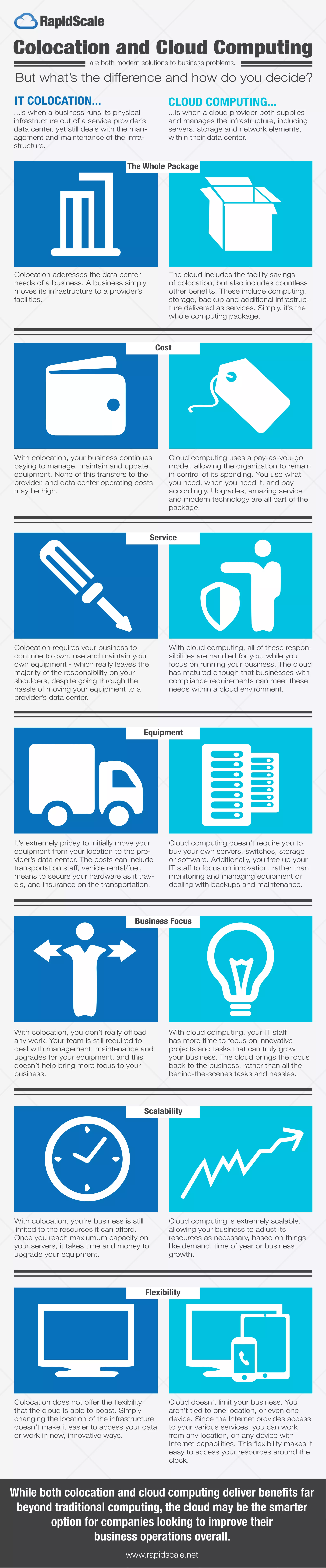
[Infographic] Colocation vs. Cloud Computing

  • 1.
    are both modernsolutions to business problems. Colocation and Cloud Computing The cloud includes the facility savings of colocation, but also includes countless other benefits. These include computing, storage, backup and additional infrastruc- ture delivered as services. Simply, it’s the whole computing package. Colocation addresses the data center needs of a business. A business simply moves its infrastructure to a provider’s facilities. ...is when a business runs its physical infrastructure out of a service provider’s data center, yet still deals with the man- agement and maintenance of the infra- structure. ...is when a cloud provider both supplies and manages the infrastructure, including servers, storage and network elements, within their data center. Cloud computing uses a pay-as-you-go model, allowing the organization to remain in control of its spending. You use what you need, when you need it, and pay accordingly. Upgrades, amazing service and modern technology are all part of the package. With colocation, your business continues paying to manage, maintain and update equipment. None of this transfers to the provider, and data center operating costs may be high. With cloud computing, all of these respon- sibilities are handled for you, while you focus on running your business. The cloud has matured enough that businesses with compliance requirements can meet these needs within a cloud environment. Colocation requires your business to continue to own, use and maintain your own equipment - which really leaves the majority of the responsibility on your shoulders, despite going through the hassle of moving your equipment to a provider’s data center. Cloud computing doesn’t require you to buy your own servers, switches, storage or software. Additionally, you free up your IT staff to focus on innovation, rather than monitoring and managing equipment or dealing with backups and maintenance. It’s extremely pricey to initially move your equipment from your location to the pro- vider’s data center. The costs can include transportation staff, vehicle rental/fuel, means to secure your hardware as it trav- els, and insurance on the transportation. With cloud computing, your IT staff has more time to focus on innovative projects and tasks that can truly grow your business. The cloud brings the focus back to the business, rather than all the behind-the-scenes tasks and hassles. With colocation, you don’t really offload any work. Your team is still required to deal with management, maintenance and upgrades for your equipment, and this doesn’t help bring more focus to your business. Cloud computing is extremely scalable, allowing your business to adjust its resources as necessary, based on things like demand, time of year or business growth. With colocation, you’re business is still limited to the resources it can afford. Once you reach maxiumum capacity on your servers, it takes time and money to upgrade your equipment. Cloud doesn’t limit your business. You aren’t tied to one location, or even one device. Since the Internet provides access to your various services, you can work from any location, on any device with Internet capabilities. This flexibility makes it easy to access your resources around the clock. Colocation does not offer the flexibility that the cloud is able to boast. Simply changing the location of the infrastructure doesn’t make it easier to access your data or work in new, innovative ways. The Whole Package Cost Service Equipment Business Focus Scalability Flexibility While both colocation and cloud computing deliver benefits far beyond traditional computing, the cloud may be the smarter option for companies looking to improve their business operations overall. www.rapidscale.net But what’s the difference and how do you decide? IT COLOCATION... CLOUD COMPUTING...