CLOUD COMPUTING
THE FUTURE OF COMPUTING IS IN THE CLOUD
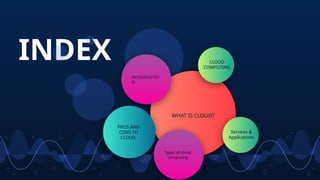
INDEX
2
WHAT IS CLOUD?
INTRODUCTIO
N
PROS AND
CONS TO
CLOUD
CLOUD
COMPUTING
Types of cloud
computing
Services &
Applications
INTRODUCTION
“
Cloud computing has emerged as one of the most important
technological advancements of the 21st century. It is
transforming the way we store and access data, build and
deploy applications, and collaborate across geographies. In
this presentation, we will discuss the fundamentals of cloud
computing, its key benefits and challenges, and some of the
popular cloud platforms
4
CLOUD COMPUTING
5
“
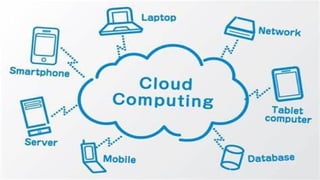
Cloud Computing Is Defined As Storing And Accessing Of
Data And Computing Services Over The Internet. It Doesn’t
Store Any Data On Your Personal Computer. It Is The On-
demand Availability Of Computer Services Like Servers,
Data Storage, Networking, Databases, etc.
6
“
7
“
▹TYPES OF
CLOUDS
8
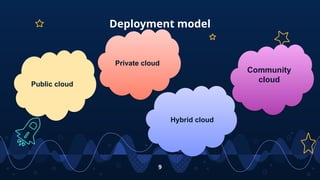
Deployment model
9
Public cloud
Private cloud
Hybrid cloud
Community
cloud
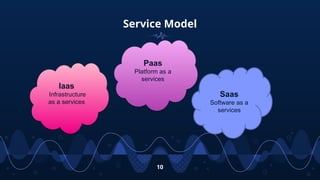
Service Model
10
Iaas
Infrastructure
as a services
Paas
Platform as a
services
Saas
Software as a
services
11
CLOUD COMPUTING SERVICES
Offers a comprehensive
set of cloud computing
services, including IaaS,
PaaS, and SaaS, as well as
storage, database, and
serverless computing
services.
Offers a broad range of
cloud computing services,
including IaaS, PaaS, and
SaaS, as well as storage,
database, and serverless
computing services.
Offers a
comprehensive set of
cloud computing
services, including
IaaS, PaaS, and SaaS,
as well as storage,
database, and
serverless computing
services.
offers a wide range
of cloud computing
services, including
IaaS, PaaS, and
SaaS, as well as
storage, database,
and serverless
computing services.
APPLICATIONS OF CLOUD
COMPUTING
12
13
EDUCATION
BANKING
GAMING
Health
Care
GMAI
L
Communication
GOVERNMEN
T
PROS OF CLOUD COMPUTING
Scalability
.Companies don’t need to
pay for or build the
infrastructure needed to
support their highest load
levels. Likewise, they can
quickly scale down if
resources aren’t being used.
Cost saving
cost saving is one of the
biggest Cloud Computing
benefits. It helps you to save
substantial capital cost as it
does not need any physical
hardware investments.
Flexibility
cloud computing gives your
business more flexibility. You
can quickly scale resources
and storage up to meet
business demands without
having to invest in physical
infrastructure
14
Unlimited storage
The cloud offers almost
limitless storage capacity. At
any time you can quickly
expand your storage
capacity with very nominal
monthly fees.
Reliabilty
Reliability is one of the
biggest benefits of Cloud
hosting. You can always get
instantly updated about the
changes.
CONS OF CLOUD COMPUTING
Control
You have reduce control of
your IT system and are
completely on the service
provider.
Security and
privacy
Although cloud service
providers implement the best
security standards and
industry certifications, storing
data and important files on
external service providers
always opens up risks.
Vendor lock-in
Switching between cloud
providers can be difficult
and costly, as different
providers may have different
platforms, features, and
configurations
15
Complex pricing
some cloud services may
have hidden costs or
unpredictable fees that can
surprise you at the end of
the month
Downtime
since cloud computing
systems are internet-based,
service outages are always a
possibility and can affect
your business operations.
CONCLUSION
Cloud computing is a way of delivering computing services over the
internet. It offers many advantages to users and businesses, such as
reduced costs, increased flexibility, scalability, and reliability.
However, cloud computing also faces some security issues and
challenges that need to be addressed. Therefore, cloud computing is
not a perfect solution, but a promising one that has the potential to
transform the IT world in the future.
16
17
THANKS!
ABIN CHRISTY A
RIJOY S
MUHAMMED SAGAR

Cloud Computing presentation describing its types

  • 1.
    CLOUD COMPUTING THE FUTUREOF COMPUTING IS IN THE CLOUD
  • 2.
    INDEX 2 WHAT IS CLOUD? INTRODUCTIO N PROSAND CONS TO CLOUD CLOUD COMPUTING Types of cloud computing Services & Applications
  • 3.
  • 4.
    “ Cloud computing hasemerged as one of the most important technological advancements of the 21st century. It is transforming the way we store and access data, build and deploy applications, and collaborate across geographies. In this presentation, we will discuss the fundamentals of cloud computing, its key benefits and challenges, and some of the popular cloud platforms 4
  • 5.
  • 6.
    “ Cloud Computing IsDefined As Storing And Accessing Of Data And Computing Services Over The Internet. It Doesn’t Store Any Data On Your Personal Computer. It Is The On- demand Availability Of Computer Services Like Servers, Data Storage, Networking, Databases, etc. 6
  • 7.
  • 8.
  • 9.
    Deployment model 9 Public cloud Privatecloud Hybrid cloud Community cloud
  • 10.
    Service Model 10 Iaas Infrastructure as aservices Paas Platform as a services Saas Software as a services
  • 11.
    11 CLOUD COMPUTING SERVICES Offersa comprehensive set of cloud computing services, including IaaS, PaaS, and SaaS, as well as storage, database, and serverless computing services. Offers a broad range of cloud computing services, including IaaS, PaaS, and SaaS, as well as storage, database, and serverless computing services. Offers a comprehensive set of cloud computing services, including IaaS, PaaS, and SaaS, as well as storage, database, and serverless computing services. offers a wide range of cloud computing services, including IaaS, PaaS, and SaaS, as well as storage, database, and serverless computing services.
  • 12.
  • 13.
  • 14.
    PROS OF CLOUDCOMPUTING Scalability .Companies don’t need to pay for or build the infrastructure needed to support their highest load levels. Likewise, they can quickly scale down if resources aren’t being used. Cost saving cost saving is one of the biggest Cloud Computing benefits. It helps you to save substantial capital cost as it does not need any physical hardware investments. Flexibility cloud computing gives your business more flexibility. You can quickly scale resources and storage up to meet business demands without having to invest in physical infrastructure 14 Unlimited storage The cloud offers almost limitless storage capacity. At any time you can quickly expand your storage capacity with very nominal monthly fees. Reliabilty Reliability is one of the biggest benefits of Cloud hosting. You can always get instantly updated about the changes.
  • 15.
    CONS OF CLOUDCOMPUTING Control You have reduce control of your IT system and are completely on the service provider. Security and privacy Although cloud service providers implement the best security standards and industry certifications, storing data and important files on external service providers always opens up risks. Vendor lock-in Switching between cloud providers can be difficult and costly, as different providers may have different platforms, features, and configurations 15 Complex pricing some cloud services may have hidden costs or unpredictable fees that can surprise you at the end of the month Downtime since cloud computing systems are internet-based, service outages are always a possibility and can affect your business operations.
  • 16.
    CONCLUSION Cloud computing isa way of delivering computing services over the internet. It offers many advantages to users and businesses, such as reduced costs, increased flexibility, scalability, and reliability. However, cloud computing also faces some security issues and challenges that need to be addressed. Therefore, cloud computing is not a perfect solution, but a promising one that has the potential to transform the IT world in the future. 16
  • 17.