Prof. Colm Campbell
  Transitional Justice Institute, School of
Law, University of Ulster, Northern Ireland
International Trends
   Transitional justice and the democratic
    state
     Northern Ireland
     Canadian Truth and Reconciliation Commission
 Transnational norm-diffusion. Legal norms
  and ideational norms (‘peace process’)
 Increasing focus on violations by armed
  opposition groups
 Increasing role of ‘bottom up’ initiatives
Comparative Perspectives
 The ‘Big Four’, South
  Africa, Israel/Palestine, Northern Ireland
  and the Basque Country. Entrenched
  conflict & rechstsstaat
 Transnational frame diffusion: SA  NI
   Basque Country: meso and macro
  levels
 Pacto de olvido: palimpsest of the
  transition from Francoism
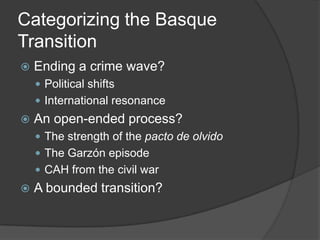
Categorizing the Basque
Transition
   Ending a crime wave?
     Political shifts
     International resonance
   An open-ended process?
     The strength of the pacto de olvido
     The Garzón episode
     CAH from the civil war
   A bounded transition?
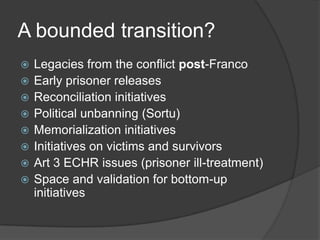
A bounded transition?
   Legacies from the conflict post-Franco
   Early prisoner releases
   Reconciliation initiatives
   Political unbanning (Sortu)
   Memorialization initiatives
   Initiatives on victims and survivors
   Art 3 ECHR issues (prisoner ill-treatment)
   Space and validation for bottom-up
    initiatives
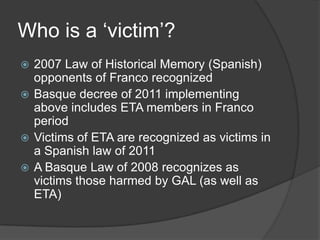
Who is a ‘victim’?
 2007 Law of Historical Memory (Spanish)
  opponents of Franco recognized
 Basque decree of 2011 implementing
  above includes ETA members in Franco
  period
 Victims of ETA are recognized as victims in
  a Spanish law of 2011
 A Basque Law of 2008 recognizes as
  victims those harmed by GAL (as well as
  ETA)
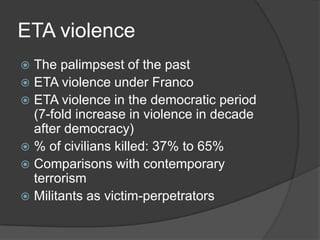
ETA violence
 The palimpsest of the past
 ETA violence under Franco
 ETA violence in the democratic period
  (7-fold increase in violence in decade
  after democracy)
 % of civilians killed: 37% to 65%
 Comparisons with contemporary
  terrorism
 Militants as victim-perpetrators
Conclusions
 Strong evidence of ‘peace process’ frame
  diffusion from NI and SA to the Basque
  Country
 Although frayed the pacto de olvido
  remains strong
 Even with the pact in place there is a
  ample space for transitional moves on
  prisoners, memorialization, and
  reconciliation (including apologies), with
  contributions both from state and non-state
  actors.

Colm Campbell - Foro Social para impulsar el proceso de paz

  • 1.
    Prof. Colm Campbell Transitional Justice Institute, School of Law, University of Ulster, Northern Ireland
  • 2.
    International Trends  Transitional justice and the democratic state  Northern Ireland  Canadian Truth and Reconciliation Commission  Transnational norm-diffusion. Legal norms and ideational norms (‘peace process’)  Increasing focus on violations by armed opposition groups  Increasing role of ‘bottom up’ initiatives
  • 3.
    Comparative Perspectives  The‘Big Four’, South Africa, Israel/Palestine, Northern Ireland and the Basque Country. Entrenched conflict & rechstsstaat  Transnational frame diffusion: SA  NI  Basque Country: meso and macro levels  Pacto de olvido: palimpsest of the transition from Francoism
  • 4.
    Categorizing the Basque Transition  Ending a crime wave?  Political shifts  International resonance  An open-ended process?  The strength of the pacto de olvido  The Garzón episode  CAH from the civil war  A bounded transition?
  • 5.
    A bounded transition?  Legacies from the conflict post-Franco  Early prisoner releases  Reconciliation initiatives  Political unbanning (Sortu)  Memorialization initiatives  Initiatives on victims and survivors  Art 3 ECHR issues (prisoner ill-treatment)  Space and validation for bottom-up initiatives
  • 6.
    Who is a‘victim’?  2007 Law of Historical Memory (Spanish) opponents of Franco recognized  Basque decree of 2011 implementing above includes ETA members in Franco period  Victims of ETA are recognized as victims in a Spanish law of 2011  A Basque Law of 2008 recognizes as victims those harmed by GAL (as well as ETA)
  • 7.
    ETA violence  Thepalimpsest of the past  ETA violence under Franco  ETA violence in the democratic period (7-fold increase in violence in decade after democracy)  % of civilians killed: 37% to 65%  Comparisons with contemporary terrorism  Militants as victim-perpetrators
  • 8.
    Conclusions  Strong evidenceof ‘peace process’ frame diffusion from NI and SA to the Basque Country  Although frayed the pacto de olvido remains strong  Even with the pact in place there is a ample space for transitional moves on prisoners, memorialization, and reconciliation (including apologies), with contributions both from state and non-state actors.