DISARMAMENT, DISMANTLING AND
DISBANDMENT

   LESSONS FROM THE SOUTH
   AFRICAN PROCESS


   ROBERT MCBRIDE
THE BEGINNING

•   50 years of peaceful resistance
•   30 years of armed struggle
•   Prison talks, July 1986
•   Secret Channels
•   Harare Declaration
•   Unbanning , Feb 1990
RELEASE OF MANDELA

• Temporary Indemnity for ANC Negotiators
  returning to South Africa

• Temporary firearm permits to protectors of
  ANC Leaders

• Return of Exiles
GROOTE SCHUUR MINUTE 4TH MAY 1990

• First direct public negotiations between
  Government and ANC (“talk about talks”)
  – setting the rules
• Common commitment towards ending a
  climate of violence and intimidation as
  well as a commitment to stability and to
  a peaceful process of negotiations
• Definition of Political Offences
• Establish effective channels of
  communication
PRETORIA MINUTE, AUG 6TH 1990


•   Establishment of Working Groups
•   Prisoners
•   Violence
•   Review of Security Legislation
•   Paragraph 3
    • Unilateral Suspension of armed activity
    • Establishment of Working Group to deal with above decision
PARAGRAPH 3 WORKING GROUP REPORT
•    The Working Group agreed on the following

    • No armed attacks, no infiltration of men or materials, no creation of
      underground structures, no incitement of violence, no threats of
      armed action and no training in South Africa
    • Agreed on the principal that no political party or movement should
      have a private army
    • Recognise that MK is no longer an unlawful organization
    • Noted the historical fact that MK had weapons and cadres in the
      country
    • Agreed that control over such cadres and arms be excercised
    • Move towards legalisation and normalisation of arms issues
    • Security forces must take cognisance of the suspension of armed
      action and related activities
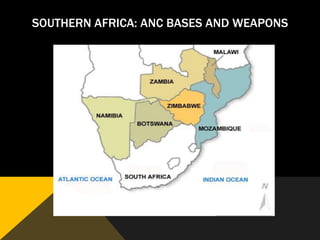
SOUTHERN AFRICA: ANC BASES AND WEAPONS
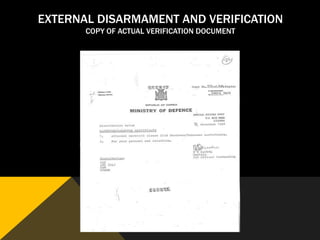
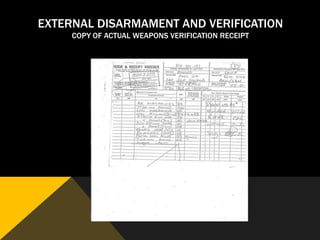
EXTERNAL DISARMAMENT AND VERIFICATION

• 1991 process of decommissioning MKs
  external arms caches
• Weapons surrendered to host countries
• This involved description of weapons,
  numbers, and working condition
• Verification by MK Commanders and
  host Governments
• All external weapons surrendered
• Joint secret working groups, MK and
  Government
EXTERNAL DISARMAMENT AND VERIFICATION
       COPY OF ACTUAL VERIFICATION DOCUMENT
EXTERNAL DISARMAMENT AND VERIFICATION
     COPY OF ACTUAL WEAPONS VERIFICATION RECEIPT
NEGOTIATIONS, FRUSTRATION & BREAKDOWN
•   CODESA I
• Government political point-scoring & Mandela‟s
  response… “Now he is attacking us because we have not
  dissolved Umkhonto. He is not even telling you, … that
  we agreed, …at the beginning of this year on Umkhonto
  we Sizwe. We then had an agreement in terms of which
  we had to hand over our weapons for joint control by the
  Government and ourselves, but we linked that to the
  development of the political process. You are asking us
  to commit suicide, because when your Government is not
  prepared to intervene to stop the violence; when the
  perception amongst our people is that it is elements in
  the Security Forces that are killing our people; when our
  people demand to be armed, what political organisation
  would had over its weapons to the same man who is
  regarded by people as killing innocent people.”
•   Violence, Prisoners, harassment of ANC &MK
•   BREAKDOWN
BREAKTHROUGH
• Record of Understanding, Sept 1992

• CODESA II

• November „93 Election date

• December 16
   • Disbanding of MK

• April 27, 1994
   • First Democratic Elections
ARMS & AMNESTIES
 August „94
  • Main stockpile of ANC arms surrendered , 40
    trucks worth

 October ‟94
  First post-apartheid amnesty to cover activists
   who had possession of weapons

 A number of subsequent amnesties were declared
 Integration of armed forces. New Defence Force
   Non-Statutory

 Demobilisation and Normalisation
LESSONS FROM SOUTH AFRICA
• Peace making is a process fraught with risk and
  frustration
• Acknowledgement that alternative means, other
  than armed conflict, need to be pursued
• Political will for a just and equitable solution.
  Free political activity
• Arms must be removed from the equation,
  equally so, repression
• Disarmament and decommissioning is a
  significant part of the process. Directly liked to
  building confidence in the process
• Must be formalised and verified. Independent/
  neutral honest broker

Robert mc bride

  • 1.
    DISARMAMENT, DISMANTLING AND DISBANDMENT LESSONS FROM THE SOUTH AFRICAN PROCESS ROBERT MCBRIDE
  • 2.
    THE BEGINNING • 50 years of peaceful resistance • 30 years of armed struggle • Prison talks, July 1986 • Secret Channels • Harare Declaration • Unbanning , Feb 1990
  • 3.
    RELEASE OF MANDELA •Temporary Indemnity for ANC Negotiators returning to South Africa • Temporary firearm permits to protectors of ANC Leaders • Return of Exiles
  • 4.
    GROOTE SCHUUR MINUTE4TH MAY 1990 • First direct public negotiations between Government and ANC (“talk about talks”) – setting the rules • Common commitment towards ending a climate of violence and intimidation as well as a commitment to stability and to a peaceful process of negotiations • Definition of Political Offences • Establish effective channels of communication
  • 5.
    PRETORIA MINUTE, AUG6TH 1990 • Establishment of Working Groups • Prisoners • Violence • Review of Security Legislation • Paragraph 3 • Unilateral Suspension of armed activity • Establishment of Working Group to deal with above decision
  • 6.
    PARAGRAPH 3 WORKINGGROUP REPORT • The Working Group agreed on the following • No armed attacks, no infiltration of men or materials, no creation of underground structures, no incitement of violence, no threats of armed action and no training in South Africa • Agreed on the principal that no political party or movement should have a private army • Recognise that MK is no longer an unlawful organization • Noted the historical fact that MK had weapons and cadres in the country • Agreed that control over such cadres and arms be excercised • Move towards legalisation and normalisation of arms issues • Security forces must take cognisance of the suspension of armed action and related activities
  • 7.
    SOUTHERN AFRICA: ANCBASES AND WEAPONS
  • 8.
    EXTERNAL DISARMAMENT ANDVERIFICATION • 1991 process of decommissioning MKs external arms caches • Weapons surrendered to host countries • This involved description of weapons, numbers, and working condition • Verification by MK Commanders and host Governments • All external weapons surrendered • Joint secret working groups, MK and Government
  • 9.
    EXTERNAL DISARMAMENT ANDVERIFICATION COPY OF ACTUAL VERIFICATION DOCUMENT
  • 10.
    EXTERNAL DISARMAMENT ANDVERIFICATION COPY OF ACTUAL WEAPONS VERIFICATION RECEIPT
  • 11.
    NEGOTIATIONS, FRUSTRATION &BREAKDOWN • CODESA I • Government political point-scoring & Mandela‟s response… “Now he is attacking us because we have not dissolved Umkhonto. He is not even telling you, … that we agreed, …at the beginning of this year on Umkhonto we Sizwe. We then had an agreement in terms of which we had to hand over our weapons for joint control by the Government and ourselves, but we linked that to the development of the political process. You are asking us to commit suicide, because when your Government is not prepared to intervene to stop the violence; when the perception amongst our people is that it is elements in the Security Forces that are killing our people; when our people demand to be armed, what political organisation would had over its weapons to the same man who is regarded by people as killing innocent people.” • Violence, Prisoners, harassment of ANC &MK • BREAKDOWN
  • 12.
    BREAKTHROUGH • Record ofUnderstanding, Sept 1992 • CODESA II • November „93 Election date • December 16 • Disbanding of MK • April 27, 1994 • First Democratic Elections
  • 13.
    ARMS & AMNESTIES August „94 • Main stockpile of ANC arms surrendered , 40 trucks worth October ‟94 First post-apartheid amnesty to cover activists who had possession of weapons A number of subsequent amnesties were declared Integration of armed forces. New Defence Force Non-Statutory Demobilisation and Normalisation
  • 14.
    LESSONS FROM SOUTHAFRICA • Peace making is a process fraught with risk and frustration • Acknowledgement that alternative means, other than armed conflict, need to be pursued • Political will for a just and equitable solution. Free political activity • Arms must be removed from the equation, equally so, repression • Disarmament and decommissioning is a significant part of the process. Directly liked to building confidence in the process • Must be formalised and verified. Independent/ neutral honest broker