Andy Carl


Building the future and Dealing with the Past
 Framing our discussion
The peace process paradigm?

Preparing for peace talks
Negotiations
Agreement
Post-conflict peacebuilding
          Disarmament
          Demobilisation
          Integration
          Governance reform
          Truth Commissions/Special Courts
          Economic Development
Peaceful Coexistence?


How to move a process forward if one stage is weak or missing?
Three Domains of Reconciliation

(1) Changing Attitudes & Public Conversation


Two examples:


Radio Diaries Project (Georgia & Abkhazia)


Karabakh 2015: a “futures forum”
Three Domains of Reconciliation

(2) Reforming Public Institutions & Law


Two examples:


Fiji: Developing National Curriculum on teaching history


Uganda: Drafting legislation on amnesty and return
Three Domains of Reconciliation

(3) Changing Behaviour and Relationships


Two examples:


Colombia/Philippines: Women Leader’s exchange programme
Georgia/Abkhazia: Young party political leader’s dialogue
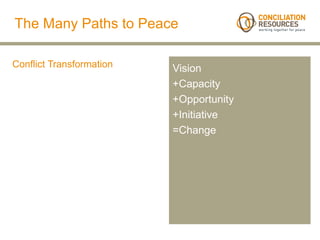
The Many Paths to Peace

Conflict Transformation   Vision
                          +Capacity
                          +Opportunity
                          +Initiative
                          =Change
On Winning the Peace

Some general principles:
  There is no roadmap but you are on the road
  Reconciliation (and conciliation) involves work on multiple levels with
  multiple actors (government, parties and wider civsoc)
  The need to have the Difficult yet Collaborative Conversations
  Understanding differences: bridging the divides: finding common
  ground
  Value in-betweeners and Consensus Figures
  The need to learn and teach the tools and tactics of dialogue
  There is a creative tension between the struggle for truth, justice
  and peace
www.c-r.org
Registered charity: 1055438

Andy Carl - Foro Social para impulsar el proceso de paz

  • 1.
    Andy Carl Building thefuture and Dealing with the Past Framing our discussion
  • 2.
    The peace processparadigm? Preparing for peace talks Negotiations Agreement Post-conflict peacebuilding Disarmament Demobilisation Integration Governance reform Truth Commissions/Special Courts Economic Development Peaceful Coexistence? How to move a process forward if one stage is weak or missing?
  • 3.
    Three Domains ofReconciliation (1) Changing Attitudes & Public Conversation Two examples: Radio Diaries Project (Georgia & Abkhazia) Karabakh 2015: a “futures forum”
  • 4.
    Three Domains ofReconciliation (2) Reforming Public Institutions & Law Two examples: Fiji: Developing National Curriculum on teaching history Uganda: Drafting legislation on amnesty and return
  • 5.
    Three Domains ofReconciliation (3) Changing Behaviour and Relationships Two examples: Colombia/Philippines: Women Leader’s exchange programme Georgia/Abkhazia: Young party political leader’s dialogue
  • 6.
    The Many Pathsto Peace Conflict Transformation Vision +Capacity +Opportunity +Initiative =Change
  • 7.
    On Winning thePeace Some general principles: There is no roadmap but you are on the road Reconciliation (and conciliation) involves work on multiple levels with multiple actors (government, parties and wider civsoc) The need to have the Difficult yet Collaborative Conversations Understanding differences: bridging the divides: finding common ground Value in-betweeners and Consensus Figures The need to learn and teach the tools and tactics of dialogue There is a creative tension between the struggle for truth, justice and peace
  • 8.

Editor's Notes

  • #2 My two illustrious Professors: Colm Campbell a Lawyer and international authority on transitional justice – and Brandon Hamber a clinical psychologist by training – and also a professor at the Univerisity of Ulster in N.Ireland– and an renowned expert on transition and reconciliation and a world-class Tweeter Like both my colleagues I am a practitioner – but as I am not at teacher I will try to pick up where we left off yesterday in Pamplona in our discussion on human rights in a peace process –offer some very general framing remarks – give a few experiences and offer some conclusions
  • #3 *The Bad News is that your peace process has gone off the map *In fact even those processes that have been successful at following the map have found themselves experiencing so much violence that they are talking of a new peace process *The Good News is that you are moving forward and making progress * Perhaps a more appropriate diagramme for this progress may look at bit the logo of Lokarri? *In the early 1990’s - in the depths of the repression in Guatemala –and after final peace agreements were signed when there was little – the Catholic Church – or more specifically a very courageous priest and Bishop Msgr Gerardi – working in the largely indigenous province of Quiche – launched a very creative project called the Recovery of Historical Memory Project – at the end of 36years of war. (murdered 2-days after the report was published) 800 testimony taker/5,000 tesimonies/55,000 victims – their evidence formed the basis of the first archive of the Guatemalan Truth Commission.
  • #4 Of course This Social Forum is about articulating a vision for consolidating the peace and agenda for change Yesterday Mark Freeman spoke about changing what he called the Dominant Narrative and developing a new inclusive collective narrative – but how? We realised early on that evangelising for peace – printing T-shirts, paying for public ads had limited impact – we need to find better ways to reach and involve people So when the ways in which talk about the conflict – or think about peace gets stuck – or when there is no public constituency for peace and reconciliation – What can we do?
  • #5 Fiji a collaboration between a diverse civil society group (including both academics and activists) working in partnership with the Minister of Education Uganda the initiative began with family members of abductees – and working with Parliament they put together a draft bill which acknowledged their local traditional processes of accountability and reconciliation – and this provided a mechanism for the return of tens of thousands of young people.
  • #6 I see a core dimension of finding succesessful ways of living and working together – is engagement and dialogue. What peace advocates pay attention to is where are the conflict divides that need to be bridged and how to bridge them (we need to pay attention both to what divides us and what brings us together) Like having a stroke – and learning how to talk all over again Single commnunity work – cross community work? We draw strength and confidence from our friends and family but we make peace by engaging with our opposition and those we most disagree with (not to befriend them but to find a way to recognise their humanity and live alongside them
  • #7 This Social Forum is about articulating a vision for consolidating the peace and agenda for change Building on what you know and what you have learned – Somalia has a lot to teach the world about local peacemaking: Colombia has a lot to teach the world on peacemaking; The Basque conflict has a lot to teach the world about reconciliation (theory and practice)
  • #8 The imprtance of knowing who you wish to make peace with