Writing in a Statistics
Classroom in the 21st Century
1

CHRISTIAN G. NORTHRUP, Ph.D.
Introduction
2

Technology

Common
Core

Writing in
Statistics
Technology
3

Graphing
Calculators

Statistical
Software

Spreadsheets

Webquests

Internet

Teacher
Website

Infographics

Moviemaker
4
How are students performing?
5

Gerald Bracey

Educator Effectiveness


Proficiency or Growth?

Remain Optimistic
National Assessment of Educational Progress
Age 17 Math Results
6

Year
Sex

1978

2012

Male

304

308

Female

297

304

All Students

300

306
How are students performing?
7

 Gerald Bracey
 Educator Effectiveness
 Proficiency or Growth?
 Remain Optimistic
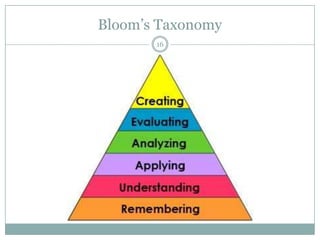
Bloom’s Taxonomy
8
National Assessment of Educational Progress
Age 17 Math Results
9

Year
Sex

1978

2012

Male

304

308

Female

297

304

All Students

300

306
National Assessment of Educational Progress
10

Geometry

Data
Analysis,
Statistics and
Probability

Algebra

Standards

Number
Properties
and
Operations

Measurement
Common Core High School Mathematics Standards
11

Geometry

Statistics
and
Probability

Algebra

Standards
Number
and
Quantity

Functions

Modeling
12
Why Writing?
13

Common Core Mathematical Practices
1. Make sense of problems and persevere in solving them.
2. Reason abstractly and quantitatively.
3. Construct viable arguments and critique the reasoning of
others.

Common Core Standards
Bloom’s Taxonomy
14
Why Writing?
15

 Vygotsky (1962) viewed both thought and language

as being linked through conceptual understanding.
 Vygotsky (1987) believed that writing purposely

requires one to process concepts analytically to gain
understanding.
Bloom’s Taxonomy
16
Why Writing?
17

The Principles and Standards for School
Mathematics set forth by the National Council of
Teachers of Mathematics (2000) list problem solving
as one of five process skills expected of students.
Why Writing?
18

 Pugalee (1995, 1997) has shown that writing

supports mathematical reasoning.
 Pugalee (2005) designed a rubric to assess problem-

solving abilities.
What is Being Investigated?
19

Conceptual
Understanding

ProblemSolving Ability

Procedural
Understanding

ProblemSolving
Processes

Mathematical
Content

Mathematical
Reasoning
Sample Writing Prompt 1
20

A department supervisor is considering purchasing one of two comparable
photocopy machines, A or B. Machine A costs $10,000, and machine B costs
$10,500. This department replaces photocopy machines every three years. The
repair contract for machine A costs $50 per month and covers an unlimited
number of repairs. The repair contract for machine B costs $200 per repair.
Based on past performance, the distribution of the number of repairs needed
over any one-year period for machine B is shown below.
Number of
Repairs

0

1

2

3

Probability

.5

.25

.15

.1
Sample Writing Prompt 1
21

You are asked to give a recommendation based on
overall cost as to which machine, A or B, along with
its repair contract, should be purchased.
1. What would your recommendation be?
2. Give a statistical justification to support your
recommendation.
Student A Response
22

I used the mean of a random variable. This showed
me the mean of the variable as an average of the
possible values of X, but with a change to consider
that all outcomes don’t need to be equal.
x1 p1 x2 p2 x3 p3 x4 p4
x

0(.5) 1(.25) 2(.15) 3(.1)
.85
which is the probability you will need a repair
Sample B Response
23

E (x) .85
I would suggest that Machine B be purchased.
For one year, with no repairs, Machine B is
$100 cheaper than Machine A. There is a .5
probability that Machine B will not need any
repairs, while one repair has a probability of
only .25. Machine B would save more money.
Sample C Response
24

E(X) = µx = 0(.5)+1(.25)+2(.15)+3(.1) = .85 repairs
per year. .85 * 3 = 2.55 repairs * $200 = $510.
10,000 + 510 = $11,010. I would recommend buying
Machine B because over the three years that the
machine will be in operation, it will be cheaper. The
expected number of repairs over the next three
years is 2.55. Therefore, with this number of repairs,
Machine B will cost $11,010, and machine A will cost
$11,800. So, it is a better idea to purchase Machine
B.
Sample Writing Prompt 2
25

A quarterback completes 44% of his passes.
1. What is the probability that the quarterback throws
3 incomplete passes before he has a completion?

2. Write a four-sentence summary to the football coach
of the team that this quarterback plays telling him
how he can use this information in a game.
Sample Response 2
26

Dear Coach,

I have performed some statistical analysis on your
quarterback’s percentage of completed passes. He makes
44% of his passes. So, I created a geometric probability
distribution. Using the formula for expected value of 1/p, I
calculated that you can expect him to throw 2.27 passes
before he completes one. So, you may want to wait until he is
on his third pass to try anything vital to scoring. Hang in there
Coach.
- Phoebe
Why Writing?
27

 Baxter, Woodward, and Olson (2005) discussed that

one of the primary limitations from a teacher’s
perspective is the amount of time it takes to read and
respond to students concerning their writing
activities.
How should teachers manage feedback?
28

Five ways to manage feedback (Pugalee, 2005)
1.

Identify key strengths and weaknesses and address these with the entire class.

2.

While monitoring students’ work that involves writing, make comments and
ask questions to guide writing as students are working on their tasks.

3.

Use examples of good writing to show the entire class as a way of reinforcing
and developing common performance expectations about written products.

4.

Use peer and group assessment. Students can effectively identify and specify
strengths and weaknesses in writing.

5.

Limit written comments and focus questions or comments so they will guide
writing (p. 21).
Other Benefits
29

 Baxter, Woodward, and Olson (2005) suggest that

not all students benefit the greatest from verbal
dialogue in a mathematics classroom for various
reasons, including anxiety.
 Pugalee (2005) argued that developing a

mathematical literacy for classrooms should be a
goal of all mathematics educators.
Findings
30

Problem-Solving Ability
Conceptual Understanding
Procedural Understanding
M athematical Content
M athematical Reasoning

4
76.3%
57.8%
79.3%
76.9%
78.7%

3
13.7%
23.7%
6.7%
11.2%
7.3%

2
6.7%
13.7%
9.7%
8.2%
10.3%

1
3.3%
4.9%
4.3%
3.6%
3.6%
Findings
31

How do the students’ writings improve over time?


Phoebe



Enjoys writing in English class.



Did not enjoy writing in Statistics class, at first.
Findings
32

How can one describe problem posing by students as
they solve problems in a statistics course?


Helped students reflect on statistical concepts.



Cultivate their mathematical thinking and further develop
their understanding of statistical concepts.
Findings
33

Table 5.1
Means, Standard Deviations, and Intra-class Correlation for Each Construct
Mean

SD

ICC

Problem-Solving ability

3.63

0.75

0.035

Conceptual Understanding

3.34

0.89

0.112

Procedural Understanding

3.61

0.83

0.101

Mathematical Reasoning

3.61

0.79

0.083

Mathematical Content

3.61

0.82

0.077
Findings
34

 The HLM analyses revealed statistically significant

differences between conceptual understanding and
that of problem-solving ability, t (1643) = -9.231, p <
.001.
 This result makes teachers aware of the fact that

students need to further develop their conceptual
understanding of statistical concepts as they solve
problems.
Findings
35

Advanced Placement Exam Scores for Students in the Study
Name
Score
Leroy
5
Parker
5
Melanie
4
Isaac
4
Lola
4
Langston 4
Hubert
4
Isabella
4
Lennie
4
Leah
4
Phoebe
3
AJ
3
Chloe
3
Liz
3
Findings
36

 Writing in complete sentences is not the only way to

communicate statistics through writing.

 Diagrams were an important communicative tool for

students as they solved problems.

 Students can use diagrammatical literacy as a way to

communicate statistical concepts.

 The use of diagrams and graphic organizers can also be

critical for students in mathematics classrooms
(Diezmann & English, 2001).
Findings
37

If someone
uses tobacco
The amount of
apples
someone eats

Lack of
flossing

The number of
times someone
brushes their
teeth

The
number
of new
cavities

How much
candy
someone eats
Implications
38

First, teachers should require students to write as they solve
problems since the written responses will provide teachers
with an enriching description of student understanding of
statistical ideas.

This enables teachers to better assist students with feedback
that would help them be more successful.
Implications
39

Second, the role of writing aids students to realize the depth of
statistical material that they actually know.
Third, requiring students to write in statistics leads to students
understanding the material better.


Better scores on the Advanced Placement Statistics examination.
Implications
40

Teachers in statistics classrooms should implement
some form of writing.

The benefits of requiring students to write about
their conceptual understanding regarding specific
content are too significant to ignore.
Conclusion
41

Developing a mathematical literacy should be a goal
among all mathematics and statistics educators.

Colloquium

  • 1.
    Writing in aStatistics Classroom in the 21st Century 1 CHRISTIAN G. NORTHRUP, Ph.D.
  • 2.
  • 3.
  • 4.
  • 5.
    How are studentsperforming? 5 Gerald Bracey Educator Effectiveness  Proficiency or Growth? Remain Optimistic
  • 6.
    National Assessment ofEducational Progress Age 17 Math Results 6 Year Sex 1978 2012 Male 304 308 Female 297 304 All Students 300 306
  • 7.
    How are studentsperforming? 7  Gerald Bracey  Educator Effectiveness  Proficiency or Growth?  Remain Optimistic
  • 8.
  • 9.
    National Assessment ofEducational Progress Age 17 Math Results 9 Year Sex 1978 2012 Male 304 308 Female 297 304 All Students 300 306
  • 10.
    National Assessment ofEducational Progress 10 Geometry Data Analysis, Statistics and Probability Algebra Standards Number Properties and Operations Measurement
  • 11.
    Common Core HighSchool Mathematics Standards 11 Geometry Statistics and Probability Algebra Standards Number and Quantity Functions Modeling
  • 12.
  • 13.
    Why Writing? 13 Common CoreMathematical Practices 1. Make sense of problems and persevere in solving them. 2. Reason abstractly and quantitatively. 3. Construct viable arguments and critique the reasoning of others. Common Core Standards
  • 14.
  • 15.
    Why Writing? 15  Vygotsky(1962) viewed both thought and language as being linked through conceptual understanding.  Vygotsky (1987) believed that writing purposely requires one to process concepts analytically to gain understanding.
  • 16.
  • 17.
    Why Writing? 17 The Principlesand Standards for School Mathematics set forth by the National Council of Teachers of Mathematics (2000) list problem solving as one of five process skills expected of students.
  • 18.
    Why Writing? 18  Pugalee(1995, 1997) has shown that writing supports mathematical reasoning.  Pugalee (2005) designed a rubric to assess problem- solving abilities.
  • 19.
    What is BeingInvestigated? 19 Conceptual Understanding ProblemSolving Ability Procedural Understanding ProblemSolving Processes Mathematical Content Mathematical Reasoning
  • 20.
    Sample Writing Prompt1 20 A department supervisor is considering purchasing one of two comparable photocopy machines, A or B. Machine A costs $10,000, and machine B costs $10,500. This department replaces photocopy machines every three years. The repair contract for machine A costs $50 per month and covers an unlimited number of repairs. The repair contract for machine B costs $200 per repair. Based on past performance, the distribution of the number of repairs needed over any one-year period for machine B is shown below. Number of Repairs 0 1 2 3 Probability .5 .25 .15 .1
  • 21.
    Sample Writing Prompt1 21 You are asked to give a recommendation based on overall cost as to which machine, A or B, along with its repair contract, should be purchased. 1. What would your recommendation be? 2. Give a statistical justification to support your recommendation.
  • 22.
    Student A Response 22 Iused the mean of a random variable. This showed me the mean of the variable as an average of the possible values of X, but with a change to consider that all outcomes don’t need to be equal. x1 p1 x2 p2 x3 p3 x4 p4 x 0(.5) 1(.25) 2(.15) 3(.1) .85 which is the probability you will need a repair
  • 23.
    Sample B Response 23 E(x) .85 I would suggest that Machine B be purchased. For one year, with no repairs, Machine B is $100 cheaper than Machine A. There is a .5 probability that Machine B will not need any repairs, while one repair has a probability of only .25. Machine B would save more money.
  • 24.
    Sample C Response 24 E(X)= µx = 0(.5)+1(.25)+2(.15)+3(.1) = .85 repairs per year. .85 * 3 = 2.55 repairs * $200 = $510. 10,000 + 510 = $11,010. I would recommend buying Machine B because over the three years that the machine will be in operation, it will be cheaper. The expected number of repairs over the next three years is 2.55. Therefore, with this number of repairs, Machine B will cost $11,010, and machine A will cost $11,800. So, it is a better idea to purchase Machine B.
  • 25.
    Sample Writing Prompt2 25 A quarterback completes 44% of his passes. 1. What is the probability that the quarterback throws 3 incomplete passes before he has a completion? 2. Write a four-sentence summary to the football coach of the team that this quarterback plays telling him how he can use this information in a game.
  • 26.
    Sample Response 2 26 DearCoach, I have performed some statistical analysis on your quarterback’s percentage of completed passes. He makes 44% of his passes. So, I created a geometric probability distribution. Using the formula for expected value of 1/p, I calculated that you can expect him to throw 2.27 passes before he completes one. So, you may want to wait until he is on his third pass to try anything vital to scoring. Hang in there Coach. - Phoebe
  • 27.
    Why Writing? 27  Baxter,Woodward, and Olson (2005) discussed that one of the primary limitations from a teacher’s perspective is the amount of time it takes to read and respond to students concerning their writing activities.
  • 28.
    How should teachersmanage feedback? 28 Five ways to manage feedback (Pugalee, 2005) 1. Identify key strengths and weaknesses and address these with the entire class. 2. While monitoring students’ work that involves writing, make comments and ask questions to guide writing as students are working on their tasks. 3. Use examples of good writing to show the entire class as a way of reinforcing and developing common performance expectations about written products. 4. Use peer and group assessment. Students can effectively identify and specify strengths and weaknesses in writing. 5. Limit written comments and focus questions or comments so they will guide writing (p. 21).
  • 29.
    Other Benefits 29  Baxter,Woodward, and Olson (2005) suggest that not all students benefit the greatest from verbal dialogue in a mathematics classroom for various reasons, including anxiety.  Pugalee (2005) argued that developing a mathematical literacy for classrooms should be a goal of all mathematics educators.
  • 30.
    Findings 30 Problem-Solving Ability Conceptual Understanding ProceduralUnderstanding M athematical Content M athematical Reasoning 4 76.3% 57.8% 79.3% 76.9% 78.7% 3 13.7% 23.7% 6.7% 11.2% 7.3% 2 6.7% 13.7% 9.7% 8.2% 10.3% 1 3.3% 4.9% 4.3% 3.6% 3.6%
  • 31.
    Findings 31 How do thestudents’ writings improve over time?  Phoebe  Enjoys writing in English class.  Did not enjoy writing in Statistics class, at first.
  • 32.
    Findings 32 How can onedescribe problem posing by students as they solve problems in a statistics course?  Helped students reflect on statistical concepts.  Cultivate their mathematical thinking and further develop their understanding of statistical concepts.
  • 33.
    Findings 33 Table 5.1 Means, StandardDeviations, and Intra-class Correlation for Each Construct Mean SD ICC Problem-Solving ability 3.63 0.75 0.035 Conceptual Understanding 3.34 0.89 0.112 Procedural Understanding 3.61 0.83 0.101 Mathematical Reasoning 3.61 0.79 0.083 Mathematical Content 3.61 0.82 0.077
  • 34.
    Findings 34  The HLManalyses revealed statistically significant differences between conceptual understanding and that of problem-solving ability, t (1643) = -9.231, p < .001.  This result makes teachers aware of the fact that students need to further develop their conceptual understanding of statistical concepts as they solve problems.
  • 35.
    Findings 35 Advanced Placement ExamScores for Students in the Study Name Score Leroy 5 Parker 5 Melanie 4 Isaac 4 Lola 4 Langston 4 Hubert 4 Isabella 4 Lennie 4 Leah 4 Phoebe 3 AJ 3 Chloe 3 Liz 3
  • 36.
    Findings 36  Writing incomplete sentences is not the only way to communicate statistics through writing.  Diagrams were an important communicative tool for students as they solved problems.  Students can use diagrammatical literacy as a way to communicate statistical concepts.  The use of diagrams and graphic organizers can also be critical for students in mathematics classrooms (Diezmann & English, 2001).
  • 37.
    Findings 37 If someone uses tobacco Theamount of apples someone eats Lack of flossing The number of times someone brushes their teeth The number of new cavities How much candy someone eats
  • 38.
    Implications 38 First, teachers shouldrequire students to write as they solve problems since the written responses will provide teachers with an enriching description of student understanding of statistical ideas. This enables teachers to better assist students with feedback that would help them be more successful.
  • 39.
    Implications 39 Second, the roleof writing aids students to realize the depth of statistical material that they actually know. Third, requiring students to write in statistics leads to students understanding the material better.  Better scores on the Advanced Placement Statistics examination.
  • 40.
    Implications 40 Teachers in statisticsclassrooms should implement some form of writing. The benefits of requiring students to write about their conceptual understanding regarding specific content are too significant to ignore.
  • 41.
    Conclusion 41 Developing a mathematicalliteracy should be a goal among all mathematics and statistics educators.

Editor's Notes

  • #13  Poll Title: As a student, what have been your experiences with writing in a mathematics or statistics classroom? http://www.polleverywhere.com/free_text_polls/YgXb2Go11tniNOH