Presenting bye
Jagatap. j. m
2nd MSc nursing
Krishna institute of nursing sciences
KRISHNA INSTITUTE OF
NURSING SCIENCES,
KARAD.
SUB- ADMINISTRATION
AND MANAGEMENT
Introduction
■ Other than continuing arguing about appropriate education
for nurses collective bargaining is the most controversial and
divisive issue in ,nursing some believe that collective
bargaining reduce the professionalism of nursing others
view it as mechanism to prevent employees nurses. It has
been seen as complex legal issue, but deal with by attorney
and other experts specifically trained to handle the problem
Meaning
■ Collective bargaining is a process between emplyoees
and employers to reach a collective bargaining aims to
reach a collective agreement which usually sets out
issues such as employees pay working hours, training,
health, and safety and rights to participate in workplace
or company affairs.
DEFINITION
1] collective bargaining is an agreement between a single
employer or an association of employers on the one hand and a
labour union on the other, which regulates the term and
conditions of employment.
2] collective bargaining takes place when a number of work
people enter into a negotiation as bargaining unit an employer
with object of reaching an agreement on conditions of the
employment of the work people
Objectives of collective bargaining
1] to provide an opportunity to the workers to voice
their problems on issues related to employment.
2] to facilitate reaching a solution that is acceptable to
all the parties involves.
3] to resolve all and disputes in a mutually agreeable
manner
Cont…
4] to prevent any disputes/conflict in the future through mutually
signed contracts.
5] to develop a conductive atmosphere to foster good organization
relations.
6]to provide stable and peaceful organization{hospital} relations.
7] to enhance the productivity of the organization by preventing
strikes lock. out etc.
Characteristics of collective bargaining
■ It is group process, where in on group representing employees and the other
representing the employees, sit together to negotiate terms of employment.
■ Negotiations from an important aspect of process of collective bargaining
discussion. Compromise or mutual give and take in collective bargaining
■ Collective bargaining is formalized process by which employers and
independent trade union negotiations terms and condition of employment
and the way in which certain employment related issues are to be regulated
at national organizational and workplace levels.
■ It is bipartite process, this means are always two parties involved in the
process of collective bargaining. The negotiations generally take place
between the employees and the management. It is a form of
participation.
■ Collective bargaining is a complementary process is each party needs.
Something that the other party has ;labour can increase productivity and
management can pay better for their efforts
■ Collective bargaining tends to improve the relations between workers
and the union on the one hand and the employer on the other hand.
■ collective bargaining is continuous process it enables industrial
democracy to be effective it uses co-operation and consensus for
setting disputes rather than conflicts and confrontation.
■ Collective bargaining takes into account day to day policies
potentialities capacities and interests.
Union labor organization
■ An organization in which employees participate for the
purpose of negotiating with the employers about grievances,
labour disagreement, wages, hours of work, and conditions of
employment.
■ PREPATION FOR COLLECTIVE BARGAING
■ Preparation should begin month before than contract talks .
■ Chairperson should be establish and maintain pleasant
relationship with union representatives by treating them
courteousy in social situations, grievance hearing.
■ Obtain information from other nurse executives about union
activities in neighboring health agencies.
■ Review other labour contracts negotiating in other agencies to
determine what type of demands were made by various
worker categories.
■ Keep ongoing record agency employees grievances and
analyses these before negotiation begins.
■ Research the wage salary structures of other health agencies
in the community and compare against agencies current
wage package.
■ Should read the act to identify limitations.
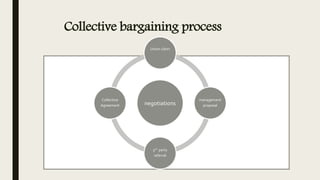
Collective bargaining process
negotiations
Union claim
management
proposal
3rd party
referral
Collective
Agreement
Collective bargaining comprises of five core steps.
1] prepare
2]discuss
3] propose
4] bargain
5] settlement
Steps
1] selection of a bargaining agent
2] certification to contract
3] contract administration
4] the nurse managers role
5]Decertification
Types of strikes
■ Economic strikes
■ Unfair labour strikes
■ Sympathy strikes
■ Jurisdictional strike
■ Recognition strike
Bargaining from tactics
■ A collective bargaining process generally consists of four types
of activities distributive bargaining, integrative bargaining
attitudinal restructuring and intra organizational bargaining.
■ Distributive bargaining
■ Integrative bargaining
■ Attitudinal restructuring
■ Intra organizational bargaining
Levels of collective bargaining
As 3 levels
1] national level
2] sectoral industrial level
3] company enterprise level
Importance of collective bargaining
■ Collective bargaining includes not only negotiations between
the employees between the employers and unions but also
includes the process of resolving labour management
conflicts.
■ thus collective bargaining is essentially, a recognized way of
creating a system of industrial jurisdiction. It acts as method
of introducing civil rights in the industry that is the
management should be conducted by rules rather than
arbitrary decision making.
■ It establishes rules which define and restrict the traditional
authority exercised by the management.
IMPORTANCE TO EMPLOYEES
■ To increase the strength of workforce thereby increasing their
bargaining capacity as a group.
■ Collective bargaining increases the morale and productivity
of employees
■ It restricts management freed for arbitrary action against
employees.
IMPORTANCE TO EMPLOYERS
■ It becomes easier for the management to resolve issues at the
bargaining level rather than taking up complaints of
individual workers.
■ Collective bargaing tends to promote a sense of job security
among employees and thereby tends to reduce the cost of labor
to be management.
■ Collective bargaining opens up the channel of communication
between the workers and the management and increases
worker and the management and increases worker
participation in decision making.
IMPORTANCE TO SOCIETY
■ Collective bargaining leads to industrial peace
■ It results in establishment of a harmonious industrial climate
which support which helps the piece of nation efforts towards
economic and social development can be reduced
considerably.
■ The discrimination and exploitation of workers is constantly
being checked
Advantages And Disadvantages
■ ADVANTAGES
■ Equalization
■ Viable grievance procedure
■ Equitable distribution of work
■ Professionalism promoted
■ Nurses control practice
■ DISADVANTAGES
■ Adversay relationship
■ Strikes may not be prevented
■ Leadership may be different to be obtain
■ Unprofessional behavior
■ Interference with management
■
OCCUPATIONAL HEALTH AND SAFETY
■ All occupational fields have their own hazards. There
are variety are variety of hazards which may cause
various diseases by following the proper guidelines
and precautions, All occupational hazards can be
minimized.
OCCUPATIONAL ENVIRONMENT
■ By occupational is meant the sum of external conditions and
influences which prevail at the place of work and which
have a bearing on the health of the working population,
basically there are three types of interaction in the working
environment.
A] man and physical chemical and biological agents
B]Man and machine
C]Man and man
MAN AND PHYSICAL, CHEMICAL AND
BIOLOGICALAGENTS
■ Physical agents
■ Chemical agents
■ Biological agents
MAN AND MAN
■ There are numerous psychological factors that operators in
the he place of work these are human relationships amongst
workers themselves on the one hand, and those in authority
over them on the other hand examples of psychological
factors include the type and rhythm of work, work stability,
service conditions, job satisfaction, leadership style, security,
workers participation, communication, system of payment,
■ welfare conditions, degree of responsibility, trade
union activities, incentives and a host similar other
factors, all entering the field of human relationship.in
modern occupational health, the emphasis is upon the
people, the conditions in which they live and work,
their hopes and fears and their attitudes towards their
job, their fellow –workers and employees
OCCUPATIONAL
HAZARDS
1] PHYSICAL HAZARDS
■ heat and cold
■ Light
■ Noise
■ Vibration
■ Ultraviolet radiation
■ Ionizing radiation
2] CHEMICAL HAZARDS
■ Local Action
■ Inhalation
■ Gases
■ Metals & their components
3] biological Hazards
Workers be exposed to infective and parasitic agent of the
place of work. The occupational disease in the category are
brucellosis, leptospirosis, anthrax, hydatiditis tetanus,
encephalitis, fungal infections and a host of others
4] psychological hazards
the psychological hazards arises from the workers failure to
adapt to the alien psychological environment, frustration, lack of
job satisfaction, industry poor human relationship, emotional
tension are psychological factors which undermine the both
physical and mental health of workers.
Mechanical hazard
■ The mechanical hazards in the industry Centre
around machinery protruding and moving parts
and the like about 10% of accidents in industry
are said to be due to mechanical causes
Occupational disease
■ Disease due to physical agents
■ Disease due to chemical agents
■ Disease due to biological agent
■ Occupational cancer
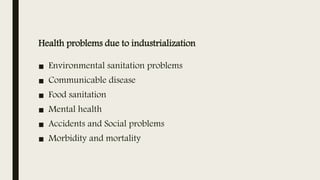
Health problems due to industrialization
■ Environmental sanitation problems
■ Communicable disease
■ Food sanitation
■ Mental health
■ Accidents and Social problems
■ Morbidity and mortality
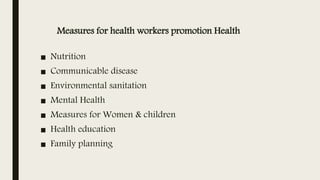
Measures for health workers promotion Health
■ Nutrition
■ Communicable disease
■ Environmental sanitation
■ Mental Health
■ Measures for Women & children
■ Health education
■ Family planning
Prevention of occupational disease
■ Medical measures
■ Engineering measures
■ Legislation
Role of nurse
■ Clinician
■ Specialist
■ Manager
■ Co-ordinator
■ Health Educator
■ Counsellor
■ Researcher
collective bargainng.pptx

collective bargainng.pptx

  • 2.
    Presenting bye Jagatap. j.m 2nd MSc nursing Krishna institute of nursing sciences KRISHNA INSTITUTE OF NURSING SCIENCES, KARAD. SUB- ADMINISTRATION AND MANAGEMENT
  • 3.
    Introduction ■ Other thancontinuing arguing about appropriate education for nurses collective bargaining is the most controversial and divisive issue in ,nursing some believe that collective bargaining reduce the professionalism of nursing others view it as mechanism to prevent employees nurses. It has been seen as complex legal issue, but deal with by attorney and other experts specifically trained to handle the problem
  • 4.
    Meaning ■ Collective bargainingis a process between emplyoees and employers to reach a collective bargaining aims to reach a collective agreement which usually sets out issues such as employees pay working hours, training, health, and safety and rights to participate in workplace or company affairs.
  • 5.
    DEFINITION 1] collective bargainingis an agreement between a single employer or an association of employers on the one hand and a labour union on the other, which regulates the term and conditions of employment. 2] collective bargaining takes place when a number of work people enter into a negotiation as bargaining unit an employer with object of reaching an agreement on conditions of the employment of the work people
  • 6.
    Objectives of collectivebargaining 1] to provide an opportunity to the workers to voice their problems on issues related to employment. 2] to facilitate reaching a solution that is acceptable to all the parties involves. 3] to resolve all and disputes in a mutually agreeable manner
  • 7.
    Cont… 4] to preventany disputes/conflict in the future through mutually signed contracts. 5] to develop a conductive atmosphere to foster good organization relations. 6]to provide stable and peaceful organization{hospital} relations. 7] to enhance the productivity of the organization by preventing strikes lock. out etc.
  • 8.
    Characteristics of collectivebargaining ■ It is group process, where in on group representing employees and the other representing the employees, sit together to negotiate terms of employment. ■ Negotiations from an important aspect of process of collective bargaining discussion. Compromise or mutual give and take in collective bargaining ■ Collective bargaining is formalized process by which employers and independent trade union negotiations terms and condition of employment and the way in which certain employment related issues are to be regulated at national organizational and workplace levels.
  • 9.
    ■ It isbipartite process, this means are always two parties involved in the process of collective bargaining. The negotiations generally take place between the employees and the management. It is a form of participation. ■ Collective bargaining is a complementary process is each party needs. Something that the other party has ;labour can increase productivity and management can pay better for their efforts ■ Collective bargaining tends to improve the relations between workers and the union on the one hand and the employer on the other hand.
  • 10.
    ■ collective bargainingis continuous process it enables industrial democracy to be effective it uses co-operation and consensus for setting disputes rather than conflicts and confrontation. ■ Collective bargaining takes into account day to day policies potentialities capacities and interests.
  • 11.
    Union labor organization ■An organization in which employees participate for the purpose of negotiating with the employers about grievances, labour disagreement, wages, hours of work, and conditions of employment. ■ PREPATION FOR COLLECTIVE BARGAING ■ Preparation should begin month before than contract talks . ■ Chairperson should be establish and maintain pleasant relationship with union representatives by treating them courteousy in social situations, grievance hearing.
  • 12.
    ■ Obtain informationfrom other nurse executives about union activities in neighboring health agencies. ■ Review other labour contracts negotiating in other agencies to determine what type of demands were made by various worker categories. ■ Keep ongoing record agency employees grievances and analyses these before negotiation begins.
  • 13.
    ■ Research thewage salary structures of other health agencies in the community and compare against agencies current wage package. ■ Should read the act to identify limitations.
  • 14.
    Collective bargaining process negotiations Unionclaim management proposal 3rd party referral Collective Agreement
  • 15.
    Collective bargaining comprisesof five core steps. 1] prepare 2]discuss 3] propose 4] bargain 5] settlement
  • 16.
    Steps 1] selection ofa bargaining agent 2] certification to contract 3] contract administration 4] the nurse managers role 5]Decertification
  • 17.
    Types of strikes ■Economic strikes ■ Unfair labour strikes ■ Sympathy strikes ■ Jurisdictional strike ■ Recognition strike
  • 18.
    Bargaining from tactics ■A collective bargaining process generally consists of four types of activities distributive bargaining, integrative bargaining attitudinal restructuring and intra organizational bargaining.
  • 19.
    ■ Distributive bargaining ■Integrative bargaining ■ Attitudinal restructuring ■ Intra organizational bargaining
  • 20.
    Levels of collectivebargaining As 3 levels 1] national level 2] sectoral industrial level 3] company enterprise level
  • 21.
    Importance of collectivebargaining ■ Collective bargaining includes not only negotiations between the employees between the employers and unions but also includes the process of resolving labour management conflicts. ■ thus collective bargaining is essentially, a recognized way of creating a system of industrial jurisdiction. It acts as method of introducing civil rights in the industry that is the management should be conducted by rules rather than arbitrary decision making. ■ It establishes rules which define and restrict the traditional authority exercised by the management.
  • 22.
    IMPORTANCE TO EMPLOYEES ■To increase the strength of workforce thereby increasing their bargaining capacity as a group. ■ Collective bargaining increases the morale and productivity of employees ■ It restricts management freed for arbitrary action against employees.
  • 23.
    IMPORTANCE TO EMPLOYERS ■It becomes easier for the management to resolve issues at the bargaining level rather than taking up complaints of individual workers. ■ Collective bargaing tends to promote a sense of job security among employees and thereby tends to reduce the cost of labor to be management. ■ Collective bargaining opens up the channel of communication between the workers and the management and increases worker and the management and increases worker participation in decision making.
  • 24.
    IMPORTANCE TO SOCIETY ■Collective bargaining leads to industrial peace ■ It results in establishment of a harmonious industrial climate which support which helps the piece of nation efforts towards economic and social development can be reduced considerably. ■ The discrimination and exploitation of workers is constantly being checked
  • 25.
    Advantages And Disadvantages ■ADVANTAGES ■ Equalization ■ Viable grievance procedure ■ Equitable distribution of work ■ Professionalism promoted ■ Nurses control practice
  • 26.
    ■ DISADVANTAGES ■ Adversayrelationship ■ Strikes may not be prevented ■ Leadership may be different to be obtain ■ Unprofessional behavior ■ Interference with management ■
  • 27.
    OCCUPATIONAL HEALTH ANDSAFETY ■ All occupational fields have their own hazards. There are variety are variety of hazards which may cause various diseases by following the proper guidelines and precautions, All occupational hazards can be minimized.
  • 28.
    OCCUPATIONAL ENVIRONMENT ■ Byoccupational is meant the sum of external conditions and influences which prevail at the place of work and which have a bearing on the health of the working population, basically there are three types of interaction in the working environment. A] man and physical chemical and biological agents B]Man and machine C]Man and man
  • 29.
    MAN AND PHYSICAL,CHEMICAL AND BIOLOGICALAGENTS ■ Physical agents ■ Chemical agents ■ Biological agents
  • 30.
    MAN AND MAN ■There are numerous psychological factors that operators in the he place of work these are human relationships amongst workers themselves on the one hand, and those in authority over them on the other hand examples of psychological factors include the type and rhythm of work, work stability, service conditions, job satisfaction, leadership style, security, workers participation, communication, system of payment,
  • 31.
    ■ welfare conditions,degree of responsibility, trade union activities, incentives and a host similar other factors, all entering the field of human relationship.in modern occupational health, the emphasis is upon the people, the conditions in which they live and work, their hopes and fears and their attitudes towards their job, their fellow –workers and employees
  • 32.
    OCCUPATIONAL HAZARDS 1] PHYSICAL HAZARDS ■heat and cold ■ Light ■ Noise ■ Vibration ■ Ultraviolet radiation ■ Ionizing radiation
  • 33.
    2] CHEMICAL HAZARDS ■Local Action ■ Inhalation ■ Gases ■ Metals & their components
  • 34.
    3] biological Hazards Workersbe exposed to infective and parasitic agent of the place of work. The occupational disease in the category are brucellosis, leptospirosis, anthrax, hydatiditis tetanus, encephalitis, fungal infections and a host of others 4] psychological hazards the psychological hazards arises from the workers failure to adapt to the alien psychological environment, frustration, lack of job satisfaction, industry poor human relationship, emotional tension are psychological factors which undermine the both physical and mental health of workers.
  • 35.
    Mechanical hazard ■ Themechanical hazards in the industry Centre around machinery protruding and moving parts and the like about 10% of accidents in industry are said to be due to mechanical causes
  • 36.
    Occupational disease ■ Diseasedue to physical agents ■ Disease due to chemical agents ■ Disease due to biological agent ■ Occupational cancer
  • 37.
    Health problems dueto industrialization ■ Environmental sanitation problems ■ Communicable disease ■ Food sanitation ■ Mental health ■ Accidents and Social problems ■ Morbidity and mortality
  • 38.
    Measures for healthworkers promotion Health ■ Nutrition ■ Communicable disease ■ Environmental sanitation ■ Mental Health ■ Measures for Women & children ■ Health education ■ Family planning
  • 39.
    Prevention of occupationaldisease ■ Medical measures ■ Engineering measures ■ Legislation
  • 40.
    Role of nurse ■Clinician ■ Specialist ■ Manager ■ Co-ordinator ■ Health Educator ■ Counsellor ■ Researcher