SOA –
Agile or Fragile?
Colin Robb
HP Software Product Marketing Director
Poll
How many know what
SOA stands for?

25
Poll
How many could briefly
describe what SOA
means?
24
Poll
How many of your
organisations have been
considering SOA?
23
Poll
How many are actually
developing SOA
applications as we
speak?
22
Poll
How many are actually
testing SOA applications
as we speak?
21
Poll
How many have SOA
applications in
production?
20
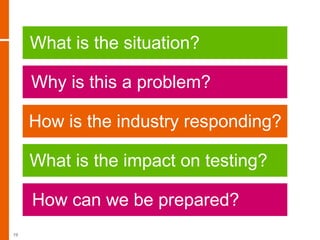
What is the situation?
Why is this a problem?
How is the industry responding?
What is the impact on testing?
How can we be prepared?
19
What is the situation?
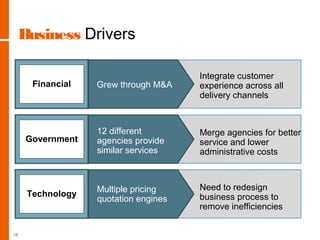
Business Drivers
Financial
Government
Technology
Multiple pricing
quotation engines
Grew through M&A
12 different
agencies provide
similar services
Integrate customer
experience across all
delivery channels
Merge agencies for better
service and lower
administrative costs
Need to redesign
business process to
remove inefficiencies
18
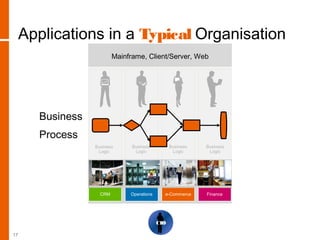
Applications in a Typical Organisation
CIO
Mainframe, Client/Server, Web
CRM Operations e-Commerce Finance
Business
Logic
Business
Logic
Business
Logic
Business
Logic
Business
Process
17
Why is this a problem?
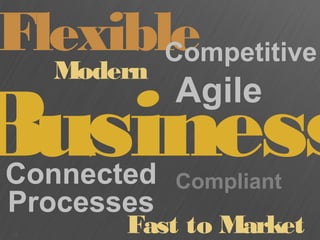
Connected
Processes
Agile
Fast to Market
FlexibleCompetitive
Modern
Compliant
Business
16
SLOW
Traditional IT is
Expensive and
Inefficient
But …
15
Fundamental
change is required
14
How is the industry responding?
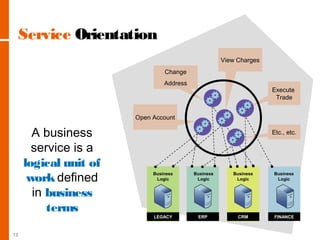
Service Orientation
A business
service is a
logical unit of
workdefined
in business
terms
Business
Logic
LEGACY ERP CRM FINANCE
Business
Logic
Business
Logic
Business
Logic
Open Account
Change
Address
View Charges
Execute
Trade
Etc., etc.
13
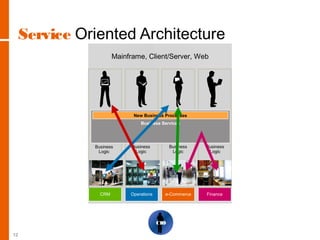
Service Oriented Architecture
CIO
Mainframe, Client/Server, Web
CRM Operations e-Commerce Finance
Business
Logic
Business
Logic
Business
Logic
Business
Logic
New Business Processes
Business Services
12
But now let’s talk about the Real World …
Today’s solutions are
tomorrow’s problems
11
Hide
Support through
alignment and management
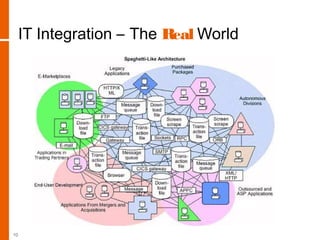
IT Integration – The Real World
Business Complexity:
IT Complexity:
10
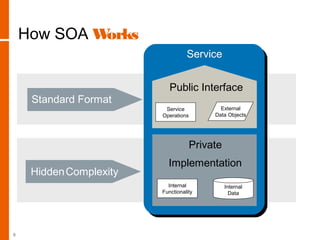
Standard Format
HiddenComplexity
How SOA Works
Service
Service
Operations
External
Data Objects
Public Interface
Internal
Functionality
Internal
Data
Private
Implementation
9
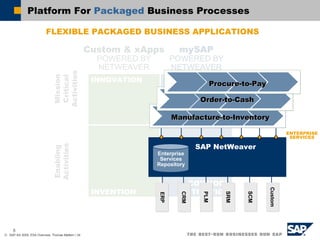
Does this apply to me though?
© SAP AG 2005, ESA Overview, Thomas Mattern / 24
INNOVATION STANDARD-
IZATION
COMMODI-
TIZATIONINVENTION
Mission
Critical
Activities
Enabling
Activities
Custom & xApps
POWERED BY
NETWEAVER
mySAP
POWERED BY
NETWEAVER
Platform For Packaged Business Processes
FLEXIBLE PACKAGED BUSINESS APPLICATIONS
SAP NetWeaver
ERPERP
CRMCRM
Enterprise
Services
Repository
ENTERPRISE
SERVICES
PLMPLM
SRMSRM
SCMSCM
CustomCustom
Manufacture-to-InventoryManufacture-to-Inventory
Order-to-CashOrder-to-Cash
Procure-to-PayProcure-to-Pay
8
© SAP AG 2005, ESA Overview, Thomas Mattern / 25
Mission
Critical
Activities
INNOVATION STANDARD-
IZATION
COMMODI-
TIZATIONINVENTION
Enabling
Activities
Custom & xApps
POWERED BY
NETWEAVER
mySAP
POWERED BY
NETWEAVER
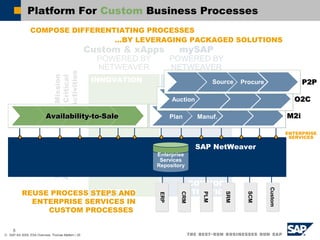
Platform For Custom Business Processes
REUSE PROCESS STEPS AND
ENTERPRISE SERVICES IN
CUSTOM PROCESSES
…BY LEVERAGING PACKAGED SOLUTIONS
ERPERP
CRMCRM
PLMPLM
SRMSRM
SCMSCM
CustomCustom
SAP NetWeaver
ENTERPRISE
SERVICES
SAP NetWeaver
Enterprise
Services
Repository
Plan Manuf.
Auction
Source
COMPOSE DIFFERENTIATING PROCESSES
Procure
Availability-to-SaleAvailability-to-Sale
P2PP2P
O2CO2C
M2iM2i
8
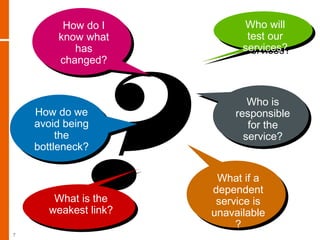
What is the impact on testing?
?
Who will
test our
services?
Who will
test our
services?
What is the
weakest link?
What is the
weakest link?
What if a
dependent
service is
unavailable
?
What if a
dependent
service is
unavailable
?
How do we
avoid being
the
bottleneck?
How do we
avoid being
the
bottleneck?
How do I
know what
has
changed?
How do I
know what
has
changed?
Who is
responsible
for the
service?
Who is
responsible
for the
service?
7
Vulnerability
Interoperability
6
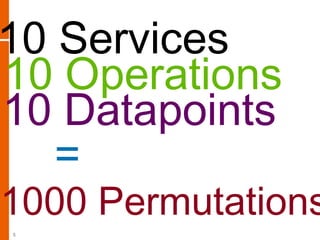
10 Services
10 Operations
10 Datapoints
=
1000 Permutations
5
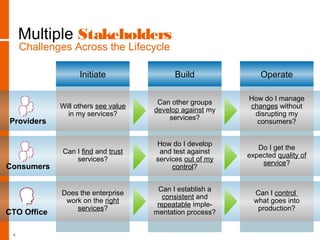
Challenges Across the Lifecycle
Multiple Stakeholders
Providers
Consumers
CTO Office
Initiate
Will others see value
in my services?
Can I find and trust
services?
Does the enterprise
work on the right
services?
Build
Can other groups
develop against my
services?
How do I develop
and test against
services out of my
control?
Can I establish a
consistent and
repeatable imple-
mentation process?
Operate
How do I manage
changes without
disrupting my
consumers?
Do I get the
expected quality of
service?
Can I control
what goes into
production?
4
How can we be prepared?
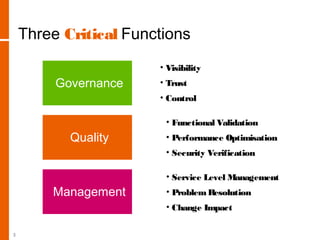
Three Critical Functions
• Visibility
• Trust
• Control
Governance
• Functional Validation
• Performance Optimisation
• Security Verification
Quality
• Service Level Management
• ProblemResolution
• Change Impact
Management
3
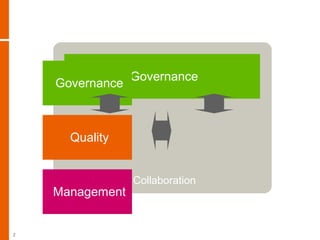
Collaboration
Governance
Governance
Quality
Management
2
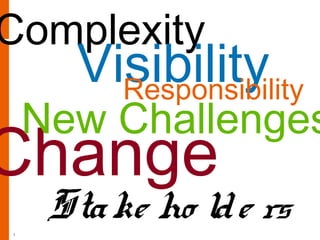
Change
New Challenges
Stake ho lde rs
Complexity
VisibilityResponsibility
1
Thank-you
for your attention!
colin.robb@hp.com

Colin Robb - SOA - Agile or Fragile?

  • 1.
    SOA – Agile orFragile? Colin Robb HP Software Product Marketing Director
  • 2.
    Poll How many knowwhat SOA stands for?  25
  • 3.
    Poll How many couldbriefly describe what SOA means? 24
  • 4.
    Poll How many ofyour organisations have been considering SOA? 23
  • 5.
    Poll How many areactually developing SOA applications as we speak? 22
  • 6.
    Poll How many areactually testing SOA applications as we speak? 21
  • 7.
    Poll How many haveSOA applications in production? 20
  • 8.
    What is thesituation? Why is this a problem? How is the industry responding? What is the impact on testing? How can we be prepared? 19
  • 9.
    What is thesituation?
  • 10.
    Business Drivers Financial Government Technology Multiple pricing quotationengines Grew through M&A 12 different agencies provide similar services Integrate customer experience across all delivery channels Merge agencies for better service and lower administrative costs Need to redesign business process to remove inefficiencies 18
  • 11.
    Applications in aTypical Organisation CIO Mainframe, Client/Server, Web CRM Operations e-Commerce Finance Business Logic Business Logic Business Logic Business Logic Business Process 17
  • 12.
    Why is thisa problem?
  • 13.
  • 14.
    SLOW Traditional IT is Expensiveand Inefficient But … 15
  • 15.
  • 16.
    How is theindustry responding?
  • 17.
    Service Orientation A business serviceis a logical unit of workdefined in business terms Business Logic LEGACY ERP CRM FINANCE Business Logic Business Logic Business Logic Open Account Change Address View Charges Execute Trade Etc., etc. 13
  • 18.
    Service Oriented Architecture CIO Mainframe,Client/Server, Web CRM Operations e-Commerce Finance Business Logic Business Logic Business Logic Business Logic New Business Processes Business Services 12
  • 19.
    But now let’stalk about the Real World …
  • 20.
  • 21.
    Hide Support through alignment andmanagement IT Integration – The Real World Business Complexity: IT Complexity: 10
  • 22.
    Standard Format HiddenComplexity How SOAWorks Service Service Operations External Data Objects Public Interface Internal Functionality Internal Data Private Implementation 9
  • 23.
    Does this applyto me though?
  • 24.
    © SAP AG2005, ESA Overview, Thomas Mattern / 24 INNOVATION STANDARD- IZATION COMMODI- TIZATIONINVENTION Mission Critical Activities Enabling Activities Custom & xApps POWERED BY NETWEAVER mySAP POWERED BY NETWEAVER Platform For Packaged Business Processes FLEXIBLE PACKAGED BUSINESS APPLICATIONS SAP NetWeaver ERPERP CRMCRM Enterprise Services Repository ENTERPRISE SERVICES PLMPLM SRMSRM SCMSCM CustomCustom Manufacture-to-InventoryManufacture-to-Inventory Order-to-CashOrder-to-Cash Procure-to-PayProcure-to-Pay 8
  • 25.
    © SAP AG2005, ESA Overview, Thomas Mattern / 25 Mission Critical Activities INNOVATION STANDARD- IZATION COMMODI- TIZATIONINVENTION Enabling Activities Custom & xApps POWERED BY NETWEAVER mySAP POWERED BY NETWEAVER Platform For Custom Business Processes REUSE PROCESS STEPS AND ENTERPRISE SERVICES IN CUSTOM PROCESSES …BY LEVERAGING PACKAGED SOLUTIONS ERPERP CRMCRM PLMPLM SRMSRM SCMSCM CustomCustom SAP NetWeaver ENTERPRISE SERVICES SAP NetWeaver Enterprise Services Repository Plan Manuf. Auction Source COMPOSE DIFFERENTIATING PROCESSES Procure Availability-to-SaleAvailability-to-Sale P2PP2P O2CO2C M2iM2i 8
  • 26.
    What is theimpact on testing?
  • 27.
    ? Who will test our services? Whowill test our services? What is the weakest link? What is the weakest link? What if a dependent service is unavailable ? What if a dependent service is unavailable ? How do we avoid being the bottleneck? How do we avoid being the bottleneck? How do I know what has changed? How do I know what has changed? Who is responsible for the service? Who is responsible for the service? 7
  • 28.
  • 29.
    10 Services 10 Operations 10Datapoints = 1000 Permutations 5
  • 30.
    Challenges Across theLifecycle Multiple Stakeholders Providers Consumers CTO Office Initiate Will others see value in my services? Can I find and trust services? Does the enterprise work on the right services? Build Can other groups develop against my services? How do I develop and test against services out of my control? Can I establish a consistent and repeatable imple- mentation process? Operate How do I manage changes without disrupting my consumers? Do I get the expected quality of service? Can I control what goes into production? 4
  • 31.
    How can webe prepared?
  • 32.
    Three Critical Functions •Visibility • Trust • Control Governance • Functional Validation • Performance Optimisation • Security Verification Quality • Service Level Management • ProblemResolution • Change Impact Management 3
  • 33.
  • 34.
    Change New Challenges Stake holde rs Complexity VisibilityResponsibility 1
  • 35.

Editor's Notes

  • #3 Key Messages: Expect the hands in each poll to become less and less, although I expect more to be left at the end each time I do this as SOA becomes more of a reality (especially in EMEA)
  • #4 Key Messages: Expect the hands in each poll to become less and less, although I expect more to be left at the end each time I do this as SOA becomes more of a reality (especially in EMEA)
  • #5 Key Messages: Expect the hands in each poll to become less and less, although I expect more to be left at the end each time I do this as SOA becomes more of a reality (especially in EMEA)
  • #6 Key Messages: Expect the hands in each poll to become less and less, although I expect more to be left at the end each time I do this as SOA becomes more of a reality (especially in EMEA)
  • #7 Key Messages: Expect the hands in each poll to become less and less, although I expect more to be left at the end each time I do this as SOA becomes more of a reality (especially in EMEA)
  • #8 Key Messages: Expect the hands in each poll to become less and less, although I expect more to be left at the end each time I do this as SOA becomes more of a reality (especially in EMEA)
  • #9 Agenda only
  • #11 Key Messages: Technology change doesn’t happen without reason Different business challenges often point to the same IT challenges – integration, flexibility, agility
  • #12 Key Messages: Business Processes are not silo’d any more. A typical enterprise business process spans many areas and many apps
  • #14 Key Messages: IT serves the business, not the other way around, although IT’s function is to enable the business. Here is what modern business is looking for, and therefore what business is looking for from IT
  • #15 Key Messages: But IT is currently not well aligned to deliver what the business wants, because it is still structured around old, inflexible technologies
  • #16 Key Message: The industry has reached a turning point, where everyone agrees that we can’t carry on as we are, yet no-one has a perfect solution
  • #18 Key Message: The theory of service orientation is not new, but the way it is being talked about is more engaging – it is more business focused so is catching the attention of the right people. It is also “abstracted” rather than proprietary, so there is general buy-in rather than rejection from any “not-invented-here” domains
  • #19 Key Messages: Although the functionality may still be silo’d (encapsulated in a business service), this is transparent to the business process
  • #21 Key Messages: We have been here before SOA does not remove complexity, it hides it It is the current “hot topic” which means that everybody wants to jump on the bandwagon. There is scant regard for the potential pitfalls
  • #22 Key Messages: Recognise this? SOA does not make this magically go away The complexity is still there, but as it is hidden, it is even harder to understand the impact and implications of problems – therefore testing is fundamental and critical to SOA
  • #23 Key Message: SOA is succeeding where others failed not because it is new, but because it is based on standards. Services from distinct vendors will work together regardless of the technology used to build them (or that’s the theory anyway – testing must validate this) The implementation may be simple or complex. We may not know (a service may be third-party and only exposed as a black box to us)
  • #25 Key Message: Quick reality check if there are any attendees feeling that SOA doesn’t apply to them Anyone in the room work for companies with SAP or Oracle implementations? If so, the news is that you are getting SOA whether you like it or not, as both SAP and Oracle’s latest releases are SOA-based (although maybe by some other name)
  • #26 Key Message: Example of SAP slide talking about custom business processes
  • #27 Key Messages: Testing of SOA is not the same as testing traditional in-house or COTS apps (it needs to do everything that traditional testing does, but more on top) Traditional tasks become harder and there are new tasks to consider Remembering the key business drivers which have led to IT adopting SOA - the expectation is that our work needs to be done much faster (time to market) and more effectively (increased quality), yet there is more for us to do, and it’s potentially harder to do it Note: Real-world customer examples to be used throughout the remaining sections
  • #28 Key Messages: We’ve seen how SOA is a potential solution to the problem, and why it is seen as the latest panacea - we’ve also seen that it is inevitable But this means new challenges for testers New things to think about (as well as the old stuff)
  • #29 Key Messages: There are new types of test we need to run The key tenet of SOA is re-use (without it, SOA is irrelevant). Even if a service is not yet reused, it must be validated as “reusable” Huge security risk with any new technology – must think about validating this
  • #30 Key Messages: Even though the SOA model is nice and neat, with encapsulated services, the testing of individual services is complex and time-consuming, even before they are consumed by an application This looks like traditional unit testing, but it must be more than that – this is too important to be left to the developers who wrote the code – there must be separation of duties
  • #31 Key Messages: It is no longer just the application development team and the testing team (which as we know is hard enough to manage) Now there are the service developers and the app developers, consumers and providers (who can also be consumers themselves) Services are not necessarily developed or even owned in-house, so how do we validate the quality?
  • #33 Key Messages: Must look at SOA in a different way. We must understand what constitutes our “SOA” to be able to test it effectively – we have to have some kind of governance – how do I know what the latest version of a service is, which version I have, who developed it, what its service levels are supposed to be Testing is more important than ever – more interfaces means more points of failure Must not see deployment as the end of the process, must be able to understand the impact of ongoing changes so that they can be tested properly prior to deployment etc. SOA makes this more of a challenge
  • #34 Key Messages: #1 message is we need to collaborate. We cannot be successful in SOA working as silo’d organisations
  • #35 Key Messages: In summary, we have to consider new things and be prepared to work in different ways to test SOA services and applications properly Testing is absolutely critical in SOA projects as there is such a high expectation of success (via the hype), yet so many potential pitfalls We have to be involved earlier in the process to ensure that testing is not the bottleneck at the end We must be prepared for testing before testing begins – consider how we will test third-party services, services with a per-usage cost associated with them, services which are not complete or are unavailable etc.