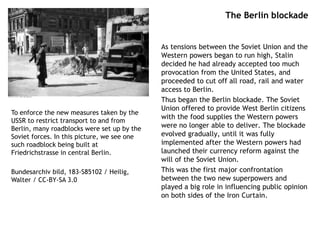
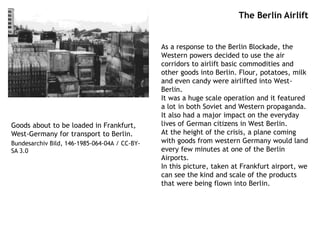
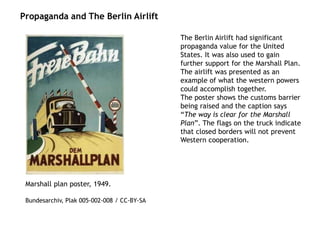
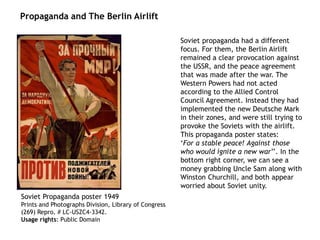
This source collection deals with a relatively short but significant period in the history of the Cold
War. The main part of the collection covers the five years following US President Harry S.
Truman’s address to Congress on 12 March 1947 which announced what came to be known as the
Truman Doctrine. However, the rising tension between former allies during this period needs to be
contextualised. Although allies in World War II there had been an uneasy relationship for much of
that time, particularly regarding the fate of Eastern Europe after the war. At the Yalta Conference
in February 1945 President Roosevelt had gone a long way towards recognising that Stalin was
seeking to create buffer states between the West and the Soviet Union because past attacks on
Russia had often come through Eastern Europe, particularly Poland.
However, Roosevelt believed that the formation of the United Nations could provide an
opportunity for the war-time allies to continue to work together to maintain the peace. In
particular, he saw the new UN Security Council which had five permanent members – the war-time
allies (Britain, China, France, USA and USSR) - as a way of maintaining cooperation between the
major powers which, in turn, might lead to the Soviet Union and China being more integrated into
the international community. But Roosevelt died before the UN Charter was formally signed. His
successor, Harry S.Truman, was much less committed to the idea of continued cooperation with
the Soviet Union, but when he and Stalin met at the Potsdam Conference in July 1945 they found
a number of areas of agreement and afterwards Truman wrote: “I can deal with Stalin. He is
honest – but smart as hell”. Over the following year the relationship soured. Russia’s continued
occupation of Iran and political developments in Eastern Europe and the Baltic states led Truman
to write to James Byrnes, his Secretary of State, the time for making compromises to
accommodate Soviet foreign policy was over: “Unless Russia is faced with an iron fist and strong
language another war is in the making.”
The Origins of The Cold War:
Different Historical Perspectives
Between 1945 and 1991 the world was changing rapidly, and sometimes dramatically, and even
those historians and other academics who were writing about the early days of the Cold War
were influenced by changing events. The possession of the atom bomb, the Marshall Plan, the
division of Germany, the Berlin blockade, the Korean War, the Cuban Missile Crisis, the Vietnam
War, the fall of the Berlin Wall in 1989 all helped to shape the perceptions of historians
specialising in the Cold War. And not necessarily in the same way. The same events and, indeed,
the same facts, could be interpreted very differently. Nor was it simply a case of western
historians interpreting events in one way and Soviet historians interpreting them in a different
way. In the west in the 1950s and ‘60s there was a traditional approach which was widely held,
which attributed the blame for the emergence of the Cold War to Soviet intransigence, Marxism-
Leninism and Stalin’s personality. But there was also what came to be known as a revisionist
position which argued that the Soviet Union was mainly reacting to Washington’s assertive
foreign policy (both political and economic). Some western hisotrians described this as US
imperialism (as did most Soviet historians) and another concept – American exceptionalism – was
also used - meaning basically a “sense of manifest destiny that what is best for America is best
for the rest of the world”. But events in the 1970s, particularly the Vietnam War, led some
historians to adopt what came to be known as a post-revisionist approach, which explored the
complex interactions of the two sides rather than simply using the evidence selectively to assign
responsibility for the Cold War to one side only. In the east there was a consensus about US
imperialism but events such as the death of Stalin, the Krushchev thaw, détente and the
Gorbachev era produced an increasingly nuanced account of the Cold War.
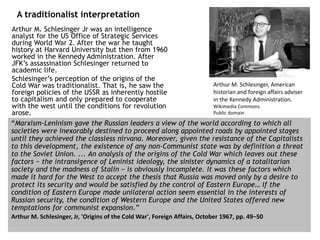
Arthur M. Schlesinger Jr was an intelligence
analyst for the US Office of Strategic Services
during World War 2. After the war he taught
history at Harvard University but then from 1960
worked in the Kennedy Administration. After
JFK’s assassination Schlesinger returned to
academic life.
Schlesinger’s perception of the origins of the
Cold War was traditionalist. That is, he saw the
foreign policies of the USSR as inherently hostile
to capitalism and only prepared to cooperate
with the west until the conditions for revolution
arose.
A traditionalist interpretation
“Marxism-Leninism gave the Russian leaders a view of the world according to which all
societies were inexorably destined to proceed along appointed roads by appointed stages
until they achieved the classless nirvana. Moreover, given the resistance of the Capitalists
to this development, the existence of any non-Communist state was by definition a threat
to the Soviet Union. ... An analysis of the origins of the Cold War which leaves out these
factors − the intransigence of Leninist ideology, the sinister dynamics of a totalitarian
society and the madness of Stalin − is obviously incomplete. It was these factors which
made it hard for the West to accept the thesis that Russia was moved only by a desire to
protect its security and would be satisfied by the control of Eastern Europe… If the
condition of Eastern Europe made unilateral action seem essential in the interests of
Russian security, the condition of Western Europe and the United States offered new
temptations for communist expansion.”
Arthur M. Schlesinger, Jr, 'Origins of the Cold War', Foreign Affairs, October 1967, pp. 49−50
Arthur M. Schlesinger, American
historian and foreign affairs adviser
in the Kennedy Administration.
Wikimedia Commons
Public domain
A revisionist interpretation
William A.Williams has been widely regarded
as one of the leading revisionist historians of
the Cold War. At the time when he was
writing (the 1960s) some Americans regarded
his work as subversive, even un-American.
He regarded American foreign policy as
promoting economic imperialism. He saw the
open-door economic policy of the US as the
main source of conflict between the USA and
the USSR. This ‘open-door policy’ required
free trade around the world and the
elimination of tariffs and preferential
systems. Because the USA was the leading
economic power this policy could only
enhance the likelihood of US economic and
political domination in the world.
“American leaders had internalized, and
had come to believe, the theory, the
necessity, and the morality of open-door
expansion. Hence they seldom thought it
necessary to explain or defend the
approach…As far as American leaders
were concerned, the philosophy and
practice of open-door expansion had
become, in both its missionary and
economic aspects, the view of the world.
Particularly after the atom bomb was
created and used, the attitude of the
United States left the soviets with but
one real option: either acquiesce in
American proposals or be confronted
with American power and hostility. It was
the decision of the United States to
employ its new and awesome power in
keeping with the traditional Open Door
Policy which crystallized the Cold
War…The popular idea that Soviet
leaders emerged from the war ready to
do aggressive battle against the United
States is simply not borne out by the
evidence.”
William A. Williams, The Tragedy of
American Diplomacy, New York 1962pp.206ff.
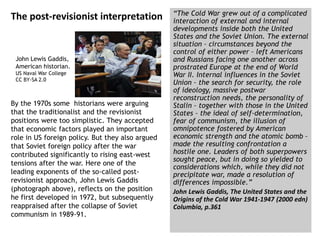
The post-revisionist interpretation
By the 1970s some historians were arguing
that the traditionalist and the revisionist
positions were too simplistic. They accepted
that economic factors played an important
role in US foreign policy. But they also argued
that Soviet foreign policy after the war
contributed significantly to rising east-west
tensions after the war. Here one of the
leading exponents of the so-called post-
revisionist approach, John Lewis Gaddis
(photograph above), reflects on the position
he first developed in 1972, but subsequently
reappraised after the collapse of Soviet
communism in 1989-91.
“The Cold War grew out of a complicated
interaction of external and internal
developments inside both the United
States and the Soviet Union. The external
situation – circumstances beyond the
control of either power – left Americans
and Russians facing one another across
prostrated Europe at the end of World
War II. Internal influences in the Soviet
Union – the search for security, the role
of ideology, massive postwar
reconstruction needs, the personality of
Stalin – together with those in the United
States – the ideal of self-determination,
fear of communism, the illusion of
omnipotence fostered by American
economic strength and the atomic bomb –
made the resulting confrontation a
hostile one. Leaders of both superpowers
sought peace, but in doing so yielded to
considerations which, while they did not
precipitate war, made a resolution of
differences impossible.”
John Lewis Gaddis, The United States and the
Origins of the Cold War 1941-1947 (2000 edn)
Columbia, p.361
John Lewis Gaddis,
American historian.
US Naval War College
CC BY-SA 2.0
Post-Soviet interpretation
The orthodox Soviet postion on the origins of the
Cold War from the early 1950s through to 1988
was that it came about as a result of US
imperialism. This perspective is clearly stated, for
example, in the works of Nikolai Inozemtsev,
Director of the Moscow Institute of World
Economy and International Relations. Here,
however, is a view from two younger Russian
historians, now working in the USA, who grew up
and were educated in the Soviet Union and both
worked at the Institute of US and Canada Studies
in Moscow until the mid-1990s.
“Stalin wanted to avoid confrontation
with the West [because he] believed in
the inevitability of a postwar economic
crisis of the capitalist economy and of
clashes within the capitalist camp that
would provide him with a lot of space for
geopolitical manoeuvering in Europe and
Asia – all within the framework of
general cooperation… Stalin’s postwar
foreign policy was more defensive,
reactive and prudent than it was the
fulfilment of a master plan. Yet instead
of postponing a confrontation with the
United States …he managed to draw
closer to it with every step.”
Vladislav Zubok and Constantin
Pleshakov, Inside the Kremlin’s Cold
War: From Stalin to Khrushchev,
(Cambridge MA, 1996)
From wartime alliance to a war of nerves (1945-1946)
As the Norwegian historian, Odd Arne Westad, has pointed out, the USA, the USSR
and Great Britain were “accidental allies in a global war brought on by their mutual
enemies”. [The Alliance] “did not consist of a long period of working together for
common aims, as most successful alliances do. It was a set of shotgun weddings
brought on by real need, at a time when each of them had to find help to defeat
immediate threats.” (The Cold War: A World History, Penguin Random House, London
2017, pp.43-44). In Section 2 of our module on The Cold War, Andrea Scionti has
highlighted the tensions that existed between the allies during the war and these
carried over into the period 1945–1948. Nevertheless, at the end of the war political
or military confrontation was not uppermost in the minds of the political elites in
London, Moscow or Washington. Each of the allies was confronted by major domestic
political and economic issues and while Britain and the USA were seeking to stabilise
the situation in war-torn Europe, the Soviet Union needed to concentrate on
consolidating its position in eastern and south-eastern Europe. However, at this stage
there were still some signs of willingness on both sides to cooperate. This included
the founding of the United Nations, the establishment of the UN Atomic Energy
Commission and cooperation in the development of the UN Universal Declaration of
Human Rights. But by the end of 1947 the necessity and the will to cooperate no
longer existed.
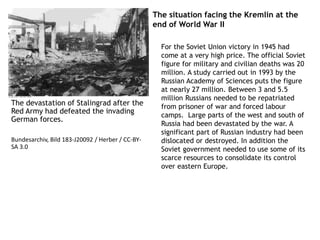
The situation facing the Kremlin at the
end of World War II
For the Soviet Union victory in 1945 had
come at a very high price. The official Soviet
figure for military and civilian deaths was 20
million. A study carried out in 1993 by the
Russian Academy of Sciences puts the figure
at nearly 27 million. Between 3 and 5.5
million Russians needed to be repatriated
from prisoner of war and forced labour
camps. Large parts of the west and south of
Russia had been devastated by the war. A
significant part of Russian industry had been
dislocated or destroyed. In addition the
Soviet government needed to use some of its
scarce resources to consolidate its control
over eastern Europe.
The devastation of Stalingrad after the
Red Army had defeated the invading
German forces.
Bundesarchiv, Bild 183-J20092 / Herber / CC-BY-
SA 3.0
The situation facing the Kremlin at the
end of World War II
The Kremlin was also faced with the
major problem of how to reinstate
Communist party control in the German-
occupied territories of the Soviet Union.
In June 1941 Hitler had issued the
Komissarbefehl ordering his Generals to
summarily execute all commisars amongst
the Soviet prisoners of war during
Operation Barbarossa. A month later, SS
General Reinhard Heydrich, Chief of Reich
Security, ordered the SS Einsatzgruppen
(the mobile SS Death squads), who were
moving into eastern occupied territories
behind the army, to eliminate communist
officials as well as the Jews living there.
As a result, once Germany had been
defeated the Kremlin was faced with a
major task of resurrecting communist
control over much of the western and
south-western USSR.
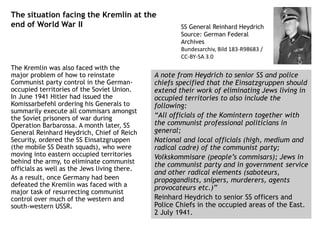
A note from Heydrich to senior SS and police
chiefs specified that the Einsatzgruppen should
extend their work of eliminating Jews living in
occupied territories to also include the
following:
“All officials of the Komintern together with
the communist professional politicians in
general;
National and local officials (high, medium and
radical cadre) of the communist party;
Volkskommisare (people’s commisars); Jews in
the communist party and in government service
and other radical elements (saboteurs,
propagandists, snipers, murderers, agents
provocateurs etc.)”
Reinhard Heydrich to senior SS officers and
Police Chiefs in the occupied areas of the East.
2 July 1941.
SS General Reinhard Heydrich
Source: German Federal
Archives
Bundesarchiv, Bild 183-R98683 /
CC-BY-SA 3.0
The chances of revolution in Eastern
Europe
Not surprisingly, in 1945-47 world revolution
was very low on the USSR’s list of priorities.
Indeed, Stalin did not even anticipate that
Eastern Europe, now liberated by the Red
Army, was ripe for home-grown revolution
[See his comment to Roosevelt’s envoy, Harry
Hopkins, in 1944]. In the immediate post-war
years the Red Army was still fighting anti-
Soviet resistance groups in the Baltic States,
Belarus, Poland, Romania and Ukraine. In
most of Eastern Europe in the 1930s
communist parties had been banned and
their leaders imprisoned. At this stage
Stalin’s preference was for the Communist
Party in these countries to go into coalition
with other non-Fascist parties until such time
as conditions favoured a communist takeover
of power. According to the historian Anne
Applebaum, Stalin’s foreign minister in 1944
thought this might take 30-40 years. [Iron
Curtain, London 2013, p.xxx]
Harry Hopkins (left) at the Livadia Palace, Crimea,
Feb.1945 with tewo other members of the team.
US National Archives & Records Administration Public Domain
In a meeting in Moscow to plan the Yalta
Conference in February 1945, Harry
Hopkins, President Roosevelt’s envoy,
recorded that when he asked Stalin about
the Soviet Union’s intentions towards
Poland, Stalin offered this blunt response:
“Communism would fit Poland as a saddle
on a cow.”
Quoted by Adam Ulam, Understanding the Cold
War, (New York 2002) p.277.
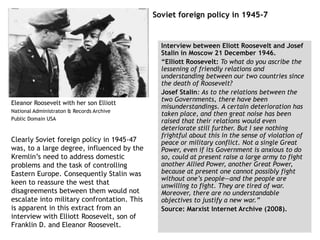
Soviet foreign policy in 1945-7
Interview between Eliott Roosevelt and Josef
Stalin in Moscow 21 December 1946.
“Elliott Roosevelt: To what do you ascribe the
lessening of friendly relations and
understanding between our two countries since
the death of Roosevelt?
Josef Stalin: As to the relations between the
two Governments, there have been
misunderstandings. A certain deterioration has
taken place, and then great noise has been
raised that their relations would even
deteriorate still further. But I see nothing
frightful about this in the sense of violation of
peace or military conflict. Not a single Great
Power, even if its Government is anxious to do
so, could at present raise a large army to fight
another Allied Power, another Great Power,
because at present one cannot possibly fight
without one’s people—and the people are
unwilling to fight. They are tired of war.
Moreover, there are no understandable
objectives to justify a new war.”
Source: Marxist Internet Archive (2008).
Eleanor Roosevelt with her son Elliott
National Administraton & Records Archive
Public Domain USA
Clearly Soviet foreign policy in 1945-47
was, to a large degree, influenced by the
Kremlin’s need to address domestic
problems and the task of controlling
Eastern Europe. Consequently Stalin was
keen to reassure the west that
disagreements between them would not
escalate into military confrontation. This
is apparent in this extract from an
interview with Elliott Roosevelt, son of
Franklin D. and Eleanor Roosevelt.
Soviet Union’s main priorities at the Potsdam Conference
Although Stalin and Foreign Minister Molotov went to the Potsdam Conference in July
1945 with a long list of demands, they had three main aims:
SECURITY: The Western Allies had acknowledged at Yalta that a primary aim of Soviet postwar
foreign policy would be to establish buffer states between itself and the other powers in case
they attempted an invasion in the future. Poland was critical to this and Stalin was determined
that the Communist Lublin Government retained control in spite of the Yalta agreement to
form a coalition government with non-Communists and hold free elections.
CONTINUED LEND-LEASE SUPPORT: Throughout the war the US government had used a
Lend-Lease scheme to supply its allies with food, oil and weapons. In return for aid the US
obtained leases on military and naval bases in Allied territory. In 1944 Roosevelt had proposed
to Stalin that he begin using Lend-Lease to obtain industrial equipment for postwar
reconstruction. In January 1945, before Potsdam, the US and Soviet governments discussed the
possibility of the US providing equipment to the value of $6 billion repaid over 30 years at low
interest. Since this required the agreement of the US Congress, Stalin was keen to formalise
the arrangement as soon as possible.
REPARATIONS FROM GERMANY: At Yalta the ‘Big Three’ had agreed to total reparations from
Germany of $20 billion, with half going to the Soviet Union. Stalin was keen that a significant
part of the reparations would take the form of industrial equipment from western Germany to
assist Soviet reconstruction.
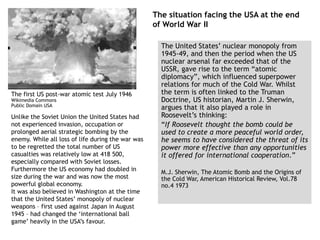
The situation facing the USA at the end
of World War II
The United States’ nuclear monopoly from
1945-49, and then the period when the US
nuclear arsenal far exceeded that of the
USSR, gave rise to the term “atomic
diplomacy”, which influenced superpower
relations for much of the Cold War. Whilst
the term is often linked to the Truman
Doctrine, US historian, Martin J. Sherwin,
argues that it also played a role in
Roosevelt’s thinking:
“If Roosevelt thought the bomb could be
used to create a more peaceful world order,
he seems to have considered the threat of its
power more effective than any opportunities
it offered for international cooperation.”
M.J. Sherwin, The Atomic Bomb and the Origins of
the Cold War, American Historical Review, Vol.78
no.4 1973
The first US post-war atomic test July 1946
Wikimedia Commons
Public Domain USA
Unlike the Soviet Union the United States had
not experienced invasion, occupation or
prolonged aerial strategic bombing by the
enemy. While all loss of life during the war was
to be regretted the total number of US
casualties was relatively low at 418 500,
especially compared with Soviet losses.
Furthermore the US economy had doubled in
size during the war and was now the most
powerful global economy.
It was also believed in Washington at the time
that the United States’ monopoly of nuclear
weapons – first used against Japan in August
1945 – had changed the ‘international ball
game’ heavily in the USA’s favour.
The situation facing the USA at the end
of World War II
In 1918-19, after Germany had surrendered,
President Woodrow Wilson had been
dismayed to find that there was a mood of
isolationism in the United States and the US
Senate decided not to ratify the Treaty of
Versailles which meant that the US remained
outside the League of Nations.
There were some isolationists in the US
Congress in 1945, led by the Republican
Senator Robert A. Taft. But the majority in
both Houses recognised that the United
States’ superpower status combined with its
global economic dominance meant that it
would and should intervene in world affairs
to promote its economic and political
interests.
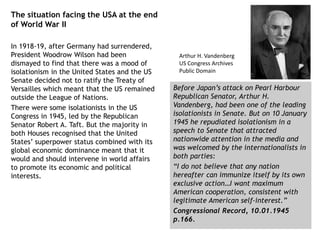
Before Japan’s attack on Pearl Harbour
Republican Senator, Arthur H.
Vandenberg, had been one of the leading
isolationists in Senate. But on 10 January
1945 he repudiated isolationism in a
speech to Senate that attracted
nationwide attention in the media and
was welcomed by the internationalists in
both parties:
“I do not believe that any nation
hereafter can immunize itself by its own
exclusive action…I want maximum
American cooperation, consistent with
legitimate American self-interest.”
Congressional Record, 10.01.1945
p.166.
Arthur H. Vandenberg
US Congress Archives
Public Domain
US public opinion regarding the
intentions of the Soviet Union in 1945.
Before the United States entered the war in
1941 the majority of Americans were strongly
anti-Communist. It took all of President
Roosevelt’s considerable persuasive powers
to convince American public opinion that the
Soviet Union were allies that could be
trusted. Indeed, he encouraged the mass
media to refer to Stalin as ‘Uncle Joe’ and
actively encouraged Hollywood to make pro-
Soviet films such as Mission to Moscow, North
Star and Song of Russia.
However, by the time of the Potsdam
Conference American public opinion was
calling for ‘our boys to come home’ and was
much more sceptical about the Soviet Union’s
foreign policies. The Administration had to
strike a balance between acknowledging the
public’s concerns while encouraging them to
believe that an internationalist policy was
the best approach to keeping Soviet
expansionism in check.
George Kennan, the diplomat who had
written the Long Telegram which strongly
influenced US post-war policy towards
the Soviet Union, returned to Washington
in 1946 and was sent on a speaking tour
of the US in the spring to assess public
opinion. Years later he recalled his
impressions of that tour:
“[M]uch of American opinion..was at that
time bewildered and uncertain. People
had been persuaded for years by our
government that the peoples and
government of the Soviet Union were
great and noble allies. Now, contrary
reports and opinions were beginning to
be heard [and] had already begun to
make people wonder whether the Soviet
regime was quite what they had been
encouraged to believe it to be.”
Letter to his biographer, John Lukacs,
December 1995 reprinted in American
Heritage, Vol.46, no.8 1995
Roosevelt died and the foreign policy
‘hawks’ began to gain influence with
Truman
President Roosevelt died in office on 12 April 1945. His Vice President, Harry S. Truman took
over. Though well-informed about domestic political issues he had not been involved in the
conduct of the war or in the planning or implementation of the Administration’s foreign
policy. In his first three months in office he continued to rely heavily on the foreign policy
advisers who had advised Roosevelt. In policy terms these were “doves” and advised Truman
to be conciliatory towards the Soviet Union to ensure peaceful coexistence with them in the
postwar era. But increasingly those of a more ‘hawkish disposition’ became more influential
within the White House. While Truman took both ‘doves’ and ‘hawks’ to Potsdam it was the
hawks, like James Byrnes, Admiral Leahy and Averell Harriman who regularly attended
conference meetings. Only Joseph E. Davies, a ‘dove’ in policy terms, had the same degree
of access to the President as Byrnes, Leahy and Harriman.
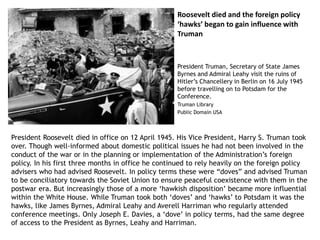
President Truman, Secretary of State James
Byrnes and Admiral Leahy visit the ruins of
Hitler’s Chancellery in Berlin on 16 July 1945
before travelling on to Potsdam for the
Conference.
Truman Library
Public Domain USA
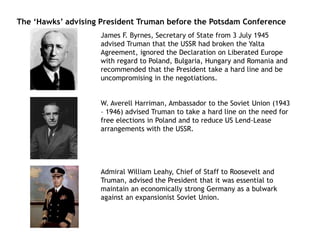
The ‘Hawks’ advising President Truman before the Potsdam Conference
James F. Byrnes, Secretary of State from 3 July 1945
advised Truman that the USSR had broken the Yalta
Agreement, ignored the Declaration on Liberated Europe
with regard to Poland, Bulgaria, Hungary and Romania and
recommended that the President take a hard line and be
uncompromising in the negotiations.
W. Averell Harriman, Ambassador to the Soviet Union (1943
– 1946) advised Truman to take a hard line on the need for
free elections in Poland and to reduce US Lend-Lease
arrangements with the USSR.
Admiral William Leahy, Chief of Staff to Roosevelt and
Truman, advised the President that it was essential to
maintain an economically strong Germany as a bulwark
against an expansionist Soviet Union.
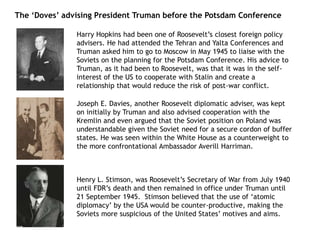
The ‘Doves’ advising President Truman before the Potsdam Conference
Harry Hopkins had been one of Roosevelt’s closest foreign policy
advisers. He had attended the Tehran and Yalta Conferences and
Truman asked him to go to Moscow in May 1945 to liaise with the
Soviets on the planning for the Potsdam Conference. His advice to
Truman, as it had been to Roosevelt, was that it was in the self-
interest of the US to cooperate with Stalin and create a
relationship that would reduce the risk of post-war conflict.
Joseph E. Davies, another Roosevelt diplomatic adviser, was kept
on initially by Truman and also advised cooperation with the
Kremlin and even argued that the Soviet position on Poland was
understandable given the Soviet need for a secure cordon of buffer
states. He was seen within the White House as a counterweight to
the more confrontational Ambassador Averill Harriman.
Henry L. Stimson, was Roosevelt’s Secretary of War from July 1940
until FDR’s death and then remained in office under Truman until
21 September 1945. Stimson believed that the use of ‘atomic
diplomacy’ by the USA would be counter-productive, making the
Soviets more suspicious of the United States’ motives and aims.
United States’ main priorities at the Potsdam Conference
DEFEAT JAPAN – to do this he needed to maintain the coalition of the Big Three until the war in the Pacific
was over and this necessitated the USSR sticking to the commitment it had made at Yalta to declare war on
Japan after the surrender of Germany. However, the successful test of the atomic bomb during the
Potsdam Conference raised the prospect of defeating Japan more quickly and without committing US
troops to dangerous amphibious landings on Japan’s coast.
RESTORE ORDER in war-torn Europe to prevent the same kinds of political developments and economic
depression that had emerged after World War I. This also involved the USSR agreeing to implement the
principles that all three powers had agreed to at Yalta, i.e. to assist the peoples of liberated Europe to
create democratic institutions of their own choice and to freely choose the form of government under
which they would live.
DE-MILITARIZATION AND DE-NAZIFICATION OF GERMANY – to agree the procedures for doing this in all
four zones of occupation.
REPARATIONS – to negotiate a reparations settlement with the USSR that would not economically cripple
Germany and yet avoid Soviet reprisals in terms of holding back food shipments from the Soviet zone to
the western zones. The US plan was that reparations could not be extracted from Germany until imports
essential to keep German people alive and re-start their economy had been paid for. Otherwise, Truman’s
administration feared that it would be the USA picking up the bill for reparations instead.
PEACE SETTLEMENTS – to agree with the UK, USSR, China and France to set up a Council of Foreign
Ministers to prepare the peace settlements with the defeated Axis countries.
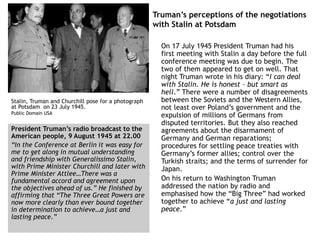
Truman’s perceptions of the negotiations
with Stalin at Potsdam
On 17 July 1945 President Truman had his
first meeting with Stalin a day before the full
conference meeting was due to begin. The
two of them appeared to get on well. That
night Truman wrote in his diary: “I can deal
with Stalin. He is honest – but smart as
hell.” There were a number of disagreements
between the Soviets and the Western Allies,
not least over Poland’s government and the
expulsion of millions of Germans from
disputed territories. But they also reached
agreements about the disarmament of
Germany and German reparations;
procedures for settling peace treaties with
Germany’s former allies; control over the
Turkish straits; and the terms of surrender for
Japan.
On his return to Washington Truman
addressed the nation by radio and
emphasised how the “Big Three” had worked
together to achieve “a just and lasting
peace.”
Stalin, Truman and Churchill pose for a photograph
at Potsdam on 23 July 1945.
Public Domain USA
President Truman’s radio broadcast to the
American people, 9 August 1945 at 22.00
“In the Conference at Berlin it was easy for
me to get along in mutual understanding
and friendship with Generalissimo Stalin,
with Prime Minister Churchill and later with
Prime Minister Attlee…There was a
fundamental accord and agreement upon
the objectives ahead of us.” He finished by
affirming that “The Three Great Powers are
now more clearly than ever bound together
in determination to achieve…a just and
lasting peace.”
The ‘war of nerves’ intensifies (January 1946 – March 1947)
On returning from Potsdam President Truman and the foreign policy ‘hawks’ in his
administration reappraised the outcomes of the conference and began to formulate a
harder line towards the Soviet Union than had been adopted by President Roosevelt and
the ‘doves’ in his Administration. The ‘hawks’ were looking to capitalise on the United
States global economic dominance and monoply of the atomic bomb. After Truman’s
decision to drastically cut Lend-Lease to the USSR, even before Potsdam, Stalin had
concluded that this was a clear attempt to use that economic dominance to force
political concessions from the USSR.
The future of Germany was a major matter of concern to both the Soviet Union and the
United States and its ally, Britain. The Soviet side feared that US economic power would
ensure that a unified Germany adopted a capitalist economy. The Americans were equally
afraid that a united Germany would go communist.
Straight after Potsdam Stalin had given orders to speed up the work being done to
develop and test a Soviet atomic bomb. At the same time the Kremlin was also
reappraising the Potsdam outcomes. His plans for Germany had been thwarted. He had
wanted $10 billion in reparations, most of which was to be taken from the industrialised
west of Germany. Instead he had been firmly told by the Americans to take the
reparations from the eastern zone. The western allies wanted the USSR to abide by the
Yalta agreement regarding central and eastern Europe. Stalin was frustrated that they
could not understand the Soviet need for the security of buffer states that also owed
political allegiance to the USSR.
For the next 18 months the mistrust between the allies which had reared up from time to
time during the war now became increasingly apparent.
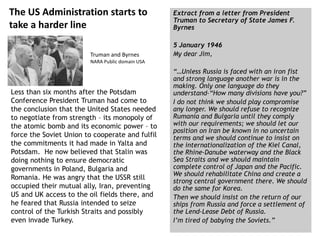
The US Administration starts to
take a harder line
Less than six months after the Potsdam
Conference President Truman had come to
the conclusion that the United States needed
to negotiate from strength – its monopoly of
the atomic bomb and its economic power – to
force the Soviet Union to cooperate and fulfil
the commitments it had made in Yalta and
Potsdam. He now believed that Stalin was
doing nothing to ensure democratic
governments in Poland, Bulgaria and
Romania. He was angry that the USSR still
occupied their mutual ally, Iran, preventing
US and UK access to the oil fields there, and
he feared that Russia intended to seize
control of the Turkish Straits and possibly
even invade Turkey.
Extract from a letter from President
Truman to Secretary of State James F.
Byrnes
5 January 1946
My dear Jim,
“…Unless Russia is faced with an iron fist
and strong language another war is in the
making. Only one language do they
understand–“How many divisions have you?”
I do not think we should play compromise
any longer. We should refuse to recognize
Rumania and Bulgaria until they comply
with our requirements; we should let our
position on Iran be known in no uncertain
terms and we should continue to insist on
the internationalization of the Kiel Canal,
the Rhine-Danube waterway and the Black
Sea Straits and we should maintain
complete control of Japan and the Pacific.
We should rehabilitate China and create a
strong central government there. We should
do the same for Korea.
Then we should insist on the return of our
ships from Russia and force a settlement of
the Lend-Lease Debt of Russia.
I’m tired of babying the Soviets.”
Truman and Byrnes
NARA Public domain USA
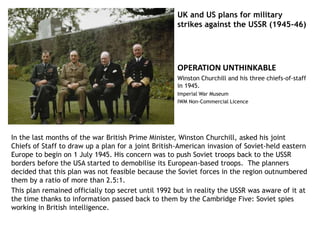
UK and US plans for military
strikes against the USSR (1945-46)
In the last months of the war British Prime Minister, Winston Churchill, asked his joint
Chiefs of Staff to draw up a plan for a joint British-American invasion of Soviet-held eastern
Europe to begin on 1 July 1945. His concern was to push Soviet troops back to the USSR
borders before the USA started to demobilise its European-based troops. The planners
decided that this plan was not feasible because the Soviet forces in the region outnumbered
them by a ratio of more than 2.5:1.
This plan remained officially top secret until 1992 but in reality the USSR was aware of it at
the time thanks to information passed back to them by the Cambridge Five: Soviet spies
working in British intelligence.
OPERATION UNTHINKABLE
Winston Churchill and his three chiefs-of-staff
in 1945.
Imperial War Museum
IWM Non-Commercial Licence
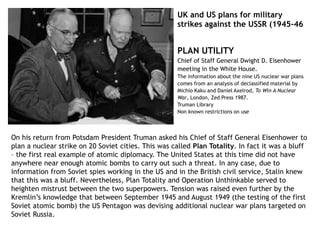
UK and US plans for military
strikes against the USSR (1945-46
On his return from Potsdam President Truman asked his Chief of Staff General Eisenhower to
plan a nuclear strike on 20 Soviet cities. This was called Plan Totality. In fact it was a bluff
– the first real example of atomic diplomacy. The United States at this time did not have
anywhere near enough atomic bombs to carry out such a threat. In any case, due to
information from Soviet spies working in the US and in the British civil service, Stalin knew
that this was a bluff. Nevertheless, Plan Totality and Operation Unthinkable served to
heighten mistrust between the two superpowers. Tension was raised even further by the
Kremlin’s knowledge that between September 1945 and August 1949 (the testing of the first
Soviet atomic bomb) the US Pentagon was devising additional nuclear war plans targeted on
Soviet Russia.
PLAN UTILITY
Chief of Staff General Dwight D. Eisenhower
meeting in the White House.
The information about the nine US nuclear war plans
comes from an analysis of declassified material by
Michio Kaku and Daniel Axelrod, To Win A Nuclear
War, London, Zed Press 1987.
Truman Library
Non known restrictions on use
In February 1946 Stalin predicted further
global conflict in the future
On 9 February 1946, election day in the
Soviet Union, Stalin delivered a speech which
was interpreted in widely different ways in
the United States. Time magazine described
the speech as “the most warlike
pronouncement…since V-J Day”, W.O.
Douglas, a US Supreme Court Justice,
described it to James Forrestal, Secretary of
the Navy as “the Declaration of World War
III”. But most of the US press agreed with
Newsweek that this speech was aimed at
mobilising a domestic audience to accept
more sacrifices in order to ensure that the
Red Army would have the means to protect
them from encirclement by capitalist states.
Extracts from a speech made by Josef Stalin
in Moscow on 9 February 1946.
Looking back at World Wars I and II Stalin
predicted that the same conditions would
occur in the future: “the uneven
development of capitalist countries
usually leads, in the course of time, to a
sharp disturbance of the equilibrium
within the world system of capitalism”
and that, he argued, would lead to the
capitalist world splitting into two hostile
camps again.
He went on to argue that, by comparison
“the Soviet social system has proved to
be more viable and stable than the non-
Soviet social system, that the Soviet
social system is a better form of
organization of society than any non-
Soviet social system.”
Source: I. V. Stalin, Speeches Delivered at
Meetings of Voters of the Stalin Electoral
District, Moscow (Moscow: Foreign
Languages Publishing House, 1950), pp. 19-
44.
The ‘Long Telegram’
Although Stalin’s speech, delivered on 9 February
1946, was standard Marxist-Lenininst analysis,
there was alarm in Washington about what it meant
for future US-Soviet relations. Secretary of State
James F. Byrnes cabled George Kennan at the US
Embassy in Moscow to provide him with “an
interpretive analysis of what we may expect in the
way of future implementation of the policies”
outlined in his speech by Stalin. The result was one
of the longest diplomatic dispatches of the Cold
War era; ‘the Long Telegram’, which explained the
background to the Soviet position and set out the
terms for future US foreign policy towards the
Soviet Union. It is too long to reproduce in full and
parts of it have already been reproduced in Section
2 of our module on The Cold War.
Instead, what we have done here is extract some
quotes which are designed to reflect the logic of
Kennan’s case. The first set of quotes focus on
Kennan’s account of why the Kremlin had adopted
the position outlined in Stalin’s speech and what
this revealed about Soviet foreign policy aims. The
second set of quotes focus on Kennan’s views about
how the State Department should respond to the
Soviet Union when it pursued its foreign policies.
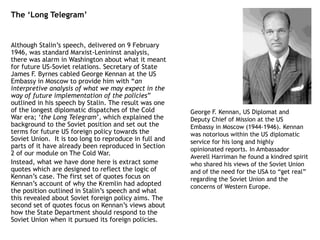
George F. Kennan, US Diplomat and
Deputy Chief of Mission at the US
Embassy in Moscow (1944-1946). Kennan
was notorious within the US diplomatic
service for his long and highly
opinionated reports. In Ambassador
Averell Harriman he found a kindred spirit
who shared his views of the Soviet Union
and of the need for the USA to “get real”
regarding the Soviet Union and the
concerns of Western Europe.
Extracts from the Kennan ‘Long Telegram’ to explain
the thinking behind Soviet foreign policy
Kennan began by explaining that Russian rulers have always feared contact and
foreign penetration:
“At bottom of Kremlin's neurotic view of world affairs is traditional and instinctive
Russian sense of insecurity…”
“Internal policy [is] devoted to increasing in every way strength and prestige of Soviet
state: intensive military-industrialization; maximum development of armed forces;
great displays to impress outsiders; continued secretiveness about internal matters,
designed to conceal weaknesses and to keep opponents in dark….”
“Russians will participate officially in international organizations where they see
opportunity of extending Soviet power or of inhibiting or diluting power of others….”
“Toward colonial areas and backward or dependent peoples, Soviet policy..will be
directed toward weakening of power and influence and contacts of advanced Western
nations…[to create] a vacuum which will favor Communist-Soviet penetration...”
Kennan anticipated a major propaganda war by the Soviets targeted on the West:
“To undermine general political and strategic potential of major western powers: poor
will be set against rich, black against white, young against old, newcomers against
established residents….”
“Everything possible will be done to set major Western Powers against each other...”
Extracts from the Kennan ‘Long Telegram’ recommending the
course of action that Washington should take.
At no point in the telegram did Kennan specifically refer to a policy of containment
but neither was he advocating a military solution:
“Soviets are still by far the weaker force. Thus, their success will really depend on
degree of cohesion, firmness and vigor which Western World can muster…I would like
to record my conviction that problem is within our power to solve--and that without
recourse to any general military conflict.”
“All Soviet propaganda beyond Soviet security sphere is basically negative and
destructive. It should therefore be relatively easy to combat it by any intelligent and
really constructive program….”
“We must formulate and put forward for other nations a much more positive and
constructive picture of sort of world we would like to see than we have put forward in
past. It is not enough to urge people to develop political processes similar to our own.
Many foreign peoples, in Europe at least, are tired and frightened by experiences of
past, and are less interested in abstract freedom than in security. They are seeking
guidance rather than responsibilities. We should be better able than Russians to give
them this. And unless we do, Russians certainly will…”
“We must see that our public is educated to realities of Russian situation. I cannot
over-emphasize importance of this. …. I am convinced that there would be far less
hysterical anti-Sovietism in our country today if realities of this situation were better
understood by our people. There is nothing as dangerous or as terrifying as the
unknown…”
Winston Churchill calls for a US-UK
partnership against Soviet expansion
Westminster College, Missouri holds an
annual lecture to promote international
relations. In 1946 the guest lecturer was
Winston Churchill, who was no longer in
power in the UK. In the presence of President
Truman, he called for a US-UK partnership to
halt the expansion of Soviet influence.
Winston Churchill and President Truman on the train
to Fulton, Missouri before Churchill gave his speech
at Westminster College, Missouri, 5 March 1946.
Missouri State Archives
No known restrictions on use
Extracts from Winston Churchill’s
‘Sinews of Peace’ [or Iron Curtain]
speech
“From Stettin in the Baltic to Trieste in the
Adriatic, an iron curtain has descended
across the continent. Behind that line lie all
the capitals of the ancient states of central
and eastern Europe. Warsaw, Berlin, Prague,
Vienna, Budapest, Belgrade, Bucharest and
Sofia… and all are subject…to a very high
and increasing measure of control from
Moscow….”
“I do not believe that Soviet Russia desires
war. What they desire is the fruits of war
and the indefinite expansion of their power
and doctrines. But what we have to consider
here today while time remains, is the
permanent prevention of war and the
establishment of conditions of freedom and
democracy as rapidly as possible in all
countries. Our difficulties and dangers will
not be removed by closing our eyes to them.
They will not be removed by mere waiting
to see what happens; nor will they be
removed by a policy of appeasement… I am
convinced that there is nothing they admire
so much as strength, and there is nothing
for which they have less respect than for
military weakness.”
Congressional Record, 79th Congress, 2nd session,
A1146-7
Josef Stalin’s reply to Winston Churchill’s
“iron curtain” speech
Extract from Stalin’s response in Pravda
to Churchill’s ‘iron curtain’ speech:
“Interviewer: What is your opinion of Mr
Churchill’s latest speech in the United
States of America?
Stalin: I regard it as a dangerous move,
calculated to sow the seeds of dissension
among the Allied states and impede their
collaboration.
Interviewer: Can it be considered that Mr
Churchill’s speech is prejudicial to the cause
of peace and security?
Stalin: Yes, unquestionably. As a matter of
fact, Mr Churchill now takes the stand of
the warmongers, and in this Mr Churchill is
not alone. He has friends not only in Britain
but in the United States of America as
well….The Germans made their invasion
through Finland, Poland, Romania, Bulgaria
and Hungary…And so what can there be
surprising about the fact that the Soviet
Union, anxious for its future safety, is trying
to see to it that governments loyal in their
attitude to the Soviet Union should exist in
these countries? How can anyone, who has
not taken leave of his senses, describe these
peaceful aspirations of the Soviet Union as
expansionist?”
Pravda, 13 March 1946 (translation)
Marshal Stalin was quick to respond to
Churchill’s ‘iron curtain’ speech. This
interview was published in Pravda [then the
official newspaper of the Communist Party]
on 13 March 1946. He labelled Churchill as a
warmonger and denied that Soviet policy
regarding central and eastern Europe was
expansionist. It was vital to soviet security
that they should regard the region as a
sphere of influence.
The Iran Crisis 1945-46
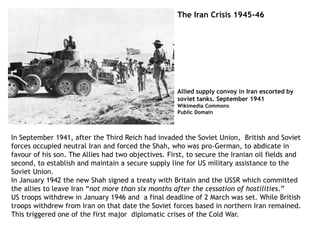
In September 1941, after the Third Reich had invaded the Soviet Union, British and Soviet
forces occupied neutral Iran and forced the Shah, who was pro-German, to abdicate in
favour of his son. The Allies had two objectives. First, to secure the Iranian oil fields and
second, to establish and maintain a secure supply line for US military assistance to the
Soviet Union.
In January 1942 the new Shah signed a treaty with Britain and the USSR which committed
the allies to leave Iran “not more than six months after the cessation of hostilities.”
US troops withdrew in January 1946 and a final deadline of 2 March was set. While British
troops withdrew from Iran on that date the Soviet forces based in northern Iran remained.
This triggered one of the first major diplomatic crises of the Cold War.
Allied supply convoy in Iran escorted by
soviet tanks. September 1941
Wikimedia Commons
Public Domain
The Iran Crisis intensifies in the spring of
1946
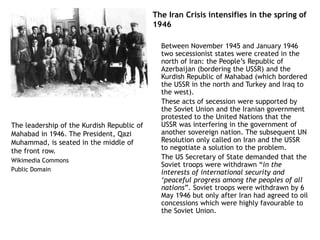
Between November 1945 and January 1946
two secessionist states were created in the
north of Iran: the People’s Republic of
Azerbaijan (bordering the USSR) and the
Kurdish Republic of Mahabad (which bordered
the USSR in the north and Turkey and Iraq to
the west).
These acts of secession were supported by
the Soviet Union and the Iranian government
protested to the United Nations that the
USSR was interfering in the government of
another sovereign nation. The subsequent UN
Resolution only called on Iran and the USSR
to negotiate a solution to the problem.
The US Secretary of State demanded that the
Soviet troops were withdrawn “in the
interests of international security and
‘peaceful progress among the peoples of all
nations”. Soviet troops were withdrawn by 6
May 1946 but only after Iran had agreed to oil
concessions which were highly favourable to
the Soviet Union.
The leadership of the Kurdish Republic of
Mahabad in 1946. The President, Qazi
Muhammad, is seated in the middle of
the front row.
Wikimedia Commons
Public Domain
The Iran Crisis – the US and Soviet
perspectives
At first the US had seen the issue in Iran as
simply a case of the Soviet Union being in
breach of the Allied Declaration of 1942 and the
Charter of the United Nations.
Only gradually did the US State Department
begin to appreciate that Iran had strategic
significance for the USSR.
As soon as Soviet troops had been withdrawn the
Iranian parliament refused to ratify the Soviet
oil concessions agreement, which it claimed was
forced on them by Soviet pressure, and Iranian
forces moved into the two secessionist states
and deposed the governments there by force
and executed the leaders.
Although the Kremlin was bitterly angry about
this they decided not to carry out a second
invasion of Iran in case this escalated the
tension between themselves and the USA and
Britain to the point of a military confrontation.
On 3 February the British Ambassador to the
United States reported back that the US
Administration needed to realise “the
importance of Iran to the United States not
only for oil, trade and airports, but as a
stage on which its world leadership is being
tested.”
Lord Halifax to Foreign Office, 3/2/1946
George Kennan in his Long Telegram had
warned that: “Wherever it is considered
timely and promising, efforts will be made
to advance official limits of Soviet power.
For the moment, these efforts are
restricted to certain neighboring points
conceived of here as being of immediate
strategic necessity, such as Northern Iran.”
22/2/1946
In an earlier telegram to Byrnes in
February he had observed: I consider it
almost a foregone conclusion that Soviets
must make some effort..to bring into power
in Iran a regime prepared to accede to
major Soviet demands.” 17/2/1946
The Turkish Straits crisis 1946
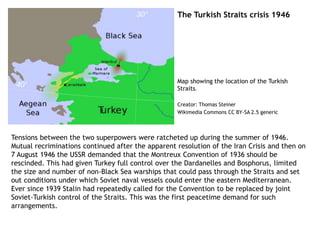
Tensions between the two superpowers were ratcheted up during the summer of 1946.
Mutual recriminations continued after the apparent resolution of the Iran Crisis and then on
7 August 1946 the USSR demanded that the Montreux Convention of 1936 should be
rescinded. This had given Turkey full control over the Dardanelles and Bosphorus, limited
the size and number of non-Black Sea warships that could pass through the Straits and set
out conditions under which Soviet naval vessels could enter the eastern Mediterranean.
Ever since 1939 Stalin had repeatedly called for the Convention to be replaced by joint
Soviet-Turkish control of the Straits. This was the first peacetime demand for such
arrangements.
Map showing the location of the Turkish
Straits.
Creator: Thomas Steiner
Wikimedia Commons CC BY-SA 2.5 generic
The Turkish Straits crisis 1946
The Potsdam Agreement in 1945 had included
a clause confirming the right of the USSR to
seek a revision of the Montreux Convention.
However, the mood in Washington had
changed since then and this was now seen as
a move on Moscow’s part that would lead
inevitably to Soviet control of Turkey, then
Greece and eventually the whole eastern
Mediterranean (an early statement of what
came to be known as the “Domino theory”).
This source, a memorandum from the US
Secretaries of State, War and the Navy makes
the US position regarding the Turkish Straits
very clear. It went on to assert that: “the
best hope of peace” was that “the United
States would not hesitate to join other
nations in meeting armed aggression by the
force of American arms.”
[We] “feel that it is in the vital interests
of the United States that the Soviet
Union should not by force or through
threat of force succeed in its unilateral
plans with regard to the Dardanelles and
Turkey. If Turkey under pressure should
agree to the Soviet
proposals, any case which we might later
present in opposition to the Soviet plan
before the United Nations or to the
world public
would be materially weakened; but the
Turkish Government insists that it has
faith in the United Nations system and
that it will resist
by force Soviet efforts to secure bases in
Turkish territory even if Turkey has to
fight alone. While this may be the
present Turkish
position, we are frankly doubtful
whether Turkey will continue to adhere
to this determination without assurance
of support from the United States.”
Memorandum to the US President from
the Secretaries of State, War and the
Navy, 15 August 1946.
The Turkish Straits crisis 1946
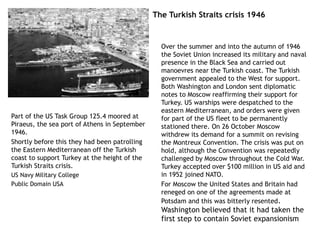
Over the summer and into the autumn of 1946
the Soviet Union increased its military and naval
presence in the Black Sea and carried out
manoevres near the Turkish coast. The Turkish
government appealed to the West for support.
Both Washington and London sent diplomatic
notes to Moscow reaffirming their support for
Turkey. US warships were despatched to the
eastern Mediterranean, and orders were given
for part of the US fleet to be permanently
stationed there. On 26 October Moscow
withdrew its demand for a summit on revising
the Montreux Convention. The crisis was put on
hold, although the Convention was repeatedly
challenged by Moscow throughout the Cold War.
Turkey accepted over $100 million in US aid and
in 1952 joined NATO.
For Moscow the United States and Britain had
reneged on one of the agreements made at
Potsdam and this was bitterly resented.
Washington believed that it had taken the
first step to contain Soviet expansionism
Part of the US Task Group 125.4 moored at
Piraeus, the sea port of Athens in September
1946.
Shortly before this they had been patrolling
the Eastern Mediterranean off the Turkish
coast to support Turkey at the height of the
Turkish Straits crisis.
US Navy Military College
Public Domain USA
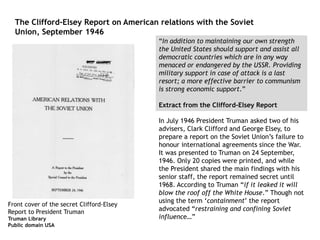
“In addition to maintaining our own strength
the United States should support and assist all
democratic countries which are in any way
menaced or endangered by the USSR. Providing
military support in case of attack is a last
resort; a more effective barrier to communism
is strong economic support.”
Extract from the Clifford-Elsey Report
In July 1946 President Truman asked two of his
advisers, Clark Clifford and George Elsey, to
prepare a report on the Soviet Union’s failure to
honour international agreements since the War.
It was presented to Truman on 24 September,
1946. Only 20 copies were printed, and while
the President shared the main findings with his
senior staff, the report remained secret until
1968. According to Truman “if it leaked it will
blow the roof off the White House.” Though not
using the term ‘containment’ the report
advocated “restraining and confining Soviet
influence…”
Front cover of the secret Clifford-Elsey
Report to President Truman
Truman Library
Public domain USA
The Clifford-Elsey Report on American relations with the Soviet
Union, September 1946
Extracts from the Novikov Telegram on
U.S. post-war Foreign Policy
In September 1946 Nikolai Novikov, Soviet
Ambassador to the United States was asked
to write a report analysing US post-war
foreign policy. If Kennan’s telegram was long
at around 5300 words Novikov’s telegram was
even longer, at around 8500 words. The first
half of the telegram mainly focused on what
Novikov perceived as an American
preoccupation with achieving global
economic and political supremacy.
“US foreign policy has been characterized
in the postwar period by a desire for
world domination...”
“All the countries of Europe and Asia are
feeling an enormous need for consumer
goods, industrial and transportation
equipment, etc. Such a situation opens
up a vista for American monopoly
capital…. The realization of this
opportunity would mean a serious
strengthening of the economic position
of the US throughout the entire world….”
"Obvious indications of the U.S. effort to
establish world dominance are also to be
found in the increase in military
potential in peacetime and in the
establishment of a large number of naval
and air bases both in the United States
and beyond its borders.”
Source: Wilson Center Digital Archive
Extracts from the Novikov Telegram on
U.S. post-war Foreign Policy
The second half of the telegram is mainly
concerned with the implications of Novikov’s
analysis for the USSR and its future relations
with the United States. Having argued that
the US and Britain were dividing up Asia and
the Far East into their spheres of influence
he turned to Europe and, in particular,
Germany. Stressing that the “hawks” have
taken over in the White House since the
death of Roosevelt, he suggests that the
evidence is pointing to the USA preparing for
another war, this time against the USSR.
Source: Wilson Center Digital Archive
“The "hard-line" policy with respect to the
USSR proclaimed by Byrnes is right now the
main impediment in the way to cooperation
between the great powers…in the postwar
period the US has no longer been pursuing a
policy of strengthening the cooperation of
the Big Three…”
“One of the most important lines of overall
US policy directed at limiting the
international role of the USSR in the
postwar world is policy with regard to
Germany. ….the US is providing for the
possibility of ending the Allied occupation
of German territory even before ….the
demilitarization and democratization of
Germany are finished. The preconditions
would thereby be created for a revival of an
imperialist Germany which the US is
counting on using on its side in a future
war….”
”All these steps… are intended only to
prepare conditions to win world domination
in a new war being planned by the most
warlike circles of American imperialism, the
timeframe for which, needless to say, no
one can determine right now.”
The propaganda war between the USA
and the USSR “heats up”
By the end of 1946 a propaganda war had
emerged. Both sides squabbled publicly with
each other at the United Nations and at the
peace conference in Paris. Both were trying
to reassure their allies and develop closer
relations with nations that were not yet
committed to either side. In doing so they
articulated different visions of a postwar
world, defended themselves from the other’s
criticisms and highlighted the other’s
unreasonableness and ideological
weaknesses. A pattern emerged. The
Americans presented their position as if it
was wholly based on the agreed principles
behind the United Nations and the Atlantic
Charter. The Soviets presented their position
as being logical and based upon sound Marxist
principles.
Source: Avalon Law Project, Yale University
Washington at the end of the peace
conference in Paris (July-October 1946).
“I should be less than frank if I did not
confess my bewilderment at the motives
which the Soviet Delegation attributed to
the United States at Paris. Not once, but
many times, they charged that the United
States had enriched itself during the war,
and, under the guise of freedom for
commerce and equality of opportunity for
the trade of all nations, was now seeking to
enslave Europe economically….
The United States has never claimed the
right to dictate to other countries how they
should manage their own trade and
commerce. We have simply urged in the
interest of all peoples that no country
should make trade discriminations in its
relations with other countries.
On that principle the United States stands.
It does not question the right of any country
to debate the economic advantages or
disadvantages of that principle. It does
object to any government charging that the
United States enriched itself during the war
and desires to make "hand-outs" to European
governments in order to enslave their
peoples.”
18 October, 1946
Cold War Confrontation
Historians disagree about when the Cold War began. Some trace it back to
fundamental disagreements apparent at the Yalta and Potsam conferences; some
argue that World War II slipped almost imperceptibly into the Cold War in the autumn
of 1945. Others argue that it begins in 1947 with the introduction of the Truman
Doctrine. Prior to that it is a ‘war of nerves’ and a propaganda war based on clear
ideological differences, but then a series of measures taken by both sides from 1947
onwards escalate the level of conflict between them.
What is apparent is that there was a change in tone in the nature of the tension
between the two superpowers in 1947. The historian, J.M. Macintosh, writing in the
early 1960s observed that “between 1944 and 1947 the Kremlin exploited its victory
in World War II, while between 1947 and 1953 it was reduced to reacting to policies
emerging from the USA and Britain”.
Certainly there is clear evidence that during that period the Kremlin was often
reacting to external developments and circumstances such as the US nuclear
monopoly, the Truman Doctrine, the Marshall Plan, the unification of the West
German zones of occupation and the founding of NATO. However, the Czech coup in
1948 and the Berlin blockade also sent a powerful message to the countries of
Eastern Europe and to the internal audience within the Soviet Union.
The British government informs the US
State Department that it will withdraw
its troops and financial support from
Greece within six weeks
During the war Greece, Turkey and the eastern
Mediterranean was seen as a British sphere of
influence. In 1944, after Greece was liberated
from Geman occupation a civil war broke out.
Left-wing resistance groups formed the National
Liberation Front which gradually came under the
control of the communists. The British backed
the right-wing forces and a government was put
in place. By spring 1945 the left had been
crushed by a coalition of government and British
forces. But hostilities broke out again in early
1946 and the British found themselves
increasingly involved in supporting the Greek
government, militarily and financially. On 21
February 1947, the British Government sent two
diplomatic notes to Washington, one relating to
Greece and the other to Turkey, stating that,
due to domestic economic difficulties, all British
military and economic assistance would end on
31 March.
In 1946 Joseph M. Jones was special
assistant to Dean Acheson, US
Undersecretary of State. He was
present in the State Department when
the British diplomatic notes were
presented and recorded the contents:
“In total Greece needs in 1947 between
£60 million and £70 million [equivalent
to $240 to $280 million at that time] in
foreign exchange and for several years
thereafter…..But Great Britain would be
unable to offer further financial
assistance after March 31. The British
Government hoped the United States
would be able to provide enough aid to
enable Greece to meet its minimum
needs, civilian and military, assuming as
of April 1 the burden theretofore borne
chiefly by Great Britain.”
Cited in Joseph M. Jones, The Fifteen
Weeks, Viking Press, New York 1955
pp.5-6.
Greece: the trigger that led to the
Truman Doctrine and an escalation of
tension between the US and the USSR
In the absence of Acheson and the
Secretary of State George C. Marshall,
the British diplomatic notes were
received by John Hickinson, Director of
the Office of European Affairs in the
State Department. He observed that at
that moment Britain had “handed the job
of world leadership, with all its burdens
and all its glory, to the United States”.
[Jones, Fifteen Hours, p.7]
Undersecretary of State Acheson was
later to comment directly to President
Truman that this was “the most major
decision with which we have been faced
since the war”. On 27 February 1947 he
made a report to Truman in which he
spelt out the dangers if the United States
did nothing about the Greek situation.
Extract from a Briefing by Dean
Acheson to President Truman and other
advisers on 27 February 1947:
“In the past eighteen months, Soviet
pressure on the Straits, on Iran, and on
northern Greece had brought the Balkans
to the point where a highly possible
Soviet breakthrough might open three
continents to Soviet penetration. Like
apples in a barrel infected by one rotten
one, the corruption of Greece would
infect Iran and all to the east. It would
also carry infection to Africa through Asia
Minor and Egypt, and to Europe through
Italy and France, already threatened by
the strongest domestic Communist
parties in Western Europe. The Soviet
Union was playing one of the greatest
gambles in history at minimal cost. It did
not need to win all the possibilities. Even
one or two offered immense gains. We
and we alone were in a position to break
up the play.”
Source: Dean Acheson, Present at the Crreation: My
Years in the State Department, New York, Norton
1969, p.219
The Soviet response to the American position on Greece in 1947
Perhaps because the US had treated Greece as a
part of the British sphere of influence, the US
State Department’s knowledge of what was
happening in Greece was sketchy. The
interpretation provided by Dean Acheson, which
strongly influenced Truman’s thinking,
perpetuated a myth about the Greek Civil War
within the Truman Administration that the Greek
Communists were receiving aid from the Soviet
Union as part of a planned expansion in the
region. In fact the assistance the Greek
communists were getting was from the Yugoslavs
and Albanians. This was contrary to Stalin’s
orders.
When Stalin and Churchill had met in Moscow in
October 1944 they had made the so-called
“percentages agreement”. They agreed that
Britain would have 90% influence in Greece in
return for the USSR having 90% influence in
Romania and 75% in Yugoslavia. According to
American historian, W.H. MacNeill, “there is no
evidence that Stalin ever reneged on this
commitment and aided the Greek Communist
movement.” [W.H. McNeill, The Greek Dilemma,
Philadelphia 1947, p.145]
The Greek Civil War was seen by some
communists in other parts of West
Europe as a possible model for them.
But, as Arne Westad has observed, Stalin
took a very different view:
“The Greek disaster led Stalin to demand
that other communists from China to
Italy, not act prematurely….they had
neither the experience nor the
theoretical understanding to take and
keep power on their own. Only when
they were guided by the Soviet Union and
protected by the Red Army [as in Eastern
Europe] would they stand a chance of
permanently defeating their enemies.”
O.A. Westad, The Cold War: A World
History (London 2017) p.76
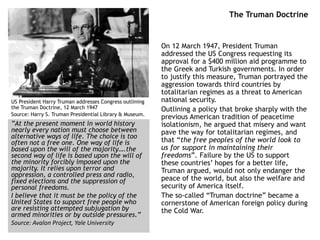
The Truman Doctrine
On 12 March 1947, President Truman
addressed the US Congress requesting its
approval for a $400 million aid programme to
the Greek and Turkish governments. In order
to justify this measure, Truman portrayed the
aggression towards third countries by
totalitarian regimes as a threat to American
national security.
Outlining a policy that broke sharply with the
previous American tradition of peacetime
isolationism, he argued that misery and want
pave the way for totalitarian regimes, and
that “the free peoples of the world look to
us for support in maintaining their
freedoms”. Failure by the US to support
these countries’ hopes for a better life,
Truman argued, would not only endanger the
peace of the world, but also the welfare and
security of America itself.
The so-called “Truman doctrine” became a
cornerstone of American foreign policy during
the Cold War.
US President Harry Truman addresses Congress outlining
the Truman Doctrine, 12 March 1947
Source: Harry S. Truman Presidential Library & Museum.
”At the present moment in world history
nearly every nation must choose between
alternative ways of life. The choice is too
often not a free one. One way of life is
based upon the will of the majority….the
second way of life is based upon the will of
the minority forcibly imposed upon the
majority. It relies upon terror and
oppression, a controlled press and radio,
fixed elections and the suppression of
personal freedoms.
I believe that it must be the policy of the
United States to support free people who
are resisting attempted subjugation by
armed minorities or by outside pressures.”
Source: Avalon Project, Yale University
It took Congress two months to pass the
legislation which released the $400 million to
support Greece and Turkey. Most historians see
this moment as the de facto beginning of the Cold
War. Undoubtedly, it is possible to see the
beginnings of a US foreign policy based on
‘containment’ in this speech. Essentially, to
persuade Congress to agree to release $400
million in aid, Truman had to persuade them that
American security required intervention to
prevent the expansion of Communism wherever in
the world it occurred. This was a significant shift
in mindset from a foreign policy based mainly on
the principle of defending US’ interests within the
Western Hemisphere (i.e. North and South
America and the surrounding waters]. However,
as the British historian, Martin Folly, observes, it
took around 18 months, following the 12 March
1947 speech, for the policy of containment to
fully evolve, and the aim was to use economic
measures to bring about internal collapse within
the Soviet system, rather than a costly war.
The Truman Doctrine
“Over the eighteen months following
the Truman Doctrine speech, Truman’s
attitude coalesced in the face of
Soviet responses, which were all now
read in Washington to show that the
Soviet Union was driven by limitless
ambitions to dominate the globe but
would use subversion and other
indirect methods in preference to
open military action. There was no
negotiating with such a power, the
only language that it understood was
strength.”
Martin Folly, Harry S. Truman, in Oxford
Encyclopedia of American Military and
Diplomatic History, [Oxford 2013] p.381
The Truman Doctrine
It took Congress two months to pass the
legislation which released the $400 million to
support Greece and Turkey. Most historians see
this moment as the de facto beginning of the
Cold War. Undoubtedly, it is possible to see the
beginnings of a US foreign policy based on
‘containment’ in this speech. Essentially, to
persuade Congress to agree to release $400
million in aid, Truman had to persuade them
that American security required intervention to
prevent the expansion of Communism wherever
in the world it occurred. This was a significant
shift in mindset from a foreign policy based
mainly on the principle of defending US’
interests within the Western Hemisphere (i.e.
North and South America and the surrounding
waters]. However, as the British historian,
Martin Folly, observes, it took around 18 months,
following the 12 March 1947 speech, for the
policy of containment to fully evolve, and the
aim was to use economic measures to bring
about internal collapse within the Soviet system,
rather than a costly war.
“Over the eighteen months following the
Truman Doctrine speech, Truman’s
attitude coalesced in the face of Soviet
responses, which were all now read in
Washington to show that the Soviet Union
was driven by limitless ambitions to
dominate the globe but would use
subversion and other indirect methods in
preference to open military action.
There was no negotiating with such a
power, the only language that it
understood was strength.”
Martin Folly, Harry S. Truman, in Oxford
Encyclopedia of American Military and
Diplomatic History, [Oxford 2013] p.381
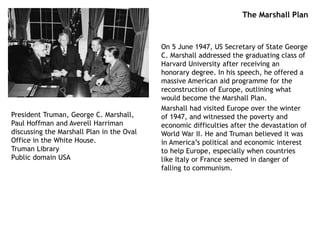
The Marshall Plan
On 5 June 1947, US Secretary of State George
C. Marshall addressed the graduating class of
Harvard University after receiving an
honorary degree. In his speech, he offered a
massive American aid programme for the
reconstruction of Europe, outlining what
would become the Marshall Plan.
Marshall had visited Europe over the winter
of 1947, and witnessed the poverty and
economic difficulties after the devastation of
World War II. He and Truman believed it was
in America’s political and economic interest
to help Europe, especially when countries
like Italy or France seemed in danger of
falling to communism.
President Truman, George C. Marshall,
Paul Hoffman and Averell Harriman
discussing the Marshall Plan in the Oval
Office in the White House.
Truman Library
Public domain USA
The Marshall Plan
In June 1947 Marshall had estimated that it
would require $17 billion to rebuild Europe in
order to secure economic recovery and
political stability at a time when there were
grave fears of Europe being overtaken by
civil war or revolution. The Plan made no
reference to which parts of Europe would be
eligible for support. initially this took the
Soviet Union by surprise and Ernest Bevin,
British Foreign Secretary, and his French
counterpart, Georges Bidault, invited the
Soviet Union to send a representative to talks
in Paris about cooperation in drawing up a
plan for the most effective use of Marshall
aid. On 27 June, Molotov, the Foreign
Minister, attended the meeting.
Source: Wilson Center Digital Archive
Telegram from V.M. Molotov to Soviet
embassies in Warsaw, Prague and Belgrade,
22 June 1947
PRIORITY.
Submit personally (to Bierut, Gottwald and
Tito)
1) We have accepted Britain and France’s
invitation for the USSR to participate at the
meeting of the three ministers concerning the
US’s assistance to European countries.
2) At this meeting, we will insist that other
allied European countries should be involved in
the development of corresponding economic
measures (Poland, Yugoslavia, Czechoslovakia,
Norway, Belgium, the Netherlands and
Luxembourg), as they have suffered German
occupation and assisted the attainment of
victory over Germany. However, we will object
to the involvement of former satellites,
including Austria, and of the former neutral
countries.
3) We consider it desirable for friendly
allied countries to take the initiative with
their participation in the development of the
specified economic activities, and declare their
intentions, keeping in mind that some
European countries (the Netherlands and
Belgium) have already expressed such desires.
Please telegraph on
execution.
June, 22, 1947.
MOLOTOV.
“The Soviet Government, considering that the Anglo-French
plan to set up a special organization for the coordination of
the economies of European states would lead to interference
in the internal affairs of European countries, particularly
those which have the greatest need for outside aid, and
believing that this can only complicate relations between
the countries of Europe and hamper their cooperation,
rejects this plan as being altogether unsatisfactory and
incapable of yielding any positive results.
The fact that the Franco-British proposals raise the question
of Germany and her resources merits special attention. It is
proposed that the above-mentioned organization of the
“Steering Committee” should also deal with the utilization
of German resources although it is generally known that the
justified reparation claims of those Allied countries which
had suffered from German aggression still remain to be met.
Therefore not only is no special concern being shown for
those countries which had made the greatest sacrifices
during the war as well as important contributions to Allied
victory but indeed it is at their expense that it is proposed
to direct the resources of Germany for purposes other than
reparations.”
Statement by Soviet Foreign Minister Molotov at the Final
meeting of the Three Power Conference in Paris, 2 July
1947
USSR has second
thoughts about the
Marshall Plan
At the three-power
meeting in Paris in late
June 1947 Bevin, with the
agreement of Bidault,
proposed setting up a
steering committee of
interested states which
would work out a four-year
programme for the
reconstruction of Europe.
Molotov agreed to this in
principle but disagreed that
this “steering committee”
should also have the power
to determine how the aid
given to Germany would be
used. On 1 July Molotov
received a telegram from
Stalin and on the next day
made a statement and then
walked out of the meeting
with his delegation.
The influence of the USSR on its eastern
European neighbours is decisive
In Moscow the leadership mistrusted the
motives behind the Plan and were concerned
that aid to eastern European states would
undermine its influence there.
Representatives of 22 European governments
were invited to meet in Paris on 12th July
1947 to discuss participation in the European
Recovery Program. The Soviet Union was not
included. Czechoslovakia, Poland and
Hungary were keen to participate, Bulgaria
and Albania expressed an interest and only
Yugoslavia and Romania in eastern Europe
sought Moscow’s advice. By 9 July Bulgaria
and Yugoslavia had decided not to attend,
Czechoslovakia and Hungary came to the
same conclusion a day later and on 11 July
Albania, Finland, Poland, and Romania
followed suit.
Jan Masaryk (right) and Laurence Steinhardt, US
Ambassador, September 1947
Wikimedia Commons public domain
On 8 July 1947 Czech premier Gottwald and
Foreign Minister Masaryk were summoned to
Moscow and forcibly told not to participate in
the Paris meeting. On their return to Prague
Gottwald recorded: “[Stalin] reproached me
bitterly for having accepted the invitation to
participate in the Paris Conference. He does
not understand how we could have done it. He
says we have acted as if we were ready to turn
our back on the Soviet Union.”
Masaryk remarked: “I went to Moscow as the
foreign minister of an independent sovereign
state. I returned as a lackey of the Soviet
government.”
E. Taborsky, Communism in Czechoslovakia,
Princeton 1961, p.20
“The so-called Truman Doctrine and the Marshall Plan are
particularly glaring examples of the manner in which the
principles of the United Nations are violated, of the way in which
the organization is ignored…”
“…the United States government has moved towards a direct
renunciation of the principles of international collaboration and
concerted action by the great powers and towards attempts to
impose its will on other independent states, while at the same
time obviously using the economic resources distributed as relief
to individual needy nations as an instrument of political
pressure. […]
It is becoming more and more evident to everyone that the
implementation of the Marshall Plan will mean placing European
countries under the economic and political control of the United
States and direct interference by the latter in the internal
affairs of those countries.
Moreover, this plan is an attempt to split Europe into two camps
and, with the help of the United Kingdom and France, to
complete the formation of a bloc of several European countries
hostile to the interests of the democratic countries of Eastern
Europe and most particularly to the interests of the Soviet
Union.”
Soviet deputy foreign minister Andrei Vyshinsky, Speech to the
UN General Assembly, 18 September 1947.
Source: Jussi M. Hanhimäki and Odd Arne Westad (eds.), The Cold
War: A History in Documents and Eyewitness Accounts, 126-128.
The Soviet reaction to
the Marshall Plan
By September 1947 the
Kremlin had completed its
move from being cautiously
positive about the Marshall
Plan in mid-June to openly
hostile. Their position was
clearly stated at the United
Nations on 18 September,
1947 by Andrei Vyshinsky,
Deputy Foreign Minister
and Soviet spokesperson at
the UN. He accused the US
of using the Marshall Plan
to impose political pressure
through economic means,
explicitly labelling it an
aggressive move on
Truman’s part.
The “X article”
The third component in the evolution of US
foreign policy after the Truman Doctrine speech
and the Marshall Plan was the idea of
containment. On 4 July 1947 an article titled
“The Sources of Soviet Conduct” appeared in
the influential Foreign Affairs magazine under
the pseudonym “X”. The author was later
revealed to be George Kennan, the author of the
Long Telegram. It had originally been produced
as an internal report for Secretary of the Navy,
James Forrestal, who received it in January
1947. By the time that it appeared in the
Foreign Affairs magazine many officers within
the Truman Administration were familiar with its
main arguments.
While restating some of the points made in the
Long Telegram and in the evidence he had
provided for the Clifford-Elsey Report, Kennan
was now spelling out the logic behind a long-
term, patient but firm policy of containing the
Soviet Union’s expansionism. Indeed this was the
first time the word ‘containment’ had been used
in relation to US foreign policy. Kennan later
stressed that he had been misinterpreted by US
policymakers who emphasised military
containment when he was talking about
containment through diplomatic and economic
means.
“The main element of any United States
policy toward the Soviet Union must be a
long-term, patient but firm and vigilant
containment of Russian expansive
tendencies. [...] Soviet pressure against the
free institutions of the Western world is
something that can be contained by the
adroit and vigilant application of
counterforce at a series of constantly
shifting geographical and political points,
corresponding to the shifts and manœuvres
of Soviet policy, but which cannot be
charmed or talked out of existence.”
X (George F. Kennan), “The Sources of Soviet
Conduct”, Foreign Affairs 25 n. 4 (July 1947),
pp.575-76.
The creation of the CIA
Another important component of the Truman
Administration’s containment policy was the
establishment of an intelligence service. On
26 July 1947, the president signed the
National Security Act of 1947 creating the
Central Intelligence Agency (CIA). Its
predecessor, the Office of Strategic Services
(OSS), had been dismantled by Truman soon
after the end of the war. The development of
the Cold War, however, forced the president
to reconsider his opposition to the notion of
a permanent intelligence agency in
peacetime. Containment of Soviet
expansionism, in fact, required detailed
information about communist moves and a
network of professional operatives.
Seal of the Central Intelligence Agency
Source: United States Government
Usage rights: Public Domain (US)
The Cominform
In response to American initiatives, the
Soviet Union promoted its own initiatives to
increase the coordination between
communist parties. On 5 October 1947, at a
conference in the Polish city of Szklarska
Poręba, the Communist Information Bureau
(Cominform) was created. Stalin had called
the meeting in part to respond to the
different positions among Eastern European
governments about participating in the
Marshall Plan.
The Cominform included seven Eastern bloc
communist parties (USSR, Czechoslovakia,
Poland, Hungary, Bulgaria, Romania and
Yugoslavia, which was expelled the following
year after the Stalin-Tito break). The French
and Italian communist parties were also
invited to join, and specifically tasked with
obstructing the implementation of the
Marshall Plan and the Truman Doctrine in the
Western bloc.
“The need for mutual consultation […] has
become particularly urgent at the present
juncture when continued isolation may lead
to a slackening of mutual understanding,
and at times, even to serious blunders.
In view of the fact that the majority of the
leaders of the Soviet parties (especially the
British Labourites and the French Socialists)
are acting as agents of the United States
imperialist circles, there has developed
upon the Communists the special historic
task of leading the resistance to the
American plan for the enthrallment of
Europe, and of boldly denouncing all
coadjutors of American imperialism in their
own countries. At the same time,
Communists must support all the really
patriotic elements who do not want their
countries to be imposed upon, who want to
resist enthrallment of their countries to
foreign capital, and to uphold their national
sovereignty.”
“A. Zhdanov at the Founding of the Cominform,
September 1947”, Documents on International
Affairs 1947-1948, pp. 122-37.
In Hanhimäki and Westad, The Cold War, 50-52
The Treaty of Brussels, March 1948
The containment policy, however, could not be confined to the economic and political level.
American allies in Europe, concerned about the perceived danger of communist aggression, asked
the US for a commitment to the defence of Europe. While the Truman administration was initially
reluctant to break the long-standing tradition of avoiding military alliances in peacetime, it
nonetheless supported the efforts by Western European governments to establish some form of
security cooperation.
American policymakers, however, were also increasingly coming to see the rearmament of
Western Germany as a necessary step to counter the Soviet Union, abandoning their initial plans
for a thoroughly demilitarised country. On this aspect remained significant disagreement with
Western Europeans (and France in particular), who were still suspicious of their former enemy. On
17 March 1948, five countries (UK, France, Belgium, Luxembourg, and the Netherlands) signed the
Treaty of Brussels, establishing the first element of a European mutual defence. The Treaty,
however, maintained a distinctive anti-German character. It would take a US commitment to
European defence through its membership in NATO, the following year, to re-orient European
defence policy in a more clearly anticommunist direction.
British Foreign Secretary Ernest Bevin signs
the Treaty of Brussels, 17 March 1948
Photographer: J.D. Noske
Source: Photo Collection of the General Dutch
Photo Bureau (ANeFo), National Archives, The
Hague, File Number 902-6325.
Creative Commons Attribution-Share Alike 3.0
Netherlands
Italian election 1946
Italian election 1948
In 1946 and again in 1948 the propaganda war
between the Soviet Union and the United States
impacted on the postwar elections in Italy and
France. In both countries the communists and
socialists had made a significant contribution to
the resistance against the occupying forces of
the Third Reich. In the 1946 elections in Italy
the communists (PCI) and Socialists (PSIUP)
together won more seats than the Christian
Democrats (DC) and the 3 parties formed a
coalition government. In 1948 the newly-formed
CIA ran covert operations in Italy (the agency’s
first such action). Money was given to help the
DC’s campaign, letters and documents were
forged to discredit the PCI, the CIA funded the
production of 10 million letters to voters and
the Voice of America broadcast daily, often using
famous Italian-Americans like Frank Sinatra, to
influence the voters. Moscow also poured a
great deal of money into the PCI’s election
campaign. Even though the communists and the
socialists united to form the Popular Democratic
Front (PDF), the DC won the largest percent of
the votes and 305 seats, a majority of 25 in the
Chamber of Deputies.
The Cold War and the 1948
Italian elections
In the 1946 election the PCI is dark red and
the Socialists are light red; the DC are light
blue. In the 1948 election the darker red
represents the PDF, while the light red are
anti-communist Social Democrats.
Creator: Nick.Mon
Source Wikimedia Commons CC BY-SA 3.0
Location of NATO member states as of 4 April
1949 are in blue. States within the Warsaw
Pact are in red. A different shade of blue is
used for France because in June 1966
President de Gaulle took France out of the
NATO Military Structure but the French
government never revoked its agreement to
the North Atlantic Treaty.
Creator: Arz
Source: Wikimedia Commons
CC BY-SA 3.0 unported
The last fundamental shift in US foreign
policy under Truman came with the
reversal of America’s long-standing
aversion to military alliances in peacetime.
Western European nations concerned about
the threat (real or perceived) of Soviet
invasion had signed a pact of mutual
defence in 1948. American involvement in
European defence, however, was deemed
essential. The intention to establish a
North Atlantic pact was announced by
Truman in January 1949. On 4 April 1949,
twelve countries (United States, United
Kingdom, France, Belgium, the
Netherlands, Luxembourg, Italy, Canada,
Portugal, Norway, Denmark, and Iceland)
signed the North Atlantic Treaty. The
British General, Lord Ismay, who was
NATO’s first Secretary General, quipped
that the purpose of the organisation was
“To keep the Russians out, the Americans
in, and the Germans down”.
North Atlantic Treaty Organization
(NATO)
Article 5 and mutual assistance
The key article in the North Atlantic Treaty
was Article 5, which committed each member
state to consider an armed attack against
one of them to be an armed attack against
all member states. Even though the Treaty
did not automatically mandate a military
response, its implications were well
understood by its members. The North
Atlantic Treaty Organization (NATO)
represented America’s commitment to come
to the defence of its European allies in case
of an attack, and established a military
alliance to counter Soviet influence and
expansion. Now the military, political, and
economic framework of the containment
policy that characterised America’s Cold War
had been put in place.
The official flag of NATO
Public domain
“The Parties agree that an armed attack against
one or more of them in Europe or North America
shall be considered an attack against them all and
consequently they agree that, if such an armed
attack occurs, each of them, in exercise of the
right of individual or collective self-defence
recognised by Article 51 of the Charter of the
United Nations, will assist the Party or Parties so
attacked by taking forthwith, individually and in
concert with the other Parties, such action as it
deems necessary, including the use of armed force,
to restore and maintain the security of the North
Atlantic area.”
Article 5, North Atlantic Treaty, 1949.
Public Domain
“In his 20 January speech Truman declared that a draft North
Atlantic Pact will soon be put before the Senate, the official
aims of which are stated to be a desire to strengthen
security in the North Atlantic. […] Just as the
implementation of the Marshall Plan is directed not at the
genuine economic regeneration of European states, but is a
means of adapting the politics and economics of the
‘Marshallized’ countries to the selfish military and strategic
plans of Anglo-American domination in Europe, in the same
way the formation of a new grouping is not at all for the
mutual assistance and collective security of the Western
Union, in so far as by the Yalta and Potsdam Agreements
these countries are not threatened with any aggression. Its
aim is to strengthen and considerably extend the dominant
influence of Anglo-American ruling circles in Europe, and to
subordinate all the domestic and foreign policies of the
corresponding European states to their own narrow
interests...
…the instigators of the North Atlantic Pact have from the
outset precluded any possibility of participation by the
People’s Democracies and the Soviet Union in that pact,
making it clear that not only could these states not be
participants, but that the North Atlantic Pact is directed
precisely against the USSR and the new democracies […].”
The Soviet reaction to
NATO
The Soviet government
reacted to the new
organisation by denouncing it
as a veiled attempt to impose
Anglo-American domination
over Europe and threaten the
Eastern bloc. In this
declaration, issued by the
Soviet Foreign Ministry, the
USSR claimed that NATO could
not have a defensive purpose
because there was no
Communist threat against the
West. Explicitly comparing it to
the Marshall Plan, the Soviet
government claimed instead
that it was aimed against the
People’s Democracies.
Declaration of the Soviet Foreign
Ministry on the North Atlantic Pact,
Izvestiya, 29 January 1949.
Source: Edward Acton and Tom
Stableford (eds.), The Soviet Union: A
Documentary History Vol. 2, 212-13.
Map showing the four occupation zones
This file is licensed under the Creative Commons
Attribution-Share Alike 2.5 Generic license.
The creation of the Federal Republic of
Germany
Throughout the late 1940s occupied
Germany remained a major source of
tension and potential conflict between
Washington and Moscow. The Kremlin
held out for the possibility that
eventually the occupied zones would be
united and that Germans would vote for
a communist government. The western
allies, on the other hand, were taking
steps to divide Germany into two. On 1
January 1947 the British and US
occupation zones had been merged. On 1
June 1948 the French zone joined to
create the Trizone. On 20 June 1948 the
Trizone replaced the Reichsmark, which
was the currency across all four
occupation zones, with the Deutsche
Mark in the Trizone (but not in Berlin).
They did this without consulting Moscow.
The Kremlin responded by introducing a
new currency in the eastern zone and in
Berlin. This provoked the West to
introduce the Deutsche Mark into the
British, American and French zones in
Berlin, which ratcheted up the tension
even more.
Stalin’s reactions to the merger of the
Western zones of occupation
For Stalin, the steps taken by the UK, the US
and France to merge their occupation zones,
were seen as a violation of the Yalta and
Potsdam agreements. In this excerpt from
the two Russian authors Vladimir Zubok and
Constantine Pleshakov on the Cold War from
the Soviet perspective, Stalin’s reasoning is
well explained.
“A division of Germany into East and
West would constitute for Stalin a major
geopolitical defeat. For Stalin, accepting
this defeat would be worse than risking a
confrontation with the only country to
possess the Bomb. After the Western
powers agreed in late 1947 to proceed
with the formal foundation of a German
state in their occupation zones, Stalin
began to squeeze them out of Berlin by
gradually imposing a blockade on the
sectors under their control. Stalin’s
reasoning was crude and obvious: joint,
four-power administration of Germany
and its capital, Berlin, was the result of
the Yalta-Potsdam agreements; if the
Western partners violated in their zones,
why should Stalin not do the same?”
Stalin’s response to the unification of the
Western occupation zones
(Vladimir Zubok & Constantine Pleshakov,
Inside the Kremlin’s Cold War: From Stalin to
Krushchev, (Harvard: Harvard University Press,
1996), 51-52)
The Berlin blockade
As tensions between the Soviet Union and the
Western powers began to run high, Stalin
decided he had already accepted too much
provocation from the United States, and
proceeded to cut off all road, rail and water
access to Berlin.
Thus began the Berlin blockade. The Soviet
Union offered to provide West Berlin citizens
with the food supplies the Western powers
were no longer able to deliver. The blockade
evolved gradually, until it was fully
implemented after the Western powers had
launched their currency reform against the
will of the Soviet Union.
This was the first major confrontation
between the two new superpowers and
played a big role in influencing public opinion
on both sides of the Iron Curtain.
To enforce the new measures taken by the
USSR to restrict transport to and from
Berlin, many roadblocks were set up by the
Soviet forces. In this picture, we see one
such roadblock being built at
Friedrichstrasse in central Berlin.
Bundesarchiv bild, 183-S85102 / Heilig,
Walter / CC-BY-SA 3.0
The Berlin Airlift
As a response to the Berlin Blockade, the
Western powers decided to use the air
corridors to airlift basic commodities and
other goods into Berlin. Flour, potatoes, milk
and even candy were airlifted into West-
Berlin.
It was a huge scale operation and it featured
a lot in both Soviet and Western propaganda.
It also had a major impact on the everyday
lives of German citizens in West Berlin.
At the height of the crisis, a plane coming
with goods from western Germany would land
every few minutes at one of the Berlin
Airports.
In this picture, taken at Frankfurt airport, we
can see the kind and scale of the products
that were being flown into Berlin.
Goods about to be loaded in Frankfurt,
West-Germany for transport to Berlin.
Bundesarchiv Bild, 146-1985-064-04A / CC-BY-
SA 3.0
The Berlin Airlift
In accord with the four Power Agreement of 4 May, 1949 the USSR lifted the blockade on 12
May. It was once more possible to travel by road from Berlin to Hannover, which the persons
depicted in this photograph are celebrating. The sign on the car reads: ‘Hurra wir leben
noch’, ]‘Hurray, we are still alive’].
‘Hurray, we are still alive!’
Imperial War Museum,
IWM (BER 49-164-009)
IWM Non Commercial Licence
Propaganda and The Berlin Airlift
Marshall plan poster, 1949.
Bundesarchiv, Plak 005-002-008 / CC-BY-SA
The Berlin Airlift had significant
propaganda value for the United
States. It was also used to gain
further support for the Marshall Plan.
The airlift was presented as an
example of what the western powers
could accomplish together.
The poster shows the customs barrier
being raised and the caption says
“The way is clear for the Marshall
Plan”. The flags on the truck indicate
that closed borders will not prevent
Western cooperation.
Soviet Propaganda poster 1949
Prints and Photographs Division, Library of Congress
(269) Repro. # LC-USZC4-3342.
Usage rights: Public Domain
Soviet propaganda had a different
focus. For them, the Berlin Airlift
remained a clear provocation against
the USSR, and the peace agreement
that was made after the war. The
Western Powers had not acted
according to the Allied Control
Council Agreement. Instead they had
implemented the new Deutsche Mark
in their zones, and were still trying to
provoke the Soviets with the airlift.
This propaganda poster states:
‘For a stable peace! Against those
who would ignite a new war’’. In the
bottom right corner, we can see a
money grabbing Uncle Sam along with
Winston Churchill, and both appear
worried about Soviet unity.
Propaganda and The Berlin Airlift
Creation of the Federal Republic of
Germany (FRG) and the German
Democratic Republic (DDR)
On 23 May 1949, the trizone of the British,
French and American sectors established the
Federal Republic of Germany. This was
perceived in Moscow as a provocation as well
as a rejection by the Western powers of what
had been agreed between the wartime Allies
at Yalta and Potsdam.
It was followed by a decision to create the
German Democratic Republic in Soviet-
occupied East Germany on 7 October 1949.
Wilhelm Pieck, the first President of the
German Democratic Republic [East
Germany] reading out the new
Constitution in Berlin on 7 October, 1949
Bundesarchiv, Bild 183-S88612 / CC-BY-SA
3.0
Since August 1945 the United
States had enjoyed a monopoly
of nuclear weapons and this had
significantly affected the balance
in the Cold War between the USA
and the USSR. However, on 29
August 1949 the Soviet Union
secretly carried out its first
successful test of its own atomic
bomb at its nuclear test site at
Semipalatinsk in Kazakhstan.
This came as a profound shock to
US Intelligence which believed
that the Soviet Union was still
several years away from
developing an atomic bomb. This
now led to an arms race between
the two superpowers.
The Soviet Union successfully tests its own atomic bomb, August 1949
The red area marks the 18000km2 Soviet nuclear
test site at Semipalatinsk in Kazakhstan
Source: Wikimedia Commons
Creator: Finlay McWalter
The Sino-Soviet Treaty of Friendship 1
October 1949
The Chinese Civil War between the Chinese
Communist Party and the Kuomintang-led
government of the Republic of China had
begun in 1927, was suspended during World
War II, and then started again in 1946. By the
summer of 1949 the communists had full
control of the mainland and the remnants of
the Kuomintang had retreated to the island
of Taiwan. Mao Zedong proclaimed the
People’s Republic of China (PRC) on 1
October 1949.
On 14 February 1950 Mao travelled to Moscow
to sign the Sino-Soviet Treaty of Friendship.
One of the key aspects of this was a $300
million loan to assist China’s economic
reconstruction. In Washington this was
perceived as a manoeuvre orchestrated in
Moscow to retain Soviet global control of the
communist movement. The PRC was
described as a Soviet “satellite state”.
Mao Zedong in Tianenmen Square, Beijing
proclaiming the establishment of the
People’s Republic of China on 1 October,
1949.
Source: Wikimedia Commons
Public Domain (China)
In 1950 Paul Nitze replaced George F. Kennan as
Director of Policy Planning in the US State
Department. Nitze had been a critic of Kennan’s
version of containment theory believing that it was
wrongly based on the premise of countering Soviet
aggression by political and economic means. Nitze
favoured a significant build-up of US military power.
Early in 1950, as a result of the Soviet atomic test
and the Communists coming to power in China,
Nitze and his team were asked by President Truman
to carry out a review of US foreign policy. The
result was National Security Council Paper No.68
(NSC-68), which formed the basis of US Cold War
policy for the next two decades. Starting from the
premise that there were now two global powers,
the USA and the USSR, It called for a dramatic
increase in US defense spending; further
development of a nuclear arsenal, increased
military aid to allies, and more effective covert
operations to undermine Soviet foreign policy. The
report was presented to the President on 7 April
1950. At first Truman was concerned about the cost
but the start of the Korean War convinced him and
NSC-68 became US policy in September 1950.
Paul Nitze, Director of Policy
Planning, US State Department
1950-53
Source: US Naval Institute
Public Domain (USA)
NSC-68: A new phase in US
foreign policy
Following World War II, Korea was split into two
by the victorious powers. The Soviet Union and
the United States divided Korea at the 38th
parallel. The Soviet Union was to incorporate
the North in their sphere and the US the South.
In May 1950 Kim Il-sung,the leader in the
north, went to Beijing to get approval from Mao
for an invasion of the south. Mao checked with
Stalin who responded that, in the light of the
changed international situation, he supported
the North Korean move towards unification of
the peninsula. Moscow provided mobile artillery
and tanks and sent hundreds of military
advisers.On 25 June the North Koreans attacked
on a broad front across the 38th parallel. As a
result South Korean forces were driven back to
Seoul, and the South Korean government
evacuated the capital. Seoul fell on the 28th
June.
On 7 July the United Nations Security Council
passed Resolution 84 calling on all UN members
to help South Korea to repel the attack and a
unified UN force under US command was
mobilized. The first proxy war of the Cold War
had begun.
South Korean refugees heading south
ahead of the invading North Korean
army. June-July 1950.
Source: Wikimedia Commons
Public Domain (USA)
The Korean War begins
Alger Hiss was a US government official who
had worked in the various areas of
government including the State Department
from 1933-1945, Then he became an official
at the United Nations. On 3 August 1949
Whittaker Chambers, a former communist,
appeared before the Senate House Un-
American Activities Committee (HUAC) and
testified that Hiss was an undercover
communist. Hiss denied the charge but was
indicted by a Federal Grand Jury. He could
not be charged with espionage because the
statute of limitations on this had expired.
But he could be charged with perjury for
denying that he was a spy. He was found
guilty on two counts of perjury and
sentenced to five years in prison.
The HUAC investigations and the trial of
Alger Hiss provided a platform for senator
Joseph McCarthy to go on to claim that there
were many more communists in government
employment and other areas of public life.
Alger Hiss testifying before a Federal
Grand Jury in January 1950.
Source: US Library of Congress
No copyright restriction known
The Alger Hiss case
Senator Joseph McCarthy and the
second “Red Scare”
Joseph McCarthy was elected to the US Senate as
Republican Senator for Wisconsin in 1947. But he
did not really become well-known until he gave a
speech on 9 February 1950 when he claimed that
he had a list of known communists working in
the State Department. Given the anti-communist
atmosphere in the United States at this time –
often referred to as “the second Red Scare” - it
was not surprising that his speech attracted a lot
of media attention.
In response to his accusations the Senate
appointed a committee chaired by Democrat
Senator Tydings to investigate the claims.
McCarthy failed to name a single current State
Department official on his list. McCarthy’s
response was to allege that his critics were
communists. When Eisenhower was elected in
1953 and the Republicans took control of the
Senate, McCarthy took the chair of the
Committee of Government Operations and made
further allegations about communists in the
Administration and in the army. On 2 December
1954 Senate passed a resolution by a vote of 62-
22 censuring McCarthy for his abuse of power.
Senator Jospeh McCarthy
Source: US Library of Congress
Public Domain (USA)
Western powers provide aid to
communist Yugoslavia after the split with
the Soviet Union
Between 1945 and 1948 Washington saw
Marshal Josip Tito, Prime Minister of
Yugoslavia and General Secretary of the
Yugoslav Communist Party as a tool of the
Kremlin. But Tito’s support for the
Communists in the Greek Civil War, against
the express wishes of Stalin, led to Yugoslavia
being expelled from COMINFORM and a
permanent split emerged between Stalin and
Tito. The Truman administration saw the
offer of aid to Yugoslavia as a means of
driving an even deeper wedge between the
two. The decision was remarkable in that it
was still financial aid to a communist country
and to a leader who was often at odds with
Washington just as he was at odds with
Moscow.
The Washington Post
Yugoslavia to Get Aid From Western
Nations
By Dan Morgan,
September 18, 1951
[Western diplomats] “say the economic
health of Yugoslavia is a key factor in the
country's independence from Soviet
influence….. Engaged in the assistance
effort along with the United States are
West Germany, Italy, Britain,
Switzerland, France and the
International Monetary Fund. Others in
the "club" of rich industrial countries,
such as Japan, and the Netherlands, may
also be asked to help, diplomatic sources
report.
The immediate thrust of the aid is to
stabilize the economy, now showing many
of the erratic, inflationary trends of
rapid development, and to improve the
country's worsening balance of payments
deficit…”
The death of Stalin 5 March 1953
Marshal Stalin, Chairman of the Soviet
Council of Ministers, died on 5 March
1953. By this time the propaganda
war between the United States and
the Soviet Union had intensified; the
Soviet Union was firmly in control of
eastern Europe, Europe had divided
into two armed camps and the
situation in Berlin continued to be
very tense.
However, the conflict in Korea, which
now involved the United States, the
USSR, China and the United Nations as
well as the north and south Koreans
meant that the Cold War had now
escalated into a global military
confrontation between the
superpowers.
Stalin’s Funeral in Moscow, on 9 March
1953.
(Martin Manhoff Archives,
Public Domain USA
COPYRIGHT AND LICENSE
EUROCLIO has tried to contact all
copyright holders of materials
published on Historiana. Please
contact copyright@historiana.eu in
case you find that materials have
been unrightfully used.
License: CC-BY-SA 4.0, Historiana
DISCLAIMER
The European Commission support
for this publication does not
constitute of an endorsement of
the contents which reflects the
view only of the authors, and the
European Commission cannot be
held responsible for any use which
may be made of the information
contained herein.
SUPPORTED BY
DEVELOPED BY
Cold War Tensions Increase: 1945-1952
This source collection was compiled by Bob Stradling and Andrea Scionti
of the Historiana historical content team
Cold War Posturing, (Carlos3653, CC BY-SA 4.0 International)

Cold War Tensions Increase - 1945-1952.pptx

  • 1.
    This source collectiondeals with a relatively short but significant period in the history of the Cold War. The main part of the collection covers the five years following US President Harry S. Truman’s address to Congress on 12 March 1947 which announced what came to be known as the Truman Doctrine. However, the rising tension between former allies during this period needs to be contextualised. Although allies in World War II there had been an uneasy relationship for much of that time, particularly regarding the fate of Eastern Europe after the war. At the Yalta Conference in February 1945 President Roosevelt had gone a long way towards recognising that Stalin was seeking to create buffer states between the West and the Soviet Union because past attacks on Russia had often come through Eastern Europe, particularly Poland. However, Roosevelt believed that the formation of the United Nations could provide an opportunity for the war-time allies to continue to work together to maintain the peace. In particular, he saw the new UN Security Council which had five permanent members – the war-time allies (Britain, China, France, USA and USSR) - as a way of maintaining cooperation between the major powers which, in turn, might lead to the Soviet Union and China being more integrated into the international community. But Roosevelt died before the UN Charter was formally signed. His successor, Harry S.Truman, was much less committed to the idea of continued cooperation with the Soviet Union, but when he and Stalin met at the Potsdam Conference in July 1945 they found a number of areas of agreement and afterwards Truman wrote: “I can deal with Stalin. He is honest – but smart as hell”. Over the following year the relationship soured. Russia’s continued occupation of Iran and political developments in Eastern Europe and the Baltic states led Truman to write to James Byrnes, his Secretary of State, the time for making compromises to accommodate Soviet foreign policy was over: “Unless Russia is faced with an iron fist and strong language another war is in the making.”
  • 2.
    The Origins ofThe Cold War: Different Historical Perspectives Between 1945 and 1991 the world was changing rapidly, and sometimes dramatically, and even those historians and other academics who were writing about the early days of the Cold War were influenced by changing events. The possession of the atom bomb, the Marshall Plan, the division of Germany, the Berlin blockade, the Korean War, the Cuban Missile Crisis, the Vietnam War, the fall of the Berlin Wall in 1989 all helped to shape the perceptions of historians specialising in the Cold War. And not necessarily in the same way. The same events and, indeed, the same facts, could be interpreted very differently. Nor was it simply a case of western historians interpreting events in one way and Soviet historians interpreting them in a different way. In the west in the 1950s and ‘60s there was a traditional approach which was widely held, which attributed the blame for the emergence of the Cold War to Soviet intransigence, Marxism- Leninism and Stalin’s personality. But there was also what came to be known as a revisionist position which argued that the Soviet Union was mainly reacting to Washington’s assertive foreign policy (both political and economic). Some western hisotrians described this as US imperialism (as did most Soviet historians) and another concept – American exceptionalism – was also used - meaning basically a “sense of manifest destiny that what is best for America is best for the rest of the world”. But events in the 1970s, particularly the Vietnam War, led some historians to adopt what came to be known as a post-revisionist approach, which explored the complex interactions of the two sides rather than simply using the evidence selectively to assign responsibility for the Cold War to one side only. In the east there was a consensus about US imperialism but events such as the death of Stalin, the Krushchev thaw, détente and the Gorbachev era produced an increasingly nuanced account of the Cold War.
  • 3.
    Arthur M. SchlesingerJr was an intelligence analyst for the US Office of Strategic Services during World War 2. After the war he taught history at Harvard University but then from 1960 worked in the Kennedy Administration. After JFK’s assassination Schlesinger returned to academic life. Schlesinger’s perception of the origins of the Cold War was traditionalist. That is, he saw the foreign policies of the USSR as inherently hostile to capitalism and only prepared to cooperate with the west until the conditions for revolution arose. A traditionalist interpretation “Marxism-Leninism gave the Russian leaders a view of the world according to which all societies were inexorably destined to proceed along appointed roads by appointed stages until they achieved the classless nirvana. Moreover, given the resistance of the Capitalists to this development, the existence of any non-Communist state was by definition a threat to the Soviet Union. ... An analysis of the origins of the Cold War which leaves out these factors − the intransigence of Leninist ideology, the sinister dynamics of a totalitarian society and the madness of Stalin − is obviously incomplete. It was these factors which made it hard for the West to accept the thesis that Russia was moved only by a desire to protect its security and would be satisfied by the control of Eastern Europe… If the condition of Eastern Europe made unilateral action seem essential in the interests of Russian security, the condition of Western Europe and the United States offered new temptations for communist expansion.” Arthur M. Schlesinger, Jr, 'Origins of the Cold War', Foreign Affairs, October 1967, pp. 49−50 Arthur M. Schlesinger, American historian and foreign affairs adviser in the Kennedy Administration. Wikimedia Commons Public domain
  • 4.
    A revisionist interpretation WilliamA.Williams has been widely regarded as one of the leading revisionist historians of the Cold War. At the time when he was writing (the 1960s) some Americans regarded his work as subversive, even un-American. He regarded American foreign policy as promoting economic imperialism. He saw the open-door economic policy of the US as the main source of conflict between the USA and the USSR. This ‘open-door policy’ required free trade around the world and the elimination of tariffs and preferential systems. Because the USA was the leading economic power this policy could only enhance the likelihood of US economic and political domination in the world. “American leaders had internalized, and had come to believe, the theory, the necessity, and the morality of open-door expansion. Hence they seldom thought it necessary to explain or defend the approach…As far as American leaders were concerned, the philosophy and practice of open-door expansion had become, in both its missionary and economic aspects, the view of the world. Particularly after the atom bomb was created and used, the attitude of the United States left the soviets with but one real option: either acquiesce in American proposals or be confronted with American power and hostility. It was the decision of the United States to employ its new and awesome power in keeping with the traditional Open Door Policy which crystallized the Cold War…The popular idea that Soviet leaders emerged from the war ready to do aggressive battle against the United States is simply not borne out by the evidence.” William A. Williams, The Tragedy of American Diplomacy, New York 1962pp.206ff.
  • 5.
    The post-revisionist interpretation Bythe 1970s some historians were arguing that the traditionalist and the revisionist positions were too simplistic. They accepted that economic factors played an important role in US foreign policy. But they also argued that Soviet foreign policy after the war contributed significantly to rising east-west tensions after the war. Here one of the leading exponents of the so-called post- revisionist approach, John Lewis Gaddis (photograph above), reflects on the position he first developed in 1972, but subsequently reappraised after the collapse of Soviet communism in 1989-91. “The Cold War grew out of a complicated interaction of external and internal developments inside both the United States and the Soviet Union. The external situation – circumstances beyond the control of either power – left Americans and Russians facing one another across prostrated Europe at the end of World War II. Internal influences in the Soviet Union – the search for security, the role of ideology, massive postwar reconstruction needs, the personality of Stalin – together with those in the United States – the ideal of self-determination, fear of communism, the illusion of omnipotence fostered by American economic strength and the atomic bomb – made the resulting confrontation a hostile one. Leaders of both superpowers sought peace, but in doing so yielded to considerations which, while they did not precipitate war, made a resolution of differences impossible.” John Lewis Gaddis, The United States and the Origins of the Cold War 1941-1947 (2000 edn) Columbia, p.361 John Lewis Gaddis, American historian. US Naval War College CC BY-SA 2.0
  • 6.
    Post-Soviet interpretation The orthodoxSoviet postion on the origins of the Cold War from the early 1950s through to 1988 was that it came about as a result of US imperialism. This perspective is clearly stated, for example, in the works of Nikolai Inozemtsev, Director of the Moscow Institute of World Economy and International Relations. Here, however, is a view from two younger Russian historians, now working in the USA, who grew up and were educated in the Soviet Union and both worked at the Institute of US and Canada Studies in Moscow until the mid-1990s. “Stalin wanted to avoid confrontation with the West [because he] believed in the inevitability of a postwar economic crisis of the capitalist economy and of clashes within the capitalist camp that would provide him with a lot of space for geopolitical manoeuvering in Europe and Asia – all within the framework of general cooperation… Stalin’s postwar foreign policy was more defensive, reactive and prudent than it was the fulfilment of a master plan. Yet instead of postponing a confrontation with the United States …he managed to draw closer to it with every step.” Vladislav Zubok and Constantin Pleshakov, Inside the Kremlin’s Cold War: From Stalin to Khrushchev, (Cambridge MA, 1996)
  • 7.
    From wartime allianceto a war of nerves (1945-1946) As the Norwegian historian, Odd Arne Westad, has pointed out, the USA, the USSR and Great Britain were “accidental allies in a global war brought on by their mutual enemies”. [The Alliance] “did not consist of a long period of working together for common aims, as most successful alliances do. It was a set of shotgun weddings brought on by real need, at a time when each of them had to find help to defeat immediate threats.” (The Cold War: A World History, Penguin Random House, London 2017, pp.43-44). In Section 2 of our module on The Cold War, Andrea Scionti has highlighted the tensions that existed between the allies during the war and these carried over into the period 1945–1948. Nevertheless, at the end of the war political or military confrontation was not uppermost in the minds of the political elites in London, Moscow or Washington. Each of the allies was confronted by major domestic political and economic issues and while Britain and the USA were seeking to stabilise the situation in war-torn Europe, the Soviet Union needed to concentrate on consolidating its position in eastern and south-eastern Europe. However, at this stage there were still some signs of willingness on both sides to cooperate. This included the founding of the United Nations, the establishment of the UN Atomic Energy Commission and cooperation in the development of the UN Universal Declaration of Human Rights. But by the end of 1947 the necessity and the will to cooperate no longer existed.
  • 8.
    The situation facingthe Kremlin at the end of World War II For the Soviet Union victory in 1945 had come at a very high price. The official Soviet figure for military and civilian deaths was 20 million. A study carried out in 1993 by the Russian Academy of Sciences puts the figure at nearly 27 million. Between 3 and 5.5 million Russians needed to be repatriated from prisoner of war and forced labour camps. Large parts of the west and south of Russia had been devastated by the war. A significant part of Russian industry had been dislocated or destroyed. In addition the Soviet government needed to use some of its scarce resources to consolidate its control over eastern Europe. The devastation of Stalingrad after the Red Army had defeated the invading German forces. Bundesarchiv, Bild 183-J20092 / Herber / CC-BY- SA 3.0
  • 9.
    The situation facingthe Kremlin at the end of World War II The Kremlin was also faced with the major problem of how to reinstate Communist party control in the German- occupied territories of the Soviet Union. In June 1941 Hitler had issued the Komissarbefehl ordering his Generals to summarily execute all commisars amongst the Soviet prisoners of war during Operation Barbarossa. A month later, SS General Reinhard Heydrich, Chief of Reich Security, ordered the SS Einsatzgruppen (the mobile SS Death squads), who were moving into eastern occupied territories behind the army, to eliminate communist officials as well as the Jews living there. As a result, once Germany had been defeated the Kremlin was faced with a major task of resurrecting communist control over much of the western and south-western USSR. A note from Heydrich to senior SS and police chiefs specified that the Einsatzgruppen should extend their work of eliminating Jews living in occupied territories to also include the following: “All officials of the Komintern together with the communist professional politicians in general; National and local officials (high, medium and radical cadre) of the communist party; Volkskommisare (people’s commisars); Jews in the communist party and in government service and other radical elements (saboteurs, propagandists, snipers, murderers, agents provocateurs etc.)” Reinhard Heydrich to senior SS officers and Police Chiefs in the occupied areas of the East. 2 July 1941. SS General Reinhard Heydrich Source: German Federal Archives Bundesarchiv, Bild 183-R98683 / CC-BY-SA 3.0
  • 10.
    The chances ofrevolution in Eastern Europe Not surprisingly, in 1945-47 world revolution was very low on the USSR’s list of priorities. Indeed, Stalin did not even anticipate that Eastern Europe, now liberated by the Red Army, was ripe for home-grown revolution [See his comment to Roosevelt’s envoy, Harry Hopkins, in 1944]. In the immediate post-war years the Red Army was still fighting anti- Soviet resistance groups in the Baltic States, Belarus, Poland, Romania and Ukraine. In most of Eastern Europe in the 1930s communist parties had been banned and their leaders imprisoned. At this stage Stalin’s preference was for the Communist Party in these countries to go into coalition with other non-Fascist parties until such time as conditions favoured a communist takeover of power. According to the historian Anne Applebaum, Stalin’s foreign minister in 1944 thought this might take 30-40 years. [Iron Curtain, London 2013, p.xxx] Harry Hopkins (left) at the Livadia Palace, Crimea, Feb.1945 with tewo other members of the team. US National Archives & Records Administration Public Domain In a meeting in Moscow to plan the Yalta Conference in February 1945, Harry Hopkins, President Roosevelt’s envoy, recorded that when he asked Stalin about the Soviet Union’s intentions towards Poland, Stalin offered this blunt response: “Communism would fit Poland as a saddle on a cow.” Quoted by Adam Ulam, Understanding the Cold War, (New York 2002) p.277.
  • 11.
    Soviet foreign policyin 1945-7 Interview between Eliott Roosevelt and Josef Stalin in Moscow 21 December 1946. “Elliott Roosevelt: To what do you ascribe the lessening of friendly relations and understanding between our two countries since the death of Roosevelt? Josef Stalin: As to the relations between the two Governments, there have been misunderstandings. A certain deterioration has taken place, and then great noise has been raised that their relations would even deteriorate still further. But I see nothing frightful about this in the sense of violation of peace or military conflict. Not a single Great Power, even if its Government is anxious to do so, could at present raise a large army to fight another Allied Power, another Great Power, because at present one cannot possibly fight without one’s people—and the people are unwilling to fight. They are tired of war. Moreover, there are no understandable objectives to justify a new war.” Source: Marxist Internet Archive (2008). Eleanor Roosevelt with her son Elliott National Administraton & Records Archive Public Domain USA Clearly Soviet foreign policy in 1945-47 was, to a large degree, influenced by the Kremlin’s need to address domestic problems and the task of controlling Eastern Europe. Consequently Stalin was keen to reassure the west that disagreements between them would not escalate into military confrontation. This is apparent in this extract from an interview with Elliott Roosevelt, son of Franklin D. and Eleanor Roosevelt.
  • 12.
    Soviet Union’s mainpriorities at the Potsdam Conference Although Stalin and Foreign Minister Molotov went to the Potsdam Conference in July 1945 with a long list of demands, they had three main aims: SECURITY: The Western Allies had acknowledged at Yalta that a primary aim of Soviet postwar foreign policy would be to establish buffer states between itself and the other powers in case they attempted an invasion in the future. Poland was critical to this and Stalin was determined that the Communist Lublin Government retained control in spite of the Yalta agreement to form a coalition government with non-Communists and hold free elections. CONTINUED LEND-LEASE SUPPORT: Throughout the war the US government had used a Lend-Lease scheme to supply its allies with food, oil and weapons. In return for aid the US obtained leases on military and naval bases in Allied territory. In 1944 Roosevelt had proposed to Stalin that he begin using Lend-Lease to obtain industrial equipment for postwar reconstruction. In January 1945, before Potsdam, the US and Soviet governments discussed the possibility of the US providing equipment to the value of $6 billion repaid over 30 years at low interest. Since this required the agreement of the US Congress, Stalin was keen to formalise the arrangement as soon as possible. REPARATIONS FROM GERMANY: At Yalta the ‘Big Three’ had agreed to total reparations from Germany of $20 billion, with half going to the Soviet Union. Stalin was keen that a significant part of the reparations would take the form of industrial equipment from western Germany to assist Soviet reconstruction.
  • 13.
    The situation facingthe USA at the end of World War II The United States’ nuclear monopoly from 1945-49, and then the period when the US nuclear arsenal far exceeded that of the USSR, gave rise to the term “atomic diplomacy”, which influenced superpower relations for much of the Cold War. Whilst the term is often linked to the Truman Doctrine, US historian, Martin J. Sherwin, argues that it also played a role in Roosevelt’s thinking: “If Roosevelt thought the bomb could be used to create a more peaceful world order, he seems to have considered the threat of its power more effective than any opportunities it offered for international cooperation.” M.J. Sherwin, The Atomic Bomb and the Origins of the Cold War, American Historical Review, Vol.78 no.4 1973 The first US post-war atomic test July 1946 Wikimedia Commons Public Domain USA Unlike the Soviet Union the United States had not experienced invasion, occupation or prolonged aerial strategic bombing by the enemy. While all loss of life during the war was to be regretted the total number of US casualties was relatively low at 418 500, especially compared with Soviet losses. Furthermore the US economy had doubled in size during the war and was now the most powerful global economy. It was also believed in Washington at the time that the United States’ monopoly of nuclear weapons – first used against Japan in August 1945 – had changed the ‘international ball game’ heavily in the USA’s favour.
  • 14.
    The situation facingthe USA at the end of World War II In 1918-19, after Germany had surrendered, President Woodrow Wilson had been dismayed to find that there was a mood of isolationism in the United States and the US Senate decided not to ratify the Treaty of Versailles which meant that the US remained outside the League of Nations. There were some isolationists in the US Congress in 1945, led by the Republican Senator Robert A. Taft. But the majority in both Houses recognised that the United States’ superpower status combined with its global economic dominance meant that it would and should intervene in world affairs to promote its economic and political interests. Before Japan’s attack on Pearl Harbour Republican Senator, Arthur H. Vandenberg, had been one of the leading isolationists in Senate. But on 10 January 1945 he repudiated isolationism in a speech to Senate that attracted nationwide attention in the media and was welcomed by the internationalists in both parties: “I do not believe that any nation hereafter can immunize itself by its own exclusive action…I want maximum American cooperation, consistent with legitimate American self-interest.” Congressional Record, 10.01.1945 p.166. Arthur H. Vandenberg US Congress Archives Public Domain
  • 15.
    US public opinionregarding the intentions of the Soviet Union in 1945. Before the United States entered the war in 1941 the majority of Americans were strongly anti-Communist. It took all of President Roosevelt’s considerable persuasive powers to convince American public opinion that the Soviet Union were allies that could be trusted. Indeed, he encouraged the mass media to refer to Stalin as ‘Uncle Joe’ and actively encouraged Hollywood to make pro- Soviet films such as Mission to Moscow, North Star and Song of Russia. However, by the time of the Potsdam Conference American public opinion was calling for ‘our boys to come home’ and was much more sceptical about the Soviet Union’s foreign policies. The Administration had to strike a balance between acknowledging the public’s concerns while encouraging them to believe that an internationalist policy was the best approach to keeping Soviet expansionism in check. George Kennan, the diplomat who had written the Long Telegram which strongly influenced US post-war policy towards the Soviet Union, returned to Washington in 1946 and was sent on a speaking tour of the US in the spring to assess public opinion. Years later he recalled his impressions of that tour: “[M]uch of American opinion..was at that time bewildered and uncertain. People had been persuaded for years by our government that the peoples and government of the Soviet Union were great and noble allies. Now, contrary reports and opinions were beginning to be heard [and] had already begun to make people wonder whether the Soviet regime was quite what they had been encouraged to believe it to be.” Letter to his biographer, John Lukacs, December 1995 reprinted in American Heritage, Vol.46, no.8 1995
  • 16.
    Roosevelt died andthe foreign policy ‘hawks’ began to gain influence with Truman President Roosevelt died in office on 12 April 1945. His Vice President, Harry S. Truman took over. Though well-informed about domestic political issues he had not been involved in the conduct of the war or in the planning or implementation of the Administration’s foreign policy. In his first three months in office he continued to rely heavily on the foreign policy advisers who had advised Roosevelt. In policy terms these were “doves” and advised Truman to be conciliatory towards the Soviet Union to ensure peaceful coexistence with them in the postwar era. But increasingly those of a more ‘hawkish disposition’ became more influential within the White House. While Truman took both ‘doves’ and ‘hawks’ to Potsdam it was the hawks, like James Byrnes, Admiral Leahy and Averell Harriman who regularly attended conference meetings. Only Joseph E. Davies, a ‘dove’ in policy terms, had the same degree of access to the President as Byrnes, Leahy and Harriman. President Truman, Secretary of State James Byrnes and Admiral Leahy visit the ruins of Hitler’s Chancellery in Berlin on 16 July 1945 before travelling on to Potsdam for the Conference. Truman Library Public Domain USA
  • 17.
    The ‘Hawks’ advisingPresident Truman before the Potsdam Conference James F. Byrnes, Secretary of State from 3 July 1945 advised Truman that the USSR had broken the Yalta Agreement, ignored the Declaration on Liberated Europe with regard to Poland, Bulgaria, Hungary and Romania and recommended that the President take a hard line and be uncompromising in the negotiations. W. Averell Harriman, Ambassador to the Soviet Union (1943 – 1946) advised Truman to take a hard line on the need for free elections in Poland and to reduce US Lend-Lease arrangements with the USSR. Admiral William Leahy, Chief of Staff to Roosevelt and Truman, advised the President that it was essential to maintain an economically strong Germany as a bulwark against an expansionist Soviet Union.
  • 18.
    The ‘Doves’ advisingPresident Truman before the Potsdam Conference Harry Hopkins had been one of Roosevelt’s closest foreign policy advisers. He had attended the Tehran and Yalta Conferences and Truman asked him to go to Moscow in May 1945 to liaise with the Soviets on the planning for the Potsdam Conference. His advice to Truman, as it had been to Roosevelt, was that it was in the self- interest of the US to cooperate with Stalin and create a relationship that would reduce the risk of post-war conflict. Joseph E. Davies, another Roosevelt diplomatic adviser, was kept on initially by Truman and also advised cooperation with the Kremlin and even argued that the Soviet position on Poland was understandable given the Soviet need for a secure cordon of buffer states. He was seen within the White House as a counterweight to the more confrontational Ambassador Averill Harriman. Henry L. Stimson, was Roosevelt’s Secretary of War from July 1940 until FDR’s death and then remained in office under Truman until 21 September 1945. Stimson believed that the use of ‘atomic diplomacy’ by the USA would be counter-productive, making the Soviets more suspicious of the United States’ motives and aims.
  • 19.
    United States’ mainpriorities at the Potsdam Conference DEFEAT JAPAN – to do this he needed to maintain the coalition of the Big Three until the war in the Pacific was over and this necessitated the USSR sticking to the commitment it had made at Yalta to declare war on Japan after the surrender of Germany. However, the successful test of the atomic bomb during the Potsdam Conference raised the prospect of defeating Japan more quickly and without committing US troops to dangerous amphibious landings on Japan’s coast. RESTORE ORDER in war-torn Europe to prevent the same kinds of political developments and economic depression that had emerged after World War I. This also involved the USSR agreeing to implement the principles that all three powers had agreed to at Yalta, i.e. to assist the peoples of liberated Europe to create democratic institutions of their own choice and to freely choose the form of government under which they would live. DE-MILITARIZATION AND DE-NAZIFICATION OF GERMANY – to agree the procedures for doing this in all four zones of occupation. REPARATIONS – to negotiate a reparations settlement with the USSR that would not economically cripple Germany and yet avoid Soviet reprisals in terms of holding back food shipments from the Soviet zone to the western zones. The US plan was that reparations could not be extracted from Germany until imports essential to keep German people alive and re-start their economy had been paid for. Otherwise, Truman’s administration feared that it would be the USA picking up the bill for reparations instead. PEACE SETTLEMENTS – to agree with the UK, USSR, China and France to set up a Council of Foreign Ministers to prepare the peace settlements with the defeated Axis countries.
  • 20.
    Truman’s perceptions ofthe negotiations with Stalin at Potsdam On 17 July 1945 President Truman had his first meeting with Stalin a day before the full conference meeting was due to begin. The two of them appeared to get on well. That night Truman wrote in his diary: “I can deal with Stalin. He is honest – but smart as hell.” There were a number of disagreements between the Soviets and the Western Allies, not least over Poland’s government and the expulsion of millions of Germans from disputed territories. But they also reached agreements about the disarmament of Germany and German reparations; procedures for settling peace treaties with Germany’s former allies; control over the Turkish straits; and the terms of surrender for Japan. On his return to Washington Truman addressed the nation by radio and emphasised how the “Big Three” had worked together to achieve “a just and lasting peace.” Stalin, Truman and Churchill pose for a photograph at Potsdam on 23 July 1945. Public Domain USA President Truman’s radio broadcast to the American people, 9 August 1945 at 22.00 “In the Conference at Berlin it was easy for me to get along in mutual understanding and friendship with Generalissimo Stalin, with Prime Minister Churchill and later with Prime Minister Attlee…There was a fundamental accord and agreement upon the objectives ahead of us.” He finished by affirming that “The Three Great Powers are now more clearly than ever bound together in determination to achieve…a just and lasting peace.”
  • 21.
    The ‘war ofnerves’ intensifies (January 1946 – March 1947) On returning from Potsdam President Truman and the foreign policy ‘hawks’ in his administration reappraised the outcomes of the conference and began to formulate a harder line towards the Soviet Union than had been adopted by President Roosevelt and the ‘doves’ in his Administration. The ‘hawks’ were looking to capitalise on the United States global economic dominance and monoply of the atomic bomb. After Truman’s decision to drastically cut Lend-Lease to the USSR, even before Potsdam, Stalin had concluded that this was a clear attempt to use that economic dominance to force political concessions from the USSR. The future of Germany was a major matter of concern to both the Soviet Union and the United States and its ally, Britain. The Soviet side feared that US economic power would ensure that a unified Germany adopted a capitalist economy. The Americans were equally afraid that a united Germany would go communist. Straight after Potsdam Stalin had given orders to speed up the work being done to develop and test a Soviet atomic bomb. At the same time the Kremlin was also reappraising the Potsdam outcomes. His plans for Germany had been thwarted. He had wanted $10 billion in reparations, most of which was to be taken from the industrialised west of Germany. Instead he had been firmly told by the Americans to take the reparations from the eastern zone. The western allies wanted the USSR to abide by the Yalta agreement regarding central and eastern Europe. Stalin was frustrated that they could not understand the Soviet need for the security of buffer states that also owed political allegiance to the USSR. For the next 18 months the mistrust between the allies which had reared up from time to time during the war now became increasingly apparent.
  • 22.
    The US Administrationstarts to take a harder line Less than six months after the Potsdam Conference President Truman had come to the conclusion that the United States needed to negotiate from strength – its monopoly of the atomic bomb and its economic power – to force the Soviet Union to cooperate and fulfil the commitments it had made in Yalta and Potsdam. He now believed that Stalin was doing nothing to ensure democratic governments in Poland, Bulgaria and Romania. He was angry that the USSR still occupied their mutual ally, Iran, preventing US and UK access to the oil fields there, and he feared that Russia intended to seize control of the Turkish Straits and possibly even invade Turkey. Extract from a letter from President Truman to Secretary of State James F. Byrnes 5 January 1946 My dear Jim, “…Unless Russia is faced with an iron fist and strong language another war is in the making. Only one language do they understand–“How many divisions have you?” I do not think we should play compromise any longer. We should refuse to recognize Rumania and Bulgaria until they comply with our requirements; we should let our position on Iran be known in no uncertain terms and we should continue to insist on the internationalization of the Kiel Canal, the Rhine-Danube waterway and the Black Sea Straits and we should maintain complete control of Japan and the Pacific. We should rehabilitate China and create a strong central government there. We should do the same for Korea. Then we should insist on the return of our ships from Russia and force a settlement of the Lend-Lease Debt of Russia. I’m tired of babying the Soviets.” Truman and Byrnes NARA Public domain USA
  • 23.
    UK and USplans for military strikes against the USSR (1945-46) In the last months of the war British Prime Minister, Winston Churchill, asked his joint Chiefs of Staff to draw up a plan for a joint British-American invasion of Soviet-held eastern Europe to begin on 1 July 1945. His concern was to push Soviet troops back to the USSR borders before the USA started to demobilise its European-based troops. The planners decided that this plan was not feasible because the Soviet forces in the region outnumbered them by a ratio of more than 2.5:1. This plan remained officially top secret until 1992 but in reality the USSR was aware of it at the time thanks to information passed back to them by the Cambridge Five: Soviet spies working in British intelligence. OPERATION UNTHINKABLE Winston Churchill and his three chiefs-of-staff in 1945. Imperial War Museum IWM Non-Commercial Licence
  • 24.
    UK and USplans for military strikes against the USSR (1945-46 On his return from Potsdam President Truman asked his Chief of Staff General Eisenhower to plan a nuclear strike on 20 Soviet cities. This was called Plan Totality. In fact it was a bluff – the first real example of atomic diplomacy. The United States at this time did not have anywhere near enough atomic bombs to carry out such a threat. In any case, due to information from Soviet spies working in the US and in the British civil service, Stalin knew that this was a bluff. Nevertheless, Plan Totality and Operation Unthinkable served to heighten mistrust between the two superpowers. Tension was raised even further by the Kremlin’s knowledge that between September 1945 and August 1949 (the testing of the first Soviet atomic bomb) the US Pentagon was devising additional nuclear war plans targeted on Soviet Russia. PLAN UTILITY Chief of Staff General Dwight D. Eisenhower meeting in the White House. The information about the nine US nuclear war plans comes from an analysis of declassified material by Michio Kaku and Daniel Axelrod, To Win A Nuclear War, London, Zed Press 1987. Truman Library Non known restrictions on use
  • 25.
    In February 1946Stalin predicted further global conflict in the future On 9 February 1946, election day in the Soviet Union, Stalin delivered a speech which was interpreted in widely different ways in the United States. Time magazine described the speech as “the most warlike pronouncement…since V-J Day”, W.O. Douglas, a US Supreme Court Justice, described it to James Forrestal, Secretary of the Navy as “the Declaration of World War III”. But most of the US press agreed with Newsweek that this speech was aimed at mobilising a domestic audience to accept more sacrifices in order to ensure that the Red Army would have the means to protect them from encirclement by capitalist states. Extracts from a speech made by Josef Stalin in Moscow on 9 February 1946. Looking back at World Wars I and II Stalin predicted that the same conditions would occur in the future: “the uneven development of capitalist countries usually leads, in the course of time, to a sharp disturbance of the equilibrium within the world system of capitalism” and that, he argued, would lead to the capitalist world splitting into two hostile camps again. He went on to argue that, by comparison “the Soviet social system has proved to be more viable and stable than the non- Soviet social system, that the Soviet social system is a better form of organization of society than any non- Soviet social system.” Source: I. V. Stalin, Speeches Delivered at Meetings of Voters of the Stalin Electoral District, Moscow (Moscow: Foreign Languages Publishing House, 1950), pp. 19- 44.
  • 26.
    The ‘Long Telegram’ AlthoughStalin’s speech, delivered on 9 February 1946, was standard Marxist-Lenininst analysis, there was alarm in Washington about what it meant for future US-Soviet relations. Secretary of State James F. Byrnes cabled George Kennan at the US Embassy in Moscow to provide him with “an interpretive analysis of what we may expect in the way of future implementation of the policies” outlined in his speech by Stalin. The result was one of the longest diplomatic dispatches of the Cold War era; ‘the Long Telegram’, which explained the background to the Soviet position and set out the terms for future US foreign policy towards the Soviet Union. It is too long to reproduce in full and parts of it have already been reproduced in Section 2 of our module on The Cold War. Instead, what we have done here is extract some quotes which are designed to reflect the logic of Kennan’s case. The first set of quotes focus on Kennan’s account of why the Kremlin had adopted the position outlined in Stalin’s speech and what this revealed about Soviet foreign policy aims. The second set of quotes focus on Kennan’s views about how the State Department should respond to the Soviet Union when it pursued its foreign policies. George F. Kennan, US Diplomat and Deputy Chief of Mission at the US Embassy in Moscow (1944-1946). Kennan was notorious within the US diplomatic service for his long and highly opinionated reports. In Ambassador Averell Harriman he found a kindred spirit who shared his views of the Soviet Union and of the need for the USA to “get real” regarding the Soviet Union and the concerns of Western Europe.
  • 27.
    Extracts from theKennan ‘Long Telegram’ to explain the thinking behind Soviet foreign policy Kennan began by explaining that Russian rulers have always feared contact and foreign penetration: “At bottom of Kremlin's neurotic view of world affairs is traditional and instinctive Russian sense of insecurity…” “Internal policy [is] devoted to increasing in every way strength and prestige of Soviet state: intensive military-industrialization; maximum development of armed forces; great displays to impress outsiders; continued secretiveness about internal matters, designed to conceal weaknesses and to keep opponents in dark….” “Russians will participate officially in international organizations where they see opportunity of extending Soviet power or of inhibiting or diluting power of others….” “Toward colonial areas and backward or dependent peoples, Soviet policy..will be directed toward weakening of power and influence and contacts of advanced Western nations…[to create] a vacuum which will favor Communist-Soviet penetration...” Kennan anticipated a major propaganda war by the Soviets targeted on the West: “To undermine general political and strategic potential of major western powers: poor will be set against rich, black against white, young against old, newcomers against established residents….” “Everything possible will be done to set major Western Powers against each other...”
  • 28.
    Extracts from theKennan ‘Long Telegram’ recommending the course of action that Washington should take. At no point in the telegram did Kennan specifically refer to a policy of containment but neither was he advocating a military solution: “Soviets are still by far the weaker force. Thus, their success will really depend on degree of cohesion, firmness and vigor which Western World can muster…I would like to record my conviction that problem is within our power to solve--and that without recourse to any general military conflict.” “All Soviet propaganda beyond Soviet security sphere is basically negative and destructive. It should therefore be relatively easy to combat it by any intelligent and really constructive program….” “We must formulate and put forward for other nations a much more positive and constructive picture of sort of world we would like to see than we have put forward in past. It is not enough to urge people to develop political processes similar to our own. Many foreign peoples, in Europe at least, are tired and frightened by experiences of past, and are less interested in abstract freedom than in security. They are seeking guidance rather than responsibilities. We should be better able than Russians to give them this. And unless we do, Russians certainly will…” “We must see that our public is educated to realities of Russian situation. I cannot over-emphasize importance of this. …. I am convinced that there would be far less hysterical anti-Sovietism in our country today if realities of this situation were better understood by our people. There is nothing as dangerous or as terrifying as the unknown…”
  • 29.
    Winston Churchill callsfor a US-UK partnership against Soviet expansion Westminster College, Missouri holds an annual lecture to promote international relations. In 1946 the guest lecturer was Winston Churchill, who was no longer in power in the UK. In the presence of President Truman, he called for a US-UK partnership to halt the expansion of Soviet influence. Winston Churchill and President Truman on the train to Fulton, Missouri before Churchill gave his speech at Westminster College, Missouri, 5 March 1946. Missouri State Archives No known restrictions on use Extracts from Winston Churchill’s ‘Sinews of Peace’ [or Iron Curtain] speech “From Stettin in the Baltic to Trieste in the Adriatic, an iron curtain has descended across the continent. Behind that line lie all the capitals of the ancient states of central and eastern Europe. Warsaw, Berlin, Prague, Vienna, Budapest, Belgrade, Bucharest and Sofia… and all are subject…to a very high and increasing measure of control from Moscow….” “I do not believe that Soviet Russia desires war. What they desire is the fruits of war and the indefinite expansion of their power and doctrines. But what we have to consider here today while time remains, is the permanent prevention of war and the establishment of conditions of freedom and democracy as rapidly as possible in all countries. Our difficulties and dangers will not be removed by closing our eyes to them. They will not be removed by mere waiting to see what happens; nor will they be removed by a policy of appeasement… I am convinced that there is nothing they admire so much as strength, and there is nothing for which they have less respect than for military weakness.” Congressional Record, 79th Congress, 2nd session, A1146-7
  • 30.
    Josef Stalin’s replyto Winston Churchill’s “iron curtain” speech Extract from Stalin’s response in Pravda to Churchill’s ‘iron curtain’ speech: “Interviewer: What is your opinion of Mr Churchill’s latest speech in the United States of America? Stalin: I regard it as a dangerous move, calculated to sow the seeds of dissension among the Allied states and impede their collaboration. Interviewer: Can it be considered that Mr Churchill’s speech is prejudicial to the cause of peace and security? Stalin: Yes, unquestionably. As a matter of fact, Mr Churchill now takes the stand of the warmongers, and in this Mr Churchill is not alone. He has friends not only in Britain but in the United States of America as well….The Germans made their invasion through Finland, Poland, Romania, Bulgaria and Hungary…And so what can there be surprising about the fact that the Soviet Union, anxious for its future safety, is trying to see to it that governments loyal in their attitude to the Soviet Union should exist in these countries? How can anyone, who has not taken leave of his senses, describe these peaceful aspirations of the Soviet Union as expansionist?” Pravda, 13 March 1946 (translation) Marshal Stalin was quick to respond to Churchill’s ‘iron curtain’ speech. This interview was published in Pravda [then the official newspaper of the Communist Party] on 13 March 1946. He labelled Churchill as a warmonger and denied that Soviet policy regarding central and eastern Europe was expansionist. It was vital to soviet security that they should regard the region as a sphere of influence.
  • 31.
    The Iran Crisis1945-46 In September 1941, after the Third Reich had invaded the Soviet Union, British and Soviet forces occupied neutral Iran and forced the Shah, who was pro-German, to abdicate in favour of his son. The Allies had two objectives. First, to secure the Iranian oil fields and second, to establish and maintain a secure supply line for US military assistance to the Soviet Union. In January 1942 the new Shah signed a treaty with Britain and the USSR which committed the allies to leave Iran “not more than six months after the cessation of hostilities.” US troops withdrew in January 1946 and a final deadline of 2 March was set. While British troops withdrew from Iran on that date the Soviet forces based in northern Iran remained. This triggered one of the first major diplomatic crises of the Cold War. Allied supply convoy in Iran escorted by soviet tanks. September 1941 Wikimedia Commons Public Domain
  • 32.
    The Iran Crisisintensifies in the spring of 1946 Between November 1945 and January 1946 two secessionist states were created in the north of Iran: the People’s Republic of Azerbaijan (bordering the USSR) and the Kurdish Republic of Mahabad (which bordered the USSR in the north and Turkey and Iraq to the west). These acts of secession were supported by the Soviet Union and the Iranian government protested to the United Nations that the USSR was interfering in the government of another sovereign nation. The subsequent UN Resolution only called on Iran and the USSR to negotiate a solution to the problem. The US Secretary of State demanded that the Soviet troops were withdrawn “in the interests of international security and ‘peaceful progress among the peoples of all nations”. Soviet troops were withdrawn by 6 May 1946 but only after Iran had agreed to oil concessions which were highly favourable to the Soviet Union. The leadership of the Kurdish Republic of Mahabad in 1946. The President, Qazi Muhammad, is seated in the middle of the front row. Wikimedia Commons Public Domain
  • 33.
    The Iran Crisis– the US and Soviet perspectives At first the US had seen the issue in Iran as simply a case of the Soviet Union being in breach of the Allied Declaration of 1942 and the Charter of the United Nations. Only gradually did the US State Department begin to appreciate that Iran had strategic significance for the USSR. As soon as Soviet troops had been withdrawn the Iranian parliament refused to ratify the Soviet oil concessions agreement, which it claimed was forced on them by Soviet pressure, and Iranian forces moved into the two secessionist states and deposed the governments there by force and executed the leaders. Although the Kremlin was bitterly angry about this they decided not to carry out a second invasion of Iran in case this escalated the tension between themselves and the USA and Britain to the point of a military confrontation. On 3 February the British Ambassador to the United States reported back that the US Administration needed to realise “the importance of Iran to the United States not only for oil, trade and airports, but as a stage on which its world leadership is being tested.” Lord Halifax to Foreign Office, 3/2/1946 George Kennan in his Long Telegram had warned that: “Wherever it is considered timely and promising, efforts will be made to advance official limits of Soviet power. For the moment, these efforts are restricted to certain neighboring points conceived of here as being of immediate strategic necessity, such as Northern Iran.” 22/2/1946 In an earlier telegram to Byrnes in February he had observed: I consider it almost a foregone conclusion that Soviets must make some effort..to bring into power in Iran a regime prepared to accede to major Soviet demands.” 17/2/1946
  • 34.
    The Turkish Straitscrisis 1946 Tensions between the two superpowers were ratcheted up during the summer of 1946. Mutual recriminations continued after the apparent resolution of the Iran Crisis and then on 7 August 1946 the USSR demanded that the Montreux Convention of 1936 should be rescinded. This had given Turkey full control over the Dardanelles and Bosphorus, limited the size and number of non-Black Sea warships that could pass through the Straits and set out conditions under which Soviet naval vessels could enter the eastern Mediterranean. Ever since 1939 Stalin had repeatedly called for the Convention to be replaced by joint Soviet-Turkish control of the Straits. This was the first peacetime demand for such arrangements. Map showing the location of the Turkish Straits. Creator: Thomas Steiner Wikimedia Commons CC BY-SA 2.5 generic
  • 35.
    The Turkish Straitscrisis 1946 The Potsdam Agreement in 1945 had included a clause confirming the right of the USSR to seek a revision of the Montreux Convention. However, the mood in Washington had changed since then and this was now seen as a move on Moscow’s part that would lead inevitably to Soviet control of Turkey, then Greece and eventually the whole eastern Mediterranean (an early statement of what came to be known as the “Domino theory”). This source, a memorandum from the US Secretaries of State, War and the Navy makes the US position regarding the Turkish Straits very clear. It went on to assert that: “the best hope of peace” was that “the United States would not hesitate to join other nations in meeting armed aggression by the force of American arms.” [We] “feel that it is in the vital interests of the United States that the Soviet Union should not by force or through threat of force succeed in its unilateral plans with regard to the Dardanelles and Turkey. If Turkey under pressure should agree to the Soviet proposals, any case which we might later present in opposition to the Soviet plan before the United Nations or to the world public would be materially weakened; but the Turkish Government insists that it has faith in the United Nations system and that it will resist by force Soviet efforts to secure bases in Turkish territory even if Turkey has to fight alone. While this may be the present Turkish position, we are frankly doubtful whether Turkey will continue to adhere to this determination without assurance of support from the United States.” Memorandum to the US President from the Secretaries of State, War and the Navy, 15 August 1946.
  • 36.
    The Turkish Straitscrisis 1946 Over the summer and into the autumn of 1946 the Soviet Union increased its military and naval presence in the Black Sea and carried out manoevres near the Turkish coast. The Turkish government appealed to the West for support. Both Washington and London sent diplomatic notes to Moscow reaffirming their support for Turkey. US warships were despatched to the eastern Mediterranean, and orders were given for part of the US fleet to be permanently stationed there. On 26 October Moscow withdrew its demand for a summit on revising the Montreux Convention. The crisis was put on hold, although the Convention was repeatedly challenged by Moscow throughout the Cold War. Turkey accepted over $100 million in US aid and in 1952 joined NATO. For Moscow the United States and Britain had reneged on one of the agreements made at Potsdam and this was bitterly resented. Washington believed that it had taken the first step to contain Soviet expansionism Part of the US Task Group 125.4 moored at Piraeus, the sea port of Athens in September 1946. Shortly before this they had been patrolling the Eastern Mediterranean off the Turkish coast to support Turkey at the height of the Turkish Straits crisis. US Navy Military College Public Domain USA
  • 37.
    “In addition tomaintaining our own strength the United States should support and assist all democratic countries which are in any way menaced or endangered by the USSR. Providing military support in case of attack is a last resort; a more effective barrier to communism is strong economic support.” Extract from the Clifford-Elsey Report In July 1946 President Truman asked two of his advisers, Clark Clifford and George Elsey, to prepare a report on the Soviet Union’s failure to honour international agreements since the War. It was presented to Truman on 24 September, 1946. Only 20 copies were printed, and while the President shared the main findings with his senior staff, the report remained secret until 1968. According to Truman “if it leaked it will blow the roof off the White House.” Though not using the term ‘containment’ the report advocated “restraining and confining Soviet influence…” Front cover of the secret Clifford-Elsey Report to President Truman Truman Library Public domain USA The Clifford-Elsey Report on American relations with the Soviet Union, September 1946
  • 38.
    Extracts from theNovikov Telegram on U.S. post-war Foreign Policy In September 1946 Nikolai Novikov, Soviet Ambassador to the United States was asked to write a report analysing US post-war foreign policy. If Kennan’s telegram was long at around 5300 words Novikov’s telegram was even longer, at around 8500 words. The first half of the telegram mainly focused on what Novikov perceived as an American preoccupation with achieving global economic and political supremacy. “US foreign policy has been characterized in the postwar period by a desire for world domination...” “All the countries of Europe and Asia are feeling an enormous need for consumer goods, industrial and transportation equipment, etc. Such a situation opens up a vista for American monopoly capital…. The realization of this opportunity would mean a serious strengthening of the economic position of the US throughout the entire world….” "Obvious indications of the U.S. effort to establish world dominance are also to be found in the increase in military potential in peacetime and in the establishment of a large number of naval and air bases both in the United States and beyond its borders.” Source: Wilson Center Digital Archive
  • 39.
    Extracts from theNovikov Telegram on U.S. post-war Foreign Policy The second half of the telegram is mainly concerned with the implications of Novikov’s analysis for the USSR and its future relations with the United States. Having argued that the US and Britain were dividing up Asia and the Far East into their spheres of influence he turned to Europe and, in particular, Germany. Stressing that the “hawks” have taken over in the White House since the death of Roosevelt, he suggests that the evidence is pointing to the USA preparing for another war, this time against the USSR. Source: Wilson Center Digital Archive “The "hard-line" policy with respect to the USSR proclaimed by Byrnes is right now the main impediment in the way to cooperation between the great powers…in the postwar period the US has no longer been pursuing a policy of strengthening the cooperation of the Big Three…” “One of the most important lines of overall US policy directed at limiting the international role of the USSR in the postwar world is policy with regard to Germany. ….the US is providing for the possibility of ending the Allied occupation of German territory even before ….the demilitarization and democratization of Germany are finished. The preconditions would thereby be created for a revival of an imperialist Germany which the US is counting on using on its side in a future war….” ”All these steps… are intended only to prepare conditions to win world domination in a new war being planned by the most warlike circles of American imperialism, the timeframe for which, needless to say, no one can determine right now.”
  • 40.
    The propaganda warbetween the USA and the USSR “heats up” By the end of 1946 a propaganda war had emerged. Both sides squabbled publicly with each other at the United Nations and at the peace conference in Paris. Both were trying to reassure their allies and develop closer relations with nations that were not yet committed to either side. In doing so they articulated different visions of a postwar world, defended themselves from the other’s criticisms and highlighted the other’s unreasonableness and ideological weaknesses. A pattern emerged. The Americans presented their position as if it was wholly based on the agreed principles behind the United Nations and the Atlantic Charter. The Soviets presented their position as being logical and based upon sound Marxist principles. Source: Avalon Law Project, Yale University Washington at the end of the peace conference in Paris (July-October 1946). “I should be less than frank if I did not confess my bewilderment at the motives which the Soviet Delegation attributed to the United States at Paris. Not once, but many times, they charged that the United States had enriched itself during the war, and, under the guise of freedom for commerce and equality of opportunity for the trade of all nations, was now seeking to enslave Europe economically…. The United States has never claimed the right to dictate to other countries how they should manage their own trade and commerce. We have simply urged in the interest of all peoples that no country should make trade discriminations in its relations with other countries. On that principle the United States stands. It does not question the right of any country to debate the economic advantages or disadvantages of that principle. It does object to any government charging that the United States enriched itself during the war and desires to make "hand-outs" to European governments in order to enslave their peoples.” 18 October, 1946
  • 41.
    Cold War Confrontation Historiansdisagree about when the Cold War began. Some trace it back to fundamental disagreements apparent at the Yalta and Potsam conferences; some argue that World War II slipped almost imperceptibly into the Cold War in the autumn of 1945. Others argue that it begins in 1947 with the introduction of the Truman Doctrine. Prior to that it is a ‘war of nerves’ and a propaganda war based on clear ideological differences, but then a series of measures taken by both sides from 1947 onwards escalate the level of conflict between them. What is apparent is that there was a change in tone in the nature of the tension between the two superpowers in 1947. The historian, J.M. Macintosh, writing in the early 1960s observed that “between 1944 and 1947 the Kremlin exploited its victory in World War II, while between 1947 and 1953 it was reduced to reacting to policies emerging from the USA and Britain”. Certainly there is clear evidence that during that period the Kremlin was often reacting to external developments and circumstances such as the US nuclear monopoly, the Truman Doctrine, the Marshall Plan, the unification of the West German zones of occupation and the founding of NATO. However, the Czech coup in 1948 and the Berlin blockade also sent a powerful message to the countries of Eastern Europe and to the internal audience within the Soviet Union.
  • 42.
    The British governmentinforms the US State Department that it will withdraw its troops and financial support from Greece within six weeks During the war Greece, Turkey and the eastern Mediterranean was seen as a British sphere of influence. In 1944, after Greece was liberated from Geman occupation a civil war broke out. Left-wing resistance groups formed the National Liberation Front which gradually came under the control of the communists. The British backed the right-wing forces and a government was put in place. By spring 1945 the left had been crushed by a coalition of government and British forces. But hostilities broke out again in early 1946 and the British found themselves increasingly involved in supporting the Greek government, militarily and financially. On 21 February 1947, the British Government sent two diplomatic notes to Washington, one relating to Greece and the other to Turkey, stating that, due to domestic economic difficulties, all British military and economic assistance would end on 31 March. In 1946 Joseph M. Jones was special assistant to Dean Acheson, US Undersecretary of State. He was present in the State Department when the British diplomatic notes were presented and recorded the contents: “In total Greece needs in 1947 between £60 million and £70 million [equivalent to $240 to $280 million at that time] in foreign exchange and for several years thereafter…..But Great Britain would be unable to offer further financial assistance after March 31. The British Government hoped the United States would be able to provide enough aid to enable Greece to meet its minimum needs, civilian and military, assuming as of April 1 the burden theretofore borne chiefly by Great Britain.” Cited in Joseph M. Jones, The Fifteen Weeks, Viking Press, New York 1955 pp.5-6.
  • 43.
    Greece: the triggerthat led to the Truman Doctrine and an escalation of tension between the US and the USSR In the absence of Acheson and the Secretary of State George C. Marshall, the British diplomatic notes were received by John Hickinson, Director of the Office of European Affairs in the State Department. He observed that at that moment Britain had “handed the job of world leadership, with all its burdens and all its glory, to the United States”. [Jones, Fifteen Hours, p.7] Undersecretary of State Acheson was later to comment directly to President Truman that this was “the most major decision with which we have been faced since the war”. On 27 February 1947 he made a report to Truman in which he spelt out the dangers if the United States did nothing about the Greek situation. Extract from a Briefing by Dean Acheson to President Truman and other advisers on 27 February 1947: “In the past eighteen months, Soviet pressure on the Straits, on Iran, and on northern Greece had brought the Balkans to the point where a highly possible Soviet breakthrough might open three continents to Soviet penetration. Like apples in a barrel infected by one rotten one, the corruption of Greece would infect Iran and all to the east. It would also carry infection to Africa through Asia Minor and Egypt, and to Europe through Italy and France, already threatened by the strongest domestic Communist parties in Western Europe. The Soviet Union was playing one of the greatest gambles in history at minimal cost. It did not need to win all the possibilities. Even one or two offered immense gains. We and we alone were in a position to break up the play.” Source: Dean Acheson, Present at the Crreation: My Years in the State Department, New York, Norton 1969, p.219
  • 44.
    The Soviet responseto the American position on Greece in 1947 Perhaps because the US had treated Greece as a part of the British sphere of influence, the US State Department’s knowledge of what was happening in Greece was sketchy. The interpretation provided by Dean Acheson, which strongly influenced Truman’s thinking, perpetuated a myth about the Greek Civil War within the Truman Administration that the Greek Communists were receiving aid from the Soviet Union as part of a planned expansion in the region. In fact the assistance the Greek communists were getting was from the Yugoslavs and Albanians. This was contrary to Stalin’s orders. When Stalin and Churchill had met in Moscow in October 1944 they had made the so-called “percentages agreement”. They agreed that Britain would have 90% influence in Greece in return for the USSR having 90% influence in Romania and 75% in Yugoslavia. According to American historian, W.H. MacNeill, “there is no evidence that Stalin ever reneged on this commitment and aided the Greek Communist movement.” [W.H. McNeill, The Greek Dilemma, Philadelphia 1947, p.145] The Greek Civil War was seen by some communists in other parts of West Europe as a possible model for them. But, as Arne Westad has observed, Stalin took a very different view: “The Greek disaster led Stalin to demand that other communists from China to Italy, not act prematurely….they had neither the experience nor the theoretical understanding to take and keep power on their own. Only when they were guided by the Soviet Union and protected by the Red Army [as in Eastern Europe] would they stand a chance of permanently defeating their enemies.” O.A. Westad, The Cold War: A World History (London 2017) p.76
  • 45.
    The Truman Doctrine On12 March 1947, President Truman addressed the US Congress requesting its approval for a $400 million aid programme to the Greek and Turkish governments. In order to justify this measure, Truman portrayed the aggression towards third countries by totalitarian regimes as a threat to American national security. Outlining a policy that broke sharply with the previous American tradition of peacetime isolationism, he argued that misery and want pave the way for totalitarian regimes, and that “the free peoples of the world look to us for support in maintaining their freedoms”. Failure by the US to support these countries’ hopes for a better life, Truman argued, would not only endanger the peace of the world, but also the welfare and security of America itself. The so-called “Truman doctrine” became a cornerstone of American foreign policy during the Cold War. US President Harry Truman addresses Congress outlining the Truman Doctrine, 12 March 1947 Source: Harry S. Truman Presidential Library & Museum. ”At the present moment in world history nearly every nation must choose between alternative ways of life. The choice is too often not a free one. One way of life is based upon the will of the majority….the second way of life is based upon the will of the minority forcibly imposed upon the majority. It relies upon terror and oppression, a controlled press and radio, fixed elections and the suppression of personal freedoms. I believe that it must be the policy of the United States to support free people who are resisting attempted subjugation by armed minorities or by outside pressures.” Source: Avalon Project, Yale University
  • 46.
    It took Congresstwo months to pass the legislation which released the $400 million to support Greece and Turkey. Most historians see this moment as the de facto beginning of the Cold War. Undoubtedly, it is possible to see the beginnings of a US foreign policy based on ‘containment’ in this speech. Essentially, to persuade Congress to agree to release $400 million in aid, Truman had to persuade them that American security required intervention to prevent the expansion of Communism wherever in the world it occurred. This was a significant shift in mindset from a foreign policy based mainly on the principle of defending US’ interests within the Western Hemisphere (i.e. North and South America and the surrounding waters]. However, as the British historian, Martin Folly, observes, it took around 18 months, following the 12 March 1947 speech, for the policy of containment to fully evolve, and the aim was to use economic measures to bring about internal collapse within the Soviet system, rather than a costly war. The Truman Doctrine “Over the eighteen months following the Truman Doctrine speech, Truman’s attitude coalesced in the face of Soviet responses, which were all now read in Washington to show that the Soviet Union was driven by limitless ambitions to dominate the globe but would use subversion and other indirect methods in preference to open military action. There was no negotiating with such a power, the only language that it understood was strength.” Martin Folly, Harry S. Truman, in Oxford Encyclopedia of American Military and Diplomatic History, [Oxford 2013] p.381
  • 47.
    The Truman Doctrine Ittook Congress two months to pass the legislation which released the $400 million to support Greece and Turkey. Most historians see this moment as the de facto beginning of the Cold War. Undoubtedly, it is possible to see the beginnings of a US foreign policy based on ‘containment’ in this speech. Essentially, to persuade Congress to agree to release $400 million in aid, Truman had to persuade them that American security required intervention to prevent the expansion of Communism wherever in the world it occurred. This was a significant shift in mindset from a foreign policy based mainly on the principle of defending US’ interests within the Western Hemisphere (i.e. North and South America and the surrounding waters]. However, as the British historian, Martin Folly, observes, it took around 18 months, following the 12 March 1947 speech, for the policy of containment to fully evolve, and the aim was to use economic measures to bring about internal collapse within the Soviet system, rather than a costly war. “Over the eighteen months following the Truman Doctrine speech, Truman’s attitude coalesced in the face of Soviet responses, which were all now read in Washington to show that the Soviet Union was driven by limitless ambitions to dominate the globe but would use subversion and other indirect methods in preference to open military action. There was no negotiating with such a power, the only language that it understood was strength.” Martin Folly, Harry S. Truman, in Oxford Encyclopedia of American Military and Diplomatic History, [Oxford 2013] p.381
  • 48.
    The Marshall Plan On5 June 1947, US Secretary of State George C. Marshall addressed the graduating class of Harvard University after receiving an honorary degree. In his speech, he offered a massive American aid programme for the reconstruction of Europe, outlining what would become the Marshall Plan. Marshall had visited Europe over the winter of 1947, and witnessed the poverty and economic difficulties after the devastation of World War II. He and Truman believed it was in America’s political and economic interest to help Europe, especially when countries like Italy or France seemed in danger of falling to communism. President Truman, George C. Marshall, Paul Hoffman and Averell Harriman discussing the Marshall Plan in the Oval Office in the White House. Truman Library Public domain USA
  • 49.
    The Marshall Plan InJune 1947 Marshall had estimated that it would require $17 billion to rebuild Europe in order to secure economic recovery and political stability at a time when there were grave fears of Europe being overtaken by civil war or revolution. The Plan made no reference to which parts of Europe would be eligible for support. initially this took the Soviet Union by surprise and Ernest Bevin, British Foreign Secretary, and his French counterpart, Georges Bidault, invited the Soviet Union to send a representative to talks in Paris about cooperation in drawing up a plan for the most effective use of Marshall aid. On 27 June, Molotov, the Foreign Minister, attended the meeting. Source: Wilson Center Digital Archive Telegram from V.M. Molotov to Soviet embassies in Warsaw, Prague and Belgrade, 22 June 1947 PRIORITY. Submit personally (to Bierut, Gottwald and Tito) 1) We have accepted Britain and France’s invitation for the USSR to participate at the meeting of the three ministers concerning the US’s assistance to European countries. 2) At this meeting, we will insist that other allied European countries should be involved in the development of corresponding economic measures (Poland, Yugoslavia, Czechoslovakia, Norway, Belgium, the Netherlands and Luxembourg), as they have suffered German occupation and assisted the attainment of victory over Germany. However, we will object to the involvement of former satellites, including Austria, and of the former neutral countries. 3) We consider it desirable for friendly allied countries to take the initiative with their participation in the development of the specified economic activities, and declare their intentions, keeping in mind that some European countries (the Netherlands and Belgium) have already expressed such desires. Please telegraph on execution. June, 22, 1947. MOLOTOV.
  • 50.
    “The Soviet Government,considering that the Anglo-French plan to set up a special organization for the coordination of the economies of European states would lead to interference in the internal affairs of European countries, particularly those which have the greatest need for outside aid, and believing that this can only complicate relations between the countries of Europe and hamper their cooperation, rejects this plan as being altogether unsatisfactory and incapable of yielding any positive results. The fact that the Franco-British proposals raise the question of Germany and her resources merits special attention. It is proposed that the above-mentioned organization of the “Steering Committee” should also deal with the utilization of German resources although it is generally known that the justified reparation claims of those Allied countries which had suffered from German aggression still remain to be met. Therefore not only is no special concern being shown for those countries which had made the greatest sacrifices during the war as well as important contributions to Allied victory but indeed it is at their expense that it is proposed to direct the resources of Germany for purposes other than reparations.” Statement by Soviet Foreign Minister Molotov at the Final meeting of the Three Power Conference in Paris, 2 July 1947 USSR has second thoughts about the Marshall Plan At the three-power meeting in Paris in late June 1947 Bevin, with the agreement of Bidault, proposed setting up a steering committee of interested states which would work out a four-year programme for the reconstruction of Europe. Molotov agreed to this in principle but disagreed that this “steering committee” should also have the power to determine how the aid given to Germany would be used. On 1 July Molotov received a telegram from Stalin and on the next day made a statement and then walked out of the meeting with his delegation.
  • 51.
    The influence ofthe USSR on its eastern European neighbours is decisive In Moscow the leadership mistrusted the motives behind the Plan and were concerned that aid to eastern European states would undermine its influence there. Representatives of 22 European governments were invited to meet in Paris on 12th July 1947 to discuss participation in the European Recovery Program. The Soviet Union was not included. Czechoslovakia, Poland and Hungary were keen to participate, Bulgaria and Albania expressed an interest and only Yugoslavia and Romania in eastern Europe sought Moscow’s advice. By 9 July Bulgaria and Yugoslavia had decided not to attend, Czechoslovakia and Hungary came to the same conclusion a day later and on 11 July Albania, Finland, Poland, and Romania followed suit. Jan Masaryk (right) and Laurence Steinhardt, US Ambassador, September 1947 Wikimedia Commons public domain On 8 July 1947 Czech premier Gottwald and Foreign Minister Masaryk were summoned to Moscow and forcibly told not to participate in the Paris meeting. On their return to Prague Gottwald recorded: “[Stalin] reproached me bitterly for having accepted the invitation to participate in the Paris Conference. He does not understand how we could have done it. He says we have acted as if we were ready to turn our back on the Soviet Union.” Masaryk remarked: “I went to Moscow as the foreign minister of an independent sovereign state. I returned as a lackey of the Soviet government.” E. Taborsky, Communism in Czechoslovakia, Princeton 1961, p.20
  • 52.
    “The so-called TrumanDoctrine and the Marshall Plan are particularly glaring examples of the manner in which the principles of the United Nations are violated, of the way in which the organization is ignored…” “…the United States government has moved towards a direct renunciation of the principles of international collaboration and concerted action by the great powers and towards attempts to impose its will on other independent states, while at the same time obviously using the economic resources distributed as relief to individual needy nations as an instrument of political pressure. […] It is becoming more and more evident to everyone that the implementation of the Marshall Plan will mean placing European countries under the economic and political control of the United States and direct interference by the latter in the internal affairs of those countries. Moreover, this plan is an attempt to split Europe into two camps and, with the help of the United Kingdom and France, to complete the formation of a bloc of several European countries hostile to the interests of the democratic countries of Eastern Europe and most particularly to the interests of the Soviet Union.” Soviet deputy foreign minister Andrei Vyshinsky, Speech to the UN General Assembly, 18 September 1947. Source: Jussi M. Hanhimäki and Odd Arne Westad (eds.), The Cold War: A History in Documents and Eyewitness Accounts, 126-128. The Soviet reaction to the Marshall Plan By September 1947 the Kremlin had completed its move from being cautiously positive about the Marshall Plan in mid-June to openly hostile. Their position was clearly stated at the United Nations on 18 September, 1947 by Andrei Vyshinsky, Deputy Foreign Minister and Soviet spokesperson at the UN. He accused the US of using the Marshall Plan to impose political pressure through economic means, explicitly labelling it an aggressive move on Truman’s part.
  • 53.
    The “X article” Thethird component in the evolution of US foreign policy after the Truman Doctrine speech and the Marshall Plan was the idea of containment. On 4 July 1947 an article titled “The Sources of Soviet Conduct” appeared in the influential Foreign Affairs magazine under the pseudonym “X”. The author was later revealed to be George Kennan, the author of the Long Telegram. It had originally been produced as an internal report for Secretary of the Navy, James Forrestal, who received it in January 1947. By the time that it appeared in the Foreign Affairs magazine many officers within the Truman Administration were familiar with its main arguments. While restating some of the points made in the Long Telegram and in the evidence he had provided for the Clifford-Elsey Report, Kennan was now spelling out the logic behind a long- term, patient but firm policy of containing the Soviet Union’s expansionism. Indeed this was the first time the word ‘containment’ had been used in relation to US foreign policy. Kennan later stressed that he had been misinterpreted by US policymakers who emphasised military containment when he was talking about containment through diplomatic and economic means. “The main element of any United States policy toward the Soviet Union must be a long-term, patient but firm and vigilant containment of Russian expansive tendencies. [...] Soviet pressure against the free institutions of the Western world is something that can be contained by the adroit and vigilant application of counterforce at a series of constantly shifting geographical and political points, corresponding to the shifts and manœuvres of Soviet policy, but which cannot be charmed or talked out of existence.” X (George F. Kennan), “The Sources of Soviet Conduct”, Foreign Affairs 25 n. 4 (July 1947), pp.575-76.
  • 54.
    The creation ofthe CIA Another important component of the Truman Administration’s containment policy was the establishment of an intelligence service. On 26 July 1947, the president signed the National Security Act of 1947 creating the Central Intelligence Agency (CIA). Its predecessor, the Office of Strategic Services (OSS), had been dismantled by Truman soon after the end of the war. The development of the Cold War, however, forced the president to reconsider his opposition to the notion of a permanent intelligence agency in peacetime. Containment of Soviet expansionism, in fact, required detailed information about communist moves and a network of professional operatives. Seal of the Central Intelligence Agency Source: United States Government Usage rights: Public Domain (US)
  • 55.
    The Cominform In responseto American initiatives, the Soviet Union promoted its own initiatives to increase the coordination between communist parties. On 5 October 1947, at a conference in the Polish city of Szklarska Poręba, the Communist Information Bureau (Cominform) was created. Stalin had called the meeting in part to respond to the different positions among Eastern European governments about participating in the Marshall Plan. The Cominform included seven Eastern bloc communist parties (USSR, Czechoslovakia, Poland, Hungary, Bulgaria, Romania and Yugoslavia, which was expelled the following year after the Stalin-Tito break). The French and Italian communist parties were also invited to join, and specifically tasked with obstructing the implementation of the Marshall Plan and the Truman Doctrine in the Western bloc. “The need for mutual consultation […] has become particularly urgent at the present juncture when continued isolation may lead to a slackening of mutual understanding, and at times, even to serious blunders. In view of the fact that the majority of the leaders of the Soviet parties (especially the British Labourites and the French Socialists) are acting as agents of the United States imperialist circles, there has developed upon the Communists the special historic task of leading the resistance to the American plan for the enthrallment of Europe, and of boldly denouncing all coadjutors of American imperialism in their own countries. At the same time, Communists must support all the really patriotic elements who do not want their countries to be imposed upon, who want to resist enthrallment of their countries to foreign capital, and to uphold their national sovereignty.” “A. Zhdanov at the Founding of the Cominform, September 1947”, Documents on International Affairs 1947-1948, pp. 122-37. In Hanhimäki and Westad, The Cold War, 50-52
  • 56.
    The Treaty ofBrussels, March 1948 The containment policy, however, could not be confined to the economic and political level. American allies in Europe, concerned about the perceived danger of communist aggression, asked the US for a commitment to the defence of Europe. While the Truman administration was initially reluctant to break the long-standing tradition of avoiding military alliances in peacetime, it nonetheless supported the efforts by Western European governments to establish some form of security cooperation. American policymakers, however, were also increasingly coming to see the rearmament of Western Germany as a necessary step to counter the Soviet Union, abandoning their initial plans for a thoroughly demilitarised country. On this aspect remained significant disagreement with Western Europeans (and France in particular), who were still suspicious of their former enemy. On 17 March 1948, five countries (UK, France, Belgium, Luxembourg, and the Netherlands) signed the Treaty of Brussels, establishing the first element of a European mutual defence. The Treaty, however, maintained a distinctive anti-German character. It would take a US commitment to European defence through its membership in NATO, the following year, to re-orient European defence policy in a more clearly anticommunist direction. British Foreign Secretary Ernest Bevin signs the Treaty of Brussels, 17 March 1948 Photographer: J.D. Noske Source: Photo Collection of the General Dutch Photo Bureau (ANeFo), National Archives, The Hague, File Number 902-6325. Creative Commons Attribution-Share Alike 3.0 Netherlands
  • 57.
    Italian election 1946 Italianelection 1948 In 1946 and again in 1948 the propaganda war between the Soviet Union and the United States impacted on the postwar elections in Italy and France. In both countries the communists and socialists had made a significant contribution to the resistance against the occupying forces of the Third Reich. In the 1946 elections in Italy the communists (PCI) and Socialists (PSIUP) together won more seats than the Christian Democrats (DC) and the 3 parties formed a coalition government. In 1948 the newly-formed CIA ran covert operations in Italy (the agency’s first such action). Money was given to help the DC’s campaign, letters and documents were forged to discredit the PCI, the CIA funded the production of 10 million letters to voters and the Voice of America broadcast daily, often using famous Italian-Americans like Frank Sinatra, to influence the voters. Moscow also poured a great deal of money into the PCI’s election campaign. Even though the communists and the socialists united to form the Popular Democratic Front (PDF), the DC won the largest percent of the votes and 305 seats, a majority of 25 in the Chamber of Deputies. The Cold War and the 1948 Italian elections In the 1946 election the PCI is dark red and the Socialists are light red; the DC are light blue. In the 1948 election the darker red represents the PDF, while the light red are anti-communist Social Democrats. Creator: Nick.Mon Source Wikimedia Commons CC BY-SA 3.0
  • 58.
    Location of NATOmember states as of 4 April 1949 are in blue. States within the Warsaw Pact are in red. A different shade of blue is used for France because in June 1966 President de Gaulle took France out of the NATO Military Structure but the French government never revoked its agreement to the North Atlantic Treaty. Creator: Arz Source: Wikimedia Commons CC BY-SA 3.0 unported The last fundamental shift in US foreign policy under Truman came with the reversal of America’s long-standing aversion to military alliances in peacetime. Western European nations concerned about the threat (real or perceived) of Soviet invasion had signed a pact of mutual defence in 1948. American involvement in European defence, however, was deemed essential. The intention to establish a North Atlantic pact was announced by Truman in January 1949. On 4 April 1949, twelve countries (United States, United Kingdom, France, Belgium, the Netherlands, Luxembourg, Italy, Canada, Portugal, Norway, Denmark, and Iceland) signed the North Atlantic Treaty. The British General, Lord Ismay, who was NATO’s first Secretary General, quipped that the purpose of the organisation was “To keep the Russians out, the Americans in, and the Germans down”. North Atlantic Treaty Organization (NATO)
  • 59.
    Article 5 andmutual assistance The key article in the North Atlantic Treaty was Article 5, which committed each member state to consider an armed attack against one of them to be an armed attack against all member states. Even though the Treaty did not automatically mandate a military response, its implications were well understood by its members. The North Atlantic Treaty Organization (NATO) represented America’s commitment to come to the defence of its European allies in case of an attack, and established a military alliance to counter Soviet influence and expansion. Now the military, political, and economic framework of the containment policy that characterised America’s Cold War had been put in place. The official flag of NATO Public domain “The Parties agree that an armed attack against one or more of them in Europe or North America shall be considered an attack against them all and consequently they agree that, if such an armed attack occurs, each of them, in exercise of the right of individual or collective self-defence recognised by Article 51 of the Charter of the United Nations, will assist the Party or Parties so attacked by taking forthwith, individually and in concert with the other Parties, such action as it deems necessary, including the use of armed force, to restore and maintain the security of the North Atlantic area.” Article 5, North Atlantic Treaty, 1949. Public Domain
  • 60.
    “In his 20January speech Truman declared that a draft North Atlantic Pact will soon be put before the Senate, the official aims of which are stated to be a desire to strengthen security in the North Atlantic. […] Just as the implementation of the Marshall Plan is directed not at the genuine economic regeneration of European states, but is a means of adapting the politics and economics of the ‘Marshallized’ countries to the selfish military and strategic plans of Anglo-American domination in Europe, in the same way the formation of a new grouping is not at all for the mutual assistance and collective security of the Western Union, in so far as by the Yalta and Potsdam Agreements these countries are not threatened with any aggression. Its aim is to strengthen and considerably extend the dominant influence of Anglo-American ruling circles in Europe, and to subordinate all the domestic and foreign policies of the corresponding European states to their own narrow interests... …the instigators of the North Atlantic Pact have from the outset precluded any possibility of participation by the People’s Democracies and the Soviet Union in that pact, making it clear that not only could these states not be participants, but that the North Atlantic Pact is directed precisely against the USSR and the new democracies […].” The Soviet reaction to NATO The Soviet government reacted to the new organisation by denouncing it as a veiled attempt to impose Anglo-American domination over Europe and threaten the Eastern bloc. In this declaration, issued by the Soviet Foreign Ministry, the USSR claimed that NATO could not have a defensive purpose because there was no Communist threat against the West. Explicitly comparing it to the Marshall Plan, the Soviet government claimed instead that it was aimed against the People’s Democracies. Declaration of the Soviet Foreign Ministry on the North Atlantic Pact, Izvestiya, 29 January 1949. Source: Edward Acton and Tom Stableford (eds.), The Soviet Union: A Documentary History Vol. 2, 212-13.
  • 61.
    Map showing thefour occupation zones This file is licensed under the Creative Commons Attribution-Share Alike 2.5 Generic license. The creation of the Federal Republic of Germany Throughout the late 1940s occupied Germany remained a major source of tension and potential conflict between Washington and Moscow. The Kremlin held out for the possibility that eventually the occupied zones would be united and that Germans would vote for a communist government. The western allies, on the other hand, were taking steps to divide Germany into two. On 1 January 1947 the British and US occupation zones had been merged. On 1 June 1948 the French zone joined to create the Trizone. On 20 June 1948 the Trizone replaced the Reichsmark, which was the currency across all four occupation zones, with the Deutsche Mark in the Trizone (but not in Berlin). They did this without consulting Moscow. The Kremlin responded by introducing a new currency in the eastern zone and in Berlin. This provoked the West to introduce the Deutsche Mark into the British, American and French zones in Berlin, which ratcheted up the tension even more.
  • 62.
    Stalin’s reactions tothe merger of the Western zones of occupation For Stalin, the steps taken by the UK, the US and France to merge their occupation zones, were seen as a violation of the Yalta and Potsdam agreements. In this excerpt from the two Russian authors Vladimir Zubok and Constantine Pleshakov on the Cold War from the Soviet perspective, Stalin’s reasoning is well explained. “A division of Germany into East and West would constitute for Stalin a major geopolitical defeat. For Stalin, accepting this defeat would be worse than risking a confrontation with the only country to possess the Bomb. After the Western powers agreed in late 1947 to proceed with the formal foundation of a German state in their occupation zones, Stalin began to squeeze them out of Berlin by gradually imposing a blockade on the sectors under their control. Stalin’s reasoning was crude and obvious: joint, four-power administration of Germany and its capital, Berlin, was the result of the Yalta-Potsdam agreements; if the Western partners violated in their zones, why should Stalin not do the same?” Stalin’s response to the unification of the Western occupation zones (Vladimir Zubok & Constantine Pleshakov, Inside the Kremlin’s Cold War: From Stalin to Krushchev, (Harvard: Harvard University Press, 1996), 51-52)
  • 63.
    The Berlin blockade Astensions between the Soviet Union and the Western powers began to run high, Stalin decided he had already accepted too much provocation from the United States, and proceeded to cut off all road, rail and water access to Berlin. Thus began the Berlin blockade. The Soviet Union offered to provide West Berlin citizens with the food supplies the Western powers were no longer able to deliver. The blockade evolved gradually, until it was fully implemented after the Western powers had launched their currency reform against the will of the Soviet Union. This was the first major confrontation between the two new superpowers and played a big role in influencing public opinion on both sides of the Iron Curtain. To enforce the new measures taken by the USSR to restrict transport to and from Berlin, many roadblocks were set up by the Soviet forces. In this picture, we see one such roadblock being built at Friedrichstrasse in central Berlin. Bundesarchiv bild, 183-S85102 / Heilig, Walter / CC-BY-SA 3.0
  • 64.
    The Berlin Airlift Asa response to the Berlin Blockade, the Western powers decided to use the air corridors to airlift basic commodities and other goods into Berlin. Flour, potatoes, milk and even candy were airlifted into West- Berlin. It was a huge scale operation and it featured a lot in both Soviet and Western propaganda. It also had a major impact on the everyday lives of German citizens in West Berlin. At the height of the crisis, a plane coming with goods from western Germany would land every few minutes at one of the Berlin Airports. In this picture, taken at Frankfurt airport, we can see the kind and scale of the products that were being flown into Berlin. Goods about to be loaded in Frankfurt, West-Germany for transport to Berlin. Bundesarchiv Bild, 146-1985-064-04A / CC-BY- SA 3.0
  • 65.
    The Berlin Airlift Inaccord with the four Power Agreement of 4 May, 1949 the USSR lifted the blockade on 12 May. It was once more possible to travel by road from Berlin to Hannover, which the persons depicted in this photograph are celebrating. The sign on the car reads: ‘Hurra wir leben noch’, ]‘Hurray, we are still alive’]. ‘Hurray, we are still alive!’ Imperial War Museum, IWM (BER 49-164-009) IWM Non Commercial Licence
  • 66.
    Propaganda and TheBerlin Airlift Marshall plan poster, 1949. Bundesarchiv, Plak 005-002-008 / CC-BY-SA The Berlin Airlift had significant propaganda value for the United States. It was also used to gain further support for the Marshall Plan. The airlift was presented as an example of what the western powers could accomplish together. The poster shows the customs barrier being raised and the caption says “The way is clear for the Marshall Plan”. The flags on the truck indicate that closed borders will not prevent Western cooperation.
  • 67.
    Soviet Propaganda poster1949 Prints and Photographs Division, Library of Congress (269) Repro. # LC-USZC4-3342. Usage rights: Public Domain Soviet propaganda had a different focus. For them, the Berlin Airlift remained a clear provocation against the USSR, and the peace agreement that was made after the war. The Western Powers had not acted according to the Allied Control Council Agreement. Instead they had implemented the new Deutsche Mark in their zones, and were still trying to provoke the Soviets with the airlift. This propaganda poster states: ‘For a stable peace! Against those who would ignite a new war’’. In the bottom right corner, we can see a money grabbing Uncle Sam along with Winston Churchill, and both appear worried about Soviet unity. Propaganda and The Berlin Airlift
  • 68.
    Creation of theFederal Republic of Germany (FRG) and the German Democratic Republic (DDR) On 23 May 1949, the trizone of the British, French and American sectors established the Federal Republic of Germany. This was perceived in Moscow as a provocation as well as a rejection by the Western powers of what had been agreed between the wartime Allies at Yalta and Potsdam. It was followed by a decision to create the German Democratic Republic in Soviet- occupied East Germany on 7 October 1949. Wilhelm Pieck, the first President of the German Democratic Republic [East Germany] reading out the new Constitution in Berlin on 7 October, 1949 Bundesarchiv, Bild 183-S88612 / CC-BY-SA 3.0
  • 69.
    Since August 1945the United States had enjoyed a monopoly of nuclear weapons and this had significantly affected the balance in the Cold War between the USA and the USSR. However, on 29 August 1949 the Soviet Union secretly carried out its first successful test of its own atomic bomb at its nuclear test site at Semipalatinsk in Kazakhstan. This came as a profound shock to US Intelligence which believed that the Soviet Union was still several years away from developing an atomic bomb. This now led to an arms race between the two superpowers. The Soviet Union successfully tests its own atomic bomb, August 1949 The red area marks the 18000km2 Soviet nuclear test site at Semipalatinsk in Kazakhstan Source: Wikimedia Commons Creator: Finlay McWalter
  • 70.
    The Sino-Soviet Treatyof Friendship 1 October 1949 The Chinese Civil War between the Chinese Communist Party and the Kuomintang-led government of the Republic of China had begun in 1927, was suspended during World War II, and then started again in 1946. By the summer of 1949 the communists had full control of the mainland and the remnants of the Kuomintang had retreated to the island of Taiwan. Mao Zedong proclaimed the People’s Republic of China (PRC) on 1 October 1949. On 14 February 1950 Mao travelled to Moscow to sign the Sino-Soviet Treaty of Friendship. One of the key aspects of this was a $300 million loan to assist China’s economic reconstruction. In Washington this was perceived as a manoeuvre orchestrated in Moscow to retain Soviet global control of the communist movement. The PRC was described as a Soviet “satellite state”. Mao Zedong in Tianenmen Square, Beijing proclaiming the establishment of the People’s Republic of China on 1 October, 1949. Source: Wikimedia Commons Public Domain (China)
  • 71.
    In 1950 PaulNitze replaced George F. Kennan as Director of Policy Planning in the US State Department. Nitze had been a critic of Kennan’s version of containment theory believing that it was wrongly based on the premise of countering Soviet aggression by political and economic means. Nitze favoured a significant build-up of US military power. Early in 1950, as a result of the Soviet atomic test and the Communists coming to power in China, Nitze and his team were asked by President Truman to carry out a review of US foreign policy. The result was National Security Council Paper No.68 (NSC-68), which formed the basis of US Cold War policy for the next two decades. Starting from the premise that there were now two global powers, the USA and the USSR, It called for a dramatic increase in US defense spending; further development of a nuclear arsenal, increased military aid to allies, and more effective covert operations to undermine Soviet foreign policy. The report was presented to the President on 7 April 1950. At first Truman was concerned about the cost but the start of the Korean War convinced him and NSC-68 became US policy in September 1950. Paul Nitze, Director of Policy Planning, US State Department 1950-53 Source: US Naval Institute Public Domain (USA) NSC-68: A new phase in US foreign policy
  • 72.
    Following World WarII, Korea was split into two by the victorious powers. The Soviet Union and the United States divided Korea at the 38th parallel. The Soviet Union was to incorporate the North in their sphere and the US the South. In May 1950 Kim Il-sung,the leader in the north, went to Beijing to get approval from Mao for an invasion of the south. Mao checked with Stalin who responded that, in the light of the changed international situation, he supported the North Korean move towards unification of the peninsula. Moscow provided mobile artillery and tanks and sent hundreds of military advisers.On 25 June the North Koreans attacked on a broad front across the 38th parallel. As a result South Korean forces were driven back to Seoul, and the South Korean government evacuated the capital. Seoul fell on the 28th June. On 7 July the United Nations Security Council passed Resolution 84 calling on all UN members to help South Korea to repel the attack and a unified UN force under US command was mobilized. The first proxy war of the Cold War had begun. South Korean refugees heading south ahead of the invading North Korean army. June-July 1950. Source: Wikimedia Commons Public Domain (USA) The Korean War begins
  • 73.
    Alger Hiss wasa US government official who had worked in the various areas of government including the State Department from 1933-1945, Then he became an official at the United Nations. On 3 August 1949 Whittaker Chambers, a former communist, appeared before the Senate House Un- American Activities Committee (HUAC) and testified that Hiss was an undercover communist. Hiss denied the charge but was indicted by a Federal Grand Jury. He could not be charged with espionage because the statute of limitations on this had expired. But he could be charged with perjury for denying that he was a spy. He was found guilty on two counts of perjury and sentenced to five years in prison. The HUAC investigations and the trial of Alger Hiss provided a platform for senator Joseph McCarthy to go on to claim that there were many more communists in government employment and other areas of public life. Alger Hiss testifying before a Federal Grand Jury in January 1950. Source: US Library of Congress No copyright restriction known The Alger Hiss case
  • 74.
    Senator Joseph McCarthyand the second “Red Scare” Joseph McCarthy was elected to the US Senate as Republican Senator for Wisconsin in 1947. But he did not really become well-known until he gave a speech on 9 February 1950 when he claimed that he had a list of known communists working in the State Department. Given the anti-communist atmosphere in the United States at this time – often referred to as “the second Red Scare” - it was not surprising that his speech attracted a lot of media attention. In response to his accusations the Senate appointed a committee chaired by Democrat Senator Tydings to investigate the claims. McCarthy failed to name a single current State Department official on his list. McCarthy’s response was to allege that his critics were communists. When Eisenhower was elected in 1953 and the Republicans took control of the Senate, McCarthy took the chair of the Committee of Government Operations and made further allegations about communists in the Administration and in the army. On 2 December 1954 Senate passed a resolution by a vote of 62- 22 censuring McCarthy for his abuse of power. Senator Jospeh McCarthy Source: US Library of Congress Public Domain (USA)
  • 75.
    Western powers provideaid to communist Yugoslavia after the split with the Soviet Union Between 1945 and 1948 Washington saw Marshal Josip Tito, Prime Minister of Yugoslavia and General Secretary of the Yugoslav Communist Party as a tool of the Kremlin. But Tito’s support for the Communists in the Greek Civil War, against the express wishes of Stalin, led to Yugoslavia being expelled from COMINFORM and a permanent split emerged between Stalin and Tito. The Truman administration saw the offer of aid to Yugoslavia as a means of driving an even deeper wedge between the two. The decision was remarkable in that it was still financial aid to a communist country and to a leader who was often at odds with Washington just as he was at odds with Moscow. The Washington Post Yugoslavia to Get Aid From Western Nations By Dan Morgan, September 18, 1951 [Western diplomats] “say the economic health of Yugoslavia is a key factor in the country's independence from Soviet influence….. Engaged in the assistance effort along with the United States are West Germany, Italy, Britain, Switzerland, France and the International Monetary Fund. Others in the "club" of rich industrial countries, such as Japan, and the Netherlands, may also be asked to help, diplomatic sources report. The immediate thrust of the aid is to stabilize the economy, now showing many of the erratic, inflationary trends of rapid development, and to improve the country's worsening balance of payments deficit…”
  • 76.
    The death ofStalin 5 March 1953 Marshal Stalin, Chairman of the Soviet Council of Ministers, died on 5 March 1953. By this time the propaganda war between the United States and the Soviet Union had intensified; the Soviet Union was firmly in control of eastern Europe, Europe had divided into two armed camps and the situation in Berlin continued to be very tense. However, the conflict in Korea, which now involved the United States, the USSR, China and the United Nations as well as the north and south Koreans meant that the Cold War had now escalated into a global military confrontation between the superpowers. Stalin’s Funeral in Moscow, on 9 March 1953. (Martin Manhoff Archives, Public Domain USA
  • 77.
    COPYRIGHT AND LICENSE EUROCLIOhas tried to contact all copyright holders of materials published on Historiana. Please contact copyright@historiana.eu in case you find that materials have been unrightfully used. License: CC-BY-SA 4.0, Historiana DISCLAIMER The European Commission support for this publication does not constitute of an endorsement of the contents which reflects the view only of the authors, and the European Commission cannot be held responsible for any use which may be made of the information contained herein. SUPPORTED BY DEVELOPED BY Cold War Tensions Increase: 1945-1952 This source collection was compiled by Bob Stradling and Andrea Scionti of the Historiana historical content team Cold War Posturing, (Carlos3653, CC BY-SA 4.0 International)

Editor's Notes

  • #4 https://commons.wikimedia.org/wiki/File:Arthur_Schlesinger,_Jr._NBC-TV_program_1951.JPG Public Domain (USA)
  • #6 https://commons.wikimedia.org/wiki/File:John_Lewis_Gaddis_speaks_to_U.S._Naval_War_College_(NWC)_faculty_during_the_Teaching_Grand_Strategy_workshop_at_the_NWC_120816-N-LE393-023_(7796812032).jpg Source: US Naval War College created 2012 CC BY-SA 2.0
  • #11 https://commons.wikimedia.org/wiki/File:Harry_Hopkins,_Steve_Early,_and_Chip_Bohlen_at_the_Livadia_Palace_in_the_Crimea_-_NARA_-_197290.jpg Source: US National Archives and Records Administration Public Domain
  • #12 https://commons.wikimedia.org/wiki/File:Eleanor_Roosevelt_and_Elliott_Roosevelt_-_NARA_-_195321.jpg
  • #14 https://commons.wikimedia.org/wiki/File:Baker_Test_atomic_explosion_during_Operation_Crossroads_25_July_1946.jpg Public Domain
  • #15 https://commons.wikimedia.org/wiki/File:Arthur_H._Vandenberg.jpg Source: Archives of the US Congress Public Domain
  • #16 Source: https://www.americanheritage.com/content/world-war-cold-war
  • #18 https://en.wikipedia.org/wiki/James_F._Byrnes#/media/File:James_F._Byrnes_cph.3c32232.jpg Public Domain https://en.wikipedia.org/wiki/W._Averell_Harriman#/media/File:William_Averell_Harriman.jpg Public Domain https://en.wikipedia.org/wiki/William_D._Leahy#/media/File:Fleet_Admiral_Leahy.tif Public Domain
  • #19 https://en.wikipedia.org/wiki/Harry_Hopkins#/media/File:Harry_Lloyd_Hopkins.jpg Public Domain https://en.wikipedia.org/wiki/Joseph_E._Davies#/media/File:Davies-and-Stalin-May1943.jpg Public Domain USA https://en.wikipedia.org/wiki/Henry_L._Stimson#/media/File:Henry_Stimson,_Harris_%26_Ewing_bw_photo_portrait,_1929.jpg Public Domain
  • #24 https://en.wikipedia.org/wiki/Chiefs_of_Staff_Committee#/media/File:The_Prime_Minister,_the_Rt_Hon_Winston_Churchill,_With_His_Chiefs_of_Staff_in_the_Garden_of_No_10_Downing_Street,_London,_7_May_1945_TR2858.jpg Public Domain
  • #25 https://www.trumanlibrary.org/photographs/view.php?id=14130 Source: Truman Library Rights: “As far as the Truman Library is aware this item can be used freely without further permission”.
  • #27 Image: https://en.wikipedia.org/wiki/George_F._Kennan#/media/File:George_F._Kennan_1947.jpg Public Domain (USA)
  • #30 https://www.flickr.com/photos/missouristatearchives/8116078542 Rights: No known restrictions on use Text: Congressional Record, 79th Congress, 2nd session, A1146-7
  • #31 Source: Martin McCauley, The Origins of The Cold War 1941-1949 (London, Longman 1995) pp. 133-134
  • #32 https://en.wikipedia.org/wiki/Anglo-Soviet_invasion_of_Iran#/media/File:British_supply_convoy_in_Iran,_headed_by_Soviet_BA-10_armored_vehicle.jpg Public Domain
  • #33 https://en.wikipedia.org/wiki/Qazi_Muhammad#/media/File:Kurdish_Mahabad_Republic_Was_Established_in_1947_-_The_President_Ghazi_Muhammad_In_The_Middle.jpg Public Domain
  • #35 https://commons.wikimedia.org/wiki/File:Turkish_Strait_disambig.svg modified from Image:Vertrag sevres otoman.svg, created by Thomas Steiner. CC BY-SA 2.5 Generic
  • #37 https://www.history.navy.mil/research/histories/ship-histories/danfs/l/little-rock.html Public Domain (USA)
  • #41 http://avalon.law.yale.edu/20th_century/decade21.asp
  • #49 https://commons.wikimedia.org/wiki/File:L_to_R,_President_Truman,_George_C._Marshall,_Paul_Hoffman,_and_Averell_Harriman_in_the_oval_office_discussing_the..._-_NARA_-_200035.jpg Country: United States Creator: Publisher: Harry S. Truman Presidential Library & Museum (Accession Number: 73-2875) Date: 29 November 1948 Usage rights: Public Domain (US)
  • #52 https://commons.wikimedia.org/w/index.php?title=Special:Search&search=laurence+steinhardt+and+jan+masaryk&fulltext=1&profile=default&searchToken=ad1a2rcpj1njpyq96lc27v3hh#/media/File:Laurence_Steinhardt_a_Jan_Masaryk.jpg Public Domain (USA)
  • #57 https://commons.wikimedia.org/wiki/File:Pact_van_Brussel,_Bevin_tekent.jpg
  • #58 Alessandro Brogi, Confronting America, University of North Carolina Press, 2011 p.109 https://commons.wikimedia.org/wiki/File:Italian_Parliament,_1946.svg 1948: https://commons.wikimedia.org/wiki/File:Italian_Chamber_of_Deputies,_1948.svg Creator:Nick.Mon Source: Wikimedia Commons
  • #59 Url: https://commons.wikimedia.org/wiki/File:Map_of_NATO_chronological.gif Country: Creator: Arz Publisher: Date: Usage rights: Creative Commons Attribution-Share Alike 3.0 Unported (free to share)
  • #60 https://en.wikipedia.org/wiki/File:Flag_of_NATO.svg
  • #62 Url: https://upload.wikimedia.org/wikipedia/commons/6/6f/Map-Germany-1945.svg Creator: Based on map data of the IEG-Maps project (Andreas Kunz, B. Johnen and Joachim Robert Moeschl: University of Mainz) - www.ieg-maps.uni-mainz.de. Usage rights: This file is licensed under the Creative Commons Attribution-Share Alike 2.5 Generic license. https://en.wikipedia.org/wiki/File:Map-Germany-1945.svg
  • #67 Url: https://commons.wikimedia.org/wiki/Category:Marshall_Plan#/media/File:Marshallplan_1949.jpg Country: Germany Creator: Unknown Publisher: Bundersarchiv Bild Date: 1 January 1949 Usage rights: free re-use
  • #68 Url: http://www.learnnc.org/lp/multimedia/13797Country: Germany Creator: USSR Publisher: Library of Congress Date: 1949 Usage rights: Public Domain
  • #70 https://en.wikipedia.org/wiki/Semipalatinsk_Test_Site#/media/File:Wfm_sts_overview.png
  • #72 https://en.wikipedia.org/wiki/Paul_Nitze#/media/File:Nitze,_Paul.jpg Public Domain (USA)
  • #73 https://en.wikipedia.org/wiki/Korean_War#/media/File:South_Korean_refugees_mid-1950.jpg Public Domain (USA)
  • #74 https://en.wikipedia.org/wiki/Alger_Hiss#/media/File:Alger_Hiss_(1950).jpg Source: US Library of Congress Usage: No copyright restriction known
  • #75 https://en.wikipedia.org/wiki/McCarthyism#/media/File:Joseph_McCarthy.jpg
  • #77 https://commons.wikimedia.org/wiki/File:APCs_passing_Manezhnaya_Square_during_Stalin%27s_funeral.jpg Photograph from Martin Manhoff archive, used with the permission of Douglas Smith / Facebook http://chnm.gmu.edu/worldhistorysources/sources/stalinsdeath.html