Download to read offline

![22
Also in the realm of politics, policy is often argued against if it is perceived to be only partially
effective at achieving its goals, e.g. some claim that the Americans with Disabilities Act cannot
possibly provide equal access for every conceivable disability, therefore it should be stricken from the
books. All else being equal (and without making a statement regarding the political value of the claim),
this argument is based on a false dilemma: if the law is not entirely effective, then it is entirely a failure
and should not exist.
Advertisements often promote their product as the only solution to a given problem. Ads for weight-
loss products, for example, will often claim that their product is the only reliable way to a thinner you,
creating the dilemma “Buy our product or stay fat.” Ads for cleaning products may claim that theirs is
the only product that does the job, creating the dilemma “Buy our product or stay dirty.” Both of these
types of approaches ignore (or explicitly downplay) other options: other products, other approaches,
etc.
People tend to think of other people as either “good” or “bad” people, with little or no interplay
between the two. They place people into two categories without recognizing the “grey area” in which
most of us exist. People who are seen to do inappropriate things are thought of as wholly “bad,” or
figures or moral authority are seen as unimpeachably “good.” An ethical false dilemma ignores the
good and bad within each individual, the merits and flaws we all possess, and the moral interstice in
which most people live most of their lives.
Bridging the Gap
When a child engages in all-or-nothing thinking, he is reducing his personal and social world down to two
possibilities when many more are present. The thought process goes like this:
You can either be a success or failure [creation of the false dilemma]. People who are successes don’t fail
[ignoring other options]. I messed up once, so I’m not a success. I guess that means I’m a failure [application
of the dilemma to self-image].
Likewise, when the child creates false dilemmas about his social world, it leads to all-or-nothing thinking. The
thought process is almost identical: people can either be good or bad (where “good” is equated with “perfect”
and “bad” with “monstrous”), and a good person doesn’t do bad things, so when someone does a bad thing, it
means they’re a bad person.
The child’s thought process ignores the spectrum of possibilities between “perfect success” and “perfect
failure,” or between “always good” and “always bad.” He doesn’t grade these opposites based on the relative
presence of the two, but chooses instead to think of them as discrete and exclusionary categories. Once the
child understands how these types of negative thoughtsOnce the child understands how these types of negative
thoughts rest on a false dilemma, it is easy to generalize the all-or-nothing thinking error to other parts of life.
reshttp://kidsthinkingcritically.wordpress.com/thinkingerrors/all-or-nothing-thinking/
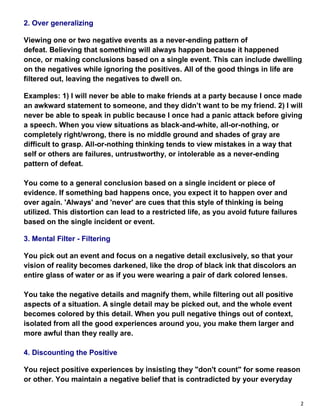
2. Overgeneralization – You see a single negative event as a never ending pattern of defeat.
Example: When one woman declined a date, the man concluded, “I’m never going to get a date. No
one will ever want me.”](https://image.slidesharecdn.com/cognitivedistortionschecklistmarch112014-140311095746-phpapp02/85/Do-not-Download-22-320.jpg)

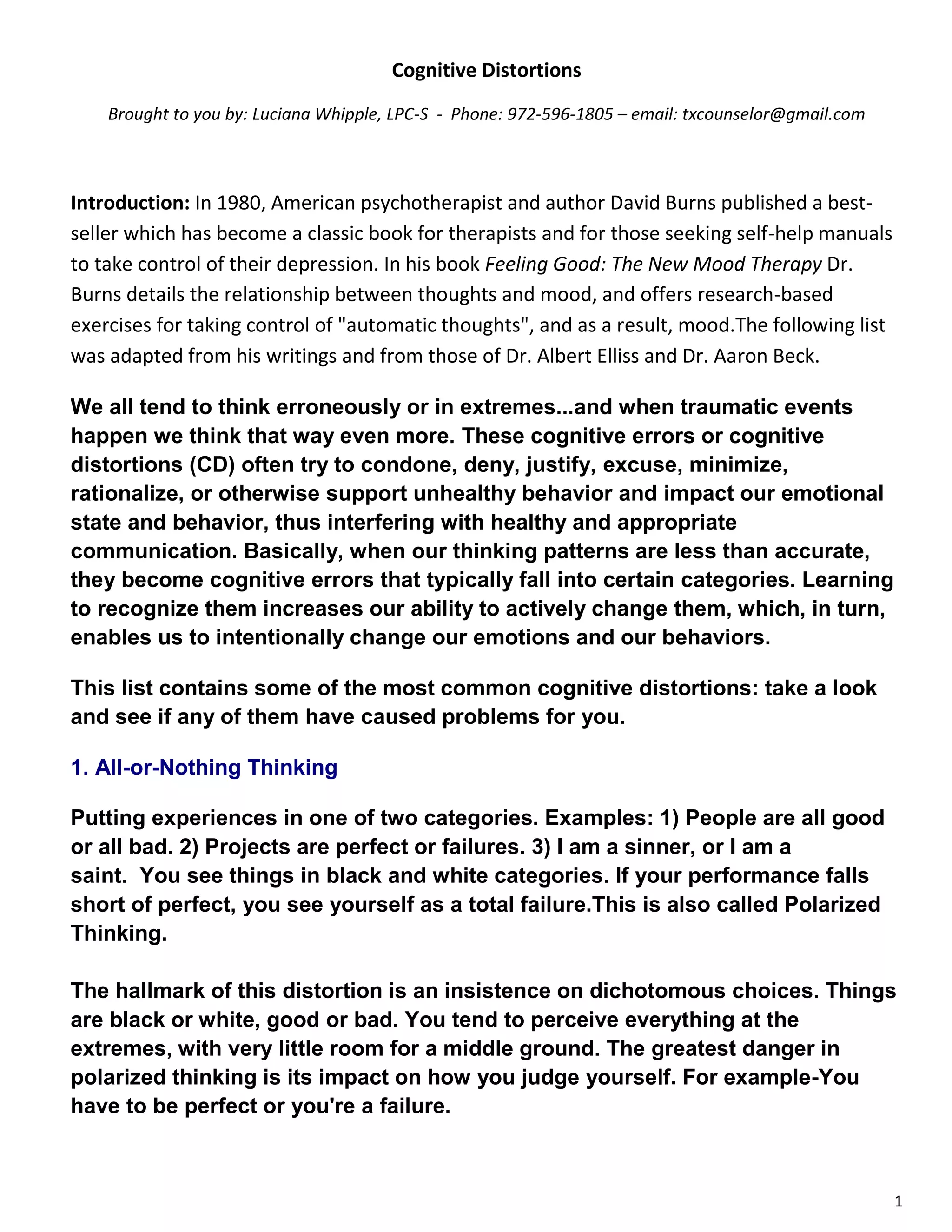
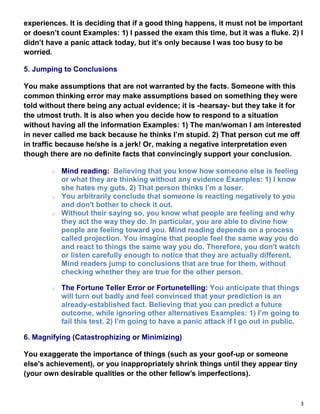
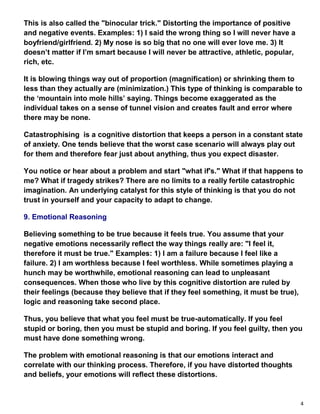
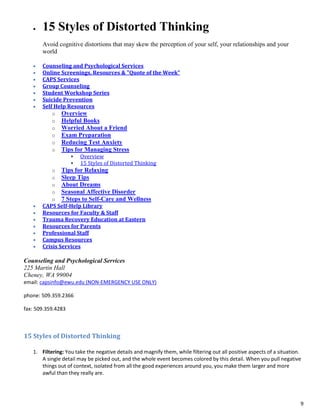
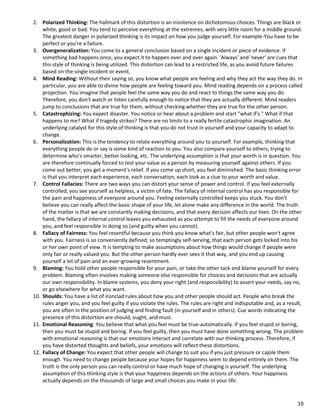
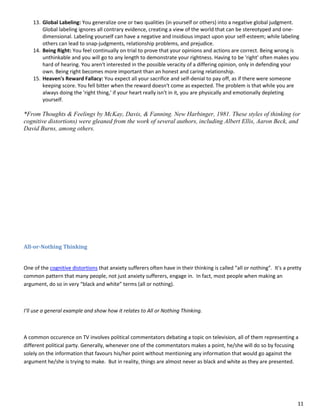
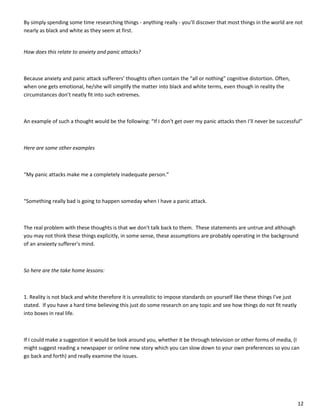
This document outlines 15 common cognitive distortions: all-or-nothing thinking, overgeneralizing, mental filtering, discounting positives, jumping to conclusions, magnifying/minimizing, emotional reasoning, "should" statements, blaming, labeling, personalization, always being right, fallacy of change, control fallacy, and fairness fallacy. It provides examples and explanations of each distortion to help the reader identify thinking patterns that may negatively impact emotions and behaviors. The goal is to recognize distorted thinking in order to intentionally change emotions and behaviors.


