Cognitive Psychology:
Topic:
Language comprehsion
Language and thoughts
Child language acqusition
Submitted by:
Shahroz Nasir 15538
Submitted to:
Madam. Safiya sultana
Department of Psychology
Contents:
 Types of thinking
 Reasoning
 Means-end Analysis
 Heuristic & Algorithm
 Syllogism
Thinking:
Define:
Thinking is a cognative process which includes mental activites, the logical & some
illogical ways in which we create concepts, slove problems,make decision and make judgments
OR
The process of using one's mind to consider or reason about something.
Types of thinking:
 Autistic Thinking
 Realistic Thinking
Autistic Thinking:
The term autistic derived from Greek word “ Auto” which means slef.
This thinking consist of personal needs and satisfactions and have no relation with reality.
Elements of Autistic Thinkin:
 Daydreaming
 Free Association
 Word Association
Daydreaming:
Pleasant thoughts about your life and future that you have, while you you are
awake mean not in reality .you live in your own imaginary world.
Example:
If a person thinks that if he becomes a rich person then he will be buy all the things of
world like own banglow, cars, shopping malls etc
Free Association:
Free association is a technique use in psychoanalytic therapy to help patient
learn about more what they are thinking and feeling freely. Sigmurd fired who was the founder
of the psychoanalytic therapy, used free association technique to hlep his patient to discover the
unconscious thoughts and feelings that had been repressed and ignored.When his patients
became aware these unconscious thoughts and feelings,they were better able to manage them and
change problematic behaviour.
Word Association:
Word association is a common word game involving exchange of words that
are associate togather. In other words it is the connection and production of other words in
response to given words.
Example:
Word association is a test (WAT) , the main purpose of this test is to get clear idea
about the candidates thinking.
Like word ‘‘ Garden” sentence for be
 There is a garden in front of my house
 There are beautiful flowers in the garden
 I go daily for jogging in the garden
So here are three sentences if we talk about first two sentce then they are correct but childish
but the 3rd sentence is more intrest to psychologist beacuse it is good habit .
Realistic thinking:
Realistic thinking is controlled , constructive,directive, and factual based
thinking, mean reality (reasoning) based thinking.
Elements of Realistic Thinking:
 Problem Solving
 Creative Thinking
 Reasoning
Problem Sloving:
Problem solving is the mental process that inlove discovering,analyzing and
solving problems.
Steps to solve problems:
 Recognising & defining the problem
 Finding possible solution
 Choosing the best solution
 Implementing of solution
Creative Thinking:
The process of thinking in which we focuse on explore the new ideas,
generates the possible solution of problems called creative thinking
Example:
Faishon designers
Reasoning:
Reasoning broadly defined as the process og drwaing conclusion to inform how
people solve problems and make decisions.
Types of Reasoning:
 Inductive Reasoning
 Deductive Reasoning
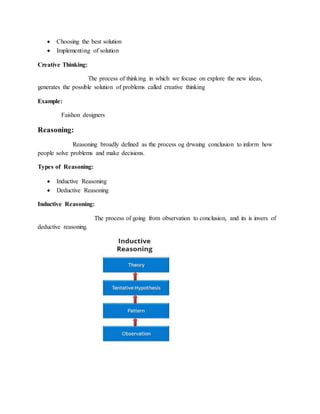
Inductive Reasoning:
The process of going from observation to conclusion, and its is invers of
deductive reasoning.
Decutive Reasoning:
It is the logical process , which starts with the general rule ( a premise)
which we know to be true .then from that rule we make true conclusion about something
specific.
Heuristic:
Heuristic is the rule or mental shortcut that allows people to solve problems, make
judgments quickly and efficently.In which you discover instructions for yourself .
Example:
Here’s a heuristic for getting to someone’s house: Find the last letter we mailed you.
Drive to the town in the return address. When you get to town, ask someone where our house is.
Everyone knows us—someone will be glad to help you. If you can’t find anyone, call us from a
public phone, and we’ll come get you.
Alogrithim:
Alogrithm is set of well defined instructions to perform or carrying out for a
particular task or to solve problem.Alogrithim gives you instruction directly.
Example:
Here is an alogrithim for driving my house .Take GT road west from shahdara and
drive 2km in west to begum kot take left then second right drive 300 meters then again left and
you reached my home house # 4.
Syllogism:
Syllogism is a kind of logical mental process where two premise and one
conclusion are formed ,it is kind of deductive reasoning.General to specific approach.
Example:
(a) Dogs are green (b)Jacki is green (c)jacki is a dog
So generaly in our everyday experince ,dogs are not green so first two statments
are not valid while 3rd is vaild.
Means –ends Analysis:
A heuristic stragety in which the current position is compared with the
desired goal and a series of steps are formulated and taken to close the gap between them.
Example:
When you take a math problem and look at the answer and then work the problem
step-by-step until you get the answer, you are using means-end analysis.

Cognative psycholog6

  • 1.
    Cognitive Psychology: Topic: Language comprehsion Languageand thoughts Child language acqusition Submitted by: Shahroz Nasir 15538 Submitted to: Madam. Safiya sultana Department of Psychology
  • 2.
    Contents:  Types ofthinking  Reasoning  Means-end Analysis  Heuristic & Algorithm  Syllogism
  • 3.
    Thinking: Define: Thinking is acognative process which includes mental activites, the logical & some illogical ways in which we create concepts, slove problems,make decision and make judgments OR The process of using one's mind to consider or reason about something. Types of thinking:  Autistic Thinking  Realistic Thinking Autistic Thinking: The term autistic derived from Greek word “ Auto” which means slef. This thinking consist of personal needs and satisfactions and have no relation with reality. Elements of Autistic Thinkin:  Daydreaming  Free Association  Word Association Daydreaming: Pleasant thoughts about your life and future that you have, while you you are awake mean not in reality .you live in your own imaginary world. Example: If a person thinks that if he becomes a rich person then he will be buy all the things of world like own banglow, cars, shopping malls etc Free Association: Free association is a technique use in psychoanalytic therapy to help patient learn about more what they are thinking and feeling freely. Sigmurd fired who was the founder of the psychoanalytic therapy, used free association technique to hlep his patient to discover the
  • 4.
    unconscious thoughts andfeelings that had been repressed and ignored.When his patients became aware these unconscious thoughts and feelings,they were better able to manage them and change problematic behaviour. Word Association: Word association is a common word game involving exchange of words that are associate togather. In other words it is the connection and production of other words in response to given words. Example: Word association is a test (WAT) , the main purpose of this test is to get clear idea about the candidates thinking. Like word ‘‘ Garden” sentence for be  There is a garden in front of my house  There are beautiful flowers in the garden  I go daily for jogging in the garden So here are three sentences if we talk about first two sentce then they are correct but childish but the 3rd sentence is more intrest to psychologist beacuse it is good habit . Realistic thinking: Realistic thinking is controlled , constructive,directive, and factual based thinking, mean reality (reasoning) based thinking. Elements of Realistic Thinking:  Problem Solving  Creative Thinking  Reasoning Problem Sloving: Problem solving is the mental process that inlove discovering,analyzing and solving problems. Steps to solve problems:  Recognising & defining the problem  Finding possible solution
  • 5.
     Choosing thebest solution  Implementing of solution Creative Thinking: The process of thinking in which we focuse on explore the new ideas, generates the possible solution of problems called creative thinking Example: Faishon designers Reasoning: Reasoning broadly defined as the process og drwaing conclusion to inform how people solve problems and make decisions. Types of Reasoning:  Inductive Reasoning  Deductive Reasoning Inductive Reasoning: The process of going from observation to conclusion, and its is invers of deductive reasoning.
  • 6.
    Decutive Reasoning: It isthe logical process , which starts with the general rule ( a premise) which we know to be true .then from that rule we make true conclusion about something specific. Heuristic: Heuristic is the rule or mental shortcut that allows people to solve problems, make judgments quickly and efficently.In which you discover instructions for yourself . Example: Here’s a heuristic for getting to someone’s house: Find the last letter we mailed you. Drive to the town in the return address. When you get to town, ask someone where our house is. Everyone knows us—someone will be glad to help you. If you can’t find anyone, call us from a public phone, and we’ll come get you. Alogrithim: Alogrithm is set of well defined instructions to perform or carrying out for a particular task or to solve problem.Alogrithim gives you instruction directly.
  • 7.
    Example: Here is analogrithim for driving my house .Take GT road west from shahdara and drive 2km in west to begum kot take left then second right drive 300 meters then again left and you reached my home house # 4. Syllogism: Syllogism is a kind of logical mental process where two premise and one conclusion are formed ,it is kind of deductive reasoning.General to specific approach. Example: (a) Dogs are green (b)Jacki is green (c)jacki is a dog So generaly in our everyday experince ,dogs are not green so first two statments are not valid while 3rd is vaild. Means –ends Analysis: A heuristic stragety in which the current position is compared with the desired goal and a series of steps are formulated and taken to close the gap between them. Example: When you take a math problem and look at the answer and then work the problem step-by-step until you get the answer, you are using means-end analysis.