Code Optimization
 Optimization is a program
transformation technique, which tries
to improve the code by making it
consume less resources (i.e. CPU,
Memory) and deliver high speed.
 In optimization, high-level general
programming constructs are replaced
by very efficient low-level programming
codes.
 code optimizing process must follow the three
rules given below:
 1. The output code must not, in any way,
change the meaning of the program.
 2. Optimization should increase the speed of
the program and if possible, the program
should demand less number of resources.
 3. Optimization should itself be fast and should
not delay the overall compiling process.
 Efforts for an optimized code can be made at
various levels of compiling the process.
 At the beginning, users can change/rearrange the
code or use better algorithms to write the code.
 After generating intermediate code, the compiler
can modify the intermediate code by address
calculations and improving loops.
 While producing the target machine code, the
compiler can make use of memory hierarchy and
CPU registers.
 Source codes generally have a number of
instructions, which are always executed in
sequence and are considered as the basic
blocks of the code.
 These basic blocks do not have any jump
statements among them,
 i.e., when the first instruction is executed, all
the instructions in the same basic block will
be executed in their sequence of appearance
without losing the flow control of the
program.
Basic Blocks
6
Places for potential improvements
by the user and compiler
 Optimization can be done in almost all phases
of compilation.
Front
end
Code
generator
Source
code
Inter.
code
target
code
Profile and
optimize
(user)
Loop, proc
calls, addr
calculation
improvement
(compiler)
Reg usage,
instruction
choice,
peephole opt
(compiler)
7
The Code Optimizer
Front
end
Code
generator
Code
optimizer
Control-
flow
analysis
Data-
flow
analysis
Transfor-
mations
 A transformation of a program is called
local if it can be performed by looking
only at the statements in a basic block;
otherwise, it is called global.
 Many transformations can be
performed at both the local and global
levels. Local transformations are usually
performed first.
PRINCIPAL SOURCES OF
OPTIMIZATION(UQ 15 marks)
 There are a number of ways in which a
compiler can improve a program without
changing the function it computes.
 Function preserving transformations
examples:
 Common sub expression elimination
 Copy propagation,
 Dead-code elimination
 Constant folding
Function-Preserving
Transformations
 An occurrence of an expression E is
called a common sub-expression if E was
previously computed, and the values of
variables in E have not changed since the
previous computation.
 We can avoid recomputing the
expression if we can use the previously
computed value.
Common Sub expressions
elimination:
 For example

 t1: = 4*i
 t2: = a [t1]
 t3: = 4*j
 t4: = 4*i
 t5: = n
 t6: = b [t4] +t5
 The above code can be optimized using the common sub-
expression elimination as
 t1: = 4*i
 t2: = a [t1]
 t3: = 4*j
 t5: = n
 t6: = b [t1] +t5
 The common sub expression t4: =4*i is eliminated
as its computation is already in t1 and the value of
i is not been changed from definition to use.
Flow Graph
 Assignments of the form f : = g called copy
statements, or copies for short.
 The idea behind the copy-propagation
transformation is to use g for f, whenever
possible after the copy statement f: = g.
 Copy propagation means use of one variable
instead of another.
 This may not appear to be an improvement,
but as we shall see it gives us an opportunity to
eliminate x.
Copy Propagation:
 • For example:
 x=Pi;
 A=x*r*r;
 The optimization using copy propagation can
be done as follows: A=Pi*r*r;
 Here the variable x is eliminated
Copy Propagation:
 A variable is live at a point in a program
if its value can be used subsequently;
otherwise, it is dead at that point.
 A related idea is dead or useless code,
statements that compute values that
never get used.
 While the programmer is unlikely to
introduce any dead code intentionally, it
may appear as the result of previous
transformations.
Dead-Code Eliminations:
 Example:
i=0;
if(i=1)
{
a=b+5;
}
 Here, ‘if’ statement is dead code because this
condition will never get satisfied.
Dead-Code Eliminations:
 Deducing at compile time that the value of an
expression is a constant and using the constant
instead is known as constant folding. One
advantage of copy propagation is that it often
turns the copy statement into dead code.
 For example,
 a=3.14157/2 can be replaced by
 a=1.570 there by eliminating a division
operation.
Constant folding:
 In loops, especially in the inner loops, programs tend to
spend the bulk of their time.
 The running time of a program may be improved if the
number of instructions in an inner loop is decreased, even if
we increase the amount of code outside that loop.
 Three techniques are important for loop optimization:
 1. Code motion, which moves code outside a loop;
 2. Induction-variable elimination, which we apply to replace
variables from inner loop.
 3. Reduction in strength, which replaces and expensive
operation by a cheaper one, such as a multiplication by an
addition.
Loop Optimizations:
 An important modification that decreases the
amount of code in a loop is code motion.
 This transformation takes an expression that
yields the same result independent of the number
of times a loop is executed (a loop-invariant
computation) and places the expression before the
loop.
 Note that the notion “before the loop” assumes
the existence of an entry for the loop. For
example, evaluation of limit-2 is a loop-invariant
computation in the following while-statement:
Code Motion:
 while (i <= limit-2) /* statement does not
change limit*/
 Code motion will result in the equivalent of
 t= limit-2;
 while (i<=t) /* statement does not change limit
or t */
Code Motion:
 Loops are usually processed inside out. For
example consider the loop around B3.
 Note that the values of j and t4 remain in
lock-step;
 every time the value of j decreases by 1, that
of t4 decreases by 4 because 4*j is assigned
to t4.
 Such identifiers are called induction variables.
Induction Variables :
 When there are two or more induction
variables in a loop, it may be possible to
get rid of all but one, by the process of
induction-variable elimination.
 For the inner loop around B3 in Fig. we
cannot get rid of either j or t4
completely; t4 is used in B3 and j in B4.
 However, we can illustrate
reduction in strength and illustrate
a part of the process of induction-
variable elimination. Eventually j
will be eliminated when the outer
loop of B2- B5 is considered.
 Example:
As the relationship t4:=4*j surely holds after
such an assignment to t4 in Fig. and t4 is not
changed elsewhere in the inner loop around
B3, it follows that just after the statement j:=j-
1 the relationship t4:= 4*j-4 must hold. We
may therefore replace the assignment t4:= 4*j
by t4:= t4-4.
 The replacement of a multiplication
by a subtraction will speed up the
object code if multiplication takes
more time than addition or
subtraction, as is the case on many
machines.
 Reduction in strength replaces expensive
operations by equivalent cheaper ones on the
target machine. Certain machine instructions
are considerably cheaper than others and can
often be used as special cases of more
expensive operators.
Reduction In Strength:
 For example, x² is invariably cheaper to
implement as x*x than as a call to an
exponentiation routine.
 Fixed-point multiplication or division by a
power of two is cheaper to implement as a
shift.
 Floating-point division by a constant can be
implemented as multiplication by a constant,
which may be cheaper.
Reduction In Strength:
 A statement-by-statement code-
generations strategy often produces
target code that contains redundant
instructions and suboptimal constructs.
 The quality of such target code can be
improved by applying “optimizing”
transformations to the target program.
PEEPHOLE OPTIMIZATION(6 marks
UQ)
 A simple but effective technique for improving
the target code is peephole optimization, a
method for trying to improving the
performance of the target program by
examining a short sequence of target
instructions (called the peephole) and replacing
these instructions by a shorter or faster
sequence, whenever possible.
 The peephole is a small, moving window
on the target program.
 The code in the peephole need not be
contiguous, although some
implementations do require this.
 It is characteristic of peephole
optimization that each improvement
may spawn opportunities for additional
improvements.
 Characteristics of peephole optimizations:
 Redundant-instructions elimination
 Flow-of-control optimizations
 Algebraic simplifications
 Use of machine idioms
 Unreachable code
 There are two types of basic block
optimizations. They are :
1. Structure-Preserving Transformations
2. Algebraic Transformations
OPTIMIZATION OF BASIC BLOCKS
 The primary Structure-Preserving
Transformation on basic blocks are:
 Common sub-expression elimination
 Dead code elimination
 Renaming of temporary variables
 Interchange of two independent adjacent
statements.
1.Structure-Preserving
Transformations:
 Common sub expressions need not be computed
over and over again. Instead they can be computed
once and kept in store from where it’s referenced.
 Example:
 a: =b+c
 b: =a-d
 c: =b+c
 d: =a-d
Common sub-expression
elimination:
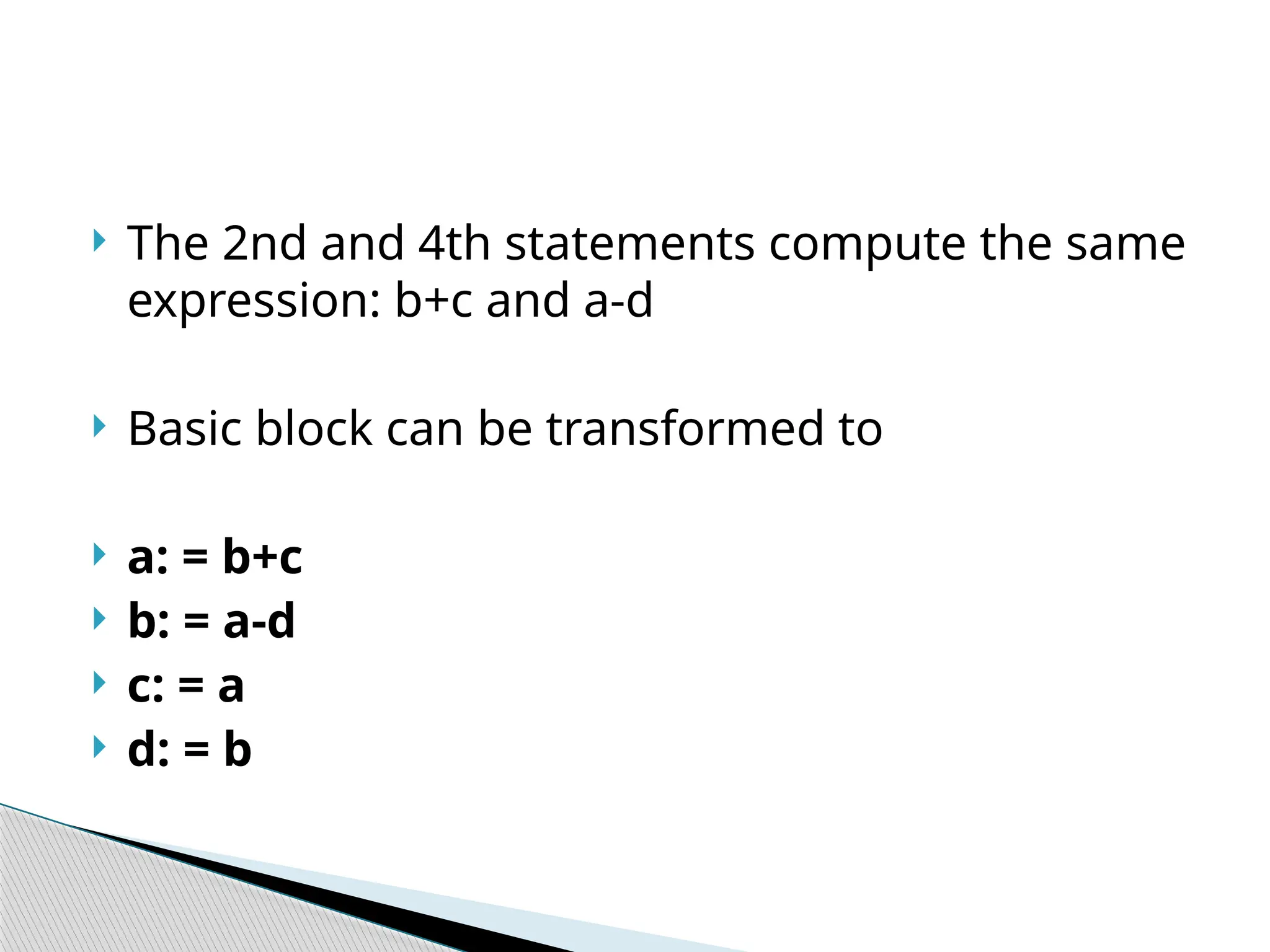
 The 2nd and 4th statements compute the same
expression: b+c and a-d
 Basic block can be transformed to
 a: = b+c
 b: = a-d
 c: = a
 d: = b
 It is possible that a large amount of dead
(useless) code may exist in the program.
 This might be especially caused when
introducing variables and procedures as part of
construction or error-correction of a program -
once declared and defined, one forgets to
remove them in case they serve no purpose.
 Eliminating these will definitely optimize the
code.
Dead code elimination:
 A statement t:=b+c where t is a temporary
name can be changed to u:=b+c where u is
another temporary name, and change all uses
of t to u.
 In this a basic block is transformed to its
equivalent block called normal-form block.
Renaming of temporary variables:
 Two statements

 t1:=b+c
 t2:=x+y

 can be interchanged or reordered in its
computation in the basic block when value of t1
does not affect the value of t2.
Interchange of two independent
adjacent statements:
 Algebraic identities represent another important
class of optimizations on basic blocks.
 This includes simplifying expressions or replacing
expensive operation by cheaper ones i.e. reduction
in strength.
 Another class of related optimizations is constant
folding. Here we evaluate constant expressions at
compile time and replace the constant expressions
by their values.
 Thus the expression 2*3.14 would be replaced by
6.28.
2. Algebraic Transformations:

Code optmize.pptx which is related to coding

  • 1.
  • 2.
     Optimization isa program transformation technique, which tries to improve the code by making it consume less resources (i.e. CPU, Memory) and deliver high speed.  In optimization, high-level general programming constructs are replaced by very efficient low-level programming codes.
  • 3.
     code optimizingprocess must follow the three rules given below:  1. The output code must not, in any way, change the meaning of the program.  2. Optimization should increase the speed of the program and if possible, the program should demand less number of resources.  3. Optimization should itself be fast and should not delay the overall compiling process.
  • 4.
     Efforts foran optimized code can be made at various levels of compiling the process.  At the beginning, users can change/rearrange the code or use better algorithms to write the code.  After generating intermediate code, the compiler can modify the intermediate code by address calculations and improving loops.  While producing the target machine code, the compiler can make use of memory hierarchy and CPU registers.
  • 5.
     Source codesgenerally have a number of instructions, which are always executed in sequence and are considered as the basic blocks of the code.  These basic blocks do not have any jump statements among them,  i.e., when the first instruction is executed, all the instructions in the same basic block will be executed in their sequence of appearance without losing the flow control of the program. Basic Blocks
  • 6.
    6 Places for potentialimprovements by the user and compiler  Optimization can be done in almost all phases of compilation. Front end Code generator Source code Inter. code target code Profile and optimize (user) Loop, proc calls, addr calculation improvement (compiler) Reg usage, instruction choice, peephole opt (compiler)
  • 7.
  • 8.
     A transformationof a program is called local if it can be performed by looking only at the statements in a basic block; otherwise, it is called global.  Many transformations can be performed at both the local and global levels. Local transformations are usually performed first. PRINCIPAL SOURCES OF OPTIMIZATION(UQ 15 marks)
  • 9.
     There area number of ways in which a compiler can improve a program without changing the function it computes.  Function preserving transformations examples:  Common sub expression elimination  Copy propagation,  Dead-code elimination  Constant folding Function-Preserving Transformations
  • 10.
     An occurrenceof an expression E is called a common sub-expression if E was previously computed, and the values of variables in E have not changed since the previous computation.  We can avoid recomputing the expression if we can use the previously computed value. Common Sub expressions elimination:
  • 11.
     For example  t1: = 4*i  t2: = a [t1]  t3: = 4*j  t4: = 4*i  t5: = n  t6: = b [t4] +t5
  • 12.
     The abovecode can be optimized using the common sub- expression elimination as  t1: = 4*i  t2: = a [t1]  t3: = 4*j  t5: = n  t6: = b [t1] +t5  The common sub expression t4: =4*i is eliminated as its computation is already in t1 and the value of i is not been changed from definition to use.
  • 13.
  • 15.
     Assignments ofthe form f : = g called copy statements, or copies for short.  The idea behind the copy-propagation transformation is to use g for f, whenever possible after the copy statement f: = g.  Copy propagation means use of one variable instead of another.  This may not appear to be an improvement, but as we shall see it gives us an opportunity to eliminate x. Copy Propagation:
  • 16.
     • Forexample:  x=Pi;  A=x*r*r;  The optimization using copy propagation can be done as follows: A=Pi*r*r;  Here the variable x is eliminated Copy Propagation:
  • 17.
     A variableis live at a point in a program if its value can be used subsequently; otherwise, it is dead at that point.  A related idea is dead or useless code, statements that compute values that never get used.  While the programmer is unlikely to introduce any dead code intentionally, it may appear as the result of previous transformations. Dead-Code Eliminations:
  • 18.
     Example: i=0; if(i=1) { a=b+5; }  Here,‘if’ statement is dead code because this condition will never get satisfied. Dead-Code Eliminations:
  • 19.
     Deducing atcompile time that the value of an expression is a constant and using the constant instead is known as constant folding. One advantage of copy propagation is that it often turns the copy statement into dead code.  For example,  a=3.14157/2 can be replaced by  a=1.570 there by eliminating a division operation. Constant folding:
  • 20.
     In loops,especially in the inner loops, programs tend to spend the bulk of their time.  The running time of a program may be improved if the number of instructions in an inner loop is decreased, even if we increase the amount of code outside that loop.  Three techniques are important for loop optimization:  1. Code motion, which moves code outside a loop;  2. Induction-variable elimination, which we apply to replace variables from inner loop.  3. Reduction in strength, which replaces and expensive operation by a cheaper one, such as a multiplication by an addition. Loop Optimizations:
  • 21.
     An importantmodification that decreases the amount of code in a loop is code motion.  This transformation takes an expression that yields the same result independent of the number of times a loop is executed (a loop-invariant computation) and places the expression before the loop.  Note that the notion “before the loop” assumes the existence of an entry for the loop. For example, evaluation of limit-2 is a loop-invariant computation in the following while-statement: Code Motion:
  • 22.
     while (i<= limit-2) /* statement does not change limit*/  Code motion will result in the equivalent of  t= limit-2;  while (i<=t) /* statement does not change limit or t */ Code Motion:
  • 23.
     Loops areusually processed inside out. For example consider the loop around B3.  Note that the values of j and t4 remain in lock-step;  every time the value of j decreases by 1, that of t4 decreases by 4 because 4*j is assigned to t4.  Such identifiers are called induction variables. Induction Variables :
  • 24.
     When thereare two or more induction variables in a loop, it may be possible to get rid of all but one, by the process of induction-variable elimination.  For the inner loop around B3 in Fig. we cannot get rid of either j or t4 completely; t4 is used in B3 and j in B4.
  • 25.
     However, wecan illustrate reduction in strength and illustrate a part of the process of induction- variable elimination. Eventually j will be eliminated when the outer loop of B2- B5 is considered.
  • 26.
     Example: As therelationship t4:=4*j surely holds after such an assignment to t4 in Fig. and t4 is not changed elsewhere in the inner loop around B3, it follows that just after the statement j:=j- 1 the relationship t4:= 4*j-4 must hold. We may therefore replace the assignment t4:= 4*j by t4:= t4-4.
  • 27.
     The replacementof a multiplication by a subtraction will speed up the object code if multiplication takes more time than addition or subtraction, as is the case on many machines.
  • 28.
     Reduction instrength replaces expensive operations by equivalent cheaper ones on the target machine. Certain machine instructions are considerably cheaper than others and can often be used as special cases of more expensive operators. Reduction In Strength:
  • 29.
     For example,x² is invariably cheaper to implement as x*x than as a call to an exponentiation routine.  Fixed-point multiplication or division by a power of two is cheaper to implement as a shift.  Floating-point division by a constant can be implemented as multiplication by a constant, which may be cheaper. Reduction In Strength:
  • 30.
     A statement-by-statementcode- generations strategy often produces target code that contains redundant instructions and suboptimal constructs.  The quality of such target code can be improved by applying “optimizing” transformations to the target program. PEEPHOLE OPTIMIZATION(6 marks UQ)
  • 31.
     A simplebut effective technique for improving the target code is peephole optimization, a method for trying to improving the performance of the target program by examining a short sequence of target instructions (called the peephole) and replacing these instructions by a shorter or faster sequence, whenever possible.
  • 32.
     The peepholeis a small, moving window on the target program.  The code in the peephole need not be contiguous, although some implementations do require this.  It is characteristic of peephole optimization that each improvement may spawn opportunities for additional improvements.
  • 33.
     Characteristics ofpeephole optimizations:  Redundant-instructions elimination  Flow-of-control optimizations  Algebraic simplifications  Use of machine idioms  Unreachable code
  • 34.
     There aretwo types of basic block optimizations. They are : 1. Structure-Preserving Transformations 2. Algebraic Transformations OPTIMIZATION OF BASIC BLOCKS
  • 35.
     The primaryStructure-Preserving Transformation on basic blocks are:  Common sub-expression elimination  Dead code elimination  Renaming of temporary variables  Interchange of two independent adjacent statements. 1.Structure-Preserving Transformations:
  • 36.
     Common subexpressions need not be computed over and over again. Instead they can be computed once and kept in store from where it’s referenced.  Example:  a: =b+c  b: =a-d  c: =b+c  d: =a-d Common sub-expression elimination:
  • 37.
     The 2ndand 4th statements compute the same expression: b+c and a-d  Basic block can be transformed to  a: = b+c  b: = a-d  c: = a  d: = b
  • 38.
     It ispossible that a large amount of dead (useless) code may exist in the program.  This might be especially caused when introducing variables and procedures as part of construction or error-correction of a program - once declared and defined, one forgets to remove them in case they serve no purpose.  Eliminating these will definitely optimize the code. Dead code elimination:
  • 39.
     A statementt:=b+c where t is a temporary name can be changed to u:=b+c where u is another temporary name, and change all uses of t to u.  In this a basic block is transformed to its equivalent block called normal-form block. Renaming of temporary variables:
  • 40.
     Two statements  t1:=b+c  t2:=x+y   can be interchanged or reordered in its computation in the basic block when value of t1 does not affect the value of t2. Interchange of two independent adjacent statements:
  • 41.
     Algebraic identitiesrepresent another important class of optimizations on basic blocks.  This includes simplifying expressions or replacing expensive operation by cheaper ones i.e. reduction in strength.  Another class of related optimizations is constant folding. Here we evaluate constant expressions at compile time and replace the constant expressions by their values.  Thus the expression 2*3.14 would be replaced by 6.28. 2. Algebraic Transformations: