Code Beauty
           Prof. Fabio Kon

  Department of Computer Science
Institute of Mathematics and Statistics
        University of São Paulo


  SugarLoafPLoP'2010 - 24/9/2010
         Salvador, Brazil


                                          1
Agenda
●   Definition of Beauty
●   Is Code Beauty important for Software
    Development?
●   What is Code Beauty


                                            2
Beauty - Ancient View
●   pre-socratic (e.g., Pythagoras): strong
    connection among Beauty and Mathematics;
    objects with proportions following the golden
    ratio are more attractive to the human brain
●   two quantities are in the golden ratio if the ratio of the
    sum of the quantities to the larger quantity is equal to
    the ratio of the larger quantity to the smaller one. The
    golden ratio is an irrational mathematical constant,
    approximately 1.6180339887
●   greek architecture is based on symmetry and
    on the golden ratio

                                                                 3
Beauty - Romantic View

●   works do not need to be harmoniously
    proportioned and constitute a well-rounded
    whole to be beautiful; on the contrary,
    dissonance and fragmentation is beautiful

●   more precisely: dissonance and fragmentation
    allude to a harmony and wholeness that is not
    in the work

                                                    4
Beauty - Modernist View
●   architect Mies van der Rohe: “Less is More”
         ~ 1940

●   designer Buckminster Fuller (geodesic dome)
    adopted the engineer's goal of “Doing more
    with less”
●   writer Antoine de Saint Exupéry (1939)
    “perfection is attained not when there is
    nothing more to add, but when there is nothing
    more to remove”
                                                     5
Beauty: Post-modernist view


●   architect Robert Venturi: “Less is a Bore”, let's
    do whatever people like


                                                        6
the greek and modernist views of beauty
provide us with a good basis for approaching
Beauty in Science and Technology


                                               7
Science


make everything as simple as possible, but
not simpler


                                             8
Technology


Conceptual integrity
    –   the architect or team of architects should
          develop an idea of what the system should
          do and make sure this vision is understood
          by the rest of the team
    –   to ensure a user-friendly system, a system
          may deliberately provide fewer features than
          it is capable of


                                                         9
Beauty dictionary definition
the quality that gives pleasure to the mind or
senses and is associated with such properties
as
    –   harmony of form or color,
    –   excellence of artistry,
    –   truthfulness,
    –   and originality.


The American Heritage Dictionary of the
English Language, 4th Edition, 2000.
                                                 10
Does it matter?


    Why are we talking about Code Beauty on a
    “serious” Software Conference???


●   personally, I have two reasons...


                                                11
●   there has been a strong movement towards
    managing software development projects as
    any other production process/system

●   many cases of managers that have never
    written a single line of code

●   is it possible to have a good Chef de Cuisine
    that has never cooked in his life?
                                                    12
●   scientists/engineers/practitioners sometimes
    tend to overestimate the power of science and
    mathematics


●   can science and engineering provide all what's
    needed to explain life? and software
    development?


                                                     13
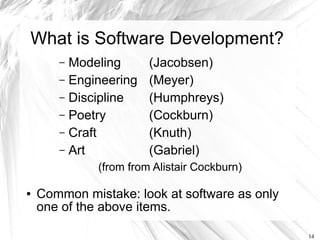
What is Software Development?
       – Modeling       (Jacobsen)
       – Engineering    (Meyer)
       – Discipline     (Humphreys)
       – Poetry         (Cockburn)
       – Craft          (Knuth)
       – Art            (Gabriel)
              (from from Alistair Cockburn)

●   Common mistake: look at software as only
    one of the above items.

                                               14
●   our goal here, is to bring attention to a few
    important aspects of software development
    that are neglected in some software
    engineering communities


●   we'll look at the most important deliverable on
    a software project:

         The Code

                                                      15
Beauty is fundamental
                                        vinicius de morais

Beautiful code
    –   brings pleasure to the reader
    –   makes the writer happy
    –   makes working in groups fun
This leads to
    –   fewer bugs
    –   maintainability
    –   team productivity
    –   in other words, Quality

                                                             16
In Software Development,

    Beauty

        Leads to

             Quality


                           17
What is Beauty in
        Software Development?

sources:
●   Robert C. Martin. Clean Code - A Handbook of Agile
    Software Craftsmanship. Prentice Hall. 2008.
●   Andy Oram and Greg Wilson. Beautiful Code.
    O'Reilly. 2007.
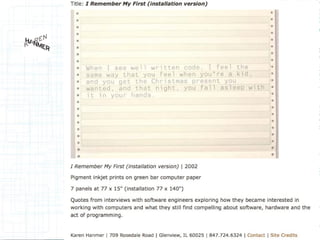
●   beaute(code) art exhibit by Bob Hanmer, Karen
    Hanmer, and Andrea Polli.
●   exchange with experts

                                                         18
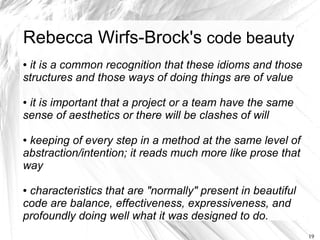
Rebecca Wirfs-Brock's code beauty
●it is a common recognition that these idioms and those
structures and those ways of doing things are of value

●it is important that a project or a team have the same
sense of aesthetics or there will be clashes of will

●keeping of every step in a method at the same level of
abstraction/intention; it reads much more like prose that
way

●characteristics that are "normally" present in beautiful
code are balance, effectiveness, expressiveness, and
profoundly doing well what it was designed to do.
                                                            19
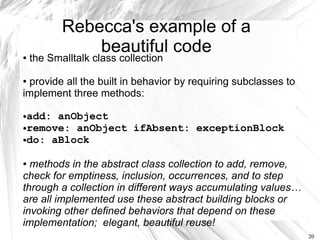
Rebecca's example of a
               beautiful code
●   the Smalltalk class collection

●provide all the built in behavior by requiring subclasses to
implement three methods:

●add: anObject
●remove: anObject ifAbsent: exceptionBlock

●do: aBlock


● methods in the abstract class collection to add, remove,
check for emptiness, inclusion, occurrences, and to step
through a collection in different ways accumulating values…
are all implemented use these abstract building blocks or
invoking other defined behaviors that depend on these
implementation; elegant, beautiful reuse!
                                                                20
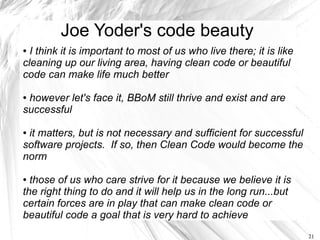
Joe Yoder's code beauty
● I think it is important to most of us who live there; it is like
cleaning up our living area, having clean code or beautiful
code can make life much better

●however let's face it, BBoM still thrive and exist and are
successful

●it matters, but is not necessary and sufficient for successful
software projects. If so, then Clean Code would become the
norm

● those of us who care strive for it because we believe it is
the right thing to do and it will help us in the long run...but
certain forces are in play that can make clean code or
beautiful code a goal that is very hard to achieve
                                                                     21
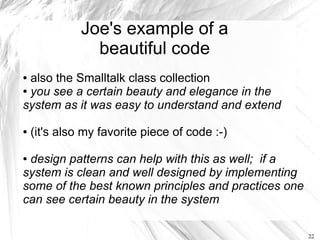
Joe's example of a
                beautiful code
● also the Smalltalk class collection
● you see a certain beauty and elegance in the

system as it was easy to understand and extend

●   (it's also my favorite piece of code :-)

●design patterns can help with this as well; if a
system is clean and well designed by implementing
some of the best known principles and practices one
can see certain beauty in the system

                                                      22
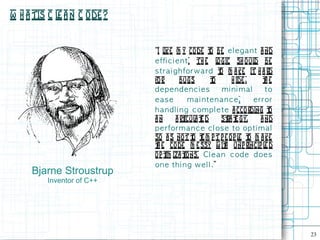
W h a tis C l a n C ode ?
             e


                            “I l m y co de t be e l e g a n t a nd
                                ike               o
                            e ffi c i e n t. Th e l gic sh o ul be
                                                      o             d
                            s t ra i g h forw a rd t m a ke it h a rd
                                                       o
                            fo r        bugs      to        h ide ,     te
                                                                         h
                            dependenc i es              mi ni mal        to
                            ease           mai ntenanc e,           e rror
                            h a n d l i n g c om p l e t e a cco rding t   o
                            an        a rt a t d
                                          icul e        st t gy,
                                                          ra e         a nd
                            p e rform a n c e c l os e to op t i m a l
                            so a s not t t m p t p e op l t m a ke
                                             o e               e o
                            t e co de m e ssy w it unp rincip l d
                             h                           h               e
                            op t iza t
                                 im       ions. Cl e a n c od e d oe s
                            on e t h i n g w e l l .”
     Bjarne Stroustrup
         Inventor of C++


                                                                               23
W h a tis C l a n C ode ?
             e


                                         “C l a n co de is s i m p l e a nd d i re c t.
                                             e
                                         C l a n co de re a d s l i k e w e l l -
                                            e
                                         w ri t te n p ros e . C l a n code ne ve r
                                                                   e
                                         obscure s t e de signe r's int nt but
                                                       h                    e
                                         ra t e r is ful o f crisp [cl a rl de fine d]
                                             h          l             e y
                                         a bst ct ns a nd s tra i g h forw a rd
                                               ra io
                                         l s o f co nt l ”
                                          ine            ro .


         Grady Booch
Author of Object Oriented Analysis and
       Design with Applications


                                                                                          24
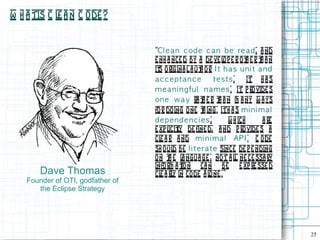
W h a tis C l a n C ode ?
             e


                                   “Cl e a n c od e c a n b e re ad , a nd
                                   e nh a nce d by a de ve l p e r o t e r t a n
                                                              o         h   h
                                   it origina l a ut or I t h a s u n i t a n d
                                     s               h .
                                   ac c eptanc e          tests.        It h a s
                                   m e a n i n g fu l n am e s . It p rovide s
                                   on e w a y ra t e r t a n m a ny w a ys
                                                      h     h
                                   fo r do ing o ne t ing. It h a s m i n i m a l
                                                      h
                                   dependenc i es,              w h ich      a re
                                   e xp l l de fine d, a nd p ro vide s a
                                         icity
                                   cl a r a nd m i n i m a l AP I . C ode
                                     e
                                   sh o ul be l i te ra t e since de p e nding
                                           d
                                   on t e l ngua ge , not a l ne ce ssa ry
                                         h a                      l
                                   info rm a t n ca n be e xp re sse d
                                              io
        Dave Thomas                cl a rl in code a l ne . ”
                                     e y                o
    Founder of OTI, godfather of
       the Eclipse Strategy


                                                                                    25
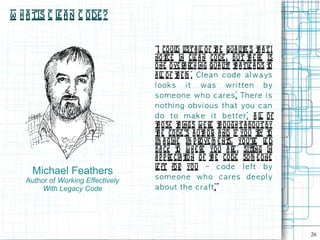
W h a tis C l a n C ode ?
             e


                                    “I co ul l a l o f t e qua l ie s t a t I
                                              d ist l       h        it    h
                                    no t  ice in cl a n code , but t e re is
                                                    e                   h
                                    one ove ra rch ing qua l y t a t l a ds t
                                                                it h    e       o
                                    a l o f t e m . Cl e a n c od e a l w a ys
                                        l     h
                                    l ook s i t w a s w ri t t e n b y
                                    s om e on e w h o c a re s . Th e re i s
                                    n ot h i n g obvi ou s t h a t you c a n
                                    d o t o m a k e i t b e tt e r. A l of  l
                                    t o se t ings w e re t o ugh t a bo ut by
                                      h        h              h
                                    t e co de 's a ut or a nd if you t t
                                      h                h ,                 ry o
                                    im a gine im p ro ve m e nt yo u're l d
                                                                  s,          e
                                    ba ck t w h e re you a re , siting in
                                              o                          t
                                    a p p re cia t n o f t e code som e one
                                                 io       h
                                    l ft fo r yo u – c od e l e ft b y
                                     e
     Michael Feathers
    Author of Working Effectively   s om e on e w h o c are s d e e p l y
         With Legacy Code           a b ou t th e c ra ft. ”


                                                                                    26
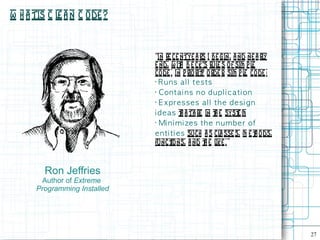
W h a tis C l a n C ode ?
             e


                              “In re ce ntye a rs I be gin, a nd ne a rl y
                              e nd, w it B e ck's rul s of sim p l
                                          h             e             e
                              co de . In p rio rit o rde r, sim p l code :
                                                 y                 e
                              •
                                R u n s al l t e s t s
                              •
                                Con ta i n s n o d u p l i c a t i on
                              •
                                E x p re s s e s al l t h e d e s i g n
                              i d e a s t a ta re in t e syst m
                                           h           h        e
                              •
                                Mi n i m i ze s th e n u m b e r of
                              e n t i ti e s such a s cl sse s, m e t o ds,
                                                         a             h
                              funct   ions, a nd t e l . ”
                                                   h ike


        Ron Jeffries
       Author of Extreme
      Programming Installed


                                                                              27
W h a tis C l a n C ode ?
              e


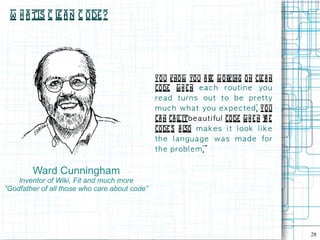
                                               Y o u kno w you a re w orking on cl a n   e
                                               co de w h e n e a c h rou ti n e you
                                               re a d tu rn s ou t t o be p re t t y
                                               m u c h w h at you e x p e c t e d . Y o u
                                               ca n ca l it b e a u t i fu l code w h e n t e
                                                        l                                  h
                                               co de s a l m a k e s i t l ook l i k e
                                                          so
                                               t h e l a n g u a g e w a s m a d e for
                                               t h e p rob l e m . ”


        Ward Cunningham
    Inventor of Wiki, Fit and much more
”Godfather of all those who care about code”


                                                                                                28
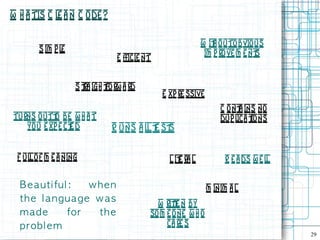
W h a tis C l a n C ode ?
             e

                                                           W it outo bvio us
                                                               h
       S im p le                                            im p rove m e nt
                                                                           s
                               E fficie nt


                   S t igh t rw a rd
                     ra    fo
                                             E xp re ssive
                                                                 C o nt ins no
                                                                       a
Turns outt be w h a t
           o                                                     dup l t
                                                                      ica ions
   you e xp e ct d
               e             R uns a l t st
                                      le s

 F ul o f m e a ning
     l                                         L it ra l
                                                   e              R e a ds w e ll

  B e a u t i fu l :   when                                  M inim a l
  th e l anguage was                       W rite n by
                                                t
  made             for  th e             som e one w h o
  p rob l e m                                ca re s
                                                                                    29
language may influence
/* C Language */
#include <stdio.h>
#define NumLines 10               /* number of lines */
main(argc,argv) int argc; char **argv;
{
   int tri[NumLines][NumLines], /* triangle */
   r,c,i;             /* row, column, misc index */

    /* initialize array */
    for (r=0;r<NumLines;r++) {
        tri[r][0]=1;
        for (c=1;c<NumLines;c++) {
             tri[r][c]=0;
    };
    /* generate triangle */
    tri[0][0]=1;
    for (r=1;r<NumLines;r++){
        for (c=1;c<NumLines;c++) {
             tri[r][c]=tri[r-1][c] + tri[r-1][c-1];
        }
    };
    /* print triangle */
    for (r=0;r<NumLines;r++){
           for (i=0;i < ((NumLines-r-1)/2);i++) printf("     ");
           if (r%2 == 0) printf(" ");
        for (c=0;c<NumLines;c++){
             if (tri[r][c] != 0) printf("%3d ",tri[r][c]);
        };
        printf("n");
    }
}


                                 source: http://www.andreapolli.com/beaute%28code%29/good_bad_ugly/pascal.html   30
let's get a little more technical


                                    31
Me an i n g fu l
 Names


                   32
M e a ningful N a m e s

                          N a m e s are vi t a l !

 ●
     C ode is ba sica ly na m e s a nd re se rve d w o rds
                       l


 ●   C h o o sing go od na m e s t ke s t e butsa ve s
                                  a      im
 m o re t a n itt ke s
        h        a


 ●   N a m e s sh oul be e xp re ssive a nd sh o ul
                     d                             d
 a nsw e r que st ns
                 io


                                                             33
M e a ningful N a m e s


                          E xampl e

public List<int[]> getThem() {
  List<int[]> list1 = new ArrayList<int[]>();
  for (int[] x : theList)
     if(x[0] == 4)
       list1.add(x);
  return list1;
}


                                                34
M e a ningful N a m e s


                              E xampl e

           public List<int[]> getThem() {
               List<int[]> list1 = new ArrayList<int[]>();
               for (int[] x : theList)
                   if(x[0] == 4)
                       list1.add(x);
               return list1;
           }


              M a ny do ubt a rise . . .
                           s
     1 . W h a tdoe s t is m e t od ge t
                       h       h        ?
     2 . W h a tkinds o f t ings a re in t e L ist
                           h              h       ?
     3. W h a tis t e im p ort nce of t e ze rot p osit
                  h          a         h        h     ion?
     4. W h a tis t e significa nce o f t e va l 4?
                  h                     h       ue

                                                             35
M e a ningful N a m e s
                            E xampl e
           public List<int[]> getThem() {
               List<int[]> list1 = new ArrayList<int[]>();
               for (int[] x : theList)
                   if(x[0] == 4)
                       list1.add(x);
               return list1;
           }

                      W h a ta bo utt is
                                    h
                      code ?
 public List<int[]> getFlaggedCells() {
    List<int[]> flaggedCells = new ArrayList<int[]>();
    for (int[] cell : gameBoard)
       if(cell[STATUS_VALUE] == FLAGGED)
          flaggedCells.add(cell);
    return flaggedCells;
 }


                                                             36
M e a ningful N a m e s


                                      E xampl e
        public List<int[]> getFlaggedCells() {
            List<int[]> flaggedCells = new ArrayList<int[]>();
            for (int[] cell : gameBoard)
                if(cell[STATUS_VALUE] == FLAGGED)
                    flaggedCells.add(cell);
            return flaggedCells;
        }


                                   P robl m
                                          e
                                   sol d!
                                       ve
   1 . W h a tdo e s t is m e t o d ge t Itge t a l fl gge d ce ls!
                      h        h       ?      s l a             l
   2 . W h a tkinds o f t ings a re in t e L ist t e L istis a ga m e B oa rd file d w it
                         h              h       ? h                             l       h
   ce ls!
       l
   3. W h a tis t e im p o rt nce of t e ze rot p osit n? Th a t t e S t t Va l !
                h            a       h         h     io        's h    a us    ue
   4. W h a tis t e significa nce o f t e va l 4? Itm e a ns itis fl gge d!
                h                      h      ue                    a


                                                                                            37
M e a ningful N a m e s

                            E xampl e
       public List<int[]> getFlaggedCells() {
           List<int[]> flaggedCells = new ArrayList<int[]>();
           for (int[] cell : gameBoard)
               if(cell[STATUS_VALUE] == FLAGGED)
                   flaggedCells.add(cell);
           return flaggedCells;
       }

                          G oing furt e r . .
                                     h .

public List<Cell> getFlaggedCells() {
   List<Cell> flaggedCells = new ArrayList<Cell>();
   for (Cell cell : gameBoard)
      if(cell.isFlagged())
         flaggedCells.add(cell);
   return flaggedCells;            Th i s i s p re t ty
}                                   muc h wh at
                                                      you
                                                 e x p e c te d !   38
Ch a n g e s s h ou l d b e
                                 e as y!
                                                          To m a ke ch a nge s, w e
                                                         ne e d t unde rst nd t e
                                                                o          a     h
●
    Us e R e a d ab l e n am e s                                   co de !
      ●   X Y Z C o nt l rH a ndl
                      role       ingO fS trings != X Y Z C ont le rS t ge O fS t
                                                             ro l    ora       rings
●   Us e Se a rc h a b l e n am e s
●
    Us e t h e L an g u ag e St an d a rd s
●
    Us e Sol u t i on Dom a i n n a m e s
      ●   U se p a te rn a nd a l
                    t            gorit m na m e s, m a t t rm s, …
                                      h                 h e
●
    Us e P rob l e m Dom a i n n a m e s
●
    Don 't c on fu s e t h e re a d e r
      ●   U se t e ”O ne W ord P e r C o nce p t rul
               h                                ” e
      ●   D o n'tuse j s, m ind m a p p ings, h unga ria n no t t
                     oke                                      a ion, . . .


                                                                                       39
M e a ningful N a m e s


                             Con c l u s i on

●   itis e a sy t sa y t a tna m e s sh oul re ve a l int nt W h a t
                o      h                   d            e .
w e w a ntt im p re ss up o n yo u is t a tw e a re s e rio us a bo ut
          o                           h
t is
h


●   sh o rtna m e s a re ge ne ra ly be te r t a n l nge r o ne s, so
                                  l     t h         o
l ng a s t e y a re cl a r (do notp ro m o t obscurit t sa ve a
 o       h            e                    e        y o
co up l o f ke yst ke s)
       e         ro


●
     i f you fi n d a b a d n a m e , c h a n g e i t n ow !
                                                                         40
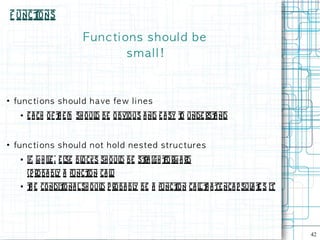
Fu n c t i on s


                  41
F unct
         ions

                            Fu n c ti on s s h ou l d b e
                                       smal l !


●
    fu n c t i on s s h ou l d h a ve fe w l i n e s
      ●   e a ch of t e m sh oul be o bvio us a nd e a sy t unde rst nd
                     h          d                          o       a


●
    fu n c t i on s s h ou l d n ot h ol d n e s te d s t ru c t u re s
      ●   if, w h il , e l bl cks sh o ul be st igh t
                    e se o               d    ra     forw a rd
          (p roba bl a funct ca l)
                    y       ion  l
      ●   t e condit na l sh oul p roba bl be a funct n ca l t a te nca p sul t s it
          h         io          d         y          io     lh               a e


                                                                                       42
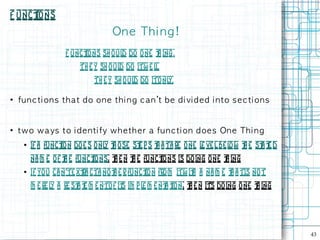
F unct
     ions
                                     On e Th i n g !
                    F unct
                         ions sh oul do one t ing.
                                    d       h
                         Th e y sh oul do itw e l.
                                      d          l
                              Th e y sh o ul do itonl
                                            d        y.

●
    fu n c ti on s t h a t d o on e t h i n g c an 't b e d i vi d e d i n t o s e c t i on s


●
    t w o w a ys t o i d e n t i fy w h e th e r a fu n c t i on d oe s On e Th i n g
     ●   if a funct do e s onl t ose st p s t a ta re one l ve l be l w t e st t d
                  ion         y h      e    h              e         o h     a e
         na m e of t e funct
                   h        ions, t e n t e funct ns is do ing one t ing
                                  h     h       io                  h
     ●   If you ca n'te xt cta no t e r funct n from itw it a na m e t a tis no t
                         ra       h         io             h         h
         m e re l a re st t m e ntof it im p l m e nt t
                 y       a e           s      e      a ion, t e n it doing o ne t ing
                                                            h      's           h


                                                                                                43
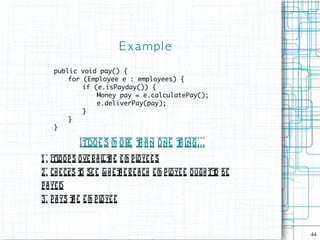
E xampl e

    public void pay() {
        for (Employee e : employees) {
            if (e.isPayday()) {
                Money pay = e.calculatePay();
                e.deliverPay(pay);
            }
        }
    }

             Itdoe s m ore t a n one t ing. . .
                           h          h
1 . itl op s ove r a l t e e m p l e s
       o              lh          oye
2 . ch e cks t se e w h e t e r e a ch e m p l e ough tt be
              o            h                  oye       o
p a ye d
3. p a ys t e e m p l ye e
          h          o


                                                              44
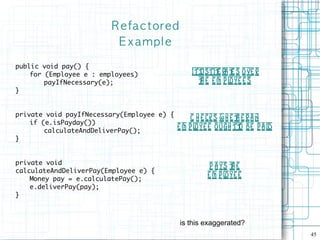
R e fa c t ore d
                          E xampl e

public void pay() {
    for (Employee e : employees)                Itj it ra t s ove r
                                                  ust e e
        payIfNecessary(e);                        t e em pl es
                                                   h       oye
}


private void payIfNecessary(Employee e) {
                                                 C h e cks w h e t e r a n
                                                                  h
    if (e.isPayday())
        calculateAndDeliverPay();
                                            e m p l e o ugh tt be p a id
                                                   oye             o
}


private void
                                                      P a ys t e
                                                              h
calculateAndDeliverPay(Employee e) {
    Money pay = e.calculatePay();
                                                     e m p l ye e
                                                            o
    e.deliverPay(pay);
}


                                            is this exaggerated?
                                                                             45
F unct
     ions


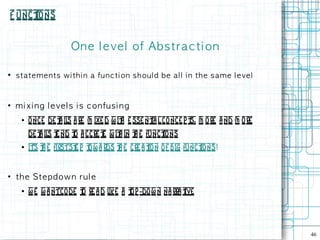
                         On e l e ve l of Ab s t ra c t i on

●
    s t a t e m e n t s w i th i n a fu n c t i on s h ou l d b e a l l i n th e s a m e l e ve l


●
    m i x i n g l e ve l s i s c on fu s i n g
      ●   o nce de t il a re m ixe d w it e sse nt l conce p t m ore a nd m ore
                    a s                 h        ia           s,
          de t il t nd t a ccre t w it in t e funct
              a s e     o       e     h   h       ions
      ●   it t e firstst p t a rds t e cre a t of big funct
           's h         e ow        h        ion           ions!


●
    t h e St e p d ow n ru l e
      ●   w e w a ntcode t re a d l a t -do w n na rra t
                         o         ike op              ive


                                                                                                    46
F unct
     ions


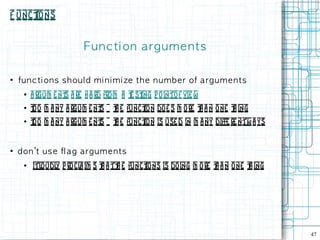
                          Fu n c ti on a rg u m e n t s

●
    fu n c ti on s s h ou l d m i n i m i ze t h e n u m b e r of a rg u m e n ts
     ●   a rgum e nt a re h a rd from a t st p o into f vie w
                    s                   e ing
     ●   t o m a ny a rgum e nt = t e funct doe s m o re t a n o ne t ing
         o                    s h         ion             h         h
     ●   t o m a ny a rgum e nt = t e funct is use d in m a ny diffe re ntw a ys
         o                    s h         ion


●
    d on 't u s e fl ag arg u m e n t s
     ●   itloudl p ro cl im s t a tt e funct
                y       a     h     h       ions is doing m o re t a n one t ing
                                                                 h          h


                                                                                    47
F unct
     ions


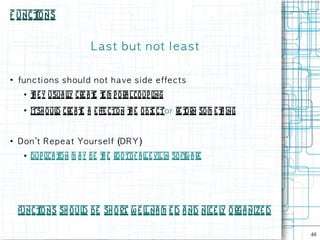
                             L as t b u t n ot l e a s t

●
    fu n c ti on s s h ou l d n ot h a ve s i d e e ffe c t s
     ●   t e y usua ly cre a t t m p ora l co up l
         h          l         e e                 ing
     ●
         itsh o ul cre a t a e ffe cton t e obj ctor re t so m e t ing
                  d       e              h    e         urn       h


●
    Don 't R e p e a t You rs e l f (DR Y)
     ●   dup l t n m a y be t e rooto f a l e vil in soft a re
              ica io         h             l            w


    functions sh o ul be sh ort w e l na m e d a nd nice l orga nize d
                     d         ,     l                    y

                                                                         48
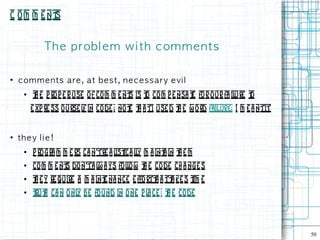
Com m e n t s


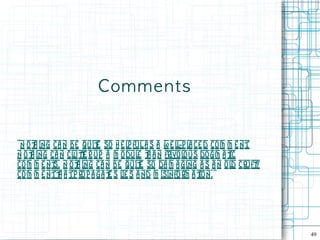
”N o t ing ca n be quit so h e l ful a s a w e l-p l ce d com m e nt
     h                  e        p              l a                 .
N o t ing ca n cl t r up a m odul t a n frivo l
    h            ute               e h            ous do gm a t
                                                              ic
co m m e nt N ot ing ca n be quit so da m a ging a s a n ol cruft
           s.     h                 e                          d      y
co m m e ntt a tp rop a ga t s l s a nd m isinfo rm a t ”
            h              e ie                       ion.


                                                                          49
C o m m e nt
           s


             Th e p rob l e m w i th c om m e n t s

●
    c om m e n t s are , a t b e s t , n e c e s s ary e vi l
     ●   t e p ro p e r use o f com m e nt is t co m p e nsa t for our fa il
          h                              s     o              e             ure t
                                                                                o
         e xp re ss o urse l in code ; no t t a tI use d t e w ord failure; I m e a ntit
                            f             e h            h


●
    th ey l i e!
     ●   p ro gra m m e rs ca n'tre a l ica ly m a int in t e m
                                       ist l         a h
     ●   co m m e nt do n'ta l a ys folow t e code ch a nge s
                    s         w        l  h
     ●   t e y re quire a m a int na nce e ffo rtt a tt ke s t e
          h                     e                h     a      im
     ●   t h ca n o nl be found in o ne p l ce : t e code
          rut         y                    a      h


                                                                                           50
C o m m e nt
           s


               Cod e i s t h e on l y tru th


                                               51
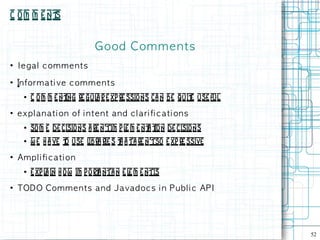
C o m m e nt
           s


                                Good Com m e n ts
●
    l e g a l c om m e n t s
●
    in form a ti ve c om m e n t s
      ●   C o m m e nt re gul r e xp re ssions ca n be quit use ful
                     ing     a                            e
●
    e x p l an at i on of i n t e n t an d c l a ri fi c at i on s
      ●   som e de cisions a re n'tim p l m e nt t de cisions
                                         e     a ion
      ●   w e h a ve t use l rie s t a ta re n'tso e xp re ssive
                      o     ibra    h
●
    Am p l i fi c a ti on
      ●   e xp l in h ow im p o rt nta n e l m e ntis
                a                a          e
●
    TODO Com m e n t s an d J avad oc s i n P u b l i c AP I


                                                                      52
53
why should we write
    beautiful code?

to feel good with ourselves


                              54
Bibliography
●   Wikipedia definition for Beauty, Golden Ratio,
    Minimalism. 2010.
●   Fred Brooks. The Mythical Man-Month:
    Essays on Software Engineering. 1975.
●   Dorthe Jørgensen. The Metamorphosis of
    Beauty. 2002.
●   The American Heritage Dictionary of the
    English Language, 4th Edition, 2000.


                                                     55
Bibliography
●   Robert C. Martin. Clean Code - A Handbook of Agile
    Software Craftsmanship. Prentice Hall. 2008.
●   Andy Oram and Greg Wilson. Beautiful Code.
    O'Reilly. 2007.
●   beaute(code) art exhibit by Bob Hanmer, Karen
    Hanmer, and Andrea Polli. Some material available at
     http://karenhanmer.com/gallery/?gallery=beautecode
    and http://www.andreapolli.com/beaute(code)
●   Interviews with experts
●   slides by João Machini de Miranda - IME/USP

                                                           56

Code Beauty

  • 1.
    Code Beauty Prof. Fabio Kon Department of Computer Science Institute of Mathematics and Statistics University of São Paulo SugarLoafPLoP'2010 - 24/9/2010 Salvador, Brazil 1
  • 2.
    Agenda ● Definition of Beauty ● Is Code Beauty important for Software Development? ● What is Code Beauty 2
  • 3.
    Beauty - AncientView ● pre-socratic (e.g., Pythagoras): strong connection among Beauty and Mathematics; objects with proportions following the golden ratio are more attractive to the human brain ● two quantities are in the golden ratio if the ratio of the sum of the quantities to the larger quantity is equal to the ratio of the larger quantity to the smaller one. The golden ratio is an irrational mathematical constant, approximately 1.6180339887 ● greek architecture is based on symmetry and on the golden ratio 3
  • 4.
    Beauty - RomanticView ● works do not need to be harmoniously proportioned and constitute a well-rounded whole to be beautiful; on the contrary, dissonance and fragmentation is beautiful ● more precisely: dissonance and fragmentation allude to a harmony and wholeness that is not in the work 4
  • 5.
    Beauty - ModernistView ● architect Mies van der Rohe: “Less is More” ~ 1940 ● designer Buckminster Fuller (geodesic dome) adopted the engineer's goal of “Doing more with less” ● writer Antoine de Saint Exupéry (1939) “perfection is attained not when there is nothing more to add, but when there is nothing more to remove” 5
  • 6.
    Beauty: Post-modernist view ● architect Robert Venturi: “Less is a Bore”, let's do whatever people like 6
  • 7.
    the greek andmodernist views of beauty provide us with a good basis for approaching Beauty in Science and Technology 7
  • 8.
    Science make everything assimple as possible, but not simpler 8
  • 9.
    Technology Conceptual integrity – the architect or team of architects should develop an idea of what the system should do and make sure this vision is understood by the rest of the team – to ensure a user-friendly system, a system may deliberately provide fewer features than it is capable of 9
  • 10.
    Beauty dictionary definition thequality that gives pleasure to the mind or senses and is associated with such properties as – harmony of form or color, – excellence of artistry, – truthfulness, – and originality. The American Heritage Dictionary of the English Language, 4th Edition, 2000. 10
  • 11.
    Does it matter? Why are we talking about Code Beauty on a “serious” Software Conference??? ● personally, I have two reasons... 11
  • 12.
    there has been a strong movement towards managing software development projects as any other production process/system ● many cases of managers that have never written a single line of code ● is it possible to have a good Chef de Cuisine that has never cooked in his life? 12
  • 13.
    scientists/engineers/practitioners sometimes tend to overestimate the power of science and mathematics ● can science and engineering provide all what's needed to explain life? and software development? 13
  • 14.
    What is SoftwareDevelopment? – Modeling (Jacobsen) – Engineering (Meyer) – Discipline (Humphreys) – Poetry (Cockburn) – Craft (Knuth) – Art (Gabriel) (from from Alistair Cockburn) ● Common mistake: look at software as only one of the above items. 14
  • 15.
    our goal here, is to bring attention to a few important aspects of software development that are neglected in some software engineering communities ● we'll look at the most important deliverable on a software project: The Code 15
  • 16.
    Beauty is fundamental vinicius de morais Beautiful code – brings pleasure to the reader – makes the writer happy – makes working in groups fun This leads to – fewer bugs – maintainability – team productivity – in other words, Quality 16
  • 17.
    In Software Development, Beauty Leads to Quality 17
  • 18.
    What is Beautyin Software Development? sources: ● Robert C. Martin. Clean Code - A Handbook of Agile Software Craftsmanship. Prentice Hall. 2008. ● Andy Oram and Greg Wilson. Beautiful Code. O'Reilly. 2007. ● beaute(code) art exhibit by Bob Hanmer, Karen Hanmer, and Andrea Polli. ● exchange with experts 18
  • 19.
    Rebecca Wirfs-Brock's codebeauty ●it is a common recognition that these idioms and those structures and those ways of doing things are of value ●it is important that a project or a team have the same sense of aesthetics or there will be clashes of will ●keeping of every step in a method at the same level of abstraction/intention; it reads much more like prose that way ●characteristics that are "normally" present in beautiful code are balance, effectiveness, expressiveness, and profoundly doing well what it was designed to do. 19
  • 20.
    Rebecca's example ofa beautiful code ● the Smalltalk class collection ●provide all the built in behavior by requiring subclasses to implement three methods: ●add: anObject ●remove: anObject ifAbsent: exceptionBlock ●do: aBlock ● methods in the abstract class collection to add, remove, check for emptiness, inclusion, occurrences, and to step through a collection in different ways accumulating values… are all implemented use these abstract building blocks or invoking other defined behaviors that depend on these implementation; elegant, beautiful reuse! 20
  • 21.
    Joe Yoder's codebeauty ● I think it is important to most of us who live there; it is like cleaning up our living area, having clean code or beautiful code can make life much better ●however let's face it, BBoM still thrive and exist and are successful ●it matters, but is not necessary and sufficient for successful software projects. If so, then Clean Code would become the norm ● those of us who care strive for it because we believe it is the right thing to do and it will help us in the long run...but certain forces are in play that can make clean code or beautiful code a goal that is very hard to achieve 21
  • 22.
    Joe's example ofa beautiful code ● also the Smalltalk class collection ● you see a certain beauty and elegance in the system as it was easy to understand and extend ● (it's also my favorite piece of code :-) ●design patterns can help with this as well; if a system is clean and well designed by implementing some of the best known principles and practices one can see certain beauty in the system 22
  • 23.
    W h atis C l a n C ode ? e “I l m y co de t be e l e g a n t a nd ike o e ffi c i e n t. Th e l gic sh o ul be o d s t ra i g h forw a rd t m a ke it h a rd o fo r bugs to h ide , te h dependenc i es mi ni mal to ease mai ntenanc e, e rror h a n d l i n g c om p l e t e a cco rding t o an a rt a t d icul e st t gy, ra e a nd p e rform a n c e c l os e to op t i m a l so a s not t t m p t p e op l t m a ke o e e o t e co de m e ssy w it unp rincip l d h h e op t iza t im ions. Cl e a n c od e d oe s on e t h i n g w e l l .” Bjarne Stroustrup Inventor of C++ 23
  • 24.
    W h atis C l a n C ode ? e “C l a n co de is s i m p l e a nd d i re c t. e C l a n co de re a d s l i k e w e l l - e w ri t te n p ros e . C l a n code ne ve r e obscure s t e de signe r's int nt but h e ra t e r is ful o f crisp [cl a rl de fine d] h l e y a bst ct ns a nd s tra i g h forw a rd ra io l s o f co nt l ” ine ro . Grady Booch Author of Object Oriented Analysis and Design with Applications 24
  • 25.
    W h atis C l a n C ode ? e “Cl e a n c od e c a n b e re ad , a nd e nh a nce d by a de ve l p e r o t e r t a n o h h it origina l a ut or I t h a s u n i t a n d s h . ac c eptanc e tests. It h a s m e a n i n g fu l n am e s . It p rovide s on e w a y ra t e r t a n m a ny w a ys h h fo r do ing o ne t ing. It h a s m i n i m a l h dependenc i es, w h ich a re e xp l l de fine d, a nd p ro vide s a icity cl a r a nd m i n i m a l AP I . C ode e sh o ul be l i te ra t e since de p e nding d on t e l ngua ge , not a l ne ce ssa ry h a l info rm a t n ca n be e xp re sse d io Dave Thomas cl a rl in code a l ne . ” e y o Founder of OTI, godfather of the Eclipse Strategy 25
  • 26.
    W h atis C l a n C ode ? e “I co ul l a l o f t e qua l ie s t a t I d ist l h it h no t ice in cl a n code , but t e re is e h one ove ra rch ing qua l y t a t l a ds t it h e o a l o f t e m . Cl e a n c od e a l w a ys l h l ook s i t w a s w ri t t e n b y s om e on e w h o c a re s . Th e re i s n ot h i n g obvi ou s t h a t you c a n d o t o m a k e i t b e tt e r. A l of l t o se t ings w e re t o ugh t a bo ut by h h h t e co de 's a ut or a nd if you t t h h , ry o im a gine im p ro ve m e nt yo u're l d s, e ba ck t w h e re you a re , siting in o t a p p re cia t n o f t e code som e one io h l ft fo r yo u – c od e l e ft b y e Michael Feathers Author of Working Effectively s om e on e w h o c are s d e e p l y With Legacy Code a b ou t th e c ra ft. ” 26
  • 27.
    W h atis C l a n C ode ? e “In re ce ntye a rs I be gin, a nd ne a rl y e nd, w it B e ck's rul s of sim p l h e e co de . In p rio rit o rde r, sim p l code : y e • R u n s al l t e s t s • Con ta i n s n o d u p l i c a t i on • E x p re s s e s al l t h e d e s i g n i d e a s t a ta re in t e syst m h h e • Mi n i m i ze s th e n u m b e r of e n t i ti e s such a s cl sse s, m e t o ds, a h funct ions, a nd t e l . ” h ike Ron Jeffries Author of Extreme Programming Installed 27
  • 28.
    W h atis C l a n C ode ? e Y o u kno w you a re w orking on cl a n e co de w h e n e a c h rou ti n e you re a d tu rn s ou t t o be p re t t y m u c h w h at you e x p e c t e d . Y o u ca n ca l it b e a u t i fu l code w h e n t e l h co de s a l m a k e s i t l ook l i k e so t h e l a n g u a g e w a s m a d e for t h e p rob l e m . ” Ward Cunningham Inventor of Wiki, Fit and much more ”Godfather of all those who care about code” 28
  • 29.
    W h atis C l a n C ode ? e W it outo bvio us h S im p le im p rove m e nt s E fficie nt S t igh t rw a rd ra fo E xp re ssive C o nt ins no a Turns outt be w h a t o dup l t ica ions you e xp e ct d e R uns a l t st le s F ul o f m e a ning l L it ra l e R e a ds w e ll B e a u t i fu l : when M inim a l th e l anguage was W rite n by t made for th e som e one w h o p rob l e m ca re s 29
  • 30.
    language may influence /*C Language */ #include <stdio.h> #define NumLines 10 /* number of lines */ main(argc,argv) int argc; char **argv; { int tri[NumLines][NumLines], /* triangle */ r,c,i; /* row, column, misc index */ /* initialize array */ for (r=0;r<NumLines;r++) { tri[r][0]=1; for (c=1;c<NumLines;c++) { tri[r][c]=0; }; /* generate triangle */ tri[0][0]=1; for (r=1;r<NumLines;r++){ for (c=1;c<NumLines;c++) { tri[r][c]=tri[r-1][c] + tri[r-1][c-1]; } }; /* print triangle */ for (r=0;r<NumLines;r++){ for (i=0;i < ((NumLines-r-1)/2);i++) printf(" "); if (r%2 == 0) printf(" "); for (c=0;c<NumLines;c++){ if (tri[r][c] != 0) printf("%3d ",tri[r][c]); }; printf("n"); } } source: http://www.andreapolli.com/beaute%28code%29/good_bad_ugly/pascal.html 30
  • 31.
    let's get alittle more technical 31
  • 32.
    Me an in g fu l Names 32
  • 33.
    M e aningful N a m e s N a m e s are vi t a l ! ● C ode is ba sica ly na m e s a nd re se rve d w o rds l ● C h o o sing go od na m e s t ke s t e butsa ve s a im m o re t a n itt ke s h a ● N a m e s sh oul be e xp re ssive a nd sh o ul d d a nsw e r que st ns io 33
  • 34.
    M e aningful N a m e s E xampl e public List<int[]> getThem() { List<int[]> list1 = new ArrayList<int[]>(); for (int[] x : theList) if(x[0] == 4) list1.add(x); return list1; } 34
  • 35.
    M e aningful N a m e s E xampl e public List<int[]> getThem() { List<int[]> list1 = new ArrayList<int[]>(); for (int[] x : theList) if(x[0] == 4) list1.add(x); return list1; } M a ny do ubt a rise . . . s 1 . W h a tdoe s t is m e t od ge t h h ? 2 . W h a tkinds o f t ings a re in t e L ist h h ? 3. W h a tis t e im p ort nce of t e ze rot p osit h a h h ion? 4. W h a tis t e significa nce o f t e va l 4? h h ue 35
  • 36.
    M e aningful N a m e s E xampl e public List<int[]> getThem() { List<int[]> list1 = new ArrayList<int[]>(); for (int[] x : theList) if(x[0] == 4) list1.add(x); return list1; } W h a ta bo utt is h code ? public List<int[]> getFlaggedCells() { List<int[]> flaggedCells = new ArrayList<int[]>(); for (int[] cell : gameBoard) if(cell[STATUS_VALUE] == FLAGGED) flaggedCells.add(cell); return flaggedCells; } 36
  • 37.
    M e aningful N a m e s E xampl e public List<int[]> getFlaggedCells() { List<int[]> flaggedCells = new ArrayList<int[]>(); for (int[] cell : gameBoard) if(cell[STATUS_VALUE] == FLAGGED) flaggedCells.add(cell); return flaggedCells; } P robl m e sol d! ve 1 . W h a tdo e s t is m e t o d ge t Itge t a l fl gge d ce ls! h h ? s l a l 2 . W h a tkinds o f t ings a re in t e L ist t e L istis a ga m e B oa rd file d w it h h ? h l h ce ls! l 3. W h a tis t e im p o rt nce of t e ze rot p osit n? Th a t t e S t t Va l ! h a h h io 's h a us ue 4. W h a tis t e significa nce o f t e va l 4? Itm e a ns itis fl gge d! h h ue a 37
  • 38.
    M e aningful N a m e s E xampl e public List<int[]> getFlaggedCells() { List<int[]> flaggedCells = new ArrayList<int[]>(); for (int[] cell : gameBoard) if(cell[STATUS_VALUE] == FLAGGED) flaggedCells.add(cell); return flaggedCells; } G oing furt e r . . h . public List<Cell> getFlaggedCells() { List<Cell> flaggedCells = new ArrayList<Cell>(); for (Cell cell : gameBoard) if(cell.isFlagged()) flaggedCells.add(cell); return flaggedCells; Th i s i s p re t ty } muc h wh at you e x p e c te d ! 38
  • 39.
    Ch a ng e s s h ou l d b e e as y! To m a ke ch a nge s, w e ne e d t unde rst nd t e o a h ● Us e R e a d ab l e n am e s co de ! ● X Y Z C o nt l rH a ndl role ingO fS trings != X Y Z C ont le rS t ge O fS t ro l ora rings ● Us e Se a rc h a b l e n am e s ● Us e t h e L an g u ag e St an d a rd s ● Us e Sol u t i on Dom a i n n a m e s ● U se p a te rn a nd a l t gorit m na m e s, m a t t rm s, … h h e ● Us e P rob l e m Dom a i n n a m e s ● Don 't c on fu s e t h e re a d e r ● U se t e ”O ne W ord P e r C o nce p t rul h ” e ● D o n'tuse j s, m ind m a p p ings, h unga ria n no t t oke a ion, . . . 39
  • 40.
    M e aningful N a m e s Con c l u s i on ● itis e a sy t sa y t a tna m e s sh oul re ve a l int nt W h a t o h d e . w e w a ntt im p re ss up o n yo u is t a tw e a re s e rio us a bo ut o h t is h ● sh o rtna m e s a re ge ne ra ly be te r t a n l nge r o ne s, so l t h o l ng a s t e y a re cl a r (do notp ro m o t obscurit t sa ve a o h e e y o co up l o f ke yst ke s) e ro ● i f you fi n d a b a d n a m e , c h a n g e i t n ow ! 40
  • 41.
    Fu n ct i on s 41
  • 42.
    F unct ions Fu n c ti on s s h ou l d b e smal l ! ● fu n c t i on s s h ou l d h a ve fe w l i n e s ● e a ch of t e m sh oul be o bvio us a nd e a sy t unde rst nd h d o a ● fu n c t i on s s h ou l d n ot h ol d n e s te d s t ru c t u re s ● if, w h il , e l bl cks sh o ul be st igh t e se o d ra forw a rd (p roba bl a funct ca l) y ion l ● t e condit na l sh oul p roba bl be a funct n ca l t a te nca p sul t s it h io d y io lh a e 42
  • 43.
    F unct ions On e Th i n g ! F unct ions sh oul do one t ing. d h Th e y sh oul do itw e l. d l Th e y sh o ul do itonl d y. ● fu n c ti on s t h a t d o on e t h i n g c an 't b e d i vi d e d i n t o s e c t i on s ● t w o w a ys t o i d e n t i fy w h e th e r a fu n c t i on d oe s On e Th i n g ● if a funct do e s onl t ose st p s t a ta re one l ve l be l w t e st t d ion y h e h e o h a e na m e of t e funct h ions, t e n t e funct ns is do ing one t ing h h io h ● If you ca n'te xt cta no t e r funct n from itw it a na m e t a tis no t ra h io h h m e re l a re st t m e ntof it im p l m e nt t y a e s e a ion, t e n it doing o ne t ing h 's h 43
  • 44.
    E xampl e public void pay() { for (Employee e : employees) { if (e.isPayday()) { Money pay = e.calculatePay(); e.deliverPay(pay); } } } Itdoe s m ore t a n one t ing. . . h h 1 . itl op s ove r a l t e e m p l e s o lh oye 2 . ch e cks t se e w h e t e r e a ch e m p l e ough tt be o h oye o p a ye d 3. p a ys t e e m p l ye e h o 44
  • 45.
    R e fac t ore d E xampl e public void pay() { for (Employee e : employees) Itj it ra t s ove r ust e e payIfNecessary(e); t e em pl es h oye } private void payIfNecessary(Employee e) { C h e cks w h e t e r a n h if (e.isPayday()) calculateAndDeliverPay(); e m p l e o ugh tt be p a id oye o } private void P a ys t e h calculateAndDeliverPay(Employee e) { Money pay = e.calculatePay(); e m p l ye e o e.deliverPay(pay); } is this exaggerated? 45
  • 46.
    F unct ions On e l e ve l of Ab s t ra c t i on ● s t a t e m e n t s w i th i n a fu n c t i on s h ou l d b e a l l i n th e s a m e l e ve l ● m i x i n g l e ve l s i s c on fu s i n g ● o nce de t il a re m ixe d w it e sse nt l conce p t m ore a nd m ore a s h ia s, de t il t nd t a ccre t w it in t e funct a s e o e h h ions ● it t e firstst p t a rds t e cre a t of big funct 's h e ow h ion ions! ● t h e St e p d ow n ru l e ● w e w a ntcode t re a d l a t -do w n na rra t o ike op ive 46
  • 47.
    F unct ions Fu n c ti on a rg u m e n t s ● fu n c ti on s s h ou l d m i n i m i ze t h e n u m b e r of a rg u m e n ts ● a rgum e nt a re h a rd from a t st p o into f vie w s e ing ● t o m a ny a rgum e nt = t e funct doe s m o re t a n o ne t ing o s h ion h h ● t o m a ny a rgum e nt = t e funct is use d in m a ny diffe re ntw a ys o s h ion ● d on 't u s e fl ag arg u m e n t s ● itloudl p ro cl im s t a tt e funct y a h h ions is doing m o re t a n one t ing h h 47
  • 48.
    F unct ions L as t b u t n ot l e a s t ● fu n c ti on s s h ou l d n ot h a ve s i d e e ffe c t s ● t e y usua ly cre a t t m p ora l co up l h l e e ing ● itsh o ul cre a t a e ffe cton t e obj ctor re t so m e t ing d e h e urn h ● Don 't R e p e a t You rs e l f (DR Y) ● dup l t n m a y be t e rooto f a l e vil in soft a re ica io h l w functions sh o ul be sh ort w e l na m e d a nd nice l orga nize d d , l y 48
  • 49.
    Com m en t s ”N o t ing ca n be quit so h e l ful a s a w e l-p l ce d com m e nt h e p l a . N o t ing ca n cl t r up a m odul t a n frivo l h ute e h ous do gm a t ic co m m e nt N ot ing ca n be quit so da m a ging a s a n ol cruft s. h e d y co m m e ntt a tp rop a ga t s l s a nd m isinfo rm a t ” h e ie ion. 49
  • 50.
    C o mm e nt s Th e p rob l e m w i th c om m e n t s ● c om m e n t s are , a t b e s t , n e c e s s ary e vi l ● t e p ro p e r use o f com m e nt is t co m p e nsa t for our fa il h s o e ure t o e xp re ss o urse l in code ; no t t a tI use d t e w ord failure; I m e a ntit f e h h ● th ey l i e! ● p ro gra m m e rs ca n'tre a l ica ly m a int in t e m ist l a h ● co m m e nt do n'ta l a ys folow t e code ch a nge s s w l h ● t e y re quire a m a int na nce e ffo rtt a tt ke s t e h e h a im ● t h ca n o nl be found in o ne p l ce : t e code rut y a h 50
  • 51.
    C o mm e nt s Cod e i s t h e on l y tru th 51
  • 52.
    C o mm e nt s Good Com m e n ts ● l e g a l c om m e n t s ● in form a ti ve c om m e n t s ● C o m m e nt re gul r e xp re ssions ca n be quit use ful ing a e ● e x p l an at i on of i n t e n t an d c l a ri fi c at i on s ● som e de cisions a re n'tim p l m e nt t de cisions e a ion ● w e h a ve t use l rie s t a ta re n'tso e xp re ssive o ibra h ● Am p l i fi c a ti on ● e xp l in h ow im p o rt nta n e l m e ntis a a e ● TODO Com m e n t s an d J avad oc s i n P u b l i c AP I 52
  • 53.
  • 54.
    why should wewrite beautiful code? to feel good with ourselves 54
  • 55.
    Bibliography ● Wikipedia definition for Beauty, Golden Ratio, Minimalism. 2010. ● Fred Brooks. The Mythical Man-Month: Essays on Software Engineering. 1975. ● Dorthe Jørgensen. The Metamorphosis of Beauty. 2002. ● The American Heritage Dictionary of the English Language, 4th Edition, 2000. 55
  • 56.
    Bibliography ● Robert C. Martin. Clean Code - A Handbook of Agile Software Craftsmanship. Prentice Hall. 2008. ● Andy Oram and Greg Wilson. Beautiful Code. O'Reilly. 2007. ● beaute(code) art exhibit by Bob Hanmer, Karen Hanmer, and Andrea Polli. Some material available at http://karenhanmer.com/gallery/?gallery=beautecode and http://www.andreapolli.com/beaute(code) ● Interviews with experts ● slides by João Machini de Miranda - IME/USP 56