IMPORTANCE OF
CODD’S RULES
Presented by: George Alvina Verghis (PG-19-115)
Database Model
◦ A Database model defines the logical design of data. The model describes the relationships
between different parts of the data. Historically, in database design, three models are
commonly used. They are as follows
◦ Hierarchical Model
◦ Network Model
◦ Relational Model
Hierarchical Model
◦ In this model each entity has only one parent but can have several children . At the
top of hierarchy there is only one entity which is called Root
◦ Data is grouped into clusters at one or more levels, and this model follows a tree-like
structure
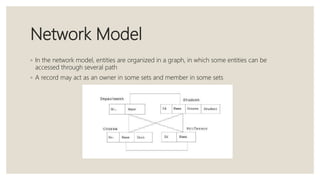
Network Model
◦ In the network model, entities are organized in a graph, in which some entities can be
accessed through several path
◦ A record may act as an owner in some sets and member in some sets
Relational Model
◦ In this model, data is organized in two - dimensional tables called relations. The tables or
relation are related to each other
◦ This model represents how data is stored in relational databases
RDBMS Concept
◦ A Relational Database management System(RDBMS) is a database management system
based on relational model introduced by E.F Codd. In relational model, data is represented in
terms of tuples(rows)
◦ RDBMS is used to manage Relational database. Relational database is a collection of
organized set of tables from which data can be accessed easily. Relational Database is most
commonly used database. It consists of number of tables and each table has its own primary
key
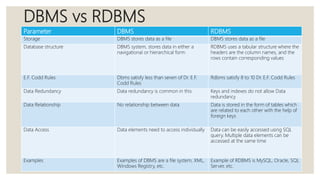
DBMS vs RDBMS
Parameter DBMS RDBMS
Storage DBMS stores data as a file DBMS stores data as a file
Database structure DBMS system, stores data in either a
navigational or hierarchical form
RDBMS uses a tabular structure where the
headers are the column names, and the
rows contain corresponding values
E.F. Codd Rules Dbms satisfy less than seven of Dr. E.F.
Codd Rules
Rdbms satisfy 8 to 10 Dr. E.F. Codd Rules
Data Redundancy Data redundancy is common in this Keys and indexes do not allow Data
redundancy
Data Relationship No relationship between data Data is stored in the form of tables which
are related to each other with the help of
foreign keys
Data Access Data elements need to access individually Data can be easily accessed using SQL
query. Multiple data elements can be
accessed at the same time
Examples Examples of DBMS are a file system, XML,
Windows Registry, etc.
Example of RDBMS is MySQL, Oracle, SQL
Server, etc.
Codd's Rule
◦ E.F Codd was a Computer Scientist who invented Relational model for Database
management. Based on relational model, Relation database was created. Codd proposed 13
rules popularly known as Codd's 12 rules to test DBMS's concept against his relational model
◦ Codd's rule actually define what quality a DBMS requires in order to become a Relational
Database Management System(RDBMS). Till now, there is hardly any commercial product that
follows all the 13 Codd's rules. Even Oracle follows only eight and half out(8.5) of 13. The
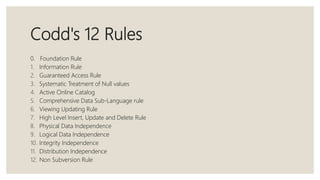
Codd's 12 rules are as follows
Codd's 12 Rules
0. Foundation Rule
1. Information Rule
2. Guaranteed Access Rule
3. Systematic Treatment of Null values
4. Active Online Catalog
5. Comprehensive Data Sub-Language rule
6. Viewing Updating Rule
7. High Level Insert, Update and Delete Rule
8. Physical Data Independence
9. Logical Data Independence
10. Integrity Independence
11. Distribution Independence
12. Non Subversion Rule
Conclusion
Codd’s 12 rules for relational databases can be used to explain much about how SQL Server
operates today. These rules were a major step forward in determining whether a database
vendor could call his system “relational” and presented stiff implementation challenges for
database developers. Fifteen years on, even the implementation of the most complex of these
rules is becoming achievable, though SQL Server (and other RDBMSs) still fall short of achieving
all their objectives

Codds rule

  • 1.
    IMPORTANCE OF CODD’S RULES Presentedby: George Alvina Verghis (PG-19-115)
  • 2.
    Database Model ◦ ADatabase model defines the logical design of data. The model describes the relationships between different parts of the data. Historically, in database design, three models are commonly used. They are as follows ◦ Hierarchical Model ◦ Network Model ◦ Relational Model
  • 3.
    Hierarchical Model ◦ Inthis model each entity has only one parent but can have several children . At the top of hierarchy there is only one entity which is called Root ◦ Data is grouped into clusters at one or more levels, and this model follows a tree-like structure
  • 4.
    Network Model ◦ Inthe network model, entities are organized in a graph, in which some entities can be accessed through several path ◦ A record may act as an owner in some sets and member in some sets
  • 5.
    Relational Model ◦ Inthis model, data is organized in two - dimensional tables called relations. The tables or relation are related to each other ◦ This model represents how data is stored in relational databases
  • 6.
    RDBMS Concept ◦ ARelational Database management System(RDBMS) is a database management system based on relational model introduced by E.F Codd. In relational model, data is represented in terms of tuples(rows) ◦ RDBMS is used to manage Relational database. Relational database is a collection of organized set of tables from which data can be accessed easily. Relational Database is most commonly used database. It consists of number of tables and each table has its own primary key
  • 7.
    DBMS vs RDBMS ParameterDBMS RDBMS Storage DBMS stores data as a file DBMS stores data as a file Database structure DBMS system, stores data in either a navigational or hierarchical form RDBMS uses a tabular structure where the headers are the column names, and the rows contain corresponding values E.F. Codd Rules Dbms satisfy less than seven of Dr. E.F. Codd Rules Rdbms satisfy 8 to 10 Dr. E.F. Codd Rules Data Redundancy Data redundancy is common in this Keys and indexes do not allow Data redundancy Data Relationship No relationship between data Data is stored in the form of tables which are related to each other with the help of foreign keys Data Access Data elements need to access individually Data can be easily accessed using SQL query. Multiple data elements can be accessed at the same time Examples Examples of DBMS are a file system, XML, Windows Registry, etc. Example of RDBMS is MySQL, Oracle, SQL Server, etc.
  • 8.
    Codd's Rule ◦ E.FCodd was a Computer Scientist who invented Relational model for Database management. Based on relational model, Relation database was created. Codd proposed 13 rules popularly known as Codd's 12 rules to test DBMS's concept against his relational model ◦ Codd's rule actually define what quality a DBMS requires in order to become a Relational Database Management System(RDBMS). Till now, there is hardly any commercial product that follows all the 13 Codd's rules. Even Oracle follows only eight and half out(8.5) of 13. The Codd's 12 rules are as follows
  • 9.
    Codd's 12 Rules 0.Foundation Rule 1. Information Rule 2. Guaranteed Access Rule 3. Systematic Treatment of Null values 4. Active Online Catalog 5. Comprehensive Data Sub-Language rule 6. Viewing Updating Rule 7. High Level Insert, Update and Delete Rule 8. Physical Data Independence 9. Logical Data Independence 10. Integrity Independence 11. Distribution Independence 12. Non Subversion Rule
  • 10.
    Conclusion Codd’s 12 rulesfor relational databases can be used to explain much about how SQL Server operates today. These rules were a major step forward in determining whether a database vendor could call his system “relational” and presented stiff implementation challenges for database developers. Fifteen years on, even the implementation of the most complex of these rules is becoming achievable, though SQL Server (and other RDBMSs) still fall short of achieving all their objectives