Coblation tonsillectomy, is it superior to cold steel method? Haider S Hashim, Ahmed M Al-Abbasi & Sabah Al-Urabi
Bas J Surg,June, 27, 2021
41
Basrah Journal Original Article
Of Surgery Bas J Surg, June, 27, 2021
COBLATION TONSILLECTOMY, IS IT SUPERIOR TO
COLD STEEL METHOD?
Haider Sabri Hashim*
, Ahmed M Al-Abbasi@
& Sabah Al-Urabi#
*MB,ChB, FIBMS Specialist in ORL-H&N Surgery, Basrah Teaching Hospital. @
MB,ChB, FIBMS,
FRCS, Professor of ORL-H&N Surgery, Department of Surgery, College of Medicine, University of
Basrah. #
MB,ChB, FIBMS, Specialist in ORL-H&N Surgery, Al-Shifaa Hospital, Basrah, IRAQ.
Abstract
Coblation tonsillectomy is a new technique that was started in 1975, it involves passing a
radiofrequency bipolar electrical current through a medium of normal saline, resulting in a
plasma field of highly ionized particles which in turn break down intercellular bonds and thus
melt tissue at around 40º to 70ºC (in comparison with electrocautery which cuts tissues at
400ºC)
The aim of this study is to evaluate the benefit of coblation tonsillectomy over conventional
(cold steel) tonsillectomy, comparing tonsillectomy duration, blood loss during the surgery, and
the postoperative pain.
This prospective randomised single-blinded clinical trial was done on 90 patients. Patients
were divided into 2 equal groups; Group A: Underwent coblation tonsillectomy, and Group B
who underwent cold steel tonsillectomy. The study was performed in Al-Musawy Private
Hospital, Basrah Teaching Hospital, and Al-shifaa hospital, Basrah, Iraq. All surgeries were
done by the three authors in the period between February 2018 to August 2020. The
intraoperative bleeding, duration of surgery, and postoperative pain were evaluated and
compared for both groups.
The age range of the studied patients was 4–32 years, 52 were males and 38 were females.
The average duration of tonsillectomy procedure was 31.8 minutes in coblation tonsillectomy
(Group A), while the average duration in the cold steel tonsillectomy (Group B) was 25.8
minutes. The average operative blood loss in cold steel tonsillectomy was 31.5 ml while that in
coblation was 3.2 ml. Average postoperative pain in coblation group was (20.7± 6.15), while in
cold steel group was (27.5±7.27).
In conclusion, coblation tonsillectomy is effective and beneficial in decreasing the volume of
intraoperative blood loss but not for postoperative pain in comparison with conventional method,
in addition that it take more time to be completed.
Key words: coblation, cold steel, tonsillectomy.
Introduction:
elsus was the first person to
recognize tonsillar disease and its
relationship to infection performing the
first tonsillectomy in 40 A.D1
. The tide
turned in the 1980s, when Paradise et al
demonstrated that surgery significantly
improved patient outcome compared with
medical therapy2
.
Chronic tonsillitis is one of the most
common and frequent illness within
otolaryngology. Tonsillectomy is also one
of the most frequently performed surgical
procedure3
. Improvements in the
procedure of tonsillectomy which are
many should have the advantage of
decreasing the operating time, reduction
in the intraoperative and postoperative
blood loss, and reduction in postoperative
morbidity namely pain.
Coblation is a new technique that was
started in 1975. It involves passing a
radiofrequency bipolar electrical current
through a medium of normal saline
resulting in a plasma field of highly
C
Coblation tonsillectomy, is it superior to cold steel method? Haider S Hashim, Ahmed M Al-Abbasi & Sabah Al-Urabi
Bas J Surg,June, 27, 2021
42
ionized particles, which in turn break
down intercellular bonds and thus melt
tissue at around 40º to 70ºC (in
comparison with electrocautery which
cuts tissues at 400º C)4
.
This study was carried out to evaluate the
benefit of coblation tonsillectomy over
conventional (cold steel) tonsillectomy,
comparing tonsillectomy duration, blood
loss during surgery, and the postoperative
pain.
Patients and methods
This is prospective, randomized, single-
blinded clinical trial included 90 patients.
Forty five randomly selected patients
underwent coblation tonsillectomy
(Group A), the later 45 patients
underwent cold steel tonsillectomy
(Group B). The study was carried out in
Al-Musawy Private Hospital, Basrah
Teaching Hospital and Al-Shifaa
Hospital, Basra, Iraq in the period
between February 2018 to August 2020.
The risk was mentioned to all the
patients. Some of them refused to take
part in the study, but all those who were
included accepted the possibility of risk
and gave their permission.
All of the included patients have
recurrent acute tonsillitis above 3 years of
age.
All patients with unilateral or
asymmetrically enlarged tonsils, those
who need adenoidectomy, or additional
procedure like myringotomy, and those
with bleeding tendency, were excluded.
All adult patients have paracetamol tab.
500mg thrice daily and 20mg/kg for
children for 7 days.
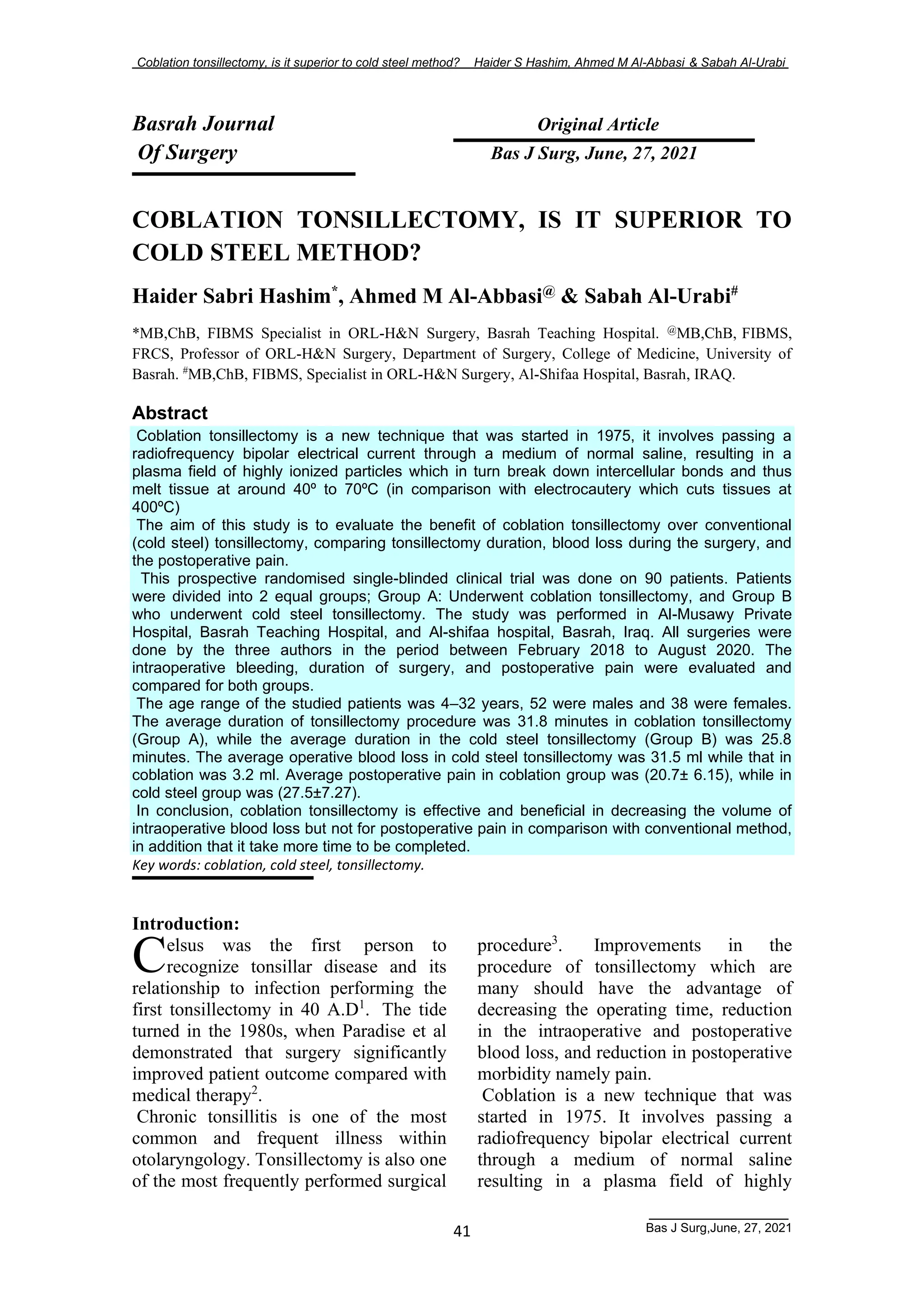
Figure 1: Coblation machine and probe.
Tonsillectomy operation duration was
calculated as the time interval between
the first application of coblator probe
(Figure 1) or first incision, to the time
when all bleeding and oozing was secured
completely. The operative blood loss was
calculated by weighing the blood
impregnated gauze packs against an equal
number of unused packs as well by
measuring the volume of blood for each
group separately. The volume of blood in
the packs was calculated by dividing the
weight of blood on the pack by the
specific gravity of blood (1.055)5
.
Patient's follow-up was performed at
operative day (after recovery), 1st, 3rd,
7th postoperative days in regard to pain.
Pain assessment was done using the
numeric pain rating scale for adult and
Wong baker faces scale for children (age
3 years and older), both scores from 0-10
(record from day 0,3,7,14), until returned
to normal diet and activity. The “Wong
baker faces” pain scale is a visual
analogue scale that uses faces rather a
line to identify the level of pain or
discomfort that the child is experiencing.
The children were asked by themselves or
by the assistance of parents to point the
“face” that best expresses the way that
they feel.
The results of the study were statistically
analyzed by using paired t-test for
significance.
Coblation tonsillectomy, is it superior to cold steel method? Haider S Hashim, Ahmed M Al-Abbasi & Sabah Al-Urabi
Bas J Surg,June, 27, 2021
43
Results
The age range of the studied patients was
4–32 years, 52 were males and 38 were
females. The average duration of
tonsillectomy procedure was 31.8
minutes in coblation tonsillectomy
(Group A), while the average duration in
the cold steel tonsillectomy (Group B)
was 25.8 minutes, which meant increment
in tonsillectomy duration in coblation
method. This is statistically not
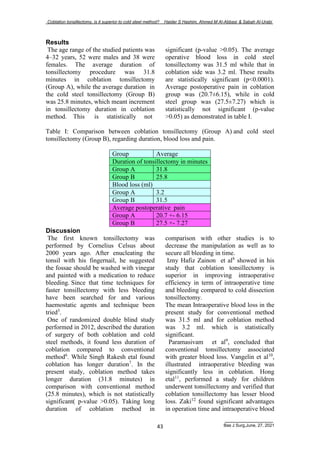
significant (p-value >0.05). The average
operative blood loss in cold steel
tonsillectomy was 31.5 ml while that in
coblation side was 3.2 ml. These results
are statistically significant (p<0.0001).
Average postoperative pain in coblation
group was (20.7±6.15), while in cold
steel group was (27.5±7.27) which is
statistically not significant (p-value
>0.05) as demonstrated in table I.
Table I: Comparison between coblation tonsillectomy (Group A) and cold steel
tonsillectomy (Group B), regarding duration, blood loss and pain.
Group Average
Duration of tonsillectomy in minutes
Group A 31.8
Group B 25.8
Blood loss (ml)
Group A 3.2
Group B 31.5
Average postoperative pain
Group A 20.7 +- 6.15
Group B 27.5 +- 7.27
Discussion
The first known tonsillectomy was
performed by Cornelius Celsus about
2000 years ago. After enucleating the
tonsil with his fingernail, he suggested
the fossae should be washed with vinegar
and painted with a medication to reduce
bleeding. Since that time techniques for
faster tonsillectomy with less bleeding
have been searched for and various
haemostatic agents and technique been
tried3
.
One of randomized double blind study
performed in 2012, described the duration
of surgery of both coblation and cold
steel methods, it found less duration of
coblation compared to conventional
method6
. While Singh Rakesh etal found
coblation has longer duration7
. In the
present study, coblation method takes
longer duration (31.8 minutes) in
comparison with conventional method
(25.8 minutes), which is not statistically
significant( p-value >0.05). Taking long
duration of coblation method in
comparison with other studies is to
decrease the manipulation as well as to
secure all bleeding in time.
Izny Hafiz Zainon et al8
showed in his
study that coblation tonsillectomy is
superior in improving intraoperative
efficiency in term of intraoperative time
and bleeding compared to cold dissection
tonsillectomy.
The mean Intraoperative blood loss in the
present study for conventional method
was 31.5 ml and for coblation method
was 3.2 ml. which is statistically
significant.
Paramasivam et al9
, concluded that
conventional tonsillectomy associated
with greater blood loss. Vangelin et al10
,
illustrated intraoperative bleeding was
significantly less in coblation. Hong
etal11
, performed a study for children
underwent tonsillectomy and verified that
coblation tonsillectomy has lesser blood
loss. Zaki12
found significant advantages
in operation time and intraoperative blood
Coblation tonsillectomy, is it superior to cold steel method? Haider S Hashim, Ahmed M Al-Abbasi & Sabah Al-Urabi
Bas J Surg,June, 27, 2021
44
loss compared with dissection
tonsillectomy.
Izny Hafiz Zainon et al8
, showed that
coblation tonsillectomy does have
superiority in decreasing bleeding
compared to cold dissection.
The marked difference in blood loss
between our study and other studies
probably due to taking long time in
coagulation in coblation to stop bleeding
during operation.
Regarding postoperative pain, some
studies reported no significant reduction
in pain with coblation surgery which is
agreeable with our study but Polites et
al13
, showed that coblation tonsillectomy
was significantly less painful specially in
the first 3 post-operative days. Timms et
al14
, suggested significant benefit of
coblation tonsillectomy in regard of
postoperative pain.
Jingjia Li et al15
, showed that coblation
method is a safe and effective technique
that is capable of reducing postoperative
pain and hemorrhage.
Izny Hafiz Zainon et al8
, stated that
coblation tonsillectomy associated with
minimal postoperative pain in comparison
with conventional method.
Braverman et al16
, stated fewer
intraoperative and postoperative
complications and less postoperative pain
were observed with coblation
In the present study the average
postoperative pain in coblation group was
(20.7±6.15), while in cold steel group
was (27.5±7.27) which is statistically not
significant (p-value >0.05), we suggested
that the slight decrement of postoperative
pain probably due to less manipulation
during coblation procedure.
Conclusion:
Coblation tonsillectomy is effective and
beneficial in decreasing the volume of
intraoperative blood loss but not for
postoperative pain in comparison with
conventional method, additionally, it
takes more time to be completed.
References
1. Curtin JM. The history of tonsil and adenoid surgery. Otolaryngol Clin North Am. 1987; 20:415–419.
2. Paradise JL, Bluestone CD, Bachman RZ, Colborn DK, Bernard BS, Taylor FH, et al. Efficacy of tonsillectomy for
recurrent throat infection in severely affected children - Results of parallel randomized and nonrandomized clinical trials. N
Engl J Med. 1984;310:674–683.
3. Hydrogen peroxide 3%: Is it beneficial in tonsillectomy. Al Abbasi, Ahmed M. ; Saeed, Zahra K. J. Arab Board Med.
Special. 2008; 9 (2): 19-22.
4. Philpott, C.M., A double-blinded randomized controlled trial of coblation versus conventional dissection tonsillectomy on
postoperative symptoms Clinical. Otolaryngology. 2005; 30: 143–148.
5. Agrawal SR, Jain AK, Marathe D, Agrawal R. The effect of bismuth sub-gallate as hemostatic agent in
tonsillectomy. Indian J Oto-laryngol. 2005;57:287–289.
6. Mohammadreza Omrani,et al Coblation versus traditional tonsille-ctomy: A double blind randomized controlled trial . J
Res Med Sci. 2012; 17(1): 45-50 69.
7. Singh Rakesh et al A Prospective, Randomized, Double-Blind Study of Coblation versus Dissection Tonsillectomy in
Adult Patients Indian Journal Otolaryngology Head Neck Surgery .2012;64(3):290–296
8.Izny Hafiz Zainon, Rosdan Salim, Mohd Khairi Md Daud. Coblation tonsillectomy versus dissection tonsillectomy: A
comparison of intraoperative time, intraoperative blood loss and post-operative pain. Med J Malaysia . 2014; 69:2 .
9. Paramasivam V K et al Randomised comparative study of adenotonsillectomy by conventional and coblation method for
children with obstructive sleep apnoea. Int J Pediatr Otorhinolaryngol. 2012;76 (6):816-21.
10. Comparison of Common Tonsillectomy Methods. M.A. SattarTajmira SultanaTajmira Sultana Vangelin G et al
Mymensingh Medical Journal.2016; 25(1):50-54.
11. Christopher Metcalfe, Jameel Muzaffar, Charles Daultrey & Christopher Coulson .Coblation tonsillectomy: a systematic
review and descriptive analysis.European Archives of Oto-Rhino-Laryngology.2017; 274:2637–2647.
12.Zaki M F. Coblation versus Traditional Tonsillectomy: A Double Blind Randomized Controlled Trial. Glob J Oto. 2017;
6(3).
13. N Polites et al Post operative pain following coblation tonsillectomy randomized control trail. ANZ Journal of Surgery
2006; 76: 226–229
14. Coblation tonsillectomy: A double blind randomized controlled study. Michael Steven TimmsMichael Steven TimmsR
H Temple.The Journal of Laryngology & Otology. 2002; 116(6):450-452.
15. Jingjia Li, Lixia Luo, Weixiong Chen , Jianli Zhang, Xuequan Deng, Lieqiang Liao, Xianping Zeng, Bin Wang.
Application of Coblation Tonsillectomy with Inferior Pole Capsule Preservation in Pediatric Patients .Laryngoscope,
2020;25
16. Braverman, I., Nemirovsky, A., Klein, A., Sarid, M. and Avior, G. Coblation Intracapsular Tonsillectomy and Coblation
Complete Tonsillectomy for Obstructive Sleep Apnea. International Journal of Otolaryngology and Head & Neck
Surgery.2015; 4:350-355.

coblation tonsillectomy. is it superior to cold steel method?

  • 1.
    Coblation tonsillectomy, isit superior to cold steel method? Haider S Hashim, Ahmed M Al-Abbasi & Sabah Al-Urabi Bas J Surg,June, 27, 2021 41 Basrah Journal Original Article Of Surgery Bas J Surg, June, 27, 2021 COBLATION TONSILLECTOMY, IS IT SUPERIOR TO COLD STEEL METHOD? Haider Sabri Hashim* , Ahmed M Al-Abbasi@ & Sabah Al-Urabi# *MB,ChB, FIBMS Specialist in ORL-H&N Surgery, Basrah Teaching Hospital. @ MB,ChB, FIBMS, FRCS, Professor of ORL-H&N Surgery, Department of Surgery, College of Medicine, University of Basrah. # MB,ChB, FIBMS, Specialist in ORL-H&N Surgery, Al-Shifaa Hospital, Basrah, IRAQ. Abstract Coblation tonsillectomy is a new technique that was started in 1975, it involves passing a radiofrequency bipolar electrical current through a medium of normal saline, resulting in a plasma field of highly ionized particles which in turn break down intercellular bonds and thus melt tissue at around 40º to 70ºC (in comparison with electrocautery which cuts tissues at 400ºC) The aim of this study is to evaluate the benefit of coblation tonsillectomy over conventional (cold steel) tonsillectomy, comparing tonsillectomy duration, blood loss during the surgery, and the postoperative pain. This prospective randomised single-blinded clinical trial was done on 90 patients. Patients were divided into 2 equal groups; Group A: Underwent coblation tonsillectomy, and Group B who underwent cold steel tonsillectomy. The study was performed in Al-Musawy Private Hospital, Basrah Teaching Hospital, and Al-shifaa hospital, Basrah, Iraq. All surgeries were done by the three authors in the period between February 2018 to August 2020. The intraoperative bleeding, duration of surgery, and postoperative pain were evaluated and compared for both groups. The age range of the studied patients was 4–32 years, 52 were males and 38 were females. The average duration of tonsillectomy procedure was 31.8 minutes in coblation tonsillectomy (Group A), while the average duration in the cold steel tonsillectomy (Group B) was 25.8 minutes. The average operative blood loss in cold steel tonsillectomy was 31.5 ml while that in coblation was 3.2 ml. Average postoperative pain in coblation group was (20.7± 6.15), while in cold steel group was (27.5±7.27). In conclusion, coblation tonsillectomy is effective and beneficial in decreasing the volume of intraoperative blood loss but not for postoperative pain in comparison with conventional method, in addition that it take more time to be completed. Key words: coblation, cold steel, tonsillectomy. Introduction: elsus was the first person to recognize tonsillar disease and its relationship to infection performing the first tonsillectomy in 40 A.D1 . The tide turned in the 1980s, when Paradise et al demonstrated that surgery significantly improved patient outcome compared with medical therapy2 . Chronic tonsillitis is one of the most common and frequent illness within otolaryngology. Tonsillectomy is also one of the most frequently performed surgical procedure3 . Improvements in the procedure of tonsillectomy which are many should have the advantage of decreasing the operating time, reduction in the intraoperative and postoperative blood loss, and reduction in postoperative morbidity namely pain. Coblation is a new technique that was started in 1975. It involves passing a radiofrequency bipolar electrical current through a medium of normal saline resulting in a plasma field of highly C
  • 2.
    Coblation tonsillectomy, isit superior to cold steel method? Haider S Hashim, Ahmed M Al-Abbasi & Sabah Al-Urabi Bas J Surg,June, 27, 2021 42 ionized particles, which in turn break down intercellular bonds and thus melt tissue at around 40º to 70ºC (in comparison with electrocautery which cuts tissues at 400º C)4 . This study was carried out to evaluate the benefit of coblation tonsillectomy over conventional (cold steel) tonsillectomy, comparing tonsillectomy duration, blood loss during surgery, and the postoperative pain. Patients and methods This is prospective, randomized, single- blinded clinical trial included 90 patients. Forty five randomly selected patients underwent coblation tonsillectomy (Group A), the later 45 patients underwent cold steel tonsillectomy (Group B). The study was carried out in Al-Musawy Private Hospital, Basrah Teaching Hospital and Al-Shifaa Hospital, Basra, Iraq in the period between February 2018 to August 2020. The risk was mentioned to all the patients. Some of them refused to take part in the study, but all those who were included accepted the possibility of risk and gave their permission. All of the included patients have recurrent acute tonsillitis above 3 years of age. All patients with unilateral or asymmetrically enlarged tonsils, those who need adenoidectomy, or additional procedure like myringotomy, and those with bleeding tendency, were excluded. All adult patients have paracetamol tab. 500mg thrice daily and 20mg/kg for children for 7 days. Figure 1: Coblation machine and probe. Tonsillectomy operation duration was calculated as the time interval between the first application of coblator probe (Figure 1) or first incision, to the time when all bleeding and oozing was secured completely. The operative blood loss was calculated by weighing the blood impregnated gauze packs against an equal number of unused packs as well by measuring the volume of blood for each group separately. The volume of blood in the packs was calculated by dividing the weight of blood on the pack by the specific gravity of blood (1.055)5 . Patient's follow-up was performed at operative day (after recovery), 1st, 3rd, 7th postoperative days in regard to pain. Pain assessment was done using the numeric pain rating scale for adult and Wong baker faces scale for children (age 3 years and older), both scores from 0-10 (record from day 0,3,7,14), until returned to normal diet and activity. The “Wong baker faces” pain scale is a visual analogue scale that uses faces rather a line to identify the level of pain or discomfort that the child is experiencing. The children were asked by themselves or by the assistance of parents to point the “face” that best expresses the way that they feel. The results of the study were statistically analyzed by using paired t-test for significance.
  • 3.
    Coblation tonsillectomy, isit superior to cold steel method? Haider S Hashim, Ahmed M Al-Abbasi & Sabah Al-Urabi Bas J Surg,June, 27, 2021 43 Results The age range of the studied patients was 4–32 years, 52 were males and 38 were females. The average duration of tonsillectomy procedure was 31.8 minutes in coblation tonsillectomy (Group A), while the average duration in the cold steel tonsillectomy (Group B) was 25.8 minutes, which meant increment in tonsillectomy duration in coblation method. This is statistically not significant (p-value >0.05). The average operative blood loss in cold steel tonsillectomy was 31.5 ml while that in coblation side was 3.2 ml. These results are statistically significant (p<0.0001). Average postoperative pain in coblation group was (20.7±6.15), while in cold steel group was (27.5±7.27) which is statistically not significant (p-value >0.05) as demonstrated in table I. Table I: Comparison between coblation tonsillectomy (Group A) and cold steel tonsillectomy (Group B), regarding duration, blood loss and pain. Group Average Duration of tonsillectomy in minutes Group A 31.8 Group B 25.8 Blood loss (ml) Group A 3.2 Group B 31.5 Average postoperative pain Group A 20.7 +- 6.15 Group B 27.5 +- 7.27 Discussion The first known tonsillectomy was performed by Cornelius Celsus about 2000 years ago. After enucleating the tonsil with his fingernail, he suggested the fossae should be washed with vinegar and painted with a medication to reduce bleeding. Since that time techniques for faster tonsillectomy with less bleeding have been searched for and various haemostatic agents and technique been tried3 . One of randomized double blind study performed in 2012, described the duration of surgery of both coblation and cold steel methods, it found less duration of coblation compared to conventional method6 . While Singh Rakesh etal found coblation has longer duration7 . In the present study, coblation method takes longer duration (31.8 minutes) in comparison with conventional method (25.8 minutes), which is not statistically significant( p-value >0.05). Taking long duration of coblation method in comparison with other studies is to decrease the manipulation as well as to secure all bleeding in time. Izny Hafiz Zainon et al8 showed in his study that coblation tonsillectomy is superior in improving intraoperative efficiency in term of intraoperative time and bleeding compared to cold dissection tonsillectomy. The mean Intraoperative blood loss in the present study for conventional method was 31.5 ml and for coblation method was 3.2 ml. which is statistically significant. Paramasivam et al9 , concluded that conventional tonsillectomy associated with greater blood loss. Vangelin et al10 , illustrated intraoperative bleeding was significantly less in coblation. Hong etal11 , performed a study for children underwent tonsillectomy and verified that coblation tonsillectomy has lesser blood loss. Zaki12 found significant advantages in operation time and intraoperative blood
  • 4.
    Coblation tonsillectomy, isit superior to cold steel method? Haider S Hashim, Ahmed M Al-Abbasi & Sabah Al-Urabi Bas J Surg,June, 27, 2021 44 loss compared with dissection tonsillectomy. Izny Hafiz Zainon et al8 , showed that coblation tonsillectomy does have superiority in decreasing bleeding compared to cold dissection. The marked difference in blood loss between our study and other studies probably due to taking long time in coagulation in coblation to stop bleeding during operation. Regarding postoperative pain, some studies reported no significant reduction in pain with coblation surgery which is agreeable with our study but Polites et al13 , showed that coblation tonsillectomy was significantly less painful specially in the first 3 post-operative days. Timms et al14 , suggested significant benefit of coblation tonsillectomy in regard of postoperative pain. Jingjia Li et al15 , showed that coblation method is a safe and effective technique that is capable of reducing postoperative pain and hemorrhage. Izny Hafiz Zainon et al8 , stated that coblation tonsillectomy associated with minimal postoperative pain in comparison with conventional method. Braverman et al16 , stated fewer intraoperative and postoperative complications and less postoperative pain were observed with coblation In the present study the average postoperative pain in coblation group was (20.7±6.15), while in cold steel group was (27.5±7.27) which is statistically not significant (p-value >0.05), we suggested that the slight decrement of postoperative pain probably due to less manipulation during coblation procedure. Conclusion: Coblation tonsillectomy is effective and beneficial in decreasing the volume of intraoperative blood loss but not for postoperative pain in comparison with conventional method, additionally, it takes more time to be completed. References 1. Curtin JM. The history of tonsil and adenoid surgery. Otolaryngol Clin North Am. 1987; 20:415–419. 2. Paradise JL, Bluestone CD, Bachman RZ, Colborn DK, Bernard BS, Taylor FH, et al. Efficacy of tonsillectomy for recurrent throat infection in severely affected children - Results of parallel randomized and nonrandomized clinical trials. N Engl J Med. 1984;310:674–683. 3. Hydrogen peroxide 3%: Is it beneficial in tonsillectomy. Al Abbasi, Ahmed M. ; Saeed, Zahra K. J. Arab Board Med. Special. 2008; 9 (2): 19-22. 4. Philpott, C.M., A double-blinded randomized controlled trial of coblation versus conventional dissection tonsillectomy on postoperative symptoms Clinical. Otolaryngology. 2005; 30: 143–148. 5. Agrawal SR, Jain AK, Marathe D, Agrawal R. The effect of bismuth sub-gallate as hemostatic agent in tonsillectomy. Indian J Oto-laryngol. 2005;57:287–289. 6. Mohammadreza Omrani,et al Coblation versus traditional tonsille-ctomy: A double blind randomized controlled trial . J Res Med Sci. 2012; 17(1): 45-50 69. 7. Singh Rakesh et al A Prospective, Randomized, Double-Blind Study of Coblation versus Dissection Tonsillectomy in Adult Patients Indian Journal Otolaryngology Head Neck Surgery .2012;64(3):290–296 8.Izny Hafiz Zainon, Rosdan Salim, Mohd Khairi Md Daud. Coblation tonsillectomy versus dissection tonsillectomy: A comparison of intraoperative time, intraoperative blood loss and post-operative pain. Med J Malaysia . 2014; 69:2 . 9. Paramasivam V K et al Randomised comparative study of adenotonsillectomy by conventional and coblation method for children with obstructive sleep apnoea. Int J Pediatr Otorhinolaryngol. 2012;76 (6):816-21. 10. Comparison of Common Tonsillectomy Methods. M.A. SattarTajmira SultanaTajmira Sultana Vangelin G et al Mymensingh Medical Journal.2016; 25(1):50-54. 11. Christopher Metcalfe, Jameel Muzaffar, Charles Daultrey & Christopher Coulson .Coblation tonsillectomy: a systematic review and descriptive analysis.European Archives of Oto-Rhino-Laryngology.2017; 274:2637–2647. 12.Zaki M F. Coblation versus Traditional Tonsillectomy: A Double Blind Randomized Controlled Trial. Glob J Oto. 2017; 6(3). 13. N Polites et al Post operative pain following coblation tonsillectomy randomized control trail. ANZ Journal of Surgery 2006; 76: 226–229 14. Coblation tonsillectomy: A double blind randomized controlled study. Michael Steven TimmsMichael Steven TimmsR H Temple.The Journal of Laryngology & Otology. 2002; 116(6):450-452. 15. Jingjia Li, Lixia Luo, Weixiong Chen , Jianli Zhang, Xuequan Deng, Lieqiang Liao, Xianping Zeng, Bin Wang. Application of Coblation Tonsillectomy with Inferior Pole Capsule Preservation in Pediatric Patients .Laryngoscope, 2020;25 16. Braverman, I., Nemirovsky, A., Klein, A., Sarid, M. and Avior, G. Coblation Intracapsular Tonsillectomy and Coblation Complete Tonsillectomy for Obstructive Sleep Apnea. International Journal of Otolaryngology and Head & Neck Surgery.2015; 4:350-355.