Laurie Ehlhardt Powell, PhD, CCC-SLP
Center on Brain Injury Research and Training
University of Oregon
Coastline Community College - Brain Injury
Research Symposium
Tuesday, May 13, 2014
Thanks for inviting me
What is CBIRT?
• Research center at University of Oregon
• Established in 1993
• Focus: Conduct research and training to
improve the lives of children and adults with
TBI
Funders: National Institute of Disability and
Rehabilitation Research (NIDRR); Health
Resources Service Administration/Maternal and
Child Health—TBI Program; National Institute of
Child Health and Human Development; Oregon
Department of Education
CBIRT team
In this presentation,
attendees will learn about:
• current research re: problem solving
interventions following brain injury.
• systematic instructional techniques that
can support improved problem solving.
• a prototype, integrated model for
supporting problem solving.
Following brain injury…
What is problem solving?
“Problem solving is a higher-order
cognitive activity that arises in
situations for which no response is
immediately apparent or available.”
(Rath, Hadril, Litke & Diller, 2011; pg. 320).
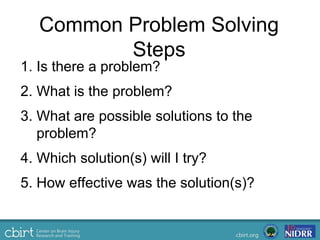
Common Problem Solving
Steps
1. Is there a problem?
2. What is the problem?
3. What are possible solutions to the
problem?
4. Which solution(s) will I try?
5. How effective was the solution(s)?
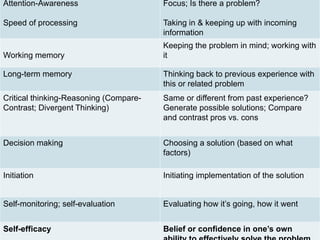
What goes into problem solving (PS)?
Examples
Attention-Awareness
Speed of processing
Focus; Is there a problem?
Taking in & keeping up with incoming
information
Working memory
Keeping the problem in mind; working with
it
Long-term memory Thinking back to previous experience with
this or related problem
Critical thinking-Reasoning (Compare-
Contrast; Divergent Thinking)
Same or different from past experience?
Generate possible solutions; Compare
and contrast pros vs. cons
Decision making Choosing a solution (based on what
factors)
Initiation Initiating implementation of the solution
Self-monitoring; self-evaluation Evaluating how it’s going, how it went
Self-efficacy Belief or confidence in one’s own
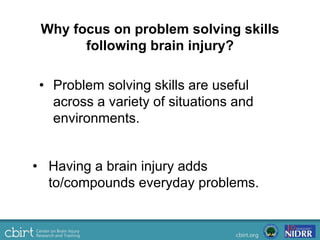
Why focus on problem solving skills
following brain injury?
• Problem solving skills are useful
across a variety of situations and
environments.
• Having a brain injury adds
to/compounds everyday problems.
Cory’s Story ….
Context
Executive functions: goal setting,
planning, organizing, initiating, self-
monitoring, problem solving) = Self-
regulation
Metacognition: Thinking about your own
thinking
Meta-cognitive strategy instruction
(MSI)
(Kennedy et al., 2008)
Meta-cognitive strategies -
Examples
• Prediction-Reflection (Cicerone & Giacino,
1992)
• Goal Management Training (Levine et al.,
2000)
• Time Pressure Management (Fasotti et
al., 2000)
• Problem Solving Skills (von Cramon et al.,
1991; Rath et al., 2003)
Research
Kennedy et al., 2008 – Meta-analysis; executive function
interventions – meta-cognitive strategies; TBI
Studies N = 15 studies
Type: RCTs, single case experimental, case reports
Outcome: “(There is) sufficient evidence to make the
clinical recommendation that MSI should be used with
young to middle-aged adults when improvement in
everyday, functional problems is the goal.”
Research
Cicerone et al., 2011 – Literature review;
cognitive rehabilitation; TBI & stroke
Studies N = 112 total; 19 focused on executive
dysfunction
Type: RCTs, single case experimental, case
reports
Note: Some overlap between Kennedy &
Cicerone
Outcome: For those with executive function
deficits - “Training in formal problem-solving
strategies and their application to everyday
situations is recommended during post-acute
Research
Spikman et al (2010); executive dysfunction; ABI
Type: RCT
Participants N=75
Intervention: 24 sessions (individual);
information-awareness; goal setting-planning;
initiation-execution
Control: computerized cognitive training
Outcome: Significant improvements in goal
setting, planning, initiation, regulation
Research
Rath et al, study - 2003; review article - 2011;
group manuals (see Resources)
Type: RCT
Participants N=60
Intervention: 24 session (group); problem skills
AND problem orientation (attitude; emotional
self-regulation)
Control: Conventional neuropsych rehab
Outcome: Significant improvements in exec
functions, self-appraisal, emotional self-
regulation
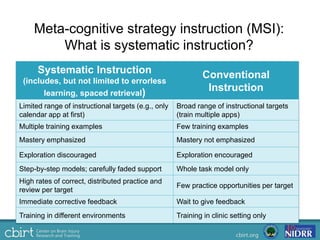
Meta-cognitive strategy instruction (MSI):
What is systematic instruction?
Systematic Instruction
(includes, but not limited to errorless
learning, spaced retrieval)
Conventional
Instruction
Limited range of instructional targets (e.g., only
calendar app at first)
Broad range of instructional targets
(train multiple apps)
Multiple training examples Few training examples
Mastery emphasized Mastery not emphasized
Exploration discouraged Exploration encouraged
Step-by-step models; carefully faded support Whole task model only
High rates of correct, distributed practice and
review per target
Few practice opportunities per target
Immediate corrective feedback Wait to give feedback
Training in different environments Training in clinic setting only
SI - stages
Acquisition: Learning new skills &
strategies
Adaptation: Applying (generalizing) the
skills & strategies to real life contexts
Maintenance (Follow up): Making sure
these “stick” for the long haul
SI & external aids
Ehlhardt, L., Sohlberg, M.M. et al. (2008).
Evidence-based practice guidelines for
instructing individuals with neurogenic memory
impairments: What have we learned in the past
20 years? Neuropsychlogical Rehabilitation,
18(3), 300-342. (www.ancds.org; Practice
Guidelines)
Gillespie, A., Best, C., & O'Neill, B. (2012). Cognitive
function and assistive technology for cognition: a
systematic review, Journal of the International
Neuropsychological Society, 18(1), 1-19.
Related research
Powell, Glang, et al., (2012) (NIHR03HD054768)
Type: RCT
Participants N= 29
Intervention: Systematic instruction (SI)
applied to PDA; calendar and task apps
Control: Conventional, trial & error
instruction
Outcome: SI = better maintenance and
generalization
SI applied to assistive technology
for cognition (ATC)
(Ehlhardt Powell, Glang, et al., 2012)
Related research
Ehlhardt Powell, Glang, et al., (in
preparation) (NIDRR-H133G090227)
Type: multiple baseline across behaviors in
a vocational setting
Participant N= 1
Intervention: SI applied to ATC + internal
strategy training – “If I need to remember, I
need to record it.” “Go home”
Outcome: Routine use device/apps at work
SI applied to ATC + MSI
(Ehlhardt Powell, Glang et al in preparation)
Summary-Themes
• Research evidence
• Problem solving skills (steps) AND problem
orientation (attitude; self-regulation)
• Systematic instruction: internal strategies &
external supports
• Limited resources for multiple treatment sessions
• ABI heterogeneity -Severity & type of cognitive
impairments
Generalizing Problem Solving Strategies to
Everyday Environments Following TBI
National Institute on Disability and Rehabilitation
Research (NIDRR): H133A120149
Three-year development grant (October 2012-
September, 2015)
Grantee: Center on Brain Injury Research and
Training, University of Oregon; Laurie Powell,
Principal Investigator
Partners: Michelle Wild, Co-Investigator; Coastline
Community College, Acquired Brain Injury Program
Current status: Wrapping up development and
heading into experimental evaluation phase
ProSolv Intervention Package
Improved
problem
solving skills
in everyday
life
Client-
coach
partnership
Introductory
on-line
tutorial
Web-based
mobile app
ProSolv Steps
1. What is the problem?
• in the moment vs. future
2. What do I already know about the problem?
• self-efficacy/attitude; past experience; triggers
3. What are possible solutions to the problem?
4. Which solution(s) will I try?
5. How effective was the solution(s)?
ProSolv Component #1
Client-Coach Partnership
ProSolv Component #1:
Coaches’ Manual TOC
ProSolv Components #2:
On-line training
ProSolv Components #3:
Mobile app
ProSolv Methodology -
Participants
Individuals with acquired brain injury:
 Medically stable; at least 1 year post
 Memory & executive function challenges
 Independent using mobile technologies for
phone, calendar, tasks lists, etc
Coaches:
 Occupational therapists; speech-language
pathologists; rehab assistants;
neuropsychologists
ProSolv Methodology - Design
Years 1-2 (2012-2014): Participatory Action
Research:
• “Lean Start Up” product development
• Focus groups
• Several rounds of usability testing;
Years 2-3 (2014-2015): Single case
experimental study; Experimental group
study
ProSolv Methodology –
Outcome Measures
Ultimate Outcome? Stay tuned…
ProSolv faded out = Adaptability
Questions-Discussion
See References & Resources page
Contact Information:
Laurie Ehlhardt Powell, CBIRT, University of
Oregon
lpowell@uoregon.edu
541-346-0572
Like our facebook page: Cbirt Online
Updates on news and research related to TBI,
CBIRT events, and new resources
Join the Conversation

Problem Solving in Everyday Life Following Brain Injury: Current Research

  • 1.
    Laurie Ehlhardt Powell,PhD, CCC-SLP Center on Brain Injury Research and Training University of Oregon Coastline Community College - Brain Injury Research Symposium Tuesday, May 13, 2014
  • 2.
  • 3.
    What is CBIRT? •Research center at University of Oregon • Established in 1993 • Focus: Conduct research and training to improve the lives of children and adults with TBI Funders: National Institute of Disability and Rehabilitation Research (NIDRR); Health Resources Service Administration/Maternal and Child Health—TBI Program; National Institute of Child Health and Human Development; Oregon Department of Education
  • 4.
  • 5.
    In this presentation, attendeeswill learn about: • current research re: problem solving interventions following brain injury. • systematic instructional techniques that can support improved problem solving. • a prototype, integrated model for supporting problem solving.
  • 6.
  • 7.
    What is problemsolving? “Problem solving is a higher-order cognitive activity that arises in situations for which no response is immediately apparent or available.” (Rath, Hadril, Litke & Diller, 2011; pg. 320).
  • 8.
    Common Problem Solving Steps 1.Is there a problem? 2. What is the problem? 3. What are possible solutions to the problem? 4. Which solution(s) will I try? 5. How effective was the solution(s)?
  • 9.
    What goes intoproblem solving (PS)? Examples Attention-Awareness Speed of processing Focus; Is there a problem? Taking in & keeping up with incoming information Working memory Keeping the problem in mind; working with it Long-term memory Thinking back to previous experience with this or related problem Critical thinking-Reasoning (Compare- Contrast; Divergent Thinking) Same or different from past experience? Generate possible solutions; Compare and contrast pros vs. cons Decision making Choosing a solution (based on what factors) Initiation Initiating implementation of the solution Self-monitoring; self-evaluation Evaluating how it’s going, how it went Self-efficacy Belief or confidence in one’s own
  • 10.
    Why focus onproblem solving skills following brain injury? • Problem solving skills are useful across a variety of situations and environments. • Having a brain injury adds to/compounds everyday problems.
  • 11.
  • 12.
    Context Executive functions: goalsetting, planning, organizing, initiating, self- monitoring, problem solving) = Self- regulation Metacognition: Thinking about your own thinking Meta-cognitive strategy instruction (MSI) (Kennedy et al., 2008)
  • 13.
    Meta-cognitive strategies - Examples •Prediction-Reflection (Cicerone & Giacino, 1992) • Goal Management Training (Levine et al., 2000) • Time Pressure Management (Fasotti et al., 2000) • Problem Solving Skills (von Cramon et al., 1991; Rath et al., 2003)
  • 14.
    Research Kennedy et al.,2008 – Meta-analysis; executive function interventions – meta-cognitive strategies; TBI Studies N = 15 studies Type: RCTs, single case experimental, case reports Outcome: “(There is) sufficient evidence to make the clinical recommendation that MSI should be used with young to middle-aged adults when improvement in everyday, functional problems is the goal.”
  • 15.
    Research Cicerone et al.,2011 – Literature review; cognitive rehabilitation; TBI & stroke Studies N = 112 total; 19 focused on executive dysfunction Type: RCTs, single case experimental, case reports Note: Some overlap between Kennedy & Cicerone Outcome: For those with executive function deficits - “Training in formal problem-solving strategies and their application to everyday situations is recommended during post-acute
  • 16.
    Research Spikman et al(2010); executive dysfunction; ABI Type: RCT Participants N=75 Intervention: 24 sessions (individual); information-awareness; goal setting-planning; initiation-execution Control: computerized cognitive training Outcome: Significant improvements in goal setting, planning, initiation, regulation
  • 17.
    Research Rath et al,study - 2003; review article - 2011; group manuals (see Resources) Type: RCT Participants N=60 Intervention: 24 session (group); problem skills AND problem orientation (attitude; emotional self-regulation) Control: Conventional neuropsych rehab Outcome: Significant improvements in exec functions, self-appraisal, emotional self- regulation
  • 18.
    Meta-cognitive strategy instruction(MSI): What is systematic instruction? Systematic Instruction (includes, but not limited to errorless learning, spaced retrieval) Conventional Instruction Limited range of instructional targets (e.g., only calendar app at first) Broad range of instructional targets (train multiple apps) Multiple training examples Few training examples Mastery emphasized Mastery not emphasized Exploration discouraged Exploration encouraged Step-by-step models; carefully faded support Whole task model only High rates of correct, distributed practice and review per target Few practice opportunities per target Immediate corrective feedback Wait to give feedback Training in different environments Training in clinic setting only
  • 19.
    SI - stages Acquisition:Learning new skills & strategies Adaptation: Applying (generalizing) the skills & strategies to real life contexts Maintenance (Follow up): Making sure these “stick” for the long haul
  • 20.
    SI & externalaids Ehlhardt, L., Sohlberg, M.M. et al. (2008). Evidence-based practice guidelines for instructing individuals with neurogenic memory impairments: What have we learned in the past 20 years? Neuropsychlogical Rehabilitation, 18(3), 300-342. (www.ancds.org; Practice Guidelines) Gillespie, A., Best, C., & O'Neill, B. (2012). Cognitive function and assistive technology for cognition: a systematic review, Journal of the International Neuropsychological Society, 18(1), 1-19.
  • 21.
    Related research Powell, Glang,et al., (2012) (NIHR03HD054768) Type: RCT Participants N= 29 Intervention: Systematic instruction (SI) applied to PDA; calendar and task apps Control: Conventional, trial & error instruction Outcome: SI = better maintenance and generalization
  • 22.
    SI applied toassistive technology for cognition (ATC) (Ehlhardt Powell, Glang, et al., 2012)
  • 23.
    Related research Ehlhardt Powell,Glang, et al., (in preparation) (NIDRR-H133G090227) Type: multiple baseline across behaviors in a vocational setting Participant N= 1 Intervention: SI applied to ATC + internal strategy training – “If I need to remember, I need to record it.” “Go home” Outcome: Routine use device/apps at work
  • 24.
    SI applied toATC + MSI (Ehlhardt Powell, Glang et al in preparation)
  • 25.
    Summary-Themes • Research evidence •Problem solving skills (steps) AND problem orientation (attitude; self-regulation) • Systematic instruction: internal strategies & external supports • Limited resources for multiple treatment sessions • ABI heterogeneity -Severity & type of cognitive impairments
  • 26.
    Generalizing Problem SolvingStrategies to Everyday Environments Following TBI National Institute on Disability and Rehabilitation Research (NIDRR): H133A120149 Three-year development grant (October 2012- September, 2015) Grantee: Center on Brain Injury Research and Training, University of Oregon; Laurie Powell, Principal Investigator Partners: Michelle Wild, Co-Investigator; Coastline Community College, Acquired Brain Injury Program Current status: Wrapping up development and heading into experimental evaluation phase
  • 27.
    ProSolv Intervention Package Improved problem solvingskills in everyday life Client- coach partnership Introductory on-line tutorial Web-based mobile app
  • 28.
    ProSolv Steps 1. Whatis the problem? • in the moment vs. future 2. What do I already know about the problem? • self-efficacy/attitude; past experience; triggers 3. What are possible solutions to the problem? 4. Which solution(s) will I try? 5. How effective was the solution(s)?
  • 29.
  • 30.
  • 31.
  • 32.
  • 33.
    ProSolv Methodology - Participants Individualswith acquired brain injury:  Medically stable; at least 1 year post  Memory & executive function challenges  Independent using mobile technologies for phone, calendar, tasks lists, etc Coaches:  Occupational therapists; speech-language pathologists; rehab assistants; neuropsychologists
  • 34.
    ProSolv Methodology -Design Years 1-2 (2012-2014): Participatory Action Research: • “Lean Start Up” product development • Focus groups • Several rounds of usability testing; Years 2-3 (2014-2015): Single case experimental study; Experimental group study
  • 35.
  • 36.
    Ultimate Outcome? Staytuned… ProSolv faded out = Adaptability
  • 37.
    Questions-Discussion See References &Resources page Contact Information: Laurie Ehlhardt Powell, CBIRT, University of Oregon lpowell@uoregon.edu 541-346-0572
  • 38.
    Like our facebookpage: Cbirt Online Updates on news and research related to TBI, CBIRT events, and new resources Join the Conversation