WELCOME
CMOS
Group-8
MEET OUR GROUP
SHAHID HASAN
SHUVO
221002038
Introduction, Historical
Background, Basics of
Semiconductor Physics,
Introduction to CMOS
Technology
MD. MURAD
HOSSAIN
221002235
CMOS Structure, Operation
of NMOS and PMOS
Transistors, CMOS Inverter.
2
MOHAMMAD
ANOWARUL ASIF
22100230
CMOS Fabrication Process,
Applications of CMOS
Technology & Conclusion
SUBMITTED TO
MD. ASHIQUR RAHMAN
LECTURER
GREEN UNIVERSITY OF BANGLADESH
3
SHAHID HASAN
SHUVO
221002038
4
INTRODUCTION
CMOS stands for Complementary Metal-Oxide-Semiconductor,
and it refers to a semiconductor technology
In a CMOS circuit:
•Metal: Represents the conductive material used in the transistor
gates.
•Oxide: Refers to the insulating material, typically silicon dioxide,
which separates the gate from the semiconductor.
•Semiconductor: The underlying silicon substrate that acts as
the channel through which current flows.
5
HISTORICAL
BACKGROUND
Early Discoveries (Late 19th to Early 20th Century):
The study of semiconductors began with the discovery of the
photoconductivity of selenium by Willoughby Smith in 1873.
Invention of the Transistor (1947):
The pivotal moment in semiconductor history came with the
invention of the transistor at Bell Labs in 1947 by John Bardeen,
Walter Brattain, and William Shockley.
First Generation to Fifth Generation Evolution of
Semiconductor Technology
Pitch deck title 6
INTRODUCTION TO SEMICONDUCTOR
PHYSICS
Pitch deck title 7
Semiconductor Materials
Intrinsic and Extrinsic Semiconductors
Electron and Hole Carriers
INTRODUCTION TO CMOS
TECHNOLOGY
Pitch deck title 8
CMOS as a Dominant Semiconductor Technology
Characteristics of CMOS Devices
Low Power Consumption and High Integration
MD. MURAD
HOSSAIN
221002235
9
CMOS STRUCTURE
05
CMOS STRUCTURE
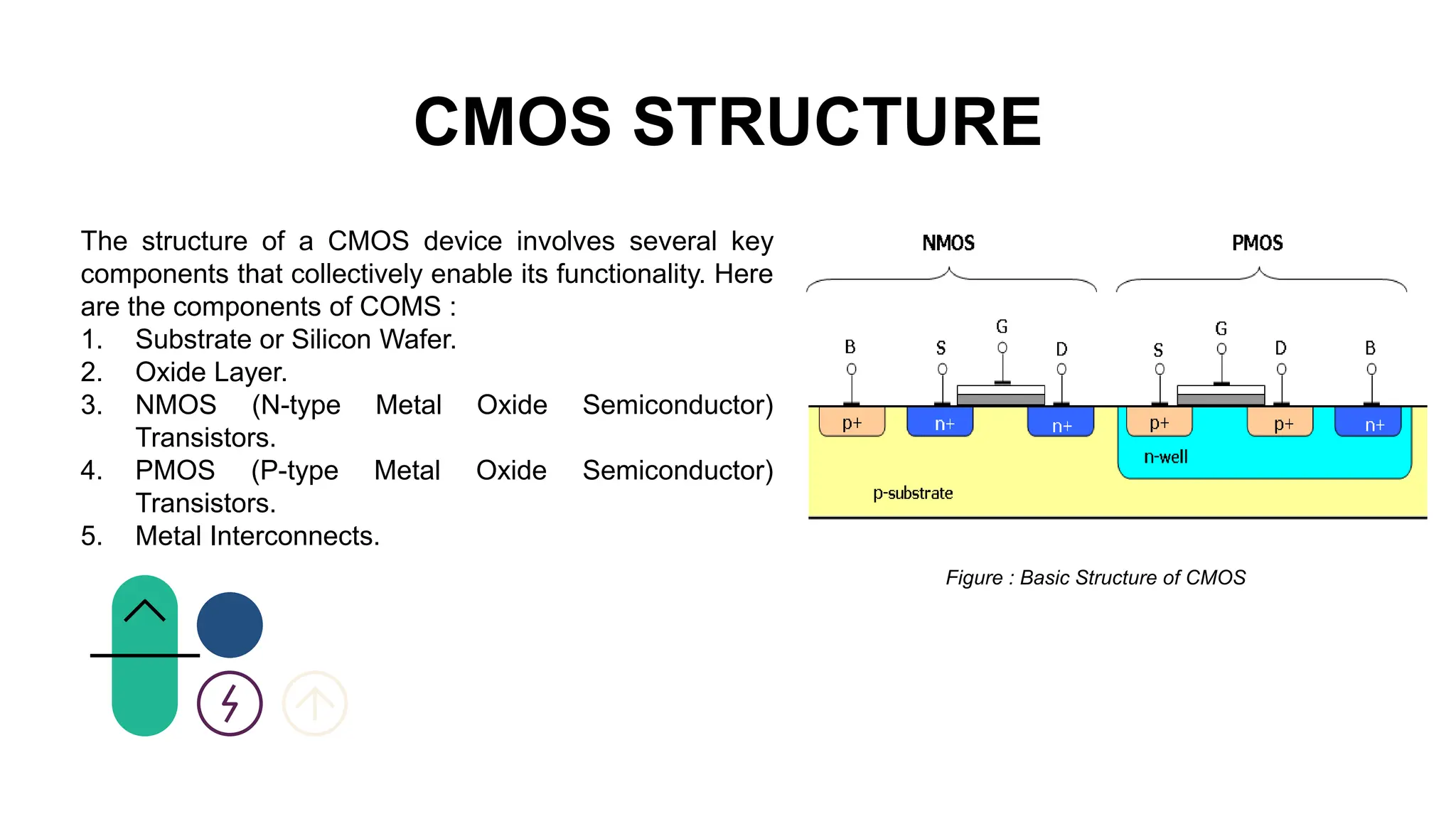
The structure of a CMOS device involves several key
components that collectively enable its functionality. Here
are the components of COMS :
1. Substrate or Silicon Wafer.
2. Oxide Layer.
3. NMOS (N-type Metal Oxide Semiconductor)
Transistors.
4. PMOS (P-type Metal Oxide Semiconductor)
Transistors.
5. Metal Interconnects.
Figure : Basic Structure of CMOS
OPERATION OF NMOS AND
PMOS TRANSISTORS
06
NMOS
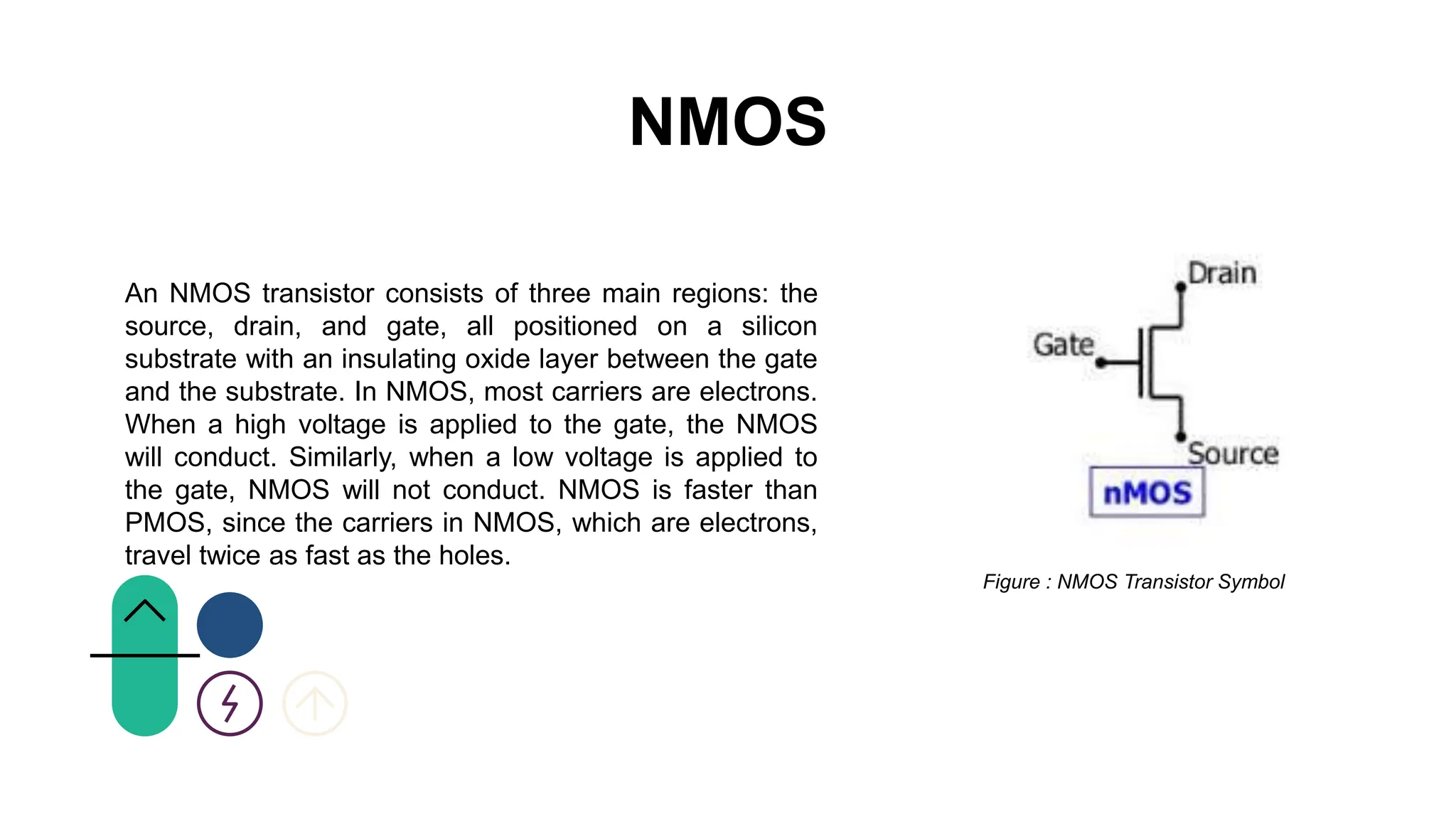
An NMOS transistor consists of three main regions: the
source, drain, and gate, all positioned on a silicon
substrate with an insulating oxide layer between the gate
and the substrate. In NMOS, most carriers are electrons.
When a high voltage is applied to the gate, the NMOS
will conduct. Similarly, when a low voltage is applied to
the gate, NMOS will not conduct. NMOS is faster than
PMOS, since the carriers in NMOS, which are electrons,
travel twice as fast as the holes.
Figure : NMOS Transistor Symbol
PMOS
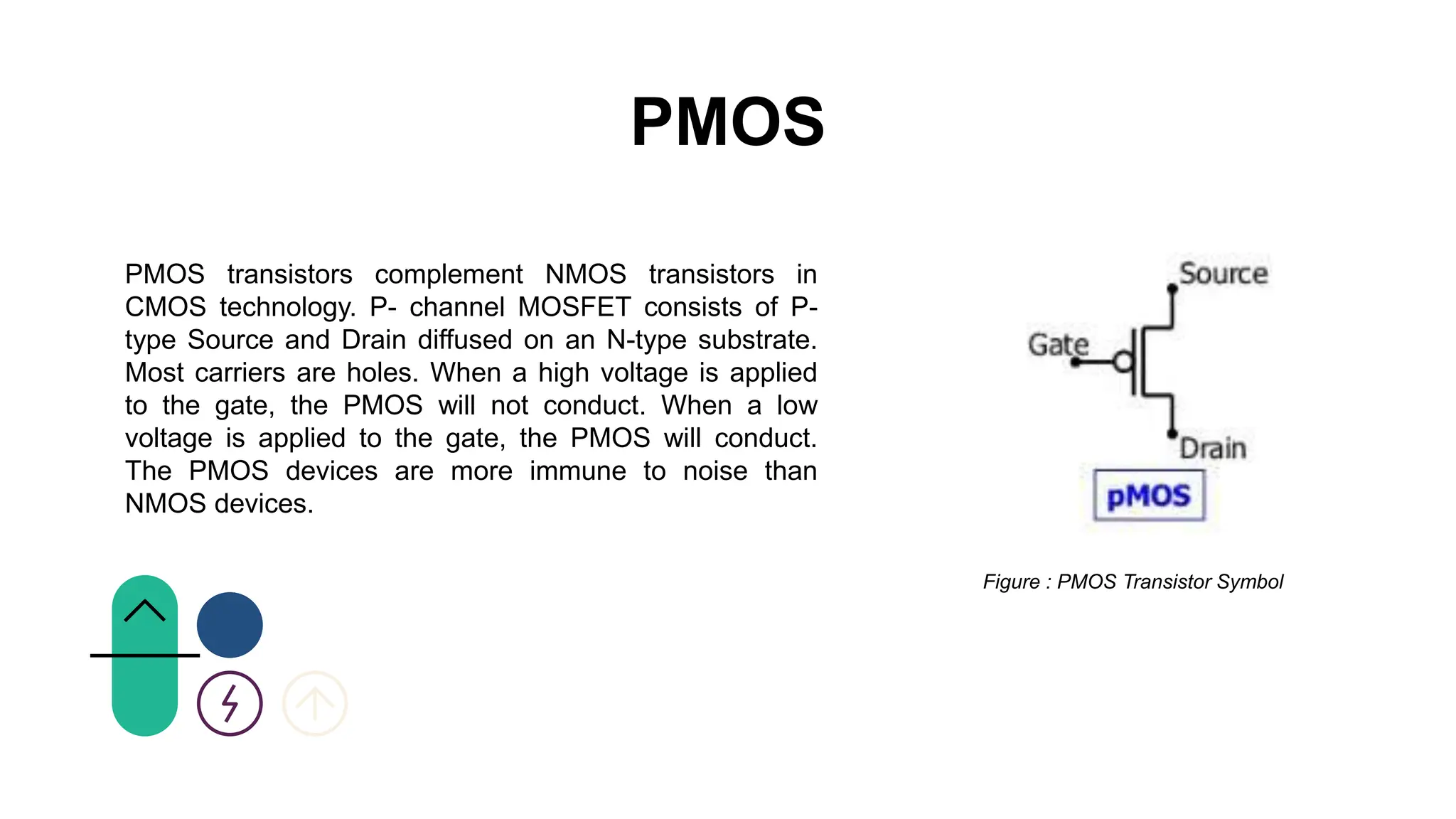
PMOS transistors complement NMOS transistors in
CMOS technology. P- channel MOSFET consists of P-
type Source and Drain diffused on an N-type substrate.
Most carriers are holes. When a high voltage is applied
to the gate, the PMOS will not conduct. When a low
voltage is applied to the gate, the PMOS will conduct.
The PMOS devices are more immune to noise than
NMOS devices.
Figure : PMOS Transistor Symbol
CMOS INVERTER
07
CMOS INVERTER
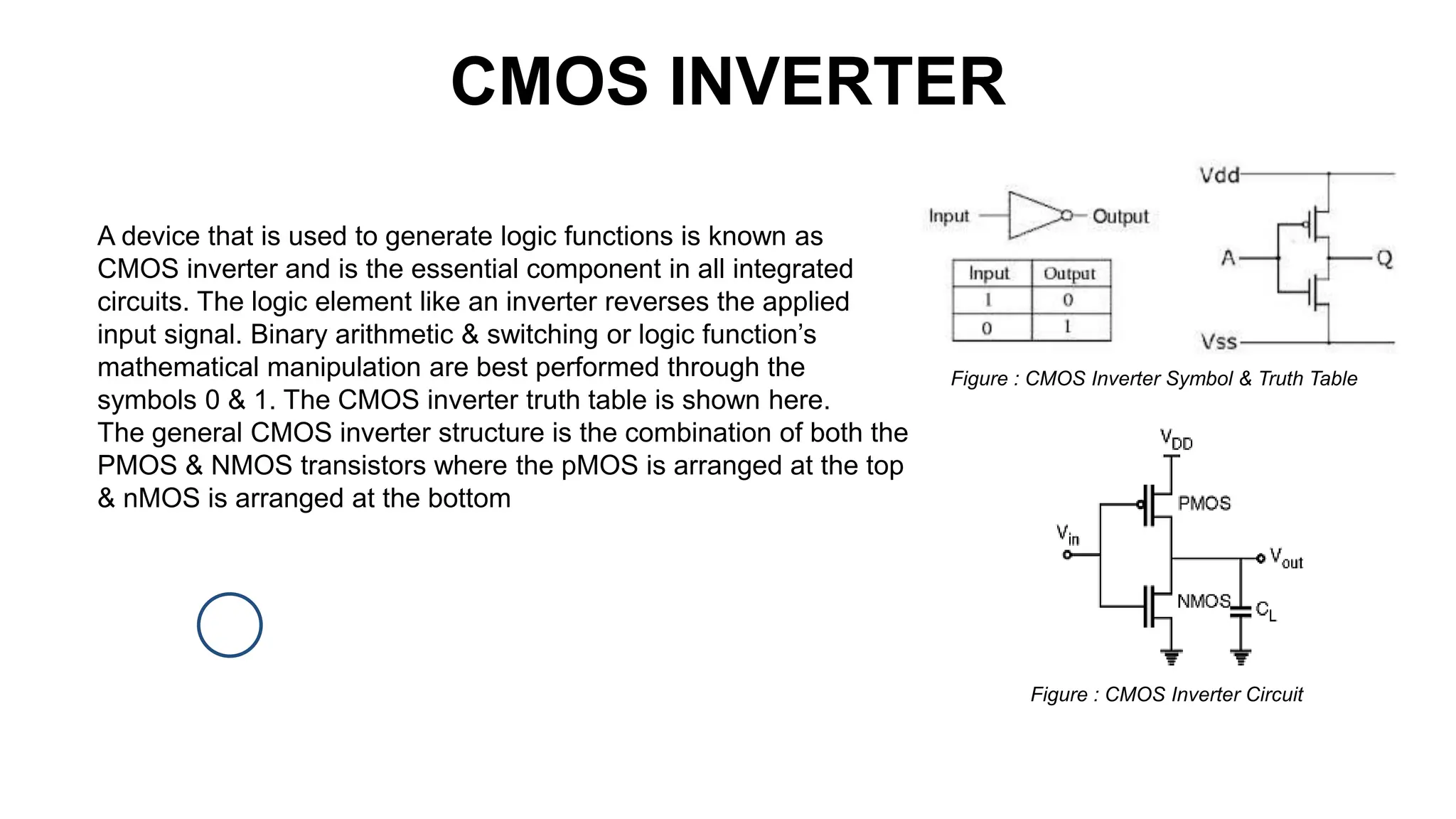
A device that is used to generate logic functions is known as
CMOS inverter and is the essential component in all integrated
circuits. The logic element like an inverter reverses the applied
input signal. Binary arithmetic & switching or logic function’s
mathematical manipulation are best performed through the
symbols 0 & 1. The CMOS inverter truth table is shown here.
The general CMOS inverter structure is the combination of both the
PMOS & NMOS transistors where the pMOS is arranged at the top
& nMOS is arranged at the bottom
Figure : CMOS Inverter Symbol & Truth Table
Figure : CMOS Inverter Circuit
MOHAMMAD
ANOWARUL ASIF
221002230
17
CMOS FABRICATION
PROCESS
08
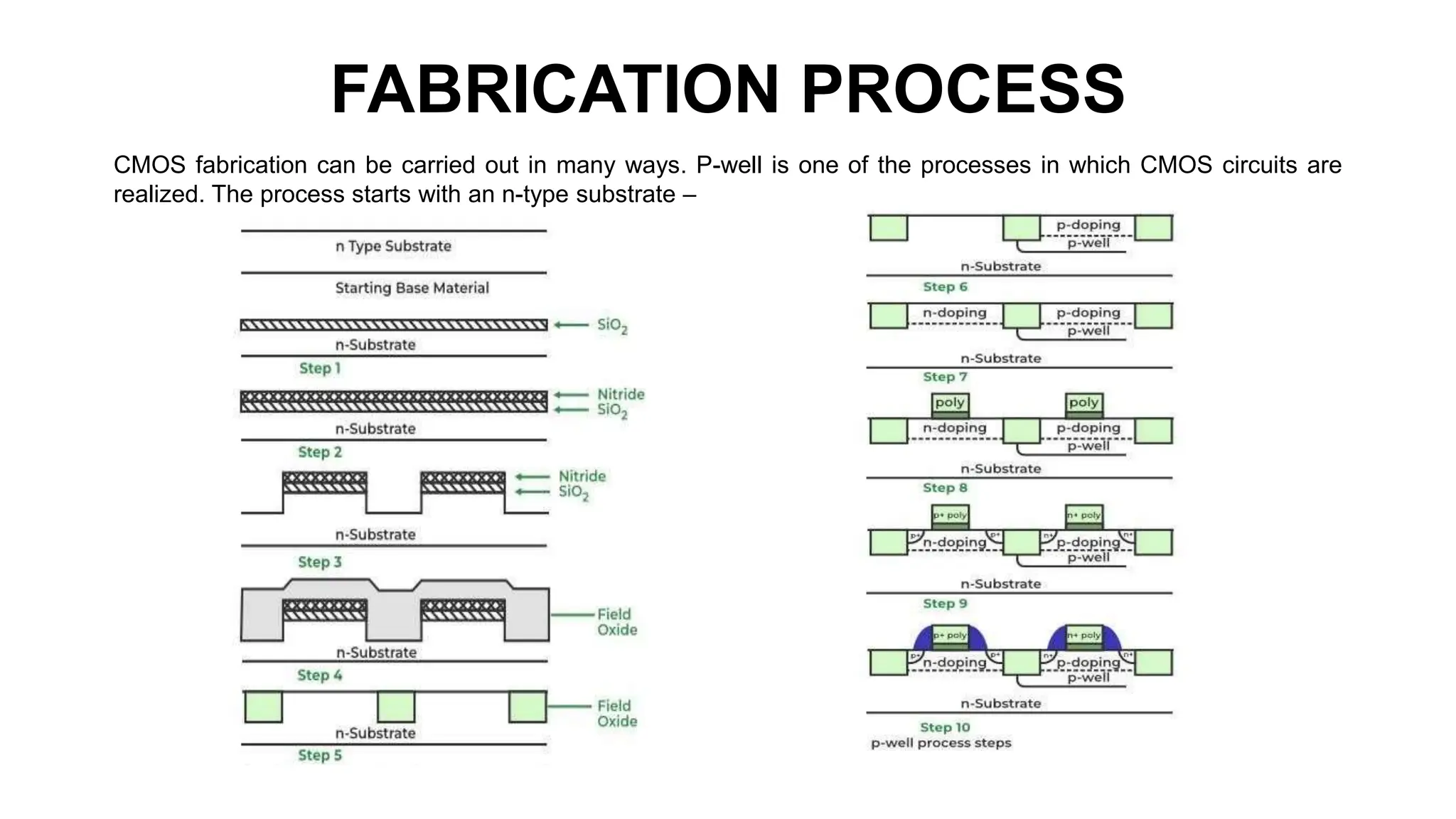
FABRICATION PROCESS
CMOS fabrication can be carried out in many ways. P-well is one of the processes in which CMOS circuits are
realized. The process starts with an n-type substrate –
APPLICATIONS OF
CMOS
09
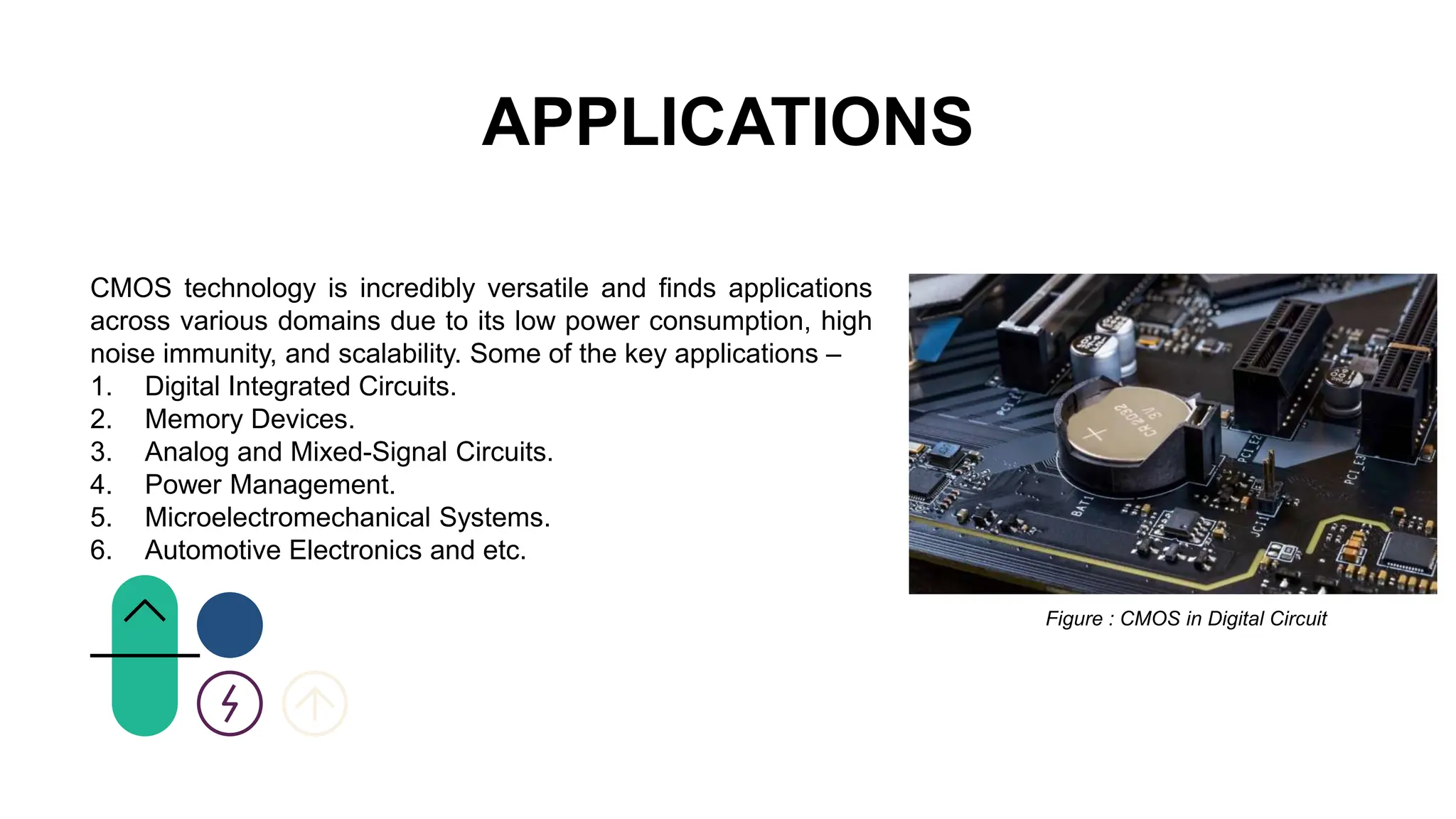
APPLICATIONS
CMOS technology is incredibly versatile and finds applications
across various domains due to its low power consumption, high
noise immunity, and scalability. Some of the key applications –
1. Digital Integrated Circuits.
2. Memory Devices.
3. Analog and Mixed-Signal Circuits.
4. Power Management.
5. Microelectromechanical Systems.
6. Automotive Electronics and etc.
Figure : CMOS in Digital Circuit
CONCLUSION
10
CONCLUSION
CMOS technology's pivotal role in modern electronics and pulse circuits is
underscored by its trifecta of low power consumption, high noise immunity, and
scalability. Its foundational design allows for minimal power usage, making it a
cornerstone in energy-efficient devices. CMOS's versatility spans across
applications, from digital circuits to sensors and wireless communication, solidifying
its status as a fundamental technology driving innovation across diverse industries.
As ongoing research delves into novel materials and design techniques, CMOS's
promise for the future remains unwavering, ensuring its continued relevance in
shaping the landscape of modern electronics
THANK YOU
Any Question ??

cmos of metal oxide field effect tansistor

  • 1.
  • 2.
    MEET OUR GROUP SHAHIDHASAN SHUVO 221002038 Introduction, Historical Background, Basics of Semiconductor Physics, Introduction to CMOS Technology MD. MURAD HOSSAIN 221002235 CMOS Structure, Operation of NMOS and PMOS Transistors, CMOS Inverter. 2 MOHAMMAD ANOWARUL ASIF 22100230 CMOS Fabrication Process, Applications of CMOS Technology & Conclusion
  • 3.
    SUBMITTED TO MD. ASHIQURRAHMAN LECTURER GREEN UNIVERSITY OF BANGLADESH 3
  • 4.
  • 5.
    INTRODUCTION CMOS stands forComplementary Metal-Oxide-Semiconductor, and it refers to a semiconductor technology In a CMOS circuit: •Metal: Represents the conductive material used in the transistor gates. •Oxide: Refers to the insulating material, typically silicon dioxide, which separates the gate from the semiconductor. •Semiconductor: The underlying silicon substrate that acts as the channel through which current flows. 5
  • 6.
    HISTORICAL BACKGROUND Early Discoveries (Late19th to Early 20th Century): The study of semiconductors began with the discovery of the photoconductivity of selenium by Willoughby Smith in 1873. Invention of the Transistor (1947): The pivotal moment in semiconductor history came with the invention of the transistor at Bell Labs in 1947 by John Bardeen, Walter Brattain, and William Shockley. First Generation to Fifth Generation Evolution of Semiconductor Technology Pitch deck title 6
  • 7.
    INTRODUCTION TO SEMICONDUCTOR PHYSICS Pitchdeck title 7 Semiconductor Materials Intrinsic and Extrinsic Semiconductors Electron and Hole Carriers
  • 8.
    INTRODUCTION TO CMOS TECHNOLOGY Pitchdeck title 8 CMOS as a Dominant Semiconductor Technology Characteristics of CMOS Devices Low Power Consumption and High Integration
  • 9.
  • 10.
  • 11.
    CMOS STRUCTURE The structureof a CMOS device involves several key components that collectively enable its functionality. Here are the components of COMS : 1. Substrate or Silicon Wafer. 2. Oxide Layer. 3. NMOS (N-type Metal Oxide Semiconductor) Transistors. 4. PMOS (P-type Metal Oxide Semiconductor) Transistors. 5. Metal Interconnects. Figure : Basic Structure of CMOS
  • 12.
    OPERATION OF NMOSAND PMOS TRANSISTORS 06
  • 13.
    NMOS An NMOS transistorconsists of three main regions: the source, drain, and gate, all positioned on a silicon substrate with an insulating oxide layer between the gate and the substrate. In NMOS, most carriers are electrons. When a high voltage is applied to the gate, the NMOS will conduct. Similarly, when a low voltage is applied to the gate, NMOS will not conduct. NMOS is faster than PMOS, since the carriers in NMOS, which are electrons, travel twice as fast as the holes. Figure : NMOS Transistor Symbol
  • 14.
    PMOS PMOS transistors complementNMOS transistors in CMOS technology. P- channel MOSFET consists of P- type Source and Drain diffused on an N-type substrate. Most carriers are holes. When a high voltage is applied to the gate, the PMOS will not conduct. When a low voltage is applied to the gate, the PMOS will conduct. The PMOS devices are more immune to noise than NMOS devices. Figure : PMOS Transistor Symbol
  • 15.
  • 16.
    CMOS INVERTER A devicethat is used to generate logic functions is known as CMOS inverter and is the essential component in all integrated circuits. The logic element like an inverter reverses the applied input signal. Binary arithmetic & switching or logic function’s mathematical manipulation are best performed through the symbols 0 & 1. The CMOS inverter truth table is shown here. The general CMOS inverter structure is the combination of both the PMOS & NMOS transistors where the pMOS is arranged at the top & nMOS is arranged at the bottom Figure : CMOS Inverter Symbol & Truth Table Figure : CMOS Inverter Circuit
  • 17.
  • 18.
  • 19.
    FABRICATION PROCESS CMOS fabricationcan be carried out in many ways. P-well is one of the processes in which CMOS circuits are realized. The process starts with an n-type substrate –
  • 20.
  • 21.
    APPLICATIONS CMOS technology isincredibly versatile and finds applications across various domains due to its low power consumption, high noise immunity, and scalability. Some of the key applications – 1. Digital Integrated Circuits. 2. Memory Devices. 3. Analog and Mixed-Signal Circuits. 4. Power Management. 5. Microelectromechanical Systems. 6. Automotive Electronics and etc. Figure : CMOS in Digital Circuit
  • 22.
  • 23.
    CONCLUSION CMOS technology's pivotalrole in modern electronics and pulse circuits is underscored by its trifecta of low power consumption, high noise immunity, and scalability. Its foundational design allows for minimal power usage, making it a cornerstone in energy-efficient devices. CMOS's versatility spans across applications, from digital circuits to sensors and wireless communication, solidifying its status as a fundamental technology driving innovation across diverse industries. As ongoing research delves into novel materials and design techniques, CMOS's promise for the future remains unwavering, ensuring its continued relevance in shaping the landscape of modern electronics
  • 24.