
The most damaging phrase in the language is – “ It’s always been done that way.” --Rear Admiral Grace Hopper
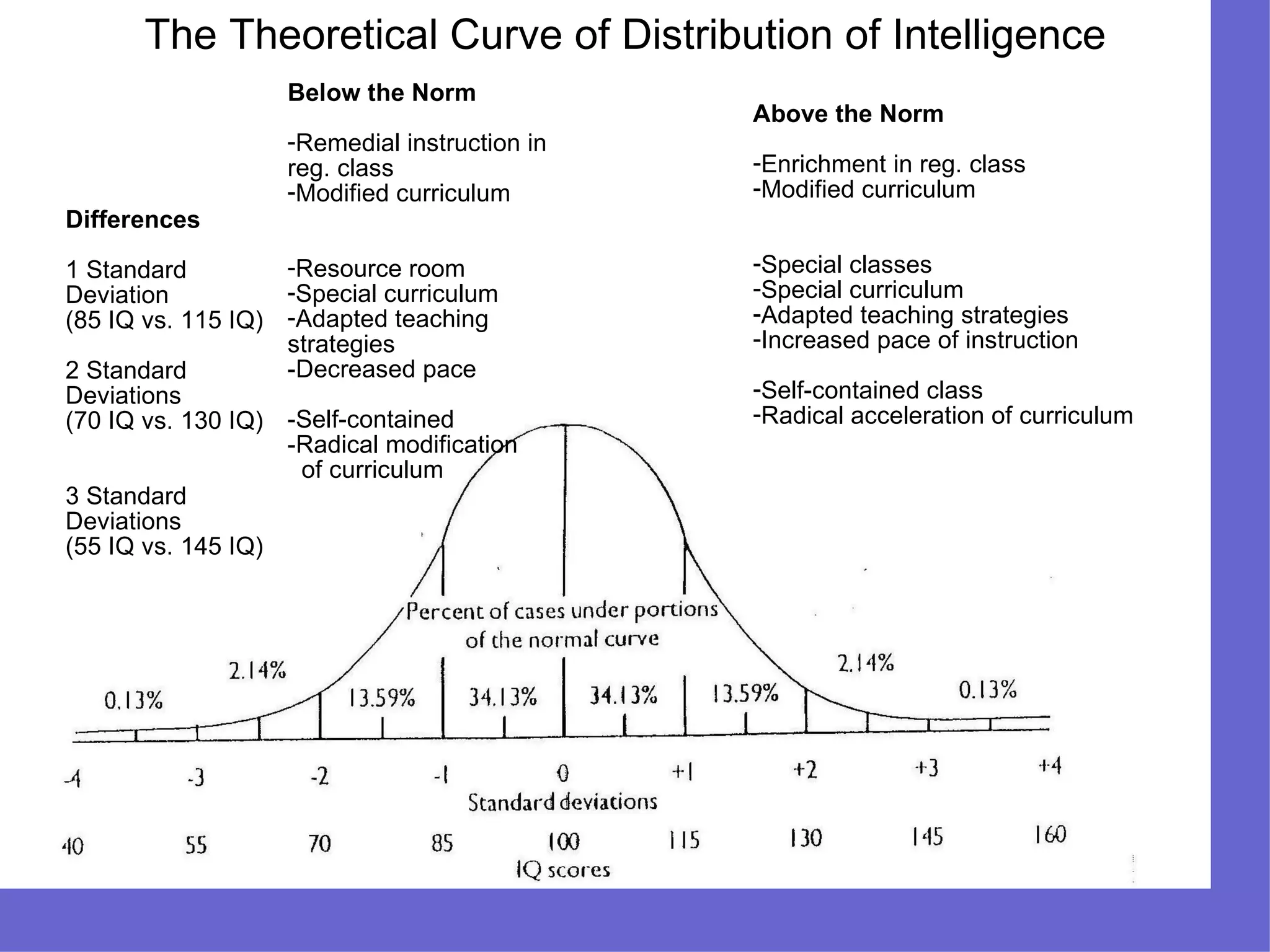
Differences 1 Standard  Deviation (85 IQ vs. 115 IQ) 2 Standard  Deviations (70 IQ vs. 130 IQ) 3 Standard  Deviations (55 IQ vs. 145 IQ) Below the Norm Remedial instruction in reg. class Modified curriculum Resource room  Special curriculum Adapted teaching strategies -Decreased pace -Self-contained -Radical modification of curriculum Above the Norm Enrichment in reg. class Modified curriculum Special classes Special curriculum Adapted teaching strategies Increased pace of instruction Self-contained class Radical acceleration of curriculum The Theoretical Curve of Distribution of Intelligence
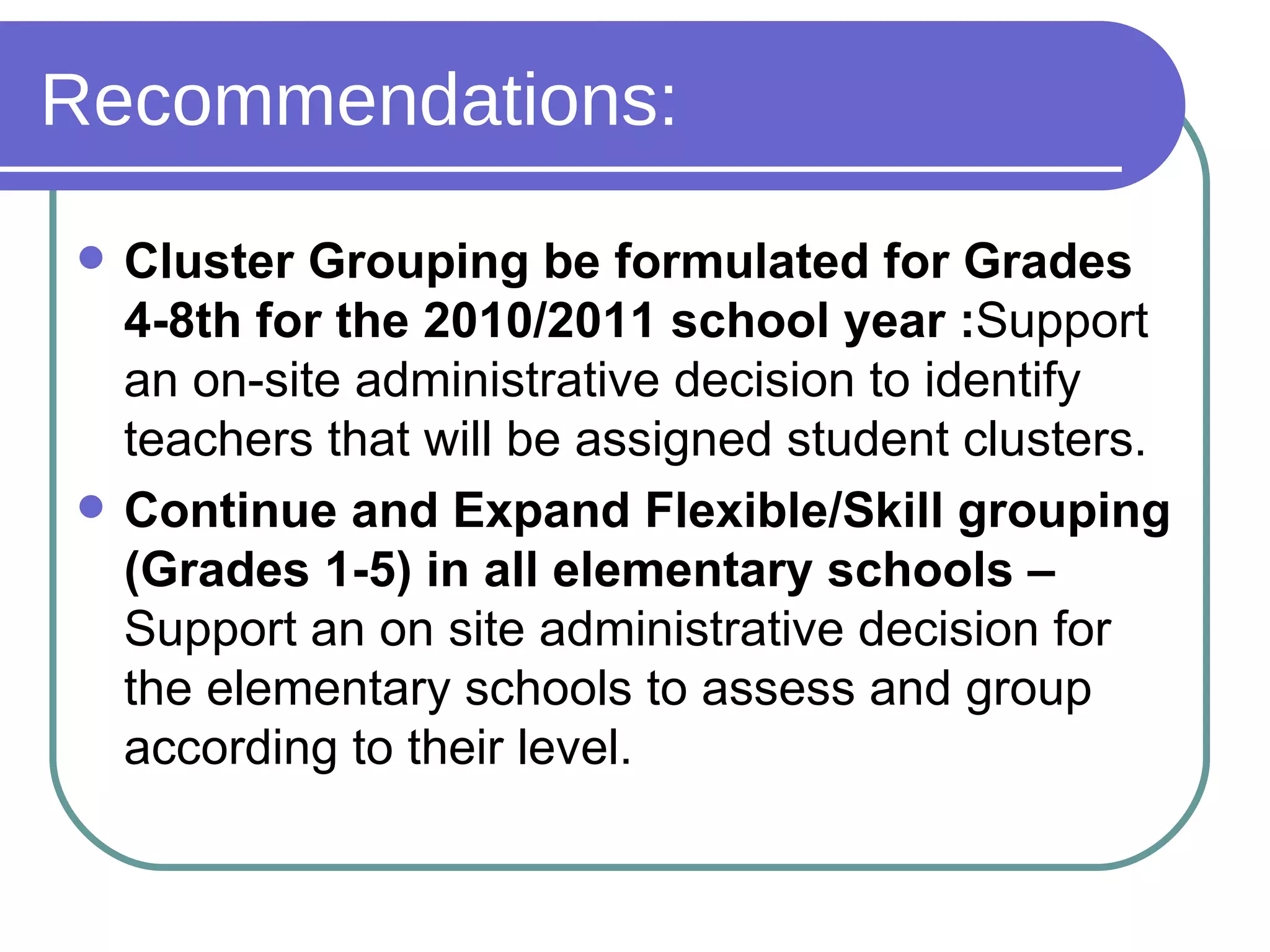
Recommendations: Cluster Grouping be formulated for Grades 4-8th for the 2010/2011 school year : Support an on-site administrative decision to identify teachers that will be assigned student clusters.  Continue and Expand Flexible/Skill grouping (Grades 1-5) in all elementary schools –  Support an on site administrative decision for the elementary schools to assess and group according to their level.
Creating the Cluster Model: Success for Gifted Students in Today’s Educational Environment
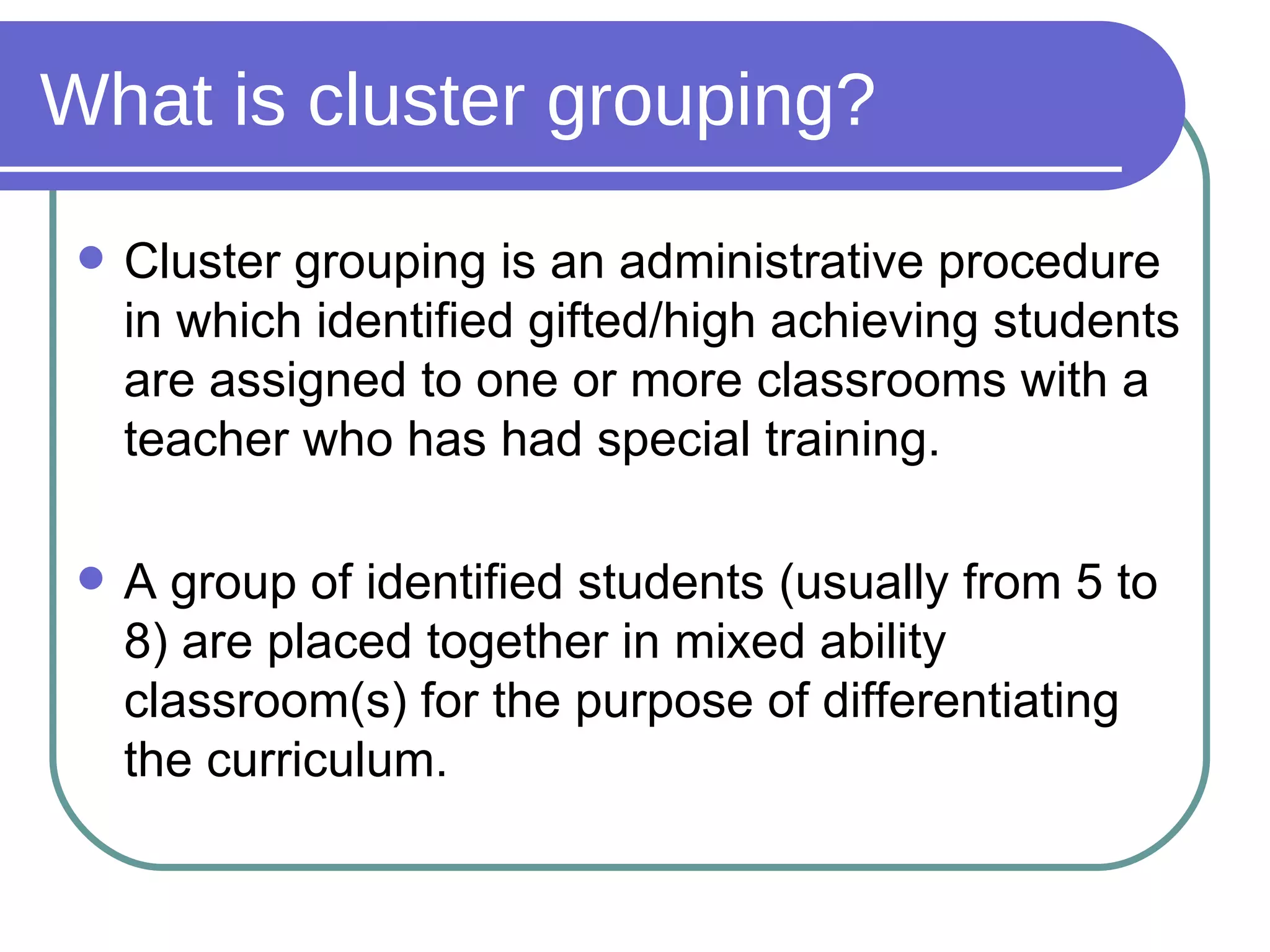
What is cluster grouping? Cluster grouping is an administrative procedure in which identified gifted/high achieving students are assigned to one or more classrooms with a teacher who has had special training. A group of identified students (usually from 5 to 8) are placed together in mixed ability classroom(s) for the purpose of differentiating the curriculum.
Isn’t cluster grouping the same as tracking? No.  In a tracking system, all students are grouped by ability for much of the school day, and students tend to remain in the same track throughout their school experience.  Cluster grouping of gifted/high achieving students allows them to be placed with students of similar strengths in classes with others of mixed abilities.     (Hoover, Sayler, & Feldhusen, 1992; Rogers 1993)
Why cluster group instead of assigning gifted students evenly to all classes? When teachers are required to meet the diverse learning needs of all students, it becomes extremely difficult to provide adequately for everyone. Often, the highest ability students are expected to “make it on their own.” Collaboration between the GATE Specialist and the general education teacher is more likely to occur when cluster groups are formed.  (Winebrenner & Devlin, 2001)
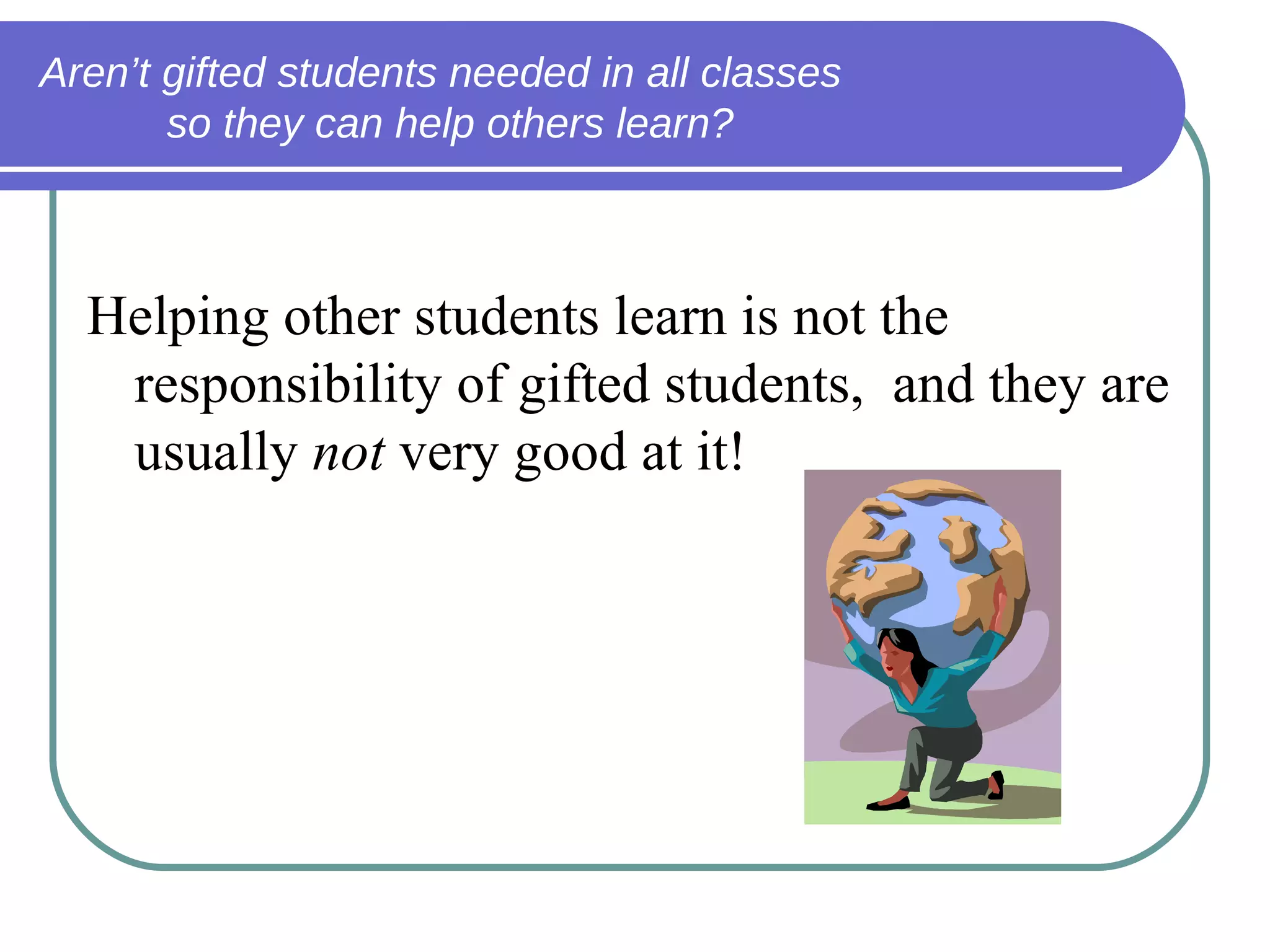
Aren’t gifted students needed in all classes  so they can help others learn? Gifted students… Helping other students learn is not the responsibility of gifted students,  and they are usually  not  very good at it!
Gifted children typically… Are intensely curious and have many interests Process information with great speed and deep understanding Remember forever what they learn  Readily grasp underlying principles and make generalizations Are highly sensitive  Prefer to work alone Relate well with older students and adults Demonstrate advanced sense of humor Require little direction Sustain long periods of attention and concentration  *These behaviors apply to all content areas, all day long.
Including non-productive gifted students Non-productive students may: not see the need to complete assignments feel unmotivated by required work  that does not hold their interest or challenge them be afraid to fail, so they never  begin Gifted Cluster Teachers can: give credit for previously mastered content allow students to do more challenging work teach students to set their own goals acknowledge and show appreciation for effort allow student-directed learning based on interests and strengths
What are the benefits of cluster grouping? Both cluster and non-cluster classrooms experience an improvement in achievement for all class members because teachers are able to provide more appropriate instruction for all students. In cluster classrooms, teachers learn to provide strategies for gifted/high ability students and offer modified versions of the same opportunities to the entire class. In non-cluster classrooms, new student role models and leaders emerge. (Kennedy, 1989; Winebrenner, 1992; Gentry 1999)
What training should cluster teachers receive? understand the unique attributes and needs of GATE students be intellectually creative be creatively productive be flexible and willing to find appropriate outlets for student production. be attuned to the process of teaching be a role model for students be willing to spend sufficient time in planning and delivery of instruction. Teachers need special training in order to :
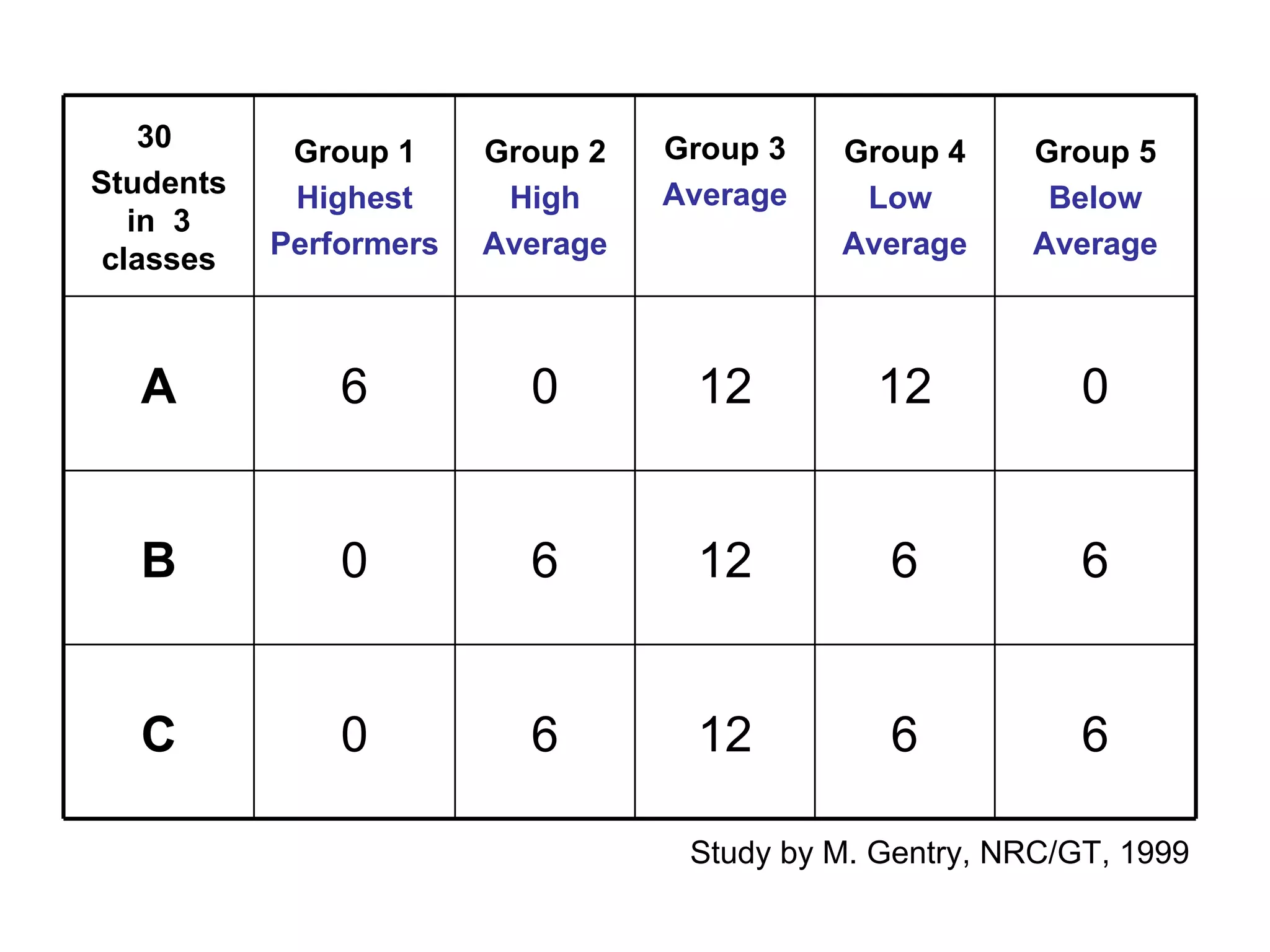
How should cluster classrooms be structured? One class, taught by a teacher trained in differentiation, should be assigned the cluster group of gifted students and some students of average and low average abilities. (See Gentry’s model on next slide.) The remaining classrooms include a range of students from high average to below average. The goal is to create a more narrow range of student achievement levels, allowing the teacher to focus instructional activities.   (Gentry 1999)
Study by M. Gentry, NRC/GT, 1999 30  Students in  3 classes Group 1 Highest Performers Group 2 High Average Group 3 Average Group 4 Low  Average Group 5 Below Average A 6 0 12 12 0 B 0 6 12 6 6 C 0 6 12 6 6
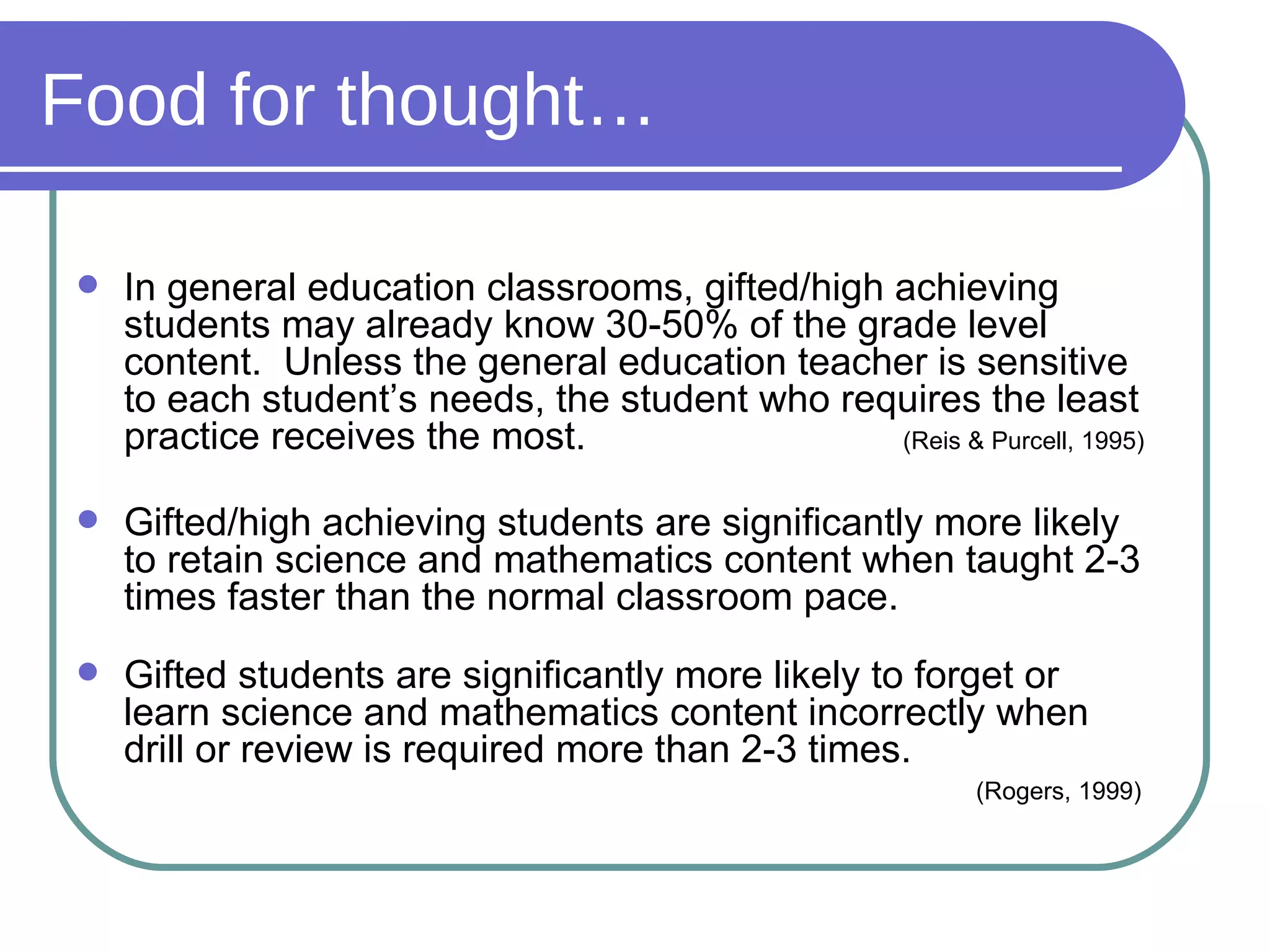
Food for thought… In general education classrooms, gifted/high achieving students may already know 30-50% of the grade level content.  Unless the general education teacher is sensitive to each student’s needs, the student who requires the least practice receives the most.    (Reis & Purcell, 1995) Gifted/high achieving students are significantly more likely to retain science and mathematics content when taught 2-3 times faster than the normal classroom pace. Gifted students are significantly more likely to forget or learn science and mathematics content incorrectly when drill or review is required more than 2-3 times.      (Rogers, 1999)
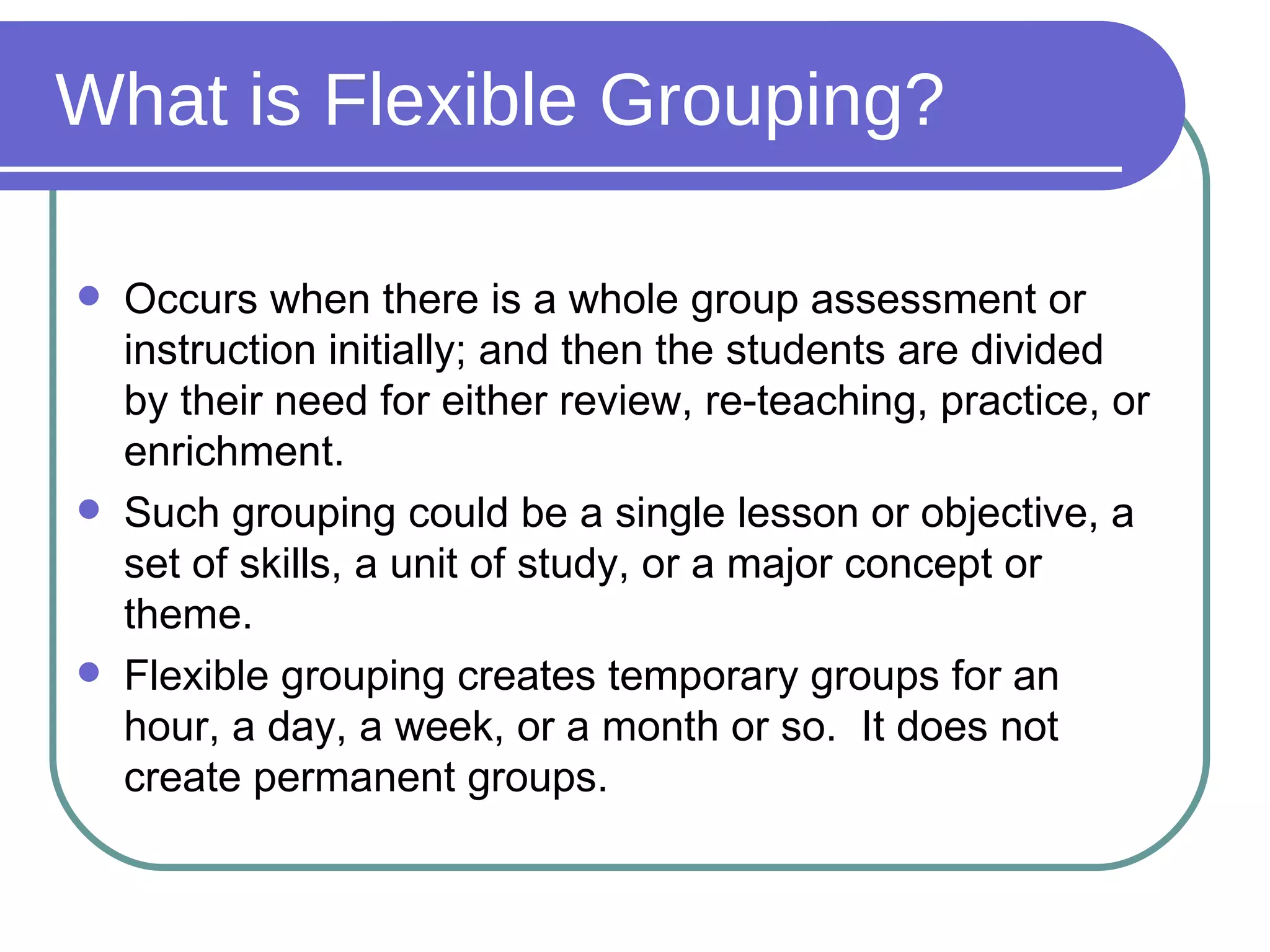
What is Flexible Grouping? Occurs when there is a whole group assessment or instruction initially; and then the students are divided by their need for either review, re-teaching, practice, or enrichment.  Such grouping could be a single lesson or objective, a set of skills, a unit of study, or a major concept or theme.  Flexible grouping creates temporary groups for an hour, a day, a week, or a month or so.  It does not create permanent groups.
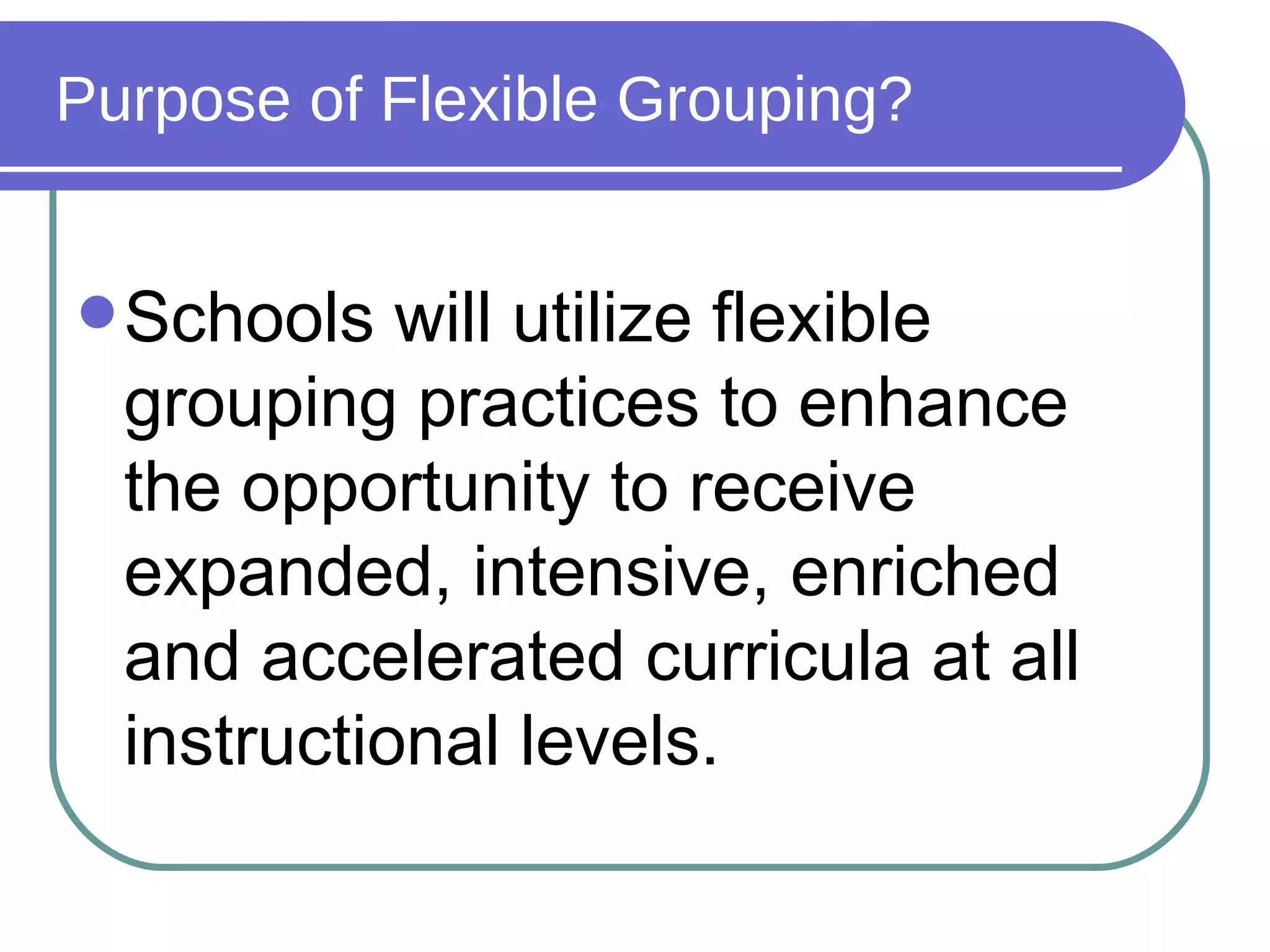
Purpose of Flexible Grouping? Schools will utilize flexible grouping practices to enhance the opportunity to receive expanded, intensive, enriched and accelerated curricula at all instructional levels.
Why use Flexible Grouping? Allows both collaborative and independent work. Allows students to work with a wide variety of peers. Allows for quick mastery of ideas. Allows for additional exploration by students. Keeps students from being “pegged” as advanced or struggling. Gives students and teachers a voice in work arrangements
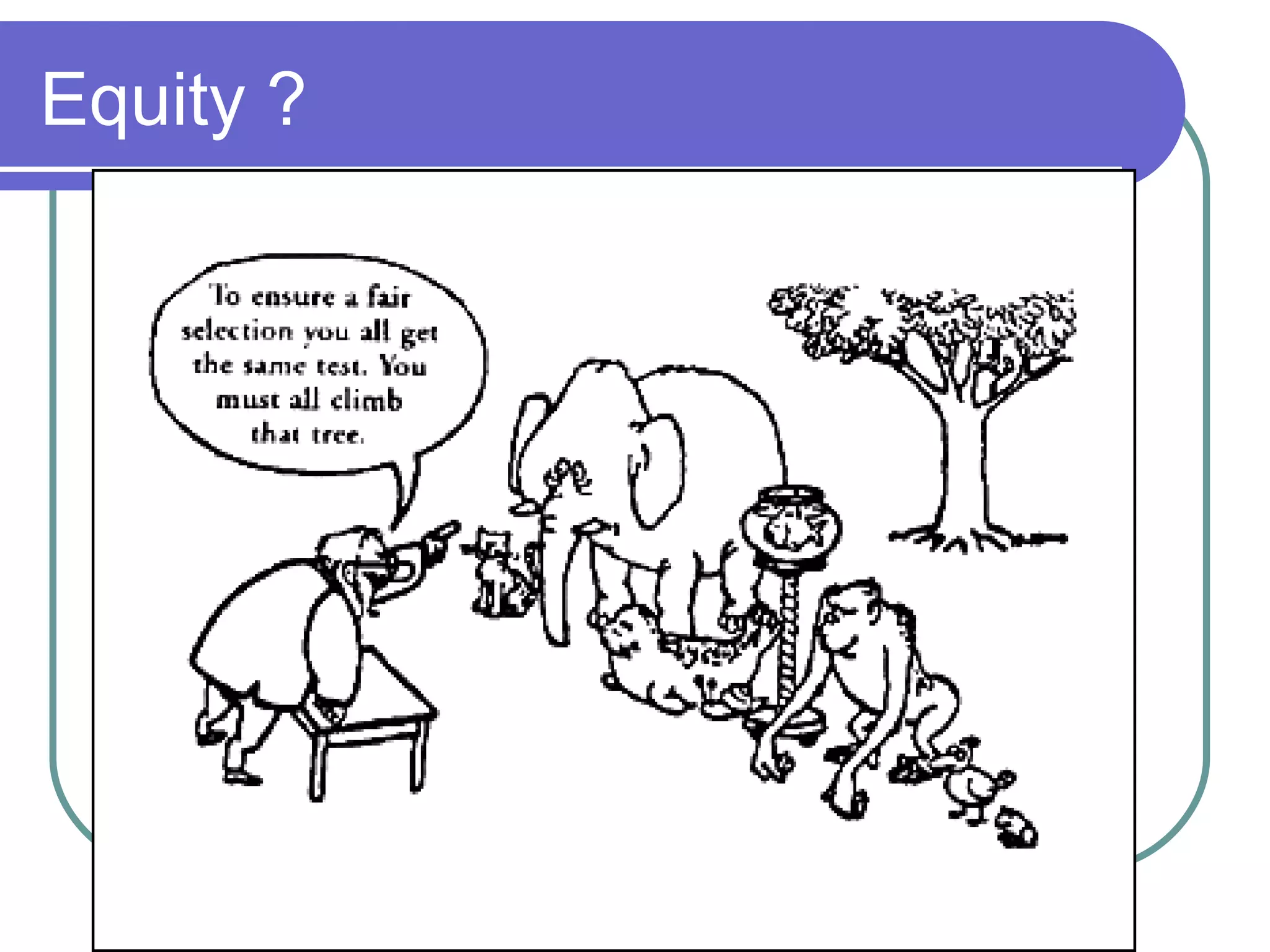
Equity ?
In conclusion In the era of “No Child Left Behind” federal legislation, it is imperative to find new ways to educate gifted children. Cluster grouping and flexible grouping reduces the range of achievement that must be addressed within the classrooms, thereby allowing teachers to differentiate the curriculum and plan more effectively for all learners.
References Gentry, Marcia (1996). “Total School Cluster Grouping:  An Investigation of Achievement and Identification of Elementary School Students.”  The National Research Center on the Gifted and Talented, Storrs, CT. Kingore, Bertie. (2004).  Differentiation:  Simplified, Realistic, and Effective .  Austin: Professional Associates Publishing. Rogers, Karen (2002).  Reforming Gifted Education:  How Parents and Teachers Can Match the Program to the Child .  Arizona: Great Potential Press. Schuler, P. (1997). “Cluster Grouping Coast to Coast.”  The National Research Center on the Gifted and Talented, Storrs, CT. Winebrenner, Susan (2000).  Teaching Gifted Kids in the Regular Classroom . Minneapolis:  Free Spirit Publishing. Winebrenner, S and B. Devlin (1996)  “Cluster Grouping of Gifted Students:  How to Provide Full-Time Services on a Part-Time Budget.”  ERIC EC Digest #E607.

Cluster+model+2

  • 1.
    The most damagingphrase in the language is – “ It’s always been done that way.” --Rear Admiral Grace Hopper
  • 2.
    Differences 1 Standard Deviation (85 IQ vs. 115 IQ) 2 Standard Deviations (70 IQ vs. 130 IQ) 3 Standard Deviations (55 IQ vs. 145 IQ) Below the Norm Remedial instruction in reg. class Modified curriculum Resource room Special curriculum Adapted teaching strategies -Decreased pace -Self-contained -Radical modification of curriculum Above the Norm Enrichment in reg. class Modified curriculum Special classes Special curriculum Adapted teaching strategies Increased pace of instruction Self-contained class Radical acceleration of curriculum The Theoretical Curve of Distribution of Intelligence
  • 3.
    Recommendations: Cluster Groupingbe formulated for Grades 4-8th for the 2010/2011 school year : Support an on-site administrative decision to identify teachers that will be assigned student clusters.  Continue and Expand Flexible/Skill grouping (Grades 1-5) in all elementary schools – Support an on site administrative decision for the elementary schools to assess and group according to their level.
  • 4.
    Creating the ClusterModel: Success for Gifted Students in Today’s Educational Environment
  • 5.
    What is clustergrouping? Cluster grouping is an administrative procedure in which identified gifted/high achieving students are assigned to one or more classrooms with a teacher who has had special training. A group of identified students (usually from 5 to 8) are placed together in mixed ability classroom(s) for the purpose of differentiating the curriculum.
  • 6.
    Isn’t cluster groupingthe same as tracking? No. In a tracking system, all students are grouped by ability for much of the school day, and students tend to remain in the same track throughout their school experience. Cluster grouping of gifted/high achieving students allows them to be placed with students of similar strengths in classes with others of mixed abilities. (Hoover, Sayler, & Feldhusen, 1992; Rogers 1993)
  • 7.
    Why cluster groupinstead of assigning gifted students evenly to all classes? When teachers are required to meet the diverse learning needs of all students, it becomes extremely difficult to provide adequately for everyone. Often, the highest ability students are expected to “make it on their own.” Collaboration between the GATE Specialist and the general education teacher is more likely to occur when cluster groups are formed. (Winebrenner & Devlin, 2001)
  • 8.
    Aren’t gifted studentsneeded in all classes so they can help others learn? Gifted students… Helping other students learn is not the responsibility of gifted students, and they are usually not very good at it!
  • 9.
    Gifted children typically…Are intensely curious and have many interests Process information with great speed and deep understanding Remember forever what they learn Readily grasp underlying principles and make generalizations Are highly sensitive Prefer to work alone Relate well with older students and adults Demonstrate advanced sense of humor Require little direction Sustain long periods of attention and concentration *These behaviors apply to all content areas, all day long.
  • 10.
    Including non-productive giftedstudents Non-productive students may: not see the need to complete assignments feel unmotivated by required work that does not hold their interest or challenge them be afraid to fail, so they never begin Gifted Cluster Teachers can: give credit for previously mastered content allow students to do more challenging work teach students to set their own goals acknowledge and show appreciation for effort allow student-directed learning based on interests and strengths
  • 11.
    What are thebenefits of cluster grouping? Both cluster and non-cluster classrooms experience an improvement in achievement for all class members because teachers are able to provide more appropriate instruction for all students. In cluster classrooms, teachers learn to provide strategies for gifted/high ability students and offer modified versions of the same opportunities to the entire class. In non-cluster classrooms, new student role models and leaders emerge. (Kennedy, 1989; Winebrenner, 1992; Gentry 1999)
  • 12.
    What training shouldcluster teachers receive? understand the unique attributes and needs of GATE students be intellectually creative be creatively productive be flexible and willing to find appropriate outlets for student production. be attuned to the process of teaching be a role model for students be willing to spend sufficient time in planning and delivery of instruction. Teachers need special training in order to :
  • 13.
    How should clusterclassrooms be structured? One class, taught by a teacher trained in differentiation, should be assigned the cluster group of gifted students and some students of average and low average abilities. (See Gentry’s model on next slide.) The remaining classrooms include a range of students from high average to below average. The goal is to create a more narrow range of student achievement levels, allowing the teacher to focus instructional activities. (Gentry 1999)
  • 14.
    Study by M.Gentry, NRC/GT, 1999 30 Students in 3 classes Group 1 Highest Performers Group 2 High Average Group 3 Average Group 4 Low Average Group 5 Below Average A 6 0 12 12 0 B 0 6 12 6 6 C 0 6 12 6 6
  • 15.
    Food for thought…In general education classrooms, gifted/high achieving students may already know 30-50% of the grade level content. Unless the general education teacher is sensitive to each student’s needs, the student who requires the least practice receives the most. (Reis & Purcell, 1995) Gifted/high achieving students are significantly more likely to retain science and mathematics content when taught 2-3 times faster than the normal classroom pace. Gifted students are significantly more likely to forget or learn science and mathematics content incorrectly when drill or review is required more than 2-3 times. (Rogers, 1999)
  • 16.
    What is FlexibleGrouping? Occurs when there is a whole group assessment or instruction initially; and then the students are divided by their need for either review, re-teaching, practice, or enrichment. Such grouping could be a single lesson or objective, a set of skills, a unit of study, or a major concept or theme. Flexible grouping creates temporary groups for an hour, a day, a week, or a month or so. It does not create permanent groups.
  • 17.
    Purpose of FlexibleGrouping? Schools will utilize flexible grouping practices to enhance the opportunity to receive expanded, intensive, enriched and accelerated curricula at all instructional levels.
  • 18.
    Why use FlexibleGrouping? Allows both collaborative and independent work. Allows students to work with a wide variety of peers. Allows for quick mastery of ideas. Allows for additional exploration by students. Keeps students from being “pegged” as advanced or struggling. Gives students and teachers a voice in work arrangements
  • 19.
  • 20.
    In conclusion Inthe era of “No Child Left Behind” federal legislation, it is imperative to find new ways to educate gifted children. Cluster grouping and flexible grouping reduces the range of achievement that must be addressed within the classrooms, thereby allowing teachers to differentiate the curriculum and plan more effectively for all learners.
  • 21.
    References Gentry, Marcia(1996). “Total School Cluster Grouping: An Investigation of Achievement and Identification of Elementary School Students.” The National Research Center on the Gifted and Talented, Storrs, CT. Kingore, Bertie. (2004). Differentiation: Simplified, Realistic, and Effective . Austin: Professional Associates Publishing. Rogers, Karen (2002). Reforming Gifted Education: How Parents and Teachers Can Match the Program to the Child . Arizona: Great Potential Press. Schuler, P. (1997). “Cluster Grouping Coast to Coast.” The National Research Center on the Gifted and Talented, Storrs, CT. Winebrenner, Susan (2000). Teaching Gifted Kids in the Regular Classroom . Minneapolis: Free Spirit Publishing. Winebrenner, S and B. Devlin (1996) “Cluster Grouping of Gifted Students: How to Provide Full-Time Services on a Part-Time Budget.” ERIC EC Digest #E607.