qaware.de
Cluster-as-code.
The Many Ways towards Kubernetes
Mario-Leander Reimer
mario-leander.reimer@qaware.de
@LeanderReimer
2
Mario-Leander Reimer
Principal Software Architect
@LeanderReimer
#cloudnativenerd #qaware
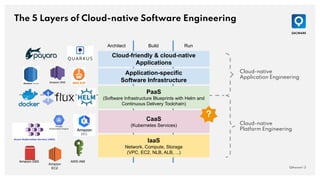
The 5 Layers of Cloud-native Software Engineering
QAware | 3
IaaS
Network, Compute, Storage
(VPC, EC2, NLB, ALB, ...)
CaaS
(Kubernetes Services)
PaaS
(Software Infrastructure Blueprints with Helm and
Continuous Delivery Toolchain)
Application-specific
Software Infrastructure
Cloud-friendly & cloud-native
Applications
Architect Build Run
Amazon SNS
AWS IAM
Amazon
EC2
Amazon EBS
Cloud-native
Application Engineering
Cloud-native
Platform Engineering
?
Use the right CLI tool for the job!
4
eksctl
gcloud
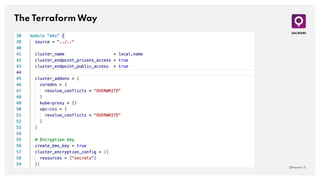
The Terraform Way
QAware | 5
Declarative
VS
Imperative
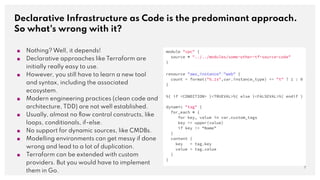
Declarative Infrastructure as Code is the predominant approach.
So what's wrong with it?
7
■ Nothing? Well, it depends!
■ Declarative approaches like Terraform are
initially really easy to use.
■ However, you still have to learn a new tool
and syntax, including the associated
ecosystem.
■ Modern engineering practices (clean code and
architecture, TDD) are not well established.
■ Usually, almost no flow control constructs, like
loops, conditionals, if-else.
■ No support for dynamic sources, like CMDBs.
■ Modelling environments can get messy if done
wrong and lead to a lot of duplication.
■ Terraform can be extended with custom
providers. But you would have to implement
them in Go.
module "vpc" {
source = "../../modules/some-other-tf-source-code"
}
resource "aws_instance" "web" {
count = format("%.1s",var.instance_type) == "t" ? 1 : 0
}
%{ if <CONDITION> }<TRUEVAL>%{ else }<FALSEVAL>%{ endif }
dynamic "tag" {
for_each = {
for key, value in var.custom_tags
key => upper(value)
if key != “Name”
}
content {
key = tag.key
value = tag.value
}
}
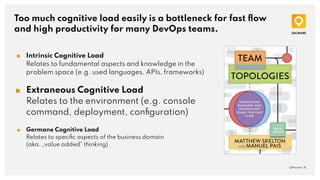
Too much cognitive load easily is a bottleneck for fast flow
and high productivity for many DevOps teams.
QAware | 8
■ Intrinsic Cognitive Load
Relates to fundamental aspects and knowledge in the
problem space (e.g. used languages, APIs, frameworks)
■ Extraneous Cognitive Load
Relates to the environment (e.g. console
command, deployment, configuration)
■ Germane Cognitive Load
Relates to specific aspects of the business domain
(aka. „value added“ thinking)
Imperative Tools like Pulumi or Amazon CDK enable modern cloud
infrastructure engineering for software developers and SREs.
QAware | 9
■ Tame overall complexity. Use your favourite language!
■ Easy to apply well-known clean code and general engineering practices to infrastructure code:
automation, modularity, testing, and CI/CD.
■ No breach between application development and DevOps engineering. Rich programmable cloud
interfaces with abstractions and reusable packages.
■ One consistent approach to Infrastructure as Code and cloud engineering for Docker, many cloud
providers and Kubernetes.
■ Many alternatives:
– Pulumi (https://github.com/pulumi/pulumi)
– Amazon CDK (https://github.com/aws/aws-cdk)
– cdk8s (https://github.com/cdk8s-team/cdk8s)
Pulumi - Cloud Engineering for Everyone.
Modern Infrastructure as Code for Developers and SREs
QAware | 10
■ Tame overall complexity. One consistent approach to cloud engineering for Docker, many cloud
providers and Kubernetes.
■ No breach between application development and DevOps engineering. Rich programmable cloud
interfaces with abstractions and reusable packages.
■ Apply engineering practices to infrastructure code: automation, modularity, testing, and CI/CD.
■ No intermediary formats. Direct usage of provided APIs.
■ Several converters available: arm2pulumi, crd2pulumi, kube2pulumi, tf2pulumi
■ Possibility to automate Pulumi workflows itself via API, instead of using the CLI.
■ Documentation and example resources available
– https://www.pulumi.com/docs/get-started/
– https://github.com/pulumi/examples
– https://www.pulumi.com/registry/packages/kubernetes/
– https://github.com/pulumi/pulumi-eks
Amazon CDK - Define cloud infrastructure in your favorite
programming language and deploy it using CloudFormation
QAware | 11
■ AWS CDK supports TypeScript, JavaScript, Python, Java, C#/.Net, and (in developer preview) Go
■ Many, many advantages (according to their website):
– Use logic (if statements, for-loops, etc) when defining your infrastructure
– Use object-oriented techniques to create a model of your system
– Organize your project into logical modules, share and reuse your infrastructure as a library
– Define high level abstractions, share them, and publish them to your team and company
– Testing your infrastructure code using industry-standard protocols and tools
– Use your existing code review workflow and features such as code completion within your IDE
■ Good documentation and example resources available
– https://docs.aws.amazon.com/cdk/latest/guide/home.html
– https://cdkworkshop.com
– https://docs.aws.amazon.com/cdk/api/v1/docs/aws-eks-readme.html
■ Currently AWS only, AWS CloudFormation is still present as final output.
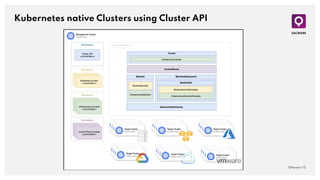
Kubernetes native Clusters using Cluster API
QAware | 12
Meet us at our booth.
Lerne uns bei einem online Schreibtisch-Workout kennen
Meistens fängt man ja erst an, wenn‘s schon zwickt.
Damit das gar nicht erst passiert, zeigt uns eine Trainerin von
Besser Bewegen Übungen, die man in einer kleinen Pause am
Schreibtisch machen kann, um die Rückenmuskulatur gezielt zu
stärken, Schmerzen vorzubeugen oder zu lindern.
Fr, 01.07. 12:45-13:30
Di, 19.07. 12:45-13:30
Anmeldung an susanna.suchan@qaware.de
&
qaware.de
QAware GmbH
Aschauer Straße 32
81549 München
Tel. +49 89 232315-0
info@qaware.de
twitter.com/qaware
linkedin.com/company/qaware-gmbh
xing.com/companies/qawaregmbh
slideshare.net/qaware
github.com/qaware

Cluster-as-code. The Many Ways towards Kubernetes

  • 1.
    qaware.de Cluster-as-code. The Many Waystowards Kubernetes Mario-Leander Reimer mario-leander.reimer@qaware.de @LeanderReimer
  • 2.
    2 Mario-Leander Reimer Principal SoftwareArchitect @LeanderReimer #cloudnativenerd #qaware
  • 3.
    The 5 Layersof Cloud-native Software Engineering QAware | 3 IaaS Network, Compute, Storage (VPC, EC2, NLB, ALB, ...) CaaS (Kubernetes Services) PaaS (Software Infrastructure Blueprints with Helm and Continuous Delivery Toolchain) Application-specific Software Infrastructure Cloud-friendly & cloud-native Applications Architect Build Run Amazon SNS AWS IAM Amazon EC2 Amazon EBS Cloud-native Application Engineering Cloud-native Platform Engineering ?
  • 4.
    Use the rightCLI tool for the job! 4 eksctl gcloud
  • 5.
  • 6.
  • 7.
    Declarative Infrastructure asCode is the predominant approach. So what's wrong with it? 7 ■ Nothing? Well, it depends! ■ Declarative approaches like Terraform are initially really easy to use. ■ However, you still have to learn a new tool and syntax, including the associated ecosystem. ■ Modern engineering practices (clean code and architecture, TDD) are not well established. ■ Usually, almost no flow control constructs, like loops, conditionals, if-else. ■ No support for dynamic sources, like CMDBs. ■ Modelling environments can get messy if done wrong and lead to a lot of duplication. ■ Terraform can be extended with custom providers. But you would have to implement them in Go. module "vpc" { source = "../../modules/some-other-tf-source-code" } resource "aws_instance" "web" { count = format("%.1s",var.instance_type) == "t" ? 1 : 0 } %{ if <CONDITION> }<TRUEVAL>%{ else }<FALSEVAL>%{ endif } dynamic "tag" { for_each = { for key, value in var.custom_tags key => upper(value) if key != “Name” } content { key = tag.key value = tag.value } }
  • 8.
    Too much cognitiveload easily is a bottleneck for fast flow and high productivity for many DevOps teams. QAware | 8 ■ Intrinsic Cognitive Load Relates to fundamental aspects and knowledge in the problem space (e.g. used languages, APIs, frameworks) ■ Extraneous Cognitive Load Relates to the environment (e.g. console command, deployment, configuration) ■ Germane Cognitive Load Relates to specific aspects of the business domain (aka. „value added“ thinking)
  • 9.
    Imperative Tools likePulumi or Amazon CDK enable modern cloud infrastructure engineering for software developers and SREs. QAware | 9 ■ Tame overall complexity. Use your favourite language! ■ Easy to apply well-known clean code and general engineering practices to infrastructure code: automation, modularity, testing, and CI/CD. ■ No breach between application development and DevOps engineering. Rich programmable cloud interfaces with abstractions and reusable packages. ■ One consistent approach to Infrastructure as Code and cloud engineering for Docker, many cloud providers and Kubernetes. ■ Many alternatives: – Pulumi (https://github.com/pulumi/pulumi) – Amazon CDK (https://github.com/aws/aws-cdk) – cdk8s (https://github.com/cdk8s-team/cdk8s)
  • 10.
    Pulumi - CloudEngineering for Everyone. Modern Infrastructure as Code for Developers and SREs QAware | 10 ■ Tame overall complexity. One consistent approach to cloud engineering for Docker, many cloud providers and Kubernetes. ■ No breach between application development and DevOps engineering. Rich programmable cloud interfaces with abstractions and reusable packages. ■ Apply engineering practices to infrastructure code: automation, modularity, testing, and CI/CD. ■ No intermediary formats. Direct usage of provided APIs. ■ Several converters available: arm2pulumi, crd2pulumi, kube2pulumi, tf2pulumi ■ Possibility to automate Pulumi workflows itself via API, instead of using the CLI. ■ Documentation and example resources available – https://www.pulumi.com/docs/get-started/ – https://github.com/pulumi/examples – https://www.pulumi.com/registry/packages/kubernetes/ – https://github.com/pulumi/pulumi-eks
  • 11.
    Amazon CDK -Define cloud infrastructure in your favorite programming language and deploy it using CloudFormation QAware | 11 ■ AWS CDK supports TypeScript, JavaScript, Python, Java, C#/.Net, and (in developer preview) Go ■ Many, many advantages (according to their website): – Use logic (if statements, for-loops, etc) when defining your infrastructure – Use object-oriented techniques to create a model of your system – Organize your project into logical modules, share and reuse your infrastructure as a library – Define high level abstractions, share them, and publish them to your team and company – Testing your infrastructure code using industry-standard protocols and tools – Use your existing code review workflow and features such as code completion within your IDE ■ Good documentation and example resources available – https://docs.aws.amazon.com/cdk/latest/guide/home.html – https://cdkworkshop.com – https://docs.aws.amazon.com/cdk/api/v1/docs/aws-eks-readme.html ■ Currently AWS only, AWS CloudFormation is still present as final output.
  • 12.
    Kubernetes native Clustersusing Cluster API QAware | 12
  • 13.
    Meet us atour booth.
  • 14.
    Lerne uns beieinem online Schreibtisch-Workout kennen Meistens fängt man ja erst an, wenn‘s schon zwickt. Damit das gar nicht erst passiert, zeigt uns eine Trainerin von Besser Bewegen Übungen, die man in einer kleinen Pause am Schreibtisch machen kann, um die Rückenmuskulatur gezielt zu stärken, Schmerzen vorzubeugen oder zu lindern. Fr, 01.07. 12:45-13:30 Di, 19.07. 12:45-13:30 Anmeldung an susanna.suchan@qaware.de &
  • 15.
    qaware.de QAware GmbH Aschauer Straße32 81549 München Tel. +49 89 232315-0 info@qaware.de twitter.com/qaware linkedin.com/company/qaware-gmbh xing.com/companies/qawaregmbh slideshare.net/qaware github.com/qaware