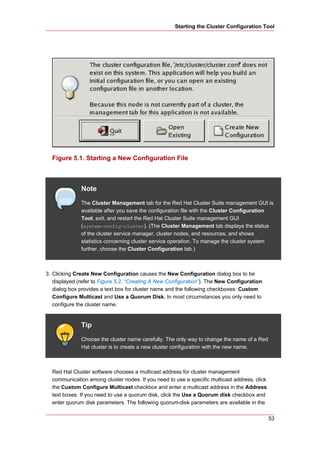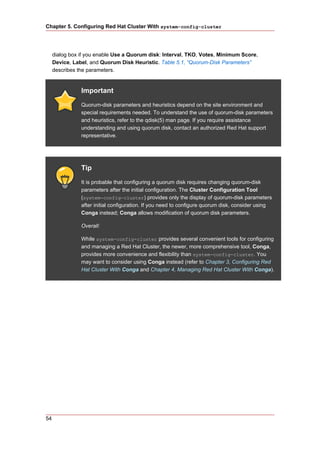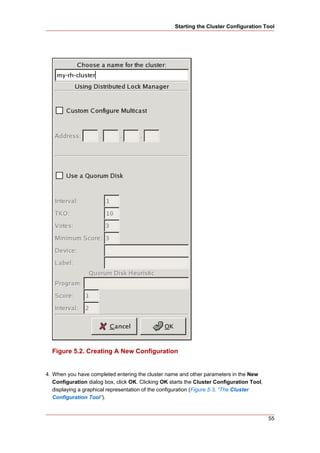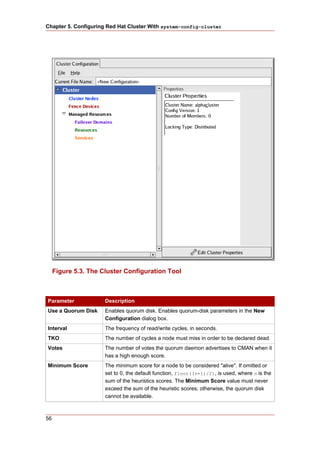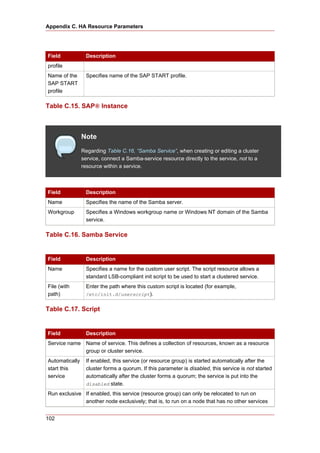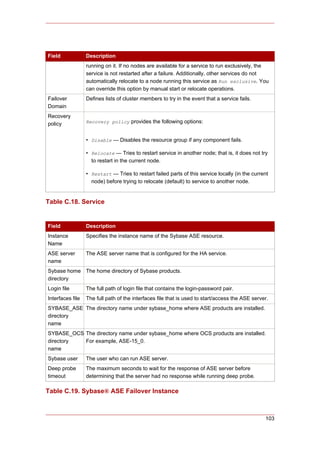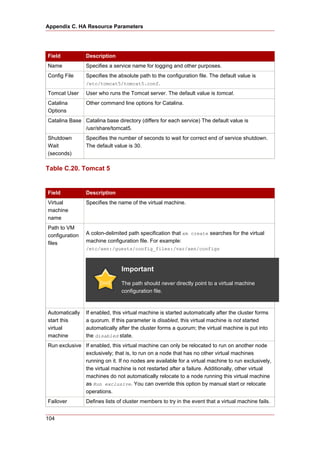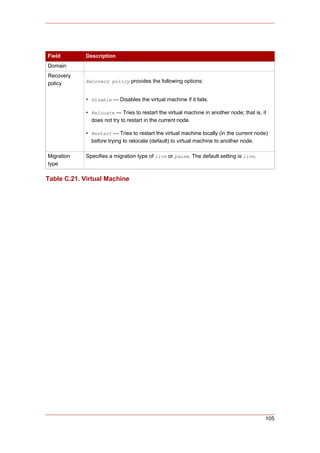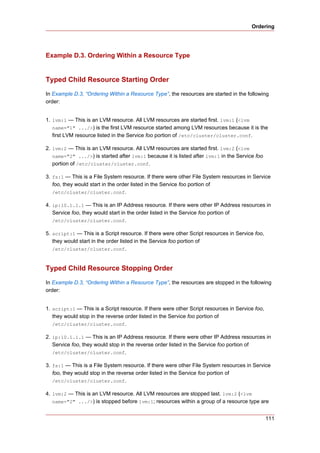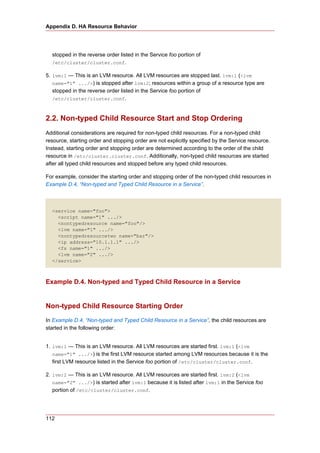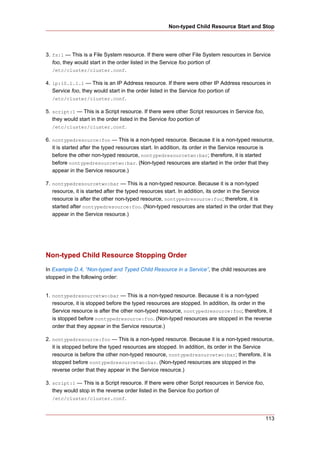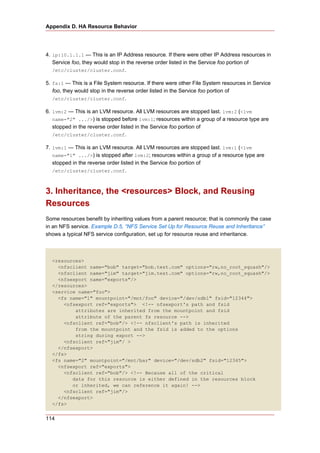



Configuring and Managing a Red Hat
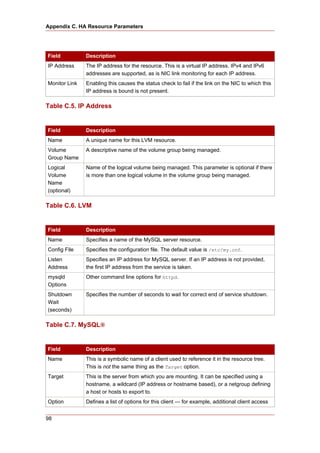
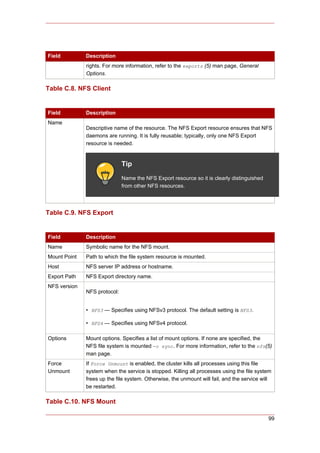
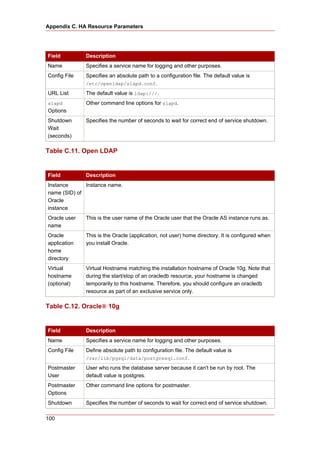
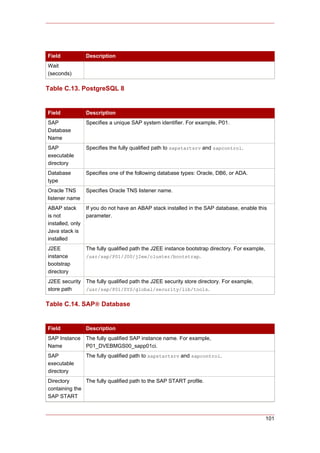
              Cluster


Red Hat Cluster for Red
 Hat Enterprise Linux

                 5.2
          Cluster_Administration
                  ISBN: N/A
         Publication date: May 2008
Configuring and Managing a Red Hat Cluster


Configuring and Managing a Red Hat Cluster describes the configuration and management of
Red Hat cluster systems for Red Hat Enterprise Linux 5.2 It does not include information about
Red Hat Linux Virtual Servers (LVS). Information about installing and configuring LVS is in a
separate document.
Configuring and Managing a Red Hat Cluster: Red Hat Cluster
for Red Hat Enterprise Linux
Copyright © 2008 Red Hat, Inc.

Copyright © 2008 Red Hat, Inc. This material may only be distributed subject to the terms and conditions set forth in the
Open Publication License, V1.0 or later with the restrictions noted below (the latest version of the OPL is presently
available at http://www.opencontent.org/openpub/).

Distribution of substantively modified versions of this document is prohibited without the explicit permission of the
copyright holder.

Distribution of the work or derivative of the work in any standard (paper) book form for commercial purposes is
prohibited unless prior permission is obtained from the copyright holder.

Red Hat and the Red Hat "Shadow Man" logo are registered trademarks of Red Hat, Inc. in the United States and other
countries.

All other trademarks referenced herein are the property of their respective owners.

The GPG fingerprint of the security@redhat.com key is:

CA 20 86 86 2B D6 9D FC 65 F6 EC C4 21 91 80 CD DB 42 A6 0E


1801 Varsity Drive
Raleigh, NC 27606-2072
USA
Phone: +1 919 754 3700
Phone: 888 733 4281
Fax: +1 919 754 3701
PO Box 13588
Research Triangle Park, NC 27709
USA
Configuring and Managing a Red Hat Cluster
Introduction .............................................................................................................. vii
      1. Document Conventions ................................................................................ viii
      2. Feedback ...................................................................................................... ix
1. Red Hat Cluster Configuration and Management Overview ....................................... 1
      1. Configuration Basics ...................................................................................... 1
            1.1. Setting Up Hardware ........................................................................... 1
            1.2. Installing Red Hat Cluster software ....................................................... 2
            1.3. Configuring Red Hat Cluster Software .................................................. 2
      2. Conga ........................................................................................................... 4
      3. system-config-cluster Cluster Administration GUI ....................................... 7
            3.1. Cluster Configuration Tool ................................................................ 8
            3.2. Cluster Status Tool ...........................................................................10
      4. Command Line Administration Tools ..............................................................11
2. Before Configuring a Red Hat Cluster .....................................................................13
      1. Compatible Hardware ....................................................................................13
      2. Enabling IP Ports ..........................................................................................13
            2.1. Enabling IP Ports on Cluster Nodes .....................................................13
            2.2. Enabling IP Ports on Computers That Run luci ....................................14
            2.3. Examples of iptables Rules ..............................................................15
      3. Configuring ACPI For Use with Integrated Fence Devices ................................17
            3.1. Disabling ACPI Soft-Off with chkconfig Management ..........................18
            3.2. Disabling ACPI Soft-Off with the BIOS .................................................19
            3.3. Disabling ACPI Completely in the grub.conf File .................................21
      4. Considerations for Configuring HA Services ....................................................22
      5. Configuring max_luns ....................................................................................23
      6. Considerations for Using Quorum Disk ...........................................................23
      7. Multicast Addresses ......................................................................................24
      8. Considerations for Using Conga ....................................................................25
      9. General Configuration Considerations ............................................................25
3. Configuring Red Hat Cluster With Conga ...............................................................27
      1. Configuration Tasks ......................................................................................27
      2. Starting luci and ricci ...................................................................................28
      3. Creating A Cluster .........................................................................................29
      4. Global Cluster Properties ...............................................................................30
      5. Configuring Fence Devices ............................................................................32
            5.1. Creating a Shared Fence Device .........................................................34
            5.2. Modifying or Deleting a Fence Device ..................................................36
      6. Configuring Cluster Members .........................................................................36
            6.1. Initially Configuring Members ..............................................................36
            6.2. Adding a Member to a Running Cluster ...............................................37
            6.3. Deleting a Member from a Cluster .......................................................38
      7. Configuring a Failover Domain .......................................................................39
            7.1. Adding a Failover Domain ...................................................................41
            7.2. Modifying a Failover Domain ...............................................................41
      8. Adding Cluster Resources .............................................................................43
      9. Adding a Cluster Service to the Cluster ..........................................................43


                                                                                                                                  v
Configuring and Managing a Red Hat Cluster


     10. Configuring Cluster Storage .........................................................................45
4. Managing Red Hat Cluster With Conga ..................................................................47
     1. Starting, Stopping, and Deleting Clusters ........................................................47
     2. Managing Cluster Nodes ...............................................................................48
     3. Managing High-Availability Services ...............................................................49
     4. Diagnosing and Correcting Problems in a Cluster ............................................50
5. Configuring Red Hat Cluster With system-config-cluster ....................................51
     1. Configuration Tasks ......................................................................................51
     2. Starting the Cluster Configuration Tool ........................................................52
     3. Configuring Cluster Properties .......................................................................57
     4. Configuring Fence Devices ............................................................................58
     5. Adding and Deleting Members .......................................................................59
            5.1. Adding a Member to a Cluster .............................................................59
            5.2. Adding a Member to a Running Cluster ...............................................61
            5.3. Deleting a Member from a Cluster .......................................................63
     6. Configuring a Failover Domain .......................................................................64
            6.1. Adding a Failover Domain ...................................................................66
            6.2. Removing a Failover Domain ..............................................................69
            6.3. Removing a Member from a Failover Domain .......................................69
     7. Adding Cluster Services ................................................................................70
     8. Adding a Cluster Service to the Cluster ..........................................................70
     9. Propagating The Configuration File: New Cluster ............................................73
     10. Starting the Cluster Software .......................................................................73
6. Managing Red Hat Cluster With system-config-cluster ......................................75
     1. Starting and Stopping the Cluster Software .....................................................75
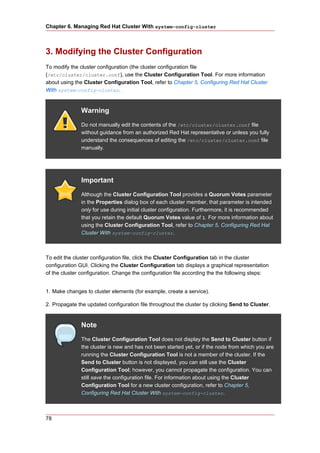
     2. Managing High-Availability Services ...............................................................76
     3. Modifying the Cluster Configuration ................................................................78
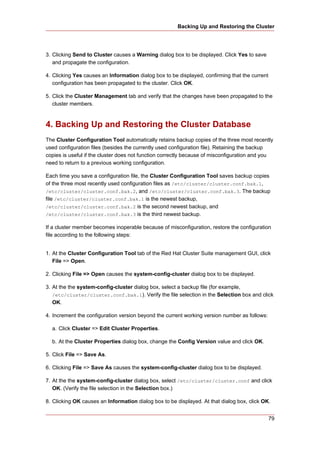
     4. Backing Up and Restoring the Cluster Database .............................................79
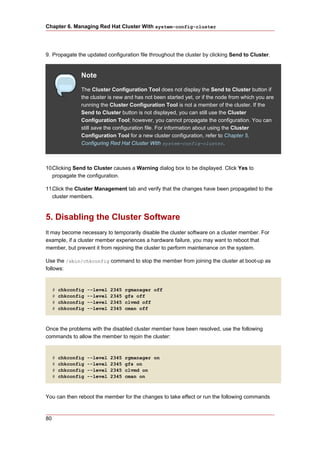
     5. Disabling the Cluster Software .......................................................................80
     6. Diagnosing and Correcting Problems in a Cluster ............................................81
A. Example of Setting Up Apache HTTP Server ..........................................................83
     1. Apache HTTP Server Setup Overview ............................................................83
     2. Configuring Shared Storage ...........................................................................84
     3. Installing and Configuring the Apache HTTP Server ........................................84
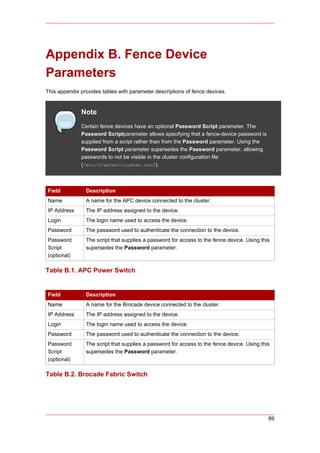
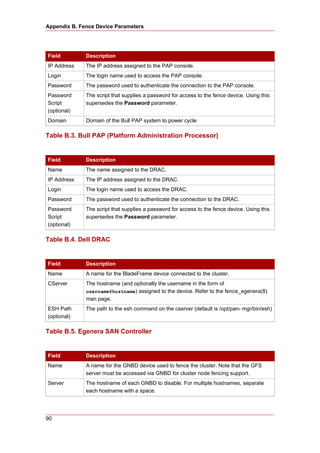
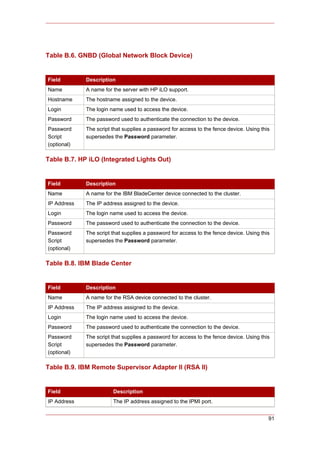
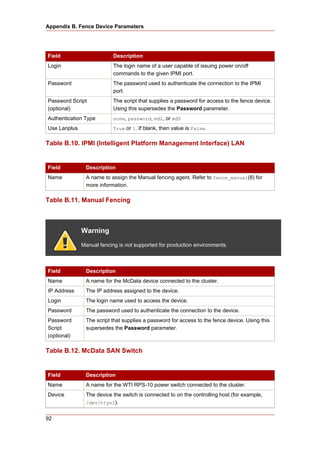
B. Fence Device Parameters .....................................................................................89
C. HA Resource Parameters .....................................................................................95
D. HA Resource Behavior .......................................................................................107
     1. Parent, Child, and Sibling Relationships Among Resources ...........................108
     2. Sibling Start Ordering and Resource Child Ordering ......................................109
            2.1. Typed Child Resource Start and Stop Ordering ..................................109
            2.2. Non-typed Child Resource Start and Stop Ordering ............................112
     3. Inheritance, the <resources> Block, and Reusing Resources .........................114
     4. Failure Recovery and Independent Subtrees ................................................115
     5. Debugging and Testing Services and Resource Ordering ..............................116
E. Upgrading A Red Hat Cluster from RHEL 4 to RHEL 5 ..........................................119
Index .....................................................................................................................123


vi
Introduction

This document provides information about installing, configuring and managing Red Hat Cluster
components. Red Hat Cluster components are part of Red Hat Cluster Suite and allow you to
connect a group of computers (called nodes or members) to work together as a cluster. This
document does not include information about installing, configuring, and managing Linux Virtual
Server (LVS) software. Information about that is in a separate document.

The audience of this document should have advanced working knowledge of Red Hat
Enterprise Linux and understand the concepts of clusters, storage, and server computing.

This document is organized as follows:


• Chapter 1, Red Hat Cluster Configuration and Management Overview

• Chapter 2, Before Configuring a Red Hat Cluster

• Chapter 3, Configuring Red Hat Cluster With Conga

• Chapter 4, Managing Red Hat Cluster With Conga

• Chapter 5, Configuring Red Hat Cluster With system-config-cluster

• Chapter 6, Managing Red Hat Cluster With system-config-cluster

• Appendix A, Example of Setting Up Apache HTTP Server

• Appendix B, Fence Device Parameters

• Appendix D, HA Resource Behavior

• Appendix E, Upgrading A Red Hat Cluster from RHEL 4 to RHEL 5


For more information about Red Hat Enterprise Linux 5, refer to the following resources:


• Red Hat Enterprise Linux Installation Guide — Provides information regarding installation of
  Red Hat Enterprise Linux 5.

• Red Hat Enterprise Linux Deployment Guide — Provides information regarding the
  deployment, configuration and administration of Red Hat Enterprise Linux 5.


For more information about Red Hat Cluster Suite for Red Hat Enterprise Linux 5, refer to the
following resources:


• Red Hat Cluster Suite Overview — Provides a high level overview of the Red Hat Cluster
  Suite.

• LVM Administrator's Guide: Configuration and Administration — Provides a description of the
  Logical Volume Manager (LVM), including information on running LVM in a clustered


                                                                                                 vii
Introduction


   environment.

• Global File System: Configuration and Administration — Provides information about installing,
  configuring, and maintaining Red Hat GFS (Red Hat Global File System).

• Using Device-Mapper Multipath — Provides information about using the Device-Mapper
  Multipath feature of Red Hat Enterprise Linux 5.

• Using GNBD with Global File System — Provides an overview on using Global Network Block
  Device (GNBD) with Red Hat GFS.

• Linux Virtual Server Administration — Provides information on configuring high-performance
  systems and services with the Linux Virtual Server (LVS).

• Red Hat Cluster Suite Release Notes — Provides information about the current release of
  Red Hat Cluster Suite.


Red Hat Cluster Suite documentation and other Red Hat documents are available in HTML,
PDF, and RPM versions on the Red Hat Enterprise Linux Documentation CD and online at
http://www.redhat.com/docs/.


1. Document Conventions
Certain words in this manual are represented in different fonts, styles, and weights. This
highlighting indicates that the word is part of a specific category. The categories include the
following:


Courier font
        Courier font represents commands, file names and paths, and prompts .

        When shown as below, it indicates computer output:


       Desktop         about.html          logs        paulwesterberg.png
       Mail            backupfiles         mail        reports


bold Courier font
        Bold Courier font represents text that you are to type, such as: service jonas start

        If you have to run a command as root, the root prompt (#) precedes the command:


       # gconftool-2


italic Courier font


viii
Feedback


    Italic Courier font represents a variable, such as an installation directory:
    install_dir/bin/

bold font
   Bold font represents application programs and text found on a graphical interface.

    When shown like this: OK , it indicates a button on a graphical application interface.


Additionally, the manual uses different strategies to draw your attention to pieces of information.
In order of how critical the information is to you, these items are marked as follows:


               Note
               A note is typically information that you need to understand the behavior of the
               system.


               Tip
               A tip is typically an alternative way of performing a task.


               Important
               Important information is necessary, but possibly unexpected, such as a
               configuration change that will not persist after a reboot.


               Caution
               A caution indicates an act that would violate your support agreement, such as
               recompiling the kernel.


               Warning
               A warning indicates potential data loss, as may happen when tuning hardware
               for maximum performance.


2. Feedback

                                                                                                 ix
Introduction


If you spot a typo, or if you have thought of a way to make this manual better, we would love to
hear from you. Please submit a report in Bugzilla (http://bugzilla.redhat.com/bugzilla/) against
the component Documentation-cluster.

Be sure to mention the manual's identifier:


    Cluster_Administration(EN)-5.2 (2008-05-19T17:11)


By mentioning this manual's identifier, we know exactly which version of the guide you have.

If you have a suggestion for improving the documentation, try to be as specific as possible. If
you have found an error, please include the section number and some of the surrounding text
so we can find it easily.


x
Chapter 1.


Red Hat Cluster Configuration and
Management Overview
Red Hat Cluster allows you to connect a group of computers (called nodes or members) to work
together as a cluster. You can use Red Hat Cluster to suit your clustering needs (for example,
setting up a cluster for sharing files on a GFS file system or setting up service failover).


1. Configuration Basics
To set up a cluster, you must connect the nodes to certain cluster hardware and configure the
nodes into the cluster environment. This chapter provides an overview of cluster configuration
and management, and tools available for configuring and managing a Red Hat Cluster.

Configuring and managing a Red Hat Cluster consists of the following basic steps:


1. Setting up hardware. Refer to Section 1.1, “Setting Up Hardware”.

2. Installing Red Hat Cluster software. Refer to Section 1.2, “Installing Red Hat Cluster
   software”.

3. Configuring Red Hat Cluster Software. Refer to Section 1.3, “Configuring Red Hat Cluster
   Software”.


1.1. Setting Up Hardware
Setting up hardware consists of connecting cluster nodes to other hardware required to run a
Red Hat Cluster. The amount and type of hardware varies according to the purpose and
availability requirements of the cluster. Typically, an enterprise-level cluster requires the
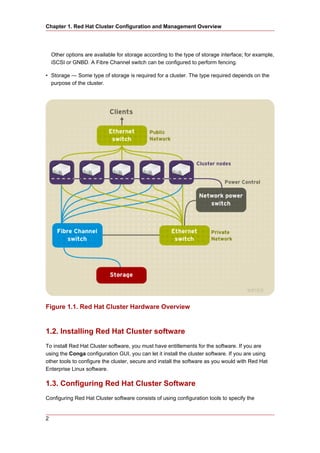
following type of hardware (refer to Figure 1.1, “Red Hat Cluster Hardware Overview”). For
considerations about hardware and other cluster configuration concerns, refer to Chapter 2,
Before Configuring a Red Hat Cluster or check with an authorized Red Hat representative.


• Cluster nodes — Computers that are capable of running Red Hat Enterprise Linux 5 software,
  with at least 1GB of RAM.

• Ethernet switch or hub for public network — This is required for client access to the cluster.

• Ethernet switch or hub for private network — This is required for communication among the
  cluster nodes and other cluster hardware such as network power switches and Fibre Channel
  switches.

• Network power switch — A network power switch is recommended to perform fencing in an
  enterprise-level cluster.

• Fibre Channel switch — A Fibre Channel switch provides access to Fibre Channel storage.


                                                                                                   1
Chapter 1. Red Hat Cluster Configuration and Management Overview


    Other options are available for storage according to the type of storage interface; for example,
    iSCSI or GNBD. A Fibre Channel switch can be configured to perform fencing.

• Storage — Some type of storage is required for a cluster. The type required depends on the
  purpose of the cluster.


Figure 1.1. Red Hat Cluster Hardware Overview


1.2. Installing Red Hat Cluster software
To install Red Hat Cluster software, you must have entitlements for the software. If you are
using the Conga configuration GUI, you can let it install the cluster software. If you are using
other tools to configure the cluster, secure and install the software as you would with Red Hat
Enterprise Linux software.

1.3. Configuring Red Hat Cluster Software
Configuring Red Hat Cluster software consists of using configuration tools to specify the


2
Configuring Red Hat Cluster Software


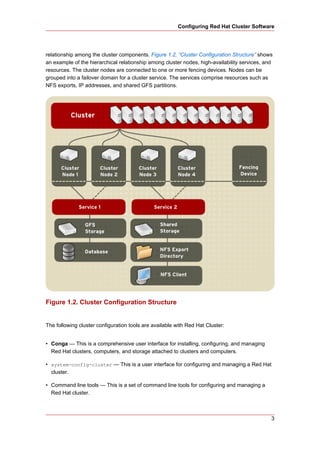
relationship among the cluster components. Figure 1.2, “Cluster Configuration Structure” shows
an example of the hierarchical relationship among cluster nodes, high-availability services, and
resources. The cluster nodes are connected to one or more fencing devices. Nodes can be
grouped into a failover domain for a cluster service. The services comprise resources such as
NFS exports, IP addresses, and shared GFS partitions.


Figure 1.2. Cluster Configuration Structure


The following cluster configuration tools are available with Red Hat Cluster:


• Conga — This is a comprehensive user interface for installing, configuring, and managing
  Red Hat clusters, computers, and storage attached to clusters and computers.

• system-config-cluster — This is a user interface for configuring and managing a Red Hat
  cluster.

• Command line tools — This is a set of command line tools for configuring and managing a
  Red Hat cluster.


                                                                                               3
Chapter 1. Red Hat Cluster Configuration and Management Overview


A brief overview of each configuration tool is provided in the following sections:


• Section 2, “Conga”

• Section 3, “system-config-cluster Cluster Administration GUI”

• Section 4, “Command Line Administration Tools”


In addition, information about using Conga and system-config-cluster is provided in
subsequent chapters of this document. Information about the command line tools is available in
the man pages for the tools.


2. Conga
Conga is an integrated set of software components that provides centralized configuration and
management of Red Hat clusters and storage. Conga provides the following major features:


• One Web interface for managing cluster and storage

• Automated Deployment of Cluster Data and Supporting Packages

• Easy Integration with Existing Clusters

• No Need to Re-Authenticate

• Integration of Cluster Status and Logs

• Fine-Grained Control over User Permissions


The primary components in Conga are luci and ricci, which are separately installable. luci is a
server that runs on one computer and communicates with multiple clusters and computers via
ricci. ricci is an agent that runs on each computer (either a cluster member or a standalone
computer) managed by Conga.

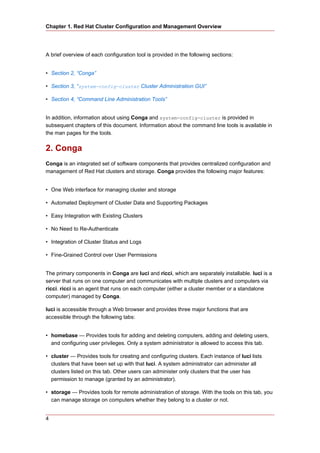
luci is accessible through a Web browser and provides three major functions that are
accessible through the following tabs:


• homebase — Provides tools for adding and deleting computers, adding and deleting users,
  and configuring user privileges. Only a system administrator is allowed to access this tab.

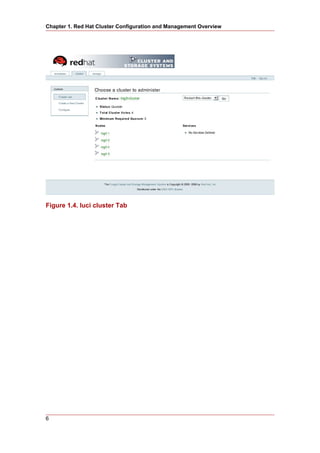
• cluster — Provides tools for creating and configuring clusters. Each instance of luci lists
  clusters that have been set up with that luci. A system administrator can administer all
  clusters listed on this tab. Other users can administer only clusters that the user has
  permission to manage (granted by an administrator).

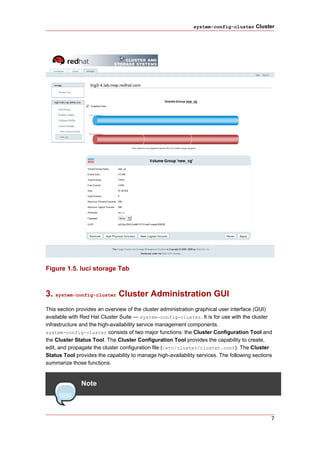
• storage — Provides tools for remote administration of storage. With the tools on this tab, you
  can manage storage on computers whether they belong to a cluster or not.


4
Conga


To administer a cluster or storage, an administrator adds (or registers) a cluster or a computer
to a luci server. When a cluster or a computer is registered with luci, the FQDN hostname or IP
address of each computer is stored in a luci database.

You can populate the database of one luci instance from another luciinstance. That capability
provides a means of replicating a luci server instance and provides an efficient upgrade and
testing path. When you install an instance of luci, its database is empty. However, you can
import part or all of a luci database from an existing luci server when deploying a new luci
server.

Each luci instance has one user at initial installation — admin. Only the admin user may add
systems to a luci server. Also, the admin user can create additional user accounts and
determine which users are allowed to access clusters and computers registered in the luci
database. It is possible to import users as a batch operation in a new luci server, just as it is
possible to import clusters and computers.

When a computer is added to a luci server to be administered, authentication is done once. No
authentication is necessary from then on (unless the certificate used is revoked by a CA). After
that, you can remotely configure and manage clusters and storage through the luci user
interface. luci and ricci communicate with each other via XML.

The following figures show sample displays of the three major luci tabs: homebase, cluster,
and storage.

For more information about Conga, refer to Chapter 3, Configuring Red Hat Cluster With
Conga, Chapter 4, Managing Red Hat Cluster With Conga, and the online help available with
the luci server.


Figure 1.3. luci homebase Tab


                                                                                                    5
Chapter 1. Red Hat Cluster Configuration and Management Overview


Figure 1.4. luci cluster Tab


6
system-config-cluster Cluster


Figure 1.5. luci storage Tab


3. system-config-cluster Cluster Administration GUI
This section provides an overview of the cluster administration graphical user interface (GUI)
available with Red Hat Cluster Suite — system-config-cluster. It is for use with the cluster
infrastructure and the high-availability service management components.
system-config-cluster consists of two major functions: the Cluster Configuration Tool and
the Cluster Status Tool. The Cluster Configuration Tool provides the capability to create,
edit, and propagate the cluster configuration file (/etc/cluster/cluster.conf). The Cluster
Status Tool provides the capability to manage high-availability services. The following sections
summarize those functions.


               Note


                                                                                               7
Chapter 1. Red Hat Cluster Configuration and Management Overview


              While system-config-cluster provides several convenient tools for configuring
              and managing a Red Hat Cluster, the newer, more comprehensive tool, Conga,
              provides more convenience and flexibility than system-config-cluster.


3.1. Cluster Configuration Tool
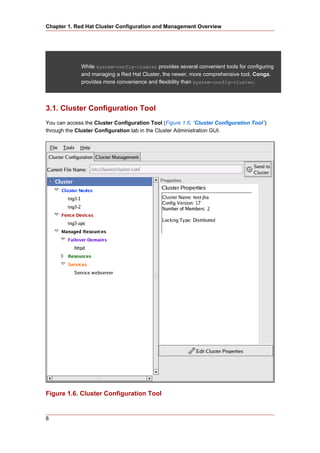
You can access the Cluster Configuration Tool (Figure 1.6, “Cluster Configuration Tool”)
through the Cluster Configuration tab in the Cluster Administration GUI.


Figure 1.6. Cluster Configuration Tool


8
Administration GUI


The Cluster Configuration Tool represents cluster configuration components in the
configuration file (/etc/cluster/cluster.conf) with a hierarchical graphical display in the left
panel. A triangle icon to the left of a component name indicates that the component has one or
more subordinate components assigned to it. Clicking the triangle icon expands and collapses
the portion of the tree below a component. The components displayed in the GUI are
summarized as follows:


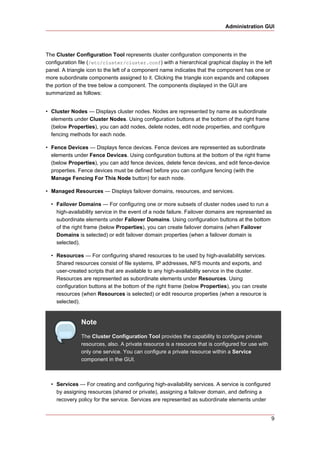
• Cluster Nodes — Displays cluster nodes. Nodes are represented by name as subordinate
  elements under Cluster Nodes. Using configuration buttons at the bottom of the right frame
  (below Properties), you can add nodes, delete nodes, edit node properties, and configure
  fencing methods for each node.

• Fence Devices — Displays fence devices. Fence devices are represented as subordinate
  elements under Fence Devices. Using configuration buttons at the bottom of the right frame
  (below Properties), you can add fence devices, delete fence devices, and edit fence-device
  properties. Fence devices must be defined before you can configure fencing (with the
  Manage Fencing For This Node button) for each node.

• Managed Resources — Displays failover domains, resources, and services.

  • Failover Domains — For configuring one or more subsets of cluster nodes used to run a
    high-availability service in the event of a node failure. Failover domains are represented as
    subordinate elements under Failover Domains. Using configuration buttons at the bottom
    of the right frame (below Properties), you can create failover domains (when Failover
    Domains is selected) or edit failover domain properties (when a failover domain is
    selected).

  • Resources — For configuring shared resources to be used by high-availability services.
    Shared resources consist of file systems, IP addresses, NFS mounts and exports, and
    user-created scripts that are available to any high-availability service in the cluster.
    Resources are represented as subordinate elements under Resources. Using
    configuration buttons at the bottom of the right frame (below Properties), you can create
    resources (when Resources is selected) or edit resource properties (when a resource is
    selected).


               Note
               The Cluster Configuration Tool provides the capability to configure private
               resources, also. A private resource is a resource that is configured for use with
               only one service. You can configure a private resource within a Service
               component in the GUI.


  • Services — For creating and configuring high-availability services. A service is configured
    by assigning resources (shared or private), assigning a failover domain, and defining a
    recovery policy for the service. Services are represented as subordinate elements under


                                                                                                   9
Chapter 1. Red Hat Cluster Configuration and Management Overview


     Services. Using configuration buttons at the bottom of the right frame (below Properties),
     you can create services (when Services is selected) or edit service properties (when a
     service is selected).


3.2. Cluster Status Tool
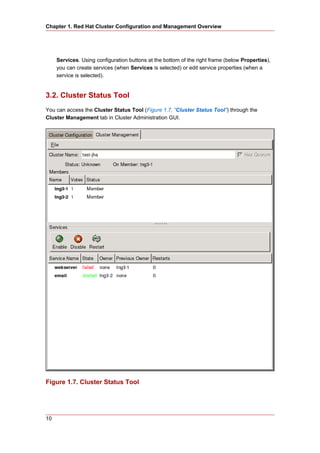
You can access the Cluster Status Tool (Figure 1.7, “Cluster Status Tool”) through the
Cluster Management tab in Cluster Administration GUI.


Figure 1.7. Cluster Status Tool


10
Command Line Administration Tools


The nodes and services displayed in the Cluster Status Tool are determined by the cluster
configuration file (/etc/cluster/cluster.conf). You can use the Cluster Status Tool to
enable, disable, restart, or relocate a high-availability service.


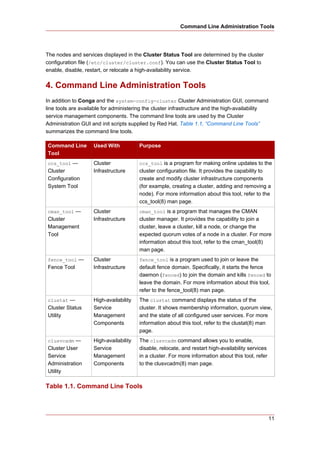
4. Command Line Administration Tools
In addition to Conga and the system-config-cluster Cluster Administration GUI, command
line tools are available for administering the cluster infrastructure and the high-availability
service management components. The command line tools are used by the Cluster
Administration GUI and init scripts supplied by Red Hat. Table 1.1, “Command Line Tools”
summarizes the command line tools.

Command Line        Used With           Purpose
Tool
ccs_tool —          Cluster             ccs_tool is a program for making online updates to the
Cluster             Infrastructure      cluster configuration file. It provides the capability to
Configuration                           create and modify cluster infrastructure components
System Tool                             (for example, creating a cluster, adding and removing a
                                        node). For more information about this tool, refer to the
                                        ccs_tool(8) man page.
cman_tool —         Cluster             cman_tool is a program that manages the CMAN
Cluster             Infrastructure      cluster manager. It provides the capability to join a
Management                              cluster, leave a cluster, kill a node, or change the
Tool                                    expected quorum votes of a node in a cluster. For more
                                        information about this tool, refer to the cman_tool(8)
                                        man page.
fence_tool —        Cluster             fence_tool is a program used to join or leave the
Fence Tool          Infrastructure      default fence domain. Specifically, it starts the fence
                                        daemon (fenced) to join the domain and kills fenced to
                                        leave the domain. For more information about this tool,
                                        refer to the fence_tool(8) man page.
clustat —           High-availability   The clustat command displays the status of the
Cluster Status      Service             cluster. It shows membership information, quorum view,
Utility             Management          and the state of all configured user services. For more
                    Components          information about this tool, refer to the clustat(8) man
                                        page.
clusvcadm —         High-availability   The clusvcadm command allows you to enable,
Cluster User        Service             disable, relocate, and restart high-availability services
Service             Management          in a cluster. For more information about this tool, refer
Administration      Components          to the clusvcadm(8) man page.
Utility

Table 1.1. Command Line Tools


                                                                                                    11
12
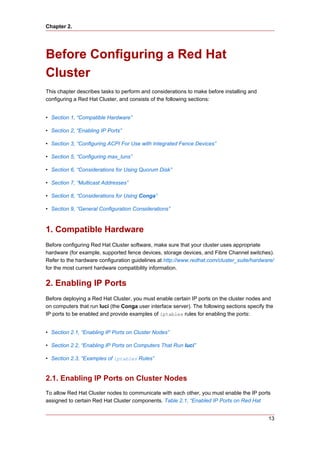
Chapter 2.


Before Configuring a Red Hat
Cluster
This chapter describes tasks to perform and considerations to make before installing and
configuring a Red Hat Cluster, and consists of the following sections:


• Section 1, “Compatible Hardware”

• Section 2, “Enabling IP Ports”

• Section 3, “Configuring ACPI For Use with Integrated Fence Devices”

• Section 5, “Configuring max_luns”

• Section 6, “Considerations for Using Quorum Disk”

• Section 7, “Multicast Addresses”

• Section 8, “Considerations for Using Conga”

• Section 9, “General Configuration Considerations”


1. Compatible Hardware
Before configuring Red Hat Cluster software, make sure that your cluster uses appropriate
hardware (for example, supported fence devices, storage devices, and Fibre Channel switches).
Refer to the hardware configuration guidelines at http://www.redhat.com/cluster_suite/hardware/
for the most current hardware compatibility information.


2. Enabling IP Ports
Before deploying a Red Hat Cluster, you must enable certain IP ports on the cluster nodes and
on computers that run luci (the Conga user interface server). The following sections specify the
IP ports to be enabled and provide examples of iptables rules for enabling the ports:


• Section 2.1, “Enabling IP Ports on Cluster Nodes”

• Section 2.2, “Enabling IP Ports on Computers That Run luci”

• Section 2.3, “Examples of iptables Rules”


2.1. Enabling IP Ports on Cluster Nodes
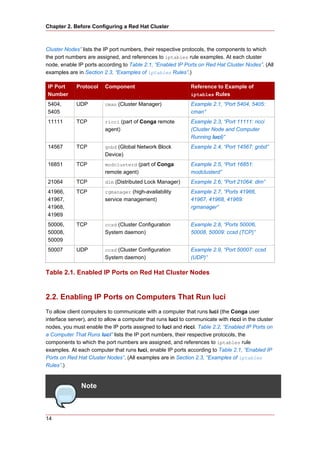
To allow Red Hat Cluster nodes to communicate with each other, you must enable the IP ports
assigned to certain Red Hat Cluster components. Table 2.1, “Enabled IP Ports on Red Hat


                                                                                             13
Chapter 2. Before Configuring a Red Hat Cluster


Cluster Nodes” lists the IP port numbers, their respective protocols, the components to which
the port numbers are assigned, and references to iptables rule examples. At each cluster
node, enable IP ports according to Table 2.1, “Enabled IP Ports on Red Hat Cluster Nodes”. (All
examples are in Section 2.3, “Examples of iptables Rules”.)

IP Port      Protocol    Component                            Reference to Example of
Number                                                        iptables Rules

5404,        UDP         cman (Cluster Manager)               Example 2.1, “Port 5404, 5405:
5405                                                          cman”
11111        TCP         ricci (part of Conga remote          Example 2.3, “Port 11111: ricci
                         agent)                               (Cluster Node and Computer
                                                              Running luci)”
14567        TCP         gnbd (Global Network Block           Example 2.4, “Port 14567: gnbd”
                         Device)
16851        TCP         modclusterd (part of Conga           Example 2.5, “Port 16851:
                         remote agent)                        modclusterd”
21064        TCP         dlm (Distributed Lock Manager)       Example 2.6, “Port 21064: dlm”
41966,       TCP         rgmanager (high-availability         Example 2.7, “Ports 41966,
41967,                   service management)                  41967, 41968, 41969:
41968,                                                        rgmanager”
41969
50006,       TCP         ccsd (Cluster Configuration          Example 2.8, “Ports 50006,
50008,                   System daemon)                       50008, 50009: ccsd (TCP)”
50009
50007        UDP         ccsd (Cluster Configuration          Example 2.9, “Port 50007: ccsd
                         System daemon)                       (UDP)”

Table 2.1. Enabled IP Ports on Red Hat Cluster Nodes


2.2. Enabling IP Ports on Computers That Run luci
To allow client computers to communicate with a computer that runs luci (the Conga user
interface server), and to allow a computer that runs luci to communicate with ricci in the cluster
nodes, you must enable the IP ports assigned to luci and ricci. Table 2.2, “Enabled IP Ports on
a Computer That Runs luci” lists the IP port numbers, their respective protocols, the
components to which the port numbers are assigned, and references to iptables rule
examples. At each computer that runs luci, enable IP ports according to Table 2.1, “Enabled IP
Ports on Red Hat Cluster Nodes”. (All examples are in Section 2.3, “Examples of iptables
Rules”.)


               Note


14
Examples of iptables Rules


              If a cluster node is running luci, port 11111 should already have been enabled.


IP Port     Protocol    Component                           Reference to Example of
Number                                                      iptables Rules

8084        TCP         luci (Conga user interface          Example 2.2, “Port 8084: luci
                        server)                             (Cluster Node or Computer
                                                            Running luci)”
11111       TCP         ricci (Conga remote agent)          Example 2.3, “Port 11111: ricci
                                                            (Cluster Node and Computer
                                                            Running luci)”

Table 2.2. Enabled IP Ports on a Computer That Runs luci


2.3. Examples of iptables Rules
This section provides iptables rule examples for enabling IP ports on Red Hat Cluster nodes
and computers that run luci. The examples enable IP ports for a computer having an IP
address of 10.10.10.200, using a subnet mask of 10.10.10.0/24.


              Note
              Examples are for cluster nodes unless otherwise noted in the example titles.


  iptables -A INPUT -i 10.10.10.200 -m multiport -m state --state NEW -p udp
  -s 10.10.10.0/24 -d 10.10.10.0/24 --dports 5404,5405 -j ACCEPT


Example 2.1. Port 5404, 5405: cman


  -A INPUT -i 10.10.10.200 -m state --state NEW -m multiport -p tcp -s
  10.10.10.0/24 -d 10.10.10.0/24 --dports 8084 -j ACCEPT


Example 2.2. Port 8084: luci (Cluster Node or Computer Running luci)


  -A INPUT -i 10.10.10.200 -m state --state NEW -m multiport -p tcp -s


                                                                                              15
Chapter 2. Before Configuring a Red Hat Cluster


     10.10.10.0/24 -d 10.10.10.0/24 --dports 11111 -j ACCEPT


Example 2.3. Port 11111: ricci (Cluster Node and Computer Running luci)


     -A INPUT -i 10.10.10.200 -m state --state NEW -m multiport -p tcp -s
     10.10.10.0/24 -d 10.10.10.0/24 --dports 14567 -j ACCEPT


Example 2.4. Port 14567: gnbd


     -A INPUT -i 10.10.10.200 -m state --state NEW -m multiport -p tcp -s
     10.10.10.0/24 -d 10.10.10.0/24 --dports 16851 -j ACCEPT


Example 2.5. Port 16851: modclusterd


     -A INPUT -i 10.10.10.200 -m state --state NEW -m multiport -p tcp -s
     10.10.10.0/24 -d 10.10.10.0/24 --dports 21064 -j ACCEPT


Example 2.6. Port 21064: dlm


     -A INPUT -i 10.10.10.200 -m state --state NEW -m multiport -p tcp -s
     10.10.10.0/24 -d 10.10.10.0/24 --dports 41966,41967,41968,41969 -j ACCEPT


Example 2.7. Ports 41966, 41967, 41968, 41969: rgmanager


     -A INPUT -i 10.10.10.200 -m state --state NEW -m multiport -p tcp -s
     10.10.10.0/24 -d 10.10.10.0/24 --dports 50006,50008,50009 -j ACCEPT


Example 2.8. Ports 50006, 50008, 50009: ccsd (TCP)


     -A INPUT -i 10.10.10.200 -m state --state NEW -m multiport -p udp -s


16
Configuring ACPI For Use with Integrated


  10.10.10.0/24 -d 10.10.10.0/24 --dports 50007 -j ACCEPT


Example 2.9. Port 50007: ccsd (UDP)


3. Configuring ACPI For Use with Integrated Fence
Devices
If your cluster uses integrated fence devices, you must configure ACPI (Advanced Configuration
and Power Interface) to ensure immediate and complete fencing.


               Note
               For the most current information about integrated fence devices supported by
               Red Hat Cluster Suite, refer to http://www.redhat.com/cluster_suite/hardware/1.


If a cluster node is configured to be fenced by an integrated fence device, disable ACPI Soft-Off
for that node. Disabling ACPI Soft-Off allows an integrated fence device to turn off a node
immediately and completely rather than attempting a clean shutdown (for example, shutdown
-h now). Otherwise, if ACPI Soft-Off is enabled, an integrated fence device can take four or
more seconds to turn off a node (refer to note that follows). In addition, if ACPI Soft-Off is
enabled and a node panics or freezes during shutdown, an integrated fence device may not be
able to turn off the node. Under those circumstances, fencing is delayed or unsuccessful.
Consequently, when a node is fenced with an integrated fence device and ACPI Soft-Off is
enabled, a cluster recovers slowly or requires administrative intervention to recover.


               Note
               The amount of time required to fence a node depends on the integrated fence
               device used. Some integrated fence devices perform the equivalent of pressing
               and holding the power button; therefore, the fence device turns off the node in
               four to five seconds. Other integrated fence devices perform the equivalent of
               pressing the power button momentarily, relying on the operating system to turn
               off the node; therefore, the fence device turns off the node in a time span much
               longer than four to five seconds.


To disable ACPI Soft-Off, use chkconfig management and verify that the node turns off
immediately when fenced. The preferred way to disable ACPI Soft-Off is with chkconfig
management: however, if that method is not satisfactory for your cluster, you can disable ACPI
Soft-Off with one of the following alternate methods:
1
  http://www.redhat.com/cluster_suite/hardware/


                                                                                               17
Chapter 2. Before Configuring a Red Hat Cluster


• Changing the BIOS setting to "instant-off" or an equivalent setting that turns off the node
  without delay


               Note
               Disabling ACPI Soft-Off with the BIOS may not be possible with some
               computers.


• Appending acpi=off to the kernel boot command line of the /boot/grub/grub.conf file


               Important
               This method completely disables ACPI; some computers do not boot correctly if
               ACPI is completely disabled. Use this method only if the other methods are not
               effective for your cluster.


The following sections provide procedures for the preferred method and alternate methods of
disabling ACPI Soft-Off:


• Section 3.1, “Disabling ACPI Soft-Off with chkconfig Management” — Preferred method

• Section 3.2, “Disabling ACPI Soft-Off with the BIOS” — First alternate method

• Section 3.3, “Disabling ACPI Completely in the grub.conf File” — Second alternate method


3.1. Disabling ACPI Soft-Off with chkconfig Management
You can use chkconfig management to disable ACPI Soft-Off either by removing the ACPI
daemon (acpid) from chkconfig management or by turning off acpid.


               Note
               This is the preferred method of disabling ACPI Soft-Off.


Disable ACPI Soft-Off with chkconfig management at each cluster node as follows:


1. Run either of the following commands:

     • chkconfig --del acpid — This command removes acpid from chkconfig


18
Fence Devices


    management.

    — OR —

  • chkconfig --level 2345 acpid off — This command turns off acpid.

2. Reboot the node.

3. When the cluster is configured and running, verify that the node turns off immediately when
   fenced.


              Tip
              You can fence the node with the fence_node command or Conga.


3.2. Disabling ACPI Soft-Off with the BIOS
The preferred method of disabling ACPI Soft-Off is with chkconfig management (Section 3.1,
“Disabling ACPI Soft-Off with chkconfig Management”). However, if the preferred method is
not effective for your cluster, follow the procedure in this section.


              Note
              Disabling ACPI Soft-Off with the BIOS may not be possible with some
              computers.


You can disable ACPI Soft-Off by configuring the BIOS of each cluster node as follows:


1. Reboot the node and start the BIOS CMOS Setup Utility program.

2. Navigate to the Power menu (or equivalent power management menu).

3. At the Power menu, set the Soft-Off by PWR-BTTN function (or equivalent) to Instant-Off
   (or the equivalent setting that turns off the node via the power button without delay).
   Example 2.10, “BIOS CMOS Setup Utility: Soft-Off by PWR-BTTN set to Instant-Off”
   shows a Power menu with ACPI Function set to Enabled and Soft-Off by PWR-BTTN set
   to Instant-Off.


              Note
              The equivalents to ACPI Function, Soft-Off by PWR-BTTN, and Instant-Off


                                                                                             19
Chapter 2. Before Configuring a Red Hat Cluster


              may vary among computers. However, the objective of this procedure is to
              configure the BIOS so that the computer is turned off via the power button
              without delay.


4. Exit the BIOS CMOS Setup Utility program, saving the BIOS configuration.

5. When the cluster is configured and running, verify that the node turns off immediately when
   fenced.


              Tip
              You can fence the node with the fence_node command or Conga.


     +-------------------------------------------------|------------------------+
     |    ACPI Function             [Enabled]          |         Item Help      |
     |    ACPI Suspend Type         [S1(POS)]          |------------------------|
     | x Run VGABIOS if S3 Resume    Auto              | Menu Level   *         |
     |    Suspend Mode              [Disabled]         |                        |
     |    HDD Power Down            [Disabled]         |                        |
     |    Soft-Off by PWR-BTTN      [Instant-Off]      |                        |
     |    CPU THRM-Throttling       [50.0%]            |                        |
     |    Wake-Up by PCI card       [Enabled]          |                        |
     |    Power On by Ring          [Enabled]          |                        |
     |    Wake Up On LAN            [Enabled]          |                        |
     | x USB KB Wake-Up From S3      Disabled          |                        |
     |    Resume by Alarm           [Disabled]         |                        |
     | x Date(of Month) Alarm         0                |                        |
     | x Time(hh:mm:ss) Alarm         0 : 0 : 0        |                        |
     |    POWER ON Function         [BUTTON ONLY]      |                        |
     | x KB Power ON Password        Enter             |                        |
     | x Hot Key Power ON            Ctrl-F1           |                        |
     |                                                 |                        |
     |                                                 |                        |
     +-------------------------------------------------|------------------------+


This example shows ACPI Function set to Enabled, and Soft-Off by PWR-BTTN set to
Instant-Off.

Example 2.10. BIOS      CMOS Setup Utility:     Soft-Off by PWR-BTTN set to
Instant-Off


20
Disabling ACPI Completely in the grub.conf


3.3. Disabling ACPI Completely in the grub.conf File
The preferred method of disabling ACPI Soft-Off is with chkconfig management (Section 3.1,
“Disabling ACPI Soft-Off with chkconfig Management”). If the preferred method is not effective
for your cluster, you can disable ACPI Soft-Off with the BIOS power management (Section 3.2,
“Disabling ACPI Soft-Off with the BIOS”). If neither of those methods is effective for your cluster,
you can disable ACPI completely by appending acpi=off to the kernel boot command line in
the grub.conf file.


               Important
               This method completely disables ACPI; some computers do not boot correctly if
               ACPI is completely disabled. Use this method only if the other methods are not
               effective for your cluster.


You can disable ACPI completely by editing the grub.conf file of each cluster node as follows:


1. Open /boot/grub/grub.conf with a text editor.

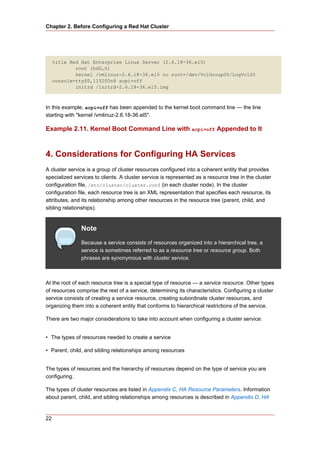
2. Append acpi=off to the kernel boot command line in /boot/grub/grub.conf (refer to
   Example 2.11, “Kernel Boot Command Line with acpi=off Appended to It”).

3. Reboot the node.

4. When the cluster is configured and running, verify that the node turns off immediately when
   fenced.


               Tip
               You can fence the node with the fence_node command or Conga.


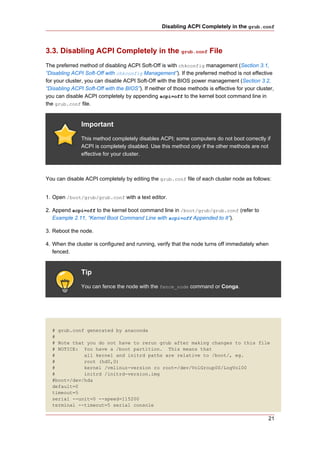
  # grub.conf generated by anaconda
  #
  # Note that you do not have to rerun grub after making changes to this file
  # NOTICE: You have a /boot partition. This means that
  #          all kernel and initrd paths are relative to /boot/, eg.
  #          root (hd0,0)
  #          kernel /vmlinuz-version ro root=/dev/VolGroup00/LogVol00
  #          initrd /initrd-version.img
  #boot=/dev/hda
  default=0
  timeout=5
  serial --unit=0 --speed=115200
  terminal --timeout=5 serial console

                                                                                                 21
Chapter 2. Before Configuring a Red Hat Cluster


     title Red Hat Enterprise Linux Server (2.6.18-36.el5)
             root (hd0,0)
             kernel /vmlinuz-2.6.18-36.el5 ro root=/dev/VolGroup00/LogVol00
     console=ttyS0,115200n8 acpi=off
             initrd /initrd-2.6.18-36.el5.img


In this example, acpi=off has been appended to the kernel boot command line — the line
starting with "kernel /vmlinuz-2.6.18-36.el5".

Example 2.11. Kernel Boot Command Line with acpi=off Appended to It


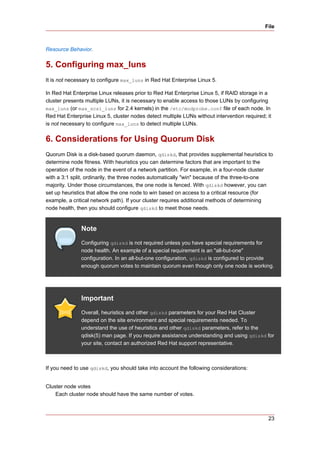
4. Considerations for Configuring HA Services
A cluster service is a group of cluster resources configured into a coherent entity that provides
specialized services to clients. A cluster service is represented as a resource tree in the cluster
configuration file, /etc/cluster/cluster.conf (in each cluster node). In the cluster
configuration file, each resource tree is an XML representation that specifies each resource, its
attributes, and its relationship among other resources in the resource tree (parent, child, and
sibling relationships).


               Note
               Because a service consists of resources organized into a hierarchical tree, a
               service is sometimes referred to as a resource tree or resource group. Both
               phrases are synonymous with cluster service.


At the root of each resource tree is a special type of resource — a service resource. Other types
of resources comprise the rest of a service, determining its characteristics. Configuring a cluster
service consists of creating a service resource, creating subordinate cluster resources, and
organizing them into a coherent entity that conforms to hierarchical restrictions of the service.

There are two major considerations to take into account when configuring a cluster service:


• The types of resources needed to create a service

• Parent, child, and sibling relationships among resources


The types of resources and the hierarchy of resources depend on the type of service you are
configuring.

The types of cluster resources are listed in Appendix C, HA Resource Parameters. Information
about parent, child, and sibling relationships among resources is described in Appendix D, HA


22
File


Resource Behavior.


5. Configuring max_luns
It is not necessary to configure max_luns in Red Hat Enterprise Linux 5.

In Red Hat Enterprise Linux releases prior to Red Hat Enterprise Linux 5, if RAID storage in a
cluster presents multiple LUNs, it is necessary to enable access to those LUNs by configuring
max_luns (or max_scsi_luns for 2.4 kernels) in the /etc/modprobe.conf file of each node. In
Red Hat Enterprise Linux 5, cluster nodes detect multiple LUNs without intervention required; it
is not necessary to configure max_luns to detect multiple LUNs.


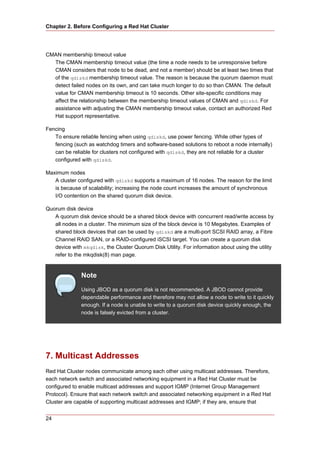
6. Considerations for Using Quorum Disk
Quorum Disk is a disk-based quorum daemon, qdiskd, that provides supplemental heuristics to
determine node fitness. With heuristics you can determine factors that are important to the
operation of the node in the event of a network partition. For example, in a four-node cluster
with a 3:1 split, ordinarily, the three nodes automatically "win" because of the three-to-one
majority. Under those circumstances, the one node is fenced. With qdiskd however, you can
set up heuristics that allow the one node to win based on access to a critical resource (for
example, a critical network path). If your cluster requires additional methods of determining
node health, then you should configure qdiskd to meet those needs.


               Note
               Configuring qdiskd is not required unless you have special requirements for
               node health. An example of a special requirement is an "all-but-one"
               configuration. In an all-but-one configuration, qdiskd is configured to provide
               enough quorum votes to maintain quorum even though only one node is working.


               Important
               Overall, heuristics and other qdiskd parameters for your Red Hat Cluster
               depend on the site environment and special requirements needed. To
               understand the use of heuristics and other qdiskd parameters, refer to the
               qdisk(5) man page. If you require assistance understanding and using qdiskd for
               your site, contact an authorized Red Hat support representative.


If you need to use qdiskd, you should take into account the following considerations:


Cluster node votes
    Each cluster node should have the same number of votes.


                                                                                              23
Chapter 2. Before Configuring a Red Hat Cluster


CMAN membership timeout value
  The CMAN membership timeout value (the time a node needs to be unresponsive before
  CMAN considers that node to be dead, and not a member) should be at least two times that
  of the qdiskd membership timeout value. The reason is because the quorum daemon must
  detect failed nodes on its own, and can take much longer to do so than CMAN. The default
  value for CMAN membership timeout is 10 seconds. Other site-specific conditions may
  affect the relationship between the membership timeout values of CMAN and qdiskd. For
  assistance with adjusting the CMAN membership timeout value, contact an authorized Red
  Hat support representative.

Fencing
   To ensure reliable fencing when using qdiskd, use power fencing. While other types of
   fencing (such as watchdog timers and software-based solutions to reboot a node internally)
   can be reliable for clusters not configured with qdiskd, they are not reliable for a cluster
   configured with qdiskd.

Maximum nodes
   A cluster configured with qdiskd supports a maximum of 16 nodes. The reason for the limit
   is because of scalability; increasing the node count increases the amount of synchronous
   I/O contention on the shared quorum disk device.

Quorum disk device
   A quorum disk device should be a shared block device with concurrent read/write access by
   all nodes in a cluster. The minimum size of the block device is 10 Megabytes. Examples of
   shared block devices that can be used by qdiskd are a multi-port SCSI RAID array, a Fibre
   Channel RAID SAN, or a RAID-configured iSCSI target. You can create a quorum disk
   device with mkqdisk, the Cluster Quorum Disk Utility. For information about using the utility
   refer to the mkqdisk(8) man page.


              Note
              Using JBOD as a quorum disk is not recommended. A JBOD cannot provide
              dependable performance and therefore may not allow a node to write to it quickly
              enough. If a node is unable to write to a quorum disk device quickly enough, the
              node is falsely evicted from a cluster.


7. Multicast Addresses
Red Hat Cluster nodes communicate among each other using multicast addresses. Therefore,
each network switch and associated networking equipment in a Red Hat Cluster must be
configured to enable multicast addresses and support IGMP (Internet Group Management
Protocol). Ensure that each network switch and associated networking equipment in a Red Hat
Cluster are capable of supporting multicast addresses and IGMP; if they are, ensure that


24
Considerations for Using Conga


multicast addressing and IGMP are enabled. Without multicast and IGMP, not all nodes can
participate in a cluster, causing the cluster to fail.


               Note
               Procedures for configuring network switches and associated networking
               equipment vary according each product. Refer to the appropriate vendor
               documentation or other information about configuring network switches and
               associated networking equipment to enable multicast addresses and IGMP.


8. Considerations for Using Conga
When using Conga to configure and manage your Red Hat Cluster, make sure that each
computer running luci (the Conga user interface server) is running on the same network that
the cluster is using for cluster communication. Otherwise, luci cannot configure the nodes to
communicate on the right network. If the computer running luci is on another network (for
example, a public network rather than a private network that the cluster is communicating on),
contact an authorized Red Hat support representative to make sure that the appropriate host
name is configured for each cluster node.


9. General Configuration Considerations
You can configure a Red Hat Cluster in a variety of ways to suit your needs. Take into account
the following considerations when you plan, configure, and implement your Red Hat Cluster.


No-single-point-of-failure hardware configuration
   Clusters can include a dual-controller RAID array, multiple bonded network channels,
   multiple paths between cluster members and storage, and redundant un-interruptible power
   supply (UPS) systems to ensure that no single failure results in application down time or
   loss of data.

    Alternatively, a low-cost cluster can be set up to provide less availability than a
    no-single-point-of-failure cluster. For example, you can set up a cluster with a
    single-controller RAID array and only a single Ethernet channel.

    Certain low-cost alternatives, such as host RAID controllers, software RAID without cluster
    support, and multi-initiator parallel SCSI configurations are not compatible or appropriate for
    use as shared cluster storage.

Data integrity assurance
   To ensure data integrity, only one node can run a cluster service and access cluster-service
   data at a time. The use of power switches in the cluster hardware configuration enables a
   node to power-cycle another node before restarting that node's cluster services during a
   failover process. This prevents two nodes from simultaneously accessing the same data


                                                                                                 25
Chapter 2. Before Configuring a Red Hat Cluster


     and corrupting it. It is strongly recommended that fence devices (hardware or software
     solutions that remotely power, shutdown, and reboot cluster nodes) are used to guarantee
     data integrity under all failure conditions. Watchdog timers provide an alternative way to to
     ensure correct operation of cluster service failover.

Ethernet channel bonding
    Cluster quorum and node health is determined by communication of messages among
    cluster nodes via Ethernet. In addition, cluster nodes use Ethernet for a variety of other
    critical cluster functions (for example, fencing). With Ethernet channel bonding, multiple
    Ethernet interfaces are configured to behave as one, reducing the risk of a
    single-point-of-failure in the typical switched Ethernet connection among cluster nodes and
    other cluster hardware.


26
Chapter 3.


Configuring Red Hat Cluster With
Conga
This chapter describes how to configure Red Hat Cluster software using Conga, and consists of
the following sections:


• Section 1, “Configuration Tasks”

• Section 2, “Starting luci and ricci”

• Section 3, “Creating A Cluster”

• Section 4, “Global Cluster Properties”

• Section 5, “Configuring Fence Devices”

• Section 6, “Configuring Cluster Members”

• Section 7, “Configuring a Failover Domain”

• Section 8, “Adding Cluster Resources”

• Section 9, “Adding a Cluster Service to the Cluster”

• Section 10, “Configuring Cluster Storage”


1. Configuration Tasks
Configuring Red Hat Cluster software with Conga consists of the following steps:


1. Configuring and running the Conga configuration user interface — the luci server. Refer to
   Section 2, “Starting luci and ricci”.

2. Creating a cluster. Refer to Section 3, “Creating A Cluster”.

3. Configuring global cluster properties. Refer to Section 4, “Global Cluster Properties”.

4. Configuring fence devices. Refer to Section 5, “Configuring Fence Devices”.

5. Configuring cluster members. Refer to Section 6, “Configuring Cluster Members”.

6. Creating failover domains. Refer to Section 7, “Configuring a Failover Domain”.

7. Creating resources. Refer to Section 8, “Adding Cluster Resources”.

8. Creating cluster services. Refer to Section 9, “Adding a Cluster Service to the Cluster”.

9. Configuring storage. Refer to Section 10, “Configuring Cluster Storage”.


                                                                                                27
Chapter 3. Configuring Red Hat Cluster With Conga


2. Starting luci and ricci
To administer Red Hat Clusters with Conga, install and run luci and ricci as follows:


1. At each node to be administered by Conga, install the ricci agent. For example:


     # yum install ricci


2. At each node to be administered by Conga, start ricci. For example:


     # service ricci start
     Starting ricci:                                                       [   OK    ]


3. Select a computer to host luci and install the luci software on that computer. For example:


     # yum install luci


               Note
               Typically, a computer in a server cage or a data center hosts luci; however, a
               cluster computer can host luci.


4. At the computer running luci, initialize the luci server using the luci_admin init command.
   For example:


     # luci_admin init
     Initializing the Luci server


     Creating the 'admin' user

     Enter password: <Type password and press ENTER.>
     Confirm password: <Re-type password and press ENTER.>

     Please wait...
     The admin password has been successfully set.
     Generating SSL certificates...
     Luci server has been successfully initialized


     Restart the Luci server for changes to take effect
     eg. service luci restart


28
Creating A Cluster


5. Start luci using service luci restart. For example:


  # service luci restart
  Shutting down luci:                                                       [    OK   ]
  Starting luci: generating https SSL certificates...                done
                                                                            [    OK   ]

  Please, point your web browser to https://nano-01:8084 to access luci


6. At a Web browser, place the URL of the luci server into the URL address box and click Go
   (or the equivalent). The URL syntax for the luci server is
   https://luci_server_hostname:8084. The first time you access luci, two SSL certificate
   dialog boxes are displayed. Upon acknowledging the dialog boxes, your Web browser
   displays the luci login page.


3. Creating A Cluster
Creating a cluster with luci consists of selecting cluster nodes, entering their passwords, and
submitting the request to create a cluster. If the node information and passwords are correct,
Conga automatically installs software into the cluster nodes and starts the cluster. Create a
cluster as follows:


1. As administrator of luci, select the cluster tab.

2. Click Create a New Cluster.

3. At the Cluster Name text box, enter a cluster name. The cluster name cannot exceed 15
   characters. Add the node name and password for each cluster node. Enter the node name
   for each node in the Node Hostname column; enter the root password for each node in the
   in the Root Password column. Check the Enable Shared Storage Support checkbox if
   clustered storage is required.

4. Click Submit. Clicking Submit causes the following actions:

  a. Cluster software packages to be downloaded onto each cluster node.

  b. Cluster software to be installed onto each cluster node.

  c. Cluster configuration file to be created and propagated to each node in the cluster.

  d. Starting the cluster.

  A progress page shows the progress of those actions for each node in the cluster.

  When the process of creating a new cluster is complete, a page is displayed providing a
  configuration interface for the newly created cluster.


                                                                                                  29
Chapter 3. Configuring Red Hat Cluster With Conga


4. Global Cluster Properties
When a cluster is created, or if you select a cluster to configure, a cluster-specific page is
displayed. The page provides an interface for configuring cluster-wide properties and detailed
properties. You can configure cluster-wide properties with the tabbed interface below the cluster
name. The interface provides the following tabs: General, Fence, Multicast, and Quorum
Partition. To configure the parameters in those tabs, follow the steps in this section. If you do
not need to configure parameters in a tab, skip the step for that tab.


1. General tab — This tab displays cluster name and provides an interface for configuring the
   configuration version and advanced cluster properties. The parameters are summarized as
   follows:

     • The Cluster Name text box displays the cluster name; it does not accept a cluster name
       change. You cannot change the cluster name. The only way to change the name of a Red
       Hat cluster is to create a new cluster configuration with the new name.

     • The Configuration Version value is set to 1 by default and is automatically incremented
       each time you modify your cluster configuration. However, if you need to set it to another
       value, you can specify it at the Configuration Version text box.

     • You can enter advanced cluster properties by clicking Show advanced cluster
       properties. Clicking Show advanced cluster properties reveals a list of advanced
       properties. You can click any advanced property for online help about the property.

     Enter the values required and click Apply for changes to take effect.

2. Fence tab — This tab provides an interface for configuring these Fence Daemon Properties
   parameters: Post-Fail Delay and Post-Join Delay. The parameters are summarized as
   follows:

     • The Post-Fail Delay parameter is the number of seconds the fence daemon (fenced)
       waits before fencing a node (a member of the fence domain) after the node has failed. The
       Post-Fail Delay default value is 0. Its value may be varied to suit cluster and network
       performance.

     • The Post-Join Delay parameter is the number of seconds the fence daemon (fenced)
       waits before fencing a node after the node joins the fence domain. The Post-Join Delay
       default value is 3. A typical setting for Post-Join Delay is between 20 and 30 seconds, but
       can vary according to cluster and network performance.

     Enter values required and Click Apply for changes to take effect.


                 Note
                 For more information about Post-Join Delay and Post-Fail Delay, refer to the
                 fenced(8) man page.


30
Global Cluster Properties


3. Multicast tab — This tab provides an interface for configuring these Multicast
   Configuration parameters: Let cluster choose the multicast address and Specify the
   multicast address manually. Red Hat Cluster software chooses a multicast address for
   cluster management communication among cluster nodes; therefore, the default setting is
   Let cluster choose the multicast address. If you need to use a specific multicast address,
   click Specify the multicast address manually, enter a multicast address into the text box,
   and click Apply for changes to take effect.

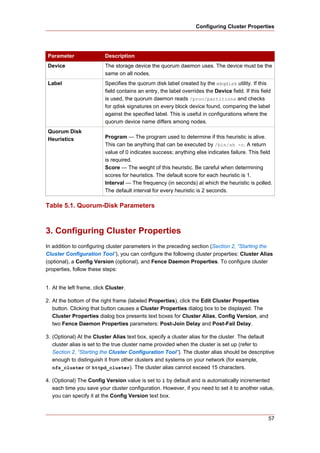
4. Quorum Partition tab — This tab provides an interface for configuring these Quorum
   Partition Configuration parameters: Do not use a Quorum Partition, Use a Quorum
   Partition, Interval, Votes, TKO, Minimum Score, Device, Label, and Heuristics. The Do
   not use a Quorum Partition parameter is enabled by default. Table 3.1, “Quorum-Disk
   Parameters” describes the parameters. If you need to use a quorum disk, click Use a
   Quorum Partition, enter quorum disk parameters, click Apply, and restart the cluster for the
   changes to take effect.


              Important
              Quorum-disk parameters and heuristics depend on the site environment and the
              special requirements needed. To understand the use of quorum-disk parameters
              and heuristics, refer to the qdisk(5) man page. If you require assistance
              understanding and using quorum disk, contact an authorized Red Hat support
              representative.


              Note
              Clicking Apply on the Quorum Partition tab propagates changes to the cluster
              configuration file (/etc/cluster/cluster.conf) in each cluster node. However,
              for the quorum disk to operate, you must restart the cluster (refer to Section 1,
              “Starting, Stopping, and Deleting Clusters”).


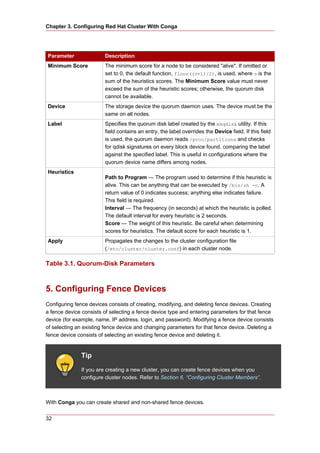
Parameter               Description
Do not use a            Disables quorum partition. Disables quorum-disk parameters in the
Quorum Partition        Quorum Partition tab.
Use a Quorum            Enables quorum partition. Enables quorum-disk parameters in the
Partition               Quorum Partition tab.
Interval                The frequency of read/write cycles, in seconds.
Votes                   The number of votes the quorum daemon advertises to CMAN when it
                        has a high enough score.
TKO                     The number of cycles a node must miss to be declared dead.


                                                                                             31
Chapter 3. Configuring Red Hat Cluster With Conga


Parameter               Description
Minimum Score           The minimum score for a node to be considered "alive". If omitted or
                        set to 0, the default function, floor((n+1)/2), is used, where n is the
                        sum of the heuristics scores. The Minimum Score value must never
                        exceed the sum of the heuristic scores; otherwise, the quorum disk
                        cannot be available.
Device                  The storage device the quorum daemon uses. The device must be the
                        same on all nodes.
Label                   Specifies the quorum disk label created by the mkqdisk utility. If this
                        field contains an entry, the label overrides the Device field. If this field
                        is used, the quorum daemon reads /proc/partitions and checks
                        for qdisk signatures on every block device found, comparing the label
                        against the specified label. This is useful in configurations where the
                        quorum device name differs among nodes.
Heuristics
                        Path to Program — The program used to determine if this heuristic is
                        alive. This can be anything that can be executed by /bin/sh -c. A
                        return value of 0 indicates success; anything else indicates failure.
                        This field is required.
                        Interval — The frequency (in seconds) at which the heuristic is polled.
                        The default interval for every heuristic is 2 seconds.
                        Score — The weight of this heuristic. Be careful when determining
                        scores for heuristics. The default score for each heuristic is 1.
Apply                   Propagates the changes to the cluster configuration file
                        (/etc/cluster/cluster.conf) in each cluster node.

Table 3.1. Quorum-Disk Parameters


5. Configuring Fence Devices
Configuring fence devices consists of creating, modifying, and deleting fence devices. Creating
a fence device consists of selecting a fence device type and entering parameters for that fence
device (for example, name, IP address, login, and password). Modifying a fence device consists
of selecting an existing fence device and changing parameters for that fence device. Deleting a
fence device consists of selecting an existing fence device and deleting it.


              Tip
              If you are creating a new cluster, you can create fence devices when you
              configure cluster nodes. Refer to Section 6, “Configuring Cluster Members”.


With Conga you can create shared and non-shared fence devices.


32
Configuring Fence Devices


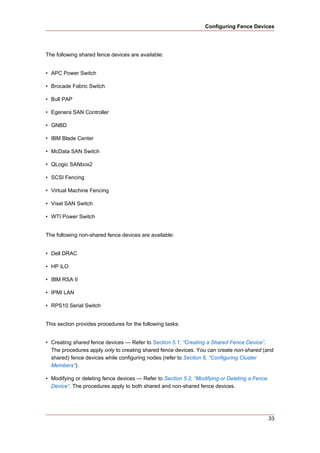
The following shared fence devices are available:


• APC Power Switch

• Brocade Fabric Switch

• Bull PAP

• Egenera SAN Controller

• GNBD

• IBM Blade Center

• McData SAN Switch

• QLogic SANbox2

• SCSI Fencing

• Virtual Machine Fencing

• Vixel SAN Switch

• WTI Power Switch


The following non-shared fence devices are available:


• Dell DRAC

• HP iLO

• IBM RSA II

• IPMI LAN

• RPS10 Serial Switch


This section provides procedures for the following tasks:


• Creating shared fence devices — Refer to Section 5.1, “Creating a Shared Fence Device”.
  The procedures apply only to creating shared fence devices. You can create non-shared (and
  shared) fence devices while configuring nodes (refer to Section 6, “Configuring Cluster
  Members”).

• Modifying or deleting fence devices — Refer to Section 5.2, “Modifying or Deleting a Fence
  Device”. The procedures apply to both shared and non-shared fence devices.


                                                                                               33
Chapter 3. Configuring Red Hat Cluster With Conga


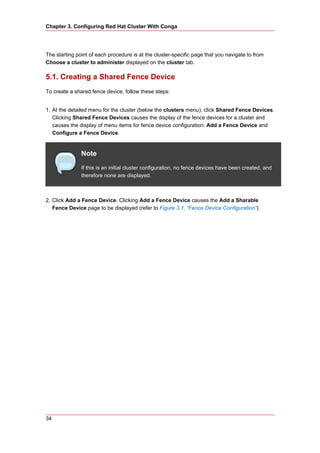
The starting point of each procedure is at the cluster-specific page that you navigate to from
Choose a cluster to administer displayed on the cluster tab.

5.1. Creating a Shared Fence Device
To create a shared fence device, follow these steps:


1. At the detailed menu for the cluster (below the clusters menu), click Shared Fence Devices.
   Clicking Shared Fence Devices causes the display of the fence devices for a cluster and
   causes the display of menu items for fence device configuration: Add a Fence Device and
   Configure a Fence Device.


               Note
               If this is an initial cluster configuration, no fence devices have been created, and
               therefore none are displayed.


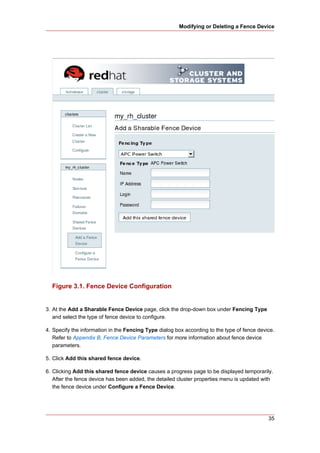
2. Click Add a Fence Device. Clicking Add a Fence Device causes the Add a Sharable
   Fence Device page to be displayed (refer to Figure 3.1, “Fence Device Configuration”).


34
Modifying or Deleting a Fence Device


  Figure 3.1. Fence Device Configuration


3. At the Add a Sharable Fence Device page, click the drop-down box under Fencing Type
   and select the type of fence device to configure.

4. Specify the information in the Fencing Type dialog box according to the type of fence device.
   Refer to Appendix B, Fence Device Parameters for more information about fence device
   parameters.

5. Click Add this shared fence device.

6. Clicking Add this shared fence device causes a progress page to be displayed temporarily.
   After the fence device has been added, the detailed cluster properties menu is updated with
   the fence device under Configure a Fence Device.


                                                                                             35
Chapter 3. Configuring Red Hat Cluster With Conga


5.2. Modifying or Deleting a Fence Device
To modify or delete a fence device, follow these steps:


1. At the detailed menu for the cluster (below the clusters menu), click Shared Fence Devices.
   Clicking Shared Fence Devices causes the display of the fence devices for a cluster and
   causes the display of menu items for fence device configuration: Add a Fence Device and
   Configure a Fence Device.

2. Click Configure a Fence Device. Clicking Configure a Fence Device causes the display of
   a list of fence devices under Configure a Fence Device.

3. Click a fence device in the list. Clicking a fence device in the list causes the display of a
   Fence Device Form page for the fence device selected from the list.

4. Either modify or delete the fence device as follows:

     • To modify the fence device, enter changes to the parameters displayed. Refer to
       Appendix B, Fence Device Parameters for more information about fence device
       parameters. Click Update this fence device and wait for the configuration to be updated.

     • To delete the fence device, click Delete this fence device and wait for the configuration to
       be updated.


                 Note
                 You can create shared fence devices on the node configuration page, also.
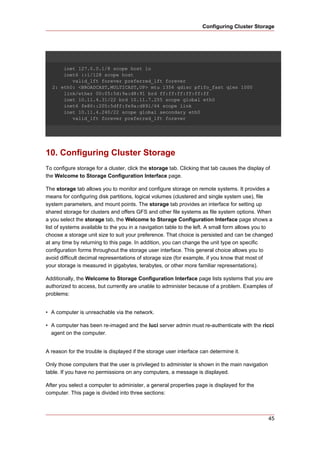
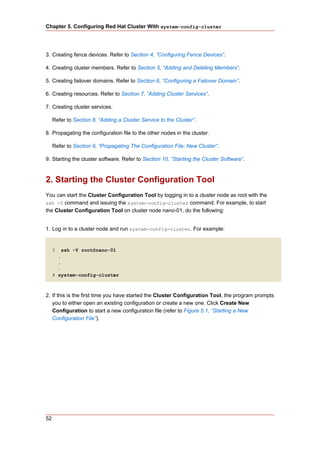
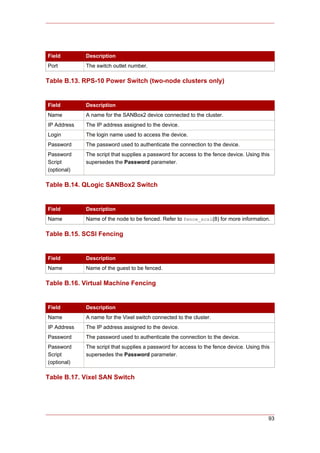
                 However, you can only modify or delete a shared fence device via Shared
                 Fence Devices at the detailed menu for the cluster (below the clusters menu).


6. Configuring Cluster Members
Configuring cluster members consists of initially configuring nodes in a newly configured cluster,
adding members, and deleting members. The following sections provide procedures for initial
configuration of nodes, adding nodes, and deleting nodes:


• Section 6.1, “Initially Configuring Members”

• Section 6.2, “Adding a Member to a Running Cluster”

• Section 6.3, “Deleting a Member from a Cluster”


6.1. Initially Configuring Members


36
Adding a Member to a Running Cluster


Creating a cluster consists of selecting a set of nodes (or members) to be part of the cluster.
Once you have completed the initial step of creating a cluster and creating fence devices, you
need to configure cluster nodes. To initially configure cluster nodes after creating a new cluster,
follow the steps in this section. The starting point of the procedure is at the cluster-specific page
that you navigate to from Choose a cluster to administer displayed on the cluster tab.


1. At the detailed menu for the cluster (below the clusters menu), click Nodes. Clicking Nodes
   causes the display of an Add a Node element and a Configure element with a list of the
   nodes already configured in the cluster.

2. Click a link for a node at either the list in the center of the page or in the list in the detailed
   menu under the clusters menu. Clicking a link for a node causes a page to be displayed for
   that link showing how that node is configured.

3. At the bottom of the page, under Main Fencing Method, click Add a fence device to this
   level.

4. Select a fence device and provide parameters for the fence device (for example port
   number).


                Note
                You can choose from an existing fence device or create a new fence device.


5. Click Update main fence properties and wait for the change to take effect.


6.2. Adding a Member to a Running Cluster
To add a member to a running cluster, follow the steps in this section. The starting point of the
procedure is at the cluster-specific page that you navigate to from Choose a cluster to
administer displayed on the cluster tab.


1. At the detailed menu for the cluster (below the clusters menu), click Nodes. Clicking Nodes
   causes the display of an Add a Node element and a Configure element with a list of the
   nodes already configured in the cluster. (In addition, a list of the cluster nodes is displayed in
   the center of the page.)

2. Click Add a Node. Clicking Add a Node causes the display of the Add a node to cluster
   name page.

3. At that page, enter the node name in the Node Hostname text box; enter the root password
   in the Root Password text box. Check the Enable Shared Storage Support checkbox if
   clustered storage is required. If you want to add more nodes, click Add another entry and
   enter node name and password for the each additional node.


                                                                                                     37
Chapter 3. Configuring Red Hat Cluster With Conga


4. Click Submit. Clicking Submit causes the following actions:

     a. Cluster software packages to be downloaded onto the added node.

     b. Cluster software to be installed (or verification that the appropriate software packages are
        installed) onto the added node.

     c. Cluster configuration file to be updated and propagated to each node in the cluster —
        including the added node.

     d. Joining the added node to cluster.

     A progress page shows the progress of those actions for each added node.

5. When the process of adding a node is complete, a page is displayed providing a
   configuration interface for the cluster.

6. At the detailed menu for the cluster (below the clusters menu), click Nodes. Clicking Nodes
   causes the following displays:

     • A list of cluster nodes in the center of the page

     • The Add a Node element and the Configure element with a list of the nodes configured in
       the cluster at the detailed menu for the cluster (below the clusters menu)

7. Click the link for an added node at either the list in the center of the page or in the list in the
   detailed menu under the clusters menu. Clicking the link for the added node causes a page
   to be displayed for that link showing how that node is configured.

8. At the bottom of the page, under Main Fencing Method, click Add a fence device to this
   level.

9. Select a fence device and provide parameters for the fence device (for example port
   number).


                 Note
                 You can choose from an existing fence device or create a new fence device.


10.Click Update main fence properties and wait for the change to take effect.


6.3. Deleting a Member from a Cluster
To delete a member from an existing cluster that is currently in operation, follow the steps in this
section. The starting point of the procedure is at the Choose a cluster to administer page
(displayed on the cluster tab).


38
Configuring a Failover Domain


1. Click the link of the node to be deleted. Clicking the link of the node to be deleted causes a
   page to be displayed for that link showing how that node is configured.


               Note
               To allow services running on a node to fail over when the node is deleted, skip
               the next step.


2. Disable or relocate each service that is running on the node to be deleted:


               Note
               Repeat this step for each service that needs to be disabled or started on another
               node.


  a. Under Services on this Node, click the link for a service. Clicking that link cause a
     configuration page for that service to be displayed.

  b. On that page, at the Choose a taskdrop-down box, choose to either disable the service
     are start it on another node and click Go.

  c. Upon confirmation that the service has been disabled or started on another node, click the
     cluster tab. Clicking the cluster tab causes the Choose a cluster to administer page to
     be displayed.

  d. At the Choose a cluster to administer page, click the link of the node to be deleted.
     Clicking the link of the node to be deleted causes a page to be displayed for that link
     showing how that node is configured.

3. On that page, at the Choose a taskdrop-down box, choose Delete this node and click Go.
   When the node is deleted, a page is displayed that lists the nodes in the cluster. Check the
   list to make sure that the node has been deleted.


7. Configuring a Failover Domain
A failover domain is a named subset of cluster nodes that are eligible to run a cluster service in
the event of a node failure. A failover domain can have the following characteristics:


• Unrestricted — Allows you to specify that a subset of members are preferred, but that a
  cluster service assigned to this domain can run on any available member.

• Restricted — Allows you to restrict the members that can run a particular cluster service. If
  none of the members in a restricted failover domain are available, the cluster service cannot


                                                                                                    39
Chapter 3. Configuring Red Hat Cluster With Conga


  be started (either manually or by the cluster software).

• Unordered — When a cluster service is assigned to an unordered failover domain, the
  member on which the cluster service runs is chosen from the available failover domain
  members with no priority ordering.

• Ordered — Allows you to specify a preference order among the members of a failover
  domain. The member at the top of the list is the most preferred, followed by the second
  member in the list, and so on.


               Note
               Changing a failover domain configuration has no effect on currently running
               services.


               Note
               Failover domains are not required for operation.


By default, failover domains are unrestricted and unordered.

In a cluster with several members, using a restricted failover domain can minimize the work to
set up the cluster to run a cluster service (such as httpd), which requires you to set up the
configuration identically on all members that run the cluster service). Instead of setting up the
entire cluster to run the cluster service, you must set up only the members in the restricted
failover domain that you associate with the cluster service.


               Tip
               To configure a preferred member, you can create an unrestricted failover domain
               comprising only one cluster member. Doing that causes a cluster service to run
               on that cluster member primarily (the preferred member), but allows the cluster
               service to fail over to any of the other members.


The following sections describe adding a failover domain and modifying a failover domain:


• Section 7.1, “Adding a Failover Domain”

• Section 7.2, “Modifying a Failover Domain”


40
Modifying a Failover Domain


7.1. Adding a Failover Domain
To add a failover domain, follow the steps in this section. The starting point of the procedure is
at the cluster-specific page that you navigate to from Choose a cluster to administer
displayed on the cluster tab.


1. At the detailed menu for the cluster (below the clusters menu), click Failover Domains.
   Clicking Failover Domains causes the display of failover domains with related services and
   the display of menu items for failover domains: Add a Failover Domain and Configure a
   Failover Domain .

2. Click Add a Failover Domain. Clicking Add a Failover Domain causes the display of the
   Add a Failover Domain page.

3. At the Add a Failover Domain page, specify a failover domain name at the Failover
   Domain Name text box.


               Note
               The name should be descriptive enough to distinguish its purpose relative to
               other names used in your cluster.


4. To enable setting failover priority of the members in the failover domain, click the Prioritized
   checkbox. With Prioritized checked, you can set the priority value, Priority, for each node
   selected as members of the failover domain.

5. To restrict failover to members in this failover domain, click the checkbox next to Restrict
   failover to this domain's members. With Restrict failover to this domain's members
   checked, services assigned to this failover domain fail over only to nodes in this failover
   domain.

6. Configure members for this failover domain. Under Failover domain membership, click the
   Membercheckbox for each node that is to be a member of the failover domain. If Prioritized
   is checked, set the priority in the Priority text box for each member of the failover domain.

7. Click Submit. Clicking Submit causes a progress page to be displayed followed by the
   display of the Failover Domain Form page. That page displays the added resource and
   includes the failover domain in the cluster menu to the left under Domain.

8. To make additional changes to the failover domain, continue modifications at the Failover
   Domain Form page and click Submit when you are done.


7.2. Modifying a Failover Domain
To modify a failover domain, follow the steps in this section. The starting point of the procedure
is at the cluster-specific page that you navigate to from Choose a cluster to administer


                                                                                                  41
Chapter 3. Configuring Red Hat Cluster With Conga


displayed on the cluster tab.


1. At the detailed menu for the cluster (below the clusters menu), click Failover Domains.
   Clicking Failover Domains causes the display of failover domains with related services and
   the display of menu items for failover domains: Add a Failover Domain and Configure a
   Failover Domain .

2. Click Configure a Failover Domain. Clicking Configure a Failover Domain causes the
   display of failover domains under Configure a Failover Domain at the detailed menu for the
   cluster (below the clusters menu).

3. At the detailed menu for the cluster (below the clusters menu), click the failover domain to
   modify. Clicking the failover domain causes the display of the Failover Domain Form page.
   At the Failover Domain Form page, you can modify the failover domain name, prioritize
   failover, restrict failover to this domain, and modify failover domain membership.

4. Modifying failover name — To change the failover domain name, modify the text at the
   Failover Domain Name text box.


               Note
               The name should be descriptive enough to distinguish its purpose relative to
               other names used in your cluster.


5. Failover priority — To enable or disable prioritized failover in this failover domain, click the
   Prioritized checkbox. With Prioritized checked, you can set the priority value, Priority, for
   each node selected as members of the failover domain. With Prioritizednot checked, setting
   priority levels is disabled for this failover domain.

6. Restricted failover — To enable or disable restricted failover for members in this failover
   domain, click the checkbox next to Restrict failover to this domain's members. With
   Restrict failover to this domain's members checked, services assigned to this failover
   domain fail over only to nodes in this failover domain. With Restrict failover to this
   domain's membersnot checked, services assigned to this failover domain can fail over to
   nodes outside this failover domain.

7. Modifying failover domain membership — Under Failover domain membership, click the
   Membercheckbox for each node that is to be a member of the failover domain. A checked
   box for a node means that the node is a member of the failover domain. If Prioritized is
   checked, you can adjust the priority in the Priority text box for each member of the failover
   domain.

8. Click Submit. Clicking Submit causes a progress page to be displayed followed by the
   display of the Failover Domain Form page. That page displays the added resource and
   includes the failover domain in the cluster menu to the left under Domain.


42
Adding Cluster Resources


9. To make additional changes to the failover domain, continue modifications at the Failover
   Domain Form page and click Submit when you are done.


8. Adding Cluster Resources
To add a cluster resource, follow the steps in this section. The starting point of the procedure is
at the cluster-specific page that you navigate to from Choose a cluster to administer
displayed on the cluster tab.


1. At the detailed menu for the cluster (below the clusters menu), click Resources. Clicking
   Resources causes the display of resources in the center of the page and causes the display
   of menu items for resource configuration: Add a Resource and Configure a Resource.

2. Click Add a Resource. Clicking Add a Resource causes the Add a Resource page to be
   displayed.

3. At the Add a Resource page, click the drop-down box under Select a Resource Type and
   select the type of resource to configure. Appendix C, HA Resource Parameters describes
   resource paramaters.

4. Click Submit. Clicking Submit causes a progress page to be displayed followed by the
   display of Resources forcluster name page. That page displays the added resource (and
   other resources).


9. Adding a Cluster Service to the Cluster
To add a cluster service to the cluster, follow the steps in this section. The starting point of the
procedure is at the cluster-specific page that you navigate to from Choose a cluster to
administer displayed on the cluster tab.


1. At the detailed menu for the cluster (below the clusters menu), click Services. Clicking
   Services causes the display of services in the center of the page and causes the display of
   menu items for services configuration: Add a Service and Configure a Service.

2. Click Add a Service. Clicking Add a Service causes the Add a Service page to be
   displayed.

3. On the Add a Service page, at the Service name text box, type the name of the service.
   Below the Service name text box is an checkbox labeled Automatically start this service.
   The checkbox is checked by default. When the checkbox is checked, the service is started
   automatically when a cluster is started and running. If the checkbox is not checked, the
   service must be started manually any time the cluster comes up from the stopped state.


                                                                                                   43
Chapter 3. Configuring Red Hat Cluster With Conga


               Tip
               Use a descriptive name that clearly distinguishes the service from other services
               in the cluster.


4. Add a resource to the service; click Add a resource to this service. Clicking Add a
   resource to this service causes the display of two drop-down boxes: Add a new local
   resource and Use an existing global resource. Adding a new local resource adds a
   resource that is available only to this service. The process of adding a local resource is the
   same as adding a global resource described in Section 8, “Adding Cluster Resources”.
   Adding a global resource adds a resource that has been previously added as a global
   resource (refer to Section 8, “Adding Cluster Resources”).

5. At the drop-down box of either Add a new local resource or Use an existing global
   resource, select the resource to add and configure it according to the options presented.
   (The options are the same as described in Section 8, “Adding Cluster Resources”.)


               Note
               If you are adding a Samba-service resource, connect a Samba-service resource
               directly to the service, not to a resource within a service.


6. If you want to add resources to that resource, click Add a child. Clicking Add a child causes
   the display of additional options to local and global resources. You can continue adding
   children resources to the resource to suit your requirements. To view children resources,
   click the triangle icon to the left of Show Children.

7. When you have completed adding resources to the service, and have completed adding
   children resources to resources, click Submit. Clicking Submit causes a progress page to be
   displayed followed by a page displaying the added service (and other services).


               Note
               To verify the existence of the IP service resource used in a cluster service, you
               must use the /sbin/ip addr list command on a cluster node. The following
               output shows the /sbin/ip addr list command executed on a node running a
               cluster service:


     1: lo: <LOOPBACK,UP> mtu 16436 qdisc noqueue
         link/loopback 00:00:00:00:00:00 brd 00:00:00:00:00:00


44
Configuring Cluster Storage


      inet 127.0.0.1/8 scope host lo
      inet6 ::1/128 scope host
         valid_lft forever preferred_lft forever
  2: eth0: <BROADCAST,MULTICAST,UP> mtu 1356 qdisc pfifo_fast qlen 1000
      link/ether 00:05:5d:9a:d8:91 brd ff:ff:ff:ff:ff:ff
      inet 10.11.4.31/22 brd 10.11.7.255 scope global eth0
      inet6 fe80::205:5dff:fe9a:d891/64 scope link
      inet 10.11.4.240/22 scope global secondary eth0
         valid_lft forever preferred_lft forever


10. Configuring Cluster Storage
To configure storage for a cluster, click the storage tab. Clicking that tab causes the display of
the Welcome to Storage Configuration Interface page.

The storage tab allows you to monitor and configure storage on remote systems. It provides a
means for configuring disk partitions, logical volumes (clustered and single system use), file
system parameters, and mount points. The storage tab provides an interface for setting up
shared storage for clusters and offers GFS and other file systems as file system options. When
a you select the storage tab, the Welcome to Storage Configuration Interface page shows a
list of systems available to the you in a navigation table to the left. A small form allows you to
choose a storage unit size to suit your preference. That choice is persisted and can be changed
at any time by returning to this page. In addition, you can change the unit type on specific
configuration forms throughout the storage user interface. This general choice allows you to
avoid difficult decimal representations of storage size (for example, if you know that most of
your storage is measured in gigabytes, terabytes, or other more familiar representations).

Additionally, the Welcome to Storage Configuration Interface page lists systems that you are
authorized to access, but currently are unable to administer because of a problem. Examples of
problems:


• A computer is unreachable via the network.

• A computer has been re-imaged and the luci server admin must re-authenticate with the ricci
  agent on the computer.


A reason for the trouble is displayed if the storage user interface can determine it.

Only those computers that the user is privileged to administer is shown in the main navigation
table. If you have no permissions on any computers, a message is displayed.

After you select a computer to administer, a general properties page is displayed for the
computer. This page is divided into three sections:


                                                                                                 45
Chapter 3. Configuring Red Hat Cluster With Conga


• Hard Drives

• Partitions

• Volume Groups


Each section is set up as an expandable tree, with links to property sheets for specific devices,
partitions, and storage entities.

Configure the storage for your cluster to suit your cluster requirements. If you are configuring
Red Hat GFS, configure clustered logical volumes first, using CLVM. For more information
about CLVM and GFS refer to Red Hat documentation for those products.


46
Chapter 4.


Managing Red Hat Cluster With
Conga
This chapter describes various administrative tasks for managing a Red Hat Cluster and
consists of the following sections:


• Section 1, “Starting, Stopping, and Deleting Clusters”

• Section 2, “Managing Cluster Nodes”

• Section 3, “Managing High-Availability Services”

• Section 4, “Diagnosing and Correcting Problems in a Cluster”


1. Starting, Stopping, and Deleting Clusters
You can perform the following cluster-management functions through the luci server component
of Conga:


• Restart a cluster.

• Start a cluster.

• Stop a cluster.

• Delete a cluster.


To perform one of the functions in the preceding list, follow the steps in this section. The starting
point of the procedure is at the cluster tab (at the Choose a cluster to administer page).


1. At the right of the Cluster Name for each cluster listed on the Choose a cluster to
   administer page is a drop-down box. By default, the drop-down box is set to Restart this
   cluster. Clicking the drop-down box box reveals all the selections available: Restart this
   cluster, Stop this cluster/Start this cluster, and Delete this cluster. The actions of each
   function are summarized as follows:

  • Restart this cluster — Selecting this action causes the cluster to be restarted. You can
    select this action for any state the cluster is in.

  • Stop this cluster/Start this cluster — Stop this cluster is available when a cluster is
    running. Start this cluster is available when a cluster is stopped.

     Selecting Stop this cluster shuts down cluster software in all cluster nodes.

     Selecting Start this cluster starts cluster software.


                                                                                                  47
Chapter 4. Managing Red Hat Cluster With Conga


     • Delete this cluster — Selecting this action halts a running cluster, disables cluster
       software from starting automatically, and removes the cluster configuration file from each
       node. You can select this action for any state the cluster is in. Deleting a cluster frees each
       node in the cluster for use in another cluster.

2. Select one of the functions and click Go.

3. Clicking Go causes a progress page to be displayed. When the action is complete, a page is
   displayed showing either of the following pages according to the action selected:

     • For Restart this cluster and Stop this cluster/Start this cluster — Displays a page with
       the list of nodes for the cluster.

     • For Delete this cluster — Displays the Choose a cluster to administer page in the
       cluster tab, showing a list of clusters.


2. Managing Cluster Nodes
You can perform the following node-management functions through the luci server component
of Conga:


• Make a node leave or join a cluster.

• Fence a node.

• Reboot a node.

• Delete a node.


To perform one the functions in the preceding list, follow the steps in this section. The starting
point of the procedure is at the cluster-specific page that you navigate to from Choose a
cluster to administer displayed on the cluster tab.


1. At the detailed menu for the cluster (below the clusters menu), click Nodes. Clicking Nodes
   causes the display of nodes in the center of the page and causes the display of an Add a
   Node element and a Configure element with a list of the nodes already configured in the
   cluster.

2. At the right of each node listed on the page displayed from the preceding step, click the
   Choose a task drop-down box. Clicking Choose a task drop-down box reveals the following
   selections: Have node leave cluster/Have node join cluster, Fence this node, Reboot
   this node, and Delete. The actions of each function are summarized as follows:

     • Have node leave cluster/Have node join cluster — Have node leave cluster is
       available when a node has joined of a cluster. Have node join cluster is available when a
       node has left a cluster.


48
Managing High-Availability Services


     Selecting Have node leave cluster shuts down cluster software and makes the node
     leave the cluster. Making a node leave a cluster prevents the node from automatically
     joining the cluster when it is rebooted.

     Selecting Have node join cluster starts cluster software and makes the node join the
     cluster. Making a node join a cluster allows the node to automatically join the cluster when
     it is rebooted.

  • Fence this node — Selecting this action causes the node to be fenced according to how
    the node is configured to be fenced.

  • Reboot this node — Selecting this action causes the node to be rebooted.

  • Delete — Selecting this action causes the node to be deleted from the cluster
    configuration. It also stops all cluster services on the node, and deletes the cluster.conf
    file from /etc/cluster/.

3. Select one of the functions and click Go.

4. Clicking Go causes a progress page to be displayed. When the action is complete, a page is
   displayed showing the list of nodes for the cluster.


3. Managing High-Availability Services
You can perform the following management functions for high-availability services through the
luci server component of Conga:


• Configure a service.

• Stop or start a service.

• Restart a service.

• Delete a service


To perform one the functions in the preceding list, follow the steps in this section. The starting
point of the procedure is at the cluster-specific page that you navigate to from Choose a
cluster to administer displayed on the cluster tab.


1. At the detailed menu for the cluster (below the clusters menu), click Services. Clicking
   Services causes the display of services for the cluster in the center of the page.

2. At the right of each service listed on the page, click the Choose a task drop-down box.
   Clicking Choose a task drop-down box reveals the following selections depending on if the
   service is running:


                                                                                                     49
Chapter 4. Managing Red Hat Cluster With Conga


     • If service is running — Configure this service, Restart this service, and Stop this
       service.

     • If service is not running — Configure this service, Start this service, and Delete this
       service.

     The actions of each function are summarized as follows:

     • Configure this service — Configure this service is available when the service is running
       or not running. Selecting Configure this service causes the services configuration page
       for the service to be displayed. On that page, you can change the configuration of the
       service. For example, you can add a resource to the service. (For more information about
       adding resources and services, refer toSection 8, “Adding Cluster Resources” and
       Section 9, “Adding a Cluster Service to the Cluster”.) In addition, a drop-down box on the
       page provides other functions depending on if the service is running.

       When a service is running, the drop-down box provides the following functions: restarting,
       disabling, and relocating the service.

       When a service is not running, the drop-down box on the configuration page provides the
       following functions: enabling and deleting the service.

       If you are making configuration changes, save the changes by clicking Save. Clicking Save
       causes a progress page to be displayed. When the change is complete, another page is
       displayed showing a list of services for the cluster.

       If you have selected one of the functions in the drop-down box on the configuration page,
       click Go. Clicking Go causes a progress page to be displayed. When the change is
       complete, another page is displayed showing a list of services for the cluster.

     • Restart this service and Stop this service — These selections are available when the
       service is running. Select either function and click Go to make the change take effect.
       Clicking Go causes a progress page to be displayed. When the change is complete,
       another page is displayed showing a list of services for the cluster.

     • Start this service and Delete this service — These selections are available when the
       service is not running. Select either function and click Go to make the change take effect.
       Clicking Go causes a progress page to be displayed. When the change is complete,
       another page is displayed showing a list of services for the cluster.


4. Diagnosing and Correcting Problems in a Cluster
For information about diagnosing and correcting problems in a cluster, contact an authorized
Red Hat support representative.


50
Chapter 5.


Configuring Red Hat Cluster With
system-config-cluster
This chapter describes how to configure Red Hat Cluster software using
system-config-cluster, and consists of the following sections:


• Section 1, “Configuration Tasks”

• Section 2, “Starting the Cluster Configuration Tool”

• Section 3, “Configuring Cluster Properties”

• Section 4, “Configuring Fence Devices”

• Section 5, “Adding and Deleting Members”

• Section 6, “Configuring a Failover Domain”

• Section 7, “Adding Cluster Services”

• Section 8, “Adding a Cluster Service to the Cluster”

• Section 9, “Propagating The Configuration File: New Cluster”

• Section 10, “Starting the Cluster Software”


               Tip
               While system-config-cluster provides several convenient tools for configuring
               and managing a Red Hat Cluster, the newer, more comprehensive tool, Conga,
               provides more convenience and flexibility than system-config-cluster. You
               may want to consider using Conga instead (refer to Chapter 3, Configuring Red
               Hat Cluster With Conga and Chapter 4, Managing Red Hat Cluster With Conga).


1. Configuration Tasks
Configuring Red Hat Cluster software with system-config-cluster consists of the following
steps:


1. Starting the Cluster Configuration Tool, system-config-cluster. Refer to Section 2,
   “Starting the Cluster Configuration Tool”.

2. Configuring cluster properties. Refer to Section 3, “Configuring Cluster Properties”.


                                                                                            51
Chapter 5. Configuring Red Hat Cluster With system-config-cluster


3. Creating fence devices. Refer to Section 4, “Configuring Fence Devices”.

4. Creating cluster members. Refer to Section 5, “Adding and Deleting Members”.

5. Creating failover domains. Refer to Section 6, “Configuring a Failover Domain”.

6. Creating resources. Refer to Section 7, “Adding Cluster Services”.

7. Creating cluster services.

     Refer to Section 8, “Adding a Cluster Service to the Cluster”.

8. Propagating the configuration file to the other nodes in the cluster.

     Refer to Section 9, “Propagating The Configuration File: New Cluster”.

9. Starting the cluster software. Refer to Section 10, “Starting the Cluster Software”.


2. Starting the Cluster Configuration Tool
You can start the Cluster Configuration Tool by logging in to a cluster node as root with the
ssh -Y command and issuing the system-config-cluster command. For example, to start
the Cluster Configuration Tool on cluster node nano-01, do the following:


1. Log in to a cluster node and run system-config-cluster. For example:


     $   ssh -Y root@nano-01
       .
       .
       .
     # system-config-cluster


2. If this is the first time you have started the Cluster Configuration Tool, the program prompts
   you to either open an existing configuration or create a new one. Click Create New
   Configuration to start a new configuration file (refer to Figure 5.1, “Starting a New
   Configuration File”).


52
Starting the Cluster Configuration Tool


  Figure 5.1. Starting a New Configuration File


              Note
              The Cluster Management tab for the Red Hat Cluster Suite management GUI is
              available after you save the configuration file with the Cluster Configuration
              Tool, exit, and restart the Red Hat Cluster Suite management GUI
              (system-config-cluster). (The Cluster Management tab displays the status
              of the cluster service manager, cluster nodes, and resources, and shows
              statistics concerning cluster service operation. To manage the cluster system
              further, choose the Cluster Configuration tab.)


3. Clicking Create New Configuration causes the New Configuration dialog box to be
   displayed (refer to Figure 5.2, “Creating A New Configuration”). The New Configuration
   dialog box provides a text box for cluster name and the following checkboxes: Custom
   Configure Multicast and Use a Quorum Disk. In most circumstances you only need to
   configure the cluster name.


              Tip
              Choose the cluster name carefully. The only way to change the name of a Red
              Hat cluster is to create a new cluster configuration with the new name.


  Red Hat Cluster software chooses a multicast address for cluster management
  communication among cluster nodes. If you need to use a specific multicast address, click
  the Custom Configure Multicast checkbox and enter a multicast address in the Address
  text boxes. If you need to use a quorum disk, click the Use a Quorum disk checkbox and
  enter quorum disk parameters. The following quorum-disk parameters are available in the

                                                                                              53
Chapter 5. Configuring Red Hat Cluster With system-config-cluster


     dialog box if you enable Use a Quorum disk: Interval, TKO, Votes, Minimum Score,
     Device, Label, and Quorum Disk Heuristic. Table 5.1, “Quorum-Disk Parameters”
     describes the parameters.


                Important
                Quorum-disk parameters and heuristics depend on the site environment and
                special requirements needed. To understand the use of quorum-disk parameters
                and heuristics, refer to the qdisk(5) man page. If you require assistance
                understanding and using quorum disk, contact an authorized Red Hat support
                representative.


                Tip
                It is probable that configuring a quorum disk requires changing quorum-disk
                parameters after the initial configuration. The Cluster Configuration Tool
                (system-config-cluster) provides only the display of quorum-disk parameters
                after initial configuration. If you need to configure quorum disk, consider using
                Conga instead; Conga allows modification of quorum disk parameters.

                Overall:

                While system-config-cluster provides several convenient tools for configuring
                and managing a Red Hat Cluster, the newer, more comprehensive tool, Conga,
                provides more convenience and flexibility than system-config-cluster. You
                may want to consider using Conga instead (refer to Chapter 3, Configuring Red
                Hat Cluster With Conga and Chapter 4, Managing Red Hat Cluster With Conga).


54
Starting the Cluster Configuration Tool


  Figure 5.2. Creating A New Configuration


4. When you have completed entering the cluster name and other parameters in the New
   Configuration dialog box, click OK. Clicking OK starts the Cluster Configuration Tool,
   displaying a graphical representation of the configuration (Figure 5.3, “The Cluster
   Configuration Tool”).


                                                                                            55
Chapter 5. Configuring Red Hat Cluster With system-config-cluster


     Figure 5.3. The Cluster Configuration Tool


Parameter             Description
Use a Quorum Disk     Enables quorum disk. Enables quorum-disk parameters in the New
                      Configuration dialog box.
Interval              The frequency of read/write cycles, in seconds.
TKO                   The number of cycles a node must miss in order to be declared dead.
Votes                 The number of votes the quorum daemon advertises to CMAN when it
                      has a high enough score.
Minimum Score         The minimum score for a node to be considered "alive". If omitted or
                      set to 0, the default function, floor((n+1)/2), is used, where n is the
                      sum of the heuristics scores. The Minimum Score value must never
                      exceed the sum of the heuristic scores; otherwise, the quorum disk
                      cannot be available.


56
Configuring Cluster Properties


Parameter                 Description
Device                    The storage device the quorum daemon uses. The device must be the
                          same on all nodes.
Label                     Specifies the quorum disk label created by the mkqdisk utility. If this
                          field contains an entry, the label overrides the Device field. If this field
                          is used, the quorum daemon reads /proc/partitions and checks
                          for qdisk signatures on every block device found, comparing the label
                          against the specified label. This is useful in configurations where the
                          quorum device name differs among nodes.
Quorum Disk
Heuristics                Program — The program used to determine if this heuristic is alive.
                          This can be anything that can be executed by /bin/sh -c. A return
                          value of 0 indicates success; anything else indicates failure. This field
                          is required.
                          Score — The weight of this heuristic. Be careful when determining
                          scores for heuristics. The default score for each heuristic is 1.
                          Interval — The frequency (in seconds) at which the heuristic is polled.
                          The default interval for every heuristic is 2 seconds.

Table 5.1. Quorum-Disk Parameters


3. Configuring Cluster Properties
In addition to configuring cluster parameters in the preceding section (Section 2, “Starting the
Cluster Configuration Tool”), you can configure the following cluster properties: Cluster Alias
(optional), a Config Version (optional), and Fence Daemon Properties. To configure cluster
properties, follow these steps:


1. At the left frame, click Cluster.

2. At the bottom of the right frame (labeled Properties), click the Edit Cluster Properties
   button. Clicking that button causes a Cluster Properties dialog box to be displayed. The
   Cluster Properties dialog box presents text boxes for Cluster Alias, Config Version, and
   two Fence Daemon Properties parameters: Post-Join Delay and Post-Fail Delay.

3. (Optional) At the Cluster Alias text box, specify a cluster alias for the cluster. The default
   cluster alias is set to the true cluster name provided when the cluster is set up (refer to
   Section 2, “Starting the Cluster Configuration Tool”). The cluster alias should be descriptive
   enough to distinguish it from other clusters and systems on your network (for example,
   nfs_cluster or httpd_cluster). The cluster alias cannot exceed 15 characters.

4. (Optional) The Config Version value is set to 1 by default and is automatically incremented
   each time you save your cluster configuration. However, if you need to set it to another value,
   you can specify it at the Config Version text box.


                                                                                                    57
Chapter 5. Configuring Red Hat Cluster With system-config-cluster


5. Specify the Fence Daemon Properties parameters: Post-Join Delay and Post-Fail Delay.

     a. The Post-Join Delay parameter is the number of seconds the fence daemon (fenced)
        waits before fencing a node after the node joins the fence domain. The Post-Join Delay
        default value is 3. A typical setting for Post-Join Delay is between 20 and 30 seconds, but
        can vary according to cluster and network performance.

     b. The Post-Fail Delay parameter is the number of seconds the fence daemon (fenced)
        waits before fencing a node (a member of the fence domain) after the node has failed.The
        Post-Fail Delay default value is 0. Its value may be varied to suit cluster and network
        performance.


                 Note
                 For more information about Post-Join Delay and Post-Fail Delay, refer to the
                 fenced(8) man page.


6. Save cluster configuration changes by selecting File => Save.


4. Configuring Fence Devices
Configuring fence devices for the cluster consists of selecting one or more fence devices and
specifying fence-device-dependent parameters (for example, name, IP address, login, and
password).

To configure fence devices, follow these steps:


1. Click Fence Devices. At the bottom of the right frame (labeled Properties), click the Add a
   Fence Device button. Clicking Add a Fence Device causes the Fence Device
   Configuration dialog box to be displayed (refer to Figure 5.4, “Fence Device Configuration”).


58
Adding and Deleting Members


  Figure 5.4. Fence Device Configuration


2. At the Fence Device Configuration dialog box, click the drop-down box under Add a New
   Fence Device and select the type of fence device to configure.

3. Specify the information in the Fence Device Configuration dialog box according to the type
   of fence device. Refer to Appendix B, Fence Device Parameters for more information about
   fence device parameters.

4. Click OK.

5. Choose File => Save to save the changes to the cluster configuration.


5. Adding and Deleting Members
The procedure to add a member to a cluster varies depending on whether the cluster is a
newly-configured cluster or a cluster that is already configured and running. To add a member
to a new cluster, refer to Section 5.1, “Adding a Member to a Cluster”. To add a member to an
existing cluster, refer to Section 5.2, “Adding a Member to a Running Cluster”. To delete a
member from a cluster, refer to Section 5.3, “Deleting a Member from a Cluster”.

5.1. Adding a Member to a Cluster
To add a member to a new cluster, follow these steps:


1. Click Cluster Node.


                                                                                            59
Chapter 5. Configuring Red Hat Cluster With system-config-cluster


2. At the bottom of the right frame (labeled Properties), click the Add a Cluster Node button.
   Clicking that button causes a Node Properties dialog box to be displayed. The Node
   Properties dialog box presents text boxes for Cluster Node Name and Quorum Votes
   (refer to Figure 5.5, “Adding a Member to a New Cluster”).


     Figure 5.5. Adding a Member to a New Cluster


3. At the Cluster Node Name text box, specify a node name. The entry can be a name or an IP
   address of the node on the cluster subnet.


                 Note
                 Each node must be on the same subnet as the node from which you are running
                 the Cluster Configuration Tool and must be defined either in DNS or in the
                 /etc/hosts file of each cluster node.


                 Note
                 The node on which you are running the Cluster Configuration Tool must be
                 explicitly added as a cluster member; the node is not automatically added to the
                 cluster configuration as a result of running the Cluster Configuration Tool.


4. Optionally, at the Quorum Votes text box, you can specify a value; however in most
   configurations you can leave it blank. Leaving the Quorum Votes text box blank causes the
   quorum votes value for that node to be set to the default value of 1.

5. Click OK.

6. Configure fencing for the node:

     a. Click the node that you added in the previous step.

     b. At the bottom of the right frame (below Properties), click Manage Fencing For This
        Node. Clicking Manage Fencing For This Node causes the Fence Configuration dialog


60
Adding a Member to a Running Cluster


     box to be displayed.

  c. At the Fence Configuration dialog box, bottom of the right frame (below Properties),
     click Add a New Fence Level. Clicking Add a New Fence Level causes a fence-level
     element (for example, Fence-Level-1, Fence-Level-2, and so on) to be displayed below
     the node in the left frame of the Fence Configuration dialog box.

  d. Click the fence-level element.

  e. At the bottom of the right frame (below Properties), click Add a New Fence to this Level.
     Clicking Add a New Fence to this Level causes the Fence Properties dialog box to be
     displayed.

  f. At the Fence Properties dialog box, click the Fence Device Type drop-down box and
     select the fence device for this node. Also, provide additional information required (for
     example, Port and Switch for an APC Power Device).

  g. At the Fence Properties dialog box, click OK. Clicking OK causes a fence device element
     to be displayed below the fence-level element.

  h. To create additional fence devices at this fence level, return to step 6d. Otherwise,
     proceed to the next step.

  i. To create additional fence levels, return to step 6c. Otherwise, proceed to the next step.

  j. If you have configured all the fence levels and fence devices for this node, click Close.

7. Choose File => Save to save the changes to the cluster configuration.


5.2. Adding a Member to a Running Cluster
The procedure for adding a member to a running cluster depends on whether the cluster
contains only two nodes or more than two nodes. To add a member to a running cluster, follow
the steps in one of the following sections according to the number of nodes in the cluster:


• For clusters with only two nodes —

  Section 5.2.1, “Adding a Member to a Running Cluster That Contains Only Two Nodes”

• For clusters with more than two nodes —

  Section 5.2.2, “Adding a Member to a Running Cluster That Contains More Than Two Nodes”


5.2.1. Adding a Member to a Running Cluster That Contains Only
Two Nodes
To add a member to an existing cluster that is currently in operation, and contains only two


                                                                                                  61
Chapter 5. Configuring Red Hat Cluster With system-config-cluster


nodes, follow these steps:


1. Add the node and configure fencing for it as in

     Section 5.1, “Adding a Member to a Cluster”.

2. Click Send to Cluster to propagate the updated configuration to other running nodes in the
   cluster.

3. Use the scp command to send the updated /etc/cluster/cluster.conf file from one of
   the existing cluster nodes to the new node.

4. At the Red Hat Cluster Suite management GUI Cluster Status Tool tab, disable each
   service listed under Services.

5. Stop the cluster software on the two running nodes by running the following commands at
   each node in this order:

     a. service rgmanager stop

     b. service gfs stop, if you are using Red Hat GFS

     c. service clvmd stop, if CLVM has been used to create clustered volumes

     d. service cman stop

6. Start cluster software on all cluster nodes (including the added one) by running the following
   commands in this order:

     a. service cman start

     b. service clvmd start, if CLVM has been used to create clustered volumes

     c. service gfs start, if you are using Red Hat GFS

     d. service rgmanager start

7. Start the Red Hat Cluster Suite management GUI. At the Cluster Configuration Tool tab,
   verify that the configuration is correct. At the Cluster Status Tool tab verify that the nodes
   and services are running as expected.


5.2.2. Adding a Member to a Running Cluster That Contains More
Than Two Nodes
To add a member to an existing cluster that is currently in operation, and contains more than
two nodes, follow these steps:


1. Add the node and configure fencing for it as in

     Section 5.1, “Adding a Member to a Cluster”.


62
Deleting a Member from a Cluster


2. Click Send to Cluster to propagate the updated configuration to other running nodes in the
   cluster.

3. Use the scp command to send the updated /etc/cluster/cluster.conf file from one of
   the existing cluster nodes to the new node.

4. Start cluster services on the new node by running the following commands in this order:

  a. service cman start

  b. service clvmd start, if CLVM has been used to create clustered volumes

  c. service gfs start, if you are using Red Hat GFS

  d. service rgmanager start

5. Start the Red Hat Cluster Suite management GUI. At the Cluster Configuration Tool tab,
   verify that the configuration is correct. At the Cluster Status Tool tab verify that the nodes
   and services are running as expected.


5.3. Deleting a Member from a Cluster
To delete a member from an existing cluster that is currently in operation, follow these steps:


1. At one of the running nodes (not to be removed), run the Red Hat Cluster Suite management
   GUI. At the Cluster Status Tool tab, under Services, disable or relocate each service that is
   running on the node to be deleted.

2. Stop the cluster software on the node to be deleted by running the following commands at
   that node in this order:

  a. service rgmanager stop

  b. service gfs stop, if you are using Red Hat GFS

  c. service clvmd stop, if CLVM has been used to create clustered volumes

  d. service cman stop

3. At the Cluster Configuration Tool (on one of the running members), delete the member as
   follows:

  a. If necessary, click the triangle icon to expand the Cluster Nodes property.

  b. Select the cluster node to be deleted. At the bottom of the right frame (labeled
     Properties), click the Delete Node button.

  c. Clicking the Delete Node button causes a warning dialog box to be displayed requesting
     confirmation of the deletion (Figure 5.6, “Confirm Deleting a Member”).


                                                                                                    63
Chapter 5. Configuring Red Hat Cluster With system-config-cluster


       Figure 5.6. Confirm Deleting a Member


     d. At that dialog box, click Yes to confirm deletion.

     e. Propagate the updated configuration by clicking the Send to Cluster button. (Propagating
        the updated configuration automatically saves the configuration.)

4. Stop the cluster software on the remaining running nodes by running the following commands
   at each node in this order:

     a. service rgmanager stop

     b. service gfs stop, if you are using Red Hat GFS

     c. service clvmd stop, if CLVM has been used to create clustered volumes

     d. service cman stop

5. Start cluster software on all remaining cluster nodes by running the following commands in
   this order:

     a. service cman start

     b. service clvmd start, if CLVM has been used to create clustered volumes

     c. service gfs start, if you are using Red Hat GFS

     d. service rgmanager start

6. Start the Red Hat Cluster Suite management GUI. At the Cluster Configuration Tool tab,
   verify that the configuration is correct. At the Cluster Status Tool tab verify that the nodes
   and services are running as expected.


6. Configuring a Failover Domain
A failover domain is a named subset of cluster nodes that are eligible to run a cluster service in
the event of a node failure. A failover domain can have the following characteristics:


64
Configuring a Failover Domain


• Unrestricted — Allows you to specify that a subset of members are preferred, but that a
  cluster service assigned to this domain can run on any available member.

• Restricted — Allows you to restrict the members that can run a particular cluster service. If
  none of the members in a restricted failover domain are available, the cluster service cannot
  be started (either manually or by the cluster software).

• Unordered — When a cluster service is assigned to an unordered failover domain, the
  member on which the cluster service runs is chosen from the available failover domain
  members with no priority ordering.

• Ordered — Allows you to specify a preference order among the members of a failover
  domain. The member at the top of the list is the most preferred, followed by the second
  member in the list, and so on.


               Note
               Changing a failover domain configuration has no effect on currently running
               services.


               Note
               Failover domains are not required for operation.


By default, failover domains are unrestricted and unordered.

In a cluster with several members, using a restricted failover domain can minimize the work to
set up the cluster to run a cluster service (such as httpd), which requires you to set up the
configuration identically on all members that run the cluster service). Instead of setting up the
entire cluster to run the cluster service, you must set up only the members in the restricted
failover domain that you associate with the cluster service.


               Tip
               To configure a preferred member, you can create an unrestricted failover domain
               comprising only one cluster member. Doing that causes a cluster service to run
               on that cluster member primarily (the preferred member), but allows the cluster
               service to fail over to any of the other members.


The following sections describe adding a failover domain, removing a failover domain, and
removing members from a failover domain:


                                                                                                    65
Chapter 5. Configuring Red Hat Cluster With system-config-cluster


• Section 6.1, “Adding a Failover Domain”

• Section 6.2, “Removing a Failover Domain”

• Section 6.3, “Removing a Member from a Failover Domain”


6.1. Adding a Failover Domain
To add a failover domain, follow these steps:


1. At the left frame of the Cluster Configuration Tool, click Failover Domains.

2. At the bottom of the right frame (labeled Properties), click the Create a Failover Domain
   button. Clicking the Create a Failover Domain button causes the Add Failover Domain
   dialog box to be displayed.

3. At the Add Failover Domain dialog box, specify a failover domain name at the Name for
   new Failover Domain text box and click OK. Clicking OK causes the Failover Domain
   Configuration dialog box to be displayed (Figure 5.7, “Failover Domain Configuration:
   Configuring a Failover Domain”).


               Note
               The name should be descriptive enough to distinguish its purpose relative to
               other names used in your cluster.


66
Adding a Failover Domain


  Figure 5.7. Failover Domain Configuration: Configuring a Failover
  Domain


4. Click the Available Cluster Nodes drop-down box and select the members for this failover
   domain.

5. To restrict failover to members in this failover domain, click (check) the Restrict Failover To
   This Domains Members checkbox. (With Restrict Failover To This Domains Members
   checked, services assigned to this failover domain fail over only to nodes in this failover
   domain.)

6. To prioritize the order in which the members in the failover domain assume control of a failed
   cluster service, follow these steps:

  a. Click (check) the Prioritized List checkbox (Figure 5.8, “Failover Domain Configuration:
     Adjusting Priority”). Clicking Prioritized List causes the Priority column to be displayed
     next to the Member Node column.


                                                                                                67
Chapter 5. Configuring Red Hat Cluster With system-config-cluster


       Figure 5.8. Failover Domain Configuration: Adjusting Priority


     b. For each node that requires a priority adjustment, click the node listed in the Member
        Node/Priority columns and adjust priority by clicking one of the Adjust Priority arrows.
        Priority is indicated by the position in the Member Node column and the value in the
        Priority column. The node priorities are listed highest to lowest, with the highest priority
        node at the top of the Member Node column (having the lowest Priority number).

7. Click Close to create the domain.

8. At the Cluster Configuration Tool, perform one of the following actions depending on
   whether the configuration is for a new cluster or for one that is operational and running:

     • New cluster — If this is a new cluster, choose File => Save to save the changes to the
       cluster configuration.

     • Running cluster — If this cluster is operational and running, and you want to propagate the
       change immediately, click the Send to Cluster button. Clicking Send to Cluster
       automatically saves the configuration change. If you do not want to propagate the change
       immediately, choose File => Save to save the changes to the cluster configuration.


68
Removing a Member from a Failover Domain


6.2. Removing a Failover Domain
To remove a failover domain, follow these steps:


1. At the left frame of the Cluster Configuration Tool, click the failover domain that you want
   to delete (listed under Failover Domains).

2. At the bottom of the right frame (labeled Properties), click the Delete Failover Domain
   button. Clicking the Delete Failover Domain button causes a warning dialog box do be
   displayed asking if you want to remove the failover domain. Confirm that the failover domain
   identified in the warning dialog box is the one you want to delete and click Yes. Clicking Yes
   causes the failover domain to be removed from the list of failover domains under Failover
   Domains in the left frame of the Cluster Configuration Tool.

3. At the Cluster Configuration Tool, perform one of the following actions depending on
   whether the configuration is for a new cluster or for one that is operational and running:

  • New cluster — If this is a new cluster, choose File => Save to save the changes to the
    cluster configuration.

  • Running cluster — If this cluster is operational and running, and you want to propagate the
    change immediately, click the Send to Cluster button. Clicking Send to Cluster
    automatically saves the configuration change. If you do not want to propagate the change
    immediately, choose File => Save to save the changes to the cluster configuration.


6.3. Removing a Member from a Failover Domain
To remove a member from a failover domain, follow these steps:


1. At the left frame of the Cluster Configuration Tool, click the failover domain that you want
   to change (listed under Failover Domains).

2. At the bottom of the right frame (labeled Properties), click the Edit Failover Domain
   Properties button. Clicking the Edit Failover Domain Properties button causes the
   Failover Domain Configuration dialog box to be displayed (Figure 5.7, “Failover Domain
   Configuration: Configuring a Failover Domain”).

3. At the Failover Domain Configuration dialog box, in the Member Node column, click the
   node name that you want to delete from the failover domain and click the Remove Member
   from Domain button. Clicking Remove Member from Domain removes the node from the
   Member Node column. Repeat this step for each node that is to be deleted from the failover
   domain. (Nodes must be deleted one at a time.)

4. When finished, click Close.

5. At the Cluster Configuration Tool, perform one of the following actions depending on
   whether the configuration is for a new cluster or for one that is operational and running:


                                                                                                69
Chapter 5. Configuring Red Hat Cluster With system-config-cluster


     • New cluster — If this is a new cluster, choose File => Save to save the changes to the
       cluster configuration.

     • Running cluster — If this cluster is operational and running, and you want to propagate the
       change immediately, click the Send to Cluster button. Clicking Send to Cluster
       automatically saves the configuration change. If you do not want to propagate the change
       immediately, choose File => Save to save the changes to the cluster configuration.


7. Adding Cluster Services
To specify a device for a cluster service, follow these steps:


1. On the Resources property of the Cluster Configuration Tool, click the Create a Resource
   button. Clicking the Create a Resource button causes the Resource Configuration dialog
   box to be displayed.

2. At the Resource Configuration dialog box, under Select a Resource Type, click the
   drop-down box. At the drop-down box, select a resource to configure. Appendix C, HA
   Resource Parameters describes resource paramaters.

3. When finished, click OK.

4. Choose File => Save to save the change to the /etc/cluster/cluster.conf configuration
   file.


8. Adding a Cluster Service to the Cluster
To add a cluster service to the cluster, follow these steps:


1. At the left frame, click Services.

2. At the bottom of the right frame (labeled Properties), click the Create a Service button.
   Clicking Create a Service causes the Add a Service dialog box to be displayed.

3. At the Add a Service dialog box, type the name of the service in the Name text box and click
   OK. Clicking OK causes the Service Management dialog box to be displayed (refer to
   Figure 5.9, “Adding a Cluster Service”).


                 Tip
                 Use a descriptive name that clearly distinguishes the service from other services
                 in the cluster.


70
Adding a Cluster Service to the Cluster


  Figure 5.9. Adding a Cluster Service


4. If you want to restrict the members on which this cluster service is able to run, choose a
   failover domain from the Failover Domain drop-down box. (Refer to Section 6, “Configuring
   a Failover Domain” for instructions on how to configure a failover domain.)

5. Autostart This Service checkbox — This is checked by default. If Autostart This Service is
   checked, the service is started automatically when a cluster is started and running. If
   Autostart This Service is not checked, the service must be started manually any time the
   cluster comes up from stopped state.

6. Run Exclusive checkbox — This sets a policy wherein the service only runs on nodes that
   have no other services running on them. For example, for a very busy web server that is
   clustered for high availability, it would would be advisable to keep that service on a node
   alone with no other services competing for his resources — that is, Run Exclusive checked.
   On the other hand, services that consume few resources (like NFS and Samba), can run
   together on the same node without little concern over contention for resources. For those


                                                                                            71
Chapter 5. Configuring Red Hat Cluster With system-config-cluster


     types of services you can leave the Run Exclusive unchecked.


                 Note
                 Circumstances that require enabling Run Exclusive are rare. Enabling Run
                 Exclusive can render a service offline if the node it is running on fails and no
                 other nodes are empty.


7. Select a recovery policy to specify how the resource manager should recover from a service
   failure. At the upper right of the Service Management dialog box, there are three Recovery
   Policy options available:

     • Restart — Restart the service in the node the service is currently located. The default
       setting is Restart. If the service cannot be restarted in the current node, the service is
       relocated.

     • Relocate — Relocate the service before restarting. Do not restart the node where the
       service is currently located.

     • Disable — Do not restart the service at all.

8. Click the Add a Shared Resource to this service button and choose the a resource listed
   that you have configured in Section 7, “Adding Cluster Services”.


                 Note
                 If you are adding a Samba-service resource, connect a Samba-service resource
                 directly to the service, not to a resource within a service. That is, at the Service
                 Management dialog box, use either Create a new resource for this service or
                 Add a Shared Resource to this service; do not use Attach a new Private
                 Resource to the Selection or Attach a Shared Resource to the selection.


9. If needed, you may also create a private resource that you can create that becomes a
   subordinate resource by clicking on the Attach a new Private Resource to the Selection
   button. The process is the same as creating a shared resource described in Section 7,
   “Adding Cluster Services”. The private resource will appear as a child to the shared resource
   to which you associated with the shared resource. Click the triangle icon next to the shared
   resource to display any private resources associated.

10.When finished, click OK.

11.Choose File => Save to save the changes to the cluster configuration.


72
Propagating The Configuration File: New


               Note
               To verify the existence of the IP service resource used in a cluster service, you
               must use the /sbin/ip addr list command on a cluster node. The following
               output shows the /sbin/ip addr list command executed on a node running a
               cluster service:


  1: lo: <LOOPBACK,UP> mtu 16436 qdisc noqueue
      link/loopback 00:00:00:00:00:00 brd 00:00:00:00:00:00
      inet 127.0.0.1/8 scope host lo
      inet6 ::1/128 scope host
         valid_lft forever preferred_lft forever
  2: eth0: <BROADCAST,MULTICAST,UP> mtu 1356 qdisc pfifo_fast qlen 1000
      link/ether 00:05:5d:9a:d8:91 brd ff:ff:ff:ff:ff:ff
      inet 10.11.4.31/22 brd 10.11.7.255 scope global eth0
      inet6 fe80::205:5dff:fe9a:d891/64 scope link
      inet 10.11.4.240/22 scope global secondary eth0
         valid_lft forever preferred_lft forever


9. Propagating The Configuration File: New Cluster
For newly defined clusters, you must propagate the configuration file to the cluster nodes as
follows:


1. Log in to the node where you created the configuration file.

2. Using the scp command, copy the /etc/cluster/cluster.conf file to all nodes in the
   cluster.


               Note
               Propagating the cluster configuration file this way is necessary for the first time a
               cluster is created. Once a cluster is installed and running, the cluster
               configuration file is propagated using the Red Hat cluster management GUI
               Send to Cluster button. For more information about propagating the cluster
               configuration using the GUI Send to Cluster button, refer to Section 3,
               “Modifying the Cluster Configuration”.


10. Starting the Cluster Software
After you have propagated the cluster configuration to the cluster nodes you can either reboot


                                                                                                  73
Chapter 5. Configuring Red Hat Cluster With system-config-cluster


each node or start the cluster software on each cluster node by running the following
commands at each node in this order:


1. service cman start

2. service clvmd start, if CLVM has been used to create clustered volumes

3. service gfs start, if you are using Red Hat GFS

4. service rgmanager start

5. Start the Red Hat Cluster Suite management GUI. At the Cluster Configuration Tool tab,
   verify that the configuration is correct. At the Cluster Status Tool tab verify that the nodes
   and services are running as expected.


74
Chapter 6.


Managing Red Hat Cluster With
system-config-cluster
This chapter describes various administrative tasks for managing a Red Hat Cluster and
consists of the following sections:


• Section 1, “Starting and Stopping the Cluster Software”

• Section 2, “Managing High-Availability Services”

• Section 4, “Backing Up and Restoring the Cluster Database”

• Section 5, “Disabling the Cluster Software”

• Section 6, “Diagnosing and Correcting Problems in a Cluster”


              Tip
              While system-config-cluster provides several convenient tools for configuring
              and managing a Red Hat Cluster, the newer, more comprehensive tool, Conga,
              provides more convenience and flexibility than system-config-cluster. You
              may want to consider using Conga instead (refer to Chapter 3, Configuring Red
              Hat Cluster With Conga and Chapter 4, Managing Red Hat Cluster With Conga).


1. Starting and Stopping the Cluster Software
To start the cluster software on a member, type the following commands in this order:


1. service cman start

2. service clvmd start, if CLVM has been used to create clustered volumes

3. service gfs start, if you are using Red Hat GFS

4. service rgmanager start


To stop the cluster software on a member, type the following commands in this order:


1. service rgmanager stop

2. service gfs stop, if you are using Red Hat GFS


                                                                                         75
Chapter 6. Managing Red Hat Cluster With system-config-cluster


3. service clvmd stop, if CLVM has been used to create clustered volumes

4. service cman stop


Stopping the cluster services on a member causes its services to fail over to an active member.


2. Managing High-Availability Services
You can manage cluster services with the Cluster Status Tool (Figure 6.1, “Cluster Status
Tool”) through the Cluster Management tab in Cluster Administration GUI.


Figure 6.1. Cluster Status Tool


76
Modifying the Cluster Configuration


You can use the Cluster Status Tool to enable, disable, restart, or relocate a high-availability
service. The Cluster Status Tool displays the current cluster status in the Services area and
automatically updates the status every 10 seconds.

To enable a service, you can select the service in the Services area and click Enable. To
disable a service, you can select the service in the Services area and click Disable. To restart
a service, you can select the service in the Services area and click Restart. To relocate a
service from one node to another, you can drag the service to another node and drop the
service onto that node. Relocating a service restarts the service on that node. (Relocating a
service to its current node — that is, dragging a service to its current node and dropping the
service onto that node — restarts the service.)

The following tables describe the members and services status information displayed by the
Cluster Status Tool.

Members Status           Description
Member
                         The node is part of the cluster.
                         Note: A node can be a member of a cluster; however, the node may
                         be inactive and incapable of running services. For example, if
                         rgmanager is not running on the node, but all other cluster software
                         components are running in the node, the node appears as a Member
                         in the Cluster Status Tool.
Dead                     The node is unable to participate as a cluster member. The most
                         basic cluster software is not running on the node.

Table 6.1. Members Status


Services Status          Description
Started                  The service resources are configured and available on the cluster
                         system that owns the service.
Pending                  The service has failed on a member and is pending start on another
                         member.
Disabled                 The service has been disabled, and does not have an assigned
                         owner. A disabled service is never restarted automatically by the
                         cluster.
Stopped                  The service is not running; it is waiting for a member capable of
                         starting the service. A service remains in the stopped state if autostart
                         is disabled.
Failed                   The service has failed to start on the cluster and cannot successfully
                         stop the service. A failed service is never restarted automatically by
                         the cluster.

Table 6.2. Services Status

                                                                                                   77
Chapter 6. Managing Red Hat Cluster With system-config-cluster


3. Modifying the Cluster Configuration
To modify the cluster configuration (the cluster configuration file
(/etc/cluster/cluster.conf), use the Cluster Configuration Tool. For more information
about using the Cluster Configuration Tool, refer to Chapter 5, Configuring Red Hat Cluster
With system-config-cluster.


               Warning
               Do not manually edit the contents of the /etc/cluster/cluster.conf file
               without guidance from an authorized Red Hat representative or unless you fully
               understand the consequences of editing the /etc/cluster/cluster.conf file
               manually.


               Important
               Although the Cluster Configuration Tool provides a Quorum Votes parameter
               in the Properties dialog box of each cluster member, that parameter is intended
               only for use during initial cluster configuration. Furthermore, it is recommended
               that you retain the default Quorum Votes value of 1. For more information about
               using the Cluster Configuration Tool, refer to Chapter 5, Configuring Red Hat
               Cluster With system-config-cluster.


To edit the cluster configuration file, click the Cluster Configuration tab in the cluster
configuration GUI. Clicking the Cluster Configuration tab displays a graphical representation
of the cluster configuration. Change the configuration file according the the following steps:


1. Make changes to cluster elements (for example, create a service).

2. Propagate the updated configuration file throughout the cluster by clicking Send to Cluster.


               Note
               The Cluster Configuration Tool does not display the Send to Cluster button if
               the cluster is new and has not been started yet, or if the node from which you are
               running the Cluster Configuration Tool is not a member of the cluster. If the
               Send to Cluster button is not displayed, you can still use the Cluster
               Configuration Tool; however, you cannot propagate the configuration. You can
               still save the configuration file. For information about using the Cluster
               Configuration Tool for a new cluster configuration, refer to Chapter 5,
               Configuring Red Hat Cluster With system-config-cluster.


78
Backing Up and Restoring the Cluster


3. Clicking Send to Cluster causes a Warning dialog box to be displayed. Click Yes to save
   and propagate the configuration.

4. Clicking Yes causes an Information dialog box to be displayed, confirming that the current
   configuration has been propagated to the cluster. Click OK.

5. Click the Cluster Management tab and verify that the changes have been propagated to the
   cluster members.


4. Backing Up and Restoring the Cluster Database
The Cluster Configuration Tool automatically retains backup copies of the three most recently
used configuration files (besides the currently used configuration file). Retaining the backup
copies is useful if the cluster does not function correctly because of misconfiguration and you
need to return to a previous working configuration.

Each time you save a configuration file, the Cluster Configuration Tool saves backup copies
of the three most recently used configuration files as /etc/cluster/cluster.conf.bak.1,
/etc/cluster/cluster.conf.bak.2, and /etc/cluster/cluster.conf.bak.3. The backup
file /etc/cluster/cluster.conf.bak.1 is the newest backup,
/etc/cluster/cluster.conf.bak.2 is the second newest backup, and
/etc/cluster/cluster.conf.bak.3 is the third newest backup.

If a cluster member becomes inoperable because of misconfiguration, restore the configuration
file according to the following steps:


1. At the Cluster Configuration Tool tab of the Red Hat Cluster Suite management GUI, click
   File => Open.

2. Clicking File => Open causes the system-config-cluster dialog box to be displayed.

3. At the the system-config-cluster dialog box, select a backup file (for example,
   /etc/cluster/cluster.conf.bak.1). Verify the file selection in the Selection box and click
   OK.

4. Increment the configuration version beyond the current working version number as follows:

  a. Click Cluster => Edit Cluster Properties.

  b. At the Cluster Properties dialog box, change the Config Version value and click OK.

5. Click File => Save As.

6. Clicking File => Save As causes the system-config-cluster dialog box to be displayed.

7. At the the system-config-cluster dialog box, select /etc/cluster/cluster.conf and click
   OK. (Verify the file selection in the Selection box.)

8. Clicking OK causes an Information dialog box to be displayed. At that dialog box, click OK.


                                                                                                79
Chapter 6. Managing Red Hat Cluster With system-config-cluster


9. Propagate the updated configuration file throughout the cluster by clicking Send to Cluster.


                Note
                The Cluster Configuration Tool does not display the Send to Cluster button if
                the cluster is new and has not been started yet, or if the node from which you are
                running the Cluster Configuration Tool is not a member of the cluster. If the
                Send to Cluster button is not displayed, you can still use the Cluster
                Configuration Tool; however, you cannot propagate the configuration. You can
                still save the configuration file. For information about using the Cluster
                Configuration Tool for a new cluster configuration, refer to Chapter 5,
                Configuring Red Hat Cluster With system-config-cluster.


10.Clicking Send to Cluster causes a Warning dialog box to be displayed. Click Yes to
   propagate the configuration.

11.Click the Cluster Management tab and verify that the changes have been propagated to the
   cluster members.


5. Disabling the Cluster Software
It may become necessary to temporarily disable the cluster software on a cluster member. For
example, if a cluster member experiences a hardware failure, you may want to reboot that
member, but prevent it from rejoining the cluster to perform maintenance on the system.

Use the /sbin/chkconfig command to stop the member from joining the cluster at boot-up as
follows:


     #   chkconfig   --level   2345   rgmanager off
     #   chkconfig   --level   2345   gfs off
     #   chkconfig   --level   2345   clvmd off
     #   chkconfig   --level   2345   cman off


Once the problems with the disabled cluster member have been resolved, use the following
commands to allow the member to rejoin the cluster:


     #   chkconfig   --level   2345   rgmanager on
     #   chkconfig   --level   2345   gfs on
     #   chkconfig   --level   2345   clvmd on
     #   chkconfig   --level   2345   cman on


You can then reboot the member for the changes to take effect or run the following commands


80
Database


in the order shown to restart cluster software:


1. service cman start

2. service clvmd start, if CLVM has been used to create clustered volumes

3. service gfs start, if you are using Red Hat GFS

4. service rgmanager start


6. Diagnosing and Correcting Problems in a Cluster
For information about diagnosing and correcting problems in a cluster, contact an authorized
Red Hat support representative.


                                                                                               81
82
Appendix A. Example of Setting Up
Apache HTTP Server
This appendix provides an example of setting up a highly available Apache HTTP Server on a
Red Hat Cluster. The example describes how to set up a service to fail over an Apache HTTP
Server. Variables in the example apply to this example only; they are provided to assist setting
up a service that suits your requirements.


               Note
               This example uses the Cluster Configuration Tool (system-config-cluster).
               You can use comparable Conga functions to make an Apache HTTP Server
               highly available on a Red Hat Cluster.


1. Apache HTTP Server Setup Overview
First, configure Apache HTTP Server on all nodes in the cluster. If using a failover domain ,
assign the service to all cluster nodes configured to run the Apache HTTP Server. Refer to
Section 6, “Configuring a Failover Domain” for instructions. The cluster software ensures that
only one cluster system runs the Apache HTTP Server at one time. The example configuration
consists of installing the httpd RPM package on all cluster nodes (or on nodes in the failover
domain, if used) and configuring a shared GFS shared resource for the Web content.

When installing the Apache HTTP Server on the cluster systems, run the following command to
ensure that the cluster nodes do not automatically start the service when the system boots:


  # chkconfig --del httpd


Rather than having the system init scripts spawn the httpd daemon, the cluster infrastructure
initializes the service on the active cluster node. This ensures that the corresponding IP address
and file system mounts are active on only one cluster node at a time.

When adding an httpd service, a floating IP address must be assigned to the service so that
the IP address will transfer from one cluster node to another in the event of failover or service
relocation. The cluster infrastructure binds this IP address to the network interface on the cluster
system that is currently running the Apache HTTP Server. This IP address ensures that the
cluster node running httpd is transparent to the clients accessing the service.

The file systems that contain the Web content cannot be automatically mounted on the shared
storage resource when the cluster nodes boot. Instead, the cluster software must mount and
unmount the file system as the httpd service is started and stopped. This prevents the cluster


                                                                                                 83
Appendix A. Example of Setting Up Apache HTTP Server


systems from accessing the same data simultaneously, which may result in data corruption.
Therefore, do not include the file systems in the /etc/fstab file.


2. Configuring Shared Storage
To set up the shared file system resource, perform the following tasks as root on one cluster
system:


1. On one cluster node, use the interactive parted utility to create a partition to use for the
   document root directory. Note that it is possible to create multiple document root directories
   on different disk partitions.

2. Use the mkfs command to create an ext3 file system on the partition you created in the
   previous step. Specify the drive letter and the partition number. For example:


     # mkfs -t ext3 /dev/sde3


3. Mount the file system that contains the document root directory. For example:


     # mount /dev/sde3 /var/www/html


     Do not add this mount information to the /etc/fstab file because only the cluster software
     can mount and unmount file systems used in a service.

4. Copy all the required files to the document root directory.

5. If you have CGI files or other files that must be in different directories or in separate
   partitions, repeat these steps, as needed.


3. Installing and Configuring the Apache HTTP Server
The Apache HTTP Server must be installed and configured on all nodes in the assigned failover
domain, if used, or in the cluster. The basic server configuration must be the same on all nodes
on which it runs for the service to fail over correctly. The following example shows a basic
Apache HTTP Server installation that includes no third-party modules or performance tuning.

On all node in the cluster (or nodes in the failover domain, if used), install the httpd RPM
package. For example:

rpm -Uvh httpd-<version>.<arch>.rpm

To configure the Apache HTTP Server as a cluster service, perform the following tasks:


1. Edit the /etc/httpd/conf/httpd.conf configuration file and customize the file according to


84
Installing and Configuring the Apache HTTP


  your configuration. For example:

  • Specify the directory that contains the HTML files. Also specify this mount point when
    adding the service to the cluster configuration. It is only required to change this field if the
    mount point for the web site's content differs from the default setting of /var/www/html/.
    For example:


  DocumentRoot "/mnt/httpdservice/html"


  • Specify a unique IP address to which the service will listen for requests. For example:


  Listen 192.168.1.100:80


     This IP address then must be configured as a cluster resource for the service using the
     Cluster Configuration Tool.

  • If the script directory resides in a non-standard location, specify the directory that contains
    the CGI programs. For example:


  ScriptAlias /cgi-bin/ "/mnt/httpdservice/cgi-bin/"


  • Specify the path that was used in the previous step, and set the access permissions to
    default to that directory. For example:


  <Directory /mnt/httpdservice/cgi-bin">
  AllowOverride None
  Options None
  Order allow,deny
  Allow from all
  </Directory>


     Additional changes may need to be made to tune the Apache HTTP Server or add module
     functionality. For information on setting up other options, refer to the Red Hat Enterprise
     Linux System Administration Guide and the Red Hat Enterprise Linux Reference Guide.

2. The standard Apache HTTP Server start script, /etc/rc.d/init.d/httpd is also used
   within the cluster framework to start and stop the Apache HTTP Server on the active cluster
   node. Accordingly, when configuring the service, specify this script by adding it as a Script
   resource in the Cluster Configuration Tool.

3. Copy the configuration file over to the other nodes of the cluster (or nodes of the failover
   domain, if configured).


                                                                                                   85
Appendix A. Example of Setting Up Apache HTTP Server


Before the service is added to the cluster configuration, ensure that the Apache HTTP Server
directories are not mounted. Then, on one node, invoke the Cluster Configuration Tool to add
the service, as follows. This example assumes a failover domain named httpd-domain was
created for this service.


1. Add the init script for the Apache HTTP Server service.

     • Select the Resources tab and click Create a Resource. The Resources Configuration
       properties dialog box is displayed.

     • Select Script form the drop down menu.

     • Enter a Name to be associated with the Apache HTTP Server service.

     • Specify the path to the Apache HTTP Server init script (for example,
       /etc/rc.d/init.d/httpd) in the File (with path) field.

     • Click OK.

2. Add a device for the Apache HTTP Server content files and/or custom scripts.

     • Click Create a Resource.

     • In the Resource Configuration dialog, select File System from the drop-down menu.

     • Enter the Name for the resource (for example, httpd-content.

     • Choose ext3 from the File System Type drop-down menu.

     • Enter the mount point in the Mount Point field (for example, /var/www/html/).

     • Enter the device special file name in the Device field (for example, /dev/sda3).

3. Add an IP address for the Apache HTTP Server service.

     • Click Create a Resource.

     • Choose IP Address from the drop-down menu.

     • Enter the IP Address to be associated with the Apache HTTP Server service.

     • Make sure that the Monitor Link checkbox is left checked.

     • Click OK.

4. Click the Services property.

5. Create the Apache HTTP Server service.

     • Click Create a Service. Type a Name for the service in the Add a Service dialog.

     • In the Service Management dialog, select a Failover Domain from the drop-down menu


86
Server


    or leave it as None.

  • Click the Add a Shared Resource to this service button. From the available list, choose
    each resource that you created in the previous steps. Repeat this step until all resources
    have been added.

  • Click OK.

6. Choose File => Save to save your changes.


                                                                                             87
88
Appendix B. Fence Device
Parameters
This appendix provides tables with parameter descriptions of fence devices.


              Note
              Certain fence devices have an optional Password Script parameter. The
              Password Scriptparameter allows specifying that a fence-device password is
              supplied from a script rather than from the Password parameter. Using the
              Password Script parameter supersedes the Password parameter, allowing
              passwords to not be visible in the cluster configuration file
              (/etc/cluster/cluster.conf).


Field           Description
Name            A name for the APC device connected to the cluster.
IP Address      The IP address assigned to the device.
Login           The login name used to access the device.
Password        The password used to authenticate the connection to the device.
Password        The script that supplies a password for access to the fence device. Using this
Script          supersedes the Password parameter.
(optional)

Table B.1. APC Power Switch


Field           Description
Name            A name for the Brocade device connected to the cluster.
IP Address      The IP address assigned to the device.
Login           The login name used to access the device.
Password        The password used to authenticate the connection to the device.
Password        The script that supplies a password for access to the fence device. Using this
Script          supersedes the Password parameter.
(optional)

Table B.2. Brocade Fabric Switch


                                                                                             89
Appendix B. Fence Device Parameters


Field         Description
IP Address    The IP address assigned to the PAP console.
Login         The login name used to access the PAP console.
Password      The password used to authenticate the connection to the PAP console.
Password      The script that supplies a password for access to the fence device. Using this
Script        supersedes the Password parameter.
(optional)
Domain        Domain of the Bull PAP system to power cycle

Table B.3. Bull PAP (Platform Administration Processor)


Field         Description
Name          The name assigned to the DRAC.
IP Address    The IP address assigned to the DRAC.
Login         The login name used to access the DRAC.
Password      The password used to authenticate the connection to the DRAC.
Password      The script that supplies a password for access to the fence device. Using this
Script        supersedes the Password parameter.
(optional)

Table B.4. Dell DRAC


Field         Description
Name          A name for the BladeFrame device connected to the cluster.
CServer       The hostname (and optionally the username in the form of
              username@hostname) assigned to the device. Refer to the fence_egenera(8)
              man page.
ESH Path      The path to the esh command on the cserver (default is /opt/pan- mgr/bin/esh)
(optional)

Table B.5. Egenera SAN Controller


Field         Description
Name          A name for the GNBD device used to fence the cluster. Note that the GFS
              server must be accessed via GNBD for cluster node fencing support.
Server        The hostname of each GNBD to disable. For multiple hostnames, separate
              each hostname with a space.


90
Table B.6. GNBD (Global Network Block Device)


Field        Description
Name         A name for the server with HP iLO support.
Hostname     The hostname assigned to the device.
Login        The login name used to access the device.
Password     The password used to authenticate the connection to the device.
Password     The script that supplies a password for access to the fence device. Using this
Script       supersedes the Password parameter.
(optional)

Table B.7. HP iLO (Integrated Lights Out)


Field        Description
Name         A name for the IBM BladeCenter device connected to the cluster.
IP Address   The IP address assigned to the device.
Login        The login name used to access the device.
Password     The password used to authenticate the connection to the device.
Password     The script that supplies a password for access to the fence device. Using this
Script       supersedes the Password parameter.
(optional)

Table B.8. IBM Blade Center


Field        Description
Name         A name for the RSA device connected to the cluster.
IP Address   The IP address assigned to the device.
Login        The login name used to access the device.
Password     The password used to authenticate the connection to the device.
Password     The script that supplies a password for access to the fence device. Using this
Script       supersedes the Password parameter.
(optional)

Table B.9. IBM Remote Supervisor Adapter II (RSA II)


Field                   Description
IP Address              The IP address assigned to the IPMI port.


                                                                                          91
Appendix B. Fence Device Parameters


Field                      Description
Login                      The login name of a user capable of issuing power on/off
                           commands to the given IPMI port.
Password                   The password used to authenticate the connection to the IPMI
                           port.
Password Script            The script that supplies a password for access to the fence device.
(optional)                 Using this supersedes the Password parameter.
Authentication Type        none, password, md2, or md5

Use Lanplus                True or 1. If blank, then value is False.


Table B.10. IPMI (Intelligent Platform Management Interface) LAN


Field          Description
Name           A name to assign the Manual fencing agent. Refer to fence_manual(8) for
               more information.

Table B.11. Manual Fencing


              Warning
              Manual fencing is not supported for production environments.


Field          Description
Name           A name for the McData device connected to the cluster.
IP Address     The IP address assigned to the device.
Login          The login name used to access the device.
Password       The password used to authenticate the connection to the device.
Password       The script that supplies a password for access to the fence device. Using this
Script         supersedes the Password parameter.
(optional)

Table B.12. McData SAN Switch


Field          Description
Name           A name for the WTI RPS-10 power switch connected to the cluster.
Device         The device the switch is connected to on the controlling host (for example,
               /dev/ttys2).


92
Field        Description
Port         The switch outlet number.

Table B.13. RPS-10 Power Switch (two-node clusters only)


Field        Description
Name         A name for the SANBox2 device connected to the cluster.
IP Address   The IP address assigned to the device.
Login        The login name used to access the device.
Password     The password used to authenticate the connection to the device.
Password     The script that supplies a password for access to the fence device. Using this
Script       supersedes the Password parameter.
(optional)

Table B.14. QLogic SANBox2 Switch


Field        Description
Name         Name of the node to be fenced. Refer to fence_scsi(8) for more information.

Table B.15. SCSI Fencing


Field        Description
Name         Name of the guest to be fenced.

Table B.16. Virtual Machine Fencing


Field        Description
Name         A name for the Vixel switch connected to the cluster.
IP Address   The IP address assigned to the device.
Password     The password used to authenticate the connection to the device.
Password     The script that supplies a password for access to the fence device. Using this
Script       supersedes the Password parameter.
(optional)

Table B.17. Vixel SAN Switch


                                                                                          93
Appendix B. Fence Device Parameters


Field         Description
Name          A name for the WTI power switch connected to the cluster.
IP Address    The IP address assigned to the device.
Password      The password used to authenticate the connection to the device.
Password      The script that supplies a password for access to the fence device. Using this
Script        supersedes the Password parameter.
(optional)

Table B.18. WTI Power Switch


94
Appendix C. HA Resource
Parameters
This appendix provides descriptions of HA resource parameters. You can configure the
parameters with Luci, system-config-cluster, or by editing etc/cluster/cluster.conf.
Table C.1, “HA Resource Summary” lists the resources, their corresponding resource agents,
and references to other tables containing parameter descriptions. To understand resource
agents in more detail you can view them in /usr/share/cluster of any cluster node.

Resource        Resource Agent                                Reference to Parameter
                                                              Description
Apache          apache.sh                                     Table C.2, “Apache Server”
File System     fs.sh                                         Table C.3, “File System”
GFS File        clusterfs.sh                                  Table C.4, “GFS”
System
IP Address      ip.sh                                         Table C.5, “IP Address”
LVM             lvm.sh                                        Table C.6, “LVM”
MySQL           mysql.sh                                      Table C.7, “MySQL®”
NFS Client      nfsclient.sh                                  Table C.8, “NFS Client”
NFS Export      nfsexport.sh                                  Table C.9, “NFS Export”
NFS Mount       netfs.sh                                      Table C.10, “NFS Mount”
Open LDAP       openldap.sh                                   Table C.11, “Open LDAP”
Oracle 10g      oracledb.sh                                   Table C.12, “Oracle® 10g”
PostgreSQL      postgres-8.sh                                 Table C.13, “PostgreSQL 8”
8
SAP             SAPDatabase                                   Table C.14, “SAP®
Database                                                      Database”
SAP Instance    SAPInstance                                   Table C.15, “SAP® Instance”
Samba           smb.sh                                        Table C.16, “Samba Service”
Script          script.sh                                     Table C.17, “Script”
Service         service.sh                                    Table C.18, “Service”
Sybase ASE      ASEHAagent.sh                                 Table C.19, “Sybase® ASE
                                                              Failover Instance”
Tomcat 5        tomcat-5.sh                                   Table C.20, “Tomcat 5”
Virtual         vm.sh                                         Table C.21, “Virtual Machine”
Machine
                                                              NOTE: Luci displays this as a
                                                              virtual service if the host
                                                              cluster can support virtual


                                                                                             95
Appendix C. HA Resource Parameters


Resource        Resource Agent                                    Reference to Parameter
                                                                  Description
                                                                  machines.

Table C.1. HA Resource Summary


Field           Description
Name            The name of the Apache Service.
Server Root     The default value is /etc/httpd.
Config File     Specifies the Apache configuration file. The default valuer is
                /etc/httpd/conf.

httpd Options   Other command line options for httpd.
Shutdown        Specifies the number of seconds to wait for correct end of service shutdown.
Wait
(seconds)

Table C.2. Apache Server


Field           Description
Name            Specifies a name for the file system resource.
File System     If not specified, mount tries to determine the file system type.
Type
Mount Point     Path in file system hierarchy to mount this file system.
Device          Specifies the device associated with the file system resource. This can be a
                block device, file system label, or UUID of a file system.
Options         Mount options; that is, options used when the file system is mounted. These
                may be file-system specific. Refer to the mount(8) man page for supported
                mount options.
File System
ID
                               Note
                               File System ID is used only by NFS services.


                When creating a new file system resource, you can leave this field blank.
                Leaving the field blank causes a file system ID to be assigned automatically
                after you commit the parameter during configuration. If you need to assign a
                file system ID explicitly, specify it in this field.
Force           If enabled, forces the file system to unmount. The default setting is disabled.


96
Field           Description
unmount         Force Unmount kills all processes using the mount point to free up the mount
                when it tries to unmount.
Reboot host     If enabled, reboots the node if unmounting this file system fails. The default
node if         setting is disabled.
unmount fails
Check file      If enabled, causes fsck to be run on the file system before mounting it. The
system          default setting is disabled.
before
mounting

Table C.3. File System


Field           Description
Name            The name of the file system resource.
Mount Point     The path to which the file system resource is mounted.
Device          The device file associated with the file system resource.
Options         Mount options.
File System
ID
                                 Note
                                 File System ID is used only by NFS services.


                When creating a new GFS resource, you can leave this field blank. Leaving
                the field blank causes a file system ID to be assigned automatically after you
                commit the parameter during configuration. If you need to assign a file system
                ID explicitly, specify it in this field.
Force           If enabled, forces the file system to unmount. The default setting is disabled.
Unmount         Force Unmount kills all processes using the mount point to free up the mount
                when it tries to unmount. With GFS resources, the mount point is not
                unmounted at service tear-down unless Force Unmount is enabled.
Reboot Host     If enabled and unmounting the file system fails, the node will immediately
Node if         reboot. Generally, this is used in conjunction with force-unmount support, but
Unmount         it is not required.
Fails (self
fence)

Table C.4. GFS


                                                                                                 97
Appendix C. HA Resource Parameters


Field          Description
IP Address     The IP address for the resource. This is a virtual IP address. IPv4 and IPv6
               addresses are supported, as is NIC link monitoring for each IP address.
Monitor Link   Enabling this causes the status check to fail if the link on the NIC to which this
               IP address is bound is not present.

Table C.5. IP Address


Field          Description
Name           A unique name for this LVM resource.
Volume         A descriptive name of the volume group being managed.
Group Name
Logical        Name of the logical volume being managed. This parameter is optional if there
Volume         is more than one logical volume in the volume group being managed.
Name
(optional)

Table C.6. LVM


Field          Description
Name           Specifies a name of the MySQL server resource.
Config File    Specifies the configuration file. The default value is /etc/my.cnf.
Listen         Specifies an IP address for MySQL server. If an IP address is not provided,
Address        the first IP address from the service is taken.
mysqld         Other command line options for httpd.
Options
Shutdown       Specifies the number of seconds to wait for correct end of service shutdown.
Wait
(seconds)

Table C.7. MySQL®


Field          Description
Name           This is a symbolic name of a client used to reference it in the resource tree.
               This is not the same thing as the Target option.
Target         This is the server from which you are mounting. It can be specified using a
               hostname, a wildcard (IP address or hostname based), or a netgroup defining
               a host or hosts to export to.
Option         Defines a list of options for this client — for example, additional client access


98
Field         Description
              rights. For more information, refer to the exports (5) man page, General
              Options.

Table C.8. NFS Client


Field         Description
Name
              Descriptive name of the resource. The NFS Export resource ensures that NFS
              daemons are running. It is fully reusable; typically, only one NFS Export
              resource is needed.


                              Tip
                              Name the NFS Export resource so it is clearly distinguished
                              from other NFS resources.


Table C.9. NFS Export


Field         Description
Name          Symbolic name for the NFS mount.
Mount Point   Path to which the file system resource is mounted.
Host          NFS server IP address or hostname.
Export Path   NFS Export directory name.
NFS version
              NFS protocol:


              • NFS3 — Specifies using NFSv3 protocol. The default setting is NFS3.

              • NFS4 — Specifies using NFSv4 protocol.

Options       Mount options. Specifies a list of mount options. If none are specified, the
              NFS file system is mounted -o sync. For more information, refer to the nfs(5)
              man page.
Force         If Force Unmount is enabled, the cluster kills all processes using this file
Unmount       system when the service is stopped. Killing all processes using the file system
              frees up the file system. Otherwise, the unmount will fail, and the service will
              be restarted.

Table C.10. NFS Mount

                                                                                            99
Appendix C. HA Resource Parameters


Field         Description
Name          Specifies a service name for logging and other purposes.
Config File   Specifies an absolute path to a configuration file. The default value is
              /etc/openldap/slapd.conf.

URL List      The default value is ldap:///.
slapd         Other command line options for slapd.
Options
Shutdown      Specifies the number of seconds to wait for correct end of service shutdown.
Wait
(seconds)

Table C.11. Open LDAP


Field         Description
Instance      Instance name.
name (SID) of
Oracle
instance
Oracle user   This is the user name of the Oracle user that the Oracle AS instance runs as.
name
Oracle        This is the Oracle (application, not user) home directory. It is configured when
application   you install Oracle.
home
directory
Virtual       Virtual Hostname matching the installation hostname of Oracle 10g. Note that
hostname      during the start/stop of an oracledb resource, your hostname is changed
(optional)    temporarily to this hostname. Therefore, you should configure an oracledb
              resource as part of an exclusive service only.

Table C.12. Oracle® 10g


Field         Description
Name          Specifies a service name for logging and other purposes.
Config File   Define absolute path to configuration file. The default value is
              /var/lib/pgsql/data/postgresql.conf.

Postmaster    User who runs the database server because it can't be run by root. The
User          default value is postgres.
Postmaster    Other command line options for postmaster.
Options
Shutdown      Specifies the number of seconds to wait for correct end of service shutdown.

100
Field             Description
Wait
(seconds)

Table C.13. PostgreSQL 8


Field             Description
SAP               Specifies a unique SAP system identifier. For example, P01.
Database
Name
SAP               Specifies the fully qualified path to sapstartsrv and sapcontrol.
executable
directory
Database          Specifies one of the following database types: Oracle, DB6, or ADA.
type
Oracle TNS        Specifies Oracle TNS listener name.
listener name
ABAP stack        If you do not have an ABAP stack installed in the SAP database, enable this
is not            parameter.
installed, only
Java stack is
installed
J2EE              The fully qualified path the J2EE instance bootstrap directory. For example,
instance          /usr/sap/P01/J00/j2ee/cluster/bootstrap.
bootstrap
directory
J2EE security The fully qualified path the J2EE security store directory. For example,
store path    /usr/sap/P01/SYS/global/security/lib/tools.


Table C.14. SAP® Database


Field             Description
SAP Instance      The fully qualified SAP instance name. For example,
Name              P01_DVEBMGS00_sapp01ci.
SAP               The fully qualified path to sapstartsrv and sapcontrol.
executable
directory
Directory      The fully qualified path to the SAP START profile.
containing the
SAP START


                                                                                                 101
Appendix C. HA Resource Parameters


Field             Description
profile
Name of the       Specifies name of the SAP START profile.
SAP START
profile

Table C.15. SAP® Instance


                Note
                Regarding Table C.16, “Samba Service”, when creating or editing a cluster
                service, connect a Samba-service resource directly to the service, not to a
                resource within a service.


Field             Description
Name              Specifies the name of the Samba server.
Workgroup         Specifies a Windows workgroup name or Windows NT domain of the Samba
                  service.

Table C.16. Samba Service


Field             Description
Name              Specifies a name for the custom user script. The script resource allows a
                  standard LSB-compliant init script to be used to start a clustered service.
File (with        Enter the path where this custom script is located (for example,
path)             /etc/init.d/userscript).


Table C.17. Script


Field             Description
Service name Name of service. This defines a collection of resources, known as a resource
             group or cluster service.
Automatically     If enabled, this service (or resource group) is started automatically after the
start this        cluster forms a quorum. If this parameter is disabled, this service is not started
service           automatically after the cluster forms a quorum; the service is put into the
                  disabled state.

Run exclusive If enabled, this service (resource group) can only be relocated to run on
              another node exclusively; that is, to run on a node that has no other services


102
Field             Description
                  running on it. If no nodes are available for a service to run exclusively, the
                  service is not restarted after a failure. Additionally, other services do not
                  automatically relocate to a node running this service as Run exclusive. You
                  can override this option by manual start or relocate operations.
Failover          Defines lists of cluster members to try in the event that a service fails.
Domain
Recovery
policy            Recovery policy provides the following options:


                  • Disable — Disables the resource group if any component fails.

                  • Relocate — Tries to restart service in another node; that is, it does not try
                    to restart in the current node.

                  • Restart — Tries to restart failed parts of this service locally (in the current
                    node) before trying to relocate (default) to service to another node.


Table C.18. Service


Field             Description
Instance          Specifies the instance name of the Sybase ASE resource.
Name
ASE server        The ASE server name that is configured for the HA service.
name
Sybase home The home directory of Sybase products.
directory
Login file        The full path of login file that contains the login-password pair.
Interfaces file   The full path of the interfaces file that is used to start/access the ASE server.
SYBASE_ASE The directory name under sybase_home where ASE products are installed.
directory
name
SYBASE_OCS The directory name under sybase_home where OCS products are installed.
directory  For example, ASE-15_0.
name
Sybase user       The user who can run ASE server.
Deep probe        The maximum seconds to wait for the response of ASE server before
timeout           determining that the server had no response while running deep probe.

Table C.19. Sybase® ASE Failover Instance


                                                                                                 103
Appendix C. HA Resource Parameters


Field           Description
Name            Specifies a service name for logging and other purposes.
Config File     Specifies the absolute path to the configuration file. The default value is
                /etc/tomcat5/tomcat5.conf.

Tomcat User     User who runs the Tomcat server. The default value is tomcat.
Catalina        Other command line options for Catalina.
Options
Catalina Base Catalina base directory (differs for each service) The default value is
              /usr/share/tomcat5.
Shutdown        Specifies the number of seconds to wait for correct end of service shutdown.
Wait            The default value is 30.
(seconds)

Table C.20. Tomcat 5


Field           Description
Virtual         Specifies the name of the virtual machine.
machine
name
Path to VM
configuration   A colon-delimited path specification that xm create searches for the virtual
files           machine configuration file. For example:
                /etc/xen:/guests/config_files:/var/xen/configs


                               Important
                               The path should never directly point to a virtual machine
                               configuration file.


Automatically   If enabled, this virtual machine is started automatically after the cluster forms
start this      a quorum. If this parameter is disabled, this virtual machine is not started
virtual         automatically after the cluster forms a quorum; the virtual machine is put into
machine         the disabled state.
Run exclusive If enabled, this virtual machine can only be relocated to run on another node
              exclusively; that is, to run on a node that has no other virtual machines
              running on it. If no nodes are available for a virtual machine to run exclusively,
              the virtual machine is not restarted after a failure. Additionally, other virtual
              machines do not automatically relocate to a node running this virtual machine
              as Run exclusive. You can override this option by manual start or relocate
              operations.
Failover        Defines lists of cluster members to try in the event that a virtual machine fails.


104
Field        Description
Domain
Recovery
policy       Recovery policy provides the following options:


             • Disable — Disables the virtual machine if it fails.

             • Relocate — Tries to restart the virtual machine in another node; that is, it
               does not try to restart in the current node.

             • Restart — Tries to restart the virtual machine locally (in the current node)
               before trying to relocate (default) to virtual machine to another node.

Migration    Specifies a migration type of live or pause. The default setting is live.
type

Table C.21. Virtual Machine


                                                                                          105
106
Appendix D. HA Resource Behavior
This appendix describes common behavior of HA resources. It is meant to provide ancillary
information that may be helpful in configuring HA services. You can configure the parameters
with Luci, system-config-cluster, or by editing etc/cluster/cluster.conf. For
descriptions of HA resource parameters, refer to Appendix C, HA Resource Parameters. To
understand resource agents in more detail you can view them in /usr/share/cluster of any
cluster node.


               Note
               To fully comprehend the information in this appendix, you may require detailed
               understanding of resource agents and the cluster configuration file,
               /etc/cluster/cluster.conf.


A cluster service is a group of cluster resources configured into a coherent entity that provides
specialized services to clients. A cluster service is represented as a resource tree in the cluster
configuration file, /etc/cluster/cluster.conf (in each cluster node). In the cluster
configuration file, each resource tree is an XML representation that specifies each resource, its
attributes, and its relationship among other resources in the resource tree (parent, child, and
sibling relationships).


               Note
               Because a service consists of resources organized into a hierarchical tree, a
               service is sometimes referred to as a resource tree or resource group. Both
               phrases are synonymous with cluster service.


At the root of each resource tree is a special type of resource — a service resource. Other types
of resources comprise the rest of a service, determining its characteristics. Configuring a cluster
service consists of creating a service resource, creating subordinate cluster resources, and
organizing them into a coherent entity that conforms to hierarchical restrictions of the service.

This appendix consists of the following sections:


• Section 1, “Parent, Child, and Sibling Relationships Among Resources”

• Section 2, “Sibling Start Ordering and Resource Child Ordering”

• Section 3, “Inheritance, the <resources> Block, and Reusing Resources”

• Section 4, “Failure Recovery and Independent Subtrees”


                                                                                                107
Appendix D. HA Resource Behavior


• Section 5, “Debugging and Testing Services and Resource Ordering”


               Note
               The sections that follow present examples from the cluster configuration file,
               /etc/cluster/cluster.conf, for illustration purposes only.


1. Parent, Child, and Sibling Relationships Among
Resources
A cluster service is an integrated entity that runs under the control of rgmanager. All resources
in a service run on the same node. From the perspective of rgmanager, a cluster service is one
entity that can be started, stopped, or relocated. Within a cluster service, however, the hierarchy
of the resources determines the order in which each resource is started and stopped.The
hierarchical levels consist of parent, child, and sibling.

Example D.1, “Resource Hierarchy of Service foo” shows a sample resource tree of the service
foo. In the example, the relationships among the resources are as follows:


• fs:myfs (<fs name="myfs" ...>) and ip:10.1.1.2 (<ip address="10.1.1.2 .../>) are siblings.

• fs:myfs (<fs name="myfs" ...>) is the parent of script:script_child (<script
  name="script_child"/>).

• script:script_child (<script name="script_child"/>) is the child of fs:myfs (<fs
  name="myfs" ...>).


  <service name="foo" ...>
      <fs name="myfs" ...>
          <script name="script_child"/>
      </fs>
      <ip address="10.1.1.2" .../>
  </service>


Example D.1. Resource Hierarchy of Service foo


The following rules apply to parent/child relationships in a resource tree:


• Parents are started before children.


108
Sibling Start Ordering and Resource Child


• Children must all stop cleanly before a parent may be stopped.

• For a resource to be considered in good health, all its children must be in good health.


2. Sibling Start Ordering and Resource Child Ordering
The Service resource determines the start order and the stop order of a child resource
according to whether it designates a child-type attribute for a child resource as follows:


• Designates child-type attribute (typed child resource) — If the Service resource designates a
  child-type attribute for a child resource, the child resource is typed. The child-type attribute
  explicitly determines the start and the stop order of the child resource.

• Does not designate child-type attribute (non-typed child resource) — If the Service resource
  does not designate a child-type attribute for a child resource, the child resource is non-typed.
  The Service resource does not explicitly control the starting order and stopping order of a
  non-typed child resource. However, a non-typed child resource is started and stopped
  according to its order in /etc/cluster.cluster.conf In addition, non-typed child resources
  are started after all typed child resources have started and are stopped before any typed child
  resources have stopped.


               Note
               The only resource to implement defined child resource type ordering is the
               Service resource.


For more information about typed child resource start and stop ordering, refer to Section 2.1,
“Typed Child Resource Start and Stop Ordering”. For more information about non-typed child
resource start and stop ordering, refer to Section 2.2, “Non-typed Child Resource Start and Stop
Ordering”.

2.1. Typed Child Resource Start and Stop Ordering
For a typed child resource, the type attribute for the child resource defines the start order and
the stop order of each resource type with a number from 1 and 100; one value for start, and one
value for stop. The lower the number, the earlier a resource type starts or stops. For example,
Table D.1, “Child Resource Type Start and Stop Order” shows the start and stop values for
each resource type; Example D.2, “Resource Start and Stop Values: Excerpt from Service
Resource Agent, service.sh” shows the start and stop values as they appear in the Service
resource agent, service.sh. For the Service resource, all LVM children are started first,
followed by all File System children, followed by all Script children, and so forth.


                                                                                               109
Appendix D. HA Resource Behavior


Resource                Child Type              Start-order Value      Stop-order Value
LVM                     lvm                     1                      9
File System             fs                      2                      8
GFS File System         clusterfs               3                      7
NFS Mount               netfs                   4                      6
NFS Export              nfsexport               5                      5
NFS Client              nfsclient               6                      4
IP Address              ip                      7                      2
Samba                   smb                     8                      3
Script                  script                  9                      1

Table D.1. Child Resource Type Start and Stop Order


  <special tag="rgmanager">
      <attributes root="1" maxinstances="1"/>
      <child type="lvm" start="1" stop="9"/>
      <child type="fs" start="2" stop="8"/>
      <child type="clusterfs" start="3" stop="7"/>
      <child type="netfs" start="4" stop="6"/>
      <child type="nfsexport" start="5" stop="5"/>
      <child type="nfsclient" start="6" stop="4"/>
      <child type="ip" start="7" stop="2"/>
      <child type="smb" start="8" stop="3"/>
      <child type="script" start="9" stop="1"/>
  </special>


Example D.2. Resource Start and Stop Values: Excerpt from Service
Resource Agent, service.sh


Ordering within a resource type is preserved as it exists in the cluster configuration file,
/etc/cluster/cluster.conf. For example, consider the starting order and stopping order of
the typed child resources in Example D.3, “Ordering Within a Resource Type”.


  <service name="foo">
    <script name="1" .../>
    <lvm name="1" .../>
    <ip address="10.1.1.1" .../>
    <fs name="1" .../>
    <lvm name="2" .../>
  </service>


110
Ordering


Example D.3. Ordering Within a Resource Type


Typed Child Resource Starting Order
In Example D.3, “Ordering Within a Resource Type”, the resources are started in the following
order:


1. lvm:1 — This is an LVM resource. All LVM resources are started first. lvm:1 (<lvm
   name="1" .../>) is the first LVM resource started among LVM resources because it is the
   first LVM resource listed in the Service foo portion of /etc/cluster/cluster.conf.

2. lvm:2 — This is an LVM resource. All LVM resources are started first. lvm:2 (<lvm
   name="2" .../>) is started after lvm:1 because it is listed after lvm:1 in the Service foo
   portion of /etc/cluster/cluster.conf.

3. fs:1 — This is a File System resource. If there were other File System resources in Service
   foo, they would start in the order listed in the Service foo portion of
   /etc/cluster/cluster.conf.

4. ip:10.1.1.1 — This is an IP Address resource. If there were other IP Address resources in
   Service foo, they would start in the order listed in the Service foo portion of
   /etc/cluster/cluster.conf.

5. script:1 — This is a Script resource. If there were other Script resources in Service foo,
   they would start in the order listed in the Service foo portion of
   /etc/cluster/cluster.conf.


Typed Child Resource Stopping Order
In Example D.3, “Ordering Within a Resource Type”, the resources are stopped in the following
order:


1. script:1 — This is a Script resource. If there were other Script resources in Service foo,
   they would stop in the reverse order listed in the Service foo portion of
   /etc/cluster/cluster.conf.

2. ip:10.1.1.1 — This is an IP Address resource. If there were other IP Address resources in
   Service foo, they would stop in the reverse order listed in the Service foo portion of
   /etc/cluster/cluster.conf.

3. fs:1 — This is a File System resource. If there were other File System resources in Service
   foo, they would stop in the reverse order listed in the Service foo portion of
   /etc/cluster/cluster.conf.

4. lvm:2 — This is an LVM resource. All LVM resources are stopped last. lvm:2 (<lvm
   name="2" .../>) is stopped before lvm:1; resources within a group of a resource type are


                                                                                                111
Appendix D. HA Resource Behavior


  stopped in the reverse order listed in the Service foo portion of
  /etc/cluster/cluster.conf.

5. lvm:1 — This is an LVM resource. All LVM resources are stopped last. lvm:1 (<lvm
   name="1" .../>) is stopped after lvm:2; resources within a group of a resource type are
   stopped in the reverse order listed in the Service foo portion of
   /etc/cluster/cluster.conf.


2.2. Non-typed Child Resource Start and Stop Ordering
Additional considerations are required for non-typed child resources. For a non-typed child
resource, starting order and stopping order are not explicitly specified by the Service resource.
Instead, starting order and stopping order are determined according to the order of the child
resource in /etc/cluster.cluster.conf. Additionally, non-typed child resources are started
after all typed child resources and stopped before any typed child resources.

For example, consider the starting order and stopping order of the non-typed child resources in
Example D.4, “Non-typed and Typed Child Resource in a Service”.


  <service name="foo">
    <script name="1" .../>
    <nontypedresource name="foo"/>
    <lvm name="1" .../>
    <nontypedresourcetwo name="bar"/>
    <ip address="10.1.1.1" .../>
    <fs name="1" .../>
    <lvm name="2" .../>
  </service>


Example D.4. Non-typed and Typed Child Resource in a Service


Non-typed Child Resource Starting Order
In Example D.4, “Non-typed and Typed Child Resource in a Service”, the child resources are
started in the following order:


1. lvm:1 — This is an LVM resource. All LVM resources are started first. lvm:1 (<lvm
   name="1" .../>) is the first LVM resource started among LVM resources because it is the
   first LVM resource listed in the Service foo portion of /etc/cluster/cluster.conf.

2. lvm:2 — This is an LVM resource. All LVM resources are started first. lvm:2 (<lvm
   name="2" .../>) is started after lvm:1 because it is listed after lvm:1 in the Service foo
   portion of /etc/cluster/cluster.conf.


112
Non-typed Child Resource Start and Stop


3. fs:1 — This is a File System resource. If there were other File System resources in Service
   foo, they would start in the order listed in the Service foo portion of
   /etc/cluster/cluster.conf.

4. ip:10.1.1.1 — This is an IP Address resource. If there were other IP Address resources in
   Service foo, they would start in the order listed in the Service foo portion of
   /etc/cluster/cluster.conf.

5. script:1 — This is a Script resource. If there were other Script resources in Service foo,
   they would start in the order listed in the Service foo portion of
   /etc/cluster/cluster.conf.

6. nontypedresource:foo — This is a non-typed resource. Because it is a non-typed resource,
   it is started after the typed resources start. In addition, its order in the Service resource is
   before the other non-typed resource, nontypedresourcetwo:bar; therefore, it is started
   before nontypedresourcetwo:bar. (Non-typed resources are started in the order that they
   appear in the Service resource.)

7. nontypedresourcetwo:bar — This is a non-typed resource. Because it is a non-typed
   resource, it is started after the typed resources start. In addition, its order in the Service
   resource is after the other non-typed resource, nontypedresource:foo; therefore, it is
   started after nontypedresource:foo. (Non-typed resources are started in the order that they
   appear in the Service resource.)


Non-typed Child Resource Stopping Order
In Example D.4, “Non-typed and Typed Child Resource in a Service”, the child resources are
stopped in the following order:


1. nontypedresourcetwo:bar — This is a non-typed resource. Because it is a non-typed
   resource, it is stopped before the typed resources are stopped. In addition, its order in the
   Service resource is after the other non-typed resource, nontypedresource:foo; therefore, it
   is stopped before nontypedresource:foo. (Non-typed resources are stopped in the reverse
   order that they appear in the Service resource.)

2. nontypedresource:foo — This is a non-typed resource. Because it is a non-typed resource,
   it is stopped before the typed resources are stopped. In addition, its order in the Service
   resource is before the other non-typed resource, nontypedresourcetwo:bar; therefore, it is
   stopped before nontypedresourcetwo:bar. (Non-typed resources are stopped in the
   reverse order that they appear in the Service resource.)

3. script:1 — This is a Script resource. If there were other Script resources in Service foo,
   they would stop in the reverse order listed in the Service foo portion of
   /etc/cluster/cluster.conf.


                                                                                                113
Appendix D. HA Resource Behavior


4. ip:10.1.1.1 — This is an IP Address resource. If there were other IP Address resources in
   Service foo, they would stop in the reverse order listed in the Service foo portion of
   /etc/cluster/cluster.conf.

5. fs:1 — This is a File System resource. If there were other File System resources in Service
   foo, they would stop in the reverse order listed in the Service foo portion of
   /etc/cluster/cluster.conf.

6. lvm:2 — This is an LVM resource. All LVM resources are stopped last. lvm:2 (<lvm
   name="2" .../>) is stopped before lvm:1; resources within a group of a resource type are
   stopped in the reverse order listed in the Service foo portion of
   /etc/cluster/cluster.conf.

7. lvm:1 — This is an LVM resource. All LVM resources are stopped last. lvm:1 (<lvm
   name="1" .../>) is stopped after lvm:2; resources within a group of a resource type are
   stopped in the reverse order listed in the Service foo portion of
   /etc/cluster/cluster.conf.


3. Inheritance, the <resources> Block, and Reusing
Resources
Some resources benefit by inheriting values from a parent resource; that is commonly the case
in an NFS service. Example D.5, “NFS Service Set Up for Resource Reuse and Inheritance”
shows a typical NFS service configuration, set up for resource reuse and inheritance.


  <resources>
    <nfsclient name="bob" target="bob.test.com" options="rw,no_root_squash"/>
    <nfsclient name="jim" target="jim.test.com" options="rw,no_root_squash"/>
    <nfsexport name="exports"/>
  </resources>
  <service name="foo">
    <fs name="1" mountpoint="/mnt/foo" device="/dev/sdb1" fsid="12344">
      <nfsexport ref="exports"> <!-- nfsexport's path and fsid
          attributes are inherited from the mountpoint and fsid
          attribute of the parent fs resource -->
      <nfsclient ref="bob"/> <!-- nfsclient's path is inherited
          from the mountpoint and the fsid is added to the options
          string during export -->
      <nfsclient ref="jim"/ >
    </nfsexport>
  </fs>
  <fs name="2" mountpoint="/mnt/bar" device="/dev/sdb2" fsid="12345">
    <nfsexport ref="exports">
      <nfsclient ref="bob"/> <!-- Because all of the critical
         data for this resource is either defined in the resources block
         or inherited, we can reference it again! -->
      <nfsclient ref="jim"/>
    </nfsexport>
  </fs>


114
Ordering


   <ip address="10.2.13.20"/>
   </service>


Example D.5. NFS Service Set Up for Resource Reuse and Inheritance


If the service were flat (that is, with no parent/child relationships), it would need to be configured
as follows:


• The service would need four nfsclient resources — one per file system (a total of two for file
  systems), and one per target machine (a total of two for target machines).

• The service would need to specify export path and file system ID to each nfsclient, which
  introduces chances for errors in the configuration.


In Example D.5, “NFS Service Set Up for Resource Reuse and Inheritance” however, the NFS
client resources nfsclient:bob and nfsclient:jim are defined once; likewise, the NFS export
resource nfsexport:exports is defined once. All the attributes needed by the resources are
inherited from parent resources. Because the inherited attributes are dynamic (and do not
conflict with one another), it is possible to reuse those resources — which is why they are
defined in the resources block. It may not be practical to configure some resources in multiple
places. For example, configuring a file system resource in multiple places can result in mounting
one file system on two nodes, therefore causing problems.


4. Failure Recovery and Independent Subtrees
In most enterprise environments, the normal course of action for failure recovery of a service is
to restart the entire service if any component in the service fails. For example, in Example D.6,
“Service foo Normal Failure Recovery”, if any of the scripts defined in this service fail, the
normal course of action is to restart (or relocate or disable, according to the service recovery
policy) the service. However, in some circumstances certain parts of a service may be
considered non-critical; it may be necessary to restart only part of the service in place before
attempting normal recovery. To accomplish that, you can use the __independent_subtree
attribute. For example, in Example D.7, “Service foo Failure Recovery with
__independent_subtree Attribute”, the __independent_subtree attribute is used to
accomplish the following actions:


• If script:script_one fails, restart script:script_two and script:script_one.

• If script:script_two fails, restart just script:script_two.

• If script:script_three fails, restart script:script_one, script:script_two, and script:script_three.

• If script:script_four fails, restart the whole service.


                                                                                                     115
Appendix D. HA Resource Behavior


  <service name="foo">
        <script name="script_one" ...>
            <script name="script_two" .../>
        </script>
        <script name="script_three" .../>
  </service>


Example D.6. Service foo Normal Failure Recovery


  <service name="foo">
        <script name="script_one" __independent_subtree="1" ...>
            <script name="script_two" __independent_subtree="1" .../>
            <script name="script_three" .../>
        </script>
        <script name="script_four" .../>
  </service>


Example D.7. Service foo Failure Recovery with __independent_subtree
Attribute


5. Debugging and Testing Services and Resource
Ordering
You can debug and test services and resource ordering with the rg_test utility. rg_test is a
command-line utility that is run from a shell or a terminal (it is not available in Conga or
system-config-cluster.) Table D.2, “rg_test Utility Summary” summarizes the actions and
syntax for the rg_test utility.

Action         Syntax
Display the    rg_test rules
resource
rules that
rg_test
understands.
Test a        rg_test test /etc/cluster/cluster.conf
configuration
(and
/usr/share/cluster)
for errors or
redundant

116
Debugging and Testing Services and


Action         Syntax
resource
agents.
Display the
start and      Display start order:
stop
               rg_test noop /etc/cluster/cluster.conf start service servicename
ordering of
a service.     Display stop order:

               rg_test noop /etc/cluster/cluster.conf stop service servicename

Explicitly
start or       Start a service:
stop a
               rg_test test /etc/cluster/cluster.conf start service servicename
service.
               Stop a service:

                Important
               rg_test test /etc/cluster/cluster.conf stop service servicename

                Only
                do
                this
                on
                one
                node,
                and
                always
                disable
                the
                service
                in
                rgmanager
                first.


Calculate
and display    rg_test delta cluster.conf file 1 cluster.conf file 2

the
               For example:
resource
tree delta     rg_test delta /etc/cluster/cluster.conf.bak
between        /etc/cluster/cluster.conf
two
cluster.conf
files.

Table D.2. rg_test Utility Summary


                                                                                 117
118
Appendix E. Upgrading A Red Hat
Cluster from RHEL 4 to RHEL 5
This appendix provides a procedure for upgrading a Red Hat cluster from RHEL 4 to RHEL 5.
The procedure includes changes required for Red Hat GFS and CLVM, also. For more
information about Red Hat GFS, refer to Global File System: Configuration and Administration.
For more information about LVM for clusters, refer to LVM Administrator's Guide: Configuration
and Administration.

Upgrading a Red Hat Cluster from RHEL 4 to RHEL 5 consists of stopping the cluster,
converting the configuration from a GULM cluster to a CMAN cluster (only for clusters
configured with the GULM cluster manager/lock manager), adding node IDs, and updating
RHEL and cluster software. To upgrade a Red Hat Cluster from RHEL 4 to RHEL 5, follow
these steps:


1. Stop client access to cluster high-availability services.

2. At each cluster node, stop the cluster software as follows:

  a. Stop all high-availability services.

  b. Run service rgmanager stop.

  c. Run service gfs stop, if you are using Red Hat GFS.

  d. Run service clvmd stop, if CLVM has been used to create clustered volumes.


               Note
               If clvmd is already stopped, an error message is displayed:


  # service clvmd stop
  Stopping clvm:                                                             [FAILED]


               The error message is the expected result when running service clvmd stop
               after clvmd has stopped.


  e. Depending on the type of cluster manager (either CMAN or GULM), run the following
     command or commands:

     • CMAN — Run service fenced stop; service cman stop.

     • GULM — Run service lock_gulmd stop.


                                                                                           119
Appendix E. Upgrading A Red Hat Cluster from RHEL 4 to RHEL 5


  f. Run service ccsd stop.

3. Disable cluster software from starting during reboot. At each node, run /sbin/chkconfig as
   follows:


  #   chkconfig   --level    2345   rgmanager off
  #   chkconfig   --level    2345   gfs off
  #   chkconfig   --level    2345   clvmd off
  #   chkconfig   --level    2345   fenced off
  #   chkconfig   --level    2345   cman off
  #   chkconfig   --level    2345   ccsd off


4. Edit the cluster configuration file as follows:

  a. At a cluster node, open /etc/cluster/cluster.conf with a text editor.

  b. If your cluster is configured with GULM as the cluster manager, remove the GULM XML
     elements — <gulm> and </gulm> — and their content from
     /etc/cluster/cluster.conf. GULM is not supported in Red Hat Cluster Suite for RHEL
     5. Example E.1, “GULM XML Elements and Content” shows an example of GULM XML
     elements and content.

  c. At the <clusternode> element for each node in the configuration file, insert
     nodeid="number" after name="name". Use a number value unique to that node. Inserting it
     there follows the format convention of the <clusternode> element in a RHEL 5 cluster
     configuration file.


                Note
                The nodeid parameter is required in Red Hat Cluster Suite for RHEL 5. The
                parameter is optional in Red Hat Cluster Suite for RHEL 4. If your configuration
                file already contains nodeid parameters, skip this step.


  d. When you have completed editing /etc/cluster/cluster.conf, save the file and copy it
     to the other nodes in the cluster (for example, using the scp command).

5. If your cluster is a GULM cluster and uses Red Hat GFS, change the superblock of each
   GFS file system to use the DLM locking protocol. Use the gfs_tool command with the sb
   and proto options, specifying lock_dlm for the DLM locking protocol:

  gfs_tool sb device proto lock_dlm

  For example:


  # gfs_tool sb /dev/my_vg/gfs1 proto lock_dlm

120
You shouldn't change any of these values if the filesystem is mounted.

  Are you sure? [y/n] y

  current lock protocol name = "lock_gulm"
  new lock protocol name = "lock_dlm"
  Done


6. Update the software in the cluster nodes to RHEL 5 and Red Hat Cluster Suite for RHEL 5.
   You can acquire and update software through Red Hat Network channels for RHEL 5 and
   Red Hat Cluster Suite for RHEL 5.

7. Run lvmconf --enable-cluster.

8. Enable cluster software to start upon reboot. At each node run /sbin/chkconfig as follows:


  #   chkconfig   --level   2345   rgmanager on
  #   chkconfig   --level   2345   gfs on
  #   chkconfig   --level   2345   clvmd on
  #   chkconfig   --level   2345   cman on


9. Reboot the nodes. The RHEL 5 cluster software should start while the nodes reboot. Upon
   verification that the Red Hat cluster is running, the upgrade is complete.


  <gulm>
    <lockserver name="gulmserver1"/>
    <lockserver name="gulmserver2"/>
    <lockserver name="gulmserver3"/>
  </gulm>


Example E.1. GULM XML Elements and Content


                                                                                          121
122
75

Index                                                 starting, stopping, restarting, and deleting a
                                                      cluster, 47
                                                   cluster configuration, 27
A                                                     modifying, 78
ACPI                                               Cluster Configuration Tool
  configuring, 17                                     accessing, 10
Apache HTTP Server                                 cluster database
  httpd.conf, 84                                      backing up, 79
  setting up service, 83                              restoring, 79
                                                   cluster resource relationships, 108
B                                                  cluster resource types, 22
                                                   cluster service
behavior, HA resources, 107
                                                      displaying status, 11, 77
                                                   cluster service configuration
C
                                                      overview, 22
cluster
                                                   cluster service managers
   administration, 13, 47, 75
                                                      configuration, 43, 70, 73
   diagnosing and correcting problems, 50, 81
                                                   cluster services, 43, 70
   disabling the cluster software, 80
                                                      (see also adding to the cluster
   displaying status, 11, 77
                                                      configuration)
   managing node, 48
                                                      Apache HTTP Server, setting up, 83
   starting, 73
                                                         httpd.conf, 84
   starting, stopping, restarting, and deleting,
                                                   cluster software
   47
                                                      configuration, 27
cluster administration, 13, 47, 75
                                                      disabling, 80
   backing up the cluster database, 79
                                                      installation and configuration, 51
   compatible hardware, 13
                                                      starting and stopping, 75
   configuring ACPI, 17
                                                   cluster software installation and configuration,
   configuring iptables, 13
                                                   51
   configuring max_luns, 23
                                                   cluster storage
   Conga considerations, 25
                                                      configuration, 45
   considerations for using qdisk, 23
                                                   command line tools table, 11
   considerations for using quorum disk, 23
                                                   configuration
   diagnosing and correcting problems in a
                                                      cluster service, 22
   cluster, 50, 81
                                                   configuration file
   disabling the cluster software, 80
                                                      propagation of, 73
   displaying cluster and service status, 11, 77
                                                   configuring cluster storage , 45
   enabling IP ports, 13
                                                   Conga
   general considerations, 25
                                                      accessing, 2
   managing cluster node, 48
                                                      considerations for cluster administration, 25
   managing high-availability services, 49
                                                      overview, 4
   modifying the cluster configuration, 78
                                                   Conga overview, 4
   network switches and multicast addresses,
   24
                                                   F
   restoring the cluster database, 79
                                                   feedback, ix, ix
   starting and stopping the cluster software,


                                                                                                123
Index


                                                      cluster resource, 108
G
general                                           S
  considerations for cluster administration, 25   starting the cluster software, 73
                                                  System V init, 75
H
hardware                                          T
  compatible, 13                                  table
HTTP services                                        command line tools, 11
  Apache HTTP Server                              tables
     httpd.conf, 84                                  HA resources, parameters, 96
     setting up, 83                                  power controller connection, configuring, 89
                                                  troubleshooting
I                                                    diagnosing and correcting problems in a
integrated fence devices                             cluster, 50, 81
   configuring ACPI, 17                           types
introduction, vii                                    cluster resource, 22
   other Red Hat Enterprise Linux documents,
   vii                                            U
IP ports                                          upgrading, RHEL 4 to RHEL 5, 119
   enabling, 13
iptables
   configuring, 13

M
max_luns
  configuring, 23
multicast addresses
  considerations for using with network
  switches and multicast addresses, 24

P
parameters, fence device, 89
parameters, HA resources, 95
power controller connection, configuring, 89
power switch, 89
  (see also power controller)

Q
qdisk
  considerations for using, 23
quorum disk
  considerations for using, 23

R
relationships


124

Cluster in linux

  • 1.
    Configuring and Managinga Red Hat Cluster Red Hat Cluster for Red Hat Enterprise Linux 5.2 Cluster_Administration ISBN: N/A Publication date: May 2008
  • 2.
    Configuring and Managinga Red Hat Cluster Configuring and Managing a Red Hat Cluster describes the configuration and management of Red Hat cluster systems for Red Hat Enterprise Linux 5.2 It does not include information about Red Hat Linux Virtual Servers (LVS). Information about installing and configuring LVS is in a separate document.
  • 3.
    Configuring and Managinga Red Hat Cluster: Red Hat Cluster for Red Hat Enterprise Linux Copyright © 2008 Red Hat, Inc. Copyright © 2008 Red Hat, Inc. This material may only be distributed subject to the terms and conditions set forth in the Open Publication License, V1.0 or later with the restrictions noted below (the latest version of the OPL is presently available at http://www.opencontent.org/openpub/). Distribution of substantively modified versions of this document is prohibited without the explicit permission of the copyright holder. Distribution of the work or derivative of the work in any standard (paper) book form for commercial purposes is prohibited unless prior permission is obtained from the copyright holder. Red Hat and the Red Hat "Shadow Man" logo are registered trademarks of Red Hat, Inc. in the United States and other countries. All other trademarks referenced herein are the property of their respective owners. The GPG fingerprint of the security@redhat.com key is: CA 20 86 86 2B D6 9D FC 65 F6 EC C4 21 91 80 CD DB 42 A6 0E 1801 Varsity Drive Raleigh, NC 27606-2072 USA Phone: +1 919 754 3700 Phone: 888 733 4281 Fax: +1 919 754 3701 PO Box 13588 Research Triangle Park, NC 27709 USA
  • 4.
    Configuring and Managinga Red Hat Cluster
  • 5.
    Introduction .............................................................................................................. vii 1. Document Conventions ................................................................................ viii 2. Feedback ...................................................................................................... ix 1. Red Hat Cluster Configuration and Management Overview ....................................... 1 1. Configuration Basics ...................................................................................... 1 1.1. Setting Up Hardware ........................................................................... 1 1.2. Installing Red Hat Cluster software ....................................................... 2 1.3. Configuring Red Hat Cluster Software .................................................. 2 2. Conga ........................................................................................................... 4 3. system-config-cluster Cluster Administration GUI ....................................... 7 3.1. Cluster Configuration Tool ................................................................ 8 3.2. Cluster Status Tool ...........................................................................10 4. Command Line Administration Tools ..............................................................11 2. Before Configuring a Red Hat Cluster .....................................................................13 1. Compatible Hardware ....................................................................................13 2. Enabling IP Ports ..........................................................................................13 2.1. Enabling IP Ports on Cluster Nodes .....................................................13 2.2. Enabling IP Ports on Computers That Run luci ....................................14 2.3. Examples of iptables Rules ..............................................................15 3. Configuring ACPI For Use with Integrated Fence Devices ................................17 3.1. Disabling ACPI Soft-Off with chkconfig Management ..........................18 3.2. Disabling ACPI Soft-Off with the BIOS .................................................19 3.3. Disabling ACPI Completely in the grub.conf File .................................21 4. Considerations for Configuring HA Services ....................................................22 5. Configuring max_luns ....................................................................................23 6. Considerations for Using Quorum Disk ...........................................................23 7. Multicast Addresses ......................................................................................24 8. Considerations for Using Conga ....................................................................25 9. General Configuration Considerations ............................................................25 3. Configuring Red Hat Cluster With Conga ...............................................................27 1. Configuration Tasks ......................................................................................27 2. Starting luci and ricci ...................................................................................28 3. Creating A Cluster .........................................................................................29 4. Global Cluster Properties ...............................................................................30 5. Configuring Fence Devices ............................................................................32 5.1. Creating a Shared Fence Device .........................................................34 5.2. Modifying or Deleting a Fence Device ..................................................36 6. Configuring Cluster Members .........................................................................36 6.1. Initially Configuring Members ..............................................................36 6.2. Adding a Member to a Running Cluster ...............................................37 6.3. Deleting a Member from a Cluster .......................................................38 7. Configuring a Failover Domain .......................................................................39 7.1. Adding a Failover Domain ...................................................................41 7.2. Modifying a Failover Domain ...............................................................41 8. Adding Cluster Resources .............................................................................43 9. Adding a Cluster Service to the Cluster ..........................................................43 v
  • 6.
    Configuring and Managinga Red Hat Cluster 10. Configuring Cluster Storage .........................................................................45 4. Managing Red Hat Cluster With Conga ..................................................................47 1. Starting, Stopping, and Deleting Clusters ........................................................47 2. Managing Cluster Nodes ...............................................................................48 3. Managing High-Availability Services ...............................................................49 4. Diagnosing and Correcting Problems in a Cluster ............................................50 5. Configuring Red Hat Cluster With system-config-cluster ....................................51 1. Configuration Tasks ......................................................................................51 2. Starting the Cluster Configuration Tool ........................................................52 3. Configuring Cluster Properties .......................................................................57 4. Configuring Fence Devices ............................................................................58 5. Adding and Deleting Members .......................................................................59 5.1. Adding a Member to a Cluster .............................................................59 5.2. Adding a Member to a Running Cluster ...............................................61 5.3. Deleting a Member from a Cluster .......................................................63 6. Configuring a Failover Domain .......................................................................64 6.1. Adding a Failover Domain ...................................................................66 6.2. Removing a Failover Domain ..............................................................69 6.3. Removing a Member from a Failover Domain .......................................69 7. Adding Cluster Services ................................................................................70 8. Adding a Cluster Service to the Cluster ..........................................................70 9. Propagating The Configuration File: New Cluster ............................................73 10. Starting the Cluster Software .......................................................................73 6. Managing Red Hat Cluster With system-config-cluster ......................................75 1. Starting and Stopping the Cluster Software .....................................................75 2. Managing High-Availability Services ...............................................................76 3. Modifying the Cluster Configuration ................................................................78 4. Backing Up and Restoring the Cluster Database .............................................79 5. Disabling the Cluster Software .......................................................................80 6. Diagnosing and Correcting Problems in a Cluster ............................................81 A. Example of Setting Up Apache HTTP Server ..........................................................83 1. Apache HTTP Server Setup Overview ............................................................83 2. Configuring Shared Storage ...........................................................................84 3. Installing and Configuring the Apache HTTP Server ........................................84 B. Fence Device Parameters .....................................................................................89 C. HA Resource Parameters .....................................................................................95 D. HA Resource Behavior .......................................................................................107 1. Parent, Child, and Sibling Relationships Among Resources ...........................108 2. Sibling Start Ordering and Resource Child Ordering ......................................109 2.1. Typed Child Resource Start and Stop Ordering ..................................109 2.2. Non-typed Child Resource Start and Stop Ordering ............................112 3. Inheritance, the <resources> Block, and Reusing Resources .........................114 4. Failure Recovery and Independent Subtrees ................................................115 5. Debugging and Testing Services and Resource Ordering ..............................116 E. Upgrading A Red Hat Cluster from RHEL 4 to RHEL 5 ..........................................119 Index .....................................................................................................................123 vi
  • 7.
    Introduction This document providesinformation about installing, configuring and managing Red Hat Cluster components. Red Hat Cluster components are part of Red Hat Cluster Suite and allow you to connect a group of computers (called nodes or members) to work together as a cluster. This document does not include information about installing, configuring, and managing Linux Virtual Server (LVS) software. Information about that is in a separate document. The audience of this document should have advanced working knowledge of Red Hat Enterprise Linux and understand the concepts of clusters, storage, and server computing. This document is organized as follows: • Chapter 1, Red Hat Cluster Configuration and Management Overview • Chapter 2, Before Configuring a Red Hat Cluster • Chapter 3, Configuring Red Hat Cluster With Conga • Chapter 4, Managing Red Hat Cluster With Conga • Chapter 5, Configuring Red Hat Cluster With system-config-cluster • Chapter 6, Managing Red Hat Cluster With system-config-cluster • Appendix A, Example of Setting Up Apache HTTP Server • Appendix B, Fence Device Parameters • Appendix D, HA Resource Behavior • Appendix E, Upgrading A Red Hat Cluster from RHEL 4 to RHEL 5 For more information about Red Hat Enterprise Linux 5, refer to the following resources: • Red Hat Enterprise Linux Installation Guide — Provides information regarding installation of Red Hat Enterprise Linux 5. • Red Hat Enterprise Linux Deployment Guide — Provides information regarding the deployment, configuration and administration of Red Hat Enterprise Linux 5. For more information about Red Hat Cluster Suite for Red Hat Enterprise Linux 5, refer to the following resources: • Red Hat Cluster Suite Overview — Provides a high level overview of the Red Hat Cluster Suite. • LVM Administrator's Guide: Configuration and Administration — Provides a description of the Logical Volume Manager (LVM), including information on running LVM in a clustered vii
  • 8.
    Introduction environment. • Global File System: Configuration and Administration — Provides information about installing, configuring, and maintaining Red Hat GFS (Red Hat Global File System). • Using Device-Mapper Multipath — Provides information about using the Device-Mapper Multipath feature of Red Hat Enterprise Linux 5. • Using GNBD with Global File System — Provides an overview on using Global Network Block Device (GNBD) with Red Hat GFS. • Linux Virtual Server Administration — Provides information on configuring high-performance systems and services with the Linux Virtual Server (LVS). • Red Hat Cluster Suite Release Notes — Provides information about the current release of Red Hat Cluster Suite. Red Hat Cluster Suite documentation and other Red Hat documents are available in HTML, PDF, and RPM versions on the Red Hat Enterprise Linux Documentation CD and online at http://www.redhat.com/docs/. 1. Document Conventions Certain words in this manual are represented in different fonts, styles, and weights. This highlighting indicates that the word is part of a specific category. The categories include the following: Courier font Courier font represents commands, file names and paths, and prompts . When shown as below, it indicates computer output: Desktop about.html logs paulwesterberg.png Mail backupfiles mail reports bold Courier font Bold Courier font represents text that you are to type, such as: service jonas start If you have to run a command as root, the root prompt (#) precedes the command: # gconftool-2 italic Courier font viii
  • 9.
    Feedback Italic Courier font represents a variable, such as an installation directory: install_dir/bin/ bold font Bold font represents application programs and text found on a graphical interface. When shown like this: OK , it indicates a button on a graphical application interface. Additionally, the manual uses different strategies to draw your attention to pieces of information. In order of how critical the information is to you, these items are marked as follows: Note A note is typically information that you need to understand the behavior of the system. Tip A tip is typically an alternative way of performing a task. Important Important information is necessary, but possibly unexpected, such as a configuration change that will not persist after a reboot. Caution A caution indicates an act that would violate your support agreement, such as recompiling the kernel. Warning A warning indicates potential data loss, as may happen when tuning hardware for maximum performance. 2. Feedback ix
  • 10.
    Introduction If you spota typo, or if you have thought of a way to make this manual better, we would love to hear from you. Please submit a report in Bugzilla (http://bugzilla.redhat.com/bugzilla/) against the component Documentation-cluster. Be sure to mention the manual's identifier: Cluster_Administration(EN)-5.2 (2008-05-19T17:11) By mentioning this manual's identifier, we know exactly which version of the guide you have. If you have a suggestion for improving the documentation, try to be as specific as possible. If you have found an error, please include the section number and some of the surrounding text so we can find it easily. x
  • 11.
    Chapter 1. Red HatCluster Configuration and Management Overview Red Hat Cluster allows you to connect a group of computers (called nodes or members) to work together as a cluster. You can use Red Hat Cluster to suit your clustering needs (for example, setting up a cluster for sharing files on a GFS file system or setting up service failover). 1. Configuration Basics To set up a cluster, you must connect the nodes to certain cluster hardware and configure the nodes into the cluster environment. This chapter provides an overview of cluster configuration and management, and tools available for configuring and managing a Red Hat Cluster. Configuring and managing a Red Hat Cluster consists of the following basic steps: 1. Setting up hardware. Refer to Section 1.1, “Setting Up Hardware”. 2. Installing Red Hat Cluster software. Refer to Section 1.2, “Installing Red Hat Cluster software”. 3. Configuring Red Hat Cluster Software. Refer to Section 1.3, “Configuring Red Hat Cluster Software”. 1.1. Setting Up Hardware Setting up hardware consists of connecting cluster nodes to other hardware required to run a Red Hat Cluster. The amount and type of hardware varies according to the purpose and availability requirements of the cluster. Typically, an enterprise-level cluster requires the following type of hardware (refer to Figure 1.1, “Red Hat Cluster Hardware Overview”). For considerations about hardware and other cluster configuration concerns, refer to Chapter 2, Before Configuring a Red Hat Cluster or check with an authorized Red Hat representative. • Cluster nodes — Computers that are capable of running Red Hat Enterprise Linux 5 software, with at least 1GB of RAM. • Ethernet switch or hub for public network — This is required for client access to the cluster. • Ethernet switch or hub for private network — This is required for communication among the cluster nodes and other cluster hardware such as network power switches and Fibre Channel switches. • Network power switch — A network power switch is recommended to perform fencing in an enterprise-level cluster. • Fibre Channel switch — A Fibre Channel switch provides access to Fibre Channel storage. 1
  • 12.
    Chapter 1. RedHat Cluster Configuration and Management Overview Other options are available for storage according to the type of storage interface; for example, iSCSI or GNBD. A Fibre Channel switch can be configured to perform fencing. • Storage — Some type of storage is required for a cluster. The type required depends on the purpose of the cluster. Figure 1.1. Red Hat Cluster Hardware Overview 1.2. Installing Red Hat Cluster software To install Red Hat Cluster software, you must have entitlements for the software. If you are using the Conga configuration GUI, you can let it install the cluster software. If you are using other tools to configure the cluster, secure and install the software as you would with Red Hat Enterprise Linux software. 1.3. Configuring Red Hat Cluster Software Configuring Red Hat Cluster software consists of using configuration tools to specify the 2
  • 13.
    Configuring Red HatCluster Software relationship among the cluster components. Figure 1.2, “Cluster Configuration Structure” shows an example of the hierarchical relationship among cluster nodes, high-availability services, and resources. The cluster nodes are connected to one or more fencing devices. Nodes can be grouped into a failover domain for a cluster service. The services comprise resources such as NFS exports, IP addresses, and shared GFS partitions. Figure 1.2. Cluster Configuration Structure The following cluster configuration tools are available with Red Hat Cluster: • Conga — This is a comprehensive user interface for installing, configuring, and managing Red Hat clusters, computers, and storage attached to clusters and computers. • system-config-cluster — This is a user interface for configuring and managing a Red Hat cluster. • Command line tools — This is a set of command line tools for configuring and managing a Red Hat cluster. 3
  • 14.
    Chapter 1. RedHat Cluster Configuration and Management Overview A brief overview of each configuration tool is provided in the following sections: • Section 2, “Conga” • Section 3, “system-config-cluster Cluster Administration GUI” • Section 4, “Command Line Administration Tools” In addition, information about using Conga and system-config-cluster is provided in subsequent chapters of this document. Information about the command line tools is available in the man pages for the tools. 2. Conga Conga is an integrated set of software components that provides centralized configuration and management of Red Hat clusters and storage. Conga provides the following major features: • One Web interface for managing cluster and storage • Automated Deployment of Cluster Data and Supporting Packages • Easy Integration with Existing Clusters • No Need to Re-Authenticate • Integration of Cluster Status and Logs • Fine-Grained Control over User Permissions The primary components in Conga are luci and ricci, which are separately installable. luci is a server that runs on one computer and communicates with multiple clusters and computers via ricci. ricci is an agent that runs on each computer (either a cluster member or a standalone computer) managed by Conga. luci is accessible through a Web browser and provides three major functions that are accessible through the following tabs: • homebase — Provides tools for adding and deleting computers, adding and deleting users, and configuring user privileges. Only a system administrator is allowed to access this tab. • cluster — Provides tools for creating and configuring clusters. Each instance of luci lists clusters that have been set up with that luci. A system administrator can administer all clusters listed on this tab. Other users can administer only clusters that the user has permission to manage (granted by an administrator). • storage — Provides tools for remote administration of storage. With the tools on this tab, you can manage storage on computers whether they belong to a cluster or not. 4
  • 15.
    Conga To administer acluster or storage, an administrator adds (or registers) a cluster or a computer to a luci server. When a cluster or a computer is registered with luci, the FQDN hostname or IP address of each computer is stored in a luci database. You can populate the database of one luci instance from another luciinstance. That capability provides a means of replicating a luci server instance and provides an efficient upgrade and testing path. When you install an instance of luci, its database is empty. However, you can import part or all of a luci database from an existing luci server when deploying a new luci server. Each luci instance has one user at initial installation — admin. Only the admin user may add systems to a luci server. Also, the admin user can create additional user accounts and determine which users are allowed to access clusters and computers registered in the luci database. It is possible to import users as a batch operation in a new luci server, just as it is possible to import clusters and computers. When a computer is added to a luci server to be administered, authentication is done once. No authentication is necessary from then on (unless the certificate used is revoked by a CA). After that, you can remotely configure and manage clusters and storage through the luci user interface. luci and ricci communicate with each other via XML. The following figures show sample displays of the three major luci tabs: homebase, cluster, and storage. For more information about Conga, refer to Chapter 3, Configuring Red Hat Cluster With Conga, Chapter 4, Managing Red Hat Cluster With Conga, and the online help available with the luci server. Figure 1.3. luci homebase Tab 5
  • 16.
    Chapter 1. RedHat Cluster Configuration and Management Overview Figure 1.4. luci cluster Tab 6
  • 17.
    system-config-cluster Cluster Figure 1.5.luci storage Tab 3. system-config-cluster Cluster Administration GUI This section provides an overview of the cluster administration graphical user interface (GUI) available with Red Hat Cluster Suite — system-config-cluster. It is for use with the cluster infrastructure and the high-availability service management components. system-config-cluster consists of two major functions: the Cluster Configuration Tool and the Cluster Status Tool. The Cluster Configuration Tool provides the capability to create, edit, and propagate the cluster configuration file (/etc/cluster/cluster.conf). The Cluster Status Tool provides the capability to manage high-availability services. The following sections summarize those functions. Note 7
  • 18.
    Chapter 1. RedHat Cluster Configuration and Management Overview While system-config-cluster provides several convenient tools for configuring and managing a Red Hat Cluster, the newer, more comprehensive tool, Conga, provides more convenience and flexibility than system-config-cluster. 3.1. Cluster Configuration Tool You can access the Cluster Configuration Tool (Figure 1.6, “Cluster Configuration Tool”) through the Cluster Configuration tab in the Cluster Administration GUI. Figure 1.6. Cluster Configuration Tool 8
  • 19.
    Administration GUI The ClusterConfiguration Tool represents cluster configuration components in the configuration file (/etc/cluster/cluster.conf) with a hierarchical graphical display in the left panel. A triangle icon to the left of a component name indicates that the component has one or more subordinate components assigned to it. Clicking the triangle icon expands and collapses the portion of the tree below a component. The components displayed in the GUI are summarized as follows: • Cluster Nodes — Displays cluster nodes. Nodes are represented by name as subordinate elements under Cluster Nodes. Using configuration buttons at the bottom of the right frame (below Properties), you can add nodes, delete nodes, edit node properties, and configure fencing methods for each node. • Fence Devices — Displays fence devices. Fence devices are represented as subordinate elements under Fence Devices. Using configuration buttons at the bottom of the right frame (below Properties), you can add fence devices, delete fence devices, and edit fence-device properties. Fence devices must be defined before you can configure fencing (with the Manage Fencing For This Node button) for each node. • Managed Resources — Displays failover domains, resources, and services. • Failover Domains — For configuring one or more subsets of cluster nodes used to run a high-availability service in the event of a node failure. Failover domains are represented as subordinate elements under Failover Domains. Using configuration buttons at the bottom of the right frame (below Properties), you can create failover domains (when Failover Domains is selected) or edit failover domain properties (when a failover domain is selected). • Resources — For configuring shared resources to be used by high-availability services. Shared resources consist of file systems, IP addresses, NFS mounts and exports, and user-created scripts that are available to any high-availability service in the cluster. Resources are represented as subordinate elements under Resources. Using configuration buttons at the bottom of the right frame (below Properties), you can create resources (when Resources is selected) or edit resource properties (when a resource is selected). Note The Cluster Configuration Tool provides the capability to configure private resources, also. A private resource is a resource that is configured for use with only one service. You can configure a private resource within a Service component in the GUI. • Services — For creating and configuring high-availability services. A service is configured by assigning resources (shared or private), assigning a failover domain, and defining a recovery policy for the service. Services are represented as subordinate elements under 9
  • 20.
    Chapter 1. RedHat Cluster Configuration and Management Overview Services. Using configuration buttons at the bottom of the right frame (below Properties), you can create services (when Services is selected) or edit service properties (when a service is selected). 3.2. Cluster Status Tool You can access the Cluster Status Tool (Figure 1.7, “Cluster Status Tool”) through the Cluster Management tab in Cluster Administration GUI. Figure 1.7. Cluster Status Tool 10
  • 21.
    Command Line AdministrationTools The nodes and services displayed in the Cluster Status Tool are determined by the cluster configuration file (/etc/cluster/cluster.conf). You can use the Cluster Status Tool to enable, disable, restart, or relocate a high-availability service. 4. Command Line Administration Tools In addition to Conga and the system-config-cluster Cluster Administration GUI, command line tools are available for administering the cluster infrastructure and the high-availability service management components. The command line tools are used by the Cluster Administration GUI and init scripts supplied by Red Hat. Table 1.1, “Command Line Tools” summarizes the command line tools. Command Line Used With Purpose Tool ccs_tool — Cluster ccs_tool is a program for making online updates to the Cluster Infrastructure cluster configuration file. It provides the capability to Configuration create and modify cluster infrastructure components System Tool (for example, creating a cluster, adding and removing a node). For more information about this tool, refer to the ccs_tool(8) man page. cman_tool — Cluster cman_tool is a program that manages the CMAN Cluster Infrastructure cluster manager. It provides the capability to join a Management cluster, leave a cluster, kill a node, or change the Tool expected quorum votes of a node in a cluster. For more information about this tool, refer to the cman_tool(8) man page. fence_tool — Cluster fence_tool is a program used to join or leave the Fence Tool Infrastructure default fence domain. Specifically, it starts the fence daemon (fenced) to join the domain and kills fenced to leave the domain. For more information about this tool, refer to the fence_tool(8) man page. clustat — High-availability The clustat command displays the status of the Cluster Status Service cluster. It shows membership information, quorum view, Utility Management and the state of all configured user services. For more Components information about this tool, refer to the clustat(8) man page. clusvcadm — High-availability The clusvcadm command allows you to enable, Cluster User Service disable, relocate, and restart high-availability services Service Management in a cluster. For more information about this tool, refer Administration Components to the clusvcadm(8) man page. Utility Table 1.1. Command Line Tools 11
  • 22.
  • 23.
    Chapter 2. Before Configuringa Red Hat Cluster This chapter describes tasks to perform and considerations to make before installing and configuring a Red Hat Cluster, and consists of the following sections: • Section 1, “Compatible Hardware” • Section 2, “Enabling IP Ports” • Section 3, “Configuring ACPI For Use with Integrated Fence Devices” • Section 5, “Configuring max_luns” • Section 6, “Considerations for Using Quorum Disk” • Section 7, “Multicast Addresses” • Section 8, “Considerations for Using Conga” • Section 9, “General Configuration Considerations” 1. Compatible Hardware Before configuring Red Hat Cluster software, make sure that your cluster uses appropriate hardware (for example, supported fence devices, storage devices, and Fibre Channel switches). Refer to the hardware configuration guidelines at http://www.redhat.com/cluster_suite/hardware/ for the most current hardware compatibility information. 2. Enabling IP Ports Before deploying a Red Hat Cluster, you must enable certain IP ports on the cluster nodes and on computers that run luci (the Conga user interface server). The following sections specify the IP ports to be enabled and provide examples of iptables rules for enabling the ports: • Section 2.1, “Enabling IP Ports on Cluster Nodes” • Section 2.2, “Enabling IP Ports on Computers That Run luci” • Section 2.3, “Examples of iptables Rules” 2.1. Enabling IP Ports on Cluster Nodes To allow Red Hat Cluster nodes to communicate with each other, you must enable the IP ports assigned to certain Red Hat Cluster components. Table 2.1, “Enabled IP Ports on Red Hat 13
  • 24.
    Chapter 2. BeforeConfiguring a Red Hat Cluster Cluster Nodes” lists the IP port numbers, their respective protocols, the components to which the port numbers are assigned, and references to iptables rule examples. At each cluster node, enable IP ports according to Table 2.1, “Enabled IP Ports on Red Hat Cluster Nodes”. (All examples are in Section 2.3, “Examples of iptables Rules”.) IP Port Protocol Component Reference to Example of Number iptables Rules 5404, UDP cman (Cluster Manager) Example 2.1, “Port 5404, 5405: 5405 cman” 11111 TCP ricci (part of Conga remote Example 2.3, “Port 11111: ricci agent) (Cluster Node and Computer Running luci)” 14567 TCP gnbd (Global Network Block Example 2.4, “Port 14567: gnbd” Device) 16851 TCP modclusterd (part of Conga Example 2.5, “Port 16851: remote agent) modclusterd” 21064 TCP dlm (Distributed Lock Manager) Example 2.6, “Port 21064: dlm” 41966, TCP rgmanager (high-availability Example 2.7, “Ports 41966, 41967, service management) 41967, 41968, 41969: 41968, rgmanager” 41969 50006, TCP ccsd (Cluster Configuration Example 2.8, “Ports 50006, 50008, System daemon) 50008, 50009: ccsd (TCP)” 50009 50007 UDP ccsd (Cluster Configuration Example 2.9, “Port 50007: ccsd System daemon) (UDP)” Table 2.1. Enabled IP Ports on Red Hat Cluster Nodes 2.2. Enabling IP Ports on Computers That Run luci To allow client computers to communicate with a computer that runs luci (the Conga user interface server), and to allow a computer that runs luci to communicate with ricci in the cluster nodes, you must enable the IP ports assigned to luci and ricci. Table 2.2, “Enabled IP Ports on a Computer That Runs luci” lists the IP port numbers, their respective protocols, the components to which the port numbers are assigned, and references to iptables rule examples. At each computer that runs luci, enable IP ports according to Table 2.1, “Enabled IP Ports on Red Hat Cluster Nodes”. (All examples are in Section 2.3, “Examples of iptables Rules”.) Note 14
  • 25.
    Examples of iptablesRules If a cluster node is running luci, port 11111 should already have been enabled. IP Port Protocol Component Reference to Example of Number iptables Rules 8084 TCP luci (Conga user interface Example 2.2, “Port 8084: luci server) (Cluster Node or Computer Running luci)” 11111 TCP ricci (Conga remote agent) Example 2.3, “Port 11111: ricci (Cluster Node and Computer Running luci)” Table 2.2. Enabled IP Ports on a Computer That Runs luci 2.3. Examples of iptables Rules This section provides iptables rule examples for enabling IP ports on Red Hat Cluster nodes and computers that run luci. The examples enable IP ports for a computer having an IP address of 10.10.10.200, using a subnet mask of 10.10.10.0/24. Note Examples are for cluster nodes unless otherwise noted in the example titles. iptables -A INPUT -i 10.10.10.200 -m multiport -m state --state NEW -p udp -s 10.10.10.0/24 -d 10.10.10.0/24 --dports 5404,5405 -j ACCEPT Example 2.1. Port 5404, 5405: cman -A INPUT -i 10.10.10.200 -m state --state NEW -m multiport -p tcp -s 10.10.10.0/24 -d 10.10.10.0/24 --dports 8084 -j ACCEPT Example 2.2. Port 8084: luci (Cluster Node or Computer Running luci) -A INPUT -i 10.10.10.200 -m state --state NEW -m multiport -p tcp -s 15
  • 26.
    Chapter 2. BeforeConfiguring a Red Hat Cluster 10.10.10.0/24 -d 10.10.10.0/24 --dports 11111 -j ACCEPT Example 2.3. Port 11111: ricci (Cluster Node and Computer Running luci) -A INPUT -i 10.10.10.200 -m state --state NEW -m multiport -p tcp -s 10.10.10.0/24 -d 10.10.10.0/24 --dports 14567 -j ACCEPT Example 2.4. Port 14567: gnbd -A INPUT -i 10.10.10.200 -m state --state NEW -m multiport -p tcp -s 10.10.10.0/24 -d 10.10.10.0/24 --dports 16851 -j ACCEPT Example 2.5. Port 16851: modclusterd -A INPUT -i 10.10.10.200 -m state --state NEW -m multiport -p tcp -s 10.10.10.0/24 -d 10.10.10.0/24 --dports 21064 -j ACCEPT Example 2.6. Port 21064: dlm -A INPUT -i 10.10.10.200 -m state --state NEW -m multiport -p tcp -s 10.10.10.0/24 -d 10.10.10.0/24 --dports 41966,41967,41968,41969 -j ACCEPT Example 2.7. Ports 41966, 41967, 41968, 41969: rgmanager -A INPUT -i 10.10.10.200 -m state --state NEW -m multiport -p tcp -s 10.10.10.0/24 -d 10.10.10.0/24 --dports 50006,50008,50009 -j ACCEPT Example 2.8. Ports 50006, 50008, 50009: ccsd (TCP) -A INPUT -i 10.10.10.200 -m state --state NEW -m multiport -p udp -s 16
  • 27.
    Configuring ACPI ForUse with Integrated 10.10.10.0/24 -d 10.10.10.0/24 --dports 50007 -j ACCEPT Example 2.9. Port 50007: ccsd (UDP) 3. Configuring ACPI For Use with Integrated Fence Devices If your cluster uses integrated fence devices, you must configure ACPI (Advanced Configuration and Power Interface) to ensure immediate and complete fencing. Note For the most current information about integrated fence devices supported by Red Hat Cluster Suite, refer to http://www.redhat.com/cluster_suite/hardware/1. If a cluster node is configured to be fenced by an integrated fence device, disable ACPI Soft-Off for that node. Disabling ACPI Soft-Off allows an integrated fence device to turn off a node immediately and completely rather than attempting a clean shutdown (for example, shutdown -h now). Otherwise, if ACPI Soft-Off is enabled, an integrated fence device can take four or more seconds to turn off a node (refer to note that follows). In addition, if ACPI Soft-Off is enabled and a node panics or freezes during shutdown, an integrated fence device may not be able to turn off the node. Under those circumstances, fencing is delayed or unsuccessful. Consequently, when a node is fenced with an integrated fence device and ACPI Soft-Off is enabled, a cluster recovers slowly or requires administrative intervention to recover. Note The amount of time required to fence a node depends on the integrated fence device used. Some integrated fence devices perform the equivalent of pressing and holding the power button; therefore, the fence device turns off the node in four to five seconds. Other integrated fence devices perform the equivalent of pressing the power button momentarily, relying on the operating system to turn off the node; therefore, the fence device turns off the node in a time span much longer than four to five seconds. To disable ACPI Soft-Off, use chkconfig management and verify that the node turns off immediately when fenced. The preferred way to disable ACPI Soft-Off is with chkconfig management: however, if that method is not satisfactory for your cluster, you can disable ACPI Soft-Off with one of the following alternate methods: 1 http://www.redhat.com/cluster_suite/hardware/ 17
  • 28.
    Chapter 2. BeforeConfiguring a Red Hat Cluster • Changing the BIOS setting to "instant-off" or an equivalent setting that turns off the node without delay Note Disabling ACPI Soft-Off with the BIOS may not be possible with some computers. • Appending acpi=off to the kernel boot command line of the /boot/grub/grub.conf file Important This method completely disables ACPI; some computers do not boot correctly if ACPI is completely disabled. Use this method only if the other methods are not effective for your cluster. The following sections provide procedures for the preferred method and alternate methods of disabling ACPI Soft-Off: • Section 3.1, “Disabling ACPI Soft-Off with chkconfig Management” — Preferred method • Section 3.2, “Disabling ACPI Soft-Off with the BIOS” — First alternate method • Section 3.3, “Disabling ACPI Completely in the grub.conf File” — Second alternate method 3.1. Disabling ACPI Soft-Off with chkconfig Management You can use chkconfig management to disable ACPI Soft-Off either by removing the ACPI daemon (acpid) from chkconfig management or by turning off acpid. Note This is the preferred method of disabling ACPI Soft-Off. Disable ACPI Soft-Off with chkconfig management at each cluster node as follows: 1. Run either of the following commands: • chkconfig --del acpid — This command removes acpid from chkconfig 18
  • 29.
    Fence Devices management. — OR — • chkconfig --level 2345 acpid off — This command turns off acpid. 2. Reboot the node. 3. When the cluster is configured and running, verify that the node turns off immediately when fenced. Tip You can fence the node with the fence_node command or Conga. 3.2. Disabling ACPI Soft-Off with the BIOS The preferred method of disabling ACPI Soft-Off is with chkconfig management (Section 3.1, “Disabling ACPI Soft-Off with chkconfig Management”). However, if the preferred method is not effective for your cluster, follow the procedure in this section. Note Disabling ACPI Soft-Off with the BIOS may not be possible with some computers. You can disable ACPI Soft-Off by configuring the BIOS of each cluster node as follows: 1. Reboot the node and start the BIOS CMOS Setup Utility program. 2. Navigate to the Power menu (or equivalent power management menu). 3. At the Power menu, set the Soft-Off by PWR-BTTN function (or equivalent) to Instant-Off (or the equivalent setting that turns off the node via the power button without delay). Example 2.10, “BIOS CMOS Setup Utility: Soft-Off by PWR-BTTN set to Instant-Off” shows a Power menu with ACPI Function set to Enabled and Soft-Off by PWR-BTTN set to Instant-Off. Note The equivalents to ACPI Function, Soft-Off by PWR-BTTN, and Instant-Off 19
  • 30.
    Chapter 2. BeforeConfiguring a Red Hat Cluster may vary among computers. However, the objective of this procedure is to configure the BIOS so that the computer is turned off via the power button without delay. 4. Exit the BIOS CMOS Setup Utility program, saving the BIOS configuration. 5. When the cluster is configured and running, verify that the node turns off immediately when fenced. Tip You can fence the node with the fence_node command or Conga. +-------------------------------------------------|------------------------+ | ACPI Function [Enabled] | Item Help | | ACPI Suspend Type [S1(POS)] |------------------------| | x Run VGABIOS if S3 Resume Auto | Menu Level * | | Suspend Mode [Disabled] | | | HDD Power Down [Disabled] | | | Soft-Off by PWR-BTTN [Instant-Off] | | | CPU THRM-Throttling [50.0%] | | | Wake-Up by PCI card [Enabled] | | | Power On by Ring [Enabled] | | | Wake Up On LAN [Enabled] | | | x USB KB Wake-Up From S3 Disabled | | | Resume by Alarm [Disabled] | | | x Date(of Month) Alarm 0 | | | x Time(hh:mm:ss) Alarm 0 : 0 : 0 | | | POWER ON Function [BUTTON ONLY] | | | x KB Power ON Password Enter | | | x Hot Key Power ON Ctrl-F1 | | | | | | | | +-------------------------------------------------|------------------------+ This example shows ACPI Function set to Enabled, and Soft-Off by PWR-BTTN set to Instant-Off. Example 2.10. BIOS CMOS Setup Utility: Soft-Off by PWR-BTTN set to Instant-Off 20
  • 31.
    Disabling ACPI Completelyin the grub.conf 3.3. Disabling ACPI Completely in the grub.conf File The preferred method of disabling ACPI Soft-Off is with chkconfig management (Section 3.1, “Disabling ACPI Soft-Off with chkconfig Management”). If the preferred method is not effective for your cluster, you can disable ACPI Soft-Off with the BIOS power management (Section 3.2, “Disabling ACPI Soft-Off with the BIOS”). If neither of those methods is effective for your cluster, you can disable ACPI completely by appending acpi=off to the kernel boot command line in the grub.conf file. Important This method completely disables ACPI; some computers do not boot correctly if ACPI is completely disabled. Use this method only if the other methods are not effective for your cluster. You can disable ACPI completely by editing the grub.conf file of each cluster node as follows: 1. Open /boot/grub/grub.conf with a text editor. 2. Append acpi=off to the kernel boot command line in /boot/grub/grub.conf (refer to Example 2.11, “Kernel Boot Command Line with acpi=off Appended to It”). 3. Reboot the node. 4. When the cluster is configured and running, verify that the node turns off immediately when fenced. Tip You can fence the node with the fence_node command or Conga. # grub.conf generated by anaconda # # Note that you do not have to rerun grub after making changes to this file # NOTICE: You have a /boot partition. This means that # all kernel and initrd paths are relative to /boot/, eg. # root (hd0,0) # kernel /vmlinuz-version ro root=/dev/VolGroup00/LogVol00 # initrd /initrd-version.img #boot=/dev/hda default=0 timeout=5 serial --unit=0 --speed=115200 terminal --timeout=5 serial console 21
  • 32.
    Chapter 2. BeforeConfiguring a Red Hat Cluster title Red Hat Enterprise Linux Server (2.6.18-36.el5) root (hd0,0) kernel /vmlinuz-2.6.18-36.el5 ro root=/dev/VolGroup00/LogVol00 console=ttyS0,115200n8 acpi=off initrd /initrd-2.6.18-36.el5.img In this example, acpi=off has been appended to the kernel boot command line — the line starting with "kernel /vmlinuz-2.6.18-36.el5". Example 2.11. Kernel Boot Command Line with acpi=off Appended to It 4. Considerations for Configuring HA Services A cluster service is a group of cluster resources configured into a coherent entity that provides specialized services to clients. A cluster service is represented as a resource tree in the cluster configuration file, /etc/cluster/cluster.conf (in each cluster node). In the cluster configuration file, each resource tree is an XML representation that specifies each resource, its attributes, and its relationship among other resources in the resource tree (parent, child, and sibling relationships). Note Because a service consists of resources organized into a hierarchical tree, a service is sometimes referred to as a resource tree or resource group. Both phrases are synonymous with cluster service. At the root of each resource tree is a special type of resource — a service resource. Other types of resources comprise the rest of a service, determining its characteristics. Configuring a cluster service consists of creating a service resource, creating subordinate cluster resources, and organizing them into a coherent entity that conforms to hierarchical restrictions of the service. There are two major considerations to take into account when configuring a cluster service: • The types of resources needed to create a service • Parent, child, and sibling relationships among resources The types of resources and the hierarchy of resources depend on the type of service you are configuring. The types of cluster resources are listed in Appendix C, HA Resource Parameters. Information about parent, child, and sibling relationships among resources is described in Appendix D, HA 22
  • 33.
    File Resource Behavior. 5. Configuringmax_luns It is not necessary to configure max_luns in Red Hat Enterprise Linux 5. In Red Hat Enterprise Linux releases prior to Red Hat Enterprise Linux 5, if RAID storage in a cluster presents multiple LUNs, it is necessary to enable access to those LUNs by configuring max_luns (or max_scsi_luns for 2.4 kernels) in the /etc/modprobe.conf file of each node. In Red Hat Enterprise Linux 5, cluster nodes detect multiple LUNs without intervention required; it is not necessary to configure max_luns to detect multiple LUNs. 6. Considerations for Using Quorum Disk Quorum Disk is a disk-based quorum daemon, qdiskd, that provides supplemental heuristics to determine node fitness. With heuristics you can determine factors that are important to the operation of the node in the event of a network partition. For example, in a four-node cluster with a 3:1 split, ordinarily, the three nodes automatically "win" because of the three-to-one majority. Under those circumstances, the one node is fenced. With qdiskd however, you can set up heuristics that allow the one node to win based on access to a critical resource (for example, a critical network path). If your cluster requires additional methods of determining node health, then you should configure qdiskd to meet those needs. Note Configuring qdiskd is not required unless you have special requirements for node health. An example of a special requirement is an "all-but-one" configuration. In an all-but-one configuration, qdiskd is configured to provide enough quorum votes to maintain quorum even though only one node is working. Important Overall, heuristics and other qdiskd parameters for your Red Hat Cluster depend on the site environment and special requirements needed. To understand the use of heuristics and other qdiskd parameters, refer to the qdisk(5) man page. If you require assistance understanding and using qdiskd for your site, contact an authorized Red Hat support representative. If you need to use qdiskd, you should take into account the following considerations: Cluster node votes Each cluster node should have the same number of votes. 23
  • 34.
    Chapter 2. BeforeConfiguring a Red Hat Cluster CMAN membership timeout value The CMAN membership timeout value (the time a node needs to be unresponsive before CMAN considers that node to be dead, and not a member) should be at least two times that of the qdiskd membership timeout value. The reason is because the quorum daemon must detect failed nodes on its own, and can take much longer to do so than CMAN. The default value for CMAN membership timeout is 10 seconds. Other site-specific conditions may affect the relationship between the membership timeout values of CMAN and qdiskd. For assistance with adjusting the CMAN membership timeout value, contact an authorized Red Hat support representative. Fencing To ensure reliable fencing when using qdiskd, use power fencing. While other types of fencing (such as watchdog timers and software-based solutions to reboot a node internally) can be reliable for clusters not configured with qdiskd, they are not reliable for a cluster configured with qdiskd. Maximum nodes A cluster configured with qdiskd supports a maximum of 16 nodes. The reason for the limit is because of scalability; increasing the node count increases the amount of synchronous I/O contention on the shared quorum disk device. Quorum disk device A quorum disk device should be a shared block device with concurrent read/write access by all nodes in a cluster. The minimum size of the block device is 10 Megabytes. Examples of shared block devices that can be used by qdiskd are a multi-port SCSI RAID array, a Fibre Channel RAID SAN, or a RAID-configured iSCSI target. You can create a quorum disk device with mkqdisk, the Cluster Quorum Disk Utility. For information about using the utility refer to the mkqdisk(8) man page. Note Using JBOD as a quorum disk is not recommended. A JBOD cannot provide dependable performance and therefore may not allow a node to write to it quickly enough. If a node is unable to write to a quorum disk device quickly enough, the node is falsely evicted from a cluster. 7. Multicast Addresses Red Hat Cluster nodes communicate among each other using multicast addresses. Therefore, each network switch and associated networking equipment in a Red Hat Cluster must be configured to enable multicast addresses and support IGMP (Internet Group Management Protocol). Ensure that each network switch and associated networking equipment in a Red Hat Cluster are capable of supporting multicast addresses and IGMP; if they are, ensure that 24
  • 35.
    Considerations for UsingConga multicast addressing and IGMP are enabled. Without multicast and IGMP, not all nodes can participate in a cluster, causing the cluster to fail. Note Procedures for configuring network switches and associated networking equipment vary according each product. Refer to the appropriate vendor documentation or other information about configuring network switches and associated networking equipment to enable multicast addresses and IGMP. 8. Considerations for Using Conga When using Conga to configure and manage your Red Hat Cluster, make sure that each computer running luci (the Conga user interface server) is running on the same network that the cluster is using for cluster communication. Otherwise, luci cannot configure the nodes to communicate on the right network. If the computer running luci is on another network (for example, a public network rather than a private network that the cluster is communicating on), contact an authorized Red Hat support representative to make sure that the appropriate host name is configured for each cluster node. 9. General Configuration Considerations You can configure a Red Hat Cluster in a variety of ways to suit your needs. Take into account the following considerations when you plan, configure, and implement your Red Hat Cluster. No-single-point-of-failure hardware configuration Clusters can include a dual-controller RAID array, multiple bonded network channels, multiple paths between cluster members and storage, and redundant un-interruptible power supply (UPS) systems to ensure that no single failure results in application down time or loss of data. Alternatively, a low-cost cluster can be set up to provide less availability than a no-single-point-of-failure cluster. For example, you can set up a cluster with a single-controller RAID array and only a single Ethernet channel. Certain low-cost alternatives, such as host RAID controllers, software RAID without cluster support, and multi-initiator parallel SCSI configurations are not compatible or appropriate for use as shared cluster storage. Data integrity assurance To ensure data integrity, only one node can run a cluster service and access cluster-service data at a time. The use of power switches in the cluster hardware configuration enables a node to power-cycle another node before restarting that node's cluster services during a failover process. This prevents two nodes from simultaneously accessing the same data 25
  • 36.
    Chapter 2. BeforeConfiguring a Red Hat Cluster and corrupting it. It is strongly recommended that fence devices (hardware or software solutions that remotely power, shutdown, and reboot cluster nodes) are used to guarantee data integrity under all failure conditions. Watchdog timers provide an alternative way to to ensure correct operation of cluster service failover. Ethernet channel bonding Cluster quorum and node health is determined by communication of messages among cluster nodes via Ethernet. In addition, cluster nodes use Ethernet for a variety of other critical cluster functions (for example, fencing). With Ethernet channel bonding, multiple Ethernet interfaces are configured to behave as one, reducing the risk of a single-point-of-failure in the typical switched Ethernet connection among cluster nodes and other cluster hardware. 26
  • 37.
    Chapter 3. Configuring RedHat Cluster With Conga This chapter describes how to configure Red Hat Cluster software using Conga, and consists of the following sections: • Section 1, “Configuration Tasks” • Section 2, “Starting luci and ricci” • Section 3, “Creating A Cluster” • Section 4, “Global Cluster Properties” • Section 5, “Configuring Fence Devices” • Section 6, “Configuring Cluster Members” • Section 7, “Configuring a Failover Domain” • Section 8, “Adding Cluster Resources” • Section 9, “Adding a Cluster Service to the Cluster” • Section 10, “Configuring Cluster Storage” 1. Configuration Tasks Configuring Red Hat Cluster software with Conga consists of the following steps: 1. Configuring and running the Conga configuration user interface — the luci server. Refer to Section 2, “Starting luci and ricci”. 2. Creating a cluster. Refer to Section 3, “Creating A Cluster”. 3. Configuring global cluster properties. Refer to Section 4, “Global Cluster Properties”. 4. Configuring fence devices. Refer to Section 5, “Configuring Fence Devices”. 5. Configuring cluster members. Refer to Section 6, “Configuring Cluster Members”. 6. Creating failover domains. Refer to Section 7, “Configuring a Failover Domain”. 7. Creating resources. Refer to Section 8, “Adding Cluster Resources”. 8. Creating cluster services. Refer to Section 9, “Adding a Cluster Service to the Cluster”. 9. Configuring storage. Refer to Section 10, “Configuring Cluster Storage”. 27
  • 38.
    Chapter 3. ConfiguringRed Hat Cluster With Conga 2. Starting luci and ricci To administer Red Hat Clusters with Conga, install and run luci and ricci as follows: 1. At each node to be administered by Conga, install the ricci agent. For example: # yum install ricci 2. At each node to be administered by Conga, start ricci. For example: # service ricci start Starting ricci: [ OK ] 3. Select a computer to host luci and install the luci software on that computer. For example: # yum install luci Note Typically, a computer in a server cage or a data center hosts luci; however, a cluster computer can host luci. 4. At the computer running luci, initialize the luci server using the luci_admin init command. For example: # luci_admin init Initializing the Luci server Creating the 'admin' user Enter password: <Type password and press ENTER.> Confirm password: <Re-type password and press ENTER.> Please wait... The admin password has been successfully set. Generating SSL certificates... Luci server has been successfully initialized Restart the Luci server for changes to take effect eg. service luci restart 28
  • 39.
    Creating A Cluster 5.Start luci using service luci restart. For example: # service luci restart Shutting down luci: [ OK ] Starting luci: generating https SSL certificates... done [ OK ] Please, point your web browser to https://nano-01:8084 to access luci 6. At a Web browser, place the URL of the luci server into the URL address box and click Go (or the equivalent). The URL syntax for the luci server is https://luci_server_hostname:8084. The first time you access luci, two SSL certificate dialog boxes are displayed. Upon acknowledging the dialog boxes, your Web browser displays the luci login page. 3. Creating A Cluster Creating a cluster with luci consists of selecting cluster nodes, entering their passwords, and submitting the request to create a cluster. If the node information and passwords are correct, Conga automatically installs software into the cluster nodes and starts the cluster. Create a cluster as follows: 1. As administrator of luci, select the cluster tab. 2. Click Create a New Cluster. 3. At the Cluster Name text box, enter a cluster name. The cluster name cannot exceed 15 characters. Add the node name and password for each cluster node. Enter the node name for each node in the Node Hostname column; enter the root password for each node in the in the Root Password column. Check the Enable Shared Storage Support checkbox if clustered storage is required. 4. Click Submit. Clicking Submit causes the following actions: a. Cluster software packages to be downloaded onto each cluster node. b. Cluster software to be installed onto each cluster node. c. Cluster configuration file to be created and propagated to each node in the cluster. d. Starting the cluster. A progress page shows the progress of those actions for each node in the cluster. When the process of creating a new cluster is complete, a page is displayed providing a configuration interface for the newly created cluster. 29
  • 40.
    Chapter 3. ConfiguringRed Hat Cluster With Conga 4. Global Cluster Properties When a cluster is created, or if you select a cluster to configure, a cluster-specific page is displayed. The page provides an interface for configuring cluster-wide properties and detailed properties. You can configure cluster-wide properties with the tabbed interface below the cluster name. The interface provides the following tabs: General, Fence, Multicast, and Quorum Partition. To configure the parameters in those tabs, follow the steps in this section. If you do not need to configure parameters in a tab, skip the step for that tab. 1. General tab — This tab displays cluster name and provides an interface for configuring the configuration version and advanced cluster properties. The parameters are summarized as follows: • The Cluster Name text box displays the cluster name; it does not accept a cluster name change. You cannot change the cluster name. The only way to change the name of a Red Hat cluster is to create a new cluster configuration with the new name. • The Configuration Version value is set to 1 by default and is automatically incremented each time you modify your cluster configuration. However, if you need to set it to another value, you can specify it at the Configuration Version text box. • You can enter advanced cluster properties by clicking Show advanced cluster properties. Clicking Show advanced cluster properties reveals a list of advanced properties. You can click any advanced property for online help about the property. Enter the values required and click Apply for changes to take effect. 2. Fence tab — This tab provides an interface for configuring these Fence Daemon Properties parameters: Post-Fail Delay and Post-Join Delay. The parameters are summarized as follows: • The Post-Fail Delay parameter is the number of seconds the fence daemon (fenced) waits before fencing a node (a member of the fence domain) after the node has failed. The Post-Fail Delay default value is 0. Its value may be varied to suit cluster and network performance. • The Post-Join Delay parameter is the number of seconds the fence daemon (fenced) waits before fencing a node after the node joins the fence domain. The Post-Join Delay default value is 3. A typical setting for Post-Join Delay is between 20 and 30 seconds, but can vary according to cluster and network performance. Enter values required and Click Apply for changes to take effect. Note For more information about Post-Join Delay and Post-Fail Delay, refer to the fenced(8) man page. 30
  • 41.
    Global Cluster Properties 3.Multicast tab — This tab provides an interface for configuring these Multicast Configuration parameters: Let cluster choose the multicast address and Specify the multicast address manually. Red Hat Cluster software chooses a multicast address for cluster management communication among cluster nodes; therefore, the default setting is Let cluster choose the multicast address. If you need to use a specific multicast address, click Specify the multicast address manually, enter a multicast address into the text box, and click Apply for changes to take effect. 4. Quorum Partition tab — This tab provides an interface for configuring these Quorum Partition Configuration parameters: Do not use a Quorum Partition, Use a Quorum Partition, Interval, Votes, TKO, Minimum Score, Device, Label, and Heuristics. The Do not use a Quorum Partition parameter is enabled by default. Table 3.1, “Quorum-Disk Parameters” describes the parameters. If you need to use a quorum disk, click Use a Quorum Partition, enter quorum disk parameters, click Apply, and restart the cluster for the changes to take effect. Important Quorum-disk parameters and heuristics depend on the site environment and the special requirements needed. To understand the use of quorum-disk parameters and heuristics, refer to the qdisk(5) man page. If you require assistance understanding and using quorum disk, contact an authorized Red Hat support representative. Note Clicking Apply on the Quorum Partition tab propagates changes to the cluster configuration file (/etc/cluster/cluster.conf) in each cluster node. However, for the quorum disk to operate, you must restart the cluster (refer to Section 1, “Starting, Stopping, and Deleting Clusters”). Parameter Description Do not use a Disables quorum partition. Disables quorum-disk parameters in the Quorum Partition Quorum Partition tab. Use a Quorum Enables quorum partition. Enables quorum-disk parameters in the Partition Quorum Partition tab. Interval The frequency of read/write cycles, in seconds. Votes The number of votes the quorum daemon advertises to CMAN when it has a high enough score. TKO The number of cycles a node must miss to be declared dead. 31
  • 42.
    Chapter 3. ConfiguringRed Hat Cluster With Conga Parameter Description Minimum Score The minimum score for a node to be considered "alive". If omitted or set to 0, the default function, floor((n+1)/2), is used, where n is the sum of the heuristics scores. The Minimum Score value must never exceed the sum of the heuristic scores; otherwise, the quorum disk cannot be available. Device The storage device the quorum daemon uses. The device must be the same on all nodes. Label Specifies the quorum disk label created by the mkqdisk utility. If this field contains an entry, the label overrides the Device field. If this field is used, the quorum daemon reads /proc/partitions and checks for qdisk signatures on every block device found, comparing the label against the specified label. This is useful in configurations where the quorum device name differs among nodes. Heuristics Path to Program — The program used to determine if this heuristic is alive. This can be anything that can be executed by /bin/sh -c. A return value of 0 indicates success; anything else indicates failure. This field is required. Interval — The frequency (in seconds) at which the heuristic is polled. The default interval for every heuristic is 2 seconds. Score — The weight of this heuristic. Be careful when determining scores for heuristics. The default score for each heuristic is 1. Apply Propagates the changes to the cluster configuration file (/etc/cluster/cluster.conf) in each cluster node. Table 3.1. Quorum-Disk Parameters 5. Configuring Fence Devices Configuring fence devices consists of creating, modifying, and deleting fence devices. Creating a fence device consists of selecting a fence device type and entering parameters for that fence device (for example, name, IP address, login, and password). Modifying a fence device consists of selecting an existing fence device and changing parameters for that fence device. Deleting a fence device consists of selecting an existing fence device and deleting it. Tip If you are creating a new cluster, you can create fence devices when you configure cluster nodes. Refer to Section 6, “Configuring Cluster Members”. With Conga you can create shared and non-shared fence devices. 32
  • 43.
    Configuring Fence Devices Thefollowing shared fence devices are available: • APC Power Switch • Brocade Fabric Switch • Bull PAP • Egenera SAN Controller • GNBD • IBM Blade Center • McData SAN Switch • QLogic SANbox2 • SCSI Fencing • Virtual Machine Fencing • Vixel SAN Switch • WTI Power Switch The following non-shared fence devices are available: • Dell DRAC • HP iLO • IBM RSA II • IPMI LAN • RPS10 Serial Switch This section provides procedures for the following tasks: • Creating shared fence devices — Refer to Section 5.1, “Creating a Shared Fence Device”. The procedures apply only to creating shared fence devices. You can create non-shared (and shared) fence devices while configuring nodes (refer to Section 6, “Configuring Cluster Members”). • Modifying or deleting fence devices — Refer to Section 5.2, “Modifying or Deleting a Fence Device”. The procedures apply to both shared and non-shared fence devices. 33
  • 44.
    Chapter 3. ConfiguringRed Hat Cluster With Conga The starting point of each procedure is at the cluster-specific page that you navigate to from Choose a cluster to administer displayed on the cluster tab. 5.1. Creating a Shared Fence Device To create a shared fence device, follow these steps: 1. At the detailed menu for the cluster (below the clusters menu), click Shared Fence Devices. Clicking Shared Fence Devices causes the display of the fence devices for a cluster and causes the display of menu items for fence device configuration: Add a Fence Device and Configure a Fence Device. Note If this is an initial cluster configuration, no fence devices have been created, and therefore none are displayed. 2. Click Add a Fence Device. Clicking Add a Fence Device causes the Add a Sharable Fence Device page to be displayed (refer to Figure 3.1, “Fence Device Configuration”). 34
  • 45.
    Modifying or Deletinga Fence Device Figure 3.1. Fence Device Configuration 3. At the Add a Sharable Fence Device page, click the drop-down box under Fencing Type and select the type of fence device to configure. 4. Specify the information in the Fencing Type dialog box according to the type of fence device. Refer to Appendix B, Fence Device Parameters for more information about fence device parameters. 5. Click Add this shared fence device. 6. Clicking Add this shared fence device causes a progress page to be displayed temporarily. After the fence device has been added, the detailed cluster properties menu is updated with the fence device under Configure a Fence Device. 35
  • 46.
    Chapter 3. ConfiguringRed Hat Cluster With Conga 5.2. Modifying or Deleting a Fence Device To modify or delete a fence device, follow these steps: 1. At the detailed menu for the cluster (below the clusters menu), click Shared Fence Devices. Clicking Shared Fence Devices causes the display of the fence devices for a cluster and causes the display of menu items for fence device configuration: Add a Fence Device and Configure a Fence Device. 2. Click Configure a Fence Device. Clicking Configure a Fence Device causes the display of a list of fence devices under Configure a Fence Device. 3. Click a fence device in the list. Clicking a fence device in the list causes the display of a Fence Device Form page for the fence device selected from the list. 4. Either modify or delete the fence device as follows: • To modify the fence device, enter changes to the parameters displayed. Refer to Appendix B, Fence Device Parameters for more information about fence device parameters. Click Update this fence device and wait for the configuration to be updated. • To delete the fence device, click Delete this fence device and wait for the configuration to be updated. Note You can create shared fence devices on the node configuration page, also. However, you can only modify or delete a shared fence device via Shared Fence Devices at the detailed menu for the cluster (below the clusters menu). 6. Configuring Cluster Members Configuring cluster members consists of initially configuring nodes in a newly configured cluster, adding members, and deleting members. The following sections provide procedures for initial configuration of nodes, adding nodes, and deleting nodes: • Section 6.1, “Initially Configuring Members” • Section 6.2, “Adding a Member to a Running Cluster” • Section 6.3, “Deleting a Member from a Cluster” 6.1. Initially Configuring Members 36
  • 47.
    Adding a Memberto a Running Cluster Creating a cluster consists of selecting a set of nodes (or members) to be part of the cluster. Once you have completed the initial step of creating a cluster and creating fence devices, you need to configure cluster nodes. To initially configure cluster nodes after creating a new cluster, follow the steps in this section. The starting point of the procedure is at the cluster-specific page that you navigate to from Choose a cluster to administer displayed on the cluster tab. 1. At the detailed menu for the cluster (below the clusters menu), click Nodes. Clicking Nodes causes the display of an Add a Node element and a Configure element with a list of the nodes already configured in the cluster. 2. Click a link for a node at either the list in the center of the page or in the list in the detailed menu under the clusters menu. Clicking a link for a node causes a page to be displayed for that link showing how that node is configured. 3. At the bottom of the page, under Main Fencing Method, click Add a fence device to this level. 4. Select a fence device and provide parameters for the fence device (for example port number). Note You can choose from an existing fence device or create a new fence device. 5. Click Update main fence properties and wait for the change to take effect. 6.2. Adding a Member to a Running Cluster To add a member to a running cluster, follow the steps in this section. The starting point of the procedure is at the cluster-specific page that you navigate to from Choose a cluster to administer displayed on the cluster tab. 1. At the detailed menu for the cluster (below the clusters menu), click Nodes. Clicking Nodes causes the display of an Add a Node element and a Configure element with a list of the nodes already configured in the cluster. (In addition, a list of the cluster nodes is displayed in the center of the page.) 2. Click Add a Node. Clicking Add a Node causes the display of the Add a node to cluster name page. 3. At that page, enter the node name in the Node Hostname text box; enter the root password in the Root Password text box. Check the Enable Shared Storage Support checkbox if clustered storage is required. If you want to add more nodes, click Add another entry and enter node name and password for the each additional node. 37
  • 48.
    Chapter 3. ConfiguringRed Hat Cluster With Conga 4. Click Submit. Clicking Submit causes the following actions: a. Cluster software packages to be downloaded onto the added node. b. Cluster software to be installed (or verification that the appropriate software packages are installed) onto the added node. c. Cluster configuration file to be updated and propagated to each node in the cluster — including the added node. d. Joining the added node to cluster. A progress page shows the progress of those actions for each added node. 5. When the process of adding a node is complete, a page is displayed providing a configuration interface for the cluster. 6. At the detailed menu for the cluster (below the clusters menu), click Nodes. Clicking Nodes causes the following displays: • A list of cluster nodes in the center of the page • The Add a Node element and the Configure element with a list of the nodes configured in the cluster at the detailed menu for the cluster (below the clusters menu) 7. Click the link for an added node at either the list in the center of the page or in the list in the detailed menu under the clusters menu. Clicking the link for the added node causes a page to be displayed for that link showing how that node is configured. 8. At the bottom of the page, under Main Fencing Method, click Add a fence device to this level. 9. Select a fence device and provide parameters for the fence device (for example port number). Note You can choose from an existing fence device or create a new fence device. 10.Click Update main fence properties and wait for the change to take effect. 6.3. Deleting a Member from a Cluster To delete a member from an existing cluster that is currently in operation, follow the steps in this section. The starting point of the procedure is at the Choose a cluster to administer page (displayed on the cluster tab). 38
  • 49.
    Configuring a FailoverDomain 1. Click the link of the node to be deleted. Clicking the link of the node to be deleted causes a page to be displayed for that link showing how that node is configured. Note To allow services running on a node to fail over when the node is deleted, skip the next step. 2. Disable or relocate each service that is running on the node to be deleted: Note Repeat this step for each service that needs to be disabled or started on another node. a. Under Services on this Node, click the link for a service. Clicking that link cause a configuration page for that service to be displayed. b. On that page, at the Choose a taskdrop-down box, choose to either disable the service are start it on another node and click Go. c. Upon confirmation that the service has been disabled or started on another node, click the cluster tab. Clicking the cluster tab causes the Choose a cluster to administer page to be displayed. d. At the Choose a cluster to administer page, click the link of the node to be deleted. Clicking the link of the node to be deleted causes a page to be displayed for that link showing how that node is configured. 3. On that page, at the Choose a taskdrop-down box, choose Delete this node and click Go. When the node is deleted, a page is displayed that lists the nodes in the cluster. Check the list to make sure that the node has been deleted. 7. Configuring a Failover Domain A failover domain is a named subset of cluster nodes that are eligible to run a cluster service in the event of a node failure. A failover domain can have the following characteristics: • Unrestricted — Allows you to specify that a subset of members are preferred, but that a cluster service assigned to this domain can run on any available member. • Restricted — Allows you to restrict the members that can run a particular cluster service. If none of the members in a restricted failover domain are available, the cluster service cannot 39
  • 50.
    Chapter 3. ConfiguringRed Hat Cluster With Conga be started (either manually or by the cluster software). • Unordered — When a cluster service is assigned to an unordered failover domain, the member on which the cluster service runs is chosen from the available failover domain members with no priority ordering. • Ordered — Allows you to specify a preference order among the members of a failover domain. The member at the top of the list is the most preferred, followed by the second member in the list, and so on. Note Changing a failover domain configuration has no effect on currently running services. Note Failover domains are not required for operation. By default, failover domains are unrestricted and unordered. In a cluster with several members, using a restricted failover domain can minimize the work to set up the cluster to run a cluster service (such as httpd), which requires you to set up the configuration identically on all members that run the cluster service). Instead of setting up the entire cluster to run the cluster service, you must set up only the members in the restricted failover domain that you associate with the cluster service. Tip To configure a preferred member, you can create an unrestricted failover domain comprising only one cluster member. Doing that causes a cluster service to run on that cluster member primarily (the preferred member), but allows the cluster service to fail over to any of the other members. The following sections describe adding a failover domain and modifying a failover domain: • Section 7.1, “Adding a Failover Domain” • Section 7.2, “Modifying a Failover Domain” 40
  • 51.
    Modifying a FailoverDomain 7.1. Adding a Failover Domain To add a failover domain, follow the steps in this section. The starting point of the procedure is at the cluster-specific page that you navigate to from Choose a cluster to administer displayed on the cluster tab. 1. At the detailed menu for the cluster (below the clusters menu), click Failover Domains. Clicking Failover Domains causes the display of failover domains with related services and the display of menu items for failover domains: Add a Failover Domain and Configure a Failover Domain . 2. Click Add a Failover Domain. Clicking Add a Failover Domain causes the display of the Add a Failover Domain page. 3. At the Add a Failover Domain page, specify a failover domain name at the Failover Domain Name text box. Note The name should be descriptive enough to distinguish its purpose relative to other names used in your cluster. 4. To enable setting failover priority of the members in the failover domain, click the Prioritized checkbox. With Prioritized checked, you can set the priority value, Priority, for each node selected as members of the failover domain. 5. To restrict failover to members in this failover domain, click the checkbox next to Restrict failover to this domain's members. With Restrict failover to this domain's members checked, services assigned to this failover domain fail over only to nodes in this failover domain. 6. Configure members for this failover domain. Under Failover domain membership, click the Membercheckbox for each node that is to be a member of the failover domain. If Prioritized is checked, set the priority in the Priority text box for each member of the failover domain. 7. Click Submit. Clicking Submit causes a progress page to be displayed followed by the display of the Failover Domain Form page. That page displays the added resource and includes the failover domain in the cluster menu to the left under Domain. 8. To make additional changes to the failover domain, continue modifications at the Failover Domain Form page and click Submit when you are done. 7.2. Modifying a Failover Domain To modify a failover domain, follow the steps in this section. The starting point of the procedure is at the cluster-specific page that you navigate to from Choose a cluster to administer 41
  • 52.
    Chapter 3. ConfiguringRed Hat Cluster With Conga displayed on the cluster tab. 1. At the detailed menu for the cluster (below the clusters menu), click Failover Domains. Clicking Failover Domains causes the display of failover domains with related services and the display of menu items for failover domains: Add a Failover Domain and Configure a Failover Domain . 2. Click Configure a Failover Domain. Clicking Configure a Failover Domain causes the display of failover domains under Configure a Failover Domain at the detailed menu for the cluster (below the clusters menu). 3. At the detailed menu for the cluster (below the clusters menu), click the failover domain to modify. Clicking the failover domain causes the display of the Failover Domain Form page. At the Failover Domain Form page, you can modify the failover domain name, prioritize failover, restrict failover to this domain, and modify failover domain membership. 4. Modifying failover name — To change the failover domain name, modify the text at the Failover Domain Name text box. Note The name should be descriptive enough to distinguish its purpose relative to other names used in your cluster. 5. Failover priority — To enable or disable prioritized failover in this failover domain, click the Prioritized checkbox. With Prioritized checked, you can set the priority value, Priority, for each node selected as members of the failover domain. With Prioritizednot checked, setting priority levels is disabled for this failover domain. 6. Restricted failover — To enable or disable restricted failover for members in this failover domain, click the checkbox next to Restrict failover to this domain's members. With Restrict failover to this domain's members checked, services assigned to this failover domain fail over only to nodes in this failover domain. With Restrict failover to this domain's membersnot checked, services assigned to this failover domain can fail over to nodes outside this failover domain. 7. Modifying failover domain membership — Under Failover domain membership, click the Membercheckbox for each node that is to be a member of the failover domain. A checked box for a node means that the node is a member of the failover domain. If Prioritized is checked, you can adjust the priority in the Priority text box for each member of the failover domain. 8. Click Submit. Clicking Submit causes a progress page to be displayed followed by the display of the Failover Domain Form page. That page displays the added resource and includes the failover domain in the cluster menu to the left under Domain. 42
  • 53.
    Adding Cluster Resources 9.To make additional changes to the failover domain, continue modifications at the Failover Domain Form page and click Submit when you are done. 8. Adding Cluster Resources To add a cluster resource, follow the steps in this section. The starting point of the procedure is at the cluster-specific page that you navigate to from Choose a cluster to administer displayed on the cluster tab. 1. At the detailed menu for the cluster (below the clusters menu), click Resources. Clicking Resources causes the display of resources in the center of the page and causes the display of menu items for resource configuration: Add a Resource and Configure a Resource. 2. Click Add a Resource. Clicking Add a Resource causes the Add a Resource page to be displayed. 3. At the Add a Resource page, click the drop-down box under Select a Resource Type and select the type of resource to configure. Appendix C, HA Resource Parameters describes resource paramaters. 4. Click Submit. Clicking Submit causes a progress page to be displayed followed by the display of Resources forcluster name page. That page displays the added resource (and other resources). 9. Adding a Cluster Service to the Cluster To add a cluster service to the cluster, follow the steps in this section. The starting point of the procedure is at the cluster-specific page that you navigate to from Choose a cluster to administer displayed on the cluster tab. 1. At the detailed menu for the cluster (below the clusters menu), click Services. Clicking Services causes the display of services in the center of the page and causes the display of menu items for services configuration: Add a Service and Configure a Service. 2. Click Add a Service. Clicking Add a Service causes the Add a Service page to be displayed. 3. On the Add a Service page, at the Service name text box, type the name of the service. Below the Service name text box is an checkbox labeled Automatically start this service. The checkbox is checked by default. When the checkbox is checked, the service is started automatically when a cluster is started and running. If the checkbox is not checked, the service must be started manually any time the cluster comes up from the stopped state. 43
  • 54.
    Chapter 3. ConfiguringRed Hat Cluster With Conga Tip Use a descriptive name that clearly distinguishes the service from other services in the cluster. 4. Add a resource to the service; click Add a resource to this service. Clicking Add a resource to this service causes the display of two drop-down boxes: Add a new local resource and Use an existing global resource. Adding a new local resource adds a resource that is available only to this service. The process of adding a local resource is the same as adding a global resource described in Section 8, “Adding Cluster Resources”. Adding a global resource adds a resource that has been previously added as a global resource (refer to Section 8, “Adding Cluster Resources”). 5. At the drop-down box of either Add a new local resource or Use an existing global resource, select the resource to add and configure it according to the options presented. (The options are the same as described in Section 8, “Adding Cluster Resources”.) Note If you are adding a Samba-service resource, connect a Samba-service resource directly to the service, not to a resource within a service. 6. If you want to add resources to that resource, click Add a child. Clicking Add a child causes the display of additional options to local and global resources. You can continue adding children resources to the resource to suit your requirements. To view children resources, click the triangle icon to the left of Show Children. 7. When you have completed adding resources to the service, and have completed adding children resources to resources, click Submit. Clicking Submit causes a progress page to be displayed followed by a page displaying the added service (and other services). Note To verify the existence of the IP service resource used in a cluster service, you must use the /sbin/ip addr list command on a cluster node. The following output shows the /sbin/ip addr list command executed on a node running a cluster service: 1: lo: <LOOPBACK,UP> mtu 16436 qdisc noqueue link/loopback 00:00:00:00:00:00 brd 00:00:00:00:00:00 44
  • 55.
    Configuring Cluster Storage inet 127.0.0.1/8 scope host lo inet6 ::1/128 scope host valid_lft forever preferred_lft forever 2: eth0: <BROADCAST,MULTICAST,UP> mtu 1356 qdisc pfifo_fast qlen 1000 link/ether 00:05:5d:9a:d8:91 brd ff:ff:ff:ff:ff:ff inet 10.11.4.31/22 brd 10.11.7.255 scope global eth0 inet6 fe80::205:5dff:fe9a:d891/64 scope link inet 10.11.4.240/22 scope global secondary eth0 valid_lft forever preferred_lft forever 10. Configuring Cluster Storage To configure storage for a cluster, click the storage tab. Clicking that tab causes the display of the Welcome to Storage Configuration Interface page. The storage tab allows you to monitor and configure storage on remote systems. It provides a means for configuring disk partitions, logical volumes (clustered and single system use), file system parameters, and mount points. The storage tab provides an interface for setting up shared storage for clusters and offers GFS and other file systems as file system options. When a you select the storage tab, the Welcome to Storage Configuration Interface page shows a list of systems available to the you in a navigation table to the left. A small form allows you to choose a storage unit size to suit your preference. That choice is persisted and can be changed at any time by returning to this page. In addition, you can change the unit type on specific configuration forms throughout the storage user interface. This general choice allows you to avoid difficult decimal representations of storage size (for example, if you know that most of your storage is measured in gigabytes, terabytes, or other more familiar representations). Additionally, the Welcome to Storage Configuration Interface page lists systems that you are authorized to access, but currently are unable to administer because of a problem. Examples of problems: • A computer is unreachable via the network. • A computer has been re-imaged and the luci server admin must re-authenticate with the ricci agent on the computer. A reason for the trouble is displayed if the storage user interface can determine it. Only those computers that the user is privileged to administer is shown in the main navigation table. If you have no permissions on any computers, a message is displayed. After you select a computer to administer, a general properties page is displayed for the computer. This page is divided into three sections: 45
  • 56.
    Chapter 3. ConfiguringRed Hat Cluster With Conga • Hard Drives • Partitions • Volume Groups Each section is set up as an expandable tree, with links to property sheets for specific devices, partitions, and storage entities. Configure the storage for your cluster to suit your cluster requirements. If you are configuring Red Hat GFS, configure clustered logical volumes first, using CLVM. For more information about CLVM and GFS refer to Red Hat documentation for those products. 46
  • 57.
    Chapter 4. Managing RedHat Cluster With Conga This chapter describes various administrative tasks for managing a Red Hat Cluster and consists of the following sections: • Section 1, “Starting, Stopping, and Deleting Clusters” • Section 2, “Managing Cluster Nodes” • Section 3, “Managing High-Availability Services” • Section 4, “Diagnosing and Correcting Problems in a Cluster” 1. Starting, Stopping, and Deleting Clusters You can perform the following cluster-management functions through the luci server component of Conga: • Restart a cluster. • Start a cluster. • Stop a cluster. • Delete a cluster. To perform one of the functions in the preceding list, follow the steps in this section. The starting point of the procedure is at the cluster tab (at the Choose a cluster to administer page). 1. At the right of the Cluster Name for each cluster listed on the Choose a cluster to administer page is a drop-down box. By default, the drop-down box is set to Restart this cluster. Clicking the drop-down box box reveals all the selections available: Restart this cluster, Stop this cluster/Start this cluster, and Delete this cluster. The actions of each function are summarized as follows: • Restart this cluster — Selecting this action causes the cluster to be restarted. You can select this action for any state the cluster is in. • Stop this cluster/Start this cluster — Stop this cluster is available when a cluster is running. Start this cluster is available when a cluster is stopped. Selecting Stop this cluster shuts down cluster software in all cluster nodes. Selecting Start this cluster starts cluster software. 47
  • 58.
    Chapter 4. ManagingRed Hat Cluster With Conga • Delete this cluster — Selecting this action halts a running cluster, disables cluster software from starting automatically, and removes the cluster configuration file from each node. You can select this action for any state the cluster is in. Deleting a cluster frees each node in the cluster for use in another cluster. 2. Select one of the functions and click Go. 3. Clicking Go causes a progress page to be displayed. When the action is complete, a page is displayed showing either of the following pages according to the action selected: • For Restart this cluster and Stop this cluster/Start this cluster — Displays a page with the list of nodes for the cluster. • For Delete this cluster — Displays the Choose a cluster to administer page in the cluster tab, showing a list of clusters. 2. Managing Cluster Nodes You can perform the following node-management functions through the luci server component of Conga: • Make a node leave or join a cluster. • Fence a node. • Reboot a node. • Delete a node. To perform one the functions in the preceding list, follow the steps in this section. The starting point of the procedure is at the cluster-specific page that you navigate to from Choose a cluster to administer displayed on the cluster tab. 1. At the detailed menu for the cluster (below the clusters menu), click Nodes. Clicking Nodes causes the display of nodes in the center of the page and causes the display of an Add a Node element and a Configure element with a list of the nodes already configured in the cluster. 2. At the right of each node listed on the page displayed from the preceding step, click the Choose a task drop-down box. Clicking Choose a task drop-down box reveals the following selections: Have node leave cluster/Have node join cluster, Fence this node, Reboot this node, and Delete. The actions of each function are summarized as follows: • Have node leave cluster/Have node join cluster — Have node leave cluster is available when a node has joined of a cluster. Have node join cluster is available when a node has left a cluster. 48
  • 59.
    Managing High-Availability Services Selecting Have node leave cluster shuts down cluster software and makes the node leave the cluster. Making a node leave a cluster prevents the node from automatically joining the cluster when it is rebooted. Selecting Have node join cluster starts cluster software and makes the node join the cluster. Making a node join a cluster allows the node to automatically join the cluster when it is rebooted. • Fence this node — Selecting this action causes the node to be fenced according to how the node is configured to be fenced. • Reboot this node — Selecting this action causes the node to be rebooted. • Delete — Selecting this action causes the node to be deleted from the cluster configuration. It also stops all cluster services on the node, and deletes the cluster.conf file from /etc/cluster/. 3. Select one of the functions and click Go. 4. Clicking Go causes a progress page to be displayed. When the action is complete, a page is displayed showing the list of nodes for the cluster. 3. Managing High-Availability Services You can perform the following management functions for high-availability services through the luci server component of Conga: • Configure a service. • Stop or start a service. • Restart a service. • Delete a service To perform one the functions in the preceding list, follow the steps in this section. The starting point of the procedure is at the cluster-specific page that you navigate to from Choose a cluster to administer displayed on the cluster tab. 1. At the detailed menu for the cluster (below the clusters menu), click Services. Clicking Services causes the display of services for the cluster in the center of the page. 2. At the right of each service listed on the page, click the Choose a task drop-down box. Clicking Choose a task drop-down box reveals the following selections depending on if the service is running: 49
  • 60.
    Chapter 4. ManagingRed Hat Cluster With Conga • If service is running — Configure this service, Restart this service, and Stop this service. • If service is not running — Configure this service, Start this service, and Delete this service. The actions of each function are summarized as follows: • Configure this service — Configure this service is available when the service is running or not running. Selecting Configure this service causes the services configuration page for the service to be displayed. On that page, you can change the configuration of the service. For example, you can add a resource to the service. (For more information about adding resources and services, refer toSection 8, “Adding Cluster Resources” and Section 9, “Adding a Cluster Service to the Cluster”.) In addition, a drop-down box on the page provides other functions depending on if the service is running. When a service is running, the drop-down box provides the following functions: restarting, disabling, and relocating the service. When a service is not running, the drop-down box on the configuration page provides the following functions: enabling and deleting the service. If you are making configuration changes, save the changes by clicking Save. Clicking Save causes a progress page to be displayed. When the change is complete, another page is displayed showing a list of services for the cluster. If you have selected one of the functions in the drop-down box on the configuration page, click Go. Clicking Go causes a progress page to be displayed. When the change is complete, another page is displayed showing a list of services for the cluster. • Restart this service and Stop this service — These selections are available when the service is running. Select either function and click Go to make the change take effect. Clicking Go causes a progress page to be displayed. When the change is complete, another page is displayed showing a list of services for the cluster. • Start this service and Delete this service — These selections are available when the service is not running. Select either function and click Go to make the change take effect. Clicking Go causes a progress page to be displayed. When the change is complete, another page is displayed showing a list of services for the cluster. 4. Diagnosing and Correcting Problems in a Cluster For information about diagnosing and correcting problems in a cluster, contact an authorized Red Hat support representative. 50
  • 61.
    Chapter 5. Configuring RedHat Cluster With system-config-cluster This chapter describes how to configure Red Hat Cluster software using system-config-cluster, and consists of the following sections: • Section 1, “Configuration Tasks” • Section 2, “Starting the Cluster Configuration Tool” • Section 3, “Configuring Cluster Properties” • Section 4, “Configuring Fence Devices” • Section 5, “Adding and Deleting Members” • Section 6, “Configuring a Failover Domain” • Section 7, “Adding Cluster Services” • Section 8, “Adding a Cluster Service to the Cluster” • Section 9, “Propagating The Configuration File: New Cluster” • Section 10, “Starting the Cluster Software” Tip While system-config-cluster provides several convenient tools for configuring and managing a Red Hat Cluster, the newer, more comprehensive tool, Conga, provides more convenience and flexibility than system-config-cluster. You may want to consider using Conga instead (refer to Chapter 3, Configuring Red Hat Cluster With Conga and Chapter 4, Managing Red Hat Cluster With Conga). 1. Configuration Tasks Configuring Red Hat Cluster software with system-config-cluster consists of the following steps: 1. Starting the Cluster Configuration Tool, system-config-cluster. Refer to Section 2, “Starting the Cluster Configuration Tool”. 2. Configuring cluster properties. Refer to Section 3, “Configuring Cluster Properties”. 51
  • 62.
    Chapter 5. ConfiguringRed Hat Cluster With system-config-cluster 3. Creating fence devices. Refer to Section 4, “Configuring Fence Devices”. 4. Creating cluster members. Refer to Section 5, “Adding and Deleting Members”. 5. Creating failover domains. Refer to Section 6, “Configuring a Failover Domain”. 6. Creating resources. Refer to Section 7, “Adding Cluster Services”. 7. Creating cluster services. Refer to Section 8, “Adding a Cluster Service to the Cluster”. 8. Propagating the configuration file to the other nodes in the cluster. Refer to Section 9, “Propagating The Configuration File: New Cluster”. 9. Starting the cluster software. Refer to Section 10, “Starting the Cluster Software”. 2. Starting the Cluster Configuration Tool You can start the Cluster Configuration Tool by logging in to a cluster node as root with the ssh -Y command and issuing the system-config-cluster command. For example, to start the Cluster Configuration Tool on cluster node nano-01, do the following: 1. Log in to a cluster node and run system-config-cluster. For example: $ ssh -Y root@nano-01 . . . # system-config-cluster 2. If this is the first time you have started the Cluster Configuration Tool, the program prompts you to either open an existing configuration or create a new one. Click Create New Configuration to start a new configuration file (refer to Figure 5.1, “Starting a New Configuration File”). 52
  • 63.
    Starting the ClusterConfiguration Tool Figure 5.1. Starting a New Configuration File Note The Cluster Management tab for the Red Hat Cluster Suite management GUI is available after you save the configuration file with the Cluster Configuration Tool, exit, and restart the Red Hat Cluster Suite management GUI (system-config-cluster). (The Cluster Management tab displays the status of the cluster service manager, cluster nodes, and resources, and shows statistics concerning cluster service operation. To manage the cluster system further, choose the Cluster Configuration tab.) 3. Clicking Create New Configuration causes the New Configuration dialog box to be displayed (refer to Figure 5.2, “Creating A New Configuration”). The New Configuration dialog box provides a text box for cluster name and the following checkboxes: Custom Configure Multicast and Use a Quorum Disk. In most circumstances you only need to configure the cluster name. Tip Choose the cluster name carefully. The only way to change the name of a Red Hat cluster is to create a new cluster configuration with the new name. Red Hat Cluster software chooses a multicast address for cluster management communication among cluster nodes. If you need to use a specific multicast address, click the Custom Configure Multicast checkbox and enter a multicast address in the Address text boxes. If you need to use a quorum disk, click the Use a Quorum disk checkbox and enter quorum disk parameters. The following quorum-disk parameters are available in the 53
  • 64.
    Chapter 5. ConfiguringRed Hat Cluster With system-config-cluster dialog box if you enable Use a Quorum disk: Interval, TKO, Votes, Minimum Score, Device, Label, and Quorum Disk Heuristic. Table 5.1, “Quorum-Disk Parameters” describes the parameters. Important Quorum-disk parameters and heuristics depend on the site environment and special requirements needed. To understand the use of quorum-disk parameters and heuristics, refer to the qdisk(5) man page. If you require assistance understanding and using quorum disk, contact an authorized Red Hat support representative. Tip It is probable that configuring a quorum disk requires changing quorum-disk parameters after the initial configuration. The Cluster Configuration Tool (system-config-cluster) provides only the display of quorum-disk parameters after initial configuration. If you need to configure quorum disk, consider using Conga instead; Conga allows modification of quorum disk parameters. Overall: While system-config-cluster provides several convenient tools for configuring and managing a Red Hat Cluster, the newer, more comprehensive tool, Conga, provides more convenience and flexibility than system-config-cluster. You may want to consider using Conga instead (refer to Chapter 3, Configuring Red Hat Cluster With Conga and Chapter 4, Managing Red Hat Cluster With Conga). 54
  • 65.
    Starting the ClusterConfiguration Tool Figure 5.2. Creating A New Configuration 4. When you have completed entering the cluster name and other parameters in the New Configuration dialog box, click OK. Clicking OK starts the Cluster Configuration Tool, displaying a graphical representation of the configuration (Figure 5.3, “The Cluster Configuration Tool”). 55
  • 66.
    Chapter 5. ConfiguringRed Hat Cluster With system-config-cluster Figure 5.3. The Cluster Configuration Tool Parameter Description Use a Quorum Disk Enables quorum disk. Enables quorum-disk parameters in the New Configuration dialog box. Interval The frequency of read/write cycles, in seconds. TKO The number of cycles a node must miss in order to be declared dead. Votes The number of votes the quorum daemon advertises to CMAN when it has a high enough score. Minimum Score The minimum score for a node to be considered "alive". If omitted or set to 0, the default function, floor((n+1)/2), is used, where n is the sum of the heuristics scores. The Minimum Score value must never exceed the sum of the heuristic scores; otherwise, the quorum disk cannot be available. 56
  • 67.
    Configuring Cluster Properties Parameter Description Device The storage device the quorum daemon uses. The device must be the same on all nodes. Label Specifies the quorum disk label created by the mkqdisk utility. If this field contains an entry, the label overrides the Device field. If this field is used, the quorum daemon reads /proc/partitions and checks for qdisk signatures on every block device found, comparing the label against the specified label. This is useful in configurations where the quorum device name differs among nodes. Quorum Disk Heuristics Program — The program used to determine if this heuristic is alive. This can be anything that can be executed by /bin/sh -c. A return value of 0 indicates success; anything else indicates failure. This field is required. Score — The weight of this heuristic. Be careful when determining scores for heuristics. The default score for each heuristic is 1. Interval — The frequency (in seconds) at which the heuristic is polled. The default interval for every heuristic is 2 seconds. Table 5.1. Quorum-Disk Parameters 3. Configuring Cluster Properties In addition to configuring cluster parameters in the preceding section (Section 2, “Starting the Cluster Configuration Tool”), you can configure the following cluster properties: Cluster Alias (optional), a Config Version (optional), and Fence Daemon Properties. To configure cluster properties, follow these steps: 1. At the left frame, click Cluster. 2. At the bottom of the right frame (labeled Properties), click the Edit Cluster Properties button. Clicking that button causes a Cluster Properties dialog box to be displayed. The Cluster Properties dialog box presents text boxes for Cluster Alias, Config Version, and two Fence Daemon Properties parameters: Post-Join Delay and Post-Fail Delay. 3. (Optional) At the Cluster Alias text box, specify a cluster alias for the cluster. The default cluster alias is set to the true cluster name provided when the cluster is set up (refer to Section 2, “Starting the Cluster Configuration Tool”). The cluster alias should be descriptive enough to distinguish it from other clusters and systems on your network (for example, nfs_cluster or httpd_cluster). The cluster alias cannot exceed 15 characters. 4. (Optional) The Config Version value is set to 1 by default and is automatically incremented each time you save your cluster configuration. However, if you need to set it to another value, you can specify it at the Config Version text box. 57
  • 68.
    Chapter 5. ConfiguringRed Hat Cluster With system-config-cluster 5. Specify the Fence Daemon Properties parameters: Post-Join Delay and Post-Fail Delay. a. The Post-Join Delay parameter is the number of seconds the fence daemon (fenced) waits before fencing a node after the node joins the fence domain. The Post-Join Delay default value is 3. A typical setting for Post-Join Delay is between 20 and 30 seconds, but can vary according to cluster and network performance. b. The Post-Fail Delay parameter is the number of seconds the fence daemon (fenced) waits before fencing a node (a member of the fence domain) after the node has failed.The Post-Fail Delay default value is 0. Its value may be varied to suit cluster and network performance. Note For more information about Post-Join Delay and Post-Fail Delay, refer to the fenced(8) man page. 6. Save cluster configuration changes by selecting File => Save. 4. Configuring Fence Devices Configuring fence devices for the cluster consists of selecting one or more fence devices and specifying fence-device-dependent parameters (for example, name, IP address, login, and password). To configure fence devices, follow these steps: 1. Click Fence Devices. At the bottom of the right frame (labeled Properties), click the Add a Fence Device button. Clicking Add a Fence Device causes the Fence Device Configuration dialog box to be displayed (refer to Figure 5.4, “Fence Device Configuration”). 58
  • 69.
    Adding and DeletingMembers Figure 5.4. Fence Device Configuration 2. At the Fence Device Configuration dialog box, click the drop-down box under Add a New Fence Device and select the type of fence device to configure. 3. Specify the information in the Fence Device Configuration dialog box according to the type of fence device. Refer to Appendix B, Fence Device Parameters for more information about fence device parameters. 4. Click OK. 5. Choose File => Save to save the changes to the cluster configuration. 5. Adding and Deleting Members The procedure to add a member to a cluster varies depending on whether the cluster is a newly-configured cluster or a cluster that is already configured and running. To add a member to a new cluster, refer to Section 5.1, “Adding a Member to a Cluster”. To add a member to an existing cluster, refer to Section 5.2, “Adding a Member to a Running Cluster”. To delete a member from a cluster, refer to Section 5.3, “Deleting a Member from a Cluster”. 5.1. Adding a Member to a Cluster To add a member to a new cluster, follow these steps: 1. Click Cluster Node. 59
  • 70.
    Chapter 5. ConfiguringRed Hat Cluster With system-config-cluster 2. At the bottom of the right frame (labeled Properties), click the Add a Cluster Node button. Clicking that button causes a Node Properties dialog box to be displayed. The Node Properties dialog box presents text boxes for Cluster Node Name and Quorum Votes (refer to Figure 5.5, “Adding a Member to a New Cluster”). Figure 5.5. Adding a Member to a New Cluster 3. At the Cluster Node Name text box, specify a node name. The entry can be a name or an IP address of the node on the cluster subnet. Note Each node must be on the same subnet as the node from which you are running the Cluster Configuration Tool and must be defined either in DNS or in the /etc/hosts file of each cluster node. Note The node on which you are running the Cluster Configuration Tool must be explicitly added as a cluster member; the node is not automatically added to the cluster configuration as a result of running the Cluster Configuration Tool. 4. Optionally, at the Quorum Votes text box, you can specify a value; however in most configurations you can leave it blank. Leaving the Quorum Votes text box blank causes the quorum votes value for that node to be set to the default value of 1. 5. Click OK. 6. Configure fencing for the node: a. Click the node that you added in the previous step. b. At the bottom of the right frame (below Properties), click Manage Fencing For This Node. Clicking Manage Fencing For This Node causes the Fence Configuration dialog 60
  • 71.
    Adding a Memberto a Running Cluster box to be displayed. c. At the Fence Configuration dialog box, bottom of the right frame (below Properties), click Add a New Fence Level. Clicking Add a New Fence Level causes a fence-level element (for example, Fence-Level-1, Fence-Level-2, and so on) to be displayed below the node in the left frame of the Fence Configuration dialog box. d. Click the fence-level element. e. At the bottom of the right frame (below Properties), click Add a New Fence to this Level. Clicking Add a New Fence to this Level causes the Fence Properties dialog box to be displayed. f. At the Fence Properties dialog box, click the Fence Device Type drop-down box and select the fence device for this node. Also, provide additional information required (for example, Port and Switch for an APC Power Device). g. At the Fence Properties dialog box, click OK. Clicking OK causes a fence device element to be displayed below the fence-level element. h. To create additional fence devices at this fence level, return to step 6d. Otherwise, proceed to the next step. i. To create additional fence levels, return to step 6c. Otherwise, proceed to the next step. j. If you have configured all the fence levels and fence devices for this node, click Close. 7. Choose File => Save to save the changes to the cluster configuration. 5.2. Adding a Member to a Running Cluster The procedure for adding a member to a running cluster depends on whether the cluster contains only two nodes or more than two nodes. To add a member to a running cluster, follow the steps in one of the following sections according to the number of nodes in the cluster: • For clusters with only two nodes — Section 5.2.1, “Adding a Member to a Running Cluster That Contains Only Two Nodes” • For clusters with more than two nodes — Section 5.2.2, “Adding a Member to a Running Cluster That Contains More Than Two Nodes” 5.2.1. Adding a Member to a Running Cluster That Contains Only Two Nodes To add a member to an existing cluster that is currently in operation, and contains only two 61
  • 72.
    Chapter 5. ConfiguringRed Hat Cluster With system-config-cluster nodes, follow these steps: 1. Add the node and configure fencing for it as in Section 5.1, “Adding a Member to a Cluster”. 2. Click Send to Cluster to propagate the updated configuration to other running nodes in the cluster. 3. Use the scp command to send the updated /etc/cluster/cluster.conf file from one of the existing cluster nodes to the new node. 4. At the Red Hat Cluster Suite management GUI Cluster Status Tool tab, disable each service listed under Services. 5. Stop the cluster software on the two running nodes by running the following commands at each node in this order: a. service rgmanager stop b. service gfs stop, if you are using Red Hat GFS c. service clvmd stop, if CLVM has been used to create clustered volumes d. service cman stop 6. Start cluster software on all cluster nodes (including the added one) by running the following commands in this order: a. service cman start b. service clvmd start, if CLVM has been used to create clustered volumes c. service gfs start, if you are using Red Hat GFS d. service rgmanager start 7. Start the Red Hat Cluster Suite management GUI. At the Cluster Configuration Tool tab, verify that the configuration is correct. At the Cluster Status Tool tab verify that the nodes and services are running as expected. 5.2.2. Adding a Member to a Running Cluster That Contains More Than Two Nodes To add a member to an existing cluster that is currently in operation, and contains more than two nodes, follow these steps: 1. Add the node and configure fencing for it as in Section 5.1, “Adding a Member to a Cluster”. 62
  • 73.
    Deleting a Memberfrom a Cluster 2. Click Send to Cluster to propagate the updated configuration to other running nodes in the cluster. 3. Use the scp command to send the updated /etc/cluster/cluster.conf file from one of the existing cluster nodes to the new node. 4. Start cluster services on the new node by running the following commands in this order: a. service cman start b. service clvmd start, if CLVM has been used to create clustered volumes c. service gfs start, if you are using Red Hat GFS d. service rgmanager start 5. Start the Red Hat Cluster Suite management GUI. At the Cluster Configuration Tool tab, verify that the configuration is correct. At the Cluster Status Tool tab verify that the nodes and services are running as expected. 5.3. Deleting a Member from a Cluster To delete a member from an existing cluster that is currently in operation, follow these steps: 1. At one of the running nodes (not to be removed), run the Red Hat Cluster Suite management GUI. At the Cluster Status Tool tab, under Services, disable or relocate each service that is running on the node to be deleted. 2. Stop the cluster software on the node to be deleted by running the following commands at that node in this order: a. service rgmanager stop b. service gfs stop, if you are using Red Hat GFS c. service clvmd stop, if CLVM has been used to create clustered volumes d. service cman stop 3. At the Cluster Configuration Tool (on one of the running members), delete the member as follows: a. If necessary, click the triangle icon to expand the Cluster Nodes property. b. Select the cluster node to be deleted. At the bottom of the right frame (labeled Properties), click the Delete Node button. c. Clicking the Delete Node button causes a warning dialog box to be displayed requesting confirmation of the deletion (Figure 5.6, “Confirm Deleting a Member”). 63
  • 74.
    Chapter 5. ConfiguringRed Hat Cluster With system-config-cluster Figure 5.6. Confirm Deleting a Member d. At that dialog box, click Yes to confirm deletion. e. Propagate the updated configuration by clicking the Send to Cluster button. (Propagating the updated configuration automatically saves the configuration.) 4. Stop the cluster software on the remaining running nodes by running the following commands at each node in this order: a. service rgmanager stop b. service gfs stop, if you are using Red Hat GFS c. service clvmd stop, if CLVM has been used to create clustered volumes d. service cman stop 5. Start cluster software on all remaining cluster nodes by running the following commands in this order: a. service cman start b. service clvmd start, if CLVM has been used to create clustered volumes c. service gfs start, if you are using Red Hat GFS d. service rgmanager start 6. Start the Red Hat Cluster Suite management GUI. At the Cluster Configuration Tool tab, verify that the configuration is correct. At the Cluster Status Tool tab verify that the nodes and services are running as expected. 6. Configuring a Failover Domain A failover domain is a named subset of cluster nodes that are eligible to run a cluster service in the event of a node failure. A failover domain can have the following characteristics: 64
  • 75.
    Configuring a FailoverDomain • Unrestricted — Allows you to specify that a subset of members are preferred, but that a cluster service assigned to this domain can run on any available member. • Restricted — Allows you to restrict the members that can run a particular cluster service. If none of the members in a restricted failover domain are available, the cluster service cannot be started (either manually or by the cluster software). • Unordered — When a cluster service is assigned to an unordered failover domain, the member on which the cluster service runs is chosen from the available failover domain members with no priority ordering. • Ordered — Allows you to specify a preference order among the members of a failover domain. The member at the top of the list is the most preferred, followed by the second member in the list, and so on. Note Changing a failover domain configuration has no effect on currently running services. Note Failover domains are not required for operation. By default, failover domains are unrestricted and unordered. In a cluster with several members, using a restricted failover domain can minimize the work to set up the cluster to run a cluster service (such as httpd), which requires you to set up the configuration identically on all members that run the cluster service). Instead of setting up the entire cluster to run the cluster service, you must set up only the members in the restricted failover domain that you associate with the cluster service. Tip To configure a preferred member, you can create an unrestricted failover domain comprising only one cluster member. Doing that causes a cluster service to run on that cluster member primarily (the preferred member), but allows the cluster service to fail over to any of the other members. The following sections describe adding a failover domain, removing a failover domain, and removing members from a failover domain: 65
  • 76.
    Chapter 5. ConfiguringRed Hat Cluster With system-config-cluster • Section 6.1, “Adding a Failover Domain” • Section 6.2, “Removing a Failover Domain” • Section 6.3, “Removing a Member from a Failover Domain” 6.1. Adding a Failover Domain To add a failover domain, follow these steps: 1. At the left frame of the Cluster Configuration Tool, click Failover Domains. 2. At the bottom of the right frame (labeled Properties), click the Create a Failover Domain button. Clicking the Create a Failover Domain button causes the Add Failover Domain dialog box to be displayed. 3. At the Add Failover Domain dialog box, specify a failover domain name at the Name for new Failover Domain text box and click OK. Clicking OK causes the Failover Domain Configuration dialog box to be displayed (Figure 5.7, “Failover Domain Configuration: Configuring a Failover Domain”). Note The name should be descriptive enough to distinguish its purpose relative to other names used in your cluster. 66
  • 77.
    Adding a FailoverDomain Figure 5.7. Failover Domain Configuration: Configuring a Failover Domain 4. Click the Available Cluster Nodes drop-down box and select the members for this failover domain. 5. To restrict failover to members in this failover domain, click (check) the Restrict Failover To This Domains Members checkbox. (With Restrict Failover To This Domains Members checked, services assigned to this failover domain fail over only to nodes in this failover domain.) 6. To prioritize the order in which the members in the failover domain assume control of a failed cluster service, follow these steps: a. Click (check) the Prioritized List checkbox (Figure 5.8, “Failover Domain Configuration: Adjusting Priority”). Clicking Prioritized List causes the Priority column to be displayed next to the Member Node column. 67
  • 78.
    Chapter 5. ConfiguringRed Hat Cluster With system-config-cluster Figure 5.8. Failover Domain Configuration: Adjusting Priority b. For each node that requires a priority adjustment, click the node listed in the Member Node/Priority columns and adjust priority by clicking one of the Adjust Priority arrows. Priority is indicated by the position in the Member Node column and the value in the Priority column. The node priorities are listed highest to lowest, with the highest priority node at the top of the Member Node column (having the lowest Priority number). 7. Click Close to create the domain. 8. At the Cluster Configuration Tool, perform one of the following actions depending on whether the configuration is for a new cluster or for one that is operational and running: • New cluster — If this is a new cluster, choose File => Save to save the changes to the cluster configuration. • Running cluster — If this cluster is operational and running, and you want to propagate the change immediately, click the Send to Cluster button. Clicking Send to Cluster automatically saves the configuration change. If you do not want to propagate the change immediately, choose File => Save to save the changes to the cluster configuration. 68
  • 79.
    Removing a Memberfrom a Failover Domain 6.2. Removing a Failover Domain To remove a failover domain, follow these steps: 1. At the left frame of the Cluster Configuration Tool, click the failover domain that you want to delete (listed under Failover Domains). 2. At the bottom of the right frame (labeled Properties), click the Delete Failover Domain button. Clicking the Delete Failover Domain button causes a warning dialog box do be displayed asking if you want to remove the failover domain. Confirm that the failover domain identified in the warning dialog box is the one you want to delete and click Yes. Clicking Yes causes the failover domain to be removed from the list of failover domains under Failover Domains in the left frame of the Cluster Configuration Tool. 3. At the Cluster Configuration Tool, perform one of the following actions depending on whether the configuration is for a new cluster or for one that is operational and running: • New cluster — If this is a new cluster, choose File => Save to save the changes to the cluster configuration. • Running cluster — If this cluster is operational and running, and you want to propagate the change immediately, click the Send to Cluster button. Clicking Send to Cluster automatically saves the configuration change. If you do not want to propagate the change immediately, choose File => Save to save the changes to the cluster configuration. 6.3. Removing a Member from a Failover Domain To remove a member from a failover domain, follow these steps: 1. At the left frame of the Cluster Configuration Tool, click the failover domain that you want to change (listed under Failover Domains). 2. At the bottom of the right frame (labeled Properties), click the Edit Failover Domain Properties button. Clicking the Edit Failover Domain Properties button causes the Failover Domain Configuration dialog box to be displayed (Figure 5.7, “Failover Domain Configuration: Configuring a Failover Domain”). 3. At the Failover Domain Configuration dialog box, in the Member Node column, click the node name that you want to delete from the failover domain and click the Remove Member from Domain button. Clicking Remove Member from Domain removes the node from the Member Node column. Repeat this step for each node that is to be deleted from the failover domain. (Nodes must be deleted one at a time.) 4. When finished, click Close. 5. At the Cluster Configuration Tool, perform one of the following actions depending on whether the configuration is for a new cluster or for one that is operational and running: 69
  • 80.
    Chapter 5. ConfiguringRed Hat Cluster With system-config-cluster • New cluster — If this is a new cluster, choose File => Save to save the changes to the cluster configuration. • Running cluster — If this cluster is operational and running, and you want to propagate the change immediately, click the Send to Cluster button. Clicking Send to Cluster automatically saves the configuration change. If you do not want to propagate the change immediately, choose File => Save to save the changes to the cluster configuration. 7. Adding Cluster Services To specify a device for a cluster service, follow these steps: 1. On the Resources property of the Cluster Configuration Tool, click the Create a Resource button. Clicking the Create a Resource button causes the Resource Configuration dialog box to be displayed. 2. At the Resource Configuration dialog box, under Select a Resource Type, click the drop-down box. At the drop-down box, select a resource to configure. Appendix C, HA Resource Parameters describes resource paramaters. 3. When finished, click OK. 4. Choose File => Save to save the change to the /etc/cluster/cluster.conf configuration file. 8. Adding a Cluster Service to the Cluster To add a cluster service to the cluster, follow these steps: 1. At the left frame, click Services. 2. At the bottom of the right frame (labeled Properties), click the Create a Service button. Clicking Create a Service causes the Add a Service dialog box to be displayed. 3. At the Add a Service dialog box, type the name of the service in the Name text box and click OK. Clicking OK causes the Service Management dialog box to be displayed (refer to Figure 5.9, “Adding a Cluster Service”). Tip Use a descriptive name that clearly distinguishes the service from other services in the cluster. 70
  • 81.
    Adding a ClusterService to the Cluster Figure 5.9. Adding a Cluster Service 4. If you want to restrict the members on which this cluster service is able to run, choose a failover domain from the Failover Domain drop-down box. (Refer to Section 6, “Configuring a Failover Domain” for instructions on how to configure a failover domain.) 5. Autostart This Service checkbox — This is checked by default. If Autostart This Service is checked, the service is started automatically when a cluster is started and running. If Autostart This Service is not checked, the service must be started manually any time the cluster comes up from stopped state. 6. Run Exclusive checkbox — This sets a policy wherein the service only runs on nodes that have no other services running on them. For example, for a very busy web server that is clustered for high availability, it would would be advisable to keep that service on a node alone with no other services competing for his resources — that is, Run Exclusive checked. On the other hand, services that consume few resources (like NFS and Samba), can run together on the same node without little concern over contention for resources. For those 71
  • 82.
    Chapter 5. ConfiguringRed Hat Cluster With system-config-cluster types of services you can leave the Run Exclusive unchecked. Note Circumstances that require enabling Run Exclusive are rare. Enabling Run Exclusive can render a service offline if the node it is running on fails and no other nodes are empty. 7. Select a recovery policy to specify how the resource manager should recover from a service failure. At the upper right of the Service Management dialog box, there are three Recovery Policy options available: • Restart — Restart the service in the node the service is currently located. The default setting is Restart. If the service cannot be restarted in the current node, the service is relocated. • Relocate — Relocate the service before restarting. Do not restart the node where the service is currently located. • Disable — Do not restart the service at all. 8. Click the Add a Shared Resource to this service button and choose the a resource listed that you have configured in Section 7, “Adding Cluster Services”. Note If you are adding a Samba-service resource, connect a Samba-service resource directly to the service, not to a resource within a service. That is, at the Service Management dialog box, use either Create a new resource for this service or Add a Shared Resource to this service; do not use Attach a new Private Resource to the Selection or Attach a Shared Resource to the selection. 9. If needed, you may also create a private resource that you can create that becomes a subordinate resource by clicking on the Attach a new Private Resource to the Selection button. The process is the same as creating a shared resource described in Section 7, “Adding Cluster Services”. The private resource will appear as a child to the shared resource to which you associated with the shared resource. Click the triangle icon next to the shared resource to display any private resources associated. 10.When finished, click OK. 11.Choose File => Save to save the changes to the cluster configuration. 72
  • 83.
    Propagating The ConfigurationFile: New Note To verify the existence of the IP service resource used in a cluster service, you must use the /sbin/ip addr list command on a cluster node. The following output shows the /sbin/ip addr list command executed on a node running a cluster service: 1: lo: <LOOPBACK,UP> mtu 16436 qdisc noqueue link/loopback 00:00:00:00:00:00 brd 00:00:00:00:00:00 inet 127.0.0.1/8 scope host lo inet6 ::1/128 scope host valid_lft forever preferred_lft forever 2: eth0: <BROADCAST,MULTICAST,UP> mtu 1356 qdisc pfifo_fast qlen 1000 link/ether 00:05:5d:9a:d8:91 brd ff:ff:ff:ff:ff:ff inet 10.11.4.31/22 brd 10.11.7.255 scope global eth0 inet6 fe80::205:5dff:fe9a:d891/64 scope link inet 10.11.4.240/22 scope global secondary eth0 valid_lft forever preferred_lft forever 9. Propagating The Configuration File: New Cluster For newly defined clusters, you must propagate the configuration file to the cluster nodes as follows: 1. Log in to the node where you created the configuration file. 2. Using the scp command, copy the /etc/cluster/cluster.conf file to all nodes in the cluster. Note Propagating the cluster configuration file this way is necessary for the first time a cluster is created. Once a cluster is installed and running, the cluster configuration file is propagated using the Red Hat cluster management GUI Send to Cluster button. For more information about propagating the cluster configuration using the GUI Send to Cluster button, refer to Section 3, “Modifying the Cluster Configuration”. 10. Starting the Cluster Software After you have propagated the cluster configuration to the cluster nodes you can either reboot 73
  • 84.
    Chapter 5. ConfiguringRed Hat Cluster With system-config-cluster each node or start the cluster software on each cluster node by running the following commands at each node in this order: 1. service cman start 2. service clvmd start, if CLVM has been used to create clustered volumes 3. service gfs start, if you are using Red Hat GFS 4. service rgmanager start 5. Start the Red Hat Cluster Suite management GUI. At the Cluster Configuration Tool tab, verify that the configuration is correct. At the Cluster Status Tool tab verify that the nodes and services are running as expected. 74
  • 85.
    Chapter 6. Managing RedHat Cluster With system-config-cluster This chapter describes various administrative tasks for managing a Red Hat Cluster and consists of the following sections: • Section 1, “Starting and Stopping the Cluster Software” • Section 2, “Managing High-Availability Services” • Section 4, “Backing Up and Restoring the Cluster Database” • Section 5, “Disabling the Cluster Software” • Section 6, “Diagnosing and Correcting Problems in a Cluster” Tip While system-config-cluster provides several convenient tools for configuring and managing a Red Hat Cluster, the newer, more comprehensive tool, Conga, provides more convenience and flexibility than system-config-cluster. You may want to consider using Conga instead (refer to Chapter 3, Configuring Red Hat Cluster With Conga and Chapter 4, Managing Red Hat Cluster With Conga). 1. Starting and Stopping the Cluster Software To start the cluster software on a member, type the following commands in this order: 1. service cman start 2. service clvmd start, if CLVM has been used to create clustered volumes 3. service gfs start, if you are using Red Hat GFS 4. service rgmanager start To stop the cluster software on a member, type the following commands in this order: 1. service rgmanager stop 2. service gfs stop, if you are using Red Hat GFS 75
  • 86.
    Chapter 6. ManagingRed Hat Cluster With system-config-cluster 3. service clvmd stop, if CLVM has been used to create clustered volumes 4. service cman stop Stopping the cluster services on a member causes its services to fail over to an active member. 2. Managing High-Availability Services You can manage cluster services with the Cluster Status Tool (Figure 6.1, “Cluster Status Tool”) through the Cluster Management tab in Cluster Administration GUI. Figure 6.1. Cluster Status Tool 76
  • 87.
    Modifying the ClusterConfiguration You can use the Cluster Status Tool to enable, disable, restart, or relocate a high-availability service. The Cluster Status Tool displays the current cluster status in the Services area and automatically updates the status every 10 seconds. To enable a service, you can select the service in the Services area and click Enable. To disable a service, you can select the service in the Services area and click Disable. To restart a service, you can select the service in the Services area and click Restart. To relocate a service from one node to another, you can drag the service to another node and drop the service onto that node. Relocating a service restarts the service on that node. (Relocating a service to its current node — that is, dragging a service to its current node and dropping the service onto that node — restarts the service.) The following tables describe the members and services status information displayed by the Cluster Status Tool. Members Status Description Member The node is part of the cluster. Note: A node can be a member of a cluster; however, the node may be inactive and incapable of running services. For example, if rgmanager is not running on the node, but all other cluster software components are running in the node, the node appears as a Member in the Cluster Status Tool. Dead The node is unable to participate as a cluster member. The most basic cluster software is not running on the node. Table 6.1. Members Status Services Status Description Started The service resources are configured and available on the cluster system that owns the service. Pending The service has failed on a member and is pending start on another member. Disabled The service has been disabled, and does not have an assigned owner. A disabled service is never restarted automatically by the cluster. Stopped The service is not running; it is waiting for a member capable of starting the service. A service remains in the stopped state if autostart is disabled. Failed The service has failed to start on the cluster and cannot successfully stop the service. A failed service is never restarted automatically by the cluster. Table 6.2. Services Status 77
  • 88.
    Chapter 6. ManagingRed Hat Cluster With system-config-cluster 3. Modifying the Cluster Configuration To modify the cluster configuration (the cluster configuration file (/etc/cluster/cluster.conf), use the Cluster Configuration Tool. For more information about using the Cluster Configuration Tool, refer to Chapter 5, Configuring Red Hat Cluster With system-config-cluster. Warning Do not manually edit the contents of the /etc/cluster/cluster.conf file without guidance from an authorized Red Hat representative or unless you fully understand the consequences of editing the /etc/cluster/cluster.conf file manually. Important Although the Cluster Configuration Tool provides a Quorum Votes parameter in the Properties dialog box of each cluster member, that parameter is intended only for use during initial cluster configuration. Furthermore, it is recommended that you retain the default Quorum Votes value of 1. For more information about using the Cluster Configuration Tool, refer to Chapter 5, Configuring Red Hat Cluster With system-config-cluster. To edit the cluster configuration file, click the Cluster Configuration tab in the cluster configuration GUI. Clicking the Cluster Configuration tab displays a graphical representation of the cluster configuration. Change the configuration file according the the following steps: 1. Make changes to cluster elements (for example, create a service). 2. Propagate the updated configuration file throughout the cluster by clicking Send to Cluster. Note The Cluster Configuration Tool does not display the Send to Cluster button if the cluster is new and has not been started yet, or if the node from which you are running the Cluster Configuration Tool is not a member of the cluster. If the Send to Cluster button is not displayed, you can still use the Cluster Configuration Tool; however, you cannot propagate the configuration. You can still save the configuration file. For information about using the Cluster Configuration Tool for a new cluster configuration, refer to Chapter 5, Configuring Red Hat Cluster With system-config-cluster. 78
  • 89.
    Backing Up andRestoring the Cluster 3. Clicking Send to Cluster causes a Warning dialog box to be displayed. Click Yes to save and propagate the configuration. 4. Clicking Yes causes an Information dialog box to be displayed, confirming that the current configuration has been propagated to the cluster. Click OK. 5. Click the Cluster Management tab and verify that the changes have been propagated to the cluster members. 4. Backing Up and Restoring the Cluster Database The Cluster Configuration Tool automatically retains backup copies of the three most recently used configuration files (besides the currently used configuration file). Retaining the backup copies is useful if the cluster does not function correctly because of misconfiguration and you need to return to a previous working configuration. Each time you save a configuration file, the Cluster Configuration Tool saves backup copies of the three most recently used configuration files as /etc/cluster/cluster.conf.bak.1, /etc/cluster/cluster.conf.bak.2, and /etc/cluster/cluster.conf.bak.3. The backup file /etc/cluster/cluster.conf.bak.1 is the newest backup, /etc/cluster/cluster.conf.bak.2 is the second newest backup, and /etc/cluster/cluster.conf.bak.3 is the third newest backup. If a cluster member becomes inoperable because of misconfiguration, restore the configuration file according to the following steps: 1. At the Cluster Configuration Tool tab of the Red Hat Cluster Suite management GUI, click File => Open. 2. Clicking File => Open causes the system-config-cluster dialog box to be displayed. 3. At the the system-config-cluster dialog box, select a backup file (for example, /etc/cluster/cluster.conf.bak.1). Verify the file selection in the Selection box and click OK. 4. Increment the configuration version beyond the current working version number as follows: a. Click Cluster => Edit Cluster Properties. b. At the Cluster Properties dialog box, change the Config Version value and click OK. 5. Click File => Save As. 6. Clicking File => Save As causes the system-config-cluster dialog box to be displayed. 7. At the the system-config-cluster dialog box, select /etc/cluster/cluster.conf and click OK. (Verify the file selection in the Selection box.) 8. Clicking OK causes an Information dialog box to be displayed. At that dialog box, click OK. 79
  • 90.
    Chapter 6. ManagingRed Hat Cluster With system-config-cluster 9. Propagate the updated configuration file throughout the cluster by clicking Send to Cluster. Note The Cluster Configuration Tool does not display the Send to Cluster button if the cluster is new and has not been started yet, or if the node from which you are running the Cluster Configuration Tool is not a member of the cluster. If the Send to Cluster button is not displayed, you can still use the Cluster Configuration Tool; however, you cannot propagate the configuration. You can still save the configuration file. For information about using the Cluster Configuration Tool for a new cluster configuration, refer to Chapter 5, Configuring Red Hat Cluster With system-config-cluster. 10.Clicking Send to Cluster causes a Warning dialog box to be displayed. Click Yes to propagate the configuration. 11.Click the Cluster Management tab and verify that the changes have been propagated to the cluster members. 5. Disabling the Cluster Software It may become necessary to temporarily disable the cluster software on a cluster member. For example, if a cluster member experiences a hardware failure, you may want to reboot that member, but prevent it from rejoining the cluster to perform maintenance on the system. Use the /sbin/chkconfig command to stop the member from joining the cluster at boot-up as follows: # chkconfig --level 2345 rgmanager off # chkconfig --level 2345 gfs off # chkconfig --level 2345 clvmd off # chkconfig --level 2345 cman off Once the problems with the disabled cluster member have been resolved, use the following commands to allow the member to rejoin the cluster: # chkconfig --level 2345 rgmanager on # chkconfig --level 2345 gfs on # chkconfig --level 2345 clvmd on # chkconfig --level 2345 cman on You can then reboot the member for the changes to take effect or run the following commands 80
  • 91.
    Database in the ordershown to restart cluster software: 1. service cman start 2. service clvmd start, if CLVM has been used to create clustered volumes 3. service gfs start, if you are using Red Hat GFS 4. service rgmanager start 6. Diagnosing and Correcting Problems in a Cluster For information about diagnosing and correcting problems in a cluster, contact an authorized Red Hat support representative. 81
  • 92.
  • 93.
    Appendix A. Exampleof Setting Up Apache HTTP Server This appendix provides an example of setting up a highly available Apache HTTP Server on a Red Hat Cluster. The example describes how to set up a service to fail over an Apache HTTP Server. Variables in the example apply to this example only; they are provided to assist setting up a service that suits your requirements. Note This example uses the Cluster Configuration Tool (system-config-cluster). You can use comparable Conga functions to make an Apache HTTP Server highly available on a Red Hat Cluster. 1. Apache HTTP Server Setup Overview First, configure Apache HTTP Server on all nodes in the cluster. If using a failover domain , assign the service to all cluster nodes configured to run the Apache HTTP Server. Refer to Section 6, “Configuring a Failover Domain” for instructions. The cluster software ensures that only one cluster system runs the Apache HTTP Server at one time. The example configuration consists of installing the httpd RPM package on all cluster nodes (or on nodes in the failover domain, if used) and configuring a shared GFS shared resource for the Web content. When installing the Apache HTTP Server on the cluster systems, run the following command to ensure that the cluster nodes do not automatically start the service when the system boots: # chkconfig --del httpd Rather than having the system init scripts spawn the httpd daemon, the cluster infrastructure initializes the service on the active cluster node. This ensures that the corresponding IP address and file system mounts are active on only one cluster node at a time. When adding an httpd service, a floating IP address must be assigned to the service so that the IP address will transfer from one cluster node to another in the event of failover or service relocation. The cluster infrastructure binds this IP address to the network interface on the cluster system that is currently running the Apache HTTP Server. This IP address ensures that the cluster node running httpd is transparent to the clients accessing the service. The file systems that contain the Web content cannot be automatically mounted on the shared storage resource when the cluster nodes boot. Instead, the cluster software must mount and unmount the file system as the httpd service is started and stopped. This prevents the cluster 83
  • 94.
    Appendix A. Exampleof Setting Up Apache HTTP Server systems from accessing the same data simultaneously, which may result in data corruption. Therefore, do not include the file systems in the /etc/fstab file. 2. Configuring Shared Storage To set up the shared file system resource, perform the following tasks as root on one cluster system: 1. On one cluster node, use the interactive parted utility to create a partition to use for the document root directory. Note that it is possible to create multiple document root directories on different disk partitions. 2. Use the mkfs command to create an ext3 file system on the partition you created in the previous step. Specify the drive letter and the partition number. For example: # mkfs -t ext3 /dev/sde3 3. Mount the file system that contains the document root directory. For example: # mount /dev/sde3 /var/www/html Do not add this mount information to the /etc/fstab file because only the cluster software can mount and unmount file systems used in a service. 4. Copy all the required files to the document root directory. 5. If you have CGI files or other files that must be in different directories or in separate partitions, repeat these steps, as needed. 3. Installing and Configuring the Apache HTTP Server The Apache HTTP Server must be installed and configured on all nodes in the assigned failover domain, if used, or in the cluster. The basic server configuration must be the same on all nodes on which it runs for the service to fail over correctly. The following example shows a basic Apache HTTP Server installation that includes no third-party modules or performance tuning. On all node in the cluster (or nodes in the failover domain, if used), install the httpd RPM package. For example: rpm -Uvh httpd-<version>.<arch>.rpm To configure the Apache HTTP Server as a cluster service, perform the following tasks: 1. Edit the /etc/httpd/conf/httpd.conf configuration file and customize the file according to 84
  • 95.
    Installing and Configuringthe Apache HTTP your configuration. For example: • Specify the directory that contains the HTML files. Also specify this mount point when adding the service to the cluster configuration. It is only required to change this field if the mount point for the web site's content differs from the default setting of /var/www/html/. For example: DocumentRoot "/mnt/httpdservice/html" • Specify a unique IP address to which the service will listen for requests. For example: Listen 192.168.1.100:80 This IP address then must be configured as a cluster resource for the service using the Cluster Configuration Tool. • If the script directory resides in a non-standard location, specify the directory that contains the CGI programs. For example: ScriptAlias /cgi-bin/ "/mnt/httpdservice/cgi-bin/" • Specify the path that was used in the previous step, and set the access permissions to default to that directory. For example: <Directory /mnt/httpdservice/cgi-bin"> AllowOverride None Options None Order allow,deny Allow from all </Directory> Additional changes may need to be made to tune the Apache HTTP Server or add module functionality. For information on setting up other options, refer to the Red Hat Enterprise Linux System Administration Guide and the Red Hat Enterprise Linux Reference Guide. 2. The standard Apache HTTP Server start script, /etc/rc.d/init.d/httpd is also used within the cluster framework to start and stop the Apache HTTP Server on the active cluster node. Accordingly, when configuring the service, specify this script by adding it as a Script resource in the Cluster Configuration Tool. 3. Copy the configuration file over to the other nodes of the cluster (or nodes of the failover domain, if configured). 85
  • 96.
    Appendix A. Exampleof Setting Up Apache HTTP Server Before the service is added to the cluster configuration, ensure that the Apache HTTP Server directories are not mounted. Then, on one node, invoke the Cluster Configuration Tool to add the service, as follows. This example assumes a failover domain named httpd-domain was created for this service. 1. Add the init script for the Apache HTTP Server service. • Select the Resources tab and click Create a Resource. The Resources Configuration properties dialog box is displayed. • Select Script form the drop down menu. • Enter a Name to be associated with the Apache HTTP Server service. • Specify the path to the Apache HTTP Server init script (for example, /etc/rc.d/init.d/httpd) in the File (with path) field. • Click OK. 2. Add a device for the Apache HTTP Server content files and/or custom scripts. • Click Create a Resource. • In the Resource Configuration dialog, select File System from the drop-down menu. • Enter the Name for the resource (for example, httpd-content. • Choose ext3 from the File System Type drop-down menu. • Enter the mount point in the Mount Point field (for example, /var/www/html/). • Enter the device special file name in the Device field (for example, /dev/sda3). 3. Add an IP address for the Apache HTTP Server service. • Click Create a Resource. • Choose IP Address from the drop-down menu. • Enter the IP Address to be associated with the Apache HTTP Server service. • Make sure that the Monitor Link checkbox is left checked. • Click OK. 4. Click the Services property. 5. Create the Apache HTTP Server service. • Click Create a Service. Type a Name for the service in the Add a Service dialog. • In the Service Management dialog, select a Failover Domain from the drop-down menu 86
  • 97.
    Server or leave it as None. • Click the Add a Shared Resource to this service button. From the available list, choose each resource that you created in the previous steps. Repeat this step until all resources have been added. • Click OK. 6. Choose File => Save to save your changes. 87
  • 98.
  • 99.
    Appendix B. FenceDevice Parameters This appendix provides tables with parameter descriptions of fence devices. Note Certain fence devices have an optional Password Script parameter. The Password Scriptparameter allows specifying that a fence-device password is supplied from a script rather than from the Password parameter. Using the Password Script parameter supersedes the Password parameter, allowing passwords to not be visible in the cluster configuration file (/etc/cluster/cluster.conf). Field Description Name A name for the APC device connected to the cluster. IP Address The IP address assigned to the device. Login The login name used to access the device. Password The password used to authenticate the connection to the device. Password The script that supplies a password for access to the fence device. Using this Script supersedes the Password parameter. (optional) Table B.1. APC Power Switch Field Description Name A name for the Brocade device connected to the cluster. IP Address The IP address assigned to the device. Login The login name used to access the device. Password The password used to authenticate the connection to the device. Password The script that supplies a password for access to the fence device. Using this Script supersedes the Password parameter. (optional) Table B.2. Brocade Fabric Switch 89
  • 100.
    Appendix B. FenceDevice Parameters Field Description IP Address The IP address assigned to the PAP console. Login The login name used to access the PAP console. Password The password used to authenticate the connection to the PAP console. Password The script that supplies a password for access to the fence device. Using this Script supersedes the Password parameter. (optional) Domain Domain of the Bull PAP system to power cycle Table B.3. Bull PAP (Platform Administration Processor) Field Description Name The name assigned to the DRAC. IP Address The IP address assigned to the DRAC. Login The login name used to access the DRAC. Password The password used to authenticate the connection to the DRAC. Password The script that supplies a password for access to the fence device. Using this Script supersedes the Password parameter. (optional) Table B.4. Dell DRAC Field Description Name A name for the BladeFrame device connected to the cluster. CServer The hostname (and optionally the username in the form of username@hostname) assigned to the device. Refer to the fence_egenera(8) man page. ESH Path The path to the esh command on the cserver (default is /opt/pan- mgr/bin/esh) (optional) Table B.5. Egenera SAN Controller Field Description Name A name for the GNBD device used to fence the cluster. Note that the GFS server must be accessed via GNBD for cluster node fencing support. Server The hostname of each GNBD to disable. For multiple hostnames, separate each hostname with a space. 90
  • 101.
    Table B.6. GNBD(Global Network Block Device) Field Description Name A name for the server with HP iLO support. Hostname The hostname assigned to the device. Login The login name used to access the device. Password The password used to authenticate the connection to the device. Password The script that supplies a password for access to the fence device. Using this Script supersedes the Password parameter. (optional) Table B.7. HP iLO (Integrated Lights Out) Field Description Name A name for the IBM BladeCenter device connected to the cluster. IP Address The IP address assigned to the device. Login The login name used to access the device. Password The password used to authenticate the connection to the device. Password The script that supplies a password for access to the fence device. Using this Script supersedes the Password parameter. (optional) Table B.8. IBM Blade Center Field Description Name A name for the RSA device connected to the cluster. IP Address The IP address assigned to the device. Login The login name used to access the device. Password The password used to authenticate the connection to the device. Password The script that supplies a password for access to the fence device. Using this Script supersedes the Password parameter. (optional) Table B.9. IBM Remote Supervisor Adapter II (RSA II) Field Description IP Address The IP address assigned to the IPMI port. 91
  • 102.
    Appendix B. FenceDevice Parameters Field Description Login The login name of a user capable of issuing power on/off commands to the given IPMI port. Password The password used to authenticate the connection to the IPMI port. Password Script The script that supplies a password for access to the fence device. (optional) Using this supersedes the Password parameter. Authentication Type none, password, md2, or md5 Use Lanplus True or 1. If blank, then value is False. Table B.10. IPMI (Intelligent Platform Management Interface) LAN Field Description Name A name to assign the Manual fencing agent. Refer to fence_manual(8) for more information. Table B.11. Manual Fencing Warning Manual fencing is not supported for production environments. Field Description Name A name for the McData device connected to the cluster. IP Address The IP address assigned to the device. Login The login name used to access the device. Password The password used to authenticate the connection to the device. Password The script that supplies a password for access to the fence device. Using this Script supersedes the Password parameter. (optional) Table B.12. McData SAN Switch Field Description Name A name for the WTI RPS-10 power switch connected to the cluster. Device The device the switch is connected to on the controlling host (for example, /dev/ttys2). 92
  • 103.
    Field Description Port The switch outlet number. Table B.13. RPS-10 Power Switch (two-node clusters only) Field Description Name A name for the SANBox2 device connected to the cluster. IP Address The IP address assigned to the device. Login The login name used to access the device. Password The password used to authenticate the connection to the device. Password The script that supplies a password for access to the fence device. Using this Script supersedes the Password parameter. (optional) Table B.14. QLogic SANBox2 Switch Field Description Name Name of the node to be fenced. Refer to fence_scsi(8) for more information. Table B.15. SCSI Fencing Field Description Name Name of the guest to be fenced. Table B.16. Virtual Machine Fencing Field Description Name A name for the Vixel switch connected to the cluster. IP Address The IP address assigned to the device. Password The password used to authenticate the connection to the device. Password The script that supplies a password for access to the fence device. Using this Script supersedes the Password parameter. (optional) Table B.17. Vixel SAN Switch 93
  • 104.
    Appendix B. FenceDevice Parameters Field Description Name A name for the WTI power switch connected to the cluster. IP Address The IP address assigned to the device. Password The password used to authenticate the connection to the device. Password The script that supplies a password for access to the fence device. Using this Script supersedes the Password parameter. (optional) Table B.18. WTI Power Switch 94
  • 105.
    Appendix C. HAResource Parameters This appendix provides descriptions of HA resource parameters. You can configure the parameters with Luci, system-config-cluster, or by editing etc/cluster/cluster.conf. Table C.1, “HA Resource Summary” lists the resources, their corresponding resource agents, and references to other tables containing parameter descriptions. To understand resource agents in more detail you can view them in /usr/share/cluster of any cluster node. Resource Resource Agent Reference to Parameter Description Apache apache.sh Table C.2, “Apache Server” File System fs.sh Table C.3, “File System” GFS File clusterfs.sh Table C.4, “GFS” System IP Address ip.sh Table C.5, “IP Address” LVM lvm.sh Table C.6, “LVM” MySQL mysql.sh Table C.7, “MySQL®” NFS Client nfsclient.sh Table C.8, “NFS Client” NFS Export nfsexport.sh Table C.9, “NFS Export” NFS Mount netfs.sh Table C.10, “NFS Mount” Open LDAP openldap.sh Table C.11, “Open LDAP” Oracle 10g oracledb.sh Table C.12, “Oracle® 10g” PostgreSQL postgres-8.sh Table C.13, “PostgreSQL 8” 8 SAP SAPDatabase Table C.14, “SAP® Database Database” SAP Instance SAPInstance Table C.15, “SAP® Instance” Samba smb.sh Table C.16, “Samba Service” Script script.sh Table C.17, “Script” Service service.sh Table C.18, “Service” Sybase ASE ASEHAagent.sh Table C.19, “Sybase® ASE Failover Instance” Tomcat 5 tomcat-5.sh Table C.20, “Tomcat 5” Virtual vm.sh Table C.21, “Virtual Machine” Machine NOTE: Luci displays this as a virtual service if the host cluster can support virtual 95
  • 106.
    Appendix C. HAResource Parameters Resource Resource Agent Reference to Parameter Description machines. Table C.1. HA Resource Summary Field Description Name The name of the Apache Service. Server Root The default value is /etc/httpd. Config File Specifies the Apache configuration file. The default valuer is /etc/httpd/conf. httpd Options Other command line options for httpd. Shutdown Specifies the number of seconds to wait for correct end of service shutdown. Wait (seconds) Table C.2. Apache Server Field Description Name Specifies a name for the file system resource. File System If not specified, mount tries to determine the file system type. Type Mount Point Path in file system hierarchy to mount this file system. Device Specifies the device associated with the file system resource. This can be a block device, file system label, or UUID of a file system. Options Mount options; that is, options used when the file system is mounted. These may be file-system specific. Refer to the mount(8) man page for supported mount options. File System ID Note File System ID is used only by NFS services. When creating a new file system resource, you can leave this field blank. Leaving the field blank causes a file system ID to be assigned automatically after you commit the parameter during configuration. If you need to assign a file system ID explicitly, specify it in this field. Force If enabled, forces the file system to unmount. The default setting is disabled. 96
  • 107.
    Field Description unmount Force Unmount kills all processes using the mount point to free up the mount when it tries to unmount. Reboot host If enabled, reboots the node if unmounting this file system fails. The default node if setting is disabled. unmount fails Check file If enabled, causes fsck to be run on the file system before mounting it. The system default setting is disabled. before mounting Table C.3. File System Field Description Name The name of the file system resource. Mount Point The path to which the file system resource is mounted. Device The device file associated with the file system resource. Options Mount options. File System ID Note File System ID is used only by NFS services. When creating a new GFS resource, you can leave this field blank. Leaving the field blank causes a file system ID to be assigned automatically after you commit the parameter during configuration. If you need to assign a file system ID explicitly, specify it in this field. Force If enabled, forces the file system to unmount. The default setting is disabled. Unmount Force Unmount kills all processes using the mount point to free up the mount when it tries to unmount. With GFS resources, the mount point is not unmounted at service tear-down unless Force Unmount is enabled. Reboot Host If enabled and unmounting the file system fails, the node will immediately Node if reboot. Generally, this is used in conjunction with force-unmount support, but Unmount it is not required. Fails (self fence) Table C.4. GFS 97
  • 108.
    Appendix C. HAResource Parameters Field Description IP Address The IP address for the resource. This is a virtual IP address. IPv4 and IPv6 addresses are supported, as is NIC link monitoring for each IP address. Monitor Link Enabling this causes the status check to fail if the link on the NIC to which this IP address is bound is not present. Table C.5. IP Address Field Description Name A unique name for this LVM resource. Volume A descriptive name of the volume group being managed. Group Name Logical Name of the logical volume being managed. This parameter is optional if there Volume is more than one logical volume in the volume group being managed. Name (optional) Table C.6. LVM Field Description Name Specifies a name of the MySQL server resource. Config File Specifies the configuration file. The default value is /etc/my.cnf. Listen Specifies an IP address for MySQL server. If an IP address is not provided, Address the first IP address from the service is taken. mysqld Other command line options for httpd. Options Shutdown Specifies the number of seconds to wait for correct end of service shutdown. Wait (seconds) Table C.7. MySQL® Field Description Name This is a symbolic name of a client used to reference it in the resource tree. This is not the same thing as the Target option. Target This is the server from which you are mounting. It can be specified using a hostname, a wildcard (IP address or hostname based), or a netgroup defining a host or hosts to export to. Option Defines a list of options for this client — for example, additional client access 98
  • 109.
    Field Description rights. For more information, refer to the exports (5) man page, General Options. Table C.8. NFS Client Field Description Name Descriptive name of the resource. The NFS Export resource ensures that NFS daemons are running. It is fully reusable; typically, only one NFS Export resource is needed. Tip Name the NFS Export resource so it is clearly distinguished from other NFS resources. Table C.9. NFS Export Field Description Name Symbolic name for the NFS mount. Mount Point Path to which the file system resource is mounted. Host NFS server IP address or hostname. Export Path NFS Export directory name. NFS version NFS protocol: • NFS3 — Specifies using NFSv3 protocol. The default setting is NFS3. • NFS4 — Specifies using NFSv4 protocol. Options Mount options. Specifies a list of mount options. If none are specified, the NFS file system is mounted -o sync. For more information, refer to the nfs(5) man page. Force If Force Unmount is enabled, the cluster kills all processes using this file Unmount system when the service is stopped. Killing all processes using the file system frees up the file system. Otherwise, the unmount will fail, and the service will be restarted. Table C.10. NFS Mount 99
  • 110.
    Appendix C. HAResource Parameters Field Description Name Specifies a service name for logging and other purposes. Config File Specifies an absolute path to a configuration file. The default value is /etc/openldap/slapd.conf. URL List The default value is ldap:///. slapd Other command line options for slapd. Options Shutdown Specifies the number of seconds to wait for correct end of service shutdown. Wait (seconds) Table C.11. Open LDAP Field Description Instance Instance name. name (SID) of Oracle instance Oracle user This is the user name of the Oracle user that the Oracle AS instance runs as. name Oracle This is the Oracle (application, not user) home directory. It is configured when application you install Oracle. home directory Virtual Virtual Hostname matching the installation hostname of Oracle 10g. Note that hostname during the start/stop of an oracledb resource, your hostname is changed (optional) temporarily to this hostname. Therefore, you should configure an oracledb resource as part of an exclusive service only. Table C.12. Oracle® 10g Field Description Name Specifies a service name for logging and other purposes. Config File Define absolute path to configuration file. The default value is /var/lib/pgsql/data/postgresql.conf. Postmaster User who runs the database server because it can't be run by root. The User default value is postgres. Postmaster Other command line options for postmaster. Options Shutdown Specifies the number of seconds to wait for correct end of service shutdown. 100
  • 111.
    Field Description Wait (seconds) Table C.13. PostgreSQL 8 Field Description SAP Specifies a unique SAP system identifier. For example, P01. Database Name SAP Specifies the fully qualified path to sapstartsrv and sapcontrol. executable directory Database Specifies one of the following database types: Oracle, DB6, or ADA. type Oracle TNS Specifies Oracle TNS listener name. listener name ABAP stack If you do not have an ABAP stack installed in the SAP database, enable this is not parameter. installed, only Java stack is installed J2EE The fully qualified path the J2EE instance bootstrap directory. For example, instance /usr/sap/P01/J00/j2ee/cluster/bootstrap. bootstrap directory J2EE security The fully qualified path the J2EE security store directory. For example, store path /usr/sap/P01/SYS/global/security/lib/tools. Table C.14. SAP® Database Field Description SAP Instance The fully qualified SAP instance name. For example, Name P01_DVEBMGS00_sapp01ci. SAP The fully qualified path to sapstartsrv and sapcontrol. executable directory Directory The fully qualified path to the SAP START profile. containing the SAP START 101
  • 112.
    Appendix C. HAResource Parameters Field Description profile Name of the Specifies name of the SAP START profile. SAP START profile Table C.15. SAP® Instance Note Regarding Table C.16, “Samba Service”, when creating or editing a cluster service, connect a Samba-service resource directly to the service, not to a resource within a service. Field Description Name Specifies the name of the Samba server. Workgroup Specifies a Windows workgroup name or Windows NT domain of the Samba service. Table C.16. Samba Service Field Description Name Specifies a name for the custom user script. The script resource allows a standard LSB-compliant init script to be used to start a clustered service. File (with Enter the path where this custom script is located (for example, path) /etc/init.d/userscript). Table C.17. Script Field Description Service name Name of service. This defines a collection of resources, known as a resource group or cluster service. Automatically If enabled, this service (or resource group) is started automatically after the start this cluster forms a quorum. If this parameter is disabled, this service is not started service automatically after the cluster forms a quorum; the service is put into the disabled state. Run exclusive If enabled, this service (resource group) can only be relocated to run on another node exclusively; that is, to run on a node that has no other services 102
  • 113.
    Field Description running on it. If no nodes are available for a service to run exclusively, the service is not restarted after a failure. Additionally, other services do not automatically relocate to a node running this service as Run exclusive. You can override this option by manual start or relocate operations. Failover Defines lists of cluster members to try in the event that a service fails. Domain Recovery policy Recovery policy provides the following options: • Disable — Disables the resource group if any component fails. • Relocate — Tries to restart service in another node; that is, it does not try to restart in the current node. • Restart — Tries to restart failed parts of this service locally (in the current node) before trying to relocate (default) to service to another node. Table C.18. Service Field Description Instance Specifies the instance name of the Sybase ASE resource. Name ASE server The ASE server name that is configured for the HA service. name Sybase home The home directory of Sybase products. directory Login file The full path of login file that contains the login-password pair. Interfaces file The full path of the interfaces file that is used to start/access the ASE server. SYBASE_ASE The directory name under sybase_home where ASE products are installed. directory name SYBASE_OCS The directory name under sybase_home where OCS products are installed. directory For example, ASE-15_0. name Sybase user The user who can run ASE server. Deep probe The maximum seconds to wait for the response of ASE server before timeout determining that the server had no response while running deep probe. Table C.19. Sybase® ASE Failover Instance 103
  • 114.
    Appendix C. HAResource Parameters Field Description Name Specifies a service name for logging and other purposes. Config File Specifies the absolute path to the configuration file. The default value is /etc/tomcat5/tomcat5.conf. Tomcat User User who runs the Tomcat server. The default value is tomcat. Catalina Other command line options for Catalina. Options Catalina Base Catalina base directory (differs for each service) The default value is /usr/share/tomcat5. Shutdown Specifies the number of seconds to wait for correct end of service shutdown. Wait The default value is 30. (seconds) Table C.20. Tomcat 5 Field Description Virtual Specifies the name of the virtual machine. machine name Path to VM configuration A colon-delimited path specification that xm create searches for the virtual files machine configuration file. For example: /etc/xen:/guests/config_files:/var/xen/configs Important The path should never directly point to a virtual machine configuration file. Automatically If enabled, this virtual machine is started automatically after the cluster forms start this a quorum. If this parameter is disabled, this virtual machine is not started virtual automatically after the cluster forms a quorum; the virtual machine is put into machine the disabled state. Run exclusive If enabled, this virtual machine can only be relocated to run on another node exclusively; that is, to run on a node that has no other virtual machines running on it. If no nodes are available for a virtual machine to run exclusively, the virtual machine is not restarted after a failure. Additionally, other virtual machines do not automatically relocate to a node running this virtual machine as Run exclusive. You can override this option by manual start or relocate operations. Failover Defines lists of cluster members to try in the event that a virtual machine fails. 104
  • 115.
    Field Description Domain Recovery policy Recovery policy provides the following options: • Disable — Disables the virtual machine if it fails. • Relocate — Tries to restart the virtual machine in another node; that is, it does not try to restart in the current node. • Restart — Tries to restart the virtual machine locally (in the current node) before trying to relocate (default) to virtual machine to another node. Migration Specifies a migration type of live or pause. The default setting is live. type Table C.21. Virtual Machine 105
  • 116.
  • 117.
    Appendix D. HAResource Behavior This appendix describes common behavior of HA resources. It is meant to provide ancillary information that may be helpful in configuring HA services. You can configure the parameters with Luci, system-config-cluster, or by editing etc/cluster/cluster.conf. For descriptions of HA resource parameters, refer to Appendix C, HA Resource Parameters. To understand resource agents in more detail you can view them in /usr/share/cluster of any cluster node. Note To fully comprehend the information in this appendix, you may require detailed understanding of resource agents and the cluster configuration file, /etc/cluster/cluster.conf. A cluster service is a group of cluster resources configured into a coherent entity that provides specialized services to clients. A cluster service is represented as a resource tree in the cluster configuration file, /etc/cluster/cluster.conf (in each cluster node). In the cluster configuration file, each resource tree is an XML representation that specifies each resource, its attributes, and its relationship among other resources in the resource tree (parent, child, and sibling relationships). Note Because a service consists of resources organized into a hierarchical tree, a service is sometimes referred to as a resource tree or resource group. Both phrases are synonymous with cluster service. At the root of each resource tree is a special type of resource — a service resource. Other types of resources comprise the rest of a service, determining its characteristics. Configuring a cluster service consists of creating a service resource, creating subordinate cluster resources, and organizing them into a coherent entity that conforms to hierarchical restrictions of the service. This appendix consists of the following sections: • Section 1, “Parent, Child, and Sibling Relationships Among Resources” • Section 2, “Sibling Start Ordering and Resource Child Ordering” • Section 3, “Inheritance, the <resources> Block, and Reusing Resources” • Section 4, “Failure Recovery and Independent Subtrees” 107
  • 118.
    Appendix D. HAResource Behavior • Section 5, “Debugging and Testing Services and Resource Ordering” Note The sections that follow present examples from the cluster configuration file, /etc/cluster/cluster.conf, for illustration purposes only. 1. Parent, Child, and Sibling Relationships Among Resources A cluster service is an integrated entity that runs under the control of rgmanager. All resources in a service run on the same node. From the perspective of rgmanager, a cluster service is one entity that can be started, stopped, or relocated. Within a cluster service, however, the hierarchy of the resources determines the order in which each resource is started and stopped.The hierarchical levels consist of parent, child, and sibling. Example D.1, “Resource Hierarchy of Service foo” shows a sample resource tree of the service foo. In the example, the relationships among the resources are as follows: • fs:myfs (<fs name="myfs" ...>) and ip:10.1.1.2 (<ip address="10.1.1.2 .../>) are siblings. • fs:myfs (<fs name="myfs" ...>) is the parent of script:script_child (<script name="script_child"/>). • script:script_child (<script name="script_child"/>) is the child of fs:myfs (<fs name="myfs" ...>). <service name="foo" ...> <fs name="myfs" ...> <script name="script_child"/> </fs> <ip address="10.1.1.2" .../> </service> Example D.1. Resource Hierarchy of Service foo The following rules apply to parent/child relationships in a resource tree: • Parents are started before children. 108
  • 119.
    Sibling Start Orderingand Resource Child • Children must all stop cleanly before a parent may be stopped. • For a resource to be considered in good health, all its children must be in good health. 2. Sibling Start Ordering and Resource Child Ordering The Service resource determines the start order and the stop order of a child resource according to whether it designates a child-type attribute for a child resource as follows: • Designates child-type attribute (typed child resource) — If the Service resource designates a child-type attribute for a child resource, the child resource is typed. The child-type attribute explicitly determines the start and the stop order of the child resource. • Does not designate child-type attribute (non-typed child resource) — If the Service resource does not designate a child-type attribute for a child resource, the child resource is non-typed. The Service resource does not explicitly control the starting order and stopping order of a non-typed child resource. However, a non-typed child resource is started and stopped according to its order in /etc/cluster.cluster.conf In addition, non-typed child resources are started after all typed child resources have started and are stopped before any typed child resources have stopped. Note The only resource to implement defined child resource type ordering is the Service resource. For more information about typed child resource start and stop ordering, refer to Section 2.1, “Typed Child Resource Start and Stop Ordering”. For more information about non-typed child resource start and stop ordering, refer to Section 2.2, “Non-typed Child Resource Start and Stop Ordering”. 2.1. Typed Child Resource Start and Stop Ordering For a typed child resource, the type attribute for the child resource defines the start order and the stop order of each resource type with a number from 1 and 100; one value for start, and one value for stop. The lower the number, the earlier a resource type starts or stops. For example, Table D.1, “Child Resource Type Start and Stop Order” shows the start and stop values for each resource type; Example D.2, “Resource Start and Stop Values: Excerpt from Service Resource Agent, service.sh” shows the start and stop values as they appear in the Service resource agent, service.sh. For the Service resource, all LVM children are started first, followed by all File System children, followed by all Script children, and so forth. 109
  • 120.
    Appendix D. HAResource Behavior Resource Child Type Start-order Value Stop-order Value LVM lvm 1 9 File System fs 2 8 GFS File System clusterfs 3 7 NFS Mount netfs 4 6 NFS Export nfsexport 5 5 NFS Client nfsclient 6 4 IP Address ip 7 2 Samba smb 8 3 Script script 9 1 Table D.1. Child Resource Type Start and Stop Order <special tag="rgmanager"> <attributes root="1" maxinstances="1"/> <child type="lvm" start="1" stop="9"/> <child type="fs" start="2" stop="8"/> <child type="clusterfs" start="3" stop="7"/> <child type="netfs" start="4" stop="6"/> <child type="nfsexport" start="5" stop="5"/> <child type="nfsclient" start="6" stop="4"/> <child type="ip" start="7" stop="2"/> <child type="smb" start="8" stop="3"/> <child type="script" start="9" stop="1"/> </special> Example D.2. Resource Start and Stop Values: Excerpt from Service Resource Agent, service.sh Ordering within a resource type is preserved as it exists in the cluster configuration file, /etc/cluster/cluster.conf. For example, consider the starting order and stopping order of the typed child resources in Example D.3, “Ordering Within a Resource Type”. <service name="foo"> <script name="1" .../> <lvm name="1" .../> <ip address="10.1.1.1" .../> <fs name="1" .../> <lvm name="2" .../> </service> 110
  • 121.
    Ordering Example D.3. OrderingWithin a Resource Type Typed Child Resource Starting Order In Example D.3, “Ordering Within a Resource Type”, the resources are started in the following order: 1. lvm:1 — This is an LVM resource. All LVM resources are started first. lvm:1 (<lvm name="1" .../>) is the first LVM resource started among LVM resources because it is the first LVM resource listed in the Service foo portion of /etc/cluster/cluster.conf. 2. lvm:2 — This is an LVM resource. All LVM resources are started first. lvm:2 (<lvm name="2" .../>) is started after lvm:1 because it is listed after lvm:1 in the Service foo portion of /etc/cluster/cluster.conf. 3. fs:1 — This is a File System resource. If there were other File System resources in Service foo, they would start in the order listed in the Service foo portion of /etc/cluster/cluster.conf. 4. ip:10.1.1.1 — This is an IP Address resource. If there were other IP Address resources in Service foo, they would start in the order listed in the Service foo portion of /etc/cluster/cluster.conf. 5. script:1 — This is a Script resource. If there were other Script resources in Service foo, they would start in the order listed in the Service foo portion of /etc/cluster/cluster.conf. Typed Child Resource Stopping Order In Example D.3, “Ordering Within a Resource Type”, the resources are stopped in the following order: 1. script:1 — This is a Script resource. If there were other Script resources in Service foo, they would stop in the reverse order listed in the Service foo portion of /etc/cluster/cluster.conf. 2. ip:10.1.1.1 — This is an IP Address resource. If there were other IP Address resources in Service foo, they would stop in the reverse order listed in the Service foo portion of /etc/cluster/cluster.conf. 3. fs:1 — This is a File System resource. If there were other File System resources in Service foo, they would stop in the reverse order listed in the Service foo portion of /etc/cluster/cluster.conf. 4. lvm:2 — This is an LVM resource. All LVM resources are stopped last. lvm:2 (<lvm name="2" .../>) is stopped before lvm:1; resources within a group of a resource type are 111
  • 122.
    Appendix D. HAResource Behavior stopped in the reverse order listed in the Service foo portion of /etc/cluster/cluster.conf. 5. lvm:1 — This is an LVM resource. All LVM resources are stopped last. lvm:1 (<lvm name="1" .../>) is stopped after lvm:2; resources within a group of a resource type are stopped in the reverse order listed in the Service foo portion of /etc/cluster/cluster.conf. 2.2. Non-typed Child Resource Start and Stop Ordering Additional considerations are required for non-typed child resources. For a non-typed child resource, starting order and stopping order are not explicitly specified by the Service resource. Instead, starting order and stopping order are determined according to the order of the child resource in /etc/cluster.cluster.conf. Additionally, non-typed child resources are started after all typed child resources and stopped before any typed child resources. For example, consider the starting order and stopping order of the non-typed child resources in Example D.4, “Non-typed and Typed Child Resource in a Service”. <service name="foo"> <script name="1" .../> <nontypedresource name="foo"/> <lvm name="1" .../> <nontypedresourcetwo name="bar"/> <ip address="10.1.1.1" .../> <fs name="1" .../> <lvm name="2" .../> </service> Example D.4. Non-typed and Typed Child Resource in a Service Non-typed Child Resource Starting Order In Example D.4, “Non-typed and Typed Child Resource in a Service”, the child resources are started in the following order: 1. lvm:1 — This is an LVM resource. All LVM resources are started first. lvm:1 (<lvm name="1" .../>) is the first LVM resource started among LVM resources because it is the first LVM resource listed in the Service foo portion of /etc/cluster/cluster.conf. 2. lvm:2 — This is an LVM resource. All LVM resources are started first. lvm:2 (<lvm name="2" .../>) is started after lvm:1 because it is listed after lvm:1 in the Service foo portion of /etc/cluster/cluster.conf. 112
  • 123.
    Non-typed Child ResourceStart and Stop 3. fs:1 — This is a File System resource. If there were other File System resources in Service foo, they would start in the order listed in the Service foo portion of /etc/cluster/cluster.conf. 4. ip:10.1.1.1 — This is an IP Address resource. If there were other IP Address resources in Service foo, they would start in the order listed in the Service foo portion of /etc/cluster/cluster.conf. 5. script:1 — This is a Script resource. If there were other Script resources in Service foo, they would start in the order listed in the Service foo portion of /etc/cluster/cluster.conf. 6. nontypedresource:foo — This is a non-typed resource. Because it is a non-typed resource, it is started after the typed resources start. In addition, its order in the Service resource is before the other non-typed resource, nontypedresourcetwo:bar; therefore, it is started before nontypedresourcetwo:bar. (Non-typed resources are started in the order that they appear in the Service resource.) 7. nontypedresourcetwo:bar — This is a non-typed resource. Because it is a non-typed resource, it is started after the typed resources start. In addition, its order in the Service resource is after the other non-typed resource, nontypedresource:foo; therefore, it is started after nontypedresource:foo. (Non-typed resources are started in the order that they appear in the Service resource.) Non-typed Child Resource Stopping Order In Example D.4, “Non-typed and Typed Child Resource in a Service”, the child resources are stopped in the following order: 1. nontypedresourcetwo:bar — This is a non-typed resource. Because it is a non-typed resource, it is stopped before the typed resources are stopped. In addition, its order in the Service resource is after the other non-typed resource, nontypedresource:foo; therefore, it is stopped before nontypedresource:foo. (Non-typed resources are stopped in the reverse order that they appear in the Service resource.) 2. nontypedresource:foo — This is a non-typed resource. Because it is a non-typed resource, it is stopped before the typed resources are stopped. In addition, its order in the Service resource is before the other non-typed resource, nontypedresourcetwo:bar; therefore, it is stopped before nontypedresourcetwo:bar. (Non-typed resources are stopped in the reverse order that they appear in the Service resource.) 3. script:1 — This is a Script resource. If there were other Script resources in Service foo, they would stop in the reverse order listed in the Service foo portion of /etc/cluster/cluster.conf. 113
  • 124.
    Appendix D. HAResource Behavior 4. ip:10.1.1.1 — This is an IP Address resource. If there were other IP Address resources in Service foo, they would stop in the reverse order listed in the Service foo portion of /etc/cluster/cluster.conf. 5. fs:1 — This is a File System resource. If there were other File System resources in Service foo, they would stop in the reverse order listed in the Service foo portion of /etc/cluster/cluster.conf. 6. lvm:2 — This is an LVM resource. All LVM resources are stopped last. lvm:2 (<lvm name="2" .../>) is stopped before lvm:1; resources within a group of a resource type are stopped in the reverse order listed in the Service foo portion of /etc/cluster/cluster.conf. 7. lvm:1 — This is an LVM resource. All LVM resources are stopped last. lvm:1 (<lvm name="1" .../>) is stopped after lvm:2; resources within a group of a resource type are stopped in the reverse order listed in the Service foo portion of /etc/cluster/cluster.conf. 3. Inheritance, the <resources> Block, and Reusing Resources Some resources benefit by inheriting values from a parent resource; that is commonly the case in an NFS service. Example D.5, “NFS Service Set Up for Resource Reuse and Inheritance” shows a typical NFS service configuration, set up for resource reuse and inheritance. <resources> <nfsclient name="bob" target="bob.test.com" options="rw,no_root_squash"/> <nfsclient name="jim" target="jim.test.com" options="rw,no_root_squash"/> <nfsexport name="exports"/> </resources> <service name="foo"> <fs name="1" mountpoint="/mnt/foo" device="/dev/sdb1" fsid="12344"> <nfsexport ref="exports"> <!-- nfsexport's path and fsid attributes are inherited from the mountpoint and fsid attribute of the parent fs resource --> <nfsclient ref="bob"/> <!-- nfsclient's path is inherited from the mountpoint and the fsid is added to the options string during export --> <nfsclient ref="jim"/ > </nfsexport> </fs> <fs name="2" mountpoint="/mnt/bar" device="/dev/sdb2" fsid="12345"> <nfsexport ref="exports"> <nfsclient ref="bob"/> <!-- Because all of the critical data for this resource is either defined in the resources block or inherited, we can reference it again! --> <nfsclient ref="jim"/> </nfsexport> </fs> 114
  • 125.
    Ordering <ip address="10.2.13.20"/> </service> Example D.5. NFS Service Set Up for Resource Reuse and Inheritance If the service were flat (that is, with no parent/child relationships), it would need to be configured as follows: • The service would need four nfsclient resources — one per file system (a total of two for file systems), and one per target machine (a total of two for target machines). • The service would need to specify export path and file system ID to each nfsclient, which introduces chances for errors in the configuration. In Example D.5, “NFS Service Set Up for Resource Reuse and Inheritance” however, the NFS client resources nfsclient:bob and nfsclient:jim are defined once; likewise, the NFS export resource nfsexport:exports is defined once. All the attributes needed by the resources are inherited from parent resources. Because the inherited attributes are dynamic (and do not conflict with one another), it is possible to reuse those resources — which is why they are defined in the resources block. It may not be practical to configure some resources in multiple places. For example, configuring a file system resource in multiple places can result in mounting one file system on two nodes, therefore causing problems. 4. Failure Recovery and Independent Subtrees In most enterprise environments, the normal course of action for failure recovery of a service is to restart the entire service if any component in the service fails. For example, in Example D.6, “Service foo Normal Failure Recovery”, if any of the scripts defined in this service fail, the normal course of action is to restart (or relocate or disable, according to the service recovery policy) the service. However, in some circumstances certain parts of a service may be considered non-critical; it may be necessary to restart only part of the service in place before attempting normal recovery. To accomplish that, you can use the __independent_subtree attribute. For example, in Example D.7, “Service foo Failure Recovery with __independent_subtree Attribute”, the __independent_subtree attribute is used to accomplish the following actions: • If script:script_one fails, restart script:script_two and script:script_one. • If script:script_two fails, restart just script:script_two. • If script:script_three fails, restart script:script_one, script:script_two, and script:script_three. • If script:script_four fails, restart the whole service. 115
  • 126.
    Appendix D. HAResource Behavior <service name="foo"> <script name="script_one" ...> <script name="script_two" .../> </script> <script name="script_three" .../> </service> Example D.6. Service foo Normal Failure Recovery <service name="foo"> <script name="script_one" __independent_subtree="1" ...> <script name="script_two" __independent_subtree="1" .../> <script name="script_three" .../> </script> <script name="script_four" .../> </service> Example D.7. Service foo Failure Recovery with __independent_subtree Attribute 5. Debugging and Testing Services and Resource Ordering You can debug and test services and resource ordering with the rg_test utility. rg_test is a command-line utility that is run from a shell or a terminal (it is not available in Conga or system-config-cluster.) Table D.2, “rg_test Utility Summary” summarizes the actions and syntax for the rg_test utility. Action Syntax Display the rg_test rules resource rules that rg_test understands. Test a rg_test test /etc/cluster/cluster.conf configuration (and /usr/share/cluster) for errors or redundant 116
  • 127.
    Debugging and TestingServices and Action Syntax resource agents. Display the start and Display start order: stop rg_test noop /etc/cluster/cluster.conf start service servicename ordering of a service. Display stop order: rg_test noop /etc/cluster/cluster.conf stop service servicename Explicitly start or Start a service: stop a rg_test test /etc/cluster/cluster.conf start service servicename service. Stop a service: Important rg_test test /etc/cluster/cluster.conf stop service servicename Only do this on one node, and always disable the service in rgmanager first. Calculate and display rg_test delta cluster.conf file 1 cluster.conf file 2 the For example: resource tree delta rg_test delta /etc/cluster/cluster.conf.bak between /etc/cluster/cluster.conf two cluster.conf files. Table D.2. rg_test Utility Summary 117
  • 128.
  • 129.
    Appendix E. UpgradingA Red Hat Cluster from RHEL 4 to RHEL 5 This appendix provides a procedure for upgrading a Red Hat cluster from RHEL 4 to RHEL 5. The procedure includes changes required for Red Hat GFS and CLVM, also. For more information about Red Hat GFS, refer to Global File System: Configuration and Administration. For more information about LVM for clusters, refer to LVM Administrator's Guide: Configuration and Administration. Upgrading a Red Hat Cluster from RHEL 4 to RHEL 5 consists of stopping the cluster, converting the configuration from a GULM cluster to a CMAN cluster (only for clusters configured with the GULM cluster manager/lock manager), adding node IDs, and updating RHEL and cluster software. To upgrade a Red Hat Cluster from RHEL 4 to RHEL 5, follow these steps: 1. Stop client access to cluster high-availability services. 2. At each cluster node, stop the cluster software as follows: a. Stop all high-availability services. b. Run service rgmanager stop. c. Run service gfs stop, if you are using Red Hat GFS. d. Run service clvmd stop, if CLVM has been used to create clustered volumes. Note If clvmd is already stopped, an error message is displayed: # service clvmd stop Stopping clvm: [FAILED] The error message is the expected result when running service clvmd stop after clvmd has stopped. e. Depending on the type of cluster manager (either CMAN or GULM), run the following command or commands: • CMAN — Run service fenced stop; service cman stop. • GULM — Run service lock_gulmd stop. 119
  • 130.
    Appendix E. UpgradingA Red Hat Cluster from RHEL 4 to RHEL 5 f. Run service ccsd stop. 3. Disable cluster software from starting during reboot. At each node, run /sbin/chkconfig as follows: # chkconfig --level 2345 rgmanager off # chkconfig --level 2345 gfs off # chkconfig --level 2345 clvmd off # chkconfig --level 2345 fenced off # chkconfig --level 2345 cman off # chkconfig --level 2345 ccsd off 4. Edit the cluster configuration file as follows: a. At a cluster node, open /etc/cluster/cluster.conf with a text editor. b. If your cluster is configured with GULM as the cluster manager, remove the GULM XML elements — <gulm> and </gulm> — and their content from /etc/cluster/cluster.conf. GULM is not supported in Red Hat Cluster Suite for RHEL 5. Example E.1, “GULM XML Elements and Content” shows an example of GULM XML elements and content. c. At the <clusternode> element for each node in the configuration file, insert nodeid="number" after name="name". Use a number value unique to that node. Inserting it there follows the format convention of the <clusternode> element in a RHEL 5 cluster configuration file. Note The nodeid parameter is required in Red Hat Cluster Suite for RHEL 5. The parameter is optional in Red Hat Cluster Suite for RHEL 4. If your configuration file already contains nodeid parameters, skip this step. d. When you have completed editing /etc/cluster/cluster.conf, save the file and copy it to the other nodes in the cluster (for example, using the scp command). 5. If your cluster is a GULM cluster and uses Red Hat GFS, change the superblock of each GFS file system to use the DLM locking protocol. Use the gfs_tool command with the sb and proto options, specifying lock_dlm for the DLM locking protocol: gfs_tool sb device proto lock_dlm For example: # gfs_tool sb /dev/my_vg/gfs1 proto lock_dlm 120
  • 131.
    You shouldn't changeany of these values if the filesystem is mounted. Are you sure? [y/n] y current lock protocol name = "lock_gulm" new lock protocol name = "lock_dlm" Done 6. Update the software in the cluster nodes to RHEL 5 and Red Hat Cluster Suite for RHEL 5. You can acquire and update software through Red Hat Network channels for RHEL 5 and Red Hat Cluster Suite for RHEL 5. 7. Run lvmconf --enable-cluster. 8. Enable cluster software to start upon reboot. At each node run /sbin/chkconfig as follows: # chkconfig --level 2345 rgmanager on # chkconfig --level 2345 gfs on # chkconfig --level 2345 clvmd on # chkconfig --level 2345 cman on 9. Reboot the nodes. The RHEL 5 cluster software should start while the nodes reboot. Upon verification that the Red Hat cluster is running, the upgrade is complete. <gulm> <lockserver name="gulmserver1"/> <lockserver name="gulmserver2"/> <lockserver name="gulmserver3"/> </gulm> Example E.1. GULM XML Elements and Content 121
  • 132.
  • 133.
    75 Index starting, stopping, restarting, and deleting a cluster, 47 cluster configuration, 27 A modifying, 78 ACPI Cluster Configuration Tool configuring, 17 accessing, 10 Apache HTTP Server cluster database httpd.conf, 84 backing up, 79 setting up service, 83 restoring, 79 cluster resource relationships, 108 B cluster resource types, 22 cluster service behavior, HA resources, 107 displaying status, 11, 77 cluster service configuration C overview, 22 cluster cluster service managers administration, 13, 47, 75 configuration, 43, 70, 73 diagnosing and correcting problems, 50, 81 cluster services, 43, 70 disabling the cluster software, 80 (see also adding to the cluster displaying status, 11, 77 configuration) managing node, 48 Apache HTTP Server, setting up, 83 starting, 73 httpd.conf, 84 starting, stopping, restarting, and deleting, cluster software 47 configuration, 27 cluster administration, 13, 47, 75 disabling, 80 backing up the cluster database, 79 installation and configuration, 51 compatible hardware, 13 starting and stopping, 75 configuring ACPI, 17 cluster software installation and configuration, configuring iptables, 13 51 configuring max_luns, 23 cluster storage Conga considerations, 25 configuration, 45 considerations for using qdisk, 23 command line tools table, 11 considerations for using quorum disk, 23 configuration diagnosing and correcting problems in a cluster service, 22 cluster, 50, 81 configuration file disabling the cluster software, 80 propagation of, 73 displaying cluster and service status, 11, 77 configuring cluster storage , 45 enabling IP ports, 13 Conga general considerations, 25 accessing, 2 managing cluster node, 48 considerations for cluster administration, 25 managing high-availability services, 49 overview, 4 modifying the cluster configuration, 78 Conga overview, 4 network switches and multicast addresses, 24 F restoring the cluster database, 79 feedback, ix, ix starting and stopping the cluster software, 123
  • 134.
    Index cluster resource, 108 G general S considerations for cluster administration, 25 starting the cluster software, 73 System V init, 75 H hardware T compatible, 13 table HTTP services command line tools, 11 Apache HTTP Server tables httpd.conf, 84 HA resources, parameters, 96 setting up, 83 power controller connection, configuring, 89 troubleshooting I diagnosing and correcting problems in a integrated fence devices cluster, 50, 81 configuring ACPI, 17 types introduction, vii cluster resource, 22 other Red Hat Enterprise Linux documents, vii U IP ports upgrading, RHEL 4 to RHEL 5, 119 enabling, 13 iptables configuring, 13 M max_luns configuring, 23 multicast addresses considerations for using with network switches and multicast addresses, 24 P parameters, fence device, 89 parameters, HA resources, 95 power controller connection, configuring, 89 power switch, 89 (see also power controller) Q qdisk considerations for using, 23 quorum disk considerations for using, 23 R relationships 124