The Traditional Scientific Theory of the Origin of the First Americans
                         “The Clovis Model”


                   The Evolution of Humans
                   The Bering Land Bridge
                   The Ice-Free Corridor
                   The Clovis Barrier
                   Spreading through the Americas
The Evolution of Humans


•   The theory of evolution is widely accepted by scientists, but many religions do
    not accept the idea.
•   Scientists believe humans evolved. Some early monkeys led to apes. One
    group of apes evolved into humans
•   Human evolution occurred in Africa
•   Humans were hunters and gatherers - developing uniquely human
    characteristics -
     – walking on two feet
     – tools
     – language
     – fire
     – shelter and clothing
The Evolution of Humans - 2

•   Four types of humans evolved
     – Negroid in Africa
     – Caucasoid in Europe and western Asia
     – Australoid in Australia
     – Mongoloid in eastern parts of Asia
•   By about 50,000 years BP they were able to move out of tropics into coldest
    areas of the earth - reached all through the Old World as far as Australia and
    Siberia
•   At this time scientists believe there were still no humans in the Americas
The Bering Land Bridge

•   Scientists believe humans moved from Siberia into Alaska and the Yukon
    perhaps as long ago as 40,000- 25,000 years BP
•   They were able to cross on foot where the Bering Strait is today
     – Sea levels went down as a result of the last ice age
     – During the ice age the normal water cycle did not work
     – Precipitation was frozen and trapped in huge glaciers or ice sheets
     – The ice sheets were as thick as 3000 metres
     – Sea levels went down as huge amounts of water were trapped in the ice
        sheets
     – the Bering Strait was above sea level - the land there has been called the
        Bering Land Bridge or Beringia
     – Beringia may have been 600 km wide from north to south
The Ice Free Corridor

•   Scientists believe humans reached Alaska and the Yukon by at least 25,000
    years BP by way of the Bering land Bridge
•   These first Americans were big game hunters
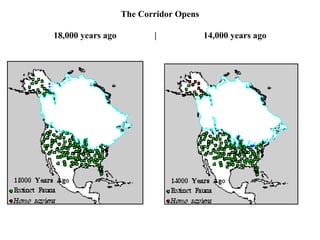
•   Scientists believe the ice sheets did not cover Alaska and the Yukon, but
    covered almost all of the rest of North America south of the Yukon
•   About 14,000 years ago the temperature of the earth began to warm
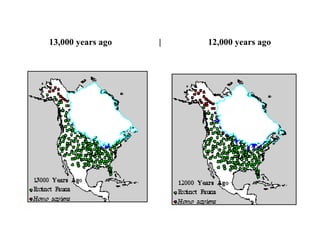
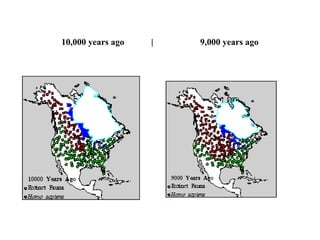
•   11,000 - 10,500 years BP the ice sheet on the Rocky Mountains separated
    from the ice sheet over central Canada, and a corridor along the eastern side of
    the Rockies opened
•   Humans moved through the corridor into the southwestern parts of the United
    States
•   Humans then spread rapidly through the unglaciated parts of the Americas
The Corridor Opens

18,000 years ago          |             14,000 years ago
13,000 years ago   |   12,000 years ago
10,000 years ago   |   9,000 years ago
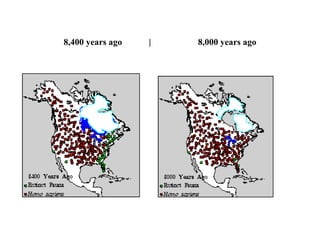
8,400 years ago   |   8,000 years ago
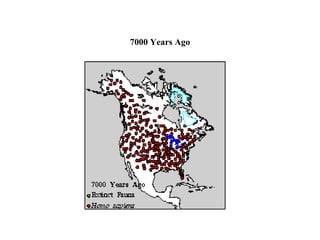
7000 Years Ago
4. The Clovis Barrier

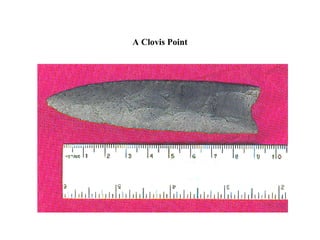
•   Archaeologists found a spear point at Clovis in New Mexico
•   It was the oldest clearly datable artifact made by humans - it dated to 10,500-
    11,000 BP
•   It was found in with bones of a mammoth, which became extinct 10,000 years
    ago
•   Clovis points were found widely through North America
•   No earlier traces of human activity could be clearly proven before the Clovis
    dates
•   Evidence of human activity soon after this date is found all the way to the
    southern tip of South America
•   Evidence of human big game hunting traditions is widespread after the Clovis
    dates
•   Scientists believed (in the 1970s) that no humans entered the Americas before
    the Clovis dates
•   Evidence for any earlier human presence could not be found - the Clovis dates
    were a barrier. Before this there was no clear evidence.
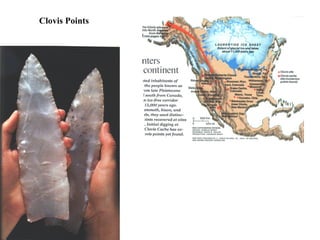
Clovis Points
A Clovis Point
5. Spreading through the Americas


•   The original big game hunters who entered the Americas south of the Yukon
    moved rapidly through the new environment
•   Many animals became extinct in the Americas soon after this
     – mammoths
     – mastodons
     – horses
     – camels (in North America)
     – giant bison
•   Human hunting may have been a factor, together with changes in environment
•   Big game hunters moved into new environments, and adapted, finding new
    ways to live
•   Many new cultures arose in the new environments

Clovis

  • 1.
    The Traditional ScientificTheory of the Origin of the First Americans “The Clovis Model” The Evolution of Humans The Bering Land Bridge The Ice-Free Corridor The Clovis Barrier Spreading through the Americas
  • 2.
    The Evolution ofHumans • The theory of evolution is widely accepted by scientists, but many religions do not accept the idea. • Scientists believe humans evolved. Some early monkeys led to apes. One group of apes evolved into humans • Human evolution occurred in Africa • Humans were hunters and gatherers - developing uniquely human characteristics - – walking on two feet – tools – language – fire – shelter and clothing
  • 3.
    The Evolution ofHumans - 2 • Four types of humans evolved – Negroid in Africa – Caucasoid in Europe and western Asia – Australoid in Australia – Mongoloid in eastern parts of Asia • By about 50,000 years BP they were able to move out of tropics into coldest areas of the earth - reached all through the Old World as far as Australia and Siberia • At this time scientists believe there were still no humans in the Americas
  • 4.
    The Bering LandBridge • Scientists believe humans moved from Siberia into Alaska and the Yukon perhaps as long ago as 40,000- 25,000 years BP • They were able to cross on foot where the Bering Strait is today – Sea levels went down as a result of the last ice age – During the ice age the normal water cycle did not work – Precipitation was frozen and trapped in huge glaciers or ice sheets – The ice sheets were as thick as 3000 metres – Sea levels went down as huge amounts of water were trapped in the ice sheets – the Bering Strait was above sea level - the land there has been called the Bering Land Bridge or Beringia – Beringia may have been 600 km wide from north to south
  • 5.
    The Ice FreeCorridor • Scientists believe humans reached Alaska and the Yukon by at least 25,000 years BP by way of the Bering land Bridge • These first Americans were big game hunters • Scientists believe the ice sheets did not cover Alaska and the Yukon, but covered almost all of the rest of North America south of the Yukon • About 14,000 years ago the temperature of the earth began to warm • 11,000 - 10,500 years BP the ice sheet on the Rocky Mountains separated from the ice sheet over central Canada, and a corridor along the eastern side of the Rockies opened • Humans moved through the corridor into the southwestern parts of the United States • Humans then spread rapidly through the unglaciated parts of the Americas
  • 6.
    The Corridor Opens 18,000years ago | 14,000 years ago
  • 7.
    13,000 years ago | 12,000 years ago
  • 8.
    10,000 years ago | 9,000 years ago
  • 9.
    8,400 years ago | 8,000 years ago
  • 10.
  • 11.
    4. The ClovisBarrier • Archaeologists found a spear point at Clovis in New Mexico • It was the oldest clearly datable artifact made by humans - it dated to 10,500- 11,000 BP • It was found in with bones of a mammoth, which became extinct 10,000 years ago • Clovis points were found widely through North America • No earlier traces of human activity could be clearly proven before the Clovis dates • Evidence of human activity soon after this date is found all the way to the southern tip of South America • Evidence of human big game hunting traditions is widespread after the Clovis dates • Scientists believed (in the 1970s) that no humans entered the Americas before the Clovis dates • Evidence for any earlier human presence could not be found - the Clovis dates were a barrier. Before this there was no clear evidence.
  • 12.
  • 13.
  • 14.
    5. Spreading throughthe Americas • The original big game hunters who entered the Americas south of the Yukon moved rapidly through the new environment • Many animals became extinct in the Americas soon after this – mammoths – mastodons – horses – camels (in North America) – giant bison • Human hunting may have been a factor, together with changes in environment • Big game hunters moved into new environments, and adapted, finding new ways to live • Many new cultures arose in the new environments