Mark R. Hinkle
Director, Cloud Computing Community
Citrix Systems Inc.
Twitter: @mrhinkle
Email: mrhinkle@cloudstack.org
Crash Course in Open
Source Cloud Computing
Cloud Computing Expo West 2011
Santa Clara, CA
2
Agenda
1. Introduction
2. Quick Cloud Computing Overview
3. Open Source Building Blocks for Cloud
Computing
4. Open Source Tools for Cloud Management
5. Questions
3
%whoami
• Responsible for Driving Adoption of
CloudStack Open Source Cloud Computing
Software
• Joined Citrix via Cloud.com acquisition July
2011
• Former manager of Zenoss Open Source
project 100,000 users, 1.5 million downloads
• Former Linux Desktop Advocate (Zealot?)
• Former LinuxWorld Magazine Editor-in-Chief
• Open Management Consortium organizer
• Author - “Windows to Linux Business Desktop
Migration” – Thomson
• NetDirector Project - Open Source
Configuration Management Project
• Sometimes Author and Blogger at
SocializedSoftware.com/NetworkWorld
Quick Cloud Computing
Overview: Or the Obligatory
“What is the Cloud?” Slides
5
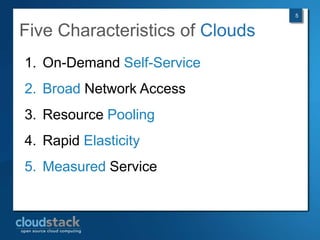
Five Characteristics of Clouds
1. On-Demand Self-Service
2. Broad Network Access
3. Resource Pooling
4. Rapid Elasticity
5. Measured Service
6
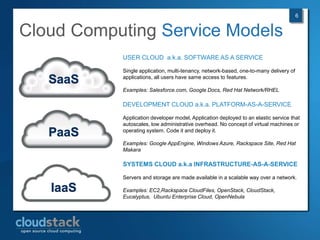
Cloud Computing Service Models
USER CLOUD a.k.a. SOFTWARE AS A SERVICE
Single application, multi-tenancy, network-based, one-to-many delivery of
applications, all users have same access to features.
Examples: Salesforce.com, Google Docs, Red Hat Network/RHEL
DEVELOPMENT CLOUD a.k.a. PLATFORM-AS-A-SERVICE
Application developer model, Application deployed to an elastic service that
autoscales, low administrative overhead. No concept of virtual machines or
operating system. Code it and deploy it.
Examples: Google AppEngine, Windows Azure, Rackspace Site, Red Hat
Makara
SYSTEMS CLOUD a.k.a INFRASTRUCTURE-AS-A-SERVICE
Servers and storage are made available in a scalable way over a network.
Examples: EC2,Rackspace CloudFiles, OpenStack, CloudStack,
Eucalyptus, Ubuntu Enterprise Cloud, OpenNebula
7
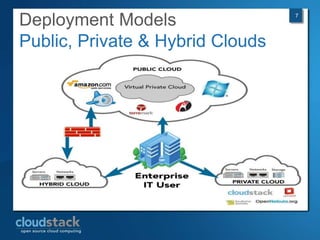
Deployment Models
Public, Private & Hybrid Clouds
8
Cloud Still Requires
Architectural Design
• Cloud Computing isn’t a magical solution
apps need to be able to scale out
• Design your architecture with the end in
mind
• Make your infrastructure easily replicable
Building Compute Clouds
with Open Source Software
10
Why Open Source?
• User-Driven Solutions to Real Problems
• Lower barrier to participation
• Larger user base, users helping users
• Aggressive release cycles stay current with the state-
of-the-art
• Open data, Open standards, Open APIs
11
Open Virtual Machine Formats
Open Virtualization Format (OVF) is an open
standard for packaging and distributing virtual
appliances or more generally software to be run
in virtual machines.
Formats for hypervisors/cloud technologies:
• Amazon - AMI
• KVM – QCOW2
• VMware – VMDK
• Xen – IMG
• VHD – Virtual Hard Disk - Hyper-V
12
Sourcing OSS
VMs and Cloud Appliances
13
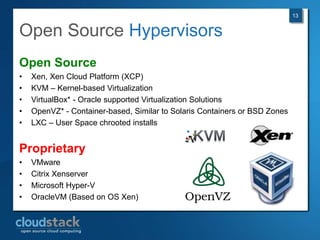
Open Source Hypervisors
Open Source
• Xen, Xen Cloud Platform (XCP)
• KVM – Kernel-based Virtualization
• VirtualBox* - Oracle supported Virtualization Solutions
• OpenVZ* - Container-based, Similar to Solaris Containers or BSD Zones
• LXC – User Space chrooted installs
Proprietary
• VMware
• Citrix Xenserver
• Microsoft Hyper-V
• OracleVM (Based on OS Xen)
14
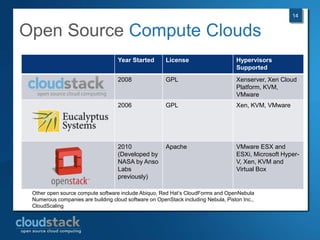
Open Source Compute Clouds
Year Started License Hypervisors
Supported
2008 GPL Xenserver, Xen Cloud
Platform, KVM,
VMware
2006 GPL Xen, KVM, VMware
2010
(Developed by
NASA by Anso
Labs
previously)
Apache VMware ESX and
ESXi, Microsoft Hyper-
V, Xen, KVM and
Virtual Box
Other open source compute software include Abiquo, Red Hat’s CloudForms and OpenNebula
Numerous companies are building cloud software on OpenStack including Nebula, Piston Inc.,
CloudScaling
15
Scale-Up or Scale-Out
• Vertical Scaling (Scale-Up) – Allocate
additional resources to VMs, requires a
reboot, no need for distributed app logic,
single-point of OS failure
• Horizontal Scaling (Scale-Out) –
Application needs logic to work in
distributed fashion (e.g. HA-Proxy and
Apache, Hadoop)
16
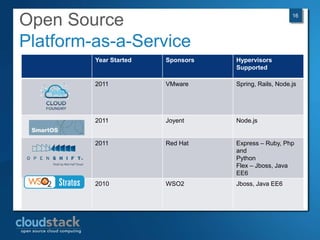
Open Source
Platform-as-a-Service
Year Started Sponsors Hypervisors
Supported
2011 VMware Spring, Rails, Node.js
2011 Joyent Node.js
2011 Red Hat Express – Ruby, Php
and
Python
Flex – Jboss, Java
EE6
2010 WSO2 Jboss, Java EE6
17
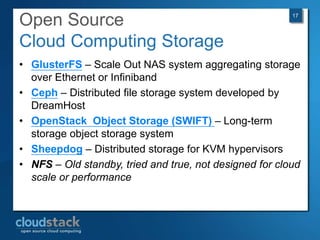
Open Source
Cloud Computing Storage
• GlusterFS – Scale Out NAS system aggregating storage
over Ethernet or Infiniband
• Ceph – Distributed file storage system developed by
DreamHost
• OpenStack Object Storage (SWIFT) – Long-term
storage object storage system
• Sheepdog – Distributed storage for KVM hypervisors
• NFS – Old standby, tried and true, not designed for cloud
scale or performance
18
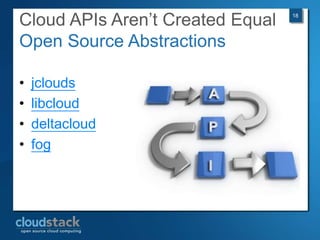
Cloud APIs Aren’t Created Equal
Open Source Abstractions
• jclouds
• libcloud
• deltacloud
• fog
19
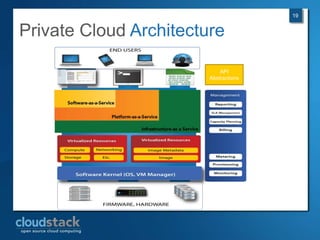
Private Cloud Architecture
API
Abstractions
Managing Clouds with
Open Source Tools
21
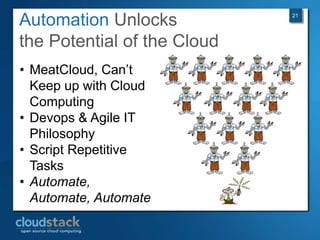
Automation Unlocks
the Potential of the Cloud
• MeatCloud, Can’t
Keep up with Cloud
Computing
• Devops & Agile IT
Philosophy
• Script Repetitive
Tasks
• Automate,
Automate, Automate
22
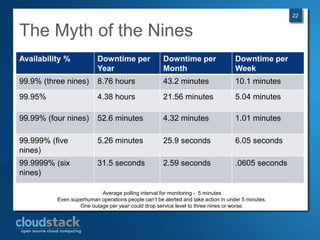
The Myth of the Nines
Availability % Downtime per
Year
Downtime per
Month
Downtime per
Week
99.9% (three nines) 8.76 hours 43.2 minutes 10.1 minutes
99.95% 4.38 hours 21.56 minutes 5.04 minutes
99.99% (four nines) 52.6 minutes 4.32 minutes 1.01 minutes
99.999% (five
nines)
5.26 minutes 25.9 seconds 6.05 seconds
99.9999% (six
nines)
31.5 seconds 2.59 seconds .0605 seconds
Average polling interval for monitoring - 5 minutes
Even superhuman operations people can’t be alerted and take action in under 5 minutes.
One outage per year could drop service level to three nines or worse.
23
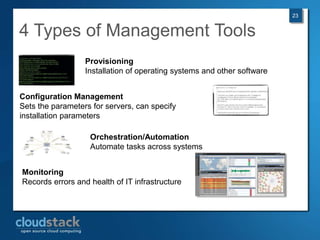
4 Types of Management Tools
Provisioning
Installation of operating systems and other software
Configuration Management
Sets the parameters for servers, can specify
installation parameters
Orchestration/Automation
Automate tasks across systems
Monitoring
Records errors and health of IT infrastructure
24
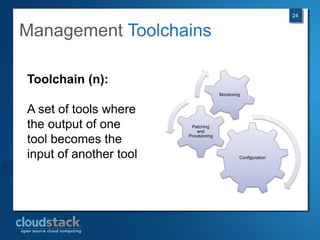
Management Toolchains
Configuration
Patching
and
Provisioning
Monitoring
Toolchain (n):
A set of tools where
the output of one
tool becomes the
input of another tool
25
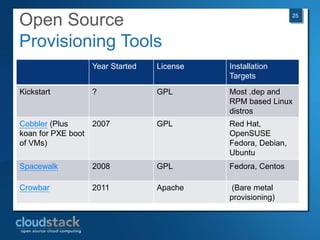
Open Source
Provisioning Tools
Year Started License Installation
Targets
Kickstart ? GPL Most .dep and
RPM based Linux
distros
Cobbler (Plus
koan for PXE boot
of VMs)
2007 GPL Red Hat,
OpenSUSE
Fedora, Debian,
Ubuntu
Spacewalk 2008 GPL Fedora, Centos
Crowbar 2011 Apache (Bare metal
provisioning)
26
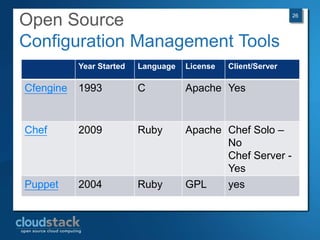
Open Source
Configuration Management Tools
Year Started Language License Client/Server
Cfengine 1993 C Apache Yes
Chef 2009 Ruby Apache Chef Solo –
No
Chef Server -
Yes
Puppet 2004 Ruby GPL yes
27
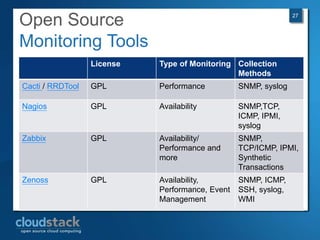
Open Source
Monitoring Tools
License Type of Monitoring Collection
Methods
Cacti / RRDTool GPL Performance SNMP, syslog
Nagios GPL Availability SNMP,TCP,
ICMP, IPMI,
syslog
Zabbix GPL Availability/
Performance and
more
SNMP,
TCP/ICMP, IPMI,
Synthetic
Transactions
Zenoss GPL Availability,
Performance, Event
Management
SNMP, ICMP,
SSH, syslog,
WMI
28
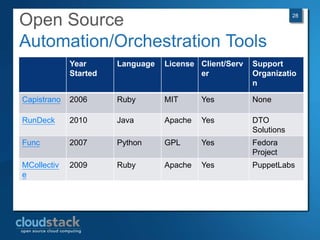
Open Source
Automation/Orchestration Tools
Year
Started
Language License Client/Serv
er
Support
Organizatio
n
Capistrano 2006 Ruby MIT Yes None
RunDeck 2010 Java Apache Yes DTO
Solutions
Func 2007 Python GPL Yes Fedora
Project
MCollectiv
e
2009 Ruby Apache Yes PuppetLabs
29
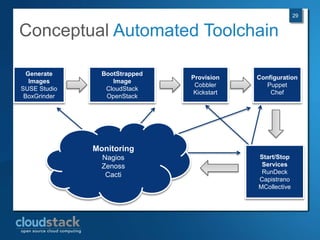
Conceptual Automated Toolchain
BootStrapped
Image
CloudStack
OpenStack
Configuration
Puppet
Chef
Start/Stop
Services
RunDeck
Capistrano
MCollective
Provision
Cobbler
Kickstart
Monitoring
Nagios
Zenoss
Cacti
Generate
Images
SUSE Studio
BoxGrinder
Slides Can be Viewed and Downloaded at:
http://www.slideshare.net/socializedsoftware/
Questions?
31
Contact Me
Professional:
mrhinkle@cloustack.org
Personal: mrhinkle@gmail.com
Professional: 919.228.8049
Professional: http://www.cloudstack.org
Personal:
http://www.socializedsoftware.com
Twitter: @mrhinkle
Mark R. Hinkle
Director, Cloud Computing Community
Citrix Systems Inc.
Open Source Enthusiast
32
Additional Resources
• Devops Toolchains Group
• DevOps Wikipedia Page
• Open Cloud Initiative
• NIST Cloud Computing Platform
• Open Virtualization Format Specs
• Clouderati Twitter Account
• Planet DevOps
Crash Course in Open Source Cloud Computing
by Mark R. Hinkle is licensed under a Creative Commons Attribution-
ShareAlike 3.0 United States License.

Cloudexpowest opensourcecloudcomputing-1by arun kumar

  • 1.
    Mark R. Hinkle Director,Cloud Computing Community Citrix Systems Inc. Twitter: @mrhinkle Email: mrhinkle@cloudstack.org Crash Course in Open Source Cloud Computing Cloud Computing Expo West 2011 Santa Clara, CA
  • 2.
    2 Agenda 1. Introduction 2. QuickCloud Computing Overview 3. Open Source Building Blocks for Cloud Computing 4. Open Source Tools for Cloud Management 5. Questions
  • 3.
    3 %whoami • Responsible forDriving Adoption of CloudStack Open Source Cloud Computing Software • Joined Citrix via Cloud.com acquisition July 2011 • Former manager of Zenoss Open Source project 100,000 users, 1.5 million downloads • Former Linux Desktop Advocate (Zealot?) • Former LinuxWorld Magazine Editor-in-Chief • Open Management Consortium organizer • Author - “Windows to Linux Business Desktop Migration” – Thomson • NetDirector Project - Open Source Configuration Management Project • Sometimes Author and Blogger at SocializedSoftware.com/NetworkWorld
  • 4.
    Quick Cloud Computing Overview:Or the Obligatory “What is the Cloud?” Slides
  • 5.
    5 Five Characteristics ofClouds 1. On-Demand Self-Service 2. Broad Network Access 3. Resource Pooling 4. Rapid Elasticity 5. Measured Service
  • 6.
    6 Cloud Computing ServiceModels USER CLOUD a.k.a. SOFTWARE AS A SERVICE Single application, multi-tenancy, network-based, one-to-many delivery of applications, all users have same access to features. Examples: Salesforce.com, Google Docs, Red Hat Network/RHEL DEVELOPMENT CLOUD a.k.a. PLATFORM-AS-A-SERVICE Application developer model, Application deployed to an elastic service that autoscales, low administrative overhead. No concept of virtual machines or operating system. Code it and deploy it. Examples: Google AppEngine, Windows Azure, Rackspace Site, Red Hat Makara SYSTEMS CLOUD a.k.a INFRASTRUCTURE-AS-A-SERVICE Servers and storage are made available in a scalable way over a network. Examples: EC2,Rackspace CloudFiles, OpenStack, CloudStack, Eucalyptus, Ubuntu Enterprise Cloud, OpenNebula
  • 7.
  • 8.
    8 Cloud Still Requires ArchitecturalDesign • Cloud Computing isn’t a magical solution apps need to be able to scale out • Design your architecture with the end in mind • Make your infrastructure easily replicable
  • 9.
    Building Compute Clouds withOpen Source Software
  • 10.
    10 Why Open Source? •User-Driven Solutions to Real Problems • Lower barrier to participation • Larger user base, users helping users • Aggressive release cycles stay current with the state- of-the-art • Open data, Open standards, Open APIs
  • 11.
    11 Open Virtual MachineFormats Open Virtualization Format (OVF) is an open standard for packaging and distributing virtual appliances or more generally software to be run in virtual machines. Formats for hypervisors/cloud technologies: • Amazon - AMI • KVM – QCOW2 • VMware – VMDK • Xen – IMG • VHD – Virtual Hard Disk - Hyper-V
  • 12.
    12 Sourcing OSS VMs andCloud Appliances
  • 13.
    13 Open Source Hypervisors OpenSource • Xen, Xen Cloud Platform (XCP) • KVM – Kernel-based Virtualization • VirtualBox* - Oracle supported Virtualization Solutions • OpenVZ* - Container-based, Similar to Solaris Containers or BSD Zones • LXC – User Space chrooted installs Proprietary • VMware • Citrix Xenserver • Microsoft Hyper-V • OracleVM (Based on OS Xen)
  • 14.
    14 Open Source ComputeClouds Year Started License Hypervisors Supported 2008 GPL Xenserver, Xen Cloud Platform, KVM, VMware 2006 GPL Xen, KVM, VMware 2010 (Developed by NASA by Anso Labs previously) Apache VMware ESX and ESXi, Microsoft Hyper- V, Xen, KVM and Virtual Box Other open source compute software include Abiquo, Red Hat’s CloudForms and OpenNebula Numerous companies are building cloud software on OpenStack including Nebula, Piston Inc., CloudScaling
  • 15.
    15 Scale-Up or Scale-Out •Vertical Scaling (Scale-Up) – Allocate additional resources to VMs, requires a reboot, no need for distributed app logic, single-point of OS failure • Horizontal Scaling (Scale-Out) – Application needs logic to work in distributed fashion (e.g. HA-Proxy and Apache, Hadoop)
  • 16.
    16 Open Source Platform-as-a-Service Year StartedSponsors Hypervisors Supported 2011 VMware Spring, Rails, Node.js 2011 Joyent Node.js 2011 Red Hat Express – Ruby, Php and Python Flex – Jboss, Java EE6 2010 WSO2 Jboss, Java EE6
  • 17.
    17 Open Source Cloud ComputingStorage • GlusterFS – Scale Out NAS system aggregating storage over Ethernet or Infiniband • Ceph – Distributed file storage system developed by DreamHost • OpenStack Object Storage (SWIFT) – Long-term storage object storage system • Sheepdog – Distributed storage for KVM hypervisors • NFS – Old standby, tried and true, not designed for cloud scale or performance
  • 18.
    18 Cloud APIs Aren’tCreated Equal Open Source Abstractions • jclouds • libcloud • deltacloud • fog
  • 19.
  • 20.
  • 21.
    21 Automation Unlocks the Potentialof the Cloud • MeatCloud, Can’t Keep up with Cloud Computing • Devops & Agile IT Philosophy • Script Repetitive Tasks • Automate, Automate, Automate
  • 22.
    22 The Myth ofthe Nines Availability % Downtime per Year Downtime per Month Downtime per Week 99.9% (three nines) 8.76 hours 43.2 minutes 10.1 minutes 99.95% 4.38 hours 21.56 minutes 5.04 minutes 99.99% (four nines) 52.6 minutes 4.32 minutes 1.01 minutes 99.999% (five nines) 5.26 minutes 25.9 seconds 6.05 seconds 99.9999% (six nines) 31.5 seconds 2.59 seconds .0605 seconds Average polling interval for monitoring - 5 minutes Even superhuman operations people can’t be alerted and take action in under 5 minutes. One outage per year could drop service level to three nines or worse.
  • 23.
    23 4 Types ofManagement Tools Provisioning Installation of operating systems and other software Configuration Management Sets the parameters for servers, can specify installation parameters Orchestration/Automation Automate tasks across systems Monitoring Records errors and health of IT infrastructure
  • 24.
    24 Management Toolchains Configuration Patching and Provisioning Monitoring Toolchain (n): Aset of tools where the output of one tool becomes the input of another tool
  • 25.
    25 Open Source Provisioning Tools YearStarted License Installation Targets Kickstart ? GPL Most .dep and RPM based Linux distros Cobbler (Plus koan for PXE boot of VMs) 2007 GPL Red Hat, OpenSUSE Fedora, Debian, Ubuntu Spacewalk 2008 GPL Fedora, Centos Crowbar 2011 Apache (Bare metal provisioning)
  • 26.
    26 Open Source Configuration ManagementTools Year Started Language License Client/Server Cfengine 1993 C Apache Yes Chef 2009 Ruby Apache Chef Solo – No Chef Server - Yes Puppet 2004 Ruby GPL yes
  • 27.
    27 Open Source Monitoring Tools LicenseType of Monitoring Collection Methods Cacti / RRDTool GPL Performance SNMP, syslog Nagios GPL Availability SNMP,TCP, ICMP, IPMI, syslog Zabbix GPL Availability/ Performance and more SNMP, TCP/ICMP, IPMI, Synthetic Transactions Zenoss GPL Availability, Performance, Event Management SNMP, ICMP, SSH, syslog, WMI
  • 28.
    28 Open Source Automation/Orchestration Tools Year Started LanguageLicense Client/Serv er Support Organizatio n Capistrano 2006 Ruby MIT Yes None RunDeck 2010 Java Apache Yes DTO Solutions Func 2007 Python GPL Yes Fedora Project MCollectiv e 2009 Ruby Apache Yes PuppetLabs
  • 29.
  • 30.
    Slides Can beViewed and Downloaded at: http://www.slideshare.net/socializedsoftware/ Questions?
  • 31.
    31 Contact Me Professional: mrhinkle@cloustack.org Personal: mrhinkle@gmail.com Professional:919.228.8049 Professional: http://www.cloudstack.org Personal: http://www.socializedsoftware.com Twitter: @mrhinkle Mark R. Hinkle Director, Cloud Computing Community Citrix Systems Inc. Open Source Enthusiast
  • 32.
    32 Additional Resources • DevopsToolchains Group • DevOps Wikipedia Page • Open Cloud Initiative • NIST Cloud Computing Platform • Open Virtualization Format Specs • Clouderati Twitter Account • Planet DevOps
  • 33.
    Crash Course inOpen Source Cloud Computing by Mark R. Hinkle is licensed under a Creative Commons Attribution- ShareAlike 3.0 United States License.

Editor's Notes

  • #30 Automated Toolchain (For Linux guests) Bootstrapped image is launched fro a template in the cloud provider, then searches for the Cobbler server. Post Install from Cobbler kicks off Puppet with defined management class to configure server using roles After cobbler runs kicks off configuration management in Puppet. Then services can be started and stopped with RunDeck or post-install scripts Then RunDeck can insert new hosts in Zenoss or Nagios Finally as the network conditions change Zenoss can remediate via other tools based on situational awareness