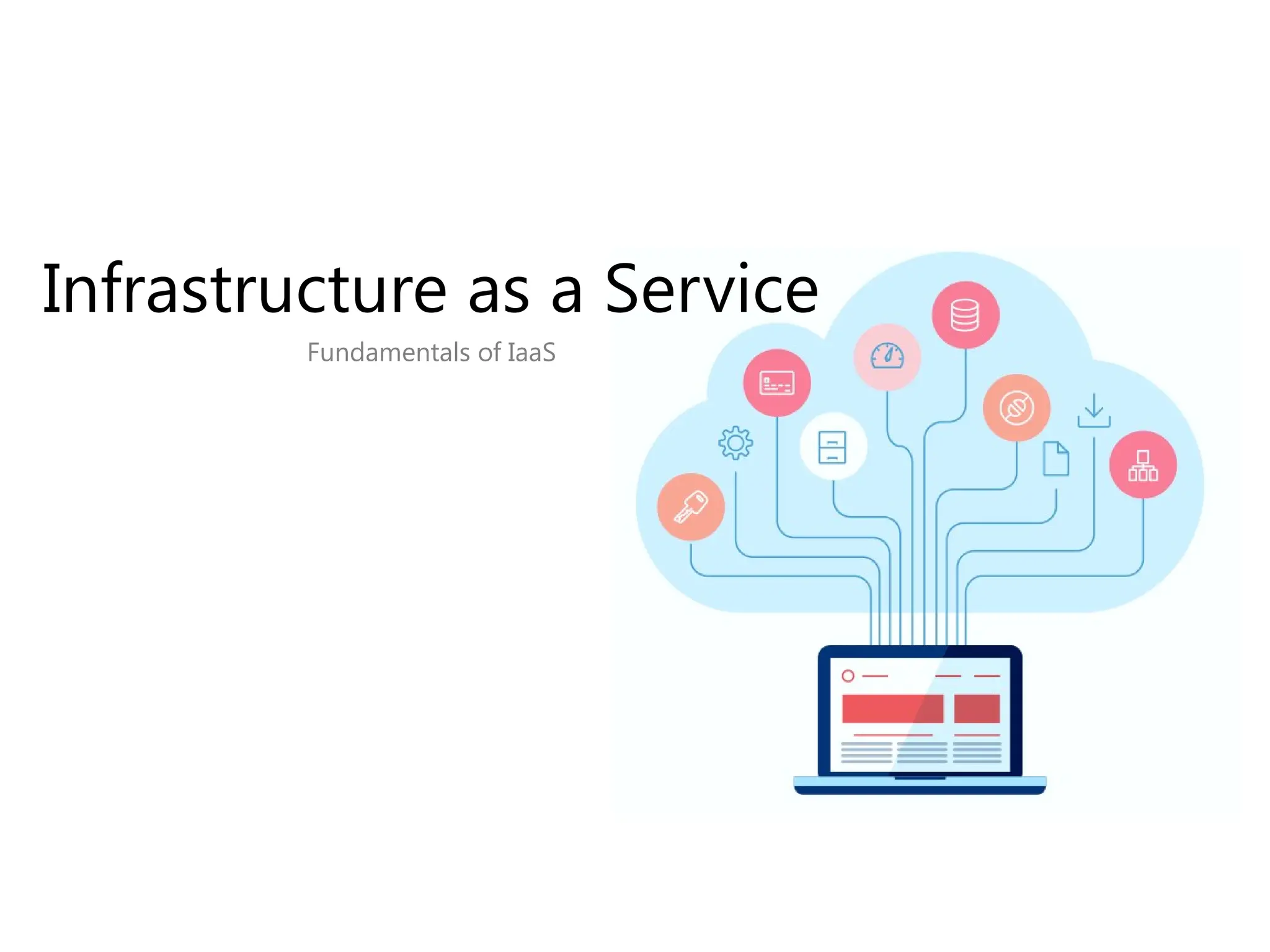
Infrastructure as a Service
Fundamentals of IaaS
Introduction
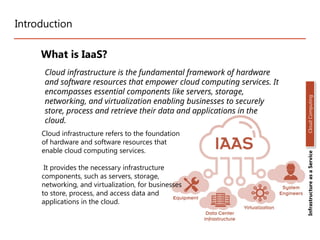
What is IaaS?
Cloud infrastructure is the fundamental framework of hardware
and software resources that empower cloud computing services. It
encompasses essential components like servers, storage,
networking, and virtualization enabling businesses to securely
store, process and retrieve their data and applications in the
cloud.
Infrastructure
as
a
Service
Cloud
Computing
Cloud infrastructure refers to the foundation
of hardware and software resources that
enable cloud computing services.
It provides the necessary infrastructure
components, such as servers, storage,
networking, and virtualization, for businesses
to store, process, and access data and
applications in the cloud.
Components of Infrastructure as a Service
Key components of IaaS
Virtual Machines (VMs): These are virtual instances of
computers that provide computing power, including
processing, memory, and storage, on demand.
Storage: IaaS offers scalable and reliable storage solutions
that allow businesses to store and access data as needed.
Networking: IaaS provides networking capabilities, including
virtual networks, load balancers, and firewalls, to connect and
secure the infrastructure.
Management Tools: IaaS platforms offer management tools
that allow users to provision, monitor, and manage their
infrastructure efficiently.
IaaS comprises several essential
components:
Infrastructure
as
a
Service
Cloud
Computing
Benefits of IaaS
• Scalability: IaaS enables businesses to scale their infrastructure up or
down instantly, providing agility and cost optimization.
• Cost Savings: With IaaS, businesses can avoid the upfront costs of
purchasing and maintaining physical hardware, paying only for the
resources they consume.
• Flexibility: IaaS allows businesses to choose the infrastructure
components they need and customize their environments to meet
specific requirements.
• Reliability: IaaS providers ensure high availability and redundancy,
minimizing downtime and providing reliable infrastructure services.
Infrastructure
as
a
Service
Cloud
Computing
IaaS offers numerous benefits for businesses:
IaaS for Adoption
• Security: Implementing robust security measures to protect data and
applications is essential. This includes access controls, encryption, and
compliance with relevant regulations.
• Performance: Optimizing network performance, latency, and
bandwidth is crucial to ensure a seamless user experience.
• Vendor Selection: Choose a reputable and reliable IaaS provider that
aligns with your business needs and offers adequate support and
service level agreements (SLAs).
• Data Transfer and Integration: Consider the ease of transferring data
to and from the IaaS environment and integrating it with other systems
or services.
Infrastructure
as
a
Service
Cloud
Computing
When adopting IaaS, What organizations should
consider?
Cloud Infrastructure Simplified with IaaS: Key Takeaways
• Cloud infrastructure serves as the foundation for cloud computing
services, enabling businesses to store, process, and access data
and applications in the cloud.
• IaaS provides virtualized computing resources, scalable storage,
networking capabilities, and management tools.
• Key benefits of IaaS include scalability, cost savings, flexibility, and
reliability.
• Security, performance, vendor selection, and data transfer are
important considerations when adopting IaaS.
Infrastructure
as
a
Service
Cloud
Computing
Use cases of IaaS
• Development and Testing Environments: IaaS is commonly used
to create and manage development and testing environments,
allowing businesses to rapidly provision resources and reduce
time-to-market.
• Web and Mobile Applications: IaaS provides a scalable and
reliable infrastructure for hosting web and mobile applications,
ensuring optimal performance and availability.
• Big Data Analytics: IaaS platforms offer the necessary
computational power and storage capacity to process and analyze
large datasets in real-time.
• Disaster Recovery: IaaS can serve as a backup and disaster
recovery solution, allowing businesses to replicate their
infrastructure and data in the cloud.
Infrastructure
as
a
Service
Cloud
Computing
Conclusion
• Infrastructure as a Service (IaaS) is a powerful cloud computing
model that provides businesses with flexible and scalable
infrastructure resources.
• By leveraging IaaS, organizations can reduce costs, improve agility,
and focus on their core competencies.
• Understanding the fundamentals of IaaS is essential for businesses
looking to embrace the benefits of cloud computing.
Infrastructure
as
a
Service
Cloud
Computing
THANK YOU

Cloud - What is IaaS and its explaination.pptx

  • 1.
    Infrastructure as aService Fundamentals of IaaS
  • 2.
    Introduction What is IaaS? Cloudinfrastructure is the fundamental framework of hardware and software resources that empower cloud computing services. It encompasses essential components like servers, storage, networking, and virtualization enabling businesses to securely store, process and retrieve their data and applications in the cloud. Infrastructure as a Service Cloud Computing Cloud infrastructure refers to the foundation of hardware and software resources that enable cloud computing services. It provides the necessary infrastructure components, such as servers, storage, networking, and virtualization, for businesses to store, process, and access data and applications in the cloud.
  • 3.
    Components of Infrastructureas a Service Key components of IaaS Virtual Machines (VMs): These are virtual instances of computers that provide computing power, including processing, memory, and storage, on demand. Storage: IaaS offers scalable and reliable storage solutions that allow businesses to store and access data as needed. Networking: IaaS provides networking capabilities, including virtual networks, load balancers, and firewalls, to connect and secure the infrastructure. Management Tools: IaaS platforms offer management tools that allow users to provision, monitor, and manage their infrastructure efficiently. IaaS comprises several essential components: Infrastructure as a Service Cloud Computing
  • 4.
    Benefits of IaaS •Scalability: IaaS enables businesses to scale their infrastructure up or down instantly, providing agility and cost optimization. • Cost Savings: With IaaS, businesses can avoid the upfront costs of purchasing and maintaining physical hardware, paying only for the resources they consume. • Flexibility: IaaS allows businesses to choose the infrastructure components they need and customize their environments to meet specific requirements. • Reliability: IaaS providers ensure high availability and redundancy, minimizing downtime and providing reliable infrastructure services. Infrastructure as a Service Cloud Computing IaaS offers numerous benefits for businesses:
  • 5.
    IaaS for Adoption •Security: Implementing robust security measures to protect data and applications is essential. This includes access controls, encryption, and compliance with relevant regulations. • Performance: Optimizing network performance, latency, and bandwidth is crucial to ensure a seamless user experience. • Vendor Selection: Choose a reputable and reliable IaaS provider that aligns with your business needs and offers adequate support and service level agreements (SLAs). • Data Transfer and Integration: Consider the ease of transferring data to and from the IaaS environment and integrating it with other systems or services. Infrastructure as a Service Cloud Computing When adopting IaaS, What organizations should consider?
  • 6.
    Cloud Infrastructure Simplifiedwith IaaS: Key Takeaways • Cloud infrastructure serves as the foundation for cloud computing services, enabling businesses to store, process, and access data and applications in the cloud. • IaaS provides virtualized computing resources, scalable storage, networking capabilities, and management tools. • Key benefits of IaaS include scalability, cost savings, flexibility, and reliability. • Security, performance, vendor selection, and data transfer are important considerations when adopting IaaS. Infrastructure as a Service Cloud Computing
  • 7.
    Use cases ofIaaS • Development and Testing Environments: IaaS is commonly used to create and manage development and testing environments, allowing businesses to rapidly provision resources and reduce time-to-market. • Web and Mobile Applications: IaaS provides a scalable and reliable infrastructure for hosting web and mobile applications, ensuring optimal performance and availability. • Big Data Analytics: IaaS platforms offer the necessary computational power and storage capacity to process and analyze large datasets in real-time. • Disaster Recovery: IaaS can serve as a backup and disaster recovery solution, allowing businesses to replicate their infrastructure and data in the cloud. Infrastructure as a Service Cloud Computing
  • 8.
    Conclusion • Infrastructure asa Service (IaaS) is a powerful cloud computing model that provides businesses with flexible and scalable infrastructure resources. • By leveraging IaaS, organizations can reduce costs, improve agility, and focus on their core competencies. • Understanding the fundamentals of IaaS is essential for businesses looking to embrace the benefits of cloud computing. Infrastructure as a Service Cloud Computing
  • 9.