Cloud Storage: Enabling The Dynamic DatacenterJoel KaufmanConsulting Systems Architect
2Agenda© 2010 NetApp.  All rights reserved.Business ClimateChallenges and RequirementsTransforming to a Dynamic Data CenterHow NetApp Can HelpReal  World ExperiencesGetting Started22
Transformation is Happening“The NetApp architecture and tools scale seamlessly with the expanding cloud and our growing business requirements.”“NetApp has helped us deploy a powerful, service-based model that we can expand in both size and functionality.”“Most of our clients require around-the-clock access to IT services to maintain business continuity. This infrastructure allows us to deliver the uptime clients expect and desire.”
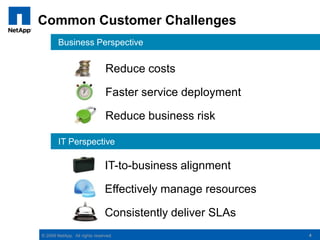
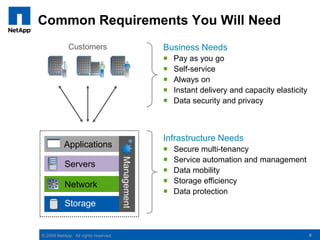
4Common Customer ChallengesIT PerspectiveIT-to-business alignmentEffectively manage resourcesConsistently deliver SLAsBusiness PerspectiveReduce costsFaster service deploymentReduce business risk
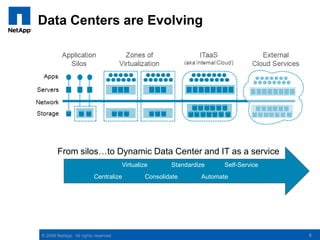
Data Centers are Evolving5From silos…to Dynamic Data Center and IT as a serviceStandardizeVirtualizeSelf-ServiceConsolidateAutomateCentralize
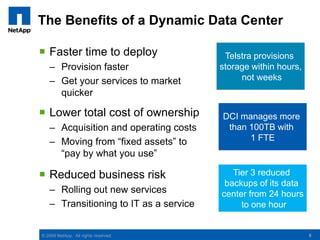
6The Benefits of a Dynamic Data CenterFaster time to deployProvision fasterGet your services to market quickerLower total cost of ownershipAcquisition and operating costsMoving from “fixed assets” to “pay by what you use”Reduced business riskRolling out new services Transitioning to IT as a serviceTelstra provisions storage within hours, not weeksDCI manages more than 100TB with 1 FTETier 3 reduced backups of its data center from 24 hours to one hour
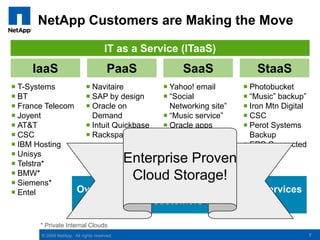
NetApp Customers are Making the MoveIaaSPaaSSaaSStaaSIT as a Service (ITaaS)T-Systems
BT
France Telecom
Joyent
AT&T
CSC
IBM Hosting
Unisys
Telstra*
BMW*
Siemens*
Entel
Navitaire
SAP by design

Cloud Storage: Enabling The Dynamic Datacenter

  • 1.
    Cloud Storage: EnablingThe Dynamic DatacenterJoel KaufmanConsulting Systems Architect
  • 2.
    2Agenda© 2010 NetApp. All rights reserved.Business ClimateChallenges and RequirementsTransforming to a Dynamic Data CenterHow NetApp Can HelpReal World ExperiencesGetting Started22
  • 3.
    Transformation is Happening“TheNetApp architecture and tools scale seamlessly with the expanding cloud and our growing business requirements.”“NetApp has helped us deploy a powerful, service-based model that we can expand in both size and functionality.”“Most of our clients require around-the-clock access to IT services to maintain business continuity. This infrastructure allows us to deliver the uptime clients expect and desire.”
  • 4.
    4Common Customer ChallengesITPerspectiveIT-to-business alignmentEffectively manage resourcesConsistently deliver SLAsBusiness PerspectiveReduce costsFaster service deploymentReduce business risk
  • 5.
    Data Centers areEvolving5From silos…to Dynamic Data Center and IT as a serviceStandardizeVirtualizeSelf-ServiceConsolidateAutomateCentralize
  • 6.
    6The Benefits ofa Dynamic Data CenterFaster time to deployProvision fasterGet your services to market quickerLower total cost of ownershipAcquisition and operating costsMoving from “fixed assets” to “pay by what you use”Reduced business riskRolling out new services Transitioning to IT as a serviceTelstra provisions storage within hours, not weeksDCI manages more than 100TB with 1 FTETier 3 reduced backups of its data center from 24 hours to one hour
  • 7.
    NetApp Customers areMaking the MoveIaaSPaaSSaaSStaaSIT as a Service (ITaaS)T-Systems
  • 8.
  • 9.
  • 10.
  • 11.
  • 12.
  • 13.
  • 14.
  • 15.
  • 16.
  • 17.
  • 18.
  • 19.
  • 20.

Editor's Notes

  • #5 Goal of Slide: Highlight the top three business and IT challenges happening in the industry today. Key Points:In working with companies in almost every major industry around the world, these are some of the common challenges that we’re hearing from them, and what they are facing in today’s business climate that is forcing them to evaluate transforming their data center to become more dynamic: From a business perspective:Clearly there has been global economic uncertainty that has caused many organizations to look at reducing and containing costs, but at the same time feeling the pressure to increase productivity. Customer demand for differentiation and faster innovation and time to market is greater than ever before in a global economy, where competitors can easily outpace you. And we’re operating in a 24x7 environment, there is no downtime and customers expect always-on service or they’ll take their business elsewhere. Many companies have a lack of standards and defined business processes, such as for disaster and backup and recovery that increases their business risk. From a technical perspective: IT is being asked to be more strategic to the overall success of the business. IT is being forced to become more cost-efficient and help make the overall business more productive, with the ability to shift resources and capacity quickly to meet changing demand.And IT is still looking at flat or reduced budgets while trying to maintain consistent service levels and roll out new services to meet business needs.  Transition: These challenges are causing organizations to re-evaluate their internal IT systems to better support their business goals and needs.
  • #6 Goal of Slide: Talk through the evolution of data center models towards a dynamic data center.Key Points: What many organizations are finding is that their underlying technology may prohibit their organization from effectively managing costs and quickly responding to the demands of business. This is causing many IT shops to re-evaluate what they have and to start incorporating new infrastructure models in their data centers. This graphic depicts what we’re seeing: Traditional Silos. At the far left of this graphic, you can recognize the traditional silos that are still the standard in many IT shops today. These environments were built and optimized to run specific applications. They work, but most deliver poor utilization of servers (on average only 10-15%) and storage (on average only 30-40%) because they are dedicated to an application that may need more or less usage at various times. But some applications work perfectly fine in this type of environment and companies will keep them as is. Zones of Virtualization: Many organizations over the last few years have virtualized some of their servers and storage, which has created these zones of virtualization. Many companies have benefited from this and have improved utilization and efficiency. Server and storage virtualization and converged networks have achieved a maturity level where they can be counted on to build large shared infrastructure models.Additionally, many of our customers are either implementing or working on plans to implement what many people refer to as a “Dynamic Data Center.” A DDC is designed from the ground up on virtualized, dynamic infrastructures and enables customers to deliver IT as a service – either internally or externally.Internal Clouds. A virtualized environment provides the perfect foundation for cloud computing. We’ve heard a lot in the industry about what’s being called “internal or private clouds,” where applications are decoupled from servers. Applications are mobile; they can be moved transparently without disruption to satisfy usage and performance needs. IT can offer IT services to their internal customers from a service catalog, create charge-back models, and deliver IT as a service for greater cost savings, utilization, and efficiencies leveraging a shared infrastructure. External Clouds. In addition to internal clouds, there are “external or public clouds” where applications are hosted by Service Providers and offered to enterprises that don’t want to or can’t build their own. Many enterprises are or will start to mandate that external cloud providers be used for non-core applications, where SLAs and cost benefits will outweigh local control of those applications. This has been happening already for years with applications such as payroll and email.  There are many different names for this shift – virtualization, dynamic data center, cloud infrastructure, cloud services – but in general, these terms refer to the same concept – a new way of architecting and running IT to be more cost efficient and more responsive to the business. Transition: In reality, most enterprise data centers will have a hybrid environment with more than one of these types of infrastructure models. It’s the move towards delivering IT as a service that is creating the need for what we call a dynamic data center.
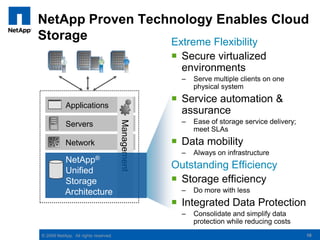
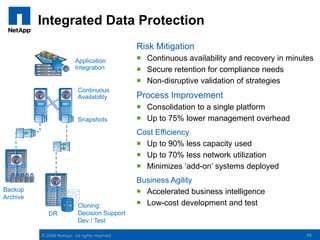
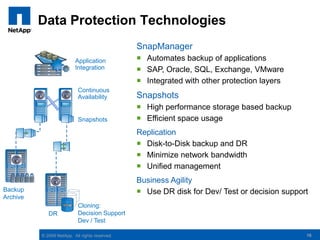
  • #11 Goal of Slide: Make the point of NetApp’s unique technologies for evolving to a dynamic data center.Key Points:A service-oriented infrastructure pools all resources (storage, network, and compute) to create a shared infrastructure that is elastic, efficient, and dynamic. It is the architectural design that is needed to deliver IT as a service internally as an enterprise IT company, or as a service provider delivering IT services to companies. Extreme flexibility and outstanding efficiency are the main pillars of an agile, high-performance infrastructure. NetApp’s technology capabilities are built on the Data ONTAP platform, which is the foundation of the NetApp Unified Storage Architecture and provides these key capabilities that are critical to a dynamic data center: Secure virtualized environments to cost-effectively and securely partition a single NetApp system to support multiple tenants, including applications, customers, workgroups, and security zonesService automation and assurance for near real-time visibility, monitoring, and proactive alerts of availability, performance, or policy problemsData mobility to easily and quickly migrate data across multiple storage systems while maintaining continuous access to your applicationsStorage efficiency through a single unified storage architecture and management interface that supports multiple protocols and multi-vendor arraysIntegrated data protection to meet backup, disaster recovery, archiving, compliance and security service level agreements Transition: Let’s take a look at these requirements in more detail.  
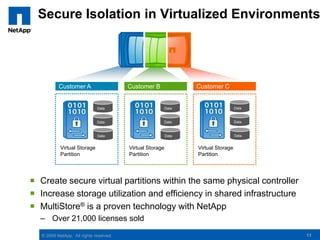
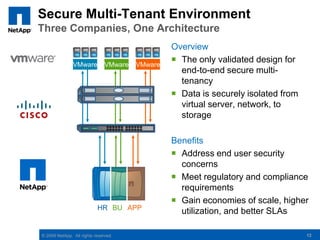
  • #12 Goal of Slide: Provide details and benefits on multi-tenancy enabled by MultiStore. Key points:A cloud infrastructure is a shared and virtualized infrastructure where multi-tenancy support is a foundation requirement to avoid one to one mapping to physical systemsMulti-tenancy support on storage system enables the end to end secure multi tenancy concept that is common today at the server stack with the virtualization technologyNetApp supports multitenancy through a technology called multistore: it’s a proven technology that has sold more than 21,000 licenses to date. It securely separate logical data with a single physical storage system as if they are residing on totally separated physical storage systems. A simple way to think about this is in the context of an environment where there are multiple customers, each having a need for storage but not necessarily the desire or budget to manage their own physical storage system. Basically, MultiStore allows your customer to take a single Data ONTAP system and break it up into individual and highly secure virtual containers and from the point of view of one of those individual departments these containers can also be thought of their own private storage domain. The physical resources of the physical storage system such as system memory and CPU are shared between each of these virtual controllers. But a key thing to keep in mind is that these containers or vFilers as they are called not only contain data but also the security attributes associated with that data. Network settings such as IP addresses, DNS associations, Windows domain settings and other settings are explicitly assigned to each MultiStore partition. The result is that any data contained in a MultiStore partition is completely secure and sepatate. As a result, MultiStore allows your customers to implement something that is frequently referred to as Multi-tenancy. Transition: In addition to our MultiStore capabilities, we offer a capability for secure multi-tenancy throughout the stack.
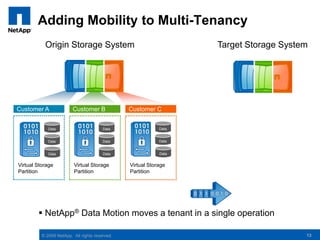
  • #14 Goal of Slide: Highlight the relationship of data mobility and multi-tenancy.Key Points:When performing a live data migration, NetApp Data Motion moves one or more MultiStore partitions from one storage system to another. In the example shown here, the task of moving a tenant is greatly simplified because all data volumes, access permissions, and networking attributes are moved together as part of the MultiStore partition. This level of granularity and isolation means that storage optimization can be performed with specific customer service goals in mind, greatly simplifying the task of SLA management.
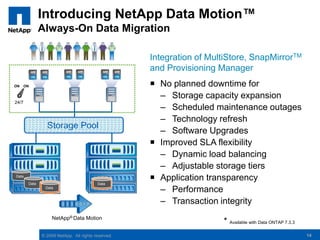
  • #15 Goal of Slide: Drill down into more detail on NetApp’s data mobility capabilities.Key Points:NetApp Data Motion provides true data mobility to storage infrastructure without impacting the availability of client applications. This is critically important for lifecycle management tasks such as system maintenance, technology refresh and software upgrades since these activities have traditionally required planned outages and have impacted the ability to provide continuous access to data. With the increasing need to optimize service levels, it is also important to dynamically balance system performance without compromise to transaction performance or integrity. The always-on value of NetApp Data Motion is that clients are always connected to their data even as it is being moved to a new physical location.