Cloud	Compu)ng		
An	Introduc)on	
	
Iqbal	Khan,	2014
What	is	Cloud	Compu)ng	?	
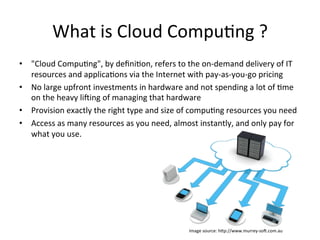
•  "Cloud	Compu)ng",	by	defini)on,	refers	to	the	on-demand	delivery	of	IT	
resources	and	applica)ons	via	the	Internet	with	pay-as-you-go	pricing	
•  No	large	upfront	investments	in	hardware	and	not	spending	a	lot	of	)me	
on	the	heavy	liIing	of	managing	that	hardware	
•  Provision	exactly	the	right	type	and	size	of	compu)ng	resources	you	need	
•  Access	as	many	resources	as	you	need,	almost	instantly,	and	only	pay	for	
what	you	use.	
Image	source:	hOp://www.murrey-soI.com.au
How	Does	it	Work?	
•  Cloud	Compu)ng	providers	such	as	Amazon	
Web	Services	own	and	maintain	the	network-
connected	hardware	required	for	these	
applica)on	services	
•  You	provision	and	use	what	you	need	via	a	
web	applica)on	
•  Access	servers,	storage,	databases	and	a	
broad	set	of	applica)on	services	over	the	
Internet.
Why	Cloud	Compu)ng	?	
•  Trade	capital	expense	for	variable	expense		
–  No	need	to	invest	heavily	in	data	centers	and	servers	before	you	
know	how	you’re	going	to	use	them.	
–  Only	pay	when	you	consume	compu)ng	resources,	and	only	pay	
for	how	much	you	consume.	
•  Benefit	from	massive	economies	of	scale		
–  usage	from	hundreds	of	thousands	of	customers	are	aggregated	
in	the	cloud,	providers	such	as	Amazon	Web	Services	can	
achieve	higher	economies	of	scale	which	translates	into	lower	
pay	as	you	go	prices	
•  Stop	guessing	capacity		
–  With	Cloud	Compu)ng,	you	can	access	as	much	or	as	liOle	as	
you	need,	and	scale	up	and	down	as	required	with	only	a	few	
minutes	no)ce
Why	Cloud	Compu)ng	?	
•  Increase	speed	and	agility		
–  Reduce	the	)me	it	takes	to	make	those	resources	available	to	your	
developers	from	weeks	to	just	minutes	
–  Increase	agility	of	your	organiza)on,	reduce	the	cost	and	)me	it	takes	
to	experiment	and	develop			
•  Stop	spending	money	on	running	and	maintaining	data	centers		
–  Focus	on	projects	that	differen)ate	your	business,	not	the	
infrastructure	
–  Cloud	compu)ng	lets	you	focus	on	your	own	customers,	rather	than	
on	the	heavy	liIing	of	racking,	stacking	and	powering	servers.	
•  Go	global	in	minutes		
–  Easily	deploy	your	applica)on	in	mul)ple	regions	around	the	world	
with	just	a	few	clicks	
–  Provide	a	lower	latency	and	beOer	experience	for	your	customers	
simply	and	at	minimal	cost.
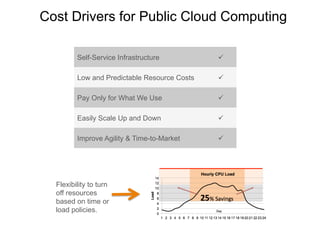
Self-Service Infrastructure ü
Low and Predictable Resource Costs ü
Pay Only for What We Use ü
Easily Scale Up and Down ü
Improve Agility & Time-to-Market ü
Cost Drivers for Public Cloud Computing
Flexibility to turn
off resources
based on time or
load policies.
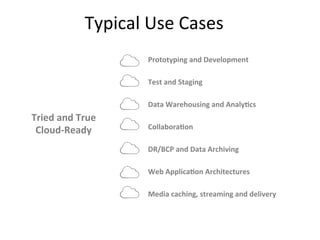
Typical	Use	Cases	
Prototyping	and	Development	
	
Test	and	Staging	
	
Data	Warehousing	and	Analy9cs	
	
Collabora9on	
	
DR/BCP	and	Data	Archiving	
	
Web	Applica9on	Architectures	
	
Media	caching,	streaming	and	delivery	
	
Tried	and	True		
Cloud-Ready
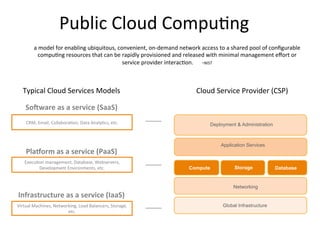
Public	Cloud	Compu)ng	
Execu)on	management,	Database,	Webservers,	
Development	Environments,	etc.	
Virtual	Machines,	Networking,	Load	Balancers,	Storage,	
etc.	
Infrastructure	as	a	service	(IaaS)	
PlaGorm	as	a	service	(PaaS)	
SoHware	as	a	service	(SaaS)	
Global Infrastructure
Application Services
Networking
Deployment & Administration
DatabaseStorageCompute
CRM,	Email,	Collabora)on,	Data	Analy)cs,	etc.			
Typical	Cloud	Services	Models	 Cloud	Service	Provider	(CSP)	
a	model	for	enabling	ubiquitous,	convenient,	on-demand	network	access	to	a	shared	pool	of	configurable	
compu)ng	resources	that	can	be	rapidly	provisioned	and	released	with	minimal	management	effort	or	
service	provider	interac)on.	 	-NIST
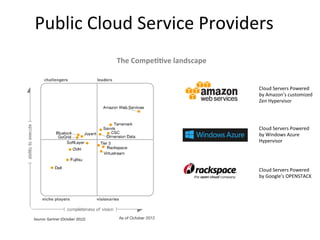
Public	Cloud	Service	Providers	
Source:	Gartner	(October	2012)	
The	Compe99ve	landscape	
Cloud	Servers	Powered	
by	Google’s	OPENSTACK	
Cloud	Servers	Powered	
by	Windows	Azure	
Hypervisor	
Cloud	Servers	Powered	
by	Amazon’s	customized	
Zen	Hypervisor
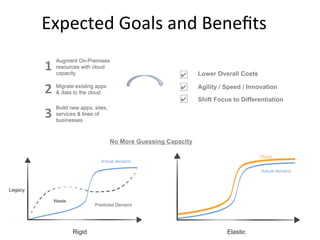
Expected	Goals	and	Benefits	
Lower Overall Costs
No More Guessing Capacity
Agility / Speed / Innovation
Shift Focus to Differentiation
✔
✔
✔
Migrate existing apps
& data to the cloud
Build new apps, sites,
services & lines of
businesses
Augment On-Premises
resources with cloud
capacity
Legacy
Waste
Actual demand
Predicted Demand
Rigid Elastic
Actual demand
Cloud
1	
2	
3
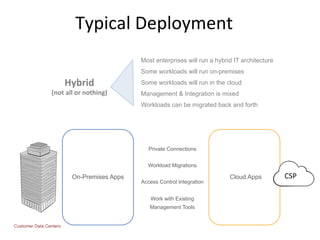
Typical	Deployment	
Private Connections
Workload Migrations
Access Control Integration
Work with Existing
Management Tools
On-Premises Apps
Customer Data Centers
Cloud Apps CSP	
Most enterprises will run a hybrid IT architecture
Some workloads will run on-premises
Some workloads will run in the cloud
Management & Integration is mixed
Workloads can be migrated back and forth
Hybrid		
(not	all	or	nothing)
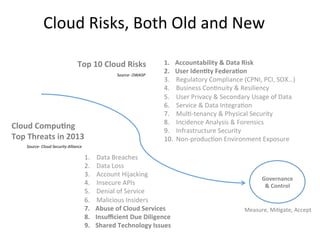
Cloud	Risks,	Both	Old	and	New	
1.  Data	Breaches		
2.  Data	Loss		
3.  Account	Hijacking		
4.  Insecure	APIs		
5.  Denial	of	Service		
6.  Malicious	Insiders		
7.  Abuse	of	Cloud	Services		
8.  Insufficient	Due	Diligence		
9.  Shared	Technology	Issues		
Source-	Cloud	Security	Alliance	
Cloud	Compu9ng		
Top	Threats	in	2013	 		
	
1.  Accountability	&	Data	Risk	
2.  User	Iden9ty	Federa9on	
3.  Regulatory	Compliance	(CPNI,	PCI,	SOX…)	
4.  Business	Con)nuity	&	Resiliency	
5.  User	Privacy	&	Secondary	Usage	of	Data	
6.  Service	&	Data	Integra)on	
7.  Mul)-tenancy	&	Physical	Security	
8.  Incidence	Analysis	&	Forensics	
9.  Infrastructure	Security	
10.  Non-produc)on	Environment	Exposure	
Top	10	Cloud	Risks	
Source-	OWASP	
Governance	
&	Control	
Measure,	Mi)gate,	Accept

Cloud introduction