Use ful for beginers
Cloud
Computing ..
What is it?
And
what dose it
mean?
WHAT IS CLOUD COMPUTING?
• Cloud computing is an information technology paradigm that
enables ubiquitous access to shared pools of configurable
system resources
• higher-level services that can be rapidly provisioned with
minimal management effort, often over the Internet.
TYPES
• SaaS (software as a service)
• IaaS (infrastructure as a service)
• PaaS (platform as a service)
• FaaS (functions as a service)
• Private cloud
• Hybrid cloud
• Public APIs (application programming interfaces)
• iPaaS (integration platform as a service)
• IDaaS (identity as a service)
• Collaboration platforms
• Vertical clouds
SAAS
• This type of public cloud computing delivers applications
over the internet through the browser.
• Typically, SaaS applications offer extensive configuration
options as well as development environments
• That enable customers to code their own modifications
and additions.
IAAS
• At a basic level, IaaS public cloud providers offer
storage and compute services on a pay-per-use basis.
• But the full array of services offered by all major public
cloud providers is staggering.
• Highly scalable databases, virtual private networks, big
data analytics, developer tools, machine learning,
application monitoring, and so on.
PAAS
• PaaS provides sets of services and workflows that
specifically target developers and APIs to accelerate the
development, test, and deployment of applications.
• Note that a variety of PaaS tailored for developers of
mobile applications generally goes by the name of
MBaaS (mobile back end as a service), or sometimes just
BaaS (back end as a service).
FAAS
• FaaS, the cloud instantiation of adds another layer of
abstraction to PaaS.
• so that developers are completely insulated from everything in
the stack below their code
• All the major clouds offer FaaS on top of IaaS: AWS Lambda,
Azure Functions, Google Cloud Functions, and IBM OpenWhisk.
• A special benefit of FaaS applications is that they consume no
IaaS resources until an event occurs, reducing pay-per-use
fees.
PRIVATE CLOUD
• The private cloud downsizes the technologies used to run
IaaS public clouds into software that can be deployed
and operated in a customer’s data center.
• VMware’s Software Defined Data Center stack is the
most popular commercial private cloud software, while
OpenStack is the open source leader.
HYBRID CLOUD
• A hybrid cloud is the integration of a private cloud with a
public cloud.
• The hybrid cloud involves creating parallel environments in
which applications can move easily between private and
public clouds.
• The types of integrations between private and public cloud
vary widely, but they must be extensive to earn a hybrid
cloud designation.
PUBLIC API’S
• Just as SaaS delivers applications to users over the internet,
public APIs offer developers application functionality that can
be accessed programmatically.
• For example, in building web applications, developers often
tap into Google Maps’ API to provide driving directions;
• To integrate with social media, developers may call upon APIs
maintained by Twitter, Facebook, or LinkedIn.
IPAAS
• Data integration is a key issue for any sizeable company, but
particularly for those that adopt SaaS at scale.
• iPaaS providers typically offer prebuilt connectors for sharing
data among popular SaaS applications
• on-premises enterprise applications, though providers may
focus more or less on B-to-B and ecommerce integrations, cloud
integrations, or traditional SOA-style integrations.
IDAAS
• The most difficult security issue related to cloud computing is
the management of user identity and its associated rights and
permissions across private data centers and pubic cloud sites
• IDaaS providers maintain cloud-based user profiles that
authenticate users
• Enable access to resources or applications based on security
policies, user groups, and individual privileges.
COLLABORATION PLATFORMS
• Collaboration solutions such as Slack, Microsoft Teams,
and Hip Chat have become vital messaging platforms
that enable groups to communicate and work together
effectively.
• Basically, these solutions are relatively simple SaaS
applications that support chat-style messaging along with
file sharing and audio or video communication.
VERTICAL CLOUDS
• Key players in such industries as financial services,
healthcare, retail, life sciences, and manufacturing
• Provide PaaS clouds to enable customers to build vertical
applications that tap into industry-specific, API-accessible
services
• Most vertical clouds are built with the intent of nurturing
partner ecosystems.
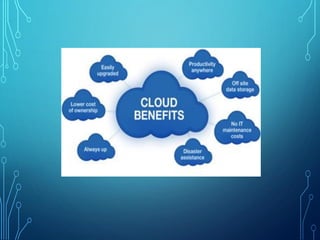
ADVANTAGES
• The cloud’s main appeal is to reduce the time to market
of applications that need to scale dynamically.
• Although businesses sometimes migrate legacy
applications to the cloud to reduce data center resource
requirements.
• The real benefits accrue to new applications that take
advantage of cloud services and “cloud native” attributes
Cloud computing
Cloud computing

Cloud computing

  • 1.
    Use ful forbeginers Cloud Computing .. What is it? And what dose it mean?
  • 2.
    WHAT IS CLOUDCOMPUTING? • Cloud computing is an information technology paradigm that enables ubiquitous access to shared pools of configurable system resources • higher-level services that can be rapidly provisioned with minimal management effort, often over the Internet.
  • 4.
    TYPES • SaaS (softwareas a service) • IaaS (infrastructure as a service) • PaaS (platform as a service) • FaaS (functions as a service) • Private cloud • Hybrid cloud • Public APIs (application programming interfaces) • iPaaS (integration platform as a service) • IDaaS (identity as a service) • Collaboration platforms • Vertical clouds
  • 5.
    SAAS • This typeof public cloud computing delivers applications over the internet through the browser. • Typically, SaaS applications offer extensive configuration options as well as development environments • That enable customers to code their own modifications and additions.
  • 6.
    IAAS • At abasic level, IaaS public cloud providers offer storage and compute services on a pay-per-use basis. • But the full array of services offered by all major public cloud providers is staggering. • Highly scalable databases, virtual private networks, big data analytics, developer tools, machine learning, application monitoring, and so on.
  • 7.
    PAAS • PaaS providessets of services and workflows that specifically target developers and APIs to accelerate the development, test, and deployment of applications. • Note that a variety of PaaS tailored for developers of mobile applications generally goes by the name of MBaaS (mobile back end as a service), or sometimes just BaaS (back end as a service).
  • 8.
    FAAS • FaaS, thecloud instantiation of adds another layer of abstraction to PaaS. • so that developers are completely insulated from everything in the stack below their code • All the major clouds offer FaaS on top of IaaS: AWS Lambda, Azure Functions, Google Cloud Functions, and IBM OpenWhisk. • A special benefit of FaaS applications is that they consume no IaaS resources until an event occurs, reducing pay-per-use fees.
  • 9.
    PRIVATE CLOUD • Theprivate cloud downsizes the technologies used to run IaaS public clouds into software that can be deployed and operated in a customer’s data center. • VMware’s Software Defined Data Center stack is the most popular commercial private cloud software, while OpenStack is the open source leader.
  • 10.
    HYBRID CLOUD • Ahybrid cloud is the integration of a private cloud with a public cloud. • The hybrid cloud involves creating parallel environments in which applications can move easily between private and public clouds. • The types of integrations between private and public cloud vary widely, but they must be extensive to earn a hybrid cloud designation.
  • 11.
    PUBLIC API’S • Justas SaaS delivers applications to users over the internet, public APIs offer developers application functionality that can be accessed programmatically. • For example, in building web applications, developers often tap into Google Maps’ API to provide driving directions; • To integrate with social media, developers may call upon APIs maintained by Twitter, Facebook, or LinkedIn.
  • 12.
    IPAAS • Data integrationis a key issue for any sizeable company, but particularly for those that adopt SaaS at scale. • iPaaS providers typically offer prebuilt connectors for sharing data among popular SaaS applications • on-premises enterprise applications, though providers may focus more or less on B-to-B and ecommerce integrations, cloud integrations, or traditional SOA-style integrations.
  • 13.
    IDAAS • The mostdifficult security issue related to cloud computing is the management of user identity and its associated rights and permissions across private data centers and pubic cloud sites • IDaaS providers maintain cloud-based user profiles that authenticate users • Enable access to resources or applications based on security policies, user groups, and individual privileges.
  • 14.
    COLLABORATION PLATFORMS • Collaborationsolutions such as Slack, Microsoft Teams, and Hip Chat have become vital messaging platforms that enable groups to communicate and work together effectively. • Basically, these solutions are relatively simple SaaS applications that support chat-style messaging along with file sharing and audio or video communication.
  • 15.
    VERTICAL CLOUDS • Keyplayers in such industries as financial services, healthcare, retail, life sciences, and manufacturing • Provide PaaS clouds to enable customers to build vertical applications that tap into industry-specific, API-accessible services • Most vertical clouds are built with the intent of nurturing partner ecosystems.
  • 16.
    ADVANTAGES • The cloud’smain appeal is to reduce the time to market of applications that need to scale dynamically. • Although businesses sometimes migrate legacy applications to the cloud to reduce data center resource requirements. • The real benefits accrue to new applications that take advantage of cloud services and “cloud native” attributes