Cloud Computing
    Disruptive innovation
             And
    Enabling technology
             By:
  NOR SYAFIQAH BT HANAFI
INTRODUCTION


• Multiple Definitions
• The “Cloud” = 10X Improvements
• Redefining The Definitions
The “Cloud” = 10X Improvements
•   Ease of Use
•   Scalability
•   Risk
•   Reliability
•   Cost
Understanding how others view ‘Cloud Computing’


       MULTIPLE DEFINITIONS
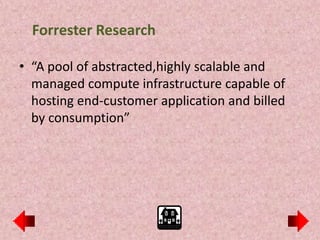
Forrester Research

• “A pool of abstracted,highly scalable and
  managed compute infrastructure capable of
  hosting end-customer application and billed
  by consumption”
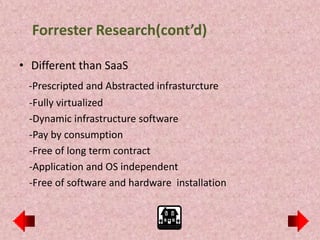
Forrester Research(cont’d)

• Different than SaaS
 -Prescripted and Abstracted infrasturcture
 -Fully virtualized
 -Dynamic infrastructure software
 -Pay by consumption
 -Free of long term contract
 -Application and OS independent
 -Free of software and hardware installation
Our view of Cloud Computing


REDEFINING THE DEFINITION
Defining the Segment

• SaaS
  -Software as a service
  -Storage as a service
• PaaS – Platform as a service
• IaaS – Infrastructure as a service
The cloud’s ‘Snowball Effect’
• Maturation of virtualization technology
• Virtualization enables COMPUTE Clouds
• Compute clouds create demand for STORAGE Clouds
• Storage +compute create cloud INFRASTRUCTURE
• Cloud infrastructure enables Cloud PLATFORMS&
  APPLICATIONS
• Multiple Cloud types lead to Cloud AGGREGATORS
• Niche requirements enable Cloud EXTENDERS
Cloud computing is…
…virtualized compute power and storage
 delivered via platform-agnostic infrastructures
 of abstracted hardware and software accessed
 over the internet.These shared,on –demand IT
 resources ,are created and disposed of
 programmatic interfaces and are billed
 variably based on measureable usage.
Cloud “Applications”

• SaaS resides here
• Most common Cloud/Many providers of
  different services
• Examples :SalesForce,Gmail.Yahoo!
  Mail,Quicken Online
• Advantages : Free,easy,Consumer adoption
• Disadvantages : Limited functionally,no
  control or access to underlying technology
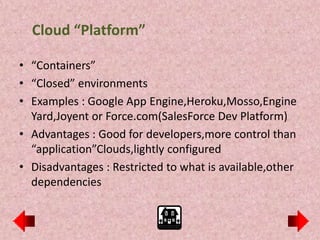
Cloud “Platform”

• “Containers”
• “Closed” environments
• Examples : Google App Engine,Heroku,Mosso,Engine
  Yard,Joyent or Force.com(SalesForce Dev Platform)
• Advantages : Good for developers,more control than
  “application”Clouds,lightly configured
• Disadvantages : Restricted to what is available,other
  dependencies
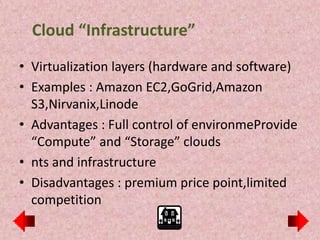
Cloud “Infrastructure”
• Virtualization layers (hardware and software)
• Examples : Amazon EC2,GoGrid,Amazon
  S3,Nirvanix,Linode
• Advantages : Full control of environmeProvide
  “Compute” and “Storage” clouds
• nts and infrastructure
• Disadvantages : premium price point,limited
  competition
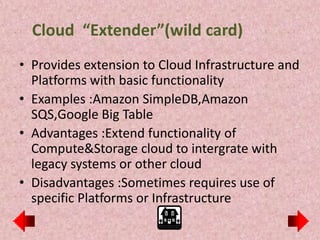
Cloud “Extender”(wild card)
• Provides extension to Cloud Infrastructure and
  Platforms with basic functionality
• Examples :Amazon SimpleDB,Amazon
  SQS,Google Big Table
• Advantages :Extend functionality of
  Compute&Storage cloud to intergrate with
  legacy systems or other cloud
• Disadvantages :Sometimes requires use of
  specific Platforms or Infrastructure
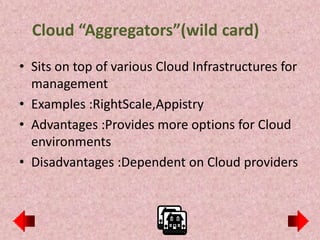
Cloud “Aggregators”(wild card)
• Sits on top of various Cloud Infrastructures for
  management
• Examples :RightScale,Appistry
• Advantages :Provides more options for Cloud
  environments
• Disadvantages :Dependent on Cloud providers
THE END

Cloud computing

  • 1.
    Cloud Computing Disruptive innovation And Enabling technology By: NOR SYAFIQAH BT HANAFI
  • 2.
    INTRODUCTION • Multiple Definitions •The “Cloud” = 10X Improvements • Redefining The Definitions
  • 3.
    The “Cloud” =10X Improvements • Ease of Use • Scalability • Risk • Reliability • Cost
  • 4.
    Understanding how othersview ‘Cloud Computing’ MULTIPLE DEFINITIONS
  • 5.
    Forrester Research • “Apool of abstracted,highly scalable and managed compute infrastructure capable of hosting end-customer application and billed by consumption”
  • 6.
    Forrester Research(cont’d) • Differentthan SaaS -Prescripted and Abstracted infrasturcture -Fully virtualized -Dynamic infrastructure software -Pay by consumption -Free of long term contract -Application and OS independent -Free of software and hardware installation
  • 7.
    Our view ofCloud Computing REDEFINING THE DEFINITION
  • 8.
    Defining the Segment •SaaS -Software as a service -Storage as a service • PaaS – Platform as a service • IaaS – Infrastructure as a service
  • 9.
    The cloud’s ‘SnowballEffect’ • Maturation of virtualization technology • Virtualization enables COMPUTE Clouds • Compute clouds create demand for STORAGE Clouds • Storage +compute create cloud INFRASTRUCTURE • Cloud infrastructure enables Cloud PLATFORMS& APPLICATIONS • Multiple Cloud types lead to Cloud AGGREGATORS • Niche requirements enable Cloud EXTENDERS
  • 10.
    Cloud computing is… …virtualizedcompute power and storage delivered via platform-agnostic infrastructures of abstracted hardware and software accessed over the internet.These shared,on –demand IT resources ,are created and disposed of programmatic interfaces and are billed variably based on measureable usage.
  • 11.
    Cloud “Applications” • SaaSresides here • Most common Cloud/Many providers of different services • Examples :SalesForce,Gmail.Yahoo! Mail,Quicken Online • Advantages : Free,easy,Consumer adoption • Disadvantages : Limited functionally,no control or access to underlying technology
  • 12.
    Cloud “Platform” • “Containers” •“Closed” environments • Examples : Google App Engine,Heroku,Mosso,Engine Yard,Joyent or Force.com(SalesForce Dev Platform) • Advantages : Good for developers,more control than “application”Clouds,lightly configured • Disadvantages : Restricted to what is available,other dependencies
  • 13.
    Cloud “Infrastructure” • Virtualizationlayers (hardware and software) • Examples : Amazon EC2,GoGrid,Amazon S3,Nirvanix,Linode • Advantages : Full control of environmeProvide “Compute” and “Storage” clouds • nts and infrastructure • Disadvantages : premium price point,limited competition
  • 14.
    Cloud “Extender”(wild card) •Provides extension to Cloud Infrastructure and Platforms with basic functionality • Examples :Amazon SimpleDB,Amazon SQS,Google Big Table • Advantages :Extend functionality of Compute&Storage cloud to intergrate with legacy systems or other cloud • Disadvantages :Sometimes requires use of specific Platforms or Infrastructure
  • 15.
    Cloud “Aggregators”(wild card) •Sits on top of various Cloud Infrastructures for management • Examples :RightScale,Appistry • Advantages :Provides more options for Cloud environments • Disadvantages :Dependent on Cloud providers
  • 16.