by
Isah Sani Birnin Gwari
CLOUD BASED TESTING
INTRODUCTION
 Testing an enterprise application is an important part
of software development life cycle and so is the case
with application deployment environment. Application
has to be tested for correctness, completeness,
security and quality.
 It also has to be tested for the performance of the
system under varied load, check when it fails so that
the application can be constantly improvised
 With respect to Software engineering, performance testing
is determining the system behaviour in terms of
responsiveness, stability, scalability, reliability and resource
usage under a particular workload.
CLOUD
COMPUTING
 Refers to the provision of computational
resources on demand via a computer network,
such as applications, databases, file services,
email, etc.
 The means of using the Internet and remote
servers for software applications, data access,
data management and storage resources.
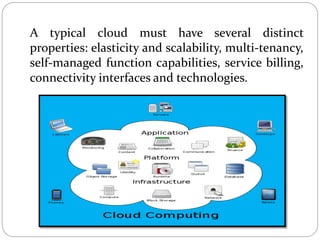
A typical cloud must have several distinct
properties: elasticity and scalability, multi-tenancy,
self-managed function capabilities, service billing,
connectivity interfaces and technologies.
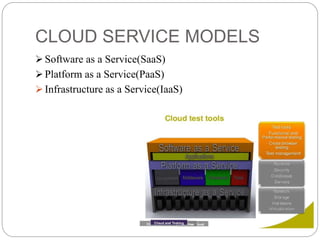
CLOUD SERVICE MODELS
 Software as a Service(SaaS)
 Platform as a Service(PaaS)
 Infrastructure as a Service(IaaS)
Software as a Service(SaaS)
The applications / products are available to the user on
demand via the internet. Eg:Gmail, Google docs.
Platform as a Service(PaaS)
The runtime environment is available on demand
which is used by developers to deliver their
applications. Eg: Google App Engine.
Infrastructure as a Service(IaaS)
IaaS is for architects where the actual hardware
infrastructure is deployed on pay per use basis.
Eg: Amazon webservices, GoGrid.
CLOUD BASED
TESTING
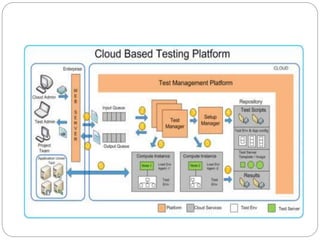
Cloud testing is a form of testing in which
web applications uses cloud computing
environment and infrastructure to simulate
real world user traffic by using cloud
technologies and solutions.
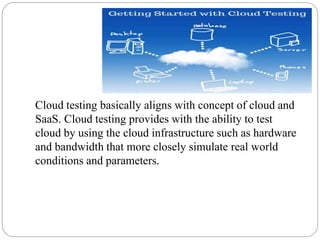
Cloud testing basically aligns with concept of cloud and
SaaS. Cloud testing provides with the ability to test
cloud by using the cloud infrastructure such as hardware
and bandwidth that more closely simulate real world
conditions and parameters.
Testing as a Service
(TaaS)
 TaaS is considered as a new business and service model, in
which a provider undertakes software testing activities of a
given application in a cloud infrastructure for customers.
 TaaS can be used to validation of various products owned
by organizations that deal with testing products and
services which are making use of a cloud based licensing
model for their clients.
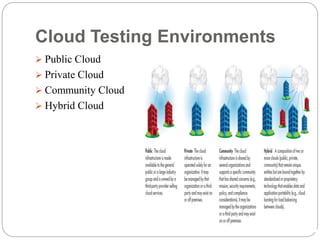
Cloud Testing Environments
 Public Cloud
 Private Cloud
 Community Cloud
 Hybrid Cloud
BENEFITS OF CLOUD TESTING
Testing on cloud carried quite a number of benefits in terms of cost and
resources. It is something like “service on demand” or “testing on
demand”. The cost of hardware, software, tools, tester etc. is charged on
usage basis. Some of the key benefits that can be drawn from this are.
 Easier to access environments
-Easier to get virtual environments vs. dedicated physical
hardware
-Easier to get different system types & software configurations
 Easier to deploy
-Test Systems
-Applications Under Test
 Easier to manage
-Access systems when needed (e.g. during a test cycle)
 Reduced Costs
 Scalability
-A cloud based application or product can be customized based
on the requirement.
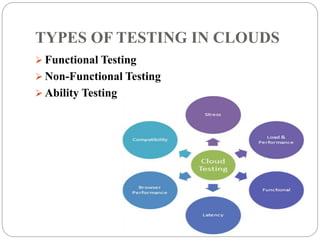
TYPES OF TESTING IN CLOUDS
 Functional Testing
 Non-Functional Testing
 Ability Testing
Cloud Testing Key Players
 Acutes (2002) SAP performance testing, load testing and stress
testing
 LoadRunner(2006) Load testing, examination system
performance.
 SOASTA(2006) Touch test, mPulse and cloud testing.
 Amazon web services(2006) Infrastructure as a service.
 Google app engine(2008) Web Application platform as a service.
 Loadstorm(2008) Saas, performance testing, load testing and
stress testing.
 Azure(2009) Application platform as a services.
 Heroku(2010) Build modern apps, PaaS.
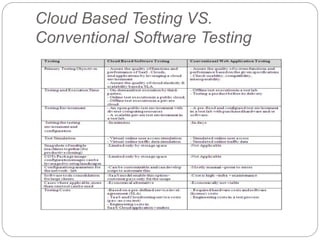
Cloud Based Testing VS.
Conventional Software Testing
CONCLUSION
Testing in a cloud is to increase availability, security,
performance, interoperability, disaster recovery and multi-
tenancy testing.
The aim of cloud testing is to ensures high quality service
delivery and avoiding data outages requires testing inside
datacenter or outside the datacenter or in both place.
Most organizations are now leaning to adopting the cloud
testing because of its flexibility, scalability and reduced
costs.

Cloud based testing

  • 1.
    by Isah Sani BirninGwari CLOUD BASED TESTING
  • 2.
    INTRODUCTION  Testing anenterprise application is an important part of software development life cycle and so is the case with application deployment environment. Application has to be tested for correctness, completeness, security and quality.  It also has to be tested for the performance of the system under varied load, check when it fails so that the application can be constantly improvised
  • 3.
     With respectto Software engineering, performance testing is determining the system behaviour in terms of responsiveness, stability, scalability, reliability and resource usage under a particular workload.
  • 4.
    CLOUD COMPUTING  Refers tothe provision of computational resources on demand via a computer network, such as applications, databases, file services, email, etc.  The means of using the Internet and remote servers for software applications, data access, data management and storage resources.
  • 5.
    A typical cloudmust have several distinct properties: elasticity and scalability, multi-tenancy, self-managed function capabilities, service billing, connectivity interfaces and technologies.
  • 6.
    CLOUD SERVICE MODELS Software as a Service(SaaS)  Platform as a Service(PaaS)  Infrastructure as a Service(IaaS)
  • 7.
    Software as aService(SaaS) The applications / products are available to the user on demand via the internet. Eg:Gmail, Google docs. Platform as a Service(PaaS) The runtime environment is available on demand which is used by developers to deliver their applications. Eg: Google App Engine. Infrastructure as a Service(IaaS) IaaS is for architects where the actual hardware infrastructure is deployed on pay per use basis. Eg: Amazon webservices, GoGrid.
  • 8.
    CLOUD BASED TESTING Cloud testingis a form of testing in which web applications uses cloud computing environment and infrastructure to simulate real world user traffic by using cloud technologies and solutions.
  • 9.
    Cloud testing basicallyaligns with concept of cloud and SaaS. Cloud testing provides with the ability to test cloud by using the cloud infrastructure such as hardware and bandwidth that more closely simulate real world conditions and parameters.
  • 10.
    Testing as aService (TaaS)  TaaS is considered as a new business and service model, in which a provider undertakes software testing activities of a given application in a cloud infrastructure for customers.  TaaS can be used to validation of various products owned by organizations that deal with testing products and services which are making use of a cloud based licensing model for their clients.
  • 11.
    Cloud Testing Environments Public Cloud  Private Cloud  Community Cloud  Hybrid Cloud
  • 13.
    BENEFITS OF CLOUDTESTING Testing on cloud carried quite a number of benefits in terms of cost and resources. It is something like “service on demand” or “testing on demand”. The cost of hardware, software, tools, tester etc. is charged on usage basis. Some of the key benefits that can be drawn from this are.  Easier to access environments -Easier to get virtual environments vs. dedicated physical hardware -Easier to get different system types & software configurations  Easier to deploy -Test Systems -Applications Under Test  Easier to manage -Access systems when needed (e.g. during a test cycle)  Reduced Costs  Scalability -A cloud based application or product can be customized based on the requirement.
  • 14.
    TYPES OF TESTINGIN CLOUDS  Functional Testing  Non-Functional Testing  Ability Testing
  • 15.
    Cloud Testing KeyPlayers  Acutes (2002) SAP performance testing, load testing and stress testing  LoadRunner(2006) Load testing, examination system performance.  SOASTA(2006) Touch test, mPulse and cloud testing.  Amazon web services(2006) Infrastructure as a service.  Google app engine(2008) Web Application platform as a service.  Loadstorm(2008) Saas, performance testing, load testing and stress testing.  Azure(2009) Application platform as a services.  Heroku(2010) Build modern apps, PaaS.
  • 16.
    Cloud Based TestingVS. Conventional Software Testing
  • 17.
    CONCLUSION Testing in acloud is to increase availability, security, performance, interoperability, disaster recovery and multi- tenancy testing. The aim of cloud testing is to ensures high quality service delivery and avoiding data outages requires testing inside datacenter or outside the datacenter or in both place. Most organizations are now leaning to adopting the cloud testing because of its flexibility, scalability and reduced costs.