Cloud Testing
Speaker : Mrityunjaya Hikkalgutti
2 11 September 2016
Overview of Cloud
• Pay by the drink model
• Pay for extra resources when needed
• Better economics
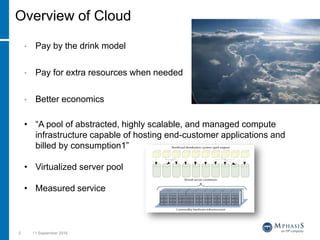
• “A pool of abstracted, highly scalable, and managed compute
infrastructure capable of hosting end-customer applications and
billed by consumption1”
• Virtualized server pool
• Measured service
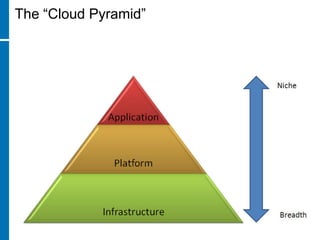
The “Cloud Pyramid”
‘Why’ Cloud Migration
• Nothing to buy
− Cloud computing, a solution to rescue organizations to focus on their
core business rather than worrying about the investment and
maintenance of their business IT infrastructure.
• Cancel service immediately
• Virtually infinite storage capacity
• Efficient, reliable load distribution layer
• Nothing is there to Throw it out
• Just send cancellation request
• High availability large-store database
Commercial clouds
4 Cloud Deployment Models
• Private cloud
− enterprise owned or leased
• Community cloud
− shared infrastructure for specific community
• Public cloud
− Sold to the public, mega-scale infrastructure
• Hybrid cloud
− composition of two or more clouds
Cloud Service Level Agreements (CSLAs)
Mainly 2 Sections(M2S):
• Technical Terms and Conditions (TTC)
• Commercial Terms and Conditions (CTC)
Technical Terms and Conditions (TTC)
• Technical Critical Areas
•Consistency
•Compatibility
•Availability
•Scalability
•Environment
•Stress
•Load
•Volume
•Reliability
•Tuning
•Security / IP protection
•Disaster Recovery Centers
•Min and Max System break down time
•Connectivity
•Multi tenancy
Commercial Terms and Conditions (TTC)
• Commercial Critical Areas
•List of service with commercial terms
•Each Service with Minimum & Maximum Usage with cost
•Service Offer validity
•Minimum & Maximum trail period Duration for any service
•Prepaid Services
•Postpaid services
Cloud Solution Challenges
• Security
• Reliability
• Manageability
• Disaster Recovery Centers
•Cloud SLA Analysis
•Requirement Analysis
•Designing
•Coding
•Development Environment set up
( This phase is not required)
•Testing
What are the CSDLC Phases
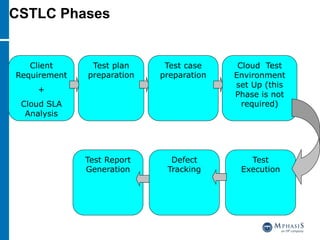
Client
Requirement
+
Cloud SLA
Analysis
Test plan
preparation
Test case
preparation
Cloud Test
Environment
set Up (this
Phase is not
required)
Test
Execution
Test Report
Generation
Defect
Tracking
CSTLC Phases
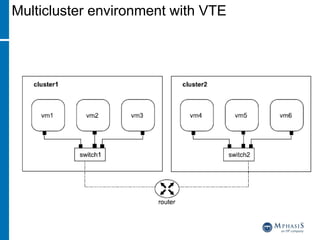
Multicluster environment with VTE
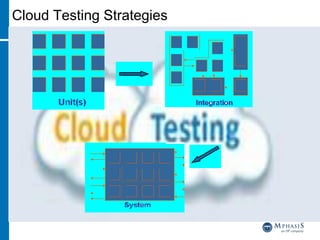
Cloud Testing Strategies
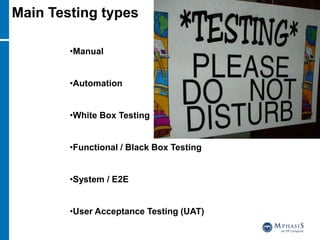
•Manual
•Automation
•White Box Testing
•Functional / Black Box Testing
•System / E2E
•User Acceptance Testing (UAT)
Main Testing types
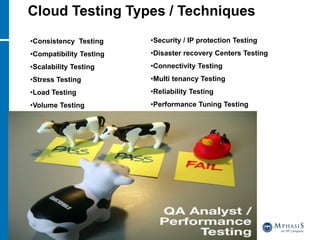
Cloud Testing Types / Techniques
•Consistency Testing
•Compatibility Testing
•Scalability Testing
•Stress Testing
•Load Testing
•Volume Testing
•Security / IP protection Testing
•Disaster recovery Centers Testing
•Connectivity Testing
•Multi tenancy Testing
•Reliability Testing
•Performance Tuning Testing
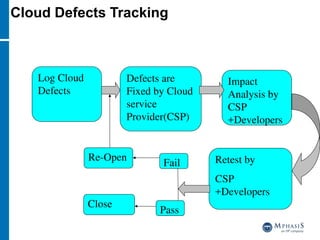
Cloud Defects Tracking
Log Cloud
Defects
Defects are
Fixed by Cloud
service
Provider(CSP)
Impact
Analysis by
CSP
+Developers
Retest by
CSP
+Developers
Re-Open
Close
Pass
Fail
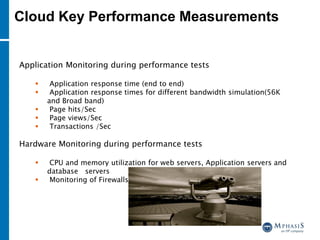
Application Monitoring during performance tests
 Application response time (end to end)
 Application response times for different bandwidth simulation(56K
and Broad band)
 Page hits/Sec
 Page views/Sec
 Transactions /Sec
Hardware Monitoring during performance tests
 CPU and memory utilization for web servers, Application servers and
database servers
 Monitoring of Firewalls
Cloud Key Performance Measurements
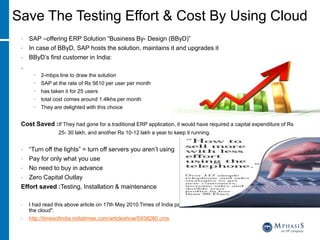
Save The Testing Effort & Cost By Using Cloud
• SAP –offering ERP Solution “Business By- Design (BByD)”
• In case of BByD, SAP hosts the solution, maintains it and upgrades it
• BByD’s first customer in India:
.
− 2-mbps line to draw the solution
− SAP at the rate of Rs 5610 per user per month
− has taken it for 25 users
− total cost comes around 1.4lkhs per month
− They are delighted with this choice
Cost Saved :If They had gone for a traditional ERP application, it would have required a capital expenditure of Rs
25- 30 lakh, and another Rs 10-12 lakh a year to keep it running.
• “Turn off the lights” = turn off servers you aren’t using
• Pay for only what you use
• No need to buy in advance
• Zero Capital Outlay
Effort saved :Testing, Installation & maintenance
• I had read this above article on 17th May 2010 Times of India paper (times business column) "Taking Computing to
the cloud".
• http://timesofindia.indiatimes.com/articleshow/5938260.cms
hjay55@gmail.com

Cloud_Testing_The_future_of_softwareV1.04

  • 1.
    Cloud Testing Speaker :Mrityunjaya Hikkalgutti
  • 2.
    2 11 September2016 Overview of Cloud • Pay by the drink model • Pay for extra resources when needed • Better economics • “A pool of abstracted, highly scalable, and managed compute infrastructure capable of hosting end-customer applications and billed by consumption1” • Virtualized server pool • Measured service
  • 3.
  • 4.
    ‘Why’ Cloud Migration •Nothing to buy − Cloud computing, a solution to rescue organizations to focus on their core business rather than worrying about the investment and maintenance of their business IT infrastructure. • Cancel service immediately • Virtually infinite storage capacity • Efficient, reliable load distribution layer • Nothing is there to Throw it out • Just send cancellation request • High availability large-store database
  • 5.
  • 6.
    4 Cloud DeploymentModels • Private cloud − enterprise owned or leased • Community cloud − shared infrastructure for specific community • Public cloud − Sold to the public, mega-scale infrastructure • Hybrid cloud − composition of two or more clouds
  • 7.
    Cloud Service LevelAgreements (CSLAs) Mainly 2 Sections(M2S): • Technical Terms and Conditions (TTC) • Commercial Terms and Conditions (CTC)
  • 8.
    Technical Terms andConditions (TTC) • Technical Critical Areas •Consistency •Compatibility •Availability •Scalability •Environment •Stress •Load •Volume •Reliability •Tuning •Security / IP protection •Disaster Recovery Centers •Min and Max System break down time •Connectivity •Multi tenancy
  • 9.
    Commercial Terms andConditions (TTC) • Commercial Critical Areas •List of service with commercial terms •Each Service with Minimum & Maximum Usage with cost •Service Offer validity •Minimum & Maximum trail period Duration for any service •Prepaid Services •Postpaid services
  • 10.
    Cloud Solution Challenges •Security • Reliability • Manageability • Disaster Recovery Centers
  • 11.
    •Cloud SLA Analysis •RequirementAnalysis •Designing •Coding •Development Environment set up ( This phase is not required) •Testing What are the CSDLC Phases
  • 12.
    Client Requirement + Cloud SLA Analysis Test plan preparation Testcase preparation Cloud Test Environment set Up (this Phase is not required) Test Execution Test Report Generation Defect Tracking CSTLC Phases
  • 14.
  • 15.
  • 16.
    •Manual •Automation •White Box Testing •Functional/ Black Box Testing •System / E2E •User Acceptance Testing (UAT) Main Testing types
  • 17.
    Cloud Testing Types/ Techniques •Consistency Testing •Compatibility Testing •Scalability Testing •Stress Testing •Load Testing •Volume Testing •Security / IP protection Testing •Disaster recovery Centers Testing •Connectivity Testing •Multi tenancy Testing •Reliability Testing •Performance Tuning Testing
  • 18.
    Cloud Defects Tracking LogCloud Defects Defects are Fixed by Cloud service Provider(CSP) Impact Analysis by CSP +Developers Retest by CSP +Developers Re-Open Close Pass Fail
  • 19.
    Application Monitoring duringperformance tests  Application response time (end to end)  Application response times for different bandwidth simulation(56K and Broad band)  Page hits/Sec  Page views/Sec  Transactions /Sec Hardware Monitoring during performance tests  CPU and memory utilization for web servers, Application servers and database servers  Monitoring of Firewalls Cloud Key Performance Measurements
  • 20.
    Save The TestingEffort & Cost By Using Cloud • SAP –offering ERP Solution “Business By- Design (BByD)” • In case of BByD, SAP hosts the solution, maintains it and upgrades it • BByD’s first customer in India: . − 2-mbps line to draw the solution − SAP at the rate of Rs 5610 per user per month − has taken it for 25 users − total cost comes around 1.4lkhs per month − They are delighted with this choice Cost Saved :If They had gone for a traditional ERP application, it would have required a capital expenditure of Rs 25- 30 lakh, and another Rs 10-12 lakh a year to keep it running. • “Turn off the lights” = turn off servers you aren’t using • Pay for only what you use • No need to buy in advance • Zero Capital Outlay Effort saved :Testing, Installation & maintenance • I had read this above article on 17th May 2010 Times of India paper (times business column) "Taking Computing to the cloud". • http://timesofindia.indiatimes.com/articleshow/5938260.cms
  • 21.