Vassil VassilevVassil Vassilev
Cling – The LLVM-basedCling – The LLVM-based
InterpreterInterpreter
Why Do We Need Cling?
Cling's advantages:
 Full C++ support
 STL + templates
 Path to C++0x
 Planned massive reduction of dictionaries
 Easier and smoother transition between
interpreted and compiled code
 Easy maintenance
What Is Cling?
 An interpreter – looks like an interpreter and
behaves like an interpreter
Cling follows the read-evaluate-print-loop (repl) concept.
 More than interpreter – built on top of a compiler
(clang) and compiler framework (LLVM)
Contains interpreter parts and compiler parts. More of an interactive
compiler or an interactive compiler interface for clang
What Cling Depends On?
 LLVM
“The LLVM Project is a collection of modular and reusable compiler
and toolchain technologies...”
 More than 120 active contributors
Apple, ARM, Google, Qualcomm, QuIC, NVidia, AMD and more
 ~250 commits/week
 Clang
“The goal of the Clang project is to create a new C, C++, Objective C
and Objective C++ front-end for the LLVM compiler.“
 More than 100 active contributors
Apple, ARM, AMD and more
 ~150 commits/week
* Stats from last year until 14.10.2011
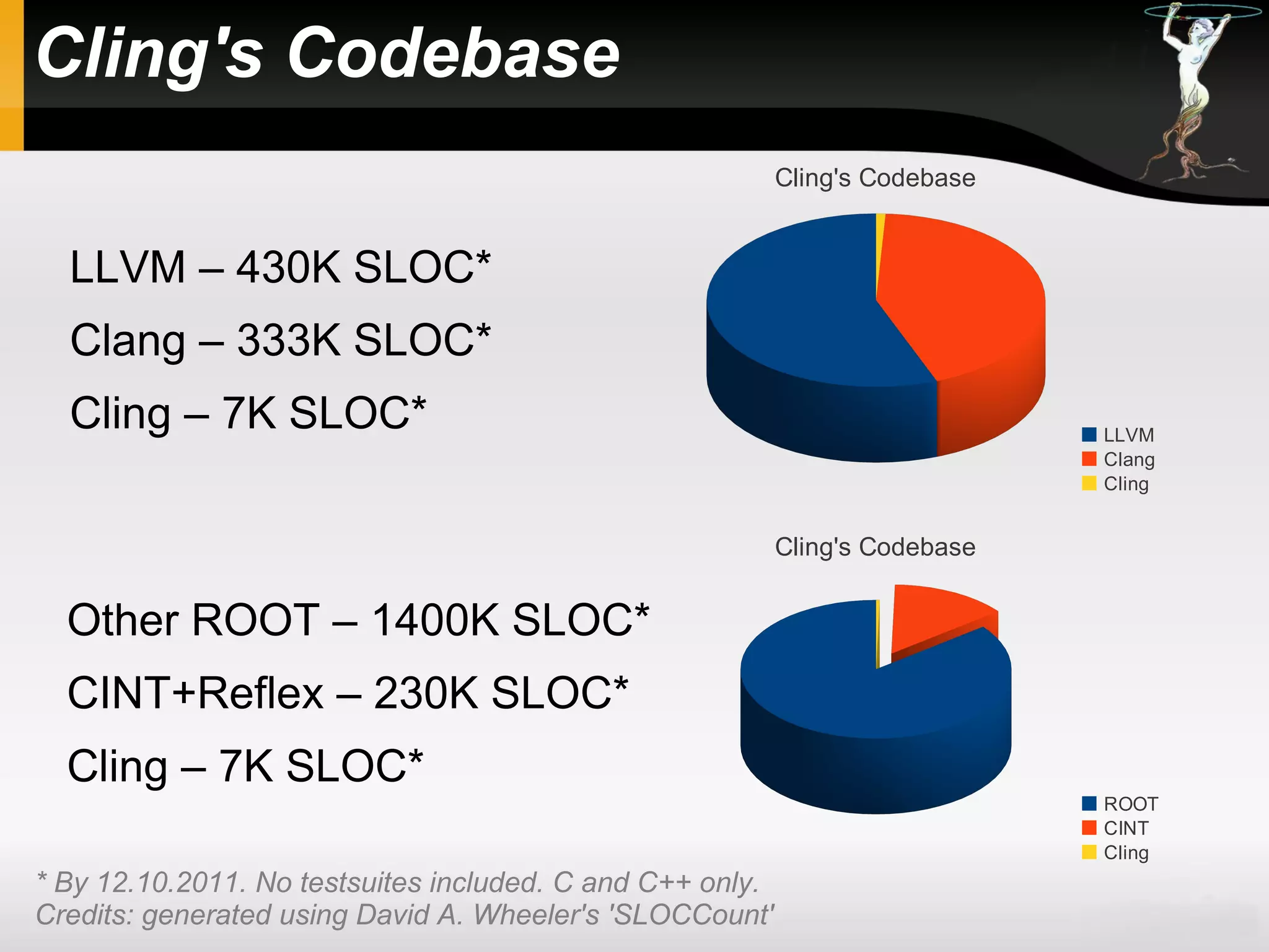
Cling's Codebase
LLVM – 430K SLOC*
Clang – 333K SLOC*
Cling – 7K SLOC*
* By 12.10.2011. No testsuites included. C and C++ only.
Credits: generated using David A. Wheeler's 'SLOCCount'
Cling's Codebase
LLVM
Clang
Cling
Other ROOT – 1400K SLOC*
CINT+Reflex – 230K SLOC*
Cling – 7K SLOC*
Cling's Codebase
ROOT
CINT
Cling
Additional Features
 Just-in-time compiler (JIT)
 Extra platform support
 World class performance and optimizations
 OpenCL
 Expressive diagnostics
 ...
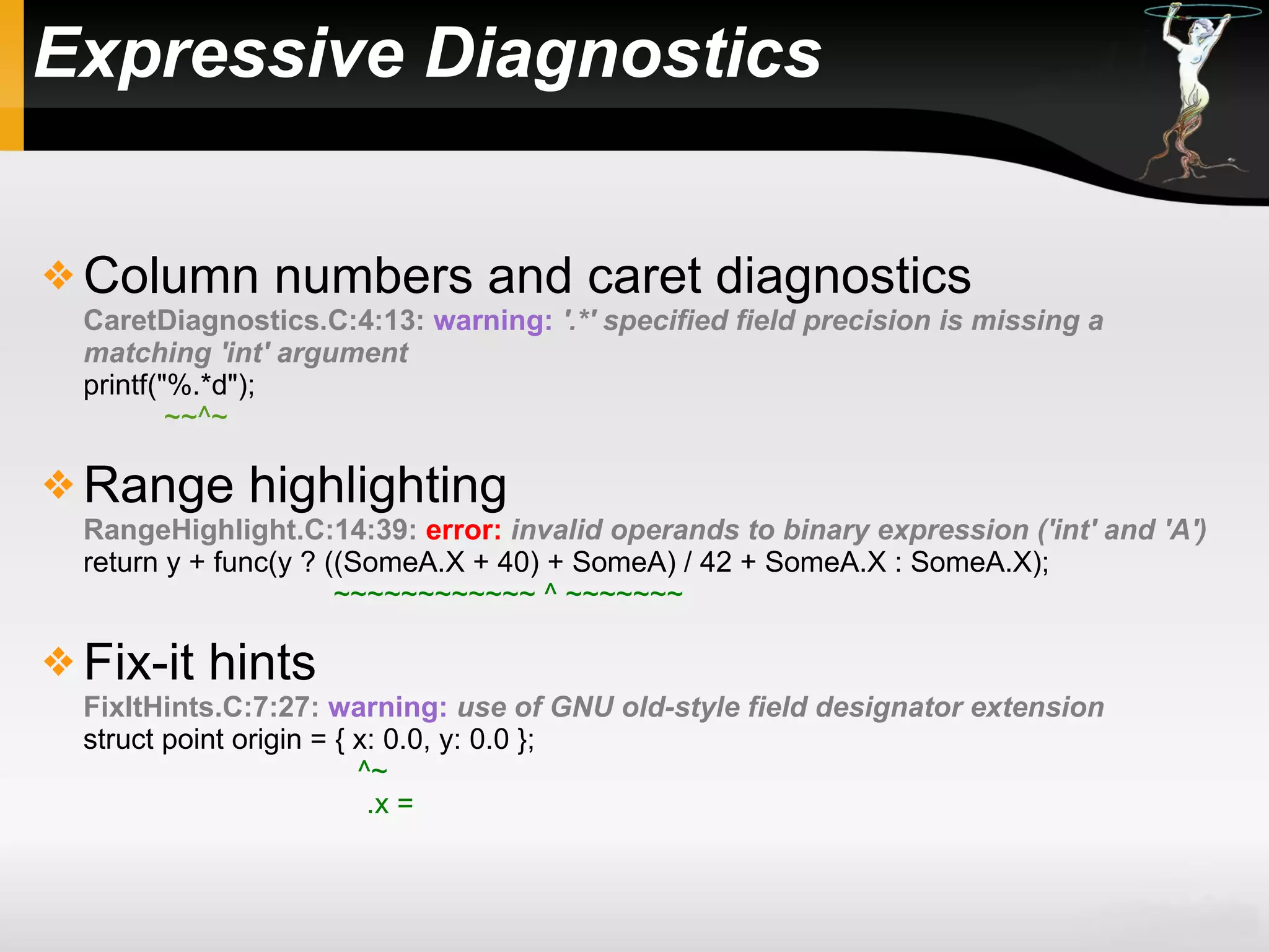
Expressive Diagnostics
 Column numbers and caret diagnostics
CaretDiagnostics.C:4:13: warning: '.*' specified field precision is missing a
matching 'int' argument
printf("%.*d");
~~^~
 Range highlighting
RangeHighlight.C:14:39: error: invalid operands to binary expression ('int' and 'A')
return y + func(y ? ((SomeA.X + 40) + SomeA) / 42 + SomeA.X : SomeA.X);
~~~~~~~~~~~~ ^ ~~~~~~~
 Fix-it hints
FixItHints.C:7:27: warning: use of GNU old-style field designator extension
struct point origin = { x: 0.0, y: 0.0 };
^~
.x =
Improving Cling Step-By-Step
Cling prototype in 2010:
 Shortcomings of the existing prototype were
analyzed
Source-to-source manipulations, variable initializers not managed
correctly, redundant re-parsing, low efficiency, ...
 Redesign almost from scratch
 Resulted in complete rewrite
Advantages of the New Design
 Rely on the compiler libraries where possible
instead of custom implementations
Reduces the maintenance load. If the implementation is not too
specific and makes sense for a compiler we prefer putting it into the
compiler codebase and delegate the maintenance...
 More language independent
The necessary code injections and rewrites are directly in the internal
structures of the underlying compiler
 Stability
The new design enables the implementation of stable error recovery
 Better performance
Re-parsing only in very few cases
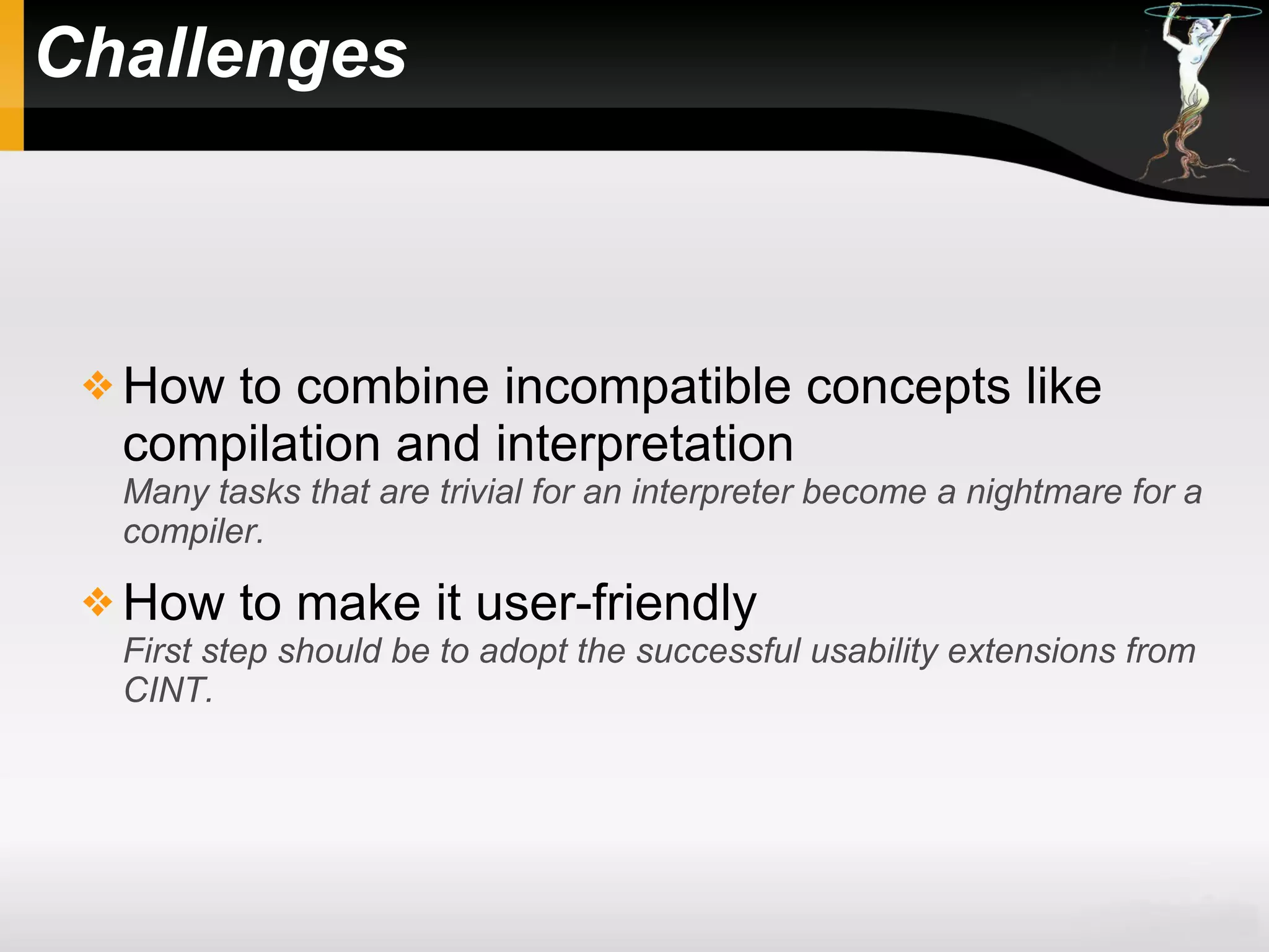
Challenges
 How to combine incompatible concepts like
compilation and interpretation
Many tasks that are trivial for an interpreter become a nightmare for a
compiler.
 How to make it user-friendly
First step should be to adopt the successful usability extensions from
CINT.
Challenges
How to make it user-friendly
First step should be to adopt the successful usability extensions from
CINT.
 Value printer
The interactive mode obeys the repl concept and there should be
easy, interactive and user-extensible access to types and values
 Expressions and statements
CINT-specific C++ extension improving the user interaction with the
interpreter from the terminal...
[cling]$ sin(1)
(double const) 0.841471
void wrapper() {
sin(1);
}
[cling]$
[cling]$
int i = 12; printf("%dn",i);
printf("%fn",sin(i));
Expressions and Statements
 Wrap the input
 Scan for declarations
 Extract the declarations one level up, as global
declarations
void wrapper1() {
int i = 12;
printf("%dn",i);
}
void wrapper2() {
printf("%fn", sin(i));
}
int i = 12;
Challenges
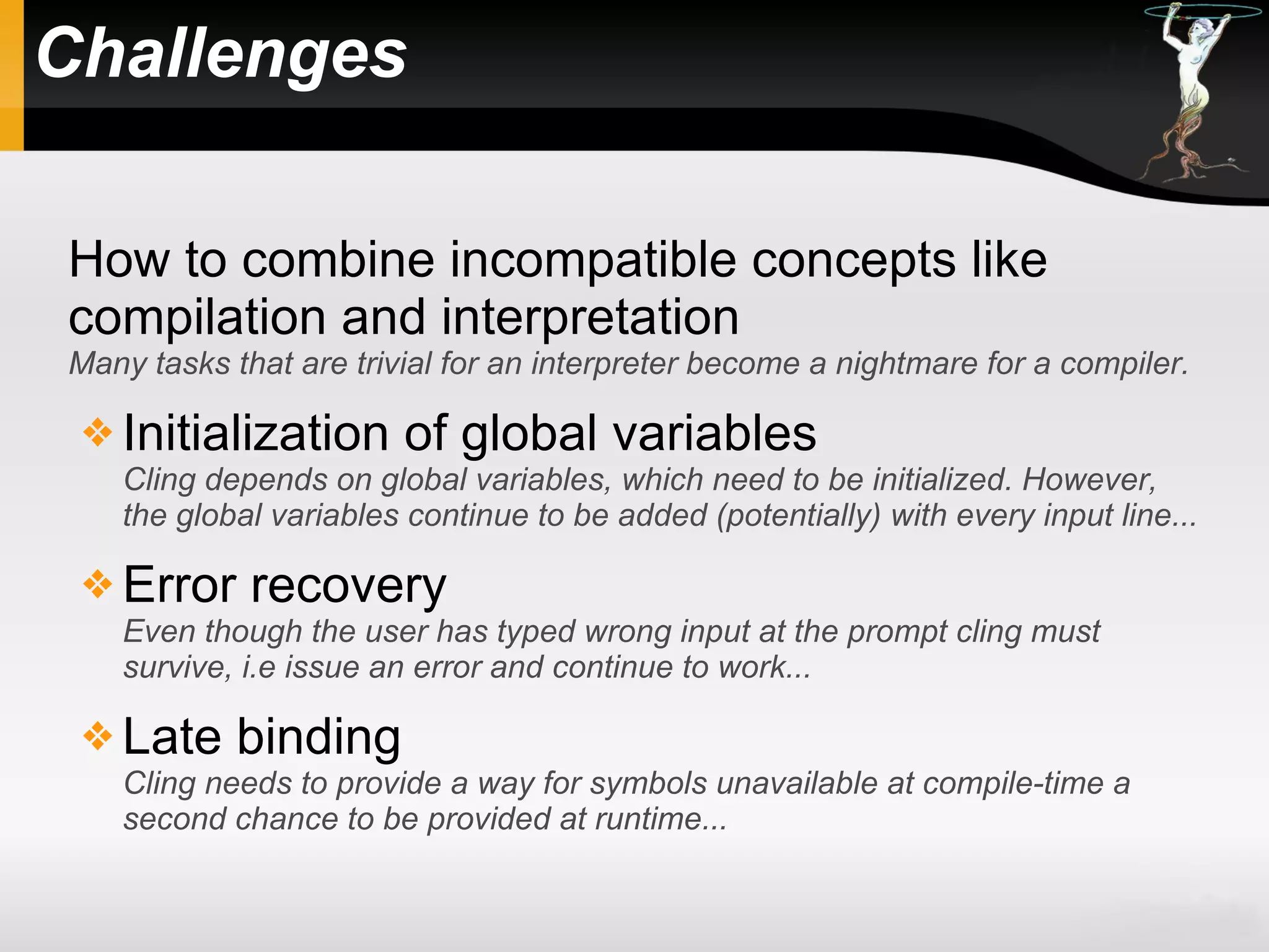
How to combine incompatible concepts like
compilation and interpretation
Many tasks that are trivial for an interpreter become a nightmare for a compiler.
 Initialization of global variables
Cling depends on global variables, which need to be initialized. However,
the global variables continue to be added (potentially) with every input line...
 Error recovery
Even though the user has typed wrong input at the prompt cling must
survive, i.e issue an error and continue to work...
 Late binding
Cling needs to provide a way for symbols unavailable at compile-time a
second chance to be provided at runtime...
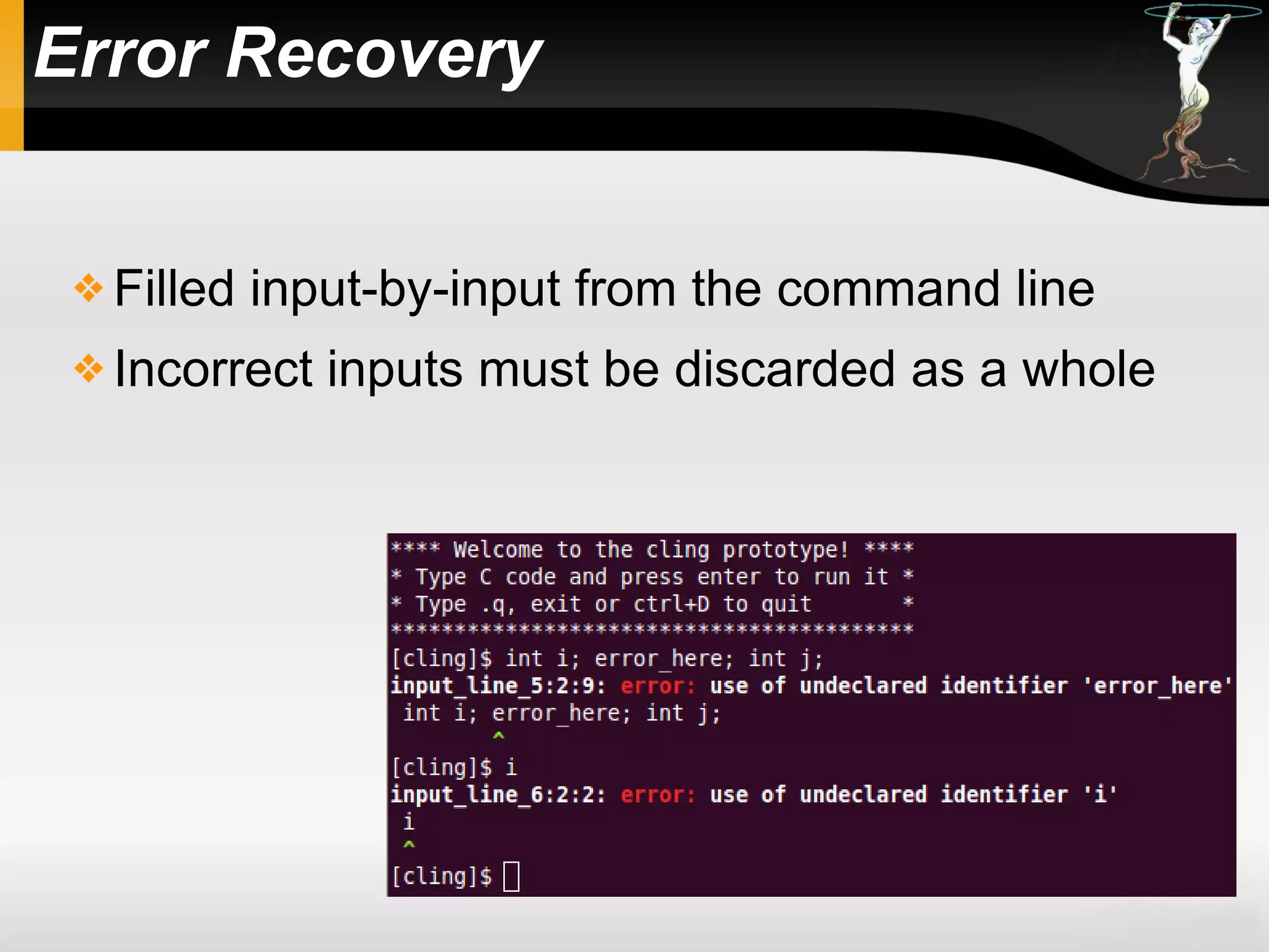
Error Recovery
 Filled input-by-input from the command line
 Incorrect inputs must be discarded as a whole
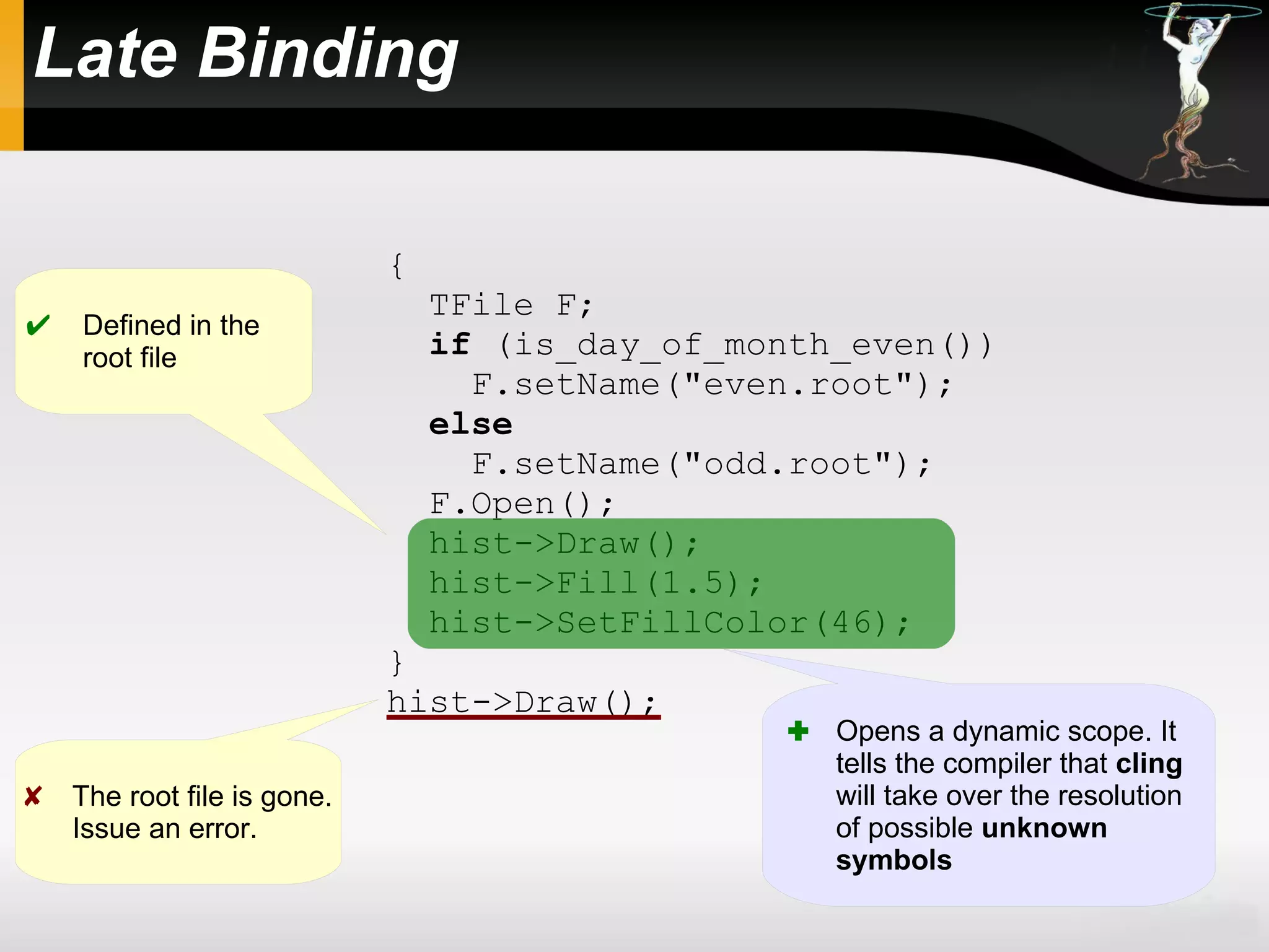
Late Binding
{
TFile F;
if (is_day_of_month_even())
F.setName("even.root");
else
F.setName("odd.root");
F.Open();
hist->Draw();
hist->Fill(1.5);
hist->SetFillColor(46);
}
hist->Draw();
 Defined in the
root file
 The root file is gone.
Issue an error.
 Opens a dynamic scope. It
tells the compiler that cling
will take over the resolution
of possible unknown
symbols
Late Binding
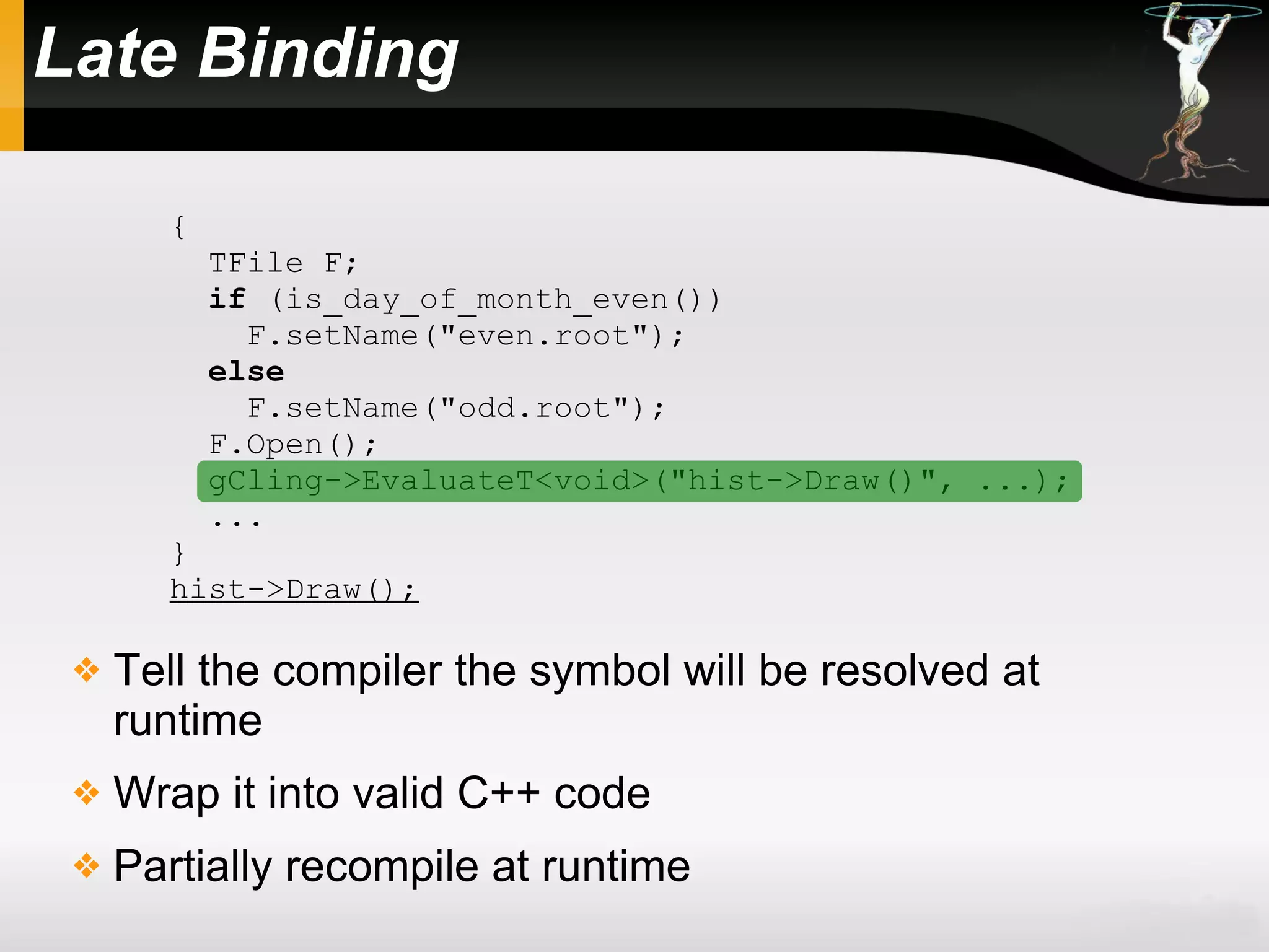
 Tell the compiler the symbol will be resolved at
runtime
 Wrap it into valid C++ code
 Partially recompile at runtime
{
TFile F;
if (is_day_of_month_even())
F.setName("even.root");
else
F.setName("odd.root");
F.Open();
gCling->EvaluateT<void>("hist->Draw()", ...);
...
}
hist->Draw();
Challenges
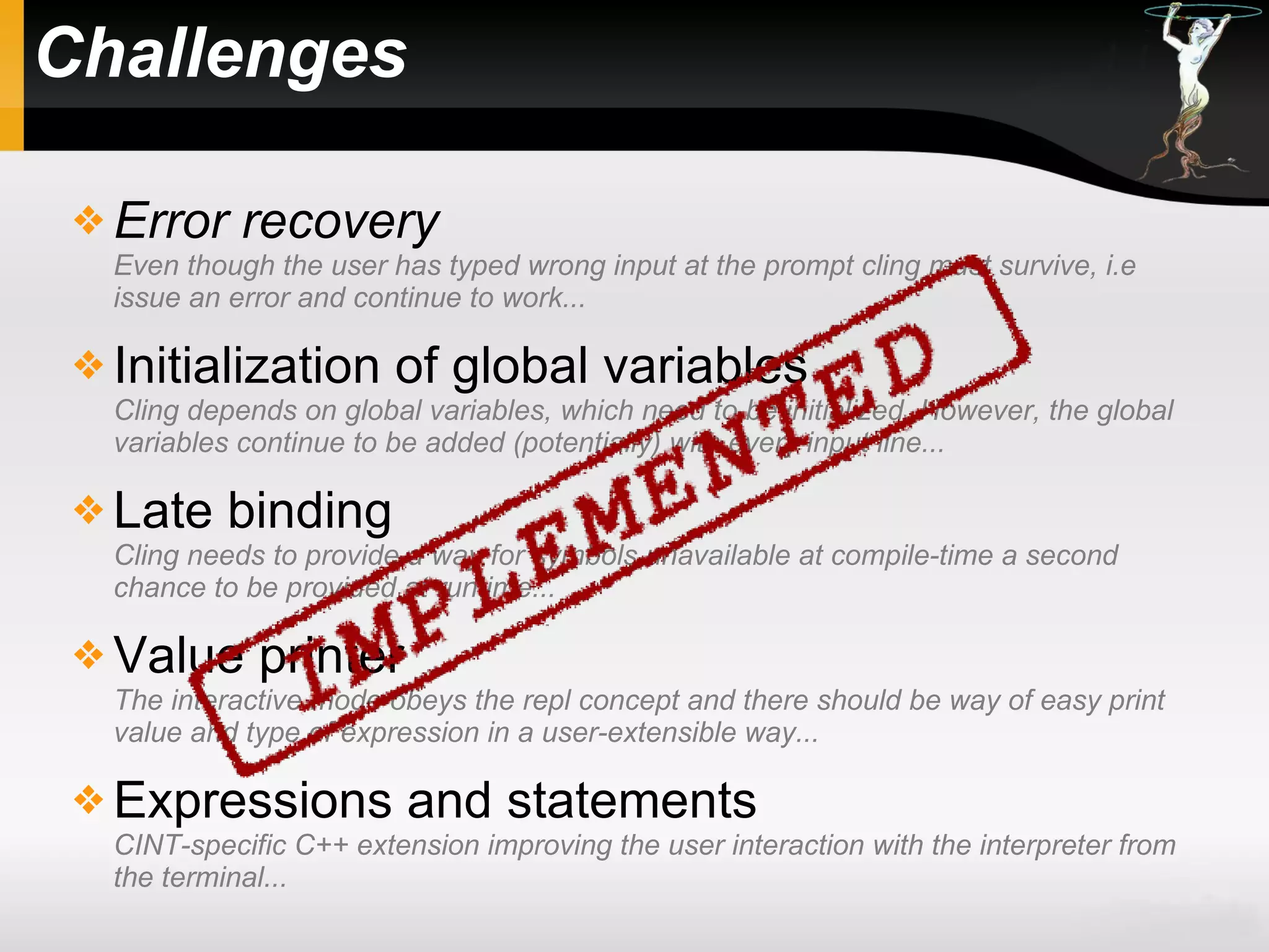
 Error recovery
Even though the user has typed wrong input at the prompt cling must survive, i.e
issue an error and continue to work...
 Initialization of global variables
Cling depends on global variables, which need to be initialized. However, the global
variables continue to be added (potentially) with every input line...
 Late binding
Cling needs to provide a way for symbols unavailable at compile-time a second
chance to be provided at runtime...
 Value printer
The interactive mode obeys the repl concept and there should be way of easy print
value and type of expression in a user-extensible way...
 Expressions and statements
CINT-specific C++ extension improving the user interaction with the interpreter from
the terminal...
Dictionaries
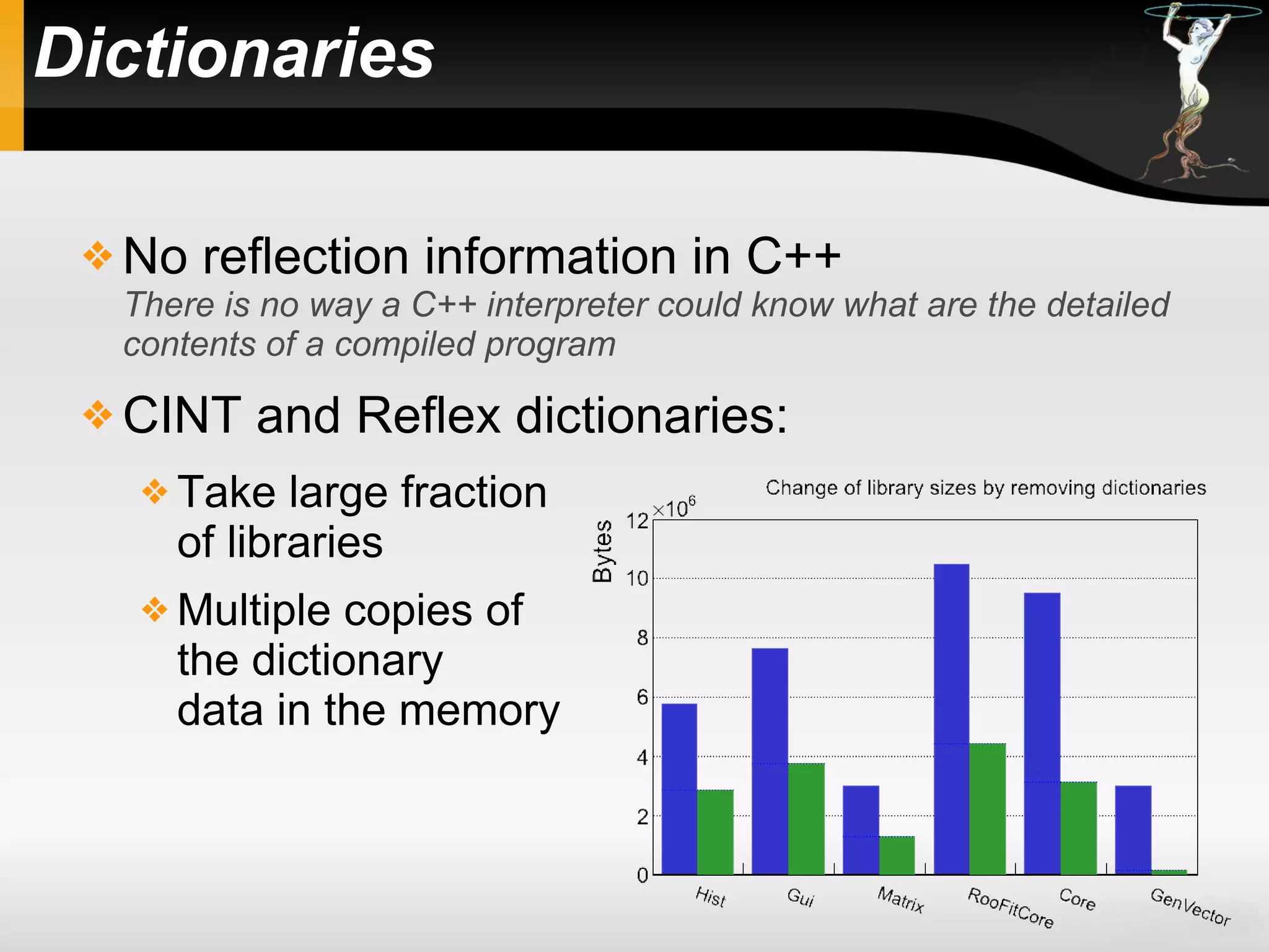
 No reflection information in C++
There is no way a C++ interpreter could know what are the detailed
contents of a compiled program
 CINT and Reflex dictionaries:
 Take large fraction
of libraries
 Multiple copies of
the dictionary
data in the memory
Dictionaries in Cling
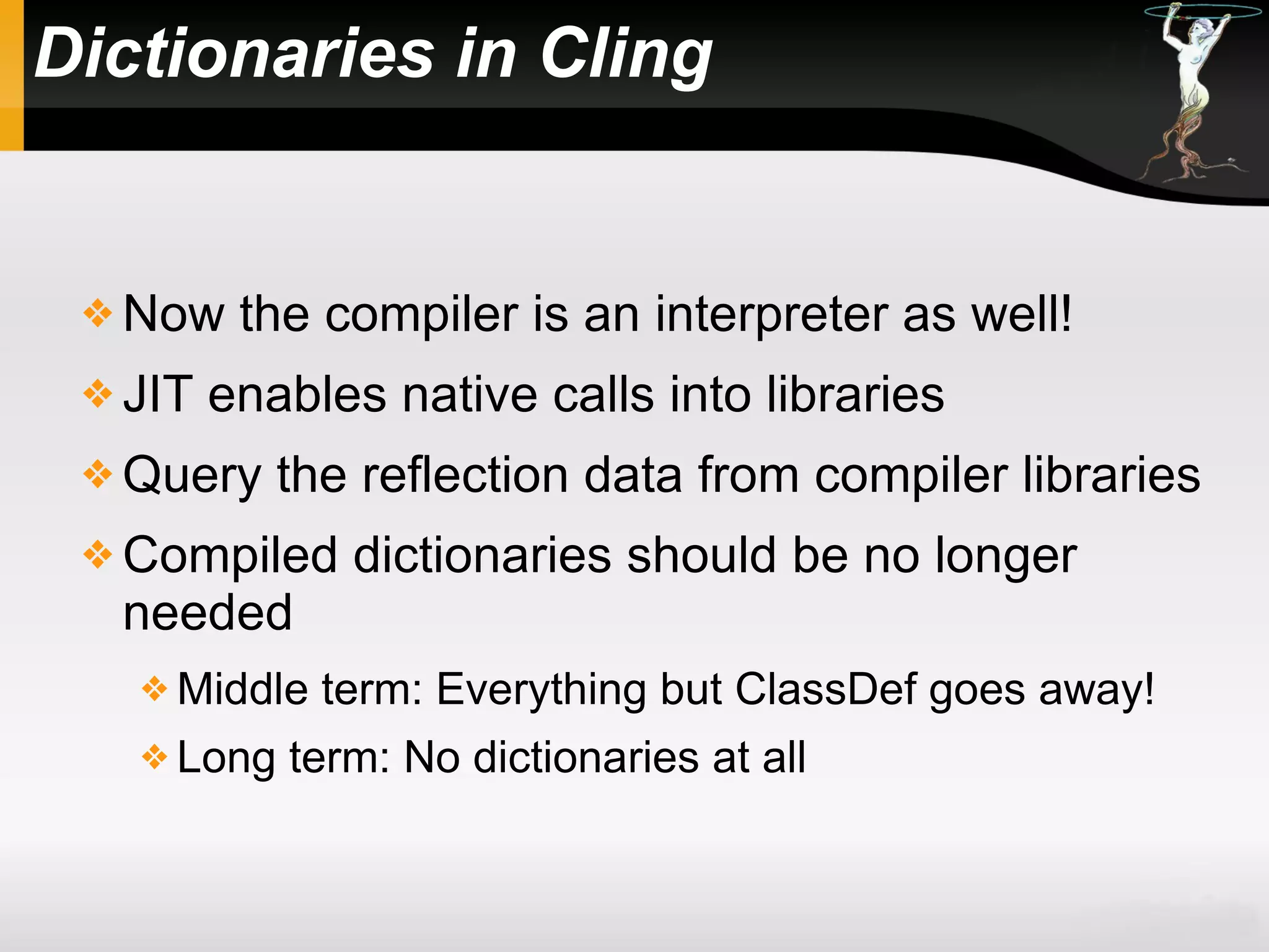
 Now the compiler is an interpreter as well!
 JIT enables native calls into libraries
 Query the reflection data from compiler libraries
 Compiled dictionaries should be no longer
needed
 Middle term: Everything but ClassDef goes away!
 Long term: No dictionaries at all
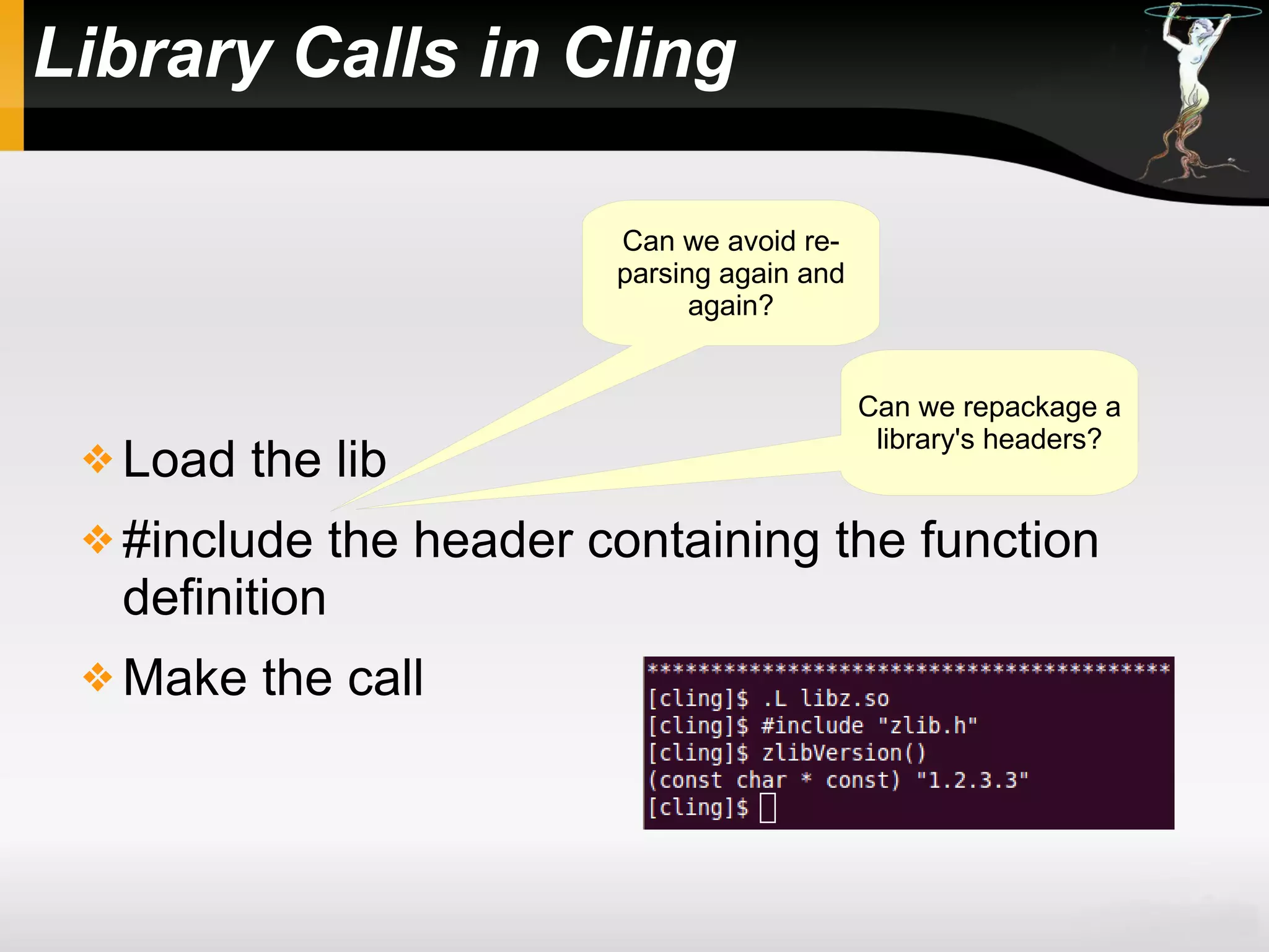
Library Calls in Cling
 Load the lib
 #include the header containing the function
definition
 Make the call
Can we repackage a
library's headers?
Can we avoid re-
parsing again and
again?
Cling @ the LLVM Community
 On 25.07.2011 cling was announced on clang's
mailing list as a working C++ interpreter
 People were thrilled and enthusiastic about it
 Lots of excellent comment and suggestions
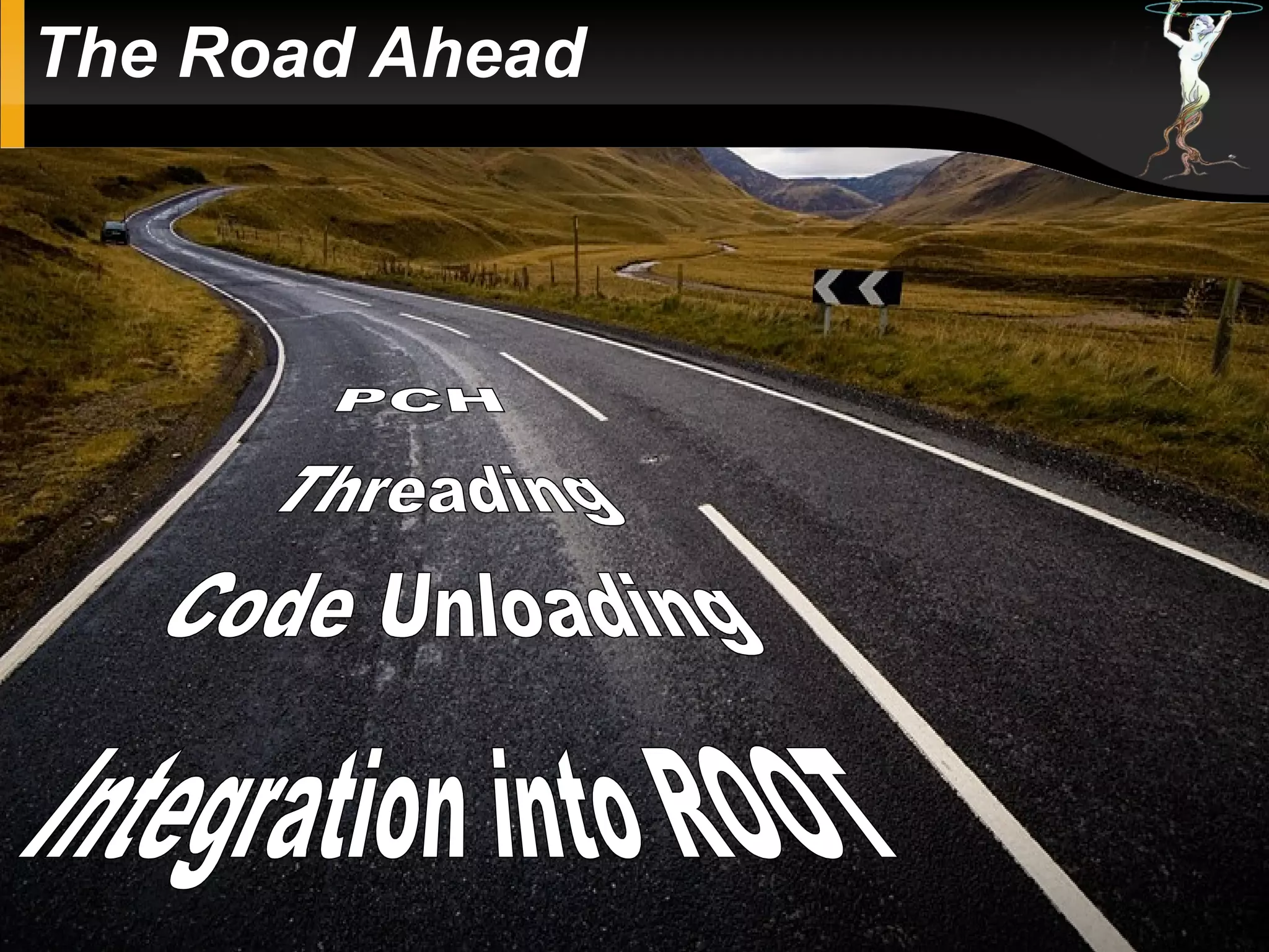
The Road Ahead
Integration into ROOT
Ongoing and continuous process that needs:
Experience with ROOT
Knowledge about cling and clang
interfaces
Future: Code Unloading
[cling]$
[cling]$
[cling]$
[cling]$
[cling]$
[cling]$
[cling]$
[cling]$
[cling]$
.L Calculator.h
Calculator calc;
calc.Add(3, 1)
2
.U Calculator.h
.L Calculator.h
Calculator calc;
calc.Add(3, 1)
4
// Calculator.h
class Calculator {
int Add(int a, int b) {
return a + b;
}
...
};
// Calculator.h
class Calculator {
int Add(int a, int b) {
return a - b;
}
...
};
Future: Code Unloading
 Fundamental requirement for ROOT
This is what drives the rapid development in ROOT...
 Extremely difficult for a compiler
Teaching an elephant to dance...
 Requires in-depth knowledge of clang internals
Different phases in the compiler, advanced AST manipulations, inter-
procedural analysis, knowledge about LLVM intermediate representation
(bitcode), JIT internals, bitcode recompilation...
 Thinking out-of-the-box
Not often seen problem needs novel way of understanding the compiler
libraries...
 We know how to do it!
Watermarks, dependency analysis, annotation of the corresponding
bitcode, generated for the high-level internal structures,...
Cling in ROOT
Lots of interest from experiments and
physicists
The prototype will be included in the
source package of ROOT (the November
release)
The prototype will be an optional
interpreter for ROOT
Demo:Demo:
C N GC N G
Thank you!Thank you!
Backup slidesBackup slides
Pre-Compiled Headers
Carefully crafted data structures designed to
improve translator's performance:
 Reduce lexical, syntax and semantic analysis
 Loaded “lazily” on demand
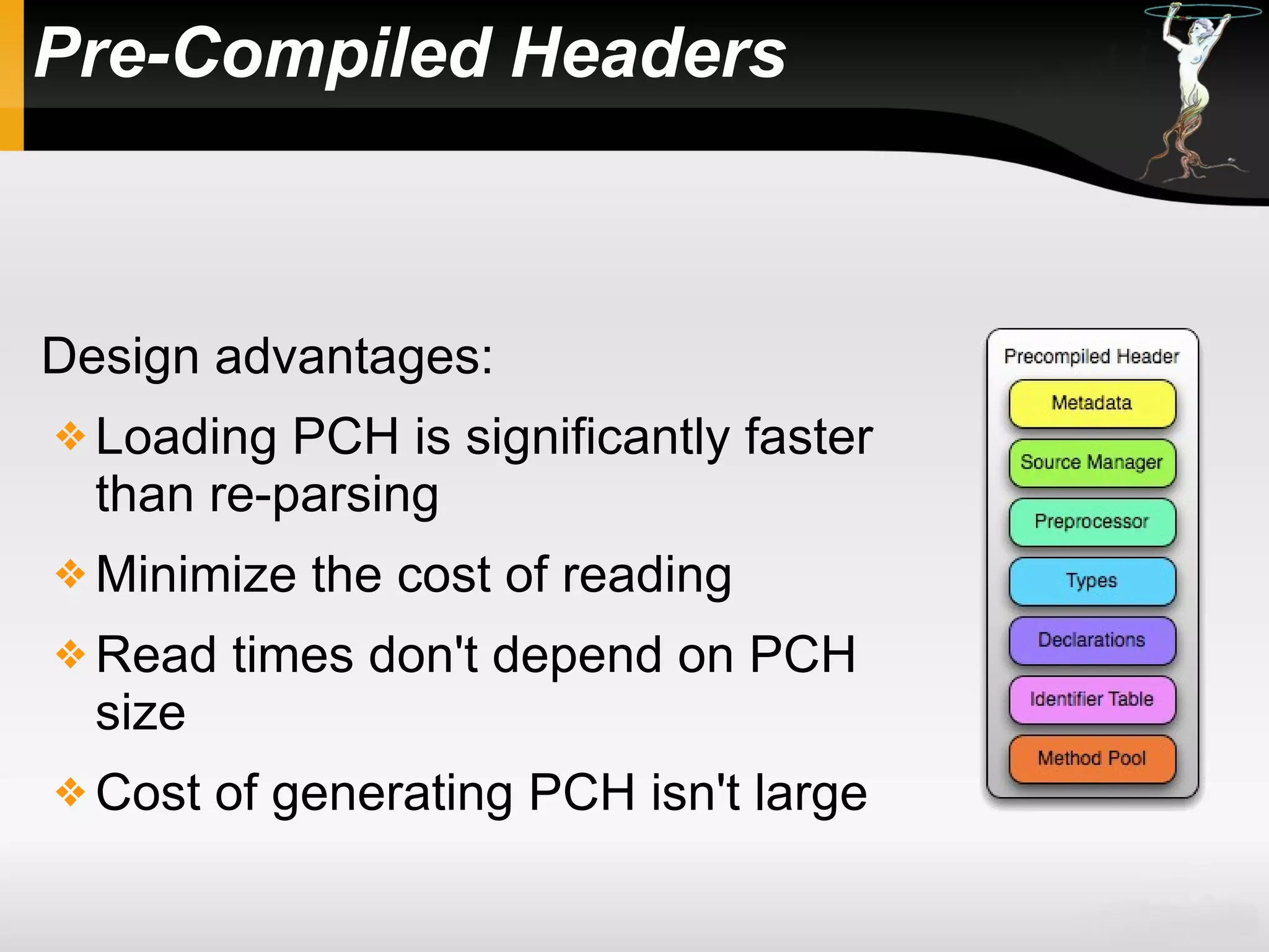
Pre-Compiled Headers
Design advantages:
 Loading PCH is significantly faster
than re-parsing
 Minimize the cost of reading
 Read times don't depend on PCH
size
 Cost of generating PCH isn't large

Cling the llvm based interpreter

  • 1.
    Vassil VassilevVassil Vassilev Cling– The LLVM-basedCling – The LLVM-based InterpreterInterpreter
  • 2.
    Why Do WeNeed Cling? Cling's advantages:  Full C++ support  STL + templates  Path to C++0x  Planned massive reduction of dictionaries  Easier and smoother transition between interpreted and compiled code  Easy maintenance
  • 3.
    What Is Cling? An interpreter – looks like an interpreter and behaves like an interpreter Cling follows the read-evaluate-print-loop (repl) concept.  More than interpreter – built on top of a compiler (clang) and compiler framework (LLVM) Contains interpreter parts and compiler parts. More of an interactive compiler or an interactive compiler interface for clang
  • 4.
    What Cling DependsOn?  LLVM “The LLVM Project is a collection of modular and reusable compiler and toolchain technologies...”  More than 120 active contributors Apple, ARM, Google, Qualcomm, QuIC, NVidia, AMD and more  ~250 commits/week  Clang “The goal of the Clang project is to create a new C, C++, Objective C and Objective C++ front-end for the LLVM compiler.“  More than 100 active contributors Apple, ARM, AMD and more  ~150 commits/week * Stats from last year until 14.10.2011
  • 5.
    Cling's Codebase LLVM –430K SLOC* Clang – 333K SLOC* Cling – 7K SLOC* * By 12.10.2011. No testsuites included. C and C++ only. Credits: generated using David A. Wheeler's 'SLOCCount' Cling's Codebase LLVM Clang Cling Other ROOT – 1400K SLOC* CINT+Reflex – 230K SLOC* Cling – 7K SLOC* Cling's Codebase ROOT CINT Cling
  • 6.
    Additional Features  Just-in-timecompiler (JIT)  Extra platform support  World class performance and optimizations  OpenCL  Expressive diagnostics  ...
  • 7.
    Expressive Diagnostics  Columnnumbers and caret diagnostics CaretDiagnostics.C:4:13: warning: '.*' specified field precision is missing a matching 'int' argument printf("%.*d"); ~~^~  Range highlighting RangeHighlight.C:14:39: error: invalid operands to binary expression ('int' and 'A') return y + func(y ? ((SomeA.X + 40) + SomeA) / 42 + SomeA.X : SomeA.X); ~~~~~~~~~~~~ ^ ~~~~~~~  Fix-it hints FixItHints.C:7:27: warning: use of GNU old-style field designator extension struct point origin = { x: 0.0, y: 0.0 }; ^~ .x =
  • 8.
    Improving Cling Step-By-Step Clingprototype in 2010:  Shortcomings of the existing prototype were analyzed Source-to-source manipulations, variable initializers not managed correctly, redundant re-parsing, low efficiency, ...  Redesign almost from scratch  Resulted in complete rewrite
  • 9.
    Advantages of theNew Design  Rely on the compiler libraries where possible instead of custom implementations Reduces the maintenance load. If the implementation is not too specific and makes sense for a compiler we prefer putting it into the compiler codebase and delegate the maintenance...  More language independent The necessary code injections and rewrites are directly in the internal structures of the underlying compiler  Stability The new design enables the implementation of stable error recovery  Better performance Re-parsing only in very few cases
  • 10.
    Challenges  How tocombine incompatible concepts like compilation and interpretation Many tasks that are trivial for an interpreter become a nightmare for a compiler.  How to make it user-friendly First step should be to adopt the successful usability extensions from CINT.
  • 11.
    Challenges How to makeit user-friendly First step should be to adopt the successful usability extensions from CINT.  Value printer The interactive mode obeys the repl concept and there should be easy, interactive and user-extensible access to types and values  Expressions and statements CINT-specific C++ extension improving the user interaction with the interpreter from the terminal... [cling]$ sin(1) (double const) 0.841471 void wrapper() { sin(1); }
  • 12.
    [cling]$ [cling]$ int i =12; printf("%dn",i); printf("%fn",sin(i)); Expressions and Statements  Wrap the input  Scan for declarations  Extract the declarations one level up, as global declarations void wrapper1() { int i = 12; printf("%dn",i); } void wrapper2() { printf("%fn", sin(i)); } int i = 12;
  • 13.
    Challenges How to combineincompatible concepts like compilation and interpretation Many tasks that are trivial for an interpreter become a nightmare for a compiler.  Initialization of global variables Cling depends on global variables, which need to be initialized. However, the global variables continue to be added (potentially) with every input line...  Error recovery Even though the user has typed wrong input at the prompt cling must survive, i.e issue an error and continue to work...  Late binding Cling needs to provide a way for symbols unavailable at compile-time a second chance to be provided at runtime...
  • 14.
    Error Recovery  Filledinput-by-input from the command line  Incorrect inputs must be discarded as a whole
  • 15.
    Late Binding { TFile F; if(is_day_of_month_even()) F.setName("even.root"); else F.setName("odd.root"); F.Open(); hist->Draw(); hist->Fill(1.5); hist->SetFillColor(46); } hist->Draw();  Defined in the root file  The root file is gone. Issue an error.  Opens a dynamic scope. It tells the compiler that cling will take over the resolution of possible unknown symbols
  • 16.
    Late Binding  Tellthe compiler the symbol will be resolved at runtime  Wrap it into valid C++ code  Partially recompile at runtime { TFile F; if (is_day_of_month_even()) F.setName("even.root"); else F.setName("odd.root"); F.Open(); gCling->EvaluateT<void>("hist->Draw()", ...); ... } hist->Draw();
  • 17.
    Challenges  Error recovery Eventhough the user has typed wrong input at the prompt cling must survive, i.e issue an error and continue to work...  Initialization of global variables Cling depends on global variables, which need to be initialized. However, the global variables continue to be added (potentially) with every input line...  Late binding Cling needs to provide a way for symbols unavailable at compile-time a second chance to be provided at runtime...  Value printer The interactive mode obeys the repl concept and there should be way of easy print value and type of expression in a user-extensible way...  Expressions and statements CINT-specific C++ extension improving the user interaction with the interpreter from the terminal...
  • 18.
    Dictionaries  No reflectioninformation in C++ There is no way a C++ interpreter could know what are the detailed contents of a compiled program  CINT and Reflex dictionaries:  Take large fraction of libraries  Multiple copies of the dictionary data in the memory
  • 19.
    Dictionaries in Cling Now the compiler is an interpreter as well!  JIT enables native calls into libraries  Query the reflection data from compiler libraries  Compiled dictionaries should be no longer needed  Middle term: Everything but ClassDef goes away!  Long term: No dictionaries at all
  • 20.
    Library Calls inCling  Load the lib  #include the header containing the function definition  Make the call Can we repackage a library's headers? Can we avoid re- parsing again and again?
  • 21.
    Cling @ theLLVM Community  On 25.07.2011 cling was announced on clang's mailing list as a working C++ interpreter  People were thrilled and enthusiastic about it  Lots of excellent comment and suggestions
  • 22.
  • 23.
    Integration into ROOT Ongoingand continuous process that needs: Experience with ROOT Knowledge about cling and clang interfaces
  • 24.
    Future: Code Unloading [cling]$ [cling]$ [cling]$ [cling]$ [cling]$ [cling]$ [cling]$ [cling]$ [cling]$ .LCalculator.h Calculator calc; calc.Add(3, 1) 2 .U Calculator.h .L Calculator.h Calculator calc; calc.Add(3, 1) 4 // Calculator.h class Calculator { int Add(int a, int b) { return a + b; } ... }; // Calculator.h class Calculator { int Add(int a, int b) { return a - b; } ... };
  • 25.
    Future: Code Unloading Fundamental requirement for ROOT This is what drives the rapid development in ROOT...  Extremely difficult for a compiler Teaching an elephant to dance...  Requires in-depth knowledge of clang internals Different phases in the compiler, advanced AST manipulations, inter- procedural analysis, knowledge about LLVM intermediate representation (bitcode), JIT internals, bitcode recompilation...  Thinking out-of-the-box Not often seen problem needs novel way of understanding the compiler libraries...  We know how to do it! Watermarks, dependency analysis, annotation of the corresponding bitcode, generated for the high-level internal structures,...
  • 26.
    Cling in ROOT Lotsof interest from experiments and physicists The prototype will be included in the source package of ROOT (the November release) The prototype will be an optional interpreter for ROOT
  • 27.
  • 28.
  • 29.
  • 30.
    Pre-Compiled Headers Carefully crafteddata structures designed to improve translator's performance:  Reduce lexical, syntax and semantic analysis  Loaded “lazily” on demand
  • 31.
    Pre-Compiled Headers Design advantages: Loading PCH is significantly faster than re-parsing  Minimize the cost of reading  Read times don't depend on PCH size  Cost of generating PCH isn't large