climatechang
voices from communities
affected by climate change
friends of the earth international
november 2007
12°s, 77°w“So many lost their crops … almost all the families were affected. All the crops, almost all, were damaged in Quebrada
Honda. The crops of native potato, beans, olluco, oca, mashua [types of tubers], most of which are for our own
consumption, are hoped to recover once it rains, so we will have at least some of the seeds of our labour.”
Eulogio Capitan Coleto, age 63, president, Environment Committee, Vicos community, department of Ancash, Peru.
2 | climate change: the testimonies
friends of the earth international secretariat P.O. Box 19199, 1000 GD Amsterdam, The Netherlands
Tel: 31 20 622 1369 Fax: 31 20 639 2181 E-mail: info@foei.org website www.foei.org
These and additional testimonies are on-line at www.foei.org/en/campaigns/climate
climatechang
voices from communities
affected by climate change
friends of the earth international
november 2007
introduction voices from communities affected by climate change 3
australia fire and water 4
brazil learning to expect the unexpected 8
honduras planetary fever jeopardises human health 11
malaysia rising to the challenge 16
mali a dry land confronts a warming world 20
peru high climate risk in a land of extremes 24
swaziland facing the heat 28
tuvalu islanders lose ground to rising seas 32
united kingdom tides of change threaten historic town 35
friends of the earth international Friends of the Earth International is the world’s largest grassroots environmental network, uniting 70 diverse national
member groups and some 5,000 local activist groups on every continent. With over 2 million members and supporters around the world, we campaign
on today’s most urgent environmental and social issues. Our vision is of a peaceful and sustainable world based on societies living in harmony with
nature. We envision a society of interdependent people living in dignity, wholeness and fulfilment in which equity and human and peoples’rights are
realized. This will be a society built upon peoples’sovereignty and participation. It will be founded on social, economic, gender and environmental justice
and free from all forms of domination and exploitation, such as neoliberalism, corporate globalization, neo-colonialism and militarism. We believe that
our children’s future will be better because of what we do.
Frontcover:EulogioCapitanColetoholdingpotatoaffectedbyfungus,Vicos,Peru,2007©AsociacionCivilLabor/FoEPeru
climate change: the testimonies | 3
In the face of such pressing realities, the challenges are even greater. It is a matter of record
that the peoples of the global South and Indigenous Peoples worldwide are most vulnerable
to climate change. This is because their livelihoods are intimately tied to the land and water,
to the diversity of their ecosystems and to their traditional knowledge about these resources.
These foundations of their existence are now severely threatened by the climate crisis.
But what about their voices? They are rarely heard. This is despite the higher risk these
peoples face, and despite an abundance of information, research reports and TV programs on
climate change, which was recently even the subject of a Nobel Prize. Friends of the Earth
International is therefore publishing this report, to give voice to the peoples at the front lines
of climate change, and to reveal the perspectives of those who live out this reality.
The report includes nine stories from different countries around the world. These case studies
chronicle specific impacts, and provide testimonies of local community members who have
dramatic first-hand experience of devastating climate events. They also describe their
perceptions of the various challenges faced by policymakers, decision makers, and even the
local populations themselves.
In this report, Indigenous Peoples, local authorities, small-hold farmers, and small-scale fisher
peoples speak out — all the way from Honduras, Peru and Brazil to Mali and Swaziland, from
the United Kingdom to Australia, Malaysia and Tuvalu. The voices of these women and men
express strategies they have invented to try to adapt to the transformations climate change
has imposed on their territories, lifestyles and ecosystems. Their statements are forceful,
sharp and conclusive, and reveal their skepticism of measures being taken by their own
government institutions and the international community.
Knowledge of their natural surroundings leads many of these peoples to wisely conclude that
the only way to adapt is to reclaim, restore and promote their traditional, ancestral ways of
life, while distancing and differentiating themselves from the conventional proposals which
they question. The motivations of these peoples are shared: they want to protect their
livelihoods and their communities. The many solutions they seek include ecological
agriculture, traditional medicine, sustainable soil and water management, the construction of
decent housing, and affordable alternative energies. However, they also know their efforts will
be insufficient on their own; local communities also recognize the decisive need for a
profound transformation.
This drives home the imperative of a global, diverse and effective movement that will halt
climate change and assure climate justice, by fostering initiatives that counterbalance the
vulnerability of such communities. Herein lays the challenge — and the commitment of
Friends of the Earth International.
Building such a movement requires us to challenge the prevailing political and economic
system that drives climate change and unsustainable production and consumption. It implies
championing secure and sovereign energy supplies that will drastically cut unsustainable and
fossil-fuel energy consumption, and put a halt to their financing. It also implies fostering
alternative renewable energy sources that promote eco-efficiency and eco-sufficiency, and are
consistent with sovereignty and a fair and equitable transition. It requires pursuing effective
regional, municipal and local regimes that foster climate justice.
This publication is a contribution and an appeal to the environmental movement to join
forces with other social movements, to work united in building solutions to the climate crisis.
This is our challenge; this is our chosen path.
introductionvoices from communities
affected by climate change
introduction Tatiana Roa Avendaño,
CENSAT Agua Viva/Friends of the Earth Colombia
The upheaval caused by climatic change is
approaching the scale of that caused by
armed conflict. A recent United Nations
report shows that more people are being
displaced in the world today as a result of
environmental problems than because of
conflict, and many of them are climate
refugees. Climate change is no longer a
potential threat. It is now an established
reality of life on our planet.
Bangladesh is being flooded by the sea, and
there are real fears it will lose a large part of its
territory. The populations of several towns
there have already been forced to move due to
flooding. In the Pacific islands, the sea level will
rise enough to inundate whole islands, forcing
local populations to leave their homelands
forever. Glaciers are melting in the Andean
nations of South America and Himalayan
countries of Asia, regions where entire
communities base their agriculture and water
supplies on sources from everlasting mountain
snows. This puts them on a path to extinction.
While some regions are suffering from floods,
others are experiencing severe drought and
increasing desertification, all of which is
fostering more hunger, thirst, disease and
displacement. The climate crisis facing the
planet today has already caused irreversible
damage to many ecosystems; these impacts
will only become more severe, intensifying
social and economical conflicts.
With every passing second, climate change is
exposing the fragility of the prevailing economic
system, which imposes limitless demands on
nature’s bounty and relies on fossil fuels such as
oil and coal, the main source of greenhouse gas
emissions. Unfettered over-consumption in the
North is the main cause of climate change; it is
urgent that this consumption be reduced,
despite the fact that this challenge is cynically
neglected. While it is clear that it will be
impossible to reduce consumption and demand
unless we simultaneously cut back on
production and supply, the interests of powerful
automobile, oil, mining and, more recently,
agrofuel corporations still prevail over all
solutions to climate change.
friends of the earth international www.foei.org
australia
35°s, 149°e
fire and water
authors Polly Buchhorn & Stephanie Long,
Friends of the Earth Australia
with collaboration from: Oxfam Australia
Droughts and bushfires have been persistent threats throughout Australia’s 200 years of
European settlement. Now a seven-year drought, punctuated with extreme bushfires, is
exposing the nation’s vulnerability to climate change. Australia is a wealthy, resource-rich
country with the ability to adapt; but it is also the world’s driest inhabited continent, with
ecosystems that are highly vulnerable to climatic change. Although recent events have
crystallized public awareness of the climate threat, Australians remain the industrialised
world’s highest per capita emitters of greenhouse gases, and their Federal Government
continues to undermine international efforts to curb emissions.
impacts
“The fire came out of the drought: The drought put people on edge, especially
fire fighters and farmers. The blaze came so early in the fire season ― people
knew straight away it was serious.”
Hanna Rubenach, 29-year-old volunteer fire fighter, student and disability support worker.
a hotter future: Though Australia is already a hot, dry continent, climate change is
expected to make it hotter still, with average temperatures likely to increase by up to
1.3˚C by 2020, and 6.7 ˚C by 2080, according to the UN Intergovernmental Panel on
Climate Change (IPCC).1 Reduced rainfall and more evaporation mean that “water
security problems are projected to intensify by 2030 in southern and eastern Australia,”
according to the IPCC.
These changes will create problems for agriculture. Fruit and nut crops will suffer due to
lack of required winter chilling; grain quality will decline due to heat shock; livestock will
experience more heat stress, and productive pasture will be lost. Forestry production will
also drop in many parts of the country.
Cities and towns where Australians live, generally concentrated near the coast, will be
affected by sea-level rise and storms and, in the North, by more intense cyclones. Heat-
related deaths in Australia’s major urban centres are expected to become five times
more frequent by 2050.
unique life at risk: Also at risk are Australia’s plant and animal species, many of which
are found nowhere else in the world. Even small temperature increases could lead to
extinctions. For example, Great Barrier Reef tourism generates about USD 4.5 billion per
year, and provides about 63,000 jobs. Yet in coming decades warming oceans could send
the reef’s corals into serious decline.
a drought that defies memory
the fingerprint of climate change? Although the current federal leadership has sought to
minimise the climate change threat, Australians are already grappling with a hotter, drier
reality. Since the late 1800s, droughts of one to nine years’duration have been known, but
now the climate is hotter, and in southern and eastern Australia, it is also drier. These
changes have set the stage for one of the most damaging droughts in Australian recorded
history. In 2001 a state of drought was declared in most areas of New South Wales,
Victoria and Queensland. Though 2007 winter rains brought some relief, experts warned
in September, 2007 that Australia remains in the drought’s grip, with no end in sight.2
Polly Buchhorn, 45-year-old father of
three from Scamander, state of Tasmania.
on december 2006 bushfires: Living out in
the Australian bush and knowing a bit about
its bushfires, I had thought of the worst case:
That the drought had dried the eucalyptus
forests all around our community so that, if
ignited on a day of extreme fire weather, they
could literally explode, an uncontrollable
inferno that could destroy farms, homes,
animals and perhaps people. But I never
really thought it would happen.
When it did happen the bushfire brought my
community to its knees, for a time. My family
and I were lucky. We lost some fences, but
others lost their homes. The roads and town
water supply were cut, electricity lines were
burnt down and the phones, radio and
television were dead. Later one young fire
fighter lost his life.
a fortunate community: Shocked, I expected
the phone, electricity, roads and water to be
out for weeks. Yet just two days later the
lights, fridge and phone all worked and the
road was reopened.
on a fiery future with climate change: Even if
this bushfire wasn’t attributable to climate
change, it was just what was expected for
my community in decades to come: more
drought, extreme weather and bushfires.
I knew that we, in well-off Australia, were
expected to cope with such consequences of
climate change relatively well. That millions of
people in the world haven’t the capacity to
recover from such damage in two days ― let
alone having electricity, water and telephones
and cars in every home ― put a different light
on the devastation and trauma we faced.
I was unsettled by the flood of emergency
aid that followed … We Australians like to
share a cold beer from the fridge after a
tough day, but after beating this bushfire it
didn’t quite taste right.
There has been a really good thing to come
from this bushfire: my community has
become more resilient, and thoughtful.
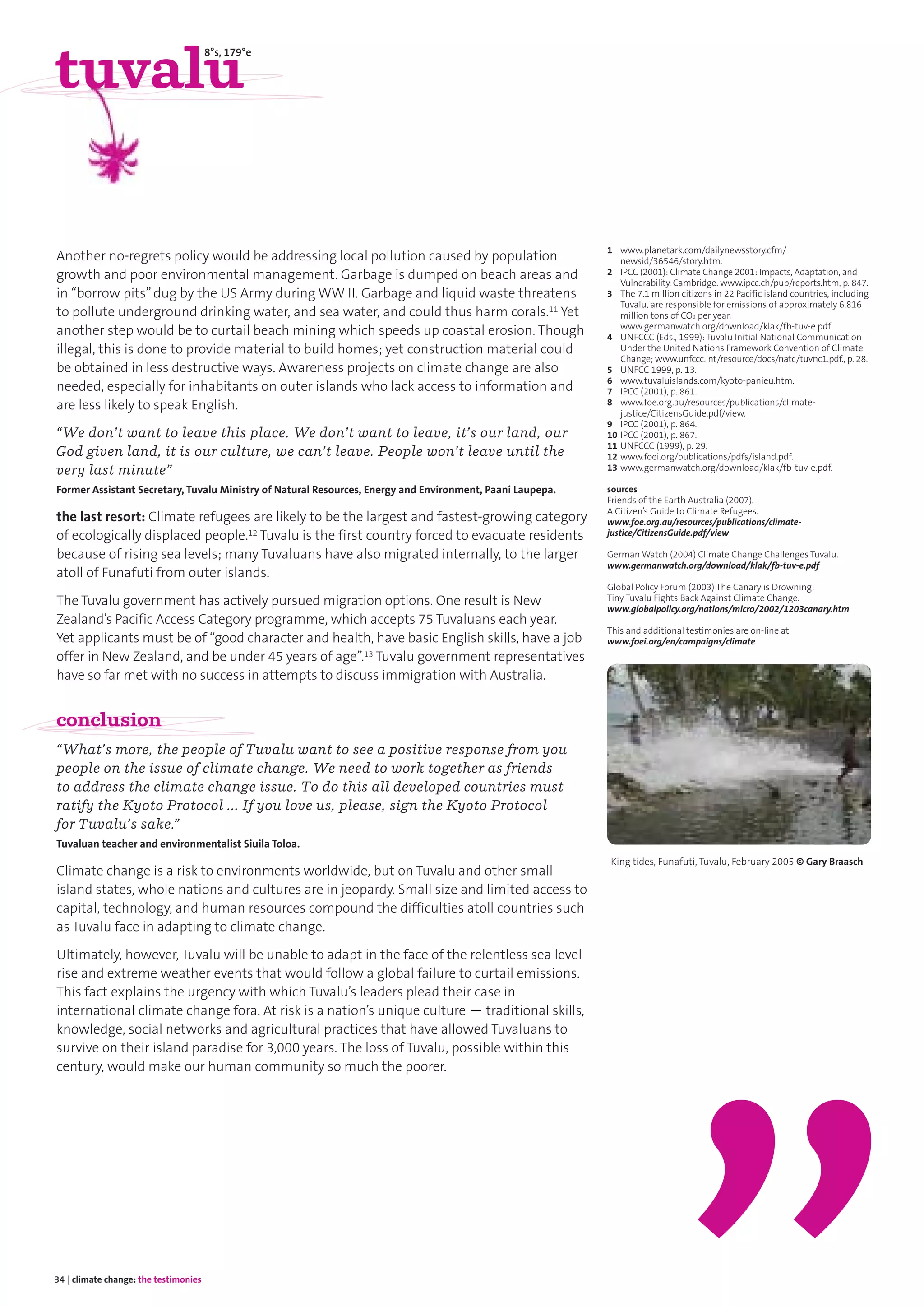
february2005,Kingtides,Funafuti,Tuvalu©garybraasch
4 | climate change: the testimonies
BushfiresinScamander,Australia,December2006©PollyBuchhorn
reservoir levels drop: In cities, water shortages are a major issue. Reservoir levels have
hovered at alarmingly low levels in recent years ― around a fifth of capacity in major
cities including Brisbane, Sydney, Melbourne and Adelaide. Despite recent rains, cities
like Melbourne are maintaining stringent water restrictions to ensure water storage
levels improve. Adelaide currently faces the possibility of running out of water by the
summer of 2008-09 due to lack of winter rain in 2007.
mighty rivers at risk: The Murray and Darling Rivers are part of Australia’s largest
drainage basin, home to about 70 percent of the country’s irrigated agriculture and more
than half of its food production. Yet in December 2006, less water flowed into the
Murray River than at any time in the past century, leaving irrigators with a major water
deficit and compromising the river’s ecological health.
farmers hit hard: The Murray-Darling’s poor state has had a major impact on agriculture. In
March 2007, a government bureau stated that “Severe drought across southern and central
Australia is projected to reduce farm incomes in 2006-07 to their lowest level in over thirty
years.”3 Another extremely bad drought year, in 2002-3, slashed Australia’s economic growth
by about AUD 6.6 billion. Total rural employment fell by almost 80,000 jobs between 2001
and 2005.4 Behind these statistics is the human face of the drought. Farmers have been
forced to shoot livestock rather than let animals starve. Crop failures have meant the loss of
family farms held for generations, despite government drought assistance.
unusually ferocious bushfires
Bushfires are a seasonal threat in Australia, but in 2006, the season began in October ―
an unusually early start. As temperatures spiked and wind speeds rose, bushfires were
ignited in New South Wales. By December, fires also raged across Victoria and Tasmania.
The fires continued for more than two months, compelling up to 3,000 fire fighters to
work daily to tame blazes that often proved uncontrollable.
Fire fighters spoke of severe fire behaviour they couldn’t explain or deal with, of “mega-
fires”moving at extreme speed, covering many kilometres in every direction, with
towering flames and intense heat. The longest-burning fire, in Gippsland, Victoria, took
more than 19,000 fire fighters 69 days to contain, and razed more than one million
hectares of public forests and alpine areas.
Nor can Australians be complacent about the future: the frequency of very high and
extreme fire danger days is likely to increase by up to 25 percent by 2020, and 70 percent
by 2050, across south-eastern Australia, according to the IPCC.
on the front lines of climate change: aboriginal australians
particularly vulnerable: Aboriginal peoples are among Australia’s most vulnerable to climate
change.5 More than 100,000 live in remote communities, many of which lack adequate
infrastructure, health services and employment ― disadvantages that may restrict their
ability to cope with climate hazards, according to the IPCC. Direct impacts include heat
stress, loss of traditional food sources, and more food- and water-borne illnesses.
Julia Weston and Frank Giles,
farmers of blueberries, cherries and cattle,
from Seaview Farm near St Marys,
state of Tasmania.
drought torture: Rainfall records have been
kept here at Seaview Farm since 1929. We
expect 40 inches of rain a year, but last year
we received just 16 inches, the lowest by far,
ever. Day by day it got drier and drier, it was
relentless. Everyone’s pastures, crops,
livestock and streams shrivelled; old-timers
said the creeks had never dried up, but we
had barely enough water in the creek to keep
our cherry orchard alive. We’d already lost
the crop to frost.
Then the bushfire came with more extreme
weather. We’re pretty safe at the house. We
had to fight to protect our young blueberries
but we were cut off from our cherry orchard.
Some big farms nearby are sceptical about
climate change’s role and future threat. We’re
worried erratic weather can upset things in
so many ways we can’t plan for. Our
blueberries might not get enough winter
chilling, will there be water for irrigation, how
much more fodder should we keep on hand?
reacclimatising farming practices: A few years
ago we started a move to “biological farming”
practices using non-chemical fertilisers and
rebuilding soil ecology to restore natural
systems. And we’ve been making bio–diesel to
run the irrigation pump and tractor.
After the bushfire, the drought’s impact
persisted and forced our neighbour to sell off
a lot of his livestock. But our animals and
pastures were in good condition, and we
started buying more animals. People came
and shook their heads, but we’re certain,
after the drought, we came out of it so well
because of our switch to biological farming.
If we are going to be affected by climate
change in the future we’ll have to find new
ways of farming. Conventional “big”farming
might turn a lot of farmland into a dust bowl.
With an uncertain climate we need to be
flexible and diversify our farming, and learn
to farm with nature, rather than fight it.
climate change: the testimonies | 5friends of the earth international www.foei.org
“We expect 40 inches of rain a year, but last year we received just 16 inches, the
lowest by far, ever. Day by day it got drier and drier, it was relentless. Everyone’s
pastures, crops, livestock and streams shrivelled; old-timers said the creeks had
never dried up, but we had barely enough water in the creek to keep our cherry
orchard alive … Then the bushfire came.”
Julia Weston and Frank Giles, farmers, Seaview Farm, near St Marys, Tasmania.
JuliaWestonandFrankGiles,Australia,2007©PollyBuchhorn
Most Aboriginal Australians live in the country’s north, often in low-lying tropical areas
vulnerable to storm surges and floods ― events expected to be on the rise as the planet
warms. Sea level rise of one or two metres would wipe out dozens of populated homelands
and islands, particularly those in the Gulf of Carpentaria and adjacent Torres Strait.
torres strait islanders: The Torres Strait Islands, scattered across 22,000 square kilometres
between Australia and Papua New Guinea, are home to more than eight thousand people.
Many live only metres from the beach, sometimes less than one metre above sea level.
In early 2006, high tides, strong winds and heavy rain caused severe damage to half the
region’s inhabited islands. Homes were damaged, sewage systems flooded and belongings
lost. Islanders report such events as increasingly common. The Yorke Island chairperson, Mr
Donald Mosby, is in no doubt that global warming is to blame. “You don’t have to be a
scientist,”he said, “not when you see metres of beach disappearing every week.”
losing control of their country: Climate change damage to traditional homelands will
also affect Aboriginal people indirectly. According to one expert, “Indigenous people
don't see the land as distinct from themselves in the same way as maybe society in the
south-east (of Australia) would. If they feel that the ecosystem has changed it’s a mental
anxiety to them. They feel like they've lost control of their “country”― they're
responsible for looking after it.”6
adaptation
headed in the wrong direction: The most fundamental step toward dealing with climate
change is to stop fuelling the problem. Yet Australia’s energy emissions are soaring. Coal
power supplies about 85 percent of our electricity, and Australia remains the world’s
biggest coal exporter. Captive to fossil fuel industry interests, the current federal
government has refused to ratify the Kyoto Protocol, and has generally obstructed
meaningful international progress.
On a more positive note, climate change is now firmly fixed on the public radar. A
convergence of events including the drought, the film The Inconvenient Truth, and the
Stern Review have given climate change a high profile. With a national election due in
late 2007, politicians are full of climate change pronouncements and international
posturing. Bids for emissions cuts are slowly rising, and there is hope for policies that
would recognise and accept climate refugees.
will farmers find relief? Despite billions of dollars spent on drought relief, many farmers
have faced bankruptcy and loss of their farmland. Authorities say climate change will
create both winners and losers, and that there are ways agriculture could adapt (new
crop varieties, new farm practices, and shifting cropping to wetter regions). However,
these changes will require investment and major management changes for farmers.
water solutions trickle in: Debates about building more dams, water recycling and
energy-intensive desalination plants regularly make headlines. Many urban Australians
have been forced to embrace water-saving measures never required before. More people
are installing rainwater tanks, thanks to government rebates. In future, stormwater
capture and recycling could play a major role in urban water supply. A new national
water plan is attempting to grapple with the Australia’s over-allocated water supply and
conflicting user demands, however, water use in Australia is still far from sustainable.
6 | climate change: the testimonies
Hanna Rubenach, 29-year-old
volunteer fire fighter, student
and disability support worker.
on fighting local 2006 bushfires: The fire
came out of the drought: The drought put
people on edge, especially fire fighters and
farmers. The blaze came so early in the fire
season – people knew straight away it was
serious. Air humidity of 15 percent is bad,
but it got well below 10 percent and the
wind was very strong. We were powerless in
the face the fires’speed, size and ferocity;
the community wasn’t ready for this.
People were shocked, and angry. Angry
towards the extreme bushfire conditions
that caused so much loss and fear. And angry
for the cuts to services that took some time
to rebuild. The fire burnt powerlines and
telephone lines, the radio, television and
mobile phone transmission towers, and
blocked roads with fallen trees and rocks.
From all over an enormous community spirit
and generosity came to. Letters from other
volunteer fire brigades gave my exhausted
brigade a boost. From across all of Tasmania
and Australia came donations and support
that lifted people up again.
responding to climate change: That drought
is expected with climate change, people here
know. Still six months from the next summer
people are already thinking about protecting
themselves from bushfire. They are conscious
of climate change meaning more drought
and extreme weather, but are mainly
concerned for local needs and personal
protection. I know about the global aspects of
the problem of climate change. But I don’t
know how to make them more aware of the
links with the drought and fire and the wider
implications it has for how we live here.
australia
35°s, 149°e
BushfiresinScamander,Australia,December2006©KimImber
coastal concerns: Australia’s coastal population is large and growing, and the threat of
future sea level rise to homes, roads and other infrastructure is now being taken
seriously. Local councils and planning authorities have begun to take planning and
regulation measures, crucial steps if continued rates of coastal development are to be
sustainable, according to the IPCC.
ecosystems pushed to limits: Some of Australia’s most celebrated natural wonders have
little or no potential to adapt to climate change. The Wet Tropics and upland rain forests,
the alpine snow country, and the Great Barrier Reef are faced with a rapidly changing
climate. Yet the species that make up these ecosystems simply have nowhere to go, or
cannot migrate quickly enough.
conclusion
A dry, hot country with a history of drought and bushfires, Australia has been described
as a portal into the world’s future with climate change. While we cannot be certain that
climate change is behind the current drought, there is no doubt about the threat posed
by a hotter future. Though wider Australian society has the resources to adapt, many
among its Aboriginal population are not so fortunate. Furthermore, even low levels of
climate change have the potential to alter the country’s landscape and wipe out unique
forms of life. Since much will depend on collective international efforts to reduce
emissions, Australians must continue to press for change from their federal leaders, who
have so far resisted any binding emissions cuts at home.
1 Relative to 1990 temperatures; refers to areas 800 km from
the coast; central Australian increases are expected to be
greater. (IPCC, 2007, www.ipcc-wg2.org, p. 515).
2 ABC News, Thursday September 6, 2007, National drought
expected to continue, experts say.
3 Australian Bureau of Agricultural and Resource Economics; see
www.abareconomics.com/publications_html/economy/econo
my_07/fsr_07.pdf.
4 ABARE Australian Commodities Statistics 2005, p. 25.
5 A. McMicheal et al. (2002); see
www.health.gov.au/pubhlth/strateg/envhlth/climate/
6 Dr Donna Green, “Climate Change and Health: Impacts on
Remote Indigenous Communities in Northern Australia”.
CSIRO, 2006.”
sources
Climate Change 2007: Impacts, Adaptation and Vulnerability.
Contribution of Working Group II to the Fourth Assessment
Report of the Intergovernmental Panel on Climate Change.
www.ipcc-wg2.org/
Friends of the Earth Australia
www.foe.org.au/
This and additional testimonies are on-line at
www.foei.org/en/campaigns/climate
climate change: the testimonies | 7friends of the earth international www.foei.org
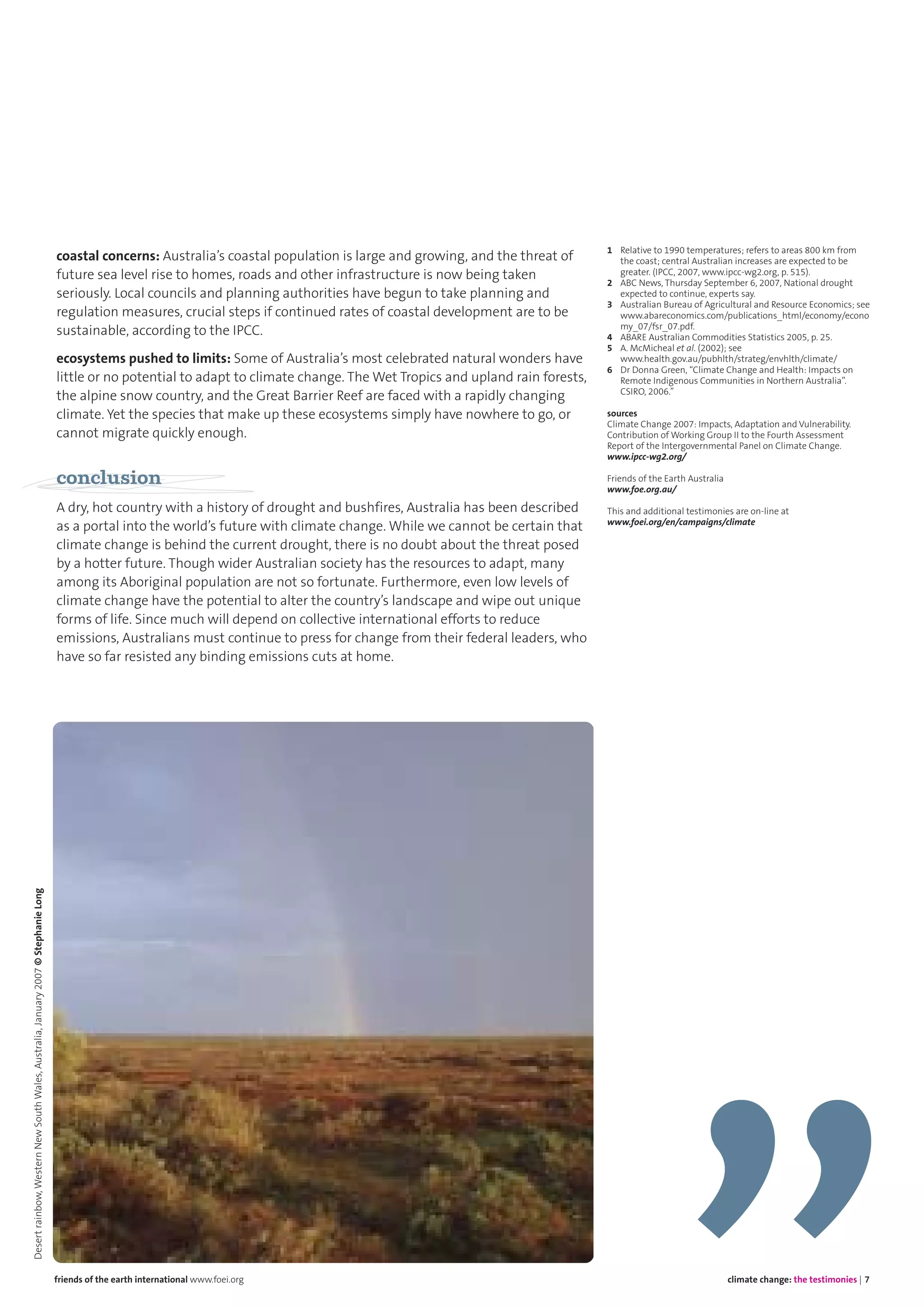
Desertrainbow,WesternNewSouthWales,Australia,January2007©StephanieLong
brazil
15°s, 47°w
learning to expect
the unexpected
author Carolina Herrmann Coelho de Souza,
Friends of the Earth Brazil
translation Anne Wilson
with collaboration from: Caroline Gatt, Daniele
Sallaberry, Lúcia Ortiz, and the Southern Santa
Catarina Municipalities Association
In 2004, southern Brazilians were stunned by the region’s first recorded hurricane.
Was it triggered by climate change? The answer is still debated, but one thing is certain.
Hurricane Catarina served up a harsh and unmistakable warning of the risks of a distorted
and more extreme climate. Standing in the way of dealing with this threat are numerous
barriers: political, institutional and technological as well as financial. To address these
barriers, a forum and workshops were held, to interweave the hard lessons of Hurricane
Catarina with hopeful prescriptions for the way forward.
impacts
“The researchers are considering two possibilities: either this
[Hurricane Catarina] is a rare event that only occurs sporadically,
or it is an early sign of the climate changes the earth will suffer because
of the pollution produced by humans.”
Carlos Nobre, scientist at the Centre forWeather Forecasting and Climate Studies, Brazilian Institute for Space Research1.
out of the blue — hurricane catarina: In our new era of rapid climate change, tropical storms
are likely to be more intense. This feature of a warming world revealed itself to southern
Brazilians when the South Atlantic Ocean spawned its first recorded hurricane late in March,
2004. The rare and unexpected event, which brought winds of up to 180 km/h, is known by
the name of the state it devastated: Santa Catarina, in Brazil’s south.
Hurricane Catarina made landfall on the evening of March 27. By the time it had cut its
destructive swathe through the unsuspecting and unprepared states of Santa Catarina
and Rio Grande do Sul, four people were killed and seven fishermen had disappeared at
sea. Property destruction was severe, with 40,000 homes damaged. Farmers lost 90
percent of the corn crop, 70 percent of the banana crop and 25 percent of the rice crop.
Even children’s education went into limbo as 80 percent of schools were forced to close
for two weeks. Damages totalled more than USD 470 million (BRL 1 billion).
wider climate impacts: The latest research, from the world’s top scientists on the UN
IPCC (Intergovernmental Panel on Climate Change), tells us that temperatures across the
Latin American region will generally increase, while water in soils will decrease. Eastern
Amazonia is expected to dry out, with tropical forest replaced by savanna, and semi-arid
zones becoming arid. Farmers in dryer areas can expect their land to turn to desert and
be impacted by salinisation (increased soil saltiness). This means farmers won’t be able
to produce as much of some important crops and livestock. Scientists also warn that
another hurricane like Catarina could happen in the South Atlantic.
These are the broad-brush changes. As for the details, considerable uncertainty remains
in terms of exactly how climate change impacts will play out in Santa Catarina and other
parts of Brazil. A lack of systems to observe and monitor climatic change contributes to
this uncertainty, and complicates people’s ability to adapt.
Terezinha da Rocha Quirino,
Araranguá, Santa Catarina.
on hurricane catarina: It was terrible not
knowing why the wind was so strong. We
were working in the fields the whole day so
we didn’t have time to listen to the radio or
watch TV. When we got home that night the
national news made it sound like there
wasn’t any danger…
Two trees fell onto our roof, and we ran to
our neighbour’s. When the wind stopped
[the eye of the hurricane], we went back to
our house to get blankets and jackets. The
wind came back and blew the tree that was
on the roof onto our car and killed my
husband, and I hurt my spleen. I didn’t see
anything after that because I fainted.
on uncertainty: Just knowing that a strong
wind is coming I get terrified. I am insecure
and don’t know what to do.
I beg the government not to talk with the
community only when it is election time.
There are a lot of people that don't have radio,
telephone or internet.There are a lot of isolated
places in the world with lack of information.
Tadeu Santos from Araranguá, Santa
Catarina, a 55-year-old environmentalist.
on actions to address climate change: I lodge
complaints in the region about CO2 (carbon
dioxide) emissions from the coal-fired power
plants, yet the government still wants to
install new ones. In each document we
produce, we conclude by highlighting the
dangers of global warming, CO2 emissions
and the greenhouse effect. We believe that
this is a form of environmental education.
Not just environmental education for
children, but to change the mentality of our
politicians too. Today, in fact, I am going to a
public hearing to pressure the government
to reduce CO2 emissions and coal use.
TadeuSantos,Araranguá,Brazil,November2006©CarolinaHerrmannCoelhodeSouza
8 | climate change: the testimonies
IeneGonçalvesdaSilva,Araranguá,SantaCatarina,Brazil,November2006©CarolinaHerrmannCoelhodeSouza
adaptation
Those who lived through Hurricane Catarina maintain that uncertainty was the worst
outcome: uncertainty about new climate catastrophes and how to deal with them. This
is further compounded by poverty, which leaves a shortfall in the financial resources and
expertise needed to deal with climate change.
Furthermore, climate change will only work to exacerbate the poverty and vulnerability
of the most exposed populations. Women may be more likely to bear the brunt of
climate change impacts, due to the nature of their work, their role as caregivers, or if
their domestic role puts them out of touch with disaster warnings, for example.
regional forums for change: To adapt to climate change, people need the appropriate
political, institutional and technological frameworks.To this end, a forum called the First
Meeting of the Southern Region on Natural Phenomena, Adversities and Climate Change was
held in April 2005 in Araranguá, Santa Catarina. Its 700 attendees came together to debate
and clarify the causes and impacts of climate change, and the measures needed to adapt.
Attendees were also asked to “take”the meeting to their local communities.This in turn led to
a series of local workshops; and ultimately to a manifesto for high-level action (see below).
A second such regional climate change forum is planned for the end of 2007.
workshops lay local foundations: Following on from the above regional meeting, Climate
Change Adaptation Workshops were held during September and October of 2005 in six
cities in Santa Catarina and Rio Grande do Sul. The workshops addressed issues including
floods, agriculture and drought, natural disasters, human health, ecosystems and
biodiversity. Held in the areas affected by the hurricane, they were attended by 150
people, including professors, public agencies, private companies, civil defence personnel,
firemen, NGO staff, and others from the public and private sector. They produced a list of
demands and tasks for local governments in Santa Catarina and Rio Grande do Sul.
• emergency planning and disaster prevention: To address the rise in extreme weather
events, local authorities must bolster essential services such as health care and
emergency services. This includes recognizing high-risk zones, creating proper
monitoring and warning systems, and planning community refuges, evacuation
procedures, and emergency food distribution. Long-term planning must ensure new
residential areas are located away from rivers, lakes and seafronts.
• environmental education: Individuals and governments must be made aware of the
causes, consequences and impacts of climate change.
• environmental preservation: Environmental preservation and sustainable resource use
will help reduce climate change impacts by protecting local microclimates. Key
solutions include conscientious consumerism, recycling, protecting native vegetation,
prohibiting forest fires and deforestation, de-centralization of raw materials, and
switching to renewable energy.
Luis Ismael de Carmargo Leme, 44
year-old farmer from Araranguá, Santa Catarina.
on the hurricane: Hurricane Catarina was a
marker for us. There is before the hurricane
and after the hurricane. … Lots of animals died,
many birds, monkeys, wild animals and
vegetation suffered badly. The annual crops at
that time, like manioc, corn and rice were
badly affected and people couldn’t harvest
them. The salt that rained down more strongly
in some parts affected some of the crops
before it could be washed out of the soil. The
greenhouses and silos were also damaged, and
the stored grain was lost as silos fell over.
on reducing climate impacts: To reduce the
impact on farmers you can diversify your crops.
If a farmer has a little bit of each thing, plants
one thing at a certain time of the year,
something else at another time, if there is a
problem it will only affect what is planted at the
time, and he can plant other things later on.The
more the farmers diversify, the less risk they run.
That way they don’t lose everything.There are
types of crops that handle bad weather better.
LuisIsmaeldeCarmargoLeme,Araranguá,Brazil,November2006©CarolinaHerrmannCoelhodeSouza
Ernany Palma Ribeiro Filho of
Araranguá, Santa Catarina, a 51-year-old
lawyer and civil defense coordinator
on climate change risks: I’m concerned about
water, I live in a region where there’s a lack of
water. The neighbouring municipalities don’t
have anywhere to get water from. Today you
can’t rely on the river, because the little water
in it is contaminated, particularly by pesticides,
herbicides and fertilizers. In Araranguá we
have a lagoon system and a phreatic [ground
water] sheet which is good in theory, because
the water needs to be treated. Seventy five
percent of the ponteiras [a type of water well]
were found to have illegally high levels of
suspended aluminum [which can be toxic].
ErnanyPalmaRibeiroFilho,Araranguá,Brazil,November2006©CarolinaHerrmannCoelhodeSouza
climate change: the testimonies | 9friends of the earth international www.foei.org
“We heard a sound like an explosion and we tried to open the door but couldn’t.
In the morning I saw that the house next door didn’t have a roof anymore.
Looking around it was just walls … terrifying ... that’s climate change for you.”
Tânia Guimarães, 43-year-old Manager, Tourism Department, Balneário Arroio do Silva, Santa Catarina.
• sustainable agriculture: Protecting the soil will help combat climate change and
preserve it for future generations. To do this, changes in the agricultural-economic
model will be needed, along with permaculture techniques, more diverse crop
rotation, composting and promoting local products for local use.
• efficient use of water: Climate change will exacerbate current water shortages.
To deal with this challenge, it’s important to avoid wasting water; and to install
rainwater storage tanks and treat and recycle sewerage. It’s also important to take
steps to reduce pollution, and protect the physical environment of rivers through
improved and integrated management.
• family planning: Looking at deeper root causes, the workshops cited family planning
as being essential to help stem the global population growth which is draining the
planet’s resources.
a manifesto for high-level action: An important result of the workshops was a manifesto
of demands for the Brazilian Government, as well as for governments of developed
countries. The demands include phasing out coal-power plants, adopting energy
efficiency and clean, renewable energy technology, and putting an end to deforestation
and forest burning.
conclusion
Hurricane Catarina demonstrated that southern Brazilians do not have the luxury of a
“wait and see”attitude toward climate change. This unprecedented storm also drew a line
under the threat of less acute but equally serious climatic changes already underway.
The first steps toward tackling climate change highlight the need to address a wide range of
human and environmental factors. If we fail, our legacy will be more “Catarinas”, whether
arriving at hurricane speed or as slow-motion disasters. But if we succeed, we will not only
address climate change, we will also put in place the fundamental building blocks of a more
sustainable future. And we will leave a safer, more hospitable future to our children.
1 Centro de Previsão de Tempo e Estudos Climáticos, Instituto
Nacional de Pesquisas Espaciais.
sources
Friends of the Earth Brazil.
www.natbrasil.org.br
UN Intergovernmental Panel on Climate Change (2007)
Climate Change 2007: Impacts, Adaptation and Vulnerability;
Summary for Policymakers.
www.ipcc.ch/SPM13apr07.pdf
NASA. Hurricane Catarina Hits Brazil.
earthobservatory.nasa.gov/Newsroom/NewImages/images.php3?
img_id=16505
This and additional testimonies are on-line at
www.foei.org/en/campaigns/climate
Djalma Santos Nile, a 42-year-old military
fire fighter from Araranguá, Santa Catarina.
on climatic changes: We monitored the water
along the coastline and verified that it was
quite hot last summer. You can notice that in
the last few years we’ve had more droughts,
we’ve been shocked by the lack of rain.
on hurricane catarina’s effects: Many things
have affected us since Hurricane Catarina. As
a citizen and as an emergency services worker,
I’m more apprehensive about hurricanes. How
will the community handle it? It’s one thing to
experience a hurricane without knowing
what it was, as we’d never had one before, but
it’s quite different when the threat continues.
Previously, hurricanes didn’t exist in the South
Atlantic, but now that we know what they’re
like and we could suddenly be surprised by
something similar, how will our community
react? This changes people’s lives significantly.
Due to lack of clarification, every time there’s a
strong wind people start calling us, and
children are worrying about meteorology.
When there was a tornado in the town of
Passo de Torres, there were people who had
lived through the hurricane who hid in their
wardrobes for four hours, even though the
wind passed through in just five minutes.
Our community has really been affected
psychologically. We need some form of
monitoring – we don’t have a meteorological
station. Still today looking around you can
tell which houses were hit by the hurricane.
on preparedness: The emergency services are
a little more prepared for another hurricane,
because we didn’t have a clue before. But this
preparation has to reach the community.
DjalmaSantosNile,Araranguá,Brazil,November2006©CarolinaHerrmannCoelhodeSouza
10 | climate change: the testimonies
brazil
15°s, 47°w
Left: april 2005, the First Meeting of the Southern Region
on Natural Phenomena, Adversities and Climate Change,
Araranguá, Brazil. Right: september 2005, adaptation
workshop, Sombrio, Brazil.
© Carolina Herrmann Coelho De Souza
honduras
14°n, 87°w
planetary fever jeopardises
human health
author Dr. Juan Almendares,
Movimiento Madre Tierra/Friends of the Earth Honduras
Mitch, the western hemisphere’s most deadly hurricane in two centuries, demonstrates
Hondurans’extreme vulnerability to climatic change. Stalling over Central America for
three days, the 1998 hurricane directly affected about half of Honduras’s six million people
and decimated infrastructure and agriculture. Mitch also dealt an enduring blow to
Hondurans’health. This effect went beyond the thousands of fatalities and injuries directly
caused by the storm, beyond its destruction of water, sanitation and health infrastructure.
Ultimately, Mitch left Hondurans vulnerable to exploitation by large corporate interests,
resulting in structural changes that will affect Hondurans’health and well being for
decades. The Honduran experience is a warning to Central American countries of the major
societal shockwaves that can follow extreme weather events such as Mitch — events
expected to intensify with climate change.
impacts
“There are a greater number of illnesses. The heat is unbearable, there are
skin problems, dehydration, headaches. There is a lower quality of life.
The percentage of poverty is rising, there is less to eat because we don’t have
anywhere to plant food.”
Candida Rosa Maradiaga, 69-year-old single mother, Tegucigalpa.
a stormy future: Central American nations including Honduras are vulnerable to extreme
weather events, which occasionally magnify into full-scale disasters. The latest UN IPCC
(Intergovernmental Panel on Climate Change) research notes that, already, “In Latin
America there is ample evidence of increases in extreme climatic events and climate
change.”What’s more, the IPCC expects the frequency of weather and climate extremes
to increase in this region. Additional major climate impacts for Central America include
warming of as much as 6.6 °C by 20801 and more frequent dry extremes in all seasons.
extreme weather, unprecedented consequences: Hurricane Mitch set some Central
American countries back decades in terms of their health services. In Honduras, the
death toll has been estimated at roughly 7,000, and a total of 123 health installations
were damaged. In the capital Tegucigalpa, a third of buildings were damaged, while
around the country 60-70 percent of transport infrastructure was destroyed. Up to one
quarter of the population was left homeless. The government estimated it would take at
least 40 years to recover, and that the reconstruction bill will top $5 billion. Adding insult
to injury, flooding followed in 1999, drought in 2000, and Hurricane Michelle in 2001.
mitch’s shockwaves continue: Yet the hurricane’s devastation also set in chain a series
of social, political and economic crises that have locked the nation into a chronic state
of emergency, and caused enduring damage to Hondurans’health and well being.
Several multinationals took advantage of the economic and social upheaval following
Mitch. Neoliberal economic policies, external debt and ecological debt further
contributed to the crisis.
Maritza Arévalo Amador,
a 58-year-old single mother of five,
Flor #1 neighbourhood, Tegucigalpa.
on environmental changes: There’s been
a change in the climate and in the seasons,
because before you knew when it was winter
or summer. But human beings have made
these changes with deforestation, cutting
down trees. That has been the worst for our
environment, since the deforestation has
caused the lack of water in our communities
or our country.
on the impacts of these changes: The impacts
that we have received from these changes are:
hot weather, many skin illnesses in people …
lack of water and the pollution of the
environment. The destruction of our soil, as
well as the mining exploitation in our country
that pollutes the air, the water and human
beings. Also the children and old people suffer
from skin and lung problems.
on working for change: I have had a lot of
experience in my life because we have
fought for the environment. The struggles
have been hard, mainly in the communities
where I work planting trees ... We work to
improve the environment with talks about
environmental health ... You have to plant
trees to “breathe”a better environment. Also
we have learned to recycle garbage. We
prepare compost for our gardens that we
have in our homes. We classify the garbage,
and use the waste for organic compost, and
in that way we have changed our way of life.
my message to other communities affected
by climate change: First, organize; second,
fight for just causes; third, have the will and
spirit to work; fourth, educate yourself and
have a vision for the future of our grandchildren,
great-grandchildren and great-great-
grandchildren, so that in the future they are
well educated, and so that they can have a
better environment and a better country.
MaritzaArévaloAmador©CandyBaiza
climate change: the testimonies | 11friends of the earth international www.foei.org
mining industry digs in: In 1996-97, foreign mining companies were granted concessions
to more than 30 percent of Honduran national territory. Then in Hurricane Mitch’s
aftermath, a new law proposed by the mining industry granted unprecedented new
privileges. Called the General Mining Law, it reduced mineral export taxes and slashed
environmental regulation. It also gave miners almost unlimited access to local water
supplies, allowed them to grab land against local objection, and centralised
environmental approval into a notoriously corrupt state agency. In 2000, the IMF
(International Monetary Fund) further pressured Honduras to completely eliminate
mining product export tax.
The mining industry’s ensuing rapid growth has led to contamination of waterways —
used by Hondurans for drinking and bathing — with mercury, arsenic, lead, copper and
other heavy metals. To process gold ore, several artificial lakes have been constructed
and filled with deadly cyanide; leakage into rivers has been reported, and in one mining
community homes are located within 42 metres of a cyanide leaching pad.
industrial farming grows: Expansion of export agri-business, such as banana
monoculture, has also taken its toll on Hondurans’environment. Deforestation and
increased use of toxic pesticides such as organochlorines, dioxins, organo-phosphates
and paraquat are some of the negative consequences. As a result, Hondurans’health is
adversely affected not only in the present, but will be for generations to come because
these contaminants are accumulating in the food chain. In particular the tobacco
industry, which also expanded its Honduran operations after Mitch, applies pesticides
while promoting consumption of its health-damaging products.
Timber companies further contribute to deforestation. These impacts have caused direct
species diversity declines in a region of high and important biodiversity. Drawing a line of
concern under such practices, the IPCC notes that Central America is already at high risk
from forest loss due to climate change. It further finds that, “Under severe dry conditions,
inappropriate agricultural practices (deforestation, soil erosion and the excessive use of
agrochemicals) will deteriorate surface and groundwater quantity and quality.”
competition for vital resources: Big agribusiness and mining industries also compete for
land and water with subsistence farmers. The competition erodes the food and income
of Indigenous Peoples and peasants, and increases their poverty and forced evictions.
This helps explain why Hondurans, though living in a nation that exports food, are
among Latin America’s most malnourished. The latest IPCC research emphasizes the
particular climate change vulnerability of these Central American smallholders and
farmers, who have already been hit by drying trends.
other social shockwaves from mitch: Structural adjustment and ramped-up economic
privatisation since Mitch have led to reduced funding for health and education.
Simultaneously, the military budget has increased substantially. The overall result is a
decline in social well being, health, education and living conditions. At the same time,
poverty, violence, corruption, repression, disease, panic and terror are all on the rise. For
example, Amnesty International documents the death squad killings of more than 1,500
children and youths in Honduras after Mitch, from 1998-2002. According to the 2005 UN
Resident Coordinator Annual Report for Honduras, more than 47 percent of households
face extreme poverty, with the situation being worse in rural (71 percent living in
poverty) than urban areas (60 percent living in poverty). Among Indigenous and
Garífuna2 people, malnourishment is most severe, reaching 80 percent.
12 | climate change: the testimonies
Candida Rosa Maradiaga,
a 69-year-old single mother of nine,
Villa Franca neighbourhood, Tegucigalpa.
on environmental changes: There have been
changes in rain, the months of the rainy
season and the months of summer. It’s too
hot; before it wasn’t like this. There’s more
wind and even tremors in the ground that
have caused landslides. There’s more poverty.
on the impacts of these changes: There are
a greater number of illnesses. The heat is
unbearable, there are skin problems,
dehydration, headaches. There is a lower
quality of life. The percentage of poverty is
rising, there is less to eat because we don’t
have anywhere to plant food; extreme
poverty, desperation, affliction. There is
deforestation. The food we consume is
lower quality. And there is pollution
of the environment.
on working for change: We have struggled in
an organized way in the neighbourhoods,
looking for support from institutions, to be
able to carry on despite the poverty in our
communities. There are many things we
didn’t have before, and now we do.
I have organized and participated in
workshops on natural medicine, human
rights, health, and environment. I work as a
midwife, as a leader in five community
groups, I work in literacy campaigns, as a
health volunteer, a housewife club, and in
balanced meals workshops. I support
children’s lunch programs, housing
construction and improvements. I have
worked in the communities for sixteen years.
We are currently supporting a project to
build containers to gather rainwater.
honduras
14°n, 87°w
Left:CandidaRosaMaradiaga©CandyBaizaRight:FoEHondurasworkshop,Honduras©LeighMeuthing
quantifying mitch’s toll
nine families’ stories: To establish how climate change affects health and social
conditions, particularly in light of Honduran and international policies before, during and
after Mitch, we conducted focus groups with nine families. These women-headed
families are from poor communities hardest-hit by Mitch in Tegucigalpa and
neighbouring Comayagüela (which together form the Honduran capital).
The researchers also gathered the women’s life histories, and used scenario building. The
study included quantitative work to determine climate change impacts on infectious
diseases, and qualitative work on how poor communities perceive climatic change. The
work was done from 2004-2006 through community leaders affiliated with Honduran
Committee for Peace Action (COHAPAZ), a grassroots women's organization committed
to improving living standards of low-income families in marginalized communities.3
quality of life eroded: The results illustrate how Hurricane Mitch and climatic change in
general contribute to poverty. For example, 88 percent of study participants had their
homes partially destroyed by the hurricane, and 77 percent lost their jobs. Forty percent
had a family member migrate within the country after Mitch, while 60 percent had at
least one family member migrate to the USA or another country.4
Most (78 percent) found garbage management more difficult, and qualitative reporting
revealed complete lack, or poor management, of sewage and water drainage, and
problems with garbage disposal.
Poor quality and lack of access to water was another major issue. All respondents noted
decreased water availability in the dry season and increased water cost. They all also
observed increased amounts of dust and increased fire during the dry season. Three
quarters of respondents noted increased land slides. All respondents noticed ecological
changes in the form of slowed native plant growth.
pervasive health issues: Most respondents (89 percent) reported physical health
problems and depressed mood (78 percent) after Hurricane Mitch. Most (85 percent)
also thought there were new diseases since the hurricane, and 71 percent reported
slower than usual recovery from common diseases. Respiratory problems, diarrhoea, skin
infections, cholera, dengue fever and malaria were diseases noted by respondents.
an unhealthy combination: Overall, our results indicate that Mitch’s direct impact on the
environment combines with destruction of health infrastructure, increased poverty and
violence (gang, police, as well as intra-family), and poor education to erode quality of life
and to increase disease. Other forms of climatic change, such as extreme dry or rainfall
events, add a particular burden for Hondurans, especially those who live in zones of risk.
outlook pessimistic if no change: Looking to the future, the women who participated in
our study were asked to predict what would happen if the situation remained
unchanged to 2020. They answered that they expect environmental and health
problems to increase and health services to remain poor or inaccessible. They also expect
higher infant mortality from malnutrition, higher AIDS incidence, and mental health
problems. They predict more violence, delinquency, corruption and social chaos, extreme
poverty and increased emigration.
The latest report of IPCC scientists echoes this bleak outlook for urban dwellers in Latin
America, predicting that speeded-up urban growth, growing poverty and low investment
in water supply will contribute to urban water shortages, lack of access to sanitation
services, an absence of treatment plants, high groundwater pollution, and lack of urban
drainage systems. They also predict greater vulnerability to landslides and mudslides for
cities like Honduras’s capital.
climate change: the testimonies | 13friends of the earth international www.foei.org
“… when families tell us they are not organized we talk to them to see if they want
to belong to our group. Then we start to see the needs of each family; first if there
is no sewage system, drinking water, if they don’t have latrines. When we see all
this we request a project, like [water catchment] tubs, planting vegetables,
carrying out sanitation campaigns.”
Blanca Estela Serrano, 51-year-old mother, Tegucigalpa.
Topleft:BlancaEstelaSerrano©CandyBaizaToprightandbottom:FamilymarketgardensinHonduras©LeighMeuthing
adaptation and resistance
“We have struggled in an organized way in the neighbourhoods looking for
support from institutions to be able to carry on despite the poverty in our
communities. There are many things we didn’t have before and now we do.”
Candida Rosa Maradiaga, 69-year-old single mother, Tegucigalpa.
complex problems demand integrated solutions: Our research indicates that extreme
weather, exacerbated by climate change, has the greatest impact on health and
environment when combined with deforestation and loss of biodiversity. The
interconnected nature of these problems suggests that stand-alone adaptation
strategies, such as pesticide programs to deal with malaria and dengue fever, will not be
successful. The wider preventative measures needed to tackle health impacts include:
improving quality of life by restoring forest cover; increasing biodiversity; improving soil,
water, and air quality; and applying the precautionary principle.
“If the Latin American countries continue to follow the business-as-usual
scenario, the wealth of natural resources that have supported economic and
socio-cultural development in the region will be further degraded, reducing the
regional potential for growth. Urgent measures must be taken to help bring
environmental and social considerations from the margins to the fore of
decision-making and development strategies …”
IPCC Fourth Assessment Report, 2007 p 607.
amid chaos, clarity on solutions: Our research shows that poor communities know what
they want: clean communities, decent housing, access to safe water, telephone service,
legal property rights, education, recreation areas such as football fields, health care,
policing without violence, and reforestation.
Just as importantly, the women who participated in our study also have clear ideas
about how to get there: through community organization; education and capacity
building, especially for children and youth; literacy programs; the freedom to protest
state-imposed injustice; working with health authorities and community programs;
developing micro-enterprises and cooperatives; educating the police on human rights;
and generally raising community awareness of environmental justice and human rights.
a holistic approach: A possible approach to the challenge of health impacts from climate
change is the holistic, eco-centric one of “holobiohealth”. This entails considering the
health of all species — instead of taking the usual human-centred focus — with the
underlying logic that humans are intrinsically connected to their environment. This
necessitates looking at health promotion from the points of view of ecology, society,
economy, politics and ethics.
For Honduras, this entails preventing deforestation, addressing contamination by
pesticides and the mining industry, and dealing with the issue of toxic residues.
Adhering to the precautionary principle, using integrative science and employing ethical
values, while acknowledging the complexity of issues, are the required approaches.
Significantly, our proposed strategies are in harmony with many of the IPCC’s latest
recommendations for climate change adaptation in Latin America: that nations
empower marginalised groups to allow them to influence decisions that affect their
ecosystem services; that nations properly value and manage these ecosystem services
when it comes to poverty-reduction strategies; and that they fund adequate
programmes to reduce deforestation.
14 | climate change: the testimonies
Hilda Maradiaga Mejia,
a 55-year-old single mother of six,
Nueva Suyapa neighbourhood, Tegucigalpa.
about my life: In my personal and family life,
since I was a child, I was organized. I like to help
my family, my mother, my siblings and others, I
value people who work together.
I work on sustainable development with
groups and organizations, to improve the
development of my community and the rest
of the people, and local and environmental
development of the land. I work in the fields
in agriculture and development, for my
children, to take care of the family education
and to improve education so as to improve
our quality of life for my family and also for
my organized group.
what I do to reduce climate impacts:
Community visits with the comrades who
are organized. Fighting poverty, by making
family and community gardens. Educating
about heath, nutrition, to improve child and
family nutrition. Making natural medicine
from plants and making syrups. Workshops
on stress, health, and back, head and hand
massages. Medicinal plant exchanges
among communities, preventive medicine.
my message to other affected communities:
Organize to move forward and improve
yourselves. Improve nutrition by growing
family and community gardens. Join efforts
in different communities and organize. Plant
ornamental and fruit trees. Unite and work
on a national and international level,
because if we unite we are stronger and
more persistent. Be brave and try to help
your neighbours. Fight for a just world
without borders. Show affection, and love
God and your neighbours.
honduras
14°n, 87°w
HildaMaradiagaMejia©CandyBaiza
specific strategies: The holobiohealth approach underlies some of the following specific
strategies, which were suggested as outcomes to this study. These strategies aim to help
affected communities strive for better health, living conditions, dignity, human rights
and environmental justice.
• environmental education: To enhance participation in the environmental movement,
to organize and educate children and youngsters to engage in environmental justice
initiatives and encourage their participation in restoring forest cover. This can be
accomplished through organizations such as Movimiento Madre Tierra (Friends of the
Earth Honduras) and Friends of the Earth International.
• gardens and water: To strengthen the organization of COHAPAZ, which is already
working in 25 communities affected by Hurricane Mitch. Also, to expand a successful
eight-month 2006 program that encouraged poor urban families to cultivate 180
organic kitchen gardens and install systems to capture rainwater on rooftops, and
store it in homemade concrete reservoirs. (This project was mediated through
COHAPAZ and Canada’s Falls Brook Centre).
• education: Literacy programs, health education, and gender education on prevention
of violence against women are other important initiatives that could be carried out
through COHAPAZ and Fundación Alfabetizadora Laubach, an award-winning literacy
foundation.
• opposing corporate domination: Looking to higher-level solutions, it remains crucial to
oppose the Central American Free Trade Agreement (CAFTA) which Honduras joined in
2006, and policies that will lead to the privatisation of Honduran health, education
and water services.
conclusion
Our research demonstrates the devastating impact of extreme weather events on the
economy, health, social well being and infrastructure of Honduras. The incursion of
multinationals and neoliberal economic policies have served to further aggravate
environmental destruction and injustice. This chain of events is a cautionary tale for the
Central American region, where climate change is expected to intensify extreme weather
such as Hurricane Mitch.
To tackle the prevailing chronic state of emergency and further climate change impacts
in Honduras, we propose a holobiohealth approach. Our analysis of policies on climatic
changes and health drives home the need to account for the relationship between
sustainable development, respect for human rights, and environmental rights.
Ultimately, we must rely on the people themselves to generate change. In a testament to
Honduran women’s resilience and strength, those who participated in rebuilding houses,
streets and even bridges completed this work in a shorter time than planned by
governments. Clearly great human potential exists. Our role is to foster its organization,
promote citizen’s participation in decisions, and mobilize them to create the
fundamental social, economic and political conditions required to address the root
causes and impacts of climate change.
1 Temperature increases of up to 6.6 °C for the wet season, and
up to 5.0 °C for the dry season, by 2080; IPCC.
2 The Garífunas are descendents of Amerindian and African people.
3 COHAPAZ also organises protests against transnational
companies that pollute and engage in land-grabs and political
manoeuvring to the detriment of Hondurans’well being.
4 Minister of the Interior, Dr. Jorge Ramón Hernández Alcerro,
estimates 80,000 Honduran citizens emigrate to the US each year.
sources
COHAPAZ
www.enableinternational.com/cohapaz.html
Climate Change 2007: Impacts, Adaptation and Vulnerability.
Contribution of Working Group II to the Fourth Assessment
Report of the Intergovernmental Panel on Climate Change.
Almendares J, Ela K, Epstein PR, Sierra M, Anderson PK (1988)
Environmental Change and Human Health in Honduras. In
Ecosystem Health, D. Rapport, R. Costanza, P. Epstein, C. Gaudet &
R. Levins (eds.), Blackwell Science, Oxford: 343-347.
Almendares J, Sierra M, Anderson PK, Epstein PR (1993) Health
and climate change. Critical regions: a profile of Honduras. Lancet,
342:1400-2.
Almendares, J. Climate Change Futures: Health, Ecological and
Economic Dimensions. Country Regional Remarks, Rüschlikon
Executive Roundtable 2-4 June 2004.
Tickner, Joel (ed), 2002. Precaution, environmental science and
preventative public policy. Island Press.
acknowledgments
The author would like to thank Paul Epstein and Richard Levins,
Harvard University; Joel Tickner, Lowell University; Jean Arnold
and the team at Falls Brook Centre, Canada; Michael Collins and
Carol Grandstaff; the women of COHAPAZ; Candy Baiza Martinez
of MMT; Professor Ruben Mairena, Physiology Department,
University of Honduras; and the Alcohol, Tobacco Nutrition Drugs
and Ecology team at the National Autonomous University of
Honduras (Universidad Nacional Autónoma de Honduras).
This and additional testimonies are on-line at
www.foei.org/en/campaigns/climate
climate change: the testimonies | 15friends of the earth international www.foei.org
Woman from COHAPAZ participating in the construction
of a water reservoir. Villanueva Tegucigalpa, Honduras
© Leigh Meuthing
malaysia
3°n, 101°e
rising to the challenge
authors Sangeetha Amarthalingam & Meenakshi Raman,
Sahabat Alam Malaysia/Friends of the Earth Malaysia
In December 2006, the worst flooding ever recorded in the Malaysian southern region
claimed 15 lives. Successive waves of heavy rainfall following on from annual typhoons
prompted massive evacuations of tens of thousands of people. With damages tallied at
USD 440 million (MYR 1.5 billion), it was also the costliest flood in Malaysian history.
Notably, the intensity of the rainfall was attributed to climate change1. Although the
Malaysian Government had previously done little to tackle climate change, within a
month of the floods the Deputy Prime Minister announced a technical committee to
look into how to mitigate and adapt to climate change. However, the pace of change
remains slow for latecomer Malaysia, and much remains to be done.
impacts
high on emissions, low on action: Since the December 2006 floods, the words “climate
change”are often on Malaysians’lips, yet surveys indicate that understanding of its
causes and effects remains hazy.
Malaysia’s emission levels are very high for a small Southeast Asian nation. National
greenhouse gas emissions totalled 144 million tonnes (CO2 equivalents) in 19942, with
per capita emissions being 57 percent above the global average (6.3 tonnes versus four
tonnes)3. A major contributor to the problem is the nation’s inefficient transportation
sector, accounting for 49 percent of total CO2 emissions in 1994, more than any other
major sector.4 Malaysian industry is also highly polluting thanks to lackadaisical
government enforcement, and accounted for 41 percent of 1994 CO2 emissions.
While many industrial scientists in Malaysia’s private sector are actually working intently
to find energy efficiency alternatives, better results could be achieved if the government
tackled the problem with resolve. Government action that does come about in Malaysia
tends to be ad hoc — in response to particular events or public pressure, but without
addressing the fundamental shift required. These obstacles are compounded by the lack
of a precise Southeast Asian model for future climate scenarios.
Yet government has a duty to introduce effective adaptation and mitigation plans,
particularly in light of their responsibility to address the threat to affected people. As is
the case in so many regions, it is the lower-income Malaysians who have the most to
lose from climate change, and the most difficulty being heard.
coastal populations at risk: In Peninsular Malaysia, 56 percent of the population lives along
1,400 km of coastline. Nationwide, about three million Malaysians live in flood-prone areas
that incur annual flood damage estimated at USD 30 million (MYR 103 million).
These coastal populations will be at further risk due to expected sea level rise of 3–15 cm
by 2010 and 90 cm by 2070. In fact, the widespread inundation and erosion is expected
to lead to massive evacuations. Some structures, such as bridges, dams, houses and
reclaimed lands, must be reassessed.5 Erosion is already taking place along coastal areas
that have been cleared for development and aquaculture. Demand for coastal property
remains high, despite strong calls to halt such developments.
Rousli Ibrahim, 61, inshore fisherman,
and former president, Penang Inshore
Fishermen’s Welfare Association (PIFWA),
town of Nibong Tebal, Penang state.
Life as an inshore fisherman is never easy these
days. Numerous threats and dilemmas plague
our daily lives, but the problem that really
affects our livelihood is the depletion of marine
stocks as result of mangrove forest clearing.
Since the early 1990s, PIFWA has been
replanting mangroves because of depleting
stocks but coupled with the problem of
illegal trawlers, we still became victims of
development. However, PIFWA was not
about to shirk its obligations of rejuvenating
the environment. This proved to be good
because mangrove forests reduce the threat
of flooding during storm surges, and break
strong waves and wind.
During the Asian Tsunami in 2004, the
forests protected us from the waves. There
were no casualties although the village faced
slight flooding. We were also thankful for
not losing our houses like what happened in
other parts of Penang, and Acheh. This
incident reinforced our efforts to replant
cleared areas and new sites along the coast
with mangrove. … We have planted close to
100,000 seedlings in seven places in Penang
since the mid 1990s. We did this without the
help of the authorities. …Our work has
encouraged other inshore fishermen in
neighbouring states to do the same.
We do not identify with the words “climate
change”but we know there is a change in
the climate these days because we cannot
predict the weather or the wind conditions
like before. Rainy seasons are unpredictable.
In the meantime, we will continue planting
mangrove trees to prevent any further
disastrous impacts. It is our way of surviving
and keeping the ecosystem intact.
Left:RousliIbrahim©CAPRight:Childrenplantingmangroves,Malaysia©PIFWA
16 | climate change: the testimonies
“These pests, including brown hoppers, snails and rats, seem to have adapted
to the changing hot and rainy weather, and know how to survive the pesticides.
The constant heat and heavier downpours enable the pests to thrive in my
paddy fields.”
Hadi Edar, paddy farmer, Seberang Perai Selatan district, Penang state.
important crops vulnerable: Agriculture, the second largest contributor to Malaysia’s GDP, is also
threatened by climate change. From 1968 to 2000, Malaysia’s average temperature rose
1 °C; for each further 1 °C rise, 9–10 percent of Malaysia’s grain yield will be lost. If the mean
annual temperature (currently 26 °C to 28 °C) reaches 31 °C, 12 percent of oil-palm yielding
hectares could be wiped out, and 15 percent of rubber-growing land will be adversely affected.6
As for rising sea level, storm-driven ocean surges are already causing regular flooding of
rice fields in coastal regions. In December 2005, several thousand acres of rice fields were
inundated with seawater during storms in the rice-producing state of Kedah, for example.
“When logging began … we lost the ability to survive on the forest for food and
livelihood … The temperatures rose because of the lack of trees to keep the place
cool, there was a loss of biodiversity including flora and fauna, and some
animal species disappeared ...”
Juk Eng Jau, community development programme manager, Uma Bawang/Sungai Keluan communities,
Baram River region, Sarawak state.
forests destruction fuels climate change: Diverse rainforests and carbon-rich forest peatlands
cover 57 percent of Malaysia’s landmass.They store billions of tons of carbon, but rapid —
sometimes illegal — destruction of these forests for timber or land development is fuelling
climate change by releasing this stored carbon, as greenhouse gases, into the atmosphere.
Other negative impacts of deforestation include widespread erosion, silting up of waterways,
mudslides, flash floods, loss of livelihood for forest-dependent communities, and biodiversity
loss including the threat to the orang-utan, one of human beings’closest relatives.The issuing
of several million hectares worth of licences for oil palm plantations and pulp and paper
production in Sarawak will drive further forest conversion. In coastal regions, mangrove
forests, which provide critical breeding and rearing habitat for fish and shield coastal
communities from sea level rise, have been replaced by vast aquaculture projects.
adaptation
lack of leadership from the top: Malaysia still has no unified, concrete plan to mitigate
climate change or adapt to its impacts. In Malaysia, plans to tackle catastrophes are
typically put in place after a national catastrophe. Yet a national plan to deal with future
climate change is urgently needed now. The recent announcement of a technical
committee to study the impacts of climate change and mitigation methods is definitely
timely. The Initial National Communication submitted to the UNFCCC in 2000 also
contained sound recommendations, but most of them have yet to be explored.
action from the grassroots: Despite their relative lack of economic resources, a handful
of communities are using Indigenous knowledge to adapt their livelihoods to the reality
of climate change, as the testimony on these pages shows. They are doing so without
help or scientific input from the authorities.
climate change: the testimonies | 17friends of the earth international www.foei.org
Hadi Edar, a paddy farmer in his 60s from
the town of Sungai Acheh, Penang state.
I have been a paddy farmer for the past 40
years after learning the trade from my father.
Since I was young, I learned how to cultivate
paddy using traditional methods, but in the
early 1970s, the authorities introduced new
methods to grow paddy that yielded good
results for a short time.
Those methods are no longer sustainable
these days because of the changes in the
environment and the rise in plant diseases.
The pesticides and seeds that are supplied to
us are not able to withstand the diseases
and increase of pests. These pests, including
brown hoppers, snails and rats, seem to have
adapted to the changing hot and rainy
weather, and know how to survive the
pesticides. The constant heat and heavier
downpours enable the pests to thrive in my
paddy fields.
I changed back to the traditional methods
known as the cedung system … I realised that
the traditional methods kept the pests at
bay. And because this method uses lots of
water, even when it rains and floods the
fields, it will not destroy the crop because
the plants are tall and rise higher than the
water level …
The cedung system has rendered higher
yields because of the native knowledge of
keeping paddy fields healthy, including
rearing catfish in the water, which eat the
brown hoppers. And using buffalo to plough
the land instead of tractors. I am also using
[the] organic pesticide pachakavya which
does not kill earthworms, and keeps the soil
healthy. I want to urge the government to
reinstate the old methods of cultivating
paddy fields because they would definitely
help farmers to prepare for the drastic
weather which is already showing its signs.
“What scientists are saying about climate change and deforestation is nothing
new to us. We just wish the government would take our plight into consideration,
as the people who are directly affected by their inaction in enforcing the law;
particularly since climate change is becoming an important agenda for them now.”
Juk Eng Jau, community development programme manager,
Uma Bawang/Sungai Keluan communities, Baram River region, Sarawak state.
slow path to forest conservation: Forests have an important role in reducing climate
change impacts.7 For example, mangrove forests provide a crucial shield for vulnerable
coastal development and agriculture, by buffering the effects of strong winds and heavy
wave action. Forests’important role as carbon sinks was recognised by both the Forest
Research Institute of Malaysia8 and the Stern Review, which advocate incentives to halt
deforestation in developing countries as a way to reduce emissions. However, such
measures are not provided for under the Kyoto Protocol.
Despite the negative trends of forest destruction and conversion described above, some
positive steps are being taken in Malaysia. These include the preservation, as permanent
forest reserve, of 316 hectares of mangrove forests in Balik Pulau and Byram, both in
Penang state in Peninsular Malaysia. The Penang State Government has also
implemented guidelines to deter destruction of forests for development, particularly
aquaculture projects that have wiped out vast tracts of mangrove forest in the past.
“There have been several times when the villages were spared from coastal
disasters because the [mangrove] forests absorbed the impact. During the
Asian Tsunami in 2004, the forests protected us from the waves. There were no
casualties although the village faced slight flooding.”
Rousli Ibrahim, inshore fisherman, and former president of the Penang Inshore Fishermen’s Welfare Association,
Sungai Chenaam village, Penang state.
tackling annual flooding: Government efforts underway to tackle flooding include
deepening rivers, installing high-capacity pumping plants and harvesting rainwater (see
below). Measures identified by the Drainage and Irrigation Department include zoning
flood areas, creating a large buffer between rivers and developments in forested areas,
and preventing developers from building on floodplains.
Developments on floodplains are already numerous, and usually require the ground to be
levelled, which further contributes to flooding. However, a new housing model, adapted from
traditional Malay housing, is on the drawing board.The proposed houses would be raised on
stilts to put occupants beyond the reach floodwaters; and because the stilted homes can be
built on rugged terrain, they will not require surrounding ground to be levelled.
water shortages: Recently Malaysia’s Prime Minister highlighted the importance of rainwater
harvesting to save freshwater for periods of prolonged drought. By-laws are being introduced
to require buildings with large roofs — schools, factories, building complexes and some single
homes — to have rainwater harvesting systems.This measure also aims to circumvent the
problem of river pollution, which has made river water untreatable or unusable.
conclusion
In Malaysia, change is often laboriously slow. Though some initial steps have been taken
in the wake of the December 2006 floods, the need to address climate change impacts
remains urgent. Malaysia’s political leaders must ensure that climate change risk factors
are mainstreamed and integrated into current government policies.
Yet if this is ever to happen, this issue must first be taken seriously by the Malaysian
people. Without their support and public outcry, it will be impossible to mobilise the
action urgently required from politicians and policymakers. To mobilise the public,
it will be crucial to translate the science on risks and threats, so that Malaysians can
understand the full implications of climate change.
Juk Eng Jau, 40, community
development programme manager,
communities of Uma Bawang/Sungai
Keluan, Baram River region, Sarawak state.
We are native people of the Kayan
community who have lived on our ancestral
land for hundreds of years. Our village lies in
the interior of Sungai Keluan and despite the
remoteness, we still suffer at the hands of
giant corporations. When logging began in
these forests, including natural water
catchment areas, we felt our identity was
being taken away from us because we lost
the ability to survive on the forest for food
and livelihood …
The temperatures rose because of the lack of
trees to keep the place cool, there was a loss
of biodiversity including flora and fauna, and
some animal species disappeared …
In 1992, when we could not take the clearing
of our forests anymore, we decided to
reforest the land ourselves with 2,000 local
tree species such as meranti, kapur and
engkabang in Temhah Uket near our village.
To date, the 68-strong community group
known as the Uma Bawang Residents’
Association (UBRA) has planted up to 30,000
trees in four different areas. … In fact, my
family and I have planted 1,000 seedlings
since this venture started in the 1990s.
We hope that these trees would not just
help to restore the ecosystem, but also
reduce the impact of climate change.
Recently, we noticed that hornbill birds
(Sarawak’s national bird that disappeared
due to forest clearing) have returned to the
parts we reforested …
We know how important the forest is to the
environment because we are part of it and we
respect it. What scientists are saying about
climate change and deforestation is nothing
new to us. We just wish the government
would take our plight into consideration as
the people who are directly affected by their
inaction in enforcing the law, particularly
since climate change is becoming an
important agenda for them now.
18 | climate change: the testimonies
malaysia
3°n, 101°e
P. Sambasivam, 50, vegetable farmer,
Cameron Highlands, Pahang state.
The weather is not cold anymore in the hills
because of rampant land clearing. This has
also caused high sediment in rivers and
occasional landslides. As a result of this, I
cannot grow the vegetables that I have been
growing for the past 25 years.
The weather is gradually becoming warmer
and the change in the weather from rain to
sun and rain again is ruining my crops. I have
to change the seed sowing time because of
the climate.
Some vegetables like the cold weather and if it
continues getting warmer, I cannot grow them
anymore. The trees used to help keep the
highlands cool; now it is hot even in the rainy
months of November and December. I have
now moved towards planting flowers like
marigolds to subsidise my income because the
vegetables are not yielding good profits like
they used to when the hills were cooler.
Sanmargam Kathiravan, 41,
part-time jasmine flower grower,
town of Lunas, Kedah state.
The flower industry is very vulnerable to
changes in the weather as it depends on this
natural cycle to remain healthy. In the past
10 years, the weather has gone through
various changes such as heavy rain and hot
sun in different months. The weather is not
as predictable as before. …
My jasmine flower produce has never been
as consistent as it was some 10 years ago.
The flowers cannot withstand continuous
rain because the buds do not mature. … The
quality of the buds has also dropped. In the
past, the months between April and June
yielded good harvests. Now, the harvest has
shifted to July. The business has suffered a
drop of between 25 and 30 percent.
There is not much I can do to solve the
problem, apart from planting other types of
plants that will adapt to this new climate. I
have started cultivating several vegetables to
subsidise my income.
climate change: the testimonies | 19friends of the earth international www.foei.org
1 23 Jan 2007, The Star. According to Deputy Prime Minister Datuk
Seri Najib Tun Razak: “Malaysians have to accept that the recent
floods, including Johor floods were caused by climate change …”
2 Net emissions after accounting for sinks totalled the
equivalent of 76 million tonnes of CO2; according to Malaysia’s
Initial National Communication, submitted to the UNFCCC in
July 2000.
3 Ministry of Natural Resources and Environment (2005)
Climate Change in Malaysia – Multilateral Environmental
Agreements: Capacity Building and Implementation Project,
Malaysia. By the Conservation and Environmental
Management Division.
4 Malaysia’s Initial National Communication submitted to the
UNFCCC in July 2000, CO2 Emissions Fuel Combustion Based
on Total Final Use in 1994.
5 IPCC (1992) Global Climate Change and Rising Challenge of
the Sea, supporting document for IPCC, World Meteorological
Organization and UNEP, Geneva.
6 Research and Numerical Weather Prediction Development of
the Malaysian Meteorological Department.
7 Priority noted by the Forest Research Institute of Malaysia to
the UNFCCC.
8 Reducing Emissions from Deforestation in Developing Countries
– Submissions of Views by Malaysia to UNFCCC (Feb, 2007).
This and additional testimonies are on-line at
www.foei.org/en/campaigns/climate
Left:Jasmineflowers,Malaysia©CAPRight:Womantendingplants,Malaysia©CAP
Mangroveseedlings,Malaysia©PIFWA
mali
12°n, 8°w
a dry land confronts
a warming world
authors Moctar Coulibaly,
Malian Association for Integrated and Participative Development
& Janice Wormworth
In Mali, people are absolutely dependent on agriculture, and agriculture is absolutely
dependent on the climate. But this central dynamic of Malian life is becoming ever-more
tenuous. Reduced rainfall in recent decades has devastated Mali’s largely arid and semi-
arid landscape by causing periods of severe drought, which in turn triggered severe
famines. And although rainfall and harvests have improved somewhat in recent years,
climate change means that Malians must regard drought as a future reality, not a passing
threat. A hotter climate with reduced and shifting rainfall will bring a severe challenge to a
nation already grappling with poverty, desertification and a growing population.
impacts
“Over the last few years, we have noticed that the sun is more burning
and the weather is hotter every year. There is much more dust in the air
and we ask ourselves where it comes from ... On top of this, there is the land
degradation, mostly due to cotton monoculture. Cotton takes about 85 percent
of our arable land.”
Daouda Sogoba, AV Secretary, Songuela, Zanina district.
on the desert’s edge: Landlocked in West Africa, Mali’s territory extends into the Sahara
Desert to the north, the semi-arid Sahel region at its centre, and the somewhat wetter
Sudanian region to the south. Relatively favourable conditions for agriculture in the
Sudanian make it Mali’s major food- and cotton-producing region. The Niger River, running
southeast to northwest through the southern half of Mali, is also a major focus of economic
activity, teeming with life when annual flooding transforms it into a huge inland delta.
severe drought a fresh memory: During the 70s and 80s, drought struck Mali hard as
rainfall dropped off by 20 to 40 percent in the Sahel. In the first five years of the drought, a
quarter of a million people and 3.5 million cattle died. Trees withered as the water table
sank below their root systems. Then drought hit again, forcing rural dwellers to leave their
farms and migrate to Bamako, the nation’s capital, and other population centres.
Although rains and harvests improved somewhat from 2003 to 2006, most scientists
agree that the Sahel is still desertifying. And the reason, most agree, is deforestation and
land use change, exacerbated by global warming.
future forecast: hotter with less rain: Climate change is expected to bring a hotter, dryer
and more variable climate to Mali. Average temperatures could increase by up to 4.5 ˚C
by 2025. Most climate models predict greater extremes of dryness for the Sahel. Overall,
Mali’s rainy season will be shorter and rainfall generally more variable.
These climate shifts will threaten the food security of Mali’s farmers, as the growing
season is predicted to shorten by 20 percent by 2050. Some crops, such as cool-season
potato farming in Sikasso, may simply no longer be viable. The end result will be more
hunger; by 2030 two thirds of Malians could be undernourished.
Zoumana Dembélé, cotton farmer in
Zanzoni, Fakolo district, Koutiala Circle,
Sikasso region.
on too many farmers: In the past, farmers
using the land were just a few. At present,
the situation is just the opposite. So, today’s
land is very different. The land used to be
richer and more productive. As population
grows, land is more intensively farmed.
Fallowing land was practiced as a way of
restoring the soil’s fertility, but this doesn’t
exist anymore.
Continuous farming, excessive logging,
runoff of water and negative impacts of
chemical fertilizers lead to soil degradation.
Our parents and grand-parents did not use
chemical fertilizers; at that time, cotton
cultivation was not so very important. Things
were less difficult then. There were plenty of
trees and grasses that protected the soil.
on the lack of rain: At present, the vegetative
cover is very reduced and it rains less than
before. Farmers like myself can scarcely
survive. Sometimes, we lose an entire
harvest through lack of rain. When this
happens, we can’t get out of it. This
aggravates poverty.
The lack of rain threatens agriculture and,
when agriculture is jeopardized, the whole
development process is brought to a stop, since
farming is the only real source of income.
Climate change is a real danger for our survival,
but we have no solution to this problem.
On the other hand, we are looking for
partners who could help us to develop
alternatives, such as market gardening,
that we practise here with water from wells.
Cotton,KoutialaCircle,Mali,2004©NicFox
20 | climate change: the testimonies
Siaka Coulibaly, Chair of the Union
of Cooperatives in Tao District (Fonfona),
Koutiala Circle, Sikasso region.
on weather changes: I have noticed that it is
very hot now, and much too windy. In the
past, it rained very often and the weather was
favourable, but it’s different now. When there
is too much wind, there are more diseases.
Ten years ago, rains used to begin in April.
Now, we have to wait until the end of May,
and often until the 15th of June, to begin the
sowing. Rains were regular and well
distributed in all farming zones.
on the expanding desert: At present, some
villages have a lot of rain within a few days,
while their neighbours suffer from the
drought. Which means that the desert is
taking great steps forward, mostly because
there are less trees, not only people cut them
but many of them die as a result of the
scarcity or the lack of rain.
on soil degradation: About our soil’s
degradation, I think that it is the negative
impact of runoff water that destroys the soil
because there are not as many trees and
shrubs as before. Men too are greatly
responsible for this situation, because they
fell too many trees without taking into
account the dramatic results of doing so.
on re-planting trees: If we cut trees because
man cannot live without wood, we should
have the courage to replace them. True
enough, the drought makes reforestation
activities very hard, but we must make some
effort along that line.
Then, there is the monoculture and the loss of
the practice of fallowing land. The unbridled
cultivation of cotton and the excessive use of
chemical fertilizers have degraded and
destroyed our land. We are experiencing now
the negative effects of this situation.
a nation of farmers: Agriculture is the lifeblood of Mali. About 80 percent of the labour
force works in agricultural production, and cotton makes up roughly half of all exports.
But this foundation of Mali’s existence is becoming ever-more shaky. The sub-Saharan
region where Mali lies is the one region of the world where food production, per person,
is constant at an inadequate level ― or is declining. About one third of Malians are
simply not getting enough to eat.
other challenges
As a least-developed country and one of the world’s poorest nations, Mali is highly
exposed in a continent already noted for its climate change vulnerability. There are
insufficient resources to grapple with existing health and education demands and
development goals, let alone environmental shocks such as drought and climate change.
the quest for land: Poverty, population growth and reduced rainfall are forcing farmers
to expand the amount of waterless, marginal land they use for crops. This transforms
woodlands into fields prone to erosion and desertification. The quest for cooking fuel
and essential medicines further drives deforestation, perpetuating the cycle of
environmental degradation and poverty. The land degradation also leads to increased
labour demands, especially for women. Many Malians are being forced to leave their
farms, and food insecurity is rife. All this puts tremendous pressure on natural resources,
and causes conflict between different groups seeking to use them.
a question of fertility: Low soil fertility is a serious and growing problem in Mali.
Potential natural inputs, such as crop waste, are rarely added to the soil because farmers
believe their non-agricultural uses are more valuable. At the same time, the excessive
use of chemical fertilizers and pesticides for cotton monoculture has caused soil and
pollution problems.
adaptation
“… we should move towards a shift from conventional cotton to organic cotton,
which does not require the use of chemicals and pesticides. We plan to invest
in the production of organic manure, in order to restore the land and to
ameliorate its productivity. But we need external support to implement
those solutions.”
Teuguezié Malle, Chair of the Union of Cooperatives in M’Pèssoba district, Koutiala Circle, Sikasso region.
Facing up to persistent drought is Malians’central challenge when it comes to climate
change. This is true even in the wetter Sikasso region (located in Mali’s southern
Sudanian region) where rainfall has also declined since 1969. As the testimony on these
pages shows, lack of water has a direct and devastating impact in Sikasso, which is
highly dependent on agriculture, livestock and fisheries.
climate change: the testimonies | 21friends of the earth international www.foei.org
Farmers being interviewed, Mali, 2007 © AMADIP
“The lack of rain threatens agriculture and, when agriculture is jeopardized,
the whole development process is brought to a stop, since farming is the only real
source of income. Climate change is a real danger for our survival,
but we have no solution to this problem.”
Zoumana Dembélé, cotton farmer in Zanzoni, Fakolo district,
Koutiala Circle, Sikasso region.
how farmers are reacting
Even if they do not know the root cause, Malians know the climate is changing, and they
are trying to adapt at the local level in a variety of ways. Education and awareness are
key to helping farmers adapt, so decision makers and specialists are working to spread
useful information and the fruits of agricultural research.
fields of change: In Mali, weather information is being used to help farmers plan and
respond to climate change. One successful national initiative provides expert bulletins
with the latest weather and hydrology information, along with data on current
agricultural problems or issues in the field. This helps decision-makers act if there is a
crisis, and also helps farmers decide when to sow and harvest crops, which leads to
fewer crop failures and better land management. Better use of farm land, in turn, helps
lessen environmental degradation.
Farmers are also being urged to choose less water-intensive crop varieties, and crops with
shorter growing seasons to match the shorter period of water availability. For example,
lack of water is forcing many farmers to abandon water-intensive rice cultivation in favour
of more drought-resistant millet, sorghum and corn. The development of more drought-
and heat-tolerant crops and strains is recognised as another important strategy. Where
soil erosion is a problem, farmers are being urged to address it by, for example, building
retention walls around their fields to keep soil from blowing off.
There are also initiatives to stop “genetic erosion”of traditional crops that are more
suited to the current climate, such as traditional varieties of millet. Some farmers are
also switching to organic cropping, including organic cotton, and in 2006, a citizens’jury
of farmers in Sikasso voted to oppose the use of genetically modified crops.
keeping cows fed: Livestock play a huge role in Mali’s subsistence economy. However,
reduced rainfall has meant declines in fodder plants, leaving grazing animals little to eat.
As these fodder plants wither and disappear, formerly non-migratory stockbreeders try
to adapt by moving their stock about. Farmers also collect and save crop wastes for use
as animal fodder, and resort to any other sources of cattle food they can find.
changes to fishing needed: During the annual August-to-November floods, the Niger
River’s inland delta is transformed into a huge network of lakes, which later dry out into
separate lakes and ponds. The river’s freshwater fishery is an important source of food
and income for Malians. However, climatic change, irrigation and damming of the river
have reduced its flow by up to 30 percent in recent decades, causing major fish declines.
Overexploitation and destructive fishing techniques have also played a role. Malians are
trying to adapt to these challenges with measures to protect water levels, by using more
appropriate techniques for fishing, and by starting fish farming collectives. The
government is working to better regulate fishing and has also made the delta a focus of
plans to develop fish breeding, to boost fish production.
Teuguezié Malle, Chair of the Union
of Cooperatives in M’Pèssoba district,
Koutiala Circle, Sikasso region.
on the pros and cons of cotton: Cotton is
very important to us, because it is the only
cash crop in the area. It is because of cotton
that farmers are provided with chemical
fertilizers, pesticides, etc. These products are
given to us by the Compagnie Malienne pour
le Développement des Textiles (CMDT), the
cotton corporation in Mali.
The excessive use of these products has a
negative impact on our environment.
However, we need to buy them and to use
them in order to gain access to credit from the
Banque Nationale de Développement Agricole
(BNDA) and other microfinance organizations.
on jeopardised development: Bush fires and
burning waste from the harvest have
negative impacts on the soil. Deforestation
and runoff water contribute to the problem.
All these factors lead to the loss of trees and
grasses, thus making it very difficult to raise
cattle. So, not only agriculture is difficult
because of the reduction of rainfall and the
continuous degradation of the land and the
vegetative cover, but cattle breeding is
jeopardised too, because of the lack of feed.
In these conditions, we try to pursue our
farming activities in spite of everything,
because this is the only source of income and
the whole development program depends on
it. But poverty worsens, depriving people of
their fundamental rights.
on solutions: The solutions we can explore are
to reduce the areas sown with cotton and to
start to plant trees. Also, we must diversify our
sources of income, for instance by developing
local products and promoting equitable trade.
Furthermore, we should move towards a shift
from conventional cotton to organic cotton,
which does not require the use of chemicals
and pesticides. We plan to invest in the
production of organic manure, in order to
restore the land and to ameliorate its
productivity. But we need external support to
implement those solutions.
Left:Unloadingcotton,KoutialaCircle,Mali,2004©NicFoxRight:Waterpumpdrivenbywindpower,Mali,2007©AMADIP
22 | climate change: the testimonies
mali
12°n, 8°w
making every drop count: Integrated management of water resources is vitally
important to help farmers adapt to climate change, but has so far had limited success.
Dams, barriers and weirs to regulate river flow form a major strategy. However, it can be
challenging to ensure that some water users do not benefit at the expense of others.
Other strategies include encouraging farmers to capture more rain and surface water,
deepening wells, and providing well drilling services for free. Farmers are also being
encouraged to make better use of water, for example, by trapping moisture in the soil
with a layer of straw. Cloud seeding2, which began in 2006, is a new way that national
authorities are trying to tackle the rainfall deficit.
saving forests: Reforestation and forest protection are considered important in Mali, but
these efforts are losing ground against the relentless drive for fuel wood and farm land.
The government aims to intensify reforestation efforts. At the same time, local solutions
are being sought, such as the use more efficient stoves, and charcoal briquettes made
from waste products such as charcoal residues, cotton stalks and shavings from
sawmills. Solar technology and alternative fuels are also being explored.
trying to get by: Other ways Malians are trying adapt to climate change include
gathering wild grains and fruits, engaging in small-scale trade, and even switching their
occupations. In times of severe drought, many rural Malians migrate to cities, returning
to the countryside when farming conditions become more favourable.
conclusion
The livelihood of most Malians is tied intimately to their land, but climate change is
literally causing the ground to shift beneath their feet. The sands of the Sahara are
claiming more and more fields as deforestation and global warming take their toll.
Though Malians have endured severe droughts in recent decades, they face a still hotter,
dryer future under climate change. The nation is trying to respond with information
programs, new farming practises and better water management. But these adaptations
will take Mali, one of the world’s poorest countries, only so far. Ultimately, very real limits
on its ability to adapt mean that Mali and other least-developed African nations must
rely on global efforts to tackle climate change.
1 Association Malienne pour le Développement
Intégré et Participatif.
2 Cloud seeding refers to attempts to create rainfall in a target
area by dispersing substances, such as silver iodide or dry ice
into the air, which encourage ice crystals to form. As they fall,
the ice crystals become raindrops.
sources
Malian Association for Integrated and Participative Development
(AMADIP)1.
Climate Change 2007: Impacts, Adaptation and Vulnerability.
Contribution of Working Group II to the Fourth Assessment
Report of the Intergovernmental Panel on Climate Change.
www.ipcc-wg2.org/
Mainstreaming Adaptation to Climate Change in Least Developed
Countries (LDCs; April 2003). International Institute for
Environment and Development.
www.un.org/special-rep/ohrlls/ldc/LDCsreport.pdf
Butt et al. (2006) Policies for reducing agricultural sector
vulnerability to climate change in Mali. Climate Policy 5; 583–598.
This and additional testimonies are on-line at
www.foei.org/en/campaigns/climate
climate change: the testimonies | 23friends of the earth international www.foei.org
The effects of drought and erosion, Mali, 2007 © AMADIP
Collecting water, Mali, 2007 © AMADIPbruary 2005, King
tides, Funafuti, Tuvalu © gary braasch
24 | climate change: the testimonies
peru
12°s, 77°w
high climate risk in a
land of extremes
authors María Teresa Colque Pinelo & Victor Emilio Sánchez Campos,
Asociacion Civil Labor/Friends of the Earth Peru
As with many developing countries, a big mismatch exists between Peru’s relatively
small contribution to the climate change crisis and the enormity of the impacts it faces.
Though contributing just 0.4 percent of global greenhouse gas (GHG) emissions, Peru
has been called the world’s third most-vulnerable country to climate change impacts.
Melting glaciers, more extreme weather and intensifying El Niños warn that climate
change is already underway in this spectacular but sensitive landscape — from the
snow-capped mountains to coastal deserts and tropical rainforests.
impacts
a hotter future: Global warming will make Peru hotter, causing average temperature
increases of up to 1.8 ˚C by 2020, 4.0 ˚C by 2050 and 7.5 ˚C by 20801 ― a huge change. This
warming is very likely to cause tropical glaciers like Peru’s to disappear over the next 15
years, according to the latest UN Intergovernmental Panel on Climate Change (IPCC) report.
trickle down effect: As a result, sixty percent of Peru’s population is likely to be affected by loss
of water supply and energy supply, and the economy will also be impacted.The Mantaro River
is likely to be one of the most affected; it feeds a hydroelectric plant that supplies 40 percent
of Peru’s power, including energy for 70 percent of the country’s industries.
coastal impacts in store: On Peru’s largely arid coastal plain, climate change is likely to
transform agricultural lands into desert, and increase soil saltiness (salinisation). El Niño
events are expected to intensify. Warming ocean water, along with other changes caused
by global warming, would disrupt Peru’s fisheries, and along the coast, flooding is
expected to cause problems.
frozen water stores vanishing
records of retreat: Global warming has already caused Peru’s glaciers to shrink at an
alarming rate. This trend is accelerating, becoming critical in Peru and other Andean nations.
Over the past 35 years, almost a quarter of Peru’s total glacier area has been lost, causing a
12 percent reduction of freshwater to the coastal zone.
The retreat of four Cordillera Blanca glaciers2 has meant the loss of 188 million cubic metres
of water reserves over the last fifty years. The Qori Kalis glacier in the Cordillera Vilcanota
retreated an average of 155 metres per year from 1998 to 2001; 32 times faster than during
1963 to 1978. It is very likely to disappear in the next few years — as is the Pastoruri glacier,
the most emblematic in the Cordillera Blanca.
economy at risk: These glaciers have great importance for Peru’s coastal region, home to
about 60 percent of all Peruvians, and 70 percent of productive activities, including
irrigated agriculture. Water supply and activities from electricity production to tourism
are almost entirely dependent on mountain sources. Traditionally, about 80 percent of
Peru’s electricity comes from hydro power. In the dry season most of this water comes
from the now-dwindling glaciers, and water supplies have already been compromised.
“We are [the] only city in South America with so few reserves — less than a
year's supply. We are very vulnerable … We really are on the edge of an abyss.
Carlos Silvestri, former president of state-owned water company Sedapal, on Lima’s water crisis3.
Eulogio Capitan Coleto, age 63,
president, Environment Committee, Vicos
community, department4 of Ancash.
on climatic changes: Now the people are
realizing that the snows are receding. They
also realize that the climate has changed. For
example, at any time we get frosts, hail.
Before the frost came every three or four
years in the month of December or
November. In the time of our grandparents
and parents it came every three or four years;
now it happens in any given month. Also the
hail was very infrequent before. When I was
a child the winds came in August, now it’s
any time; we’ve lost crops because of that.
on farming impacts: We harvest potato, corn,
wheat, peas, beans, quinoa, etc. The crops
have not changed; we might change the
type of potato, quinoa, but not the crops.
The quality has changed. Before there was
higher quality and more harvests. Now it’s not
like that, it’s a lower quality, there are worms;
before we only cured the crops once, now we
have to do it two or three times. New diseases
have appeared. The black mark [fungus]
appeared just 10 years ago; now we use a
remedy against it. This could have something
to do with the change in temperature.
on frost damage: Most of the crops are
watered with snow melt. However, the frost
that happened in February has damaged a lot
of crops in the Quebrada Honda [a deep valley
two hours up in the Cordillera Blanca mountain
range]. Normally the frosts come before
January 8. This is the first time it happened
in February; nobody had given it a thought.
So many lost their crops … almost all the
families were affected. All the crops, almost
all, were damaged in Quebrada Honda. The
crops of native potato, beans, olluco, oca,
mashua [types of tubers], most of which are
for our own consumption, are hoped to
recover once it rains, so we will have at least
some of the seeds of our labour.
EulogioCapitanColetoholdingpotatoaffectedbyfungus,Vicos,Peru,2007©AsociacionCivilLabor/FoEPeru
climate change: the testimonies | 25friends of the earth international www.foei.org
deadly breaches: Over the past century, global warming in the Cordillera Blanca has
caused some of the world’s most deadly glacial lake outburst floods. Since 1941, thirty
glacier disasters have led to 30,000 deaths there. Harvests, cattle, industrial facilities,
infrastructure, houses and other private property have been destroyed. Many residents
remain in the path of danger even today.
other changes underway: While north-western Peru has seen more precipitation during
recent decades, southern Peru’s precipitation has declined. More extreme El Niño events
are taking a toll. El Niño begins with warming of Pacific Ocean surface waters just off
Peru’s coast, followed by unusually heavy rains in the country’s northwest. In recent
decades, successive El Niños have caused flash floods and mudslides, leaving many dead
and hundreds of thousands homeless. El Niño is also bad news for Peru’s fisherman,
causing numbers of coldwater fish, such as anchovies, to plummet.
threats to farmers
“Before the frost came every three or four years in the month of December or
November … now it happens in any given month.”
Eulogio Capitan Coleto, age 63, President of the Environment Committee, Vicos community, department of Ancash.
Climatic changes are already affecting Peru’s crops, which in the coastal region depend
on dwindling mountain water sources. Agriculture uses about 80 percent of Peru’s water,
but current irrigation methods are neither efficient nor effective.
Livestock, including animals in high mountain zones, are also affected by water shortages.
Alpacas get infections when forced to drink from muddy pools instead of running streams.
These highland animals are being infected with new diseases, as warmer temperatures
make their environment more hospitable to snails which host parasites.
El Niño has brought a new disease threat to crops. Higher rainfall and humidity in some
regions has brought plagues of fungal disease to crops of maize, potato, wheat and beans.
the friaje: Climate change also brings more extreme weather. In Peru, episodes of
extreme cold with frost and hail, called friaje, strike mountain areas, causing
temperatures to dip as low as minus 35 ˚C. This can impact entire communities
dependent on subsistence agriculture for their survival, including some of Peru’s poorest
and most isolated mountain dwellers who live at elevations of 4,000 to 4,500 metres.
Though cold fronts are not new, highland dwellers believe they are getting more
frequent, abrupt and extreme. Farmers complain of hail storms that now come without
warning and out of season, at any time of the year. In February 2007, unseasonable and
severe frost and hail destroyed crops in the south-central department of Huancavelica,
affecting 40,110 farming families. And in 2004, recurrent icy fronts with hail affected
more than 300,000 families in the poorest areas of Peru’s southern highlands; more than
250,000 cattle died and over 1,000,000 ha of pastures and crops were lost.6
Local people also say that although days are warmer, nights are colder, and this is
causing alpacas to freeze to death. These animals are indispensable to highland people’s
survival and way of life.
“At the moment, we are experiencing a very strong process of glacial retreat.
… in the dry season the glaciers are the only ecosystem that is supporting the river.
And this problem of the process of glacial retreat is so fast, that in a very short
time, it’s possible the glaciers will disappear and there will be a problem of a lack
of water for future generations.”
Marco Zapata Luyo, Head, Glaciology and Water Resources Unit,
INRENA; as quoted by the BBC5.
Aurelia Luria Ceferina, age 45,
farmer and mother, Vicos community,
department of Ancash.
on weird weather: We don’t know anymore
when it will rain or when there will be frost.
Before we knew when frosts would happen
and we could protect our crops, provide
warmth to the plants so they wouldn’t freeze.
Now the rains are strong, washing out the
ground, the wind also blows strong and bends
the corn; the frosts have frozen crops.
on coping with the frost: Here in our gardens
we plant for our daily consumption; we have
a little native potato, a little corn. The big
crops are up in Quebrada Honda and all have
been frostbitten.
The women normally stay at home in charge
of the garden and the children, we only go
up to help our husbands. Now, because of
the frost, we have all gone up to try to
salvage something. The children stay here
with their oldest sister (aged 12).
AureliaLuriaCeferinawithpotatoesaffectedbyfrost,Vicos,Peru,2007©AsociacionCivilLabor/FoEPeru
26 | climate change: the testimonies
Vicente Salvador, age 58, farmer, Camray
Chico community, department of Ancash.
on the friaje: Some farms have been affected
by the frosts. When the frost comes you lose
the entire year’s harvests, as well as the
investment. The frost comes when the rains
go away; but we have never had frost in
February, and it has ruined all our crops.
Here we plant food for our own use, there
are very few people who plant to sell, mostly
it’s for our own consumption. We just hope
the rains come and we can recover some of
what we lost. There are approximately 140
families that have lost their crops.
on new plant diseases: Before there were no
diseases that affected the potato and other
crops. These diseases have been increasing
through the years. The black mark has
appeared because of the excessive humidity;
this black colour is a fungus and the remedy
is costly.
The potato production is not like it was when
I started growing approximately 10 years
ago. The yield is lower; before we got 17 or
15 bags, now we only get eight or five.
Sometimes there is a lot of rain and it kills
the potato flower; now the rains are very
strong and the water saturates the ground.
on declining rain and snow: Before Juliota
lagoon didn’t dry out, it had water; last year it
dried out. The lagoon provided a sign; when
the fog rose from the lagoon we knew it would
rain. But now that it has dried out, it hasn’t
rained until December.
The snow is receding every year. Three years
ago there was snow in the mountain, now it’s
all turning black. Now we see that the water
from snowmelt has a leaden colour, because it
is going through areas that had snow before
but now are bare. This water drains through to
the Negro River and pollutes it even more. …
The waters of the Negro River are used for
watering and for drinking. These waters come
down from the snowy peaks.
Left:VicenteSalvador&LuisBalabarcainfieldofcropsdestroyedbyfrost,CanreyChico,Peru,2007©AsociacionCivilLabor/FoEPeru
peru
12°s, 77°w
cultural meltdown: Climate change is also affecting our people’s culture. Every June,
since the days of the Inca Empire, thousands have made the yearly pilgrimage to
Ausangate, a sacred 6,372-metre peak in Peru’s southern highlands. Their goal is to
attend the festival of Qoyllur Riti (snow star), in which Ukukos (people dressed in bear
costumes) take ice blocks from the mountain to bless their lands and crops, and thank
the Apus (divine mountains) for their kindness. In 2007, however, the ritual could not be
followed; there was so little snow on Ausangate that the Ukukos decided not to remove
more of it, out of respect for the Apus.
adaptation
In Peru, the environmental, economic, cultural and health impacts of climate change are
exacerbated by lack of knowledge about the problem and its solutions. Despite the
seriousness of the threat, climate change still rarely makes political agendas in southern
Peru. It is vitally important that steps be taken to inform the population, and adopt
public policies to mitigate climate change’s effects.
One of the first official efforts to tack climate change is PROCLIM7, a National
Environment Council (CONAM8) project that seeks to reduce poverty while integrating
climate change and air quality issues into sustainable development policies. PROCLIM
focuses on three regions directly dependent on natural resources vulnerable to climate
change: the basins of the Mantaro (department of Junín), Piura (Piura) and Santa
(Ancash) rivers.
Under a second CONAM project, the Ancash government is working with CONAM to
evaluate the Santa River Basin’s vulnerability and propose ways to adapt to climate
change through participative processes.9
helping farmers adapt
Many non-indigenous crops cannot withstand the current Andean trend toward more
extreme weather, so authorities are bringing back traditional varieties better suited to
tough conditions, or trying new varieties. Pilot projects proposed by CONAM are being
trialled; in northwestern Peru’s Piura department, farmers are using corn varieties
adapted to tropical conditions. Species of fruit trees less sensitive to temperature
anomalies are also being assessed, and proposals for crops with lower water
requirements are underway. In the Junín department, proposals for integrated
management systems to tackle the problem of plant diseases are being developed.
In the Vicos area of Ancash, people are also tackling the new problem of water
contamination, caused by sediment and minerals released as glaciers retreat above the
Quebrada Honda (valley). Villagers are building holding ponds to allow loose minerals to
settle, to keep the mid- and lower reaches of the river basin free of contamination.
climate change: the testimonies | 27friends of the earth international www.foei.org
addressing water woes
Various attempts are underway to address pressures on Peru’s water supply. The
National Institute of Natural Resources (INRENA10) is using its Glaciology and Water
Resources Unit to monitor and evaluate glaciers and high-altitude lakes in Huascaran
National Park in the Cordillera Blanca, with the goal of using this information to help
prevent natural disasters and water shortages caused by global warming.
Improved irrigation methods are being trialled. In one initiative, farmers on upper slopes
are installing piping beneath their plots to cut their use in half, so that users further
downslope receive more water. On a macro level, trans-basin water transfers could help
solve water shortages, as is already done for Peru’s Alto Piura and Mantaro basins.
However, this approach poses new risks to watersheds and the wider environment. The
latest IPCC report also suggests that the sophisticated methods used by our pre-
Columbian societies to deal with limited water resources and the harsh climate could be
brought back, to help us adapt to this era of global warming.
conclusion
Peru’s tropical glaciers have already proven extremely sensitive to global warming.
What’s more, our economy — from livestock raising to hydroelectricity — is highly
dependent on glacier water. Climate change is not a future threat, but instead an
alarming reality upon us now, revealing the fragility of our economic system.
Unfortunately, it is the poorest among us who are being most harmed. As a developing
country, we are unable to do much directly to stem global emissions. However, it falls
upon us to warn the wider world community about the impacts they are generating;
and to demand responsible policies to see through immediate GHG reductions.
Our population must not be forced to suffer the consequences of this mighty
irresponsibility; it is time for action.
Marco Zapata Luyo, Head, Glaciology
and Water Resources Unit, INRENA.
Global warming has caused [the extent of]
the Pastoruri glacier, the most emblematic of
the Cordillera Blanca, to decrease
approximately 21 percent in a period of four
years (2001-2005); if this continues, it is very
probable that in the next years this glacier will
disappear completely.
In 1989 an inventory was made, on the basis
of aerial photos, of different mountain
ranges in Peru, to determine the number of
existing glaciers. The result showed 3,044
glaciers with an extension of 2,041 km2.
Nevertheless, in 1997, a new inventory
showed the loss of 111 glaciers, and also the
loss of 446 km2 of their extension.
At the present time, the Broggi andYanamarey
glaciers are suffering from the damage of global
warming; at the moment the Broggi glacier
is not considered a glacier anymore, because
it lost an important mass of ice in recent
years. We worry that, because of the reduction
of the water reserves, it could cause future
water problems, especially for agriculture.
1 Refers to dry season values for Amazonia (Tropical South
America) which includes Peru; IPCC 2007, P. 594.
2 Broggi, Uruashraju, Yanamarey and Santa Rosa glaciers; the
Cordillera Blanca is located in the department of Ancash, west-
central Peru and is the country’s highest mountain range.
3 Quoted in People and Planet, 14 March 2007 at
www.peopleandplanet.net/doc.php?id=2971
4 A department is similar to a state or region.
5 Peru's glaciers in retreat, BBC website, 25 August 2005, at:
news.bbc.co.uk/2/hi/americas/4720621.stm.
6 According to INDECI (National Institute on Civil Defense)
7 “Programa de Fortalecimiento de Capacidades Nacionales para
Manejar el Impacto del Cambio Climático y la Contaminación
del Aire”or “Empowering national capacities program to
manage climate change impacts and air pollution”.
8 Consejo Nacional del Ambiente, Peru’s national environmental
authority.
9 The project is called the “Second National Communication
from Peru to the Climate Change Convention”.
10 Instituto Nacional de Recursos Naturales (INRENA).
sources
Climate Change 2007: Impacts, Adaptation and Vulnerability.
Contribution of Working Group II to the Fourth Assessment
Report of the Intergovernmental Panel on Climate Change.
www.ipcc-wg2.org/
Friends of the Earth Peru / Asociación Civíl Labor.
www.labor.org.pe/
This and additional testimonies are on-line at
www.foei.org/en/campaigns/climate
AureliaLuriaCeferina,Vicos,Peru,2007©AsociacionCivilLabor/FoEPeru
swaziland
26°s, 31°e
facing the heat
author Natacha Terrot,
Yonge Nawe Environmental Action/Friends of the Earth Swaziland
Swaziland’s greenhouse gas emissions are so low as to make this southern African nation
essentially carbon neutral. Unfortunately, this does not make Swaziland immune to
climate change impacts. Swazis are expected to suffer greatly from a future of hotter
temperatures, greater drought, and more extreme weather. However, events on the
ground already signal that these changes are not part of some far off future scenario. This
year, drought caused crop failures so severe that a state of natural disaster was declared by
the government. Though climate change is clearly a daily feature of Swazis’lives, and
despite stark evidence of mounting impacts, leadership’s failure to prioritise the problem
means little is being done to help Swazis adapt.
impacts
“Climate variability, including extreme events such as storms, floods
and sustained droughts, already has marked impacts on settlements and
infrastructure [in Africa].”
IPCC Fourth Assessment Report, 2007 p 450.
vulnerable country, vulnerable region: The Kingdom of Swaziland is a landlocked nation
in the southern part of Africa, one of the continents most vulnerable to climate change,
according to the UN IPCC (Intergovernmental Panel on Climate Change). Factors including
poverty and environmental damage serve to aggravate this vulnerability. And although
Swaziland is one of Africa’s wealthiest nations, it is still one of the world’s poorest.
Although specific predictions for Swaziland are lacking, a picture of the expected
regional changes has emerged. Africa-wide, the latest IPCC figures warn of a 3-4 ˚C
temperature increase by 2080-2099.1 Climate models also predict that by mid-century,
sub-Saharan Africa will be 0.5-2 ˚C warmer, and drier, with 10 percent less rainfall. By
2055, the number of people in the southern Africa subregion experiencing water stress
is expected to increase by tens of millions, and almost all countries in this region will
have stream flow reduced. Southern Africans can also expect to see maize production
reduced, while studies of Swaziland’s neighbour, South Africa, warn of a 90 percent drop
in net crop revenues by 2100, with small-scale farmers being hardest hit. Climate change
is also likely to cause malaria transmission zones to expand in this subregion.
“The weather has changed. Summers have become unbearably hot and winters
extremely cold. There is a lot more sickness during the winter. When we were
young we knew that summers were always wet. When school opened in
January there was always a lot of rain. But in recent years the rainfalls have
decreased. This year was even worse. We have had droughts before
but this was one has been the worst.”
DuDu Dlamini, 34, high school teacher, Mdumezulu, Manzini region.
Emmanuel Dlamini, Director,
Swaziland Meteorological Services, Mbabane.
on climatic changes: Recent weather
patterns indicate a serious change from the
past and we’re aware that Africa is predicted
to be the worst affected with more frequent
and extreme weather events.
Whilst in Swaziland we do not have the
statistics to make long-term comparisons,
we do know that in the last 15 years there
has been a 12 percent increase in days with
temperatures over 35 degrees Celsius, and
up to a 50 percent decline in precipitation
during the months of September and
October, the start of the rainy season in
some parts of the country. The frequency and
intensity of storms is also on the rise.
We’re also at risk because our economy
relies heavily on a climate sensitive
industry, agriculture.
on lack of preparedness: The biggest
challenge for us is whether we have the
mechanisms in place to cope when these
happen. It’s not a nice thing to say but
unfortunately I believe we do not.
It is at times like these that disaster planning
and coping systems come into play. If a
disease outbreak occurs in industrialised
countries, the people are quickly given
vaccines to prevent the disease spreading. If
the disease is serious those that have it are
quickly quarantined. They have long grown a
culture of preparedness. If severe flooding
occurs, rescue helicopters are quickly
dispatched and few lives are lost.
This does not happen here. We are typically
more vulnerable to events such as natural
disasters and far less well equipped to cope
with the consequences. Our people eventually
have to bear the full brunt of the catastrophe
on their own. Political leadership, economic
realities and constant bickering between
states results in governments focusing on
defence instead of these pressing issues.
climate change not prioritized: Seemingly we
have not given the topic of climate change
the priority it deserves. Our leaders do not
even mention this problem in their addresses
unless they are specifically invited to a
meeting to do so. This shows an acute lack of
understanding — or is it commitment?
Instead we learn our future fate from
European and American satellite television.
february2005,Kingtides,Funafuti,Tuvalu©garybraasch
28 | climate change: the testimonies
a real and present danger: However, the reality is that in Swaziland, these changes are
already underway. Drought, erratic weather and declining or disappearing crops are not
abstract projections, but rather the scourge of rural Swazis’daily lives.
In April 2007, following a prolonged dry spell, the country experienced its worst-ever
harvest. Approximately 400,000 vulnerable people — about 40 percent of the population
— need food assistance until the next harvest in April 2008.
state of disaster: The Government of Swaziland has declared a state of national disaster
in light of the harvest failure, and has promised USD 18 million (SDE 170 million) in
assistance. But without successful adaptation strategies, food security will become
increasingly difficult to achieve and humanitarian crises will worsen in Swaziland.
“The poorest will be hit earliest and most severely. … The human consequences
will be most serious and widespread in sub-Saharan Africa, where millions
more will die from malnutrition, diarrhoea, malaria and dengue fever, unless
effective control measures are in place.”
Stern Review on the Economics of Climate Change, p. 84.
low on emissions, high on impacts: In its first National Communication to the United
Nations Framework Convention on Climate Change (UNFCC) in 2000, the Kingdom
proudly declared Swaziland’s carbon neutrality. Despite having played almost no role in
causing climate change, Swazis are already struggling with the extra stresses it imposes.
According to top British economist Sir Nicholas Stern, those worst affected will be sub-
Saharan countries like Swaziland. Rain-fed, small-scale farming provides most of
Swaziland’s food and employs 75 percent of the workforce. These fundamental facts
make the Kingdom exceptionally vulnerable to the uncertainties and weather extremes
of global warming.
“Crime is also on the increase. Just last week some students were chased around
by unknown men. Teachers have been robbed and their houses broken into.
There are a lot of young people without jobs and people are hungry. We feel
very vulnerable.”
DuDu Dlamini, 34, high school teacher, Mdumezulu, Manzini region.
a decade of drought: Whilst Swazis are accustomed to the challenges of drought and
food shortages, these droughts are changing. As well as lasting longer, they are more
frequent and intense, giving families and their livestock less time to recover. The rainy
seasons, once predictable, have become erratic and scarce. The people complain that
there are no good rains anymore. The Great Usutu River, which would flow strongly after
rains in January and remain high for much of the year, is now low year-round. Water,
which was once plentiful, has become so scarce that some rural people have been forced
to drink from the same sources as their cattle.
Make Nhleko, traditional council elder,
Zombodze Emuva, Shiselweni region.
onextremeweatherdamage:Thishasbeena
verybadyearasIhavecultivatedverylittle.The
hailstorminDecember2006madethingseven
worse.Theroofofthesupermarket behindus
wastotallyblownoffduringthestormandcrops
andhousesweredestroyed.Inowhavetobuy
maizeandbeanswhichIusedtoplant.But at
least Icanaffordtobuymaize.Therearemany
that cannot andit ismuchworseforthem.
time-worn traditions wearing out: In the past,
the chief would call the people to weed or
harvest his fields. This was a way of unifying
the people of the area. After weeding the fields
the people would gather at the chief’s kraal
[livestock enclosure] and issues affecting the
community would be discussed. The chief
would slaughter a cow for the people and food
harvested from the chief’s fields would be
used to feed those people in the community
who had nothing and could not afford to feed
themselves. In this way everyone had
something to eat. But now there is nothing to
harvest so even the chief cannot help those
that have nothing to eat.
how livestock are affected: I also keep goats
and cattle. But there is very little grass for them
to feed on. In the past the grass was always
lush and plentiful.The cattle would survive the
winter through eating whatever was left on the
fields after harvest. But now there is nothing
left.There has always been stock theft but now
it is worse because our cattle have to travel
long distances in search of water.This pains me
because for us our cattle are gold.
on water shortages: Water is a big problem.
Our rivers and wells have dried up. Even
some boreholes provided by the Canadian
government back in 1997 have since dried
up. The community is now digging some
trenches for water pipes which we hope will
carry water from an old borehole. At the
moment we must fetch from the rivers and
wells that have not yet dried up. We share
the water with livestock. Diseases like
cholera and diarrhoea are very common
because the water is always dirty.
climate change: the testimonies | 29friends of the earth international www.foei.org
“Seemingly we have not given the topic of climate change the priority it deserves.
Our leaders do not even mention this problem in their addresses unless they are
specifically invited to a meeting to do so. This shows an acute lack of
understanding — or is it commitment? Instead we learn our future fate from
European and American satellite television.”
Emmanuel Dlamini, Director, Swaziland Meteorological Services, Mbabane
MrsNhelko,Swaziland©NatachaTerrot
competition for water: Global warming is one, but by no means the main, cause of the
region’s water shortages. In theory, there should be plenty of water for all. The Lubombo
region, one of the hardest-hit by the drought, is home to big commercial sugar cane farms.
A water-intensive crop, sugar cane requires year-round irrigation. People are beginning to
complain that unregulated irrigation by the big farms is reducing river and ground water
levels. Yet the government is reluctant to impose restrictions on these commercial farmers,
choosing instead to lecture small-scale farmers on water conservation.
“It has always been difficult, since my husband passed away, but we usually
manage by selling our surplus harvest. But there was nothing this year. The
drought wiped out our maize crop and now we must manage to stay alive on
the food supplies handed out.”
Make Ndzabandzaba, 44, small-scale farmer and mother of seven.
no safety net: Furthermore, most Swazis cannot afford insurance, do not have savings to
fall back on, and are not in a financial position to change their means of earning a living
if land is flooded or crops fail. In the aftermath of a disaster these people are more
vulnerable to infectious diseases, for example, because of poor health care, diet and
sanitation, and climate change will only worsen these risks. Bilharzia (schistosomiasis),
a potentially debilitating disease, has increased in both distribution and intensity due to
warming. In Swaziland, the lethal combination of drought and land degradation,
increasing poverty, and HIV/AIDS already pose a humanitarian crisis.
a winter marked by cold and hunger: As winter deepens, hardship following the failed
harvest fastens its grip on growing numbers of people. In 2007, the country is
experiencing its coldest winter in many years, and there is little food.
In the past, extended families shared amongst themselves to ensure no one starved
after crop failures. Now high food prices mean that even people with jobs are struggling
to feed themselves and their immediate families. The World Food Programme, in its May
2007 assessment, predicted that even middle-class Swazis would be hard pressed by
food-price inflation, while the poor would be unable to purchase even basic foodstuffs.
The Swazis’traditional coping mechanisms are stressed to breaking point.
adaptation
“If our leaders were worth their salt, global warming would have been brought
into mainstream public deliberation so that solutions would be found on how
best to position ourselves as a country.”
Wilton Mamba, Assistant Editor, The Times of Swaziland (national newspaper).
Since Swaziland ratified the Kyoto Protocol in 1998, little action has been taken to
address climate change. Public discussion of the policies and issues involved are long
overdue. Important decisions should be made: whether to make the most of projects on
offer under the Kyoto Protocol; how to adapt to the effects of climate change; how to
deal with climate-related disasters; and whether to take a role in reducing emissions at
home. However, these issues are rarely discussed. Across the board there is little
knowledge or understanding about these choices. Furthermore, climate change is rarely
associated with the extreme weather events the country is experiencing. The topic
remains low on political agendas despite being a daily feature of ordinary Swazis’lives.
Mthokozi Sibandze, 47, high school
teacher and farmer, Zombodze Emuva,
Shiselweni region.
on climatic changes: The changing weather
means we no longer know when to plant. It
used to be that if you planted before the
15th of November you would always have a
good harvest. But now there is no good time.
Many of the old farmers still plant in
November, as they have always done but the
rains never come.
on drought hardship: This year was the
worst ever. In the past we used to harvest at
least 300 bags of maize which kept my
family fed throughout the year and I was
able to sell the surplus for cash. But this year
we only managed 30 bags which will not
even feed my family let alone provide a
surplus. I support 10 people including my
brother’s children. He passed away. This year
is very difficult as my wage from teaching
will not support all of them. I do not know
what I will do.
on troubled schoolchildren: Teaching has also
become difficult. The children are hungry and
thirsty. Many fall asleep in their lessons as
they do not have any energy. And sometimes
they become unruly when the school runs
out of water. We have rain harvesters but
they are empty now. The school also has a
vegetable garden but it’s not thriving without
water. The prime beneficiaries are the AIDS
orphans at the school. We usually divide up
the remainder of the crop, or sell it and
deduct the cost of implements like seeds and
fertiliser. But this year there has not been
enough to even feed the orphans.
30 | climate change: the testimonies
swaziland
26°s, 31°e
Trenchcommunityirrigation,Swaziland©NatachaTerrot
too little, too late: When he declared the drought a national disaster, Prime Minister
Themba Dlamini announced the construction of additional water infrastructure such as
earth dams and macro water schemes. For several years, the Ministry of Agriculture has
attempted to promote the use of drought-resistant sorghum as an alternative to maize,
and goats, which are more heat-tolerant, as an alternative to cattle. But Swazi farmers
are slow to change age-old behaviours and few have made the suggested changes.
fuelling famine: In July 2007, the country held its first National Agricultural Indaba
(summit). Plans for adapting to climate change did not feature once. The question of
how Swaziland intends to deal with the drought, should it continue into the next
planting season, went unanswered. Instead Swaziland’s politicians promoted agrofuel
plantations as the latest “solution”to Swaziland’s poverty and energy security. In fact,
there is growing concern amongst civil society that these initiatives are more likely to
exacerbate climate change impacts. This year’s push for agrofuels in neighbouring South
Africa, coupled with the drought, has caused skyrocketing prices for maize, the national
staple. Now the Swazis fear they will be compelled to compete for food with fuel for the
cars of the wealthy.
conclusion
In Swaziland, the pace of government change is notoriously slow, but the need to
address climate change grows ever more urgent. Whilst some rural communities have
recognised climatic changes, and are taking steps to respond to them, others are doing
little to rise to this serious challenge. Even successful communities face uncertainty in
terms of their ability to continue to cope with the worsening climate stresses predicted.
Unless urgent action is taken, the situation in Swaziland will only become more dire.
1 Compared to the 1980-99 period.
sources
Government of Swaziland,
Swaziland’s First National Communication to the UNFCCC.
unfccc.int/resource/docs/natc/swanc1.pdf
Sir Nicholas Stern,
Stern Review on the Economics of Climate Change.
Yonge Nawe Environmental Action Group.
(Friends of the Earth Swaziland).
www.yongenawe.com
This and additional testimonies are on-line at
www.foei.org/en/campaigns/climate
climate change: the testimonies | 31friends of the earth international www.foei.org
GreatUsutuRiverdriedup,Swaziland©NatachaTerrot
Above: Hail and storm damage, Swaziland
© Fanyana Mabuza 2005, King tides, Funafuti, Tuvalu ©
gary braasch
32 | climate change: the testimonies
Kingtides,Funafuti,Tuvalu,February2005©GaryBraasch
Siuila Toloa, teacher, former Tuvalu Red
Cross secretary, and board member of Island
Care, a Tuvalu environmental group.
on the global politics of climate change:
Countries are denying the fact that it is our
business to address climate change. I say it is
OUR business. Tuvalu is a small country. We
are looking at facing a big problem there …
We can barely save our people’s lives if the
story comes true and Tuvalu is sinking. … The
small island states contribute insignificantly
to global emissions, but suffer most.
on the prospect of tuvaluans becoming climate
refugees: Climate change is an environmental
issue that leads to the complete obliteration of
Tuvalu. …Tuvaluans become climate change
refugees when the land ofTuvalu becomes
uninhabitable. With this last resort adaptation
to climate change weTuvaluans lose our
sovereignty, our traditional customs. I think you
all know how important these are to us as
native landholders.
on local impacts: Tuvalu lives off a
subsistence income and therefore is heavily
dependent on its immediate surroundings:
the marine and terrestrial resources. The
people are noticing a marked decline in their
traditional crops and marine resource
harvest. In other words, there is a decline in
local food security.
Once in 2003, the most amazing thing, we
really don’t know why — it was just a really
calm day and high waves came, affecting the
coastal areas and really damaged the
people’s gardens. And then frequent drought
— it’s so frequent … three months of
drought, it is really bad for us.
on water: The decrease in locally grown food is
the product of an increase in areas that are
degraded by salt water intrusion. This reduces
the land’s productive capabilities. … It has
affected traditional crops of six of Tuvalu’s
eight islands and it will increase. Some family
residences have been affected. It has also
increased ground water salinity. … This [ground
water] is the main source of potable water for
Tuvalu and we have lost a valuable resource.
On the string of coral reefs and atolls that form Tuvalu, the highest ground is just 4.5
metres above mean tide level, and most is well below that. Each year Islanders nervously
await king tides, the year’s highest tides. That’s when salty ocean water overcomes
shorelines, and bubbles up through the islands’porous limestone. Crops, homes and roads
are flooded. Many scientists believe that king tides, naturally driven by a combination of
short- and long-term tidal cycles, are now becoming more extreme due to sea level rise
from global warming. Tuvaluans’ability to grow food has already been affected, and mid-
range UN projections warn that the very continuity of their island life is at risk.
impacts
“Even recently, one of the islands by (our) main island capital just disappeared.”1
Former Tuvalu Prime Minister Maatia Toafa, in Japan, May 2006.
A remote Pacific nation, Tuvalu is made up of nine islands lying halfway between Hawaii
and Australia, scattered across 560 kilometres of the Pacific Ocean. Just 400 metres
across at its widest point, Tuvalu’s homes, infrastructure, and commercial activities are
never far from the seafront. Half the population of about 11,500 lives just three metres
above sea level.
This fact demonstrates why the lives and health of those on Tuvalu and other small
island developing states (along with the North African region) have already been
declared by the UN IPCC (Intergovernmental Panel on Climate Change) as being the
most vulnerable to climate change.2 A full metre’s width of land has been lost to the sea
from around Tuvalu’s largest atoll, and record levels of flooding and spring tide peaks
have occurred in recent years.
a level of controversy: Just how much the sea level has risen, and will rise in future, is
still debated. Some scientists assert the rate of rise is 2 mm per year at Tuvalu, and global
averages indicate sea levels rose 10-20 cm over the 20th century.3 The latest UN mid-
range figures predict a global sea level rise of 20-43 cm over the next century. However,
these predictions don’t include possible meltdown of ice sheets such as Greenland’s,
which would lead to increases measured in metres instead of centimetres, experts say.
Furthermore, Pacific atolls may be naturally subsiding, which makes Tuvaluans even
more vulnerable to climate change.
fragile foundation: The coral that forms Tuvalu’s reefs and atolls (ring-shaped coral
islands enclosing lagoons) provides natural breakwaters that shield shorelines from
waves and storm surges. Coral reefs also provide habitat for fish and wetlands. Yet coral’s
vulnerability to climate change is another concern in Tuvalu, where the coral grows
relatively slowly and likely won’t keep up with sea level rise. Nor will coral tolerate
changes in water surface temperature or rising ocean CO2 levels.4
cyclone danger: Tuvalu is also located near the cyclone belt.5 “We are already
experiencing increased frequency of cyclones, tornados, flooding, and tide surges many
of which unexpectedly hit us outside the usual climatic seasons of the islands,”6 Tuvalu’s
former Prime Minister told the UN in 1997. Sea level rise coupled with increased cyclone
activity threatens extreme flooding events. Islanders have not forgotten 1972 Cyclone
Bebe, which left 800 homeless.
islanders lose ground
to rising seas
authors Stephanie Long, Friends of the Earth Australia
& Janice Wormworth
8°s, 179°e
tuvalu
climate change: the testimonies | 33
freshwater is another growing concern: For many Pacific Island nations, especially atoll
nations such as Tuvalu, rainwater is the major water source. An important backup is the
thin layer of underground freshwater (called a freshwater “lens”) which sits atop the
heavier, deeper saltwater. In Tuvalu both these freshwater resources are at risk. The El Niño
Southern Oscillation (ENSO), which is expected to become more frequent and persistent,
has caused droughts for Tuvalu7, while sea level rise threatens the freshwater lens.8
poisoned paradise: Tuvaluans have always relied on locally-grown food and fishing to
meet their needs. Yet on six Tuvalu islands, rising sea level is already making some soils
too salty, poisoning gardens. For example, puluka, a giant swamp plant and Tuvalu’s
main source of taro, is grown in deep pits to tap the fresh water lens. Puluka cannot
tolerate salt and is very vulnerable to saltwater intrusion. These problems, along with
land shortages, and increased purchasing power due to employment, have led to a shift
from local to imported foods.
unhealthy trends: Tuvaluans’dietary shift from local to imported food is already
associated with lifestyle diseases such as high hypertension and diabetes. Another
important health risk relates to water. Malaria and dengue fever can become more
prevalent with warming and flooding. Failed sewage and water systems due to flooding
can also increase the prevalence of other diseases.9
adaptation
“We live in constant fear of the adverse impacts of climate change. For a coral
atoll nation, sea level rise and more severe weather events loom as a growing
threat to our entire population. The threat is real and serious, and is of no
difference to a slow and insidious form of terrorism against us.”
Former Tuvalu Prime Minister Saufatu Sopoanga at the UN General Assembly, New York, 2003
Pacific islanders contribute little to the problem of global warming, producing only 0.03
percent of the global emissions (from burning fossil fuels), though they are home to 0.12
percent of the world’s population.10 Yet Tuvaluans’losses will be great indeed if
international action is not taken to arrest global warming; they will ultimately be forced
to abandon their homeland.
small but vocal: Thus one major Tuvalu survival strategy has been a strong presence at
international climate change negotiations, starting in 1992. Though a major expense for
the word’s second-smallest independent country (by population), Tuvalu joined the
United Nations in 2000, to further spotlight climate change. UN membership allows
Tuvalu to position itself as a conscience and to be the most vocal voice in this crucial
work, with and on behalf of the Association of Small Island States.
grassroots approaches: On the home front, the strongly-Christian nation can draw on
the church, which can play a major role in civil society and grassroots approaches to
climate change. In terms of practical measures, so far Tuvaluans have been adapting by
planting crops in buckets, rather than in the ground, as a response to saltwater intrusion.
Introducing salt-tolerant crops is another logical step, one of many that scientists and
government officials urge as “no-regrets”policies — those that make sense regardless of
whether the seas rise. Tree-planting programs to protect beaches from erosion have
been led by NGOs, and sea-walls have been constructed to protect from storm surges.
friends of the earth international www.foei.org
King tides, Funafuti, Tuvalu, February 2005 © Gary Braasch
Annie Homasi, Coordinator,
Tuvalu Association of Non-Governmental
Organisations.
on local impacts: The weather changes and
heat affects people, but also sea-level rise. …
My own experience is that during spring
tides in March, my house concrete
foundation is now half in the water. This is
what I have seen and based on my own
markings of the water level at my house.
on global politics of climate change:
The Australian government has not been
willing to consider environmental refugees,
and is not very friendly. New Zealand has
been more flexible and a work scheme has
been negotiated between New Zealand and
Tuvalu. People in Tuvalu are thinking that
they will need to make a move because of
global warming. People living in Melbourne,
Australia, who have moved there 30 or 40
years ago are very concerned about where
people of Tuvalu will be able to go.
Moving away from Tuvalu is not good for our
culture and values. Where we live now, we
know how to behave and live within our
means. It will not be comfortable to live in
another place. We want to live in our own
land, our home and where our forefathers
have lived. Tuvaluan people don’t like to be
called refugees.
“Moving away from Tuvalu is not good for our culture and values.
We want to live in our own land, our home and where our forefathers have lived.
Tuvaluan people don’t like to be called refugees.”
Annie Homasi, Coordinator, Tuvalu Association of Non-Governmental Organisations.
34 | climate change: the testimonies
Another no-regrets policy would be addressing local pollution caused by population
growth and poor environmental management. Garbage is dumped on beach areas and
in “borrow pits”dug by the US Army during WW II. Garbage and liquid waste threatens
to pollute underground drinking water, and sea water, and could thus harm corals.11 Yet
another step would be to curtail beach mining which speeds up coastal erosion. Though
illegal, this is done to provide material to build homes; yet construction material could
be obtained in less destructive ways. Awareness projects on climate change are also
needed, especially for inhabitants on outer islands who lack access to information and
are less likely to speak English.
“We don’t want to leave this place. We don’t want to leave, it’s our land, our
God given land, it is our culture, we can’t leave. People won’t leave until the
very last minute”
Former Assistant Secretary, Tuvalu Ministry of Natural Resources, Energy and Environment, Paani Laupepa.
the last resort: Climate refugees are likely to be the largest and fastest-growing category
of ecologically displaced people.12 Tuvalu is the first country forced to evacuate residents
because of rising sea levels; many Tuvaluans have also migrated internally, to the larger
atoll of Funafuti from outer islands.
The Tuvalu government has actively pursued migration options. One result is New
Zealand’s Pacific Access Category programme, which accepts 75 Tuvaluans each year.
Yet applicants must be of “good character and health, have basic English skills, have a job
offer in New Zealand, and be under 45 years of age”.13 Tuvalu government representatives
have so far met with no success in attempts to discuss immigration with Australia.
conclusion
“What’s more, the people of Tuvalu want to see a positive response from you
people on the issue of climate change. We need to work together as friends
to address the climate change issue. To do this all developed countries must
ratify the Kyoto Protocol … If you love us, please, sign the Kyoto Protocol
for Tuvalu’s sake.”
Tuvaluan teacher and environmentalist Siuila Toloa.
Climate change is a risk to environments worldwide, but on Tuvalu and other small
island states, whole nations and cultures are in jeopardy. Small size and limited access to
capital, technology, and human resources compound the difficulties atoll countries such
as Tuvalu face in adapting to climate change.
Ultimately, however, Tuvalu will be unable to adapt in the face of the relentless sea level
rise and extreme weather events that would follow a global failure to curtail emissions.
This fact explains the urgency with which Tuvalu’s leaders plead their case in
international climate change fora. At risk is a nation’s unique culture — traditional skills,
knowledge, social networks and agricultural practices that have allowed Tuvaluans to
survive on their island paradise for 3,000 years. The loss of Tuvalu, possible within this
century, would make our human community so much the poorer.
1 www.planetark.com/dailynewsstory.cfm/
newsid/36546/story.htm.
2 IPCC (2001): Climate Change 2001: Impacts, Adaptation, and
Vulnerability. Cambridge. www.ipcc.ch/pub/reports.htm, p. 847.
3 The 7.1 million citizens in 22 Pacific island countries, including
Tuvalu, are responsible for emissions of approximately 6.816
million tons of CO2 per year.
www.germanwatch.org/download/klak/fb-tuv-e.pdf
4 UNFCCC (Eds., 1999): Tuvalu Initial National Communication
Under the United Nations Framework Convention of Climate
Change; www.unfccc.int/resource/docs/natc/tuvnc1.pdf., p. 28.
5 UNFCC 1999, p. 13.
6 www.tuvaluislands.com/kyoto-panieu.htm.
7 IPCC (2001), p. 861.
8 www.foe.org.au/resources/publications/climate-
justice/CitizensGuide.pdf/view.
9 IPCC (2001), p. 864.
10 IPCC (2001), p. 867.
11 UNFCCC (1999), p. 29.
12 www.foei.org/publications/pdfs/island.pdf.
13 www.germanwatch.org/download/klak/fb-tuv-e.pdf.
sources
Friends of the Earth Australia (2007).
A Citizen’s Guide to Climate Refugees.
www.foe.org.au/resources/publications/climate-
justice/CitizensGuide.pdf/view
German Watch (2004) Climate Change Challenges Tuvalu.
www.germanwatch.org/download/klak/fb-tuv-e.pdf
Global Policy Forum (2003) The Canary is Drowning:
Tiny Tuvalu Fights Back Against Climate Change.
www.globalpolicy.org/nations/micro/2002/1203canary.htm
This and additional testimonies are on-line at
www.foei.org/en/campaigns/climate
tuvalu
8°s, 179°e
King tides, Funafuti, Tuvalu, February 2005 © Gary Braasch
climate change: the testimonies | 35
united
kingdom
51°n, 0°w
tides of change threaten
historic town
authors Roland O’Brien & Ronnie Hall,
Save Our Selsey
The ancient coastal UK village of Selsey has always had an uneasy relationship
with the sea. Now climate change threatens this tight-knit community with new
and unprecedented challenges in the form of sea-level rise, storm surges and flooding.
Confronted with the prospect of UK Government withdrawal of economic support,
residents face huge economic obstacles if they are to succeed in their bid to “climate-proof”
their local landscape. The Selsey community’s plight highlights the growing debate over
whether centralized, top-down planning should dominate over local aspirations when it
comes to managing climate change adaptation.
impacts
“People living in Selsey believe they should be allowed to determine their own
future. We want social justice to be included in any plans to adapt to climate
change, so that poorer, less influential communities like ours won’t be
sacrificed by inflexible government and international edicts.”
Roland O’Brien, 47, campaign leader, Save Our Selsey campaign.
a spirited seaside community: Selsey lies on a peninsula1 that juts out into the English
Channel on England’s South Coast. Its local economy is based on tourism and
horticulture and it still boasts a fishing fleet famous for its lobster and crab catches.
A small, relatively isolated town, Selsey has escaped some of the worst impacts of
globalisation and has an exceptionally strong sense of identity and community.
Yet Selsey’s vulnerability to climate change means this vibrant community — which has
persisted since around year 400 AD — could almost completely disappear by the end
of this century.
the rising tide of climate risk: The latest research from the IPPC (Intergovernmental
Panel on Climate Change) warns that areas in the north-eastern Atlantic will experience
increases in wind speeds and storm intensity in the first half of this century. Looking at
more localised predictions, research by the UK Climate Impacts Programme warns that
subsidence risk, flood risk and water resource pressures are the biggest climate change
impacts for south-east England, where Selsey is located.2 In fact, sea levels in this part of
England could rise as much as 74 centimetres by 2080.3 Impacts of sea-level rise include
flooding, erosion, land loss, salinisation of water, and destruction of built property and
infrastructure.4 Extreme high-water levels from storm surges are expected to increase in
height and become more frequent.5 Selsey is also well-known in the UK for its
vulnerability to recent tornados; a 1998 tornado damaged one thousand homes, causing
an estimated USD 16 million worth of damage.
sense of security fading fast: Low-lying parts of Selsey have often been flooded by the
sea during stormy weather. After a particularly bad flood fifty years ago, the government
built concrete sea walls around the front of the town to protect it. They also replenished
the long shingle beach that protects the back of the town from flooding. Selsey’s
residents thought they were safe, and so did the authorities.
Blanche Butlin,
51, fairground owner, Selsey.
on the constant risk of flooding: I’ve run
Selsey’s seaside fairground with my husband
for 16 years now, but we’re moving a bit
further inland now because we’re exhausted.
We’ve been flooded at least ten times, and at
best you’ve only got twenty minutes to
collect your things together and get out
before the water is in the caravan. The
fairground equipment gets ruined too. Every
time there’s a high tide and a gale, especially
a Southerly wind, I worry we’ll be flooded
again, maybe while we’re asleep.
on being abandoned by government: One of
the government’s proposals means the
fairground and much of the campsite would
disappear permanently, as the sea is allowed to
breach our crumbling coastal defences.They
call it “managed retreat”to make it sound more
acceptable, but it isn’t.They’re abandoning
Selsey, they don’t care about the people who
live here or their livelihoods. But we’re not
responsible for climate change, why should we
have to bear the costs of it on our own?
BlancheButlin,UnitedKingdom©GaryButlin
friends of the earth international www.foei.org
36 | climate change: the testimonies
Over the years, many houses were built in areas that used to flood, and the village grew
into a small town of 12,000 people. But with sea levels and storminess on the rise with
climate change, Selsey is no longer safe. Its coastal defences are already being
undermined: during the winter of 2006-7, a violent storm broke the sea wall and the
land behind it began to erode.
will the government abandon selsey? The UK Government is refusing to fund repairs to
the wall because many other communities around Britain are facing similar problems;
government funds are being allocated to big cities, not small towns and villages.
Faced with increasing concerns about the cost of adapting to climate change, the UK
Government is threatening to withdraw funding for vital coastal protection of Selsey.
The government has formally proposed to abandon some of Selsey’s coastal defences
and will only maintain others if residents pay for them. The options provided by the
government will have devastating socioeconomic impacts on the community, but this is
ignored under current government guidelines.
what is at stake: The town’s 12,000 residents are now presented with the overwhelming
prospect of a bill totalling more than USD 67 million to save their community.
A quarter of Selsey’s houses are in flood zones and many more are threatened by erosion.
USD 47 million would be needed to protect them. To stop the sea sweeping around behind
the town and making it an island again, Selsey would need a further USD 20 million.
Many Selsey residents work in neighbouring cities, thus maintaining the causeway is
essential if they are to keep their jobs and continue to live in Selsey. Moreover, Selsey’s
biggest employer – Europe’s largest caravan park – would be partially destroyed, with
the loss of hundreds of jobs and a huge drop in tourism revenue. Ultimately, many small
businesses in the town would be forced to close, even though Selsey is already poor by
regional standards. Residents believe this would be the end of Selsey as a community.
adaptation
“I still hope that the government will help to fund our coastal defences,
although I don’t mind making a contribution. But I need to be sure that
whatever is put in place will really work. And I don’t know what they actually
mean when they say that local residents will have to pay for any coastal
defences to be maintained. What about people who can’t afford it? Will it all
have to be paid at once or will it be spread over twenty years?”
Karen Craig, 42, office worker, Selsey.
a resourceful community: Selsey’s rich, 1,600-year history needn’t end like this.
Vulnerable coastal communities are accustomed to innovating and adapting in the face
of a rapidly-changing environment, and Selsey is no exception. Local fishermen have
embraced conservation measures to protect stock, switched to catching new species,
and found new export markets for their shellfish. The local tourism industry has
diversified into leisure pursuits such as scuba diving. While government authorities are
focussed solely on the pitfalls of defending the land, the Selsey community is positive
and proactive, adapted to making the most of living by a volatile sea.
united
kingdom
51°n, 0°w
Roger Maycock, 42, local tiler, Selsey.
on the prospect of losing his house: I bought
a new house in Selsey seven years ago, very
close to the seafront. I did worry about
whether the coastal defences were OK, but
my neighbours and I decided it must be safe:
there was no way the authorities would
allow 300 brand new houses to be built on
land threatened by flooding and erosion.
How wrong we were. My house is in the zone
the government wants to abandon to the
sea. We did think of moving but we can’t find
anywhere we want to move to. Selsey is
special, it’s got a much stronger community
spirit than anywhere else. So we’re staying
for now, we’ll see what happens.
on adapting to climate change:
I think the idea of building an artificial reef
would be an excellent solution. If you take a
boat out to sea from Selsey you can see for
yourself that the water is shallow for at least
100 metres, so it’s ideal, it would be an easy
place to construct a reef. And it’s always
really windy here, so it’s a perfect place for
wind turbines too. Surely the government
can understand that this is the best way
forward for Selsey and that it can help stop
climate change too?
RogerMaycock,UnitedKingdom©GaryButlin
climate change: the testimonies | 37friends of the earth international www.foei.org
local solutions to a global problem: People in Selsey want to adapt to climate change
constructively and sustainably. They want to invite commercial investors to build a wind
farm offshore, on a new rock reef. The wind turbines would generate clean electricity;
enough for Selsey, and excess to sell to the national grid to provide a return for investors.
The reef would help to protect Selsey’s coast from storm damage, making coastal
defences sustainable for decades and giving people time to develop ways of dealing with
inevitable sea level rise. The reef would also provide a new breeding ground for crabs and
lobsters for the local fishery, and a new attraction for scuba-diving tourists. Furthermore,
it would create sheltered water that would facilitate the development of water sports,
generating economic activity and more funds to help raise the sea walls and stimulate
the town’s shops, restaurants and marine businesses.
government intransigence: But the British Government is demonstrating a remarkable
lack of flexibility, insisting on plans that would “protect”the coast for a minimum of 100
years. Investors, however, do not work on a 100-year timescale. Wind turbines have a
30-year lifespan, after which the project would need to be reviewed. Selsey could then
adapt further to changing sea levels, if needed.
No-one is certain where climate change will take us in 30 years, let alone 100. But the
Government is refusing to allow Selsey to develop its own solutions and protect its way
of life, even though the Government’s proposed solution — “managed retreat”—means
losing land, homes and businesses.
separate government agenda? Significantly, perhaps, the British Government is also
under a legal environmental obligation to create new salt marshes, to compensate for
thousands of hectares that will be lost as sea-level rise affects nearby estuaries.
Scientists have identified the low-lying land around Selsey as ideal for the creation of
such marshlands in the event that the land is flooded.
Yet this course of action means abandoning people’s homes, ruining the livelihoods of those
who depend upon the land, and destroying the future of Selsey’s children, with no
compensation available for homes and jobs lost. Is the government putting a convenient
solution to its conservation challenges ahead of preserving the ancient community of Selsey?
“My mum and dad were both brought up in Selsey so our family’s been here for
a long time. I don’t want it to change, I like it how it is. If we let our sea defences
go a lot of Selsey will be underwater in 50-100 years’ time. I think we should have
a reef and windmills and rebuild our sea defences.”
Beatrice O’Brien, 11, Selsey.
Roland O’Brien, 47, campaign leader,
Save Our Selsey campaign.
on community rights: People living in Selsey
believe they should be allowed to determine
their own future. We want social justice to be
included in any plans to adapt to climate
change, so that poorer, less influential
communities like ours won’t be sacrificed by
inflexible government and international edicts.
Our town’s young people got together and
wrote 400 letters demanding that our
community is given a right to determine its
future. We’re immensely proud of them, but
will the government listen?
RolandO’Brien,UnitedKingdom©GaryButlin
Left: Seal Primary School climate letter writing campaign,
United Kindom © Gary Butlin Right: Beatrice O’Brien,
United Kingdom © Gary Butlin
c
38 | climate change: the testimonies
conclusion
In the wealthy North, financial resources are available for adapting to climate change.
However, a key issue is whether governments will impose centrally-planned responses
upon people, or whether they will support communities’bids for local solutions to these
new challenges.
The UK’s coastal zones are home to 16.9 million people, many in small towns like Selsey
that are at risk from sea level rise. Even so, the case of Selsey illustrates that our biggest
threat may not be the sea, but legislation that denies us the right to determine our
communities’future.
This is a social justice issue as well as an environmental one. People deserve the freedom
to determine their own futures through local adaptation to climate change. If they are
denied this freedom, their human rights are undermined.
1 Selsey was actually an island until a causeway was built.
2 www.ukcip.org.uk/climate_impacts/location.asp.
3 www.ukcip.org.uk/scenarios/ukcip02_extras/sea_level_
change.asp.
4 www.ipcc-wg2.org/, p. 550-551.
5 www.metoffice.gov.uk/research/hadleycentre/pubs/
brochures/2005/climate_greenhouse.pdf, p. 50.
sources
Save Our Selsey campaign.
www.saveourselsey.org
Climate Change 2007: Impacts, Adaptation and Vulnerability.
Contribution of Working Group II to the Fourth Assessment
Report of the Intergovernmental Panel on Climate Change.
www.ipcc-wg2.org/
UK Climate Impacts Programme.
www.ukcip.org.uk
This and additional testimonies are on-line at
www.foei.org/en/campaigns/climate
Dave Morgan, 50, information
technology consultant and amateur
scuba diver, Selsey.
on funding coastal protection: Even
though Selsey’s grown into a small town,
people still insist on calling it a village,
because it has a village attitude. People
stick together, they look after each other.
Perhaps it’s because we’re a relatively
isolated community.
But we’re also neglected by the
government. I pay my taxes but I don’t see
much money coming back into my
community. I think they should at least
match any funding we can raise locally. If
we built an artificial reef, like the World
War Two Mulberry Harbour at nearby
Pagham, that would be great. It would
benefit marine wildlife and bring in more
income that we could use to maintain our
sea defences.
february2005,Kingtides,Funafuti,Tuvalu©garybraasch
united
kingdom
51°n, 0°w
Left: Damaged sea defenses, Selsey, United Kindom
Right: Sea defenses, Selsey, United Kindom © Save Our Selsey
climatechang
voices from communities
affected by climate change
friends of the earth international
november 2007
contributors Tatiana Roa Avendaño, CENSAT Agua Viva/Friends of the Earth Colombia. Polly Buchhorn and Stephanie Long, Friends of the Earth Australia.
Carolina Herrmann Coelho de Souza, Friends of the Earth Brazil. Dr Juan Almendares, Movimiento Madre Tierra/Friends of the Earth Honduras.
Sangeetha Amarthalingam and Meenakshi Raman, Sahabat Alam Malaysia/Friends of the Earth Malaysia. Moctar Coulibaly, Malian Association for
Inteegrated and Participative Development. Janice Wormworth. Maria Teresa Pinelo and Victor Emilio Sanchez Campos, Asociacion Civil Labor/Friends of
the Earth Peru. Natacha Terrot, Yonge Nawe Environmental Action/Friends of the Earth Swaziland. Roland O'Brien and Ronnie Hall, Save Our Selsey.
with thanks to Gary Braasch, Nix Fox and Fanyana Mabuza for permission to reprint photographs. Elena de Munno (French translation)
and Alberto Villareal (Spanish translation). Milieudefensie/Friends of the Earth Netherlands.
editorial team Stephanie Long, Carolina Herrmann Coelho de Souza, Janice Wormworth, Ann Doherty.
print Beelzepub, Belgium design www.onehemisphere.se
Printed on recycled post-consumer waste paper (Cyclus Offset) with vegetable-based ink.
14°s, 87°e
“First, organize; second, fight for just causes; third, have the will and spirit to work; fourth, educate yourself
and have a vision for the future of our grandchildren, great-grandchildren and great-great-grandchildren,
so that in the future they are well educated, and so that they can have a better environment and a better country.”
Maritza Arévalo Amador, a 58-year-old single mother of five, Flor #1 neighbourhood, Tegucigalpa, Honduras.
climatechang
friends of the earth international secretariat P.O. Box 19199, 1000 GD Amsterdam, The Netherlands
Tel: 31 20 622 1369 Fax: 31 20 639 2181 E-mail: info@foei.org website www.foei.org
These and additional testimonies are on-line at www.foei.org/en/campaigns/climate
voices from communities
affected by climate change
friends of the earth international
november 2007
Backcover:MaritzaArévaloAmador©CandyBaiza

climate-testimonies-EN

  • 1.
    climatechang voices from communities affectedby climate change friends of the earth international november 2007 12°s, 77°w“So many lost their crops … almost all the families were affected. All the crops, almost all, were damaged in Quebrada Honda. The crops of native potato, beans, olluco, oca, mashua [types of tubers], most of which are for our own consumption, are hoped to recover once it rains, so we will have at least some of the seeds of our labour.” Eulogio Capitan Coleto, age 63, president, Environment Committee, Vicos community, department of Ancash, Peru.
  • 2.
    2 | climatechange: the testimonies friends of the earth international secretariat P.O. Box 19199, 1000 GD Amsterdam, The Netherlands Tel: 31 20 622 1369 Fax: 31 20 639 2181 E-mail: info@foei.org website www.foei.org These and additional testimonies are on-line at www.foei.org/en/campaigns/climate climatechang voices from communities affected by climate change friends of the earth international november 2007 introduction voices from communities affected by climate change 3 australia fire and water 4 brazil learning to expect the unexpected 8 honduras planetary fever jeopardises human health 11 malaysia rising to the challenge 16 mali a dry land confronts a warming world 20 peru high climate risk in a land of extremes 24 swaziland facing the heat 28 tuvalu islanders lose ground to rising seas 32 united kingdom tides of change threaten historic town 35 friends of the earth international Friends of the Earth International is the world’s largest grassroots environmental network, uniting 70 diverse national member groups and some 5,000 local activist groups on every continent. With over 2 million members and supporters around the world, we campaign on today’s most urgent environmental and social issues. Our vision is of a peaceful and sustainable world based on societies living in harmony with nature. We envision a society of interdependent people living in dignity, wholeness and fulfilment in which equity and human and peoples’rights are realized. This will be a society built upon peoples’sovereignty and participation. It will be founded on social, economic, gender and environmental justice and free from all forms of domination and exploitation, such as neoliberalism, corporate globalization, neo-colonialism and militarism. We believe that our children’s future will be better because of what we do. Frontcover:EulogioCapitanColetoholdingpotatoaffectedbyfungus,Vicos,Peru,2007©AsociacionCivilLabor/FoEPeru
  • 3.
    climate change: thetestimonies | 3 In the face of such pressing realities, the challenges are even greater. It is a matter of record that the peoples of the global South and Indigenous Peoples worldwide are most vulnerable to climate change. This is because their livelihoods are intimately tied to the land and water, to the diversity of their ecosystems and to their traditional knowledge about these resources. These foundations of their existence are now severely threatened by the climate crisis. But what about their voices? They are rarely heard. This is despite the higher risk these peoples face, and despite an abundance of information, research reports and TV programs on climate change, which was recently even the subject of a Nobel Prize. Friends of the Earth International is therefore publishing this report, to give voice to the peoples at the front lines of climate change, and to reveal the perspectives of those who live out this reality. The report includes nine stories from different countries around the world. These case studies chronicle specific impacts, and provide testimonies of local community members who have dramatic first-hand experience of devastating climate events. They also describe their perceptions of the various challenges faced by policymakers, decision makers, and even the local populations themselves. In this report, Indigenous Peoples, local authorities, small-hold farmers, and small-scale fisher peoples speak out — all the way from Honduras, Peru and Brazil to Mali and Swaziland, from the United Kingdom to Australia, Malaysia and Tuvalu. The voices of these women and men express strategies they have invented to try to adapt to the transformations climate change has imposed on their territories, lifestyles and ecosystems. Their statements are forceful, sharp and conclusive, and reveal their skepticism of measures being taken by their own government institutions and the international community. Knowledge of their natural surroundings leads many of these peoples to wisely conclude that the only way to adapt is to reclaim, restore and promote their traditional, ancestral ways of life, while distancing and differentiating themselves from the conventional proposals which they question. The motivations of these peoples are shared: they want to protect their livelihoods and their communities. The many solutions they seek include ecological agriculture, traditional medicine, sustainable soil and water management, the construction of decent housing, and affordable alternative energies. However, they also know their efforts will be insufficient on their own; local communities also recognize the decisive need for a profound transformation. This drives home the imperative of a global, diverse and effective movement that will halt climate change and assure climate justice, by fostering initiatives that counterbalance the vulnerability of such communities. Herein lays the challenge — and the commitment of Friends of the Earth International. Building such a movement requires us to challenge the prevailing political and economic system that drives climate change and unsustainable production and consumption. It implies championing secure and sovereign energy supplies that will drastically cut unsustainable and fossil-fuel energy consumption, and put a halt to their financing. It also implies fostering alternative renewable energy sources that promote eco-efficiency and eco-sufficiency, and are consistent with sovereignty and a fair and equitable transition. It requires pursuing effective regional, municipal and local regimes that foster climate justice. This publication is a contribution and an appeal to the environmental movement to join forces with other social movements, to work united in building solutions to the climate crisis. This is our challenge; this is our chosen path. introductionvoices from communities affected by climate change introduction Tatiana Roa Avendaño, CENSAT Agua Viva/Friends of the Earth Colombia The upheaval caused by climatic change is approaching the scale of that caused by armed conflict. A recent United Nations report shows that more people are being displaced in the world today as a result of environmental problems than because of conflict, and many of them are climate refugees. Climate change is no longer a potential threat. It is now an established reality of life on our planet. Bangladesh is being flooded by the sea, and there are real fears it will lose a large part of its territory. The populations of several towns there have already been forced to move due to flooding. In the Pacific islands, the sea level will rise enough to inundate whole islands, forcing local populations to leave their homelands forever. Glaciers are melting in the Andean nations of South America and Himalayan countries of Asia, regions where entire communities base their agriculture and water supplies on sources from everlasting mountain snows. This puts them on a path to extinction. While some regions are suffering from floods, others are experiencing severe drought and increasing desertification, all of which is fostering more hunger, thirst, disease and displacement. The climate crisis facing the planet today has already caused irreversible damage to many ecosystems; these impacts will only become more severe, intensifying social and economical conflicts. With every passing second, climate change is exposing the fragility of the prevailing economic system, which imposes limitless demands on nature’s bounty and relies on fossil fuels such as oil and coal, the main source of greenhouse gas emissions. Unfettered over-consumption in the North is the main cause of climate change; it is urgent that this consumption be reduced, despite the fact that this challenge is cynically neglected. While it is clear that it will be impossible to reduce consumption and demand unless we simultaneously cut back on production and supply, the interests of powerful automobile, oil, mining and, more recently, agrofuel corporations still prevail over all solutions to climate change. friends of the earth international www.foei.org
  • 4.
    australia 35°s, 149°e fire andwater authors Polly Buchhorn & Stephanie Long, Friends of the Earth Australia with collaboration from: Oxfam Australia Droughts and bushfires have been persistent threats throughout Australia’s 200 years of European settlement. Now a seven-year drought, punctuated with extreme bushfires, is exposing the nation’s vulnerability to climate change. Australia is a wealthy, resource-rich country with the ability to adapt; but it is also the world’s driest inhabited continent, with ecosystems that are highly vulnerable to climatic change. Although recent events have crystallized public awareness of the climate threat, Australians remain the industrialised world’s highest per capita emitters of greenhouse gases, and their Federal Government continues to undermine international efforts to curb emissions. impacts “The fire came out of the drought: The drought put people on edge, especially fire fighters and farmers. The blaze came so early in the fire season ― people knew straight away it was serious.” Hanna Rubenach, 29-year-old volunteer fire fighter, student and disability support worker. a hotter future: Though Australia is already a hot, dry continent, climate change is expected to make it hotter still, with average temperatures likely to increase by up to 1.3˚C by 2020, and 6.7 ˚C by 2080, according to the UN Intergovernmental Panel on Climate Change (IPCC).1 Reduced rainfall and more evaporation mean that “water security problems are projected to intensify by 2030 in southern and eastern Australia,” according to the IPCC. These changes will create problems for agriculture. Fruit and nut crops will suffer due to lack of required winter chilling; grain quality will decline due to heat shock; livestock will experience more heat stress, and productive pasture will be lost. Forestry production will also drop in many parts of the country. Cities and towns where Australians live, generally concentrated near the coast, will be affected by sea-level rise and storms and, in the North, by more intense cyclones. Heat- related deaths in Australia’s major urban centres are expected to become five times more frequent by 2050. unique life at risk: Also at risk are Australia’s plant and animal species, many of which are found nowhere else in the world. Even small temperature increases could lead to extinctions. For example, Great Barrier Reef tourism generates about USD 4.5 billion per year, and provides about 63,000 jobs. Yet in coming decades warming oceans could send the reef’s corals into serious decline. a drought that defies memory the fingerprint of climate change? Although the current federal leadership has sought to minimise the climate change threat, Australians are already grappling with a hotter, drier reality. Since the late 1800s, droughts of one to nine years’duration have been known, but now the climate is hotter, and in southern and eastern Australia, it is also drier. These changes have set the stage for one of the most damaging droughts in Australian recorded history. In 2001 a state of drought was declared in most areas of New South Wales, Victoria and Queensland. Though 2007 winter rains brought some relief, experts warned in September, 2007 that Australia remains in the drought’s grip, with no end in sight.2 Polly Buchhorn, 45-year-old father of three from Scamander, state of Tasmania. on december 2006 bushfires: Living out in the Australian bush and knowing a bit about its bushfires, I had thought of the worst case: That the drought had dried the eucalyptus forests all around our community so that, if ignited on a day of extreme fire weather, they could literally explode, an uncontrollable inferno that could destroy farms, homes, animals and perhaps people. But I never really thought it would happen. When it did happen the bushfire brought my community to its knees, for a time. My family and I were lucky. We lost some fences, but others lost their homes. The roads and town water supply were cut, electricity lines were burnt down and the phones, radio and television were dead. Later one young fire fighter lost his life. a fortunate community: Shocked, I expected the phone, electricity, roads and water to be out for weeks. Yet just two days later the lights, fridge and phone all worked and the road was reopened. on a fiery future with climate change: Even if this bushfire wasn’t attributable to climate change, it was just what was expected for my community in decades to come: more drought, extreme weather and bushfires. I knew that we, in well-off Australia, were expected to cope with such consequences of climate change relatively well. That millions of people in the world haven’t the capacity to recover from such damage in two days ― let alone having electricity, water and telephones and cars in every home ― put a different light on the devastation and trauma we faced. I was unsettled by the flood of emergency aid that followed … We Australians like to share a cold beer from the fridge after a tough day, but after beating this bushfire it didn’t quite taste right. There has been a really good thing to come from this bushfire: my community has become more resilient, and thoughtful. february2005,Kingtides,Funafuti,Tuvalu©garybraasch 4 | climate change: the testimonies BushfiresinScamander,Australia,December2006©PollyBuchhorn
  • 5.
    reservoir levels drop:In cities, water shortages are a major issue. Reservoir levels have hovered at alarmingly low levels in recent years ― around a fifth of capacity in major cities including Brisbane, Sydney, Melbourne and Adelaide. Despite recent rains, cities like Melbourne are maintaining stringent water restrictions to ensure water storage levels improve. Adelaide currently faces the possibility of running out of water by the summer of 2008-09 due to lack of winter rain in 2007. mighty rivers at risk: The Murray and Darling Rivers are part of Australia’s largest drainage basin, home to about 70 percent of the country’s irrigated agriculture and more than half of its food production. Yet in December 2006, less water flowed into the Murray River than at any time in the past century, leaving irrigators with a major water deficit and compromising the river’s ecological health. farmers hit hard: The Murray-Darling’s poor state has had a major impact on agriculture. In March 2007, a government bureau stated that “Severe drought across southern and central Australia is projected to reduce farm incomes in 2006-07 to their lowest level in over thirty years.”3 Another extremely bad drought year, in 2002-3, slashed Australia’s economic growth by about AUD 6.6 billion. Total rural employment fell by almost 80,000 jobs between 2001 and 2005.4 Behind these statistics is the human face of the drought. Farmers have been forced to shoot livestock rather than let animals starve. Crop failures have meant the loss of family farms held for generations, despite government drought assistance. unusually ferocious bushfires Bushfires are a seasonal threat in Australia, but in 2006, the season began in October ― an unusually early start. As temperatures spiked and wind speeds rose, bushfires were ignited in New South Wales. By December, fires also raged across Victoria and Tasmania. The fires continued for more than two months, compelling up to 3,000 fire fighters to work daily to tame blazes that often proved uncontrollable. Fire fighters spoke of severe fire behaviour they couldn’t explain or deal with, of “mega- fires”moving at extreme speed, covering many kilometres in every direction, with towering flames and intense heat. The longest-burning fire, in Gippsland, Victoria, took more than 19,000 fire fighters 69 days to contain, and razed more than one million hectares of public forests and alpine areas. Nor can Australians be complacent about the future: the frequency of very high and extreme fire danger days is likely to increase by up to 25 percent by 2020, and 70 percent by 2050, across south-eastern Australia, according to the IPCC. on the front lines of climate change: aboriginal australians particularly vulnerable: Aboriginal peoples are among Australia’s most vulnerable to climate change.5 More than 100,000 live in remote communities, many of which lack adequate infrastructure, health services and employment ― disadvantages that may restrict their ability to cope with climate hazards, according to the IPCC. Direct impacts include heat stress, loss of traditional food sources, and more food- and water-borne illnesses. Julia Weston and Frank Giles, farmers of blueberries, cherries and cattle, from Seaview Farm near St Marys, state of Tasmania. drought torture: Rainfall records have been kept here at Seaview Farm since 1929. We expect 40 inches of rain a year, but last year we received just 16 inches, the lowest by far, ever. Day by day it got drier and drier, it was relentless. Everyone’s pastures, crops, livestock and streams shrivelled; old-timers said the creeks had never dried up, but we had barely enough water in the creek to keep our cherry orchard alive. We’d already lost the crop to frost. Then the bushfire came with more extreme weather. We’re pretty safe at the house. We had to fight to protect our young blueberries but we were cut off from our cherry orchard. Some big farms nearby are sceptical about climate change’s role and future threat. We’re worried erratic weather can upset things in so many ways we can’t plan for. Our blueberries might not get enough winter chilling, will there be water for irrigation, how much more fodder should we keep on hand? reacclimatising farming practices: A few years ago we started a move to “biological farming” practices using non-chemical fertilisers and rebuilding soil ecology to restore natural systems. And we’ve been making bio–diesel to run the irrigation pump and tractor. After the bushfire, the drought’s impact persisted and forced our neighbour to sell off a lot of his livestock. But our animals and pastures were in good condition, and we started buying more animals. People came and shook their heads, but we’re certain, after the drought, we came out of it so well because of our switch to biological farming. If we are going to be affected by climate change in the future we’ll have to find new ways of farming. Conventional “big”farming might turn a lot of farmland into a dust bowl. With an uncertain climate we need to be flexible and diversify our farming, and learn to farm with nature, rather than fight it. climate change: the testimonies | 5friends of the earth international www.foei.org “We expect 40 inches of rain a year, but last year we received just 16 inches, the lowest by far, ever. Day by day it got drier and drier, it was relentless. Everyone’s pastures, crops, livestock and streams shrivelled; old-timers said the creeks had never dried up, but we had barely enough water in the creek to keep our cherry orchard alive … Then the bushfire came.” Julia Weston and Frank Giles, farmers, Seaview Farm, near St Marys, Tasmania. JuliaWestonandFrankGiles,Australia,2007©PollyBuchhorn
  • 6.
    Most Aboriginal Australianslive in the country’s north, often in low-lying tropical areas vulnerable to storm surges and floods ― events expected to be on the rise as the planet warms. Sea level rise of one or two metres would wipe out dozens of populated homelands and islands, particularly those in the Gulf of Carpentaria and adjacent Torres Strait. torres strait islanders: The Torres Strait Islands, scattered across 22,000 square kilometres between Australia and Papua New Guinea, are home to more than eight thousand people. Many live only metres from the beach, sometimes less than one metre above sea level. In early 2006, high tides, strong winds and heavy rain caused severe damage to half the region’s inhabited islands. Homes were damaged, sewage systems flooded and belongings lost. Islanders report such events as increasingly common. The Yorke Island chairperson, Mr Donald Mosby, is in no doubt that global warming is to blame. “You don’t have to be a scientist,”he said, “not when you see metres of beach disappearing every week.” losing control of their country: Climate change damage to traditional homelands will also affect Aboriginal people indirectly. According to one expert, “Indigenous people don't see the land as distinct from themselves in the same way as maybe society in the south-east (of Australia) would. If they feel that the ecosystem has changed it’s a mental anxiety to them. They feel like they've lost control of their “country”― they're responsible for looking after it.”6 adaptation headed in the wrong direction: The most fundamental step toward dealing with climate change is to stop fuelling the problem. Yet Australia’s energy emissions are soaring. Coal power supplies about 85 percent of our electricity, and Australia remains the world’s biggest coal exporter. Captive to fossil fuel industry interests, the current federal government has refused to ratify the Kyoto Protocol, and has generally obstructed meaningful international progress. On a more positive note, climate change is now firmly fixed on the public radar. A convergence of events including the drought, the film The Inconvenient Truth, and the Stern Review have given climate change a high profile. With a national election due in late 2007, politicians are full of climate change pronouncements and international posturing. Bids for emissions cuts are slowly rising, and there is hope for policies that would recognise and accept climate refugees. will farmers find relief? Despite billions of dollars spent on drought relief, many farmers have faced bankruptcy and loss of their farmland. Authorities say climate change will create both winners and losers, and that there are ways agriculture could adapt (new crop varieties, new farm practices, and shifting cropping to wetter regions). However, these changes will require investment and major management changes for farmers. water solutions trickle in: Debates about building more dams, water recycling and energy-intensive desalination plants regularly make headlines. Many urban Australians have been forced to embrace water-saving measures never required before. More people are installing rainwater tanks, thanks to government rebates. In future, stormwater capture and recycling could play a major role in urban water supply. A new national water plan is attempting to grapple with the Australia’s over-allocated water supply and conflicting user demands, however, water use in Australia is still far from sustainable. 6 | climate change: the testimonies Hanna Rubenach, 29-year-old volunteer fire fighter, student and disability support worker. on fighting local 2006 bushfires: The fire came out of the drought: The drought put people on edge, especially fire fighters and farmers. The blaze came so early in the fire season – people knew straight away it was serious. Air humidity of 15 percent is bad, but it got well below 10 percent and the wind was very strong. We were powerless in the face the fires’speed, size and ferocity; the community wasn’t ready for this. People were shocked, and angry. Angry towards the extreme bushfire conditions that caused so much loss and fear. And angry for the cuts to services that took some time to rebuild. The fire burnt powerlines and telephone lines, the radio, television and mobile phone transmission towers, and blocked roads with fallen trees and rocks. From all over an enormous community spirit and generosity came to. Letters from other volunteer fire brigades gave my exhausted brigade a boost. From across all of Tasmania and Australia came donations and support that lifted people up again. responding to climate change: That drought is expected with climate change, people here know. Still six months from the next summer people are already thinking about protecting themselves from bushfire. They are conscious of climate change meaning more drought and extreme weather, but are mainly concerned for local needs and personal protection. I know about the global aspects of the problem of climate change. But I don’t know how to make them more aware of the links with the drought and fire and the wider implications it has for how we live here. australia 35°s, 149°e BushfiresinScamander,Australia,December2006©KimImber
  • 7.
    coastal concerns: Australia’scoastal population is large and growing, and the threat of future sea level rise to homes, roads and other infrastructure is now being taken seriously. Local councils and planning authorities have begun to take planning and regulation measures, crucial steps if continued rates of coastal development are to be sustainable, according to the IPCC. ecosystems pushed to limits: Some of Australia’s most celebrated natural wonders have little or no potential to adapt to climate change. The Wet Tropics and upland rain forests, the alpine snow country, and the Great Barrier Reef are faced with a rapidly changing climate. Yet the species that make up these ecosystems simply have nowhere to go, or cannot migrate quickly enough. conclusion A dry, hot country with a history of drought and bushfires, Australia has been described as a portal into the world’s future with climate change. While we cannot be certain that climate change is behind the current drought, there is no doubt about the threat posed by a hotter future. Though wider Australian society has the resources to adapt, many among its Aboriginal population are not so fortunate. Furthermore, even low levels of climate change have the potential to alter the country’s landscape and wipe out unique forms of life. Since much will depend on collective international efforts to reduce emissions, Australians must continue to press for change from their federal leaders, who have so far resisted any binding emissions cuts at home. 1 Relative to 1990 temperatures; refers to areas 800 km from the coast; central Australian increases are expected to be greater. (IPCC, 2007, www.ipcc-wg2.org, p. 515). 2 ABC News, Thursday September 6, 2007, National drought expected to continue, experts say. 3 Australian Bureau of Agricultural and Resource Economics; see www.abareconomics.com/publications_html/economy/econo my_07/fsr_07.pdf. 4 ABARE Australian Commodities Statistics 2005, p. 25. 5 A. McMicheal et al. (2002); see www.health.gov.au/pubhlth/strateg/envhlth/climate/ 6 Dr Donna Green, “Climate Change and Health: Impacts on Remote Indigenous Communities in Northern Australia”. CSIRO, 2006.” sources Climate Change 2007: Impacts, Adaptation and Vulnerability. Contribution of Working Group II to the Fourth Assessment Report of the Intergovernmental Panel on Climate Change. www.ipcc-wg2.org/ Friends of the Earth Australia www.foe.org.au/ This and additional testimonies are on-line at www.foei.org/en/campaigns/climate climate change: the testimonies | 7friends of the earth international www.foei.org Desertrainbow,WesternNewSouthWales,Australia,January2007©StephanieLong
  • 8.
    brazil 15°s, 47°w learning toexpect the unexpected author Carolina Herrmann Coelho de Souza, Friends of the Earth Brazil translation Anne Wilson with collaboration from: Caroline Gatt, Daniele Sallaberry, Lúcia Ortiz, and the Southern Santa Catarina Municipalities Association In 2004, southern Brazilians were stunned by the region’s first recorded hurricane. Was it triggered by climate change? The answer is still debated, but one thing is certain. Hurricane Catarina served up a harsh and unmistakable warning of the risks of a distorted and more extreme climate. Standing in the way of dealing with this threat are numerous barriers: political, institutional and technological as well as financial. To address these barriers, a forum and workshops were held, to interweave the hard lessons of Hurricane Catarina with hopeful prescriptions for the way forward. impacts “The researchers are considering two possibilities: either this [Hurricane Catarina] is a rare event that only occurs sporadically, or it is an early sign of the climate changes the earth will suffer because of the pollution produced by humans.” Carlos Nobre, scientist at the Centre forWeather Forecasting and Climate Studies, Brazilian Institute for Space Research1. out of the blue — hurricane catarina: In our new era of rapid climate change, tropical storms are likely to be more intense. This feature of a warming world revealed itself to southern Brazilians when the South Atlantic Ocean spawned its first recorded hurricane late in March, 2004. The rare and unexpected event, which brought winds of up to 180 km/h, is known by the name of the state it devastated: Santa Catarina, in Brazil’s south. Hurricane Catarina made landfall on the evening of March 27. By the time it had cut its destructive swathe through the unsuspecting and unprepared states of Santa Catarina and Rio Grande do Sul, four people were killed and seven fishermen had disappeared at sea. Property destruction was severe, with 40,000 homes damaged. Farmers lost 90 percent of the corn crop, 70 percent of the banana crop and 25 percent of the rice crop. Even children’s education went into limbo as 80 percent of schools were forced to close for two weeks. Damages totalled more than USD 470 million (BRL 1 billion). wider climate impacts: The latest research, from the world’s top scientists on the UN IPCC (Intergovernmental Panel on Climate Change), tells us that temperatures across the Latin American region will generally increase, while water in soils will decrease. Eastern Amazonia is expected to dry out, with tropical forest replaced by savanna, and semi-arid zones becoming arid. Farmers in dryer areas can expect their land to turn to desert and be impacted by salinisation (increased soil saltiness). This means farmers won’t be able to produce as much of some important crops and livestock. Scientists also warn that another hurricane like Catarina could happen in the South Atlantic. These are the broad-brush changes. As for the details, considerable uncertainty remains in terms of exactly how climate change impacts will play out in Santa Catarina and other parts of Brazil. A lack of systems to observe and monitor climatic change contributes to this uncertainty, and complicates people’s ability to adapt. Terezinha da Rocha Quirino, Araranguá, Santa Catarina. on hurricane catarina: It was terrible not knowing why the wind was so strong. We were working in the fields the whole day so we didn’t have time to listen to the radio or watch TV. When we got home that night the national news made it sound like there wasn’t any danger… Two trees fell onto our roof, and we ran to our neighbour’s. When the wind stopped [the eye of the hurricane], we went back to our house to get blankets and jackets. The wind came back and blew the tree that was on the roof onto our car and killed my husband, and I hurt my spleen. I didn’t see anything after that because I fainted. on uncertainty: Just knowing that a strong wind is coming I get terrified. I am insecure and don’t know what to do. I beg the government not to talk with the community only when it is election time. There are a lot of people that don't have radio, telephone or internet.There are a lot of isolated places in the world with lack of information. Tadeu Santos from Araranguá, Santa Catarina, a 55-year-old environmentalist. on actions to address climate change: I lodge complaints in the region about CO2 (carbon dioxide) emissions from the coal-fired power plants, yet the government still wants to install new ones. In each document we produce, we conclude by highlighting the dangers of global warming, CO2 emissions and the greenhouse effect. We believe that this is a form of environmental education. Not just environmental education for children, but to change the mentality of our politicians too. Today, in fact, I am going to a public hearing to pressure the government to reduce CO2 emissions and coal use. TadeuSantos,Araranguá,Brazil,November2006©CarolinaHerrmannCoelhodeSouza 8 | climate change: the testimonies IeneGonçalvesdaSilva,Araranguá,SantaCatarina,Brazil,November2006©CarolinaHerrmannCoelhodeSouza
  • 9.
    adaptation Those who livedthrough Hurricane Catarina maintain that uncertainty was the worst outcome: uncertainty about new climate catastrophes and how to deal with them. This is further compounded by poverty, which leaves a shortfall in the financial resources and expertise needed to deal with climate change. Furthermore, climate change will only work to exacerbate the poverty and vulnerability of the most exposed populations. Women may be more likely to bear the brunt of climate change impacts, due to the nature of their work, their role as caregivers, or if their domestic role puts them out of touch with disaster warnings, for example. regional forums for change: To adapt to climate change, people need the appropriate political, institutional and technological frameworks.To this end, a forum called the First Meeting of the Southern Region on Natural Phenomena, Adversities and Climate Change was held in April 2005 in Araranguá, Santa Catarina. Its 700 attendees came together to debate and clarify the causes and impacts of climate change, and the measures needed to adapt. Attendees were also asked to “take”the meeting to their local communities.This in turn led to a series of local workshops; and ultimately to a manifesto for high-level action (see below). A second such regional climate change forum is planned for the end of 2007. workshops lay local foundations: Following on from the above regional meeting, Climate Change Adaptation Workshops were held during September and October of 2005 in six cities in Santa Catarina and Rio Grande do Sul. The workshops addressed issues including floods, agriculture and drought, natural disasters, human health, ecosystems and biodiversity. Held in the areas affected by the hurricane, they were attended by 150 people, including professors, public agencies, private companies, civil defence personnel, firemen, NGO staff, and others from the public and private sector. They produced a list of demands and tasks for local governments in Santa Catarina and Rio Grande do Sul. • emergency planning and disaster prevention: To address the rise in extreme weather events, local authorities must bolster essential services such as health care and emergency services. This includes recognizing high-risk zones, creating proper monitoring and warning systems, and planning community refuges, evacuation procedures, and emergency food distribution. Long-term planning must ensure new residential areas are located away from rivers, lakes and seafronts. • environmental education: Individuals and governments must be made aware of the causes, consequences and impacts of climate change. • environmental preservation: Environmental preservation and sustainable resource use will help reduce climate change impacts by protecting local microclimates. Key solutions include conscientious consumerism, recycling, protecting native vegetation, prohibiting forest fires and deforestation, de-centralization of raw materials, and switching to renewable energy. Luis Ismael de Carmargo Leme, 44 year-old farmer from Araranguá, Santa Catarina. on the hurricane: Hurricane Catarina was a marker for us. There is before the hurricane and after the hurricane. … Lots of animals died, many birds, monkeys, wild animals and vegetation suffered badly. The annual crops at that time, like manioc, corn and rice were badly affected and people couldn’t harvest them. The salt that rained down more strongly in some parts affected some of the crops before it could be washed out of the soil. The greenhouses and silos were also damaged, and the stored grain was lost as silos fell over. on reducing climate impacts: To reduce the impact on farmers you can diversify your crops. If a farmer has a little bit of each thing, plants one thing at a certain time of the year, something else at another time, if there is a problem it will only affect what is planted at the time, and he can plant other things later on.The more the farmers diversify, the less risk they run. That way they don’t lose everything.There are types of crops that handle bad weather better. LuisIsmaeldeCarmargoLeme,Araranguá,Brazil,November2006©CarolinaHerrmannCoelhodeSouza Ernany Palma Ribeiro Filho of Araranguá, Santa Catarina, a 51-year-old lawyer and civil defense coordinator on climate change risks: I’m concerned about water, I live in a region where there’s a lack of water. The neighbouring municipalities don’t have anywhere to get water from. Today you can’t rely on the river, because the little water in it is contaminated, particularly by pesticides, herbicides and fertilizers. In Araranguá we have a lagoon system and a phreatic [ground water] sheet which is good in theory, because the water needs to be treated. Seventy five percent of the ponteiras [a type of water well] were found to have illegally high levels of suspended aluminum [which can be toxic]. ErnanyPalmaRibeiroFilho,Araranguá,Brazil,November2006©CarolinaHerrmannCoelhodeSouza climate change: the testimonies | 9friends of the earth international www.foei.org “We heard a sound like an explosion and we tried to open the door but couldn’t. In the morning I saw that the house next door didn’t have a roof anymore. Looking around it was just walls … terrifying ... that’s climate change for you.” Tânia Guimarães, 43-year-old Manager, Tourism Department, Balneário Arroio do Silva, Santa Catarina.
  • 10.
    • sustainable agriculture:Protecting the soil will help combat climate change and preserve it for future generations. To do this, changes in the agricultural-economic model will be needed, along with permaculture techniques, more diverse crop rotation, composting and promoting local products for local use. • efficient use of water: Climate change will exacerbate current water shortages. To deal with this challenge, it’s important to avoid wasting water; and to install rainwater storage tanks and treat and recycle sewerage. It’s also important to take steps to reduce pollution, and protect the physical environment of rivers through improved and integrated management. • family planning: Looking at deeper root causes, the workshops cited family planning as being essential to help stem the global population growth which is draining the planet’s resources. a manifesto for high-level action: An important result of the workshops was a manifesto of demands for the Brazilian Government, as well as for governments of developed countries. The demands include phasing out coal-power plants, adopting energy efficiency and clean, renewable energy technology, and putting an end to deforestation and forest burning. conclusion Hurricane Catarina demonstrated that southern Brazilians do not have the luxury of a “wait and see”attitude toward climate change. This unprecedented storm also drew a line under the threat of less acute but equally serious climatic changes already underway. The first steps toward tackling climate change highlight the need to address a wide range of human and environmental factors. If we fail, our legacy will be more “Catarinas”, whether arriving at hurricane speed or as slow-motion disasters. But if we succeed, we will not only address climate change, we will also put in place the fundamental building blocks of a more sustainable future. And we will leave a safer, more hospitable future to our children. 1 Centro de Previsão de Tempo e Estudos Climáticos, Instituto Nacional de Pesquisas Espaciais. sources Friends of the Earth Brazil. www.natbrasil.org.br UN Intergovernmental Panel on Climate Change (2007) Climate Change 2007: Impacts, Adaptation and Vulnerability; Summary for Policymakers. www.ipcc.ch/SPM13apr07.pdf NASA. Hurricane Catarina Hits Brazil. earthobservatory.nasa.gov/Newsroom/NewImages/images.php3? img_id=16505 This and additional testimonies are on-line at www.foei.org/en/campaigns/climate Djalma Santos Nile, a 42-year-old military fire fighter from Araranguá, Santa Catarina. on climatic changes: We monitored the water along the coastline and verified that it was quite hot last summer. You can notice that in the last few years we’ve had more droughts, we’ve been shocked by the lack of rain. on hurricane catarina’s effects: Many things have affected us since Hurricane Catarina. As a citizen and as an emergency services worker, I’m more apprehensive about hurricanes. How will the community handle it? It’s one thing to experience a hurricane without knowing what it was, as we’d never had one before, but it’s quite different when the threat continues. Previously, hurricanes didn’t exist in the South Atlantic, but now that we know what they’re like and we could suddenly be surprised by something similar, how will our community react? This changes people’s lives significantly. Due to lack of clarification, every time there’s a strong wind people start calling us, and children are worrying about meteorology. When there was a tornado in the town of Passo de Torres, there were people who had lived through the hurricane who hid in their wardrobes for four hours, even though the wind passed through in just five minutes. Our community has really been affected psychologically. We need some form of monitoring – we don’t have a meteorological station. Still today looking around you can tell which houses were hit by the hurricane. on preparedness: The emergency services are a little more prepared for another hurricane, because we didn’t have a clue before. But this preparation has to reach the community. DjalmaSantosNile,Araranguá,Brazil,November2006©CarolinaHerrmannCoelhodeSouza 10 | climate change: the testimonies brazil 15°s, 47°w Left: april 2005, the First Meeting of the Southern Region on Natural Phenomena, Adversities and Climate Change, Araranguá, Brazil. Right: september 2005, adaptation workshop, Sombrio, Brazil. © Carolina Herrmann Coelho De Souza
  • 11.
    honduras 14°n, 87°w planetary feverjeopardises human health author Dr. Juan Almendares, Movimiento Madre Tierra/Friends of the Earth Honduras Mitch, the western hemisphere’s most deadly hurricane in two centuries, demonstrates Hondurans’extreme vulnerability to climatic change. Stalling over Central America for three days, the 1998 hurricane directly affected about half of Honduras’s six million people and decimated infrastructure and agriculture. Mitch also dealt an enduring blow to Hondurans’health. This effect went beyond the thousands of fatalities and injuries directly caused by the storm, beyond its destruction of water, sanitation and health infrastructure. Ultimately, Mitch left Hondurans vulnerable to exploitation by large corporate interests, resulting in structural changes that will affect Hondurans’health and well being for decades. The Honduran experience is a warning to Central American countries of the major societal shockwaves that can follow extreme weather events such as Mitch — events expected to intensify with climate change. impacts “There are a greater number of illnesses. The heat is unbearable, there are skin problems, dehydration, headaches. There is a lower quality of life. The percentage of poverty is rising, there is less to eat because we don’t have anywhere to plant food.” Candida Rosa Maradiaga, 69-year-old single mother, Tegucigalpa. a stormy future: Central American nations including Honduras are vulnerable to extreme weather events, which occasionally magnify into full-scale disasters. The latest UN IPCC (Intergovernmental Panel on Climate Change) research notes that, already, “In Latin America there is ample evidence of increases in extreme climatic events and climate change.”What’s more, the IPCC expects the frequency of weather and climate extremes to increase in this region. Additional major climate impacts for Central America include warming of as much as 6.6 °C by 20801 and more frequent dry extremes in all seasons. extreme weather, unprecedented consequences: Hurricane Mitch set some Central American countries back decades in terms of their health services. In Honduras, the death toll has been estimated at roughly 7,000, and a total of 123 health installations were damaged. In the capital Tegucigalpa, a third of buildings were damaged, while around the country 60-70 percent of transport infrastructure was destroyed. Up to one quarter of the population was left homeless. The government estimated it would take at least 40 years to recover, and that the reconstruction bill will top $5 billion. Adding insult to injury, flooding followed in 1999, drought in 2000, and Hurricane Michelle in 2001. mitch’s shockwaves continue: Yet the hurricane’s devastation also set in chain a series of social, political and economic crises that have locked the nation into a chronic state of emergency, and caused enduring damage to Hondurans’health and well being. Several multinationals took advantage of the economic and social upheaval following Mitch. Neoliberal economic policies, external debt and ecological debt further contributed to the crisis. Maritza Arévalo Amador, a 58-year-old single mother of five, Flor #1 neighbourhood, Tegucigalpa. on environmental changes: There’s been a change in the climate and in the seasons, because before you knew when it was winter or summer. But human beings have made these changes with deforestation, cutting down trees. That has been the worst for our environment, since the deforestation has caused the lack of water in our communities or our country. on the impacts of these changes: The impacts that we have received from these changes are: hot weather, many skin illnesses in people … lack of water and the pollution of the environment. The destruction of our soil, as well as the mining exploitation in our country that pollutes the air, the water and human beings. Also the children and old people suffer from skin and lung problems. on working for change: I have had a lot of experience in my life because we have fought for the environment. The struggles have been hard, mainly in the communities where I work planting trees ... We work to improve the environment with talks about environmental health ... You have to plant trees to “breathe”a better environment. Also we have learned to recycle garbage. We prepare compost for our gardens that we have in our homes. We classify the garbage, and use the waste for organic compost, and in that way we have changed our way of life. my message to other communities affected by climate change: First, organize; second, fight for just causes; third, have the will and spirit to work; fourth, educate yourself and have a vision for the future of our grandchildren, great-grandchildren and great-great- grandchildren, so that in the future they are well educated, and so that they can have a better environment and a better country. MaritzaArévaloAmador©CandyBaiza climate change: the testimonies | 11friends of the earth international www.foei.org
  • 12.
    mining industry digsin: In 1996-97, foreign mining companies were granted concessions to more than 30 percent of Honduran national territory. Then in Hurricane Mitch’s aftermath, a new law proposed by the mining industry granted unprecedented new privileges. Called the General Mining Law, it reduced mineral export taxes and slashed environmental regulation. It also gave miners almost unlimited access to local water supplies, allowed them to grab land against local objection, and centralised environmental approval into a notoriously corrupt state agency. In 2000, the IMF (International Monetary Fund) further pressured Honduras to completely eliminate mining product export tax. The mining industry’s ensuing rapid growth has led to contamination of waterways — used by Hondurans for drinking and bathing — with mercury, arsenic, lead, copper and other heavy metals. To process gold ore, several artificial lakes have been constructed and filled with deadly cyanide; leakage into rivers has been reported, and in one mining community homes are located within 42 metres of a cyanide leaching pad. industrial farming grows: Expansion of export agri-business, such as banana monoculture, has also taken its toll on Hondurans’environment. Deforestation and increased use of toxic pesticides such as organochlorines, dioxins, organo-phosphates and paraquat are some of the negative consequences. As a result, Hondurans’health is adversely affected not only in the present, but will be for generations to come because these contaminants are accumulating in the food chain. In particular the tobacco industry, which also expanded its Honduran operations after Mitch, applies pesticides while promoting consumption of its health-damaging products. Timber companies further contribute to deforestation. These impacts have caused direct species diversity declines in a region of high and important biodiversity. Drawing a line of concern under such practices, the IPCC notes that Central America is already at high risk from forest loss due to climate change. It further finds that, “Under severe dry conditions, inappropriate agricultural practices (deforestation, soil erosion and the excessive use of agrochemicals) will deteriorate surface and groundwater quantity and quality.” competition for vital resources: Big agribusiness and mining industries also compete for land and water with subsistence farmers. The competition erodes the food and income of Indigenous Peoples and peasants, and increases their poverty and forced evictions. This helps explain why Hondurans, though living in a nation that exports food, are among Latin America’s most malnourished. The latest IPCC research emphasizes the particular climate change vulnerability of these Central American smallholders and farmers, who have already been hit by drying trends. other social shockwaves from mitch: Structural adjustment and ramped-up economic privatisation since Mitch have led to reduced funding for health and education. Simultaneously, the military budget has increased substantially. The overall result is a decline in social well being, health, education and living conditions. At the same time, poverty, violence, corruption, repression, disease, panic and terror are all on the rise. For example, Amnesty International documents the death squad killings of more than 1,500 children and youths in Honduras after Mitch, from 1998-2002. According to the 2005 UN Resident Coordinator Annual Report for Honduras, more than 47 percent of households face extreme poverty, with the situation being worse in rural (71 percent living in poverty) than urban areas (60 percent living in poverty). Among Indigenous and Garífuna2 people, malnourishment is most severe, reaching 80 percent. 12 | climate change: the testimonies Candida Rosa Maradiaga, a 69-year-old single mother of nine, Villa Franca neighbourhood, Tegucigalpa. on environmental changes: There have been changes in rain, the months of the rainy season and the months of summer. It’s too hot; before it wasn’t like this. There’s more wind and even tremors in the ground that have caused landslides. There’s more poverty. on the impacts of these changes: There are a greater number of illnesses. The heat is unbearable, there are skin problems, dehydration, headaches. There is a lower quality of life. The percentage of poverty is rising, there is less to eat because we don’t have anywhere to plant food; extreme poverty, desperation, affliction. There is deforestation. The food we consume is lower quality. And there is pollution of the environment. on working for change: We have struggled in an organized way in the neighbourhoods, looking for support from institutions, to be able to carry on despite the poverty in our communities. There are many things we didn’t have before, and now we do. I have organized and participated in workshops on natural medicine, human rights, health, and environment. I work as a midwife, as a leader in five community groups, I work in literacy campaigns, as a health volunteer, a housewife club, and in balanced meals workshops. I support children’s lunch programs, housing construction and improvements. I have worked in the communities for sixteen years. We are currently supporting a project to build containers to gather rainwater. honduras 14°n, 87°w Left:CandidaRosaMaradiaga©CandyBaizaRight:FoEHondurasworkshop,Honduras©LeighMeuthing
  • 13.
    quantifying mitch’s toll ninefamilies’ stories: To establish how climate change affects health and social conditions, particularly in light of Honduran and international policies before, during and after Mitch, we conducted focus groups with nine families. These women-headed families are from poor communities hardest-hit by Mitch in Tegucigalpa and neighbouring Comayagüela (which together form the Honduran capital). The researchers also gathered the women’s life histories, and used scenario building. The study included quantitative work to determine climate change impacts on infectious diseases, and qualitative work on how poor communities perceive climatic change. The work was done from 2004-2006 through community leaders affiliated with Honduran Committee for Peace Action (COHAPAZ), a grassroots women's organization committed to improving living standards of low-income families in marginalized communities.3 quality of life eroded: The results illustrate how Hurricane Mitch and climatic change in general contribute to poverty. For example, 88 percent of study participants had their homes partially destroyed by the hurricane, and 77 percent lost their jobs. Forty percent had a family member migrate within the country after Mitch, while 60 percent had at least one family member migrate to the USA or another country.4 Most (78 percent) found garbage management more difficult, and qualitative reporting revealed complete lack, or poor management, of sewage and water drainage, and problems with garbage disposal. Poor quality and lack of access to water was another major issue. All respondents noted decreased water availability in the dry season and increased water cost. They all also observed increased amounts of dust and increased fire during the dry season. Three quarters of respondents noted increased land slides. All respondents noticed ecological changes in the form of slowed native plant growth. pervasive health issues: Most respondents (89 percent) reported physical health problems and depressed mood (78 percent) after Hurricane Mitch. Most (85 percent) also thought there were new diseases since the hurricane, and 71 percent reported slower than usual recovery from common diseases. Respiratory problems, diarrhoea, skin infections, cholera, dengue fever and malaria were diseases noted by respondents. an unhealthy combination: Overall, our results indicate that Mitch’s direct impact on the environment combines with destruction of health infrastructure, increased poverty and violence (gang, police, as well as intra-family), and poor education to erode quality of life and to increase disease. Other forms of climatic change, such as extreme dry or rainfall events, add a particular burden for Hondurans, especially those who live in zones of risk. outlook pessimistic if no change: Looking to the future, the women who participated in our study were asked to predict what would happen if the situation remained unchanged to 2020. They answered that they expect environmental and health problems to increase and health services to remain poor or inaccessible. They also expect higher infant mortality from malnutrition, higher AIDS incidence, and mental health problems. They predict more violence, delinquency, corruption and social chaos, extreme poverty and increased emigration. The latest report of IPCC scientists echoes this bleak outlook for urban dwellers in Latin America, predicting that speeded-up urban growth, growing poverty and low investment in water supply will contribute to urban water shortages, lack of access to sanitation services, an absence of treatment plants, high groundwater pollution, and lack of urban drainage systems. They also predict greater vulnerability to landslides and mudslides for cities like Honduras’s capital. climate change: the testimonies | 13friends of the earth international www.foei.org “… when families tell us they are not organized we talk to them to see if they want to belong to our group. Then we start to see the needs of each family; first if there is no sewage system, drinking water, if they don’t have latrines. When we see all this we request a project, like [water catchment] tubs, planting vegetables, carrying out sanitation campaigns.” Blanca Estela Serrano, 51-year-old mother, Tegucigalpa. Topleft:BlancaEstelaSerrano©CandyBaizaToprightandbottom:FamilymarketgardensinHonduras©LeighMeuthing
  • 14.
    adaptation and resistance “Wehave struggled in an organized way in the neighbourhoods looking for support from institutions to be able to carry on despite the poverty in our communities. There are many things we didn’t have before and now we do.” Candida Rosa Maradiaga, 69-year-old single mother, Tegucigalpa. complex problems demand integrated solutions: Our research indicates that extreme weather, exacerbated by climate change, has the greatest impact on health and environment when combined with deforestation and loss of biodiversity. The interconnected nature of these problems suggests that stand-alone adaptation strategies, such as pesticide programs to deal with malaria and dengue fever, will not be successful. The wider preventative measures needed to tackle health impacts include: improving quality of life by restoring forest cover; increasing biodiversity; improving soil, water, and air quality; and applying the precautionary principle. “If the Latin American countries continue to follow the business-as-usual scenario, the wealth of natural resources that have supported economic and socio-cultural development in the region will be further degraded, reducing the regional potential for growth. Urgent measures must be taken to help bring environmental and social considerations from the margins to the fore of decision-making and development strategies …” IPCC Fourth Assessment Report, 2007 p 607. amid chaos, clarity on solutions: Our research shows that poor communities know what they want: clean communities, decent housing, access to safe water, telephone service, legal property rights, education, recreation areas such as football fields, health care, policing without violence, and reforestation. Just as importantly, the women who participated in our study also have clear ideas about how to get there: through community organization; education and capacity building, especially for children and youth; literacy programs; the freedom to protest state-imposed injustice; working with health authorities and community programs; developing micro-enterprises and cooperatives; educating the police on human rights; and generally raising community awareness of environmental justice and human rights. a holistic approach: A possible approach to the challenge of health impacts from climate change is the holistic, eco-centric one of “holobiohealth”. This entails considering the health of all species — instead of taking the usual human-centred focus — with the underlying logic that humans are intrinsically connected to their environment. This necessitates looking at health promotion from the points of view of ecology, society, economy, politics and ethics. For Honduras, this entails preventing deforestation, addressing contamination by pesticides and the mining industry, and dealing with the issue of toxic residues. Adhering to the precautionary principle, using integrative science and employing ethical values, while acknowledging the complexity of issues, are the required approaches. Significantly, our proposed strategies are in harmony with many of the IPCC’s latest recommendations for climate change adaptation in Latin America: that nations empower marginalised groups to allow them to influence decisions that affect their ecosystem services; that nations properly value and manage these ecosystem services when it comes to poverty-reduction strategies; and that they fund adequate programmes to reduce deforestation. 14 | climate change: the testimonies Hilda Maradiaga Mejia, a 55-year-old single mother of six, Nueva Suyapa neighbourhood, Tegucigalpa. about my life: In my personal and family life, since I was a child, I was organized. I like to help my family, my mother, my siblings and others, I value people who work together. I work on sustainable development with groups and organizations, to improve the development of my community and the rest of the people, and local and environmental development of the land. I work in the fields in agriculture and development, for my children, to take care of the family education and to improve education so as to improve our quality of life for my family and also for my organized group. what I do to reduce climate impacts: Community visits with the comrades who are organized. Fighting poverty, by making family and community gardens. Educating about heath, nutrition, to improve child and family nutrition. Making natural medicine from plants and making syrups. Workshops on stress, health, and back, head and hand massages. Medicinal plant exchanges among communities, preventive medicine. my message to other affected communities: Organize to move forward and improve yourselves. Improve nutrition by growing family and community gardens. Join efforts in different communities and organize. Plant ornamental and fruit trees. Unite and work on a national and international level, because if we unite we are stronger and more persistent. Be brave and try to help your neighbours. Fight for a just world without borders. Show affection, and love God and your neighbours. honduras 14°n, 87°w HildaMaradiagaMejia©CandyBaiza
  • 15.
    specific strategies: Theholobiohealth approach underlies some of the following specific strategies, which were suggested as outcomes to this study. These strategies aim to help affected communities strive for better health, living conditions, dignity, human rights and environmental justice. • environmental education: To enhance participation in the environmental movement, to organize and educate children and youngsters to engage in environmental justice initiatives and encourage their participation in restoring forest cover. This can be accomplished through organizations such as Movimiento Madre Tierra (Friends of the Earth Honduras) and Friends of the Earth International. • gardens and water: To strengthen the organization of COHAPAZ, which is already working in 25 communities affected by Hurricane Mitch. Also, to expand a successful eight-month 2006 program that encouraged poor urban families to cultivate 180 organic kitchen gardens and install systems to capture rainwater on rooftops, and store it in homemade concrete reservoirs. (This project was mediated through COHAPAZ and Canada’s Falls Brook Centre). • education: Literacy programs, health education, and gender education on prevention of violence against women are other important initiatives that could be carried out through COHAPAZ and Fundación Alfabetizadora Laubach, an award-winning literacy foundation. • opposing corporate domination: Looking to higher-level solutions, it remains crucial to oppose the Central American Free Trade Agreement (CAFTA) which Honduras joined in 2006, and policies that will lead to the privatisation of Honduran health, education and water services. conclusion Our research demonstrates the devastating impact of extreme weather events on the economy, health, social well being and infrastructure of Honduras. The incursion of multinationals and neoliberal economic policies have served to further aggravate environmental destruction and injustice. This chain of events is a cautionary tale for the Central American region, where climate change is expected to intensify extreme weather such as Hurricane Mitch. To tackle the prevailing chronic state of emergency and further climate change impacts in Honduras, we propose a holobiohealth approach. Our analysis of policies on climatic changes and health drives home the need to account for the relationship between sustainable development, respect for human rights, and environmental rights. Ultimately, we must rely on the people themselves to generate change. In a testament to Honduran women’s resilience and strength, those who participated in rebuilding houses, streets and even bridges completed this work in a shorter time than planned by governments. Clearly great human potential exists. Our role is to foster its organization, promote citizen’s participation in decisions, and mobilize them to create the fundamental social, economic and political conditions required to address the root causes and impacts of climate change. 1 Temperature increases of up to 6.6 °C for the wet season, and up to 5.0 °C for the dry season, by 2080; IPCC. 2 The Garífunas are descendents of Amerindian and African people. 3 COHAPAZ also organises protests against transnational companies that pollute and engage in land-grabs and political manoeuvring to the detriment of Hondurans’well being. 4 Minister of the Interior, Dr. Jorge Ramón Hernández Alcerro, estimates 80,000 Honduran citizens emigrate to the US each year. sources COHAPAZ www.enableinternational.com/cohapaz.html Climate Change 2007: Impacts, Adaptation and Vulnerability. Contribution of Working Group II to the Fourth Assessment Report of the Intergovernmental Panel on Climate Change. Almendares J, Ela K, Epstein PR, Sierra M, Anderson PK (1988) Environmental Change and Human Health in Honduras. In Ecosystem Health, D. Rapport, R. Costanza, P. Epstein, C. Gaudet & R. Levins (eds.), Blackwell Science, Oxford: 343-347. Almendares J, Sierra M, Anderson PK, Epstein PR (1993) Health and climate change. Critical regions: a profile of Honduras. Lancet, 342:1400-2. Almendares, J. Climate Change Futures: Health, Ecological and Economic Dimensions. Country Regional Remarks, Rüschlikon Executive Roundtable 2-4 June 2004. Tickner, Joel (ed), 2002. Precaution, environmental science and preventative public policy. Island Press. acknowledgments The author would like to thank Paul Epstein and Richard Levins, Harvard University; Joel Tickner, Lowell University; Jean Arnold and the team at Falls Brook Centre, Canada; Michael Collins and Carol Grandstaff; the women of COHAPAZ; Candy Baiza Martinez of MMT; Professor Ruben Mairena, Physiology Department, University of Honduras; and the Alcohol, Tobacco Nutrition Drugs and Ecology team at the National Autonomous University of Honduras (Universidad Nacional Autónoma de Honduras). This and additional testimonies are on-line at www.foei.org/en/campaigns/climate climate change: the testimonies | 15friends of the earth international www.foei.org Woman from COHAPAZ participating in the construction of a water reservoir. Villanueva Tegucigalpa, Honduras © Leigh Meuthing
  • 16.
    malaysia 3°n, 101°e rising tothe challenge authors Sangeetha Amarthalingam & Meenakshi Raman, Sahabat Alam Malaysia/Friends of the Earth Malaysia In December 2006, the worst flooding ever recorded in the Malaysian southern region claimed 15 lives. Successive waves of heavy rainfall following on from annual typhoons prompted massive evacuations of tens of thousands of people. With damages tallied at USD 440 million (MYR 1.5 billion), it was also the costliest flood in Malaysian history. Notably, the intensity of the rainfall was attributed to climate change1. Although the Malaysian Government had previously done little to tackle climate change, within a month of the floods the Deputy Prime Minister announced a technical committee to look into how to mitigate and adapt to climate change. However, the pace of change remains slow for latecomer Malaysia, and much remains to be done. impacts high on emissions, low on action: Since the December 2006 floods, the words “climate change”are often on Malaysians’lips, yet surveys indicate that understanding of its causes and effects remains hazy. Malaysia’s emission levels are very high for a small Southeast Asian nation. National greenhouse gas emissions totalled 144 million tonnes (CO2 equivalents) in 19942, with per capita emissions being 57 percent above the global average (6.3 tonnes versus four tonnes)3. A major contributor to the problem is the nation’s inefficient transportation sector, accounting for 49 percent of total CO2 emissions in 1994, more than any other major sector.4 Malaysian industry is also highly polluting thanks to lackadaisical government enforcement, and accounted for 41 percent of 1994 CO2 emissions. While many industrial scientists in Malaysia’s private sector are actually working intently to find energy efficiency alternatives, better results could be achieved if the government tackled the problem with resolve. Government action that does come about in Malaysia tends to be ad hoc — in response to particular events or public pressure, but without addressing the fundamental shift required. These obstacles are compounded by the lack of a precise Southeast Asian model for future climate scenarios. Yet government has a duty to introduce effective adaptation and mitigation plans, particularly in light of their responsibility to address the threat to affected people. As is the case in so many regions, it is the lower-income Malaysians who have the most to lose from climate change, and the most difficulty being heard. coastal populations at risk: In Peninsular Malaysia, 56 percent of the population lives along 1,400 km of coastline. Nationwide, about three million Malaysians live in flood-prone areas that incur annual flood damage estimated at USD 30 million (MYR 103 million). These coastal populations will be at further risk due to expected sea level rise of 3–15 cm by 2010 and 90 cm by 2070. In fact, the widespread inundation and erosion is expected to lead to massive evacuations. Some structures, such as bridges, dams, houses and reclaimed lands, must be reassessed.5 Erosion is already taking place along coastal areas that have been cleared for development and aquaculture. Demand for coastal property remains high, despite strong calls to halt such developments. Rousli Ibrahim, 61, inshore fisherman, and former president, Penang Inshore Fishermen’s Welfare Association (PIFWA), town of Nibong Tebal, Penang state. Life as an inshore fisherman is never easy these days. Numerous threats and dilemmas plague our daily lives, but the problem that really affects our livelihood is the depletion of marine stocks as result of mangrove forest clearing. Since the early 1990s, PIFWA has been replanting mangroves because of depleting stocks but coupled with the problem of illegal trawlers, we still became victims of development. However, PIFWA was not about to shirk its obligations of rejuvenating the environment. This proved to be good because mangrove forests reduce the threat of flooding during storm surges, and break strong waves and wind. During the Asian Tsunami in 2004, the forests protected us from the waves. There were no casualties although the village faced slight flooding. We were also thankful for not losing our houses like what happened in other parts of Penang, and Acheh. This incident reinforced our efforts to replant cleared areas and new sites along the coast with mangrove. … We have planted close to 100,000 seedlings in seven places in Penang since the mid 1990s. We did this without the help of the authorities. …Our work has encouraged other inshore fishermen in neighbouring states to do the same. We do not identify with the words “climate change”but we know there is a change in the climate these days because we cannot predict the weather or the wind conditions like before. Rainy seasons are unpredictable. In the meantime, we will continue planting mangrove trees to prevent any further disastrous impacts. It is our way of surviving and keeping the ecosystem intact. Left:RousliIbrahim©CAPRight:Childrenplantingmangroves,Malaysia©PIFWA 16 | climate change: the testimonies
  • 17.
    “These pests, includingbrown hoppers, snails and rats, seem to have adapted to the changing hot and rainy weather, and know how to survive the pesticides. The constant heat and heavier downpours enable the pests to thrive in my paddy fields.” Hadi Edar, paddy farmer, Seberang Perai Selatan district, Penang state. important crops vulnerable: Agriculture, the second largest contributor to Malaysia’s GDP, is also threatened by climate change. From 1968 to 2000, Malaysia’s average temperature rose 1 °C; for each further 1 °C rise, 9–10 percent of Malaysia’s grain yield will be lost. If the mean annual temperature (currently 26 °C to 28 °C) reaches 31 °C, 12 percent of oil-palm yielding hectares could be wiped out, and 15 percent of rubber-growing land will be adversely affected.6 As for rising sea level, storm-driven ocean surges are already causing regular flooding of rice fields in coastal regions. In December 2005, several thousand acres of rice fields were inundated with seawater during storms in the rice-producing state of Kedah, for example. “When logging began … we lost the ability to survive on the forest for food and livelihood … The temperatures rose because of the lack of trees to keep the place cool, there was a loss of biodiversity including flora and fauna, and some animal species disappeared ...” Juk Eng Jau, community development programme manager, Uma Bawang/Sungai Keluan communities, Baram River region, Sarawak state. forests destruction fuels climate change: Diverse rainforests and carbon-rich forest peatlands cover 57 percent of Malaysia’s landmass.They store billions of tons of carbon, but rapid — sometimes illegal — destruction of these forests for timber or land development is fuelling climate change by releasing this stored carbon, as greenhouse gases, into the atmosphere. Other negative impacts of deforestation include widespread erosion, silting up of waterways, mudslides, flash floods, loss of livelihood for forest-dependent communities, and biodiversity loss including the threat to the orang-utan, one of human beings’closest relatives.The issuing of several million hectares worth of licences for oil palm plantations and pulp and paper production in Sarawak will drive further forest conversion. In coastal regions, mangrove forests, which provide critical breeding and rearing habitat for fish and shield coastal communities from sea level rise, have been replaced by vast aquaculture projects. adaptation lack of leadership from the top: Malaysia still has no unified, concrete plan to mitigate climate change or adapt to its impacts. In Malaysia, plans to tackle catastrophes are typically put in place after a national catastrophe. Yet a national plan to deal with future climate change is urgently needed now. The recent announcement of a technical committee to study the impacts of climate change and mitigation methods is definitely timely. The Initial National Communication submitted to the UNFCCC in 2000 also contained sound recommendations, but most of them have yet to be explored. action from the grassroots: Despite their relative lack of economic resources, a handful of communities are using Indigenous knowledge to adapt their livelihoods to the reality of climate change, as the testimony on these pages shows. They are doing so without help or scientific input from the authorities. climate change: the testimonies | 17friends of the earth international www.foei.org Hadi Edar, a paddy farmer in his 60s from the town of Sungai Acheh, Penang state. I have been a paddy farmer for the past 40 years after learning the trade from my father. Since I was young, I learned how to cultivate paddy using traditional methods, but in the early 1970s, the authorities introduced new methods to grow paddy that yielded good results for a short time. Those methods are no longer sustainable these days because of the changes in the environment and the rise in plant diseases. The pesticides and seeds that are supplied to us are not able to withstand the diseases and increase of pests. These pests, including brown hoppers, snails and rats, seem to have adapted to the changing hot and rainy weather, and know how to survive the pesticides. The constant heat and heavier downpours enable the pests to thrive in my paddy fields. I changed back to the traditional methods known as the cedung system … I realised that the traditional methods kept the pests at bay. And because this method uses lots of water, even when it rains and floods the fields, it will not destroy the crop because the plants are tall and rise higher than the water level … The cedung system has rendered higher yields because of the native knowledge of keeping paddy fields healthy, including rearing catfish in the water, which eat the brown hoppers. And using buffalo to plough the land instead of tractors. I am also using [the] organic pesticide pachakavya which does not kill earthworms, and keeps the soil healthy. I want to urge the government to reinstate the old methods of cultivating paddy fields because they would definitely help farmers to prepare for the drastic weather which is already showing its signs. “What scientists are saying about climate change and deforestation is nothing new to us. We just wish the government would take our plight into consideration, as the people who are directly affected by their inaction in enforcing the law; particularly since climate change is becoming an important agenda for them now.” Juk Eng Jau, community development programme manager, Uma Bawang/Sungai Keluan communities, Baram River region, Sarawak state.
  • 18.
    slow path toforest conservation: Forests have an important role in reducing climate change impacts.7 For example, mangrove forests provide a crucial shield for vulnerable coastal development and agriculture, by buffering the effects of strong winds and heavy wave action. Forests’important role as carbon sinks was recognised by both the Forest Research Institute of Malaysia8 and the Stern Review, which advocate incentives to halt deforestation in developing countries as a way to reduce emissions. However, such measures are not provided for under the Kyoto Protocol. Despite the negative trends of forest destruction and conversion described above, some positive steps are being taken in Malaysia. These include the preservation, as permanent forest reserve, of 316 hectares of mangrove forests in Balik Pulau and Byram, both in Penang state in Peninsular Malaysia. The Penang State Government has also implemented guidelines to deter destruction of forests for development, particularly aquaculture projects that have wiped out vast tracts of mangrove forest in the past. “There have been several times when the villages were spared from coastal disasters because the [mangrove] forests absorbed the impact. During the Asian Tsunami in 2004, the forests protected us from the waves. There were no casualties although the village faced slight flooding.” Rousli Ibrahim, inshore fisherman, and former president of the Penang Inshore Fishermen’s Welfare Association, Sungai Chenaam village, Penang state. tackling annual flooding: Government efforts underway to tackle flooding include deepening rivers, installing high-capacity pumping plants and harvesting rainwater (see below). Measures identified by the Drainage and Irrigation Department include zoning flood areas, creating a large buffer between rivers and developments in forested areas, and preventing developers from building on floodplains. Developments on floodplains are already numerous, and usually require the ground to be levelled, which further contributes to flooding. However, a new housing model, adapted from traditional Malay housing, is on the drawing board.The proposed houses would be raised on stilts to put occupants beyond the reach floodwaters; and because the stilted homes can be built on rugged terrain, they will not require surrounding ground to be levelled. water shortages: Recently Malaysia’s Prime Minister highlighted the importance of rainwater harvesting to save freshwater for periods of prolonged drought. By-laws are being introduced to require buildings with large roofs — schools, factories, building complexes and some single homes — to have rainwater harvesting systems.This measure also aims to circumvent the problem of river pollution, which has made river water untreatable or unusable. conclusion In Malaysia, change is often laboriously slow. Though some initial steps have been taken in the wake of the December 2006 floods, the need to address climate change impacts remains urgent. Malaysia’s political leaders must ensure that climate change risk factors are mainstreamed and integrated into current government policies. Yet if this is ever to happen, this issue must first be taken seriously by the Malaysian people. Without their support and public outcry, it will be impossible to mobilise the action urgently required from politicians and policymakers. To mobilise the public, it will be crucial to translate the science on risks and threats, so that Malaysians can understand the full implications of climate change. Juk Eng Jau, 40, community development programme manager, communities of Uma Bawang/Sungai Keluan, Baram River region, Sarawak state. We are native people of the Kayan community who have lived on our ancestral land for hundreds of years. Our village lies in the interior of Sungai Keluan and despite the remoteness, we still suffer at the hands of giant corporations. When logging began in these forests, including natural water catchment areas, we felt our identity was being taken away from us because we lost the ability to survive on the forest for food and livelihood … The temperatures rose because of the lack of trees to keep the place cool, there was a loss of biodiversity including flora and fauna, and some animal species disappeared … In 1992, when we could not take the clearing of our forests anymore, we decided to reforest the land ourselves with 2,000 local tree species such as meranti, kapur and engkabang in Temhah Uket near our village. To date, the 68-strong community group known as the Uma Bawang Residents’ Association (UBRA) has planted up to 30,000 trees in four different areas. … In fact, my family and I have planted 1,000 seedlings since this venture started in the 1990s. We hope that these trees would not just help to restore the ecosystem, but also reduce the impact of climate change. Recently, we noticed that hornbill birds (Sarawak’s national bird that disappeared due to forest clearing) have returned to the parts we reforested … We know how important the forest is to the environment because we are part of it and we respect it. What scientists are saying about climate change and deforestation is nothing new to us. We just wish the government would take our plight into consideration as the people who are directly affected by their inaction in enforcing the law, particularly since climate change is becoming an important agenda for them now. 18 | climate change: the testimonies malaysia 3°n, 101°e
  • 19.
    P. Sambasivam, 50,vegetable farmer, Cameron Highlands, Pahang state. The weather is not cold anymore in the hills because of rampant land clearing. This has also caused high sediment in rivers and occasional landslides. As a result of this, I cannot grow the vegetables that I have been growing for the past 25 years. The weather is gradually becoming warmer and the change in the weather from rain to sun and rain again is ruining my crops. I have to change the seed sowing time because of the climate. Some vegetables like the cold weather and if it continues getting warmer, I cannot grow them anymore. The trees used to help keep the highlands cool; now it is hot even in the rainy months of November and December. I have now moved towards planting flowers like marigolds to subsidise my income because the vegetables are not yielding good profits like they used to when the hills were cooler. Sanmargam Kathiravan, 41, part-time jasmine flower grower, town of Lunas, Kedah state. The flower industry is very vulnerable to changes in the weather as it depends on this natural cycle to remain healthy. In the past 10 years, the weather has gone through various changes such as heavy rain and hot sun in different months. The weather is not as predictable as before. … My jasmine flower produce has never been as consistent as it was some 10 years ago. The flowers cannot withstand continuous rain because the buds do not mature. … The quality of the buds has also dropped. In the past, the months between April and June yielded good harvests. Now, the harvest has shifted to July. The business has suffered a drop of between 25 and 30 percent. There is not much I can do to solve the problem, apart from planting other types of plants that will adapt to this new climate. I have started cultivating several vegetables to subsidise my income. climate change: the testimonies | 19friends of the earth international www.foei.org 1 23 Jan 2007, The Star. According to Deputy Prime Minister Datuk Seri Najib Tun Razak: “Malaysians have to accept that the recent floods, including Johor floods were caused by climate change …” 2 Net emissions after accounting for sinks totalled the equivalent of 76 million tonnes of CO2; according to Malaysia’s Initial National Communication, submitted to the UNFCCC in July 2000. 3 Ministry of Natural Resources and Environment (2005) Climate Change in Malaysia – Multilateral Environmental Agreements: Capacity Building and Implementation Project, Malaysia. By the Conservation and Environmental Management Division. 4 Malaysia’s Initial National Communication submitted to the UNFCCC in July 2000, CO2 Emissions Fuel Combustion Based on Total Final Use in 1994. 5 IPCC (1992) Global Climate Change and Rising Challenge of the Sea, supporting document for IPCC, World Meteorological Organization and UNEP, Geneva. 6 Research and Numerical Weather Prediction Development of the Malaysian Meteorological Department. 7 Priority noted by the Forest Research Institute of Malaysia to the UNFCCC. 8 Reducing Emissions from Deforestation in Developing Countries – Submissions of Views by Malaysia to UNFCCC (Feb, 2007). This and additional testimonies are on-line at www.foei.org/en/campaigns/climate Left:Jasmineflowers,Malaysia©CAPRight:Womantendingplants,Malaysia©CAP Mangroveseedlings,Malaysia©PIFWA
  • 20.
    mali 12°n, 8°w a dryland confronts a warming world authors Moctar Coulibaly, Malian Association for Integrated and Participative Development & Janice Wormworth In Mali, people are absolutely dependent on agriculture, and agriculture is absolutely dependent on the climate. But this central dynamic of Malian life is becoming ever-more tenuous. Reduced rainfall in recent decades has devastated Mali’s largely arid and semi- arid landscape by causing periods of severe drought, which in turn triggered severe famines. And although rainfall and harvests have improved somewhat in recent years, climate change means that Malians must regard drought as a future reality, not a passing threat. A hotter climate with reduced and shifting rainfall will bring a severe challenge to a nation already grappling with poverty, desertification and a growing population. impacts “Over the last few years, we have noticed that the sun is more burning and the weather is hotter every year. There is much more dust in the air and we ask ourselves where it comes from ... On top of this, there is the land degradation, mostly due to cotton monoculture. Cotton takes about 85 percent of our arable land.” Daouda Sogoba, AV Secretary, Songuela, Zanina district. on the desert’s edge: Landlocked in West Africa, Mali’s territory extends into the Sahara Desert to the north, the semi-arid Sahel region at its centre, and the somewhat wetter Sudanian region to the south. Relatively favourable conditions for agriculture in the Sudanian make it Mali’s major food- and cotton-producing region. The Niger River, running southeast to northwest through the southern half of Mali, is also a major focus of economic activity, teeming with life when annual flooding transforms it into a huge inland delta. severe drought a fresh memory: During the 70s and 80s, drought struck Mali hard as rainfall dropped off by 20 to 40 percent in the Sahel. In the first five years of the drought, a quarter of a million people and 3.5 million cattle died. Trees withered as the water table sank below their root systems. Then drought hit again, forcing rural dwellers to leave their farms and migrate to Bamako, the nation’s capital, and other population centres. Although rains and harvests improved somewhat from 2003 to 2006, most scientists agree that the Sahel is still desertifying. And the reason, most agree, is deforestation and land use change, exacerbated by global warming. future forecast: hotter with less rain: Climate change is expected to bring a hotter, dryer and more variable climate to Mali. Average temperatures could increase by up to 4.5 ˚C by 2025. Most climate models predict greater extremes of dryness for the Sahel. Overall, Mali’s rainy season will be shorter and rainfall generally more variable. These climate shifts will threaten the food security of Mali’s farmers, as the growing season is predicted to shorten by 20 percent by 2050. Some crops, such as cool-season potato farming in Sikasso, may simply no longer be viable. The end result will be more hunger; by 2030 two thirds of Malians could be undernourished. Zoumana Dembélé, cotton farmer in Zanzoni, Fakolo district, Koutiala Circle, Sikasso region. on too many farmers: In the past, farmers using the land were just a few. At present, the situation is just the opposite. So, today’s land is very different. The land used to be richer and more productive. As population grows, land is more intensively farmed. Fallowing land was practiced as a way of restoring the soil’s fertility, but this doesn’t exist anymore. Continuous farming, excessive logging, runoff of water and negative impacts of chemical fertilizers lead to soil degradation. Our parents and grand-parents did not use chemical fertilizers; at that time, cotton cultivation was not so very important. Things were less difficult then. There were plenty of trees and grasses that protected the soil. on the lack of rain: At present, the vegetative cover is very reduced and it rains less than before. Farmers like myself can scarcely survive. Sometimes, we lose an entire harvest through lack of rain. When this happens, we can’t get out of it. This aggravates poverty. The lack of rain threatens agriculture and, when agriculture is jeopardized, the whole development process is brought to a stop, since farming is the only real source of income. Climate change is a real danger for our survival, but we have no solution to this problem. On the other hand, we are looking for partners who could help us to develop alternatives, such as market gardening, that we practise here with water from wells. Cotton,KoutialaCircle,Mali,2004©NicFox 20 | climate change: the testimonies
  • 21.
    Siaka Coulibaly, Chairof the Union of Cooperatives in Tao District (Fonfona), Koutiala Circle, Sikasso region. on weather changes: I have noticed that it is very hot now, and much too windy. In the past, it rained very often and the weather was favourable, but it’s different now. When there is too much wind, there are more diseases. Ten years ago, rains used to begin in April. Now, we have to wait until the end of May, and often until the 15th of June, to begin the sowing. Rains were regular and well distributed in all farming zones. on the expanding desert: At present, some villages have a lot of rain within a few days, while their neighbours suffer from the drought. Which means that the desert is taking great steps forward, mostly because there are less trees, not only people cut them but many of them die as a result of the scarcity or the lack of rain. on soil degradation: About our soil’s degradation, I think that it is the negative impact of runoff water that destroys the soil because there are not as many trees and shrubs as before. Men too are greatly responsible for this situation, because they fell too many trees without taking into account the dramatic results of doing so. on re-planting trees: If we cut trees because man cannot live without wood, we should have the courage to replace them. True enough, the drought makes reforestation activities very hard, but we must make some effort along that line. Then, there is the monoculture and the loss of the practice of fallowing land. The unbridled cultivation of cotton and the excessive use of chemical fertilizers have degraded and destroyed our land. We are experiencing now the negative effects of this situation. a nation of farmers: Agriculture is the lifeblood of Mali. About 80 percent of the labour force works in agricultural production, and cotton makes up roughly half of all exports. But this foundation of Mali’s existence is becoming ever-more shaky. The sub-Saharan region where Mali lies is the one region of the world where food production, per person, is constant at an inadequate level ― or is declining. About one third of Malians are simply not getting enough to eat. other challenges As a least-developed country and one of the world’s poorest nations, Mali is highly exposed in a continent already noted for its climate change vulnerability. There are insufficient resources to grapple with existing health and education demands and development goals, let alone environmental shocks such as drought and climate change. the quest for land: Poverty, population growth and reduced rainfall are forcing farmers to expand the amount of waterless, marginal land they use for crops. This transforms woodlands into fields prone to erosion and desertification. The quest for cooking fuel and essential medicines further drives deforestation, perpetuating the cycle of environmental degradation and poverty. The land degradation also leads to increased labour demands, especially for women. Many Malians are being forced to leave their farms, and food insecurity is rife. All this puts tremendous pressure on natural resources, and causes conflict between different groups seeking to use them. a question of fertility: Low soil fertility is a serious and growing problem in Mali. Potential natural inputs, such as crop waste, are rarely added to the soil because farmers believe their non-agricultural uses are more valuable. At the same time, the excessive use of chemical fertilizers and pesticides for cotton monoculture has caused soil and pollution problems. adaptation “… we should move towards a shift from conventional cotton to organic cotton, which does not require the use of chemicals and pesticides. We plan to invest in the production of organic manure, in order to restore the land and to ameliorate its productivity. But we need external support to implement those solutions.” Teuguezié Malle, Chair of the Union of Cooperatives in M’Pèssoba district, Koutiala Circle, Sikasso region. Facing up to persistent drought is Malians’central challenge when it comes to climate change. This is true even in the wetter Sikasso region (located in Mali’s southern Sudanian region) where rainfall has also declined since 1969. As the testimony on these pages shows, lack of water has a direct and devastating impact in Sikasso, which is highly dependent on agriculture, livestock and fisheries. climate change: the testimonies | 21friends of the earth international www.foei.org Farmers being interviewed, Mali, 2007 © AMADIP “The lack of rain threatens agriculture and, when agriculture is jeopardized, the whole development process is brought to a stop, since farming is the only real source of income. Climate change is a real danger for our survival, but we have no solution to this problem.” Zoumana Dembélé, cotton farmer in Zanzoni, Fakolo district, Koutiala Circle, Sikasso region.
  • 22.
    how farmers arereacting Even if they do not know the root cause, Malians know the climate is changing, and they are trying to adapt at the local level in a variety of ways. Education and awareness are key to helping farmers adapt, so decision makers and specialists are working to spread useful information and the fruits of agricultural research. fields of change: In Mali, weather information is being used to help farmers plan and respond to climate change. One successful national initiative provides expert bulletins with the latest weather and hydrology information, along with data on current agricultural problems or issues in the field. This helps decision-makers act if there is a crisis, and also helps farmers decide when to sow and harvest crops, which leads to fewer crop failures and better land management. Better use of farm land, in turn, helps lessen environmental degradation. Farmers are also being urged to choose less water-intensive crop varieties, and crops with shorter growing seasons to match the shorter period of water availability. For example, lack of water is forcing many farmers to abandon water-intensive rice cultivation in favour of more drought-resistant millet, sorghum and corn. The development of more drought- and heat-tolerant crops and strains is recognised as another important strategy. Where soil erosion is a problem, farmers are being urged to address it by, for example, building retention walls around their fields to keep soil from blowing off. There are also initiatives to stop “genetic erosion”of traditional crops that are more suited to the current climate, such as traditional varieties of millet. Some farmers are also switching to organic cropping, including organic cotton, and in 2006, a citizens’jury of farmers in Sikasso voted to oppose the use of genetically modified crops. keeping cows fed: Livestock play a huge role in Mali’s subsistence economy. However, reduced rainfall has meant declines in fodder plants, leaving grazing animals little to eat. As these fodder plants wither and disappear, formerly non-migratory stockbreeders try to adapt by moving their stock about. Farmers also collect and save crop wastes for use as animal fodder, and resort to any other sources of cattle food they can find. changes to fishing needed: During the annual August-to-November floods, the Niger River’s inland delta is transformed into a huge network of lakes, which later dry out into separate lakes and ponds. The river’s freshwater fishery is an important source of food and income for Malians. However, climatic change, irrigation and damming of the river have reduced its flow by up to 30 percent in recent decades, causing major fish declines. Overexploitation and destructive fishing techniques have also played a role. Malians are trying to adapt to these challenges with measures to protect water levels, by using more appropriate techniques for fishing, and by starting fish farming collectives. The government is working to better regulate fishing and has also made the delta a focus of plans to develop fish breeding, to boost fish production. Teuguezié Malle, Chair of the Union of Cooperatives in M’Pèssoba district, Koutiala Circle, Sikasso region. on the pros and cons of cotton: Cotton is very important to us, because it is the only cash crop in the area. It is because of cotton that farmers are provided with chemical fertilizers, pesticides, etc. These products are given to us by the Compagnie Malienne pour le Développement des Textiles (CMDT), the cotton corporation in Mali. The excessive use of these products has a negative impact on our environment. However, we need to buy them and to use them in order to gain access to credit from the Banque Nationale de Développement Agricole (BNDA) and other microfinance organizations. on jeopardised development: Bush fires and burning waste from the harvest have negative impacts on the soil. Deforestation and runoff water contribute to the problem. All these factors lead to the loss of trees and grasses, thus making it very difficult to raise cattle. So, not only agriculture is difficult because of the reduction of rainfall and the continuous degradation of the land and the vegetative cover, but cattle breeding is jeopardised too, because of the lack of feed. In these conditions, we try to pursue our farming activities in spite of everything, because this is the only source of income and the whole development program depends on it. But poverty worsens, depriving people of their fundamental rights. on solutions: The solutions we can explore are to reduce the areas sown with cotton and to start to plant trees. Also, we must diversify our sources of income, for instance by developing local products and promoting equitable trade. Furthermore, we should move towards a shift from conventional cotton to organic cotton, which does not require the use of chemicals and pesticides. We plan to invest in the production of organic manure, in order to restore the land and to ameliorate its productivity. But we need external support to implement those solutions. Left:Unloadingcotton,KoutialaCircle,Mali,2004©NicFoxRight:Waterpumpdrivenbywindpower,Mali,2007©AMADIP 22 | climate change: the testimonies mali 12°n, 8°w
  • 23.
    making every dropcount: Integrated management of water resources is vitally important to help farmers adapt to climate change, but has so far had limited success. Dams, barriers and weirs to regulate river flow form a major strategy. However, it can be challenging to ensure that some water users do not benefit at the expense of others. Other strategies include encouraging farmers to capture more rain and surface water, deepening wells, and providing well drilling services for free. Farmers are also being encouraged to make better use of water, for example, by trapping moisture in the soil with a layer of straw. Cloud seeding2, which began in 2006, is a new way that national authorities are trying to tackle the rainfall deficit. saving forests: Reforestation and forest protection are considered important in Mali, but these efforts are losing ground against the relentless drive for fuel wood and farm land. The government aims to intensify reforestation efforts. At the same time, local solutions are being sought, such as the use more efficient stoves, and charcoal briquettes made from waste products such as charcoal residues, cotton stalks and shavings from sawmills. Solar technology and alternative fuels are also being explored. trying to get by: Other ways Malians are trying adapt to climate change include gathering wild grains and fruits, engaging in small-scale trade, and even switching their occupations. In times of severe drought, many rural Malians migrate to cities, returning to the countryside when farming conditions become more favourable. conclusion The livelihood of most Malians is tied intimately to their land, but climate change is literally causing the ground to shift beneath their feet. The sands of the Sahara are claiming more and more fields as deforestation and global warming take their toll. Though Malians have endured severe droughts in recent decades, they face a still hotter, dryer future under climate change. The nation is trying to respond with information programs, new farming practises and better water management. But these adaptations will take Mali, one of the world’s poorest countries, only so far. Ultimately, very real limits on its ability to adapt mean that Mali and other least-developed African nations must rely on global efforts to tackle climate change. 1 Association Malienne pour le Développement Intégré et Participatif. 2 Cloud seeding refers to attempts to create rainfall in a target area by dispersing substances, such as silver iodide or dry ice into the air, which encourage ice crystals to form. As they fall, the ice crystals become raindrops. sources Malian Association for Integrated and Participative Development (AMADIP)1. Climate Change 2007: Impacts, Adaptation and Vulnerability. Contribution of Working Group II to the Fourth Assessment Report of the Intergovernmental Panel on Climate Change. www.ipcc-wg2.org/ Mainstreaming Adaptation to Climate Change in Least Developed Countries (LDCs; April 2003). International Institute for Environment and Development. www.un.org/special-rep/ohrlls/ldc/LDCsreport.pdf Butt et al. (2006) Policies for reducing agricultural sector vulnerability to climate change in Mali. Climate Policy 5; 583–598. This and additional testimonies are on-line at www.foei.org/en/campaigns/climate climate change: the testimonies | 23friends of the earth international www.foei.org The effects of drought and erosion, Mali, 2007 © AMADIP Collecting water, Mali, 2007 © AMADIPbruary 2005, King tides, Funafuti, Tuvalu © gary braasch
  • 24.
    24 | climatechange: the testimonies peru 12°s, 77°w high climate risk in a land of extremes authors María Teresa Colque Pinelo & Victor Emilio Sánchez Campos, Asociacion Civil Labor/Friends of the Earth Peru As with many developing countries, a big mismatch exists between Peru’s relatively small contribution to the climate change crisis and the enormity of the impacts it faces. Though contributing just 0.4 percent of global greenhouse gas (GHG) emissions, Peru has been called the world’s third most-vulnerable country to climate change impacts. Melting glaciers, more extreme weather and intensifying El Niños warn that climate change is already underway in this spectacular but sensitive landscape — from the snow-capped mountains to coastal deserts and tropical rainforests. impacts a hotter future: Global warming will make Peru hotter, causing average temperature increases of up to 1.8 ˚C by 2020, 4.0 ˚C by 2050 and 7.5 ˚C by 20801 ― a huge change. This warming is very likely to cause tropical glaciers like Peru’s to disappear over the next 15 years, according to the latest UN Intergovernmental Panel on Climate Change (IPCC) report. trickle down effect: As a result, sixty percent of Peru’s population is likely to be affected by loss of water supply and energy supply, and the economy will also be impacted.The Mantaro River is likely to be one of the most affected; it feeds a hydroelectric plant that supplies 40 percent of Peru’s power, including energy for 70 percent of the country’s industries. coastal impacts in store: On Peru’s largely arid coastal plain, climate change is likely to transform agricultural lands into desert, and increase soil saltiness (salinisation). El Niño events are expected to intensify. Warming ocean water, along with other changes caused by global warming, would disrupt Peru’s fisheries, and along the coast, flooding is expected to cause problems. frozen water stores vanishing records of retreat: Global warming has already caused Peru’s glaciers to shrink at an alarming rate. This trend is accelerating, becoming critical in Peru and other Andean nations. Over the past 35 years, almost a quarter of Peru’s total glacier area has been lost, causing a 12 percent reduction of freshwater to the coastal zone. The retreat of four Cordillera Blanca glaciers2 has meant the loss of 188 million cubic metres of water reserves over the last fifty years. The Qori Kalis glacier in the Cordillera Vilcanota retreated an average of 155 metres per year from 1998 to 2001; 32 times faster than during 1963 to 1978. It is very likely to disappear in the next few years — as is the Pastoruri glacier, the most emblematic in the Cordillera Blanca. economy at risk: These glaciers have great importance for Peru’s coastal region, home to about 60 percent of all Peruvians, and 70 percent of productive activities, including irrigated agriculture. Water supply and activities from electricity production to tourism are almost entirely dependent on mountain sources. Traditionally, about 80 percent of Peru’s electricity comes from hydro power. In the dry season most of this water comes from the now-dwindling glaciers, and water supplies have already been compromised. “We are [the] only city in South America with so few reserves — less than a year's supply. We are very vulnerable … We really are on the edge of an abyss. Carlos Silvestri, former president of state-owned water company Sedapal, on Lima’s water crisis3. Eulogio Capitan Coleto, age 63, president, Environment Committee, Vicos community, department4 of Ancash. on climatic changes: Now the people are realizing that the snows are receding. They also realize that the climate has changed. For example, at any time we get frosts, hail. Before the frost came every three or four years in the month of December or November. In the time of our grandparents and parents it came every three or four years; now it happens in any given month. Also the hail was very infrequent before. When I was a child the winds came in August, now it’s any time; we’ve lost crops because of that. on farming impacts: We harvest potato, corn, wheat, peas, beans, quinoa, etc. The crops have not changed; we might change the type of potato, quinoa, but not the crops. The quality has changed. Before there was higher quality and more harvests. Now it’s not like that, it’s a lower quality, there are worms; before we only cured the crops once, now we have to do it two or three times. New diseases have appeared. The black mark [fungus] appeared just 10 years ago; now we use a remedy against it. This could have something to do with the change in temperature. on frost damage: Most of the crops are watered with snow melt. However, the frost that happened in February has damaged a lot of crops in the Quebrada Honda [a deep valley two hours up in the Cordillera Blanca mountain range]. Normally the frosts come before January 8. This is the first time it happened in February; nobody had given it a thought. So many lost their crops … almost all the families were affected. All the crops, almost all, were damaged in Quebrada Honda. The crops of native potato, beans, olluco, oca, mashua [types of tubers], most of which are for our own consumption, are hoped to recover once it rains, so we will have at least some of the seeds of our labour. EulogioCapitanColetoholdingpotatoaffectedbyfungus,Vicos,Peru,2007©AsociacionCivilLabor/FoEPeru
  • 25.
    climate change: thetestimonies | 25friends of the earth international www.foei.org deadly breaches: Over the past century, global warming in the Cordillera Blanca has caused some of the world’s most deadly glacial lake outburst floods. Since 1941, thirty glacier disasters have led to 30,000 deaths there. Harvests, cattle, industrial facilities, infrastructure, houses and other private property have been destroyed. Many residents remain in the path of danger even today. other changes underway: While north-western Peru has seen more precipitation during recent decades, southern Peru’s precipitation has declined. More extreme El Niño events are taking a toll. El Niño begins with warming of Pacific Ocean surface waters just off Peru’s coast, followed by unusually heavy rains in the country’s northwest. In recent decades, successive El Niños have caused flash floods and mudslides, leaving many dead and hundreds of thousands homeless. El Niño is also bad news for Peru’s fisherman, causing numbers of coldwater fish, such as anchovies, to plummet. threats to farmers “Before the frost came every three or four years in the month of December or November … now it happens in any given month.” Eulogio Capitan Coleto, age 63, President of the Environment Committee, Vicos community, department of Ancash. Climatic changes are already affecting Peru’s crops, which in the coastal region depend on dwindling mountain water sources. Agriculture uses about 80 percent of Peru’s water, but current irrigation methods are neither efficient nor effective. Livestock, including animals in high mountain zones, are also affected by water shortages. Alpacas get infections when forced to drink from muddy pools instead of running streams. These highland animals are being infected with new diseases, as warmer temperatures make their environment more hospitable to snails which host parasites. El Niño has brought a new disease threat to crops. Higher rainfall and humidity in some regions has brought plagues of fungal disease to crops of maize, potato, wheat and beans. the friaje: Climate change also brings more extreme weather. In Peru, episodes of extreme cold with frost and hail, called friaje, strike mountain areas, causing temperatures to dip as low as minus 35 ˚C. This can impact entire communities dependent on subsistence agriculture for their survival, including some of Peru’s poorest and most isolated mountain dwellers who live at elevations of 4,000 to 4,500 metres. Though cold fronts are not new, highland dwellers believe they are getting more frequent, abrupt and extreme. Farmers complain of hail storms that now come without warning and out of season, at any time of the year. In February 2007, unseasonable and severe frost and hail destroyed crops in the south-central department of Huancavelica, affecting 40,110 farming families. And in 2004, recurrent icy fronts with hail affected more than 300,000 families in the poorest areas of Peru’s southern highlands; more than 250,000 cattle died and over 1,000,000 ha of pastures and crops were lost.6 Local people also say that although days are warmer, nights are colder, and this is causing alpacas to freeze to death. These animals are indispensable to highland people’s survival and way of life. “At the moment, we are experiencing a very strong process of glacial retreat. … in the dry season the glaciers are the only ecosystem that is supporting the river. And this problem of the process of glacial retreat is so fast, that in a very short time, it’s possible the glaciers will disappear and there will be a problem of a lack of water for future generations.” Marco Zapata Luyo, Head, Glaciology and Water Resources Unit, INRENA; as quoted by the BBC5. Aurelia Luria Ceferina, age 45, farmer and mother, Vicos community, department of Ancash. on weird weather: We don’t know anymore when it will rain or when there will be frost. Before we knew when frosts would happen and we could protect our crops, provide warmth to the plants so they wouldn’t freeze. Now the rains are strong, washing out the ground, the wind also blows strong and bends the corn; the frosts have frozen crops. on coping with the frost: Here in our gardens we plant for our daily consumption; we have a little native potato, a little corn. The big crops are up in Quebrada Honda and all have been frostbitten. The women normally stay at home in charge of the garden and the children, we only go up to help our husbands. Now, because of the frost, we have all gone up to try to salvage something. The children stay here with their oldest sister (aged 12). AureliaLuriaCeferinawithpotatoesaffectedbyfrost,Vicos,Peru,2007©AsociacionCivilLabor/FoEPeru
  • 26.
    26 | climatechange: the testimonies Vicente Salvador, age 58, farmer, Camray Chico community, department of Ancash. on the friaje: Some farms have been affected by the frosts. When the frost comes you lose the entire year’s harvests, as well as the investment. The frost comes when the rains go away; but we have never had frost in February, and it has ruined all our crops. Here we plant food for our own use, there are very few people who plant to sell, mostly it’s for our own consumption. We just hope the rains come and we can recover some of what we lost. There are approximately 140 families that have lost their crops. on new plant diseases: Before there were no diseases that affected the potato and other crops. These diseases have been increasing through the years. The black mark has appeared because of the excessive humidity; this black colour is a fungus and the remedy is costly. The potato production is not like it was when I started growing approximately 10 years ago. The yield is lower; before we got 17 or 15 bags, now we only get eight or five. Sometimes there is a lot of rain and it kills the potato flower; now the rains are very strong and the water saturates the ground. on declining rain and snow: Before Juliota lagoon didn’t dry out, it had water; last year it dried out. The lagoon provided a sign; when the fog rose from the lagoon we knew it would rain. But now that it has dried out, it hasn’t rained until December. The snow is receding every year. Three years ago there was snow in the mountain, now it’s all turning black. Now we see that the water from snowmelt has a leaden colour, because it is going through areas that had snow before but now are bare. This water drains through to the Negro River and pollutes it even more. … The waters of the Negro River are used for watering and for drinking. These waters come down from the snowy peaks. Left:VicenteSalvador&LuisBalabarcainfieldofcropsdestroyedbyfrost,CanreyChico,Peru,2007©AsociacionCivilLabor/FoEPeru peru 12°s, 77°w cultural meltdown: Climate change is also affecting our people’s culture. Every June, since the days of the Inca Empire, thousands have made the yearly pilgrimage to Ausangate, a sacred 6,372-metre peak in Peru’s southern highlands. Their goal is to attend the festival of Qoyllur Riti (snow star), in which Ukukos (people dressed in bear costumes) take ice blocks from the mountain to bless their lands and crops, and thank the Apus (divine mountains) for their kindness. In 2007, however, the ritual could not be followed; there was so little snow on Ausangate that the Ukukos decided not to remove more of it, out of respect for the Apus. adaptation In Peru, the environmental, economic, cultural and health impacts of climate change are exacerbated by lack of knowledge about the problem and its solutions. Despite the seriousness of the threat, climate change still rarely makes political agendas in southern Peru. It is vitally important that steps be taken to inform the population, and adopt public policies to mitigate climate change’s effects. One of the first official efforts to tack climate change is PROCLIM7, a National Environment Council (CONAM8) project that seeks to reduce poverty while integrating climate change and air quality issues into sustainable development policies. PROCLIM focuses on three regions directly dependent on natural resources vulnerable to climate change: the basins of the Mantaro (department of Junín), Piura (Piura) and Santa (Ancash) rivers. Under a second CONAM project, the Ancash government is working with CONAM to evaluate the Santa River Basin’s vulnerability and propose ways to adapt to climate change through participative processes.9 helping farmers adapt Many non-indigenous crops cannot withstand the current Andean trend toward more extreme weather, so authorities are bringing back traditional varieties better suited to tough conditions, or trying new varieties. Pilot projects proposed by CONAM are being trialled; in northwestern Peru’s Piura department, farmers are using corn varieties adapted to tropical conditions. Species of fruit trees less sensitive to temperature anomalies are also being assessed, and proposals for crops with lower water requirements are underway. In the Junín department, proposals for integrated management systems to tackle the problem of plant diseases are being developed. In the Vicos area of Ancash, people are also tackling the new problem of water contamination, caused by sediment and minerals released as glaciers retreat above the Quebrada Honda (valley). Villagers are building holding ponds to allow loose minerals to settle, to keep the mid- and lower reaches of the river basin free of contamination.
  • 27.
    climate change: thetestimonies | 27friends of the earth international www.foei.org addressing water woes Various attempts are underway to address pressures on Peru’s water supply. The National Institute of Natural Resources (INRENA10) is using its Glaciology and Water Resources Unit to monitor and evaluate glaciers and high-altitude lakes in Huascaran National Park in the Cordillera Blanca, with the goal of using this information to help prevent natural disasters and water shortages caused by global warming. Improved irrigation methods are being trialled. In one initiative, farmers on upper slopes are installing piping beneath their plots to cut their use in half, so that users further downslope receive more water. On a macro level, trans-basin water transfers could help solve water shortages, as is already done for Peru’s Alto Piura and Mantaro basins. However, this approach poses new risks to watersheds and the wider environment. The latest IPCC report also suggests that the sophisticated methods used by our pre- Columbian societies to deal with limited water resources and the harsh climate could be brought back, to help us adapt to this era of global warming. conclusion Peru’s tropical glaciers have already proven extremely sensitive to global warming. What’s more, our economy — from livestock raising to hydroelectricity — is highly dependent on glacier water. Climate change is not a future threat, but instead an alarming reality upon us now, revealing the fragility of our economic system. Unfortunately, it is the poorest among us who are being most harmed. As a developing country, we are unable to do much directly to stem global emissions. However, it falls upon us to warn the wider world community about the impacts they are generating; and to demand responsible policies to see through immediate GHG reductions. Our population must not be forced to suffer the consequences of this mighty irresponsibility; it is time for action. Marco Zapata Luyo, Head, Glaciology and Water Resources Unit, INRENA. Global warming has caused [the extent of] the Pastoruri glacier, the most emblematic of the Cordillera Blanca, to decrease approximately 21 percent in a period of four years (2001-2005); if this continues, it is very probable that in the next years this glacier will disappear completely. In 1989 an inventory was made, on the basis of aerial photos, of different mountain ranges in Peru, to determine the number of existing glaciers. The result showed 3,044 glaciers with an extension of 2,041 km2. Nevertheless, in 1997, a new inventory showed the loss of 111 glaciers, and also the loss of 446 km2 of their extension. At the present time, the Broggi andYanamarey glaciers are suffering from the damage of global warming; at the moment the Broggi glacier is not considered a glacier anymore, because it lost an important mass of ice in recent years. We worry that, because of the reduction of the water reserves, it could cause future water problems, especially for agriculture. 1 Refers to dry season values for Amazonia (Tropical South America) which includes Peru; IPCC 2007, P. 594. 2 Broggi, Uruashraju, Yanamarey and Santa Rosa glaciers; the Cordillera Blanca is located in the department of Ancash, west- central Peru and is the country’s highest mountain range. 3 Quoted in People and Planet, 14 March 2007 at www.peopleandplanet.net/doc.php?id=2971 4 A department is similar to a state or region. 5 Peru's glaciers in retreat, BBC website, 25 August 2005, at: news.bbc.co.uk/2/hi/americas/4720621.stm. 6 According to INDECI (National Institute on Civil Defense) 7 “Programa de Fortalecimiento de Capacidades Nacionales para Manejar el Impacto del Cambio Climático y la Contaminación del Aire”or “Empowering national capacities program to manage climate change impacts and air pollution”. 8 Consejo Nacional del Ambiente, Peru’s national environmental authority. 9 The project is called the “Second National Communication from Peru to the Climate Change Convention”. 10 Instituto Nacional de Recursos Naturales (INRENA). sources Climate Change 2007: Impacts, Adaptation and Vulnerability. Contribution of Working Group II to the Fourth Assessment Report of the Intergovernmental Panel on Climate Change. www.ipcc-wg2.org/ Friends of the Earth Peru / Asociación Civíl Labor. www.labor.org.pe/ This and additional testimonies are on-line at www.foei.org/en/campaigns/climate AureliaLuriaCeferina,Vicos,Peru,2007©AsociacionCivilLabor/FoEPeru
  • 28.
    swaziland 26°s, 31°e facing theheat author Natacha Terrot, Yonge Nawe Environmental Action/Friends of the Earth Swaziland Swaziland’s greenhouse gas emissions are so low as to make this southern African nation essentially carbon neutral. Unfortunately, this does not make Swaziland immune to climate change impacts. Swazis are expected to suffer greatly from a future of hotter temperatures, greater drought, and more extreme weather. However, events on the ground already signal that these changes are not part of some far off future scenario. This year, drought caused crop failures so severe that a state of natural disaster was declared by the government. Though climate change is clearly a daily feature of Swazis’lives, and despite stark evidence of mounting impacts, leadership’s failure to prioritise the problem means little is being done to help Swazis adapt. impacts “Climate variability, including extreme events such as storms, floods and sustained droughts, already has marked impacts on settlements and infrastructure [in Africa].” IPCC Fourth Assessment Report, 2007 p 450. vulnerable country, vulnerable region: The Kingdom of Swaziland is a landlocked nation in the southern part of Africa, one of the continents most vulnerable to climate change, according to the UN IPCC (Intergovernmental Panel on Climate Change). Factors including poverty and environmental damage serve to aggravate this vulnerability. And although Swaziland is one of Africa’s wealthiest nations, it is still one of the world’s poorest. Although specific predictions for Swaziland are lacking, a picture of the expected regional changes has emerged. Africa-wide, the latest IPCC figures warn of a 3-4 ˚C temperature increase by 2080-2099.1 Climate models also predict that by mid-century, sub-Saharan Africa will be 0.5-2 ˚C warmer, and drier, with 10 percent less rainfall. By 2055, the number of people in the southern Africa subregion experiencing water stress is expected to increase by tens of millions, and almost all countries in this region will have stream flow reduced. Southern Africans can also expect to see maize production reduced, while studies of Swaziland’s neighbour, South Africa, warn of a 90 percent drop in net crop revenues by 2100, with small-scale farmers being hardest hit. Climate change is also likely to cause malaria transmission zones to expand in this subregion. “The weather has changed. Summers have become unbearably hot and winters extremely cold. There is a lot more sickness during the winter. When we were young we knew that summers were always wet. When school opened in January there was always a lot of rain. But in recent years the rainfalls have decreased. This year was even worse. We have had droughts before but this was one has been the worst.” DuDu Dlamini, 34, high school teacher, Mdumezulu, Manzini region. Emmanuel Dlamini, Director, Swaziland Meteorological Services, Mbabane. on climatic changes: Recent weather patterns indicate a serious change from the past and we’re aware that Africa is predicted to be the worst affected with more frequent and extreme weather events. Whilst in Swaziland we do not have the statistics to make long-term comparisons, we do know that in the last 15 years there has been a 12 percent increase in days with temperatures over 35 degrees Celsius, and up to a 50 percent decline in precipitation during the months of September and October, the start of the rainy season in some parts of the country. The frequency and intensity of storms is also on the rise. We’re also at risk because our economy relies heavily on a climate sensitive industry, agriculture. on lack of preparedness: The biggest challenge for us is whether we have the mechanisms in place to cope when these happen. It’s not a nice thing to say but unfortunately I believe we do not. It is at times like these that disaster planning and coping systems come into play. If a disease outbreak occurs in industrialised countries, the people are quickly given vaccines to prevent the disease spreading. If the disease is serious those that have it are quickly quarantined. They have long grown a culture of preparedness. If severe flooding occurs, rescue helicopters are quickly dispatched and few lives are lost. This does not happen here. We are typically more vulnerable to events such as natural disasters and far less well equipped to cope with the consequences. Our people eventually have to bear the full brunt of the catastrophe on their own. Political leadership, economic realities and constant bickering between states results in governments focusing on defence instead of these pressing issues. climate change not prioritized: Seemingly we have not given the topic of climate change the priority it deserves. Our leaders do not even mention this problem in their addresses unless they are specifically invited to a meeting to do so. This shows an acute lack of understanding — or is it commitment? Instead we learn our future fate from European and American satellite television. february2005,Kingtides,Funafuti,Tuvalu©garybraasch 28 | climate change: the testimonies
  • 29.
    a real andpresent danger: However, the reality is that in Swaziland, these changes are already underway. Drought, erratic weather and declining or disappearing crops are not abstract projections, but rather the scourge of rural Swazis’daily lives. In April 2007, following a prolonged dry spell, the country experienced its worst-ever harvest. Approximately 400,000 vulnerable people — about 40 percent of the population — need food assistance until the next harvest in April 2008. state of disaster: The Government of Swaziland has declared a state of national disaster in light of the harvest failure, and has promised USD 18 million (SDE 170 million) in assistance. But without successful adaptation strategies, food security will become increasingly difficult to achieve and humanitarian crises will worsen in Swaziland. “The poorest will be hit earliest and most severely. … The human consequences will be most serious and widespread in sub-Saharan Africa, where millions more will die from malnutrition, diarrhoea, malaria and dengue fever, unless effective control measures are in place.” Stern Review on the Economics of Climate Change, p. 84. low on emissions, high on impacts: In its first National Communication to the United Nations Framework Convention on Climate Change (UNFCC) in 2000, the Kingdom proudly declared Swaziland’s carbon neutrality. Despite having played almost no role in causing climate change, Swazis are already struggling with the extra stresses it imposes. According to top British economist Sir Nicholas Stern, those worst affected will be sub- Saharan countries like Swaziland. Rain-fed, small-scale farming provides most of Swaziland’s food and employs 75 percent of the workforce. These fundamental facts make the Kingdom exceptionally vulnerable to the uncertainties and weather extremes of global warming. “Crime is also on the increase. Just last week some students were chased around by unknown men. Teachers have been robbed and their houses broken into. There are a lot of young people without jobs and people are hungry. We feel very vulnerable.” DuDu Dlamini, 34, high school teacher, Mdumezulu, Manzini region. a decade of drought: Whilst Swazis are accustomed to the challenges of drought and food shortages, these droughts are changing. As well as lasting longer, they are more frequent and intense, giving families and their livestock less time to recover. The rainy seasons, once predictable, have become erratic and scarce. The people complain that there are no good rains anymore. The Great Usutu River, which would flow strongly after rains in January and remain high for much of the year, is now low year-round. Water, which was once plentiful, has become so scarce that some rural people have been forced to drink from the same sources as their cattle. Make Nhleko, traditional council elder, Zombodze Emuva, Shiselweni region. onextremeweatherdamage:Thishasbeena verybadyearasIhavecultivatedverylittle.The hailstorminDecember2006madethingseven worse.Theroofofthesupermarket behindus wastotallyblownoffduringthestormandcrops andhousesweredestroyed.Inowhavetobuy maizeandbeanswhichIusedtoplant.But at least Icanaffordtobuymaize.Therearemany that cannot andit ismuchworseforthem. time-worn traditions wearing out: In the past, the chief would call the people to weed or harvest his fields. This was a way of unifying the people of the area. After weeding the fields the people would gather at the chief’s kraal [livestock enclosure] and issues affecting the community would be discussed. The chief would slaughter a cow for the people and food harvested from the chief’s fields would be used to feed those people in the community who had nothing and could not afford to feed themselves. In this way everyone had something to eat. But now there is nothing to harvest so even the chief cannot help those that have nothing to eat. how livestock are affected: I also keep goats and cattle. But there is very little grass for them to feed on. In the past the grass was always lush and plentiful.The cattle would survive the winter through eating whatever was left on the fields after harvest. But now there is nothing left.There has always been stock theft but now it is worse because our cattle have to travel long distances in search of water.This pains me because for us our cattle are gold. on water shortages: Water is a big problem. Our rivers and wells have dried up. Even some boreholes provided by the Canadian government back in 1997 have since dried up. The community is now digging some trenches for water pipes which we hope will carry water from an old borehole. At the moment we must fetch from the rivers and wells that have not yet dried up. We share the water with livestock. Diseases like cholera and diarrhoea are very common because the water is always dirty. climate change: the testimonies | 29friends of the earth international www.foei.org “Seemingly we have not given the topic of climate change the priority it deserves. Our leaders do not even mention this problem in their addresses unless they are specifically invited to a meeting to do so. This shows an acute lack of understanding — or is it commitment? Instead we learn our future fate from European and American satellite television.” Emmanuel Dlamini, Director, Swaziland Meteorological Services, Mbabane MrsNhelko,Swaziland©NatachaTerrot
  • 30.
    competition for water:Global warming is one, but by no means the main, cause of the region’s water shortages. In theory, there should be plenty of water for all. The Lubombo region, one of the hardest-hit by the drought, is home to big commercial sugar cane farms. A water-intensive crop, sugar cane requires year-round irrigation. People are beginning to complain that unregulated irrigation by the big farms is reducing river and ground water levels. Yet the government is reluctant to impose restrictions on these commercial farmers, choosing instead to lecture small-scale farmers on water conservation. “It has always been difficult, since my husband passed away, but we usually manage by selling our surplus harvest. But there was nothing this year. The drought wiped out our maize crop and now we must manage to stay alive on the food supplies handed out.” Make Ndzabandzaba, 44, small-scale farmer and mother of seven. no safety net: Furthermore, most Swazis cannot afford insurance, do not have savings to fall back on, and are not in a financial position to change their means of earning a living if land is flooded or crops fail. In the aftermath of a disaster these people are more vulnerable to infectious diseases, for example, because of poor health care, diet and sanitation, and climate change will only worsen these risks. Bilharzia (schistosomiasis), a potentially debilitating disease, has increased in both distribution and intensity due to warming. In Swaziland, the lethal combination of drought and land degradation, increasing poverty, and HIV/AIDS already pose a humanitarian crisis. a winter marked by cold and hunger: As winter deepens, hardship following the failed harvest fastens its grip on growing numbers of people. In 2007, the country is experiencing its coldest winter in many years, and there is little food. In the past, extended families shared amongst themselves to ensure no one starved after crop failures. Now high food prices mean that even people with jobs are struggling to feed themselves and their immediate families. The World Food Programme, in its May 2007 assessment, predicted that even middle-class Swazis would be hard pressed by food-price inflation, while the poor would be unable to purchase even basic foodstuffs. The Swazis’traditional coping mechanisms are stressed to breaking point. adaptation “If our leaders were worth their salt, global warming would have been brought into mainstream public deliberation so that solutions would be found on how best to position ourselves as a country.” Wilton Mamba, Assistant Editor, The Times of Swaziland (national newspaper). Since Swaziland ratified the Kyoto Protocol in 1998, little action has been taken to address climate change. Public discussion of the policies and issues involved are long overdue. Important decisions should be made: whether to make the most of projects on offer under the Kyoto Protocol; how to adapt to the effects of climate change; how to deal with climate-related disasters; and whether to take a role in reducing emissions at home. However, these issues are rarely discussed. Across the board there is little knowledge or understanding about these choices. Furthermore, climate change is rarely associated with the extreme weather events the country is experiencing. The topic remains low on political agendas despite being a daily feature of ordinary Swazis’lives. Mthokozi Sibandze, 47, high school teacher and farmer, Zombodze Emuva, Shiselweni region. on climatic changes: The changing weather means we no longer know when to plant. It used to be that if you planted before the 15th of November you would always have a good harvest. But now there is no good time. Many of the old farmers still plant in November, as they have always done but the rains never come. on drought hardship: This year was the worst ever. In the past we used to harvest at least 300 bags of maize which kept my family fed throughout the year and I was able to sell the surplus for cash. But this year we only managed 30 bags which will not even feed my family let alone provide a surplus. I support 10 people including my brother’s children. He passed away. This year is very difficult as my wage from teaching will not support all of them. I do not know what I will do. on troubled schoolchildren: Teaching has also become difficult. The children are hungry and thirsty. Many fall asleep in their lessons as they do not have any energy. And sometimes they become unruly when the school runs out of water. We have rain harvesters but they are empty now. The school also has a vegetable garden but it’s not thriving without water. The prime beneficiaries are the AIDS orphans at the school. We usually divide up the remainder of the crop, or sell it and deduct the cost of implements like seeds and fertiliser. But this year there has not been enough to even feed the orphans. 30 | climate change: the testimonies swaziland 26°s, 31°e Trenchcommunityirrigation,Swaziland©NatachaTerrot
  • 31.
    too little, toolate: When he declared the drought a national disaster, Prime Minister Themba Dlamini announced the construction of additional water infrastructure such as earth dams and macro water schemes. For several years, the Ministry of Agriculture has attempted to promote the use of drought-resistant sorghum as an alternative to maize, and goats, which are more heat-tolerant, as an alternative to cattle. But Swazi farmers are slow to change age-old behaviours and few have made the suggested changes. fuelling famine: In July 2007, the country held its first National Agricultural Indaba (summit). Plans for adapting to climate change did not feature once. The question of how Swaziland intends to deal with the drought, should it continue into the next planting season, went unanswered. Instead Swaziland’s politicians promoted agrofuel plantations as the latest “solution”to Swaziland’s poverty and energy security. In fact, there is growing concern amongst civil society that these initiatives are more likely to exacerbate climate change impacts. This year’s push for agrofuels in neighbouring South Africa, coupled with the drought, has caused skyrocketing prices for maize, the national staple. Now the Swazis fear they will be compelled to compete for food with fuel for the cars of the wealthy. conclusion In Swaziland, the pace of government change is notoriously slow, but the need to address climate change grows ever more urgent. Whilst some rural communities have recognised climatic changes, and are taking steps to respond to them, others are doing little to rise to this serious challenge. Even successful communities face uncertainty in terms of their ability to continue to cope with the worsening climate stresses predicted. Unless urgent action is taken, the situation in Swaziland will only become more dire. 1 Compared to the 1980-99 period. sources Government of Swaziland, Swaziland’s First National Communication to the UNFCCC. unfccc.int/resource/docs/natc/swanc1.pdf Sir Nicholas Stern, Stern Review on the Economics of Climate Change. Yonge Nawe Environmental Action Group. (Friends of the Earth Swaziland). www.yongenawe.com This and additional testimonies are on-line at www.foei.org/en/campaigns/climate climate change: the testimonies | 31friends of the earth international www.foei.org GreatUsutuRiverdriedup,Swaziland©NatachaTerrot Above: Hail and storm damage, Swaziland © Fanyana Mabuza 2005, King tides, Funafuti, Tuvalu © gary braasch
  • 32.
    32 | climatechange: the testimonies Kingtides,Funafuti,Tuvalu,February2005©GaryBraasch Siuila Toloa, teacher, former Tuvalu Red Cross secretary, and board member of Island Care, a Tuvalu environmental group. on the global politics of climate change: Countries are denying the fact that it is our business to address climate change. I say it is OUR business. Tuvalu is a small country. We are looking at facing a big problem there … We can barely save our people’s lives if the story comes true and Tuvalu is sinking. … The small island states contribute insignificantly to global emissions, but suffer most. on the prospect of tuvaluans becoming climate refugees: Climate change is an environmental issue that leads to the complete obliteration of Tuvalu. …Tuvaluans become climate change refugees when the land ofTuvalu becomes uninhabitable. With this last resort adaptation to climate change weTuvaluans lose our sovereignty, our traditional customs. I think you all know how important these are to us as native landholders. on local impacts: Tuvalu lives off a subsistence income and therefore is heavily dependent on its immediate surroundings: the marine and terrestrial resources. The people are noticing a marked decline in their traditional crops and marine resource harvest. In other words, there is a decline in local food security. Once in 2003, the most amazing thing, we really don’t know why — it was just a really calm day and high waves came, affecting the coastal areas and really damaged the people’s gardens. And then frequent drought — it’s so frequent … three months of drought, it is really bad for us. on water: The decrease in locally grown food is the product of an increase in areas that are degraded by salt water intrusion. This reduces the land’s productive capabilities. … It has affected traditional crops of six of Tuvalu’s eight islands and it will increase. Some family residences have been affected. It has also increased ground water salinity. … This [ground water] is the main source of potable water for Tuvalu and we have lost a valuable resource. On the string of coral reefs and atolls that form Tuvalu, the highest ground is just 4.5 metres above mean tide level, and most is well below that. Each year Islanders nervously await king tides, the year’s highest tides. That’s when salty ocean water overcomes shorelines, and bubbles up through the islands’porous limestone. Crops, homes and roads are flooded. Many scientists believe that king tides, naturally driven by a combination of short- and long-term tidal cycles, are now becoming more extreme due to sea level rise from global warming. Tuvaluans’ability to grow food has already been affected, and mid- range UN projections warn that the very continuity of their island life is at risk. impacts “Even recently, one of the islands by (our) main island capital just disappeared.”1 Former Tuvalu Prime Minister Maatia Toafa, in Japan, May 2006. A remote Pacific nation, Tuvalu is made up of nine islands lying halfway between Hawaii and Australia, scattered across 560 kilometres of the Pacific Ocean. Just 400 metres across at its widest point, Tuvalu’s homes, infrastructure, and commercial activities are never far from the seafront. Half the population of about 11,500 lives just three metres above sea level. This fact demonstrates why the lives and health of those on Tuvalu and other small island developing states (along with the North African region) have already been declared by the UN IPCC (Intergovernmental Panel on Climate Change) as being the most vulnerable to climate change.2 A full metre’s width of land has been lost to the sea from around Tuvalu’s largest atoll, and record levels of flooding and spring tide peaks have occurred in recent years. a level of controversy: Just how much the sea level has risen, and will rise in future, is still debated. Some scientists assert the rate of rise is 2 mm per year at Tuvalu, and global averages indicate sea levels rose 10-20 cm over the 20th century.3 The latest UN mid- range figures predict a global sea level rise of 20-43 cm over the next century. However, these predictions don’t include possible meltdown of ice sheets such as Greenland’s, which would lead to increases measured in metres instead of centimetres, experts say. Furthermore, Pacific atolls may be naturally subsiding, which makes Tuvaluans even more vulnerable to climate change. fragile foundation: The coral that forms Tuvalu’s reefs and atolls (ring-shaped coral islands enclosing lagoons) provides natural breakwaters that shield shorelines from waves and storm surges. Coral reefs also provide habitat for fish and wetlands. Yet coral’s vulnerability to climate change is another concern in Tuvalu, where the coral grows relatively slowly and likely won’t keep up with sea level rise. Nor will coral tolerate changes in water surface temperature or rising ocean CO2 levels.4 cyclone danger: Tuvalu is also located near the cyclone belt.5 “We are already experiencing increased frequency of cyclones, tornados, flooding, and tide surges many of which unexpectedly hit us outside the usual climatic seasons of the islands,”6 Tuvalu’s former Prime Minister told the UN in 1997. Sea level rise coupled with increased cyclone activity threatens extreme flooding events. Islanders have not forgotten 1972 Cyclone Bebe, which left 800 homeless. islanders lose ground to rising seas authors Stephanie Long, Friends of the Earth Australia & Janice Wormworth 8°s, 179°e tuvalu
  • 33.
    climate change: thetestimonies | 33 freshwater is another growing concern: For many Pacific Island nations, especially atoll nations such as Tuvalu, rainwater is the major water source. An important backup is the thin layer of underground freshwater (called a freshwater “lens”) which sits atop the heavier, deeper saltwater. In Tuvalu both these freshwater resources are at risk. The El Niño Southern Oscillation (ENSO), which is expected to become more frequent and persistent, has caused droughts for Tuvalu7, while sea level rise threatens the freshwater lens.8 poisoned paradise: Tuvaluans have always relied on locally-grown food and fishing to meet their needs. Yet on six Tuvalu islands, rising sea level is already making some soils too salty, poisoning gardens. For example, puluka, a giant swamp plant and Tuvalu’s main source of taro, is grown in deep pits to tap the fresh water lens. Puluka cannot tolerate salt and is very vulnerable to saltwater intrusion. These problems, along with land shortages, and increased purchasing power due to employment, have led to a shift from local to imported foods. unhealthy trends: Tuvaluans’dietary shift from local to imported food is already associated with lifestyle diseases such as high hypertension and diabetes. Another important health risk relates to water. Malaria and dengue fever can become more prevalent with warming and flooding. Failed sewage and water systems due to flooding can also increase the prevalence of other diseases.9 adaptation “We live in constant fear of the adverse impacts of climate change. For a coral atoll nation, sea level rise and more severe weather events loom as a growing threat to our entire population. The threat is real and serious, and is of no difference to a slow and insidious form of terrorism against us.” Former Tuvalu Prime Minister Saufatu Sopoanga at the UN General Assembly, New York, 2003 Pacific islanders contribute little to the problem of global warming, producing only 0.03 percent of the global emissions (from burning fossil fuels), though they are home to 0.12 percent of the world’s population.10 Yet Tuvaluans’losses will be great indeed if international action is not taken to arrest global warming; they will ultimately be forced to abandon their homeland. small but vocal: Thus one major Tuvalu survival strategy has been a strong presence at international climate change negotiations, starting in 1992. Though a major expense for the word’s second-smallest independent country (by population), Tuvalu joined the United Nations in 2000, to further spotlight climate change. UN membership allows Tuvalu to position itself as a conscience and to be the most vocal voice in this crucial work, with and on behalf of the Association of Small Island States. grassroots approaches: On the home front, the strongly-Christian nation can draw on the church, which can play a major role in civil society and grassroots approaches to climate change. In terms of practical measures, so far Tuvaluans have been adapting by planting crops in buckets, rather than in the ground, as a response to saltwater intrusion. Introducing salt-tolerant crops is another logical step, one of many that scientists and government officials urge as “no-regrets”policies — those that make sense regardless of whether the seas rise. Tree-planting programs to protect beaches from erosion have been led by NGOs, and sea-walls have been constructed to protect from storm surges. friends of the earth international www.foei.org King tides, Funafuti, Tuvalu, February 2005 © Gary Braasch Annie Homasi, Coordinator, Tuvalu Association of Non-Governmental Organisations. on local impacts: The weather changes and heat affects people, but also sea-level rise. … My own experience is that during spring tides in March, my house concrete foundation is now half in the water. This is what I have seen and based on my own markings of the water level at my house. on global politics of climate change: The Australian government has not been willing to consider environmental refugees, and is not very friendly. New Zealand has been more flexible and a work scheme has been negotiated between New Zealand and Tuvalu. People in Tuvalu are thinking that they will need to make a move because of global warming. People living in Melbourne, Australia, who have moved there 30 or 40 years ago are very concerned about where people of Tuvalu will be able to go. Moving away from Tuvalu is not good for our culture and values. Where we live now, we know how to behave and live within our means. It will not be comfortable to live in another place. We want to live in our own land, our home and where our forefathers have lived. Tuvaluan people don’t like to be called refugees. “Moving away from Tuvalu is not good for our culture and values. We want to live in our own land, our home and where our forefathers have lived. Tuvaluan people don’t like to be called refugees.” Annie Homasi, Coordinator, Tuvalu Association of Non-Governmental Organisations.
  • 34.
    34 | climatechange: the testimonies Another no-regrets policy would be addressing local pollution caused by population growth and poor environmental management. Garbage is dumped on beach areas and in “borrow pits”dug by the US Army during WW II. Garbage and liquid waste threatens to pollute underground drinking water, and sea water, and could thus harm corals.11 Yet another step would be to curtail beach mining which speeds up coastal erosion. Though illegal, this is done to provide material to build homes; yet construction material could be obtained in less destructive ways. Awareness projects on climate change are also needed, especially for inhabitants on outer islands who lack access to information and are less likely to speak English. “We don’t want to leave this place. We don’t want to leave, it’s our land, our God given land, it is our culture, we can’t leave. People won’t leave until the very last minute” Former Assistant Secretary, Tuvalu Ministry of Natural Resources, Energy and Environment, Paani Laupepa. the last resort: Climate refugees are likely to be the largest and fastest-growing category of ecologically displaced people.12 Tuvalu is the first country forced to evacuate residents because of rising sea levels; many Tuvaluans have also migrated internally, to the larger atoll of Funafuti from outer islands. The Tuvalu government has actively pursued migration options. One result is New Zealand’s Pacific Access Category programme, which accepts 75 Tuvaluans each year. Yet applicants must be of “good character and health, have basic English skills, have a job offer in New Zealand, and be under 45 years of age”.13 Tuvalu government representatives have so far met with no success in attempts to discuss immigration with Australia. conclusion “What’s more, the people of Tuvalu want to see a positive response from you people on the issue of climate change. We need to work together as friends to address the climate change issue. To do this all developed countries must ratify the Kyoto Protocol … If you love us, please, sign the Kyoto Protocol for Tuvalu’s sake.” Tuvaluan teacher and environmentalist Siuila Toloa. Climate change is a risk to environments worldwide, but on Tuvalu and other small island states, whole nations and cultures are in jeopardy. Small size and limited access to capital, technology, and human resources compound the difficulties atoll countries such as Tuvalu face in adapting to climate change. Ultimately, however, Tuvalu will be unable to adapt in the face of the relentless sea level rise and extreme weather events that would follow a global failure to curtail emissions. This fact explains the urgency with which Tuvalu’s leaders plead their case in international climate change fora. At risk is a nation’s unique culture — traditional skills, knowledge, social networks and agricultural practices that have allowed Tuvaluans to survive on their island paradise for 3,000 years. The loss of Tuvalu, possible within this century, would make our human community so much the poorer. 1 www.planetark.com/dailynewsstory.cfm/ newsid/36546/story.htm. 2 IPCC (2001): Climate Change 2001: Impacts, Adaptation, and Vulnerability. Cambridge. www.ipcc.ch/pub/reports.htm, p. 847. 3 The 7.1 million citizens in 22 Pacific island countries, including Tuvalu, are responsible for emissions of approximately 6.816 million tons of CO2 per year. www.germanwatch.org/download/klak/fb-tuv-e.pdf 4 UNFCCC (Eds., 1999): Tuvalu Initial National Communication Under the United Nations Framework Convention of Climate Change; www.unfccc.int/resource/docs/natc/tuvnc1.pdf., p. 28. 5 UNFCC 1999, p. 13. 6 www.tuvaluislands.com/kyoto-panieu.htm. 7 IPCC (2001), p. 861. 8 www.foe.org.au/resources/publications/climate- justice/CitizensGuide.pdf/view. 9 IPCC (2001), p. 864. 10 IPCC (2001), p. 867. 11 UNFCCC (1999), p. 29. 12 www.foei.org/publications/pdfs/island.pdf. 13 www.germanwatch.org/download/klak/fb-tuv-e.pdf. sources Friends of the Earth Australia (2007). A Citizen’s Guide to Climate Refugees. www.foe.org.au/resources/publications/climate- justice/CitizensGuide.pdf/view German Watch (2004) Climate Change Challenges Tuvalu. www.germanwatch.org/download/klak/fb-tuv-e.pdf Global Policy Forum (2003) The Canary is Drowning: Tiny Tuvalu Fights Back Against Climate Change. www.globalpolicy.org/nations/micro/2002/1203canary.htm This and additional testimonies are on-line at www.foei.org/en/campaigns/climate tuvalu 8°s, 179°e King tides, Funafuti, Tuvalu, February 2005 © Gary Braasch
  • 35.
    climate change: thetestimonies | 35 united kingdom 51°n, 0°w tides of change threaten historic town authors Roland O’Brien & Ronnie Hall, Save Our Selsey The ancient coastal UK village of Selsey has always had an uneasy relationship with the sea. Now climate change threatens this tight-knit community with new and unprecedented challenges in the form of sea-level rise, storm surges and flooding. Confronted with the prospect of UK Government withdrawal of economic support, residents face huge economic obstacles if they are to succeed in their bid to “climate-proof” their local landscape. The Selsey community’s plight highlights the growing debate over whether centralized, top-down planning should dominate over local aspirations when it comes to managing climate change adaptation. impacts “People living in Selsey believe they should be allowed to determine their own future. We want social justice to be included in any plans to adapt to climate change, so that poorer, less influential communities like ours won’t be sacrificed by inflexible government and international edicts.” Roland O’Brien, 47, campaign leader, Save Our Selsey campaign. a spirited seaside community: Selsey lies on a peninsula1 that juts out into the English Channel on England’s South Coast. Its local economy is based on tourism and horticulture and it still boasts a fishing fleet famous for its lobster and crab catches. A small, relatively isolated town, Selsey has escaped some of the worst impacts of globalisation and has an exceptionally strong sense of identity and community. Yet Selsey’s vulnerability to climate change means this vibrant community — which has persisted since around year 400 AD — could almost completely disappear by the end of this century. the rising tide of climate risk: The latest research from the IPPC (Intergovernmental Panel on Climate Change) warns that areas in the north-eastern Atlantic will experience increases in wind speeds and storm intensity in the first half of this century. Looking at more localised predictions, research by the UK Climate Impacts Programme warns that subsidence risk, flood risk and water resource pressures are the biggest climate change impacts for south-east England, where Selsey is located.2 In fact, sea levels in this part of England could rise as much as 74 centimetres by 2080.3 Impacts of sea-level rise include flooding, erosion, land loss, salinisation of water, and destruction of built property and infrastructure.4 Extreme high-water levels from storm surges are expected to increase in height and become more frequent.5 Selsey is also well-known in the UK for its vulnerability to recent tornados; a 1998 tornado damaged one thousand homes, causing an estimated USD 16 million worth of damage. sense of security fading fast: Low-lying parts of Selsey have often been flooded by the sea during stormy weather. After a particularly bad flood fifty years ago, the government built concrete sea walls around the front of the town to protect it. They also replenished the long shingle beach that protects the back of the town from flooding. Selsey’s residents thought they were safe, and so did the authorities. Blanche Butlin, 51, fairground owner, Selsey. on the constant risk of flooding: I’ve run Selsey’s seaside fairground with my husband for 16 years now, but we’re moving a bit further inland now because we’re exhausted. We’ve been flooded at least ten times, and at best you’ve only got twenty minutes to collect your things together and get out before the water is in the caravan. The fairground equipment gets ruined too. Every time there’s a high tide and a gale, especially a Southerly wind, I worry we’ll be flooded again, maybe while we’re asleep. on being abandoned by government: One of the government’s proposals means the fairground and much of the campsite would disappear permanently, as the sea is allowed to breach our crumbling coastal defences.They call it “managed retreat”to make it sound more acceptable, but it isn’t.They’re abandoning Selsey, they don’t care about the people who live here or their livelihoods. But we’re not responsible for climate change, why should we have to bear the costs of it on our own? BlancheButlin,UnitedKingdom©GaryButlin friends of the earth international www.foei.org
  • 36.
    36 | climatechange: the testimonies Over the years, many houses were built in areas that used to flood, and the village grew into a small town of 12,000 people. But with sea levels and storminess on the rise with climate change, Selsey is no longer safe. Its coastal defences are already being undermined: during the winter of 2006-7, a violent storm broke the sea wall and the land behind it began to erode. will the government abandon selsey? The UK Government is refusing to fund repairs to the wall because many other communities around Britain are facing similar problems; government funds are being allocated to big cities, not small towns and villages. Faced with increasing concerns about the cost of adapting to climate change, the UK Government is threatening to withdraw funding for vital coastal protection of Selsey. The government has formally proposed to abandon some of Selsey’s coastal defences and will only maintain others if residents pay for them. The options provided by the government will have devastating socioeconomic impacts on the community, but this is ignored under current government guidelines. what is at stake: The town’s 12,000 residents are now presented with the overwhelming prospect of a bill totalling more than USD 67 million to save their community. A quarter of Selsey’s houses are in flood zones and many more are threatened by erosion. USD 47 million would be needed to protect them. To stop the sea sweeping around behind the town and making it an island again, Selsey would need a further USD 20 million. Many Selsey residents work in neighbouring cities, thus maintaining the causeway is essential if they are to keep their jobs and continue to live in Selsey. Moreover, Selsey’s biggest employer – Europe’s largest caravan park – would be partially destroyed, with the loss of hundreds of jobs and a huge drop in tourism revenue. Ultimately, many small businesses in the town would be forced to close, even though Selsey is already poor by regional standards. Residents believe this would be the end of Selsey as a community. adaptation “I still hope that the government will help to fund our coastal defences, although I don’t mind making a contribution. But I need to be sure that whatever is put in place will really work. And I don’t know what they actually mean when they say that local residents will have to pay for any coastal defences to be maintained. What about people who can’t afford it? Will it all have to be paid at once or will it be spread over twenty years?” Karen Craig, 42, office worker, Selsey. a resourceful community: Selsey’s rich, 1,600-year history needn’t end like this. Vulnerable coastal communities are accustomed to innovating and adapting in the face of a rapidly-changing environment, and Selsey is no exception. Local fishermen have embraced conservation measures to protect stock, switched to catching new species, and found new export markets for their shellfish. The local tourism industry has diversified into leisure pursuits such as scuba diving. While government authorities are focussed solely on the pitfalls of defending the land, the Selsey community is positive and proactive, adapted to making the most of living by a volatile sea. united kingdom 51°n, 0°w Roger Maycock, 42, local tiler, Selsey. on the prospect of losing his house: I bought a new house in Selsey seven years ago, very close to the seafront. I did worry about whether the coastal defences were OK, but my neighbours and I decided it must be safe: there was no way the authorities would allow 300 brand new houses to be built on land threatened by flooding and erosion. How wrong we were. My house is in the zone the government wants to abandon to the sea. We did think of moving but we can’t find anywhere we want to move to. Selsey is special, it’s got a much stronger community spirit than anywhere else. So we’re staying for now, we’ll see what happens. on adapting to climate change: I think the idea of building an artificial reef would be an excellent solution. If you take a boat out to sea from Selsey you can see for yourself that the water is shallow for at least 100 metres, so it’s ideal, it would be an easy place to construct a reef. And it’s always really windy here, so it’s a perfect place for wind turbines too. Surely the government can understand that this is the best way forward for Selsey and that it can help stop climate change too? RogerMaycock,UnitedKingdom©GaryButlin
  • 37.
    climate change: thetestimonies | 37friends of the earth international www.foei.org local solutions to a global problem: People in Selsey want to adapt to climate change constructively and sustainably. They want to invite commercial investors to build a wind farm offshore, on a new rock reef. The wind turbines would generate clean electricity; enough for Selsey, and excess to sell to the national grid to provide a return for investors. The reef would help to protect Selsey’s coast from storm damage, making coastal defences sustainable for decades and giving people time to develop ways of dealing with inevitable sea level rise. The reef would also provide a new breeding ground for crabs and lobsters for the local fishery, and a new attraction for scuba-diving tourists. Furthermore, it would create sheltered water that would facilitate the development of water sports, generating economic activity and more funds to help raise the sea walls and stimulate the town’s shops, restaurants and marine businesses. government intransigence: But the British Government is demonstrating a remarkable lack of flexibility, insisting on plans that would “protect”the coast for a minimum of 100 years. Investors, however, do not work on a 100-year timescale. Wind turbines have a 30-year lifespan, after which the project would need to be reviewed. Selsey could then adapt further to changing sea levels, if needed. No-one is certain where climate change will take us in 30 years, let alone 100. But the Government is refusing to allow Selsey to develop its own solutions and protect its way of life, even though the Government’s proposed solution — “managed retreat”—means losing land, homes and businesses. separate government agenda? Significantly, perhaps, the British Government is also under a legal environmental obligation to create new salt marshes, to compensate for thousands of hectares that will be lost as sea-level rise affects nearby estuaries. Scientists have identified the low-lying land around Selsey as ideal for the creation of such marshlands in the event that the land is flooded. Yet this course of action means abandoning people’s homes, ruining the livelihoods of those who depend upon the land, and destroying the future of Selsey’s children, with no compensation available for homes and jobs lost. Is the government putting a convenient solution to its conservation challenges ahead of preserving the ancient community of Selsey? “My mum and dad were both brought up in Selsey so our family’s been here for a long time. I don’t want it to change, I like it how it is. If we let our sea defences go a lot of Selsey will be underwater in 50-100 years’ time. I think we should have a reef and windmills and rebuild our sea defences.” Beatrice O’Brien, 11, Selsey. Roland O’Brien, 47, campaign leader, Save Our Selsey campaign. on community rights: People living in Selsey believe they should be allowed to determine their own future. We want social justice to be included in any plans to adapt to climate change, so that poorer, less influential communities like ours won’t be sacrificed by inflexible government and international edicts. Our town’s young people got together and wrote 400 letters demanding that our community is given a right to determine its future. We’re immensely proud of them, but will the government listen? RolandO’Brien,UnitedKingdom©GaryButlin Left: Seal Primary School climate letter writing campaign, United Kindom © Gary Butlin Right: Beatrice O’Brien, United Kingdom © Gary Butlin
  • 38.
    c 38 | climatechange: the testimonies conclusion In the wealthy North, financial resources are available for adapting to climate change. However, a key issue is whether governments will impose centrally-planned responses upon people, or whether they will support communities’bids for local solutions to these new challenges. The UK’s coastal zones are home to 16.9 million people, many in small towns like Selsey that are at risk from sea level rise. Even so, the case of Selsey illustrates that our biggest threat may not be the sea, but legislation that denies us the right to determine our communities’future. This is a social justice issue as well as an environmental one. People deserve the freedom to determine their own futures through local adaptation to climate change. If they are denied this freedom, their human rights are undermined. 1 Selsey was actually an island until a causeway was built. 2 www.ukcip.org.uk/climate_impacts/location.asp. 3 www.ukcip.org.uk/scenarios/ukcip02_extras/sea_level_ change.asp. 4 www.ipcc-wg2.org/, p. 550-551. 5 www.metoffice.gov.uk/research/hadleycentre/pubs/ brochures/2005/climate_greenhouse.pdf, p. 50. sources Save Our Selsey campaign. www.saveourselsey.org Climate Change 2007: Impacts, Adaptation and Vulnerability. Contribution of Working Group II to the Fourth Assessment Report of the Intergovernmental Panel on Climate Change. www.ipcc-wg2.org/ UK Climate Impacts Programme. www.ukcip.org.uk This and additional testimonies are on-line at www.foei.org/en/campaigns/climate Dave Morgan, 50, information technology consultant and amateur scuba diver, Selsey. on funding coastal protection: Even though Selsey’s grown into a small town, people still insist on calling it a village, because it has a village attitude. People stick together, they look after each other. Perhaps it’s because we’re a relatively isolated community. But we’re also neglected by the government. I pay my taxes but I don’t see much money coming back into my community. I think they should at least match any funding we can raise locally. If we built an artificial reef, like the World War Two Mulberry Harbour at nearby Pagham, that would be great. It would benefit marine wildlife and bring in more income that we could use to maintain our sea defences. february2005,Kingtides,Funafuti,Tuvalu©garybraasch united kingdom 51°n, 0°w Left: Damaged sea defenses, Selsey, United Kindom Right: Sea defenses, Selsey, United Kindom © Save Our Selsey
  • 39.
    climatechang voices from communities affectedby climate change friends of the earth international november 2007 contributors Tatiana Roa Avendaño, CENSAT Agua Viva/Friends of the Earth Colombia. Polly Buchhorn and Stephanie Long, Friends of the Earth Australia. Carolina Herrmann Coelho de Souza, Friends of the Earth Brazil. Dr Juan Almendares, Movimiento Madre Tierra/Friends of the Earth Honduras. Sangeetha Amarthalingam and Meenakshi Raman, Sahabat Alam Malaysia/Friends of the Earth Malaysia. Moctar Coulibaly, Malian Association for Inteegrated and Participative Development. Janice Wormworth. Maria Teresa Pinelo and Victor Emilio Sanchez Campos, Asociacion Civil Labor/Friends of the Earth Peru. Natacha Terrot, Yonge Nawe Environmental Action/Friends of the Earth Swaziland. Roland O'Brien and Ronnie Hall, Save Our Selsey. with thanks to Gary Braasch, Nix Fox and Fanyana Mabuza for permission to reprint photographs. Elena de Munno (French translation) and Alberto Villareal (Spanish translation). Milieudefensie/Friends of the Earth Netherlands. editorial team Stephanie Long, Carolina Herrmann Coelho de Souza, Janice Wormworth, Ann Doherty. print Beelzepub, Belgium design www.onehemisphere.se Printed on recycled post-consumer waste paper (Cyclus Offset) with vegetable-based ink.
  • 40.
    14°s, 87°e “First, organize;second, fight for just causes; third, have the will and spirit to work; fourth, educate yourself and have a vision for the future of our grandchildren, great-grandchildren and great-great-grandchildren, so that in the future they are well educated, and so that they can have a better environment and a better country.” Maritza Arévalo Amador, a 58-year-old single mother of five, Flor #1 neighbourhood, Tegucigalpa, Honduras. climatechang friends of the earth international secretariat P.O. Box 19199, 1000 GD Amsterdam, The Netherlands Tel: 31 20 622 1369 Fax: 31 20 639 2181 E-mail: info@foei.org website www.foei.org These and additional testimonies are on-line at www.foei.org/en/campaigns/climate voices from communities affected by climate change friends of the earth international november 2007 Backcover:MaritzaArévaloAmador©CandyBaiza