Climate Information & Early Warning
Systems Communications Toolkit
UNDP Programme on Climate Information
for ResilientDevelopment in Africa
Learn to issue and package early warnings and create integrated communications strategies
that support the value proposition for climate information, weather forecasts and National
HydroMeteorological Services in Africa.
March 2016 | Prepared by The UNDP CIRDA Programme. Contact Gregory Benchwick
gregory.benchwick@undp.org.
UNDP Programme on Climate Information
for ResilientDevelopment in Africa
Learn to issue and package early warnings and create integrated communications strategies
that support the value proposition for climate information, weather forecasts and National
Hydrological and Meteorological Services in Africa.
1 December, 2015 | Prepared by Greg Benchwick
2 Climate Information and Early Warning Systems Communications Toolkit
Overview
This toolkit provides National HydroMeteorological Services (NHMS), policy makers, and media and communications
for development practitioners with the tools, resources and templates necessary to design and implement an
integrated communications strategy.
These communications strategies include the effective issuance and packaging of early warnings as well as the creation
of supportive communications products and outreach efforts that will support the long-term sustainability of
investments in the climate information and services sector. While this communications toolkit is tailored to the
specialized needs and political contexts of sub-Saharan Africa, it can easily be applied to other developing nations.
Communications is a cross-cutter and should be injected and leveraged at every stage of project implementation.
Thoughtful and purposeful communication and advocacy can build in-house collaboration, foster knowledge sharing
between nations, support technology transfer and build political support.
More importantly, through the issuance of early warnings and improved climate and weather information – and the
development of appropriate public service announcements on what to do when bad weather hits – integrating
communications into the everyday activities of NHMS can save lives, support sustainability and build livelihoods.
In this toolkit, we will define goals for the issuance of early warnings, and creation of improved climate information
products and supportive communications strategies. These supportive strategies serve to engage actors, build political
support, engage the private sector and present a true value proposition to end users. The toolkit explores best
practices, defines roles and expands on the tools that are necessary to create an integrated communications strategy.
The toolkit continues with a step-by-step outline to create response protocols and issue early warnings, address
challenges and opportunities, define messages and stakeholders, package early warning systems, and engage with
individual media and other relevant actors. There is a communications strategy template and TORs template that can
be used by projects and practitioners to generate integrated communications strategies.
3 Climate Information and Early Warning Systems Communications Toolkit
Table of Contents
OVERVIEW 2
TABLE OFCONTENTS 3
DEFINING GOALS 6
BEST PRACTICES, DEFINING ROLES, REQUIRED TOOLS 7
BEST PRACTICE EXAMPLES OFEARLY WARNING SYSTEMS 9
EUROPE –CROSS-BORDER COLLABORATION 9
Resources 10
ALERT LEVELS 11
USA –DEFINED ROLES,STANDARD OPERATING PROCEDURE 12
Resources 12
U.S.EMERGENCY ALERT SYSTEM 13
THE PHILIPPINES –LEVERAGING PUBLIC-PRIVATE PARTNERSHIPS 14
Resources 14
BENIN–ESTABLISHMENT OF A STANDARD OPERATING PROCEDURE 15
Resources 15
DEFINING ROLES 16
WHO DOES WHAT? 16
Guiding Principles 17
CROSS BORDER SHARING 18
Regional Cooperation Entities 18
REQUIREDTOOLS 19
Cycle of Preparedness 19
Cycle of response 19
EARLY WARNING DISSEMINATIONSTRATEGY 20
EARLY WARNING SYSTEMS,FORECASTS, NOWCASTS ANDMORE 20
DEVELOPING THE MESSAGE CONTENT 21
HISTORICAL DATA 22
NOWCASTING 23
SHORT RANGE FORECASTING 24
COMBINING DIFFERENT TIME SCALES 25
IDENTIFYING STAKEHOLDERS 26
END USERS 26
ACTORS 27
UNDERSTANDING YOUR STAKEHOLDERS 27
Questions to Ask 27
Resources 28
ADDRESSING CHALLENGES AND OPPORTUNITIES (SWOT) 28
SWOTS TO INCLUDE 28
SAMPLE SWOTS 29
SWOT ANALYSIS OF CLIMATE INFORMATION IN SUB-SAHARANAFRICA 29
4 Climate Information and Early Warning Systems Communications Toolkit
Resources 29
ZAMBIA METEOROLOGICAL DEPARTMENT (ZMD) 30
DEFINING THE MESSAGE 32
CREATING AN EMOTIONAL BRAND 32
MESSAGES FOR SPECIFIC STAKEHOLDERS 32
Resources 33
ENGAGING SCHOOLS AND HEALTH SECTORS 34
BUILDING YOUR NARRATIVE 35
QUESTIONS TO ASK 35
METHODOLOGY 36
WMOCOMMON ALERTING PROTOCOL 36
Resources 36
SHARING EARLY WARNINGS 36
Principles on the sharing of early warnings 36
Creating a response matrix for EWS 37
SHARING CLIMATE INFORMATION 37
PACKAGING EARLY WARNINGS 37
COMETRESOURCES ON EARLY WARNINGS AND COMMUNICATIONS 38
MEDIA BEST PRACTICES 39
MEDIA PARTNERSHIPS 39
EMERGENCY ALERT SYSTEMS 39
Resources 41
PUBLIC SERVICE ANNOUNCEMENTS 41
VIDEO 42
SAMPLE SCRIPT FOR ANIMATED TV PSA 42
RADIO 43
PRINT 43
SOCIAL MEDIA 43
INTERNET AND MOBILE APPS 44
SMSAND MESSAGING 44
Types of Messaging 45
Resources 45
ADVOCACY TO SUPPORT COMMUNICATIONGOALS 46
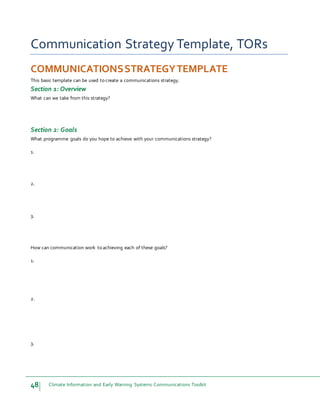
COMMUNICATIONSTRATEGY TEMPLATE,TORS 48
COMMUNICATIONS STRATEGY TEMPLATE 48
Section 1: Overview 48
Section 2: Goals 48
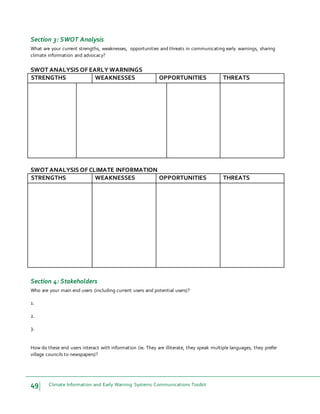
Section 3: SWOTAnalysis 49
Section 4: Stakeholders 49
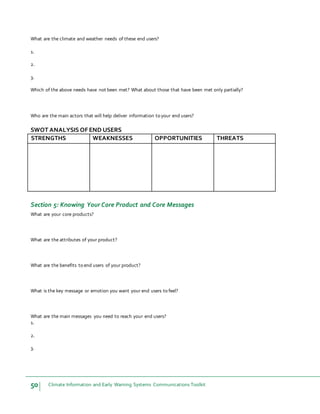
Section 5: KnowingYour CoreProduct andCore Messages 50
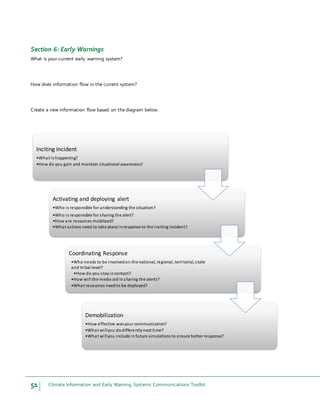
Section 6: Early Warnings 51
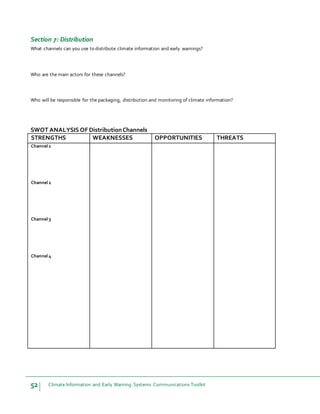
Section 7: Distribution 52
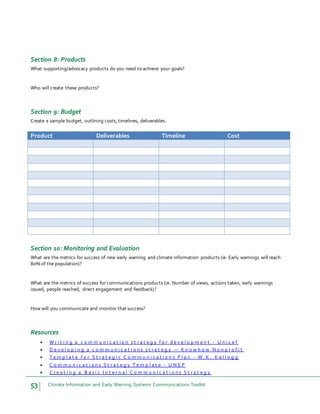
Section 8: Products 53
Section 9: Budget 53
Section 10: Monitoring and Evaluation 53
5 Climate Information and Early Warning Systems Communications Toolkit
Resources 53
COMMUNICATIONS CONSULTANT TORS TEMPLATE 54
Title 54
Application Deadline: 54
Location: 54
Type of Contract: 54
Individual Contract 54
Languages Required: 54
Starting date: 54
Duration of Initial contract: 54
Supervisor: 54
BACKGROUND 54
SCOPE OFWORK ANDDELIVERABLES 55
QUALIFICATIONS 56
MORE RESOURCES 58
WMOCOMMUNICATIONS GUIDELINES 58
OTHER RESOURCES 59
6 Climate Information and Early Warning Systems Communications Toolkit
Defining Goals
The goal of individual communications strategies will in many ways define the approach. In the case of the climate
information and early warning systems space the main goal is to leverage best practices, innovative methodologies and
existing assets to share actionable early warnings and build sustainability for climate information and early warning
systems initiatives. From this central goalpost, the approach is based on four high-level pillars that should be
considered when creating a communications strategy.
Early Warnings. According the the WMO, “The primary objective of a warning system is to empower
individuals and communities to respond timely and appropriately to the hazards in order to reduce the
risk of death, injury, property loss and damage. Warnings need to get the message across and
stimulate those at risk to take action.” In order to do this, one needs to collect and analyze data,
package and distribute early warnings, build appropriate processes and response matrixes to allow fast
delivery, and share relevant information with stakeholders and actors to ensure people know what do
to when bad weather hits.
Forecasts. Short-term forecasts and long-term outlooks can all benefit end users. The packaging,
distribution and messaging is going to depend on the end-user, the information provided and the final
goal of sharing that information.
Supportive Communications and Advocacy. This is a softer piece of the equation. The goal is to build
political support, foster understanding of the importance of NHMS, early warnings and climate
information, share best practices, actively engage community actors and brand ambassadors, and
build the value proposition being offered by NHMS.
Coordination. Coordination between agencies is key. NHMS are often the generators of early
warnings and weather and climate-related communications. However, NHMS need to work with
partner agencies, ministries, the media and more to ensure effective distribution and action based on
climate information and early warnings.
7 Climate Information and Early Warning Systems Communications Toolkit
Best Practices, Defining Roles, Required
Tools
This section provides you with best practice examples from both industrialized and developing countries on how to
issue early weather warnings. There is continued exploration on defining roles and required tools. To truly understand
what’s required, it’s also worthwhile to quickly explore the context of early warning systems in Africa.
There are a few high-level principles and challenges that should guide this conversation. For many African readers, this
will come as no surprise. However, only by understanding high-level challenges can we create communications
products and strategies to overcome those hurdles. Principle challenges for the effective issuance of early warnings in
Africa include:
 L a c k o f r e l i a b l e d a t a . W i t h l i m i t e d s t a f f s , r e s t r i c t e d b u d g e t s a n d
u n r e l i a b l e m o n i t o r i n g s y s t e m s , t h e i n f o r m a t i o n c o m i n g o u t o f m o s t N H M S
i n s u b - S a h a r a n A f r i c a i s v e r y l i m i t e d – b u t i t ’ s g e t t i n g b e t t e r ! W i t h o u t
g o o d i n f o r m a t i o n , y o u c a n ’ t m e e t t h e n e e d s o f e n d - u s e r s o r b u i l d a t r u e
v a l u e p r o p o s i t i o n .
 L a c k o f c r e d i b i l i t y . W i t h n e w i n v e s t m e n t s i n c l i m a t e m o n i t o r i n g a n d
i n f o r m a t i o n s e r v i c e s , t h e i n f o r m a t i o n g e n e r a t e d b y N H M S i s g e t t i n g
b e t t e r . H o w e v e r , m a n y N H M S c o n t i n u e t o s u f f e r f r o m a s e r i o u s i m a g e
p r o b l e m . B e c a u s e t h e r e h a s n ’ t b e e n m u c h r e l i a b l e i n f o r m a t i o n , p e o p l e ,
p o l i t i c i a n s a n d m e d i a d o n o t a l w a y s t r u s t t h e i n f o r m a t i o n c o m i n g o u t o f
N H M S . T h i s m e a n s t h a t t h e m a i n a c t o r s y o u w o u l d u s e t o s h a r e c l i m a t e
i n f o r m a t i o n a n d e a r l y w a r n i n g s a r e d i s c o n n e c t e d f r o m y o u r c o r e p r o d u c t
o f f e r i n g . R e - e n g a g i n g t h e s e a c t o r s t o d e m o n s t r a t e y o u r v a l u e p r o p o s i t i o n
w i l l b e k e y t o s u c c e s s .
 L a c k o f p r o t o c o l s . L e t ’ s s a y y o u ’ v e f i g u r e d o u t h o w t o c o l l e c t a n d a n a l y z e
w e a t h e r a n d c l i m a t e d a t a , a n d b y c r e a t i n g s o m e s m a r t a n d i n n o v a t i v e
c o m m u n i c a t i o n s s t r a t e g i e s , y o u ’ v e n i p p e d t h e c r e d i b i l i t y c h a l l e n g e i n t h e
b u d . N o w h o w d o y o u c r e a t e t h e r e s p o n s e m a t r i x n e c e s s a r y t o i s s u e e a r l y
w a r n i n g s , a n d h o w d o y o u w o r k w i t h o t h e r g o v e r n m e n t a g e n c i e s , a c t o r s ,
m e d i a a n d m o r e t o m a k e s u r e e v e r y b o d y k n o w s w h a t t h e y ’ r e d o i n g ? W h i l e
m o s t A f r i c a n n a t i o n s h a v e s o m e s o r t o f e m e r g e n c y r e s p o n s e p r o t o c o l , t h e
p a c k a g i n g a n d d i f f u s i o n ( a n d p r e v e n t a t i v e r e s p o n s e a c t i o n s ) a r e l i m i t e d .
B e n i n ’ s r e s p o n s e p r o t o c o l s h o w s a n e x a m p l e o f h o w i t c a n w o r k .
 L i m i t e d s o p h i s t i c a t i o n i n p a c k a g i n g . P e o p l e r e a d w i t h t h e i r e y e s a n d
h e a r t s – m i n d s c o m e i n l a t e r w h e n y o u a r e a n a l y z i n g w h a t y o u ’ v e j u s t
r e a d . I n l a r g e p a r t , t h e r e i s s t i l l l i m i t e d c a p a c i t y t o e f f e c t i v e l y p a c k a g e
w e a t h e r i n f o r m a t i o n – i n t h e f o r m o f e a r l y a l e r t s , a c t i o n a b l e c l i m a t e
i n f o r m a t i o n ( l i k e c r o p r e p o r t s , P u b l i c S e r v i c e A n n o u n c e m e n t s ( P S A s ) o n
w h a t t o d o w h e n b a d w e a t h e r h i t s , a n d t a i l o r e d i n f o r m a t i o n f o r p r i v a t e
s e c t o r s ) . B y c r e a t i n g p r e t t y p a c k a g e s , N H M S n o t o n l y h a v e t h e
o p p o r t u n i t y t o b u s t t h e c r e d i b i l i t y p r o b l e m , t h e y a l s o w o r k t o b u i l d m o r e
e f f e c t i v e c o n n e c t i o n w i t h t h e i r e n d u s e r s .
 L i m i t e d r e l a t i o n s h i p s w i t h t r a d i t i o n a l m e d i a a n d o t h e r a c t o r s . T h e r o l e
8 Climate Information and Early Warning Systems Communications Toolkit
o f t h e N H M S i s o f t e n l i m i t e d t o t h e g e n e r a t i o n o f t h e e a r l y w a r n i n g
m e s s a g e s . T h e s e a r e t h e n p a s s e d o n t o o t h e r a c t o r s i n t h e s y s t e m t h a t a r e
r e s p o n s i b l e f o r d i s s e m i n a t i o n a n d a c t i o n . O t h e r a c t o r s – i n c l u d i n g t h e
m e d i a , e x t e n s i o n a g e n c i e s , g o v e r n m e n t p a r t n e r s , p r i v a t e c o m p a n i e s a n d
m o r e – n e e d t o p l a y a p a r t . W h i l e l i m i t e d c r o s s - s e c t o r i a l , c r o s s - a g e n c y
c o l l a b o r a t i o n i s c u r r e n t l y h i n d e r i n g t h e a b i l i t y t o e f f e c t i v e l y e n g a g e w i t h
t h e s e p o t e n t i a l b r a n d a m b a s s a d o r s a n d m e s s e n g e r s , t h e r e i s a s t r o n g
o p p o r t u n i t y h e r e t o e n g a g e t h e m .
 L a c k o f d i s t r i b u t i o n s y s t e m s . T h e i n f o r m a t i o n i s g o o d , i t ’ s p a c k a g e d w e l l ,
p e o p l e t r u s t w h a t y o u a r e s a y i n g a n d k n o w w h a t t o d o i n t h e e v e n t o f b a d
w e a t h e r , n o w h o w d o y o u g e t t h e i n f o r m a t i o n t o a f a r m e r l i v i n g i n a
r e m o t e v a l l e y ? T h e r e a r e n u m e r o u s o p p o r t u n i t i e s i n t h i s s p a c e – a l o n g
w i t h j u s t a s m a n y c h a l l e n g e s . I n s o m e c a s e s , A f r i c a n n a t i o n s a r e m a k i n g
g o o d s t r i d e s i n c r e a t i n g e f f e c t i v e d i s t r i b u t i o n s y s t e m s , b u t s t i l l l a c k a n -
e f f e c t i v e e n d - t o - e n d p a c k a g e t h a t w i l l t r u l y r e a c h e n d - u s e r s a n d s a v e
l i v e s .
 L i m i t e d b u s i n e s s - d e v e l o p m e n t c a p a c i t y a n d n e c e s s a r y f r a m e w o r k s .
D e v e l o p i n g b u s i n e s s p l a n s a n d c o m m u n i c a t i o n s s t r a t e g i e s – o r b u i l d i n g t h e
c o n d u c i v e l e g a l a n d p o l i c y f r a m e w o r k s n e c e s s a r y t o f o s t e r t h e s e p l a n s – i s
a v e r y d i f f e r e n t s k i l l s e t f r o m t h e t r a d i t i o n a l s k i l l s o f c o l l e c t i n g ,
a n a l y z i n g a n d s h a r i n g d a t a . B y d e v e l o p i n g b u s i n e s s a c u m e n , N H M S h a v e
t h e o p p o r t u n i t y t o a d d r e s s c r e d i b i l i t y c h a l l e n g e s , b u i l d r e v e n u e s t r e a m s
a n d e n g a g e w i t h a w h o l e n e w g r o u p o f p o t e n t i a l p a r t n e r s . T h e c o n n e c t i o n s
a r e n o t y e t t h e r e , b u t i n s e v e r a l c o u n t r i e s t h e y a r e s t a r t i n g t o b l o s s o m .
 C u l t u r a l c h a l l e n g e s . C u l t u r a l c h a l l e n g e s s p a n l a n g u a g e , b e l i e f , e d u c a t i o n ,
g e n d e r , a g e a n d l i t e r a c y . T h i s i s o n e o f t h e l a r g e s t c h a l l e n g e s i n t h e u s e
a n d / o r u n d e r s t a n d i n g o f e a r l y w a r n i n g s . H o w d o y o u r e a c h a d i v e r s e g r o u p
w h o s p e a k n u m e r o u s l a n g u a g e s , h a v e u n i q u e c u l t u r a l o p t i c s o n w e a t h e r
i n f o r m a t i o n ( w h e r e t h e w o r d o f t h e v i l l a g e e l d e r m a y t r u m p t h a t o f t h e
w e a t h e r f o r e c a s t e r ) , a n d a r e o f t e n i l l i t e r a t e o r h a v e l a c k o f f o r m a l
e d u c a t i o n s ? T h i s p i e c e i s n o t e a s i l y a n s w e r e d , b u t w e m a k e s o m e a t t e m p t s
i n t h e f o l l o w i n g s e c t i o n s .
 P o l i t i c a l c h a l l e n g e s . T h e c o n t i n u e d l a c k o f c r e d i b i l i t y h a s f o s t e r e d a l a c k
o f p o l i t i c a l w i l l t o s u p p o r t N H M S w i t h e i t h e r b i g g e r b u d g e t s o r s t r o n g e r
i n s t i t u t i o n a l s t a t u s . T h i s i s w h e r e t h e s o f t w a r e p i e c e c o m e s i n . B y
c r e a t i n g s u p p o r t i v e a d v o c a c y c o m m u n i c a t i o n s t r a t e g i e s a n d a c t i v e l y
e n g a g i n g r e l e v a n t a c t o r s o n t h e p o l i c y a n d p u b l i c g o o d l e v e l , y o u h a v e t h e
o p p o r t u n i t y t o b r e a k t h e n o n - v i r t u o u s c y c l e a n d r e c o n n e c t w i t h y o u r
c h a m p i o n s i n t h e p o l i t i c a l s p a c e .
 E c o n o m i c c h a l l e n g e s . I t ’ s n o t c h e a p a n d o u t s i d e c i r c u m s t a n c e s m a y d i v e r t
f u n d s f r o m w e a t h e r a n d c l i m a t e s e r v i c e s . T h e v a l u e p r o p o s i t i o n w i l l a i d t o
l e s s e n t h e s e e c o n o m i c c h a l l e n g e s , b u t t h e y a r e , n e v e r t h e l e s s , a
r e c o g n i z e d l i m i t i n g f a c t o r , m a k i n g c e r t a i n o u t r e a c h t e c h n i q u e s o f t e n
e m p l o y e d i n d e v e l o p e d w o r l d c o n t e x t s l e s s a p p r o p r i a t e f o r t h e u n i q u e
s o c i a l , c u l t u r a l , p o l i t i c a l a n d e c o n o m i c l a n d s c a p e o f m o d e r n - d a y A f r i c a .
 C l i m a t i c c h a l l e n g e s . C h a n g i n g w e a t h e r p a t t e r n s , m o r e s e v e r e w e a t h e r
9 Climate Information and Early Warning Systems Communications Toolkit
c o n d i t i o n s , o v e r a l l c l i m a t i c c h a n g e s , f l o o d s , d r o u g h t s , l i g h t n i n g , h e a v y
r a i n s a n d o t h e r e x t r e m e w e a t h e r c o n d i t i o n s a l l p r e s e n t n e w c h a l l e n g e s f o r
N H M S a n d t h e d e v e l o p m e n t c o m m u n i t y a s a w h o l e . A d d r e s s i n g t h e s e
c h a l l e n g e s a n d p r o v i d i n g i n t e g r a t e d a d a p t a t i o n a p p r o a c h e s w i l l b u i l d
l a s t i n g r e s i l i e n c e f r o m t h e g r o u n d u p . B u t i n o r d e r t o a d a p t , t h e r e l e v a n t
s t a k e h o l d e r s w i l l r e q u i r e t i m e l y , a c c u r a t e a n d e a s i l y d i g e s t i b l e
i n f o r m a t i o n o n w e a t h e r a n d c l i m a t e .
BEST PRACTICEEXAMPLESOF EARLYWARNING
SYSTEMS
So how do you do it? Here we provide links to samples on how to build an early warning system, and how to build an
integrated communications and advocacy strategy from both developing and industrialized nations.
Europe – Cross-Border Collaboration
“Most European countries are relatively small in comparison with the scale of typical synoptic meteorological
phenomena. Many important weather events, including windstorms, heavy rains, coastal surges or cold spells can
affect large geographical areas containing several countries simultaneously; and these can occur within a very short
timescale.” This means that the need for effective exchange of warnings has existed in various European countries, and
such exchanges have been developed for some time.
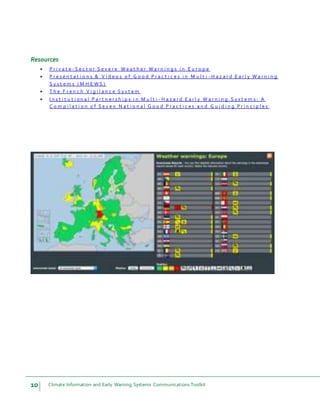
The European Multi-Purpose Meteorological Awareness (EMMA) Programme is based on the concept of
meteorological awareness and its general objective is to develop a graphical information system accessible by the
general public for the provision of expected meteorological hazard information within 24 hours. The system is intended
to complement the existing national warning systems by providing a simple and efficient way of making users aware of
possible meteorological risks. It also allows an efficient method of exchanging meteorological information related to
high-impact weather events between European forecasters.
The main characteristics of the system include:
 C o l o r - c o d e d r e g i o n s r e l a t e d t o t h e m e t e o r o l o g i c a l a w a r e n e s s l e v e l f o r t h e
s e v e r e w e a t h e r p h e n o m e n a c o v e r e d b y t h e s y s t e m .
 A c o r e o f s e v e r e w e a t h e r p h e n o m e n a t o b e a d d r e s s e d a c r o s s E u r o p e a n d t o
b e d i s p l a y e d t h r o u g h a h o m o g e n e o u s s e t o f p i c t o g r a m s , t o b e a u g m e n t e d ,
a s n e c e s s a r y , b y s o m e “ n a t i o n a l ” p h e n o m e n a .
 I n t e r a c t i v e a c c e s s t o a d d i t i o n a l l e v e l s o f i n f o r m a t i o n , s u c h a s r i s k
q u a l i f i c a t i o n f o r t h e i d e n t i f i e d p h e n o m e n a t o d e v e l o p a w a r e n e s s .
 F l e x i b l e u p d a t i n g p r o c e d u r e s d e s i g n e d t o a c c o u n t f o r i n d i v i d u a l N H M S
m o d u s o p e r a n d i , g e o g r a p h i c a l a r e a s a n d t i m e z o n e s .
 A v a i l a b i l i t y o f t e x t u a l i n f o r m a t i o n i n s e v e r a l l a n g u a g e s , a t l e a s t f o r t h e
h i g h e r l e v e l s o f a c c e s s .
 I m p l e m e n t a t i o n o f t h e M e t e o a l a r m w e b s i t e ( w w w . m e t e o a l a r m . e u ) ”
10 Climate Information and Early Warning Systems Communications Toolkit
Resources
 P r i v a t e - S e c t o r S e v e r e W e a t h e r W a r n i n g s i n E u r o p e
 P r e s e n t a t i o n s & V i d e o s o f G o o d P r a c t i c e s i n M u l t i - H a z a r d E a r l y W a r n i n g
S y s t e m s ( M H E W S )
 T h e F r e n c h V i g i l a n c e S y s t e m
 I n s t i t u t i o n a l P a r t n e r s h i p s i n M u l t i - H a z a r d E a r l y W a r n i n g S y s t e m s : A
C o m p i l a t i o n o f S e v e n N a t i o n a l G o o d P r a c t i c e s a n d G u i d i n g P r i n c i p l e s
11 Climate Information and Early Warning Systems Communications Toolkit
Alert Levels
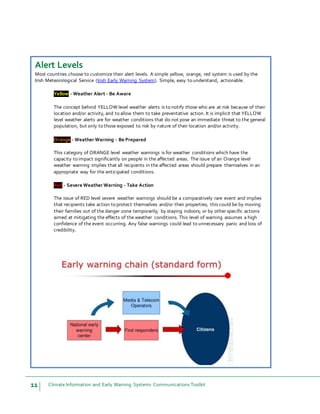
Most countries choose to customize their alert levels. A simple yellow, orange, red system is used by the
Irish Meteorological Service (Irish Early Warning System). Simple, easy to understand, actionable.
Yellow - Weather Alert - Be Aware
The concept behind YELLOW level weather alerts is to notify those who are at risk because of their
location and/or activity, and to allow them to take preventative action. It is implicit that YELLOW
level weather alerts are for weather conditions that do not pose an immediate threat to the general
population, but only to those exposed to risk by nature of their location and/or activity.
Orange - Weather Warning - Be Prepared
This category of ORANGE level weather warnings is for weather conditions which have the
capacity to impact significantly on people in the affected areas. The issue of an Orange level
weather warning implies that all recipients in the affected areas should prepare themselves in an
appropriate way for the anticipated conditions.
Red - Severe Weather Warning - Take Action
The issue of RED level severe weather warnings should be a comparatively rare event and implies
that recipients take action to protect themselves and/or their properties; this could be by moving
their families out of the danger zone temporarily; by staying indoors; or by other specific actions
aimed at mitigating the effects of the weather conditions. This level of warning assumes a high
confidence of the event occurring. Any false warnings could lead to unnecessary panic and loss of
credibility.
12 Climate Information and Early Warning Systems Communications Toolkit
USA – Defined Roles, Standard Operating Procedure
The United States has a quick acting early alert system that works across agencies to bring weather alerts at the blink
of an eye. On average, the US does 76 billion observations a year, making 1.5 million forecasts and 50,000 warnings.
Here’s how it works. The U.S. National Response Framework (NRF) provides the guiding principles that enable all
response partners to deliver a unified national response to disasters and emergencies. They share this information with
a number of agencies on the local, state and federal level. It is maintained by the U.S. Department of
Homeland Security’s Federal Emergency Management Agency (FEMA).
The National Incident Management System (NIMS) provides information to partner agencies and the private sector.
NIMS provides the framework for incident management, preparedness, communications and information
management, resource management, and other functions.
The US Emergency Management System is comprised of various agencies responsible for coordinating the
preparedness for, response to, recovery from and mitigation of disaster events. Local agencies are primarily responsible
for severe weather preparedness and warning.
Who does what? Before the event, a number of support agencies work together to coordinate response. Local
agencies provide public awareness materials. During the event, local Emergency Management Agencies coordinate
with the National Weather Service to activate warnings. Post event, disaster declarations are issued, and state, local
and federal agencies work through joint field offices to provide assistance.
Why does it work? Central components of the effective communications system are ongoing communication between
agencies through online meetings, chats, SMS and phone. There needs to be a culture of mutual trust and respect. Real
time coordination during the events is also key, as is clear messages from the National Weather Service (NWS).
Weather information is also part of everyday activities in the US. Not only do you talk about it,there’s a cable channel,
websites, apps and educational programs to reinforce the value of weather information.
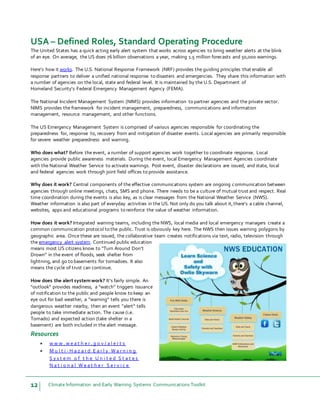
How does it work? Integrated warning teams, including the NWS, local media and local emergency managers create a
common communication protocol to the public. Trust is obviously key here. The NWS then issues warning polygons by
geographic area. Once these are issued, the collaborative team creates notifications via text, radio, television through
the emergency alert system. Continued public education
means most US citizens know to “Turn Around Don’t
Drown” in the event of floods, seek shelter from
lightning, and go to basements for tornadoes. It also
means the cycle of trust can continue.
How does the alert systemwork? It’s fairly simple. An
“outlook” provides readiness, a “watch” triggers issuance
of notification to the public and people know to keep an
eye out for bad weather, a “warning” tells you there is
dangerous weather nearby, then an event “alert” tells
people to take immediate action. The cause (i.e.
Tornado) and expected action (take shelter in a
basement) are both included in the alert message.
Resources
 w w w . w e a t h e r . g o v / a l e r t s
 M u l t i - H a z a r d E a r l y W a r n i n g
S y s t e m o f t h e U n i t e d S t a t e s
N a t i o n a l W e a t h e r S e r v i c e
13 Climate Information and Early Warning Systems Communications Toolkit
U.S. Emergency Alert System
“The Emergency Alert System (EAS) is a national public warning system that requires broadcasters, cable
television systems, wireless cable systems, satellite digital audio radio service (SDARS) providers, and direct
broadcast satellite (DBS) providers to provide the communications capability to the President to address
the American public during a national emergency. The system also may be used by state and local
authorities to deliver important emergency information, such as AMBER (child abduction) alerts and
weather information targeted to specific areas.
The Federal Communications Commission (FCC), in conjunction with Federal Emergency Management
Agency (FEMA) and the National Oceanic and Atmospheric Administration's National Weather Service
(NWS), implements the EAS at the federal level. The President has sole responsibility for determining when
the EAS will be activated at the national level, and has delegated this authority to the director of FEMA.
FEMA is responsible for implementation of the national-level activation of the EAS, tests, and exercises.
The NWS develops emergency weather information to alert the public about imminent dangerous weather
conditions.
The FCC'srole includes prescribing rules that establish technical standards for the EAS, procedures for EAS
participants to follow in the event the EAS is activated, and EAS testing protocols. Additionally, the FCC
ensures that the EAS state and local plans developed by industry conform to FCC EAS rules and
regulations.”
 E A S F C C W e b s i t e
 H u n g a r i a n N a t i o n a l A s s o c i a t i o n o f R a d i o D i s t r e s s - S i g n a l i n g a n d
I n f o c o m m u n i c a t i o n s ( R S O E )
 U S L a u n c h e s C e l l P h o n e E m e r g e n c y A l e r t S y s t e m
 I n t e g r a t e d P u b l i c A l e r t & W a r n i n g S y s t e m O p e n P l a t f o r m
 W i r e l e s s E m e r g e n c y R e p o r t s
14 Climate Information and Early Warning Systems Communications Toolkit
The Philippines – Leveraging Public-Private Partnerships
In the Philippines a new network of nearly 1,000 Automatic Weather Stations (AWS) – installed and maintained through
innovative public-private partnerships – is looking to provide the 100 million people of this island nation with free,
accurate and localized weather information that can be used to save lives, contain losses, build resilience and improve
livelihoods.
The Weather Philippines Foundation (WPF) has also developed a strong public outreach program to assist the
population of the Philippines in becoming “weather-wiser,” that is, knowing what weather information will be made
available from the WPF, understanding how such information can be used in a variety of situations, and then applying
that information properly, especially in times of severe weather. There’s an app, a webpage, dedicated TV channel, and
of course Facebook and Twitter pages. The real value is found in the localized, and quite accurate, five-day forecasts
and automated current weather feeds that update every ten minutes from the system of AWS monitoring stations.
Resources
 L e a r n M o r e a b o u t t h e P h i l i p p i n e s P r o g r a m m e
 A p p l y i n g L e s s o n s f r o m t h e P h i l i p p i n e s t o t h e A f r i c a C o n t e x t
 T h e B a n g l a d e s h C y c l o n e P r e p a r e d n e s s P r o g r a m
 T h e T r o p i c a l C y c l o n e E a r l y W a r n i n g S y s t e m o f C u b a
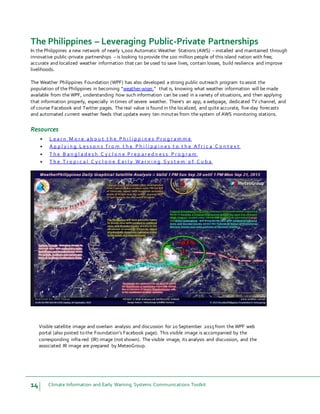
Visible satellite image and overlain analysis and discussion for 20 September 2015from the WPF web
portal (also posted to the Foundation’s Facebook page). This visible image is accompanied by the
corresponding infra-red (IR) image (not shown). The visible image, its analysis and discussion, and the
associated IR image are prepared by MeteoGroup.
15 Climate Information and Early Warning Systems Communications Toolkit
Benin – Establishment of a Standard Operating Procedure
In Benin, 800,000 people now have access to early weather warnings, thanks to the establishment of a Standard
Operating Procedure supported through the UNDP Climate Information and Early Warning Systems Project.
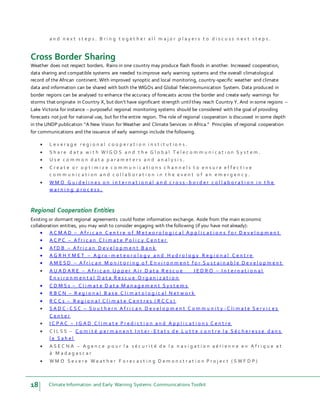
The country issued early warnings for flooding through a multi-agency committee in 2014 and 2015, using manual
monitoring of river levels, data processing and information analysis. The country has also adopted a standard operating
procedure for the diffusion of alerts through the National Disaster Management Agency. Additionally, Benin has the
technical and institutional frameworks in place for climate modelling. The country has the legal framework required to
monetize weather and climate data, but has had little success to date in successfully packaging relevant information for
use by the private sector.
The Government of Benin initiated a study to create the SOP. The communications assessment included a review of
past efforts, a state of the art, interagency brainstorming to create the SOP, SWOT analysis, analysis of the existing
communications channels and flows, and finally the proposal of a new communications flow.
The main goals of the study were to:
 I d e n t i f y a n d a n a l y z e t h e c o n t e n t o f a l l r e g u l a t i o n s a n d l e g i s l a t i o n o n t h e
d i s s e m i n a t i o n o f a l e r t s r e l a t e d t o d i s a s t e r s i n B e n i n . T h i s b a s i c d e s k s t u d y
g a v e a n o v e r a l l p i c t u r e o f h o w i n f o r m a t i o n i s s h a r e d a n d r e s p o n s i b i l i t i e s .
 I d e n t i f y a n d a n a l y z e t h e s t r e n g t h s a n d w e a k n e s s e s o f e x i s t i n g p r o t o c o l s
f o r e a r l y w a r n i n g d i s s e m i n a t i o n i n A f r i c a n c o u n t r i e s .
 P r o p o s e a s t a n d a r d i z e d s y s t e m o f c o m m u n i c a t i o n a n d w a r n i n g
d i s s e m i n a t i o n . T h i s c o m m u n i c a t i o n s y s t e m s p e c i f i e s r o l e s a n d
r e s p o n s i b i l i t i e s a n d e x p e c t e d a c t i o n s f r o m v a r i o u s a c t o r s .
 I d e n t i f y t h e l e g a l r e q u i r e m e n t s f o r t h e c r e a t i o n o f t h e S O P .
 A s s e s s s p e c i f i c c o m m u n i c a t i o n s n e e d s o f e a c h s t a k e h o l d e r .
Resources
 P r o t o c o l e N o r m a l i s e d e C o m m u n i c a t i o n e t d e D i f f u s i o n d ' a l e r t e e n c a s d e
C a t a s t r o p h e H y d r o c l i m a t i q u e a u B e n i n
 V i d e o B e n i n ' s E a r l y W a r n i n g S y s t e m
16 Climate Information and Early Warning Systems Communications Toolkit
DEFININGROLES
Who does what? How can information be shared across agencies and across borders? What structures are in place to
aid in collaboration? Defining roles is an essential component of any communications strategy. Not only is it necessary
to ensure effective issuance of early warnings, it also plays an important role in how you will elaborate a supportive
communications strategy.
Who Does What?
In order to avoid disputes over roles and responsibilities, foster buy-in and build a standard operating protocol for the
issuance of early warning messages, you’ll need to assign roles, foster a culture of collaboration and develop non-
territorial approaches. Like almost any initiative, the assignment and distribution of roles and responsibilities should
begin from the ground up. This will ensure buy-in from all stakeholders. Because every country has its unique political
framework, there are no off-the-shelf solutions. However, focusing on a few key areas will help in the definition of roles
and responsibilities.
If you look at the roles from the bottom up, you might generalize them in the following way (as adapted from the FEMA
roles and responsibilities matrix):
 L o c a l . L o c a l l e a d e r s a n d e m e r g e n c y m a n a g e r s p r e p a r e c o m m u n i t i e s t o
m a n a g e i n c i d e n t s l o c a l l y .
o E l e c t e d O f f i c i a l s e n s u r e t h e s a f e t y a n d w e l f a r e o f t h e p e o p l e u n d e r
t h e i r j u r i s d i c t i o n . T h e y a l s o w o r k c l o s e l y w i t h c o n g r e s s i o n a l a n d
r e g i o n a l l e a d e r s t o e n s u r e e f f e c t i v e r e s p o n s e a n d d i s t r i b u t i o n o f
e m e r g e n c y w a r n i n g s a n d a c t i o n s .
o E m e r g e n c y M a n a g e r . T h e l o c a l e m e r g e n c y m a n a g e r h a s t h e d a y - t o - d a y
a u t h o r i t y a n d r e s p o n s i b i l i t y f o r o v e r s e e i n g e m e r g e n c y m a n a g e m e n t
p r o g r a m s a n d a c t i v i t i e s . T h e y a r e n o t n e c e s s a r i l y r e s p o n s i b l e f o r t h e
i s s u a n c e o f e a r l y a l e r t s .
o D e p a r t m e n t a n d a g e n c y h e a d s . C o o r d i n a t e l o c a l s e r v i c e s .
o I n d i v i d u a l s a n d c o m m u n i t i e s . R e d u c e h a z a r d s , p r e p a r e f o r
e m e r g e n c i e s , m o n i t o r e m e r g e n c y c o m m u n i c a t i o n s .
 S t a t e s , T e r r i t o r i e s , A u t o n o m o u s / T r i b a l G o v e r n m e n t s . S u p p o r t l o c a l e f f o r t s .
T h e y m a y b e c h a r g e d w i t h r e g i o n a l e m e r g e n c y r e s p o n s e , o r t h i s r e s p o n s i b i l i t y
m a y l a y a t t h e l o c a l o r n a t i o n a l l e v e l .
o G o v e r n o r a n d e l e c t e d o f f i c i a l s . C o m m u n i c a t e w i t h l o c a l g r o u p s ,
n a t i o n a l g r o u p s a n d a f f e c t e d c o m m u n i t i e s .
o S t a t e E m e r g e n c y A g e n c y . T h i s m a y n o t b e a p p l i c a b l e i n a l l s i t u a t i o n s .
 F e d e r a l . I n m o s t A f r i c a n n a t i o n s , e m e r g e n c y a l e r t s w i l l b e i n i t i a t e d o n t h e
f e d e r a l l e v e l .
o P r e s i d e n t . O v e r a l l o v e r s i g h t .
o M i n i s t r i e s . I n d i v i d u a l m i n i s t r i e s m a y b e r e s p o n s i b l e f o r s e c t o r i a l
r e s p o n s e a n d a l e r t s ( i . e . h y d r o l o g y , a g r i c u l t u r e , e n e r g y , n a t i o n a l
s e c u r i t y )
o N H M S . M o n i t o r w e a t h e r a n d i s s u e a l e r t s ( o r a l e r t r e l e v a n t d i s a s t e r
m a n a g e m e n t a g e n c y )
o D i s a s t e r M a n a g e m e n t U n i t . N o t a l l c o u n t r i e s h a v e a d e d i c a t e d u n i t .
T h i s r e v o l v i n g p o i n t c a n b e u s e d t o c o o r d i n a t e w a r n i n g s .
17 Climate Information and Early Warning Systems Communications Toolkit
 I n t e r n a t i o n a l . O n t h e i n t e r n a t i o n a l l e v e l , e i t h e r t h e P r e s i d e n t o r M i n i s t e r o f
F o r e i g n A f f a i r s w o u l d b e r e s p o n s i b l e f o r i n t e r n a t i o n a l c o o r d i n a t i o n . H o w e v e r,
w e a t h e r a l e r t s s h o u l d b e s h a r e d w i t h N H M S i n n e i g h b o r i n g c o u n t r i e s t o
t r i g g e r t h e i r o w n r e s p o n s e .
 P r i v a t e S e c t o r . T h e p r i v a t e s e c t o r i s o f t e n r e s p o n s i b l e f o r l a r g e p i e c e s o f
i n f r a s t r u c t u r e . I n t h e c a s e o f t h e i s s u a n c e o f e a r l y w a r n i n g s , p r i v a t e t e l e c o m s
a n d m e d i a c o m p a n i e s c a n a l s o a i d i n t h e d i s t r i b u t i o n o f w a r n i n g s .
 N G O s . T h i s g r o u p o f a c t o r s c a n m o b i l i z e s u p p l i e s , s h a r e e m e r g e n c y
i n f o r m a t i o n a n d p r o v i d e r e s p o n s e . T h e y c a n a l s o b e m o b i l i z e d t o p r o v i d e
t r a i n i n g o n w h a t t o d o i n t h e e v e n t o f a w a r n i n g , a n d a s b r o a d c a s t e r s f o r
i n f o r m a t i o n o n r e q u i r e d a c t i o n s i n t h e e v e n t o f a n e m e r g e n c y .
Guiding Principles
 C r e a t e B u y - I n . B r a i n s t o r m i n g
s e s s i o n s , i n t e r a g e n c y
c o m m i t t e e s a n d w o r k i n g g r o u p s
a r e a l l e s s e n t i a l f o r b u i l d i n g
t h e n e c e s s a r y c o l l a b o r a t i o n .
 C o m m u n i c a t e . B y
c o m m u n i c a t i n g r e g u l a r l y w i t h
a l l s t a k e h o l d e r s ( n o t j u s t a b o u t
r o l e s , b u t a b o u t e f f e c t i v e
a c t i o n s ) , y o u c o n t i n u e t o
p e r p e t u a t e t h a t c i r c l e o f t r u s t .
 A s s i g n R o l e s a n d
R e s p o n s i b i l i t i e s . M a k e i t c l e a r
w h o i s r e s p o n s i b l e f o r w h a t .
 E n g a g e A c t o r s . R e a c h i n g y o u r
g o a l s w i l l r e q u i r e c o n n e c t i o n
w i t h a l a r g e n u m b e r o f
r e g i o n a l , t e r r i t o r i a l a n d l o c a l
a c t o r s .
 R e h e a r s e . P r a c t i c e w h a t y o u
a r e d o i n g b e f o r e i t ’ s t i m e t o
a c t u a l l y i s s u e a w a r n i n g .
 A c t i v a t e . W h e n t h e t i m e c o m e s
t o i s s u e a n e a r l y w a r n i n g , b e
s u r e t o m a i n t a i n c o n s t a n t
c o n t a c t b e t w e e n o r g a n i z a t i o n s
t o e n s u r e c o l l a b o r a t i o n .
 F o l l o w u p . A f t e r t h e s t o r m ,
y o u s h o u l d t a k e s t o c k o f
s u c c e s s e s , f a i l u r e s , c h a l l e n g e s
Information flow from the Benin SOP.
18 Climate Information and Early Warning Systems Communications Toolkit
a n d n e x t s t e p s . B r i n g t o g e t h e r a l l m a j o r p l a y e r s t o d i s c u s s n e x t s t e p s .
Cross Border Sharing
Weather does not respect borders. Rains in one country may produce flash floods in another. Increased cooperation,
data sharing and compatible systems are needed to improve early warning systems and the overall climatological
record of the African continent. With improved synoptic and local monitoring, country-specific weather and climate
data and information can be shared with both the WIGOs and Global Telecommunication System. Data produced in
border regions can be analysed to enhance the accuracy of forecasts across the border and create early warnings for
storms that originate in Country X, but don’t have significant strength until they reach Country Y. And in some regions –
Lake Victoria for instance – purposeful regional monitoring systems should be considered with the goal of providing
forecasts not just for national use, but for the entire region. The role of regional cooperation is discussed in some depth
in the UNDP publication “A New Vision for Weather and Climate Services in Africa.” Principles of regional cooperation
for communications and the issuance of early warnings include the following.
 L e v e r a g e r e g i o n a l c o o p e r a t i o n i n s t i t u t i o n s .
 S h a r e d a t a w i t h W I G O S a n d t h e G l o b a l T e l e c o m m u n i c a t i o n S y s t e m .
 U s e c o m m o n d a t a p a r a m e t e r s a n d a n a l y s i s .
 C r e a t e o r o p t i m i z e c o m m u n i c a t i o n s c h a n n e l s t o e n s u r e e f f e c t i v e
c o m m u n i c a t i o n a n d c o l l a b o r a t i o n i n t h e e v e n t o f a n e m e r g e n c y .
 W M O G u i d e l i n e s o n i n t e r n a t i o n a l a n d c r o s s - b o r d e r c o l l a b o r a t i o n i n t h e
w a r n i n g p r o c e s s .
Regional Cooperation Entities
Existing or dormant regional agreements could foster information exchange. Aside from the main economic
collaboration entities, you may wish to consider engaging with the following (if you have not already):
 A C M A D – A f r i c a n C e n t r e o f M e t e o r o l o g i c a l A p p l i c a t i o n s f o r D e v e l o p m e n t
 A C P C – A f r i c a n C l i m a t e P o l i c y C e n t e r
 A f D B – A f r i c a n D e v e l o p m e n t B a n k
 A G R H Y M E T – A g r o - m e t e o r o l o g y a n d H y d r o l o g y R e g i o n a l C e n t r e
 A M E S D – A f r i c a n M o n i t o r i n g o f E n v i r o n m e n t f o r S u s t a i n a b l e D e v e l o p m e n t
 A U A D A R E – A f r i c a n U p p e r A i r D a t a R e s c u e I E D R O – I n t e r n a t i o n a l
E n v i r o n m e n t a l D a t a R e s c u e O r g a n i z a t i o n
 C D M S s – C l i m a t e D a t a M a n a g e m e n t S y s t e m s
 R B C N – R e g i o n a l B a s e C l i m a t o l o g i c a l N e t w o r k
 R C C s – R e g i o n a l C l i m a t e C e n t r e s ( R C C s )
 S A D C - C S C – S o u t h e r n A f r i c a n D e v e l o p m e n t C o m m u n i t y - C l i m a t e S e r v i c e s
C e n t e r
 I C P A C – I G A D C l i m a t e P r e d i c t i o n a n d A p p l i c a t i o n s C e n t r e
 C I L S S – C o m i t é p e r m a n e n t I n t e r - E t a t s d e L u t t e c o n t r e l a S é c h e r e s s e d a n s
l e S a h e l
 A S E C N A – A g e n c e p o u r l a s é c u r i t é d e l a n a v i g a t i o n a é r i e n n e e n A f r i q u e e t
à M a d a g a s c a r
 W M O S e v e r e W e a t h e r F o r e c a s t i n g D e m o n s t r a t i o n P r o j e c t ( S W F D P )
19 Climate Information and Early Warning Systems Communications Toolkit
REQUIREDTOOLS
The required tools include an institutional framework, planning and response cycles, and of course the technology,
human resources and capacity to get the job done.
Cycle of Preparedness1
 P l a n . P l a n n i n g a n d c a p a c i t y
b u i l d i n g , i n f o r m a t i o n
g a t h e r i n g a n d a n a l y s i s .
 O r g a n i z e . O r g a n i z i n g t h e
r e s p o n s i b l e p a r t i e s ,
s t r e n g t h e n i n g l e a d e r s h i p a n d
e s t a b l i s h i n g r o l e s , a c q u i r i n g
n e c e s s a r y e q u i p m e n t , t r a i n i n g
o n t h e u s e o f e q u i p m e n t .
 E x e r c i s e . P r a c t i c e a n d
s i m u l a t e w h a t y o u d o .
 E v a l u a t e a n d I m p r o v e . T a k e
t h e l e s s o n s l e a r n e d t o i m p r o v e
y o u r r e s p o n s e s e r v i c e s .
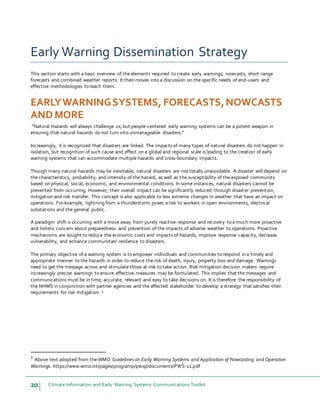
Cycle of response2
 S i t u a t i o n a l A w a r e n e s s .
E s t a b l i s h b a s e l i n e p r i o r i t i e s ,
p r o v i d e t h e r i g h t i n f o r m a t i o n
a t t h e r i g h t t i m e , s h a r e l o c a l
i n c i d e n t s w i t h r e l e v a n t a c t o r s ,
l i n k o p e r a t i o n s , i s s u a n c e o f
a l e r t s , c r e a t i o n o f o p e r a t i o n
c e n t e r s a n d u n i t s .
 A c t i v a t e a n d D e p l o y . A c t i v a t e
a n d d e p l o y p e o p l e , r e s o u r c e s ,
c a p a b i l i t i e s , e s t a b l i s h
e m e r g e n c y o p e r a t i o n s c e n t e r .
 C o o r d i n a t e R e s p o n s e .
C o o r d i n a t e b e t w e e n a l l
r e l e v a n t a c t o r s , i n c l u d i n g
c o o r d i n a t i n g i n i t i a l a c t i o n s ,
r e q u e s t s f o r a d d i t i o n a l s u p p o r t , i d e n t i f y i n g a n d i n t e g r a t i n g r e s o u r c e s a n d
c a p a b i l i t i e s , i n f o r m a t i o n f l o w .
1 S o u rc e F E MA . h t t p s : / / w w w . f e ma . g o v /p d f / e me rg e n cy / n rf / n rf -c o re .p d f
2 I b i d .
20 Climate Information and Early Warning Systems Communications Toolkit
Early Warning Dissemination Strategy
This section starts with a basic overview of the elements required to create early warnings, nowcasts, short-range
forecasts and combined weather reports. It then moves into a discussion on the specific needs of end-users and
effective methodologies to reach them.
EARLYWARNINGSYSTEMS, FORECASTS,NOWCASTS
AND MORE
“Natural Hazards will always challenge us, but people-centered early warning systems can be a potent weapon in
ensuring that natural hazards do not turn into unmanageable disasters.”
Increasingly, it is recognized that disasters are linked. The impacts of many types of natural disasters do not happen in
isolation, but recognition of such cause and effect on a global and regional scale is leading to the creation of early
warning systems that can accommodate multiple hazards and cross-boundary impacts.
Though many natural hazards may be inevitable, natural disasters are not totally unavoidable. A disaster will depend on
the characteristics, probability, and intensity of the hazard, as well as the susceptibility of the exposed community
based on physical, social, economic, and environmental conditions. In some instances, natural disasters cannot be
prevented from occurring. However, their overall impact can be significantly reduced through disaster prevention,
mitigation and risk transfer. This concept is also applicable to less extreme changes in weather that have an impact on
operations. For example, lightning from a thunderstorm poses a risk to workers in open environments, electrical
substations and the general public.
A paradigm shift is occurring with a move away from purely reactive response and recovery to a much more proactive
and holistic concern about preparedness and prevention of the impacts of adverse weather to operations. Proactive
mechanisms are sought to reduce the economic costs and impacts of hazards, improve response capacity, decrease
vulnerability, and enhance communities’ resilience to disasters.
The primary objective of a warning system is to empower individuals and communities to respond in a timely and
appropriate manner to the hazards in order to reduce the risk of death, injury, property loss and damage. Warnings
need to get the message across and stimulate those at risk to take action. Risk mitigation decision makers require
increasingly precise warnings to ensure effective measures may be formulated. This implies that the messages and
communications must be in time, accurate, relevant and easy to take decisions on. It is therefore the responsibility of
the NHMS in conjunction with partner agencies and the affected stakeholder to develop a strategy that satisfies their
requirements for risk mitigation. 3
3 Above text adopted from the WMO Guidelines on Early Warning Systems and Application of Nowcasting and Operation
Warnings. https://www.wmo.int/pages/prog/amp/pwsp/documents/PWS-21.pdf
21 Climate Information and Early Warning Systems Communications Toolkit
Developing the message content
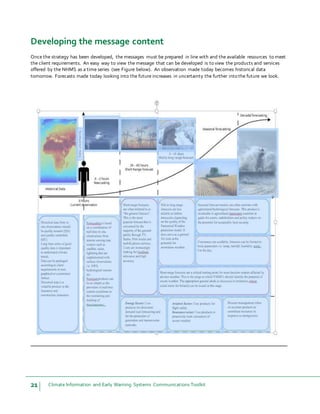
Once the strategy has been developed, the messages must be prepared in line with and the available resources to meet
the client requirements. An easy way to view the message that can be developed is to view the products and services
offered by the NHMS as a time series (see Figure below). An observation made today becomes historical data
tomorrow. Forecasts made today looking into the future increases in uncertainty the further into the future we look.
22 Climate Information and Early Warning Systems Communications Toolkit
Historical Data
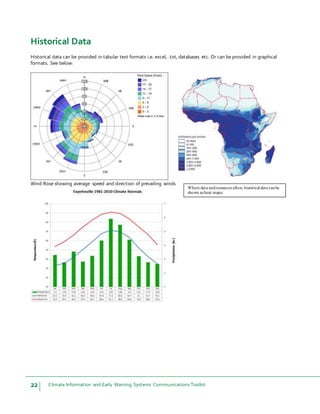
Historical data can be provided in tabular text formats i.e. excel, .txt, databases etc. Or can be provided in graphical
formats. See below:
Wind Rose showing average speed and direction of prevailing winds
30 year climate data for precipitation with Average, max and min
Where data andresources allow, historical data canbe
shown as heat maps:
23 Climate Information and Early Warning Systems Communications Toolkit
Infographic generated from radar and short range
forecasting models showing the path of the
identified storm. Note: Australia has a
comparatively high level of meteorological
literacy amongst its population due to an
extensive education campaign over the years
Radio and TV Broadcast
Advisory and action
Nowcasting
Nowcasting messages are generally associated with severe thunderstorm warnings that include heavy rain, large hail,
damaging winds and the potential of flash floods. Depending on the communication strategy, the message content can
range from a few characters i.e. twitter, sms, to a more substantial narrative sent via email. Bear in mind that severe
thunderstorms in convective environments can develop within 15 to 30 minutes. It is therefore necessary to convey as
much information as possible in a short concise message. See a sample message from the Bureau of meteorology in
Australia.
24 Climate Information and Early Warning Systems Communications Toolkit
Short-Range Forecasting
The preparation of short-range forecasts is the most flexible depending on the requirements of the end user.
The most common means of providing the general forecast is through a basic infographic. Most basic web-based
platforms have built in tools that can allow for automated infographic generation. The use of symbols can aid
understanding amongst illiterate people.
More complex methods of forecast display are through Meteograms:
It should be noted that Meteograms are dependent on good NWP processing capability to downscale regional forecasts
to an hourly update for up to 30 parameters.
25 Climate Information and Early Warning Systems Communications Toolkit
Combining different time scales
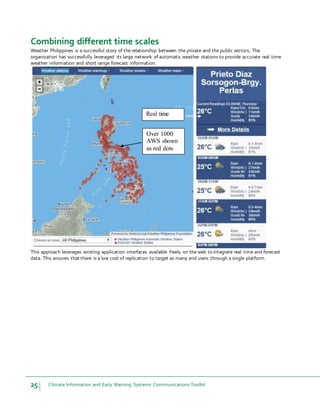
Weather Philippines is a successful story of the relationship between the private and the public sectors. The
organization has successfully leveraged its large network of automatic weather stations to provide accurate real time
weather information and short range forecast information.
This approach leverages existing application interfaces available freely on the web to integrate real time and forecast
data. This ensures that there is a low cost of replication to target as many end users through a single platform.
Over 1000
AWS shown
as red dots
Real time
data
26 Climate Information and Early Warning Systems Communications Toolkit
IDENTIFYINGSTAKEHOLDERS
The most important element of communication is remembering your audience. Only by knowing and listening to your
target market can you effectively share messages with them. End users for climate information and early warning
systems include farmers, communities, policy makers and the private sector. Actors to reach these stakeholders include
telecoms/electronic media, NHMS, communityleaders, first responders, NGOs, education, health, early warning
center, brand ambassadors, country projects, partner agencies, CIRDA, UNDP and the community of practice, rural
radio… and the list goes on.
Understanding stakeholders is not an easy process, especially as regional linguistic, cultural, media and political
variations create nuances from country to country for both end-users (communities and farmers) and policy makers.
Messages to reach specific stakeholders are discussed later in this toolkit.
End Users
Farmers. This target group is comprised of crop farmers, smallholder farmers, industrialized farmers, pastoralists
(livestock herders), fishermen and rural enterprisers. This target group has multiple needs for weather and climate
information. It can save lives, contain losses, increase productivity and reduce risk. Reaching rural farmers is a
challenge, Internet communication is virtually impossible, literacy is low, and there are regional and village-level
cultural and linguistic differences. Primary methodologies for reaching this group include: rural radio, SMS, trainings
and informational meetings hosted at the community level, billboards, outreach from schools and health organizations,
NGOs, pamphlets and other advocacy methods. They can also be reached through value-added service provides,
extension services, cooperatives and innovative last mile approaches such as Human Network International’s 3-2-1
Service.
Local Communities. This group is comprised of community leaders, farm cooperative leaders, village leadership,
regional politicians, children, teachers, moms, elders and other community members that don’t work in farming, local
NGOs, extension services and medium-scale local enterprisers. Reaching this group is a little easier. Villages will often
have access to television, radio, and may even have access to the Internet. Primary vehicles to reach them include
Public Service Announcements (PSAs), TV, training, radio, policy dialogue (learning routes), print media, social media
(growing but still limited), community meetings, school and hospital outreach, SMS and engagement with extension
services. Some communities have enabled communications tree within the leadership to ensure messages are
disseminated rapidly once generated.
Policy Makers. This group is comprised of national leaders in the NHMS, Senate, House of Representatives, executive
branch, ministries, media, large private-sector enterprise (telecommunications, banking, mining, etc.), universities,
think tanks, and regional cooperation entities (i.e. African Union). Reaching them should be the easiest of all. They can
be reached by email, social media, print, radio, broadcast, and advocacy. However, impacting their opinions and
policies is a whole other ballgame. In order to reach them and sway opinion and policy, you first need to reach their
constituencies (farmers and communities), empower product champions, and foster learning opportunities.
Private Sector. Not only do private sector enterprises benefit from tailored weather information – to protect human
and physical resources and make climate-smart business decisions – they can also play a role in disseminating
messages. Telecommunications firms can site AWS and serve as go-betweens to send early alerts, mining companies
can be tapped to leverage corporate social responsibility dollars, or pay for tailored weather information, media can be
used to share early alerts and PSAs. In order to engage the private sector, you need to create a narrative that
underscores your specific value to them and to their consumers. They need to understand you are creating a valuable
product that they can trust.
27 Climate Information and Early Warning Systems Communications Toolkit
Actors
Reaching these groups means enlisting the support of a wide group of actors. These actors serve as brand
ambassadors, as messengers, as emergency responders and as education providers. The specific needs and
responsibilities of these actors were addressed in the Who Does What section.
Understanding your stakeholders
There are various methods to understand your stakeholders. These include surveys, communityforums, policy
dialogue, media monitoring, and outreach to leaders. Constant contact between stakeholders is key. Some other
indicators may also give you unique insights on public opinion, these include elections, lobbying and interest groups,
market forces and demand, monitoring of traditional and electronic media, direct letters and calls, protests, and straw
polls.
Questions to Ask
Not only do you need to understand your stakeholders, you also need to understand what type of information they
need and demand, how they get and use information, their media habits and how information is shared. Approaches
will vary by country, but important questions to ask yourself and your stakeholders include the following:
 W h a t d i d o u r b a s e l i n e s t u d y t e l l u s a b o u t o u r t a r g e t m a r k e t ?
 W h a t a r e e n d - u s e r r e q u i r e m e n t s f o r / r e l i a n c e o n r e l i a b l e m e t e o r o l o g i c a l
i n f o r m a t i o n ?
 W h a t c u r r e n t a s s e t s d o w e h a v e ? I s t h e r e a m a r k e t s t u d y , b r o a d e r a n a l y s i s
o n m e d i a u s e , d e m o g r a p h i c i n f o r m a t i o n ? H o w c a n w e u s e t h i s i n f o r m a t i o n
t o e n g a g e o u r s t a k e h o l d e r s ?
 H o w i s t h e i r c u r r e n t w e a t h e r / c l i m a t e i n f o r m a t i o n a c q u i r e d ? ( i t m a y n o t b e
t h e m e d i a , N H M S o r a n N G O , b u t v i l l a g e e l d e r s , r e l i g i o n , n a t u r e ’ s s i g n s ,
e t c . )
 W h a t i s t h e m o s t p o p u l a r m e d i a ? A n d w h a t a r e t h e m e d i a h a b i t s o f o u r
s t a k e h o l d e r s ? U n d e r s t a n d i n g h o w p e o p l e u s e m e d i a a n d t h e r e a s o n s f o r
t h e i r c h o i c e s w i l l d e f i n e y o u r c h a n n e l s a n d m e s s a g e s .
 W h a t i s t h e a g e a n d g e n d e r d e m o g r a p h i c p r e f e r e n c e s p e r d i s s e m i n a t i o n
t e c h n o l o g y ? W h a t a b o u t t h e i n f l u e n c e o f e d u c a t i o n a n d i n c o m e ? R u r a l v s .
u r b a n p o p u l a t i o n s ? Y o u n g p e o p l e m a y b e m o r e a t t u n e d t o i n f o r m a t i o n v i a
S M S o r s m a r t p h o n e , w h i l e t h e o l d e r g e n e r a t i o n – o r w e a l t h i e r f a m i l i e s –
m a y p r e f e r r a d i o .
 W h a t a r e t h e p a s t e x p e r i e n c e s r e l a t e d t o w a r n i n g s a n d d i s a s t e r s –
t i m e l i n e s s , a c c u r a c y , c o n t e n t , r e c o m m e n d a t i o n s , c o n s i s t e n c y a c r o s s
v a r i o u s s o u r c e s .
 A r e y o u d i s s e m i n a t i n g i n f o r m a t i o n t o p e o p l e i n s i d e b u i l d i n g s o r o u t s i d e ?
D i f f e r e n t c o m m u n i c a t i o n m e a n s m a y b e n e e d e d t o d i s s e m i n a t e t h e
m e s s a g e t o t h e s e t w o g r o u p s . T h i s i s e s p e c i a l l y i m p o r t a n t i n u r b a n a r e a s .
 W h o a r e t h e t r u s t e d s o u r c e s o f y o u r a u d i e n c e s ? W i l l t h e y t r u s t a S M S f r o m
t h e N H M S o r w o u l d t h e y p r e f e r t o g e t t h e m e s s a g e f r o m a v i l l a g e l e a d e r ?
A n d i f s o , h o w d o y o u i n f o r m t h e v i l l a g e l e a d e r ?
28 Climate Information and Early Warning Systems Communications Toolkit
Resources
 A D e t a i l e d S n a p s h o t o f A f r i c a ’ s e m e r g i n g I n t e r n e t a n d s o c i a l m e d i a s p a c e
– t h e u s e r s a n d w h a t t h e y a r e d o i n g
 N i e l s e n G u i d e t o A f r i c a n M a r k e t D e m o g r a p h i c s – C o u n t r y - b y - c o u n t r y
a n a l y s i s o f m e d i a h a b i t s , m a r k e t s e g m e n t s
 M e a s u r i n g P u b l i c O p i n i o n
 C r e a t i n g S u r v e y s
 P u b l i c F o r u m s
 B r a n d A m b a s s a d o r s
 B e s t P r a c t i c e s f o r R e s e a r c h
ADDRESSINGCHALLENGESANDOPPORTUNITIES
(SWOT)
As you get started in creating a communications strategy, you may wish to consider including a SWOT analysis. This
measures the strengths, weaknesses, opportunities and threats of your products and stakeholders. You may need to
conduct more than one SWOT analysis. For instance, if you want to know how the media will react to your product
offering, you’ll wish to do a SWOT analysis ahead of time.
SWOTs to Include
 I n t e r n a l . H o w w e l l a r e t h e p r o j e c t t e a m a n d t h e b r o a d e r g r o u p
w o r k i n g t o g e t h e r t o i m p r o v e c l i m a t e i n f o r m a t io n a n d e a r l y
w a r n i n g s y s t e m s ? A r e t h e r e c o m m u n i c a t io n s b o t t l en e c ks ,
c h a l l e n g e s t h a t n e e d t o b e a d d r e s s e s ? W h o w o u l d d o t h e b e s t j o b
a t a c h i e v in g s p e c i fi c t a s k s ?
 I n t e r - A g e n cy . M o v e i t u p a n o t c h . H o w d o t h e v a r i o u s a g e n c i e s
w o r k t o g e t h e r ? H o w d o t h e y i n t e r r e l at e ? D o y o u r e q u i r e a p r o c e s s
o f c h a n g e m a n a g e m en t ?
 E n d U s e r s . W h o a r e y o u r e n d u s e r s , h o w d o t h e y u s e i n f o r m a t io n ,
d o t h e y t r u s t t h e i n f o r m a t io n y o u a r e p r o v i d i n g ?
 A c t o r s . W h o c a n y o u e n g a g e t o m o v e y o u r m e s s a g e t o e n d u s e r s
a n d a c h i e v e p r o j ec t g o a ls ?
 M e d i a . Y e s , m e d i a i s a f i n e a s s e t . B u t w i t h i n y o u r c o u n t r y , h o w
d o p e o p l e i n t e r a c t w i t h m e d i a, d o t h e m e d i a t r u s t t h e f o r e c a s t s
a n d s h a r e t h e m , a r e t h e y a t r u e b r a n d a m b a s s a d o r o r a r e t h e y a
t h r e a t ?
 P r i v a t e S e c t o r . A r e t h e r e i n d u s t r i e s t h at c o u l d b e n e f i t f r o m
t a i l o r ed w e a t h e r i n f o r m a t io n ? W h a t ’ s t h e ir p e r c e p t io n ?
 Y o u r P r o d u c t . F i r s t y o u ’ ll n e e d t o d e f i n e y o u r p r o d u c t . I s i t t h e
p r o j e c t i t s e l f ? O r i s i t t h e c l i m a t e i n f o r m a t io n a n d e a r l y w a r n i n g s
29 Climate Information and Early Warning Systems Communications Toolkit
y o u a r e p r o d u c i n g ? M o s t m a r k e t er s w o u l d a r g u e t h e l a t t er . I f s o ,
w h a t a r e t h e s t r e n g t h s a n d v a l u e p r o p o s i t i o n s o f t h a t p r o du c t ?
W h e r e a r e t h e w e a k n e s s e s ? H o w c a n y o u r e a c h n e w p e o p le a n d
n e w m a r k e t s ? A n d w h a t f o r c e s c o u l d d e r a i l y o u r e f f o r t s ? L o o k in g
a t t h e s e w i l l h e l p y o u d e f i n e y o u r m e s s a g e , y o u r c h a n n e l a n d y o ur
s t r a t e g y.
Sample SWOTs
SWOT ANALYSIS OF EARLY WARNINGS
SWOT ANALYSIS OF CLIMATE INFORMATION IN SUB-SAHARAN AFRICA
STRENGTHS WEAKNESSES OPPORTUNITIES THREATS
There have been significant advances in
explaining the dynamics ofAfrican climate
variability, which has led to a growing
confidence in climate forecasts while seasonal
outlooks have gained greater importance in
managing climatic risks.
Climate forecasts can help those who depend
on agriculture with decisions such as: whether
or not to plant, when to sow, which seeds or
crop varieties to choose, herd migration,
livestock sale orslaughter, what pest
protection alternative is best and whether or
not to apply inorganicfertilizers. Additionally,
forecasts can also help anticipate the
emergence ofcertain types of pests, fungi and
smuts.
Climate forecasts can increase farmers’
preparedness and lead to better economic and
environmental outcomes in the long run.
Climate information can improve resource
management and enhance the welfare of
agricultural and rural populations, which also
represent the bulk ofpeople living in poverty.
Climate information helps to mitigate risk,
which is a documented reason for the weak
performance ofsub-Saharan countries. The
inherent uncertainty arising from natural
climate variability is challenging since farmers
must take many critical and climate-sensitive
decisions months before the impacts ofclimate
are realized.
Climate forecasts can help contain disasters
and also capitalize on temporarily favourable
states ofnature.
Sub-Saharan Africa’s climate observation
networks and systems are poor. Where
networks and infrastructure do exist, many are
in decline.
Lowquality and limited accessibility of climate
data.
Sparse data coverage and temporal gaps. In
some locations, time series data have been,
and continue to be, disrupted by natural
disasters and/or conflict.
The development and refinement of climate
models typically take place outside of Africa.
Packaging skills are lacking, making it difficult
to reach end-users effectively.
Climate information is notsold to the private
sector on a large scale.
Increase the quality and quantity of climate
observation networks and infrastructure in sub-
Saharan Africa.
Recover unarchived historical data that has not
been digitised yet and therefore, it has been
inaccessible to researchers.
Address barriers to the uptake ofclimate
information, including institutional mandates,
hierarchical structures and the lack of adequate
incentives.
Promoting the usefulness ofclimate
information in ways that decision-makers value
most. There is a need to help them understand
what climate information should and should
not be used for, and to encourage more
systematic and evidence-based approaches to
decision making under uncertainty.
Farmers will increase their demand for accurate
climate forecasts as climate change renders
their traditional information sources and
experiences less reliable.
Break poverty cycles. By having access to
seasonal forecasts, for instance, subsistence
farmers can adapt their strategies accordingly
and avoid losses or complete crop failure.
Success, however, hinges on farmers having
access to adaptation options.
Partner with the health sector. Most infectious
diseases can be better managed if climate
information is readily available to predict
changes in rainfall, temperature and humidity.
Fostering economic development via better
informed sectors, such as agriculture, forestry,
fishing, mining, water resources, energy,
transportation, aviation and tourism. In
addition, national hydromet services can also
supplement their resources by packaging and
selling information to the private sector.
Lack ofcapacity and/or willingness among
potential users to access, understand the
probabilistic nature of climate information,
process and act upon the available information.
Political and socioeconomicfactors may be
inimical to the uptake of climate information in
decision making processes with long term
consequences.
Limited capacity to identify needs for training
on climate change and its potential impacts, as
well as on how to integrate medium- to long-
term information into existing policies and
decision making processes.
The role of communicating climate information
is usually given to formal scientific bodies and
the information that reaches end users is
usually overly technical, ill-matched to their
demands and easily leads to misunderstanding
of the uncertainties associated with it.
Lack ofeffective communication and
engagement between the users and producers
of climate information, which leads to
misunderstandings about the merits and
limitations of its use.
There is a mismatch between the capacity of
climate scientists to produce policy-relevant
information, and the decision-makers’
unrealistic expectations about the information
they could receive.
Sometimes religious beliefs clash with the
concept ofbeing able to predict the weather
and the use of climate information is
consequently reduced.
Resources
 P r o m o t i n g t h e u s e o f c l i m a t e i n f o r m a t i o n t o a c h i e v e l o n g - t e r m
d e v e l o p m e n t o b j e c t i v e s i n s u b - S a h a r a n A f r i c a .
30 Climate Information and Early Warning Systems Communications Toolkit
ZAMBIA METEOROLOGICAL DEPARTMENT (ZMD)
This SWOT was included in the Zambia CI/EWS draft communications strategy, and provides a solid look at challenges
and actions to remedy those challenges. Within the Zambia strategy, SWOT analysis for partner agencies, government
officials, end users, relevant actors and the media were all included. Each analysis was preceded by a description of the
agency mandate and possible actions to react to the SWOT presented.
SWOT ANALYSIS OF THE ZMD ANDRECOMMENDATIONS
STRENGTHS WEAKNESSES OPPORTUNITIES THREATS
The ZMD has legal mandate to
provide meteorological services
for dissemination to the various
stakeholders.
Headed by the Director of
Meteorology, ZMD has qualified,
talented and knowledgeable
personnel and has offices in every
Province and some districts.
Through the UNPD CIEWS Project
and other projects, the ZMD is
upgrading and expanding the
number of its weather stations
across the country.
Existing support, programmes and
networks such as RANET.
Weak institutional coordination
between institutions leading to
limited packaging, translation and
dissemination of weather and
climate information and warnings.
Being a department in the Ministry
of Communications, the
operational and administrative
framework of the ZMD is heavily
bureaucratic and hence decision
making and implementation of
activities get affected and
delayed.
Whereas the ZMD has qualified
personnel, the organizational
structure & culture of the
department does not allow for
effective internal communication
between top management and
lower-ranking officers and vice-
versa.
Inadequate weather and climate
monitoring infrastructure, which
limits data collection, analysis and
provision of timely met services.
Limited knowledge and capacity
to effectively project future
climate events as result of acute
shortage of technology, adequate
skilled human resources, as well as
access to climate models and
hardware.
Lack of motivation or incentives to
project team members for extra-
hours of work done outside the
routine working hours. Much as
the members of the CIEWS Project
are expected to commit
themselves to the Project as part
of the contributions of their
respective institutions, CIEWS
Project activities that are
scheduled outside routine
workings hours should be
compensated.
Through the UNDP CIEWS Project
and other projects, the ZMD has
the potential to be a leading
center for providing
meteorological services and
effective dissemination to the
various stakeholders.
Although most of the ZMD
officers are qualified, there is
potential for its personnel to
undergo further training including
in the areas of
community/stakeholder
engagement, communication and
change management.
Improved weather stations,
communication infrastructure and
other resources for effective
operations.
The activities of the PPCR and
other institutions involved in
weather, climate and early
warning services if not properly
harmonized pose a big threat to
the effective dissemination of the
CIEWS messages.
Lack of long-term adequate and
sustainable support especially
from GRZ may jeopardize all the
CIEWS efforts in the near future.
Use of external weather and
climate forecasts by ZNBC and
other broadcast stations in
Zambia pose a direct threat to the
efforts of the CIEWS Project and
the ZMD
No payment for Project members
and other stakeholders for the
extra-hours of work done outside
the routine hours will demotivate
and lead to limited outputs.
31 Climate Information and Early Warning Systems Communications Toolkit
32 Climate Information and Early Warning Systems Communications Toolkit
DEFININGTHE MESSAGE
Defining a common narrative can build cohesion, strengthen outreach and fortify the impact of your work. While this
narrative will need to be tailored to meet individual country and target-audience needs, it’s a starting point to begin the
hard work of creating those tailored messages and a framework on which to base all communications. The current
narrative on climate information, climate services and early warnings is too technical for the majority of our
stakeholders. We are talking UN, instead of talking human. We need to focus on simpler language that captures the
emotional appeal of complex subjects.
Creating an Emotional Brand
Marketers often talk about creating emotional messages.
Emotional messages focus on needs, wants and desires.
They service the heart and not the mind. These messages
answer why and not what. This is often broken down into a
brand pyramid, with emotional messages on top, benefits
in the middle and attributes on the bottom. You need to
talk about attributes in order to get to the benefits, but an
overarching narrative that creates an emotional appeal
needs to be woven into the conversation.
Emotion. Security. Safety. Comfort. Trust. Value. You
can rest easy knowing what weather is coming your way. If
you are a farmer, you know there won’t be a flood tonight and that your family is safe. If you are a farm leader, you
know what strategy to adopt so that productivity will increase and your community will prosper. If you are a policy
maker, you feel secure that your constituent’s needs are being met and you have the information you need to make
climate-smart decisions. You will also be producing a public good that saves lives and improves livelihoods.
Benefits. You will be saving lives and improving livelihoods. Lives will be saved. Productivity will increase. You will
make more money. Vulnerable rural communities will become more resilient. Better weather and climate information
means African nations become better prepared for the new challenges posed by climate change. Improved forecasts
can lower risks from mosquito-borne illnesses, and avoid the loss of life and property from flood, hail, lightning and
other severe weather. Better weather and climate information benefits a number of industries that support the
economy and generate jobs, including aviation, banking, maritime, resource extraction, energy, tourism and
construction. It also makes for better decision making over the long haul. Good data makes for good decision-making,
and good decision-making can build empowered lives and resilient nations.
Attributes. What is your product offering? New AWS, new monitoring, new analysis, new models for business, new
distribution models to share warnings, improved climate information that can be used by all, accurate weather
forecasts, accurate long-term forecasts, nowcasts, alerts? No longer will poor farmers need to look to the sky to know
their future. It will come in a simple SMS via their cell-phone. On a project level, CI-EWS are procuring new hydrology
and meteorological equipment, training staff on how to use this equipment and creating systems to share early
warnings with vulnerable communities.
Messages for Specific Stakeholders
The messages to specific stakeholders are going to vary by country, by village, by gender and by segment. A farmer
doesn’t care if energy production levels will rise nationally or if he’s getting information from an AWS or a Doppler radar
(he cares if he will have electricity and if he can feed his family). A fisherman doesn’t care if long-term policies will
reduce overall risk to changing climatic conditions and increased severe weather (he cares if he is going to die today
because of a storm). A policy maker cares little about microwave attenuation (he cares if it works and if celltower
integration and AWS will protect human life, and make his constituents happy).
Emotion
Benefits
Attributes
33 Climate Information and Early Warning Systems Communications Toolkit
End Users. The information we are giving you is reliable and it will make your life better. Your
families are safer because you will know when natural disasters are coming. The weather is
changing. Rains aren’t falling like they used to,and there will likely be more severe storms, longer
periods of drought and more lightning. Byunderstanding what weather is coming your way, you
can keep your families safe and make more money. By knowing the weather, you can plant at the
right time, you can get out of harms way when floods and hail come, you can grow better crops
for this growing season, and you can thrive. *Note that while the preservation of human life is a
solid argument, evidence from other C4D practices indicates that underscoring monetary value is
a stronger message. Messages should also concentrate on immediate value for this segment.
For early warnings, end users need simple messages that indicate the danger, the timeframe, the area at risk, and the
required action. More examples are included below.
Vulnerable Communities. The information we are giving you will make your community
safer and will improve productivity. Reliable climate information means you can optimize
planting cycles to hit markets from your farmer cooperatives. It means you can plan for long-
term prosperity because you can protect roads and other productive infrastructure with early
warnings of natural disasters. It means that you can address public health issues like malaria
outbreaks that result from unusually heavy rains. Because your community is safer, you can
concentrate your efforts on educating your children, strengthening your health system,
building roads and expanding businesses.
For early warnings, communityleaders need more in-depth information. Where should people take shelter, what
assistance will be provided, what are the communications channels, what actions need to take place.
Policy Makers. The status quo just isn’t working. We need innovative solutions. Through
the effective use of climate information, you can take decisions and make investments that
are proactive, durable and robust. Effective use of climate information also minimizes the
risk that decisions will adversely affect other systems, sectors or social groups. For over 30
years, the international development community has made substantial investments in
climate information systems for Africa, nevertheless, most hydromet services are unable to
meet the needs for weather and climate information. This lack of quality information is
costing you dearly. The collection, analysis and distribution of reliable climate and weather
information has the potential to greatly benefit your most vulnerable rural communities,
build your economy and strengthen your nation. Most importantly, reliable weather information can save lives. We
need a new vision, and you are essential to making that vision happen. With effectively structured public-private
partnerships, new technology, strengthened institutions, increased regional cooperation and continued capacity
building, sustainable climate and weather information solutions are a realistic and attainable goal. Reaching this target
could have a significant impact on your ability to protect human life and foster long-term prosperity.
Resources
 T h e P r i n c i p l e s o f C l i m a t e C h a n g e C o m m u n i c a t i o n i n B r i e f
 C h a n g e M a n a g e m e n t C o m m u n i c a t i o n s
 R e b r a n d i n g S t r a t e g i e s : A S t e p - B y - S t e p A p p r o a c h
 B u i l d i n g a B r a n d P y r a m i d
 C l i m a t e C h a n g e G u i d e - S o c i e t y o f E n v i r o n m e n t a l J o u r n a l i s t s
 C l i m a t e c h a n g e i n A f r i c a : a g u i d e b o o k f o r j o u r n a l i s t s
 W e a t h e r F o r e c a s t i n g , M e t e o r o l o g y , W e a t h e r P r e d i c t i o n
 U S A E m e r g e n c y A l e r t s
34 Climate Information and Early Warning Systems Communications Toolkit
ENGAGINGSCHOOLSANDHEALTHSECTORS
Schools and health sectors are especially low-hanging fruit for the dissemination of targeted on-
the-ground messages. School-aged children have more neuroplasticity than adults. This means
it’s easier to change a child’s mind than an adult’s. They also spend about half their time in
school, meaning they are a captive audience. By sharing specific PSAs, messages and rolling out
on-the-ground communications initiatives through schools, we have the opportunity to change
public sentiment and steer the conversation. Then when Mom asks what did you learn in school
today, they might just say, “I learned that we are going to receive messages on coming storms. If
a storm is coming, we should seek shelter in a grounded building.” Similarly health sectors can
greatly benefit from better weather information (as it can be a predictor of mosquito-borne
illnesses). They also have good outreach on the village level and canbe a key partner in the
dissemination of on-the-ground messages.
35 Climate Information and Early Warning Systems Communications Toolkit
BUILDINGYOURNARRATIVE
Individual products will need individual narratives. The value of climate information may be that it will make for better
decisions in the face of a changing climate. The value of early warnings is about the protection of life and property. It’s
about safety and trust.
Questions to Ask
 W h a t i s m y p r o d u c t ? I n t h e e n d , y o u r c o r e p r o d u c t a n d y o u r c o r e b r a n d
i s n ’ t t h e C I / E W S p r o j e c t o r n e w A W S , i t ’ s t h e p r o d u c t y o u c r e a t e ( e a r l y
w a r n i n g s a n d i m p r o v e d c l i m a t e i n f o r m a t i o n , a n d t h e c a p a c i t y t o a c t o n
t h a t i n f o r m a t i o n ) .
 W h a t i s t h e m e s s a g e ? H a s i t b e e n t e s t e d ? C r e a t e a l i s t o f t o p t a l k i n g
p o i n t s a n d m e s s a g e s . T a k e t h e m t o t h e f i e l d , l i s t e n t o y o u r s t a k e h o l d e r s ,
d o t h e y r i n g t r u e ?
 W h o i s r e p e a t i n g m y m e s s a g e a n d i n w h a t w a y ? C o n s t a n t m o n i t o r i n g o f
m e d i a a n d y o u r s t a k e h o l d e r s h e l p s a s s e s s t h e s t i c k i n e s s a n d p e n e t r a t i o n
o f m e s s a g e s .
 W h a t i s m y v a l u e p r o p o s i t i o n ? W h e r e d o m y e n d u s e r s s e e v a l u e i n t h i s ?
F o r e a r l y w a r n i n g s , v a l u e m a y b e p r e s e r v a t i o n o f l i f e , f o r c l i m a t e
i n f o r m a t i o n i t m a y b e m a k i n g m o r e m o n e y . T h e v a l u e p r o p o s i t i o n w i l l a l s o
c h a n g e b y t a r g e t m a r k e t .
 D o p e o p l e t r u s t y o u r p r o d u c t ? B u i l d c o n f i d e n c e i n w e a t h e r i n f o r m a t i o n
a n d w a r n i n g s . D o i n g t h i s m a y e v e n r e q u i r e a s u b s t a n t i a l r e b r a n d i n g o f
y o u r p r o d u c t . D o p e o p l e t r u s t t h e f o r e c a s t s a n d r e p o r t s i s s u e d b y t h e
N H M S ( y o u r s t a k e h o l d e r s u r v e y a n d m o n i t o r i n g s h o u l d t e l l y o u ) ? I f n o t ,
h o w d o y o u p i v o t t h e c o n v e r s a t i o n , e n g a g e s t a k e h o l d e r s a n d b u i l d t h e
b r a n d t h a t s a y s : “ O u r f o r e c a s t s a r e t r u s t w o r t h y , e a s y t o a c c e s s a n d b u i l t
o n t h e l a t e s t i n t e c h n o l o g y . ”
 D o p e o p l e u n d e r s t a n d y o u r p r o d u c t ? W e a t h e r r e p o r t s a r e n ’ t a l w a y s r i g h t ,
i n f a c t , t h e y c a n b e w r o n g , e v e n i n t h e m o s t d e v e l o p e d c o n t e x t s . L o n g -
t e r m f o r e c a s t s h a v e a n e v e n h i g h e r m a r g i n o f e r r o r . B u t y o u ’ v e p u t t h e
m e c h a n i s m s i n p l a c e t o i m p r o v e f i d e l i t y . M a k e s u r e y o u r e n d u s e r
u n d e r s t a n d s t h i s a s p e c t o f y o u r p r o d u c t – u n d e r s t a n d i n g b o t h i t s
a d v a n t a g e s a n d s h o r t c o m i n g s w i l l b o l s t e r c o n f i d e n c e i n t h e e n d . F o r e a r l y
w a r n i n g s a n d s h o r t t i m e - s c a l e f o r e c a s t s , y o u r a c c u r a c y i s b e t t e r , a n d
b e c a u s e y o u ’ v e c r e a t e d a s y s t e m t o m o n i t o r l o c a l w e a t h e r , y o u a r e g e t t i n g
t h e i n f o r m a t i o n y o u n e e d t o i s s u e t h o s e r e p o r t s .
36 Climate Information and Early Warning Systems Communications Toolkit
Methodology
In this section we examine the methodology in creating both early warnings and supportive communications strategies.
There is more information on packaging early warnings, channel specific models, WMO Common Alerting Protocol
Guidelines, types of alerts, response matrix, and monitoring and evaluation. At the core, good internal communication
means good external communications. Only with working communication inside your organization, project or ministry
can you expect to easily communicate with broader groups of external stakeholders.
WMOCOMMONALERTINGPROTOCOL
“The Common Alerting Protocol (CAP) is an international standard format for emergency alerting and public warning. It
is designed for "all-hazards", related to weather events, earthquakes, tsunami, volcanoes, public health, power
outages, and many other emergencies. CAP is also designed for "all-media", including communications media ranging
from sirens to cell phones, faxes, radio, television, and various digital communication networks based on the Internet.”
Resources
 V i d e o I n t r o d u c t i o n t o C o m m o n A l e r t i n g P r o t o c o l
 C A P F l y e r
 G u i d e l i n e s f o r I m p l e m e n t a t i o n o f C o m m o n A l e r t i n g P r o t o c o l ( C A P ) - E n a b l ed
E m e r g e n c y A l e r t i n g
 G u i d e l i n e s o n e a r l y w a r n i n g s y s t e m s a n d a p p l i c a t i o n o f n o w c a s t i n g a n d
w a r n i n g o p e r a t i o n s
 A d m i n i s t r a t i v e P r o c e d u r e f o r R e g i s t e r i n g W M O A l e r t i n g I d e n t i f i e r s
SHARINGEARLYWARNINGS
Early warnings should bemulti-lingual and work across various platforms. They should include information on
what to do when bad weather hits. Most importantly, they should besimple!
Principles on the sharing of early warnings
 K e e p i t s i m p l e .
 C r e a t e b r a n d a n d m e s s a g e a m b a s s a d o r s . M a k e s u r e v i l l a g e l e a d e r s ,
r e g i o n a l l e a d e r s h a v e e a r l y w a r n i n g s a n d c a n a c t i v a t e l o c a l r e s p o n s e a n d
f u r t h e r d i s t r i b u t i o n o f m e s s a g e s .
 M a i n t a i n c o n s t a n t c o n t a c t .
 C r e a t e t h r e a t l e v e l s a n d t y p e s o f a l e r t s . F o r i n s t a n c e , y e l l o w , o r a n g e a n d
r e d ( a s i s t h e c a s e i n I r e l a n d ) .
 I n t e g r a t e w i t h o t h e r a l e r t i n g s y s t e m s ( i . e . e a r t h q u a k e a n d h e a l t h a l e r t s ) .
 C r e a t e a c o m m u n i t y r e s p o n s e p l a n ( i . e . t r a i n i n g , s i m u l a t i o n , a w a r e n e s s
b u i l d i n g ) .
 D o e s t h e a l e r t d i s s e m i n a t i o n p l a n w o r k w i t h a n d w i t h o u t e l e c t r i c p o w e r ?
 I s t h e d i s s e m i n a t i o n / c o m m u n i c a t i o n t e c h n o l o g y s u s t a i n a b l e ? A r e y o u
b u i l d i n g a d i s s e m i n a t i o n s t r a t e g y t h a t w i l l w o r k l o n g - t e r m , s a y f o r a
d e c a d e o r m o r e ?
37 Climate Information and Early Warning Systems Communications Toolkit
 A r e y o u d i s s e m i n a t i n g i n f o r m a t i o n t o p e o p l e i n s i d e b u i l d i n g s o r o u t s i d e ?
D i f f e r e n t c o m m u n i c a t i o n m e a n s m a y b e n e e d e d t o d i s s e m i n a t e t h e
m e s s a g e t o t h e s e t w o g r o u p s . E s p e c i a l l y i m p o r t a n t i n u r b a n a r e a s .
 W h a t a r e t h e r e s t r i c t i o n s o n e a c h d i s s e m i n a t i o n m e c h a n i s m ?
Creating a response matrix for EWS
Creating a response matrix for early warning issuance will depend on the roles and responsibilities of individual
organizations. Here are some samples.
 U K R e s p o n s e M a t r i x
 P r o t o c o l e N o r m a l i s e d e C o m m u n i c a t i o n e t d e D i f f u s i o n d ' a l e r t e e n c a s d e
C a t a s t r o p h e H y d r o c l i m a t i q u e a u B e n i n
 U N / I S D R P l a t f o r m f o r t h e P r o m o t i o n o f E a r l y W a r n i n g s
SHARINGCLIMATEINFORMATION
Climate information is packaged differently and achieves different goals than that of early warnings and weather
forecasts. Climate information can be used to inform policy decisions, investments on infrastructure, long-term
planning and even crop production.
 P a r t i c i p a t o r y I n t e g r a t e d C l i m a t e S e r v i c e s f o r A g r i c u l t u r e ( P I C S A ) : F i e l d
M a n u a l
 P r o m o t i n g t h e u s e o f c l i m a t e i n f o r m a t i o n t o a c h i e v e l o n g - t e r m
d e v e l o p m e n t o b j e c t i v e s i n s u b - S a h a r a n A f r i c a
Packaging Early Warnings
You’ve gone through your response matrix. It’s go time. You need to issue an early warning. Packaging that
information is just as important as the information itself.
 U n i v e r s a l s y m b o l s . I n p l a c e s w i t h h i g h l e v e l s o f i l l i t e r a c y , y o u s h o u l d
c o n s i d e r t h e u s e o f u n i v e r s a l s y m b o l s . T h e m e s s a g e c o u l d b e a s s i m p l e a s
t h i s : ( f l a s h f l o o d , f o o d w i l l b e d i s t r i b u t e d a t t h e c o m m u n i t y
h o u s e ) o r ( w a r n i n g c y c l o n e , s e e k s h e l t e r ) .
 T e x t s h o u l d b e s i m p l e a n d i n d i c a t i v e o f t h e d a n g e r , t h e a r e a , t h e a c t i o n
a n d w h e r e t o g e t m o r e i n f o r m a t i o n o r r e c e i v e s u p p o r t .
 Y o u w i l l n e e d t o p a c k a g e p e r m e d i a . R a d i o r e q u i r e s a u d i o r e p o r t s ,
b r o a d c a s t r e q u i r e s e i t h e r t e x t o r v i d e o r e p o r t s , S M S r e q u i r e s t e x t .
 M a k e s u r e t h e r e s p o n s e a c t i o n i s c l e a r . Y o u ’ v e a l r e a d y p r a c t i c e d t h i s i n
t h e s i m u l a t i o n s . N o w i t ’ s t i m e t o a c t . T h i s i s n o t a d r i l l . T h e r e i s a f l a s h
f l o o d i n y o u r a r e a . M o v e t o h i g h e r g r o u n d i m m e d i a t e l y .
38 Climate Information and Early Warning Systems Communications Toolkit
COMET Resources on Early Warnings and Communications
 C o m e t F l a s h F l o o d E a r l y W a r n i n g S y s t e m R e f e r e n c e G u i d e
 T s u n a m i W a r n i n g S y s t e m s
 A S M E T : F l o o d i n g i n W e s t A f r i c a
 N o w c a s t i n g f o r A v i a t i o n i n A f r i c a
 U r b a n F l o o d i n g : I t C a n H a p p e n i n a F l a s h !
 F i r e W e a t h e r F o r e c a s t i n g : C l e a r C o m m u n i c a t i o n s
 F o r e c a s t i n g H e a v y R a i n s a n d L a n d s l i d e s i n E a s t e r n A f r i c a
 A n t i c i p a t i n g H a z a r d o u s W e a t h e r a n d C o m m u n i t y R i s k , 2 n d E d i t i o n
 W e a t h e r a n d H e a l t h
 C o m m u n i t y T s u n a m i P r e p a r e d n e s s , 2 n d E d i t i o n
 M a r i n e W e a t h e r S e r v i c e s I n c i d e n t R e s p o n s e a n d D e c i s i o n S u p p o r t
 F i r e M o d e l M a t r i x
 F l a s h F l o o d C a s e S t u d i e s
39 Climate Information and Early Warning Systems Communications Toolkit
MEDIA BEST PRACTICES
Now let’s get into the nitty-gritty. This section goes in depth to provide you with the information and resources you
need to make it work. Generally speaking, to package early warnings and share climate information, you will need
either a dedicated communications unit or personnel assigned to communications tasks. The job is to take information
from the NHMS and package it for mass consumption. It’s a different skill set from most meteorologists and thus
requires dedicated personnel.
Media Partnerships
There are several ways to partner with media companies to ensure effective delivery of early weather alerts and other
applicable climate data. These include:
 J o u r n a l i s t T r a i n i n g E v e n t s . I n v i t i n g j o u r n a l i s t s a n d m e d i a d i r e c t o r s t o
t a i l o r e d t r a i n i n g e v e n t s o n w e a t h e r a l e r t s , c l i m a t e i n f o r m a t i o n a n d o t h e r
N H M S a c t i v i t i e s i s a p r o v e n m e t h o d t o i n f o r m t h e i n f o r m e r s . I t c a n a l s o
c r e a t e t h e l a s t i n g s y n e r g i e s n e e d e d t o c r e a t e a n e a r l y a l e r t s y s t e m f o r T V ,
r a d i o , S M S a n d i n t e r n e t .
 P u b l i c - P r i v a t e P a r t n e r s h i p s . P a r t n e r s h i p s w i t h p r i v a t e - s e c t o r i n t e r e s t s
s u c h a s t e l e c o m o p e r a t o r s , t e l e v i s i o n a n d m e d i a o f f e r s t h e o p p o r t u n i t y f o r
e x p a n d e d d i s t r i b u t i o n o f e a r l y a l e r t s . W h e n c r e a t i n g P P P s w i t h t h e m e d i a ,
y o u w i l l w a n t t o i n s t i t u t e a r e s p o n s e m a t r i x t h a t a s s i g n s r o l e s a n d
r e s p o n s i b i l i t i e s , a n d m a k e s i t c l e a r w h e n , h o w a n d w h o d o e s w h a t t o
i n t e r r u p t b r o a d c a s t s f o r t h e i s s u a n c e o f e a r l y w a r n i n g s .
 P a i d M e d i a . W h i l e t h e d i s t r i b u t i o n o f e a r l y a l e r t s i s a p u b l i c g o o d ( a n d
a g r e e m e n t s t o a l l o w f o r t h e i r i s s u a n c e t h r o u g h m a j o r m e d i a s h o u l d b e
r e a c h e d – a s i s t h e c a s e i n t h e U S a n d o t h e r d e v e l o p e d n a t i o n s ) , p a y i n g f o r
m e d i a i s a l s o a n o p t i o n . U n d e r t h i s m o d e l , t h e N H M S w o u l d p a y f o r
a i r t i m e , n e w s p a p e r i n s e r t s , P S A s , e t c . T h i s p a i d a d v e r t i s i n g s h o u l d b e
c l o s e l y m o n i t o r e d f o r i m p a c t . I n t h e e n d , i t ’ s j u s t a n o t h e r a r r o w i n y o u r
q u i v e r t o r e a c h e n d u s e r s .
 E a r n e d M e d i a . T h i s i s w h e r e y o u s h a r e a s t o r y w i t h t h e m e d i a ( s a y a n e w s
r e l e a s e o n a f l o o d o r a p r e s s r e l e a s e o n t h e d e p l o y m e n t o f n e w A W S ) . I f
t h e m e d i a c o v e r s t h a t s t o r y , y o u a r e g e n e r a t i n g e a r n e d m e d i a . C a r e f u l
a t t e n t i o n t o t h e c l a r i t y a n d a c c u r a c y o f t h e m e s s a g e s h o u l d b e c o n s i d e r e d .
 P r e s s C o n f e r e n c e s a n d M e d i a a d v i s o r i e s . W e e k l y p r e s s c o n f e r e n c e s a n d
m e d i a a d v i s o r i e s w i l l e n g a g e t h e p r e s s .
Emergency Alert Systems
There are numerous examples of emergency alert systems (sometimes referred to as emergency broadcast systems)
provided in the Best Practices section of this publication. Effectively, an emergency alert system allows the government
to interrupt radio and TV broadcasts, or access cellphones, to issue early warnings. The following outline covers the US
FEMA Emergency Alert system. 4
 C o o r d i n a t e d . E A S a r e g e n e r a l l y c o o r d i n a t e d b e t w e e n t h e N H M S , d i s a s t e r
m a n a g e m e n t a g e n c y a n d n a t i o n a l c o m m u n i c a t i o n s a g e n c y .
4 T h i s s e c t i o n w a s s o u rc e d f ro m F E MA a n d W i k i p e d i a .
40 Climate Information and Early Warning Systems Communications Toolkit
 E A S m e s s a g e s a r e t r a n s m i t t e d v i a A M , F M , b r o a d c a s t t e l e v i s i o n , c a b l e
t e l e v i s i o n a n d L a n d M o b i l e R a d i o S e r v i c e , a s w e l l a s V H F , U H F , a n d F i O S
( w i r e l i n e v i d e o p r o v i d e r s ) . D i g i t a l t e l e v i s i o n , s a t e l l i t e t e l e v i s i o n , a n d
d i g i t a l c a b l e p r o v i d e r s , a l o n g w i t h c e l l p h o n e s e r v i c e s m a y b e i n c l u d e d i n
a n E A S s y s t e m .
 M e s s a g e s i n t h e E A S a r e c o m p o s e d o f f o u r p a r t s : a d i g i t a l l y e n c o d e d
S A M E h e a d e r , a n a t t e n t i o n s i g n a l , a n a u d i o a n n o u n c e m e n t , a n d a d i g i t a l l y
e n c o d e d e n d - o f - m e s s a g e m a r k e r .
 T h e S A M E h e a d e r i s t h e m o s t c r i t i c a l p a r t o f t h e E A S d e s i g n . I t
c o n t a i n s i n f o r m a t i o n a b o u t w h o o r i g i n a t e d t h e a l e r t , a s h o r t , g e n e r a l
d e s c r i p t i o n o f t h e e v e n t ( t o r n a d o , f l o o d , s e v e r e t h u n d e r s t o r m ) , t h e a r e a s
a f f e c t e d ( c o u n t y o r s t a t e ) , t h e e x p e c t e d d u r a t i o n o f t h e e v e n t ( i n
m i n u t e s ) , t h e d a t e a n d t i m e i t w a s i s s u e d ( i n U T C ) , a n d a n i d e n t i f i c a t i o n
o f t h e o r i g i n a t i n g s t a t i o n .
 P r i m a r y E n t r y P o i n t ( P E P ) s t a t i o n s . P E P s t a t i o n s a r e p r i v a t e o r
c o m m e r c i a l r a d i o b r o a d c a s t s t a t i o n s t h a t c o o p e r a t i v e l y p a r t i c i p a t e t o
p r o v i d e e m e r g e n c y a l e r t a n d w a r n i n g i n f o r m a t i o n t o t h e p u b l i c b e f o r e ,
d u r i n g , a n d a f t e r i n c i d e n t s a n d d i s a s t e r s . P E P s t a t i o n s a r e e q u i p p e d w i t h
a d d i t i o n a l a n d b a c k u p c o m m u n i c a t i o n s e q u i p m e n t a n d p o w e r g e n e r a t o r s
d e s i g n e d t o e n a b l e t h e m t o c o n t i n u e b r o a d c a s t i n g i n f o r m a t i o n t o t h e
p u b l i c d u r i n g a n d a f t e r a n e v e n t . H i g h l e v e l t a s k s f o r a c t i v a t i n g a n e w P E P
s t a t i o n i n c l u d e : i n i t i a l s i t e a s s e s s m e n t s , e n v i r o n m e n t a l a s s e s s m e n t s ,
d e s i g n s p e c i f i c a t i o n s , c o n s t r u c t i o n o f s p e c i a l f a c i l i t i e s , a n d c o o r d i n a t i n g
m e m o r a n d u m s o f a g r e e m e n t w i t h t h e s t a t i o n s a n d a c t i v i t y c o o r d i n a t i o n
w i t h t h e s t a t e , t e r r i t o r i a l , t r i b a l , o r l o c a l j u r i s d i c t i o n s . P E P s t a t i o n s w i t h
n e x t g e n e r a t i o n a l e r t a n d w a r n i n g e q u i p m e n t t o i n c l u d e C o m m o n A l e r t
P r o t o c o l ( C A P ) c o m p l i a n c e e q u i p m e n t , a n d I n t e r n e t P r o t o c o l e n a b l e d
e q u i p m e n t a r e e n c o u r a g e d .
 E A S H e a d e r . B e c a u s e t h e h e a d e r l a c k s e r r o r d e t e c t i o n c o d e s , i t i s
r e p e a t e d t h r e e t i m e s f o r r e d u n d a n c y . H o w e v e r , t h e r e p e t i t i o n o f t h e d a t a
c a n i t s e l f b e c o n s i d e r e d a n e r r o r d e t e c t i o n a n d c o r r e c t i o n c o d e – l i k e a n y
e r r o r d e t e c t i o n o r c o r r e c t i o n c o d e , i t a d d s r e d u n d a n t i n f o r m a t i o n t o t h e
s i g n a l i n o r d e r t o m a k e e r r o r s i d e n t i f i a b l e . E A S d e c o d e r s c o m p a r e t h e
r e c e i v e d h e a d e r s a g a i n s t o n e a n o t h e r , l o o k i n g f o r a n e x a c t m a t c h b e t w e e n
a n y t w o , e l i m i n a t i n g m o s t e r r o r s w h i c h c a n c a u s e a n a c t i v a t i o n t o f a i l . T h e
d e c o d e r t h e n d e c i d e s w h e t h e r t o i g n o r e t h e m e s s a g e o r t o r e l a y i t o n t h e
a i r i f t h e m e s s a g e a p p l i e s t o t h e l o c a l a r e a s e r v e d b y t h e s t a t i o n
( f o l l o w i n g p a r a m e t e r s s e t b y t h e b r o a d c a s t e r ) .
 T h e S A M E h e a d e r b u r s t s a r e f o l l o w e d b y a n a t t e n t i o n s i g n a l w h i c h
l a s t s b e t w e e n e i g h t a n d 2 5 s e c o n d s , d e p e n d i n g o n t h e o r i g i n a t i n g s t a t i o n .
T h e t o n e i s 1 0 5 0 H z ( h e l p · i n f o ) o n a N O A A W e a t h e r R a d i o ( N O A A / N W S )
s t a t i o n , w h i l e o n c o m m e r c i a l b r o a d c a s t s t a t i o n s , i t c o n s i s t s o f a " t w o
t o n e " c o m b i n a t i o n o f 8 5 3 H z a n d 9 6 0 H z s i n e w a v e s , t h e s a m e o n e u s e d b y
t h e o l d e r E m e r g e n c y B r o a d c a s t S y s t e m .
 T h e m e s s a g e e n d s w i t h t h r e e b u r s t s o f t h e A F S K " E O M " , o r E n d o f
41 Climate Information and Early Warning Systems Communications Toolkit
M e s s a g e , w h i c h i s t h e t e x t N N N N , p r e c e d e d e a c h t i m e b y t h e b i n a r y
1 0 1 0 1 0 1 1 c a l i b r a t i o n .
 S t a t i o n R e q u i r e m e n t s . T h e F C C r e q u i r e s a l l b r o a d c a s t s t a t i o n s a n d
m u l t i c h a n n e l v i d e o p r o g r a m m i n g d i s t r i b u t o r s ( M V P D ) t o i n s t a l l a n d
m a i n t a i n F C C - c e r t i f i e d E A S d e c o d e r s a n d e n c o d e r s a t t h e i r c o n t r o l p o i n t s
o r h e a d e n d s . T h e s e d e c o d e r s c o n t i n u o u s l y m o n i t o r t h e s i g n a l s f r o m o t h e r
n e a r b y b r o a d c a s t s t a t i o n s f o r E A S m e s s a g e s . F o r r e l i a b i l i t y , a t l e a s t t w o
s o u r c e s t a t i o n s m u s t b e m o n i t o r e d , o n e o f w h i c h m u s t b e a d e s i g n a t e d
l o c a l p r i m a r y . S t a t i o n s a r e r e q u i r e d b y f e d e r a l l a w t o k e e p l o g s o f a l l
r e c e i v e d m e s s a g e s .
 T e l e v i s i o n b r o a d c a s t s t a t i o n s t r a n s m i t a v i s u a l m e s s a g e c o n t a i n i n g t h e
O r i g i n a t o r , E v e n t , L o c a t i o n a n d t h e v a l i d t i m e p e r i o d o f a n E A S m e s s a g e .
T h i s m a y b e a t e x t " c r a w l " o r a s t a t i c v i s u a l m e s s a g e .
 S t a t i o n s a r e r e q u i r e d b y f e d e r a l l a w t o r e l a y E m e r g e n c y A c t i o n
N o t i f i c a t i o n ( E A N ) m e s s a g e s i m m e d i a t e l y . I n t h e U S , s t a t i o n s
t r a d i t i o n a l l y h a v e b e e n a l l o w e d t o o p t o u t o f r e l a y i n g o t h e r a l e r t s s u c h a s
s e v e r e w e a t h e r , a n d c h i l d a b d u c t i o n e m e r g e n c i e s ( A M B E R A l e r t s ) i f t h e y
s o c h o o s e .
 A l l E A S e q u i p m e n t m u s t b e t e s t e d o n a w e e k l y b a s i s .
 T a r g e t i n g . T h e a b i l i t y t o n a r r o w m e s s a g e s d o w n s o t h a t o n l y t h e a c t u a l
a r e a i n d a n g e r i s a l e r t e d i s e x t r e m e l y h e l p f u l i n p r e v e n t i n g f a l s e w a r n i n g s ,
w h i c h w a s p r e v i o u s l y a m a j o r t u n e - o u t f a c t o r . I n s t e a d o f s o u n d i n g f o r a l l
w a r n i n g s w i t h i n a s t a t i o n ' s a r e a , S A M E - d e c o d e r r a d i o s n o w s o u n d o n l y f o r
t h e c o u n t i e s f o r w h i c h t h e y a r e p r o g r a m m e d .
Resources
 C A P - E A S C o n v e r t e r s s t a r t a t U S $ 1 3 5 0 . h t t p : / / w w w . g o r m a n - r e d l i c h . c o m /
Public Service Announcements
Even if our end users get better weather information, they may not know what to do with it. In the U.S. for instance,
young people have been doing tornado drills since the first grade and know to “turn around, don’t drown” in a flood
(not the case in Africa). NHMS may consider creating a series of public service announcements on what to do when bad
weather hits. These simple messages can be shared via TV, radio, print, billboard and social media. Not only do they
serve as an advocacy tool to validate the importance of good weather and climate information, they also have the
potential to benefit end users and save lives. Initial product investment includes the following:
 R a d i o a n n o u n c e m e n t . T h i r t y - s e c o n d r a d i o s e g m e n t s o n w h a t t o d o w h e n
b a d w e a t h e r h i t s . C a n a l s o b e s h a r e d a s a p o d c a s t f o r i n t e r n e t
d i s t r i b u t i o n .
 T V a n n o u n c e m e n t . A n i m a t e d t h r e e - m i n u t e v i d e o s o n w h a t t o d o w h e n b a d
w e a t h e r h i t s . T h e s e v i d e o s w o u l d b e h u m o r o u s a n d f a m i l i a r i n t o n e a n d
t a r g e t e d t o a y o u n g a u d i e n c e ( e s p e c i a l l y s c h o o l c h i l d r e n ) . T h e y w o u l d b e
d i s t r i b u t e d v i a s o c i a l m e d i a o n Y o u T u b e , f a c e b o o k a n d t w i t t e r , a n d
p r o v i d e d t o n a t i o n a l c o m m u n i c a t i o n s o f f i c e , m e t o f f i c e a n d t h e
d e p a r t m e n t o f h e a l t h a n d e d u c a t i o n f o r d i s s e m i n a t i o n . P a i d d i s t r i b u t i o n
42 Climate Information and Early Warning Systems Communications Toolkit
v i a b r o a d c a s t s h o u l d b e c o n s i d e r e d . T h e D i d i e r D r o g b a v s . M a l a r i a v i d e o i s
a g o o d e x a m p l e .
Video
There are several options for video. These include long-form documentaries, video news releases and short information
videos.
 I n c o r p o r a t e T V b r o a d c a s t e r s i n t o a n E a r l y A l e r t S y s t e m .
 I f t h e N H M S i s i s s u i n g V i d e o N e w s R e l e a s e s ( V N R ) , t h e y w o u l d r e q u i r e a
s p o k e s p e r s o n t o r e a d t h e a n n o u n c e m e n t , v i d e o c a m e r a , s o u n d e q u i p m e n t ,
l i g h t i n g a n d b a c k d r o p f o r f i l m i n g , a n d a n e d i t o r t o e d i t t h e v i d e o . F r e e
v i d e o e d i t i n g s o f t w a r e ( i n c l u d e d o n m o s t c o m p u t e r s t o d a y ) m a y s u f f i c e f o r
V N R o r p r o f e s s i o n a l p a c k a g e s s u c h a s A d o b e P r e m i e r e c o u l d b e u s e d .
 T h e r e i s t h e o p t i o n t o p a y f o r a i r t i m e , r e a c h a g r e e m e n t s f o r t h e f a i r u s e
o f a i r t i m e i n t h e e v e n t o f e m e r g e n c y o r a g r e e m e n t s t o s h a r e d a i l y , w e e k l y ,
s e a s o n a l a n d r e l e v a n t t a i l o r e d f o r e c a s t s .
 I n t h e e n d , i f y o u h a v e g o o d i n f o r m a t i o n , y o u c a n a p p r o a c h b r o a d c a s t e r s
w i t h a s o l i d v a l u e p r o p o s i t i o n . T h i s c o n t e n t w i l l b e n e f i t y o u r v i e w e r s .
 I t ’ s a l s o w o r t h w h i l e b r i n g i n g a s p o n s o r f o r y o u r b r o a d c a s t s . T h u s w e e k l y
w e a t h e r f o r e c a s t s c o u l d b e s p o n s o r e d b y a l o c a l s e e d c o m p a n y ( w i t h c o s t
s h a r i n g b e t w e e n t h e N H M S a n d b r o a d c a s t e r ) .
SAMPLESCRIPT FORANIMATEDTVPSA
Big mountain range. A farmer is standing on one side in a horrible thunderstorm. On the other side of the
mountain range a boy is playing soccer in the sun, a farmer works in a field, a Mom hangs laundry to dry.
The man in the rain tries to yell that bad weather is coming but no one hears him. The boy continues to play. The
guy in the rain writes a note, makes it into a paper airplane and throws it. But it runs into the mountain. He builds
a catapult, attaches a note showing lighting and shoots it in the air, but the rock falls on top of him.
Then the storm comes over. The boy sees the storm and runs under a tree but lighting strikes. It fries the boy. The
boy runs to a gas station but lightning strikes it and makes a big explosion. Then the boy builds a Rube Goldberg-
style contraption to protect against the lightning but it still gets him.
The dad’s crops are destroyed and lightning comically zaps his cow. The mom and sister get zapped comically.
The Mom goes to the village and organizes the women, and everybody comes together in protest. They go to a
rural office and the crowd gets bigger. They go to the capital and the crowd gets bigger. A politician listens to
them. Back at the mountain, a group of men come and erect an AWS on a cell tower on the hill. They pull down
the boy’s Rube Goldberg contraption and put a lightning rod on his school.
A storm forms over the mountain. The AWS detects it and sends a message out to all the farmers on cell
phones. The farmer hauls in his crops and puts them in a granary. The mom hears it on the radio, and gathers the
children and goes to the school with the lightning rod. A fisherman receives an SMS and goes into port. The storm
passes. Nobody dies. The sun comes out again.
43 Climate Information and Early Warning Systems Communications Toolkit
Radio
Rural radio remains a solid distribution channel for climate information, PSAs and early warnings. Top line
considerations include:
 I n c l u d e r a d i o s t a t i o n s i n E A S .
 U s e r u r a l r a d i o s t o s h a r e P S A s o n w h a t t o d o w h e n b a d w e a t h e r h i t s a n d
c o m m u n i c a t e c l i m a t e o u t l o o k s a n d t h e i m p l i c a t i o n s o f f u t u r e c l i m a t i c
c o n d i t i o n s a s f a r a s t h e a g r i c u l t u r e o r t h e h e a l t h s e c t o r s a r e r e g a r d e d .
 C r e a t e o r i g i n a l c o n t e n t . T h e s e c a n i n c l u d e e m e r g e n c y a l e r t s , l o n g e r n e w s
p r o g r a m s o n c r o p s r e p o r t s o r h e a l t h i n f o r m a t i o n , P S A s a n d m o r e .
 I t ’ s e a s i e r t h a n y o u t h i n k t o c r e a t e a u d i o c o n t e n t .
 Y o u w i l l n e e d a r e c o r d i n g s y s t e m , m i c r o p h o n e , a n d a u d i o e d i t i n g s o f t w a r e .
Print
You can engage with print media. Print is less prevalent in poorer communities, making this a better channel for long-
term planning messages and messages to engage decision makers.
 P r i n t p r o d u c t s c a n i n c l u d e p r e s s r e l e a s e s , b r o c h u r e s , n e w s l e t t e r s ,
b a n n e r s , b i l l b o a r d s , a d v e r t i s e m e n t s , a n d m o r e .
 N e w s p a p e r s c a n b e u s e d t o c o m m u n i c a t e s e a s o n a l c l i m a t e o u t l o o k s – r a i n ,
t e m p e r a t u r e . T h e s e o u t l o o k s c a n b e a c c o m p a n i e d b y r e c o m m e n d a t i o n s o n
h o w t o i m p r o v e p r o d u c t i v i t y b a s e d o n e x p e c t e d c o n d i t i o n s .
 F o r p r i n t p r o d u c t s , y o u m a y r e q u i r e g r a p h i c d e s i g n t o i n s e r t s y m b o l s a n d
c r e a t e v i s u a l a l e r t s . T h i s c a n g e n e r a l l y b e a c h i e v e d b y a g r a p h i c d e s i g n e r ,
a n d w o u l d r e q u i r e t h e A d o b e C r e a t i v e S u i t e o r o t h e r g r a p h i c d e s i g n
s o f t w a r e .
 P r e s s r e l e a s e s . I n o r d e r t o s h a r e p r i n t e d e a r l y w a r n i n g s , y o u w i l l n e e d
s o m e b o d y t o w r i t e t h e p r e s s r e l e a s e , a d i s t r i b u t i o n s y s t e m f o r t h e r e l e a s e ,
a n d s o m e b o d y d e d i c a t e d t o a n s w e r i n g q u e s t i o n s .
Social Media
Social media is growing in popularity, but is still largely the domain of urbanites and people with access to internet. This
dynamic is changing rapidly, and having a social media strategy in place will aid in both the issuance of early alerts and
the sharing of PSAs and relevant information.
 D i f f e r e n t c h a n n e l s r e q u i r e d i f f e r e n t d y n a m i c s .
 F a c e b o o k , t w i t t e r a n d o t h e r s o c i a l n e t w o r k i n g s i t e s c a n b e u s e d t o c r o w d
s o u r c e i n f o r m a t i o n ( i m a g i n e a n e t w o r k o f t w e e t i n g w e a t h e r s p o t t e r s ) a n d
t o s h a r e i n f o r m a t i o n ( i m a g i n e s e n d i n g g e o - t a r g e t e d m e s s a g e s v i a
f a c e b o o k ) . B o t h a r e p o s s i b l e !
 H o o t s u i t e a n d t w e e t d e c k a r e c o m m o n p l a t f o r m s f o r c h a n n e l i n g s o c i a l
m e d i a .
 A s w i t h a n y m e d i a , a r e s p o n s e p r o t o c o l i s r e c o m m e n d e d .
 S o c i a l m e d i a i s a b o u t e n g a g e m e n t . I n a t y p i c a l c o m m u n i c a t i o n s
d i r e c t o r a t e , t h e r e w o u l d b e d e d i c a t e d p e r s o n n e l . I f y o u d o n o t h a v e t h e
d e d i c a t e d p e r s o n n e l , y o u m a y w i s h t o c o n s i d e r d e l a y i n g y o u r e n g a g e m e n t .
44 Climate Information and Early Warning Systems Communications Toolkit
Internet and Mobile Apps
With new technology, building mobile apps is simpler than ever. Opensource platforms are available to customize apps
and websites. However, without dedicated personnel, forays into both internet and mobile apps should be taken on a
country-by-country basis. In the end, a website needs to be maintained, you need quick response to questions and you
need to have accurate information. Every NHMS should have a website that includes the following information, at the
very least.
 A l e r t s a n d p o l y g o n s t h a t d e m o n s t r a t e a l e r t a r e a s .
 N o w c a s t , h o u r l y , d a i l y , w e e k l y a n d s e a s o n a l f o r e c a s t s .
 I n f o r m a t i o n o n w h a t t o d o w h e n b a d w e a t h e r h i t s a n d e d u c a t i o n a l
i n f o r m a t i o n .
 R S S f e e d
 P r e s s C e n t e r
 L o c a l i z e d w e a t h e r r e p o r t s
 T a i l o r e d r e p o r t s f o r c r o p s , h e a l t h , e t c .
 E a s y n a v i g a t i o n
 L o n g t e r m c l i m a t e i n f o r m a t i o n a n d i t s i m p l i c a t i o n s
 S a f e t y s e c t i o n f o r a l l r e l e v a n t r e g i o n a l d i s a s t e r s ( i . e . f l o o d , l i g h t n i n g ,
e t c . ) .
 I n c o r p o r a t e d s o c i a l m e d i a a n d r s s f e e d
 I n f o r m a t i o n o n y o u r e a r l y a l e r t s y s t e m s
 A n e a s y - t o - u n d e r s t a n d t a x o n o m y a n d i n f o r m a t i o n a r c h i v e t h a t e n s u r e s
s e a r c h a b i l i t y , e a s e o f u s e a n d f u n c t i o n a l c o n v e y a n c e o f b o t h w e a t h e r a n d
c l i m a t e i n f o r m a t i o n .
 A r c h i v e o f c l i m a t e i n f o r m a t i o n a n d d a t a d e s c r i p t i o n – h o w i t w a s
m e a s u r e d , w h e n , e t c .
 H y d r o M e t i n f r a s t r u c t u r e
SMS and Messaging
There are numerous platforms and systems to share short text messages. These include What’s APP, Viber, SMS and
more. Deciding on your distribution platform – or platforms – will be just as important as the message itself.
 M e s s a g e s s h o u l d b e s h o r t , a n d i n c l u d e t h e r e q u i r e m e n t s o u t l i n e d b y C A P .
 M e s s a g e s c a n b e u s e d f o r i s s u a n c e o f e a r l y w a r n i n g s , a n d s h a r i n g o f
v a l u a b l e c l i m a t e i n f o r m a t i o n t h a t c a n a i d i n p r o d u c t i v i t y ( i . e . 3 - 2 - 1 ) .
 T h e C e l l u l a r M e s s a g i n g A l e r t S y s t e m a l l o w s f o r g e o t a r g e t e d S M S a l e r t s .
C M A S c a n b e e f f e c t i v e l y u s e d t o w a r n t h e p u b l i c i n c a s e s o f d a n g e r o u s
f i r e s , e a r t h q u a k e s , v o l c a n i c e r u p t i o n s , h u r r i c a n e s , f l o o d s , l a n d s l i d e s a n d
t s u n a m i s … a n y i n c l e m e n t w e a t h e r o r n a t u r a l d i s a s t e r e v e n t t h a t p e o p l e
n e e d t o b e a l e r t e d o f . A n u m b e r o f t a r g e t e d s e r v i c e s w o r k t o p r o v i d e S M S
c a p a b i l i t y ( s e e r e s o u r c e s b e l o w ) . O n c e e x a m p l e i s t h e C M A S s y s t e m , w h i c h
h a s C o m m o n A l e r t i n g P r o t o c o l c a p a b i l i t y a n d i s d e s i g n e d t o w o r k a s a
s t a n d a l o n e a l e r t i n g p l a t f o r m o r i n c o n j u n c t i o n w i t h a n e x i s t i n g s y s t e m .
w w w . c m a s a l e r t . c o m .
 I n o r d e r t o s e n d S M S , y o u n e e d a d e d i c a t e d d i s t r i b u t i o n s e r v i c e a n d t h e
r e q u i s i t e a g r e e m e n t s w i t h S M S s e r v i c e p r o v i d e r s .
45 Climate Information and Early Warning Systems Communications Toolkit
Types of Messaging
While there are numerous platforms and formats for messages, top choices include:
 S h o r t M e s s a g e S e r v i c e ( S M S ) i s a t e x t m e s s a g i n g s e r v i c e c o m p o n e n t o f
p h o n e , W e b , o r m o b i l e c o m m u n i c a t i o n s y s t e m s . I t u s e s s t a n d a r d i z e d
c o m m u n i c a t i o n s p r o t o c o l s t o a l l o w f i x e d l i n e o r m o b i l e p h o n e d e v i c e s t o
e x c h a n g e s h o r t t e x t m e s s a g e s .
 I n t e r a c t i v e v o i c e r e s p o n s e ( I V R ) i s a t e c h n o l o g y t h a t a l l o w s a c o m p u t er t o
i n t e r a c t w i t h h u m a n s t h r o u g h t h e u s e o f v o i c e a n d D u a l T o n e M u l t i p l e
F r e q u e n c y ( D T M F ) t o n e s i n p u t v i a k e y p a d .
 U n s t r u c t u r e d S u p p l e m e n t a r y S e r v i c e D a t a ( U S S D ) i s a p r o t o c o l u s e d b y
G S M c e l l u l a r t e l e p h o n e s t o c o m m u n i c a t e w i t h t h e s e r v i c e p r o v i d e r ' s
c o m p u t e r s . U S S D c a n b e u s e d f o r W i r e l e s s A p p l i c a t i o n P r o t o c o l ( W A P )
b r o w s i n g , p r e p a i d c a l l b a c k s e r v i c e , m o b i l e - m o n e y s e r v i c e s , l o c a t i o n - b a s e d
c o n t e n t s e r v i c e s , m e n u - b a s e d i n f o r m a t i o n s e r v i c e s , a n d a s p a r t o f
c o n f i g u r i n g t h e p h o n e o n t h e n e t w o r k . U S S D m e s s a g e s a r e u p t o 1 8 2
a l p h a n u m e r i c c h a r a c t e r s i n l e n g t h . U n l i k e S h o r t M e s s a g e S e r v i c e ( S M S )
m e s s a g e s , U S S D m e s s a g e s c r e a t e a r e a l - t i m e c o n n e c t i o n d u r i n g a U S S D
s e s s i o n . T h e c o n n e c t i o n r e m a i n s o p e n , a l l o w i n g a t w o - w a y e x c h a n g e o f a
s e q u e n c e o f d a t a . T h i s m a k e s U S S D m o r e r e s p o n s i v e t h a n s e r v i c e s t h a t u s e
S M S .
 A W A P b r o w s e r i s a w e b b r o w s e r f o r m o b i l e d e v i c e s s u c h a s m o b i l e p h o n e s
t h a t u s e s t h e p r o t o c o l . B e f o r e t h e i n t r o d u c t i o n o f W A P , m o b i l e s e r v i c e
p r o v i d e r s h a d l i m i t e d o p p o r t u n i t i e s t o o f f e r i n t e r a c t i v e d a t a s e r v i c e s , b u t
n e e d e d i n t e r a c t i v i t y t o s u p p o r t I n t e r n e t a n d W e b a p p l i c a t i o n s s u c h a s
E m a i l b y m o b i l e p h o n e .
Resources
 W o r l d Te x t
 O p e n S t r e e t M a p s
 U M S A l e r t s
 F r e e H u m a n i t a r i a n a n d C o u n t r y I c o n s
 H o w t o R e c o r d S t r e a m i n g A u d i o , S y s t e m S o u n d , o r W h a t Y o u H e a r U s i n g
A u d a c i t y - F r e e S o f t w a r e
 S o n y J o u r n a l i s t B a c k p a c k
 1 0 T r i c k s t o M a k e A m a t e u r V i d e o L o o k P r o f e s s i o n a l
 w w w . c m a s a l e r t . c o m
 G o o g l e P u b l i c A l e r t s - G o o g l e . o r g
 F a c e b o o k - E m e r g e n c y M a n a g e m e n t
 5 0 O p e n S o u r c e M o b i l e T o o l s
 P h o n e G a p – t o c r e a t e a p p s e a s i l y
 T h e S o c i a l M e d i a B e s t P r a c t i c e s H a n d b o o k
 F r o n t l i n e S M S
 A f r i c a ’ s T a l k i n g
46 Climate Information and Early Warning Systems Communications Toolkit
 N e x m o
Advocacy to support communication goals
This issuance of early alerts and sharing of public service announcements and climate outlooks is just a piece of the
overall communications puzzle. In order to build political support, improve budgets and effectively engage with all
stakeholders – the vary ingredients required to ensure sustainability of project initiatives – supportive communications
strategies should also be considered. This is often called advocacy or supportive communications. In order to build
trust, old fashioned community engagement is still recommended. This means Townhall meetings, engagement with
village leaders, sectorial leaders and other actors. Connect in person, follow up virtually.
The considerable socio-economic benefits of a well-functioning NHMS should be presented in awareness raising
campaigns targeting government as well as the general public. Included in this material should be the likely returns
derived from investments in the NHMS human resources and infrastructure. The objective of the awareness raising
campaigns would be greater political support for the NHMSs and ultimately greater funding streams from government
and the private sector. The national treasury would be a particularly important target audience.
 S t r e n g t h e n p o l i t i c a l d i a l o g u e . E n g a g e w i t h a c t o r s f r o m e v e r y a g e n c y t o
e n s u r e s h a r i n g o f i n f o r m a t i o n .
 C o m m u n i c a t e s u c c e s s . T h e s u c c e s s e s o f t h e N H M S s h o u l d b e s h a r e d w i t h
t h e p u b l i c v i a p r e s s r e l e a s e s , p r e s s c o n f e r e n c e s , s o c i a l m e d i a a n d o t h e r
r e l e v a n t c h a n n e l s . R e m e m b e r t o s t a y o n m e s s a g e , c o m m u n i c a t e y o u r c o r e
b r a n d a n d e n g a g e o n t h e s u b j e c t s o f b e n e f i t s a n d e m o t i o n s ( n o t j u s t
a t t r i b u t e s o f w h a t y o u a r e d o i n g ) .
 M o n i t o r i n g a n d E v a l u a t i o n . T h i s i s a k e y s t e p o f t e n l e f t o u t o f m e d i a
p l a n s . W h a t a r e y o u r m e t r i c s f o r s u c c e s s ? R e s p o n s e a n d e n g a g e m e n t w i t h
m e s s a g e s , t e s t i n g o f m e s s a g e s , n u m b e r o f v i e w e r s , m e s s a g e s s e n t , s u r v e y s
a n d f a c e - t o - f a c e e n g a g e m e n t a r e a l l g o o d i n d i c a t o r s . T r a c k i n g s h o u l d b e
c o n t i n u a l t h r o u g h o u t t h e p r o c e s s . I f y o u a r e d o i n g y o u r j o b r i g h t , y o u
s h o u l d s e e i n c r e a s e s a c r o s s t h e b o a r d – a n o t h e r s h a r e a b l e s u c c e s s c o m e
b u d g e t t i m e .
 S h a r i n g w i t h U N D P , d o n o r s a n d o t h e r c o u n t r i e s . T h e s h a r i n g s h o u l d n o t
s t o p a t t h e d o o r o f t h e N H M S o r e v e n t h e r e l e v a n t m i n i s t r y . S u c c e s s e s
s h o u l d b e s h a r e d a c r o s s t h e c o m m u n i t y o f p r a c t i c e , w i t h d o n o r s a n d w i t h
n e i g h b o r i n g c o u n t r i e s t o e n s u r e t h e s h a r i n g o f b e s t p r a c t i c e s .
 C h a n g e m a n a g e m e n t . S o m e t i m e s y o u h a v e t o s t a r t o v e r ( o r p i v o t f r o m
y o u r s t a r t i n g p o i n t ) . B y l o o k i n g a t i n t e g r a t e d c h a n g e m a n a g e m e n t
s t r a t e g i e s y o u c a n e f f e c t i v e l y e n g a g e s t a k e h o l d e r s , s o l i d i f y y o u r b r a n d
a n d c r e a t e t h a t t r u e v a l u e p r o p o s i t i o n y o u n e e d t o s u c c e e d .
47 Climate Information and Early Warning Systems Communications Toolkit
48 Climate Information and Early Warning Systems Communications Toolkit
Communication Strategy Template, TORs
COMMUNICATIONSSTRATEGYTEMPLATE
This basic template can be used to create a communications strategy.
Section 1: Overview
What can we take from this strategy?
Section 2: Goals
What programme goals do you hope to achieve with your communications strategy?
1.
2.
3.
How can communication work to achieving each of these goals?
1.
2.
3.
49 Climate Information and Early Warning Systems Communications Toolkit
Section 3: SWOT Analysis
What are your current strengths, weaknesses, opportunities and threats in communicating early warnings, sharing
climate information and advocacy?
SWOT ANALYSIS OF EARLY WARNINGS
STRENGTHS WEAKNESSES OPPORTUNITIES THREATS
SWOT ANALYSIS OF CLIMATE INFORMATION
STRENGTHS WEAKNESSES OPPORTUNITIES THREATS
Section 4: Stakeholders
Who are your main end users (including current users and potential users)?
1.
2.
3.
How do these end users interact with information (ie. They are illiterate, they speak multiple languages, they prefer
village councils to newspapers)?
50 Climate Information and Early Warning Systems Communications Toolkit
What are the climate and weather needs of these end users?
1.
2.
3.
Which of the above needs have not been met? What about those that have been met only partially?
Who are the main actors that will help deliver information to your end users?
SWOT ANALYSIS OF END USERS
STRENGTHS WEAKNESSES OPPORTUNITIES THREATS
Section 5: Knowing Your Core Product and Core Messages
What are your core products?
What are the attributes of your product?
What are the benefits to end users of your product?
What is the key message or emotion you want your end users to feel?
What are the main messages you need to reach your end users?
1.
2.
3.
51 Climate Information and Early Warning Systems Communications Toolkit
Section 6: Early Warnings
What is your current early warning system?
How does information flow in the current system?
Create a new information flow based on the diagram below.
Inciting Incident
•What is happening?
•How do you gain and maintain situational awareness?
Activating and deploying alert
•Who is responsible for understanding the situation?
•Who is responsible for sharing the alert?
•How are resources mobilized?
•What actions need to take place inresponse to the inciting incident?
Coordinating Response
•Who needs to be involvedon the national, regional, territorial, state
and tribal level?
•How do you stayincontact?
•How will the media aid insharing the alerts?
•What resources needto be deployed?
Demobilization
•How effective wasyourcommunication?
•What willyou dodifferentlynext time?
•What willyou include infuture simulations to ensure better response?
52 Climate Information and Early Warning Systems Communications Toolkit
Section 7: Distribution
What channels can you use to distribute climate information and early warnings?
Who are the main actors for these channels?
Who will be responsible for the packaging, distribution and monitoring of climate information?
SWOT ANALYSIS OF DistributionChannels
STRENGTHS WEAKNESSES OPPORTUNITIES THREATS
Channel 1
Channel 2
Channel 3
Channel 4
53 Climate Information and Early Warning Systems Communications Toolkit
Section 8: Products
What supporting/advocacy products do you need to achieve your goals?
Who will create these products?
Section 9: Budget
Create a sample budget, outlining costs, timelines, deliverables.
Product Deliverables Timeline Cost
Section 10: Monitoring and Evaluation
What are the metrics for success of new early warning and climate information products (ie. Early warnings will reach
80% of the population)?
What are the metrics of success for communications products (ie. Number of views, actions taken, early warnings
issued, people reached, direct engagement and feedback)?
How will you communicate and monitor that success?
Resources
 W r i t i n g a c o m m u n i c a t i o n s t r a t e g y f o r d e v e l o p m e n t - U n i c e f
 D e v e l o p i n g a c o m m u n i c a t i o n s s t r a t e g y — K n o w h o w N o n p r o f i t
 T e m p l a t e f o r S t r a t e g i c C o m m u n i c a t i o n s P l a n - W . K . K e l l o g g
 C o m m u n i c a t i o n s S t r a t e g y T e m p l a t e - U N E P
 C r e a t i n g a B a s i c I n t e r n a l C o m m u n i c a t i o n s S t r a t e g y
54 Climate Information and Early Warning Systems Communications Toolkit
COMMUNICATIONSCONSULTANTTORSTEMPLATE
UNITED NATIONS DEVELOPMENT PROGRAMME
TERMS OF REFERENCE
Title Communications Specialist
Application Deadline:
Location:
Type of Contract: Individual Contract
LanguagesRequired:
Startingdate:
Duration of Initial contract:
Supervisor:
BACKGROUND
The UNDP-supported ClimateInformation and Early Warning Systems in [country] works to [insert
project goal]
Climate stresses and low adaptivecapacityareincreasing [country] vulnerabilityto climate change.
Climate related shocks to theeconomy, vulnerable populations,ecosystems and infrastructure
threatendevelopment goals and povertyalleviationstrategies.The abilityofdecision-makers to
understand and communicate thelikelyimpactsof climate changeis of criticalimportance in
adapting development plansto new climaterealities. However, the lackof access to reliable
climateinformation and thelack of capacityofdisseminating it prove to be significant obstaclesin
allowing governments and populationsto develop thecorrect toolsto address thechanges that will
be brought onas a result ofclimate change.
55 Climate Information and Early Warning Systems Communications Toolkit
The programmeis being implemented by [implementing agency] with funding from theGlobal
Environment Facility(GEF)Least Developed Country Fund (LDCF) and is an example of the
concrete actions that theUN is taking to reduce theimpacts of climatechangein alldevelopment
sectors.
As part of its work, theClimate Informationand EarlyWarning Systems Project seeks to hire a
communications specialist to aidin the creationand implementationof a communications
strategy,understand theneeds of keystakeholders, create messages to reach thosestakeholders,
engagewith a number of actors (including the media,community leaders, extension agencies,
ministries and thecommunity of practice)to aid in thedistributionof messages, and monitor and
evaluate theimpact of communications initiatives. Through thework, the communications
specialist will create a number of unique communications products to educate thepublicof the
value of climate informationand early warning systems and create advocacymaterials and actions
to support theachievement of theoverall communications objectivesof theproject.
SCOPEOFWORKAND DELIVERABLES
56 Climate Information and Early Warning Systems Communications Toolkit
Under the guidance and supervision of the [manager], the consultant will provide the
following:
Stakeholder Analysis
 Review of existing stakeholders (including end-users and actors) involved in the
climate information and early warning system space.
 Review of existing stakeholder surveys
 Interviews with key stakeholders
Review of Existing Assets
 Review existing communications assets, including [insert current communications
channels]
Creation of a Communication Strategy
 Working with relevant stakeholders, the consultant will develop a communications
strategy. The strategy will focus on [issuance of early warnings or advocacy
communications]
 The strategy will include the following elements: Overview, goals, SWOT analysis of
existing products, stakeholder analysis (including SWOT analysis of end users),
message creation and identification of core products and central benefits, SWOT
analysis of early warning systems [if applicable],identification of distribution channels
and SWOT analysis, list of recommended communications products to achieve project
goals, budget to create products, monitoring and evaluation matrix.
Implementation of Communication Strategy [Ideally, an initial contract would build the
strategy, with a follow up contract to implement agreed upon products]
 T h e c o n s u l t a n t w i l l w o r k w i t h t h e m a n a g e r t o i d e n t i f y p r i m e
c o m m u n i c a t i o n s p r o d u c t s a n d i m p l e m e n t a t i o n s t r a t e g y .
 P r o d u c t s w i l l i n c l u d e a n e d i t o r i a l a n d p r o d u c t c a l e n d a r a n d
a g r e e d u p o n c o m m u n i c a t i o n s p r o d u c t s .
QUALIFICATIONS
Education:
 Degree in Communications, Journalism, Public Policy or other
closely related field (max 10 points).
57 Climate Information and Early Warning Systems Communications Toolkit
Experience and
requirements
 At least 7 years relevant working experience developing and
implementing communications strategies(max 20 points).
 Demonstrable communication products from past assignments
that showcase experience in producing advocacy materials
(please attach or provide links to at least 3 samples of previous
work in your application) (max 30 points);
 Advanced skills in current communications practices and
communication for development. Graphic design, web design,
social media experience is a bonus. (max 20 points);
 Experience working with UNDP and familiarity with UNDP
corporate design and branding guidelines and templates, is an
asset (10 points).
Language
Requirements:
 Fluency in [language](max 10 points).
58 Climate Information and Early Warning Systems Communications Toolkit
More Resources
WMOCOMMUNICATIONSGUIDELINES
Guidelines for Creating a Memorandum of Understanding and a Standard Operating Procedure
between a National Meteorological or Hydrometeorological Service and a Partner Agency (PWS-26)
English
version
Guidelines on the strategies for use of social media by National Meteorological and Hydrological
Services (PWS-24)
English
version
PWS-24
Spanish
1. Guidelines on International and Cross-Border Collaboration in the Warning Process (PWS-22)
2. Lignes directrices pour la collaboration internationale et transfrontalière
en matière d’alerte (PWS-22)
3. DIRECTRICES SOBRE LA COLABORACIÓN INTERNACIONAL Y TRANSFRONTERIZA EN EL
PROCESO DE AVISO (PWS-22)
1. English
Version
2. Version
Française
3. Versión en
Español
Guidelines on Early Warning Systems and Application of Nowcasting and Warning Operations (PWS
21)
Directives sur les systèmes d'alerte précoce et l'application des prévisions immédiates et des alertes
(PWS 21)
DIRECTRICES SOBRE SISTEMAS DE
ALERTA TEMPRANA Y APLICACIÓN
DE PREDICCIÓN INMEDIATA Y
OPERACIONES DE AVISO (SMP 21)
PDF Format
2. Version
Française
3. Versión en
Español
Administrative Procedure for Registering WMO Alerting Identifiers (PWS-20)
PDF English
version
Procédure Administrative Pour l’Enregistrement des Identificateurs d’Alerte de L’OMM (PWS-20)
Version
Française
PWS Summary Guide to Survey Design and Delivery PDF Format
Working with the Media PDF Format
Using Surveys to Evaluate Services PDF Format
Communicating with the Public PDF Format
Communication, Public Education and Outreach PDF Format
Communicating Forecast Uncertainty PDF Format
59 Climate Information and Early Warning Systems Communications Toolkit
1. Guidelines on Communicating Forecast Uncertainty (PWS-18)
2. Principes Directeurs Pour la Communication Relative à l'incertitude des prévisions (PWS-18)
3. DIRECTRICES SOBRE LA COMUNICACIÓN
DE LA INCERTUDUMBRE DE LAS
PREDICCIONES (PWS-18)
1. English
Version
2. Version
Française
3. Versión en
Español
1. Examples of Best Practice in Communicating Weather Information (PWS 17)
2. Exemples de Bonnes Pratiques en Matières de Communications d'Informations Météorologiques
(PWS 17)
3. EJEMPLOS DE BUENAS PRÁCTICAS PARA COMUNICAR INFORMACIÓN METEOROLÓGICA (PWS
17)
1. English
version
2. Version
Française
3. Versión en
Español
Strategy for Developing Public Education and Outreach (PWS-14) PDF format
Guidelines on Integrating Severe Weather Warnings into Disaster Risk Management (PWS-13) PDF format
Guidelines on Weather Broadcasting and the Use of Radio for the Delivery of Weather Information
(PWS-12)
PDF format
Guidelines on Cross-Border Exchange of Warnings (PWS-9) PDF format
Guide on Improving Public Understanding of and Response to Warnings (PWS-8) PDF format
Weather on the Internet and Other New Technologies (PWS-2) PDF format
GUIDE des pratiques concernant les services
météorologiques destinés au public (janvier 2000)
PDF format
OTHER RESOURCES
 D i s c u s s i o n P a p e r - L E D S G l o b a l P a r t n e r s h i p
 R é d u i r e l e s r i s q u e s d e c a t a s t r o p h e s e n A f r i q u e d e l ' O u e s t
 C o m i t é r é g i o n a l d e g e s t i o n d e s c a t a s t r o p h e s e n A f r i q u e d e l ' o u e s t
 L ' a l e r t e p r é c o c e a u x c a t a s t r o p h e s : F a i t s e t c h i f f r e s
 P u b l i c W e a t h e r S e r v i c e s ( P W S ) G u i d e l i n e s - W M O
 I n f o r m a t i o n s y s t e m s i n a c h a n g i n g c l i m a t e
 M u l t i - H a z a r d E a r l y W a r n i n g a n d D e c i s i o n S u p p o r t S y s t e m s
 I m p l e m e n t i n g H a z a r d E a r l y W a r n i n g S y s t e m s
 E a r l y W a r n i n g S y s t e m s f o r N a t u r a l D i s a s t e r R e d u c t i o n
 G U I D E L I N E S O N E A R L Y W A R N I N G S Y S T E M S - W M O
 E a r l y W a r n i n g S y s t e m s o u t l i n e - W M O
 P a r t i c i p a t o r y I n t e g r a t e d C l i m a t e S e r v i c e s f o r A g r i c u l t u r e
 M e d i a C o l l e g e o f f e r s t r a i n i n g a n d t u t o r i a l s f o r a l l f o r m s o f e l e c t r o n i c
m e d i a — i n c l u d i n g v i d e o , a u d i o , p h o t o g r a p h y , g r a p h i c s a n d W e b d e s i g n .
 G u i d a n c e o n G e n e r a t i n g C o n t e n t : C a p t u r i n g a n d C r e a t i n g S t o r i e s , P h o t o s
a n d F i l m s . E n g l i s h ( i n t e r a c t i v e v e r s i o n ) | F r e n c h ( i n t e r a c t i v e v e r s i o n )
60 Climate Information and Early Warning Systems Communications Toolkit
 T h e M C B P ’ s M e d i a R e s o u r c e s D i r e c t o r y p r o v i d e s a c o m p i l a t i o n o f f r e e l y
a c c e s s i b l e m a t e r i a l s t o s u p p o r t A f r i c a n j o u r n a l i s t s r e p o r t i n g o n c l i m a t e -
r e l a t e d i s s u e s .
 H a v e l i t t l e o n e s a t h o m e ? T e a c h t h e m a b o u t t h e w e a t h e r w i t h O w l i e
S k y w a r n . P l a y a f r e e , o n l i n e g a m e w h e r e y o u g o o n a s e v e r e w e a t h e r
p r e p a r e d n e s s a d v e n t u r e a n d e a r n a Y o u n g M e t e o r o l o g i s t s C e r t i f i c a t e .
 L e v e r a g i n g t h e p o w e r o f r u r a l r a d i o t o b r i n g s e a s o n a l c l i m a t e f o r e c a s t s
a n d s h o r t e r - t e r m w e a t h e r a l e r t s t o a r o u n d t w o m i l l i o n f a r m e r s i n S e n e g a l
a l o n e
 C l i m a t e C h a n g e i n A f r i c a : A G u i d e b o o k f o r J o u r n a l i s t s
 C a s e s t u d y : F l o o d e a r l y w a r n i n g s y s t e m s
 A C h e c k l i s t D e v e l o p i n g E a r l y W a r n i n g S y s t e m s : - U N I D S R
 A C o n c e p t u a l F l a s h F l o o d E a r l y W a r n i n g S y s t e m f o r A f r i c a
 I m p r o v i n g e a r l y w a r n i n g s y s t e m s f o r a g r i c u l t u r a l - C G I A R
 M o n i t o r i n g , E a r l y W a r n i n g a n d C o m m u n i c a t i o n S y s t e m
 D e s i g n o f a s e v e r e c l i m a t e c h a n g e e a r l y w a r n i n g s y s t e m

Climate Information and Early Warning Systems Communications Toolkit

  • 1.
    Climate Information &Early Warning Systems Communications Toolkit UNDP Programme on Climate Information for ResilientDevelopment in Africa Learn to issue and package early warnings and create integrated communications strategies that support the value proposition for climate information, weather forecasts and National HydroMeteorological Services in Africa. March 2016 | Prepared by The UNDP CIRDA Programme. Contact Gregory Benchwick gregory.benchwick@undp.org. UNDP Programme on Climate Information for ResilientDevelopment in Africa Learn to issue and package early warnings and create integrated communications strategies that support the value proposition for climate information, weather forecasts and National Hydrological and Meteorological Services in Africa. 1 December, 2015 | Prepared by Greg Benchwick
  • 2.
    2 Climate Informationand Early Warning Systems Communications Toolkit Overview This toolkit provides National HydroMeteorological Services (NHMS), policy makers, and media and communications for development practitioners with the tools, resources and templates necessary to design and implement an integrated communications strategy. These communications strategies include the effective issuance and packaging of early warnings as well as the creation of supportive communications products and outreach efforts that will support the long-term sustainability of investments in the climate information and services sector. While this communications toolkit is tailored to the specialized needs and political contexts of sub-Saharan Africa, it can easily be applied to other developing nations. Communications is a cross-cutter and should be injected and leveraged at every stage of project implementation. Thoughtful and purposeful communication and advocacy can build in-house collaboration, foster knowledge sharing between nations, support technology transfer and build political support. More importantly, through the issuance of early warnings and improved climate and weather information – and the development of appropriate public service announcements on what to do when bad weather hits – integrating communications into the everyday activities of NHMS can save lives, support sustainability and build livelihoods. In this toolkit, we will define goals for the issuance of early warnings, and creation of improved climate information products and supportive communications strategies. These supportive strategies serve to engage actors, build political support, engage the private sector and present a true value proposition to end users. The toolkit explores best practices, defines roles and expands on the tools that are necessary to create an integrated communications strategy. The toolkit continues with a step-by-step outline to create response protocols and issue early warnings, address challenges and opportunities, define messages and stakeholders, package early warning systems, and engage with individual media and other relevant actors. There is a communications strategy template and TORs template that can be used by projects and practitioners to generate integrated communications strategies.
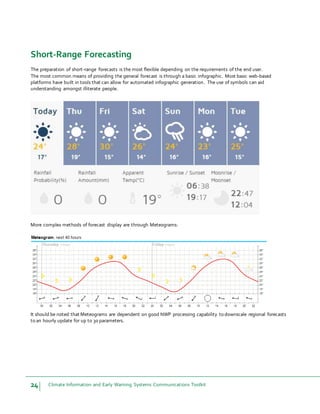
  • 3.
    3 Climate Informationand Early Warning Systems Communications Toolkit Table of Contents OVERVIEW 2 TABLE OFCONTENTS 3 DEFINING GOALS 6 BEST PRACTICES, DEFINING ROLES, REQUIRED TOOLS 7 BEST PRACTICE EXAMPLES OFEARLY WARNING SYSTEMS 9 EUROPE –CROSS-BORDER COLLABORATION 9 Resources 10 ALERT LEVELS 11 USA –DEFINED ROLES,STANDARD OPERATING PROCEDURE 12 Resources 12 U.S.EMERGENCY ALERT SYSTEM 13 THE PHILIPPINES –LEVERAGING PUBLIC-PRIVATE PARTNERSHIPS 14 Resources 14 BENIN–ESTABLISHMENT OF A STANDARD OPERATING PROCEDURE 15 Resources 15 DEFINING ROLES 16 WHO DOES WHAT? 16 Guiding Principles 17 CROSS BORDER SHARING 18 Regional Cooperation Entities 18 REQUIREDTOOLS 19 Cycle of Preparedness 19 Cycle of response 19 EARLY WARNING DISSEMINATIONSTRATEGY 20 EARLY WARNING SYSTEMS,FORECASTS, NOWCASTS ANDMORE 20 DEVELOPING THE MESSAGE CONTENT 21 HISTORICAL DATA 22 NOWCASTING 23 SHORT RANGE FORECASTING 24 COMBINING DIFFERENT TIME SCALES 25 IDENTIFYING STAKEHOLDERS 26 END USERS 26 ACTORS 27 UNDERSTANDING YOUR STAKEHOLDERS 27 Questions to Ask 27 Resources 28 ADDRESSING CHALLENGES AND OPPORTUNITIES (SWOT) 28 SWOTS TO INCLUDE 28 SAMPLE SWOTS 29 SWOT ANALYSIS OF CLIMATE INFORMATION IN SUB-SAHARANAFRICA 29
  • 4.
    4 Climate Informationand Early Warning Systems Communications Toolkit Resources 29 ZAMBIA METEOROLOGICAL DEPARTMENT (ZMD) 30 DEFINING THE MESSAGE 32 CREATING AN EMOTIONAL BRAND 32 MESSAGES FOR SPECIFIC STAKEHOLDERS 32 Resources 33 ENGAGING SCHOOLS AND HEALTH SECTORS 34 BUILDING YOUR NARRATIVE 35 QUESTIONS TO ASK 35 METHODOLOGY 36 WMOCOMMON ALERTING PROTOCOL 36 Resources 36 SHARING EARLY WARNINGS 36 Principles on the sharing of early warnings 36 Creating a response matrix for EWS 37 SHARING CLIMATE INFORMATION 37 PACKAGING EARLY WARNINGS 37 COMETRESOURCES ON EARLY WARNINGS AND COMMUNICATIONS 38 MEDIA BEST PRACTICES 39 MEDIA PARTNERSHIPS 39 EMERGENCY ALERT SYSTEMS 39 Resources 41 PUBLIC SERVICE ANNOUNCEMENTS 41 VIDEO 42 SAMPLE SCRIPT FOR ANIMATED TV PSA 42 RADIO 43 PRINT 43 SOCIAL MEDIA 43 INTERNET AND MOBILE APPS 44 SMSAND MESSAGING 44 Types of Messaging 45 Resources 45 ADVOCACY TO SUPPORT COMMUNICATIONGOALS 46 COMMUNICATIONSTRATEGY TEMPLATE,TORS 48 COMMUNICATIONS STRATEGY TEMPLATE 48 Section 1: Overview 48 Section 2: Goals 48 Section 3: SWOTAnalysis 49 Section 4: Stakeholders 49 Section 5: KnowingYour CoreProduct andCore Messages 50 Section 6: Early Warnings 51 Section 7: Distribution 52 Section 8: Products 53 Section 9: Budget 53 Section 10: Monitoring and Evaluation 53
  • 5.
    5 Climate Informationand Early Warning Systems Communications Toolkit Resources 53 COMMUNICATIONS CONSULTANT TORS TEMPLATE 54 Title 54 Application Deadline: 54 Location: 54 Type of Contract: 54 Individual Contract 54 Languages Required: 54 Starting date: 54 Duration of Initial contract: 54 Supervisor: 54 BACKGROUND 54 SCOPE OFWORK ANDDELIVERABLES 55 QUALIFICATIONS 56 MORE RESOURCES 58 WMOCOMMUNICATIONS GUIDELINES 58 OTHER RESOURCES 59
  • 6.
    6 Climate Informationand Early Warning Systems Communications Toolkit Defining Goals The goal of individual communications strategies will in many ways define the approach. In the case of the climate information and early warning systems space the main goal is to leverage best practices, innovative methodologies and existing assets to share actionable early warnings and build sustainability for climate information and early warning systems initiatives. From this central goalpost, the approach is based on four high-level pillars that should be considered when creating a communications strategy. Early Warnings. According the the WMO, “The primary objective of a warning system is to empower individuals and communities to respond timely and appropriately to the hazards in order to reduce the risk of death, injury, property loss and damage. Warnings need to get the message across and stimulate those at risk to take action.” In order to do this, one needs to collect and analyze data, package and distribute early warnings, build appropriate processes and response matrixes to allow fast delivery, and share relevant information with stakeholders and actors to ensure people know what do to when bad weather hits. Forecasts. Short-term forecasts and long-term outlooks can all benefit end users. The packaging, distribution and messaging is going to depend on the end-user, the information provided and the final goal of sharing that information. Supportive Communications and Advocacy. This is a softer piece of the equation. The goal is to build political support, foster understanding of the importance of NHMS, early warnings and climate information, share best practices, actively engage community actors and brand ambassadors, and build the value proposition being offered by NHMS. Coordination. Coordination between agencies is key. NHMS are often the generators of early warnings and weather and climate-related communications. However, NHMS need to work with partner agencies, ministries, the media and more to ensure effective distribution and action based on climate information and early warnings.
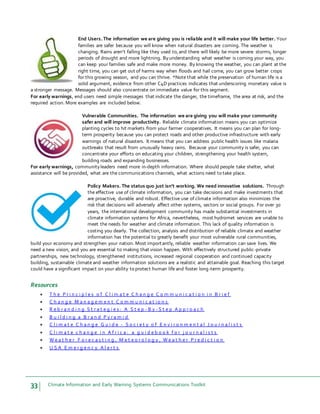
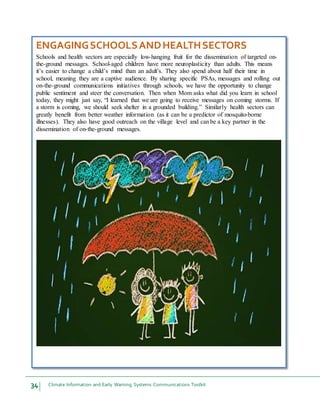
  • 7.
    7 Climate Informationand Early Warning Systems Communications Toolkit Best Practices, Defining Roles, Required Tools This section provides you with best practice examples from both industrialized and developing countries on how to issue early weather warnings. There is continued exploration on defining roles and required tools. To truly understand what’s required, it’s also worthwhile to quickly explore the context of early warning systems in Africa. There are a few high-level principles and challenges that should guide this conversation. For many African readers, this will come as no surprise. However, only by understanding high-level challenges can we create communications products and strategies to overcome those hurdles. Principle challenges for the effective issuance of early warnings in Africa include:  L a c k o f r e l i a b l e d a t a . W i t h l i m i t e d s t a f f s , r e s t r i c t e d b u d g e t s a n d u n r e l i a b l e m o n i t o r i n g s y s t e m s , t h e i n f o r m a t i o n c o m i n g o u t o f m o s t N H M S i n s u b - S a h a r a n A f r i c a i s v e r y l i m i t e d – b u t i t ’ s g e t t i n g b e t t e r ! W i t h o u t g o o d i n f o r m a t i o n , y o u c a n ’ t m e e t t h e n e e d s o f e n d - u s e r s o r b u i l d a t r u e v a l u e p r o p o s i t i o n .  L a c k o f c r e d i b i l i t y . W i t h n e w i n v e s t m e n t s i n c l i m a t e m o n i t o r i n g a n d i n f o r m a t i o n s e r v i c e s , t h e i n f o r m a t i o n g e n e r a t e d b y N H M S i s g e t t i n g b e t t e r . H o w e v e r , m a n y N H M S c o n t i n u e t o s u f f e r f r o m a s e r i o u s i m a g e p r o b l e m . B e c a u s e t h e r e h a s n ’ t b e e n m u c h r e l i a b l e i n f o r m a t i o n , p e o p l e , p o l i t i c i a n s a n d m e d i a d o n o t a l w a y s t r u s t t h e i n f o r m a t i o n c o m i n g o u t o f N H M S . T h i s m e a n s t h a t t h e m a i n a c t o r s y o u w o u l d u s e t o s h a r e c l i m a t e i n f o r m a t i o n a n d e a r l y w a r n i n g s a r e d i s c o n n e c t e d f r o m y o u r c o r e p r o d u c t o f f e r i n g . R e - e n g a g i n g t h e s e a c t o r s t o d e m o n s t r a t e y o u r v a l u e p r o p o s i t i o n w i l l b e k e y t o s u c c e s s .  L a c k o f p r o t o c o l s . L e t ’ s s a y y o u ’ v e f i g u r e d o u t h o w t o c o l l e c t a n d a n a l y z e w e a t h e r a n d c l i m a t e d a t a , a n d b y c r e a t i n g s o m e s m a r t a n d i n n o v a t i v e c o m m u n i c a t i o n s s t r a t e g i e s , y o u ’ v e n i p p e d t h e c r e d i b i l i t y c h a l l e n g e i n t h e b u d . N o w h o w d o y o u c r e a t e t h e r e s p o n s e m a t r i x n e c e s s a r y t o i s s u e e a r l y w a r n i n g s , a n d h o w d o y o u w o r k w i t h o t h e r g o v e r n m e n t a g e n c i e s , a c t o r s , m e d i a a n d m o r e t o m a k e s u r e e v e r y b o d y k n o w s w h a t t h e y ’ r e d o i n g ? W h i l e m o s t A f r i c a n n a t i o n s h a v e s o m e s o r t o f e m e r g e n c y r e s p o n s e p r o t o c o l , t h e p a c k a g i n g a n d d i f f u s i o n ( a n d p r e v e n t a t i v e r e s p o n s e a c t i o n s ) a r e l i m i t e d . B e n i n ’ s r e s p o n s e p r o t o c o l s h o w s a n e x a m p l e o f h o w i t c a n w o r k .  L i m i t e d s o p h i s t i c a t i o n i n p a c k a g i n g . P e o p l e r e a d w i t h t h e i r e y e s a n d h e a r t s – m i n d s c o m e i n l a t e r w h e n y o u a r e a n a l y z i n g w h a t y o u ’ v e j u s t r e a d . I n l a r g e p a r t , t h e r e i s s t i l l l i m i t e d c a p a c i t y t o e f f e c t i v e l y p a c k a g e w e a t h e r i n f o r m a t i o n – i n t h e f o r m o f e a r l y a l e r t s , a c t i o n a b l e c l i m a t e i n f o r m a t i o n ( l i k e c r o p r e p o r t s , P u b l i c S e r v i c e A n n o u n c e m e n t s ( P S A s ) o n w h a t t o d o w h e n b a d w e a t h e r h i t s , a n d t a i l o r e d i n f o r m a t i o n f o r p r i v a t e s e c t o r s ) . B y c r e a t i n g p r e t t y p a c k a g e s , N H M S n o t o n l y h a v e t h e o p p o r t u n i t y t o b u s t t h e c r e d i b i l i t y p r o b l e m , t h e y a l s o w o r k t o b u i l d m o r e e f f e c t i v e c o n n e c t i o n w i t h t h e i r e n d u s e r s .  L i m i t e d r e l a t i o n s h i p s w i t h t r a d i t i o n a l m e d i a a n d o t h e r a c t o r s . T h e r o l e
  • 8.
    8 Climate Informationand Early Warning Systems Communications Toolkit o f t h e N H M S i s o f t e n l i m i t e d t o t h e g e n e r a t i o n o f t h e e a r l y w a r n i n g m e s s a g e s . T h e s e a r e t h e n p a s s e d o n t o o t h e r a c t o r s i n t h e s y s t e m t h a t a r e r e s p o n s i b l e f o r d i s s e m i n a t i o n a n d a c t i o n . O t h e r a c t o r s – i n c l u d i n g t h e m e d i a , e x t e n s i o n a g e n c i e s , g o v e r n m e n t p a r t n e r s , p r i v a t e c o m p a n i e s a n d m o r e – n e e d t o p l a y a p a r t . W h i l e l i m i t e d c r o s s - s e c t o r i a l , c r o s s - a g e n c y c o l l a b o r a t i o n i s c u r r e n t l y h i n d e r i n g t h e a b i l i t y t o e f f e c t i v e l y e n g a g e w i t h t h e s e p o t e n t i a l b r a n d a m b a s s a d o r s a n d m e s s e n g e r s , t h e r e i s a s t r o n g o p p o r t u n i t y h e r e t o e n g a g e t h e m .  L a c k o f d i s t r i b u t i o n s y s t e m s . T h e i n f o r m a t i o n i s g o o d , i t ’ s p a c k a g e d w e l l , p e o p l e t r u s t w h a t y o u a r e s a y i n g a n d k n o w w h a t t o d o i n t h e e v e n t o f b a d w e a t h e r , n o w h o w d o y o u g e t t h e i n f o r m a t i o n t o a f a r m e r l i v i n g i n a r e m o t e v a l l e y ? T h e r e a r e n u m e r o u s o p p o r t u n i t i e s i n t h i s s p a c e – a l o n g w i t h j u s t a s m a n y c h a l l e n g e s . I n s o m e c a s e s , A f r i c a n n a t i o n s a r e m a k i n g g o o d s t r i d e s i n c r e a t i n g e f f e c t i v e d i s t r i b u t i o n s y s t e m s , b u t s t i l l l a c k a n - e f f e c t i v e e n d - t o - e n d p a c k a g e t h a t w i l l t r u l y r e a c h e n d - u s e r s a n d s a v e l i v e s .  L i m i t e d b u s i n e s s - d e v e l o p m e n t c a p a c i t y a n d n e c e s s a r y f r a m e w o r k s . D e v e l o p i n g b u s i n e s s p l a n s a n d c o m m u n i c a t i o n s s t r a t e g i e s – o r b u i l d i n g t h e c o n d u c i v e l e g a l a n d p o l i c y f r a m e w o r k s n e c e s s a r y t o f o s t e r t h e s e p l a n s – i s a v e r y d i f f e r e n t s k i l l s e t f r o m t h e t r a d i t i o n a l s k i l l s o f c o l l e c t i n g , a n a l y z i n g a n d s h a r i n g d a t a . B y d e v e l o p i n g b u s i n e s s a c u m e n , N H M S h a v e t h e o p p o r t u n i t y t o a d d r e s s c r e d i b i l i t y c h a l l e n g e s , b u i l d r e v e n u e s t r e a m s a n d e n g a g e w i t h a w h o l e n e w g r o u p o f p o t e n t i a l p a r t n e r s . T h e c o n n e c t i o n s a r e n o t y e t t h e r e , b u t i n s e v e r a l c o u n t r i e s t h e y a r e s t a r t i n g t o b l o s s o m .  C u l t u r a l c h a l l e n g e s . C u l t u r a l c h a l l e n g e s s p a n l a n g u a g e , b e l i e f , e d u c a t i o n , g e n d e r , a g e a n d l i t e r a c y . T h i s i s o n e o f t h e l a r g e s t c h a l l e n g e s i n t h e u s e a n d / o r u n d e r s t a n d i n g o f e a r l y w a r n i n g s . H o w d o y o u r e a c h a d i v e r s e g r o u p w h o s p e a k n u m e r o u s l a n g u a g e s , h a v e u n i q u e c u l t u r a l o p t i c s o n w e a t h e r i n f o r m a t i o n ( w h e r e t h e w o r d o f t h e v i l l a g e e l d e r m a y t r u m p t h a t o f t h e w e a t h e r f o r e c a s t e r ) , a n d a r e o f t e n i l l i t e r a t e o r h a v e l a c k o f f o r m a l e d u c a t i o n s ? T h i s p i e c e i s n o t e a s i l y a n s w e r e d , b u t w e m a k e s o m e a t t e m p t s i n t h e f o l l o w i n g s e c t i o n s .  P o l i t i c a l c h a l l e n g e s . T h e c o n t i n u e d l a c k o f c r e d i b i l i t y h a s f o s t e r e d a l a c k o f p o l i t i c a l w i l l t o s u p p o r t N H M S w i t h e i t h e r b i g g e r b u d g e t s o r s t r o n g e r i n s t i t u t i o n a l s t a t u s . T h i s i s w h e r e t h e s o f t w a r e p i e c e c o m e s i n . B y c r e a t i n g s u p p o r t i v e a d v o c a c y c o m m u n i c a t i o n s t r a t e g i e s a n d a c t i v e l y e n g a g i n g r e l e v a n t a c t o r s o n t h e p o l i c y a n d p u b l i c g o o d l e v e l , y o u h a v e t h e o p p o r t u n i t y t o b r e a k t h e n o n - v i r t u o u s c y c l e a n d r e c o n n e c t w i t h y o u r c h a m p i o n s i n t h e p o l i t i c a l s p a c e .  E c o n o m i c c h a l l e n g e s . I t ’ s n o t c h e a p a n d o u t s i d e c i r c u m s t a n c e s m a y d i v e r t f u n d s f r o m w e a t h e r a n d c l i m a t e s e r v i c e s . T h e v a l u e p r o p o s i t i o n w i l l a i d t o l e s s e n t h e s e e c o n o m i c c h a l l e n g e s , b u t t h e y a r e , n e v e r t h e l e s s , a r e c o g n i z e d l i m i t i n g f a c t o r , m a k i n g c e r t a i n o u t r e a c h t e c h n i q u e s o f t e n e m p l o y e d i n d e v e l o p e d w o r l d c o n t e x t s l e s s a p p r o p r i a t e f o r t h e u n i q u e s o c i a l , c u l t u r a l , p o l i t i c a l a n d e c o n o m i c l a n d s c a p e o f m o d e r n - d a y A f r i c a .  C l i m a t i c c h a l l e n g e s . C h a n g i n g w e a t h e r p a t t e r n s , m o r e s e v e r e w e a t h e r
  • 9.
    9 Climate Informationand Early Warning Systems Communications Toolkit c o n d i t i o n s , o v e r a l l c l i m a t i c c h a n g e s , f l o o d s , d r o u g h t s , l i g h t n i n g , h e a v y r a i n s a n d o t h e r e x t r e m e w e a t h e r c o n d i t i o n s a l l p r e s e n t n e w c h a l l e n g e s f o r N H M S a n d t h e d e v e l o p m e n t c o m m u n i t y a s a w h o l e . A d d r e s s i n g t h e s e c h a l l e n g e s a n d p r o v i d i n g i n t e g r a t e d a d a p t a t i o n a p p r o a c h e s w i l l b u i l d l a s t i n g r e s i l i e n c e f r o m t h e g r o u n d u p . B u t i n o r d e r t o a d a p t , t h e r e l e v a n t s t a k e h o l d e r s w i l l r e q u i r e t i m e l y , a c c u r a t e a n d e a s i l y d i g e s t i b l e i n f o r m a t i o n o n w e a t h e r a n d c l i m a t e . BEST PRACTICEEXAMPLESOF EARLYWARNING SYSTEMS So how do you do it? Here we provide links to samples on how to build an early warning system, and how to build an integrated communications and advocacy strategy from both developing and industrialized nations. Europe – Cross-Border Collaboration “Most European countries are relatively small in comparison with the scale of typical synoptic meteorological phenomena. Many important weather events, including windstorms, heavy rains, coastal surges or cold spells can affect large geographical areas containing several countries simultaneously; and these can occur within a very short timescale.” This means that the need for effective exchange of warnings has existed in various European countries, and such exchanges have been developed for some time. The European Multi-Purpose Meteorological Awareness (EMMA) Programme is based on the concept of meteorological awareness and its general objective is to develop a graphical information system accessible by the general public for the provision of expected meteorological hazard information within 24 hours. The system is intended to complement the existing national warning systems by providing a simple and efficient way of making users aware of possible meteorological risks. It also allows an efficient method of exchanging meteorological information related to high-impact weather events between European forecasters. The main characteristics of the system include:  C o l o r - c o d e d r e g i o n s r e l a t e d t o t h e m e t e o r o l o g i c a l a w a r e n e s s l e v e l f o r t h e s e v e r e w e a t h e r p h e n o m e n a c o v e r e d b y t h e s y s t e m .  A c o r e o f s e v e r e w e a t h e r p h e n o m e n a t o b e a d d r e s s e d a c r o s s E u r o p e a n d t o b e d i s p l a y e d t h r o u g h a h o m o g e n e o u s s e t o f p i c t o g r a m s , t o b e a u g m e n t e d , a s n e c e s s a r y , b y s o m e “ n a t i o n a l ” p h e n o m e n a .  I n t e r a c t i v e a c c e s s t o a d d i t i o n a l l e v e l s o f i n f o r m a t i o n , s u c h a s r i s k q u a l i f i c a t i o n f o r t h e i d e n t i f i e d p h e n o m e n a t o d e v e l o p a w a r e n e s s .  F l e x i b l e u p d a t i n g p r o c e d u r e s d e s i g n e d t o a c c o u n t f o r i n d i v i d u a l N H M S m o d u s o p e r a n d i , g e o g r a p h i c a l a r e a s a n d t i m e z o n e s .  A v a i l a b i l i t y o f t e x t u a l i n f o r m a t i o n i n s e v e r a l l a n g u a g e s , a t l e a s t f o r t h e h i g h e r l e v e l s o f a c c e s s .  I m p l e m e n t a t i o n o f t h e M e t e o a l a r m w e b s i t e ( w w w . m e t e o a l a r m . e u ) ”
  • 10.
    10 Climate Informationand Early Warning Systems Communications Toolkit Resources  P r i v a t e - S e c t o r S e v e r e W e a t h e r W a r n i n g s i n E u r o p e  P r e s e n t a t i o n s & V i d e o s o f G o o d P r a c t i c e s i n M u l t i - H a z a r d E a r l y W a r n i n g S y s t e m s ( M H E W S )  T h e F r e n c h V i g i l a n c e S y s t e m  I n s t i t u t i o n a l P a r t n e r s h i p s i n M u l t i - H a z a r d E a r l y W a r n i n g S y s t e m s : A C o m p i l a t i o n o f S e v e n N a t i o n a l G o o d P r a c t i c e s a n d G u i d i n g P r i n c i p l e s
  • 11.
    11 Climate Informationand Early Warning Systems Communications Toolkit Alert Levels Most countries choose to customize their alert levels. A simple yellow, orange, red system is used by the Irish Meteorological Service (Irish Early Warning System). Simple, easy to understand, actionable. Yellow - Weather Alert - Be Aware The concept behind YELLOW level weather alerts is to notify those who are at risk because of their location and/or activity, and to allow them to take preventative action. It is implicit that YELLOW level weather alerts are for weather conditions that do not pose an immediate threat to the general population, but only to those exposed to risk by nature of their location and/or activity. Orange - Weather Warning - Be Prepared This category of ORANGE level weather warnings is for weather conditions which have the capacity to impact significantly on people in the affected areas. The issue of an Orange level weather warning implies that all recipients in the affected areas should prepare themselves in an appropriate way for the anticipated conditions. Red - Severe Weather Warning - Take Action The issue of RED level severe weather warnings should be a comparatively rare event and implies that recipients take action to protect themselves and/or their properties; this could be by moving their families out of the danger zone temporarily; by staying indoors; or by other specific actions aimed at mitigating the effects of the weather conditions. This level of warning assumes a high confidence of the event occurring. Any false warnings could lead to unnecessary panic and loss of credibility.
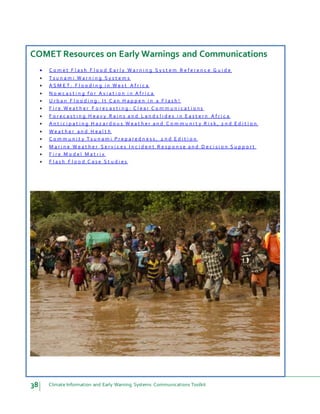
  • 12.
    12 Climate Informationand Early Warning Systems Communications Toolkit USA – Defined Roles, Standard Operating Procedure The United States has a quick acting early alert system that works across agencies to bring weather alerts at the blink of an eye. On average, the US does 76 billion observations a year, making 1.5 million forecasts and 50,000 warnings. Here’s how it works. The U.S. National Response Framework (NRF) provides the guiding principles that enable all response partners to deliver a unified national response to disasters and emergencies. They share this information with a number of agencies on the local, state and federal level. It is maintained by the U.S. Department of Homeland Security’s Federal Emergency Management Agency (FEMA). The National Incident Management System (NIMS) provides information to partner agencies and the private sector. NIMS provides the framework for incident management, preparedness, communications and information management, resource management, and other functions. The US Emergency Management System is comprised of various agencies responsible for coordinating the preparedness for, response to, recovery from and mitigation of disaster events. Local agencies are primarily responsible for severe weather preparedness and warning. Who does what? Before the event, a number of support agencies work together to coordinate response. Local agencies provide public awareness materials. During the event, local Emergency Management Agencies coordinate with the National Weather Service to activate warnings. Post event, disaster declarations are issued, and state, local and federal agencies work through joint field offices to provide assistance. Why does it work? Central components of the effective communications system are ongoing communication between agencies through online meetings, chats, SMS and phone. There needs to be a culture of mutual trust and respect. Real time coordination during the events is also key, as is clear messages from the National Weather Service (NWS). Weather information is also part of everyday activities in the US. Not only do you talk about it,there’s a cable channel, websites, apps and educational programs to reinforce the value of weather information. How does it work? Integrated warning teams, including the NWS, local media and local emergency managers create a common communication protocol to the public. Trust is obviously key here. The NWS then issues warning polygons by geographic area. Once these are issued, the collaborative team creates notifications via text, radio, television through the emergency alert system. Continued public education means most US citizens know to “Turn Around Don’t Drown” in the event of floods, seek shelter from lightning, and go to basements for tornadoes. It also means the cycle of trust can continue. How does the alert systemwork? It’s fairly simple. An “outlook” provides readiness, a “watch” triggers issuance of notification to the public and people know to keep an eye out for bad weather, a “warning” tells you there is dangerous weather nearby, then an event “alert” tells people to take immediate action. The cause (i.e. Tornado) and expected action (take shelter in a basement) are both included in the alert message. Resources  w w w . w e a t h e r . g o v / a l e r t s  M u l t i - H a z a r d E a r l y W a r n i n g S y s t e m o f t h e U n i t e d S t a t e s N a t i o n a l W e a t h e r S e r v i c e
  • 13.
    13 Climate Informationand Early Warning Systems Communications Toolkit U.S. Emergency Alert System “The Emergency Alert System (EAS) is a national public warning system that requires broadcasters, cable television systems, wireless cable systems, satellite digital audio radio service (SDARS) providers, and direct broadcast satellite (DBS) providers to provide the communications capability to the President to address the American public during a national emergency. The system also may be used by state and local authorities to deliver important emergency information, such as AMBER (child abduction) alerts and weather information targeted to specific areas. The Federal Communications Commission (FCC), in conjunction with Federal Emergency Management Agency (FEMA) and the National Oceanic and Atmospheric Administration's National Weather Service (NWS), implements the EAS at the federal level. The President has sole responsibility for determining when the EAS will be activated at the national level, and has delegated this authority to the director of FEMA. FEMA is responsible for implementation of the national-level activation of the EAS, tests, and exercises. The NWS develops emergency weather information to alert the public about imminent dangerous weather conditions. The FCC'srole includes prescribing rules that establish technical standards for the EAS, procedures for EAS participants to follow in the event the EAS is activated, and EAS testing protocols. Additionally, the FCC ensures that the EAS state and local plans developed by industry conform to FCC EAS rules and regulations.”  E A S F C C W e b s i t e  H u n g a r i a n N a t i o n a l A s s o c i a t i o n o f R a d i o D i s t r e s s - S i g n a l i n g a n d I n f o c o m m u n i c a t i o n s ( R S O E )  U S L a u n c h e s C e l l P h o n e E m e r g e n c y A l e r t S y s t e m  I n t e g r a t e d P u b l i c A l e r t & W a r n i n g S y s t e m O p e n P l a t f o r m  W i r e l e s s E m e r g e n c y R e p o r t s
  • 14.
    14 Climate Informationand Early Warning Systems Communications Toolkit The Philippines – Leveraging Public-Private Partnerships In the Philippines a new network of nearly 1,000 Automatic Weather Stations (AWS) – installed and maintained through innovative public-private partnerships – is looking to provide the 100 million people of this island nation with free, accurate and localized weather information that can be used to save lives, contain losses, build resilience and improve livelihoods. The Weather Philippines Foundation (WPF) has also developed a strong public outreach program to assist the population of the Philippines in becoming “weather-wiser,” that is, knowing what weather information will be made available from the WPF, understanding how such information can be used in a variety of situations, and then applying that information properly, especially in times of severe weather. There’s an app, a webpage, dedicated TV channel, and of course Facebook and Twitter pages. The real value is found in the localized, and quite accurate, five-day forecasts and automated current weather feeds that update every ten minutes from the system of AWS monitoring stations. Resources  L e a r n M o r e a b o u t t h e P h i l i p p i n e s P r o g r a m m e  A p p l y i n g L e s s o n s f r o m t h e P h i l i p p i n e s t o t h e A f r i c a C o n t e x t  T h e B a n g l a d e s h C y c l o n e P r e p a r e d n e s s P r o g r a m  T h e T r o p i c a l C y c l o n e E a r l y W a r n i n g S y s t e m o f C u b a Visible satellite image and overlain analysis and discussion for 20 September 2015from the WPF web portal (also posted to the Foundation’s Facebook page). This visible image is accompanied by the corresponding infra-red (IR) image (not shown). The visible image, its analysis and discussion, and the associated IR image are prepared by MeteoGroup.
  • 15.
    15 Climate Informationand Early Warning Systems Communications Toolkit Benin – Establishment of a Standard Operating Procedure In Benin, 800,000 people now have access to early weather warnings, thanks to the establishment of a Standard Operating Procedure supported through the UNDP Climate Information and Early Warning Systems Project. The country issued early warnings for flooding through a multi-agency committee in 2014 and 2015, using manual monitoring of river levels, data processing and information analysis. The country has also adopted a standard operating procedure for the diffusion of alerts through the National Disaster Management Agency. Additionally, Benin has the technical and institutional frameworks in place for climate modelling. The country has the legal framework required to monetize weather and climate data, but has had little success to date in successfully packaging relevant information for use by the private sector. The Government of Benin initiated a study to create the SOP. The communications assessment included a review of past efforts, a state of the art, interagency brainstorming to create the SOP, SWOT analysis, analysis of the existing communications channels and flows, and finally the proposal of a new communications flow. The main goals of the study were to:  I d e n t i f y a n d a n a l y z e t h e c o n t e n t o f a l l r e g u l a t i o n s a n d l e g i s l a t i o n o n t h e d i s s e m i n a t i o n o f a l e r t s r e l a t e d t o d i s a s t e r s i n B e n i n . T h i s b a s i c d e s k s t u d y g a v e a n o v e r a l l p i c t u r e o f h o w i n f o r m a t i o n i s s h a r e d a n d r e s p o n s i b i l i t i e s .  I d e n t i f y a n d a n a l y z e t h e s t r e n g t h s a n d w e a k n e s s e s o f e x i s t i n g p r o t o c o l s f o r e a r l y w a r n i n g d i s s e m i n a t i o n i n A f r i c a n c o u n t r i e s .  P r o p o s e a s t a n d a r d i z e d s y s t e m o f c o m m u n i c a t i o n a n d w a r n i n g d i s s e m i n a t i o n . T h i s c o m m u n i c a t i o n s y s t e m s p e c i f i e s r o l e s a n d r e s p o n s i b i l i t i e s a n d e x p e c t e d a c t i o n s f r o m v a r i o u s a c t o r s .  I d e n t i f y t h e l e g a l r e q u i r e m e n t s f o r t h e c r e a t i o n o f t h e S O P .  A s s e s s s p e c i f i c c o m m u n i c a t i o n s n e e d s o f e a c h s t a k e h o l d e r . Resources  P r o t o c o l e N o r m a l i s e d e C o m m u n i c a t i o n e t d e D i f f u s i o n d ' a l e r t e e n c a s d e C a t a s t r o p h e H y d r o c l i m a t i q u e a u B e n i n  V i d e o B e n i n ' s E a r l y W a r n i n g S y s t e m
  • 16.
    16 Climate Informationand Early Warning Systems Communications Toolkit DEFININGROLES Who does what? How can information be shared across agencies and across borders? What structures are in place to aid in collaboration? Defining roles is an essential component of any communications strategy. Not only is it necessary to ensure effective issuance of early warnings, it also plays an important role in how you will elaborate a supportive communications strategy. Who Does What? In order to avoid disputes over roles and responsibilities, foster buy-in and build a standard operating protocol for the issuance of early warning messages, you’ll need to assign roles, foster a culture of collaboration and develop non- territorial approaches. Like almost any initiative, the assignment and distribution of roles and responsibilities should begin from the ground up. This will ensure buy-in from all stakeholders. Because every country has its unique political framework, there are no off-the-shelf solutions. However, focusing on a few key areas will help in the definition of roles and responsibilities. If you look at the roles from the bottom up, you might generalize them in the following way (as adapted from the FEMA roles and responsibilities matrix):  L o c a l . L o c a l l e a d e r s a n d e m e r g e n c y m a n a g e r s p r e p a r e c o m m u n i t i e s t o m a n a g e i n c i d e n t s l o c a l l y . o E l e c t e d O f f i c i a l s e n s u r e t h e s a f e t y a n d w e l f a r e o f t h e p e o p l e u n d e r t h e i r j u r i s d i c t i o n . T h e y a l s o w o r k c l o s e l y w i t h c o n g r e s s i o n a l a n d r e g i o n a l l e a d e r s t o e n s u r e e f f e c t i v e r e s p o n s e a n d d i s t r i b u t i o n o f e m e r g e n c y w a r n i n g s a n d a c t i o n s . o E m e r g e n c y M a n a g e r . T h e l o c a l e m e r g e n c y m a n a g e r h a s t h e d a y - t o - d a y a u t h o r i t y a n d r e s p o n s i b i l i t y f o r o v e r s e e i n g e m e r g e n c y m a n a g e m e n t p r o g r a m s a n d a c t i v i t i e s . T h e y a r e n o t n e c e s s a r i l y r e s p o n s i b l e f o r t h e i s s u a n c e o f e a r l y a l e r t s . o D e p a r t m e n t a n d a g e n c y h e a d s . C o o r d i n a t e l o c a l s e r v i c e s . o I n d i v i d u a l s a n d c o m m u n i t i e s . R e d u c e h a z a r d s , p r e p a r e f o r e m e r g e n c i e s , m o n i t o r e m e r g e n c y c o m m u n i c a t i o n s .  S t a t e s , T e r r i t o r i e s , A u t o n o m o u s / T r i b a l G o v e r n m e n t s . S u p p o r t l o c a l e f f o r t s . T h e y m a y b e c h a r g e d w i t h r e g i o n a l e m e r g e n c y r e s p o n s e , o r t h i s r e s p o n s i b i l i t y m a y l a y a t t h e l o c a l o r n a t i o n a l l e v e l . o G o v e r n o r a n d e l e c t e d o f f i c i a l s . C o m m u n i c a t e w i t h l o c a l g r o u p s , n a t i o n a l g r o u p s a n d a f f e c t e d c o m m u n i t i e s . o S t a t e E m e r g e n c y A g e n c y . T h i s m a y n o t b e a p p l i c a b l e i n a l l s i t u a t i o n s .  F e d e r a l . I n m o s t A f r i c a n n a t i o n s , e m e r g e n c y a l e r t s w i l l b e i n i t i a t e d o n t h e f e d e r a l l e v e l . o P r e s i d e n t . O v e r a l l o v e r s i g h t . o M i n i s t r i e s . I n d i v i d u a l m i n i s t r i e s m a y b e r e s p o n s i b l e f o r s e c t o r i a l r e s p o n s e a n d a l e r t s ( i . e . h y d r o l o g y , a g r i c u l t u r e , e n e r g y , n a t i o n a l s e c u r i t y ) o N H M S . M o n i t o r w e a t h e r a n d i s s u e a l e r t s ( o r a l e r t r e l e v a n t d i s a s t e r m a n a g e m e n t a g e n c y ) o D i s a s t e r M a n a g e m e n t U n i t . N o t a l l c o u n t r i e s h a v e a d e d i c a t e d u n i t . T h i s r e v o l v i n g p o i n t c a n b e u s e d t o c o o r d i n a t e w a r n i n g s .
  • 17.
    17 Climate Informationand Early Warning Systems Communications Toolkit  I n t e r n a t i o n a l . O n t h e i n t e r n a t i o n a l l e v e l , e i t h e r t h e P r e s i d e n t o r M i n i s t e r o f F o r e i g n A f f a i r s w o u l d b e r e s p o n s i b l e f o r i n t e r n a t i o n a l c o o r d i n a t i o n . H o w e v e r, w e a t h e r a l e r t s s h o u l d b e s h a r e d w i t h N H M S i n n e i g h b o r i n g c o u n t r i e s t o t r i g g e r t h e i r o w n r e s p o n s e .  P r i v a t e S e c t o r . T h e p r i v a t e s e c t o r i s o f t e n r e s p o n s i b l e f o r l a r g e p i e c e s o f i n f r a s t r u c t u r e . I n t h e c a s e o f t h e i s s u a n c e o f e a r l y w a r n i n g s , p r i v a t e t e l e c o m s a n d m e d i a c o m p a n i e s c a n a l s o a i d i n t h e d i s t r i b u t i o n o f w a r n i n g s .  N G O s . T h i s g r o u p o f a c t o r s c a n m o b i l i z e s u p p l i e s , s h a r e e m e r g e n c y i n f o r m a t i o n a n d p r o v i d e r e s p o n s e . T h e y c a n a l s o b e m o b i l i z e d t o p r o v i d e t r a i n i n g o n w h a t t o d o i n t h e e v e n t o f a w a r n i n g , a n d a s b r o a d c a s t e r s f o r i n f o r m a t i o n o n r e q u i r e d a c t i o n s i n t h e e v e n t o f a n e m e r g e n c y . Guiding Principles  C r e a t e B u y - I n . B r a i n s t o r m i n g s e s s i o n s , i n t e r a g e n c y c o m m i t t e e s a n d w o r k i n g g r o u p s a r e a l l e s s e n t i a l f o r b u i l d i n g t h e n e c e s s a r y c o l l a b o r a t i o n .  C o m m u n i c a t e . B y c o m m u n i c a t i n g r e g u l a r l y w i t h a l l s t a k e h o l d e r s ( n o t j u s t a b o u t r o l e s , b u t a b o u t e f f e c t i v e a c t i o n s ) , y o u c o n t i n u e t o p e r p e t u a t e t h a t c i r c l e o f t r u s t .  A s s i g n R o l e s a n d R e s p o n s i b i l i t i e s . M a k e i t c l e a r w h o i s r e s p o n s i b l e f o r w h a t .  E n g a g e A c t o r s . R e a c h i n g y o u r g o a l s w i l l r e q u i r e c o n n e c t i o n w i t h a l a r g e n u m b e r o f r e g i o n a l , t e r r i t o r i a l a n d l o c a l a c t o r s .  R e h e a r s e . P r a c t i c e w h a t y o u a r e d o i n g b e f o r e i t ’ s t i m e t o a c t u a l l y i s s u e a w a r n i n g .  A c t i v a t e . W h e n t h e t i m e c o m e s t o i s s u e a n e a r l y w a r n i n g , b e s u r e t o m a i n t a i n c o n s t a n t c o n t a c t b e t w e e n o r g a n i z a t i o n s t o e n s u r e c o l l a b o r a t i o n .  F o l l o w u p . A f t e r t h e s t o r m , y o u s h o u l d t a k e s t o c k o f s u c c e s s e s , f a i l u r e s , c h a l l e n g e s Information flow from the Benin SOP.
  • 18.
    18 Climate Informationand Early Warning Systems Communications Toolkit a n d n e x t s t e p s . B r i n g t o g e t h e r a l l m a j o r p l a y e r s t o d i s c u s s n e x t s t e p s . Cross Border Sharing Weather does not respect borders. Rains in one country may produce flash floods in another. Increased cooperation, data sharing and compatible systems are needed to improve early warning systems and the overall climatological record of the African continent. With improved synoptic and local monitoring, country-specific weather and climate data and information can be shared with both the WIGOs and Global Telecommunication System. Data produced in border regions can be analysed to enhance the accuracy of forecasts across the border and create early warnings for storms that originate in Country X, but don’t have significant strength until they reach Country Y. And in some regions – Lake Victoria for instance – purposeful regional monitoring systems should be considered with the goal of providing forecasts not just for national use, but for the entire region. The role of regional cooperation is discussed in some depth in the UNDP publication “A New Vision for Weather and Climate Services in Africa.” Principles of regional cooperation for communications and the issuance of early warnings include the following.  L e v e r a g e r e g i o n a l c o o p e r a t i o n i n s t i t u t i o n s .  S h a r e d a t a w i t h W I G O S a n d t h e G l o b a l T e l e c o m m u n i c a t i o n S y s t e m .  U s e c o m m o n d a t a p a r a m e t e r s a n d a n a l y s i s .  C r e a t e o r o p t i m i z e c o m m u n i c a t i o n s c h a n n e l s t o e n s u r e e f f e c t i v e c o m m u n i c a t i o n a n d c o l l a b o r a t i o n i n t h e e v e n t o f a n e m e r g e n c y .  W M O G u i d e l i n e s o n i n t e r n a t i o n a l a n d c r o s s - b o r d e r c o l l a b o r a t i o n i n t h e w a r n i n g p r o c e s s . Regional Cooperation Entities Existing or dormant regional agreements could foster information exchange. Aside from the main economic collaboration entities, you may wish to consider engaging with the following (if you have not already):  A C M A D – A f r i c a n C e n t r e o f M e t e o r o l o g i c a l A p p l i c a t i o n s f o r D e v e l o p m e n t  A C P C – A f r i c a n C l i m a t e P o l i c y C e n t e r  A f D B – A f r i c a n D e v e l o p m e n t B a n k  A G R H Y M E T – A g r o - m e t e o r o l o g y a n d H y d r o l o g y R e g i o n a l C e n t r e  A M E S D – A f r i c a n M o n i t o r i n g o f E n v i r o n m e n t f o r S u s t a i n a b l e D e v e l o p m e n t  A U A D A R E – A f r i c a n U p p e r A i r D a t a R e s c u e I E D R O – I n t e r n a t i o n a l E n v i r o n m e n t a l D a t a R e s c u e O r g a n i z a t i o n  C D M S s – C l i m a t e D a t a M a n a g e m e n t S y s t e m s  R B C N – R e g i o n a l B a s e C l i m a t o l o g i c a l N e t w o r k  R C C s – R e g i o n a l C l i m a t e C e n t r e s ( R C C s )  S A D C - C S C – S o u t h e r n A f r i c a n D e v e l o p m e n t C o m m u n i t y - C l i m a t e S e r v i c e s C e n t e r  I C P A C – I G A D C l i m a t e P r e d i c t i o n a n d A p p l i c a t i o n s C e n t r e  C I L S S – C o m i t é p e r m a n e n t I n t e r - E t a t s d e L u t t e c o n t r e l a S é c h e r e s s e d a n s l e S a h e l  A S E C N A – A g e n c e p o u r l a s é c u r i t é d e l a n a v i g a t i o n a é r i e n n e e n A f r i q u e e t à M a d a g a s c a r  W M O S e v e r e W e a t h e r F o r e c a s t i n g D e m o n s t r a t i o n P r o j e c t ( S W F D P )
  • 19.
    19 Climate Informationand Early Warning Systems Communications Toolkit REQUIREDTOOLS The required tools include an institutional framework, planning and response cycles, and of course the technology, human resources and capacity to get the job done. Cycle of Preparedness1  P l a n . P l a n n i n g a n d c a p a c i t y b u i l d i n g , i n f o r m a t i o n g a t h e r i n g a n d a n a l y s i s .  O r g a n i z e . O r g a n i z i n g t h e r e s p o n s i b l e p a r t i e s , s t r e n g t h e n i n g l e a d e r s h i p a n d e s t a b l i s h i n g r o l e s , a c q u i r i n g n e c e s s a r y e q u i p m e n t , t r a i n i n g o n t h e u s e o f e q u i p m e n t .  E x e r c i s e . P r a c t i c e a n d s i m u l a t e w h a t y o u d o .  E v a l u a t e a n d I m p r o v e . T a k e t h e l e s s o n s l e a r n e d t o i m p r o v e y o u r r e s p o n s e s e r v i c e s . Cycle of response2  S i t u a t i o n a l A w a r e n e s s . E s t a b l i s h b a s e l i n e p r i o r i t i e s , p r o v i d e t h e r i g h t i n f o r m a t i o n a t t h e r i g h t t i m e , s h a r e l o c a l i n c i d e n t s w i t h r e l e v a n t a c t o r s , l i n k o p e r a t i o n s , i s s u a n c e o f a l e r t s , c r e a t i o n o f o p e r a t i o n c e n t e r s a n d u n i t s .  A c t i v a t e a n d D e p l o y . A c t i v a t e a n d d e p l o y p e o p l e , r e s o u r c e s , c a p a b i l i t i e s , e s t a b l i s h e m e r g e n c y o p e r a t i o n s c e n t e r .  C o o r d i n a t e R e s p o n s e . C o o r d i n a t e b e t w e e n a l l r e l e v a n t a c t o r s , i n c l u d i n g c o o r d i n a t i n g i n i t i a l a c t i o n s , r e q u e s t s f o r a d d i t i o n a l s u p p o r t , i d e n t i f y i n g a n d i n t e g r a t i n g r e s o u r c e s a n d c a p a b i l i t i e s , i n f o r m a t i o n f l o w . 1 S o u rc e F E MA . h t t p s : / / w w w . f e ma . g o v /p d f / e me rg e n cy / n rf / n rf -c o re .p d f 2 I b i d .
  • 20.
    20 Climate Informationand Early Warning Systems Communications Toolkit Early Warning Dissemination Strategy This section starts with a basic overview of the elements required to create early warnings, nowcasts, short-range forecasts and combined weather reports. It then moves into a discussion on the specific needs of end-users and effective methodologies to reach them. EARLYWARNINGSYSTEMS, FORECASTS,NOWCASTS AND MORE “Natural Hazards will always challenge us, but people-centered early warning systems can be a potent weapon in ensuring that natural hazards do not turn into unmanageable disasters.” Increasingly, it is recognized that disasters are linked. The impacts of many types of natural disasters do not happen in isolation, but recognition of such cause and effect on a global and regional scale is leading to the creation of early warning systems that can accommodate multiple hazards and cross-boundary impacts. Though many natural hazards may be inevitable, natural disasters are not totally unavoidable. A disaster will depend on the characteristics, probability, and intensity of the hazard, as well as the susceptibility of the exposed community based on physical, social, economic, and environmental conditions. In some instances, natural disasters cannot be prevented from occurring. However, their overall impact can be significantly reduced through disaster prevention, mitigation and risk transfer. This concept is also applicable to less extreme changes in weather that have an impact on operations. For example, lightning from a thunderstorm poses a risk to workers in open environments, electrical substations and the general public. A paradigm shift is occurring with a move away from purely reactive response and recovery to a much more proactive and holistic concern about preparedness and prevention of the impacts of adverse weather to operations. Proactive mechanisms are sought to reduce the economic costs and impacts of hazards, improve response capacity, decrease vulnerability, and enhance communities’ resilience to disasters. The primary objective of a warning system is to empower individuals and communities to respond in a timely and appropriate manner to the hazards in order to reduce the risk of death, injury, property loss and damage. Warnings need to get the message across and stimulate those at risk to take action. Risk mitigation decision makers require increasingly precise warnings to ensure effective measures may be formulated. This implies that the messages and communications must be in time, accurate, relevant and easy to take decisions on. It is therefore the responsibility of the NHMS in conjunction with partner agencies and the affected stakeholder to develop a strategy that satisfies their requirements for risk mitigation. 3 3 Above text adopted from the WMO Guidelines on Early Warning Systems and Application of Nowcasting and Operation Warnings. https://www.wmo.int/pages/prog/amp/pwsp/documents/PWS-21.pdf
  • 21.
    21 Climate Informationand Early Warning Systems Communications Toolkit Developing the message content Once the strategy has been developed, the messages must be prepared in line with and the available resources to meet the client requirements. An easy way to view the message that can be developed is to view the products and services offered by the NHMS as a time series (see Figure below). An observation made today becomes historical data tomorrow. Forecasts made today looking into the future increases in uncertainty the further into the future we look.
  • 22.
    22 Climate Informationand Early Warning Systems Communications Toolkit Historical Data Historical data can be provided in tabular text formats i.e. excel, .txt, databases etc. Or can be provided in graphical formats. See below: Wind Rose showing average speed and direction of prevailing winds 30 year climate data for precipitation with Average, max and min Where data andresources allow, historical data canbe shown as heat maps:
  • 23.
    23 Climate Informationand Early Warning Systems Communications Toolkit Infographic generated from radar and short range forecasting models showing the path of the identified storm. Note: Australia has a comparatively high level of meteorological literacy amongst its population due to an extensive education campaign over the years Radio and TV Broadcast Advisory and action Nowcasting Nowcasting messages are generally associated with severe thunderstorm warnings that include heavy rain, large hail, damaging winds and the potential of flash floods. Depending on the communication strategy, the message content can range from a few characters i.e. twitter, sms, to a more substantial narrative sent via email. Bear in mind that severe thunderstorms in convective environments can develop within 15 to 30 minutes. It is therefore necessary to convey as much information as possible in a short concise message. See a sample message from the Bureau of meteorology in Australia.
  • 24.
    24 Climate Informationand Early Warning Systems Communications Toolkit Short-Range Forecasting The preparation of short-range forecasts is the most flexible depending on the requirements of the end user. The most common means of providing the general forecast is through a basic infographic. Most basic web-based platforms have built in tools that can allow for automated infographic generation. The use of symbols can aid understanding amongst illiterate people. More complex methods of forecast display are through Meteograms: It should be noted that Meteograms are dependent on good NWP processing capability to downscale regional forecasts to an hourly update for up to 30 parameters.
  • 25.
    25 Climate Informationand Early Warning Systems Communications Toolkit Combining different time scales Weather Philippines is a successful story of the relationship between the private and the public sectors. The organization has successfully leveraged its large network of automatic weather stations to provide accurate real time weather information and short range forecast information. This approach leverages existing application interfaces available freely on the web to integrate real time and forecast data. This ensures that there is a low cost of replication to target as many end users through a single platform. Over 1000 AWS shown as red dots Real time data
  • 26.
    26 Climate Informationand Early Warning Systems Communications Toolkit IDENTIFYINGSTAKEHOLDERS The most important element of communication is remembering your audience. Only by knowing and listening to your target market can you effectively share messages with them. End users for climate information and early warning systems include farmers, communities, policy makers and the private sector. Actors to reach these stakeholders include telecoms/electronic media, NHMS, communityleaders, first responders, NGOs, education, health, early warning center, brand ambassadors, country projects, partner agencies, CIRDA, UNDP and the community of practice, rural radio… and the list goes on. Understanding stakeholders is not an easy process, especially as regional linguistic, cultural, media and political variations create nuances from country to country for both end-users (communities and farmers) and policy makers. Messages to reach specific stakeholders are discussed later in this toolkit. End Users Farmers. This target group is comprised of crop farmers, smallholder farmers, industrialized farmers, pastoralists (livestock herders), fishermen and rural enterprisers. This target group has multiple needs for weather and climate information. It can save lives, contain losses, increase productivity and reduce risk. Reaching rural farmers is a challenge, Internet communication is virtually impossible, literacy is low, and there are regional and village-level cultural and linguistic differences. Primary methodologies for reaching this group include: rural radio, SMS, trainings and informational meetings hosted at the community level, billboards, outreach from schools and health organizations, NGOs, pamphlets and other advocacy methods. They can also be reached through value-added service provides, extension services, cooperatives and innovative last mile approaches such as Human Network International’s 3-2-1 Service. Local Communities. This group is comprised of community leaders, farm cooperative leaders, village leadership, regional politicians, children, teachers, moms, elders and other community members that don’t work in farming, local NGOs, extension services and medium-scale local enterprisers. Reaching this group is a little easier. Villages will often have access to television, radio, and may even have access to the Internet. Primary vehicles to reach them include Public Service Announcements (PSAs), TV, training, radio, policy dialogue (learning routes), print media, social media (growing but still limited), community meetings, school and hospital outreach, SMS and engagement with extension services. Some communities have enabled communications tree within the leadership to ensure messages are disseminated rapidly once generated. Policy Makers. This group is comprised of national leaders in the NHMS, Senate, House of Representatives, executive branch, ministries, media, large private-sector enterprise (telecommunications, banking, mining, etc.), universities, think tanks, and regional cooperation entities (i.e. African Union). Reaching them should be the easiest of all. They can be reached by email, social media, print, radio, broadcast, and advocacy. However, impacting their opinions and policies is a whole other ballgame. In order to reach them and sway opinion and policy, you first need to reach their constituencies (farmers and communities), empower product champions, and foster learning opportunities. Private Sector. Not only do private sector enterprises benefit from tailored weather information – to protect human and physical resources and make climate-smart business decisions – they can also play a role in disseminating messages. Telecommunications firms can site AWS and serve as go-betweens to send early alerts, mining companies can be tapped to leverage corporate social responsibility dollars, or pay for tailored weather information, media can be used to share early alerts and PSAs. In order to engage the private sector, you need to create a narrative that underscores your specific value to them and to their consumers. They need to understand you are creating a valuable product that they can trust.
  • 27.
    27 Climate Informationand Early Warning Systems Communications Toolkit Actors Reaching these groups means enlisting the support of a wide group of actors. These actors serve as brand ambassadors, as messengers, as emergency responders and as education providers. The specific needs and responsibilities of these actors were addressed in the Who Does What section. Understanding your stakeholders There are various methods to understand your stakeholders. These include surveys, communityforums, policy dialogue, media monitoring, and outreach to leaders. Constant contact between stakeholders is key. Some other indicators may also give you unique insights on public opinion, these include elections, lobbying and interest groups, market forces and demand, monitoring of traditional and electronic media, direct letters and calls, protests, and straw polls. Questions to Ask Not only do you need to understand your stakeholders, you also need to understand what type of information they need and demand, how they get and use information, their media habits and how information is shared. Approaches will vary by country, but important questions to ask yourself and your stakeholders include the following:  W h a t d i d o u r b a s e l i n e s t u d y t e l l u s a b o u t o u r t a r g e t m a r k e t ?  W h a t a r e e n d - u s e r r e q u i r e m e n t s f o r / r e l i a n c e o n r e l i a b l e m e t e o r o l o g i c a l i n f o r m a t i o n ?  W h a t c u r r e n t a s s e t s d o w e h a v e ? I s t h e r e a m a r k e t s t u d y , b r o a d e r a n a l y s i s o n m e d i a u s e , d e m o g r a p h i c i n f o r m a t i o n ? H o w c a n w e u s e t h i s i n f o r m a t i o n t o e n g a g e o u r s t a k e h o l d e r s ?  H o w i s t h e i r c u r r e n t w e a t h e r / c l i m a t e i n f o r m a t i o n a c q u i r e d ? ( i t m a y n o t b e t h e m e d i a , N H M S o r a n N G O , b u t v i l l a g e e l d e r s , r e l i g i o n , n a t u r e ’ s s i g n s , e t c . )  W h a t i s t h e m o s t p o p u l a r m e d i a ? A n d w h a t a r e t h e m e d i a h a b i t s o f o u r s t a k e h o l d e r s ? U n d e r s t a n d i n g h o w p e o p l e u s e m e d i a a n d t h e r e a s o n s f o r t h e i r c h o i c e s w i l l d e f i n e y o u r c h a n n e l s a n d m e s s a g e s .  W h a t i s t h e a g e a n d g e n d e r d e m o g r a p h i c p r e f e r e n c e s p e r d i s s e m i n a t i o n t e c h n o l o g y ? W h a t a b o u t t h e i n f l u e n c e o f e d u c a t i o n a n d i n c o m e ? R u r a l v s . u r b a n p o p u l a t i o n s ? Y o u n g p e o p l e m a y b e m o r e a t t u n e d t o i n f o r m a t i o n v i a S M S o r s m a r t p h o n e , w h i l e t h e o l d e r g e n e r a t i o n – o r w e a l t h i e r f a m i l i e s – m a y p r e f e r r a d i o .  W h a t a r e t h e p a s t e x p e r i e n c e s r e l a t e d t o w a r n i n g s a n d d i s a s t e r s – t i m e l i n e s s , a c c u r a c y , c o n t e n t , r e c o m m e n d a t i o n s , c o n s i s t e n c y a c r o s s v a r i o u s s o u r c e s .  A r e y o u d i s s e m i n a t i n g i n f o r m a t i o n t o p e o p l e i n s i d e b u i l d i n g s o r o u t s i d e ? D i f f e r e n t c o m m u n i c a t i o n m e a n s m a y b e n e e d e d t o d i s s e m i n a t e t h e m e s s a g e t o t h e s e t w o g r o u p s . T h i s i s e s p e c i a l l y i m p o r t a n t i n u r b a n a r e a s .  W h o a r e t h e t r u s t e d s o u r c e s o f y o u r a u d i e n c e s ? W i l l t h e y t r u s t a S M S f r o m t h e N H M S o r w o u l d t h e y p r e f e r t o g e t t h e m e s s a g e f r o m a v i l l a g e l e a d e r ? A n d i f s o , h o w d o y o u i n f o r m t h e v i l l a g e l e a d e r ?
  • 28.
    28 Climate Informationand Early Warning Systems Communications Toolkit Resources  A D e t a i l e d S n a p s h o t o f A f r i c a ’ s e m e r g i n g I n t e r n e t a n d s o c i a l m e d i a s p a c e – t h e u s e r s a n d w h a t t h e y a r e d o i n g  N i e l s e n G u i d e t o A f r i c a n M a r k e t D e m o g r a p h i c s – C o u n t r y - b y - c o u n t r y a n a l y s i s o f m e d i a h a b i t s , m a r k e t s e g m e n t s  M e a s u r i n g P u b l i c O p i n i o n  C r e a t i n g S u r v e y s  P u b l i c F o r u m s  B r a n d A m b a s s a d o r s  B e s t P r a c t i c e s f o r R e s e a r c h ADDRESSINGCHALLENGESANDOPPORTUNITIES (SWOT) As you get started in creating a communications strategy, you may wish to consider including a SWOT analysis. This measures the strengths, weaknesses, opportunities and threats of your products and stakeholders. You may need to conduct more than one SWOT analysis. For instance, if you want to know how the media will react to your product offering, you’ll wish to do a SWOT analysis ahead of time. SWOTs to Include  I n t e r n a l . H o w w e l l a r e t h e p r o j e c t t e a m a n d t h e b r o a d e r g r o u p w o r k i n g t o g e t h e r t o i m p r o v e c l i m a t e i n f o r m a t io n a n d e a r l y w a r n i n g s y s t e m s ? A r e t h e r e c o m m u n i c a t io n s b o t t l en e c ks , c h a l l e n g e s t h a t n e e d t o b e a d d r e s s e s ? W h o w o u l d d o t h e b e s t j o b a t a c h i e v in g s p e c i fi c t a s k s ?  I n t e r - A g e n cy . M o v e i t u p a n o t c h . H o w d o t h e v a r i o u s a g e n c i e s w o r k t o g e t h e r ? H o w d o t h e y i n t e r r e l at e ? D o y o u r e q u i r e a p r o c e s s o f c h a n g e m a n a g e m en t ?  E n d U s e r s . W h o a r e y o u r e n d u s e r s , h o w d o t h e y u s e i n f o r m a t io n , d o t h e y t r u s t t h e i n f o r m a t io n y o u a r e p r o v i d i n g ?  A c t o r s . W h o c a n y o u e n g a g e t o m o v e y o u r m e s s a g e t o e n d u s e r s a n d a c h i e v e p r o j ec t g o a ls ?  M e d i a . Y e s , m e d i a i s a f i n e a s s e t . B u t w i t h i n y o u r c o u n t r y , h o w d o p e o p l e i n t e r a c t w i t h m e d i a, d o t h e m e d i a t r u s t t h e f o r e c a s t s a n d s h a r e t h e m , a r e t h e y a t r u e b r a n d a m b a s s a d o r o r a r e t h e y a t h r e a t ?  P r i v a t e S e c t o r . A r e t h e r e i n d u s t r i e s t h at c o u l d b e n e f i t f r o m t a i l o r ed w e a t h e r i n f o r m a t io n ? W h a t ’ s t h e ir p e r c e p t io n ?  Y o u r P r o d u c t . F i r s t y o u ’ ll n e e d t o d e f i n e y o u r p r o d u c t . I s i t t h e p r o j e c t i t s e l f ? O r i s i t t h e c l i m a t e i n f o r m a t io n a n d e a r l y w a r n i n g s
  • 29.
    29 Climate Informationand Early Warning Systems Communications Toolkit y o u a r e p r o d u c i n g ? M o s t m a r k e t er s w o u l d a r g u e t h e l a t t er . I f s o , w h a t a r e t h e s t r e n g t h s a n d v a l u e p r o p o s i t i o n s o f t h a t p r o du c t ? W h e r e a r e t h e w e a k n e s s e s ? H o w c a n y o u r e a c h n e w p e o p le a n d n e w m a r k e t s ? A n d w h a t f o r c e s c o u l d d e r a i l y o u r e f f o r t s ? L o o k in g a t t h e s e w i l l h e l p y o u d e f i n e y o u r m e s s a g e , y o u r c h a n n e l a n d y o ur s t r a t e g y. Sample SWOTs SWOT ANALYSIS OF EARLY WARNINGS SWOT ANALYSIS OF CLIMATE INFORMATION IN SUB-SAHARAN AFRICA STRENGTHS WEAKNESSES OPPORTUNITIES THREATS There have been significant advances in explaining the dynamics ofAfrican climate variability, which has led to a growing confidence in climate forecasts while seasonal outlooks have gained greater importance in managing climatic risks. Climate forecasts can help those who depend on agriculture with decisions such as: whether or not to plant, when to sow, which seeds or crop varieties to choose, herd migration, livestock sale orslaughter, what pest protection alternative is best and whether or not to apply inorganicfertilizers. Additionally, forecasts can also help anticipate the emergence ofcertain types of pests, fungi and smuts. Climate forecasts can increase farmers’ preparedness and lead to better economic and environmental outcomes in the long run. Climate information can improve resource management and enhance the welfare of agricultural and rural populations, which also represent the bulk ofpeople living in poverty. Climate information helps to mitigate risk, which is a documented reason for the weak performance ofsub-Saharan countries. The inherent uncertainty arising from natural climate variability is challenging since farmers must take many critical and climate-sensitive decisions months before the impacts ofclimate are realized. Climate forecasts can help contain disasters and also capitalize on temporarily favourable states ofnature. Sub-Saharan Africa’s climate observation networks and systems are poor. Where networks and infrastructure do exist, many are in decline. Lowquality and limited accessibility of climate data. Sparse data coverage and temporal gaps. In some locations, time series data have been, and continue to be, disrupted by natural disasters and/or conflict. The development and refinement of climate models typically take place outside of Africa. Packaging skills are lacking, making it difficult to reach end-users effectively. Climate information is notsold to the private sector on a large scale. Increase the quality and quantity of climate observation networks and infrastructure in sub- Saharan Africa. Recover unarchived historical data that has not been digitised yet and therefore, it has been inaccessible to researchers. Address barriers to the uptake ofclimate information, including institutional mandates, hierarchical structures and the lack of adequate incentives. Promoting the usefulness ofclimate information in ways that decision-makers value most. There is a need to help them understand what climate information should and should not be used for, and to encourage more systematic and evidence-based approaches to decision making under uncertainty. Farmers will increase their demand for accurate climate forecasts as climate change renders their traditional information sources and experiences less reliable. Break poverty cycles. By having access to seasonal forecasts, for instance, subsistence farmers can adapt their strategies accordingly and avoid losses or complete crop failure. Success, however, hinges on farmers having access to adaptation options. Partner with the health sector. Most infectious diseases can be better managed if climate information is readily available to predict changes in rainfall, temperature and humidity. Fostering economic development via better informed sectors, such as agriculture, forestry, fishing, mining, water resources, energy, transportation, aviation and tourism. In addition, national hydromet services can also supplement their resources by packaging and selling information to the private sector. Lack ofcapacity and/or willingness among potential users to access, understand the probabilistic nature of climate information, process and act upon the available information. Political and socioeconomicfactors may be inimical to the uptake of climate information in decision making processes with long term consequences. Limited capacity to identify needs for training on climate change and its potential impacts, as well as on how to integrate medium- to long- term information into existing policies and decision making processes. The role of communicating climate information is usually given to formal scientific bodies and the information that reaches end users is usually overly technical, ill-matched to their demands and easily leads to misunderstanding of the uncertainties associated with it. Lack ofeffective communication and engagement between the users and producers of climate information, which leads to misunderstandings about the merits and limitations of its use. There is a mismatch between the capacity of climate scientists to produce policy-relevant information, and the decision-makers’ unrealistic expectations about the information they could receive. Sometimes religious beliefs clash with the concept ofbeing able to predict the weather and the use of climate information is consequently reduced. Resources  P r o m o t i n g t h e u s e o f c l i m a t e i n f o r m a t i o n t o a c h i e v e l o n g - t e r m d e v e l o p m e n t o b j e c t i v e s i n s u b - S a h a r a n A f r i c a .
  • 30.
    30 Climate Informationand Early Warning Systems Communications Toolkit ZAMBIA METEOROLOGICAL DEPARTMENT (ZMD) This SWOT was included in the Zambia CI/EWS draft communications strategy, and provides a solid look at challenges and actions to remedy those challenges. Within the Zambia strategy, SWOT analysis for partner agencies, government officials, end users, relevant actors and the media were all included. Each analysis was preceded by a description of the agency mandate and possible actions to react to the SWOT presented. SWOT ANALYSIS OF THE ZMD ANDRECOMMENDATIONS STRENGTHS WEAKNESSES OPPORTUNITIES THREATS The ZMD has legal mandate to provide meteorological services for dissemination to the various stakeholders. Headed by the Director of Meteorology, ZMD has qualified, talented and knowledgeable personnel and has offices in every Province and some districts. Through the UNPD CIEWS Project and other projects, the ZMD is upgrading and expanding the number of its weather stations across the country. Existing support, programmes and networks such as RANET. Weak institutional coordination between institutions leading to limited packaging, translation and dissemination of weather and climate information and warnings. Being a department in the Ministry of Communications, the operational and administrative framework of the ZMD is heavily bureaucratic and hence decision making and implementation of activities get affected and delayed. Whereas the ZMD has qualified personnel, the organizational structure & culture of the department does not allow for effective internal communication between top management and lower-ranking officers and vice- versa. Inadequate weather and climate monitoring infrastructure, which limits data collection, analysis and provision of timely met services. Limited knowledge and capacity to effectively project future climate events as result of acute shortage of technology, adequate skilled human resources, as well as access to climate models and hardware. Lack of motivation or incentives to project team members for extra- hours of work done outside the routine working hours. Much as the members of the CIEWS Project are expected to commit themselves to the Project as part of the contributions of their respective institutions, CIEWS Project activities that are scheduled outside routine workings hours should be compensated. Through the UNDP CIEWS Project and other projects, the ZMD has the potential to be a leading center for providing meteorological services and effective dissemination to the various stakeholders. Although most of the ZMD officers are qualified, there is potential for its personnel to undergo further training including in the areas of community/stakeholder engagement, communication and change management. Improved weather stations, communication infrastructure and other resources for effective operations. The activities of the PPCR and other institutions involved in weather, climate and early warning services if not properly harmonized pose a big threat to the effective dissemination of the CIEWS messages. Lack of long-term adequate and sustainable support especially from GRZ may jeopardize all the CIEWS efforts in the near future. Use of external weather and climate forecasts by ZNBC and other broadcast stations in Zambia pose a direct threat to the efforts of the CIEWS Project and the ZMD No payment for Project members and other stakeholders for the extra-hours of work done outside the routine hours will demotivate and lead to limited outputs.
  • 31.
    31 Climate Informationand Early Warning Systems Communications Toolkit
  • 32.
    32 Climate Informationand Early Warning Systems Communications Toolkit DEFININGTHE MESSAGE Defining a common narrative can build cohesion, strengthen outreach and fortify the impact of your work. While this narrative will need to be tailored to meet individual country and target-audience needs, it’s a starting point to begin the hard work of creating those tailored messages and a framework on which to base all communications. The current narrative on climate information, climate services and early warnings is too technical for the majority of our stakeholders. We are talking UN, instead of talking human. We need to focus on simpler language that captures the emotional appeal of complex subjects. Creating an Emotional Brand Marketers often talk about creating emotional messages. Emotional messages focus on needs, wants and desires. They service the heart and not the mind. These messages answer why and not what. This is often broken down into a brand pyramid, with emotional messages on top, benefits in the middle and attributes on the bottom. You need to talk about attributes in order to get to the benefits, but an overarching narrative that creates an emotional appeal needs to be woven into the conversation. Emotion. Security. Safety. Comfort. Trust. Value. You can rest easy knowing what weather is coming your way. If you are a farmer, you know there won’t be a flood tonight and that your family is safe. If you are a farm leader, you know what strategy to adopt so that productivity will increase and your community will prosper. If you are a policy maker, you feel secure that your constituent’s needs are being met and you have the information you need to make climate-smart decisions. You will also be producing a public good that saves lives and improves livelihoods. Benefits. You will be saving lives and improving livelihoods. Lives will be saved. Productivity will increase. You will make more money. Vulnerable rural communities will become more resilient. Better weather and climate information means African nations become better prepared for the new challenges posed by climate change. Improved forecasts can lower risks from mosquito-borne illnesses, and avoid the loss of life and property from flood, hail, lightning and other severe weather. Better weather and climate information benefits a number of industries that support the economy and generate jobs, including aviation, banking, maritime, resource extraction, energy, tourism and construction. It also makes for better decision making over the long haul. Good data makes for good decision-making, and good decision-making can build empowered lives and resilient nations. Attributes. What is your product offering? New AWS, new monitoring, new analysis, new models for business, new distribution models to share warnings, improved climate information that can be used by all, accurate weather forecasts, accurate long-term forecasts, nowcasts, alerts? No longer will poor farmers need to look to the sky to know their future. It will come in a simple SMS via their cell-phone. On a project level, CI-EWS are procuring new hydrology and meteorological equipment, training staff on how to use this equipment and creating systems to share early warnings with vulnerable communities. Messages for Specific Stakeholders The messages to specific stakeholders are going to vary by country, by village, by gender and by segment. A farmer doesn’t care if energy production levels will rise nationally or if he’s getting information from an AWS or a Doppler radar (he cares if he will have electricity and if he can feed his family). A fisherman doesn’t care if long-term policies will reduce overall risk to changing climatic conditions and increased severe weather (he cares if he is going to die today because of a storm). A policy maker cares little about microwave attenuation (he cares if it works and if celltower integration and AWS will protect human life, and make his constituents happy). Emotion Benefits Attributes
  • 33.
    33 Climate Informationand Early Warning Systems Communications Toolkit End Users. The information we are giving you is reliable and it will make your life better. Your families are safer because you will know when natural disasters are coming. The weather is changing. Rains aren’t falling like they used to,and there will likely be more severe storms, longer periods of drought and more lightning. Byunderstanding what weather is coming your way, you can keep your families safe and make more money. By knowing the weather, you can plant at the right time, you can get out of harms way when floods and hail come, you can grow better crops for this growing season, and you can thrive. *Note that while the preservation of human life is a solid argument, evidence from other C4D practices indicates that underscoring monetary value is a stronger message. Messages should also concentrate on immediate value for this segment. For early warnings, end users need simple messages that indicate the danger, the timeframe, the area at risk, and the required action. More examples are included below. Vulnerable Communities. The information we are giving you will make your community safer and will improve productivity. Reliable climate information means you can optimize planting cycles to hit markets from your farmer cooperatives. It means you can plan for long- term prosperity because you can protect roads and other productive infrastructure with early warnings of natural disasters. It means that you can address public health issues like malaria outbreaks that result from unusually heavy rains. Because your community is safer, you can concentrate your efforts on educating your children, strengthening your health system, building roads and expanding businesses. For early warnings, communityleaders need more in-depth information. Where should people take shelter, what assistance will be provided, what are the communications channels, what actions need to take place. Policy Makers. The status quo just isn’t working. We need innovative solutions. Through the effective use of climate information, you can take decisions and make investments that are proactive, durable and robust. Effective use of climate information also minimizes the risk that decisions will adversely affect other systems, sectors or social groups. For over 30 years, the international development community has made substantial investments in climate information systems for Africa, nevertheless, most hydromet services are unable to meet the needs for weather and climate information. This lack of quality information is costing you dearly. The collection, analysis and distribution of reliable climate and weather information has the potential to greatly benefit your most vulnerable rural communities, build your economy and strengthen your nation. Most importantly, reliable weather information can save lives. We need a new vision, and you are essential to making that vision happen. With effectively structured public-private partnerships, new technology, strengthened institutions, increased regional cooperation and continued capacity building, sustainable climate and weather information solutions are a realistic and attainable goal. Reaching this target could have a significant impact on your ability to protect human life and foster long-term prosperity. Resources  T h e P r i n c i p l e s o f C l i m a t e C h a n g e C o m m u n i c a t i o n i n B r i e f  C h a n g e M a n a g e m e n t C o m m u n i c a t i o n s  R e b r a n d i n g S t r a t e g i e s : A S t e p - B y - S t e p A p p r o a c h  B u i l d i n g a B r a n d P y r a m i d  C l i m a t e C h a n g e G u i d e - S o c i e t y o f E n v i r o n m e n t a l J o u r n a l i s t s  C l i m a t e c h a n g e i n A f r i c a : a g u i d e b o o k f o r j o u r n a l i s t s  W e a t h e r F o r e c a s t i n g , M e t e o r o l o g y , W e a t h e r P r e d i c t i o n  U S A E m e r g e n c y A l e r t s
  • 34.
    34 Climate Informationand Early Warning Systems Communications Toolkit ENGAGINGSCHOOLSANDHEALTHSECTORS Schools and health sectors are especially low-hanging fruit for the dissemination of targeted on- the-ground messages. School-aged children have more neuroplasticity than adults. This means it’s easier to change a child’s mind than an adult’s. They also spend about half their time in school, meaning they are a captive audience. By sharing specific PSAs, messages and rolling out on-the-ground communications initiatives through schools, we have the opportunity to change public sentiment and steer the conversation. Then when Mom asks what did you learn in school today, they might just say, “I learned that we are going to receive messages on coming storms. If a storm is coming, we should seek shelter in a grounded building.” Similarly health sectors can greatly benefit from better weather information (as it can be a predictor of mosquito-borne illnesses). They also have good outreach on the village level and canbe a key partner in the dissemination of on-the-ground messages.
  • 35.
    35 Climate Informationand Early Warning Systems Communications Toolkit BUILDINGYOURNARRATIVE Individual products will need individual narratives. The value of climate information may be that it will make for better decisions in the face of a changing climate. The value of early warnings is about the protection of life and property. It’s about safety and trust. Questions to Ask  W h a t i s m y p r o d u c t ? I n t h e e n d , y o u r c o r e p r o d u c t a n d y o u r c o r e b r a n d i s n ’ t t h e C I / E W S p r o j e c t o r n e w A W S , i t ’ s t h e p r o d u c t y o u c r e a t e ( e a r l y w a r n i n g s a n d i m p r o v e d c l i m a t e i n f o r m a t i o n , a n d t h e c a p a c i t y t o a c t o n t h a t i n f o r m a t i o n ) .  W h a t i s t h e m e s s a g e ? H a s i t b e e n t e s t e d ? C r e a t e a l i s t o f t o p t a l k i n g p o i n t s a n d m e s s a g e s . T a k e t h e m t o t h e f i e l d , l i s t e n t o y o u r s t a k e h o l d e r s , d o t h e y r i n g t r u e ?  W h o i s r e p e a t i n g m y m e s s a g e a n d i n w h a t w a y ? C o n s t a n t m o n i t o r i n g o f m e d i a a n d y o u r s t a k e h o l d e r s h e l p s a s s e s s t h e s t i c k i n e s s a n d p e n e t r a t i o n o f m e s s a g e s .  W h a t i s m y v a l u e p r o p o s i t i o n ? W h e r e d o m y e n d u s e r s s e e v a l u e i n t h i s ? F o r e a r l y w a r n i n g s , v a l u e m a y b e p r e s e r v a t i o n o f l i f e , f o r c l i m a t e i n f o r m a t i o n i t m a y b e m a k i n g m o r e m o n e y . T h e v a l u e p r o p o s i t i o n w i l l a l s o c h a n g e b y t a r g e t m a r k e t .  D o p e o p l e t r u s t y o u r p r o d u c t ? B u i l d c o n f i d e n c e i n w e a t h e r i n f o r m a t i o n a n d w a r n i n g s . D o i n g t h i s m a y e v e n r e q u i r e a s u b s t a n t i a l r e b r a n d i n g o f y o u r p r o d u c t . D o p e o p l e t r u s t t h e f o r e c a s t s a n d r e p o r t s i s s u e d b y t h e N H M S ( y o u r s t a k e h o l d e r s u r v e y a n d m o n i t o r i n g s h o u l d t e l l y o u ) ? I f n o t , h o w d o y o u p i v o t t h e c o n v e r s a t i o n , e n g a g e s t a k e h o l d e r s a n d b u i l d t h e b r a n d t h a t s a y s : “ O u r f o r e c a s t s a r e t r u s t w o r t h y , e a s y t o a c c e s s a n d b u i l t o n t h e l a t e s t i n t e c h n o l o g y . ”  D o p e o p l e u n d e r s t a n d y o u r p r o d u c t ? W e a t h e r r e p o r t s a r e n ’ t a l w a y s r i g h t , i n f a c t , t h e y c a n b e w r o n g , e v e n i n t h e m o s t d e v e l o p e d c o n t e x t s . L o n g - t e r m f o r e c a s t s h a v e a n e v e n h i g h e r m a r g i n o f e r r o r . B u t y o u ’ v e p u t t h e m e c h a n i s m s i n p l a c e t o i m p r o v e f i d e l i t y . M a k e s u r e y o u r e n d u s e r u n d e r s t a n d s t h i s a s p e c t o f y o u r p r o d u c t – u n d e r s t a n d i n g b o t h i t s a d v a n t a g e s a n d s h o r t c o m i n g s w i l l b o l s t e r c o n f i d e n c e i n t h e e n d . F o r e a r l y w a r n i n g s a n d s h o r t t i m e - s c a l e f o r e c a s t s , y o u r a c c u r a c y i s b e t t e r , a n d b e c a u s e y o u ’ v e c r e a t e d a s y s t e m t o m o n i t o r l o c a l w e a t h e r , y o u a r e g e t t i n g t h e i n f o r m a t i o n y o u n e e d t o i s s u e t h o s e r e p o r t s .
  • 36.
    36 Climate Informationand Early Warning Systems Communications Toolkit Methodology In this section we examine the methodology in creating both early warnings and supportive communications strategies. There is more information on packaging early warnings, channel specific models, WMO Common Alerting Protocol Guidelines, types of alerts, response matrix, and monitoring and evaluation. At the core, good internal communication means good external communications. Only with working communication inside your organization, project or ministry can you expect to easily communicate with broader groups of external stakeholders. WMOCOMMONALERTINGPROTOCOL “The Common Alerting Protocol (CAP) is an international standard format for emergency alerting and public warning. It is designed for "all-hazards", related to weather events, earthquakes, tsunami, volcanoes, public health, power outages, and many other emergencies. CAP is also designed for "all-media", including communications media ranging from sirens to cell phones, faxes, radio, television, and various digital communication networks based on the Internet.” Resources  V i d e o I n t r o d u c t i o n t o C o m m o n A l e r t i n g P r o t o c o l  C A P F l y e r  G u i d e l i n e s f o r I m p l e m e n t a t i o n o f C o m m o n A l e r t i n g P r o t o c o l ( C A P ) - E n a b l ed E m e r g e n c y A l e r t i n g  G u i d e l i n e s o n e a r l y w a r n i n g s y s t e m s a n d a p p l i c a t i o n o f n o w c a s t i n g a n d w a r n i n g o p e r a t i o n s  A d m i n i s t r a t i v e P r o c e d u r e f o r R e g i s t e r i n g W M O A l e r t i n g I d e n t i f i e r s SHARINGEARLYWARNINGS Early warnings should bemulti-lingual and work across various platforms. They should include information on what to do when bad weather hits. Most importantly, they should besimple! Principles on the sharing of early warnings  K e e p i t s i m p l e .  C r e a t e b r a n d a n d m e s s a g e a m b a s s a d o r s . M a k e s u r e v i l l a g e l e a d e r s , r e g i o n a l l e a d e r s h a v e e a r l y w a r n i n g s a n d c a n a c t i v a t e l o c a l r e s p o n s e a n d f u r t h e r d i s t r i b u t i o n o f m e s s a g e s .  M a i n t a i n c o n s t a n t c o n t a c t .  C r e a t e t h r e a t l e v e l s a n d t y p e s o f a l e r t s . F o r i n s t a n c e , y e l l o w , o r a n g e a n d r e d ( a s i s t h e c a s e i n I r e l a n d ) .  I n t e g r a t e w i t h o t h e r a l e r t i n g s y s t e m s ( i . e . e a r t h q u a k e a n d h e a l t h a l e r t s ) .  C r e a t e a c o m m u n i t y r e s p o n s e p l a n ( i . e . t r a i n i n g , s i m u l a t i o n , a w a r e n e s s b u i l d i n g ) .  D o e s t h e a l e r t d i s s e m i n a t i o n p l a n w o r k w i t h a n d w i t h o u t e l e c t r i c p o w e r ?  I s t h e d i s s e m i n a t i o n / c o m m u n i c a t i o n t e c h n o l o g y s u s t a i n a b l e ? A r e y o u b u i l d i n g a d i s s e m i n a t i o n s t r a t e g y t h a t w i l l w o r k l o n g - t e r m , s a y f o r a d e c a d e o r m o r e ?
  • 37.
    37 Climate Informationand Early Warning Systems Communications Toolkit  A r e y o u d i s s e m i n a t i n g i n f o r m a t i o n t o p e o p l e i n s i d e b u i l d i n g s o r o u t s i d e ? D i f f e r e n t c o m m u n i c a t i o n m e a n s m a y b e n e e d e d t o d i s s e m i n a t e t h e m e s s a g e t o t h e s e t w o g r o u p s . E s p e c i a l l y i m p o r t a n t i n u r b a n a r e a s .  W h a t a r e t h e r e s t r i c t i o n s o n e a c h d i s s e m i n a t i o n m e c h a n i s m ? Creating a response matrix for EWS Creating a response matrix for early warning issuance will depend on the roles and responsibilities of individual organizations. Here are some samples.  U K R e s p o n s e M a t r i x  P r o t o c o l e N o r m a l i s e d e C o m m u n i c a t i o n e t d e D i f f u s i o n d ' a l e r t e e n c a s d e C a t a s t r o p h e H y d r o c l i m a t i q u e a u B e n i n  U N / I S D R P l a t f o r m f o r t h e P r o m o t i o n o f E a r l y W a r n i n g s SHARINGCLIMATEINFORMATION Climate information is packaged differently and achieves different goals than that of early warnings and weather forecasts. Climate information can be used to inform policy decisions, investments on infrastructure, long-term planning and even crop production.  P a r t i c i p a t o r y I n t e g r a t e d C l i m a t e S e r v i c e s f o r A g r i c u l t u r e ( P I C S A ) : F i e l d M a n u a l  P r o m o t i n g t h e u s e o f c l i m a t e i n f o r m a t i o n t o a c h i e v e l o n g - t e r m d e v e l o p m e n t o b j e c t i v e s i n s u b - S a h a r a n A f r i c a Packaging Early Warnings You’ve gone through your response matrix. It’s go time. You need to issue an early warning. Packaging that information is just as important as the information itself.  U n i v e r s a l s y m b o l s . I n p l a c e s w i t h h i g h l e v e l s o f i l l i t e r a c y , y o u s h o u l d c o n s i d e r t h e u s e o f u n i v e r s a l s y m b o l s . T h e m e s s a g e c o u l d b e a s s i m p l e a s t h i s : ( f l a s h f l o o d , f o o d w i l l b e d i s t r i b u t e d a t t h e c o m m u n i t y h o u s e ) o r ( w a r n i n g c y c l o n e , s e e k s h e l t e r ) .  T e x t s h o u l d b e s i m p l e a n d i n d i c a t i v e o f t h e d a n g e r , t h e a r e a , t h e a c t i o n a n d w h e r e t o g e t m o r e i n f o r m a t i o n o r r e c e i v e s u p p o r t .  Y o u w i l l n e e d t o p a c k a g e p e r m e d i a . R a d i o r e q u i r e s a u d i o r e p o r t s , b r o a d c a s t r e q u i r e s e i t h e r t e x t o r v i d e o r e p o r t s , S M S r e q u i r e s t e x t .  M a k e s u r e t h e r e s p o n s e a c t i o n i s c l e a r . Y o u ’ v e a l r e a d y p r a c t i c e d t h i s i n t h e s i m u l a t i o n s . N o w i t ’ s t i m e t o a c t . T h i s i s n o t a d r i l l . T h e r e i s a f l a s h f l o o d i n y o u r a r e a . M o v e t o h i g h e r g r o u n d i m m e d i a t e l y .
  • 38.
    38 Climate Informationand Early Warning Systems Communications Toolkit COMET Resources on Early Warnings and Communications  C o m e t F l a s h F l o o d E a r l y W a r n i n g S y s t e m R e f e r e n c e G u i d e  T s u n a m i W a r n i n g S y s t e m s  A S M E T : F l o o d i n g i n W e s t A f r i c a  N o w c a s t i n g f o r A v i a t i o n i n A f r i c a  U r b a n F l o o d i n g : I t C a n H a p p e n i n a F l a s h !  F i r e W e a t h e r F o r e c a s t i n g : C l e a r C o m m u n i c a t i o n s  F o r e c a s t i n g H e a v y R a i n s a n d L a n d s l i d e s i n E a s t e r n A f r i c a  A n t i c i p a t i n g H a z a r d o u s W e a t h e r a n d C o m m u n i t y R i s k , 2 n d E d i t i o n  W e a t h e r a n d H e a l t h  C o m m u n i t y T s u n a m i P r e p a r e d n e s s , 2 n d E d i t i o n  M a r i n e W e a t h e r S e r v i c e s I n c i d e n t R e s p o n s e a n d D e c i s i o n S u p p o r t  F i r e M o d e l M a t r i x  F l a s h F l o o d C a s e S t u d i e s
  • 39.
    39 Climate Informationand Early Warning Systems Communications Toolkit MEDIA BEST PRACTICES Now let’s get into the nitty-gritty. This section goes in depth to provide you with the information and resources you need to make it work. Generally speaking, to package early warnings and share climate information, you will need either a dedicated communications unit or personnel assigned to communications tasks. The job is to take information from the NHMS and package it for mass consumption. It’s a different skill set from most meteorologists and thus requires dedicated personnel. Media Partnerships There are several ways to partner with media companies to ensure effective delivery of early weather alerts and other applicable climate data. These include:  J o u r n a l i s t T r a i n i n g E v e n t s . I n v i t i n g j o u r n a l i s t s a n d m e d i a d i r e c t o r s t o t a i l o r e d t r a i n i n g e v e n t s o n w e a t h e r a l e r t s , c l i m a t e i n f o r m a t i o n a n d o t h e r N H M S a c t i v i t i e s i s a p r o v e n m e t h o d t o i n f o r m t h e i n f o r m e r s . I t c a n a l s o c r e a t e t h e l a s t i n g s y n e r g i e s n e e d e d t o c r e a t e a n e a r l y a l e r t s y s t e m f o r T V , r a d i o , S M S a n d i n t e r n e t .  P u b l i c - P r i v a t e P a r t n e r s h i p s . P a r t n e r s h i p s w i t h p r i v a t e - s e c t o r i n t e r e s t s s u c h a s t e l e c o m o p e r a t o r s , t e l e v i s i o n a n d m e d i a o f f e r s t h e o p p o r t u n i t y f o r e x p a n d e d d i s t r i b u t i o n o f e a r l y a l e r t s . W h e n c r e a t i n g P P P s w i t h t h e m e d i a , y o u w i l l w a n t t o i n s t i t u t e a r e s p o n s e m a t r i x t h a t a s s i g n s r o l e s a n d r e s p o n s i b i l i t i e s , a n d m a k e s i t c l e a r w h e n , h o w a n d w h o d o e s w h a t t o i n t e r r u p t b r o a d c a s t s f o r t h e i s s u a n c e o f e a r l y w a r n i n g s .  P a i d M e d i a . W h i l e t h e d i s t r i b u t i o n o f e a r l y a l e r t s i s a p u b l i c g o o d ( a n d a g r e e m e n t s t o a l l o w f o r t h e i r i s s u a n c e t h r o u g h m a j o r m e d i a s h o u l d b e r e a c h e d – a s i s t h e c a s e i n t h e U S a n d o t h e r d e v e l o p e d n a t i o n s ) , p a y i n g f o r m e d i a i s a l s o a n o p t i o n . U n d e r t h i s m o d e l , t h e N H M S w o u l d p a y f o r a i r t i m e , n e w s p a p e r i n s e r t s , P S A s , e t c . T h i s p a i d a d v e r t i s i n g s h o u l d b e c l o s e l y m o n i t o r e d f o r i m p a c t . I n t h e e n d , i t ’ s j u s t a n o t h e r a r r o w i n y o u r q u i v e r t o r e a c h e n d u s e r s .  E a r n e d M e d i a . T h i s i s w h e r e y o u s h a r e a s t o r y w i t h t h e m e d i a ( s a y a n e w s r e l e a s e o n a f l o o d o r a p r e s s r e l e a s e o n t h e d e p l o y m e n t o f n e w A W S ) . I f t h e m e d i a c o v e r s t h a t s t o r y , y o u a r e g e n e r a t i n g e a r n e d m e d i a . C a r e f u l a t t e n t i o n t o t h e c l a r i t y a n d a c c u r a c y o f t h e m e s s a g e s h o u l d b e c o n s i d e r e d .  P r e s s C o n f e r e n c e s a n d M e d i a a d v i s o r i e s . W e e k l y p r e s s c o n f e r e n c e s a n d m e d i a a d v i s o r i e s w i l l e n g a g e t h e p r e s s . Emergency Alert Systems There are numerous examples of emergency alert systems (sometimes referred to as emergency broadcast systems) provided in the Best Practices section of this publication. Effectively, an emergency alert system allows the government to interrupt radio and TV broadcasts, or access cellphones, to issue early warnings. The following outline covers the US FEMA Emergency Alert system. 4  C o o r d i n a t e d . E A S a r e g e n e r a l l y c o o r d i n a t e d b e t w e e n t h e N H M S , d i s a s t e r m a n a g e m e n t a g e n c y a n d n a t i o n a l c o m m u n i c a t i o n s a g e n c y . 4 T h i s s e c t i o n w a s s o u rc e d f ro m F E MA a n d W i k i p e d i a .
  • 40.
    40 Climate Informationand Early Warning Systems Communications Toolkit  E A S m e s s a g e s a r e t r a n s m i t t e d v i a A M , F M , b r o a d c a s t t e l e v i s i o n , c a b l e t e l e v i s i o n a n d L a n d M o b i l e R a d i o S e r v i c e , a s w e l l a s V H F , U H F , a n d F i O S ( w i r e l i n e v i d e o p r o v i d e r s ) . D i g i t a l t e l e v i s i o n , s a t e l l i t e t e l e v i s i o n , a n d d i g i t a l c a b l e p r o v i d e r s , a l o n g w i t h c e l l p h o n e s e r v i c e s m a y b e i n c l u d e d i n a n E A S s y s t e m .  M e s s a g e s i n t h e E A S a r e c o m p o s e d o f f o u r p a r t s : a d i g i t a l l y e n c o d e d S A M E h e a d e r , a n a t t e n t i o n s i g n a l , a n a u d i o a n n o u n c e m e n t , a n d a d i g i t a l l y e n c o d e d e n d - o f - m e s s a g e m a r k e r .  T h e S A M E h e a d e r i s t h e m o s t c r i t i c a l p a r t o f t h e E A S d e s i g n . I t c o n t a i n s i n f o r m a t i o n a b o u t w h o o r i g i n a t e d t h e a l e r t , a s h o r t , g e n e r a l d e s c r i p t i o n o f t h e e v e n t ( t o r n a d o , f l o o d , s e v e r e t h u n d e r s t o r m ) , t h e a r e a s a f f e c t e d ( c o u n t y o r s t a t e ) , t h e e x p e c t e d d u r a t i o n o f t h e e v e n t ( i n m i n u t e s ) , t h e d a t e a n d t i m e i t w a s i s s u e d ( i n U T C ) , a n d a n i d e n t i f i c a t i o n o f t h e o r i g i n a t i n g s t a t i o n .  P r i m a r y E n t r y P o i n t ( P E P ) s t a t i o n s . P E P s t a t i o n s a r e p r i v a t e o r c o m m e r c i a l r a d i o b r o a d c a s t s t a t i o n s t h a t c o o p e r a t i v e l y p a r t i c i p a t e t o p r o v i d e e m e r g e n c y a l e r t a n d w a r n i n g i n f o r m a t i o n t o t h e p u b l i c b e f o r e , d u r i n g , a n d a f t e r i n c i d e n t s a n d d i s a s t e r s . P E P s t a t i o n s a r e e q u i p p e d w i t h a d d i t i o n a l a n d b a c k u p c o m m u n i c a t i o n s e q u i p m e n t a n d p o w e r g e n e r a t o r s d e s i g n e d t o e n a b l e t h e m t o c o n t i n u e b r o a d c a s t i n g i n f o r m a t i o n t o t h e p u b l i c d u r i n g a n d a f t e r a n e v e n t . H i g h l e v e l t a s k s f o r a c t i v a t i n g a n e w P E P s t a t i o n i n c l u d e : i n i t i a l s i t e a s s e s s m e n t s , e n v i r o n m e n t a l a s s e s s m e n t s , d e s i g n s p e c i f i c a t i o n s , c o n s t r u c t i o n o f s p e c i a l f a c i l i t i e s , a n d c o o r d i n a t i n g m e m o r a n d u m s o f a g r e e m e n t w i t h t h e s t a t i o n s a n d a c t i v i t y c o o r d i n a t i o n w i t h t h e s t a t e , t e r r i t o r i a l , t r i b a l , o r l o c a l j u r i s d i c t i o n s . P E P s t a t i o n s w i t h n e x t g e n e r a t i o n a l e r t a n d w a r n i n g e q u i p m e n t t o i n c l u d e C o m m o n A l e r t P r o t o c o l ( C A P ) c o m p l i a n c e e q u i p m e n t , a n d I n t e r n e t P r o t o c o l e n a b l e d e q u i p m e n t a r e e n c o u r a g e d .  E A S H e a d e r . B e c a u s e t h e h e a d e r l a c k s e r r o r d e t e c t i o n c o d e s , i t i s r e p e a t e d t h r e e t i m e s f o r r e d u n d a n c y . H o w e v e r , t h e r e p e t i t i o n o f t h e d a t a c a n i t s e l f b e c o n s i d e r e d a n e r r o r d e t e c t i o n a n d c o r r e c t i o n c o d e – l i k e a n y e r r o r d e t e c t i o n o r c o r r e c t i o n c o d e , i t a d d s r e d u n d a n t i n f o r m a t i o n t o t h e s i g n a l i n o r d e r t o m a k e e r r o r s i d e n t i f i a b l e . E A S d e c o d e r s c o m p a r e t h e r e c e i v e d h e a d e r s a g a i n s t o n e a n o t h e r , l o o k i n g f o r a n e x a c t m a t c h b e t w e e n a n y t w o , e l i m i n a t i n g m o s t e r r o r s w h i c h c a n c a u s e a n a c t i v a t i o n t o f a i l . T h e d e c o d e r t h e n d e c i d e s w h e t h e r t o i g n o r e t h e m e s s a g e o r t o r e l a y i t o n t h e a i r i f t h e m e s s a g e a p p l i e s t o t h e l o c a l a r e a s e r v e d b y t h e s t a t i o n ( f o l l o w i n g p a r a m e t e r s s e t b y t h e b r o a d c a s t e r ) .  T h e S A M E h e a d e r b u r s t s a r e f o l l o w e d b y a n a t t e n t i o n s i g n a l w h i c h l a s t s b e t w e e n e i g h t a n d 2 5 s e c o n d s , d e p e n d i n g o n t h e o r i g i n a t i n g s t a t i o n . T h e t o n e i s 1 0 5 0 H z ( h e l p · i n f o ) o n a N O A A W e a t h e r R a d i o ( N O A A / N W S ) s t a t i o n , w h i l e o n c o m m e r c i a l b r o a d c a s t s t a t i o n s , i t c o n s i s t s o f a " t w o t o n e " c o m b i n a t i o n o f 8 5 3 H z a n d 9 6 0 H z s i n e w a v e s , t h e s a m e o n e u s e d b y t h e o l d e r E m e r g e n c y B r o a d c a s t S y s t e m .  T h e m e s s a g e e n d s w i t h t h r e e b u r s t s o f t h e A F S K " E O M " , o r E n d o f
  • 41.
    41 Climate Informationand Early Warning Systems Communications Toolkit M e s s a g e , w h i c h i s t h e t e x t N N N N , p r e c e d e d e a c h t i m e b y t h e b i n a r y 1 0 1 0 1 0 1 1 c a l i b r a t i o n .  S t a t i o n R e q u i r e m e n t s . T h e F C C r e q u i r e s a l l b r o a d c a s t s t a t i o n s a n d m u l t i c h a n n e l v i d e o p r o g r a m m i n g d i s t r i b u t o r s ( M V P D ) t o i n s t a l l a n d m a i n t a i n F C C - c e r t i f i e d E A S d e c o d e r s a n d e n c o d e r s a t t h e i r c o n t r o l p o i n t s o r h e a d e n d s . T h e s e d e c o d e r s c o n t i n u o u s l y m o n i t o r t h e s i g n a l s f r o m o t h e r n e a r b y b r o a d c a s t s t a t i o n s f o r E A S m e s s a g e s . F o r r e l i a b i l i t y , a t l e a s t t w o s o u r c e s t a t i o n s m u s t b e m o n i t o r e d , o n e o f w h i c h m u s t b e a d e s i g n a t e d l o c a l p r i m a r y . S t a t i o n s a r e r e q u i r e d b y f e d e r a l l a w t o k e e p l o g s o f a l l r e c e i v e d m e s s a g e s .  T e l e v i s i o n b r o a d c a s t s t a t i o n s t r a n s m i t a v i s u a l m e s s a g e c o n t a i n i n g t h e O r i g i n a t o r , E v e n t , L o c a t i o n a n d t h e v a l i d t i m e p e r i o d o f a n E A S m e s s a g e . T h i s m a y b e a t e x t " c r a w l " o r a s t a t i c v i s u a l m e s s a g e .  S t a t i o n s a r e r e q u i r e d b y f e d e r a l l a w t o r e l a y E m e r g e n c y A c t i o n N o t i f i c a t i o n ( E A N ) m e s s a g e s i m m e d i a t e l y . I n t h e U S , s t a t i o n s t r a d i t i o n a l l y h a v e b e e n a l l o w e d t o o p t o u t o f r e l a y i n g o t h e r a l e r t s s u c h a s s e v e r e w e a t h e r , a n d c h i l d a b d u c t i o n e m e r g e n c i e s ( A M B E R A l e r t s ) i f t h e y s o c h o o s e .  A l l E A S e q u i p m e n t m u s t b e t e s t e d o n a w e e k l y b a s i s .  T a r g e t i n g . T h e a b i l i t y t o n a r r o w m e s s a g e s d o w n s o t h a t o n l y t h e a c t u a l a r e a i n d a n g e r i s a l e r t e d i s e x t r e m e l y h e l p f u l i n p r e v e n t i n g f a l s e w a r n i n g s , w h i c h w a s p r e v i o u s l y a m a j o r t u n e - o u t f a c t o r . I n s t e a d o f s o u n d i n g f o r a l l w a r n i n g s w i t h i n a s t a t i o n ' s a r e a , S A M E - d e c o d e r r a d i o s n o w s o u n d o n l y f o r t h e c o u n t i e s f o r w h i c h t h e y a r e p r o g r a m m e d . Resources  C A P - E A S C o n v e r t e r s s t a r t a t U S $ 1 3 5 0 . h t t p : / / w w w . g o r m a n - r e d l i c h . c o m / Public Service Announcements Even if our end users get better weather information, they may not know what to do with it. In the U.S. for instance, young people have been doing tornado drills since the first grade and know to “turn around, don’t drown” in a flood (not the case in Africa). NHMS may consider creating a series of public service announcements on what to do when bad weather hits. These simple messages can be shared via TV, radio, print, billboard and social media. Not only do they serve as an advocacy tool to validate the importance of good weather and climate information, they also have the potential to benefit end users and save lives. Initial product investment includes the following:  R a d i o a n n o u n c e m e n t . T h i r t y - s e c o n d r a d i o s e g m e n t s o n w h a t t o d o w h e n b a d w e a t h e r h i t s . C a n a l s o b e s h a r e d a s a p o d c a s t f o r i n t e r n e t d i s t r i b u t i o n .  T V a n n o u n c e m e n t . A n i m a t e d t h r e e - m i n u t e v i d e o s o n w h a t t o d o w h e n b a d w e a t h e r h i t s . T h e s e v i d e o s w o u l d b e h u m o r o u s a n d f a m i l i a r i n t o n e a n d t a r g e t e d t o a y o u n g a u d i e n c e ( e s p e c i a l l y s c h o o l c h i l d r e n ) . T h e y w o u l d b e d i s t r i b u t e d v i a s o c i a l m e d i a o n Y o u T u b e , f a c e b o o k a n d t w i t t e r , a n d p r o v i d e d t o n a t i o n a l c o m m u n i c a t i o n s o f f i c e , m e t o f f i c e a n d t h e d e p a r t m e n t o f h e a l t h a n d e d u c a t i o n f o r d i s s e m i n a t i o n . P a i d d i s t r i b u t i o n
  • 42.
    42 Climate Informationand Early Warning Systems Communications Toolkit v i a b r o a d c a s t s h o u l d b e c o n s i d e r e d . T h e D i d i e r D r o g b a v s . M a l a r i a v i d e o i s a g o o d e x a m p l e . Video There are several options for video. These include long-form documentaries, video news releases and short information videos.  I n c o r p o r a t e T V b r o a d c a s t e r s i n t o a n E a r l y A l e r t S y s t e m .  I f t h e N H M S i s i s s u i n g V i d e o N e w s R e l e a s e s ( V N R ) , t h e y w o u l d r e q u i r e a s p o k e s p e r s o n t o r e a d t h e a n n o u n c e m e n t , v i d e o c a m e r a , s o u n d e q u i p m e n t , l i g h t i n g a n d b a c k d r o p f o r f i l m i n g , a n d a n e d i t o r t o e d i t t h e v i d e o . F r e e v i d e o e d i t i n g s o f t w a r e ( i n c l u d e d o n m o s t c o m p u t e r s t o d a y ) m a y s u f f i c e f o r V N R o r p r o f e s s i o n a l p a c k a g e s s u c h a s A d o b e P r e m i e r e c o u l d b e u s e d .  T h e r e i s t h e o p t i o n t o p a y f o r a i r t i m e , r e a c h a g r e e m e n t s f o r t h e f a i r u s e o f a i r t i m e i n t h e e v e n t o f e m e r g e n c y o r a g r e e m e n t s t o s h a r e d a i l y , w e e k l y , s e a s o n a l a n d r e l e v a n t t a i l o r e d f o r e c a s t s .  I n t h e e n d , i f y o u h a v e g o o d i n f o r m a t i o n , y o u c a n a p p r o a c h b r o a d c a s t e r s w i t h a s o l i d v a l u e p r o p o s i t i o n . T h i s c o n t e n t w i l l b e n e f i t y o u r v i e w e r s .  I t ’ s a l s o w o r t h w h i l e b r i n g i n g a s p o n s o r f o r y o u r b r o a d c a s t s . T h u s w e e k l y w e a t h e r f o r e c a s t s c o u l d b e s p o n s o r e d b y a l o c a l s e e d c o m p a n y ( w i t h c o s t s h a r i n g b e t w e e n t h e N H M S a n d b r o a d c a s t e r ) . SAMPLESCRIPT FORANIMATEDTVPSA Big mountain range. A farmer is standing on one side in a horrible thunderstorm. On the other side of the mountain range a boy is playing soccer in the sun, a farmer works in a field, a Mom hangs laundry to dry. The man in the rain tries to yell that bad weather is coming but no one hears him. The boy continues to play. The guy in the rain writes a note, makes it into a paper airplane and throws it. But it runs into the mountain. He builds a catapult, attaches a note showing lighting and shoots it in the air, but the rock falls on top of him. Then the storm comes over. The boy sees the storm and runs under a tree but lighting strikes. It fries the boy. The boy runs to a gas station but lightning strikes it and makes a big explosion. Then the boy builds a Rube Goldberg- style contraption to protect against the lightning but it still gets him. The dad’s crops are destroyed and lightning comically zaps his cow. The mom and sister get zapped comically. The Mom goes to the village and organizes the women, and everybody comes together in protest. They go to a rural office and the crowd gets bigger. They go to the capital and the crowd gets bigger. A politician listens to them. Back at the mountain, a group of men come and erect an AWS on a cell tower on the hill. They pull down the boy’s Rube Goldberg contraption and put a lightning rod on his school. A storm forms over the mountain. The AWS detects it and sends a message out to all the farmers on cell phones. The farmer hauls in his crops and puts them in a granary. The mom hears it on the radio, and gathers the children and goes to the school with the lightning rod. A fisherman receives an SMS and goes into port. The storm passes. Nobody dies. The sun comes out again.
  • 43.
    43 Climate Informationand Early Warning Systems Communications Toolkit Radio Rural radio remains a solid distribution channel for climate information, PSAs and early warnings. Top line considerations include:  I n c l u d e r a d i o s t a t i o n s i n E A S .  U s e r u r a l r a d i o s t o s h a r e P S A s o n w h a t t o d o w h e n b a d w e a t h e r h i t s a n d c o m m u n i c a t e c l i m a t e o u t l o o k s a n d t h e i m p l i c a t i o n s o f f u t u r e c l i m a t i c c o n d i t i o n s a s f a r a s t h e a g r i c u l t u r e o r t h e h e a l t h s e c t o r s a r e r e g a r d e d .  C r e a t e o r i g i n a l c o n t e n t . T h e s e c a n i n c l u d e e m e r g e n c y a l e r t s , l o n g e r n e w s p r o g r a m s o n c r o p s r e p o r t s o r h e a l t h i n f o r m a t i o n , P S A s a n d m o r e .  I t ’ s e a s i e r t h a n y o u t h i n k t o c r e a t e a u d i o c o n t e n t .  Y o u w i l l n e e d a r e c o r d i n g s y s t e m , m i c r o p h o n e , a n d a u d i o e d i t i n g s o f t w a r e . Print You can engage with print media. Print is less prevalent in poorer communities, making this a better channel for long- term planning messages and messages to engage decision makers.  P r i n t p r o d u c t s c a n i n c l u d e p r e s s r e l e a s e s , b r o c h u r e s , n e w s l e t t e r s , b a n n e r s , b i l l b o a r d s , a d v e r t i s e m e n t s , a n d m o r e .  N e w s p a p e r s c a n b e u s e d t o c o m m u n i c a t e s e a s o n a l c l i m a t e o u t l o o k s – r a i n , t e m p e r a t u r e . T h e s e o u t l o o k s c a n b e a c c o m p a n i e d b y r e c o m m e n d a t i o n s o n h o w t o i m p r o v e p r o d u c t i v i t y b a s e d o n e x p e c t e d c o n d i t i o n s .  F o r p r i n t p r o d u c t s , y o u m a y r e q u i r e g r a p h i c d e s i g n t o i n s e r t s y m b o l s a n d c r e a t e v i s u a l a l e r t s . T h i s c a n g e n e r a l l y b e a c h i e v e d b y a g r a p h i c d e s i g n e r , a n d w o u l d r e q u i r e t h e A d o b e C r e a t i v e S u i t e o r o t h e r g r a p h i c d e s i g n s o f t w a r e .  P r e s s r e l e a s e s . I n o r d e r t o s h a r e p r i n t e d e a r l y w a r n i n g s , y o u w i l l n e e d s o m e b o d y t o w r i t e t h e p r e s s r e l e a s e , a d i s t r i b u t i o n s y s t e m f o r t h e r e l e a s e , a n d s o m e b o d y d e d i c a t e d t o a n s w e r i n g q u e s t i o n s . Social Media Social media is growing in popularity, but is still largely the domain of urbanites and people with access to internet. This dynamic is changing rapidly, and having a social media strategy in place will aid in both the issuance of early alerts and the sharing of PSAs and relevant information.  D i f f e r e n t c h a n n e l s r e q u i r e d i f f e r e n t d y n a m i c s .  F a c e b o o k , t w i t t e r a n d o t h e r s o c i a l n e t w o r k i n g s i t e s c a n b e u s e d t o c r o w d s o u r c e i n f o r m a t i o n ( i m a g i n e a n e t w o r k o f t w e e t i n g w e a t h e r s p o t t e r s ) a n d t o s h a r e i n f o r m a t i o n ( i m a g i n e s e n d i n g g e o - t a r g e t e d m e s s a g e s v i a f a c e b o o k ) . B o t h a r e p o s s i b l e !  H o o t s u i t e a n d t w e e t d e c k a r e c o m m o n p l a t f o r m s f o r c h a n n e l i n g s o c i a l m e d i a .  A s w i t h a n y m e d i a , a r e s p o n s e p r o t o c o l i s r e c o m m e n d e d .  S o c i a l m e d i a i s a b o u t e n g a g e m e n t . I n a t y p i c a l c o m m u n i c a t i o n s d i r e c t o r a t e , t h e r e w o u l d b e d e d i c a t e d p e r s o n n e l . I f y o u d o n o t h a v e t h e d e d i c a t e d p e r s o n n e l , y o u m a y w i s h t o c o n s i d e r d e l a y i n g y o u r e n g a g e m e n t .
  • 44.
    44 Climate Informationand Early Warning Systems Communications Toolkit Internet and Mobile Apps With new technology, building mobile apps is simpler than ever. Opensource platforms are available to customize apps and websites. However, without dedicated personnel, forays into both internet and mobile apps should be taken on a country-by-country basis. In the end, a website needs to be maintained, you need quick response to questions and you need to have accurate information. Every NHMS should have a website that includes the following information, at the very least.  A l e r t s a n d p o l y g o n s t h a t d e m o n s t r a t e a l e r t a r e a s .  N o w c a s t , h o u r l y , d a i l y , w e e k l y a n d s e a s o n a l f o r e c a s t s .  I n f o r m a t i o n o n w h a t t o d o w h e n b a d w e a t h e r h i t s a n d e d u c a t i o n a l i n f o r m a t i o n .  R S S f e e d  P r e s s C e n t e r  L o c a l i z e d w e a t h e r r e p o r t s  T a i l o r e d r e p o r t s f o r c r o p s , h e a l t h , e t c .  E a s y n a v i g a t i o n  L o n g t e r m c l i m a t e i n f o r m a t i o n a n d i t s i m p l i c a t i o n s  S a f e t y s e c t i o n f o r a l l r e l e v a n t r e g i o n a l d i s a s t e r s ( i . e . f l o o d , l i g h t n i n g , e t c . ) .  I n c o r p o r a t e d s o c i a l m e d i a a n d r s s f e e d  I n f o r m a t i o n o n y o u r e a r l y a l e r t s y s t e m s  A n e a s y - t o - u n d e r s t a n d t a x o n o m y a n d i n f o r m a t i o n a r c h i v e t h a t e n s u r e s s e a r c h a b i l i t y , e a s e o f u s e a n d f u n c t i o n a l c o n v e y a n c e o f b o t h w e a t h e r a n d c l i m a t e i n f o r m a t i o n .  A r c h i v e o f c l i m a t e i n f o r m a t i o n a n d d a t a d e s c r i p t i o n – h o w i t w a s m e a s u r e d , w h e n , e t c .  H y d r o M e t i n f r a s t r u c t u r e SMS and Messaging There are numerous platforms and systems to share short text messages. These include What’s APP, Viber, SMS and more. Deciding on your distribution platform – or platforms – will be just as important as the message itself.  M e s s a g e s s h o u l d b e s h o r t , a n d i n c l u d e t h e r e q u i r e m e n t s o u t l i n e d b y C A P .  M e s s a g e s c a n b e u s e d f o r i s s u a n c e o f e a r l y w a r n i n g s , a n d s h a r i n g o f v a l u a b l e c l i m a t e i n f o r m a t i o n t h a t c a n a i d i n p r o d u c t i v i t y ( i . e . 3 - 2 - 1 ) .  T h e C e l l u l a r M e s s a g i n g A l e r t S y s t e m a l l o w s f o r g e o t a r g e t e d S M S a l e r t s . C M A S c a n b e e f f e c t i v e l y u s e d t o w a r n t h e p u b l i c i n c a s e s o f d a n g e r o u s f i r e s , e a r t h q u a k e s , v o l c a n i c e r u p t i o n s , h u r r i c a n e s , f l o o d s , l a n d s l i d e s a n d t s u n a m i s … a n y i n c l e m e n t w e a t h e r o r n a t u r a l d i s a s t e r e v e n t t h a t p e o p l e n e e d t o b e a l e r t e d o f . A n u m b e r o f t a r g e t e d s e r v i c e s w o r k t o p r o v i d e S M S c a p a b i l i t y ( s e e r e s o u r c e s b e l o w ) . O n c e e x a m p l e i s t h e C M A S s y s t e m , w h i c h h a s C o m m o n A l e r t i n g P r o t o c o l c a p a b i l i t y a n d i s d e s i g n e d t o w o r k a s a s t a n d a l o n e a l e r t i n g p l a t f o r m o r i n c o n j u n c t i o n w i t h a n e x i s t i n g s y s t e m . w w w . c m a s a l e r t . c o m .  I n o r d e r t o s e n d S M S , y o u n e e d a d e d i c a t e d d i s t r i b u t i o n s e r v i c e a n d t h e r e q u i s i t e a g r e e m e n t s w i t h S M S s e r v i c e p r o v i d e r s .
  • 45.
    45 Climate Informationand Early Warning Systems Communications Toolkit Types of Messaging While there are numerous platforms and formats for messages, top choices include:  S h o r t M e s s a g e S e r v i c e ( S M S ) i s a t e x t m e s s a g i n g s e r v i c e c o m p o n e n t o f p h o n e , W e b , o r m o b i l e c o m m u n i c a t i o n s y s t e m s . I t u s e s s t a n d a r d i z e d c o m m u n i c a t i o n s p r o t o c o l s t o a l l o w f i x e d l i n e o r m o b i l e p h o n e d e v i c e s t o e x c h a n g e s h o r t t e x t m e s s a g e s .  I n t e r a c t i v e v o i c e r e s p o n s e ( I V R ) i s a t e c h n o l o g y t h a t a l l o w s a c o m p u t er t o i n t e r a c t w i t h h u m a n s t h r o u g h t h e u s e o f v o i c e a n d D u a l T o n e M u l t i p l e F r e q u e n c y ( D T M F ) t o n e s i n p u t v i a k e y p a d .  U n s t r u c t u r e d S u p p l e m e n t a r y S e r v i c e D a t a ( U S S D ) i s a p r o t o c o l u s e d b y G S M c e l l u l a r t e l e p h o n e s t o c o m m u n i c a t e w i t h t h e s e r v i c e p r o v i d e r ' s c o m p u t e r s . U S S D c a n b e u s e d f o r W i r e l e s s A p p l i c a t i o n P r o t o c o l ( W A P ) b r o w s i n g , p r e p a i d c a l l b a c k s e r v i c e , m o b i l e - m o n e y s e r v i c e s , l o c a t i o n - b a s e d c o n t e n t s e r v i c e s , m e n u - b a s e d i n f o r m a t i o n s e r v i c e s , a n d a s p a r t o f c o n f i g u r i n g t h e p h o n e o n t h e n e t w o r k . U S S D m e s s a g e s a r e u p t o 1 8 2 a l p h a n u m e r i c c h a r a c t e r s i n l e n g t h . U n l i k e S h o r t M e s s a g e S e r v i c e ( S M S ) m e s s a g e s , U S S D m e s s a g e s c r e a t e a r e a l - t i m e c o n n e c t i o n d u r i n g a U S S D s e s s i o n . T h e c o n n e c t i o n r e m a i n s o p e n , a l l o w i n g a t w o - w a y e x c h a n g e o f a s e q u e n c e o f d a t a . T h i s m a k e s U S S D m o r e r e s p o n s i v e t h a n s e r v i c e s t h a t u s e S M S .  A W A P b r o w s e r i s a w e b b r o w s e r f o r m o b i l e d e v i c e s s u c h a s m o b i l e p h o n e s t h a t u s e s t h e p r o t o c o l . B e f o r e t h e i n t r o d u c t i o n o f W A P , m o b i l e s e r v i c e p r o v i d e r s h a d l i m i t e d o p p o r t u n i t i e s t o o f f e r i n t e r a c t i v e d a t a s e r v i c e s , b u t n e e d e d i n t e r a c t i v i t y t o s u p p o r t I n t e r n e t a n d W e b a p p l i c a t i o n s s u c h a s E m a i l b y m o b i l e p h o n e . Resources  W o r l d Te x t  O p e n S t r e e t M a p s  U M S A l e r t s  F r e e H u m a n i t a r i a n a n d C o u n t r y I c o n s  H o w t o R e c o r d S t r e a m i n g A u d i o , S y s t e m S o u n d , o r W h a t Y o u H e a r U s i n g A u d a c i t y - F r e e S o f t w a r e  S o n y J o u r n a l i s t B a c k p a c k  1 0 T r i c k s t o M a k e A m a t e u r V i d e o L o o k P r o f e s s i o n a l  w w w . c m a s a l e r t . c o m  G o o g l e P u b l i c A l e r t s - G o o g l e . o r g  F a c e b o o k - E m e r g e n c y M a n a g e m e n t  5 0 O p e n S o u r c e M o b i l e T o o l s  P h o n e G a p – t o c r e a t e a p p s e a s i l y  T h e S o c i a l M e d i a B e s t P r a c t i c e s H a n d b o o k  F r o n t l i n e S M S  A f r i c a ’ s T a l k i n g
  • 46.
    46 Climate Informationand Early Warning Systems Communications Toolkit  N e x m o Advocacy to support communication goals This issuance of early alerts and sharing of public service announcements and climate outlooks is just a piece of the overall communications puzzle. In order to build political support, improve budgets and effectively engage with all stakeholders – the vary ingredients required to ensure sustainability of project initiatives – supportive communications strategies should also be considered. This is often called advocacy or supportive communications. In order to build trust, old fashioned community engagement is still recommended. This means Townhall meetings, engagement with village leaders, sectorial leaders and other actors. Connect in person, follow up virtually. The considerable socio-economic benefits of a well-functioning NHMS should be presented in awareness raising campaigns targeting government as well as the general public. Included in this material should be the likely returns derived from investments in the NHMS human resources and infrastructure. The objective of the awareness raising campaigns would be greater political support for the NHMSs and ultimately greater funding streams from government and the private sector. The national treasury would be a particularly important target audience.  S t r e n g t h e n p o l i t i c a l d i a l o g u e . E n g a g e w i t h a c t o r s f r o m e v e r y a g e n c y t o e n s u r e s h a r i n g o f i n f o r m a t i o n .  C o m m u n i c a t e s u c c e s s . T h e s u c c e s s e s o f t h e N H M S s h o u l d b e s h a r e d w i t h t h e p u b l i c v i a p r e s s r e l e a s e s , p r e s s c o n f e r e n c e s , s o c i a l m e d i a a n d o t h e r r e l e v a n t c h a n n e l s . R e m e m b e r t o s t a y o n m e s s a g e , c o m m u n i c a t e y o u r c o r e b r a n d a n d e n g a g e o n t h e s u b j e c t s o f b e n e f i t s a n d e m o t i o n s ( n o t j u s t a t t r i b u t e s o f w h a t y o u a r e d o i n g ) .  M o n i t o r i n g a n d E v a l u a t i o n . T h i s i s a k e y s t e p o f t e n l e f t o u t o f m e d i a p l a n s . W h a t a r e y o u r m e t r i c s f o r s u c c e s s ? R e s p o n s e a n d e n g a g e m e n t w i t h m e s s a g e s , t e s t i n g o f m e s s a g e s , n u m b e r o f v i e w e r s , m e s s a g e s s e n t , s u r v e y s a n d f a c e - t o - f a c e e n g a g e m e n t a r e a l l g o o d i n d i c a t o r s . T r a c k i n g s h o u l d b e c o n t i n u a l t h r o u g h o u t t h e p r o c e s s . I f y o u a r e d o i n g y o u r j o b r i g h t , y o u s h o u l d s e e i n c r e a s e s a c r o s s t h e b o a r d – a n o t h e r s h a r e a b l e s u c c e s s c o m e b u d g e t t i m e .  S h a r i n g w i t h U N D P , d o n o r s a n d o t h e r c o u n t r i e s . T h e s h a r i n g s h o u l d n o t s t o p a t t h e d o o r o f t h e N H M S o r e v e n t h e r e l e v a n t m i n i s t r y . S u c c e s s e s s h o u l d b e s h a r e d a c r o s s t h e c o m m u n i t y o f p r a c t i c e , w i t h d o n o r s a n d w i t h n e i g h b o r i n g c o u n t r i e s t o e n s u r e t h e s h a r i n g o f b e s t p r a c t i c e s .  C h a n g e m a n a g e m e n t . S o m e t i m e s y o u h a v e t o s t a r t o v e r ( o r p i v o t f r o m y o u r s t a r t i n g p o i n t ) . B y l o o k i n g a t i n t e g r a t e d c h a n g e m a n a g e m e n t s t r a t e g i e s y o u c a n e f f e c t i v e l y e n g a g e s t a k e h o l d e r s , s o l i d i f y y o u r b r a n d a n d c r e a t e t h a t t r u e v a l u e p r o p o s i t i o n y o u n e e d t o s u c c e e d .
  • 47.
    47 Climate Informationand Early Warning Systems Communications Toolkit
  • 48.
    48 Climate Informationand Early Warning Systems Communications Toolkit Communication Strategy Template, TORs COMMUNICATIONSSTRATEGYTEMPLATE This basic template can be used to create a communications strategy. Section 1: Overview What can we take from this strategy? Section 2: Goals What programme goals do you hope to achieve with your communications strategy? 1. 2. 3. How can communication work to achieving each of these goals? 1. 2. 3.
  • 49.
    49 Climate Informationand Early Warning Systems Communications Toolkit Section 3: SWOT Analysis What are your current strengths, weaknesses, opportunities and threats in communicating early warnings, sharing climate information and advocacy? SWOT ANALYSIS OF EARLY WARNINGS STRENGTHS WEAKNESSES OPPORTUNITIES THREATS SWOT ANALYSIS OF CLIMATE INFORMATION STRENGTHS WEAKNESSES OPPORTUNITIES THREATS Section 4: Stakeholders Who are your main end users (including current users and potential users)? 1. 2. 3. How do these end users interact with information (ie. They are illiterate, they speak multiple languages, they prefer village councils to newspapers)?
  • 50.
    50 Climate Informationand Early Warning Systems Communications Toolkit What are the climate and weather needs of these end users? 1. 2. 3. Which of the above needs have not been met? What about those that have been met only partially? Who are the main actors that will help deliver information to your end users? SWOT ANALYSIS OF END USERS STRENGTHS WEAKNESSES OPPORTUNITIES THREATS Section 5: Knowing Your Core Product and Core Messages What are your core products? What are the attributes of your product? What are the benefits to end users of your product? What is the key message or emotion you want your end users to feel? What are the main messages you need to reach your end users? 1. 2. 3.
  • 51.
    51 Climate Informationand Early Warning Systems Communications Toolkit Section 6: Early Warnings What is your current early warning system? How does information flow in the current system? Create a new information flow based on the diagram below. Inciting Incident •What is happening? •How do you gain and maintain situational awareness? Activating and deploying alert •Who is responsible for understanding the situation? •Who is responsible for sharing the alert? •How are resources mobilized? •What actions need to take place inresponse to the inciting incident? Coordinating Response •Who needs to be involvedon the national, regional, territorial, state and tribal level? •How do you stayincontact? •How will the media aid insharing the alerts? •What resources needto be deployed? Demobilization •How effective wasyourcommunication? •What willyou dodifferentlynext time? •What willyou include infuture simulations to ensure better response?
  • 52.
    52 Climate Informationand Early Warning Systems Communications Toolkit Section 7: Distribution What channels can you use to distribute climate information and early warnings? Who are the main actors for these channels? Who will be responsible for the packaging, distribution and monitoring of climate information? SWOT ANALYSIS OF DistributionChannels STRENGTHS WEAKNESSES OPPORTUNITIES THREATS Channel 1 Channel 2 Channel 3 Channel 4
  • 53.
    53 Climate Informationand Early Warning Systems Communications Toolkit Section 8: Products What supporting/advocacy products do you need to achieve your goals? Who will create these products? Section 9: Budget Create a sample budget, outlining costs, timelines, deliverables. Product Deliverables Timeline Cost Section 10: Monitoring and Evaluation What are the metrics for success of new early warning and climate information products (ie. Early warnings will reach 80% of the population)? What are the metrics of success for communications products (ie. Number of views, actions taken, early warnings issued, people reached, direct engagement and feedback)? How will you communicate and monitor that success? Resources  W r i t i n g a c o m m u n i c a t i o n s t r a t e g y f o r d e v e l o p m e n t - U n i c e f  D e v e l o p i n g a c o m m u n i c a t i o n s s t r a t e g y — K n o w h o w N o n p r o f i t  T e m p l a t e f o r S t r a t e g i c C o m m u n i c a t i o n s P l a n - W . K . K e l l o g g  C o m m u n i c a t i o n s S t r a t e g y T e m p l a t e - U N E P  C r e a t i n g a B a s i c I n t e r n a l C o m m u n i c a t i o n s S t r a t e g y
  • 54.
    54 Climate Informationand Early Warning Systems Communications Toolkit COMMUNICATIONSCONSULTANTTORSTEMPLATE UNITED NATIONS DEVELOPMENT PROGRAMME TERMS OF REFERENCE Title Communications Specialist Application Deadline: Location: Type of Contract: Individual Contract LanguagesRequired: Startingdate: Duration of Initial contract: Supervisor: BACKGROUND The UNDP-supported ClimateInformation and Early Warning Systems in [country] works to [insert project goal] Climate stresses and low adaptivecapacityareincreasing [country] vulnerabilityto climate change. Climate related shocks to theeconomy, vulnerable populations,ecosystems and infrastructure threatendevelopment goals and povertyalleviationstrategies.The abilityofdecision-makers to understand and communicate thelikelyimpactsof climate changeis of criticalimportance in adapting development plansto new climaterealities. However, the lackof access to reliable climateinformation and thelack of capacityofdisseminating it prove to be significant obstaclesin allowing governments and populationsto develop thecorrect toolsto address thechanges that will be brought onas a result ofclimate change.
  • 55.
    55 Climate Informationand Early Warning Systems Communications Toolkit The programmeis being implemented by [implementing agency] with funding from theGlobal Environment Facility(GEF)Least Developed Country Fund (LDCF) and is an example of the concrete actions that theUN is taking to reduce theimpacts of climatechangein alldevelopment sectors. As part of its work, theClimate Informationand EarlyWarning Systems Project seeks to hire a communications specialist to aidin the creationand implementationof a communications strategy,understand theneeds of keystakeholders, create messages to reach thosestakeholders, engagewith a number of actors (including the media,community leaders, extension agencies, ministries and thecommunity of practice)to aid in thedistributionof messages, and monitor and evaluate theimpact of communications initiatives. Through thework, the communications specialist will create a number of unique communications products to educate thepublicof the value of climate informationand early warning systems and create advocacymaterials and actions to support theachievement of theoverall communications objectivesof theproject. SCOPEOFWORKAND DELIVERABLES
  • 56.
    56 Climate Informationand Early Warning Systems Communications Toolkit Under the guidance and supervision of the [manager], the consultant will provide the following: Stakeholder Analysis  Review of existing stakeholders (including end-users and actors) involved in the climate information and early warning system space.  Review of existing stakeholder surveys  Interviews with key stakeholders Review of Existing Assets  Review existing communications assets, including [insert current communications channels] Creation of a Communication Strategy  Working with relevant stakeholders, the consultant will develop a communications strategy. The strategy will focus on [issuance of early warnings or advocacy communications]  The strategy will include the following elements: Overview, goals, SWOT analysis of existing products, stakeholder analysis (including SWOT analysis of end users), message creation and identification of core products and central benefits, SWOT analysis of early warning systems [if applicable],identification of distribution channels and SWOT analysis, list of recommended communications products to achieve project goals, budget to create products, monitoring and evaluation matrix. Implementation of Communication Strategy [Ideally, an initial contract would build the strategy, with a follow up contract to implement agreed upon products]  T h e c o n s u l t a n t w i l l w o r k w i t h t h e m a n a g e r t o i d e n t i f y p r i m e c o m m u n i c a t i o n s p r o d u c t s a n d i m p l e m e n t a t i o n s t r a t e g y .  P r o d u c t s w i l l i n c l u d e a n e d i t o r i a l a n d p r o d u c t c a l e n d a r a n d a g r e e d u p o n c o m m u n i c a t i o n s p r o d u c t s . QUALIFICATIONS Education:  Degree in Communications, Journalism, Public Policy or other closely related field (max 10 points).
  • 57.
    57 Climate Informationand Early Warning Systems Communications Toolkit Experience and requirements  At least 7 years relevant working experience developing and implementing communications strategies(max 20 points).  Demonstrable communication products from past assignments that showcase experience in producing advocacy materials (please attach or provide links to at least 3 samples of previous work in your application) (max 30 points);  Advanced skills in current communications practices and communication for development. Graphic design, web design, social media experience is a bonus. (max 20 points);  Experience working with UNDP and familiarity with UNDP corporate design and branding guidelines and templates, is an asset (10 points). Language Requirements:  Fluency in [language](max 10 points).
  • 58.
    58 Climate Informationand Early Warning Systems Communications Toolkit More Resources WMOCOMMUNICATIONSGUIDELINES Guidelines for Creating a Memorandum of Understanding and a Standard Operating Procedure between a National Meteorological or Hydrometeorological Service and a Partner Agency (PWS-26) English version Guidelines on the strategies for use of social media by National Meteorological and Hydrological Services (PWS-24) English version PWS-24 Spanish 1. Guidelines on International and Cross-Border Collaboration in the Warning Process (PWS-22) 2. Lignes directrices pour la collaboration internationale et transfrontalière en matière d’alerte (PWS-22) 3. DIRECTRICES SOBRE LA COLABORACIÓN INTERNACIONAL Y TRANSFRONTERIZA EN EL PROCESO DE AVISO (PWS-22) 1. English Version 2. Version Française 3. Versión en Español Guidelines on Early Warning Systems and Application of Nowcasting and Warning Operations (PWS 21) Directives sur les systèmes d'alerte précoce et l'application des prévisions immédiates et des alertes (PWS 21) DIRECTRICES SOBRE SISTEMAS DE ALERTA TEMPRANA Y APLICACIÓN DE PREDICCIÓN INMEDIATA Y OPERACIONES DE AVISO (SMP 21) PDF Format 2. Version Française 3. Versión en Español Administrative Procedure for Registering WMO Alerting Identifiers (PWS-20) PDF English version Procédure Administrative Pour l’Enregistrement des Identificateurs d’Alerte de L’OMM (PWS-20) Version Française PWS Summary Guide to Survey Design and Delivery PDF Format Working with the Media PDF Format Using Surveys to Evaluate Services PDF Format Communicating with the Public PDF Format Communication, Public Education and Outreach PDF Format Communicating Forecast Uncertainty PDF Format
  • 59.
    59 Climate Informationand Early Warning Systems Communications Toolkit 1. Guidelines on Communicating Forecast Uncertainty (PWS-18) 2. Principes Directeurs Pour la Communication Relative à l'incertitude des prévisions (PWS-18) 3. DIRECTRICES SOBRE LA COMUNICACIÓN DE LA INCERTUDUMBRE DE LAS PREDICCIONES (PWS-18) 1. English Version 2. Version Française 3. Versión en Español 1. Examples of Best Practice in Communicating Weather Information (PWS 17) 2. Exemples de Bonnes Pratiques en Matières de Communications d'Informations Météorologiques (PWS 17) 3. EJEMPLOS DE BUENAS PRÁCTICAS PARA COMUNICAR INFORMACIÓN METEOROLÓGICA (PWS 17) 1. English version 2. Version Française 3. Versión en Español Strategy for Developing Public Education and Outreach (PWS-14) PDF format Guidelines on Integrating Severe Weather Warnings into Disaster Risk Management (PWS-13) PDF format Guidelines on Weather Broadcasting and the Use of Radio for the Delivery of Weather Information (PWS-12) PDF format Guidelines on Cross-Border Exchange of Warnings (PWS-9) PDF format Guide on Improving Public Understanding of and Response to Warnings (PWS-8) PDF format Weather on the Internet and Other New Technologies (PWS-2) PDF format GUIDE des pratiques concernant les services météorologiques destinés au public (janvier 2000) PDF format OTHER RESOURCES  D i s c u s s i o n P a p e r - L E D S G l o b a l P a r t n e r s h i p  R é d u i r e l e s r i s q u e s d e c a t a s t r o p h e s e n A f r i q u e d e l ' O u e s t  C o m i t é r é g i o n a l d e g e s t i o n d e s c a t a s t r o p h e s e n A f r i q u e d e l ' o u e s t  L ' a l e r t e p r é c o c e a u x c a t a s t r o p h e s : F a i t s e t c h i f f r e s  P u b l i c W e a t h e r S e r v i c e s ( P W S ) G u i d e l i n e s - W M O  I n f o r m a t i o n s y s t e m s i n a c h a n g i n g c l i m a t e  M u l t i - H a z a r d E a r l y W a r n i n g a n d D e c i s i o n S u p p o r t S y s t e m s  I m p l e m e n t i n g H a z a r d E a r l y W a r n i n g S y s t e m s  E a r l y W a r n i n g S y s t e m s f o r N a t u r a l D i s a s t e r R e d u c t i o n  G U I D E L I N E S O N E A R L Y W A R N I N G S Y S T E M S - W M O  E a r l y W a r n i n g S y s t e m s o u t l i n e - W M O  P a r t i c i p a t o r y I n t e g r a t e d C l i m a t e S e r v i c e s f o r A g r i c u l t u r e  M e d i a C o l l e g e o f f e r s t r a i n i n g a n d t u t o r i a l s f o r a l l f o r m s o f e l e c t r o n i c m e d i a — i n c l u d i n g v i d e o , a u d i o , p h o t o g r a p h y , g r a p h i c s a n d W e b d e s i g n .  G u i d a n c e o n G e n e r a t i n g C o n t e n t : C a p t u r i n g a n d C r e a t i n g S t o r i e s , P h o t o s a n d F i l m s . E n g l i s h ( i n t e r a c t i v e v e r s i o n ) | F r e n c h ( i n t e r a c t i v e v e r s i o n )
  • 60.
    60 Climate Informationand Early Warning Systems Communications Toolkit  T h e M C B P ’ s M e d i a R e s o u r c e s D i r e c t o r y p r o v i d e s a c o m p i l a t i o n o f f r e e l y a c c e s s i b l e m a t e r i a l s t o s u p p o r t A f r i c a n j o u r n a l i s t s r e p o r t i n g o n c l i m a t e - r e l a t e d i s s u e s .  H a v e l i t t l e o n e s a t h o m e ? T e a c h t h e m a b o u t t h e w e a t h e r w i t h O w l i e S k y w a r n . P l a y a f r e e , o n l i n e g a m e w h e r e y o u g o o n a s e v e r e w e a t h e r p r e p a r e d n e s s a d v e n t u r e a n d e a r n a Y o u n g M e t e o r o l o g i s t s C e r t i f i c a t e .  L e v e r a g i n g t h e p o w e r o f r u r a l r a d i o t o b r i n g s e a s o n a l c l i m a t e f o r e c a s t s a n d s h o r t e r - t e r m w e a t h e r a l e r t s t o a r o u n d t w o m i l l i o n f a r m e r s i n S e n e g a l a l o n e  C l i m a t e C h a n g e i n A f r i c a : A G u i d e b o o k f o r J o u r n a l i s t s  C a s e s t u d y : F l o o d e a r l y w a r n i n g s y s t e m s  A C h e c k l i s t D e v e l o p i n g E a r l y W a r n i n g S y s t e m s : - U N I D S R  A C o n c e p t u a l F l a s h F l o o d E a r l y W a r n i n g S y s t e m f o r A f r i c a  I m p r o v i n g e a r l y w a r n i n g s y s t e m s f o r a g r i c u l t u r a l - C G I A R  M o n i t o r i n g , E a r l y W a r n i n g a n d C o m m u n i c a t i o n S y s t e m  D e s i g n o f a s e v e r e c l i m a t e c h a n g e e a r l y w a r n i n g s y s t e m