Climate Change – New Corporate
Reporting Recommendations
Presentation By
Mr Raymond M Davies
ESG
• ESG refers to Environmental, Social and Governance, to
which businesses now need to pay particular regard
• Environmental conservation and sustainability including
climate change
• Social-stakeholder relationships including human rights,
diversity , working conditions
• Governance – way in which the business is directed and
controlled.
Background to the TCFD
• The Financial Stability Board established the Task
Force on Climate-related Financial Disclosures (TCFD) in
December 2015
• The Task Force comprised of 32 international members
from the Financial and non-Financial sectors with the
remit to provide more informed Disclosures on Climate
Change to enable stakeholders to better understand
the concentrations
Three Problems-One Solution
• Issuers have an obligation under existing law to
disclose all material risks but lack a coherent
framework for Climate- related Risk.
• Lenders, insurers and investors need decision-
useful climate related risk information.
• Regulators need to understand the risks that may
be building up in the Financial Systems.
The Task Force’s Recommendations and Guidance:
‒Can apply to any company in the world and can be scaled to any level of
sophistication
‒Should be addressed in financial filings
‒Are designed to solicit decision-useful information for investors and others
‒Encourage forward-looking information through scenario analysis
‒Provide additional guidance to sectors and industries most impacted by
climate change
‒Apply to organizations across the financial sector to address the full
investment chain
‒Place greater emphasis on risks and opportunities related to the transition
to a lower-carbon economy
‒Represent consensus of Task Force members, who come from the financial
sector and various non-financial sectors
Task Force Recommendations
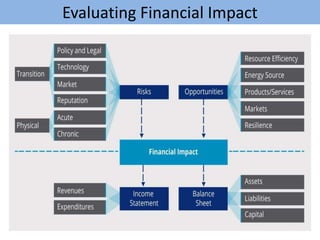
Evaluating Financial Impact
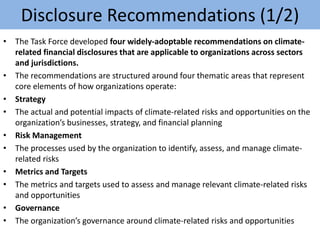
Disclosure Recommendations (1/2)
• The Task Force developed four widely-adoptable recommendations on climate-
related financial disclosures that are applicable to organizations across sectors
and jurisdictions.
• The recommendations are structured around four thematic areas that represent
core elements of how organizations operate:
• Strategy
• The actual and potential impacts of climate-related risks and opportunities on the
organization’s businesses, strategy, and financial planning
• Risk Management
• The processes used by the organization to identify, assess, and manage climate-
related risks
• Metrics and Targets
• The metrics and targets used to assess and manage relevant climate-related risks
and opportunities
• Governance
• The organization’s governance around climate-related risks and opportunities
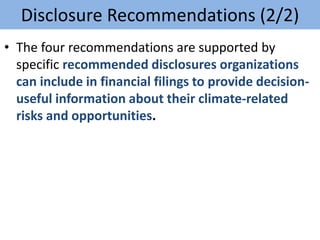
• The four recommendations are supported by
specific recommended disclosures organizations
can include in financial filings to provide decision-
useful information about their climate-related
risks and opportunities.
Disclosure Recommendations (2/2)
Recommendations and Supporting
Recommended Disclosures
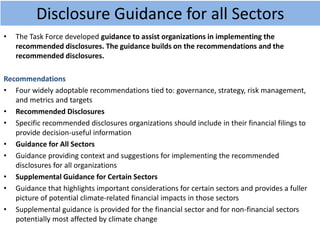
Disclosure Guidance for all Sectors
• The Task Force developed guidance to assist organizations in implementing the
recommended disclosures. The guidance builds on the recommendations and the
recommended disclosures.
Recommendations
• Four widely adoptable recommendations tied to: governance, strategy, risk management,
and metrics and targets
• Recommended Disclosures
• Specific recommended disclosures organizations should include in their financial filings to
provide decision-useful information
• Guidance for All Sectors
• Guidance providing context and suggestions for implementing the recommended
disclosures for all organizations
• Supplemental Guidance for Certain Sectors
• Guidance that highlights important considerations for certain sectors and provides a fuller
picture of potential climate-related financial impacts in those sectors
• Supplemental guidance is provided for the financial sector and for non-financial sectors
potentially most affected by climate change
Implementation Time-Frame
• How soon do companies have to start thinking about the
recommendations:
• The TCFD has proposed a five year time from 2017 over which
voluntary disclosures will become increasingly sophisticated
• Work which companies have done on environmental and
sustainability reporting will be relevant to the Disclosure
requirements.
• The TCFD takes the view of the investor and looks at the
effect of climate change on the business of the company.
Conclusion
• The benefit of adopting and understanding climate related
opportunities and risk will depend on the exposure of the
business model to climate change impact e.g. fossil fuel.
• Companies can find the TCFD final recommendations and
guidance report on TCFD website --- www.fsb-tcfd.org and
this is provided alongside an annex on implementation
• The TCFD recommendations and guidance will evolve into
board level strategic tool to implement and communicate
how the business will manage its climate financial risk and
opportunities.
• Assistance may also be sought from the Carbon Trust – visit
www.carbontrust.com/tcfd.
Update
• The TCFD Framework is not mandatory but
since the report issued by the Financial
Reporting Council (FRC) in 2020 on Climate
Thematic we are moving towards a Regulatory
Framework.
• The IASB Foundation has also established the
Sustainability Standards Board with increasing
focus on climate change

Climate Change - New Corporate Reporting Presentation - 16th June 2021

  • 1.
    Climate Change –New Corporate Reporting Recommendations Presentation By Mr Raymond M Davies
  • 2.
    ESG • ESG refersto Environmental, Social and Governance, to which businesses now need to pay particular regard • Environmental conservation and sustainability including climate change • Social-stakeholder relationships including human rights, diversity , working conditions • Governance – way in which the business is directed and controlled.
  • 3.
    Background to theTCFD • The Financial Stability Board established the Task Force on Climate-related Financial Disclosures (TCFD) in December 2015 • The Task Force comprised of 32 international members from the Financial and non-Financial sectors with the remit to provide more informed Disclosures on Climate Change to enable stakeholders to better understand the concentrations
  • 4.
    Three Problems-One Solution •Issuers have an obligation under existing law to disclose all material risks but lack a coherent framework for Climate- related Risk. • Lenders, insurers and investors need decision- useful climate related risk information. • Regulators need to understand the risks that may be building up in the Financial Systems.
  • 5.
    The Task Force’sRecommendations and Guidance: ‒Can apply to any company in the world and can be scaled to any level of sophistication ‒Should be addressed in financial filings ‒Are designed to solicit decision-useful information for investors and others ‒Encourage forward-looking information through scenario analysis ‒Provide additional guidance to sectors and industries most impacted by climate change ‒Apply to organizations across the financial sector to address the full investment chain ‒Place greater emphasis on risks and opportunities related to the transition to a lower-carbon economy ‒Represent consensus of Task Force members, who come from the financial sector and various non-financial sectors Task Force Recommendations
  • 6.
  • 7.
    Disclosure Recommendations (1/2) •The Task Force developed four widely-adoptable recommendations on climate- related financial disclosures that are applicable to organizations across sectors and jurisdictions. • The recommendations are structured around four thematic areas that represent core elements of how organizations operate: • Strategy • The actual and potential impacts of climate-related risks and opportunities on the organization’s businesses, strategy, and financial planning • Risk Management • The processes used by the organization to identify, assess, and manage climate- related risks • Metrics and Targets • The metrics and targets used to assess and manage relevant climate-related risks and opportunities • Governance • The organization’s governance around climate-related risks and opportunities
  • 8.
    • The fourrecommendations are supported by specific recommended disclosures organizations can include in financial filings to provide decision- useful information about their climate-related risks and opportunities. Disclosure Recommendations (2/2)
  • 9.
  • 10.
    Disclosure Guidance forall Sectors • The Task Force developed guidance to assist organizations in implementing the recommended disclosures. The guidance builds on the recommendations and the recommended disclosures. Recommendations • Four widely adoptable recommendations tied to: governance, strategy, risk management, and metrics and targets • Recommended Disclosures • Specific recommended disclosures organizations should include in their financial filings to provide decision-useful information • Guidance for All Sectors • Guidance providing context and suggestions for implementing the recommended disclosures for all organizations • Supplemental Guidance for Certain Sectors • Guidance that highlights important considerations for certain sectors and provides a fuller picture of potential climate-related financial impacts in those sectors • Supplemental guidance is provided for the financial sector and for non-financial sectors potentially most affected by climate change
  • 11.
    Implementation Time-Frame • Howsoon do companies have to start thinking about the recommendations: • The TCFD has proposed a five year time from 2017 over which voluntary disclosures will become increasingly sophisticated • Work which companies have done on environmental and sustainability reporting will be relevant to the Disclosure requirements. • The TCFD takes the view of the investor and looks at the effect of climate change on the business of the company.
  • 12.
    Conclusion • The benefitof adopting and understanding climate related opportunities and risk will depend on the exposure of the business model to climate change impact e.g. fossil fuel. • Companies can find the TCFD final recommendations and guidance report on TCFD website --- www.fsb-tcfd.org and this is provided alongside an annex on implementation • The TCFD recommendations and guidance will evolve into board level strategic tool to implement and communicate how the business will manage its climate financial risk and opportunities. • Assistance may also be sought from the Carbon Trust – visit www.carbontrust.com/tcfd.
  • 13.
    Update • The TCFDFramework is not mandatory but since the report issued by the Financial Reporting Council (FRC) in 2020 on Climate Thematic we are moving towards a Regulatory Framework. • The IASB Foundation has also established the Sustainability Standards Board with increasing focus on climate change

Editor's Notes

  • #6  The Subject of Climate Change is an ESG topic, and ESG is very paramount these days in company report