Long Term and Short Term
Projection of Climate Change on
Crop Pest Interaction
Introduction
Changes in climate may trigger changes in-
Geographical distribution,
Increased overwintering,
Changes in population growth rates,
Increases in the number of generations,
Changes in crop-pest synchrony,
Changes in interspecific interactions,
Pest biotypes,
Activity and abundance of natural enemies,
Species extinction,
Increased risk of invasion by migrant pests and efficacy of
crop protection technologies
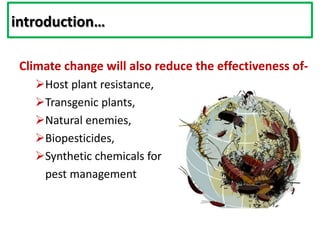
Climate change will also reduce the effectiveness of-
Host plant resistance,
Transgenic plants,
Natural enemies,
Biopesticides,
Synthetic chemicals for
pest management
introduction…
Higher temperatures and longer growing seasons
could result in increased pest population
Pest infestations often corresponds with changes in
climatic conditions
Such as early or late rains, drought, or increases in
humidity, which can reduce yields
Climate change have increased pesticide use due to
presence of diseases and pests
A 2.4 to 2.7-fold increase in pesticide use by 2050
introduction…
 Insects are poikilothermic animals
A poikilotherm : Is an organism whose internal
temperature varies considerably
 They are highly sensitive to their surrounding climate
particularly the temperature
introduction…
Increased temperature
 Insects are stenotherms (cold-blooded), sensitive to
temperature
 Higher temperature increase rates of development and
with less time between generations
20C temperature increase insects experience one to five
additional life cycles per season
Eg. Cabbage maggot, Onion maggot, European corn
borer, Colorado potato beetle
 Warmer winters -
Reduce winterkill and consequently induce increased insect
populations
It cause delay in onset and early summer may lead to faster
termination of diapauses in insects
 Reproductive rate-
 Rising temperatures will lengthen the breeding season and
increase the reproductive rate
 raise the total number of insects attacking a crop and
subsequently increase crop losses
increased temperature…
Natural enemy
 Parasitoids depend on a series of adaptations to
the ecology and physiology of their hosts
 According to a survey of over 1700 species, 50% of these
wild species are already affected
 Even a mid-range climate warming scenario predicts that
15% to 37% of the species may become extinct by 2050
 Parasitism could be reduced if host populations emerge
and pass through vulnerable life stages before
parasitoids emerge
 The tritrophic interactions between plants, herbivorous
insects, and their natural enemies (predators,
parasitoids, and pathogens)
 Coevolutionary process specific to a particular
environment and relatively stable climatic conditions
natural enemy…
These tritrophic interactions are affected by
climatic changes in diverse ways
natural enemy…
Effect of Changing Precipitation on
Insects
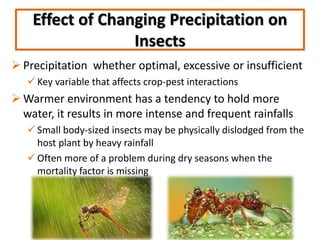
 Precipitation whether optimal, excessive or insufficient
 Key variable that affects crop-pest interactions
 Warmer environment has a tendency to hold more
water, it results in more intense and frequent rainfalls
 Small body-sized insects may be physically dislodged from the
host plant by heavy rainfall
 Often more of a problem during dry seasons when the
mortality factor is missing
 Drought stress sometimes brings increased insect pest
outbreaks
 Drought can change the physiology of host species,
leading to changes in the insects that feed on them
 Cool, wet conditions can also bring on severe insect
infestations, although excessive soil moisture may
drown out soil-residing insects
precipitation on insects…
Increase in the frequency of flooding of fields
could tend to suppress some soil dwelling
insect populations
Eg. cranberry fruit worm and other cranberry
insect pests
precipitation on insects…
 Most fungi which are known to cause various diseases in
insects (entomopathogens)
 Fungal pathogens of insects are favoured by high
humidity
 Lengthen periods of high humidity and reducing insect
pest populations
Eg. Wet northern California
winter, the fungal pathogen
(Pandora neoaphidis) causes
catastrophic mortality
to pea aphid
precipitation on insects…
CO2 would increase canopy size and density of
plants
Produce high biomass and microclimates may
become more conducive for foliar pathogens
Eg. Rusts, Mildews, Leaf spots and Blights
Effect of Rising CO2 on Insects
 Insect pests could occur through indirect effects on host
biochemical composition
i.e. Increased simple sugars in the leaves
 Greenhouse and lab studies have shown that high CO2
atmosphere increase C:N ratio
Insects respond to this ratio by increasing their feeding in
order to fulfill their metabolic needs for nitrogen
effect of rising co2 on insects…
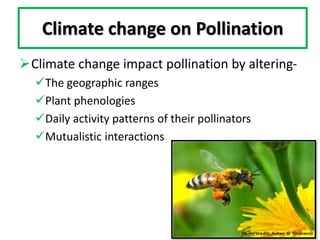
Climate change on Pollination
Climate change impact pollination by altering-
The geographic ranges
Plant phenologies
Daily activity patterns of their pollinators
Mutualistic interactions
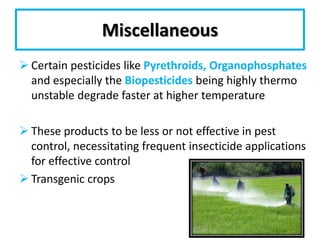
Miscellaneous
 Certain pesticides like Pyrethroids, Organophosphates
and especially the Biopesticides being highly thermo
unstable degrade faster at higher temperature
 These products to be less or not effective in pest
control, necessitating frequent insecticide applications
for effective control
 Transgenic crops
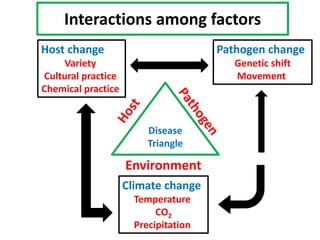
Interactions among factors
Disease
Triangle
Environment
Climate change
Temperature
CO2
Precipitation
Pathogen change
Genetic shift
Movement
Host change
Variety
Cultural practice
Chemical practice
THANK YOU...
Climate change and pest interaction

Climate change and pest interaction

  • 1.
    Long Term andShort Term Projection of Climate Change on Crop Pest Interaction
  • 2.
    Introduction Changes in climatemay trigger changes in- Geographical distribution, Increased overwintering, Changes in population growth rates, Increases in the number of generations, Changes in crop-pest synchrony, Changes in interspecific interactions, Pest biotypes, Activity and abundance of natural enemies, Species extinction, Increased risk of invasion by migrant pests and efficacy of crop protection technologies
  • 3.
    Climate change willalso reduce the effectiveness of- Host plant resistance, Transgenic plants, Natural enemies, Biopesticides, Synthetic chemicals for pest management introduction…
  • 4.
    Higher temperatures andlonger growing seasons could result in increased pest population Pest infestations often corresponds with changes in climatic conditions Such as early or late rains, drought, or increases in humidity, which can reduce yields Climate change have increased pesticide use due to presence of diseases and pests A 2.4 to 2.7-fold increase in pesticide use by 2050 introduction…
  • 5.
     Insects arepoikilothermic animals A poikilotherm : Is an organism whose internal temperature varies considerably  They are highly sensitive to their surrounding climate particularly the temperature introduction…
  • 6.
    Increased temperature  Insectsare stenotherms (cold-blooded), sensitive to temperature  Higher temperature increase rates of development and with less time between generations 20C temperature increase insects experience one to five additional life cycles per season Eg. Cabbage maggot, Onion maggot, European corn borer, Colorado potato beetle
  • 7.
     Warmer winters- Reduce winterkill and consequently induce increased insect populations It cause delay in onset and early summer may lead to faster termination of diapauses in insects  Reproductive rate-  Rising temperatures will lengthen the breeding season and increase the reproductive rate  raise the total number of insects attacking a crop and subsequently increase crop losses increased temperature…
  • 8.
    Natural enemy  Parasitoidsdepend on a series of adaptations to the ecology and physiology of their hosts  According to a survey of over 1700 species, 50% of these wild species are already affected  Even a mid-range climate warming scenario predicts that 15% to 37% of the species may become extinct by 2050
  • 9.
     Parasitism couldbe reduced if host populations emerge and pass through vulnerable life stages before parasitoids emerge  The tritrophic interactions between plants, herbivorous insects, and their natural enemies (predators, parasitoids, and pathogens)  Coevolutionary process specific to a particular environment and relatively stable climatic conditions natural enemy…
  • 10.
    These tritrophic interactionsare affected by climatic changes in diverse ways natural enemy…
  • 11.
    Effect of ChangingPrecipitation on Insects  Precipitation whether optimal, excessive or insufficient  Key variable that affects crop-pest interactions  Warmer environment has a tendency to hold more water, it results in more intense and frequent rainfalls  Small body-sized insects may be physically dislodged from the host plant by heavy rainfall  Often more of a problem during dry seasons when the mortality factor is missing
  • 12.
     Drought stresssometimes brings increased insect pest outbreaks  Drought can change the physiology of host species, leading to changes in the insects that feed on them  Cool, wet conditions can also bring on severe insect infestations, although excessive soil moisture may drown out soil-residing insects precipitation on insects…
  • 13.
    Increase in thefrequency of flooding of fields could tend to suppress some soil dwelling insect populations Eg. cranberry fruit worm and other cranberry insect pests precipitation on insects…
  • 14.
     Most fungiwhich are known to cause various diseases in insects (entomopathogens)  Fungal pathogens of insects are favoured by high humidity  Lengthen periods of high humidity and reducing insect pest populations Eg. Wet northern California winter, the fungal pathogen (Pandora neoaphidis) causes catastrophic mortality to pea aphid precipitation on insects…
  • 15.
    CO2 would increasecanopy size and density of plants Produce high biomass and microclimates may become more conducive for foliar pathogens Eg. Rusts, Mildews, Leaf spots and Blights Effect of Rising CO2 on Insects
  • 16.
     Insect pestscould occur through indirect effects on host biochemical composition i.e. Increased simple sugars in the leaves  Greenhouse and lab studies have shown that high CO2 atmosphere increase C:N ratio Insects respond to this ratio by increasing their feeding in order to fulfill their metabolic needs for nitrogen effect of rising co2 on insects…
  • 17.
    Climate change onPollination Climate change impact pollination by altering- The geographic ranges Plant phenologies Daily activity patterns of their pollinators Mutualistic interactions
  • 18.
    Miscellaneous  Certain pesticideslike Pyrethroids, Organophosphates and especially the Biopesticides being highly thermo unstable degrade faster at higher temperature  These products to be less or not effective in pest control, necessitating frequent insecticide applications for effective control  Transgenic crops
  • 19.
    Interactions among factors Disease Triangle Environment Climatechange Temperature CO2 Precipitation Pathogen change Genetic shift Movement Host change Variety Cultural practice Chemical practice
  • 20.