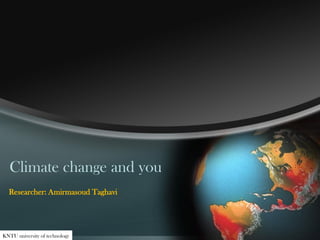
Climate change and you
Researcher: Amirmasoud Taghavi
KNTU university of technology
First of all, you should
know that weather and
climate are not the
same thing.
KNTU university of technology
Weather
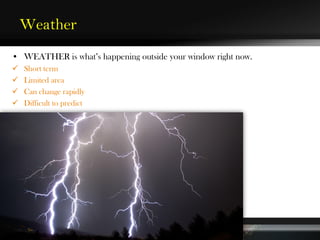
• WEATHER is what’s happening outside your window right now.
 Short term
 Limited area
 Can change rapidly
 Difficult to predict
Climate
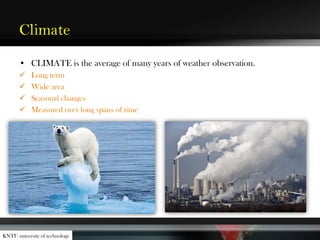
• CLIMATE is the average of many years of weather observation.
 Long term
 Wide area
 Seasonal changes
 Measured over long spans of time
KNTU university of technology
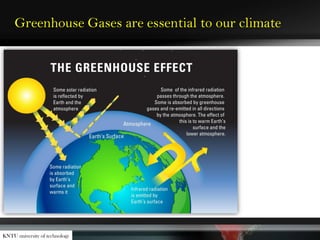
Greenhouse Gases are essential to our climate
KNTU university of technology
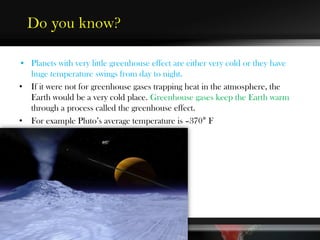
• Planets with very little greenhouse effect are either very cold or they have
huge temperature swings from day to night.
• If it were not for greenhouse gases trapping heat in the atmosphere, the
Earth would be a very cold place. Greenhouse gases keep the Earth warm
through a process called the greenhouse effect.
• For example Pluto’s average temperature is –370° F
Do you know?
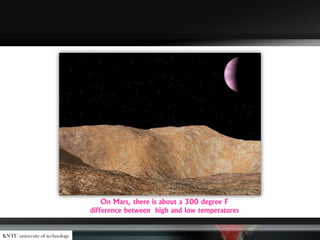
On Mars, there is about a 300 degree F
difference between high and low temperatures
KNTU university of technology
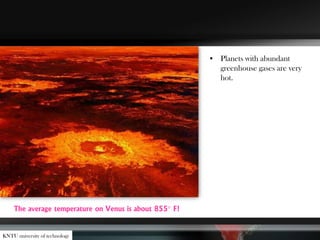
• Planets with abundant
greenhouse gases are very
hot.
The average temperature on Venus is about 855° F!
KNTU university of technology
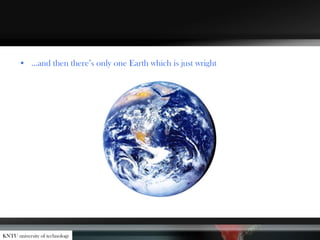
• …and then there’s only one Earth which is just wright
KNTU university of technology
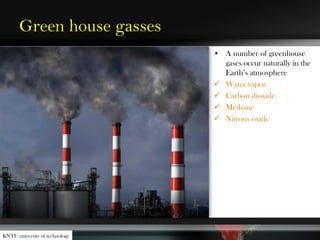
Green house gasses
• A number of greenhouse
gases occur naturally in the
Earth’s atmosphere
 Water vapor
 Carbon dioxide
 Methane
 Nitrous oxide
KNTU university of technology
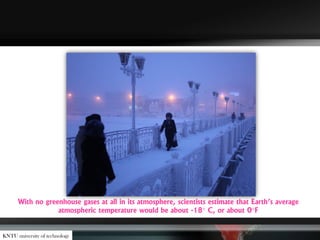
With no greenhouse gases at all in its atmosphere, scientists estimate that Earth’s average
atmospheric temperature would be about -18° C, or about 0°F
KNTU university of technology
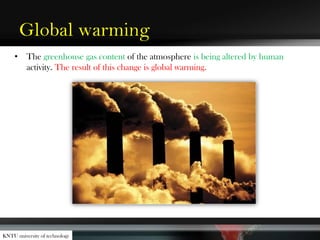
Global warming
• The greenhouse gas content of the atmosphere is being altered by human
activity. The result of this change is global warming.
KNTU university of technology
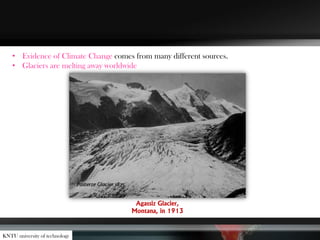
• Evidence of Climate Change comes from many different sources.
• Glaciers are melting away worldwide
Agassiz Glacier,
Montana, in 1913
KNTU university of technology
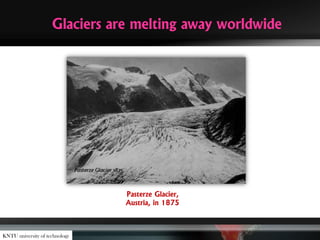
Pasterze Glacier,
Austria, in 1875
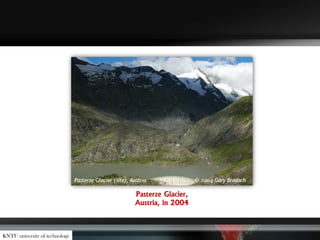
Glaciers are melting away worldwide
KNTU university of technology
Pasterze Glacier,
Austria, in 2004
KNTU university of technology
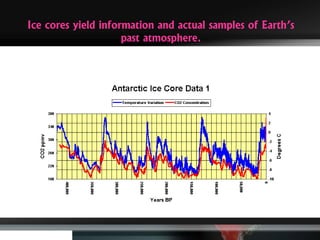
Ice cores yield information and actual samples of Earth’s
past atmosphere.
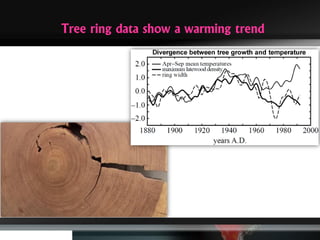
Tree ring data show a warming trend
Animal and plant life is changing
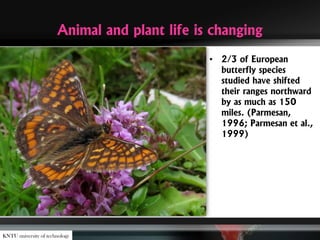
• 2/3 of European
butterfly species
studied have shifted
their ranges northward
by as much as 150
miles. (Parmesan,
1996; Parmesan et al.,
1999)
KNTU university of technology
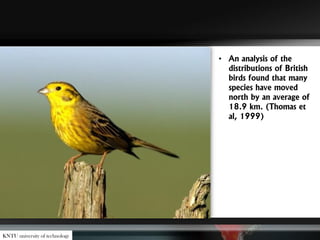
• An analysis of the
distributions of British
birds found that many
species have moved
north by an average of
18.9 km. (Thomas et
al, 1999)
KNTU university of technology
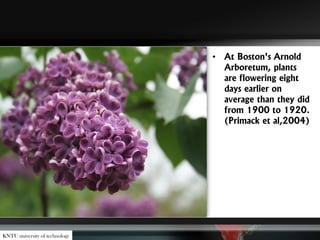
• At Boston's Arnold
Arboretum, plants
are flowering eight
days earlier on
average than they did
from 1900 to 1920.
(Primack et al,2004)
KNTU university of technology
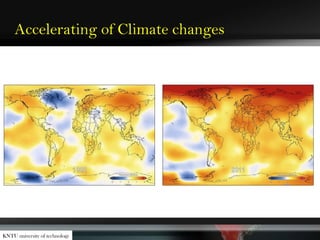
Accelerating of Climate changes
KNTU university of technology
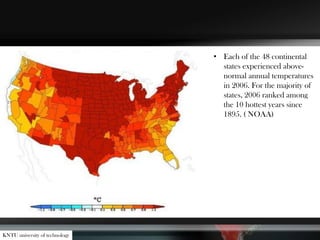
• Each of the 48 continental
states experienced above-
normal annual temperatures
in 2006. For the majority of
states, 2006 ranked among
the 10 hottest years since
1895. ( NOAA)
KNTU university of technology
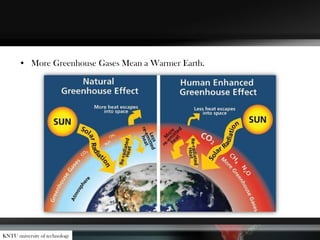
• More Greenhouse Gases Mean a Warmer Earth.
KNTU university of technology
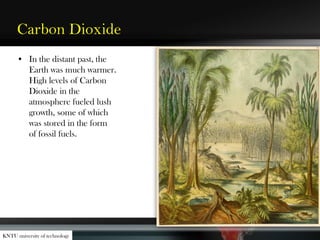
Carbon Dioxide
• In the distant past, the
Earth was much warmer.
High levels of Carbon
Dioxide in the
atmosphere fueled lush
growth, some of which
was stored in the form
of fossil fuels.
KNTU university of technology
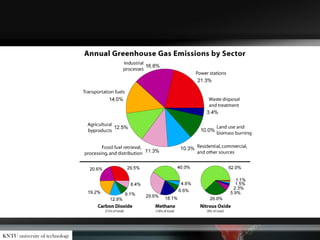
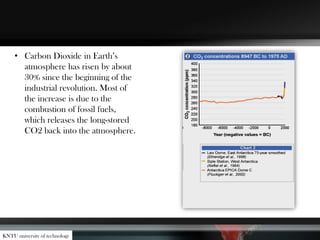
• Carbon Dioxide in Earth’s
atmosphere has risen by about
30% since the beginning of the
industrial revolution. Most of
the increase is due to the
combustion of fossil fuels,
which releases the long-stored
CO2 back into the atmosphere.
KNTU university of technology
Methane
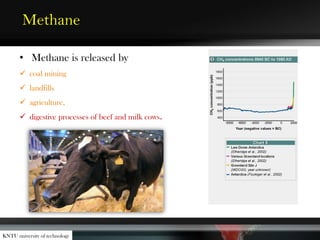
• Methane is released by
 coal mining
 landfills
 agriculture,
 digestive processes of beef and milk cows.
KNTU university of technology
What can be done?
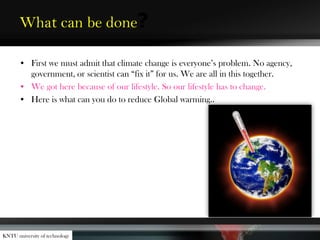
• First we must admit that climate change is everyone’s problem. No agency,
government, or scientist can “fix it” for us. We are all in this together.
• We got here because of our lifestyle. So our lifestyle has to change.
• Here is what can you do to reduce Global warming..
KNTU university of technology
Heating and Cooling
 Install programmable thermostats.
 Check and repair weather stripping on doors and windows.
 Adjust your clothing instead of the thermostat.
 Keep furnace and AC filters clean.
 Consider closing off unused rooms.
 Install insulated drapes.
 Plant deciduous trees on the sunny side of your home.
 …
KNTU university of technology
Conserve Hot Water
• In the average home, 17% of energy is used to heat water.
 Take shorter showers.
 Install low flow shower heads.
 Install a blanket on your hot water heater.
 Insulate hot water pipes.
 Wash laundry in cold water.
 Only run the dishwasher if it’s full.
 Fix leaky faucets
 …
KNTU university of technology
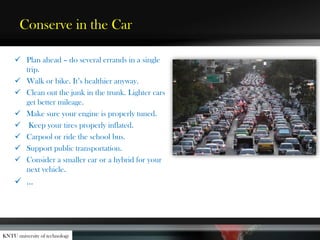
Conserve in the Car
 Plan ahead – do several errands in a single
trip.
 Walk or bike. It’s healthier anyway.
 Clean out the junk in the trunk. Lighter cars
get better mileage.
 Make sure your engine is properly tuned.
 Keep your tires properly inflated.
 Carpool or ride the school bus.
 Support public transportation.
 Consider a smaller car or a hybrid for your
next vehicle.
 …
KNTU university of technology
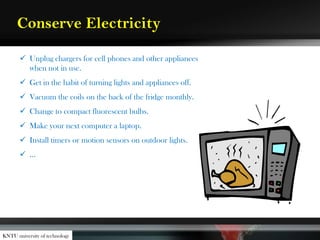
Conserve Electricity
 Unplug chargers for cell phones and other appliances
when not in use.
 Get in the habit of turning lights and appliances off.
 Vacuum the coils on the back of the fridge monthly.
 Change to compact fluorescent bulbs.
 Make your next computer a laptop.
 Install timers or motion sensors on outdoor lights.
 …
KNTU university of technology
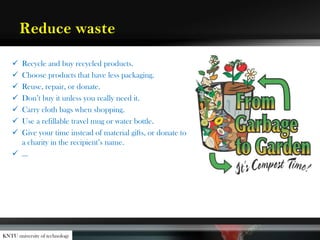
Reduce waste
 Recycle and buy recycled products.
 Choose products that have less packaging.
 Reuse, repair, or donate.
 Don’t buy it unless you really need it.
 Carry cloth bags when shopping.
 Use a refillable travel mug or water bottle.
 Give your time instead of material gifts, or donate to
a charity in the recipient’s name.
 …
KNTU university of technology
There is no place like home…
…and there may never be again. Do your part.

Climate change 2

  • 1.
    Climate change andyou Researcher: Amirmasoud Taghavi KNTU university of technology
  • 2.
    First of all,you should know that weather and climate are not the same thing. KNTU university of technology
  • 3.
    Weather • WEATHER iswhat’s happening outside your window right now.  Short term  Limited area  Can change rapidly  Difficult to predict
  • 4.
    Climate • CLIMATE isthe average of many years of weather observation.  Long term  Wide area  Seasonal changes  Measured over long spans of time KNTU university of technology
  • 5.
    Greenhouse Gases areessential to our climate KNTU university of technology
  • 6.
    • Planets withvery little greenhouse effect are either very cold or they have huge temperature swings from day to night. • If it were not for greenhouse gases trapping heat in the atmosphere, the Earth would be a very cold place. Greenhouse gases keep the Earth warm through a process called the greenhouse effect. • For example Pluto’s average temperature is –370° F Do you know?
  • 7.
    On Mars, thereis about a 300 degree F difference between high and low temperatures KNTU university of technology
  • 8.
    • Planets withabundant greenhouse gases are very hot. The average temperature on Venus is about 855° F! KNTU university of technology
  • 9.
    • …and thenthere’s only one Earth which is just wright KNTU university of technology
  • 10.
    Green house gasses •A number of greenhouse gases occur naturally in the Earth’s atmosphere  Water vapor  Carbon dioxide  Methane  Nitrous oxide KNTU university of technology
  • 11.
    With no greenhousegases at all in its atmosphere, scientists estimate that Earth’s average atmospheric temperature would be about -18° C, or about 0°F KNTU university of technology
  • 12.
    Global warming • Thegreenhouse gas content of the atmosphere is being altered by human activity. The result of this change is global warming. KNTU university of technology
  • 13.
    • Evidence ofClimate Change comes from many different sources. • Glaciers are melting away worldwide Agassiz Glacier, Montana, in 1913 KNTU university of technology
  • 14.
    Pasterze Glacier, Austria, in1875 Glaciers are melting away worldwide KNTU university of technology
  • 15.
    Pasterze Glacier, Austria, in2004 KNTU university of technology
  • 16.
    Ice cores yieldinformation and actual samples of Earth’s past atmosphere.
  • 17.
    Tree ring datashow a warming trend
  • 18.
    Animal and plantlife is changing • 2/3 of European butterfly species studied have shifted their ranges northward by as much as 150 miles. (Parmesan, 1996; Parmesan et al., 1999) KNTU university of technology
  • 19.
    • An analysisof the distributions of British birds found that many species have moved north by an average of 18.9 km. (Thomas et al, 1999) KNTU university of technology
  • 20.
    • At Boston'sArnold Arboretum, plants are flowering eight days earlier on average than they did from 1900 to 1920. (Primack et al,2004) KNTU university of technology
  • 21.
    Accelerating of Climatechanges KNTU university of technology
  • 22.
    • Each ofthe 48 continental states experienced above- normal annual temperatures in 2006. For the majority of states, 2006 ranked among the 10 hottest years since 1895. ( NOAA) KNTU university of technology
  • 23.
    • More GreenhouseGases Mean a Warmer Earth. KNTU university of technology
  • 24.
  • 25.
    Carbon Dioxide • Inthe distant past, the Earth was much warmer. High levels of Carbon Dioxide in the atmosphere fueled lush growth, some of which was stored in the form of fossil fuels. KNTU university of technology
  • 26.
    • Carbon Dioxidein Earth’s atmosphere has risen by about 30% since the beginning of the industrial revolution. Most of the increase is due to the combustion of fossil fuels, which releases the long-stored CO2 back into the atmosphere. KNTU university of technology
  • 27.
    Methane • Methane isreleased by  coal mining  landfills  agriculture,  digestive processes of beef and milk cows. KNTU university of technology
  • 28.
    What can bedone? • First we must admit that climate change is everyone’s problem. No agency, government, or scientist can “fix it” for us. We are all in this together. • We got here because of our lifestyle. So our lifestyle has to change. • Here is what can you do to reduce Global warming.. KNTU university of technology
  • 29.
    Heating and Cooling Install programmable thermostats.  Check and repair weather stripping on doors and windows.  Adjust your clothing instead of the thermostat.  Keep furnace and AC filters clean.  Consider closing off unused rooms.  Install insulated drapes.  Plant deciduous trees on the sunny side of your home.  … KNTU university of technology
  • 30.
    Conserve Hot Water •In the average home, 17% of energy is used to heat water.  Take shorter showers.  Install low flow shower heads.  Install a blanket on your hot water heater.  Insulate hot water pipes.  Wash laundry in cold water.  Only run the dishwasher if it’s full.  Fix leaky faucets  … KNTU university of technology
  • 31.
    Conserve in theCar  Plan ahead – do several errands in a single trip.  Walk or bike. It’s healthier anyway.  Clean out the junk in the trunk. Lighter cars get better mileage.  Make sure your engine is properly tuned.  Keep your tires properly inflated.  Carpool or ride the school bus.  Support public transportation.  Consider a smaller car or a hybrid for your next vehicle.  … KNTU university of technology
  • 32.
    Conserve Electricity  Unplugchargers for cell phones and other appliances when not in use.  Get in the habit of turning lights and appliances off.  Vacuum the coils on the back of the fridge monthly.  Change to compact fluorescent bulbs.  Make your next computer a laptop.  Install timers or motion sensors on outdoor lights.  … KNTU university of technology
  • 33.
    Reduce waste  Recycleand buy recycled products.  Choose products that have less packaging.  Reuse, repair, or donate.  Don’t buy it unless you really need it.  Carry cloth bags when shopping.  Use a refillable travel mug or water bottle.  Give your time instead of material gifts, or donate to a charity in the recipient’s name.  … KNTU university of technology
  • 34.
    There is noplace like home… …and there may never be again. Do your part.