Client Training:
Understanding Source Deduction
WHO WE ARE
CPA4IT BACKGROUND
Chartered
Accountants
for
Information
Technologists
ISO 9001
Registered
Specializing in
Independent
Contractors
Since 1984
WHAT ARE PAYROLL/
SOURCE DEDUCTIONS
As an employer, you
have to remit the CPP
contributions, the EI
premiums, and
income tax deducted
from your employees'
income, along with
your share of CPP
contributions and EI
premiums.
Remittances are
deemed to have been
made on the day on
which it is received by
the Receiver General,
and as such, you
should choose the
appropriate remittance
method to meet your
due date.
These deductions,
along with your
remittance form, must
be received by CRA
on or before your
remittance due dates.
Due dates vary
depending on the type
of remitter you are.
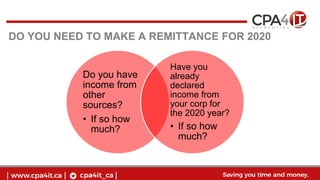
DO YOU NEED TO MAKE A REMITTANCE FOR 2020
Do you have
income from
other
sources?
• If so how
much?
Have you
already
declared
income from
your corp for
the 2020 year?
• If so how
much?
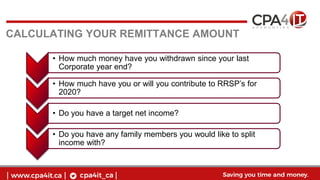
CALCULATING YOUR REMITTANCE AMOUNT
• How much money have you withdrawn since your last
Corporate year end?
• How much have you or will you contribute to RRSP’s for
2020?
• Do you have a target net income?
• Do you have any family members you would like to split
income with?
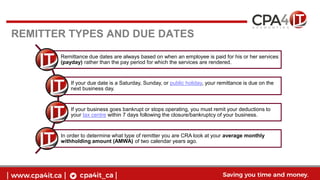
REMITTER TYPES AND DUE DATES
Remittance due dates are always based on when an employee is paid for his or her services
(payday) rather than the pay period for which the services are rendered.
If your due date is a Saturday, Sunday, or public holiday, your remittance is due on the
next business day.
If your business goes bankrupt or stops operating, you must remit your deductions to
your tax centre within 7 days following the closure/bankruptcy of your business.
In order to determine what type of remitter you are CRA look at your average monthly
withholding amount (AMWA) of two calendar years ago.
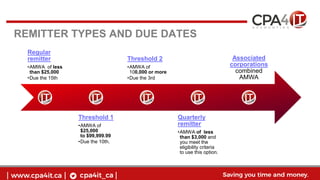
REMITTER TYPES AND DUE DATES
Regular
remitter
•AMWA of less
than $25,000
•Due the 15th
Threshold 1
•AMWA of
$25,000
to $99,999.99
•Due the 10th.
Threshold 2
•AMWA of
100,000 or more
•Due the 3rd
Quarterly
remitter
•AMWA of less
than $3,000 and
you meet the
eligibility criteria
to use this option.
Associated
corporations
combined
AMWA
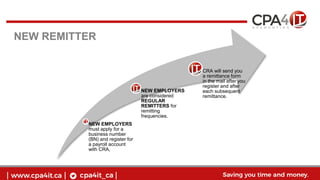
NEW REMITTER
NEW EMPLOYERS
must apply for a
business number
(BN) and register for
a payroll account
with CRA,
NEW EMPLOYERS
are considered
REGULAR
REMITTERS for
remitting
frequencies.
CRA will send you
a remittance form
in the mail after you
register and after
each subsequent
remittance.
REMITTANCE METHODS
• Online banking – instructions and links to your financial institution
• My Payment – pay now with Visa Debit, Debit MasterCard, or Interac Online
• Pre-authorized debit – instructions and links to set up a future-dated payment
• Pay by credit card, PayPal, or Interac e-Transfer Credit card, PayPal
or Interac e-Transfer
• Pay using a service provider Various third-party service providers
• Pay without a Canadian bank account Pay without a Canadian bank
account - using wire transfer or internationally issued credit card
• Pay by cheque Pay by cheque
• Pay in person
• Financial institution
• Canada Post outlet
REMITTANCE FORMS
The remittance
forms CRA sends
you are
personalized to help
you in identifying
your remittance to
your appropriate
payroll deduction
account.
Complete your
remittance voucher
(the bottom part of
the remittance form)
correctly so CRA
can apply your
remittance to your
account.
If you receive a
notice of
assessment that
states you have an
amount owing, use
only the remittance
form attached to the
notice to make that
payment.
Only use Forms
PD7A, PD7A(TM),
and PD7A-RB for
current remittances
of CPP, EI, and
income tax.
NOT MAKING A REMITTANCE
Online
TeleReply
By mail
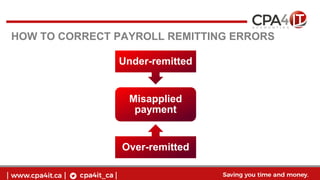
HOW TO CORRECT PAYROLL REMITTING ERRORS
Under-remitted
Misapplied
payment
Over-remitted
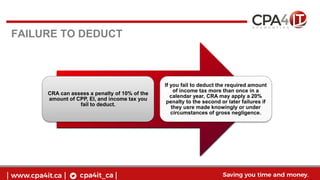
FAILURE TO DEDUCT
CRA can assess a penalty of 10% of the
amount of CPP, EI, and income tax you
fail to deduct.
If you fail to deduct the required amount
of income tax more than once in a
calendar year, CRA may apply a 20%
penalty to the second or later failures if
they usre made knowingly or under
circumstances of gross negligence.
Contact your local CA4IT representative, or visit www.CA4IT.com for more
information
Phone: 1-800-465-7532
Email: CustomerService@CPA4IT.ca
FOLLOW UP

Client training source deductions - 2020

  • 1.
  • 2.
    WHO WE ARE CPA4ITBACKGROUND Chartered Accountants for Information Technologists ISO 9001 Registered Specializing in Independent Contractors Since 1984
  • 3.
    WHAT ARE PAYROLL/ SOURCEDEDUCTIONS As an employer, you have to remit the CPP contributions, the EI premiums, and income tax deducted from your employees' income, along with your share of CPP contributions and EI premiums. Remittances are deemed to have been made on the day on which it is received by the Receiver General, and as such, you should choose the appropriate remittance method to meet your due date. These deductions, along with your remittance form, must be received by CRA on or before your remittance due dates. Due dates vary depending on the type of remitter you are.
  • 4.
    DO YOU NEEDTO MAKE A REMITTANCE FOR 2020 Do you have income from other sources? • If so how much? Have you already declared income from your corp for the 2020 year? • If so how much?
  • 5.
    CALCULATING YOUR REMITTANCEAMOUNT • How much money have you withdrawn since your last Corporate year end? • How much have you or will you contribute to RRSP’s for 2020? • Do you have a target net income? • Do you have any family members you would like to split income with?
  • 6.
    REMITTER TYPES ANDDUE DATES Remittance due dates are always based on when an employee is paid for his or her services (payday) rather than the pay period for which the services are rendered. If your due date is a Saturday, Sunday, or public holiday, your remittance is due on the next business day. If your business goes bankrupt or stops operating, you must remit your deductions to your tax centre within 7 days following the closure/bankruptcy of your business. In order to determine what type of remitter you are CRA look at your average monthly withholding amount (AMWA) of two calendar years ago.
  • 7.
    REMITTER TYPES ANDDUE DATES Regular remitter •AMWA of less than $25,000 •Due the 15th Threshold 1 •AMWA of $25,000 to $99,999.99 •Due the 10th. Threshold 2 •AMWA of 100,000 or more •Due the 3rd Quarterly remitter •AMWA of less than $3,000 and you meet the eligibility criteria to use this option. Associated corporations combined AMWA
  • 8.
    NEW REMITTER NEW EMPLOYERS mustapply for a business number (BN) and register for a payroll account with CRA, NEW EMPLOYERS are considered REGULAR REMITTERS for remitting frequencies. CRA will send you a remittance form in the mail after you register and after each subsequent remittance.
  • 9.
    REMITTANCE METHODS • Onlinebanking – instructions and links to your financial institution • My Payment – pay now with Visa Debit, Debit MasterCard, or Interac Online • Pre-authorized debit – instructions and links to set up a future-dated payment • Pay by credit card, PayPal, or Interac e-Transfer Credit card, PayPal or Interac e-Transfer • Pay using a service provider Various third-party service providers • Pay without a Canadian bank account Pay without a Canadian bank account - using wire transfer or internationally issued credit card • Pay by cheque Pay by cheque • Pay in person • Financial institution • Canada Post outlet
  • 10.
    REMITTANCE FORMS The remittance formsCRA sends you are personalized to help you in identifying your remittance to your appropriate payroll deduction account. Complete your remittance voucher (the bottom part of the remittance form) correctly so CRA can apply your remittance to your account. If you receive a notice of assessment that states you have an amount owing, use only the remittance form attached to the notice to make that payment. Only use Forms PD7A, PD7A(TM), and PD7A-RB for current remittances of CPP, EI, and income tax.
  • 11.
    NOT MAKING AREMITTANCE Online TeleReply By mail
  • 12.
    HOW TO CORRECTPAYROLL REMITTING ERRORS Under-remitted Misapplied payment Over-remitted
  • 13.
    FAILURE TO DEDUCT CRAcan assess a penalty of 10% of the amount of CPP, EI, and income tax you fail to deduct. If you fail to deduct the required amount of income tax more than once in a calendar year, CRA may apply a 20% penalty to the second or later failures if they usre made knowingly or under circumstances of gross negligence.
  • 14.
    Contact your localCA4IT representative, or visit www.CA4IT.com for more information Phone: 1-800-465-7532 Email: CustomerService@CPA4IT.ca FOLLOW UP