LEARNING OUTCOME 2
Maintain kitchen tools,
equipment and working
area
CLEANING AND SANITIZING
Cleaning is the process of
removing food and other
types of soil from a surface,
such as a dish, glass, or
cutting board.
Cleaning agents are divided into four categories:
1. Detergents – Use detergents to routinely wash tableware, surfaces, and equipment.
Detergents can penetrate soil quickly and soften it. Examples include dishwashing
detergent and automatic dishwasher detergents.
2. Solvent cleaners – Use periodically on
surfaces where grease has burned on.
Solvent cleaners are often called
degreasers.
3. Acid cleaners -- Use periodically on
mineral deposits and other soils that
detergents
cannot remove. These cleaners are often
used to remove scale in ware washing
machines and steam tables.
4. Abrasive cleaners -- Use these cleaners
to remove heavy accumulations of soil that
are difficult to remove with detergents.
Some abrasive cleaners also disinfect.
Sanitizing is done using heat, radiation, or
chemicals. Heat and chemicals are
commonly used as a method for sanitizing in
a restaurant; radiation rarely is.
Sanitizing Methods
1. Heat-There are three methods of using heat
to sanitize surfaces – steam, hot water,
and hot air.
2. Chemicals. Chemicals that are approved
sanitizers are chlorine, iodine, and
quaternary ammonium.
Different factors influence the effectiveness of chemical
sanitizers. The three factors that must be considered are:
 Concentration -- The presence of too little sanitizer will result
in an inadequate
reduction of harmful microorganisms. Too much can be toxic.
 Temperature -- Generally chemical sanitizers work best in
water that is between
55oF(13oC) and 120oF (49oC).
 Contact time -- In order for the sanitizer to kill harmful
microorganisms, the
cleaned item must be in contact with the sanitizer (either heat or
approved
chemical) for the recommended length of time.
Sanitizer Testing Every restaurant must have the
appropriate testing kit to measure chemical
sanitizer concentrations. To accurately test the
strength of a sanitizing solution, one must first
determine which chemical is being used --
chlorine, iodine, or quaternary ammonium. Test
kits are not interchangeable so check with your
chemical supplier to be certain that you are
COMMERCIAL COOKING 19 K to 12 – Technology
and Livelihood Education using the correct kit.
The appropriate test kit must then be used
throughout the day to measure chemical
sanitizer concentrations.
1 whole sheet of pad
paper
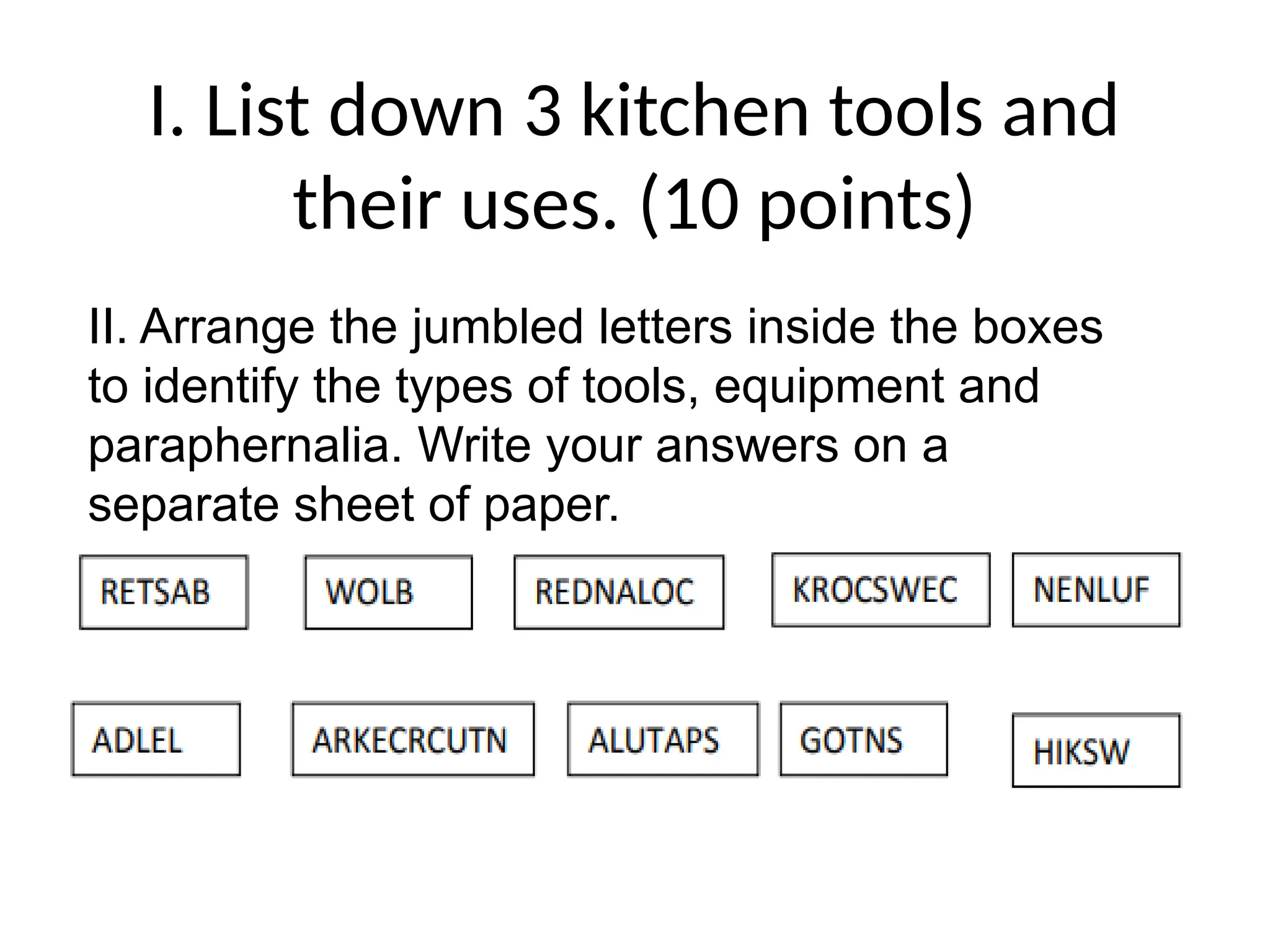
I. List down 3 kitchen tools and
their uses. (10 points)
II. Arrange the jumbled letters inside the boxes
to identify the types of tools, equipment and
paraphernalia. Write your answers on a
separate sheet of paper.
III.IDENTIFICATION
1.__________________ is a kitchen tool which is specifically
designed for the purpose of pulping garlic for cooking.
2. __________________ used to grate, shred, slice and separate
foods such as carrots, cabbage and cheese.
3. ____________________make it easier to lift a hot roasted
turkey from the roaster to the serving platter, without it falling
apart.
4. ____________________often referred to as cook's or chef's
tools, knives are a must for all types of kitchen tasks, from
peeling an onion and slicing carrots, to carving a roast or turkey.
5. ____________________They are practical for opening food
packages, cutting tape or string to package foods or simply to
remove labels or tags from items. Other cutting tools such as box
cutters are just as handy, especially for opening packages.

Maintain kitchen tools, equipment and working areaCALCULATION AND MENSURATION.pptx

  • 1.
    LEARNING OUTCOME 2 Maintainkitchen tools, equipment and working area
  • 2.
    CLEANING AND SANITIZING Cleaningis the process of removing food and other types of soil from a surface, such as a dish, glass, or cutting board.
  • 3.
    Cleaning agents aredivided into four categories: 1. Detergents – Use detergents to routinely wash tableware, surfaces, and equipment. Detergents can penetrate soil quickly and soften it. Examples include dishwashing detergent and automatic dishwasher detergents.
  • 4.
    2. Solvent cleaners– Use periodically on surfaces where grease has burned on. Solvent cleaners are often called degreasers. 3. Acid cleaners -- Use periodically on mineral deposits and other soils that detergents cannot remove. These cleaners are often used to remove scale in ware washing machines and steam tables.
  • 5.
    4. Abrasive cleaners-- Use these cleaners to remove heavy accumulations of soil that are difficult to remove with detergents. Some abrasive cleaners also disinfect. Sanitizing is done using heat, radiation, or chemicals. Heat and chemicals are commonly used as a method for sanitizing in a restaurant; radiation rarely is.
  • 6.
    Sanitizing Methods 1. Heat-Thereare three methods of using heat to sanitize surfaces – steam, hot water, and hot air. 2. Chemicals. Chemicals that are approved sanitizers are chlorine, iodine, and quaternary ammonium.
  • 7.
    Different factors influencethe effectiveness of chemical sanitizers. The three factors that must be considered are:  Concentration -- The presence of too little sanitizer will result in an inadequate reduction of harmful microorganisms. Too much can be toxic.  Temperature -- Generally chemical sanitizers work best in water that is between 55oF(13oC) and 120oF (49oC).  Contact time -- In order for the sanitizer to kill harmful microorganisms, the cleaned item must be in contact with the sanitizer (either heat or approved chemical) for the recommended length of time.
  • 8.
    Sanitizer Testing Everyrestaurant must have the appropriate testing kit to measure chemical sanitizer concentrations. To accurately test the strength of a sanitizing solution, one must first determine which chemical is being used -- chlorine, iodine, or quaternary ammonium. Test kits are not interchangeable so check with your chemical supplier to be certain that you are COMMERCIAL COOKING 19 K to 12 – Technology and Livelihood Education using the correct kit. The appropriate test kit must then be used throughout the day to measure chemical sanitizer concentrations.
  • 10.
    1 whole sheetof pad paper
  • 11.
    I. List down3 kitchen tools and their uses. (10 points) II. Arrange the jumbled letters inside the boxes to identify the types of tools, equipment and paraphernalia. Write your answers on a separate sheet of paper.
  • 12.
    III.IDENTIFICATION 1.__________________ is akitchen tool which is specifically designed for the purpose of pulping garlic for cooking. 2. __________________ used to grate, shred, slice and separate foods such as carrots, cabbage and cheese. 3. ____________________make it easier to lift a hot roasted turkey from the roaster to the serving platter, without it falling apart. 4. ____________________often referred to as cook's or chef's tools, knives are a must for all types of kitchen tasks, from peeling an onion and slicing carrots, to carving a roast or turkey. 5. ____________________They are practical for opening food packages, cutting tape or string to package foods or simply to remove labels or tags from items. Other cutting tools such as box cutters are just as handy, especially for opening packages.